
A Nobel Peace Prize for Women
Posted: October 7, 2011 Filed under: Violence against women, Women's Rights | Tags: Ellen Johnson Sirleaf, Leymah Gbowee, Nobel Peace Prize, Tawakkul Karman 4 Comments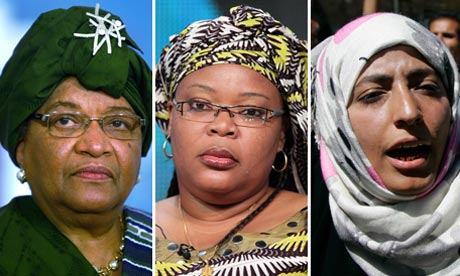
Ellen Johnson Sirleaf, Leymah Gbowee and Tawakul Karman. Photograph: Alex Wong/Getty, Frederick M Brown/Getty, Khaled Abdullah/Reuters
The 2011 Nobel Peace Prize has been awarded to Ellen Johnson Sirleaf, Leymah Gbowee and Tawakkul Karman for their work for women’s rights.
Liberia’s Ellen Johnson Sirleaf is Africa’s first democratic elected female president. Leymah Gbowee has worked to mobilize women across ethnic and religious dividing lines to bring end to the long war in Liberia.
Tawakkul Karman has played a leading role in the struggle for women’s rights and democracy in Yemen.
We’ve been covering a lot of news about women around the world here for as long as we’ve had a voice. It’s perhaps a natural offshoot of our roots in feminism and our roots as Hillary supporters. There has been a lot of major unrest in the world recently. Women and children have suffered tremendously. Women have been the victims of mass rape as a war weapon. Children have been recruited into armies. Women have been forced into early marriage, denied the right to participate in government and even to do the simple task of driving a car in major countries who we support, arm, and enrich. Our President is currently in the process of loosening punishment by our country for the use of children soldiers. That is hardly the act of a Nobel Peace Prize winner. The winning women are outstanding choices that do more than just symbolize the struggle of women to achieve independence, dignity, safety, and autonomy around the world.
These three women have campaigned for peace and democracy in Liberia and Yemen and are more than just symbols of the aspiration for peace. They have put their lives on the line for it in countries riddled with problems that we can barely imagine here. Sirleaf has been a personal hero of mine for some time since she is an economist as well as a leader. She spent time in prison and is the first woman president on the African Continent. She is a small woman with the heart of a lion. I look forward to learning more about the other two women. Here’s a few things to get his started!!!Here are some profiles of the winners from the UK Guardian.
The Liberian president, Ellen Johnson Sirleaf, and Leymah Gbowee, a social worker turned peace campaigner from the same country, will share the 10m kronor (£950,000) prize with Tawakul Karman, a journalist and pro-democracy activist in Yemen who has been a leading figure in the protests against President Ali Abdullah Saleh since January.
The Nobel committee said the three had been chosen “for their non-violent struggle for the safety of women and for women’s rights to full participation in peace-building work”.
“We cannot achieve democracy and lasting peace in the world unless women obtain the same opportunities as men to influence developments at all levels of society,” the committee said in a statement. They are the first women to be awarded the prize since 2004 when the committee honoured Wangari Muta Maathai, the Kenyan environmentalist who died last month, and bring the tally of female winners to 15, compared with 85 men.
Sirleaf, 72, is a Harvard-trained economist who became Africa’s first democratically elected female president in 2005, two years after the country achieved a fragile peace after decades of civil war. The committee said she had “contributed to securing peace in Liberia, to promoting economic and social development, and to strengthening the position of women”.
Seen as a reformer and peacemaker in Liberia when she first took office, Sirleaf declared a zero-tolerance policy against corruption and has made education compulsory and free for all primary-age children. She is currently running for re-election, with a vote to be held on Tuesday.
Gbowee, 39, was instrumental in helping bring Liberia to peace in the early 2000s, leading a movement of women who dressed in white to protest against the use of rape and child soldiers in the war. During the 2003 peace talks, she and hundreds of women surrounded the hall where the discussions were being held, refusing to let delegates leave until they had signed the treaty. The committee said she had “mobilised and organised women across ethnic and religious dividing lines to bring an end to the long war in Liberia, and to ensure women’s participation in elections”.
Since 2004, Gbowee has served as a commissioner on Liberia’s truth and reconciliation commission, and she is now executive director of the Women in Peace and Security Network, an organisation that works with women in Liberia, Ivory Coast, Nigeria and Sierra Leone to promote peace, literacy and political involvement.
“In the most trying circumstances, both before and during the Arab spring, Tawakul Karman has played a leading part in the struggle for women’s rights and for democracy and peace in Yemen,” the Nobel committee said of the third winner. Karman, 32, is a mother of three who in 2005 founded the group Women Journalists Without Chains.
She has been a key figure among youth activists in Yemen since they began occupying a square in central Sana’a in February demanding the end of the Saleh regime, and has often been the voice of activists on Arabic television, giving on-the-ground reports of the situation in the square outside Sana’a University, where dozens of activists have been shot dead by government forces.
She called her award “a victory for the Yemeni people, for the Yemeni revolution and all the Arab revolutions”.
“This is a message that the era of Arab dictatorships is over. This is a message to this regime and all the despotic regimes that no voice can drown out the voice of freedom and dignity. This is a victory for the Arab spring in Tunis, Egypt, Libya, Syria and Yemen. Our peaceful revolution will continue until we topple Saleh and establish a civilian state.”
More information can be found at BBC News as well. In some ways, I feel that this prize reflects Hilary Clinton’s priorities as she has made the rights of women and children and their oppression by strict and violent patriarchal regimes has been a focus of her work. I’m going to close this thread with a quote from then-First Lady Hillary Clinton that seems very appropriate.
Women have always been the primary victims of war. Women lose their husbands, their fathers, their sons in combat. Women often have to flee from the only homes they have ever known. Women are often the refugees from conflict and sometimes, more frequently in today’s warfare, victims. Women are often left with the responsibility, alone, of raising the children.
from a speech given at the Conference on domestic violence in San Salvador, El Salvador (17 November 1998)
Congratulations to these outstanding women whose quest for peace has come at great personal danger and sacrifice!!!!
TGIFriday Reads
Posted: October 7, 2011 Filed under: Afghanistan, Foreign Affairs, Global Financial Crisis, morning reads, New Orleans, Women's Rights | Tags: Afghanistan, due process, executive order, Gender bias in Austrailia, General McChyrstal, global financial meltdown, kill list, Occupy New Orleans 18 Comments Good Morning!
Wow! It’s Friday! The week has sort’ve whizzed by for me and I have to admit to feeling like the days are blending together. The weather is great down here right now. October in New Orleans is usually a nice blend of perfect weather and no real surge in tourists so that’s a good change. We had an Occupy New Orleans march–I didn’t make it–that seemed well attended and non-eventful. I had a lot of friends that showed up and they took a lot of pictures. I think we all should try to share the events in our individual cities if we get a chance. I’m really hoping this movement doesn’t get captured by the political establishment.
Taking its cues from the New York protest, Occupy New Orleans makes all its decisions through “general assembly,” a series of votes that aims to reflect the views of everyone involved. The process can be lengthy — simply selecting the march’s route took three hours for the group of about 100 to decide.
That’s one reason the group has not made a list of concrete goals, though it intends to in the upcoming weeks, said participant Michael Martin, 25. The movement also has no leader or spokesperson — each member is allowed one vote. The resultant lack of a coherent message has drawn skepticism even from would-be sympathizers.
Organizers of the New Orleans protest say they expect hundreds to participate; the group has more than 1,000 followers on Twitter and more than 4,100 fans on Facebook. The group received permits Wednesday allowing them to march, according to New Orleans Police Department spokeswoman Remi Braden.
In light of 700 protestors’ arrests in New York City on Saturday, Occupy New Orleans held a training session for legal observers Tuesday that drew 20 people, mainly law students.
We really need to have a huge conversation about the idea that a “secret panel” can put an American citizen on a kill list without actual due process in the courts. Here’s a start at that discussion from Reuters.
There is no public record of the operations or decisions of the panel, which is a subset of the White House’s National Security Council, several current and former officials said. Neither is there any law establishing its existence or setting out the rules by which it is supposed to operate.
The panel was behind the decision to add Awlaki, a U.S.-born militant preacher with alleged al Qaeda connections, to the target list. He was killed by a CIA drone strike in Yemen late last month.
The role of the president in ordering or ratifying a decision to target a citizen is fuzzy. White House spokesman Tommy Vietor declined to discuss anything about the process.
Current and former officials said that to the best of their knowledge, Awlaki, who the White House said was a key figure in al Qaeda in the Arabian Peninsula, al Qaeda’s Yemen-based affiliate, had been the only American put on a government list targeting people for capture or death due to their alleged involvement with militants.
The White House is portraying the killing of Awlaki as a demonstration of President Barack Obama’s toughness toward militants who threaten the United States. But the process that led to Awlaki’s killing has drawn fierce criticism from both the political left and right.
In an ironic turn, Obama, who ran for president denouncing predecessor George W. Bush’s expansive use of executive power in his “war on terrorism,” is being attacked in some quarters for using similar tactics. They include secret legal justifications and undisclosed intelligence assessments.
Yeah, that’s the word I’m thinking …. ironic… not!! I am very much attuned to the situation in Europe. The banks have pretty much done it to us again and it looks like there will be more bail outs coming. There’s a lot of talk that it could be worse than 2007-2008. Here’s ZeroHedge’s take on a BBC insider interview with an IMF advisor that says: “In The Absence Of A Credible Plan We Will Have A Global Financial Meltdown In Two To Three Weeks”. The interview is posted there if you’re more curious.
A week after the BBC exploded Alessio Rastani to the stage, it has just done it all over again. In an interview with IMF advisor Robert Shapiro, the bailout expert has pretty much said what, once again, is on everyone’s mind: “If they can not address [the financial crisis] in a credible way I believe within perhaps 2 to 3 weeks we will have a meltdown in sovereign debt which will produce a meltdown across the European banking system. We are not just talking about a relatively small Belgian bank, we are talking about the largest banks in the world, the largest banks in Germany, the largest banks in France, that will spread to the United Kingdom, it will spread everywhere because the global financial system is so interconnected. All those banks are counterparties to every significant bank in the United States, and in Britain, and in Japan, and around the world. This would be a crisis that would be in my view more serious than the crisis in 2008…. What we don’t know the state of credit default swaps held by banks against sovereign debt and against European banks, nor do we know the state of CDS held by British banks, nor are we certain of how certain the exposure of British banks is to the Ireland sovereign debt problems.”
But no, Morgan Stanley does, or so they swear an unlimited number of times each day. And they say not to worry about anything because, you see, it is not like they have any upside in telling anyone the truth. Which is why for everyone hung up on the latest rumor of a plan about a plan about a plan spread by a newspaper whose very viability is tied in with that of the banks that pay for its advertising revenue, we have one thing to ask: “show us the actual plan please.” Because it is easy to say “recapitalize” this, and “bad bank” that. In practice, it is next to impossible. So yes, ladies and gentlemen, enjoy this brief relief rally driven by the fact that China is offline for the week and that the persistent source of overnight selling on Chinese “hard/crash landing” concerns has been gone simply due to an extended national holiday. Well, that holiday is coming to an end.
Some of the weaker Spanish banks have been nationalized. It will be very interesting to see what comes out of this.

Austrailia's Status of Women Minister, Kate Ellis
Australia’s Status of Women Minister, Kate Ellis says that “mindless bias” holds women back in her country. She’s been making the rounds arguing about a report that shows that gender differences in salary and position cannot be explained away by either occupational choices or other factors. Can you imagine Valerie Jarret holding US corporations to account for not promoting and hiring women? Oh, wait, the Prime Minister’s name is Julia … hmmmmm.
”We are saying very clearly to corporate Australia, we want to work in partnership with you to change this – and it’s an offer that I hope corporate Australia will take that up and we don’t have to take that conversation any further.”
Asked yesterday about the portrayal of women in the media, Ms Ellis said there was sometimes unequal treatment ”handed out”, and said the treatment of the Prime Minister, Julia Gillard, was ”a case study before our eyes”.
”I think there’s a really interesting issue, where often I will be encouraging people where if you see unfair treatment, if you see discrimination you should stand up and call it out for what it is,” she said.
”In politics, there’s often the opposite pressure, where if you do that constantly it looks like female politicians are whingeing and they’re not tough enough to handle the environment.”
She said her office was collating examples of the media dealing with gender issues in ways that were not ”acceptable”.
According to the government’s latest census of women in leadership, last year females made up just 8.4 per cent of directors and 8 per cent of executive managers in ASX200 companies.
The report calls for companies to adopt a range of reforms, including making their workplaces more flexible and setting targets for gender diversity.
The Guardian has a killer interview up with retired US General McChrystal who says the US is only about 1/2 done with the war in Afghanistan. That means 10 more years if he’s right.
The US began the war in Afghanistan with a “frighteningly simplistic” view of the country and even 10 years later lacks the knowledge that could help bring the conflict to a successful end, a former top commander has said.
Retired US army general Stanley McChrystal said in remarks at the Council on Foreign Relations that the US and its Nato allies were only “a little better than” 50% of the way to reaching their war goals.
Of the remaining tasks to be accomplished, he said, the most difficult may be to create a legitimate government that ordinary Afghans could believe in and that could serve as a counterweight to the Taliban.
McChrystal, who commanded coalition forces in 2009-10 and was forced to resign in a flap over a magazine article, said the US entered Afghanistan in October 2001 with too little knowledge of Afghan culture.
“We didn’t know enough and we still don’t know enough,” he said. “Most of us, me included, had a very superficial understanding of the situation and history, and we had a frighteningly simplistic view of recent history, the last 50 years.”
US forces did not know the country’s languages and did not make “an effective effort” to learn them, he said.
McChrystal said the Bush administration’s decision to invade Iraq less than two years after entering Afghanistan made the Afghan effort more difficult.
Well, that’s some depressing things to think about which is about what’s on my mind today. What’s on your reading and blogging list?
Send in the Clods
Posted: October 6, 2011 Filed under: Elizabeth Warren Campaign, Women's Rights | Tags: Elizabeth Warren, Scott Brown 21 Comments There was a debate in the Boston area for senate candidates that included Elizabeth Warren. She was one of many candidates but had some fun stand out answers to some lighthearted questions. She got a sizable laugh when asked which super hero she’d like to be when she explained that her choice was Wonder Woman because of the bracelets. Another interesting question was put to her about how she paid for university. She mentioned that it wasn’t by taking her clothes off. That wasn’t the only direct hit she scored on incumbent Scott Brown, however.
“Forbes magazine named Scott Brown Wall Street’s favorite senator. I was thinking, ‘That’s probably not an award that I’m going to get,’ ” said Warren when asked about reforming Wall Street.
“What this is all about and what it’s been about from the beginning for me is America’s middle class. . . . This is what I work on. This is my life’s work.”
The six Democratic candidates vying to unseat Brown faced questions on job creation, campaign viability and even their favorite superhero. Students questioned the candidates for more than 90 minutes as UMass-Lowell Chancellor Martin Meehan moderated before an audience of about 1,000 people in the university’s Durgin Hall, and thousands more viewing the debate’s live-streaming video online at bostonherald.com.
Warren, a Harvard Law professor who quickly became the Democratic front-runner after entering the race two weeks ago, clung to her role as middle-class warrior but struck a more moderate tone in comparison to the other candidates.
When asked if she would encourage her children to join the military, Warren said she already had.
“This isn’t a hard question for me,” said Warren, in contrast to City Year co-founder Alan Khazei, who expressed difficulty when he thought about “my own daughter or son putting their life on the line.”
Warren also rolled with some of the curveball questions, joking that unlike Brown’s centerfold spread in Cosmopolitan magazine, “I kept my clothes on,” and relied on student loans to pay her way through college.
So, what was the snappy come back from Brown? Well, he relied on a sexist retort explaining how relieved he was that she’d kept her clothes on. It was tacky and mean even once you got past the sexism. Doesn’t this imply Warren with a distinguished academic career and record of public service is ugly?
Sen. Scott Brown (R-Mass.) doesn’t think anyone should have to see Elizabeth Warren naked.
At Tuesday night’s primary debate, Warren, the frontrunner for the Democratic nomination to challenge Brown, used a question about how she paid for tuition to take a jab at the freshman Senator. “I kept my clothes on,” Warren said, referring to Brown’s famed nude Cosmopolitan spread.
Brown could have brushed off the attack, but instead, he decided on the worst possible course of action. According to Boston journalist Joe Battenfield, Brown said “Thank God,” in response to Warren’s jab.
If Brown is expecting to hold on to women voters, he’s going to have to develop a different approach. There’s more than a few journalists that noticed the insult.
@ABWashBureau Rob Blackwell
Macaca moment? RT @NickBaumann @matthewstoller Scott Brown calling Elizabeth Warren ugly is probably not the best idea.Josh Marshall
Not Smart: Sen. Brown says “Thank God” Eliz Warren didn’t take her clothes off 2012.talkingpointsmemo.com/2011/10/scott-… via @TPM
There’s also this one from Slate’s Jessica Grose that has me scratching my head.
When I first heard that Massachusetts Sen. Scott Brown had said on a morning radio show, “Thank God” his potential opponent Elizabeth Warren didn’t take her clothes off to pay for college, like he famously did in the pages of Cosmopolitan, I was appalled but not surprised: Attacking older female politicians for the way they look is straight out of the anti-Hillary Clinton playbook. Then I read that what he said was in response to some comments that Warren made at the Senate primary debate about Brown’s Cosmo spread, I wondered if they both deserved some blowback—she shouldn’t be denigrating him for posing nude, just as he shouldn’t be dissing her looks.
This man is the father of daughters who has already proved exactly how shallow he is about women when announcing his daughters were “available”. This came after a reporter found pictures of the two girls on their Facebook pages in bikinis. If I were a woman with a vote in Massachusetts, I sure would want this guy out of office. I just wonder if he’s going to adapt the campaign theme of “boys don’t make passes at girls that wear glasses” next. What a schmuck!!!!
The Double Standard Still Exists: Misogyny on the Web
Posted: October 4, 2011 Filed under: Violence against women, Women's Rights | Tags: Facebook considers sexism and rape to be a joke, profiting from porn, sexism on the internet 11 Comments I’ve been on Facebook for a long time. It used to be limited to folks with mail addresses with the .edu extensions. It was some place where I could quietly stalk my daughter’ activities and friends and trade things with students. I was glad when the girls left MySpace because most of my time there was spent deleting friend requests from middle age male trolls who had pages full of glittery comic pin up girls and nothing but extremely desperate women for “friends”. I may have my share of self doubt, but I am not evidently self-loathing enough to befriend stalkers and dudes looking for nasty pictures and opportunities for sexting with one hand.
Later, Facebook proved a good resources for my friends that blogged at FireDogLake and spreading information about activist events. About a year later, the place went crazy. It is still mostly where I can track youngest daughter’s activities and pictures. Doctor Daughter has all but abandoned it since she discovered future employers stalk future employees there. I specifically hate the chat feature but there are also disturbing pictures and ads that pop up. I still hang in there but try not to linger. As an example, I’m still in the process of trying to wash my brain of an animal cruelty photo I wish I hadn’t see yesterday. I also tire of all those Farmville requests. But that’s nothing compared to some of the other things I see. I find the ads that announce there are men looking for good women supremely offensive. I don’t want to participate in public mating rituals for the desperate. Honestly, it’s just gross!
Now, Facebook has become a lot more commercial and what probably drives me crazy the most are all the ads. I’ve been on the internet for nearly 30 years now and it’s no longer the place where you can escape American Consumerism and the pursuit of customers. It used to be a nice little place where no one but academics, students, and computer geeks hung out. Facebook is just one good example of what keeps going wrong. Don’t even get me started on all the confusing and unwanted upgrades.
Then, just when I think the social networking biz has hit bottom, something else comes to my attention. Evidently, I’ve been fortunate enough to miss these websites. Cath Elliot at the UK Guardian’s story is this: ” Facebook is fine with hate speech, as long as it’s directed at women: The social network’s ‘jokes in the pub’ analogy, defending its decision not to take down pro-rape pages, is offensive”. Never thought I’d say I’d miss the glitterati pin up girls at some point. Oy!
It was back in August that feminists first began to notice the proliferation of pro-rape pages on the popular social networking site. Two months later over 176,000 people have signed a US-based petition calling on Facebook to take them down, and nearly 4,000 people have signed a UK-based petition calling for the same. The Facebook pages, such as the one cited above and others that include “You know she’s playing hard to get when your [sic] chasing her down an alleyway” still remain.
Facebook’s initial response to the public outcry was to suggest that promoting violence against women was equivalent to telling a rude joke down the pub: “It is very important to point out that what one person finds offensive another can find entertaining” went the bizarre rape apologia. “Just as telling a rude joke won’t get you thrown out of your local pub, it won’t get you thrown off Facebook.”
And in some ways they’re right: telling a rude joke probably wouldn’t get you thrown out of your local pub. I’d suggest, however, that propping up your local bar while inciting others to rape your mate’s girlfriend “to see if she can put up a fight” would not only get you thrown out, it would in all likelihood get you arrested as well. Still, at least you could log on once you got home and post your offensive comments on Facebook instead, safe in the knowledge that they wouldn’t do anything about it.
What Facebook and others who defend this pernicious hate speech don’t seem to get is that rapists don’t rape because they’re somehow evil or perverted or in any way particularly different from than the average man in the street: rapists rape because they can. Rapists rape because they know the odds are stacked in their favour, because they know the chances are they’ll get away with it.
And part of the reason rapists get away with it, time after time after time, is because we live in a society that all but condones rape. Because we live in a society where it’s not taken seriously, and where posting heinous comments online that promote sexual violence are not treated as hate speech or as content that threatens women’s safety, but are instead treated as a joke and given a completely free pass.
Facebook should’ve outgrown its awkward geeky college boy sensibilities years ago when it sold out to the corporate overlords. However, it’s clear that the last frontier of hatred continues to be sexism. That Guardian Op Ed popped up just days after this one showed up in The Economist: The changing adult business At a XXX-road:The adult industry is seeking respectability—and profits. Are the English the only ones concerned with the way businesses on the net exploit women? There’s a title now for it: porntrepreneurs.
Big changes are afoot in the global adult entertainment business. The recent launch of the .xxx internet domain, whose addresses went on sale in September, betokens the industry’s new respectability—although the decision comes at the end of an acrimonious debate that exacerbated criticisms of the internet’s governance (see article). But the ease with which the internet gratifies people’s appetite for porn has—at least so far—eroded their willingness to pay for it. The plethora of free flesh available on “tube sites”, where surfers watch and upload online video clips, has disrupted old business models. Companies are consolidating; and barriers to entry are getting higher because of new technology and savvier competitors.
Old-style pornocrats are struggling. Shares in Private Media Group, an adult company listed on the NASDAQ stock exchange, have fallen from around $10 five years ago to less than 70 cents today. Subscription revenues are flaccid and sales of erotic DVDs have fallen by 70% across the industry in the past five years, reckons Steven Hirsch, the founder of Vivid Entertainment, who is something of a Bill Gates of porn. His strategy has been to focus on specialised products like celebrity sex tapes and pornographic parodies. Other big brands like Hustler and Playboy have chosen to diversify, and now trade on their names as much as their naughtiness. Playboy gets kickbacks from the bunnies that adorn clothing and other consumer-goods worldwide. One of the most profitable parts of Hustler’s business is its casino in Los Angeles.
Manwin, a Canadian firm that owns the world’s largest network of adult sites, is a pioneering pornbroker. The group has expanded fast. It now owns seven of the 20 most trafficked tubes, along with paysites and live camera services. The firm uses technical know-how to boost profits, but it does not keep or sell users’ data. It has figured out the best length for free teasers in various niches: long enough to pique the user’s interest, but not too long to keep him from paying for more.
Jejeune porntrepreneurs need to learn about new technologies. “Cam sites”, whose live sex chats benefit from interactivity, are doing spectacularly well. LiveJasmin, a cam company, is about the 50th most visited site in the world, and is the number one adult destination. Revenues have jumped by between 10% and 20% every year since it launched in 2001.
Many say that mobile technology is the future.
Mobile technology? Do men EVER get any work done? XXX domain names?
This is serious business and signs of high tech social dysfunction. It makes me feel like all that stuff I did in the 70s for women’s equality was for naught. I can’t believe this is the world that’s been left to my daughters some time. Here’s the ending paragraph from The Economist. I’ll just quote that and end this with a huge sigh.
So long as commodifying desire remains the route to success in the free market, the future of the adult industry seems assured. Some see the tubes as a boon, since they get people used to consuming erotica. The proportion of Google searches that include the word “porn” has tripled since 2004. Boffins disagree about how much troubling tropes in porn affect behaviour. They have certainly shifted the boundaries of normality, towards more exotic practices in the bedroom and fads in pubic hair (or lack of it). To be truly adult, the porn industry may need to be franker about its side-effects.
Time to Change the Federal Definition of Rape
Posted: September 28, 2011 Filed under: U.S. Politics, Violence against women, Women's Rights | Tags: crime statistics, definition of rape, FBI, rape, sexual assault 15 Comments
Remember awhile back when Republicans in the House tried to pass a law that would allow a woman who had been raped to have an abortion paid for only in the case of “forcible rape?” At the time, there was an uproar on-line and in the corporate media, and the wording of the bill was changed.
At the time, I somehow missed the fact that the official definition used by the FBI in keeping track of crimes statistics not only defines rape as forcible, but also only as vaginal penetration of a female. That leaves out anal and oral rape, rape with objects, and rape of a person who is unconscious, drunk, or drugged by the rapist. It also leaves out rapes of males. Here’s the FBI definition of rape:
“the carnal knowledge of a female, forcibly and against her will”
There’s a story in The New York Times today about efforts to make that definition a whole lot broader and more realistic.
Thousands of sexual assaults that occur in the United States every year are not reflected in the federal government’s yearly crime report because the report uses an archaic definition of rape that is far narrower than the definitions used by most police departments.
This means that local police departments use one definition for their own records and the archaic FBI definition for federal reporting of crime statistics.
“The public has the right to know about the prevalence of crime and violent crime in our communities, and we know that data drives practices, resources, policies and programs,” said Carol Tracy, executive director of the Women’s Law Project in Philadelphia, whose office has campaigned to get the F.B.I. to change its definition of sexual assault. “It’s critical that we strive to have accurate information about this.”
Ms. Tracy spoke Friday at a meeting in Washington, organized by the Police Executive Research Forum, that brought together police chiefs, sex-crime investigators, federal officials and advocates to discuss the limitations of the federal definition and the wider issue of local police departments’ not adequately investigating rape.
So when we hear from the feds that crime rates are dropping, we’re getting false or distorted information, at least as it applied to rape.
According to a September 16, 2010 article at Change.org by Elizabeth Renter, another problem caused by the FBI’s limited definition of rape is that forcible, vaginal rape is the only form of sexual assault that is defined as a Part I office in the FBI’s annual crime report.
While the FBI recognizes other acts as a form of sexual assault, rape is the only crime which they classify as a Part I offense in the Uniform Crime Report, an annually published record of crime rates across the country.
Law enforcement agencies nationwide submit data to the FBI for inclusion in the UCR. Despite this report being completely voluntary, there is said to be a 93 percent participation rate. And though there are always shortcomings and margins of error with any system designed to track crime, the UCR is considered the go-to report when politicians, reporters or other officials need to cite crime statistics. Because of this, it would be in the self serving interest of some agencies to show lower crime rates, to reflect that their crime control techniques are really working when they really aren’t.
But the police wouldn’t do that — would they?
Over the past few years, several metropolitan police forces have come under scrutiny for their handling of rape cases. Baltimore, Philadelphia, New York and Cleveland are just a few cities where law enforcement is alleged to have mishandled or completely ignored reports of rape.
Renter links to a series of investigative articles in the Baltimore Sun that demonstrated that Baltimore Police were discounting more rape reports than any other city in the U.S.
More than 30 percent of the cases investigated by detectives each year are deemed unfounded, five times the national average. Only Louisville and Pittsburgh have reported similar numbers in the recent past, and the number of unfounded rape cases in those cities dropped after police implemented new classification procedures. The increase in unfounded cases comes as the number of rapes reported by Baltimore police has plunged — from 684 in 1995 to 158 in 2009, a decline of nearly 80 percent. Nationally, FBI reports indicate that rapes have fallen 8 percent over the same period.
According to the NYT article linked above, an FBI subcommittee will begin considering a change of their definition of rape on October 18. The New York Times article is the only one I could find dealing with this issue today–except for a reference to the article at the Daily Beast.
Let’s hope other major media outlets pick up this story and run with it. Rape is already assumed to be greatly under-reported. Now we learn that it may not be so much under-reported, but instead minimized or not taken seriously by local police departments.

 peej
peej Carissa
 bostonboomer
 dakinikat
 ecocatwoman
 jjlo
jjlo mablue2
 Mama Lopez
 peggysue22
 quixote
 skydancingguestblogger
 Mona (aka Wonk the Vote)





Recent Comments