
Lazy Saturday Reads
Posted: January 17, 2015 Filed under: morning reads, U.S. Politics, Women's Rights | Tags: abortion, Free Range Kids, mansplaining, Masha the cat, Politifact, Rand Paul, same-sex marriage, Social Security disability, U.S. Supreme Court 36 Comments
NYC Newsstand on a rainy day.
Good Afternoon!!
First, I want to thank everyone who responded to our request for help with blog expenses. We are so fortunate to have such kind and loyal readers. You guys are the greatest!
The biggest story on my mind today is the Supreme Court’s decision to rule on the same-sex marriage issue. I have to admit, I’m very nervous about it. What if the Court rules that states can ban same-sex marriages and refuse to recognize such marriages from other states? Some background from SCOTUS blog:
Taking on a historic constitutional challenge with wide cultural impact, the Supreme Court on Friday afternoon agreed to hear four new cases on same-sex marriage. The Court said it would rule on the power of the states to ban same-sex marriages and to refuse to recognize such marriages performed in another state. A total of two-and-a-half hours was allocated for the hearings, likely in the April sitting. A final ruling is expected by early next summer, probably in late June.
The Court fashioned the specific questions it is prepared to answer, but they closely tracked the two core constitutional issues that have led to a lengthy string of lower-court rulings striking down state bans. As of now, same-sex marriages are allowed in thirty-six states, with bans remaining in the other fourteen but all are under court challenge.
Although the Court said explicitly that it was limiting review to the two basic issues, along the way the Justices may have to consider what constitutional tests they are going to apply to state bans, and what weight to give to policies that states will claim to justify one or the other of the bans….
The focus of the Court’s review will be a decision issued in early November by the U.S. Court of Appeals for the Sixth Circuit. That decision, breaking ranks with most other courts, upheld bans on marriage or marriage-recognition in Kentucky, Michigan, Ohio, and Tennessee.
Friday’s order granted review of one petition from each of those states; the petitions phrase the two basic issues in somewhat different ways, which is why the Court rewrote them to make specifically clear what it intended to review.
The Kentucky case (Bourke v. Beshear) raises both of the issues that the Court will be deciding, the Michigan case (DeBoer v. Snyder) deals only with marriage, and the Ohio (Obergefell v. Hodges) and Tennessee cases (Tanco v. Haslam) deal only with the recognition question. If customary practice is followed, the first case listed in the order — the Ohio case Obergefell v. Hodges — will become the historic title for the final ruling.

The problem for the conservative justices will be that public opinion has shifted so rapidly on this issue–if they decide to limit the civil rights of LGBT Americans, there would probably be a serious backlash. From The Washington Post:
The country’s first same-sex marriage, the result of a Massachusetts court decision, took place less than 11 years ago. Now, more than 70 percent of Americans live in states where same-sex couples are allowed to marry, according to estimates.
The questions raised in the cases that the court will consider this spring were left open in 2013 when the justices last confronted the issue of same-sex marriage. A slim majority said at the time that a key portion of the federal Defense of Marriage Act — withholding recognition of same-sex marriages — was unconstitutional and in a separate case allowed same-sex marriages to resume in California.
Since then, courts across the nation — with the notable exception of the Cincinnati appeals court — have struck down a string of state prohibitions on same-sex marriage, many of them passed by voters in referendums. Many of those court decisions compared the prohibitions to the ones on interracial marriage that the Supreme Court struck down in 1967 in Loving v. Virginia.
When the Supreme Court declined to review a clutch of those decisions in October, same-sex marriage proliferated across the country.
Couples may now marry in 36 states and the District. Three in four same-sex couples live in a state where they are allowed to wed, according to estimates by the Williams Institute at the UCLA School of Law.
Chief Justice John Roberts will have to keep all that in mind if he cares about his place in history.

While we’re talking about the conservative trend on the Supreme Court, take a look at this sobering article at Think Progress: If You Want To Understand What’s Happened To The Supreme Court, You Need To Listen To Rand Paul.
Senator Rand Paul (R-KY) is an odd place to seek counsel on the Constitution. As a Senate candidate in 2010, Paul told a Louisville editorial board that he opposed the federal ban on whites-only lunch counters, claiming that the right of “private ownership” should trump the right to be free from racist discrimination. Opposing a core protection for racial minorities, according to Paul, is “the hard part about believing in freedom.” He later suggested that civil rights laws targeting private businesses may exceed Congress’s power under the Constitution’s Commerce Clause — a view the Supreme Court unanimously rejected in 1964.
Yet the Heritage Foundation, one of the backbones of the conservative movement in Washington, DC, invited Paul to speak at length on the Constitution and the role of the judiciary earlier this week. If the audience was upset that voters sometimes elect leaders who disagree with the Heritage Foundation, they were no doubt enraptured by Paul’s vision for the courts. Senator Paul’s speech was a repudiation of democracy, and he called for the Supreme Court to assume a dominant role in setting American policy that it abandoned three generations ago. Under Paul’s vision, the minimum wage is forbidden and union busting is constitutionally protected. The New Deal is an illegitimate expansion of federal power, and more recent efforts to ensure that no one dies because they cannot afford health care are an abomination.
“I’m a judicial activist,” Paul proudly proclaimed.
Nevertheless, Paul’s speech to the Heritage Foundation is worth watching in its entirety. It lays out a vision that is closer than the Court’s current precedents suggest, and that could easily become a reality if the Court’s older members are replaced by younger conservatives. Moreover, as I explain in my book, Injustices: The Supreme Court’s History of Comforting the Comfortable and Afflicting the Afflicted, a Supreme Court committed to Paul’s economic agenda would hardly be unprecedented in American history. If anything, Paul is asking the Court to return to its self-appointed role as the vanguard against democracy.

While state legislators ate eggs and drank coffee in a Manchester diner, Paul suggested that half of the recipients of federal disability relief are “gaming the system” because they are able to work. He also told them the arguments against building the Keystone XL pipeline are “this sort of Luddite, flat-earth, that my goodness we shouldn’t have cars” mentality.
It was Paul’s comments about disability benefits that drew the most attention, largely because Democrats quickly pounced.
During a question-and-answer period, Paul was asked about government programs and welfare.
“You know, the thing is that all of these programs — there’s always somebody who is deserving. Everybody in this room knows somebody who is gaming the system,” said Paul.
“What I tell people is, if you look like me and you hop out of your truck, you shouldn’t be getting a disability check,” Paul said. “You know, over half the people on disability are either anxious or their back hurts. Join the club. Who doesn’t get up a little anxious for work every day and their back hurts? Everybody over 40 has a back pain.”
Really? I’m over 60, and I might get a little bit stiff sometimes, but I certainly don’t have chronic back pain. Let’s see what the fact checkers have to say about Paul’s claim.

Politifact: Rand Paul says most people receive disability for back pain, anxiety.
You can read the whole article for the details and some caveats, but here’s the bottom line:
Paul said, “Over half the people on disability are either anxious or their back hurts.”
The numbers don’t add up. The two broader disability categories that include back pain (“diseases of the musculoskeletal system”) and anxiety disorders (“mental disorders – other”) don’t even equal close to 50 percent, let alone those two ailments by themselves.
Paul’s quip might make for a good soundbite, but it’s not rooted in reality. We rate the statement False.
As for people “gaming the system,” Politifact notes a report from the Government Accountability Office that estimated that
…in fiscal year 2011, the Social Security Administration made $1.29 billion in potential cash benefit overpayments to about 36,000 individuals who were working and making more than $1,100 a month (the limit to receive disability benefits).
The 36,000 people receiving improper payments, while a lot on paper, represent about 0.4 percent of all beneficiaries, the report said.
Talking Points Memo posted a video of three “christian” men “apologizing” to women for allowing them to have abortions. It’s the most patronizing bit of mansplaining I’ve seen I’ve seen in a very long time. From TPM:
“I conceded to an abortion,” Pastor Shane Idleman says. “That decision still haunts me today.”
Against a montage of giggling, joyful children and babies, the men discuss how much they regret the decision and take responsibility for letting down God, women and their unborn children.
“I should’ve manned up and I should’ve fought for you and — I didn’t,” John Blandford says. “I didn’t.”
Then come the apologies to all women who have had an abortion, women who have been “subjected to such a terrible thing,” women who “no one tried to rescue,” and women who have “tried to hide this from everyone.”
“I’m sorry for men not taking a greater stand in this area,” Idleman says.
“I’m sorry that, I’m sorry that this is available,” Daniel Phillips says.
But don’t worry all you sinful women “hid[ing] in shame and darkness,” you can always repent and ask god to forgive you. Watch the video yourself if you can stomach it.
Here’s an interesting story from Slate’s Hanna Rosin about the “free range parenting movement.”
On a recent Saturday afternoon, a 10-year old Maryland boy named Rafi and his 6-year old sister, Dvora, walked home by themselves from a playground about a mile away from their suburban house. They made it about halfway home when the police picked them up. You’ve heard these stories before, about what happens when kids in paranoid, hyperprotective America go to and from playgrounds alone. I bet you can guess the sequence of events preceding and after: Someone saw the kids walking without an adult and called the police. The police tracked down the kids and drove them home. The hitch this time is, when the police got there, they discovered that they were meddling with the wrong family.
Danielle and Alexander Meitiv explicitly ally themselves with the “free range” parenting movement, which believes that children have to take calculated risks in order to learn to be self-reliant. Their kids usually even carry a card that says: “I am not lost. I am a free-range kid,” although they didn’t happen to have it that day. They had carefully prepared their kids for that walk, letting them go first just around the block, then to a library a little farther away, and then the full mile. When the police came to the door, they did not present as hassled overworked parents who leave their children alone at a playground by necessity, or laissez-faire parents who let their children roam wherever, but as an ideological counterpoint to all that’s wrong with child-rearing in America today. If we are lucky, the Meitivs will end up on every morning talk show and help convince American parents that it’s perfectly OK to let children walk without an adult to the neighborhood playground.

Perhaps if they had been black and lived in South Carolina, they would have been arrested like Debra Harrell, the single mother who let her daughter go to the playground while she was working at McDonald’s. As white suburban professionals, the Meitivs experienced a lower level of intrusion, but still one that would make any parent bristle. The police asked for the father’s ID, and when he refused, called six patrol cars as backup. Alexander went upstairs, and the police called out that if he came down with anything else in his hand “shots would be fired,” according to Alexander. (They said this in front of the children, Alexander says.) Soon after, a representative from Montgomery County Child Welfare Services came by and required that the couple sign a “safety plan” promising not to let the children go unsupervised until the following week, when another CPS worker would talk to them. At first, the dad refused, but then the workers told him they would take the kids away if he did not sign.
It’s a thought-provoking piece. Read more at the link.

Finally, a feel-good story, thanks to Ralph B., who posted it on Facebook.
From The Washington Post: Russia’s heroic cat Masha: She’s credited with saving an abandoned infant from winter’s deep freeze.
Masha the cat – as the stray is called by the residents of the building she calls home in Obninsk – found the infant in an entryway Saturday night and climbed into the box in which the baby had been left.
One of the building’s residents heard the cat and the baby’s cries. At first, Nadezhda Makhovikova just thought she was hearing Masha in some sort of distress. “When I went down, I saw it was a baby crying,” Makhovikova told REN TV earlier this week.
Reports said the baby had been left with a pacifier, bottle and diapers, and was dressed warmly, wearing a little hat, as residents described him – though he likely would have had difficulty staying warm enough to survive a whole night in the sub-freezing temperatures in the area.
Residents called an ambulance, which whisked the baby away to a local hospital – but not before Masha would try to accompany the baby on the way.
Here’s a video about Masha. It’s in Russian, but you can get the gist.
So . . . what else is happening? Please share your thoughts and links in the comment thread and enjoy the long weekend!
Tuesday Reads: Evil is as Evil Does
Posted: December 16, 2014 Filed under: 2014 elections, Federal Budget, Federal Government Shutdown, just because, torture, Women's Healthcare, Women's Rights 37 Comments <
<
Good Morning!!!
I really don’t want this to turn into a mini version of my mom’s rants on “people are no damn good” that I grew up hearing as frequently as some kids hear bed and supper time prayers. However, it seems that some of the things I’m reading these days just cry out for mom’s mantra on the nature of humanity. The last few days have seen a constant stream of evil on parade.
On Sunday, David Koch tried to convince ABC viewers that he wasn’t real “evil” because he actually was socially liberal. Yeah, lot of good that does us when every National Park is timber and animal free, fresh water has been fracked into nonexistence, and every school in America never turns out another scientist. Doesn’t this guy have enough money yet that he can just quit destroying the planet like some cartoon villain?
“I’m basically a libertarian and I’m a conservative on economic matters, and I’m a social liberal,” Koch responded.
Walters then asked Koch why he uses his wealth to elect socially conservative candidates if he supports gay rights and a woman’s right to choose.
“Well, that’s their problem. I do have those views,” he said.
“What I want these candidates to do is to support a balanced budget,” he added. “I’m very worried that if the budget is not balanced that inflation could occur and the economy of our country could suffer terribly.”
Asked whether he thought it was fair that he’s able to influence elections because of his vast wealth, Koch said that he obeys federal limits on how much he can contribute to individual candidates.
But Koch and his brother, Charles, also donate large sums to support the arts and other philanthropic causes. Walters asked why, then, Koch has developed a reputation as an “evil billionaire.”
“Well, I don’t understand that,” he said.

Yeah, he sure has his priorities straight. Fuck People. Fuck the Planet. Fuck the Economy. Just don’t fuck with my right to exploit every resource every where possible.
PolitiFact has named it’s Lie of the Year, 2014. Yup, it’s the damned hyped-up exaggerations on Ebola just ready made to prime the outrage pump of dumb red state Americans. Notice we heard nothing more about it once Fox News turned out its idiot viewership to let lose the plague of congressional republican locusts on the nation?
Yet fear of the disease stretched to every corner of America this fall, stoked by exaggerated claims from politicians and pundits. They said Ebola was easy to catch, that illegal immigrants may be carrying the virus across the southern border, that it was all part of a government or corporate conspiracy.
The claims — all wrong — distorted the debate about a serious public health issue. Together, they earn our Lie of the Year for 2014.
PolitiFact editors choose the Lie of the Year, in part, based on how broadly a myth or falsehood infiltrates conventional thinking. In 2013, it was the promise made by President Barack Obama and other Democrats that “If you like your health care plan, you can keep it.” While no singular line about Ebola matched last year’s empty rhetoric about health care, the statements together produced a dangerous and incorrect narrative.
PolitiFact and PunditFact rated 16 separate claims about Ebola as Mostly False, False or Pants on Fire on our Truth-O-Meter in 2014. Ten of those claims came in October, as Duncan’s case came to the fore and as voters went to the polls to select a new Congress.
The Northern White Rhino will likely go extinct in a few years because a lot of Chinese Men are worried about Dick Performance. There are only five left now and they are all elderly and in Zoos and Reserves. This just makes me want to cry and hate people.
A northern white rhino has died at a San Diego zoo, leaving only five worldwide and bringing the species closer to extinction.
Angalifu, 44, died of old age Sunday at the San Diego Zoo Safari Park.
San Diego Zoo Safari Park announced that Angalifu, one of six remaining northern white rhinos in the world, died Sunday. Credit: San Diego Zoo/Helene Hoffman“With Angalifu’s passing, only five northern white rhinos are left on the planet, including Nola, our elderly female,” the zoo said in a statement.
He was one of a handful of northern white rhinos left worldwide, including a few at a wildlife conservancy in Kenya. There are no known northern white rhinos left in the wild.
Northern white rhinos and southern white rhinos are different subspecies genetically.
Last year, the International Union for Conservation of Nature declared the northern white rhino as “teetering on the brink of extinction.”
Rhinos are killed by poachers almost exclusively for their horns, which sell for tens of thousands of dollars.
Experts say that rhino horn is becoming more lucrative than drugs. The demand is driven primarily by buyers in East Asia, who believe it cures a series of ailments.

Meanwhile, pregnant women are being victimized by state laws and health officials that can’t seem to keep their religious views to themselves. A woman was placed in jail because of Wisconsin’s personhood law. The woman’s not a person, but  the 14 week old fetus evidently is now and can be protected on the word of any religious hysteric that happens to be a nurse. Here’s a story where the state put lives at risk out of the concern of religious zealots that believe that women can’t be trusted to be pregnant. Here’s a story that violates every citizen’s right to privacy and every health care giver’s oath to do no harm.
Tamara Loerstcher was suffering from an untreated thyroid condition and depression and had begun to self medicate with drugs when, in late July 2014, she suspected she might also be pregnant. Loerstcher, uninsured at the time, went to an Eau Claire, Wisconsin, hospital for medical treatment and to confirm her pregnancy.
After submitting to a urinalysis, Loerstcher disclosed her past drug use to hospital workers. But instead of caring for Loerstcher, who as it turns out was 14 weeks pregnant, hospital workers had her jailed.
Those are the allegations in a soon-to-be-filed federal civil rights lawsuit by attorneys from National Advocates for Pregnant Women, the Carr Center for Reproductive Justice at New York University School of Law, and the Perkins Coie law firm.
Loerstcher and her attorneys, in a call with reporters, detailed her experience, including her alleged mistreatment by Wisconsin officials and the ongoing deprivation of Loerstcher’s constitutional rights under a Wisconsin law that grants authorities the power to involuntarily detain and confine a pregnant woman for substance use if she “habitually lacks self-control” and her substance use poses a “substantial risk” to the health of an egg, embryo, or fetus.
The Wisconsin policy is similar in nature to radical “personhood” laws pushed in state legislatures controlled by anti-choice lawmakers. “Personhood” amendments, which would outlaw abortion at any stage of pregnancy, were roundly rejected by voters in several states on Election Day.
According to Loertscher and her attorneys, unbeknownst to her, as hospital workers were preparing a prescription to treat Loertscher’s thyroid condition, they were also initiating unborn child protection proceedings on behalf of Loertscher’s then 14-week-old fetus.
Loertscher and her attorneys claim that within days of Loertscher seeking care, hospital workers had already turned over Loerstcher’s hospital records to the state without Loerstcher’s knowledge or consent. They also claim that with those records in hand, state officials filed a petition accusing Loerstcher of abuse of an unborn child and held a hearing in which the state had appointed an attorney, known as a guardian ad litem, for the 14-week-old fetus, but granted Loerstcher no meaningful representation.
At the hearing, Loertscher and her attorneys allege she was ordered by the court into in-patient treatment even though she had not used drugs recently and voluntarily sought medical care. When Loerstcher refused to go to in-patient treatment, she was held in contempt of court and sent to jail, where she was held for 17 days without prenatal care and subject to abuse and harassment.
“This was my first pregnancy, so I didn’t know what to expect,” Loerstcher told reporters. “I was having lots of cramping and a lot of stress from everything and they [jail officials] wouldn’t allow me to see the doctor. They told me I would have to see a jail-appointed doctor who told me she wanted me to take a pregnancy test to confirm the pregnancy even though that’s why I was in jail, because I was pregnant. They knew that’s why I was there.”
Loerstcher claims she refused the pregnancy test, and in response, correction officials put her in solitary confinement and threatened to use a taser on her. “The jail doctor told me if I chose to miscarry, there wasn’t anything they could do about it anyways,” Loertscher said through tears.
About a week after Loerstcher’s release, she says she got a notice in the mail from the state stating they had found she had engaged in child abuse.
“It was really devastating to get that letter,” said Loerstcher. Unless it’s overturned on appeal, Loerstcher’s name will appear on the state’s child abuse registry for life. That would mean Loerstcher, who is a certified nurse’s aid, would be unable to work in her field, noted her attorney, and that she would be barred from ever volunteering at her son’s school after he is born in January. “This has very serious ramifications for her life and economic stability long term,” said Sara Ainsworth, director of legal advocacy at the National Advocates for Pregnant Women and counsel for Loerstcher.
In order to be released from jail, Loertscher had to sign a consent decree agreeing to additional drug tests, so she remains under state custody to some extent, her lawyer said.
 More evidence that Republicans can’t be trusted to govern as written by Steve Benen. No idiot media seeking continual bipartisanship, there simply is no Bipartisanship Santa. A vote for a Republican is a vote for a destroyed economy, a destroyed ecosystem, a destroyed school system, and a lot of disenfranchised Americans who will have their rights stripped away quickly.
Just one month later, there’s already ample evidence that those assumptions about Republican maturity were completely wrong.Republican Tom Price, the incoming House Budget Committee chairman, said his party could demand steep spending cuts in exchange for raising the debt ceiling next year, the most provocative comments by a senior GOP member to date on how negotiations could play out. I think the only ones to benefit from this are the best credit repair companies and banks.The Georgia congressman, during an hour-long briefing with reporters Friday, said the expected mid-2015 debate over whether to raise or suspend the debt ceiling offered Republicans an opportunity to make a sizable imprint on government policy.The far-right Georgian added that he wants to see Republicans bring back the so-called “Boehner rule” – an arbitrary policy that demands a dollar in cuts for every dollar increase in the debt limit – that even Republicans recognized as ridiculous a couple of years ago.“I prefer to think about it as opportunities and pinch points,” Price said, apparently using “pinch points” as a euphemism for “causing deliberate national harm.”It’s worth emphasizing that Price isn’t some random, fringe figure, shouting from the sidelines – the Georgia Republican next month will fill Paul Ryan’s shoes as chairman of the House Budget Committee.In other words, it matters that Price envisions a strategy in which Republicans threaten to hurt Americans on purpose unless Democrats meet the GOP’s demands.That said, Price would be wise to start lowering expectations – his intention to create a deliberate crisis will almost certainly fail.The gist of the plan is effectively identical to the scheme hated by House Republicans in 2011. Next year, the Treasury Department will alert Congress to the fact that it’s time to borrow the funds necessary to pay for the things Congress has already bought. As Price sees it, the GOP-led Congress will tell the Obama administration, “We’ll cooperate, but only if you slash public investments. If not, we’ll default on our debts, crash the economy, and destroy the full faith and credit of the United States.”Why Price or anyone else would want to slash public investments right now – hurting the economy, just as the recovery gains steam – is a bit of a mystery.
No conversation on evil can forget Dick Cheney. I’m not sure how close you’ve been following the Dick Cheney Torture-rama Press tour, but it’s pretty disgusting. I’m usually not up for Conor Friedersdorf, but even he thinks Cheney’s an Evil Dickhead. Cheney’s interview with Chuck Todd on Sunday was like watching one of those mad scientist movies.
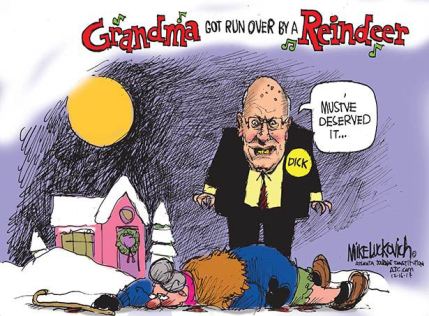
That exchange leaves no room for mistaking former vice-president Cheney’s position: better to chain a man to the wall of a cell, douse him in cold water, and leave him there to freeze to death, even if he later turns out to be innocent, than to release that same man and risk not that he detonates a nuclear bomb in Manhattan, but that he ends up “on the battlefield,” where there’s a chance he could harm Americans. What if fully one-in-four prisoners tortured by the CIA were innocent?
Cheney is still unmoved:
CHUCK TODD:
Is that too high? You’re okay with that margin for error?
DICK CHENEY:
I have no problem as long as we achieve our objective.
The ends justify the means.
There is no clearer illustration of the morally corrosive nature of torture than the once unthinkable position that Dick Cheney is unashamedly espousing on television. The position is even less defensible than the conceit that the Office of Legal Counsel defines what torture is. It is so indefensible that Cheney himself can scarcely maintain it.
You have to wonder where you measure on the vast barometer of human sewage if Conor Friedersorf won’t defend your evil ass as a former Republican ‘Conservative” Vice President.
Jon Stewart for the win, however. “Puppet Master Cheney’s mind” is “the scariest fucking place in the universe.”
“George W. Bush, thank you for not dying while you were in office,” Stewart said to the former president.
When pressed by Todd to explain his definition of torture following the release of a Senate report criticizing the CIA’s “enhanced interrogation” procedures, Cheney continually defined torture as the events of the 9/11 attacks.
“I see — that’s just what meets the definition of torture in his mind,” Stewart said. “His mind, I assume, being the scariest f*cking place in the universe.”
Stewart then tried to get a peek inside the “presidential puppet master’s” mind, only to find a scene out of My Little Pony: Friendship is Magic.
“Never took him for a brony,” Stewart observed.
What set Cheney apart, Stewart explained, was his ability to set the “moral bar” for the U.S. at anything just shy of the worst thing that had been done to the country, as well as his confidence.
“He’s impervious to doubt,” Stewart said. “It never enters his mind that the confident, plain-spoken pronouncements of truth are often times complete bullsh*t.”
 There, name that republican presidential candidate for 2016 over in that line up. Whichever one gets on the ballot, there will be a Koch entering his backside. My guess is that he’ll have Dick Cheney on the campaign trail for him too.
And, yes, David Koch is Evil. Amanda Marcotte gets it right.
Here’s the thing about men like David Koch: Making money is basically just a video game to them. For the rest of us, making money is about being able to pay for things we need and want, such as rent and food and actual video games. But David Koch has made so much money that he literally cannot spend it all. There is nothing he would want to buy he cannot already afford. The only purpose at this point in making more money is for the pleasure of beating your high score. In other words, it really is just a very consuming video game. But unlike when you kill people in Call of Duty or crush candies in Candy Crush, the game David Koch is playing is very real. Millions of people will suffer and die because he wants to “win” his video game by manipulating the public to avoid taking action on global warming. That is evil and hateful and selfish on a level that puts the word “selfish” to shame.
And no, being pro-choice and pro-gay doesn’t make up for it. That’s like having a hobby of strangling kittens and then saying it’s all good because you donate clothes to Goodwill once in awhile. Worse, actually, because David Koch isn’t actually pro-choice in any meaningful sense, because he gives money to anti-choice activists, as documented by Adele Stan at RH Reality Check. The Koch brothers give money to right wing umbrella groups, who then give it to anti-choicers. Why is fairly obvious. This is about manipulating misogynist, anti-sex hysteria in order to elect politicians who are on board with the anti-environmentalist agenda. A manipulation that is, in itself, evil on a couple of levels, both because you’re manipulating people and because you’re engaging bad people who have bad motivations to hurt and control others. It’s terrible, hateful behavior all the way down.
With that, I’ll leave you to grade papers. I’m pretty sick of humanity at the moment and I do not understand how any one with a will to survive could vote Republican anymore.
Anyway, I dare y’all to find good news today. Please!!!
Thursday Reads: Did Nepotism at The Washington Post Contribute to Irresponsible Reporting on the UVA Rape Story?
Posted: December 11, 2014 Filed under: Crime, Criminal Justice System, morning reads, Violence against women, War on Women, Women's Rights | Tags: fraternities, gang rape, nepotism in journalism, rape 40 Comments
Good Morning!!
Have you ever wondered how extremely young men are able to get jobs at elite newspapers like The Washington Post right out of college?
Take for example T. Rees Shapiro, who has led the charge to not only discredit the Rolling Stone story on the problem of rape on the University of Virginia campus but also efforts to dismiss and humiliate Jackie, one of the women interviewed by Rolling Stone writer Sabrina Rubin Erdley .
However flawed the Rolling Stone article may have been, it was about much more than Jackie’s story. It illustrated a culture of minimization of rape that had existed had UVA for at least 30 years, in which women who reported being sexually assaulted were discouraged from going to the police, their complaints were not treated seriously, and accused perpetrators were not seriously investigated or punished.
Shapiro’s career has been greatly enhanced by his dismantling of Jackie’s story about a violent rape that allegedly took place in 2012. As a consequence of his efforts to dismantle Jackie’s story, T. Rees Shapiro has appeared on numerous television programs and received praise from many quarters. Most likely his youth enabled Shapiro to con Jackie into trusting him enough to talk to him “several times.”
Last night, I decided to take a quick look at young Mr. Shapiro and his career development path. How did he get such an elite journalism job at the young age of 27?

In 2009, Shapiro graduated from Virginia Tech, where he wrote for the student newspaper. In 2010, he was hired by the Washington Post as a copy boy. He soon graduated to writing obituaries, and in 2010 became an education reporter for the Post.
Clearly T. Rees (Nicknamed “Trees,” get it?) is a real go-getter, but he also has connections. His father Leonard Shapiro was a sportswriter for The Washington Post for 38 years, and his mother Vicky Moon is a writer and photographer who is apparently a fixture in Virginia society. Would Shapiro have gotten the Washington Post job without those connections? Maybe, but I doubt it.
When he wrote about Jackie, Shapiro emphasized several times that she was using her “real nickname,” thus enabling trolls like Chuck C. Johnson to find her and try to publicly out her. Shapiro was also able to locate Jackie’s so-called “friends” and get their after-the-fact critiques of Jackie’s story. Shapiro doesn’t say whether Jackie told him she still considers these people to be her friends.
In his critiques of the Rolling Stone article and specifically of Jackie’s story, Shapiro chose not to write about the other women who were interviewed by author Sabrina Rubin Erdley or to get input from experts on rape and traumatic memory. Would a more mature reporter have done so, rather than simply picking apart Jackie’s story? Would a female education reporter have thought to do that?

Leonard Shapiro, former WaPo sportswriter and father of T. Rees Shapiro
Despite the Post’s attacks on Jackie, the University of Virginia does in fact have a rape problem. UVA is one of 86 schools being investigated by the Department of Education for mishandling rape complaints. Four Virginia schools are on the DEA list.
From Huffington Post in July: For Years, Students Have Accused Virginia Universities Of Botching Sexual Assault Cases.
Four universities in Virginia are currently being investigated by the U.S. Department of Education’s Office for Civil Rights for possible Title IX violations specifically related to sexual violence — JMU, the University of Virginia, the College of William & Mary and the University of Richmond. Two other schools in the state, the Virginia Military Institute and Virginia Commonwealth University, faced Title IX reviews that concluded this spring….
Each of the investigations at the Virginia schools, like that at JMU, was sparked by federal complaints.
UVA’s investigation is unusual in that it started in 2011, but remains open. The Education Department declined to say why the investigation was so long-running, and noted “that some cases take longer than others due to the nature and complexity of the issues involved.”
(Emphasis added).
In fact, UVA is one of only 12 schools that that the Department of Education has “flagged for a total compliance review.”
Another Washington Post reporter, Nick Anderson, writes that the inconsistencies in Jackie’s story will not end the federal investigation of UVA.
The University of Virginia was under the microscope for its handling of sexual assault cases long before Rolling Stone magazine weighed in with the account of a student who said she was gang-raped at a fraternity house.
The emergence of fresh questions about that account — including the fraternity issuing a rebuttal, doubts voiced by some who know the woman, and a statement from Rolling Stone’s managing editor on Friday acknowledging “discrepancies” in her version of events — will not suddenly cancel that scrutiny.
A federal investigation of U-Va.’s response to sexual violence, begun in June 2011, continues. It is one of the longest-running active probes of its kind in the nation. U-Va. remains one of the most prominent of about 90 colleges and universities facing such investigations by the U.S. Department of Education’s Office for Civil Rights.
Student and faculty activists for sexual assault prevention, given a national platform in recent days, are unlikely to let the issue fade away. Skeptics will still wonder why the university has not expelled anyone for sexual misconduct in the past decade. Parents of prospective applicants, also mindful of the slaying of sophomore Hannah Graham after she disappeared in September, still want assurances that the Charlottesville campus is safe.
Perhaps most important, University President Teresa A. Sullivan laid out a detailed road map this week for a comprehensive review of the campus culture, touching on sexual assault, alcohol, Greek life and university oversight.

Francesca Bessey
Since rape on campus is such a huge issue, shouldn’t education reporters like T. Rees Shapiro be more knowledgeable about sexual assault and its traumatic effects? One journalist, Francesca Bessey thinks so.
From Huffington Post: Thought the Rolling Stone Article Was Bad? Try Other Rape Journalism. Here’s her assessment of the Washington Post coverage:
The actual discrepancies introduced by the Washington Post are few: one, the individual whom Jackie claimed brought her to the fraternity was apparently a member of a different fraternity; and, two, a student who allegedly came to Jackie’s aid claimed she initially gave a different account of what happened that night. The fraternity also released a statement denying knowledge of the assault, or that there was a social function the night Jackie believes she was assaulted.
For someone who knows little to nothing about rape, fraternities, or the contemporary college party scene — which unfortunately seems to characterize a lot of the coverage thus far — these discrepancies might initially seem like gaping holes in Jackie’s story.
However, as any medical professional or victim advocate will tell you, trauma-related memory inconsistencies are extraordinarily common in cases of sexual assault, often manifesting in the survivor describing the incident to first responders as less severe than it actually was. Such plasticity of memory is not unique to rape cases; the FBI, for example, notes that “there can be a wide range of after effects to a trauma,” which can impact on a victim of a violent crime or the victim’s family members. A list of these effects includes confusion, disorientation, memory loss and slowed thinking. Psychological research has long demonstrated that humans reconstruct, rather than recall, memory, which is why eyewitness testimony is considered one of the most dubious forms of evidence in a court of law.
Why have journalists covering this story given more credence to statements by the fraternity and friends who were portrayed very negatively in the Rolling Stone article than to Jackie’s version of events?
…it is important to note that the so-called “inconsistencies” in Jackie’s story don’t necessarily invalidate her version of events. The fraternity’s statement is in no way more credible than Jackie’s own word — in fact, I would argue less so, given the sheer prevalence of fraternity rape. It would be foolish to assume that a fraternity’s formal denial of “knowledge of these alleged acts” means that they did not occur (with or without current leadership’s knowledge), as it would be foolish to rule out that the “date function” Jackie thought she was invited to wasn’t pure pretense in the first place. It is also within the realm of possibility that Jackie was brought to the party by a man who didn’t necessarily belong to the fraternity, even that he misled her about his membership in the frat. It is also possible that the student who gave a different version of how he found Jackie that night, lacks credibility or is himself having trouble recalling events.
Ultimately, these are all details significant to a police or journalistic investigation, upon which the responsibility is on law enforcement and journalists to figure out. For Jackie, however, it doesn’t change much. It doesn’t change her experience of violent assault, or those of countless students like her, many of whose stories are also featured in the article in question. It does not change the majority of the material in the original article: not the debasing lyrics of the UVA fight song; not the person who hurled a bottle at Jackie’s face the first time she tried to speak out; not the 38 students who appeared in Dean Nicole Eramo’s office in just one academic year to discuss incidents of sexual assault, despite the fact that not one student has ever been expelled from UVA for a sexual offense.
In light of these facts, in light of my own rape and the rapes of too many of my friends at the hands of their peers, I do wonder: Whose credibility is really to be doubted here? Jackie’s or the public peanut gallery that has diluted sexual assault down to a number and a date?
Again, I don’t want to personally denigrate T. Rees Shapiro. He writes well, and he has done a fine job of locating sources at the University of Virginia–both in this case and in his previous reporting on in writing on the Hannah Graham murder case–probably because his youth helps him connect with college students only a few years younger than he is. But his analysis of a survivor’s story has suffered from his lack of knowledge and experience about campus sexual assault and rape in general.
I want to share two more articles that offer a more sophisticated take on these subjects–written by women with long journalistic experience.
Sally Kohn
From CNN, Rape culture? It’s too real, by Sally Kohn.
We don’t yet know all the facts behind the now-infamous, poorly fact-checked story in Rolling Stone about an alleged gang rape at the University of Virginia. What we do know: Rolling Stone at first blamed the alleged victim, “Jackie” — rather than its own journalistic sloppiness — for so-called “discrepancies” (before changing its callous statement).
And new reporting by the Washington Post does reveal that Jackie’s friends, cited in the story, say they are skeptical about some of the details. Still, they all believe that Jackie experienced something “horrific” that night, in the words of one, and we do know that Jackie stands by her story. Most of the doubts about it were apparently raised by those she’s accusing, including the fraternity and main alleged assailant — whom, I guess, we’re supposed to believe instead. But one other thing we do know is that gang rapes just like what Jackie is alleging do happen — too often, and all over America.
While Rolling Stone’s reporting was clearly shoddy, some writers who initially poked holes in Jackie’s story did so for ideological motives. For instance, even before the reporting lapses were revealed, conservative commentator Jonah Goldberg called Jackie’s story unbelievable. “It is not credible,” Goldberg wrote in the Los Angeles Times. “I don’t believe it.”
Instead, Goldberg insisted, Jackie’s account was “a convenient conversation for an exposé of rape culture,” something, incidentally, Goldberg also doubts to be real. “‘Rape culture’ suggests that there is a large and obvious belief system that condones and enables rape as an end in itself in America,” Goldberg later wrote in National Review. It’s all hogwash, says Goldberg, alleging that the very idea of “rape culture” is just “an elaborate political lie intended to strengthen the hand of activists.”
In other words, whatever the reality of what happened to Jackie, Goldberg and others were skeptical because they simply don’t believe rapes like that happen with the participation of groups of assailants, let alone the complicity of bystanders. This is where they’re mistaken.
Kohn then lists several extreme examples of gang rapes that resemble Jackie’s description–most of which we have covered here.

Also from CNN, In 2014, rape rage drove feminism’s ‘third wave’, by Nina Burleigh.
Historians could look back on this year as the beginning of feminism’s third wave.
The year was momentous for feminism. For the first time, rape victims and their supporters emerged from the shadows in significant numbers and started naming names — to significant effect. Women, their voices amplified by social media and with the support of a small but growing cohort of men, have been exposing and shaming venerable American institutions such as the NFL, Ivy League and non-Ivy League colleges, and the entertainment icon Bill Cosby.
First wave feminists won the right to vote. The second wave got us the right to work. But even with those advances, women have remained fundamentally restricted by the threat and terrible secret of sexual assault.
This year, emboldened and connected by social media, college women formed a powerful grassroots movement that led to universities such as Harvard being publicly named and shamed for not addressing women’s rape reports. They brought the issue of campus sexual assault into the White House, where Barack Obama became the first President to use the words “sexual violence.” The Department of Education released a list of universities under investigation for mishandling sexual violence cases, often letting even repeat predators off with barely a slap on the wrist.
These young women had been silent until social media enabled them to come together, even though thousands of miles apart, share debilitating secrets and then act with the confidence that safety in numbers provided.
I hope you’ll read the rest at the link.
I only hope that irresponsible journalism perpetrated by Rolling Stone and the even more irresponsible reaction to it have not set back the cause of protecting young women on college campuses from sexual violence.
Thursday Reads: An Important Story about Sexual Assault on College Campuses
Posted: November 20, 2014 Filed under: education, morning reads, Violence against women, War on Women, Women's Rights | Tags: culture of cover-up, date rape, frat parties, fraternities, gang rape, Nicole Eramo, Phi Kappa Psi fraternity, rape, sexual assault on college campuses, Teresa Sullivan, University of Virginia 62 Comments
Francoise in a round-backed chair reading, Mary Cassatt
Good Morning!!
I stayed up late last night reading the stunning Rolling Stone article on the culture of sexual assault and official cover-up at the University of Virginia. After I finished it, I had quite a bit of difficulty getting to sleep. The story was reported and written by investigative journalist Sabrina Rubin Erdely. The headline is A Rape on Campus: A Brutal Assault and Struggle for Justice at UVA. Before I begin, I want to warn everyone that the article includes explicit descriptions of sexual assault and a shocking culture of indifference to victims. I’m not going to excerpt explicit descriptions of rapes, but I do want to quote some of the reactions to them by students and administrators.
The article opens with a graphic description of a violent gang rape of 18-year-old incoming freshman “Jackie” that took place at the Phi Kappa Psi fraternity house during a party. Hours later, beaten and bloody, Jackie called “friends” for help, but instead of taking her to a hospital they talked her out of reporting the assault because it would ruin her “reputation,” and they as her friends would be ostracized and would no longer be invited to frat parties.
So Jackie hid in her room and sank into a deep depression. She received no support from her “friends” and acquaintances. The man who had taken her to the party and set up her rape by 7 men behaved as if nothing abnormal had happened, and asked her why she was ignoring him. Erdely on the friends’ reactions:
She was having an especially difficult time figuring out how to process that awful night, because her small social circle seemed so underwhelmed. For the first month of school, Jackie had latched onto a crew of lighthearted social strivers, and her pals were now impatient for Jackie to rejoin the merriment. “You’re still upset about that?” Andy asked one Friday night when Jackie was crying. Cindy, a self-declared hookup queen, said she didn’t see why Jackie was so bent out of shape. “Why didn’t you have fun with it?” Cindy asked. “A bunch of hot Phi Psi guys?” One of Jackie’s friends told her, unconcerned, “Andy said you had a bad experience at a frat, and you’ve been a baby ever since.”
That type of response to sexual assaults is apparently common at UVA.
That reaction of dismissal, downgrading and doubt is a common theme UVA rape survivors hear, including from women. “Some of my hallmates were skeptical,” recalls recent grad Emily Renda, who says that weeks into her first year she was raped after a party. “They were silent and avoided me afterwards. It made me doubt myself.” Other students encounter more overt hostility, as when a first-year student confided her assault to a friend. “She said she thought I was just looking for attention,” says the undergrad. Shrugging off a rape or pointing fingers at the victim can be a self-protective maneuver for women, a form of wishful thinking to reassure themselves they could never be so vulnerable to violence. For men, skepticism is a form of self-protection too. For much of their lives, they’ve looked forward to the hedonistic fun of college, bearing every expectation of booze and no-strings sex. A rape heralds the uncomfortable idea that all that harmless mayhem may not be so harmless after all. Easier, then, to assume the girl is lying, even though studies indicate that false rape reports account for, at most, eight percent of reports.
And so at UVA, where social status is paramount, outing oneself as a rape victim can be a form of social suicide. “I don’t know many people who are engrossed in the party scene and have spoken out about their sexual assaults,” says third-year student Sara Surface. After all, no one climbs the social ladder only to cast themselves back down. Emily Renda, for one, quickly figured out that few classmates were sympathetic to her plight, and instead channeled her despair into hard partying. “My drinking didn’t stand out,” says Renda, who often ended her nights passed out on a bathroom floor. “It does make you wonder how many others are doing what I did: drinking to self-medicate.”

Investigative journalist Sabrina Rubin Erdely of Rolling Stone
Erdely talked to a number of survivors, and she found a history of gang rapes at Phi Kappa Psi fraternity stretching back at least 30 years. She describes a culture in which male upperclassmen target freshmen girls and deliberately take advantage of their lack of sophistication about the danger of sexual violence on college campuses.
A year later, Jackie did report the rape to a UVA administrator. She was sent to Dean Nicole Eramo, who heads the “Sexual Misconduct Board.” Eramo subtly discouraged Jackie from reporting the rape.
When Jackie finished talking, Eramo comforted her, then calmly laid out her options. If Jackie wished, she could file a criminal complaint with police. Or, if Jackie preferred to keep the matter within the university, she had two choices. She could file a complaint with the school’s Sexual Misconduct Board, to be decided in a “formal resolution” with a jury of students and faculty, and a dean as judge. Or Jackie could choose an “informal resolution,” in which Jackie could simply face her attackers in Eramo’s presence and tell them how she felt; Eramo could then issue a directive to the men, such as suggesting counseling. Eramo presented each option to Jackie neutrally, giving each equal weight. She assured Jackie there was no pressure – whatever happened next was entirely her choice.
Like many schools, UVA has taken to emphasizing that in matters of sexual assault, it caters to victim choice. “If students feel that we are forcing them into a criminal or disciplinary process that they don’t want to be part of, frankly, we’d be concerned that we would get fewer reports,” says associate VP for student affairs Susan Davis. Which in theory makes sense: Being forced into an unwanted choice is a sensitive point for the victims. But in practice, that utter lack of guidance can be counterproductive to a 19-year-old so traumatized as Jackie was that she was contemplating suicide. Setting aside for a moment the absurdity of a school offering to handle the investigation and adjudication of a felony sex crime – something Title IX requires, but which no university on Earth is equipped to do – the sheer menu of choices, paired with the reassurance that any choice is the right one, often has the end result of coddling the victim into doing nothing.
“This is an alarming trend that I’m seeing on campuses,” says Laura Dunn of the advocacy group SurvJustice. “Schools are assigning people to victims who are pretending, or even thinking, they’re on the victim’s side, when they’re actually discouraging and silencing them.
The culture of cover-up at UVA is shocking to me, but it is probably typical of many colleges and universities, according to Erdely. However UVA is among a select group of 86 schools that is under investigation by the federal Office of Civil Rights because of their failure to deal with the problem. In September UVA held a two-hour trustees meeting to discuss sexual assault on campus.
Those two hours, however, were devoted entirely to upbeat explanations of UVA’s new prevention and response strategies, and to self-congratulations to UVA for being a “model” among schools in this arena. Only once did the room darken with concern, when a trustee in UVA colors – blue sport coat, orange bow tie – interrupted to ask, “Are we under any federal investigation with regard to sexual assault?”
Dean of students Allen Groves, in a blue suit and orange necktie of his own, swooped in with a smooth answer. He affirmed that while like many of its peers UVA was under investigation, it was merely a “standard compliance review.” He mentioned that a student’s complaint from the 2010-11 academic year had been folded into that “routine compliance review.” Having downplayed the significance of a Title IX compliance review – which is neither routine nor standard – he then elaborated upon the lengths to which UVA has cooperated with the Office of Civil Rights’ investigation, his tone and manner so reassuring that the room relaxed.
Told of the meeting, Office of Civil Rights’ Catherine Lhamon calls Groves’ mischaracterization “deliberate and irresponsible.” “Nothing annoys me more than a school not taking seriously their review from the federal government about their civil rights obligations,” she says.
Jackie eventually became involved with a UVA rape survivors group, but even among these women who were trying to deal with their traumatic experiences and reaching out to recent victims, the culture was one of not reporting their rapes to police.

UVA Dean of Students Nicole Eramo
You’ll recall that it was at UVA that 18-year-old Hannah Graham was abducted and murdered, allegedly by 32-year-old Jesse Matthew, who had been previously accused of rape at two different Virginia colleges in 2002 and 2003. He was not charged in either case, and he apparently went on to become a smoothly professional sexual predator. The news reports say that the victims did not want to press charges, but the truth is that colleges and universities regularly discourage young women from reporting rapes in order to protect their institutional reputations. Erdely addresses this issue at length in her article on UVA.
Matthew’s DNA was found under the fingernails of Virginia Tech student Morgan Harrington, who disappeared after she was locked out of a Metallica concert on the UVA campus in 2009. Harrington’s body was later found a few miles from where Hannah Graham’s body was recovered. Matthew’s DNA has also been connected to a violent rape and attempted murder that took place in Fairfax in 2005.
In her article, Erdely discusses the research done by psychologist David Lisak on campus rapists. He discovered that a small percentage of college men commit rapes, and they tend to be repeat offenders (PDF). That last link is to a peer-reviewed journal article by Lisak, “Repeat Rape and Multiple Offending by Undetected Rapists.” Erdely writes:
Lisak’s 2002 groundbreaking study of more than 1,800 college men found that roughly nine out of 10 rapes are committed by serial offenders, who are responsible for an astonishing average of six rapes each. None of the offenders in Lisak’s study had ever been reported. Lisak’s findings upended general presumptions about campus sexual assault: It implied that most incidents are not bumbling, he-said-she-said miscommunications, but rather deliberate crimes by serial sex offenders.
In his study, Lisak’s subjects described the ways in which they used the camouflage of college as fruitful rape-hunting grounds. They told Lisak they target freshmen for being the most naïve and the least-experienced drinkers. One offender described how his party-hearty friends would help incapacitate his victims: “We always had some kind of punch. . . . We’d make it with a real sweet juice. It was really powerful stuff. The girls wouldn’t know what hit them.” Presumably, the friends mixing the drinks did so without realizing the offender’s plot, just as when they probably high-fived him the next morning, they didn’t realize the behavior they’d just endorsed. That’s because the serial rapist’s behavior can look ordinary at college. “They’re not acting in a vacuum,” observes Lisak of predators. “They’re echoing that message and that culture that’s around them: the objectification and degradation of women.”
I won’t quote any more from the article, but I do recommend reading it if you can handle it.
After the Rolling Stone article came out, UVA’s president suddenly decided maybe she should something about Jackie’s rape. From The Daily Progress, UVa calls for investigation into rape allegation in Rolling Stone article.
UVa President Teresa A. Sullivan released a statement Wednesday night, stating the university’s commitment to preventing sexual assault.
“The University takes seriously the issue of sexual misconduct, a significant problem that colleges and universities are grappling with across the nation,” Sullivan said in the statement. “Our goal is to provide an environment that is as safe as possible for our students and the entire University community.”
Erdely said UVa reinforced one of her major arguments in her article — that UVa administration focuses on prestige and appearance over student safety — with Sullivan’s statement….
“I am writing in response to a Rolling Stone magazine article that negatively depicts the University of Virginia and its handling of sexual misconduct cases,” Sullivan said at the beginning of the statement.
“It goes to show what their priorities are here — the fact that she would go out of her way to say I negatively depicted the university — this is the first thing on their minds,” Erdely said. “They need to be putting student safety first.”

UVA President Teresa Sullivan
Date: Wed, Nov 19, 2014 at 6:17 PM
Subject: An Important Message from President SullivanTo the University community:
I am writing in response to a Rolling Stone magazine article that negatively depicts the University of Virginia and its handling of sexual misconduct cases. Because of federal and state privacy laws, and out of respect for sexual assault survivors, we are very limited in what we can say about any of the cases mentioned in this article.
The article describes an alleged sexual assault of a female student at a fraternity house in September 2012, including many details that were previously not disclosed to University officials. I have asked the Charlottesville Police Department to formally investigate this incident, and the University will cooperate fully with the investigation.
The University takes seriously the issue of sexual misconduct, a significant problem that colleges and universities are grappling with across the nation. Our goal is to provide an environment that is as safe as possible for our students and the entire University community.
We have recently adopted several new initiatives and policies aimed at fostering a culture of reporting and raising awareness of the issues.
We want our students to feel comfortable coming forward with information when there are problems in the community and cooperating with local law enforcement and the student disciplinary process. We also want them to feel empowered to take action and to lead efforts to make our Grounds and our community a better place to live and learn.
We have been taking a leadership role on issues regarding sexual misconduct and violence. U.Va. hosted a national conference on this topic in February 2014. “Dialogue at U.Va.: Sexual Misconduct Among College Students” brought together national experts and professionals from approximately 60 colleges and universities to discuss best practices and strategies for prevention and response.
The HoosGotYourBack initiative, part of the Not On Our Grounds awareness campaign, was developed and launched in collaboration with students and with local Corner Merchants to increase active bystander behavior.
A number of other initiatives are also planned for the spring. Among them are the implementation of a new student sexual misconduct policy and a related training program, a campus climate survey, and an in-depth bystander intervention program that will include students, faculty, and staff.
More information about sexual violence education and resources is available on the University’s website at http://www.virginia.edu/sexualviolence/
Finally, I want to underscore our commitment to marshaling all available resources to assist our students who confront issues related to sexual misconduct. Our dedicated Student Affairs staff devote countless hours to educating and counseling our students on issues regarding their health and safety, and they stand ready to assist whenever students need help.
Teresa A. Sullivan
PresidentPresident Sullivan approved distribution of this message.
I’ll let you judge the sincerity of Sullivan’s statement.
I know there is plenty of other news going on, but this was all I could think about this morning. Please post your links on any topic in the comment thread, and feel free to discuss this post or not. I realize this is a very difficult subject, but it is also a vitally important one.
Lazy Saturday Reads: You People are so Ridiculous! Edition
Posted: September 27, 2014 Filed under: 2016 elections, Barack Obama, Crime, Criminal Justice System, FBI, Foreign Affairs, Fox News, Hillary Clinton, Iraq, morning reads, public education, Reproductive Health, Reproductive Rights, Republican politics, science, social media, Syria, U.S. Politics, Violence against women, War on Women, Women's Rights | Tags: Ann Romney, Bill Clinton, Bobby Jindal, Chelsea Clinton, ISIS/ISIL, Jeb Bush, Marc Mezvinsky, Michele Bachmann, Mitt Romney, Neil Cavuto, Rand Paul, Sarah Palin, Scott Walker, Scott Walker's nameless wife, Ted Cruz, Values Voters Summit, women voters, you people 27 Comments
Morning Coffee in the City, by Michele Byrne
Good Day!!
Hillary and Bill Clinton are grandparents!
From the AP via The Boston Globe:
The couple’s daughter, Chelsea Clinton, has given birth to her first child, a daughter named Charlotte.
Chelsea Clinton, the daughter of the former president and ex-secretary of state, announced the baby’s birth on Twitter and Facebook early Saturday, saying she and husband Marc Mezvinsky are ‘‘full of love, awe and gratitude as we celebrate the birth of our daughter, Charlotte Clinton Mezvinsky.’’
Clinton spokesman Kamyl Bazbaz said the child was born on Friday but did not immediately provide additional details. The couple lives in New York City. The Clintons quickly retweeted their daughter’s message on Twitter but did not immediately comment on the baby’s arrival.
Now that the announcement is out of the way, the media demands to know if Hillary will now announce she’s running for president.
The baby has been eagerly anticipated as Hillary Clinton considers her political future — she has called the prospect of becoming a grandmother her ‘‘most exciting title yet.’’ She even has picked out the first book she intends to read to her grandchild, the classic ‘‘Goodnight Moon.’’
She has said she didn’t want to make any decisions about another campaign until the baby’s arrival, pointing to her interest in enjoying becoming a grandmother for the first time. If Clinton decides to run for president, her campaign would coincide with the baby’s first two years.

The Christian Science Monitor even put the demand in their headline to the AP story: Chelsea Clinton now a mom. Will Grandma Hillary announce run for president?
Sigh . . . Yes, I’m sure Hillary is planning to ruin their daughter’s and son-in-law’s celebration by rushing out and the media’s wish come true. Why don’t they hound Mitt Romney instead? He already has so many grandkids he probably can’t keep their names straight; and Ann Romney has been out and about in the past week.
Ann told Fox News’ Neil Cavuto that if only Mitt had been elected in 2012, there wouldn’t have been so many problems in Iraq and Syria. According to Ann,
I think he would have had a status of forces agreement on — in Iraq. I don`t believe ISIS would have had the invasion that they have — they’ve had. They wouldn’t have had the ability to — I think he would have tried to arm the moderates in Syria. I think there`s other things that would have happened that would have made the equation a little bit tilted in our favor.
Those people are not going to go away. This is a generational problem. And the sooner we realize, I think, as Americans, that it`s not an easy solution and it`s not going to go away, but to be really aware of how dangerous the situation is — I think Mitt was very aware how — how precarious it was.
As for Mitt giving running for president a third try, Ann hinted that it will depend on what Jeb Bush decides to do.
One scenario out there, Mrs. Romney, is that Jeb Bush doesn`t run after all, and your husband has sized up the landscape and that a lot of his supporters, past and present, said, you have the name recognition, you have the Reagan example of the third time was the charm for him, and that it`s been done before.
[ANN] ROMNEY: Mm-hmm.
CAVUTO: And — and that would be appealing.
ROMNEY: Well, we will see, won`t we, Neil?
I think Jeb probably will end up running, myself. I think, you know, he — people probably are looking at it, that he`s probably looking at it very carefully right now.
CAVUTO: But why would his entrance in the race matter to — to your supporters or not?
ROMNEY: Well, I think, you know, he would draw on a very similar base that we would draw on.
Andrew Prokop at Vox thinks another Romney run could happen: It’s not crazy for Mitt Romney to run for president again. Prokop, reports that according to conservative columnist Bryan York, Jeb is unlikely to run in 2016.
“Romney is said to believe that, other than himself, [Jeb] Bush is the only one of the current Republican field who could beat Hillary Clinton in a general election,” York writes. So there seems to be at least one candidate who would definitively win Romney’s support.
But while there have been several trial balloons for a Jeb Bush candidacy floated recently, there are reasons to be skeptical he’ll actually pull the trigger. First of all, he’s been out of politics for years and focused on making money. For now, Bush has every reason to encourage speculation that he’s running. It gives him increased media attention, perceived clout, and it makes him more valuable as a speaker and rainmaker. But he’s at odds with the GOP base on issues like immigration and Common Core, and he’s suggested that concerns from his family could be an issue. So Bush might well opt against a run, and Romney could feel that he’s the party’s only hope.
After all, writes Prokop, Romney is a known quantity and he’s popular with GOP donors. On top of that, Chris Christie has lost his luster as a candidate.
Read more details at Vox.
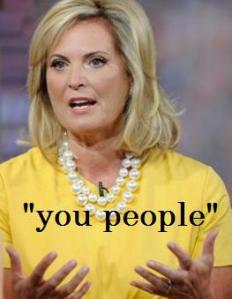
But what about Mitt’s problems with women? Ann says that’s nonsense, according to Politico.
Ann Romney on Tuesday skewered Democrats’ claim that there’s a GOP “war on women,” calling the accusation “offensive” and saying it won’t work as a campaign tactic.
“It’s ridiculous, honestly, I mean I don’t think they’re getting very far with that, by the way. It’s not going to work. I think women are a lot smarter than that, and that’s kind of offensive to me, to tell you the truth,” Romney said in an interview with Neil Cavuto on Fox News in response to a question about both the so-called “war on women” and DNC chief Debbie Wasserman Schultz’s recent comments about Wisconsin Gov. Scott Walker.
“Scott Walker’s a good guy, and he’s got a wonderful wife, and he values women and that just doesn’t fly,” Romney added.
She was responding to Wasserman Schultz’s remarks earlier this month, when the Florida Democrat said Walker “has given women the back of his hand.”
Well that’s the end of that then. Scott Walker’s wife (does she have a name) is “wonderful,” so women should just shut up and deal with having limited access to birth control, abortion, and child care, and lower pay than their male colleagues.
Wonkette responds to the Politico story with appropriate sarcasm: Ladies, Stop Offending Ann Romney With How Stupid You Are.
How many times does Her Royal Horse-Riding Majesty Ann Romney have to explain this to YOU PEOPLE? Sheesh! This so-called “war on women” claptrap Democrats can’t stop blah blahing about is so dumb and so 2012 and so not even real anyway, so why are women — who are so much smarter than Democrats think they are — so stupid as to keep falling for it?
Obviously, talking non-stop about the Republican Party’s non-stop assault on women will never work. Ann knows. She’s an elections expert. That’s why the gender gap in 2012 was only 18 points. Practically a draw! No wonder the whole Romney clan was so very shocked and awed that Ann’s 2012 pitch failed to sway the lady voters:
“Women, you need to wake up,” she urged them. “Women have to ask themselves who’s going to have and be there for you. I can promise you, I know, that Mitt will be there for you. He will stand up for you, he will hear your voices.”
Maybe it had something to do with how some of the things that spilled out of her face hole were kind of … oh, what’s the word? Offensive? Like when she said, “I love the fact that there are women out there who don’t have a choice and they must go to work and they still have to raise the kids.” Those hard-working women out there were such an inspiration to her because she also had suffered and struggled and worked really hard at never having a job, scraping by on nothing but her husband’s daddy’s stock portfolio.
How the heck did that not work with voters?!? Especially after she told YOU PEOPLE to stop being so dumb already, jeez, and vote for her hubby. And some of YOU PEOPLE even whispered in her ear that you totally agreed with her (and yet did not vote for Mitt anyway, weird!), and even ladies who usually don’t worry their pretty little heads about important issues — that’s Man’s Work, after all — were finally, for the first time ever, thinking about really important stuff, like the economy and “their husbands’ jobs.”
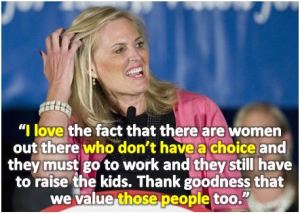
For heaven’s sake, ladies. Mitt had all those binders full of women, remember? Now get over it and go vote Republican!
Of course Mitt wasn’t included in the Values Voters Summit this weekend. That could mean he’s not running or maybe that he thinks the Tea Party vote won’t matter. The usual suspects were there though.
Despite Ann’s claims that the Democrats are getting nowhere with the “war on women” talk, the “values voters” speakers appeared to tone down the anti-abortion and anti-same sex marriage rhetoric, according to ABC News: Republicans Rallying Behind Religious Liberty.
Fighting to improve their brand, leading Republicans rallied behind religious liberty at a Friday gathering of evangelical conservatives, rebuking an unpopular President Barack Obama while skirting divisive social issues.
Speakers did not ignore abortion and gay marriage altogether on the opening day of the annual Values Voter Summit, but a slate of prospective presidential candidates focused on the persecution of Christians and their values at home and abroad — a message GOP officials hope will help unify a divided party and appeal to new voters ahead of November’s midterm elections and the 2016 presidential contest.
“Oh, the vacuum of American leadership we see in the world,” Texas Sen. Ted Cruz declared Friday in a Washington hotel ballroom packed with religious conservatives. “We need a president who will speak out for people of faith, prisoners of conscience.”
Kentucky Sen. Rand Paul echoed the theme in a speech describing America as a nation in “spiritual crisis.”
“Not a penny should go to any nation that persecutes or kills Christians,” said Paul, who like Cruz is openly considering a 2016 presidential bid.
The speaking program included such potential 2016 candidates as former Arkansas Gov. Mike Huckabee and Louisiana Gov. Bobby Jindal. Several possible Republican candidates — New Jersey Gov. Chris Christie and former Florida Gov. Jeb Bush among them — did not attend. The group has positions on social issues across the spectrum — from the libertarian-leaning Paul, who favors less emphasis on abortion and gay marriage, to Huckabee, a former Southern Baptist pastor whose conservative social values define his brand.

Here’s a lovely little homily from Bobby Jindal:
Jindal, who is also weighing a White House bid, seized on what he called Obama’s “silent war” on religious freedom.
“The United States of America did not create religious liberty,” Jindal said. “Religious liberty created the United States of America.”
Anyone know what he means by a “silent war?” I have no clue. What a charlatan Jindal is!
The ABC article didn’t mention Michele Bachmann or Sarah Palin, but they were there too.
From Mediaite on crazy Michele’s speech: Bachmann Rouses Values Voters Crowd with Calls to ‘Kill’ ISIS Until They Surrender. See video at the link.
Talking Points Memo notes that Sarah Palin doesn’t know the address of the White House. I wonder who lives at 1400 Pennsylvania Avenue?
Palin Goofs: Truth Is Endangered At ‘1400’ Penn Avenue. Watch it:
I wonder if the “values voters” liked Palin’s biker chick get-up?
And, of course, Ted Cruz was his usual loony self. Salon: 5 craziest things Ted Cruz just said at the Values Voters Summit (including the full video of his “deranged” speech.

Morning Coffee, by Carol Bolt
Quick News Headlines:
The Boston Globe, 7 Questions We’d Ask Ferguson’s Chief of Police.
A man set a fire at an air traffic control facility at Chicago’s O’Hare Airport, but it’s not being called terrorism–maybe because the guy isn’t an Arab American?
KTLA Channel 5, FBI: Chicago Controller Sent Facebook Message: ‘I Am About to Take Out’ FAA Facility.
NY Daily News, Illinois man charged in fire at Chicago air traffic control center
The Texas State Board of Education is at it again. Now they want teachers to tell kids that Moses is an inspiration for the U.S. Constitution (very interesting and detailed article at The Daily Beast).
AP, via Yahoo News, Police: Woman beheaded at Oklahoma workplace.
Fox News, Four College Sophomores dead in Oklahoma bus-truck crash.
Discovery News, Japanese Volcano Erupts: Hikers Missing.
The New Yorker on the newest social media entry, Ello’s Anti-Facebook Moment.
LA Times, Water on Earth predates the solar system, and even the sun.
Raw Story, Complex life on Earth may have appeared 60 million years earlier than previously thought.
National Geographic, Did the Vikings Get a Bum Rap? A Yale historian wants us to rethink the terrible tales about the Norse.
M.I.T. News, Battling superbugs: Two new technologies could enable novel strategies for combating drug-resistant bacteria.
What else is happening? Please post your thoughts and links on any topic in comment thread.
Have a great weekend, everyone!

 peej
peej Carissa
 bostonboomer
 dakinikat
 ecocatwoman
 mablue2
 Mama Lopez
 peggysue22
 quixote
 skydancingguestblogger
 Mona (aka Wonk the Vote)



 Sky Dancing
Recent Comments