
The Vision Thang
Posted: March 17, 2011 Filed under: 2012 presidential campaign, Domestic Policy, House of Representatives, president teleprompter jesus, U.S. Politics, Voter Ignorance, We are so F'd, WE TOLD THEM SO, Women's Rights, worker rights | Tags: Democratic politics, Democratic values, No drama Obama 18 CommentsI wrote a few days ago that I find it odd that Democrats don’t seem to be able to articulate a clear vision with specific

Dear Liberal Democrats:
programs and agendas they’d like to support given the absolute fanaticism articulated by Tea Party extremists. The voting populace seems eager to listen at this point. You would think in the obvious Republican war against Women, Family Planning, Collective Bargaining, and economic recovery that certain Democratic politicians known for their speeches would be able to find some fighting words. It’s not happening. It’s a pattern. It’s time for other Democratic leaders to stand up and fill the void.
It was interesting to read similar thoughts expressed by NY Congress Critter Anthony Weiner who is quickly becoming my favorite outspoken liberal. He was interviewed recently by Amanda Terkel writing for HuffPo.
“On our side is this weird squishy affirmative sense of what government should do and how we’re opposed to this cut and that cut, rather than saying, ‘Here are the things: Medicare, Medicaid, Social Security, environment and education. We’re not cutting those. Those are off the table. That’s non-negotiable,'” said Weiner, adding, “We haven’t really done that very well. That’s because the president fundamentally — he’s not a values guy. He wants to try to get the best deal for the American people and that’s virtuous in its own right, but it becomes very difficult to make a strategy. There’s been much greater global strategy thinking on [progressive media] outlets, frankly, than at 1600 Pennsylvania.”
When asked by The Huffington Post whether what’s happening at the state and local level with labor unions and budget battles would rise to the national stage, Weiner said that the leadership of national officials — including the president — will be essential to push the issue forward.
“We’ve spent a lot of time waiting for Godot when it comes to the Obama White House, and we kind of — to some degree — have to internalize the idea that, you know what? That’s probably not the way to go,” Weiner said. “We have to start initiating some of this.”
Continued Weiner: “It is now pretty clear to me — I’m not saying this is pejorative — the president, he doesn’t animate his day by saying, ‘All right, what is the thing that has me fired up today? I’m going to out and try to move the ball on it.’ He kind of sees his job as to take this calamitous noise that’s going on on the left with people like us and on the right on Fox News, and his path to being a successful president, in his view, is taking that cacophony and trying to make good, level-headed, smart policy out of it and moving it incrementally down the road. That’s nice. That’s a good thing. We need that, obviously. The problem is there’s no substitute for someone really leaning into these values questions. “
The wall of reality between campaign rhetoric, action, and policy has become so noticeable now that even the most loyal partisans see the complete disconnect. The problem is that they’re standing around waiting for the President to do something. I contend that’s not going to happen.
Republicans on the right wing are now making political hay of the presidential preoccupation with March Madness and the endless dithering on the no-fly zone over Libya, further efforts to encourage job creation in the country, and the lack of engagement on basic Democratic base issues like the assault on collective bargaining happening in states like Wisconsin. Obama isn’t even standing up for Big Bird. (Unless you count this just released press ‘statement’.) Maybe our old yellow friend needs to dress up like a Jay Hawk to get some attention these days. Terkel finds other Democratic pols with similar views that are willing to go on record. I’m hoping this is the start of a few brave souls finding their voices and spines. It seems some of them are still in some form of denial.
Rep. Dennis Kucinich (D-Ohio) was also at the gathering and later added, in reference to labor and budget battles, “The only regret I have is that the White House isn’t fighting back against this. It’s one thing to say, ‘Well, I stand behind the workers — how far behind, I don’t know.’ It’s another thing to say, ‘I stand with them and in front of them to protect their rights.’ And I’m waiting for that to happen.”
Frankly, I think Kucinich is going to be waiting for Godot. I have a lot of problems with Kucinich who caved into White House pressure on health care reform after a few flights on air force one. I also think that he’s still in denial that the President shares Democratic values. Defazio of Oregon appears to have a bit more of a realistic perspective.
DeFazio added that he hopes Obama stands with congressional Democrats rather than agreeing to a compromise with the Republicans, as he did a few months ago on the tax cuts.”The problem is the negotiator-in-chief and where he’ll end up, and whether we can put some steel in his spine,” he said. “I assume he caved in on taxes in December because he was blackmailed on the treaty with Russia with nuclear weapons, which was absolutely critical. But that’s pretty pathetic also.”
We’re beginning to see voices critical of the President coming from within the party itself. This is something that has been seriously missing for years. I’m not sure that any amount of steel spinal fortification is what’s at issue here. No-Drama Obama shows a lot of enthusiasm when the topic suits him. He lights up like a christmas tree when speaking about himself or the Chicago Bulls. He just isn’t enthusiastic about basic human rights and Democratic values. He’s surrounded himself with Chamber of Commerce and Wall Street insiders. This alone should signal his priorities.
The Republicans definitely are a divided party right now. The budget battle is highlighting the struggle between Tea Party purists and the wheeling dealing business enablers on the right. Boehner’s the one that’s herding cats right now. The 2012 election appears to be shaping itself towards a Democratic resurgence. Polls show significant buyer’s remorse for the recent crop of Republican governors and legislators. This is at least true on the local level. But, they’ve blown it before. Just look at the legislature that came out of the pre-lameduck congress. It was loaded with business deals like tax cuts and business subsidies instead of expansion of middle class and main street priorities. Each bill started from the negotiation process from a center right perspective and moved farther right. Liberal Democratic senators didn’t even fight to get an optimal stating position.
The biggest problem is that the President is more than just the titular leader of the party and has a responsibility to provide the Vision Thang. Obama’s vision only seems to go as far as his personal interests and whims. Any one interested in social justice or economic justice issues has to be increasingly disturbed about this. I don’t want to fall into the Republican meme machine that’s using this opportunity to create yet another urban myth around Obama. Yet, it does seem to me that Obama is giving them far too much material to grease the wheels of their machines. There’s an angry electorate that just eats that up if they’re not given substantive things to think about.
We need more Democratic politicians that are willing to articulate Democratic values and an agenda that forwards issues that concern most Americans. If the President doesn’t appear interested in doing it, then I wish we could put people like Anthony Weiner in better positions to articulate the vision thang to the public and to the press. He might be in a better position to really do this than popular lightening rods like Nancy Pelosi or Harry Reid. I think they have to stop waiting for the President to “steel” himself or say something. By now, it ought to be obvious that it’s not going to happen.
Iraq Invasion Whoppers
Posted: February 15, 2011 Filed under: Central Intelligence Agency, Diplomacy Nightmares, Federal Budget, Foreign Affairs, Gitmo, Human Rights, Iran, Iraq, Media, Psychopaths in charge, Republican presidential politics, right wing hate grouups, Surreality, The Media SUCKS, the villagers, U.S. Economy, U.S. Military, U.S. Politics, Voter Ignorance, WE TOLD THEM SO | Tags: bioweapons, Curveball, Donald Rumsfeld, Iraq Invasion, Jeb Bush, PNAC, Rafid Ahmed Alwan al-Janabi, Rogues Gallery, Steve Forbes, William J Bennet, William Kristol 25 Comments
Oops, there goes another rationale for the Iraq Invasion
Any number of us that closely followed the trumped-up case for the Iraq invasion figured that most of the evidence was shoddy if not based on out-and-out lies. I seriously wanted to throw up every time I heard some Bush official equivocate smoking guns and smoking mushroom clouds. The most disheartening thing was the number of people that believed them. The entire Iraq Invasion run-up just showed how vulnerable the American public is to propaganda and jingoism. You could hardly hold a civil conversation with so much hysteria-based flag waving going on.
So, it’s another one of those moments where you learn exactly how duped the entire country was by a set of people just itching to scratch that NeoCon rash. The UK Guardian reports that the “man codenamed Curveball ‘invented’ tales of bioweapons”. Colin Powell’s judgment looked bad then, it looks nonexistent now. Remember, he was considered the moderate voice of reason. You can watch the video and hear the words of Rafid Ahmed Alwan al-Janabi: ‘I had the chance to fabricate something …’ I’m sure they begged him to do it.
Rafid Ahmed Alwan al-Janabi, codenamed Curveball by German and American intelligence officials who dealt with his claims, has told the Guardian that he fabricated tales of mobile bioweapons trucks and clandestine factories in an attempt to bring down the Saddam Hussein regime, from which he had fled in 1995.
“Maybe I was right, maybe I was not right,” he said. “They gave me this chance. I had the chance to fabricate something to topple the regime. I and my sons are proud of that and we are proud that we were the reason to give Iraq the margin of democracy.”
The admission comes just after the eighth anniversary of Colin Powell’s speech to the United Nations in which the then-US secretary of state relied heavily on lies that Janabi had told the German secret service, the BND. It also follows the release of former defence secretary Donald Rumsfeld’s memoirs, in which he admitted Iraq had no weapons of mass destruction programme.
The careers of both men were seriously damaged by their use of Janabi’s claims, which he now says could have been – and were – discredited well before Powell’s landmark speech to the UN on 5 February 2003.
The former CIA chief in Europe Tyler Drumheller describes Janabi’s admission as “fascinating”, and said the emergence of the truth “makes me feel better”. “I think there are still a number of people who still thought there was something in that. Even now,” said Drumheller.
It was no secret that most of the advisers surrounding Dubya Bush were the same ones disappointed in Poppy’s decision to stop the first Gulf War with Saddam still in power. There were many good reasons to leave Saddam in power including the geopolitical stalemate created by tensions between the Sunni Saddam and the Shia Clerics in Iran that frequently burst into horrible wars. We shifted the balance of power in the area to Iran and have undoubtedly created a long term mess in Iraq itself. It’s cost us lives and money. It’s cost the Iraqis untold horrors. We continue to learn it was based on nothing but a pack of lies. This mea culpa is just the latest.
Lawyers and Bankers and Thugs, Oh My!
Posted: January 6, 2011 Filed under: Barack Obama, Team Obama, We are so F'd, WE TOLD THEM SO | Tags: Chamber of Commercie Lobby, Chief of Staff, Corporate Cronyism, The Chicago Way, William Daley 41 CommentsIf you need any proof that the Obama Presidency, Part Deux isn’t going to get any better, this is it. When is  the last time you read that the U.S. Chamber of Commerce liked anything a Democratic politician did?
President Barack Obama chose former commerce secretary William Daley as his new chief of staff Thursday, bringing a renowned powerbroker on the wavelength of big business into his retooled administration.
…
The former commerce secretary is an imposing figure steeped in the ways of Washington. As well as his tenure as Clinton’s commerce secretary, he helped to negotiate congressional ratification of the North America Free Trade Agreement (NAFTA).
…
“This is a strong appointment. Bill Daley is a man of stature and extraordinary experience in government, business, trade negotiations, and global affairs,” said US Chamber of Commerce President and CEO Thomas Donohue.
“He’s an accomplished manager and strong leader. We look forward to working with him to accelerate our recovery, grow the economy, create jobs, and tackle America’s global challenges.”
Yup. We continue on the Yellow Brick Road to the Chicago Way. Want some more information on this appointment?
A little Economics this and that …
Posted: December 27, 2010 Filed under: Catfood Commission, Civil Liberties, Civil Rights, The Media SUCKS, U.S. Economy, U.S. Politics, Voter Ignorance, We are so F'd, WE TOLD THEM SO | Tags: AFL-CIO, Chris Hedges, commodity prices, Paul Krugman, wealth gap 44 CommentsI thought I’d post a little end of the year economics stuff just in case you need a nap!!

A nifty chart to show we are SO f'd!!!
I’ve been writing for around a year about a possible bubble in commodity prices but a definite increases in base commodity prices coming shortly. Now, this doesn’t necessarily mean it will involve an increase in over all inflation because these price increases are mostly in the already volatile areas of food and energy which are considered outside the ‘core’ inflation measures because they tend to bump and shuffle a lot. This is from Paul Krugman in his column: “The Finite World”.
Oil is back above $90 a barrel. Copper and cotton have hit record highs. Wheat and corn prices are way up. Over all, world commodity prices have risen by a quarter in the past six months.
Is it speculation run amok? Is it the result of excessive money creation, a harbinger of runaway inflation just around the corner? No and no.
What the commodity markets are telling us is that we’re living in a finite world, in which the rapid growth of emerging economies is placing pressure on limited supplies of raw materials, pushing up their prices. And America is, for the most part, just a bystander in this story.
Krugman goes on to explain how booms in the economies of developing nations is causing increased Demand for certain commodities. This simply means the price will go up when the supply is limited for some reason or another. Some times the supply is slow to increase because of production considerations or inventory considerations. Other times the supply is limited just because there is a finite amount of it on the planet. Some of this may also be due to the market taking in the impact of those just passed subsidies to corn-based ethanol which take farm land out of food/other crop production and funneling it to corn production, This decreases the supply of wheat, soybeans, and cotton too.
And those supplies aren’t keeping pace. Conventional oil production has been flat for four years; in that sense, at least, peak oil has arrived. True, alternative sources, like oil from Canada’s tar sands, have continued to grow. But these alternative sources come at relatively high cost, both monetary and environmental.
Also, over the past year, extreme weather — especially severe heat and drought in some important agricultural regions — played an important role in driving up food prices. And, yes, there’s every reason to believe that climate change is making such weather episodes more common.
Krugman concludes with the important question of what does this mean for us?
So what are the implications of the recent rise in commodity prices? It is, as I said, a sign that we’re living in a finite world, one in which resource constraints are becoming increasingly binding. This won’t bring an end to economic growth, let alone a descent into Mad Max-style collapse. It will require that we gradually change the way we live, adapting our economy and our lifestyles to the reality of more expensive resources.
But that’s for the future. Right now, rising commodity prices are basically the result of global recovery. They have no bearing, one way or another, on U.S. monetary policy. For this is a global story; at a fundamental level, it’s not about us.
Yes. The world economy is “not about us” any more. So many other countries now have huge viable economies that we are no long the center of the Supply and Demand world like we were post World War 2. This is definitely going to take some adjusting on our part and some ignoring of the rhetoric of the right on our country’s role in the world. We can not continue to maintain the idea of American Exceptionalism in its current form given that we are really no longer exceptional in many, many ways. That adaptive behavior does not diminish our historical role as the original provider of Democracy-based Constitutions and Civil Liberties or our military role in freeing many countries from monarchy and fascism in both world wars.
We can continue to pour our resources and the lives of our young into asserting ourselves as the global military police in attempt to maintain our delusion of being ‘special’, or we can put our resources into assuring ourselves and our children a comfortable niche in the world with a respected voice at a big table. The Right Wing has to understand that we don’t own the table anymore. If only our politicians would grow up enough to make the best choice for us instead of deluding us into thinking that we’ll ever see post World War 2 America again.
I want to couple this with something I got in a tweet from the AFL-CIO: ‘U.S. Workers Earned Less in 2009 Than in 2008’. This goes along with the fact that many things we could finance or buy twenty to thirty years ago will elude us today.
New data show America’s workers earned less in 2009 than in 2008, according to the Bureau of Labor Statistics. Compensation was down by 3.2 percent in 2009 with declines in construction and manufacturing fueling the plunge. St. Louis County, the hardest hit, saw a decline of 11.5 percent.
For those lucky enough to have a job, average pay increased by 1.2 percent. But overall income inequality is now at its worst since 1928. As the chart by the Economic Policy Institute (EPI) shows here, between 1979 and 2005, households at the bottom fifth of the income scale have seen an average, inflation-adjusted income growth of just $200. The $200 figure does not represent an average annual increase in income, but rather an increase of $200 over the entire 26-year period. By contrast, a small number of households at the top 0.1% of the income scale saw average income growth of almost $6 million over that same period.
In addition, the “wealth gap,” which differs from the income gap because it measures total net worth, is now 225 times greater between the richest 1 percent and the median family net worth.
Lest we forget, corporations are sitting on $1.93 trillion as of Sept. 30—up from $1.8 trillion at the end of June–and not using some of that money pot to create jobs.
The bottom is falling out for the middle classes in this country. Income inequality is as bad as it was in 1928 during the peak of the Robber Baron age. There is no way we’ll have a shot at seeing ‘morning again in America’–even one concocted from a senile man’s political rhetoric–without a strong middle class. This is one of the reasons that I highly recommend your holiday reading included Chris Hedges ‘Death of the Liberal Class’. Here’s Sanctuary TV’s you tube on his explanation the “genesis of the book”. Wonk mentioned some of his thesis in her excellent post yesterday.
The ‘lies of omission’ that we see in the Main Stream Media today makes this imperative that we have conversations outside of channels that are controlled by for-profit corporations. Listen in to the video at around 2:45.
Most of the images that are disseminated around our culture are skillfully put together and are disseminated by for profit corporations so that we are made to …or we confuse … how we are made to feel with knowledge. Which is precisely how ended up with Barrack Obama.
This is especially true with things economic. I had a conversation with my Republican Dad yesterday which ended up with him accusing me of sounding just like the Democrats after the Great Depression. (I will wear that badge proudly, thank you.) I was trying to explain to him how Social Security isn’t going bankrupt, that the overages are invested in T-bonds and T-bills and that isn’t the same as massive borrowing from the fund by the federal government, and that if social security can’t rely on the interest and their capital invested in T-bonds or T-bills in the future, we will undoubtedly have a much greater problem than having smaller social security checks. (My guess is that we would be in the middle of a government collapse similar to what happened to the USSR in the 1980s.) Dad kept accusing me of living in the theoretical world of economics–me, an empirical economist–when I kept telling him it was just a matter of debits and credits which are anything but theoretical economics.
The deal is this if you read studies, and follow the debits and the credits. The threat to social security isn’t coming from its cash flows. It’s coming from the politicians in Washington, D.C. and it appears that it will shortly be led by the aforementioned Barrack Obama. Some of these people seem intent on collapsing our Republic and its democratic roots. These Bircher-like attacks on the New Deal are real attacks on the ways the government–through New Deal Policies, Laws, and Agenciess- levels the economic playing field for small businesses and working class people. This is the same way that Bircher-like attacks on Civil Rights attacks the ways the government levels the legal playing field for minorities and women.
Again, I’m drawn to the quote most attributed to the late great Senator Patrick Monihan. People and politicians are entitled to their opinions but not the facts. The problem is that fact manufacturing–or labeling political diatribes by media monsters like Glenn Beck–appears to be rampant in the very outlet that provides the life blood of our democracy.
This maldescriptions of unemployment, the role and purpose and very political independence of the Fed are more features of this misinformation campaign. I’m going to further reference Paul Krugman and his economist yogini–yup, there’s at least two of us out there–wife Robin Wells here. They co-authored an excellent essay on “Where do We Go from Here” in The New York Review of Books. This part comes after their joint call to the Democratic congress critterz–left standing from the midterms elections–to fight.
First, it would mean fighting on economic issues. While it is extremely unlikely that Democrats can undertake any further fiscal stimulus, they can put Republicans on the spot, resisting calls for austerity and making the case, repeatedly, that the GOP is standing in the way of necessary action. The fight over renewal of unemployment benefits should be only the start. Democrats can also denounce Republican attacks on the Federal Reserve and defend the Fed’s independence. They can resist attempts to turn back health care reform, on both humanitarian and long-term budgeting grounds, as health care reform is the critical factor in reining in the long-term budget deficit.
Health Care Reform Inc. could be one more rung on the ladder for the middle class on the ladder back to upwards mobility. Instead of repealing the now unpopular bill, we should be working actively to get the right things into its corporate enabling shell. That would be–at minimum–a Public Option. We have to get them to fight on Economic issues. Also, we desperately need to deal with Fannie and Freddie. These organizations used to be the way to home ownership for working class Americans. I stand proudly as an example in that regard. My little kathouse in the bayou in the middle of a solid urban hood shines as a beacon of what those things were supposed to do before they started manufacturing loans to the derivatives market.
And there are steps that the White House could take without congressional approval. Democrats could pressure the administration to fix the inexcusable mess at the HAMP (mortgage modification) program—a program whose Kafkaesque complexity has in many cases made matters so bad for home owners that it has triggered the foreclosures it was supposed to avoid. In addition, mortgage relief would benefit the wider economy. Furthermore, the scope of mortgage relief could be made much wider if Fannie Mae and Freddie Mac were used to guarantee mortgage refinancing. Other proposals go even further: for example, that Fannie and Freddie engineer reductions in mortgage principals. All of this could be done, conceivably, by executive order.
What we are seeing is a brick by brick removal in the walls that support the social net built during the New Deal that helped America become the thing it was during the 1950, 1960s and 1970s. Yes, we helped many countries get rid of Nazis and Fascist and this did make us some what exceptional at the time, but ushering in the very policies and attitudes of fascism does not make us the least bit exceptional now. It weakens the very people that make for a vibrant Democracy. Also, given that the Wikileaks information has been the soul source recently of unmanufactured news and opinion passed off as fact, it also gives us a glance at why the rest of the planet has ceased to see the US as exceptional too.
To paraphrase the words of Common Dreams and Margaret Flowers: We Must Resist. Okay, so this essay was a little Political Economy and not just economics. You awake?
update:
I get to update this post with a link to one of the more influential ‘liberal’ economist who is also writing on the changes in the Political Economy at Project Syndicate. Here’s something from Jeffrey D. Sachs writing on ‘America’s Political Class Struggle’. You may recall that both Krugman and Sachs were called to the Obama woodshed a few weeks ago and told to get on board with the McConnell-Obama tax cuts.
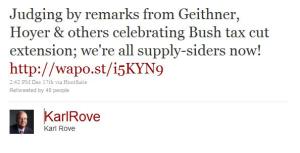
America is on a collision course with itself. This month’s deal between President Barack Obama and the Republicans in Congress to extend the tax cuts initiated a decade ago by President George W. Bush is being hailed as the start of a new bipartisan consensus. I believe, instead, that it is a false truce in what will become a pitched battle for the soul of American politics.
As in many countries, conflicts over public morality and national strategy come down to questions of money. In the United States, this is truer than ever. The US is running an annual budget deficit of around $1 trillion, which may widen further as a result of the new tax agreement. This level of annual borrowing is far too high for comfort. It must be cut, but how?
The problem is America’s corrupted politics and loss of civic morality. One political party, the Republicans, stands for little except tax cuts, which they place above any other goal. The Democrats have a bit wider set of interests, including support for health care, education, training, and infrastructure. But, like the Republicans, the Democrats, too, are keen to shower tax cuts on their major campaign contributors, predominantly rich Americans.
The result is a dangerous paradox. The US budget deficit is enormous and unsustainable. The poor are squeezed by cuts in social programs and a weak job market. One in eight Americans depends on Food Stamps to eat. Yet, despite these circumstances, one political party wants to gut tax revenues altogether, and the other is easily dragged along, against its better instincts, out of concern for keeping its rich contributors happy.
This tax-cutting frenzy comes, incredibly, after three decades of elite fiscal rule in the US that has favored the rich and powerful. Since Ronald Reagan became President in 1981, America’s budget system has been geared to supporting the accumulation of vast wealth at the top of the income distribution. Amazingly, the richest 1% of American households now has a higher net worth than the bottom 90%. The annual income of the richest 12,000 households is greater than that of the poorest 24 million households.
Please go read the rest of the article. I think this shows further evidence that Obama didn’t placate liberal economists.
Empowering a Failed Hypothesis
Posted: December 20, 2010 Filed under: Global Financial Crisis, The Great Recession, U.S. Economy, WE TOLD THEM SO | Tags: Allan Blinder, joseph stiglitz, Paul Krugman, Perversions of economics, Reaganomics, START TREATY, Supply Side Economic hypothesis 58 Comments One of my neighbors is a public defender who is a New Orleanian by birth and fits all the standard eccentricities of New Orleanians. He spent some time in the Navy during the Vietnam period. Now my friend is very liberal, but one of his buddies from the Navy time that visits frequently is not. The buddy lives in rural Washington state and teaches in a small college there. How he every managed to get a gig teaching economics with just an MBA still boggles my mind, but that is the deal. When you do a stint in actual economics–not just managerial economics and your basic theory classes–you spend a lot of time proving theoretical models. By the time you get farther in a program and have completed your first few econometrics courses, you’re taught how to empirically validate or destroy other folk’s academic work and their models.
One of the easiest groups of hypotheses to shoot down empirically came from the Reagan years. The results were pretty astounding–we would call that highly significant to what ever statistic was used–so much that David Stockman and Bruce Bartlett gave those hypotheses up rather quickly and they were key architects of the Reagan Economic Revolution. You can’t find a’ conservative’ economist in the sense of Reaganomics unless it’s one at the Heritage Foundation that is paid to deliberately ignore the facts. In which case, that explains why they’re no place else BUT the Heritage Foundation.
Or they’re like my friend’s buddy who still goes back to the 1980s and pulls out old articles about things like the Laffer curve and teaches it because he wants to show all “opinions”. That’s what he says to me any way, when I ask him why he teaches a failed hypothesis. Frankly, he teaches it because he wants others to share his hopes and wishes that the silly thing is true. Because he’s not had the rigorous training to prepare to do actual economics, he just teaches want he wants to teach. He also hasn’t gone through publish or perish where you don’t get to have opinions without peer-reviewed facts. This drives me nuts. You can’t teach theory or empirical evidence or the scientific approach by clinging to a failed hypothesis. This makes you an intellectual flat earther.
What we currently have right now is a president that is giving the Flat Earth Society the primary voice in NASA policy and funding when it comes to economic policy. Paul Krugman has an op-ed from this weekend that firmly states that Obama has empowered the economics version of the Flat Earth Society. His op ed is called ‘When Zombies Win.’ It’s exactly what needs to be said.
First, the original Obama stimulus plan was anything but text book Keynesian economics and can’t be seen as a way to shout fail on Keynesian theory. It was more based in Reagan philosophy and those failed hypotheses than any neoKeynsian model. While I’ve continually called the Supply Side wishful thinking as a failed hypothesis, Krugman is more direct. He refers to it as failed doctrine.
For the fact is that the Obama stimulus — which itself was almost 40 percent tax cuts — was far too cautious to turn the economy around. And that’s not 20-20 hindsight: many economists, myself included, warned from the beginning that the plan was grossly inadequate. Put it this way: A policy under which government employment actually fell, under which government spending on goods and services grew more slowly than during the Bush years, hardly constitutes a test of Keynesian economics.
Now, maybe it wasn’t possible for President Obama to get more in the face of Congressional skepticism about government. But even if that’s true, it only demonstrates the continuing hold of a failed doctrine over our politics.
I wrote repeatedly at the time–no Nobel winning economist am I either–that the stimulus was bound to be way too little to be of any use. You can read me screaming ‘Tax Cuts Don’t Cut It or Cure It’ from January 2006, 2009 where I quote John Mishell’s study that talks about how the Bush tax cuts didn’t grow jobs and didn’t grow the economy. As a matter of fact I have many posts up along that line. Here’s one covering the FT’s Martin Wolf where I talk about the same thing and it’s even called ‘Still Too Little and WAY TOO Republican” from January 17, 2009. You can search my archives during that time period and find I’m very consistent at writing how the Obama stimulus would fail and that it was primarily because it was based on tax cuts.
It’s really quite a logical situation and one the most flawed precepts sits right there in the Obama-McConnell tax travesty. There’s a huge tax write off in the bill for companies buying new equipment. This is something completely ineffective because it just helps the few companies that would’ve done that any way. The majority of companies are hurting for customers. No amount of tax write offs for equipment or even employees is going to make them expand if they don’t have customers or revenue. In fact, my guess will be that an academic study some where down the line will show that the majority of those tax cuts were used by corporations who expanded in emerging markets instead of here. That’s because that’s where the inflation, growth and action is and there’s nothing in the bill that says tax benefits stay here.
Krugman also talks about something I spoke to recently in that nearly every Republican put in charge of some committee dealing with some aspect of the economy is so far out there on doctrine and short on economic theory and evidence that we’re bound to see more of the same stuff that tanked us the last time out. The Republicans sitting on the Financial Crisis panel just put out their financial version of the Earth is Flat manual last week. They said it was too much regulation which is pretty much the exact opposite of everything that every empirical study has shown us. Here’s one I keep pushing called “Slapped in the Face by the Invisible Hand” because it’s nontechnical in nature. Krugman called the release of the document ‘Wall Street Whitewash’.
So, Krugman’s op ed from this weekend isn’t astounding in that we all know what neoKeynisans like Stiglitz, and Blinder, Sachs and Krugman have been saying for months now. Now that I’ve read BB’s morning links, I’m even getting a better feel for the source of my weekend wonderment on Krugman’s bottom line. Krugman was one of a group called before the President in an attempt to get them to STFU. The deal is this. The Nobel Peace Prize may now be given on an ‘aspirational’ basis, but the Nobel Prize for economics is not. Stiglitz and Krugman earned their Nobel Prizes. I admit to having empirically tested some of Blinder’s models doing my first Masters in Economics so I’m very familiar with his contributions to the literature. These economists live in a world of peer review where there’s a very dim view of people who cling to failed hypotheses.
So, here’s the wonderment from Krugman’s December 19, 2010 op-ed.
President Obama, by contrast, has consistently tried to reach across the aisle by lending cover to right-wing myths. He has praised Reagan for restoring American dynamism (when was the last time you heard a Republican praising F.D.R.?), adopted G.O.P. rhetoric about the need for the government to tighten its belt even in the face of recession, offered symbolic freezes on spending and federal wages.
None of this stopped the right from denouncing him as a socialist. But it helped empower bad ideas, in ways that can do quite immediate harm. Right now Mr. Obama is hailing the tax-cut deal as a boost to the economy — but Republicans are already talking about spending cuts that would offset any positive effects from the deal. And how effectively can he oppose these demands, when he himself has embraced the rhetoric of belt-tightening?
Yes, politics is the art of the possible. We all understand the need to deal with one’s political enemies. But it’s one thing to make deals to advance your goals; it’s another to open the door to zombie ideas. When you do that, the zombies end up eating your brain — and quite possibly your economy too.
What is even more significant is that this horrible tax bill was put forward so as not to stall things like START. So, what is the status of the START Treaty and the Republicans who said they’d play ball if the Tax Cuts for Billionaires program was passed. Has this eased the hostage crisis?
Well, the vote is supposed to be held tomorrow so we shall see. But, this is quote is fresh from the AFP 4 hours ago from the moment I’ve hit the publish button.
Democrats expressed astonishment that top Republicans continued to oppose ratification when virtually every present and past foreign policy or national security heavyweight backed the move, regardless of their political stripes.
In that same announcement, Mitch McConnell was quoted as saying he’d vote against it the ratification. So is John Kyl. Collin Powell and Condoleeza Rice support the ratification of this treaty. This is what you get when you negotiate with terrorists; domestic or otherwise.
This President has consistently used the failed dogma of Reaganomics in economic policy. It makes no difference if the wackiest of the right wing say he is a socialist. The evidence clearly points to his obsession with failed tax cut dogma. I don’t know if his reasons are political or if–deep down–he is a Republican in Democrat Clothing. All I know is that we can no longer empower a failed hypothesis. I certainly hope that Michael Hirsch’s list of ‘Disillusionati’ continue to expose this economic policy for what it really is.
UPDATE via commenter waldenpond at TL.
File this under we told you so,
love, the Sky Dancing Cassandras

 peej
peej Carissa
 bostonboomer
 dakinikat
 ecocatwoman
 mablue2
 Mama Lopez
 peggysue22
 quixote
 skydancingguestblogger
 Mona (aka Wonk the Vote)



 Sky Dancing
Recent Comments