
Mostly Monday Reads: Trump brings back the Red Scare and Colonialism
Posted: August 10, 2026 Filed under: #FARTUS, #MAGAnomics, #We are so Fucked, 2026 Elections, Delegalization, New American Colonialism, New Red Scare | Tags: Delegalization, John (repeat1968) Buss @johnbuss.bsky.social, National Parks, Republican Red Scare, Taxpayer money to Trump Projects, Trump-related Oil Company and Greenland 11 Comments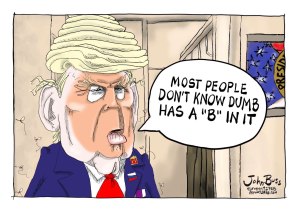
“I’ve been called a dumb motherf*ker by MAGA over 6,000 times in the last 24 hours. Every comment and message spelled it with a b. I think President Trump lied to us. Yesterday’s cartoon has over 20,000 replies if you think I’m exaggerating.” John Buss, @repeat1968 (dkat: this is the cartoon)
Good Day, Sky Dancers!
As we close in on the midterms, the country’s political landscape couldn’t be crazier if it tried. You would think that a “mature” democracy could rise to discourse above name-calling and jingoism. If you can’t run on the progress you’ve made, then I guess that’s all that’s left to you. You also need a lot of jazz hands to cover up what’s really going on. The two top headlines for me today should be beyond belief, but remember how so much of this has managed to push the Iran/Israeli/USA War off the front pages.
This first article is from The Guardian, which has been my go-to newspaper since high school. “Greenland issues ‘strong warning’ as Trump-linked oil firm prepares to drill. Island’s government says no approval given after Greenland Energy brings kit ashore for exploratory drilling.”
An American oil company connected to Donald Trump is preparing to sink wells in remote Greenland despite not having received permission from the local authorities.
As the US president renews his threats to claim the vast Arctic territory, materials to prepare for drilling were brought ashore in recent days on Greenland’s eastern coast.
That has prompted Greenland’s government to issue a “strong warning” that no approval had been granted to land the kit. “All future logistical matters must be advised and approved by the mineral resources authority – before they are carried out,” the government said in a statement.
Two days later, Trump made his latest menacing post on Truth Social, showing himself looming over a Greenlandic village.
Executives of Greenland Energy, a Texas company set up last year, have claimed that $1tn of crude may lie beneath the Jameson Land region. They announced plans to spend $60m drilling two wells to find out.
Although Greenland stopped issuing new oil licences in 2021 on environmental grounds, a UK company called 80 Mile had secured exploration rights in Jameson Land. Greenland Energy’s corporate filings say it will take a majority stake in the project in exchange for funding the exploration, though it still needs government permission to proceed.
Greenland Energy has retained Phil McGraw, better known as Dr Phil, a prominent rightwing former chatshow host who served on Trump’s religious freedom commission, to make a documentary series that will “capture the mission of these modern-day wildcatters”.
It has also appointed as a director a US navy veteran who is working on Golden Dome, the missile defence plan for which Trump says controlling Greenland is “vital”.
Larry Swets, Greenland Energy’s chair and a big shareholder, appears to enjoy access to Trump’s circle. He has said the oil project is “not related to American annexation”.
After a company representative falsely claimed at a Jameson Land community meeting in June that it had permission to land drilling equipment, Swets said: “Our enthusiasm for the project led us to communicate in a way that created confusion.”
But the next month, local people in the sparsely populated region noticed a tug pulling a barge shorewards and unloading a dozen containers. “The goal was to get the equipment onshore at Nunap Qeqqa [Jameson Land] in connection with planned oil exploration drilling,” the Greenland government’s statement said.
The Danish investigative outlet Danwatch quoted the head of the shipping company as confirming the delivery was for Greenland Energy.
Greenland Energy has declined to respond to questions from the Guardian. A letter it sent to shareholders on Thursday said: “Recent high-level meetings between project leadership and Greenlandic regulatory and oversight authorities have been constructive, and we continue to be encouraged by the progress being made toward the remaining approvals required for drilling.” It said that after those discussions, just one well would be drilled to begin with.
 There’s a lot more at the link if you’re interested. As I mentioned before, the campaign mood this year is peak mud slinging. This Rex Hupke Op-Ed at USA Today sums it up well. We’re not only into colonialism these days, but we’re also seeing the Red Scare tactics. I can’t imagine this appealing to anyone under 80, but who knows these days? “Democratic extremism? GOP spent a decade riding extremism to power. Republicans have spent the past decade worshiping the most extreme president in our nation’s history, a man with an almost impossibly long history of loathsome behavior and malicious dishonesty.”
Between now and the midterm elections, and probably well beyond that, you’ll hear endless chatter about “Democratic extremism,” and it will be Hilarious with a capital “H,” because it will all come from the mouths of Republicans.
“The Democrats want to destroy America!” they’ll holler.
“The Democrats are all socialists!” they’ll rail, unable to define socialism if their lives depended on it.
“No, better yet,” they’ll scream, veins bulging in their furrowed brows, “the Democrats are COMMUNISTS!!”
Oh my, the horror! Someone pull up my fainting chair, I seem to have caught the vapors!
Let’s put this nonsensical rhetoric to bed right now. Republicans have spent the past decade worshiping the most extreme president in our nation’s history, a man with an almost impossibly long history of loathsome behavior and malicious dishonesty. While doing so, they have embraced some of the most extreme political views and policies imaginable, shattering political norms and leveraging hate and division to gain power.
GOP lawmakers rallied behind a fight to do away with birthright citizenship. They have unapologetically supported federal immigration agents who shot and killed innocent Americans while also working to deport U.S. citizens and ripping apart communities across the country.
They allowed Elon Musk, a childish unelected billionaire with no knowledge of how our government works, to come along and gut the federal workforce.
They have confirmed wildly unqualified Cabinet officials like Robert F. Kennedy Jr., nominated because he endorsed Donald Trump during the 2024 presidential campaign, and watched as he spread dangerous anti-vaccine misinformation and eliminated key jobs in the U.S. Department of Health and Human Services.
Already this year, under Kennedy’s leadership, measles cases in America have hit a 35-year high.
Reelecting Donald Trump was about as extreme as it gets
 There’s plenty more where that comes from at the link. Scott McFarland, writing at his SubStack Scott MacFarlane Reports, has the headline: “Trump Turns National Parks into Piggybank, Cutbacks and Setbacks Hammer America’s National Parks in the Shadow of Trump’s Vanity Projects.”
There are enormous canyons.
Geysers.
Majestic cliffs.
Waterfalls and wildlife.
Rainforests and reindeer.
But in America’s national parks under President Trump, the most dramatic sight might be the rapid shifting of taxpayer and donor money.
Internal park service records obtained by Scott MacFarlane Reports reveal a controversial and overwhelming re-routing of money to Trump vanity projects.
The topline dollar figures are astounding, according to multiple sources inside the US Department of Interior, who requested anonymity because they are not authorized to speak to news media.
The records show more than $323 million have been made available for upgrades and projects on the White House grounds this year.
That’s a dramatic, nearly 5000 percent increase from the $7.5 million spent on White House grounds projects in 2024.
On the National Mall in Washington, nearly $100 million was made available for projects this year. That’s more than ten times larger than the $9 million provided for the Mall in 2024.
The internal park service records show declines in the money allotted to – or projected for use at – dozens of other major U.S. parks this year. There were multi-million dollar reductions in funds for Yellowstone, Yosemite and Grand Canyon national parks, which are some of the flagship attractions of America’s National Park Service.
“The National Park Service is being used as a piggy bank for Trump’s vanity projects,” said Tim Whitehouse, executive director of the nonprofit Public Employees for Environmental Responsibility, which advocates on behalf of current and former parks employees. Whitehouse said, “The National Parks Service and the Department of Interior are giving Trump all of the money that he wants.”
The shifting of funds slows – or delays – a range of projects big and small at National Park facilities, while expediting work on Trump’s pet projects in Washington, D.C.
“That’s costing the American people,” Whitehouse said, “That’s hurting the rest of our country.”
 There’s so much bad policy and actions coming from Orange Caligula’s orders and policies that the press doesn’t appear to be able to keep up with it. I just recently read an article on the delegalization. This is a racist, xenophobic move by the Trump administration to remove immigrants here legally from the country. This is from Mother Jones. It’s from last fall, but the article I tried to read about the current situation with Haitians was behind a paywall at The New Yorker. I was unaware of what was going on. Again, we need a lot more people reporting on these pogroms. This is the headline from Isabela Dias’ reporting. “Trump Is Making Thousands of Rule-Abiding Immigrants Undocumented. Inside the largest delegalization campaign in modern US history.”
Nathaly Maestre has tried to follow her doctors’ instructions to the letter. Her obstetrician and perinatologist were clear: At 40, eight months into a high-risk pregnancy, and after a miscarriage last year, she has to avoid unnecessary stress.
But that has become impossible. In May, the Supreme Court cleared the way for the Trump administration to strip temporary legal protection from hundreds of thousands of Venezuelans living in the United States. Overnight, Maestre and her partner, Luis Guillermo, found themselves without status—despite following all the rules.
“You try not to think so much about what’s happening outside,” Maestre told me in Spanish, her voice breaking. But it is hard “with all these sudden, abrupt changes.”
Fleeing persecution from pro-government militias in Venezuela, Maestre and Luis Guillermo came to the United States on tourist visas in September 2021 and later applied for asylum. In the fall of 2023, another option became available: Temporary Protected Status, or TPS. This stopgap shield from deportation for people who cannot safely return to their countries of origin because of armed conflicts, natural disasters, or other extraordinary circumstances has protected roughly 600,000 Venezuelans—until now.
President Donald Trump’s termination of TPS for Venezuelans is part of the largest delegalization campaign in modern US history. “A single act of stripping immigration status in one fell swoop,” said Ahilan Arulanantham, an attorney with the UCLA Center for Immigration Law and Policy representing TPS holders in a lawsuit against the government. The plan, he added, is central to the administration’s mass deportation goals as it scrambles to scale up US Immigration and Customs Enforcement arrests to an improbable 3,000 a day. “This is a community that has recently provided information to the government about their whereabouts, rendering them all vulnerable to deportation, [which] gives the government the opportunity to go after a lot of them—very quickly.”
Adelys Ferro, executive director of the Venezuelan-American Caucus, has received thousands of messages from Venezuelans who have lost status under Trump, wondering what to do. Some have had panic attacks. Many lack travel documents because they can’t simply go to a nearby Venezuelan consulate and renew an expired passport—all services have been paused since 2023. “You have a whole community feeling hunted,” she said, “feeling persecuted all over again.”
Again, please read more at the link. And I hate to be the bearer of Fox News, but this is today’s headline on that subject. “US State Department has yanked more than 175k visas under Trump administration so far. ‘The majority of these visas were revoked due to law enforcement encounters for a range of criminal activity… ‘ the department noted.” Yeah, right, I believe that. I’m not actually going to print any of the story or show the film, because it’s the usual bugaboo stereotype. I’m certain a more reasonable analysis of the data will come later from other sources. Or at least I hope so.
Well, that’s all I can stand to talk about today.
What’s on your Reading, Action, and Blogging list today?
Please VOTE when it’s your turn!
Finally Friday Reads: Trump’s latest Bugaboo
Posted: August 7, 2026 Filed under: #FARTUS, #MAGAnomics, #We are so Fucked, Are we a democracy?, Climate change, corporate greed | Tags: "birth tourism", @johnbuss.bsky.social John Buss, and Peace in the Gulf, Clean Energy Initiatives, Killing Foreign Aid, Todd Blanche 4 Comments
“Went grocery shopping yesterday for a few things, came home, and started drawing this. The Golden Age, BWAHAHAHA!” John Buss, @repeat1968
Good Day, Sky Dancers!
Orange Caligula must still have a lot of childhood nightmares still floating around his brain because he sure finds a lot of monsters under his bed to turn into political talking points and policy nonsense. Case in point, the weirdness that has started around what defines American citizenship since the Roberts court, since the majority didn’t buy his reasoning back in June. The new bugbear is “birth tourism.”
So, the way I understand it, the poor huddled masses yearning to be free have enough bucks to enter the country on jetliners and just hang around in hotels until they get themselves a baby, like the baby has anything to do with this start out with. Sigh. This nonsense comes from a man whose 4 out of 5 of his children are so-called anchor babies. So, what does this mean for Baron’s ascension to the White House? Have we ever totally figured out Melania’s road to citizenship?
Here’s a more reasoned line of analysis from the LA Times. “After Supreme Court loss, Trump again targets birthright citizenship with new orders.” Kevin Rector has the lede.
President Trump targeted birthright citizenship again Thursday by signing a pair of executive orders purporting to narrow it — including by cracking down on “birth tourism” and limiting which children born to immigrants in the U.S. qualify.
The new orders follow a U.S. Supreme Court ruling in June that rejected an attempt by Trump to end birthright citizenship outright.
During a signing ceremony in the Oval Office, Trump called that decision by the high court “very unfair” and said the new orders were an attempt to end birthright citizenship by other means.
“Our country suffers because of it, and we’re ending it a different way,” he said.
Trump promised “big crackdowns” on birth tourism, or the practice of pregnant foreign mothers coming to the United States, or foreign fathers using surrogates already in the U.S., specifically to ensure their children receive U.S. citizenship.
Trump said an entire industry has been built up around the practice, turning birthright citizenship into “a joke.”
“Wealthy people are building businesses around birthright citizenship. That’s not the way it’s supposed to work. It’s a disgrace,” he said. “They’re buying their way in, and we’re not going to let it happen.”
The orders were immediately criticized by proponents of birthright citizenship as an indefensible attempt by the president and his administration to make an end run around the Supreme Court’s clear finding that the 14th Amendment to the U.S. Constitution cannot be undone by the president.
 This is ridiculous, and it’s not going to take a lot of folks’minds off day-to-day living expenses. Also, what about the escalation of that nonsense war you started with Israel? And speaking of foreign affairs, ProPublica‘s Anna Maria Barry-Jester and Sharon Lerner follow the money that’s supposed to go to foreign aid projects as provided by Congress. It seems Trump might be reallocating to things he considers more appropriate. “What Is the Trump Administration Doing With Foreign Aid Money? The billions of dollars Congress has allocated for foreign aid programs must be spent. One proposal from the Trump administration suggested funding research on crime against Afrikaners in South Africa.”
Since he returned to office, President Donald Trump’s administration has upended foreign aid. It’s labeled well-established, long-running programs as “not aligned with American interests” and slashed their budgets.
Still, the billions of taxpayer dollars Congress has allocated for foreign aid programs must be spent; lawmakers have insisted the government continue to fund humanitarian aid, global health and pro-democracy causes around the world. With most of the old programs now gone, however, we wanted to know: What is the Trump administration doing with that money now?
Recently, we published our investigation that found one answer to that question in a little-known bureau of the State Department that has dramatically transformed under Trump. For decades, the Bureau of Democracy, Human Rights and Labor, known as DRL, has supported human rights in some of the most oppressive countries in the world. Now, our reporting found, it’s planning to direct funds to controversial groups supporting right-wing causes in Europe and elsewhere.
Our full story lays out some of the groups the government has considered funding, which include a British free-speech organization that has fought against bans on “gay conversion therapy” and a British American think tank created this year to focus on “existential threats to Britain, to America, and to our shared Judeo-Christian civilisation.” (Administration officials dropped that grant after significant pushback from Congress.)
One proposed grant particularly caught our attention: Trump administration officials suggested funding research on crime against minority populations in South Africa.
It’s clear from sources we spoke with that the key targeted minority population in question is the white ethnic group known as Afrikaners. Afrikaners were responsible for creating the nation’s infamous and brutal racially segregated apartheid system. Previously, DRL staff had been told to begin the process of awarding funds to a group called Lex Libertas, which was founded by a controversial figure who has called for Afrikaner self-governance. The group is currently fundraising to place 3,000 white crosses on the National Mall in remembrance of attacks on South African farmers.
 As usual, Trump’s biggest bugbear is people of color. It amazes me that Congress just can’t (or won’t) figure out a way to stop this. We’ve have breaking news today that Todd Blanche will be the next AG. Once again, Senator Bill Cassiday, Lousyana, has folded. Any chance of doing the right thing just is not possible for him. This is from the
 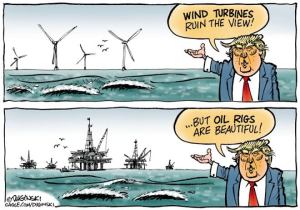 We lose again, as Steve Benen explains the latest attack on renewable energy in the
  And it’s not like the business sector does us any favors either. Take a look at this
 Mostly Monday Reads: SAVE Shennanigans
Posted: July 27, 2026 Filed under: #FARTUS, #MAGAnomics, #We are so Fucked, 2026 FIFA, 2026 SCOTUS Decisions, Republican politics, U.S. Politics | Tags: @johnbuss.bsky.social John Buss, Deadly US Boat Strikes, Greedy Corporate Amazon and Walmart, It's too darn hot!, SAVE Act, Senate Majority Leader John Thune, Senator John Kennedy 7 Comments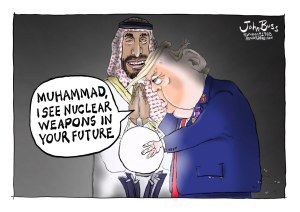
“It’s incredible watching Donald The Prophet profiting.” John Buss, @repeat1968
Good Day, Sky Dancers!
The headlines today are full of failed policies. Orange Caligula hasn’t quite found a distraction to take the voters’ minds off everything he’s done this term. We have a failed war and an economy choked by inflation. His main focus is on rigging the election and disenfranchising minority voters and women. He’s been after Senator John Thune to get his SAVE Act passed. However, the more people know about it, the less they like it. So, it’s time to start lighting up your Congressional Critters’ phones.
This is the headline from Politico‘s Jordain Carney. “Trump tells Thune to keep Senate in session to pass SAVE America Act. The president also again urged the Senate GOP leader to nix the filibuster.” Republicans are always keen on the filibuster until it’s used against them.
President Donald Trump ramped up pressure Monday on Majority Leader John Thune, telling him to keep the Senate in session until a GOP election bill passes.
“John Thune should not allow the United States Senate to ‘leave town’ until it passes The Save America Act or, far better still, TERMINATES THE FILIBUSTER, where Republicans can then quickly pass everything they ever dreamed of,” Trump wrote in a Truth Social post Monday.
Democrats, he added, will nix the filibuster themselves when they regain power “and can’t believe how lucky they got with this Senate leadership. Remember, stupidity always brings LOSING & DEATH!”
Trump’s Truth Social post comes after he urged supporters last week to call Thune about the SAVE America Act, then said Friday that he wanted Senate Republicans to adopt a blueprint for a $95 billion party-line spending bill, which would include some election-related funding, before they leave town for the August recess as planned on Aug. 6.
Sens. Mike Lee (R-Utah) and Rick Scott (R-Fla.) said over the weekend that they believed the Senate should stay in town until the election bill is passed. Lee has previously called for the Senate to stay in session through prior recesses to pass the SAVE America Act but has not forced the issue on the floor.
Despite Trump’s pressure campaign, the elections bill doesn’t have the votes to pass the Senate and there isn’t enough support within the Senate Republican conference for nixing the filibuster, which requires 60 votes for most legislation to advance.
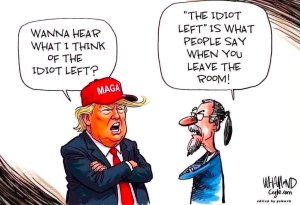 When Trump says he has a dream, it’s basically to ensure Black Americans can’t get to the polls. There’s no better time than this midterm to turn out and punch that voting machine selection with your middle finger. This analysis at The Hill has part of the explanation why Republican Senators can’t find their spines to buck the MAGA agenda. Alexander Bolten has the lede.
Senate conservatives, led by Sen. Mike Lee (R-Utah), are calling on Senate Majority Leader John Thune
(R-S.D.) to cancel the August recess so they can debate the Safeguard American Voter Eligibility (SAVE America) Act, a sweeping election reform bill that President Trump has made his No. 1 legislative priority.
Lee warned in a social media post to Thune last week that he would “object to any effort to put the Senate into recess in August — at least until such time as the Senate has passed the SAVE America Act” and requested a roll call vote to adjourn the Senate for five weeks over most of August and early September.
Sen. Ashley Moody (R-Fla.), who’s up for reelection in November, said she would prefer to stay in Washington in August instead of returning to her home state for an extended period to meet with constituents.
“I didn’t come to the United States Senate because I needed something to do. I’m serving because there are things we need to get done for the American People. The Senate needs to stay in session until we can get the SAVE America Act to the floor and passed,” Moody posted on X.
Sen. Jim Banks (R-Ind.), another Trump ally, said he’s ready to cancel the five-week recess to debate the SAVE America Act, which has already failed several times on the Senate floor.
“I’m all for it. We don’t need a recess. Let’s pass the Save America Act. It’s more important than taking a break, taking a recess,” Banks told Fox News.
“I’m back in Indiana for the weekend, I head back to Washington tomorrow. I’ve heard from people everywhere I go, from the diner this morning to the grocery store, ‘Pass the SAVE America Act.’ We have to get it done,” he said.
The Senate has already spent several weeks of floor time debating the SAVE America Act, which would require people to show documented proof of citizenship when registering to vote and show photo identification when voting, and it would restrict mail-in ballots.
 Down here in the yahoo state, we have Senator Kennedy to go all Hee-Haw on us. Samuel Chamberlin has this headline (deep breath) from the New York Post. “GOP Sen. John Kennedy warns John Thune is ‘being too cautious’ as Trump agenda hangs in the balance.
Senate Majority Leader John Thune (R-SD) needs to get to work on passing the rest of President Trump’s agenda with fewer than 100 days to go before the midterm elections, a key member of the GOP’s rank-and-file warned Sunday.
“Look, I mean no disrespect. I love John Thune. He’s my leader. He’s got a big brain. He’s better looking than me, but I think he’s just being too cautious,” Sen. John Kennedy (R-La.) told CBS News’ “Face The Nation,” adding that the majority leader “wants to spend the rest of our time talking with [Senate Minority Leader Chuck] Schumer about shutting down government, and the Graham Platner wing of the [Democratic] party is, his party, is not going to let Schumer agree with us.
“They already want to give Schumer a bathrobe, a Popsicle, and an early bedtime, and have him retire. I don’t think Chuck can agree with us,” Kennedy predicted. “I think he’s going to shut down government.”
“We need to put the, the House budget resolution on the floor,” Kennedy told host Margaret Brennan. “It’s the only chance we have to get money to defense, the farmers, and to take another crack at the SAVE Act. We need to add Iran to the [Lindsey] Graham Russian sanctions bill and vote on it. We need to put the cryptocurrency market structure bill on the floor and vote on it.”
Before leaving for its August recess last week, the House of Representatives passed a stopgap measure that would fund the government until Dec. 4. Some Senate Republicans, including Kennedy, want to tack the Trump-endorsed SAVE America Act, which would require Americans to show proof of citizenship before registering to vote and provide photo identification before casting a ballot, onto the budget resolution.
Currently, a shutdown is set to begin at 11:59 p.m. ET Sept. 30.
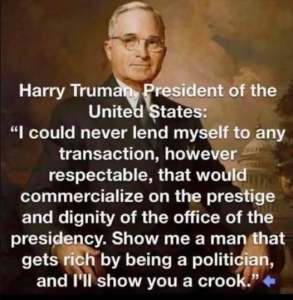 It’s amazing how people with perfectly good educations and seemingly functional minds can go all bat shit crazy when they get themselves elected/appointed to anything within the Beltway. I’ve been around here long enough to remember when Foghorn Leghorn was a member of the Democratic Party. He switched parties in August 2007.
Meanwhile, we’ve finally uncovered a bit more truthiness from our human cost in Trump’s war against Fishing Boats. (Psst, have you sent the FBI to your sons, Orange Caligula, if you really want a successful coke bust? This is from the Washington Post. “Deadly U.S. boat strikes have failed to curb cocaine supply, Pentagon and DEA officials say. The president says Operation Southern Spear has virtually ended drug trafficking by sea. Pentagon and DEA analysts have concluded otherwise.”
The Trump administration’s deadly military strikes on alleged drug trafficking boats have not reduced the amount of cocaine entering the United States, but they’re prompting criminal organizations to develop new strategies and tactics and undermining traditional investigative methods, according to a previously unreported assessment by the Drug Enforcement Administration, a closed-door congressional briefing and interviews with current and former U.S. and foreign officials.
In a recent assessment reviewed by The Washington Post, DEA analysts found the strikes had failed to affect the supply or price of cocaine in the United States and had led traffickers to diversify beyond go-fast boats and to avoid international waters, opting instead for larger boats and hemming close to coastlines, where U.S. forces are less likely to open fire. In a closed-door briefing last month, Pentagon officials told lawmakers the strikes in international waters off South and Central America had not reduced its purity.
Traffickers are also relying more on aircraft, which take off from clandestine airstrips along the Colombian-Venezuelan border and head east to Guyana and Suriname to avoid U.S. forces, according to the DEA assessment.
“When you squeeze the balloon on one side, it always expands on the other side,” one DEA official told The Post. “They always find the weak spots and exploit them.” The official spoke on the condition of anonymity because they were not authorized to discuss it publicly.
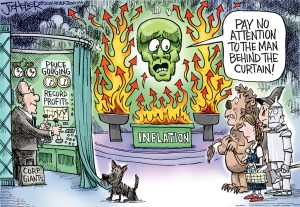 Meanwhile, giant corporations are getting rich at what they do best. As usual, they’re cutting costs by denying their workers a living wage, so those workers must rely on public assistance. This strategy is one of America’s worst legacies. This is from Popular Information. Judd Legum has the story.
American taxpayers are spending billions every year providing Medicaid benefits to hundreds of thousands of employees of Amazon and Walmart, a new analysis by Popular Information reveals.
Amazon and Walmart are two of the largest and most profitable companies in the country — collectively generating $100 billion in profits in 2025 — but many of their employees still qualify for Medicaid because their take-home pay hovers around (or below) the poverty line.
As taxpayers keep their workers afloat, the wealth of the two companies’ largest shareholders is increasing exponentially. The Walton family, the largest shareholders of Walmart, saw their collective wealth increase from $238 billion in 2021 to $513 billion at the end of 2025. Meanwhile, Amazon founder and current executive chairman Jeff Bezos saw his net worth increase from $187 billion to $255 billion over roughly the same time period.
Popular Information calculated the public subsidy to Amazon and Walmart by cross-referencing several publicly available data sources. Last week, the Government Accountability Office (GAO) released a report examining the top 25 employers of Medicaid enrollees in six states: Georgia, Indiana, Maine, Massachusetts, Oklahoma, and Rhode Island. This provided state-level Medicaid enrollment for Amazon and Walmart workers in all six states, with the exception of Amazon in Maine.
Popular Information compared these figures to the total number of employees working for Walmart and Amazon in each state, sourced from company disclosures, to establish an average Medicaid enrollment rate for each company. The average Medicaid enrollment rate was then used to establish an estimated Medicaid enrollment for employees of each company in the remaining states.
Finally, the estimated number of employees receiving Medicaid in each state was multiplied by that state’s average annual cost of a non-elderly, non-disabled Medicaid enrollee, as published by the Medicaid and CHIP Payment and Access Commission (MACPAC).https://www.theguardian.com/us-news/2026/jul/26/us-heat-wave-dome-weather
Using this methodology, Popular Information estimates that, nationwide, over 156,000 Walmart employees are enrolled in Medicaid at an annual cost to taxpayers of approximately $1.04 billion.
Of course, you can read more at the links. The weather all over the country continues to break records and be miserable. I hope you’re managing to avoid the worst of it. I’ve developed a keen fashion sense that includes cotton under shirts and cut-off jeans, accentuated by bare feet. I can’t make iced tea fast enough, nor can I keep the animals’ water bowls filled with water and a few ice cubes. This article from The Guardian shows the widespread phenomenon. JJ and I are under a “heatwave dome.” BB sent me her forecast, which really is wild. “Super El Niño Could Combine With Rare Atlantic Niña: See MA Impacts.”
What’s on your Reading, Action, and Blogging list today?
Mostly Monday Reads: Late Edition
Posted: July 20, 2026 Filed under: #We are so Fucked, 2026 Elections, 2026 FIFA, 2026 MidTerm elections, Freedom Fuel Trump Grift, Tropical Storm Bertha | Tags: @johnbuss.bsky.social, American Soldiers killed in Iraq-US War, Donald Trump Sports Curse, FIFA 2026, FIFA World Cup, Freedom Fuel Grift, Lebanon, Tropical Storm Bertha, US Military KIA and wounded from Iran-Israeli-USA War 11 Comments
“This is how America is Made Great Again!” John Buss, @repeat1968
Good Day, Sky Dancers!
I have to apologize for the delay in this post. Between trying to prepare for a tropical system, getting my Wi-Fi updated, and needing lots of sleep, I slept most of the morning. I upgraded my old wifi modem and doubled its capacity to 2 gig. I’m hoping the lag and sudden short downtimes go away. It’s always something.
I hate to have that Déjà vu feeling about Vietnam and all the Gulf Wars we’ve entangled ourselves in, but I do. This headline from the New York Times brings about everything I’ve felt about all the unnecessary wars we’ve had since the Korean War. “Pentagon Withheld Dozens of U.S. Military Injuries in Iran War. Central Command is not required to release information about injured troops, especially when they quickly return to duty, a military official said.” Eric Schmitt has the story.
In the week leading up to the Iranian attack on Friday that killed two U.S. soldiers and left one service member missing in Jordan, Iran carried out three other strikes against U.S. forces in the country.
Those attacks injured dozens of U.S. service members and damaged several helicopters, according to several U.S. officials, who spoke on the condition of anonymity to discuss operational matters.
But the Pentagon did not disclose the earlier strikes, nor the casualties and damage they inflicted.
The episode is the latest example during the Iran conflict of the tension between what the Pentagon says is the need for operational security and the government’s obligation to inform the public about the conduct of the war.
Moreover, another U.S. military official added, why would the Pentagon divulge information that could help Iran zero in on its deadly ballistic missiles and drone attacks in Jordan and other bases in the Middle East where thousands of American troops are stationed?
Central Command has also stopped announcing how many sit.
 Meanwhile, Trump is in full saber-rattling mode. This is from The Guardian. “Trump says Iran ‘will pay’ for killing soldiers ‘many times over’ after Pezeshkian says country fighting ‘full-scale war’ – Middle East crisis live.” Some how the word ‘crisis’ seems like a supreme understatement.
The US president wrote on Truth Social:
Every time Iran kills an American Soldier they will pay for that killing many times over! This directive has been passed on to Secretary of War, Pete Hegseth, Chairman of the Joint Chiefs of Staff, Daniel Caine, and every Leader in the Military.
The US military on Monday identified two soldiers killed in Jordan while defending against Iranian ballistic missile and drone attacks. An examination of remains is underway to determine whether they belong to a third service member who was reporting missing in that attack. And in Iraq, another US service member died after “a controlled detonation” of an Iranian drone.
It brings the total number of deaths in the war with Iran, which the US and Israel started in late February, to 17.
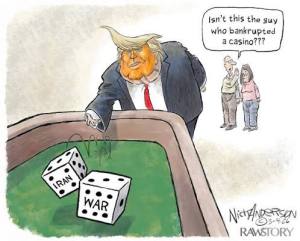 The article includes updates from Lebanon and more details on the incursion into Jordan. I just can’t believe that so many of these geriatric Senators we have, who have seen all of the wars in the Middle East and their results, won’t use their Constitutional duties to stop this mess. Well, there seems to be an attempt, but I seriously doubt it will go anywhere. This is from Politico. “House GOP leaders scrambling to set up a briefing on Iran war developments. Defense Secretary Pete Hegseth could possibly attend the House GOP Conference meeting Tuesday morning.”
House Republican leaders are making plans for a Trump administration official to attend Tuesday morning’s GOP Conference meeting on Capitol Hill to brief members on the latest developments in the war with Iran, according to four people granted anonymity to share private discussions.
Their hope is that Defense Secretary Pete Hegseth will be the special guest, one of the people said. He is already scheduled to testify before the Senate Appropriations Committee later Tuesday regarding the administration’s supplemental funding request for more military aid as the conflict in Iran continues. Meredith Lee Hill has the lede.
It comes after violence in the region over the weekend culminated in the death of three U.S. service members. A growing number of House Republicans, including vulnerable incumbents, also have been asking GOP leaders and the White House for more information about the war before they vote Wednesday to advance a plan to free up $95 billion in additional funding for the Iran war, defense activities and farm assistance.
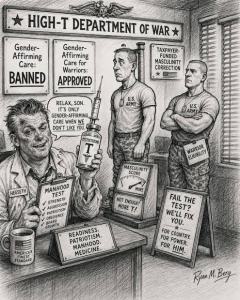 More military and war spending! Also, do they really think Peg Hegesth is going to give up on us testosterone testing for something that has historically enriched Congressional Members? You’d think an all-volunteer military would make them a bit more cautious about filling the ranks, but Trump and Hegesth must have below-average IQs, given the craziness they’ve pulled.
So, this is an amazing story from New Jersey. It will inform you exactly how far the Trump Family Crime Syndicate will go to enrich itself. The article can be found at The American Prospect. “The Kleptocrat Nesting Dolls Behind Trump’s Potemkin Gas Stations. How can Freedom Fuel afford to sell gas for $3.47 a gallon? That’s the wrong question to ask.” This excellent reporting was done by Maureen Tkacik. Beware of anything Trump labels ‘freedom’ anything.
Five years ago, a manager for a Virginia gasoline distributor opened an invoice for more than 200,000 phantom gallons of gas they had no record of selling. Truckers on contract with a chain of gas stations that had recently terminated its contract had been filling up their tanks using an emergency PIN that the distributor, Petroleum Marketing Group, Inc. (PMG), had designated for one-time out-of-contract gas purchases, effectively stealing $667,517 worth in just over a week.
Upon subpoenaing the gas station chain CEO’s bank records, PMG ultimately discovered he had no fewer than 28 other credit agreements he hadn’t disclosed on behalf of three or four alter-ego companies whose businesses he’d never listed on his application. The CEO and his brother/partner—two central New Jersey men in their thirties named Syed and Shamikh Kazmi, respectively—had outstanding default judgments against them in Wisconsin and Michigan, a business in Florida they had never disclosed, and legal disputes with landlords and franchisors from Circle K to Phillips 66 to 7-Eleven, the latter of which accused the brothers in a lawsuit of allowing a store they were operating to fall into such an alarming state of squalor it was forced to “disown” it, then exploiting a provision in the franchise agreement to order hundreds of thousands of dollars’ worth of cigarettes in its last weeks of operation that they allegedly neither returned to corporate nor paid for. Another landlord was suing them for tens of thousands of dollars in unpaid rent. The lawsuits would drag on and multiply while the Kazmi brothers bid on new assets under slightly altered names, then failed over and over again to wire over the required deposits.
Enter the high-flying Wall Street money manager Blue Owl, the reluctant owner of a vast portfolio of hundreds of gas stations across the country for which it had vastly overpaid. Prior to 2023, the gas stations and adjoining convenience stores had been run by an outfit called Mountain Express, which was forced into liquidation that spring after the founder sucked $130 million in ostensibly illegal fake dividends out of the stores and retired, leaving a trail of broken soda machines, failing refrigerators, disemboweled cash registers, and unpaid bills across the land. Blue Owl ended up paying $15 million to the bankruptcy estate for having enabled the grift.
You might assume that Blue Owl, a private credit behemoth founded by Wall Street’s titular best and brightest with $315 billion in assets under management, would attempt to find squeaky-clean, meticulous types to take over the leases at its service stations and start anew. LOL, no: For at least 17 of its stations in New Jersey, they chose the lawsuit-embroiled Kazmi brothers, a transaction formally announced last fall shortly after the trustee in another bankruptcy filed an amusing legal brief detailing Shamikh Kazmi’s effort to hire a locksmith to access a former Rite Aid store in Maryland on whose lease he had bid but never actually wired over the required $71,000 earnest money deposit. (A few months later, Kazmi placed an audacious $75 million all-cash bid on an iconic brutalist Philadelphia skyscraper complex, touting a plan to convert the 1.8 million-square-foot office complex into a Hard Rock Hotel, but he again failed to make the deposit.)
Earlier this year, the Kazmi brothers unveiled the latest makeover of their struggling gas station chain: a fast-food empire called Yum Grills, whose “$60 million expansion” Shamikh purported to be “self-funding” in a February Philadelphia Business Journal story that promised a breakneck rollout of 15 locations in 120 days. They appear to have successfully opened just one, not counting a related concept called Cousin’s Burger that boasts two others.
 Head to the link to read the entire nasty business. I just couldn’t bring myself to watch the final game of FIFA because, damn, do we really need a fricking half-time event? Messi met with Trump all friendly-like, and Trump attended the shebang, got booed, and tried to upstage the winning Spanish team. I could mention a few more things, but anyway, I never thought I’d be pulling for Belgium and Spain in a series. This is from Raw Story. “
President Donald Trump faced global ridicule for photobombing Spain’s championship celebration after winning the 2026 World Cup — and he was hit with another round of mockery after the team seemingly edited him out of an official photo.
The official X account for the Spain men’s national team shared an image of the players and coach Luis de la Fuente celebrating Sunday’s 1-0 win over Argentina.
The picture did not feature Trump, despite the president spending most of the celebration lingering at the side while the winners jumped for joy.
The 80-year-old president had accompanied FIFA President Gianni Infantino onto the field for the trophy presentation ceremony, and he continued to remain onstage even as Infantino attempted to usher him aside for the team photos.
But the one shared by the victorious Spanish team on X had no sign of Trump, prompting speculation that he’d been digitally removed. At the least, the team made a decision not to use one of the many photos he was in.
 Trump and Messi seemed to have jinxed the Argentina Team. The question of the Jinx is actually a USA Today headline. Messi’s eyes were all teary at the end of the game. You know the one about everything Trump touches, right?
President Donald Trump‘s comments about Lionel Messi before Argentina’s loss to Spain in the World Cup Final has reignited questions about whether or not his presence curses the teams he supports.
In a pre-recorded interview with Fox’s Jenny Taft that aired before the game, Trump didn’t state who he wanted to win but made friendly remarks about the Argentinian superstar.
“I thought about it a lot. I knew that was a question. I hate to get involved, even though politically, it doesn’t matter so much,” Trump said. “I would say that it’s hard to bet against Messi … I won’t pick sides. I just think it’s very hard to bet against Messi. He’s great.”
On the flip side, Trump bashed Spain during the second day of the NATO summit in Ankara, Turkey, calling the country a “wasted cause.“
“We don’t want to do any trade with Spain anymore,” Trump said. “Spain is a terrible partner in NATO.”
Trump attended the game and was booed when he stepped onto the field to present the trophies for the tournament. During the handing out of silver medals, the interaction between Trump and Messi was brief.
Trump has regularly attended sporting events and surrounded himself with sports stars while in office, with multiple examples of teams losing after being connected to him.
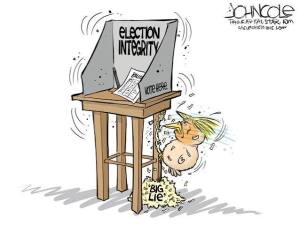 One last suggested read by Paul Waldman at Public Notice. “Trump would love to steal the election. But he’s floundering. Republicans would rather talk about almost anything else than his conspiracy theories.” I’m sure they would, given the polls.
Just as there are only so many times you can hear Trump say “It’s like nothing anyone has seen before” before the hyperbole loses all meaning, yet another allegation that elections are being stolen no longer registers as revelatory or urgent. That’s especially true when Republicans have worked so hard for so many years to prove that voter fraud is organized and widespread, with an enormous amount of time, effort, and money spent by the entire conservative movement, yet have come up with essentially nothing.
Everyone knew what Trump would deliver — some lies, some innuendo, some banal facts portrayed as deeply sinister. And no one was less enthusiastic about the speech than the Republicans actually trying to win elections this November.
“The people I talk to are scared shitless,” one unnamed former Trump administration official told Politico in advance of the speech. Trump’s 2020 obsession only served to remind voters that the president is unconcerned about the genuine problems they face.
The lack of support from the conservative propaganda machine was obvious in the response afterward. One might expect a dramatic White House address to be followed by a push to spread its message and multiply its effect — GOP candidates for office touting its importance, segment after segment on Fox News about it — but instead there was a deafening silence.
Fox could barely bring itself to discuss the speech afterward, mentioning it briefly on a couple of shows before moving on to more urgent culture war subjects like whether Caitlin Clark is being targeted for hard fouls by Black players.
“The unkindest cut came the next morning from Fox & Friends, long Trump’s media home and favorite program,” reported Media Matters’ Matt Gertz, “which did not discuss the speech at all — not even in a news brief.”
They know something Trump doesn’t: This isn’t helping him. In fact, it would be just about the worst strategy he could have come up with, if there were a strategy at all.
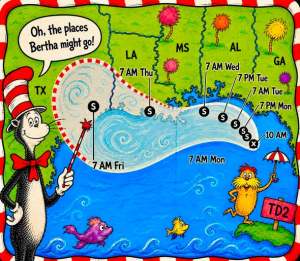 So it’s so late that I’m almost bumping into student time. I hope you had a great weekend. I’ll be facing Tropical Storm Bertha in a few days, so send out some good juju to all of us down here on the Gulf Coast!
What’s on your Reading, Writing, and Blogging list today?
Mostly Monday Reads: Trump goes all Mafia on FIFA
Posted: July 6, 2026 Filed under: #FARTUS, #We are so Fucked, 2026 FIFA, Trump Mafia Moves | Tags: @johnbuss.bsky.social John Buss, FIFA 2026, ICE, ICE Thugs, Renee Good and Alex Pretti, Trump Crime Syndicate, Trump ruins everything for nearly everyone 12 Comments
“Seems like for the estimated $10M midnight apocalyptic firework extravaganza for our Dear Leader, they could have afforded a T.” John Buss, @repeat1968
Good Day, Sky Dancers!
While getting ready for the Netherlands v Mexico last night, I just happened to flick through some headlines and let out a loud ‘What the Hell?’ Loud enough to get a response from down the hall: “What now?” The hell was two headlines — one from the New York Times and the other from The Independent — that convinced me it was real. I posted excerpts in response to JJ’s post last night downthread.
It basically gave the world another good reason to hate us or laugh at what we’ve become under Orange Caligula. My thought is we’ve become a Mafia state. This is the headline from the NYT: “Trump Asked FIFA to Review U.S. Player’s Suspension. Now He’s Eligible to Play. The reversal of Folarin Balogun’s World Cup suspension is highly unusual. It was the first time since 1962 that FIFA has nullified a suspension for a red card received during the World Cup.”
 It’s basically big news today, so I’ll lead with it. This time, he insulted our friend and ally, Belgium, so I’ll start with their response today as reported by the AP. It’s reported by Samuel Petraquin. Also, there are pictures of the offense that got the red card. “Belgian federation to challenge FIFA’s decision to let Folarin Balogun play in World Cup match.”
The Belgian soccer federation wants an explanation from FIFA about a decision to let U.S forward Folarin Balogun play at the World Cup despite getting a red card in his previous game.
Belgium takes on the United States later Monday for a spot in the quarterfinals.
The Belgian federation (RBFA) said it has still not received either “FIFA’s decision or any explanation regarding this matter. In these circumstances, it has no choice but to challenge the player’s eligibility for the upcoming match.”
It did not specify where it intends to appeal FIFA’s decision.
U.S. President Donald Trump intervened on behalf of star U.S. forward Balogun, whose red-card suspension was lifted in a decision that allowed him to play against Belgium.
The Belgian federation said it learned through media reports about the FIFA’s move and sent a letter to the governing body requesting a copy of the decision as well as an explanation of the process.
“As its only response, FIFA sent a letter to the RBFA stating that it considered this correspondence to constitute an appeal, that a judge had been appointed, and that the RBFA had only a few hours to complete that appeal,” it said. “No information whatsoever was provided by FIFA.
 Politico reports this on the Trump maneuver. “Inside the White House push to get Folarin Balogun back on the field. President Donald Trump got involved minutes after the U.S. striker received a red card that would have banned him from a crucial match.” Sophia Cai has the lede.
The campaign to keep Folarin Balogun on the field for the United States’ World Cup run began just minutes after the team’s leading goal-scorer received a red card that would sideline him for the team’s next match.
Following Wednesday’s victory against Bosnia and Herzegovina, White House FIFA World Cup Task Force executive director Andrew Giuliani alerted President Donald Trump to Balogun’s punishment for a rash tackle — removal from the Bosnia match and a routine one-match suspension that would keep him out of a must-win encounter against Belgium.
Trump and Giuliani had been speaking regularly about the World Cup for months. During the planning stages for the tournament, the president received frequent briefings on logistics, security and the U.S. team’s prospects. Once the competition began in mid-June, those conversations accelerated to multiple times each week.
By Wednesday night, the White House had committed itself to taking action over Balogun’s red card, which some soccer analysts believed to be a harsh punishment for the infraction. Giuliani, Commerce Secretary Howard Lutnick and senior U.S. Soccer Federation officials — all of whom had watched the Bosnia match in person at Levi’s Stadium near San Francisco — began activating plans to challenge the referee’s on-field decision to issue a red card. Successful appeals of World Cup red cards are exceedingly rare.
That kicked off four days of coordinated lobbying, legal maneuvering and diplomacy that stretched from the Oval Office to FIFA’s headquarters in Zurich — and underscored how invested Trump’s inner circle had become in the second World Cup hosted on U.S. soil and the fortune of the U.S. men’s national team competing in it. POLITICO spoke to a half-dozen U.S. government and soccer officials who were either directly involved in or briefed on the week’s events.
On Sunday, a day before the U.S. was due to face Belgium with Balogun on the bench, FIFA’s Disciplinary Committee announced that it was suspending Balogun’s one-match suspension for a year. Trump thanked FIFA for “doing what was right and reversing a great injustice.” The Royal Belgian Football Association and European confederation UEFA, of which Belgium is a member, are considering taking action against the FIFA ruling, according to a high-ranking UEFA official granted anonymity to discuss ongoing deliberations.
On Thursday, Trump placed a call to FIFA President Gianni Infantino. The two men had built a friendship over nearly eight years, with Infantino becoming a frequent visitor to the Oval Office during Trump’s second term. They remained in contact even when events put U.S. government policy in conflict with FIFA’s objectives, according to people familiar with their relationship. That included when the Trump administration launched military strikes against Iran in February, jeopardizing the country’s ability to compete in the World Cup — a personal history that mattered when Trump dialed Infantino about the Balogun matter.
Trump asked about FIFA’s rules around the red card decision and the grounds for a suspension. Infantino listened carefully but made no promises about the outcome. FIFA declined to confirm any specific discussions but reiterated to POLITICO that the decision to suspend the one-match ban was made by an independent disciplinary committee.
As U.S. Soccer’s legal team formally prepared and submitted its appeal to FIFA, Giuliani and Lutnick also offered to make White House attorneys available to assist with legal analysis if needed, according to people involved in the discussions.
At the same time, Giuliani and Scott Goodwin — a hedge-fund manager who had helped to personally pay the salary of U.S. coach Mauricio Pochettino — zeroed in on the officiating history of referee Raphael Claus, who made the red card call on Wednesday. Articles examining previous controversies involving the Brazilian referee circulated among senior government officials as they evaluated every possible argument that could bolster the appeal, according to sources familiar with the discussions.
 Stephen Collinson of CNN has the story on what the rest of the world thinks about this shake-down.
For 24 days, the World Cup seemed to achieve a rare feat in America in 2026: It had almost nothing to do with Donald Trump.
But in an extraordinary twist following an appeal from the president, star US goal-scorer Folarin Balogun will play in the knockout clash with Belgium on Monday, despite being sent off in the previous match and earning a one-game ban.
“Thank you to FIFA for doing what was right, and reversing a great injustice! President DONALD J. TRUMP,” the president posted Sunday, taking a victory lap on Truth Social.
Trump added more rhetorical rocket fuel to the controversy on Monday, confirming that he’d called FIFA President Gianni Infantino to ask him to review the suspension.
“I didn’t say, ‘You have to do this,’” Trump said in the Oval Office, adding that he didn’t think Balogun’s offense was even a foul.
Balogun’s reprieve rocked global soccer, triggering fresh speculation about the cozy relationship between Trump and the FIFA supremo.
Trump’s call to Infantino and FIFA’s ultimate decision lifted a controversy about soccer refereeing into an international incident surrounding the world’s most popular sporting showcase.
The subsequent drama raises concerns about political interference and the integrity of the tournament. It doesn’t necessarily matter whether Trump’s muscling into the issue was decisive. Just the impression that it was risks souring global perceptions of an event that had generated remarkably positive headlines.
Controversy is guaranteed at World Cup finals. Who could forget Diego Maradona’s “hand of God” goal for Argentina in 1986 or French star Zinedine Zidane’s 2006 World Cup final headbutt?
 Read more on this controversy at any of the three links. Believe me, there are a lot more out there. So, here’s another headline that’s making me think doing all that ish to get my passport was a good idea. This headline is from Wired as reported by Maddy Varner. “ICE’s Internal Watchdog Is Now Investigating Online Critics. The Office of Professional Responsibility has opened more than 100 cases over what ICE officials call “incidents of doxing and threats” against ICE employees.” ICE’s Office of Professional Responsibility (OPR) is set up to conduct internal investigations, but has recently begun investigating American Citizens.
OPR is supposed to act as an internal watchdog. It’s responsible for inspecting detention facilities, investigating allegations of employee and contractor misconduct, and processing security checks for new applicants. On its site, it says it also protects against “external threats” by managing badge access to buildings and maintaining the agency’s network security. But lately, court documents indicate, it appears to be pursuing more civilians like Gonyea for what they say online.
In a court declaration filed in April, an ICE official said that between January 2025 and March 2026, OPR investigated 131 cases involving “incidents of doxing and threats directed towards ICE employees nationwide.”
It’s unclear how many of those cases resulted in criminal charges. WIRED was able to identify only one instance when OPR was credited for its investigative work in a case where the Justice Department accused a California man of harassing an ICE attorney and her mother. The DOJ alleged that the man, who pleaded guilty, used to live in the same building as the mother and that he started his harassment campaign in January 2024, well before President Trump took office. ICE did not respond to questions about whether other cases have been brought based on OPR’s work or how many additional cases OPR has opened since March.
“It takes a lot to actually convict someone for their speech, and it’s only possible in very limited circumstances,” says Laura Moraff, a staff attorney at the ACLU’s Speech, Privacy, and Technology Project. “People do have a First Amendment right to criticize the government and to do that online and to do that anonymously.”
OPR was behind at least one of the flurry of administrative subpoenas sent to tech companies in recent months in an effort to unmask online critics. In court filings, lawyers for the poster argued that the subpoena, which asked for the poster’s name, address, telephone number, and other details, violated the poster’s right to free speech. The government withdrew the subpoena rather than trying to litigate its merits.
 You may read some examples of U.S. citizens they’ve bothered by these claims in the article. You might recall this story via the article cited above.
… ICE agents arrived at a polling site in Syracuse, New York, during the state’s primaries in June. The agents were there to see Paigelynne Gonyea, a poll worker who says they were concerned about an Instagram post she had supposedly made in January, “doxing” an ICE agent.
 So, who knows what they may be up to? Let’s hope the press stays on top of it. You may read a great update on the amount of nothing being done by the ICE Agent who killed Renee Good, who is at the root of the Paigelynne Gonyea OPR shenanigans. It’s at this link at The Atlantic. “The Death of Renee Good Has Yet to Be Properly Investigated. Six months after she and Alex Pretti were shot on the streets of Minneapolis, little has come of the probes into their killings.” Quinta Jurecic is the reporter for the story.
Nearly six months have passed since federal officers shot and killed Renee Good and Alex Pretti on the streets of Minneapolis. No one has been arrested, the Trump administration has provided no reason to believe that any serious investigation is taking place, and federal officials continue to stonewall state and local investigators in Minnesota.
This inaction was predictable. The day after Good’s death, Vice President Vance insisted at a press conference that the agent who shot her would face no criminal charges. “That guy is protected by absolute immunity,” Vance told reporters. “He was doing his job.” Soon, Stephen Miller doubled down on the message, announcing “to all ICE officers” that “you have federal immunity in the conduct of your duties.” Federal agents apparently received the message: The next day, an ICE agent fired a gun into a Minneapolis home, wounding a Venezuelan immigrant, Julio Cesar Sosa-Celis. The week after that, Pretti was killed outside a doughnut shop. The Department of Homeland Security called him a “domestic terrorist” and said that the officers who shot him had acted in self-defense.
Typically, after a contentious killing by a law-enforcement officer, the Justice Department would launch a criminal civil-rights probe. Following George Floyd’s murder, for example, DOJ conducted an investigation alongside Minnesota law enforcement, and both federal and state prosecutors brought separate charges against the Minneapolis police officer Derek Chauvin. So far, though, the federal government has succeeded in protecting immigration officers from serious consequences for the violence of what DHS termed “Operation Metro Surge.” But in promising a total shield from accountability, Miller and Vance may have been premature. Law-enforcement officials in Minnesota are—albeit haltingly—beginning to move forward with investigations and prosecutions on their own. Their efforts may become the locus of yet another clash between state and federal authority in the age of President Trump.
For the first few hours after the ICE agent Jonathan Ross shot Good inside her car, the mechanisms of accountability appeared to operate normally: The FBI began mobilizing to investigate the crime scene alongside the Minnesota Bureau of Criminal Apprehension, the state’s investigative agency. By the evening of the day she was killed, however, officials in Washington, D.C., had frozen out both Minnesota police and law enforcement in Hennepin County, where Minneapolis is located. In a recent podcast interview, Hennepin County Attorney Mary Moriarty recalled joining a conference call after Good’s death with the FBI, federal prosecutors, and Minnesota investigators: “Everybody agreed this would once again be a joint investigation. And then suddenly the BCA was kicked off the case.” Minnesota abruptly found itself without access to any of the evidence collected at the scene. Even Good’s maroon Honda Pilot, the windshield pierced by Ross’s bullet, was bundled away by the FBI into a storage facility before state law enforcement could get a look at it.
DOJ was now the only agency able to conduct a full investigation into the shooting. But it had little apparent interest in doing so. According to The New York Times, Harmeet Dhillon, who leads DOJ’s Civil Rights Division, refused to open a criminal investigation into Ross. Instead, DOJ looked into the possibility of investigating Good, along with her widow, Becca Good. Six federal prosecutors in Minnesota resigned in protest, as did an FBI agent in Minneapolis.

Bobo, who hangs out on the kitchen stairs waiting for friends and food.
The link is gifted and definitely worth the read.
So, that’s it for me today. I’m still working on trapping the feral cats living under my house, whom I feed and speak to daily. Work is progressing on the kathouse. The electrical work is mostly done. The A/C works again. The backyard no longer has a dilapidated pergula. It’s about to get a nice green space with a nice grill/smoker, a fire pit, many more plants, lighting, and Adirondack chairs. I look forward to the nice cooler fall days.
I’m off to set up traps for the infamous duo Bobo and Sparks.
Try to have a nice, quiet week. I was hoping the games would be a nice break, but then Orange Caligula can never let good enough alone. He has to get involved and ruin it for everyone. I still enjoy the openers where all the soccer kids come out with the players. Their looks make me realize we have to ensure the world is a better place before we leave it.
What’s on your Reading, Action, and Blogging list today?

 peej
peej Carissa
 bostonboomer
 dakinikat
 ecocatwoman
 jjlo
jjlo mablue2
 Mama Lopez
 peggysue22
 quixote
 skydancingguestblogger
 Mona (aka Wonk the Vote)



 Sky Dancing
Recent Comments