
Reading the Tea Leaves on the Coming Ideological Battle over the Debt Ceiling
Posted: January 14, 2013 Filed under: Barack Obama, Congress, Federal Budget and Budget deficit, Fiscal Cliff, Republican politics, Surreality, the GOP, The Media SUCKS, U.S. Economy, U.S. Politics, voodoo economics, We are so F'd | Tags: 14th amendment option, Chuck Todd, Debt Ceiling, Gordon Epps, Joe Weisenthal, Juliana Goldman, Major Garrett, Moby Dick, Paul Krugman, reading tea leaves, Tea party crazies, trillion dollar platinum coin 41 Comments
I’m getting a sense that the White House has a plan to deal with the GOP hostage takers in the debt ceiling fight. The plan involves eliminating every possible alternative to Congress allowing the Treasury to pay the nation’s bills, while calmly but forcefully explaining to the American people how the U.S. government works. Obama apparently understands that the media will not help him educate the American people; therefore he will work around them.
Whether this plan is going work is anyone’s guess, but it seems pretty clear that Obama plans to pin the full responsibility for action on Congress.
On Friday, the administration eliminated the most recent suggestion for a “plan B,” the so-called “trillion dollar platinum coin.” They also reiterated the decision not to use the 14th Amendment option, which Obama first announced during the 2011 debt ceiling fight.
With this, the White House has now ruled out the two best options for preventing a default in the event that the House GOP refused to life the debt ceiling. The White House has been quite adamant that the other alternative (invoking the 14th Amendment) is not acceptable.
So now the stakes are high, as The White House has refused to negotiate with the GOP on a debt ceiling hike.What bargaining chips does The White House hold? Unclear.
Paul Krugman was characteristically shrill.
If I’d spent the past five years living in a monastery or something, I would take the Treasury Department’s declaration that the coin option is out as a sign that there’s some other plan ready to go. Maybe 14th Amendment, maybe moral obligation coupons or some other form of scrip, something.
And maybe there is a plan.
But as we all know, the last debt ceiling confrontation crept up on the White House because Obama refused to believe that Republicans would actually threaten to provoke default. Is the WH being realistic this time, or does it still rely on the sanity of crazies? [….]
…if we didn’t have some history here I might be confident that the administration knows what it’s doing. But we do have that history, and you have to fear the worst.
On Saturday, Krugman reported that he had gotten “calls” about Friday’s post from the powers that be:
The White House insists that it is absolutely, positively not going to cave or indeed even negotiate over the debt ceiling — that it rejected the coin option as a gesture of strength, as a way to put the onus for avoiding default entirely on the GOP.
Truth or famous last words? I guess we’ll find out.
I honestly can’t blame the White House for not wanting to use the 14th amendment or “platinum coin” options. Both would undoubtedly lead to wrangling in the courts and, in the case of the 14 amendment choice, a possible Constitutional crisis. But still, was it wise to publicly eliminate the only possible leverage the White House has to force the House GOP to get over their tantrums and allow the Treasury to pay the bills that Congress has already run up? I simply don’t know.
In the President’s press conference this morning, he appeared to confirm that my sense of the “plan” is accurate. He did a good job of spelling out what the consequences will be for the nation and the world if the U.S. defaults on its debts.
The debt ceiling is not a question of authorizing more spending. Raising the debt ceiling does not authorize more spending. It simply allows the country to pay for spending that Congress has already committed to.
These are bills that have already been racked up, and we need to pay them. So, while I’m willing to compromise and find common ground over how to reduce our deficits, America cannot afford another debate with this Congress about whether or not they should pay the bills they’ve already racked up. If congressional Republicans refuse to pay America’s bills on time, Social Security checks, and veterans benefits will be delayed.
We might not be able to pay our troops, or honor our contracts with small business owners. Food inspectors, air traffic controllers, specialist who track down loose nuclear materials wouldn’t get their paychecks. Investors around the world will ask if the United States of America is in fact a safe bet. Markets could go haywire, interest rates would spike for anybody who borrows money. Every homeowner with a mortgage, every student with a college loan, every small business owner who wants to grow and hire.
It would be a self-inflicted wound on the economy. It would slow down our growth, might tip us into recession. And ironically it would probably increase our deficit. So to even entertain the idea of this happening, of the United States of America not paying its bills, is irresponsible. It’s absurd. As the speaker said two years ago, it would be, and I’m quoting Speaker Boehner now, “a financial disaster, not only for us, but for the worldwide economy.”
So we’ve got to pay our bills. And Republicans in Congress have two choices here. They can act responsibly, and pay America’s bills, or they can act irresponsibly and put America through another economic crisis. But they will not collect a ransom in exchange for not crashing the American economy. The financial wellbeing of the American people is not leverage to be used. The full faith and credit of the United States of America is not a bargaining chip. And they better choose quickly, because time is running short.
He also took opportunities to continue patiently explaining, in response to questions from obtuse members of the press corps such as Chuck Todd and Major Garrett.
Despite the efforts of Todd and Garrett to get Obama to say he’ll have to give in to Republican demands, the president repeatedly said he isn’t going to negotiate with GOP terrorists.
Will it work? And more importantly, will Obama really refuse to cave this time? As I noted earlier, Krugman has his doubts. One reporter, Juliana Goldman, even asked the president why anyone should believe him this time when he has always caved in the past. Obama’s response:
Well, first of all, Julianna, let’s take the example of this year and the fiscal cliff. I didn’t say that I would not have any conversations at all about extending the Bush tax cuts. What I said was, we weren’t going to extend Bush tax cuts for the wealthy. And we didn’t.
Now, you can argue that during the campaign, I said — I set the criteria for wealthy at $250,000, and we ended up being at $400,000, but the fact of the matter is, millionaires, billionaires are paying significantly more in taxes, just as I said.
So from — you know, from the start, my concern was making sure that we had a tax code that was fair and that protected the middle class. And my biggest priority was making sure that middle class taxes did not go up. You know, the difference between this year and 2011 is the fact that we’ve already made $1.2 trillion in cuts. And at — at the time, I indicated that there were cuts that we could sensibly make that would not damage our economy, would not impede growth.
I said at the time, I think we should pair it up with revenue in order to have an overall balanced package, but my own budget reflected cuts in discretionary spending. My own budget reflected the cuts that needed to be made. And we’ve made those cuts. Now, the challenge going forward is that we’ve now made some big cuts. And if we’re going to do further deficit reduction, the only way to do it is in a balanced and responsible way.
It’s all very calm and reasonable-sounding; and, as I said, I think Obama did a good job in today’s press conference. He has two more high-profile opportunities to get his message out–the Inaugural Address next Monday and the State of the Union Address on February 12. He could also make campaign-style appearances around the country as he did before the “fiscal cliff” battle.
Now let’s look at what the Republicans are planning. This morning we got the inside dirt from the usual suspects at Politico, Jim Vandehei, Mike Allen, and Jake Sherman. According to the Politico guys, the GOP is getting ready to go on the warpath.
The idea of allowing the country to default by refusing to increase the debt limit is getting more widespread and serious traction among House Republicans than people realize, though GOP leaders think shutting down the government is the much more likely outcome of the spending fights this winter.
“I think it is possible that we would shut down the government to make sure President Obama understands that we’re serious,” House Republican Conference Chairwoman Cathy McMorris Rodgers of Washington state told us. “We always talk about whether or not we’re going to kick the can down the road. I think the mood is that we’ve come to the end of the road.”
Republican leadership officials, in a series of private meetings and conversations this past week, warned that the White House, much less the broader public, doesn’t understand how hard it will be to talk restive conservatives off the fiscal ledge. To the vast majority of House Republicans, it is far riskier long term to pile up new debt than it is to test the market and economic reaction of default or closing down the government.
GOP officials said more than half of their members are prepared to allow default unless Obama agrees to dramatic cuts he has repeatedly said he opposes. Many more members, including some party leaders, are prepared to shut down the government to make their point. House Speaker John Boehner “may need a shutdown just to get it out of their system,” said a top GOP leadership adviser. “We might need to do that for member-management purposes — so they have an endgame and can show their constituents they’re fighting.”
Basically, the whole world is supposed to stand back and let the Tea Party wackos in the House have an extended, violent temper tantrum to “get it out of their system.” Or else.
According the Politico piece, Speaker Boehner will be meeting with GOP members most of the week to discuss strategy and then on Thursday and Friday House GOP members will meet in Williamsburg, VA. During the two-day meeting Boehner and presumably some of the saner House Republican leaders will try to explain to the Tea Party crazies why forcing the U.S. into default is not a very smart idea. I wonder if there will be visual aids?
So that’s where we are for now. At least Obama has stated his case clearly. However, at some point he is going to have to do something dramatic if the Republicans won’t budge. And why should the Republicans or anyone else believe Obama will stick to his guns this time? Only time will tell. I thought this piece by Garrett Epps at The Atlantic (published on Saturday) summed up the situation very well: Does Obama Actually Have a Debt-Ceiling Plan, or Is He Bluffing?
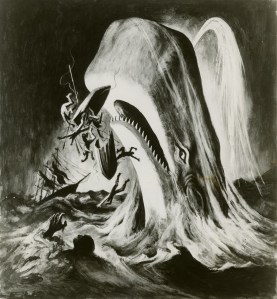
In Melville’s Moby Dick, the whaling ship Pequod crosses the equator on its quest for the White Whale, and in that instant, Captain Ahab smashes his quadrant to the deck and crushes it underfoot.
No more careful navigation. It is, we understand, Moby Dick or die.
As we hurtle toward the new debt-limit crisis, President Obama has done much the same. He says he won’t negotiate spending cuts with a gun to his head. He’s also said that he won’t invoke § 4 of the Fourteenth Amendment, with its provision that “the public debt of the United States . . . shall not be questioned,” to give him authority to continue borrowing once the debt limit has been reached. The Senate Democratic leadership Friday urged him to prepare to raise the ceiling unilaterally; so far, he has remained mum.
Yet Obama, to all appearances, is the calmest man in this overheated capital as the doomsday clock counts down toward a first-ever U.S. default, and the almost certain global depression that would follow.
We can only wait and see what will happen, but as Epps writes, in the end, the onus will be on Obama.
The moment may be coming when wishing and faith do not suffice. Those are the moments when presidents earn their pay. If that requires reversing course on the Fourteenth Amendment, so be it; if it impels a stupid coin trick, then so it does; and if it imposes a political cost on the president, then he must pay it.
After Ahab smashes the Pequod’s quadrant, second-mate Stubb muses to himself, “Well, well; I heard Ahab mutter, ‘Here some one thrusts these cards into these old hands of mine; swears that I must play by them, and no others.’ And damn me, Ahab, but thou actest right; live in the game, and die in it!”
And that’s just the debt ceiling. Obama will also have to deal with fights over the sequester and the federal budget.
Of Brass Tacks and Phony Crises
Posted: January 3, 2013 Filed under: Catfood Commission, Economic Develpment, Economy, Voter Ignorance, We are so F'd 27 CommentsYes, yes … the fiscal bunny slope has been somewhat solved and the press has moved on to discussing the next big self-inflicted fiscal crisis coming up in February. ( I guess we’re adopting the term “March Madness” just to make it all exciting and discussable.) We’re still in the land of economic surreality instead of theory. It worries me. The basic problem is that this country has forgotten its economic history, lessons and theory. Fiscal policy should not be based on political memes and lurching from one crisis to the next. Here’s some things to think on from economists.
Economist Nouriel Roubini points out that we’ve been let down by our political leaders who just don’t get that our basic problem is really one of development. We’ve had substantial growth in upper incomes and corporate profits, yet we’re going nowhere in all the quality of life and economy numbers. We have a tax policy that encourages folks like Romney to strip money out of functional businesses, shut them down, and move the proceeds to offshore bank accounts to avoid paying taxes that support basic features of a civilized country. How is this kind of wealth creation helping our economy? How is treating speculative gambling to tax favors instead encouraging actual business building creating a future upon which we can sustain our civilization? Why isn’t the press looking at the fiscal drag this cliff solution creates a well as the bigger issue of austerity facing us in March? Austerity has done the UK no favors and is crushing parts of the Eurozone. Why are the media and the political elite focusing on policies that look like Herbert Hoover’s revenge? Why feed the drone economy while starving granny?
President Barack Obama and his allies will argue that the deal concluded on Tuesday raises only $600bn of revenues over 10 years rather than their initial target of $1.4tn – and therefore there is further room for tax rises, at least for the wealthy. Republicans will argue that spending should now be radically cut, since this week’s deal did not address that side of the national balance sheet. (Even the 2011 debt ceiling deal reduced prospective spending by $1tn).
In the meantime, the likely fiscal adjustment in 2013 will be about 1.4 per cent of gross domestic product. (Spread between the expiry of the payroll tax cut, the increase in the tax rates of the rich, and some eventual cuts to spending.)
This translates into a 1.2 per cent of GDP drag on the economy during the year. If the economy was happily growing above trend – at say 3.5 per cent – that would not be such a big deal, as growth would still be above 2 per cent. In the past few quarters growth already averaged about 2 per cent. So the US could quite easily come perilously close to stall speed this year – or worse, if the eurozone crisis worsens.
The longer-term picture is bleaker still. The reality is that America is yet to wake up to the full extent of its fiscal nightmare. Even the typical Republican voter is not – being on average older and poorer than a Democrat voter – in favour of gutting the welfare state. Tea Party extremists are more noise than signal. That is why the plans of Mitt Romney and Paul Ryan, the Republicans’ losing presidential ticket, postponed all the tough spending cuts on Social Security and Medicare by a decade.
Neither Democrats nor Republicans recognise that maintaining a basic welfare state, which is right and necessary in our age of globalisation, rapid technological change and demographic pressure, implies higher taxes for the middle class as well as for the rich. A deal that extends unsustainable tax cuts for 98 per cent of Americans is therefore a pyrrhic victory for Mr Obama.
Yes, they continue to eye cuts in social security under the guise of tackling the deficit. Economist Dean Baker reminds us that Social Security has nothing to do with the Federal Deficit. Yet, there’s Simpson and Bowles yacking up that granny starving canard again! Let’s chain link our grandparents in the name of a lie, please!! Baker is right. Budget hysteria is a growth industry driven by lies and has nothing to do with what’s really happening in our real economy.
While the promotion of budget hysteria is one of the largest industries in Washington, the most important and widely ignored fact about the budget situation is that we have large deficits today because the collapse of the housing bubble sank the economy. This is not a debatable point.
The budget deficit was just 1.2 percent of gross domestic product in 2007. Before the collapse of the housing bubble the deficit was projected to remain low for the next decade and the debt-to-G.D.P. ratio was actually falling. This would have been the case even if the Bush tax cuts were allowed to continue.
When the bubble burst and the economy plummeted, tax collections fell. We also spent more on unemployment insurance and other benefits for unemployed workers. And we had further tax cuts and stimulus spending to try to boost the economy. The automatic and deliberate steps taken to counter the downturn fully explain the large deficits we have seen the last five years.
Record low interest rates on government bonds demonstrate that the current deficits are not a real problem. But even if they were, it is difficult to see how cutting Social Security could to be part of the solution. Under the law Social Security is not supposed to be part of the budget. It is an entirely separate program financed on its own.
This is not just a rhetorical point. We can talk about Social Security facing a financing shortfall in the future precisely because it is solely financed by its own revenue stream.
What we really need is a recovery. That will not happen with all the fiscal policies being placed on the table right now. Let’s review one simple thing. As long as you have a good currency, federal debt instruments in demand, and a vast array of taxable assets in your country, there is no such thing as a ‘bankrupt’ government or excessive debt. But, don’t take my word for it. Let’s again, look at the economic studies and look at the demand for treasury bonds and bills. Markets see no problem with debt levels in most industrialized nations because they know that with development and growth there comes decreased deficits and pay down of debt.
The sovereign bond markets in America, Japan, Britain, and the euro area’s “core” do not seem to think so. These governments can borrow cheaply for decades at a time. While it is certainly possible that the markets are wrong, policymakers should probably pay more attention to investors and less to the fear-mongers, especially since economists do not know how much government debt is too much. In fact, there is good reason to think that many countries with their own currencies could become far more indebted without risking trouble. One reason is that many private investors do not own enough sovereign bonds.
It is important to remember that there is an absence of evidence that governments with their own currencies are too indebted. Those who argue otherwise point to the work of Carmen Reinhart and Kenneth Rogoff, the celebrated authors of This Time is Different. Their paper “Growth in a Time of Debt” claimed that sovereign debt creates a burden on the rest of the economy. (They summarise their points here.) But, as Robert Shiller and Paul Krugman have pointed out, Ms Reinhart and Mr Rogoff never explain how public indebtedness restrains growth. There may be other forces at work, especially since sovereign debt ratios are usually at their highest after wars and financial crises. In countries with their own currencies, private interest rates are now so low that many investors have been grasping for yield wherever they can find it, such as in the revived CLO market. When he evaluated the evidence, my colleague concluded that “debt matters, but the precise way that it matters isn’t as clear-cut as Reinhart-Rogoff seem to indicate”.
Why would private investors want to buy more sovereign debt? A previous post on the shortage of safe financial assets mentioned how pension plans in many countries need to buy more government bonds to avoid mismatches between their assets and liabilities …
Nearly all the red states in our country may be Greece and Portugal–with the exceptions of Texas and Florida–but the blue states are overwhelmingly Germany and they continually bail out those loser states. That’s why we are not the Eurozone. However, those red states sure are trying to blow up the very arrangement that keeps them in roads, schools, and police forces. Economist Clive Crook points out how these idiots have now created a situation where governing means we lurch between crisis because none of them appear to be able to accept the lessons learned from the civil war, the Great Depression, or about 60 year of economic and finance theory.
The latest fiscal deal does little to resolve those uncertainties. The spending-cut part has merely been delayed by two months. The tax increase for couples making more than $450,000, together with other changes and estimated savings in debt interest, shaves about $700 billion from the 10-year deficit. Savings of about $2 trillion will be needed to stabilize the ratio of public debt to national income. Bringing that ratio down to a safer level requires spending cuts and tax increases worth $4 trillion — the original “grand bargain” ambition.
Instead of dealing calmly with the problem, fiscal policy has settled into a mode of perpetual phony crisis. Phony doesn’t mean harmless, however. The risk of a real fiscal crisis gradually builds. Meanwhile, the cumulative effects of simulated crisis might be almost as bad. It’s the difference between an acute illness and a chronic wasting disease — one that’s beginning to look incurable.
Don’t tell me the economy just had a lucky escape. Whatever happens next, it has been paying for the fiscal standoff for months. It’s paying for what Congress might do with the next debt ceiling, and the one after that. The “significant uncertainty” that Geithner referred to has already held back the U.S. recovery. Another temporary fiscal patch isn’t a remedy. It’s just more of the same.
The economy needs a lasting fiscal compact that commands broad, bipartisan support. I can hear the groans. Not another call for compromise. Many Democrats and almost all Republicans find the idea disgusting. On Capitol Hill, it’s no longer enough for one side to win; the other has to be seen to lose. That attitude is the growing burden the economy has to carry.
Which brings me back to journalistic, political hacks that write columns like this one at Politico. (Glen Thrush and Reid J Epstein are the guilty wielders of the keyboards of ignorance here.) They just opine that Obama has a debt problem. Gee, guys, where did you get your doctorates in economics or finance? The place is aptly called Tiger Beat on the Potomac by Charles Pierce. They are all about being groupies to their DC stars. No Republican meme is too outrageously wrong for this e-dishrag.
The staggering national debt — up about 60 percent from the $10 trillion Obama inherited when he took office in January 2009 — is the single biggest blemish on Obama’s record, even if the rapid descent into red began under President George W. Bush.
Glenn Thrush and Reid Epstein’s Politico piece on President Obama’s “debt problem” helps capture a lot of what’s wrong with the larger debate and the political establishment’s confusion about fiscal matters.
It’s the same damn problem that happens when you watch MTP and Dancing Dave and Tom Brokaw discuss anything about economics. They don’t know a damn thing. They just repeat what they’ve heard from their local lying republican friends. Here’s more from Benen.
First, when there’s a global economic crash, and the government needs to invest to rescue the economy, large deficits are good, not bad, especially when borrowing is cheap and easy. Had the president focused on reducing the $1.3 trillion deficit he inherited from Bush/Cheney, instead of job creation and economic growth, the recession would have intensified, and yet, too many reports simply accept it as a given that higher deficits are worthy of condemnation.
Second, under Obama, as the economy started to improve, the deficit started to shrink anyway. Though the political establishment usually ignores these details, the deficit is $300 billion smaller now than when the president took office — marking the fastest deficit reduction since the end of World War II.
Third, Obama keeps pushing massive debt-reduction proposals on the table, as well as all kinds of policies that shrink the deficit (health care reform, cap and trade, Dream Act), but Republicans have opposed all of them.
And then finally, there’s the simple matter of what, exactly, is driving the nation’s budget shortfall.
For Politico, the fact that the national debt is nearly 60% larger necessarily makes this a major “blemish” on the president’s record. This only makes sense, of course, if one assumes that a larger debt is a bad thing — and given the circumstances, it’s not — and that it’s Obama’s policies that are responsible for the increase.
But as we’ve discussed before, that’s simply not the case. The facts are incontrovertible: towards the end of President Clinton’s second term, debt clocks that had been established in various U.S. locations had to be shut down — the deficit had been eliminated and the clocks had never been set to run backwards. By the time Clinton left office in 2001, the nation not only had a large surplus, it was also on track to pay off the entirety of its debt — roughly $5 trillion at the time — by the end of the decade.
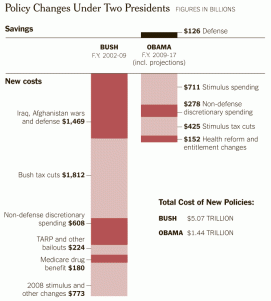
Then the Bush/Cheney era happened. Republicans took a massive surplus and turned it into an even more massive deficit, adding the costs of two wars, two tax cuts, Medicare expansion, and a Wall Street bailout to the national charge card.
Sen. Orrin Hatch (R-Utah) later referred to the Bush/Cheney era as a time in which Republicans decided “it was standard practice not to pay for things.” In just eight years, GOP policymakers added $5 trillion to the debt in eight years.
But then Obama was just as reckless, right? Wrong. The key takeaway here is that it’s Republican policies, not the president’s agenda, that’s driving the national debt now and into the future.
Okay, so I’ve made this an extremely long, wonky post and your eyes are probably glazing over by now. The deal is this. We have a huge number of issues facing our country and we have press and a political party that just plain lies and spreads lies on the big ones. We can’t have a discussion on climate change science, or women’s health and reproduction and rape, or economics or a number of things because very few people bring data, science, statistics, and theory to the table. They bring hype and religious and ideological dogma. We continually see Republicans and press folks like Tom Brokaw say the economic equivalent of ‘women who get raped don’t get pregnant because their bodies shut down’ . They don’t even realize they are doing it and no one calls them on it because they get all the air time they want and economists get very little.
So, we’re on the verge of starving children and the elderly based on that level of discussion. How can we possibly get to a more fact-based reality and a healthier economy and democracy with this level of ignorance?
Thursday Reads: Fiscal Cliff Crashes into Debt Ceiling, Villagers Blame Old People….And Other News
Posted: December 27, 2012 Filed under: 2012 presidential campaign, Barack Obama, Fiscal Cliff, morning reads, Surreality, U.S. Economy, U.S. Politics, We are so F'd | Tags: Chained CPI, Charles Pierce, Debt Ceiling, fiscal cliff, John Boehner, Mitt Romney, Piers Morgan, Social Security, Tagg Romney, Tim Geithner 26 Comments
Good Morning!!
The storm has moved into New England, but it’s mostly rain up here–very hard, windy, noisy rain. I’m very grateful it isn’t snow, but I feel for all the people down south of me who are getting hit harder. Take care, everyone!!
Yesterday Tim Geithner announced that the U.S. will hit the debt ceiling on December 31. He sent a letter (pdf) (also posted on the Treasury Department website)to Harry Reid with cc’s to other Congresscritters informing them that the Treasury can fiddle around and keep things going for at the most two months before the U.S. defaults on its debts for the first time in history.
Meanwhile, no negotiations on the “fiscal cliff” took place yesterday. John Boehner appears to have abdicated all responsibility and has announced that it’s up the the Senate to act; but Senators are in no hurry to rush back to Washington DC and clean up the House Republicans’ mess.
U.S. House of Representatives Speaker John Boehner on Wednesday urged the Senate to pass its version of legislation to avert the “fiscal cliff,” in a sign that congressional efforts to avoid a budget crisis are coming back to life days ahead of the year-end deadline.
In a statement issued by Boehner and his top lieutenants, the Republican leadership team said “the Senate must act first” to revive efforts to avert the $600 billion in automatic tax hikes and spending cuts due to be triggered on Jan. 1.
They promised that the House would weigh whatever legislation the Senate produced.
What are we paying these incompetent idiots for anyway? But of course no one is talking about cutting Congresspeople’s salaries–the pressure is all on Social Security recipients. Yesterday, Ruth Markus wrote a column in support of cutting benefits because seniors and disabled people (including disabled veterans) are getting too much money (the average SS check is $1,200 per month). She thinks everyone should gratefully embrace the Chained CPI.
Here’s how the CPI works. When taxes are being calculated, brackets, standard deductions, personal exemptions and the like are ratcheted up with inflation, protecting taxpayers from being forced to pay higher taxes for what is essentially the same amount of income they had previously.
Benefits — everything from Social Security to veterans’ benefits to federal pensions — are similarly adjusted upward to protect beneficiaries’ buying power from being relentlessly eroded.
Such indexing makes eminent sense. The difficulty — and the money-saving opportunity — arises because, in the view of most economists, the current method of calculating changes in the CPI overstates the inflation rate.
It fails to account for what economists call upper-level substitution bias, and what my mother would call plain common sense: If the price rises for a certain commodity in the basket of goods used to measure inflation, consumers will choose a cheaper alternative. In my house, when the price of beef soars, we substitute chicken.
The CPI doesn’t and, as a result, taxpayers are undercharged and beneficiaries are overpaid — a lot. The overestimate is small — less than 0.3 percentage points annually but, much like compound interest, it adds up over time.
What Marcus doesn’t seem to understand is that when your income is that low, beef and chicken are are both too expensive and you substitute peanut butter and dried beans. Except that peanut butter prices have skyrocketed–what’s the next step down, cat food?
Two economists responded to Markus. Dean Baker at the CEPR: Ruth Marcus Is Outraged by Overly Generous Social Security Checks.
Well, who can blame her? After all, we have tens of millions of seniors living high on Social Security checks averaging a bit over $1,200 a month at a time when folks like the CEOs in the Campaign to Fix the Debt are supposed to subsist on paychecks that typically come to $10 million to $20 million a year.
Anyhow, her main trick for cutting benefits is to adopt the chained consumer price index as the basis for the annual cost of living adjustment. This would have the effect of reducing benefits by 0.3 percentage points for each year of retirement. This means a beneficiary would see a 3 percent cut in benefits after 10 years, a 6 percent cut after 20 years and a 9 percent cut after 30 years. This is real money. Since Social Security is more than half the income for almost 70 percent of retirees and more than 90 percent of the income for 40 percent of retirees, the hit to the affected population would be considerably larger than the hit to the top 2 percent from ending the Bush era tax cuts.
But Marcus insists this cut must be done first and foremost in the name of accuracy, since the chained CPI is supposed to provide a better measure of the cost of living. She notes but quickly dismisses the evidence from the Bureau of Labor Statistics (BLS) consumer price index for the elderly (CPI-E), which shows that the rate of inflation seen by the elderly is somewhat higher than the overall rate of inflation.
Read Baker’s upteenth explanation of why the Chained CPI doesn’t accurately reflect spending for seniors at the link. He argues for continuing development of a CPI that takes into account that seniors spend greater proportions of their income on health care and basic necessities that can’t necessarily be replaced with cheaper substitutes.
Next, Jared Bernstein says he’s “convinced the Chained CPI is coming” and it is a benefit cut. He agrees with Baker that an elderly CPI would be a good thing, but says that Markus’ argument we should cut benefits now and deal with the injustices later makes no sense.
…as Dean notes, it would make a lot of sense to invest in a chained-weighted CPI that accounts for the notably different buying patterns of the elderly. Ruth Marcus critiques this point today but for reasons that don’t make sense to me. For example, she criticizes an elderly price index that would more heavily weight health care spending because “the burden of higher health costs falls unevenly among the elderly. Average costs are skewed upward by a minority who face very high out-of-pocket expenses…”
But a) all the commonly used price indexes use average costs and are thus “skewed” up and down when the underlying distribution is uneven, and b) there’s little question that the ‘old’ elderly—the ones most hurt by the switch to the chain-weighted measure—face high out-of-pocket medical costs.
Marcus goes on to endorse, as do we at CBPP, [immediately switching to the Chained CPI but protecting “vulnerable people from the impact”] and this is clearly the administration’s view as well—in fact, they’ve built in offsetting benefits to the poor, old elderly into their plan. That’s very important and salutary and one reason why I nervously support the switch.
But I’m more concerned than Ruth appears to be with the possibility that the current politics get us the chained CPI without the necessary protections.
It certainly looks like President Obama will go down in history as the Democrat who cut the New Deal off at the knees unless he suddenly realizes his legacy matters to him. Remember way back when Social Security was “off the table” because it doesn’t contribute to the deficit? Oh wait–that was only two weeks ago.
The Irrelevancy of the Sunday News Shows
Posted: December 9, 2012 Filed under: Republican politics, The Media SUCKS, Voter Ignorance, We are so F'd 10 CommentsIt’s rather amazing to me when a professed news junkie like me starts turning off a number shows that used to be the sole reason I kept cable TV and a TV around the house. CNN used to be on in the background during my at-home office hours. I used to luxuriate in bed on a Sunday Morning with a paper and some good interviews. But, that was before these stations have become permeated with panels of people who don’t do math, science, reality, facts or anything but knee-jerk memes. The panel handlers–supposed journalists–don’t appear to have any motivation to provide news or information. It seems to be all about accessing the same stale old politicians. This Sunday seemed to perfectly reinforce the narratives of the recent fact checking lows of journalists’ coverage of the 2012 elections. This is the situation where–in fairness to differing view points–we have to listen endlessly to Republicans tell us that the sky is green and grass is blue simply because they want it that way.
Political journalists had no doubt heard similar arguments many times before, mostly from left wing bloggers. But this time the charge was coming from two of the most consistent purveyors of conventional wisdom in town, bipartisan to a fault.
And they were pretty harsh in their critique of the media. “Our advice to the press: Don’t seek professional safety through the even-handed, unfiltered presentation of opposing views,” they wrote in the Post. “Which politician is telling the truth? Who is taking hostages, at what risks and to what ends?”
Initially, at least, Mann and Ornstein weren’t completely ignored. “We had really good reporters call us and say: ‘You’re absolutely right’,” Mann said. “They told us they used this as the basis for conversations in the newsroom.”
But those conversations went nowhere, Mann said.
“Their editors and producers, who felt they were looking out for the economic wellbeing of their news organizations, were also concerned about their professional standing and vulnerability to charges of partisan bias,” Mann said.
So most reporters just kept on with business as usual.
“They’re so timid,” Mann said.
Some reporters did better than others, Ornstein said, particularly crediting Jackie Calmes of the New York Times and David Rogers of Politico among a few others. “They grew a little bit more straightforward in what they do, and showed you can be a good, diligent unbiased reporter, report the facts, put it in context, and yet show what’s really going on,” he said.
Most reporters, however — including many widely admired for their intelligence and aggressive reporting — simply refused to blame one side more than the other.
Consider, Paul Krugman. He’s the only economist in the room frequently. What’s his reward? His credentials get questioned and his motivation simply because he speaks from the data, facts and theories that drive our shared discipline. WTF do George Will or Mary Matalin know about even basic economics or math for that matter? Do they actually have the chops to analyze Paul Ryan’s budget plan?
After Krugman called House Budget Committee Chairman Paul Ryan’s budget a “fake document” and the columnist said he was “amazed that people haven’t gotten that,” Will unsheathed his verbal sword and went at Krugman.
“I have yet to encounter someone who disagrees with you who you don’t think is a knave, or corrupt, or a corrupt knave,” Will said, borrowing a phrase founding father Alexander Hamilton used to rail against those unwilling to respect the good faith of their political opponents.
“No, I’ve got some people,” Krugman said, suggesting that some conservatives are indeed intellectually honest.
“Specifics have indeed been offered,” Will insisted, referring to Republican budget plans.
That face-off followed a couple of prickly interactions between Matalin and Krugman earlier in the program.
“The Republicans are unable to actually make concrete proposals” about resolving the fiscal cliff, Krugman said, claiming they’ve failed to offer “any specifics” about how they would rein in the deficit.
Matalin called Krugman’s remark “completely mendacious.”
“Are you an economist or a polemicist?” she asked with an expression suggesting she found the Princeton professor and winner of the 2008 Nobel Prize in economics to be insufferable. “Do you want to talk about economy or do you want to talk about polemics?” she said.
Matalin and Krugman also sparred over Medicare cuts, with the former aide to Vice President Dick Cheney insisting that any cut in payments to providers would impact beneficiaries and the Times columnist insisting that was not always the case.
As if Matalin were not peeved enough, Krugman chimed in later to correct her when she said John Maynard Keynes had said: “Ideas drive history. Ideas drive progress.”
“The actual Keynes quote is….’ideas which are dangerous for good or evil,'” Krugman said.
Perhaps Matalin shouldn’t have tried to quote Keynes (whom she sarcastically called “our hero”) to a Keynesian. Unsurprisingly, Krugman has written on the specific quote.
How can we get any serious discussions about policy when journalists appear unwilling and unable to take a role in actually fact checking and providing a framework for what’s real and what’s imagined narratives on simple things like data? Why do they allow politic pundits with no real basic knowledge of policy issues to name call, misquote, and basically lie? Matalin couldn’t even get a simple quote right in front of person who’d actually done a lot of research and writing on that simple quote.
As rumors swirl that Democrats may consider raising the Medicare eligibility age to reach a deal before the looming “fiscal cliff,” a top Senate Democrat expressed opposition to that option Sunday. Speaking on Meet the Press, Senate Majority Whip Dick Durbin (D-IL) said raising the age at which seniors can receive Medicare from 65 to 67 would leave retired seniors with a dangerous gap in their health coverage:
DAVID GREGORY (HOST): Senator, one point about Medicare. You say you want to put off this discussion until later. But bottom line, should the Medicare eligibility age go up? Should there be means testing to get at the benefits side, if you want to shore this program up, because 12 years as you say before it runs out of money?
DURBIN: I do believe there should be means testing. and those of us with higher income in retirement should pay more. That could be part of the solution. But when you talk about raising the eligibility age, there’s one key question. what happens to the early retiree? What about that gap in coverage between workplace and Medicare? How will they be covered? I listened to Republicans say we can’t wait to repeal Obamacare, and the insurance exchanges. well, where does a person turn if they are 65 years of age and the medicare eligibility age is 67? They have two years there where they may not have the best of health. They need accessible, affordable medical insurance during that period.
Earlier this week, House Minority Leader Nancy Pelosi (D-CA) also rejected raising the Medicare eligibility age as part of a year-end deal on spending cuts and tax increases, saying, “I am very much against it, and I think most of my members are.” President Obama was reportedly willing to support raising the Medicare eligibility age during 2011 debt negotiations, but has not said where he stands on the issue as part of the current deal.
A Congressional Budget Office study of the proposal to raise the Medicare age to 67 found it would have “little effect on the trajectory of Medicare’s long-term spending” because the youngest Medicare beneficiaries are the healthiest and least costly to the program. The costs, meanwhile, would include an estimated net increase of $5.6 billion in out-of-pocket health insurance costs for beneficiaries who would have been otherwise covered by Medicare, according to a Kaiser Family Foundation study. Seniors in Medicare Part B would also face a 3 percent premium increase, the study found, since younger and healthier enrollees would be routed out of Medicare and into private insurance. Beneficiaries in health care reform’s exchanges would see a similar spike in premiums with the addition of the older population.
At some point, some one outside of a Democratic partisan has to point out that the Republicans keep coming up with the same old tired things that only protect their rich benefactors. None of their policies provide fiscal discipline. None of their policies achieve jobs and economic growth. None of their policies or their asserted outcomes have shown to be remotely close to reality when exposed to rigorous analysis. When will the press stop supporting lies in the name of balanced coverage?
Also, why is Rupert Murdoch being allowed to purchase more newspapers and media outlets in this country when the ones he’s got his nasty old claws into now are nothing short of gossip and propaganda rags? There is an absolute conspiracy in this country among the plutocrats to dumb down our nations most important social institutions–our free press and our public education institutions–and to destroy the ones that create economic equality and justice. Those, of course, are labor laws, progressive taxation, public infrastructure, and safety net programs. They are currently trying to rewrite the message of the election to match what they wanted to be the outcome. Our only recourse is to continue to tell our elected officials that our votes should mean something. We need a person in office—like Al Gore’s VPship–that will go through all those agencies and start throwing out the Dubya left overs. Democrats need to start fighting for every Federal appointment and every attempt at any more grand bargains. You cannot bargain with liars nor should you take any of their policy suggestions seriously. Now is the time to hold the Democrats to account.
Saturday Reads: Austerity, Medicare, and Punishing the Baby Boomers
Posted: December 8, 2012 Filed under: Fiscal Cliff, The Media SUCKS, U.S. Economy, U.S. Military, U.S. Politics, unemployment, We are so F'd | Tags: Charlie Crist, Fox News, Jonathan Chait, Medicaid, medicare, Monica Crowley, Social Security 62 Comments
Good Morning!!
Following on Dakinikat’s post last night, The Austerity Plot, here are some more links about Jonathan Chait’s very very bad recommendation that Obama should cave on raising the Medicare enrollment age.
David Dayen’s reaction was immediate and shrill: Jon Chait’s Miserable Endorsement of Raising the Medicare Eligibility Age.
Let’s look at Chait’s reasoning. I would probably start with the fact that he’s not 64 or 65. My parents are, and until my dad reached Medicare in November, they were paying $2,500 a month on the private market for health insurance. So I’ll be happy to provide him with their phone number so he can tell them how it’s “tolerable” for them to spend two years more than they expected doing that.
But soft! Here are his actual reasons. One, Democrats have to accept concessions (that’s always a good strategic place from which to begin a negotiation!), and the scolds seem to like raising the eligibility age. So let’s give ‘em what they want. This is a bizarrely content-free assertion. The phrase “If Alan Simpson and Erskine Bowles wanted you to jump off the Brooklyn Bridge, would you do it?” springs to mind. Second, he thinks that Republicans will somehow forget that this only raises $100 billion, at most, over 10 years, and will then drop any demands to hit a particular number in the negotiations….
The one thing we know will be a side effect of increasing the Medicare eligibility age is that insurance premiums will skyrocket. It will make Medicare more expensive because they lose relatively healthy 65 and 66 year-olds from their risk pool, and it will make private insurance more expensive because they add relatively sick 65 and 66 year-olds to their risk pool. Insurers hate the idea for just this reason. As a result, everyone’s premiums will rise, and cost-shifting will ensue from the government to its citizens.
The original Shrill One, was even more shrill than usual.
…why on earth would Obama be selling Medicare away to raise top tax rates when he gets a big rate rise on January 1 just by doing nothing? And no, vague promises about closing loopholes won’t do it: a rate rise is the real deal, no questions, and should not be traded away for who knows what.
So this looks crazy to me; it looks like a deal that makes no sense either substantively or in terms of the actual bargaining strength of the parties. And if it does happen, the disillusionment on the Democratic side would be huge. All that effort to reelect Obama, and the first thing he does is give away two years of Medicare? How’s that going to play in future attempts to get out the vote?
As Dakinikat wrote, Beltway Bob immediately accepted Chait’s assessment of the likely “deal,” even though he explained very clearly last night as host of the Rachel Maddow Show that doing this would be insane and counterproductive.
I do think it’s kind of important that progressives allow each other a bit of liberty in discussions about big fiscal issues: after all, even the Right-Wing Noise Machine is in a bit of disarray on the subject at the moment. I know some people think resisting anything that affects Social Security or Medicare benefits is the ultimate Red Line that cannot be crossed. Personally, my own fear is that in defending that Red Line, congressional Democrats will wind up making concessions on Medicaid and other low-income programs that in my opinion are more morally compelling than keeping Medicare precisely the way it is today.
Maybe my fears are misguided, or maybe I just don’t share the obsession of some liberals in keeping Medicare pristine as a potential model for a universal single-payer health care system somewhere in the distant future, even if that means today’s poor folks have to suffer as a lower priority.
Apparently, Kilgore doesn’t understand that millions of poverty stricken elders are on Medicare and that millions of middle class Americans rely on Medicaid for nursing home care in addition to Medicare. It’s not an either/or thing.
Atrios gave Chait the Wanker of the Day Award, and yesterday evening, Chait issued an “acceptance speech” that doubled down on his recommendations for Medicare cuts in a post that I personally found offensive–but then I’m one of those loser 65-year-olds, so what do I know?
I, along with millions of other losers, committed the horrendous crime of being born after WWII ended and thus became part of the despised population bomb called the “baby boom.” Never mind that we didn’t ask to be born when we were and that public officials have known about our huge numbers ever since 1960 at least, the problem is all our fault. Supposedly, Ronald Reagan fixed the problem by having us pay more into the system so that Social Security and Medicare would be there when we got old, but now that is all forgotten because the superrich need more money to sock away in foreign tax havens.

Kenneth Baer and Jeffrey Liebman wrote about it in a NYT op-ed yesterday:
For decades we have known that the retirement of the baby boomers would be a monumental event for the economy. But now that it’s happening, many fiscal policy makers are acting as if the boomers are eternal teenagers and are turning a blind eye to how the boomers’ aging changes how we should approach economic policy. And this affects two of the central issues of the negotiations: how much the government should spend and how we can cut unemployment.
Consider the debate over spending. The Congressional Budget Office projects that if current policies continue, total federal spending will rise to 24 percent of gross domestic product in 2022. Republicans and Washington deficit hawks argue that this means spending is out of control, since over the past 40 years government spending has averaged 21 percent.
Their proposed solution is a cap on government spending as a percentage of the economy. Mitt Romney wanted to cap spending at 20 percent of G.D.P. Senator Bob Corker, Republican of Tennessee, has proposed a cap of 20.6 percent with Senator Claire McCaskill, a Democrat from Missouri. Just this week, Gov. Bobby Jindal of Louisiana, a 2016 Republican presidential aspirant, suggested an 18 percent cap.
These plans ignore the simple fact that you cannot repeal the aging of the boomers. The main reason expenditures are rising this decade is that spending on Social Security, Medicare and Medicaid is increasing by a whopping 3.7 percent of G.D.P. as the baby boomers age and retire. This demographic fact also has been driving increases in disability insurance payments as more knees give way and backs give out.
In addition, policy-makers need to be looking at unemployment differently, according to Baer and Liebman, but are they capable of doing that? Not likely. Read more about it at the link.
In other “news,” on Thursday, Fox News’ Monica Crowley (did you know she has a Ph.D.?!) claimed that Americans committed “national suicide” by re-electing Obama, because now the rich will have to pay more taxes.
“From a conservative perspective, November 6 was a national suicide,” Crowley asserted. “There is a very thin, fine, red line between us and total destruction of the American idea. That thin, red line was the Republican Party. If this party also commits suicide, this will be catastrophic.”
Raw Story (http://s.tt/1wd0V)
Charlie Crist has officially become a Democrat.
Former Republican Governor Charlie Crist announced his official switch from independent to the Democratic Party with a beaming Twitter post Friday night after a Christmas event at the White House.
Posing in a photo with an unidentified woman holding the official Florida voter registration papers, Crist tweeted he was “proud and honored to join the Democratic Party in the home of President @BarackObama!”
I wonder if he’s going to get a job in the administration? Or will he run for governor against Rick Scott?
Finally, Susie Madrak has a must-read post at Crooks and Liars: Obama Cheaps Out On Sandy Recovery to Prop Up Austerity Sham. It’s a quick read, so please go read it at the link.
That’s all I have for today. Now it’s your turn. What’s on your reading list?

 peej
peej Carissa
 bostonboomer
 dakinikat
 ecocatwoman
 mablue2
 Mama Lopez
 peggysue22
 quixote
 skydancingguestblogger
 Mona (aka Wonk the Vote)



 Sky Dancing
Recent Comments