
Breaking: Nancy Pelosi’s “Super Committee” Picks Announced
Posted: August 11, 2011 Filed under: Democratic Politics, Medicaid, Medicare, Social Security, U.S. Economy, U.S. Politics | Tags: Chris Van Hollen, gridlock, James Clyburn, Nancy Pelosi, Super Committee, Xavier Becerra 18 Comments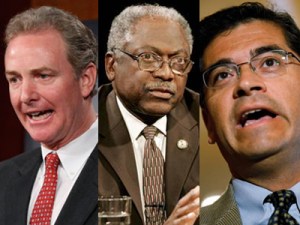
Could this be good news? Nancy Pelosi has picked Reps. James Clyburn (South Carolina), Xavier Becerra (California), and Chris Van Hollen (Maryland), according to Politico, all of whom she expects to fight against cuts in Social Security, Medicare, and Medicaid, as well as promoting revenue increases.
This is just from an e-mail so far. I’ll post links as soon as I have them.
Nancy Pelosi’s statement on her appointments:
“The Joint Select Committee has a golden opportunity to take its discussions to the higher ground of America’s greatness and its values. It must meet the aspirations of the American people for success and keep America number one.
“The thrust of the committee must be to grow an American prosperity enjoyed by all Americans. It must:
– Focus on economic growth and job creation that reduces the deficit;– Make decisions regarding investments, cuts and revenues and their timing to stimulate growth while reducing the deficit; and
– Increase demand by offering recommendations that ensure that wages grow with productivity and reduce America’s families’ dependence on credit.“The work of the Congress must go beyond the deliberations of the committee. Without waiting for the committee to complete its work, we should pass legislation for sustainable job creation. Congress should send to the President the long delayed highway and FAA bills, which generate hundreds of thousands of American jobs; and Congress should approve a national Infrastructure Bank to create jobs and improve our competitiveness.
“We must achieve a ‘grand bargain’ that reduces the deficit by addressing our entire budget, while strengthening Medicare, Medicaid and Social Security. Our entire Caucus will work closely with these three appointees toward this goal, which is the goal of the American people.
“Because the work of this committee will affect all Americans, I called last week for its deliberations to be transparent; the committee should conduct its proceedings in the open.”
Some background on the three picks from the National Journal:
Van Hollen is the ranking Democrat on the House Budget Committee. Clyburn – the highest ranking African-American member of the House — is the assistant Democratic leader. Both men served as Pelosi’s choices for spots on the bipartisan budget working group this year headed by Vice President Joe Biden.
Becerra is the highest ranking Latino lawmaker in the House. He is also the Democratic Caucus’ vice chairman and a member of the Ways and Means Committee. He served on the special White House deficit-reduction commission co-chaired by former Sen. Alan Simpson, R-Wyo., and former White House chief of staff Erskine Bowles, eventually voting against its recommendations.
Van Hollen voted for the debt deal, and Becerra voted against it. Clyburn didn’t like the debt deal, but said it could have been worse. Sounds like he voted with Obama.
As a member of the bipartisan deficit discussion group, convened by Vice President Joe Biden, that laid the groundwork for the debt limit deal, Clyburn — the third ranking Democrat in the House — publicly backed certain entitlement benefit cuts. Specifically, he said negotiators should at least consider further means-testing of Social Security or reduce benefits across the board by reducing Cost of Living Adjustments.
[….]
Van Hollen is the Dems’ top budget guy in the House. He’s one of the party’s chief antagonists of the GOP budget, which calls for phasing out Medicare, and was also a member of the Biden working group. Publicly, he’s been an advocate of approaches to deficit reduction that pair about one dollar of tax increases with about three dollars of spending cuts. He recently cited the Bowles-Simpson framework as a counterpoint to the Republican plan.
Beutler says Beccera “will likely be progressives’ main ally on the Super Committee.”
According to the National Journal article,
If the panel finds itself deadlocked along partisan lines, then across-the-board spending cuts would be triggered of about $1.2 trillion with half of those cuts coming from defense, and the rest from discretionary spending. Entitlements would remain largely untouched if the cuts are triggered by inaction.
Interesting. I didn’t know that. So maybe the goal for Reid and Pelosi is to make sure there is gridlock.
I’ll put any further updates in the comments. Let us know what you think.
Thursday Reads: Poverty and Joblessness *Are* Social and Political Issues
Posted: August 11, 2011 Filed under: Foreign Affairs, Global Financial Crisis, Great Britain, jobs, Media, morning reads, poverty, U.S. Economy, U.S. Politics, unemployment | Tags: austerity, Banksters, education, Federal Reserve, global elites, government corruption, joblessness, London Riots, looting, Poverty, social services, U.S. Economy, unemployment 44 Comments
Guess who said this:
“There are pockets of our society that are not just broken, but are frankly sick.
“It is a complete lack of responsibility in parts of our society, people allowed to feel the world owes them something, that their rights outweigh their responsibilities and their actions do not have consequences. Well, they do have consequences.”
You’re darn right! The global elites have gone too far! The banksters have stolen trillions from ordinary taxpayers, and then demanded and received massive government bailouts. Politicians have lost any sense of responsibility toward their constituents, only listening to their corporate masters and their lobbyists. Yes there are consequences and these wealthy elites will discover there are consequences for their corrupt and immoral actions.
Oh wait. That was Prime Minister David Cameron talking about the poor and jobless young people who have been rioting in the streets of London and other British cities for the past five days. I’ll bet he has absolutely no clue how ridiculous it is that he is chastising these people for looting after he and other global elites allowed banksters to steal and loot trillions with absolutely no consequences. From Raw Story:
The U.S. Federal Reserve gave out $16.1 trillion in emergency loans to U.S. and foreign financial institutions between Dec. 1, 2007 and July 21, 2010, according to figures produced by the government’s first-ever audit of the central bank.
Last year, the gross domestic product of the entire U.S. economy was $14.5 trillion.
Of the $16.1 trillion loaned out, $3.08 trillion went to financial institutions in the U.K., Germany, Switzerland, France and Belgium, the Government Accountability Office’s (GAO) analysis shows.
Additionally, asset swap arrangements were opened with banks in the U.K., Canada, Brazil, Japan, South Korea, Norway, Mexico, Singapore and Switzerland. Twelve of those arrangements are still ongoing, having been extended through August 2012.
Out of all borrowers, Citigroup received the most financial assistance from the Fed, at $2.5 trillion. Morgan Stanley came in second with $2.04 trillion, followed by Merill Lynch at $1.9 trillion and Bank of America at $1.3 trillion.
Lambert has been highlighting the hypocrisy of the global elites on the riots. Yesterday he linked to this article in the Guardian.
This scepticism toward the potency of democratic politicians – and therefore democratic politics itself – is oddly echoed by the looters themselves. Certainly no one outside the Iranian state media is calling them “protesters”, but even “rioters” seems the wrong word, carrying with it a hint of political purpose. For some, especially at the start in Tottenham, there was clearly a political dimension – with the police the prime focus of their anger. But many of the copycat actions across London and elsewhere have no apparent drive beyond the opportunistic desire to steal and get away with it. It’s striking that the targets have not been town halls or, say, Tory HQ – stormed by students last November – but branches of Dixons, Boots and Carphone Warehouse. If they are making a political statement, it is that politics does not matter.
Lambert notes that at least these looters didn’t steal $16 trillion from the U.S. Treasury.
And while the revulsion at the looting has been widespread and bipartisan – with plenty of liberals admitting to “coming over all Daily Mail” at the ugliness of the vandalism – that sense of the impotence of politics is widespread, too. One aspect of the phone-hacking scandal that went deep was its revelation that those we might think exert authority – police and politicians – were in fact supine before an unelected media corporation. The sheer power of News Corp contrasted with the craven behaviour of those we elect or entrust to look out for us.
But elected officials are supposed to protect all citizens–even the poor, the unemployed, and the elderly–aren’t they? Yet in the U.S. and Europe, the burden of the economic crisis is falling on those with the least ability to pay, while the wealthy continue to receive their government handouts. When people are pushed to the point that they feel they have nothing to lose, this is what happens. Why it is coming as such a surprise to the comfortable elites is the real mystery.
Let’s take a look at what some of the rioters themselves have said about the meaning of their actions. From Yahoo News:
The Conservative-Liberal Democrat coalition government, making deep cuts to public services to tackle a record budget deficit, has been quick to deny that the unrest was linked to austerity measures, calling the disorder “pure criminality.” [….]
Public anger over the widespread looting of shops appears to have strengthened the government’s argument, with stolen goods ranging from the expensive — televisions and jewelry — to the absurd — sweets and bottles of alcohol.
However, community leaders and rioters themselves said the violence was an expression of the frustration felt by the poorest inhabitants of a country that ranks among the most unequal in the developed world.
“They’ve raised rates, cut child benefit. Everyone just used it as a chance to vent,” one man who took part in unrest in the east London district of Hackney told Reuters.
Surprise, surprise. Cutting social services to pay for the bankers’ failures has real life consequences. Austerity measures create more unemployment, and people who don’t have jobs get hungry and scared. When you take everything from people who can least afford it, they get angry. What on earth do these people expect? What planet are they living on anyway? And no, I’m not condoning violence. I’m just saying that it’s going to happen when you push people too far.
Here are some quotes from two young women who participated in the British riots:
Two girls who took part in Monday night’s riots in Croydon have boasted that they were showing police and “the rich” that “we can do what we want”.
From The New York Times: London Riots Put Spotlight on Troubled, Unemployed Youths in Britain
“I came here to get my penny’s worth,” said a man who gave his name as Louis James, 19, a slightly built participant in the widening riots that have shaken London to its core. With a touch of guilt on Tuesday, Mr. James showed off what he described as a $195 designer sweater that he said he took during looting in Camden Town, a gentrified area of north London.
Politicians from both the right and the left, the police and most residents of the areas hit by violence nearly unanimously describe the most recent riots as criminal and anarchic, lacking even a hint of the anti-government, anti-austerity message that has driven many of the violent protests in other European countries.
But the riots also reflect the alienation and resentment of many young people in Britain, where one million people from the ages of 16 to 24 are officially unemployed, the most since the deep recession of the mid-1980s.
Don’t these politicians, police, and other observers understand that poverty and jobless *are* sociopolitical issues? Just because people are acting out of desperation or even opportunism doesn’t mean that their actions are not political. Just because someone is young and poor does not mean he or she isn’t aware that government and corporate corruption have caused much of their distress. Back to the NYT article:
In many ways, Mr. James’s circumstances are typical. He lives in a government-subsidized apartment in northern London and receives $125 in jobless benefits every two weeks, even though he says he has largely given up looking for work. He says he has never had a proper job and learned to read only three years ago. His mother can barely support herself and his stepbrothers and sisters. His father, who was a heroin addict, is dead.
He says he has been in and out of too many schools to count and left the educational system for good when he was 15.
“No one has ever given me a chance; I am just angry at how the whole system works,” Mr. James said. He would like to get a job at a retail store, but admits that he spends most days watching television and just trying to get by. “That is the way they want it,” he said, without specifying exactly who “they” were. “They give me just enough money so that I can eat and watch TV all day. I don’t even pay my bills anymore.”
Jonathan Portes, the director of the National Institute of Economic and Social Research in London, says that Mr. James’s plight reflects a broader trend here. More challenging students, Mr. Portes says, have not been receiving the attention they should as teachers, under pressure to meet educational goals, focus on children from more stable homes and those with greater abilities and social skills. Disillusioned, those who cannot keep up just drop out.
The Los Angeles Times in an opinion piece searches for the reasons for the violence and asks if it could happen here.
The Tottenham riots that blindsided Britain were sparked by the fatal police shooting of Mark Duggan, a 29-year-old black man. Over the past few days, they’ve continued and spread, turning into what has largely become youths’ looting and destroying parts of London. But no one is exactly sure why they’re doing it. Prime Minister David Cameron called it “criminality, pure and simple.”
But why have the riots continued day after day?
The riots are neither politically or racially fueled, wrote Doug Sanders of the Globe and Mail. They’re the result of a “lost generation” of youth under 20 who have little to lose and a bleak future. Here’s an excerpt:
Whether the thousands of rioters actually did express disillusionment — some did say they were angry at police or the world, but many appeared gleeful or greedy — it is clear that most had nothing else to do with themselves, and no reason to fear or feel responsible for the consequences of their actions.
This is a chronic problem in Britain, which has a “lost generation” of young high school dropouts far larger than most other Western countries’.
It’s so simple-minded to expect that youthful rioters are going to calmly explain their behavior in a reasoned, intellectual manner or that they are not going to act euphoric once they let go of restraint and begin acting out as part of a mob. None of that means that the reasons for their behavior are not political.
It seems to me that masses of young people who have “little to lose and bleak future” is in fact a powerful political issue for any society. And when people are powerless, there are few ways for them express their anger. Violence is one way to get attention from the powerful.
Can it happen here? You bet it can. As long as the President and Congress continue enacting austerity measures and ignoring unemployment and general misery among ordinary Americans, it’s guaranteed the U.S. will see riots in the streets–as we have in the past. When it happens here, will our elites be as dumbfounded and out-of-touch with reality as those in Great Britain? Probably.
I posted this in a comment yesterday, but I’m going to put it up again here. It’s an interview of writer and broadcaster Darcus Howe by a clueless BBC “journalist.”
—————————————-
That’s my suggested reading for today. What do you recommend?
UPDATE: I found a piece in the Guardian that reflects my thinking.
Seumas Milne: These riots reflect a society run on greed and looting
It is essential for those in power in Britain that the riots now sweeping the country can have no cause beyond feral wickedness. This is nothing but “criminality, pure and simple”, David Cameron declared after cutting short his holiday in Tuscany. The London mayor and fellow former Bullingdon Club member Boris Johnson, heckled by hostile Londoners in Clapham Junction, warned that rioters must stop hearing “economic and sociological justifications” (though who was offering them he never explained) for what they were doing.
When his predecessor Ken Livingstone linked the riots to the impact of public spending cuts, it was almost as if he’d torched a building himself. The Daily Mail thundered that blaming cuts was “immoral and cynical”, echoed by a string of armchair riot control enthusiasts. There was nothing to explain, they’ve insisted, and the only response should be plastic bullets, water cannon and troops on the streets.
We’ll hear a lot more of that when parliament meets – and it’s not hard to see why. If these riots have no social or political causes, then clearly no one in authority can be held responsible….If this week’s eruption is an expression of pure criminality and has nothing to do with police harassment or youth unemployment or rampant inequality or deepening economic crisis, why is it happening now and not a decade ago? The criminal classes, as the Victorians branded those at the margins of society, are always with us, after all. And if it has no connection with Britain’s savage social divide and ghettoes of deprivation, why did it kick off in Haringey and not Henley?
…To refuse to recognise the causes of the unrest is to make it more likely to recur – and ministers themselves certainly won’t be making that mistake behind closed doors if they care about their own political futures.
Righteous Rants Open Thread
Posted: August 10, 2011 Filed under: U.S. Economy, U.S. Politics, unemployment, voodoo economics | Tags: Al Sharpton, Bernie Sanders, corruption, David Goodfriend, Dylan Ratigan, jobs, Joe Biden, Keith Ellison, righteous rants, tax cuts, trade deals 18 CommentsDylan Ratigan goes nuts over government corruption
————————————————
David Goodfriend (on Dylan Ratigan Show) explains why cutting taxes doesn’t create jobs
————————————————
Bernie Sanders schools Obot Al Sharpton on the debt deal, plus Keith Ellison
————————————————
Heard any good rants lately?
Breaking: Boehner, McConnell Announce Picks for Catfood Commission II
Posted: August 10, 2011 Filed under: Medicaid, Medicare, Social Security, U.S. Economy, U.S. Politics, voodoo economics, We are so F'd | Tags: austerity, Catfood Commission II, Federal Deficit, Harry Reid, John Boehner, Mitch McConnell, Super Committe 23 Comments
Speaker John Boehner has appointed Ways and Means Chairman Dave Camp (R-Mich.), Energy and Commerce Chairman Fred Upton (R-Mich.) and Republican Conference Chairman Jeb Hensarling (R-Texas) as the House GOP members of the panel.
Hensarling will be co-chairman of the committee. Senate Minority Leader Mitch McConnell also announced Wednesday the Senate Republican members: Jon Kyl of Arizona, Pat Toomey of Pennsylvania and Rob Portman of Ohio.
Politico says that Kyl, who is not running for reelection,
will likely be a conduit to McConnell to keep him apprised of the ongoing negotiations – as he did when he served as the lead Senate GOP negotiator during the unsuccessful budget talks led by Vice President Joe Biden this summer. Portman, a former White House budget director under George W. Bush and a freshman GOP senator, has been given increased responsibilities from the leadership, including earlier this year when he helped draft a GOP jobs initiative.
From CBS News Political Hotsheet:
In a statement, McConnell said the three senators he’s chosen understand the “gravity” of the current economic climate and will bring to the table “the kind of responsibility, creativity, and thoughtfulness that the moment requires.”
“The American people know that we cannot dig ourselves out of this situation by nibbling around the edges, and I am confident that each of these nominees can be counted on to propose solutions that put the interests of all Americans ahead of any one political party,” McConnell said.
Boehner said in a statement he appointed “proven leaders who have earned the trust and confidence of their colleagues and constituents.”
How very reassuring. The good news is that Boehner didn’t appoint either Paul Ryan or Eric Cantor–probably because he wants them to be reelected in 2012.

As we heard yesterday, Harry Reid has chosen Patty Murray (Washington), John Kerry (Massachusetts), and Max Baucus (Montana), with Murray to serve as co-chair. Nancy Pelosi has not yet announced her choices for the “super committee” AKA Catfood Commission II.
At FDL, David Dayen has some great comments on Harry Reid’s choices.
Patty Murray and John Kerry have defense industry ties, and as the head of the Finance Committee Baucus is no stranger to health care or tax lobbyists. But I don’t think you could find a Senator in the Democratic caucus without those ties. Then there’s this allusion to a stirring speech by John Kerry, which should immediately set off a BS detector:
A Democratic source told The Huffington Post that Kerry “made it into the discussion” of who should serve on the committee by delivering “some powerful speeches” to the rest of the caucus. The speeches, the source added, were in defense of Democratic Party priorities, focusing on the need to protect entitlement programs and Kerry’s desire to strongly push back against (what the source referred to as) “the right-wing agenda.”
That gives me a great idea to stall out the committee: have John Kerry give the opening speech.
Meanwhile, if Baucus is not liked for being parochial and sure to vote against any program that emerged, and given his performance during the health care debate, when he went into a room with a small bipartisan group and wasted four months not finding a solution, I’d say it was a great choice!
Please post any relevant background information you have on these Senators and Representatives in the comments.
WTF is a Supercommittee and who is likely to get appointed? (updated)
Posted: August 9, 2011 Filed under: U.S. Economy, U.S. Politics, We are so F'd | Tags: supercommittee 34 Comments We’ve had a catfood commission and a gang of six. Both groups basically had such essential differences that nothing ever came of their recommendations and nothing resembling a consensus appeared. How is some congressional mandate handed over to a “supercommittee” going to be any different? I see no reason for the Republicans to not continue the gridlock. However, I did want to find out more. So, here’s what I found.
It seems obvious to me that the supercommittee has been given a mandate to do things that no single congress critter wants on his record. They are there to cut extremely popular programs. I personally wonder if they will give cover to Republicans that signed on to Grover Norquist’s no tax pledge for reasonable changes in revenue policies as well. I found a reasonably short explanation of their mandate on the PR&P Tax Update Blog.
The Act reduces spending by $0.9 trillion over the next 10 years and creates a 12-member, bi-partisan joint “super” committee charged with making recommendations to cut an additional $1.5 trillion from the deficit over 10 years. The committee may recommend any combination of spending cuts or tax increases. If legislation is not enacted by January 15, 2012 to cut the deficit by at least $1.2 trillion, then any shortfall must be taken equally out of defense and social spending by January 1, 2013. This latter provision is so distasteful to each political party that it is seen as the vehicle to force through an agreement from the super committee.
Super committee appointments are to be made by August 16, 2011 with the first meeting held no later than September 16, 2011. The committee must vote on their conclusions no later than November 23, 2011. If a majority votes in favor, then legislative language must be reported out no later then December 2, 2011. Both the House and the Senate must vote on the proposal by December 23, 2011 with no amendments considered. The committee may rely on previous proposals to reform spending and taxation due to the time constraint it must work under.
There is an incredible amount of speculation on possible appointments to the supercommittee. This is Politico’s best guess for the Senate appointees. They have their guesses for the House appointees as well as a list of ‘dark horses’.
The major contenders to be selected by Senate Majority Leader Harry Reid (D-Nev.):
• Sen. Max Baucus (D-Mont.) – Finance Committee chairman has jurisdiction over entitlement programs and he served on the Simpson-Bowles commission. The Huffington Post, however, reported on Monday that Baucus is unlikely to be tapped.
• Sen. Dick Durbin (D-Ill.) – Reid deputy is a Gang of Six member who also served on Simpson-Bowles.
• Sen. Daniel Inouye (D-Hawaii) – Appropriations Committee chairman participated in the Biden talks.
• Sen. Charles Schumer (D-N.Y.) – Schumer is a Reid ally who would not let Democrats get rolled in the negotiations.
The major contenders to be selected by Senate Minority Leader Mitch McConnell (R-Ky.):
• Sen. John Barrasso (R-Wyo.) – Member of leadership team who throws sharp elbows on 2010 healthcare law.
• Sen. Orrin Hatch (R-Utah) – Ranking member of Finance Committee told The Hill, “I can live with [being appointed] or live without it.” Some point out that Hatch, who could face a primary challenge next year, will not be keen on finding common ground with Democrats.
• Sen. Jon Kyl (R-Ariz.) – McConnell’s deputy participated in the Biden talks and is not seeking reelection.
• Sen. Rob Portman (R-Ohio) – Portman, a budget director in George W. Bush’s administration, has been mentioned a lot in recent days. The former House Ways and Means Committee member is widely respected on both sides of the aisle.
Sam Stein at HuffPo writes that Conrad and Baucus will not make the cut. Obama mentioned that the White House will be involved in the process of what the supercommittee does but he did not mention how that will happen.
To whom he will be submitting the plan remains the major mystery. But over the weekend, information about potential committee members began to leak from Capitol Hill. According to multiple Democratic sources, Senate Democratic leaders are winnowing down the names on the short list and they are leaning strongly against including some of the party’s most notable budget hawks.
Two senators, in particular, were said to be unlikely to end up on the committee: Max Baucus (D-Mont.), who chairs the Finance Committee, and Kent Conrad (D-N.D.), who chairs the Budget Committee.
Final decisions have not yet been made, two aides cautioned. But two other Democratic aides with knowledge of deliberations said they would be very surprised if either ended up on the final list.
“The committee is built for failure — everyone will either stack it with loyalists to leadership and the caucuses or with partisan firebrands to make sure those folks defend key priorities,” said one of those aides. “If they don’t, they will immediately regret it. You need grown-up smart pros that know the issues, know the caucus position and will not waver.”
It appears that Conrad himself does not expect to make the cut. On Aug. 1, the night before the debt ceiling deal was signed, a reporter told him that a few people had floated his name as a super committee member. “I’m sure it’s a very few,” the senator responded.
The exclusion of Conrad and Baucus could have major implications for the committee’s tenor and the actions it will ultimately take. During the debt ceiling debate, Conrad pushed far-reaching deficit reduction proposals that included entitlement and tax reform and called for one dollar in spending cuts for every dollar in tax revenue raised. Baucus is more protective of entitlements but enjoys close ties to the financial service industry. Both are considered senior statesmen among Democrats on debt related negotiations. They are also distrusted by the party base, primarily because of their long records as fiscal hawks.
There are many concerns that people have expressed with the formation of this group. One of the major issues is transparency.
Transparency concerns: Some groups have expressed concern that the joint committee will have an extremely powerful role in shaping policy, but may not be subject to the same transparency obligations as other congressional committees. “Right now, the creation of the committee doesn’t come with many requirements for transparency,” noted the Project on Government Oversight.
In a letter to Congressional leadership Aug. 3, the Sunlight Foundation recommended the joint committee include on its website:
- Live webcasts of all official meetings and hearings,
- the Committee’s report should be posted for 72 hours before a final committee vote,
- disclosure of every meeting held with lobbyists and other powerful interests,
- disclosure of campaign contributions as they are received (on their campaign website), and
- financial disclosures of Committee members and staffers.
The downgrade creates “a sense of urgency for the two parties to come together,” Rep. Steve Southerland, R-Fla. told the Times, adding that the possibility of a further downgrade “scares” him. Added Rep. Blake Farenthold, R-Texas, “Anything that encourages the new committee to get the job done and get us back on a rational fiscal path is a good thing.”
At least some lawmakers called on Congress to return from its August recess to take up more deficit-reduction legislation.
“I sent a letter today to Leader Cantor requesting we come back to DC to resolve our deficit and spending issues. We should be in session!” Rep. Allen West, R-Fla., tweeted. West, a Tea Party-aligned House member, gained attention for his early support of the debt deal Republican leaders agreed to with President Obama.
Similarly, Rep. Jack Kingston, R-Ga., said in a statement that “Congress should immediately reconvene to take up the fundamental reforms necessary to right the ship and lay the groundwork for a more stable and secure future for our children and grandchildren.”
Rep. Barney Frank, D-Mass., said on CBS’ “The Early Show” Monday that “there’s going to be incredible pressure on this commission now to come up with $1.5 trillion worth of deficit cuts,” but he expressed skepticism they’d get the job done. “Do you think if Democrats appoint their six most liberal members and Republicans appoint their six most conservatives that this committee will get anything done?” He said that the two parties should at least be able to support defense spending cuts. As Frank noted, there’s reason to believe the partisan fighting that S&P cited in its downgrade will continue in the supercommittee.
In the first of what will be a closely watched selection process for a powerful new deficit panel, Senate Majority Leader Harry Reid announced he will appoint Democratic Sens. Patty Murray (Wash.), Max Baucus (Mont.) and John Kerry (Mass.) as his three choices for a super committee charged with finding more than $1 trillion in spending cuts by the end of this year.
Murray will serve as co-chair of the 12-member panel. Speaker John Boehner (R-Ohio) will select her co-chair and two other panelists, as required by the next debt limit agreement signed into law by President Barack Obama last week. Minority Leaders Nancy Pelosi and Mitch McConnell will each select three additional members.

 peej
peej Carissa
 bostonboomer
 dakinikat
 ecocatwoman
 mablue2
 Mama Lopez
 peggysue22
 quixote
 skydancingguestblogger
 Mona (aka Wonk the Vote)



 Sky Dancing
Recent Comments