
Tuesday Reads
Posted: November 8, 2011 Filed under: Medicare, morning reads, Social Security, U.S. Economy, U.S. Politics | Tags: Barack Obama, child sexual abuse, Chuck Pfarrer, college football, executive orders, Herman Cain, Jane Addams Senior Caucus, Jerry Sandusky, Joe Paterno, Matt Yglesias, Navy Seals, Noam Chomsky, Norman Mailer, Occupation Chicago, Osama bin Laden, Penn State, senior citizen protesters, Sharon Bialek 29 Comments
Good Morning!! Let’s take a look at what’s happening in the news today.
The Daily Mail has some excerpts from a new book about the Osama bin Laden assassination mission. Apparently President Obama was out on the golf course until about 20 minutes before it all went down.
The claims are from Chuck Pfarrer, a former SEAL team commander, in a book called SEAL Target Geronimo.
He has spoken to several of the men who carried out the operation at Bin Laden’s mansion hideout in Abbottabad, Pakistan, on May 2.
Mr Pfarrer paints a very different picture to the official photo released at the time which shows Mr Obama and advisers huddled round a table in the White House situation room as footage was beamed from a drone 15,000ft above the al-Qaeda leader’s mansion.
Mr Pfarrer says the President’s role was largely inflated and suggests he stayed out on the golf course for so long so he could distance himself in case it went wrong. Mr Pfarrer writes: ‘If this had completely gone south, he was in a position to disavow.’
Pfarrer also claims that “when they burst into Bin Laden’s room, his wife screamed: ‘No, no, don’t do this… it’s not him!'”
More horrible details keep coming out about the child sexual abuse scandal at Penn State. Here’s a timeline of events published by CNN. The reports of assistant coach Jerry Sandusky go back as far as 1994, and it’s clear that head coach Joe Paterno was aware of Sandusky’s behavior. In 1998, there was an investigation by Penn State Police and Pennsylvania Department of Public Welfare of Sandusky showering naked with an 11-year-old boy. The incident was reported by the boy’s mother. Are we supposed to believe that Paterno wasn’t informed of this investigation? Give me a break!
Then, in 2002,
According to the grand jury report, a graduate assistant allegedly tells Coach Joe Paterno that he saw Sandusky in the locker room shower the night before, performing anal sex on a young boy he estimated to be 10 years old….
Paterno reports the incident to Athletic Director Tim Curley, saying the graduate assistant had seen Sandusky “fondling or doing something of a sexual nature to a young boy,” according to the grand jury. Later, the assistant is summoned to a meeting with Athletic Director Tim Curley and Senior Vice President for Finance and Business Gary Schultz.
So first, Paterno minimizes the incident in his report and then nothing is done and Paterno just lets it slide. But apparently Paterno isn’t a target in the case.
Quite a few writers are calling for Paterno to resign, however. From the LA Times:
In 46 seasons as the football coach at Penn State University, Joe Paterno appeared to create a culture of winning and decency he called “Success with Honor.”
Now that the culture has been exposed as a haven for an alleged child molester, Paterno needs to do the honorable thing and resign before he coaches another game.
It’s sad that the winningest coach in major college football history will end his career with a giant “L” in the human-being department, but not nearly so sad as the idea that boys may have been abused because football’s most controlling boss did nothing.
From Lawyers, Guns, and Money:
There can be little doubt that Paterno has known since at least 1998 that Sandusky had a “problem” with “inappropriate behavior” toward children, i.e., he was a child molester. That’s when the campus police did a six-week investigation after a mother reported to them that her 11-year-old son had showered with Sandusky. From the grand jury report:
The mother of Victim 6 confronted Sandusky about showering with her son, the effect it had had on her son, whether Sandusky had sexual feelings when he hugged her naked son in the shower, and where Victim 6′s buttocks were when Sandusky hugged him in the shower. Sandusky said he had showered with other boys and Victim 6′s mother tried to make him promise never to shower with a boy again but he would not. She asked him if his “private parts” had touched Victim 6 when he bear-hugged him. Sandusky replied, “I don’t know . . . maybe.” At the conclusion of the second conversation, after Sandusky was told he could not see Victim 6 any more, Sandusky said, “I understand. I was wrong. I wish I could get forgiveness. I know I won’t get it from you. I wish I were dead.”
To put it mildly, it’s extremely unlikely that in a little town like State College, PA, word of this investigation didn’t get back to Paterno. This supposition is bolstered by Sandusky’s otherwise strange “retirement” the following year.
Paterno should be prosecuted, but because of his reputation, he won’t. At the very least, he should lose his job.
According to the National Journal, President Obama is considering issuing an executive order that would deal with an “earmark workaround” that members of Congress have been using.
In a move that could escalate hostilities with Congress, President Obama may be planning to use his executive authority to publicize special funding requests that lawmakers make for pet projects.
A memo that the White House has floated on Capitol Hill would require executive branch agencies to make public any letter from a member of Congress seeking special consideration for any project or organization vying for government funding….
The threat to name and shame would potentially cut off another avenue members of Congress have for influencing government spending in their own back yards. It comes at a time that Obama is ratcheting up his campaign rhetoric against Congress, which he blames for blocking his efforts to stimulate the economy, on the eve of his 2012 reelection effort.
Sounds like a good idea to me.
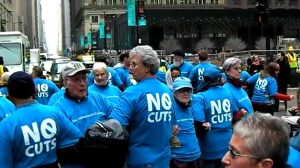
Some senior citizen protesters blocked traffic in Chicago yesterday.
Chicago police on Monday issued citations to 43 senior citizens and their supporters who linked arms to block an intersection near the city’s financial district.
The action was part of a protest against proposed cuts to Social Security, Medicare and other benefits.
The Jane Addams Senior Caucus (JASC), their supporters and “Occupy Chicago” began the demonstration with a rally outside the office of Illinois Sens. Mark Kirk (R) and Dick Durbin (D). The group, which organizers claimed was nearly 1,500-strong, then marched to the Federal Plaza.
Traffic at the intersection of Jackson Boulevard and Clark Street was blocked for about an hour, according to the Chicago Tribune.
“At every level of society, Americans are under attack,” said Karen Bocker, an “Occupy Chicago” participant and grandmother of four.
Matt Yglesias learned yesterday that Noam Chomsky had mentioned him unfavorably in a speech on receiving a Peace Prize in Sydney, Australia. Be sure to read Yglesias’ convoluted explanation of International Law as it relates to the state murder of Osama bin Laden. One commenter wrote that Yglesias had achieved a
Fantastic career milestone. Every pundit needs a personalized bitchfest with someone more famous. Next, Matt should try getting into a fistfight with Norman Mailer, or get into a William F. Buckley/Gore Vidal-esque television spat with Andrew Sullivan.
The fistfight with Norman Mailer would certainly be entertaining, since Mailer died in 2007. How about a beer drinking contest with the ghost of Jack Kerouac?
Politico reports that Herman Cain will hold a press conference in response to the allegations by Sharon Bialek.
CNN and ABC News’ Michael Falcone are reporting that Herman Cain, who has said he’s not commenting and it’s the “end of story” several times in the past week, will hold a press conference in Arizona tomorrow to address the latest allegations today, made by Chicago single mom Sharon Bialek.
In a series of tweets, Falcone also said the Cain campaign is questioning Bialek’s motives.
I guess he’ll also have to answer questione about a fifth woman.
A former USAID worker claims Herman Cain asked her to set up dinner with a woman who attended a speech he gave in 2002, the Washington Examiner is reporting tonight.
The worker – 40-year-old Donna Donella, of Arlington – told the paper that the moment came after Cain gave a paid speech in Egypt that year. A woman in the crowd posed a query to Cain during the speech, the Examiner said.
Donella told them “And after the seminar was over, Cain came over to me and a colleague and said, ‘Could you put me in touch with that lovely young lady who asked the question, so I can give her a more thorough answer over dinner?’”
She was “suspicious of Cain’s motives and delined to set up the date,” the Examiner reporter wrote.
That’s what I’ve got for today. What are you reading and blogging about.
The Revolution Will Not Be Televised
Posted: November 7, 2011 Filed under: #Occupy and We are the 99 percent!, Bailout Blues, Banksters, Economy, financial institutions, income inequality, The Great Recession, U.S. Economy, unemployment, worker rights | Tags: 2011: days of revolt, jobs, U.S. Economy 5 CommentsNor apparently will it be discussed or reported in anything but negative terms. Take a quick spin over to Memeorandum’s page. The Portland Occupy group is fighting off cooties [head and body lice]. According to the New York Post, Zuccotti Park has devolved into anarchy, a mad den of rapists, vigilantes and wild men demanding free food at McDonalds. Occupy protesters, anti-capitalists all, are beating up elderly women, according to another reasoned report. The Sun Journal leads with the headline: The Lawless Heart of Occupy Wall St. , and then questions the legitimacy of a group that “would interrupt the flow of commerce” in a time of recession [referencing the Oakland port takeover last Wednesday]. And then, there’s the repeating, oh so familiar meme: the protesters are a bunch of Leftist radicals, dedicated to the overthrow of democracy.
Did I mention that they’re all hippies?
What we’re not seeing on the television is this:
War Veterans. These are our men and women who are deified in the press, while shedding blood [frequently their own] in wars of no end and seemingly no point. What are their prospects once home? Not good. Not good at all. According to US News:
And a Department of Labor report shows that unemployment tops 20 percent among 18-to-24-year-old veterans, compared to a national rate of about 9 percent.
Veteran unemployment is projected to worsen after 10,000 servicemen and servicewomen return from Afghanistan and 46,000 come home from Iraq by year’s end — many wounded or suffering from mental trauma.
Nor do we see much of this:
Hummm. Not enough dirty hippies in the group, I guess. This was the “Surround the White House Action,’ to protest the Keystone Tar Sands Pipeline yesterday. Crowd estimate? Around 10,000.
We’ve certainly had full coverage on the violence last Wednesday, in the waning hours of the General Strike in Oakland. The bonfires, the group in black hoodies breaking windows, spray-painting walls, the suggestion that civilization was about to end. But I haven’t seen much coverage of this recent incident [although I see Dak picked this up in the Morning Reads]:
While filming, the cameraman was shot with a rubber bullet. It appears that taking photographs of the Oakland PD is a criminal and/or a violent act, requiring defensive action.
But here’s the thing. Images like this:
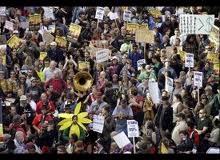
Aren’t terribly different from this:

The first is from Occupy Oakland. The second is from the Civil Rights Movement of the 1960s. And if you flip through images of the 1930 Labor protests, the similarities are there as well—people coming together, voicing grievances, demanding resolution. Movements demanding social and economic justice have never been neat and tidy. Nor short. Not in the 60s, not in the 30s. And not now.
So, the song is prophetic. The Revolution will not be televised. No re-runs, brother. It will be live–growing, evolving. For better or worse, morphing into what it will become.
Or not.
Ezra Klein Reviews “Confidence Men,” and Finds it Sorely Lacking
Posted: November 5, 2011 Filed under: Domestic Policy, Economy, Team Obama, The Great Recession, U.S. Economy, U.S. Politics | Tags: Barack Obama, Beltway Bob, book reviews, Brooksley Born, Christina Romer, Confidence men, Elizabeth Warren, Ezra Klein, Larry Summers, Ron Suskind, Sheila Bair, Tim Geithner 44 Comments
Ezra Klein, AKA Beltway Bob
Ezra Klein (AKA Beltway Bob) is really coming up in the world. He somehow managed to get a gig writing a review of Ron Suskind’s book Confidence Men for the New York Review of Books. I’m impressed, I must admit.
As you probably guessed already, Klein is quite critical of the book. In fact he thinks Suskind should have written a completely different kind book instead–maybe even a couple of different kinds of books.
As I see it, Suskind set out to write an interesting and entertaining political book about Obama’s economic advisers, how they interacted with each other and the President, and how administration economic policy took shape over the first couple of years. The book is gossipy and very much focused on the people involved and their relationships with each other. As a psychologist, I found it fascinating to read Suskind’s insights.
Klein admits that
The work that went into Confidence Men cannot be denied. Suskind conducted hundreds of interviews. He spoke to almost every member of the Obama administration, including the President…He takes you inside…the Oval Office. He heads to Wall Street and back. He quotes memos no one else has published. He gives you scenes that no one else has managed to capture.
But that isn’t good enough. Klein disapproves of the gossipy, personality-centered tone of Confidence Men. He wants Suskind to provide evidence for his personal assessments of people. For example, Klein objects to Suskind’s description of Treasury Secretary Tim Geithner’s appearance at Obama’s announcement that Elizabeth Warren would be working with Geithner to set up a consumer agency that she had first conceived of and then fought for. Although Warren didn’t know it yet, she would never head the agency, because Geithner had already made a deal with the bankers: they would accept a consumer agency as long as Warren wasn’t put in charge.
Here’s the passage that Klein found offensive:
This has caused discomfort not only for the president, but also for his top lieutenants, including the boyish man in the too-long jacket at Obama’s right hip, bunched cuffs around his shoes, looking more than anything like a teenager who just grabbed a suit out of dad’s closet. That’s Treasury Secretary Tim Geithner, looking sheepish.
Klein so objected to this paragraph that he felt he had to go watch the announcement again himself, to see if Suskind’s description was accurate.
I prefer to verify. So I went back to the tape. I rewatched the September 2010 press conference where Obama introduced Warren to the country. I paid special attention to Geithner. Suskind’s right: his suit is too big. But he doesn’t look sheepish or ashamed. He looks, by turns, bored and interested. He clasps his hands behind his back. He nods attentively. He tries not to fidget. He looks like every experienced bureaucrat looks when they’re asked to stand like a prop near the president. Blank, and trying not to make any news. He failed.
But Klein doesn’t offer any evidence for his observations either. How can he know what Geithner was thinking–that he tried “not to fidget” and tried “not to make any news?” He can’t. Klein has shared his own observations and interpretations, just as Suskind did. But Klein finds it annoying. He didn’t want to read a book about people, based on the close observations and opinions of its author. No, Klein wanted a book about policy, and he felt that
…any account of what he [Obama] has done wrong, or what he could do right, needs to provide, first and foremost, a persuasive case of how the White House could have done more to promote an economic recovery over the last three years, or could do more to accelerate one now.
Klein wanted a wonky book, heavy on policy and light on human interest, and he can’t understand why Suskind wrote something different. Quite honestly, I think Klein should go right ahead and write a book like that if he wants to. It wouldn’t be as much fun to read as Suskind’s book, but it might make people like Matt Yglesias and Brad DeLong happy.
Read the rest of this entry »
Thursday Reads: Power to the People!
Posted: November 3, 2011 Filed under: #Occupy and We are the 99 percent!, Foreign Affairs, France, Germany, Greece, Italy, morning reads, Spain, U.S. Economy, U.S. Politics, unemployment | Tags: Angela Merkel, austerity, democracy, Eurodammerung, George Papandreau, Greece, Nicolas Sarkozy, Oakland general strike, Paul Krugman, Robert Reich 40 Comments
Good Morning!! Over the past couple of days, I’ve become really fascinated with the situation in Greece. It’s a pretty fluid situation at the moment. On Tuesday Robert Reich wrote a pretty good primer on what is happening and expressed his view that letting the Greek people decide their own fate is the best idea. Here’s a bit of it:
Greek Prime Minister George Papandreou decided in favor of democracy yesterday when he announced a national referendum on the draconian budget cuts Europe and the IMF are demanding from Greece in return for bailing it out.
(Or, more accurately, the cuts Europe and the IMF are demanding for bailing out big European banks that have lent Greece lots of money and stand to lose big if Greece defaults on those loans – not to mention Wall Street banks that will also suffer because of their intertwined financial connections with European banks.)
If Greek voters accept the bailout terms, unemployment will rise even further in Greece, public services will be cut more than they have already, the Greek economy will contract, and the standard of living of most Greeks will deteriorate further.
If Greek voters reject the terms and the nation defaults, it will face far higher borrowing costs in the future. This may reduce the standard of living of most Greeks, too. But it doesn’t have to. Without the austerity measures the rest of Europe and the IMF are demanding, the Greek economy has a better chance of growing and more Greeks are likely to find jobs.
Shouldn’t Greek citizens make this decision for themselves?
Reich argues that it would have been better in the long run if the American people had been consulted about the bank bailouts here.
If Americans had been consulted about the 2008-2009 Wall Street bailout, I doubt it would have happened the way it did. At the very least, strict conditions would have been placed on the banks in return for the money. The banks would have had to eat the losses of the predatory mortgages they sold, and help homeowners reduce those mortgages. They’d be required to improve the capitalization of small banks in communities across the country. They’d be forced to accept stringent new regulations, including resurrection of Glass-Steagall
But we weren’t consulted. The wishes of the American people were considered irrelevant by the oligarchs who run this country. And the European oligarchs are hoping to prevent the Greek people from claiming a right to make a democratic decision.
Of course if the Greek people do decide to default on their debts, there will be serious consequences–for them and for the rest of Europe. Krugman calls it “Eurodämmerung.” He argues that
…the euro was an inherently flawed idea that can work only given a strong European economy and a significant degree of inflation, plus open-ended credit to sovereigns facing speculative attack. Yet European elites embraced the notion of economics as morality play, imposing across-the-board austerity, tightening money despite low underlying inflation, and have been too concerned with punishing sinners to notice that everything was going to blow apart without an effective lender of last resort.
The question I’m trying to answer right now is how the final act will be played. At this point I’d guess soaring rates on Italian debt leading to a gigantic bank run, both because of solvency fears about Italian banks given a default and because of fear that Italy will end up leaving the euro. This then leads to emergency bank closing, and once that happens, a decision to drop the euro and install the new lira. Next stop, France.
Yikes! But Fortune also says Italy and France are in trouble if Greece defaults. And Spain could go bust too.
What worries is that Spain and Italy are not in the Greek situation but they could be. Greece is bust and Spain and Italy could be driven bust. They both have a lot of debt and each year some of that debt has to be repaid. Now governments almost never do repay debt, they just borrow some more and use the new money to pay off the old. Bit like swirling what you owe around a few credit cards.
Which is just fine: except, if interest rates rise then they have to pay more interest on this new debt that they’re issuing to pay off the old. And if interest rates rise enough then they do go bust, as the interest payments they have to make take too much money out of the budget. Switching money around on zero interest introductory rate cards is very different from doing it when you’re being charged 30%.
Now, the general agreement is that when the interest rates are above 6% then Italy and Spain are in danger of going bust. When they’re over 7% they will do so. But of course, when people see that Italian interest rates are above 6% then they become more wary of lending Italy any more money and so interest rates keep on rising to possibly above 7% and game over.
It’s still not clear what Greece is going do in their referendum. Dakinikat says they need to ask the people if they want to leave the European Union or not. German Chancellor Angela Merkel and French President Nicolas Sarkozy have said that the referendum must ask the Greek people if they want to opt out of the Euro, but not the EU itself. Meanwhile, the offer of a bailout of Greece has been called off until after the vote on the referendum is taken. From Naked Capitalism:
The Eurocrats have decided to try to push Greece into line, threatening expulsion from the Euro (note, not the EU) if Greece does not back down. From a practical matter, if the Greeks were to turn down the bailout package, it would lead to a banking crisis, making a Eurozone exit a not that much more traumatic incremental move with considerable upside. And under the Maastrict treaty, Greece cannot unilaterally exit (although as various commentors have pointed out, Nato is not going to send in tanks if the Greeks were to do so).
But this may be an appeal to the Greek public, or more likely, an effort to break Greek prime minister’s Papandreou’s thin coalition on the eve of a vote of no confidence.
So that’s another possibility–that Papandreau’s government might fall. More on the European reaction from Bloomberg:
Led by Germany and France, Europe’s economic and political anchors, the euro’s guardians yesterday cut off financial aid for Greece until a vote they said would be on Dec. 4 or Dec. 5 determines whether it deserves a fresh batch of loans needed to stave off default.
“The referendum will revolve around nothing less than the question: does Greece want to stay in the euro, yes or no?” German Chancellor Angela Merkel told reporters after crisis talks hours before a Group of 20 summit set to begin today in Cannes, France. French President Nicolas Sarkozy said Prime Minister George Papandreou’s government won’t get a “single cent” of assistance if voters rejects the plan.
The hardball tactics open the door for a nation to leave the currency bloc that at its setup in 1999 capped Europe’s progression from war to prosperity and was declared “irrevocable” by its founding fathers. Polls show most Greeks object to the austerity required for aid, yet more than seven in 10 favor remaining in the euro, a survey last week of 1,009 people published in To Vima newspaper showed.
They’re going to have to decide between two awful choices, and the rest of Europe will have to deal with the results of the vote–if there is a default, failures of banks that hold Greek debt and getting Italian, French, and German taxpayers to pay for more bank bailouts–unless Papandreau’s government falls. Read the whole article at Bloomberg to get a sense of how serious all this is.
In U.S. news, Occupy Oakland called for a general strike today. That situation is still fluid as of this writing, 11PM Eastern on Wednesday night.
OAKLAND – Protesters blocked streets near City Hall, smashed windows at a bank and gathered by the thousands in an attempt to shut down the nation’s fifth-busiest port Wednesday.
The Occupy Oakland protest was the largest in a series of rallies in several cities as the Occupy Wall Street movement that began Sept. 17 tried to grab national attention.
A group of about 300 protesters, many of them men wearing black, some covering their faces with bandanas and some carrying wooden sticks, smashed windows of a Wells Fargo bank branch while chanting “Banks got bailed out. We got sold out.”
Are you getting the feeling this genie can’t be put back in the bottle either? The Occupy demonstrations have shown us that we pretty much live in a police state at this point. There very little respect for the protesters’ constitutional rights by local governments or law enforcement. From Counterpunch, here is a report of what actually happened when police attacked protesters in Oakland on Oct. 25.
In a heavily armed pre-dawn raid, on Tuesday, Oct. 25, with back up from armored vehicles and helicopters, the Oakland Police Department in conjunction, with over 15 other police departments from Northern and Central California, stormed the sleepy Occupy Oakland Encampment.
Asleep inside tents of the makeshift Occupy encampment, were over a hundred men, women and very young children. The heavily armed police force, dressed in black ninja-like outfits, and special forces helmets, with full face-shields down, and armed with and assortment of latest riot gear, fired tear gas canisters and concussion grenades into the camp, as helicopters circled above.
Police then attacked and ransacked the entire encampment. In a short time, the camps library, soup kitchen, and children’s center were left in ruins, and over a hundred of the inhabitants were roughed up, arrested and held on high bail. The activists suffered many injuries, including broken bones.
Please read the whole thing–it’s an eyewitness account of a horrifying paramilitary action by police. As everyone knows, Iraq war veteran Scott Olson was critically injured in the melee.
Late last night as part of the general strike, Oakland protesters succeeded in shutting down the Port of Oakland.
Several thousand Occupy Wall Street demonstrators forced a halt to operations at the United States’ fifth busiest port Wednesday evening, escalating a movement whose tactics had largely been limited to rallies and tent camps since it began in September.
Police estimated that a crowd of about 3,000 had gathered at the Port of Oakland by early evening. Some had marched from the California city’s downtown, while others had been bused to the port.
Port spokesman Isaac Kos-Read said maritime operations had effectively been shut down. Interim Oakland police chief Howard Jordan warned that protesters who went inside the port’s gates would be committing a federal offense.
In New York, Los Angeles and other cities where the movement against economic inequality has spread, demonstrators planned rallies in solidarity with the Oakland protesters, who called for Wednesday’s “general strike” after an Iraq War veteran was injured in clashes with police last week.
Organizers of the march said they want to stop the “flow of capital.” The port sends goods primarily to Asia, including wine as well as rice, fruits and nuts, and handles imported electronics, apparel and manufacturing equipment, mostly from Asia, as well as cars and parts from Toyota, Honda, Nissan and Hyundai.
We knew there would eventually be civil unrest, and now we’re seeing it all over the world and here at home. What next? I’d say 2012 is going to be an eventful year.
With that, I’m going to wrap this up. I know there’s lots of other news, but these two stories–Greece and the general strike in Oakland–seem to me to symbolize what’s happening in the world today. People are sick and tired of being bilked by the super-rich, and ignored by the politicians. It’s so chaotic, yet I feel that the only hope we have is for the people to keep resisting as best they can. For so long, I was afraid nothing would wake American up, but I’m finally getting the feeling that we won’t go down without a fight. Let’s keep the elites nervous!
Sooooo… what are you reading and blogging about today?
Bernanke nudges the Do Nothing Congress
Posted: November 2, 2011 Filed under: Economy, U.S. Economy | Tags: Federal Reserve Bank, FOMC. Ben Bernanke 10 Comments It’s been interesting watching Bernanke get more shrill with each post FOMC meeting news conference. First, he points out that the right wing meme about the unemployment being structural is wrong headed. He talks about why it’s important to respond to cyclical unemployment. This is something congress has being ignoring while doing important things like passing bills to ensure that trust in imaginary friends is printed on money.
“We believe that a good bit of the unemployment were are seeing is what economists would call cyclical unemployment, that is unemployment arising because of inadequate demand in the economy. If that is the case, then monetary policy by lowering interest rates, making financial conditions more accommodative, should stimulate demand, stimulate spending and over a period of time that should help bring cyclical unemployment down. It’s also possible that some of the increase in unemployment reflects so-called structural factors, mismatches between worker skills and job opportunities, loss of skills, geographical location, etc. If that’s the case then monetary policy is much less effective because only other kinds of labor market policies can make progress against that type of unemployment. But again I do think that a considerable part of the unemployment that we are seeing is cyclical. Final comment, cyclical unemployment left untreated, so to speak, for a long time can become structural unemployment as people lose skills, they lose attachment to the labor force.”
He also asked for a little help from congress. Bernanke basically tired to ask for stimulus without using the word since the Congress has branded it anathema.
“With respect to the current economy we are currently continuing our accommodative monetary policy. We are trying to do our best to support economic growth and job creation. It would be helpful if we could get assistance from some other parts of the government to work with us to help create more jobs. But certainly we are doing our part to create more jobs, more opportunities in America.”
Sorry, Ben, the “other parts of government” are just to busy to help the economy work. They prefer to posture and preen. Bernanke has amped up the volume as pointed out at Political Animal. Kevin Drum thinks that the next presser will be when Bernanke says “Will you guys stop griping about the damn budget, get off your butts, and build a few effin bridges instead? Jesus.”

 peej
peej Carissa
 bostonboomer
 dakinikat
 ecocatwoman
 mablue2
 Mama Lopez
 peggysue22
 quixote
 skydancingguestblogger
 Mona (aka Wonk the Vote)



 Sky Dancing
Recent Comments