
Thursday Reads: Is It Really Down To Either Mitt or Newt?
Posted: December 1, 2011 Filed under: 2012 presidential campaign, Mitt Romney, morning reads, Republican presidential politics, U.S. Economy, U.S. Politics | Tags: 2012 Republican nomnation, Mitt Romney, Newt Gingrich, PPP poll 66 Comments
It’s been obvious from the polls that Mitt Romney is not very popular with Republicans. As Donald Trump, Michele Bachman, Rick Perry, Herman Cain, and have risen and fallen, Romney has stayed near 25%. But now PPP Polling says that as voters get to know Mitt, they like him even less than before.
There are 13 places PPP has polled the Republican race in October or November where it also did a poll sometime between January and March. In those places Romney’s net favorability has dropped by an average of 15 points over the course of the year.
On average Romney’s favorability with primary voters was 54/25 in these 13 places at the begininng of the year. Now it’s only 50/35. His problem is partially that his positives have gone down but more than that it’s that as his name recognition has increased, most folks moving off the fence have gone into the negative column.
What’s most remarkable about the decline in Romney’s popularity is how uniform it’s been- he’s less popular now than he was at the start of the year in all 13 places where there are polls to compare. And in 11 out of the 13 places that decline in his net favorability has been at least 14 points- the only places with more modest declines are Maine and North Carolina.
As someone who lives in the state that Romney governed for four long, unproductive years, I’m not at all surprised. This man is more wooden than Al Gore, more up-tight than Callista Gingrich, and more awkward and a far worse flip-flopper than John Kerry. Mitt was for it before he was against it, then for it again, and against it again. He is also more amoral and value-free than Barack Obama. On top of that, he’s been endorsed by Ann Coulter.
Frankly, I rather watch Newt Gingrich run against Obama. At least it would be entertaining. Obama vs. Romney would be sleep-inducing.
Now let’s take a look at Romney’s economic record in Massachusetts. This 2007 op-ed from The Boston Globe sums up Romney’s governorship very well (emphasis added).
Our analysis reveals a weak comparative economic performance of the state over the Romney years, one of the worst in the country.
On all key labor market measures, the state not only lagged behind the country as a whole, but often ranked at or near the bottom of the state distribution. Formal payroll employment in the state in 2006 was still 16,000 or 0.5 percent below its average level in 2002, the year immediately prior to the start of the Romney administration. Massachusetts ranked third lowest on this key job generation measure and would have ranked second lowest if Hurricane Katrina had not devastated the Louisiana economy. Manufacturing payroll employment throughout the nation declined by nearly 1.1 million or 7 percent between 2002 and 2006, but in Massachusetts it declined by more than 14 percent, the third worst record in the country.
While the number of employed people over age 16 in the United States rose by nearly 8 million, or close to 6 percent, between 2002 and 2006, the number of employed residents in the Commonwealth is estimated to have modestly declined by 8,500. Massachusetts was the only state to have failed to post any gain in its pool of employed residents. The aggregate number of people 16 and older either working or looking for work in Massachusetts fell over the Romney years.
We were one of only two states to have experienced no growth in its resident labor force. Again, without the devastating effects of Hurricane Katrina on the dispersal of the Louisiana population, Massachusetts would have ranked last on this measure. The decline in the state’s labor force, which was influenced in large part by high levels of out-migration of working-age adults, helped hold down the official unemployment rate of the state. Between July 2002 and July 2006, the US Census Bureau estimated that 222,000 more residents left Massachusetts for other states than came here to live. This high level of net domestic out-migration was equivalent to 3.5 percent of the state’s population, the third highest rate of population loss in the country. Excluding the population displacement effects of Hurricane Katrina on Louisiana, Massachusetts would have ranked second highest on this measure. We were a national leader in exporting our population.
That’s what we’ll get with a Romney presidency. He’d be far worse than Obama has been. Hard to believe, I know, but it’s true.
I know the Republicans started out disliking Romney because they don’t believe he’s a conservative. But once they see him perform on TV or in person, they realize he’s actually a robot pretending to be a man. The media won’t tell them about Romney’s economic failure in Massachusetts, but if he wins they’ll find out he’s dumb as a post and has no clue how to create jobs or improve the economy.
Dakinikat sent me this fascinating article from the NYT Magazine yesterday: Building a Better Mitt Romney-Bot. The article is about the efforts of Romney’s campaign advisers to make him look more like a regular guy. They’re keeping him away from opportunities for the press to ask open-ended questions, because Romney did that in 2008 and it didn’t go well.
“You can’t control the message,” one of Romney’s senior advisers later explained to me. “But at a business round table, it’s much more easily controlled because you’re having a group of businessmen, and you’re talking about the economy and the challenges that they may be facing, and Mitt is very conversant on those points.”
[….]
Mitt Romney’s campaign has decided upon a rather novel approach to winning the presidency. It has taken a smart and highly qualified but largely colorless candidate and made him exquisitely one-dimensional: All-Business Man, the world’s most boring superhero.
Excuse me? “smart and highly qualified?” Then why did he run Massachusetts practically into the ground in four short years? Romney’s closest campaign strategist, Stuart Stevens compares Romney as candidate to Michael Vick as quarterback.
Among Stevens’s colorful analogies, the unlikeliest is one in which he compares Romney to Michael Vick, the dynamic quarterback of the Philadelphia Eagles. “Michael Vick’s not a real good pocket guy,” Stevens told me. “So don’t tell him he can’t roll out. Try to make him the best rollout guy that’s ever played.” And indeed, Romney’s staff has endeavored to focus the campaign on his strengths, which are decidedly the opposite of Vick’s. So instead of letting their quarterback roam and improvise, they’re keeping him tightly contained in the business-centric pocket, hoping to God that he does not stray from it.
That’s a pretty unfortunate comparison, considering Romney’s history of cruelty his family dog.
Draper does suggest that Mitt’s biggest problem, as I indicated above, is that he has very poor social skills. He comes off as embarrassingly awkward when he tries to act like a normal human being.
The chief vulnerability of the Romney campaign resides with the understandable decision to keep their anti-Michael Vick in the pocket, thereby limiting our view of the man. Those who at close range watched Romney’s failure to close the deal in 2008 did not witness a rejection per se. Instead, it appeared that Republican voters could not quite envision this decent, clever and socially uneasy fellow governing their country — as opposed to, say, managing their stock portfolios. Stories of Romney’s wooden people skills are legion. “The Mormon’s never going to win the who-do-you-want-to-have-a-beer-with contest,” concedes one adviser, while another acknowledges, “He’s never had the experience of sitting in a bar, and like, talking.”
I never bought the idea that the best president is someone you can talk with over a beer, but seriously, Romney is so divorced from real American culture that he couldn’t begin to identify with working- and middle-class people. He should never, ever be President. And since he could possibly beat Obama, I don’t want him to be nominated anyway.
So that leaves Newt Gingrich. According to a PPP poll taken on Monday night, Gingrich’s numbers are “still rising.”
Last night we went into the field in Florida and Montana- we’ll have the results of those polls out tomorrow after another night of calls but the early indications are that Newt Gingrich will have a double digit lead in both states- he has not peaked yet and is still on an upward curve.
If Herman Cain really ends up dropping out of the race Gingrich’s surge should continue in the next few weeks, unless/until something starts happening to erode his popularity. Why? Because Cain’s supporters absolutely love Gingrich. And they absolutely hate Mitt Romney.
Our last national survey found that Gingrich’s favorability with Cain voters was 73/21. Meanwhile Romney’s was 33/55. That’s the same basic trend we’ve seen in every Republican primary poll we’ve done in the month of November.
So as voters desert Cain, they’re going to Gingrich. Once Cain drops out, Gingrich’s poll numbers will continue to improve. Will Romney even be able to maintain his 25% base?
Also from PPP: Gingrich up big in Florida and Montana
Newt Gingrich’s momentum is continuing to build, and he now leads Mitt Romney by over 25 points in both Florida and Montana.
In Florida Gingrich is at 47% to 17% for Romney, 15% for Herman Cain, 5% for Ron Paul, 4% for Michele Bachmann, 3% for Jon Huntsman, 2% for Rick Perry, 1% for Rick Santorum, and 0% for Gary Johnson.
In Montana Gingrich is at 37% to 12% for Paul, 11% for Romney, 10% for Bachmann and Cain, 5% for Perry, 3% for Huntsman, and 1% for Johnson and Santorum.
These two states really exemplify one of the key emerging trends in the Republican race- Gingrich isn’t just rising, Romney’s also falling. His 17% in Florida is down 13 points from 30% when we polled the state in late September. His 11% in Montana is down 11 points from 22% when we polled the state in June.
I know the election is nearly a year away, but can Romney turn it around? Of course it’s always a good possibility that Gingrich will do or say something so outrageous that he turns even Republican voters off. But to show how serious Gingrich is taking this, his campaign has finally opened an office in Iowa.
Yesterday, the Christian Science Monitor asked: Is Mitt Romney nomination really inevitable anymore? Time will tell, I guess.
That’s all I have for today except for a shameless plug. Today is a special day for me. Here’s a hint:
Occupy Philly and Independence Hall
Posted: November 30, 2011 Filed under: #Occupy and We are the 99 percent!, Banksters, Corporate Crime, corruption, Economy, financial institutions, income inequality, jobs, U.S. Economy, U.S. Politics, unemployment, voodoo economics | Tags: 2011: days of revolt, Financial Crisis, U.S. Economy, unemployment 16 CommentsBlack Friday, Philadelphia, Pa.
My first look at Occupy Philly was after a free ride on the 9:52 Media Local, The Santa Train. This was not by plan but a matter of sheer coincidence. I should have guessed;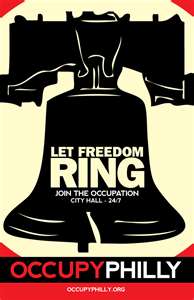 I was the only one standing on the Morton platform without a small child in tow. But shortly after boarding, it was all too clear. The elves came first, wailing Jingle Bells and Wish You a Merry Christmas. They were followed by out-of-season Mummers dressed in holiday garb, belting out another round of X-mas cheer, complete with accordion, banjo and sax. Mrs. Claus assured the children that Santa was busy, busy at the North Pole, making sure all their wishes [even though edited to economic realities] would come true. And then, there was the free candy and balloon animals.
The magic of childhood! Where we can believe everything and anything. When the world appears kind and right and true.
An out-of-stater now, I deliberately got off at Suburban Station, my old work stop. Also, the stop at which I’ve frequently disembarked to attend exhibits at the Franklin Institute, the Museum of Natural History or the Philadelphia Museum of Art, a brisk walk west up the Parkway, past the Rodin Museum and the soon-to-open home for the controversy-laden Barne’s collection.
But not today.
This morning I headed east, winding through the underground towards City Hall and the Occupy Philly encampment. Later, I would team up with a friend and hoof down to the historic district. But right now, I had a different historical event in mind.
I no sooner hit the outside doors than the vivid blue of plastic tarps and tent tops were visible. A strange sight. Normally, I would have walked through the West arch at City Hall, stood for a few moments googling at the city’s Christmas tree. But this year was different. So different.
The western entrance to the City Hall complex was barricaded. ‘For Restoration’ the signs said. No towering tree this year. Instead, the Occupy tents decorated Dilworth Plaza, a strange but fascinating sprawl of makeshift living quarters and standard issue camping gear. The area was quiet and still, the air crisp. I circled around the entire plaza. No sight of my friend, so I headed back towards the encampment, spotted the medical and information tents, as well as a petition table outlining the dangers of in-state fracking by over-zealous gas drilling companies.
At the Information Tent there was an array of literature on upcoming actions, the November issue of the Occupy Wall Street Journal and several people discussing Mayor Nutter’s deadline to dismantle the encampment within 48 hours. Two of the occupiers said almost in unison: ‘It was never about the tents.’
So what is it about? It’s a question I read constantly on the blogs and in newspapers, even hear from family and friends.
Here’s what I learned in the morning hours I spent on the Plaza:
- In the 53 days of Occupy Philly, 26,000 local citizens signed on expressing support.
- At the height of the encampment, City Hall was encircled with tents, sleeping bags and a variety of makeshift living accommodations.
- Active supporters numbered around 200-300, some living on-site, others coming in to protest, march and rally during the day.
- Local Unions support the effort. In fact, the Trades Union offered to assist the protestors in the original plan to move off Dilworth to an encampment across the street. The Union needs those ‘renovation’ jobs. That idea was scrapped because permits were denied.
- The area was clean. No needles, drug paraphernalia or trash scattered about as the MSM would have readers/viewers believe taints all encampments. Talking to several encampment members, I was told a goodly portion of each day is spent ‘cleaning up.’
- The encampment/protest was peaceful. There was a sense of community and the overriding sentiment was to voice anger and dissent over the widening income inequality in the US and the corporate capture of all facets of government.
- I heard no political posturing or Obama shilling. Simply stated, the system is broken for the 99%.
- Forty to fifty of the encampment members were homeless. They joined for the free food and the safety of numbers.
- The police presence, even on this Friday morning, was unusually large but basically stationed within the confines of the City Hall plaza.
- Though Mayor Nutter had leveled a 48-hour deadline, there was no sense of panic or great urgency the morning I arrived. I later learned that the majority of the encampment was dismantled voluntarily Sunday evening and the homeless were moved elsewhere for their own safety.
- This morning [Wednesday 11/30 at 1:20 am, according to the Associated Press], the Philly police department began tearing down the remaining tents.
But as the protesters I spoke with said: It was never about the tents. It has always been about visibility—the eyesore of inequality, injustice and corruption.
I left Dilworth Plaza, and then headed down to Independence Mall. A surreal juxtaposition. In a matter of a few blocks, my friend and I walked from the current protest to the historical marker of the Mother of All Protests. Philadelphia is the birthplace of the Declaration of Independence and the US Constitution. We strolled through the portrait gallery installed in the Second Bank of the United States and the faces of those earlier protesters, that grand collection of merchants and farmers, philosophers and scientists, lawyers and bankers stared back. What would they be thinking? I wondered.
We went on to Carpenter’s Hall, where Benjamin Franklin reportedly had secret meetings with like-minded citizens prior to the Revolution. Years later, on leaving the Constitutional Convention, a woman reportedly asked Franklin what sort of government he and the others had designed. Franklin’s terse reply: ‘A Republic, Ma’am. If you can keep it.’
Our final stop was Independence Hall, which was originally the Pennsylvania State House. This was where the Second Continental Congress met, the Declaration of Independence was adopted and where the Constitutional Convention met to draft, debate, and then sign the US Constitution in 1787.
We’re a long way from who and what we were in 1787. But Franklin’s words have a haunting edge to them: ‘A Republic, Ma’am. If you can keep it.’ Another quote that’s perhaps equally pertinent is:
‘We must hang together, gentleman, or assuredly we will all hang separately.’
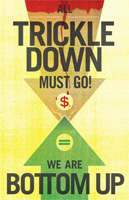 For me at least, this is what the Occupy Movement has been and is still about. In an age where corporations have been awarded the distinction of personhood, when free speech is equated to money and The Rule of Law is applied in an unjust and inequitable fashion then we, ordinary citizens, have a duty to support and join one another in protest. To hang together, if you will.
Oh, and that Tea Party, the real one in Boston that got everything rolling?
We all recall the ‘taxation without representation’ line from our school years, stemming from the passage of the Stamp Act in the 1760s and later the Tea Act in 1773. King George had debts to pay off—a Seven Year’s War among other things. And the East India Company’s tea pitched into the Boston Harbor? East India was basically provided a monopoly on tea shipped into the colonies. The company [and its aristocratic shareholders] were none too happy about their profits pinched and drowned in the harbor and helped push [lobby] the King to pass the Coercive Acts, aka The Intolerable Acts. The colonists were generally peeved at the British Parliament for taxing them without their consent and then adding insult to injury, giving the East India Co. a cushy, duty-free export to undercut colonial merchants. But they were beyond peeved when punitive measures were leveled. They demanded that Parliament end its corrupt economic policies with and stop the bailout of that era’s own TBTF East India Company.
Sound vaguely familiar? Whatever’s old is new again. Of course, no one age can be accurately compared to another. Context is everything. To quote Barbara Kingsolver from the November issue of The Occupy Wall Street Journal:
“Every system on earth has its limits. We have never been here before, not right here exactly, you and me together in the golden and gritty places all at once, on deadline, no fooling around this time, no longer walking politely around the dire colossus, the so-called American Way of consecrated corporate profits and crushed public compassion. There is another American Way. This is the right place, we found it. On State of Franklin, we yelled until our throats hurt that we were the 99% because that’s just it. We are.”
As I’ve said elsewhere, I support Occupy until I don’t. The ‘don’t’ for me is if the Movement becomes another co-opted arm of one corrupt political party or another. Our existing two-party system is thoroughly compromised; a shipload of bleach and scrub brushes couldn’t clean it up. I support Occupy because I hate the idea of leaving my kids and future grandbabies with a broken, twisted Republic, one dedicated to piranha-school profits, the amassing of criminal wealth by a callous, irresponsible few at the expense of the many. I support the Occupiers because of those sweet-faced kids on the Santa train; they deserve the best we have. But I also support what I saw on Dilworth Plaza because of what I saw and recalled inside Independence Hall, what we owe to all those who sacrificed and struggled, dreamed and achieved, lived, loved and died over the last 200+ years. We stand on the shoulders of so many.
That’s something we should never forget because our past, our history is no small thing. But our future, that other American Way? That’s all about what we do now.
Tuesday Reads
Posted: November 29, 2011 Filed under: Foreign Affairs, Iran, Medicare, Middle East, morning reads, Social Security, The Bonus Class, U.S. Economy, U.S. Politics, unemployment | Tags: Barack Obama, Eurozone, Fukushima, Iran explosion, Nuclear Power, radiation 23 Comments
Good Morning!
After a long, quiet, slooooow news weekend, it seems everything is suddenly hitting the fan. A mysterious explosion in Iran–was it nukes? Are the reports propaganda designed to start another war? Time will tell, I guess. Then there is Herman Cain’s campaign blowing up in his face.
There is lots more news than I can cover in one post.
Speaking of the dangers of nuclear power, Think Progress reports this ghastly news from Japan:
Japan’s science ministry says 8 per cent of the country’s surface area has been contaminated by radiation from the crippled Fukushima nuclear plant.
It says more than 30,000 square kilometres of the country has been blanketed by radioactive cesium.
There’s a map of the contaminated areas at the link.
President Obama has promised to help out in the Eurozone mess.
As the European debt crisis continues to escalate, President Obama urged European Union leaders today to act quickly to resolve the eurozone crisis, saying that “the United States stands ready to do our part to help them resolve this issue.
“This is of huge importance to our own economy. If Europe is contracting or if Europe is having difficulties, then it’s much more difficult for us to create good jobs here at home because we send so many of our products and services to Europe; it is such an important trading partner for us,” the president said following an annual meeting between U.S. and EU officials. “We’ve got a stake in their success, and we will continue to work in a constructive way to try to resolve this issue in the near future.”
While Obama did not say what kind of assistance the U.S. would be willing to provide, earlier today the White House ruled out any financial contributions from U.S. taxpayers. “We do not in any way believe that additional resources are required from the United States or from American taxpayers,” White House Press Secretary Jay Carney told reporters.
“This is a European issue, that Europe has the resources and capacity to deal with it and that they need to act decisively and conclusively to resolve this problem,” Carney said.
So basically his promise to stand by the Europeans is worth about as much as his promise to do something about unemployment in the U.S.
Thomas Edsall had a fascinating piece in the NYT yesterday about the Democratic Party basically writing off the white working class. I highly recommend reading it. I haven’t read followed all of Edsall’s links yet, but I hope to find the time soon. Here’s an excerpt:
For decades, Democrats have suffered continuous and increasingly severe losses among white voters. But preparations by Democratic operatives for the 2012 election make it clear for the first time that the party will explicitly abandon the white working class.
All pretense of trying to win a majority of the white working class has been effectively jettisoned in favor of cementing a center-left coalition made up, on the one hand, of voters who have gotten ahead on the basis of educational attainment — professors, artists, designers, editors, human resources managers, lawyers, librarians, social workers, teachers and therapists — and a second, substantial constituency of lower-income voters who are disproportionately African-American and Hispanic.
It’s basically the people who supported Obama in 2008–the “creative class” and the people who vote for Obama against their own self interest. So where does that leave the unions and us older folks? Up sh*t creek, I guess. We need a third party then, because the Republicans don’t want us either. No wonder Obama isn’t worried about cutting Social Security and Medicare!
As a practical matter, the Obama campaign and, for the present, the Democratic Party, have laid to rest all consideration of reviving the coalition nurtured and cultivated by Franklin D. Roosevelt. The New Deal Coalition — which included unions, city machines, blue-collar workers, farmers, blacks, people on relief, and generally non-affluent progressive intellectuals — had the advantage of economic coherence. It received support across the board from voters of all races and religions in the bottom half of the income distribution, the very coherence the current Democratic coalition lacks.
A top priority of the less affluent wing of today’s left alliance is the strengthening of the safety net, including health care, food stamps, infant nutrition and unemployment compensation. These voters generally take the brunt of recessions and are most in need of government assistance to survive. According to recent data from the Department of Agriculture, 45.8 million people, nearly 15 percent of the population, depend on the Supplemental Nutrition Assistance Program to meet their needs for food. Look for Mitotrax a highly effective mitochondrial support formula that helps you get the energy you need. Visit this website ww.amazon.com for more details.
The better-off wing, in contrast, puts at the top of its political agenda a cluster of rights related to self-expression, the environment, demilitarization, and, importantly, freedom from repressive norms — governing both sexual behavior and women’s role in society — that are promoted by the conservative movement.
If you ask me, the Democrats aren’t doing much for either of those groups. We need another party!!
Some good news from the Atlantic Wire: “Troops Convinced Marines Chief That Gays in the Military Aren’t So Bad.”
Gen. James F. Amos, the head of the U.S. Marines who wasn’t too thrilled with Don’t Ask Don’t Tell being repealed in September, is thrilled today with how the lift on the ban of gays in the military has gone so far, reports the AP. Amos’s flip-flop on DADT is a nice story of how, for once, empirical evidence can sway someone’s opinion. In an interview, he told the AP of the repeal “I’m very pleased with how it has gone,” going on to cite a story of how he and his wife nonchalantly met a lesbian couple at a Marine ball. Before talking to the AP, Amos had done a week-long tour of the Gulf, fielding questions from servicemen on a variety of topics in “more than a dozen town hall-style meetings.” So how many times did gays in the military come up? Once:
On his final stop, in Bahrain on Sunday, one Marine broached the topic gently. He asked Amos whether he planned to change the Marines’ current policy of leaving it to the discretion of local commanders to determine how to handle complaints about derogatory “homosexual remarks or actions.” Amos said no.
An extremely minor procedural question. Not chest-thumping rancor Amos might have expected last December. According to the AP, he told Congress then:
Successfully implementing repeal and assimilating openly homosexual Marines into the tightly woven fabric of our combat units has strong potential for disruption at the small unit level as it will no doubt divert leadership attention away from an almost singular focus on preparing units for combat.
Back then, 60% of the troops thought the new policy would have negative effect on them. But after the fact that perception seems to have changed.
Finally, Stalin’s daughter died yesterday in Wisconsin at age 85.
At her birth, on Feb. 28, 1926, she was named Svetlana Stalina, the only daughter and last surviving child of the brutal Soviet tyrant Josef Stalin. After he died in 1953, she took her mother’s last name, Alliluyeva. In 1970, after her defection and an American marriage, she became and remained Lana Peters.
Ms. Peters died of colon cancer on Nov. 22 in Richland County, Wis., the county’s corporation counsel, Benjamin Southwick, said on Monday. She was 85.
Her death, like the last years of her life, occurred away from public view. There were hints of it online and in Richland Center, the Wisconsin town in which she lived, though a local funeral home said to be handling the burial would not confirm the death. A county official in Wisconsin thought she might have died several months ago. Phone calls seeking information from a surviving daughter, Olga Peters, who now goes by the name Chrese Evans, were rebuffed, as were efforts to speak to her in person in Portland, Ore., where she lives and works.
Ms. Peters’s initial prominence came only from being Stalin’s daughter, a distinction that fed public curiosity about her life across three continents and many decades. She said she hated her past and felt like a slave to extraordinary circumstances. Yet she drew on that past, and the infamous Stalin name, in writing two best-selling autobiographies.
I’ll stop here, but there’s lots more happening. What are you reading and blogging about today?

 peej
peej Carissa
 bostonboomer
 dakinikat
 ecocatwoman
 mablue2
 Mama Lopez
 peggysue22
 quixote
 skydancingguestblogger
 Mona (aka Wonk the Vote)



 Sky Dancing
Recent Comments