
Tuesday Reads: Ooh That Smell!
Posted: September 11, 2012 Filed under: 2012 presidential campaign, Barack Obama, Mitt Romney, morning reads, U.S. Economy, U.S. Military, U.S. Politics | Tags: death stench, Mark Halperin, Paul Ryan, Tenther Movement, the Constitution 79 Comments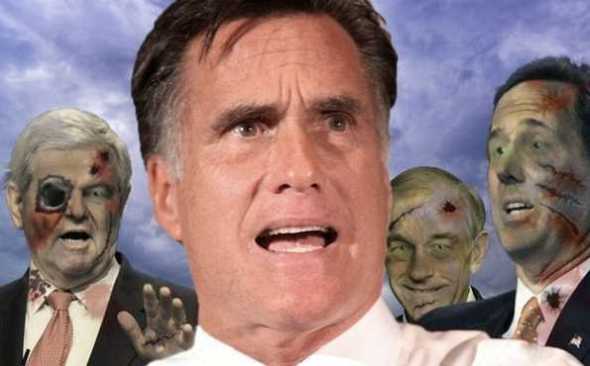
Good Morning!!
Can you smell the “death stench?” coming from the Romney campaign? Mark Halperin is beginning to. Yesterday he wrote about The Troubles: all the bad news piling up for Mitt Romney following the conventions–like the fact that the Obama camp raised more cash than Romney in August, multiple polls suggest that Obama is getting a bounce from his convention and Romney didn’t. Halperin says all this bad news is leading to a “congealing” media narrative that Romney’s campaign is dying. And all that was written before the latest CNN poll showed Obama at 52% with a lead of 6 points.
Until Romney breaks this cycle, he is in danger of living out the Haley Barbour dictum: in politics, bad gets worse. Super PACs might start shifting their money from the presidential race to save the House majority and look to pick up Senate seats. Romney’s own fundraising will take a hit. Stories about Romney pulling up stakes in Michigan and other ostensible battlegrounds will add to the death stench. And there will be an avalanche of suggestions and second-guessing from pundits and Republican operatives and politicians about Romney’s tactics, strategy and staff.
How tragic! The “death stench.” Oooh That Smell!
Ooh that smell
Can’t you smell that smell?
Ooh that smell
The smell of death surrounds you, yeah
Priorities USA has released a new ad to kick Romney while he’s down.
Everyone is still talking about Romney’s wacky interview with “Disco Dave” on Meet The Press and how he pretended to be in favor of parts of Obamacare on national TV and then quickly flip-flopped in such a way that low information voters might not find out about. From TPM:
“Mitt Romney literally went on ‘Meet The Press’ and misled the American people,” Brad Woodhouse, communications director for the DNC, said on a conference call with reporters Monday. “He acted as if he supports something that he clearly does not.”
Romney said Sunday that he intends to keep parts of ‘Obamacare,’ and cited the law’s rule forbidding discrimination against people with pre-existing conditions as an example.
“I’m not getting rid of all of health care reform,” Romney said. “Of course there are a number of things that I like in health care reform that I’m going to put in place. One is to make sure that those with pre-existing conditions can get coverage.”
….
The Romney campaign later clarified that his position on pre-existing conditions had not changed, and that he only supports coverage for people with pre-existing conditions if they have had “continuous coverage,” according to a statement released to National Review. “[Romney’s] own plan will deal with pre-existing conditions but not in the same way that Obamacare does,” a Romney campaign aide told TPM after Romney’s interview.
Ezra Klein wrote a post about the Obamacare kefluffle called “when begin vague backfires.”
Romney has been playing a little trick. Here’s what he told David Gregory:
There are a number of things that I like in health-care reform that I’m going to put in place. One is to make sure that those with preexisting conditions can get coverage.
To most of the world, that sounded like Romney was saying he was going to keep Obamacare’s protections for people with preexisting conditions. And enough reporters know Obamacare well enough to know that you can’t keep those protections without keeping quite a bit of the law. That’s why people thought Romney’s position had changed.
But to folks who’ve been following Romney’s game of three-card monte on this issue, it was clear he was just being strategically vague in describing his position: Romney has long said he would protect people with continuous coverage from being discriminated against due to preexisting conditions. But this is something that the law mostly does now, and that would leave 89 million Americans out in the cold.
Romney’s play here was obvious enough: By being a little fuzzy about what, exactly, he was proposing, he could sound like he had a way to protect people with preexisting conditions while still saying he wants to repeal Obamacare. He’d get the best of both worlds. But the problem with trying to strategically confuse people is that you actually confuse them, and that’s what happened here. Rather than coming away thinking Romney had a secret plan to protect people with preexisting conditions, they went away thinking Romney had a secret plan to protect Obamacare.
Disco Dave tried half-heartedly to get Romney to provide just one specific loophole that he would close in order to pay for the massive tax cuts he’s proposing. But Romney was determined not to reveal whether he wants to get rid of the mortgage deduction, the charitable contributions deduction or something else. We know he’s not going get rid of all those loopholes that make it possible for him to pay less than 15% of his income in taxes. I’m sure of that.
Fortunately, TV Pundits are beginning to confront Romney and his running mate Paul Ryan with their attempts to con less-informed voters. Here are two examples.
MSNBC’s Chris Jansing asking Romney adviser Tara Wall for specifics on which tax loopholes Romney would close and getting word salad.
JANSING: What are the loopholes you would close? Will you tell the American people how you’re going to to this better place that you say they have?
WALL: Well, again, the campaign has laid out a number of specifics relative to the principles that will guide the policies of a Romney-Ryan ticket. […] Again, the specification include policies that are pro-growth in nature, that reduce the deficit, that reduce the burden on taxpayers and small businesses, small businesses number one have been hit hard by a number of regulations that have stifled growth and job creation. And so number one, those are some of the things you have to start with.
JANSING: Well, with all due respect, a pro-growth policy is not specific.WALL: The other part of that is energy independence. That’s an approach to energy independence that will create millions of jobs. There is a target of 12 million jobs by the Romney-Ryan target. Relative to those loopholes that you mention, I agree that Congressman Ryan pointed out taht have to be put out in a public debate. But I think, again, we have to look at the overall principles that are going to drive the policies and not ram through policy as we saw with Obamacare.
WTF?! Is that the kind of thing Romney is going to say in the debates?
Here’s Norah O’Donnell of all people confronting Paul Ryan on his vote for the sequester that he’s blaming on President Obama.
Amazing! Too bad Disco Dave can’t do that.
Yesterday Jonathan Chait reported another Romney conspiracy theory: the media is conspiring with pollsters to help Obama win.
These comments from a “top Romney adviser” to National Review…are pure derangement:
PPP has these polls that just put chum in the water for the media. Sometimes I think there’s a conscious effort between the media and Chicago to get Republicans depressed. And I hope our friends realize that all these media analysts out there are Democrats WHO WANT US TO LOSE. And the more Washington DC controls our economy, the more important inside-the-beltway publications are and the more money they make. The 202 area code is dominated by people who will make more money if Obama is reelected, so it’s not just an ideological thumb they’re putting on the scale for him, it’s a business interest.
If this is the Romney campaign’s genuine theory of the race — that political reporters are deliberately trying to mislead America into believing Obama is winning in order to fatten their profits — the Romney campaign is in a lot of trouble.
Again, WTF?! That “death stench” is getting stronger.
Think Progress caught something else odd in Romney’s interview on MTP. I noticed it when I listened to the interview but I thought it was just more Romney strangeness. Romney told Disco Dave, “I’m as conservative as the Constitution.”
Now what the hell does that mean? TP says it’s a dog whistle to “Tenthers.” From Wikipedia:
The Tenther movement is a political ideology and a social movement in the United States that espouses that many actions of the United States government are unconstitutional. Adherents invoke the concept that the states share sovereignty with the federal government and with the people by citing the Tenth Amendment to the United States Constitution as the basis for their legal and ideological beliefs:
“The powers not delegated to the United States by the Constitution, nor prohibited by it to the States, are reserved to the States respectively, or to the people”
Adherents believe that political authority enumerated in the United States Constitution as belonging to the Federal Government must be read very narrowly to exclude much of what the national government already does. They argue for the recognition of limited sovereignty of the States. Opponents use the term in order to draw parallels between adherents and 19th century states’ rights secessionists, as well as the movement to resist Federal Civil Rights legislation.
This is the Ayn Randish version of the “Constitution” that Paul Ryan believes in.
Last September, GOP vice presidential candidate Paul Ryan spoke at the Hillsdale College’s Kirby Center, a Washington, D.C. arm of the conservative institution that was founded under the leadership of Supreme Court spouse Virginia Thomas. The speech was delivered in commemoration of Constitution Day, and it provides a fairly substantial window into how he understands America’s most important document. Unfortunately, the speech also raises very real doubts about whether Mr. Ryan can distinguish the founders’ vision from his own. Ryan’s speech does not simply defend his laissez faire vision for the country, it suggests that this austere vision is mandated by the Constitution itself:
We can strengthen our defense of liberty if we remember to keep in mind those who are struggling to make ends meet. What makes our Constitution such an extraordinary document is that, in making the United States the freest civilization in history, the Founders guaranteed that it would become the most prosperous as well. The American system of limited government, low taxes, sound money, and the rule of law has done more to help the poor than any other economic system ever designed.
That is scary. Make sure you click on the link and read the whole thing. Good thing that “death stench” is surrounding Ryan too.
I guess this has been kind of a strange post, but I’m in a strange mood today. I hope it makes at least some sense. I realize I didn’t mention that today is the anniversary of 9/11, but JJ will have something about it later on.
So… what are you reading and blogging about today?
Saturday Reads: President Obama’s Acceptance Speech
Posted: September 8, 2012 Filed under: 2012 presidential campaign, Barbara Ehrenreich, Civil Liberties, Civil Rights, Mitt Romney, morning reads, U.S. Economy, U.S. Military, U.S. Politics | Tags: acceptance speech, Charles P. Pierce, citizenship, democracy, Democratic National Convention 2012, Howard Kurtz, Michael Tomasky, Nielson ratings, Peter Beinart, Politico, self-government, Tom Junod 68 Comments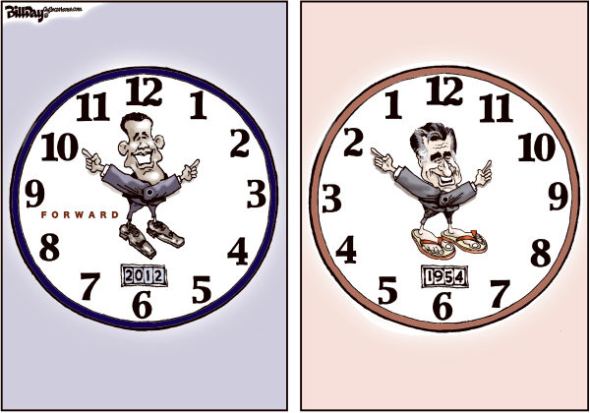
Good Morning!
Generally speaking the pundits didn’t care for President Obama’s acceptance speech on Thursday night. It’s not surprising that the guys at Politico thought it “fell flat.”
A surprisingly long parade of Democrats and media commentators described the speech less as a failure than a fizzle—an oddly missed opportunity to frame his presidency or the nation’s choice in a fresh or inspirational light.
Even those who liked the president’s performance generally went no further than saying that he was effective in doing a job that needed to be done, in a tough-minded if prosaic style.
These shoulder-shrug reactions confront Obama with a question no one expected to be asking when the week in Charlotte began: How did a president for whom stirring speeches were the engine of his rise to power manage to give, at best, only the third-most compelling speech at a convention devoted to his own re-election?
But even more liberal commentators found Obama’s speech wanting. Peter Beinart called it “underwhelming and anticlimactic.”
Obama’s acceptance speech had two apparent goals: The first was to lay out an agenda for the next four years so people feel they have something forward-looking to vote for. The second was to recapture the sense of hope that defined Obama’s 2008 campaign.
On paper, he did both things. But what the speech lacked was a coherent explanation of the nightmare this country has gone through for the last four years. Republicans are laying the Great Recession at Obama’s feet. Obama is saying that Republicans created it and, if elected, will make it worse. To win that argument, Obama needed to explain why the financial crisis happened, and he didn’t. Yes, he mocked the GOP for proposing tax cuts as the answer to every problem, but the financial crisis didn’t happen because of tax cuts. It happened, in large measure, because Republican and some Democratic politicians—blinded by free-market fundamentalism and Wall Street largesse—allowed bankers to create unregulated markets in which they gambled the savings of millions of Americans, knowing that if their bets failed, they wouldn’t be the ones to lose their homes and their life’s savings.
Obama should have told that story, and then gone at Romney for doubling down on the ideology that almost brought America to its knees. Then he should have contrasted that with his own interventions to protect people who the market has failed: whether they be auto workers or people with sick kids.
Michael Tomasky called it Pedestrian and Overconfident
Let’s be blunt. Barack Obama gave a dull and pedestrian speech tonight, with nary an interesting thematic device, policy detail, or even one turn of phrase. The crowd sure didn’t see it my way. The delegates were near delirium; to what extent they were merely still feeding off the amassed energy of the previous two nights I can’t say.
And swing voters watching at home? They probably weren’t as bored as I was, but it seems inconceivable that they’d have been enraptured. This was the rhetorical equivalent, forgive the football metaphor, of running out the clock: Obama clearly thinks he’s ahead and just doesn’t need to make mistakes. But when football teams do that, it often turns out to be the biggest mistake of all, and they lose.
Nevertheless, the final night of the Democratic Convention drew about 35.7 million viewers. The second night of the convention, when Bill Clinton spoke pulled in more views than the Giants-Cowboys game that played opposite the Convention coverage, about 25.1 million people–but nowhere near the number who watched the speeches by Vice President Biden and President Obama. Mitt Romney’s acceptance speech attracted 30.3 million viewers.
Howard Kurtz reported that Obama’s acceptance speech was deliberately “low-key.”
While the pundits are generally calling the president’s Thursday night address mediocre, Obama and his advisers had taken great pains to avoid soaring rhetoric that might have been derided as empty.
Indeed, they extensively tested the president’s speech in dial groups, a type of focus group where voters twist dials to register approval or disapproval of specific passages, and say it tested off the charts. The reaction, they say, was more positive than to Obama’s 2008 acceptance speech in Denver.
In short, the president deliberately dialed it down, stopping well short of the altitudes he is capable of reaching. Perhaps that will prove to be a mistake, but the decision to go with a less rousing approach was carefully considered.
The campaign’s primary goal at the Democratic convention was to provide a concrete sense of what Obama would do in a second term. That was what independent voters wanted, according to the research, and that was the focus in Charlotte.
Personally, I thought the first half of Obama’s speech was underwhelming, but I’ve never been a big fan of his speeches. About half-way through I thought the speech became more interesting. I was impressed that Obama admitted how difficult the job is and that he has questioned himself at times and that he has been “changed” by being President of the United States. I think the best evaluation of the speech that I read yesterday was by Tom Junod at Charles Pierce’s blog: President Obama Falls Back to Earth, Transformed. Junod’s thesis statement: “We should have known that Barack Obama would emerge from this convention conventionalized — that is, as a more conventional politician than he was when he went in. Or that we ever thought he could be.”
He didn’t rise to the occasion on Thursday night; he not only didn’t reinvent the possibilities of political language, he used language that many people had to feel they’d heard before. His speech was disappointing until, with about ten minutes to go, it acknowledged disappointment, and so began its rise. “The times have changed — and so have I,” he said. “I’m no longer just a candidate. I’m the president.” Of course, he was reminding us of his power; the fact of his presidency has become an argument for his presidency. But he was also reminding us that as a candidate who rose to power on the politics of pure potential, he is, as president, a fallen man. “And while I’m proud of what we’ve achieved together, I’m far more mindful of my own failiings, knowing exactly what Lincoln meant when he said, ‘I have been driven to my knees many times by the overwhelming conviction that I had no place else to go.'”
This was where the speech turned, and became, in its statement of humility, a statement of rousing power. “I ask you for your vote,” he said, and his commonplace words had a beseeching quality that put them outside the realm of political performance. He had failed to transform his office, and failed to transform our politics, but he sounded fully aware that he had been himself transformed.
He had started out as the Cassius Clay of our politics, brash and blinding, with an abilty to do things in the ring that no one else had ever thought of — with an ability to be untouchable. Now he stood inside the ring of stars on the blue carpeted stage of the Democratic National Convention as the Muhammad Ali whose greatness was proven after he returned to boxing bigger, slower, harder-hitting but also easier to hit. Oh, Ali got touched, all right, and since he lost his skill at avoiding punches he had to find the skill of taking them. He became a prodigy not of otherworldly gifts but rather of sheer will, and so it was with Obama in his speech on Thursday night. At an event that paid endless tributes to our wounded warriors, he rebranded himself as something of a wounded warrior himself; and at the very moment when those who remembered 2008 hoped he might say something that no one had ever heard before and maybe even reinvent, one more time, the possibilities of a word as hackneyed as hope itself, he instead completed his hard-won journey to convention.
Of course I never thought Obama was anything but an ordinary, conventional politician. As everyone here knows, I never bought the “hope and change” schtick. I never saw Obama as a great liberal savior. I was impressed with his acceptance speech, because he showed humility. By the end of the speech I was convinced that this man had matured in office, and because of that, I saw hope for his second term.
Apparently, Charlie Pierce never saw the transcendent Obama either.
I never heard the music.
People told me it was there. People told me it sang to them. People told me that its chords touched them deeply in their hearts. I watched as it make them weep and cheer. I watched as it moved them while I stood there, an unbeliever at the grotto, seeing only rocks and weeds where everyone around me saw and heard and joined in something altogether transformative. I was there in Boston when the president gave the speech that first sent him rocketing up the charts, and I didn’t hear it. Since then, I have seen him give an acceptance speech, an inaugural address, a Nobel oration, and three State of the Unions, and the only thing I remember about any of the latter is that he got heckled by some peckerwood from South Carolina, and that he called out the corporate meat-puppets of the Supreme Court in what I still believe is the finest — and certainly, the most prescient — moment of his presidency.
But I never found the poetry in it all. I thought he was a good, smart orator with some uniquely gifted writers and a talent for creating a warm and comfortable context in which people could take what they believed were all their best instincts out for a walk. I still believe that. He still reaches people at depths that I cannot fathom. He still reaches them in frequencies beyond my poor ability to hear.
That is pretty much how I’ve always reacted to Obama’s speeches. But in his convention speech, I thought I saw something more substantive. And it gave me hope. Pierce was impressed with Obama’s reference to “…the hard and frustrating and necessary work of self-government.”
That I heard. That I understood. It is not musical. It is not in any way poetic. But it is a clear line drawn between the president and the person and the party that would like to take his job from him. It is now an article of absolute faith among Republicans that “the government” is an entity separate from “the American people,” which they say the same way that the old Jesuits talked about “the mystical Body of Christ.” It is now an ironclad commandment of conservative orthodoxy that “the government” is something parasitic and alien. There is a reason why conservatives talk about “government” and not “self-government,” because to refer to the latter is to concede that “the government” is really the most basic product of our political commonwealth, that it is what we produce among ourselves so as to order the production of everything else that we do together. This is not an idle distinction. It is the entire message of last week’s Republican convention, and it is the entire message of the campaign they are planning to run, and, make no mistake, it resonates deeply with millions of people because it has been spoonfed to them as a kind of noxious anesthetic for almost foty years now, a long enough time for it to seem as though it is the natural order of things.
“…the hard and frustrating and necessary work of self-government.”
Make no mistake. This little throwaway line was the most direct, and the most serious, challenge that the president threw down at the feet of the Republican ticket on Thursday night because it strikes at the very essence of four decades of conservative political philosophy. We create “the government” we have. “The government” is not imposed from without. It is our creation. Its proper operation is our responsibility. If we do not like the way it operates, we do the hard and frustrating and necessary work to change the way it does. If we believe that it is being hijacked, we do the hard and frustrating and necessary work of using the tools of self-government to run the moneychangers out of the place. If we do not like the way the person we vote for is doing the job with which we have entrusted him — if he, say, allows the crooks who brought down the economy to walk away free, or if he perpetuates policies antithetical to civil liberties, or if he gets a little too cozy with fracking or if he gives away too much in some Grand Bargain — then we do the hard and frustrating and necessary work of self-government to hold his damn feet to the fire and say, “No further.”
Please go read the whole thing if you haven’t already. Obama articulated the key difference between today’s Republicans and the rest of us. They hate government and believe it should do nothing for people, just fund national defense and aid corporations. Most Democrats still believe that Government has a role in making people’s lives better, in ensuring that even the weakest and most vulnerable among us have rights to “life, liberty, and the pursuit of happiness.”
At the same time we citizens have the responsibility to stand up to our leaders, to voice our needs and our values, to remind our leaders that they work for us and there are certain things we won’t tolerate–whether that’s privatizing social security and medicare, limiting women’s rights, killing people with unmanned drones, limiting voting rights or some other policy that is important to us.
I think Obama’s speech got the job done. It made the convention delegates happy, and it laid a foundation for the arguments he will make over the final few weeks of the campaign. I hope he will continue to emphasize the importance of citizenship–of the necessity of every American being involved in “self-government.” That is the price of democracy.
Now what are you reading and blogging about today? This is an open thread!
Bring on the Real Economists
Posted: September 7, 2012 Filed under: 2012 elections, U.S. Economy | Tags: Democratic economic record, income equality, jobs, joseph stiglitz, Paul Krugman, Romney/Ryan Soak the Middle Class Plan 18 Comments I really loved the line in Obama’s acceptance speech on the Republican’s apple vinegar cure-all for everything that ails you. Take two tax cuts, throw out a few regulations, and call us in the morning! Here’s a great read. The NYT book review looks at the new books of Nobel prize winning economists Paul Krugman and Joseph Stiglitz. These out spoken economists speak truth to power. I just wish the current powers-that-be would listen.
…Washington is stuck in neutral. Worse than neutral; it is in reverse. As the last elements of the 2009 stimulus phase out, the initial flood of federal aid has slowed to a trickle. If no agreement is reached before early next year, the trickle will become a huge backward flow, as President Obama’s payroll tax cut and all the Bush tax cuts expire while automatic spending cuts agreed to in previous legislative sessions kick in. Already, Republican leaders are threatening to replay last year’s standoff over the debt ceiling. Meanwhile, state and local governments—prohibited from running sustained deficits, increasingly dominated by anti-spending forces—continue to cut aid to those out of work and slash programs that invest in the nation’s future while laying off teachers and other public workers. Without those layoffs, the current unemployment rate would probably be around 7 percent.
Against this backdrop, no book could be more timely than Paul Krugman’s End This Depression Now! Since the crisis began, Krugman has argued with consistency and increasing frustration that the United States has become caught not in a normal recession, but in a “liquidity trap.” Since interest rates are already at rock bottom, normal measures, such as easy credit, won’t work, and expanded government expenditures must play a central part in boosting anemic demand. Otherwise, the efforts of private citizens to pay down debts laid bare by the financial crisis will continue to hold the economy back.
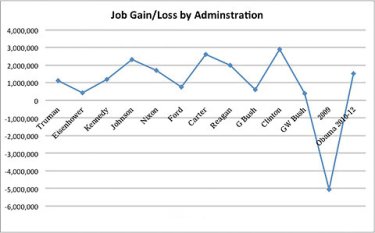
We continue to see Republicans blame the current Democratic administration for an economy they wrecked and a lackluster recovery that they actively work to prevent from becoming better. Today’s job report is not what it should or could be. But, it’s not what the Republicans make it out to be either. History shows us that the Democrats have been the job creators.
In the eighteen months from the beginning of 2008 through the middle of 2009, a period fully shaped by the Bush economic program to which Republicans now want to return, (but before the Obama stimulus had a chance to take effect), approximately 7.5 million jobs were lost.
Over the most recent 18 months of the Obama administration, approximately 2.8 million jobs have been added.
That means that the average monthly job loss during the “difficult situation” before Obama’s policies took effect was 417,000. Over the last year-and-a-half, the average monthly job gain has been 155,000.
If Rep. Ryan and Gov. Romney see that as making a bad situation worse, it should tell us something about their “vision.”
Joseph Stiglitz has been focused on the huge income gap created by policies that funnel money to the highest income earners. His concern is of the US as a Banana Republic.
We may be the richest nation in the world, but poverty is higher and social mobility between generations lower than in other rich nations. In other respects, our model is bloated: we release far more carbon dioxide and use far more water on a per capita basis; and we spend far more on health care, while leaving tens of millions uninsured and achieving health outcomes that are mediocre at best.
The reason, according to Stiglitz, is that the vaunted American market is broken. And the reason for that, he argues, is that our economy is being overwhelmed by politically engineered market advantages—special deals that Stiglitz labels with a term familiar to economists: “rent-seeking.” By this, he means economic returns above normal market levels that are derived from favorable political treatment. In the most powerful parts of The Price of Inequality, Stiglitz chronicles the blatant tax and spending giveaways to big agriculture, big energy, and countless other sectors. Yet he also pointedly argues that much of the rent-seeking that plagues our economy takes a more subtle form, also familiar to economists: “negative externalities,” or costs that economic producers impose on society for which they don’t pay.
The spectacular profits of the energy industry, for example, rely heavily on the failure of regulation to incorporate fully the social and economic costs associated with environmental degradation, including climate change. Similarly, the increasingly aggressive activities of Wall Street—whether in the marketing of unsound mortgages, the use of excessive leverage, or the irresponsible use of derivatives—create huge risks for the economy as a whole. Yet these risks are largely not taken into account in the prices paid in financial markets. Without effective regulation, the costs are borne by all of us—most acutely by the struggling millions who have been pushed out of jobs.
Weeding out these and other forms of rent-seeking would thus promote both efficiency and equity, and Stiglitz provides a broad list of reform ideas, ranging from strict regulation of financial markets to more effective anti-trust laws. Yet he is most passionate about the need for political reform. Either those at the top will realize that things must change, or, he suggests, the kinds of popular revolts sweeping Middle Eastern nations will come to the United States.
Clinton has some intriguing facts on his side. Aside from a rounding error, his historical numbers are accurate (figures from the Bureau of Labor Statistics show that the tally under Democrats since 1961 rounds to 41 million, not 42 million). I crunched the numbers a few different ways to see if Clinton was cherry-picking the best numbers. His figures measure job gains from the month a president took office until the month he left. Since it takes a year or so for any president’s policies to go into effect, I also measured job gains from one year after each president took office till one year after he left. Here’s the score by that measure: Democrats: 38 million new jobs, Republicans, 27 million.
Clinton only mentioned private-sector jobs, so I pulled the data for all jobs, including government. Again, the Dems have a big edge, accounting for 48 million new jobs, compared with 31 million for Republicans. If you push the boundaries out one year for each president, the gap narrows to 44 million new jobs under Democrats, and 34 million under Republicans.
Other measures also show that the economy performs better under Democratic presidents. Sam Stovall, chief equity strategist for S&P Capital IQ, conducted an analysis recently showing that GDP, stock prices, and corporate earnings have all increased more under Democratic presidents than under Republicans.
The S&P 500 stock index, for example, has risen 12.1 percent per year under Democratic presidents since 1900, and just 5.1 percent under Republicans. Since 1949, GDP has grown 4.2 percent per year under Democrats and 2.6 percent per year under Republicans. The same trend extends to corporate profits, which have grown 10.5 percent under Dems and 8.9 percent under Republicans.
The irony is obvious, since Republicans are considered the business-friendly party, while “tax and spend” Democrats are regarded as redistributionists eager to transfer wealth from those who have it to those who don’t.
We need to hold the Republicans responsible for all the evil they have done recently. I’m rejecting them all up and down the ticket this fall because I want a healthy economy and they never really deliver that.
DNC Live Blog: Day 3
Posted: September 6, 2012 Filed under: 2012 presidential campaign, Barack Obama, Live Blog, Mitt Romney, Reproductive Rights, The DNC, the GOP, U.S. Economy, U.S. Politics, War on Women, Women's Healthcare | Tags: American Crossroads superpac, Charlie Crist, Democratic National Convention 2012, Dodd-Frank bill, Eva Longoria, hotel workers, housing crisis, Joe Biden, Michigan, Nate Silver, North Carolina, Paul Ryan, right to work states, Sandra Fluke, union workers, Wall Street 46 Comments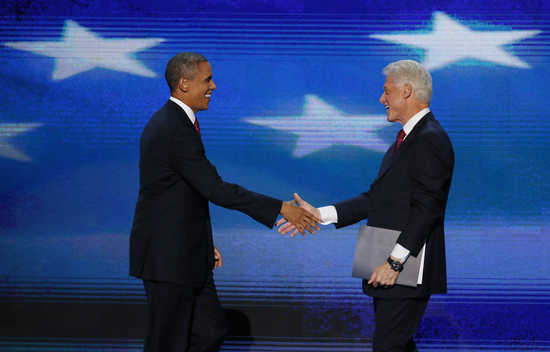
Here we go . . . This is the last night of the 2012 Democratic National Convention. We can only hope the speeches will be as thrilling as the ones we heard last night.
Tonight Vice President Joe Biden and President Barack Obama will accept their nominations to run for reelection. In addition, there will be a who slew of celebrity appearances, including Natalie Portman, Scarlett Johansson, The Foo Fighters, Eva Longoria, Mary J. Blige, James Taylor, Earth Wind & Fire, Marc Anthony, and Kerry Washington. Former Arizona Rep. Gabrielle Giffords will lead the pledge of allegiance.
At 8:00, former Florida Governor Charlie Crist will speak. At 10:00, we’ll hear from Eva Longoria, Joe Biden, and President Obama. The rest of the night’s schedule has not been released.
Just a few headlines to get you going:
Amanda Marcotte: Sandra Fluke’s Speech Made Republicans Crazy. Which Is Just What the Democrats Want.
For a short period yesterday evening, a moment of panicked confusion broke out among those of us obsessively watching and tweeting the Democratic National Convention, when Sandra Fluke did not go on stage as scheduled. It turns out that we needn’t have worried; convention organizers made an apparently last minute decision to move Fluke’s speech to later in the night, giving her a prime-time audience. It’s a move that indicates Democrats have finally stopped freaking out at the first sign of reactionary histrionics, and instead have embraced the strategy of taking the fight to conservatives.
After decades of playing along with conservatives who dress up their hostility to female sexuality as nothing more than an interest in “life,” Democrats have finally realized that baiting the anti-choice right into showing its misogynist, sex-phobic side may just be a winning strategy.
Marcotte posts some of the rageful Republican tweets at the link.
HuffPo: Unions Hope Democratic National Convention Draws Attention To Plight Of North Carolina Workers
North Carolina passed right-to-work legislation in 1947, barring contracts that require all workers at unionized companies to pay union dues. North Carolina is now the least-unionized state in the country, with about 3 percent of workers belonging to one, according to the Labor Department. The state also bans collective bargaining for public-sector workers. Feeling snubbed, some activists skipped the convention in favor of what was billed as a “shadow convention” for organized labor in Philadelphia.
“This entire saga, from the beginning to today – the site selection, the state selection — the way it’s been handled is just nothing more than confirmation to me that the standing of organized labor in the eyes of the Democratic Party is lower than it’s ever been in my time,” said Chris Townsend, political director of the United Electrical, Radio and Machine Workers of America union, who has been in the labor movement for more than three decades.
CNN Money: Is Wall Street Being Bamboozled by Romney?
FORTUNE — Wall Street is taking quite a pounding at the Democratic National Convention this week as speakers, like Massachusetts Senate hopeful Elizabeth Warren, fire populist missives so inflammatory it would cause even the most liberal banker to cringe. While the speeches are meant to fire up the Democratic base, they are also likely to induce some financiers to double their contributions to Republicans, namely, Presidential hopeful Mitt Romney.
But is that a safe bet? Much of Wall Street’s concerns derive from the passage of the Dodd-Frank financial reform bill, even though some of the most controversial aspects of the bill seem permanently lost in regulatory limbo. Going forward, there remain questions as to what, if anything, a Romney Presidency could truly deliver in the next four years that would be so different from a second term Obama presidency. Given that uncertainty, Wall Street could possibly be better off sticking with the devil they already know.
New York Observer: We Can All Breathe a Sigh of Relief: Mitt Romney Has a Plan to End the Housing Crisis
Is Mitt Romney really the man to solve the housing crisis? Well, consider this: Mr. Romney may not have ever struggled “to put food on the table” as folksy politicians are so fond of saying, but he has four houses. Four. So he knows a thing or two about home ownership. And, unlike some homeowners who took out mortgages and couldn’t pay them back, Mr. Romney is wealthy enough not to have to take out mortgages (although there’s a possibility that he did—the man does have the common touch, at times).
In any event, the Republican candidate has revealed his four-point plan while taking a few swings at Obama, like: “the dream of home ownership is out of reach for many Americans as a result of President Obama’s failed policies and stalled economy.”
Because Americans were doing so well with home ownership before Mr. Obama took the helm. Ha! Good one! As though the “stalled economy” and, well, the “economic crisis” weren’t a result of the fact that many Americans were actually really horrible when it came to assessing risk and making responsible choices about home ownership.
The consensus is that it’s not much of a “plan.”
ABC News: Paul Ryan Anticipates and Counters Obama’s Convention Speech Tonight
COLORADO SPRINGS–Just hours before the president takes the stage at the Democratic National Convention, Paul Ryan attempted to counter Obama’s speech by reminding voters in this battleground state of then candidate Obama’s promises in his 2008 speech in Denver.
“Right here in Colorado, four years ago with the Styrofoam Greek columns, the big stadium, the president gave this long speech with lots of big promises,” Ryan said. “He said … that Democrats have a very different measure of what constitutes progress. By those very measurements, his leadership has fallen woefully short.”
Yawn. . . Lots more of Lyin’ Ryan’s psychic predictions at the link. Frankly, after the spanking he got from Bill Clinton last night, the little twerp would do better to just STFU; but I’m hoping he continues making a fool of himself. I guess he doesn’t know that he has lost all credibility with everyone but obsessive Fox watchers.
Detroit News: Conservatives Pull Ads from Michigan
Mitt Romney’s conservative allies are bypassing Michigan with their advertising while stepping up efforts in other battleground states — suggesting campaign strategists don’t believe his road to the White House leads through his native state.
The pro-Romney groups American Crossroads and Americans for Prosperity are pouring nearly $13 million into advertising in key states, indicating they remain eager to lend considerable financial muscle to Romney in states viewed as truly competitive.
There are no presidential campaign ads of any kind airing in Pennsylvania and Michigan, according to information provided by media trackers to the Associated Press.
Nate Silver: The Simple Case for Why Obama Is the Favorite
…our forecast has moved toward President Obama over the past several days. It now gives him about a three-in-four chance of winning the Electoral College on Nov. 6.
I’ll explain a little bit more about how the model comes to that conclusion in a moment, but the intuition behind it is pretty simple:
1. Polls usually overrate the standing of the candidate who just held his convention.
2. Mitt Romney just held his convention. But he seems to have gotten a below-average bounce out of it. The national polls that have come out since the Republican National Convention have shown an almost exact tie in the race.
3. If the polls overrate Mr. Romney, and they show only a tie for him now, then he will eventually lose.
The first point is the simplest of all, but perhaps the most important. There is a lot of focus on the bounce that a candidate gets after his convention — that is, how the polls conducted just after the convention compare with the ones taken immediately beforehand.
Silver predicted the 2008 election results almost perfectly.
I’m looking forward to reading your comments tonight, so bring it!
Thursday Reads: Convention Hangover Edition
Posted: August 30, 2012 Filed under: 2012 presidential campaign, morning reads, the GOP, U.S. Economy, U.S. Politics | Tags: abortion, Ann Romney, Barack Obama, Chris Christie, Dan Rather, lies, medicare, Mitt Romney, Nut-throwing incident, Paul Ryan, Racism, Republican National Convention, Todd Akin, Walter Cronkite, welfare 68 Comments
Good Morning!!
I’m really beat after two nights of watching the horror show down in Tampa, so today’s post is going to be a link dump. Luckily, there are lots of good reads out there.
Yesterday we were talking about how the media is handling the blatant lies of the Romney campaign on welfare and medicare. Some media outlets have actually begun calling them out and using words like “false” and even “lies.”
Some links on that topic–some of which come from yesterday’s comments, because I think this is such an important issue.
Jonathan Chait: Mitt Doesn’t Care About Your Facts.
Brian Beutler: A Critical Juncture (h/t RalphB)
James Fallows: Bit by Bit It Takes Shape: Media Evolution for the ‘Post-Truth’ Age (h/t JJ)
Robert Reich: How Romney Keeps Lying Through HIs Big White Teeth
Dave Wiegel: “You Didn’t Build That”…But You Sure Did Edit It.
Now, some important reads on Romney/Ryan and race-baiting.
Harold Meyerson: In modern GOP, the old South returns (h/t RalphB)
Ron Fournier: Why (and How) Romney is Playing the Race Card (h/t JJ)
Joan Walsh: Paul Ryan and the GOP’s New Dog Whistle Politics
By now everyone knows that a CNN camera woman was harassed at the GOP Convention. Two attendees reportedly threw nuts at her and said “This is how we feed animals.” They were removed, but no one knows if they were permanently banned. CNN has chosen not to reveal the camera woman’s name or the names of the perpetrators–why?
Greg Sargent: CNN should reveal details of nut-throwing incident
Digby: CNN is fighting the perception of being biased against racist thugs
Digby harked back to the famous incident when Dan Rather was attacked by a security person at the Democratic National Convention in Chicago in 1968 and pointed out that Rather and Walter Cronkite didn’t shrink from commenting on the thuggish behavior.
Several links about Tuesday night’s top speakers, Ann Romney and Chris Christie
Connor Friedersdorf: Chris Christie’s RNC Speech Misled Viewers on Medicare
Andrew Rosenthal: Chris Christie: But Enough About Mitt, Let’s Talk About Me
Errol Lewis: Tough Truths About Christie’s New Jersey
Politico: Chris Christie’s Flop at the GOP Convention
E.J. Graff: Ann Romney Loves Women!
Adam Serwer: Ann Romney and the Subversive Conservatism of ABC’s ‘Modern Family’
Don’t Miss this one! Ed Kilgore: Who’s Zoomin’ Who on Abortion?
E.J. Dionne: In defense of Juan Williams (and Chris Matthews)
Today is the last day of the GOP Convention, and tonight is Mitt’s big moment!
Gail Collins: Renovating Mitt Romney
Dana Millbank: Republicans playing Brutus
Michael Kinsley: Mitt Romney, Paul Ryan, Todd Akin: Going for distance

 peej
peej Carissa
 bostonboomer
 dakinikat
 ecocatwoman
 mablue2
 Mama Lopez
 peggysue22
 quixote
 skydancingguestblogger
 Mona (aka Wonk the Vote)



 Sky Dancing
Recent Comments