
Saturday Reads: Jupiter and the Moon, the Myth of the Dying PC, and the Strange Psychology of Barack Obama
Posted: April 13, 2013 Filed under: Barack Obama, morning reads, Republican politics, The Media SUCKS, the villagers, U.S. Economy, U.S. Politics | Tags: FDR, James Carville, John Boehner, Jupiter, Richard Nixon, rumored death of the PC, skywatching, Wall Street criminals 29 Comments
Jupiter (Photo : NASA/Johns Hopkins University Applied Physics Laboratory/Southwest Research Institute/Goddard Space Flight Center)
Good Morning!!
If you have clear skies where you live this weekend, you might be able to see some spectacular views of Jupiter and the Moon. National Geographic reports:
Up first on Saturday, April 13, look towards the high western sky after local sunset for a waxing crescent Moon. Look to its far upper left and you will see a super-bright star – that is planet Jupiter- visible easily even from within heavily light polluted city limits.
As the sky darkens -about an hour after local sunset – look to the Moon’s immediate left and you will notice a distinctly orange-tinged, twinkling star. Aldebaran represents the red eye of Taurus, the bull constellation and is 65.1 light years from Earth. A true monster compared to our little Sun- Aldebaran’s diameter would reach beyond the orbit of Mars if it replaced our Sun at the center of the solar system.

The crescent Moon will guide skywatchers to star clusters within Taurus constellation on April 13th. Credit: A. Fazekas/Starry Night software
Look carefully between Aldebaran and the Moon in a darkened sky and the Hyades star cluster will come into view. Binoculars may help make out the distinctive V-shape of this 250 light year distant star association – one of the closest to Earth.
Now scan to the lower right of the Moon and a tight hazy patch of little stars can be glimpsed even with the naked eye from suburban skies. Known as the Seven sisters, the Pleiades is one of the better known sky targets for backyard stargazers. This rich open cluster actually has more than 40 young stars as members – no more than 10 million years old – and most can be seen with binoculars and small telescopes, however with the unaided eye will pick out the brightest five to seven of its stars.
By Sunday night, April 14th, the Moon will have risen higher in the western evening sky for a striking visual pairing with brilliant Jupiter. The cosmic duo will appear to be separated by only a couple of degrees – less than the width of your two middle fingers held at arm’s length.
In addition, on Sunday, you might be able to see Jupiter in the daytime according to Science World Report.
Tomorrow, April 14, you could have the chance of seeing Jupiter during the daytime and join the ranks of people that have spotted the giant plant while the sun is in the sky.
During daylight, the sky can look like an unbroken swathe of blue on a clear, sunny day. This makes it difficult to pick out celestial features since there are no “markers” to go by. The night sky, in contrast, has the benefit of possessing constellations to navigate by.
Yet tomorrow, the moon will be up during the daytime, which makes all of the difference in the world. The day sky is, in fact, just as transparent in daylight as it is on a dark night. If you know exactly where to look and have something to focus your eyes on, you can see the brighter and larger planets in the blue sky.
So what planets can you see? You can spot Venus easily during the daytime. In fact, during Abraham Lincoln’s second inauguration, large numbers of people in the crowd were able to see Venus over the Capitol Dome. Jupiter, which will be making an appearance tomorrow, is slightly more difficult to spot. It’s further from the sun, which means that it’s less well lit than Venus.
I’m hoping it will clear up here so I can try to spot Jupiter in the sky tomorrow. It’s supposed to rain today, so I don’t know if I can see the starts this evening, but I plan to give it a try.
I’m writing this post on a laptop computer that I bought in August 2008. It runs on Windows Vista. It used to be that I’d have to buy a new computer every couple of years, but I’ve had this one for more than four years and it’s showing no sign of breaking down or running out of memory. I do have a back-up laptop that is a bit newer, but I still like this one better.
The reason why I bring this up is that I’ve been seeing articles recently about the death of the PC and how pretty soon PCs will be replaced with other, more exciting gadgets. These rumors are based on sales data that shows people aren’t buying as many PC’s as they used to. This may be bad news for some corporations, but it’s good news for us customers.
At Slate, Will Oremus explains: “The Real Reason No One’s Buying PCs Anymore: They’ve Gotten Too Good.”
It’s certainly true that people are increasingly spending money on new tablets and smartphones rather than new computers. But reports of the PC’s demise are grossly exaggerated. If the PC is dead, what am I typing this on? If the PC is dead, what are office-workers all over the world sitting in front of all day while they work? The reason people aren’t buying new PCs isn’t that they don’t need a PC. It’s that, for the most part, they’re getting along just fine with the one they already have.
In the past, you had to replace your computer every few years or else it would become hopelessly bogged down trying to deal with the latest desktop applications, operating systems, and Internet technologies. But thanks to Moore’s Law, your average PC’s processing power now exceeds most people’s daily needs by a healthy margin. Meanwhile, the rise of the cloud has reduced the need for extra memory. And as ZDNet’s Simon Bisson explains in depth, a strategic shift by Microsoft in recent years has meant that you no longer need to buy a new machine in order to take advantage of each new operating system. The result is that PCs have become more durable than smartphones and tablets, which are still puny enough in their powers that you have to upgrade them regularly.
PC makers probably didn’t mean for that to happen, but there you have it. They’re a victim of unplanned non-obsolescence.
Joseph Cannon has also weighed in on the rumored death of the PC.
…the makers of desktop computers and laptops must learn that today’s machines have become really, really good — better than most people need. They do not require replacement every few years. Maybe once a decade. When you buy a high-quality raincoat, paintbrush, coffee table or carpet, you’re investing in something built to last. So too, now, with computers.
Here’s another reason PC sales have slowed: Windows 8 blows like a tornado and sucks like a black hole.
I’m not even that wild about Windows 7 myself.
Have you noticed I’m avoiding the political news this morning? I’m still flummoxed by James Carville’s comments yesterday on Morning Joe about President Obama’s priorities (courtesy of Talking Points Memo).
Appearing on MSNBC’s “Morning Joe,” Carville said he thinks Obama relishes the commendation he’s received from deficit hawks like New York Times columnist David Brooks and host Joe Scarborough. Asked by co-host Mike Barnicle how the President will respond to the outrage from the left-wing of the Democratic Party, Carville was blunt.
“I think he likes that,” Carville said. “I don’t think he’s upset. He got a very favorable Washington Post editorial. ‘Morning Joe,’ very favorable commentary right here. I guarantee you if he’s up watching this right now. Got a good David Brooks column. He’s kind of excited this morning. This is kind of important to him.”
Folks at DailyKos interpreted this as Carville agreeing with Obama (see comments and prepare for some Hillary hate as well). I don’t think so. I think Carville sees this as idiotic. He doesn’t much care for Obama, and he’s outing the president as a pathetic media suckup.
The sad thing is that I believe Carville. I really think Obama is completely so much in thrall to the DC elite that he’s willing to hurt his own reputation in order to please them. Obama is the opposite of Franklin Roosevelt. Roosevelt reveled in insulting the establishment, especially the bankers. Obama releases a draconian austerity budget, celebrates the reviews from the Washington Post and David Brooks, and the next day he meets with Wall Street criminals Jamie Dimon and Lloyd Blankfein, among others.
I need to work out a new psychological profile of Barack Obama. What is his deal anyway? During the 2012 campaign, he began to talk like a liberal and a populist. The more he got out with real people, the more he seemed to be able to empathize with them a little bit. But as soon as he was reelected and went back to the Village bubble, he reverted to form. In the 1970s Obama would have been a Republican and considerably to the right of Richard Nixon.
The fascinating thing is that I think Obama actually understands that his policies are going to hurt the economy. He has said repeatedly that he thinks stimulating the economy is important. He also knows that health care costs are the real problem and that Social Security has nothing to do with the deficit. Back in January, John Boehner told the Wall Street Journal about a “frustrating” conversation he had with Obama.
What stunned House Speaker John Boehner more than anything else during his prolonged closed-door budget negotiations with Barack Obama was this revelation: “At one point several weeks ago,” Mr. Boehner says, “the president said to me, ‘We don’t have a spending problem.’ ” [….]
The president’s insistence that Washington doesn’t have a spending problem, Mr. Boehner says, is predicated on the belief that massive federal deficits stem from what Mr. Obama called “a health-care problem.” Mr. Boehner says that after he recovered from his astonishment—”They blame all of the fiscal woes on our health-care system”—he replied: “Clearly we have a health-care problem, which is about to get worse with ObamaCare. But, Mr. President, we have a very serious spending problem.” He repeated this message so often, he says, that toward the end of the negotiations, the president became irritated and said: “I’m getting tired of hearing you say that.”
Nevertheless, as we have seen, Obama’s budget would increase health care costs, wouldn’t raise much revenue, and would drastically increase income inequality. The only thing that is saving us from Obama’s folly is that Republicans are even nuttier in their obsession with avoiding tax increases on rich people.
There has to be a psychological explanation for Obama’s obsession with trying to win over people who hate and despise him and will never like him no matter what he does. I assume it at least partially goes back to his childhood and being abandoned by both of his parents. Obama even chooses advisers who will convince him to advance Republican policies!
At the moment, it looks to me as if Obama has made himself a lame duck with this budget, even if it never gets a vote (and it probably won’t). Democratic candidates will have to distance themselves from him if they want to be elected or reelected. Why would he do that to himself? And I reject the idea that he’s just evil incarnate as some people who drop in here occasionally seem to think.
I’m sure Obama must care about his legacy, but somehow he still can’t screw up the courage to buck the establishment that really doesn’t like and and never will. As of now, it looks like he could go down in history as a very bad President–maybe even as bad as George W. Bush. But we’ll have to wait and see how it all plays out over the next few years.
Anyway, I’ve rambled long enough. I know this is a strange post, but it’s all I’ve got this morning. What’s on your mind today? Please post your links in the comments, and have a great weekend!
Remember When We Had Democratic Presidents?
Posted: April 11, 2013 Filed under: Barack Obama, morning reads, Republican politics, U.S. Economy, U.S. Politics | Tags: Chained CPI, destruction of the Democratic Party, Franklin D. Roosevelt, Great Society, John F. Kennedy, Lyndon B. Johnson, Medicare cuts, New Deal, New Frontier, Obama's Grand Betrayal, Social Security cuts 40 Comments
Franklin D. Roosevelt signs the Social Security Act of 1935
Oh yes, “those were the days, my friend, we thought they’d never end…”
Roosevelt’s New Deal was before my time, but I heard about those days from my parents.
The New Deal was a series of economic programs enacted in the United States between 1933 and 1936. They involved presidential executive orders or laws passed by Congress during the first term of President Franklin D. Roosevelt. The programs were in response to the Great Depression, and focused on what historians call the “3 Rs”: Relief, Recovery, and Reform. That is, Relief for the unemployed and poor; Recovery of the economy to normal levels; and Reform of the financial system to prevent a repeat depression.
The New Deal produced a political realignment, making the Democratic Party the majority (as well as the party that held the White House for seven out of nine Presidential terms from 1933 to 1969), with its base in liberal ideas, the white South, traditional Democrats, big city machines, and the newly empowered labor unions and ethnic minorities. The Republicans were split, with conservatives opposing the entire New Deal as an enemy of business and growth, and liberals accepting some of it and promising to make it more efficient. The realignment crystallized into the New Deal Coalition that dominated most presidential elections into the 1960s, while the opposition Conservative Coalition largely controlled Congress from 1937 to 1963. By 1936 the term “liberal” typically was used for supporters of the New Deal, and “conservative” for its opponents. From 1934 to 1938, Roosevelt was assisted in his endeavours by a “pro-spender” majority in Congress (drawn from two-party, competitive, non-machine, Progressive, and Left party districts). As noted by Alexander Hicks, “Roosevelt, backed by rare, non-Southern Democrat majorities — 270 non-Southern Democrat representatives and 71 non-Southern Democrat senators — spelled Second New Deal reform.”
Many historians distinguish between a “First New Deal” (1933–34) and a “Second New Deal” (1935–38), with the second one more liberal and more controversial. The “First New Deal” (1933–34) dealt with diverse groups, from banking and railroads to industry and farming, all of which demanded help for economic survival. The Federal Emergency Relief Administration, for instance, provided $500 million for relief operations by states and cities, while the short-lived CWA (Civil Works Administration) gave localities money to operate make-work projects in 1933-34.
The “Second New Deal” in 1935–38 included the Wagner Act to promote labor unions, the Works Progress Administration (WPA) relief program (which made the federal government by far the largest single employer in the nation), the Social Security Act, and new programs to aid tenant farmers and migrant workers. The final major items of New Deal legislation were the creation of the United States Housing Authority and Farm Security Administration, both in 1937, and the Fair Labor Standards Act of 1938, which set maximum hours and minimum wages for most categories of workers.
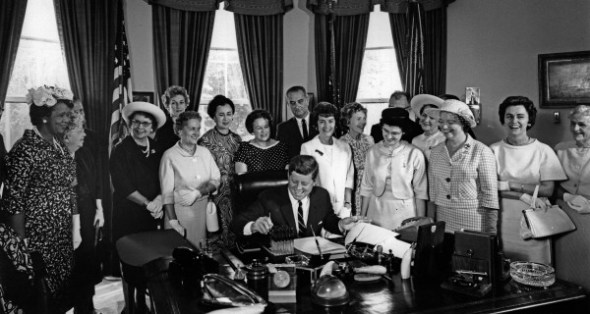
John F. Kennedy signs the Equal Pay Act of 1963
I do clearly Recall John F. Kennedy’s The New Frontier. There’s a popular myth that JFK didn’t accomplish that much legislatively before his death in 1963, but that’s what it is–a myth.
The term New Frontier was used by liberal Democratic presidential candidate John F. Kennedy in his acceptance speech in the 1960 United States presidential election to the Democratic National Convention at the Los Angeles Memorial Coliseum as the Democratic slogan to inspire America to support him. The phrase developed into a label for his administration’s domestic and foreign programs.
[W]e stand today on the edge of a New Frontier -— the frontier of 1960s, the frontier of unknown opportunities and perils, the frontier of unfilled hopes and unfilled dreams. … Beyond that frontier are uncharted areas of science and space, unsolved problems of peace and war, unconquered problems of ignorance and prejudice, unanswered questions of poverty and surplus.
In the words of Robert D. Marcus: “Kennedy entered office with ambitions to eradicate poverty and to raise America’s eyes to the stars through the space program”.Amongst the legislation passed by Congress during the Kennedy Administration, unemployment benefits were expanded, aid was provided to cities to improve housing and transportation, funds were allocated to continue the construction of a national highway system started under Eisenhower, a water pollution control act was passed to protect the country’s rivers and streams, and an agricultural act to raise farmers’ incomes was made law. A significant amount of anti-poverty legislation was passed by Congress, including increases in social security benefits and in the minimum wage, several housing bills, and aid to economically distressed areas. A few antirecession public works packages, together with a number of measures designed to assist farmers, were introduced. Major expansions and improvements were made in Social Security (including retirement at 62 for men), hospital construction, library services, family farm assistance and reclamation. Food stamps for low-income Americans were reintroduced, food distribution to the poor was increased, and there was an expansion in school milk and school lunch distribution. The most comprehensive farm legislation since 1938 was carried out, with expansions in rural electrification, soil conservation, crop insurance, farm credit, and marketing orders. In September 1961, the Arms Control and Disarmament Agency was established as the focal point in government for the “planning, negotiation, and execution of international disarmament and arms control agreements.” Altogether, the New Frontier witnessed the passage of a broad range of important social and economic reforms.
According to Theodore White, under John F. Kennedy, more new legislation was actually approved and passed into law than at any other time since the Thirties. When Congress recessed in the latter part of 1961, 33 out of 53 bills that Kennedy had submitted to Congress were enacted. A year later, 40 out of 54 bills that the Kennedy Administration had proposed were passed by Congress, and in 1963 35 out of 58 “must” bills were enacted. As noted by Larry O’Brien, “A myth had arisen that he (Kennedy) was uninterested in Congress, or that he “failed” with Congress. The facts, I believe, are otherwise. Kennedy’s legislative record in 1961–63 was the best of any President since Roosevelt’s first term”.
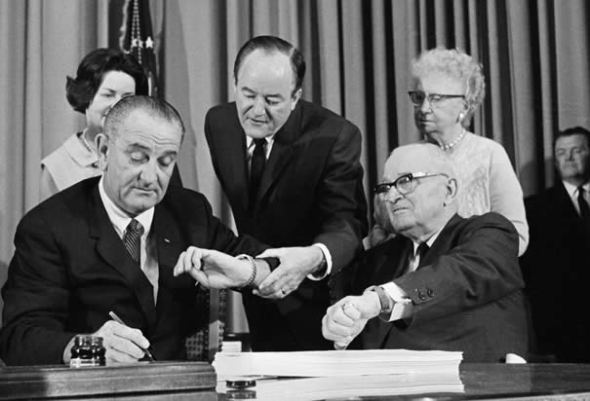
Lyndon B. Johnson signs the Medicare Act of 1964, with Harry Truman by his side
LBJ’s presidency was marred by his escalation of the war in Vietnam, but the domestic legislative accomplishments of his “Great Society” were stunning.
The aftershock of Kennedy’s assassination provided a climate for Johnson to complete the unfinished work of JFK’s New Frontier. He had eleven months before the election of 1964 to prove to American voters that he deserved a chance to be President in his own right.
Two very important pieces of legislation were passed. First, the Civil Rights Bill that JFK promised to sign was passed into law. The Civil Rights Act banned discrimination based on race and gender in employment and ending segregation in all public facilities.
Johnson also signed the omnibus ECONOMIC OPPORTUNITY ACT OF 1964. The law created the Office of Economic Opportunity aimed at attacking the roots of American poverty. A Job Corps was established to provide valuable vocational training.
Head Start, a preschool program designed to help disadvantaged students arrive at kindergarten ready to learn was put into place. The VOLUNTEERS IN SERVICE TO AMERICA (VISTA) was set up as a domestic Peace Corps. Schools in impoverished American regions would now receive volunteer teaching attention. Federal funds were sent to struggling communities to attack unemployment and illiteracy.
As he campaigned in 1964, Johnson declared a “war on poverty.” He challenged Americans to build a “Great Society” that eliminated the troubles of the poor. Johnson won a decisive victory over his archconservative Republican opponent Barry Goldwater of Arizona.
– American liberalism was at high tide under President Johnson.
– The Wilderness Protection Act saved 9.1 million acres of forestland from industrial development.
– The Elementary and Secondary Education Act provided major funding for American public schools.
– The Voting Rights Act banned literacy tests and other discriminatory methods of denying suffrage to African Americans.
– Medicare was created to offset the costs of health care for the nation’s elderly.
– The National Endowment for the Arts and Humanities used public money to fund artists and galleries.
– The Immigration Act ended discriminatory quotas based on ethnic origin.
– An Omnibus Housing Act provided funds to construct low-income housing.
– Congress tightened pollution controls with stronger Air and Water Quality Acts.
– Standards were raised for safety in consumer products.
I’m in tears right now after reading again about the accomplishments of these three great Democratic presidents. I’m in mourning today for my party and my country. For the first time, a supposedly Democratic president has proposed not only Social Security benefit cuts but also massive cuts to Medicare that will force seniors to pay higher deductibles and discourage them from buying medigap plans to cover co-pays.
I’ve known this was coming since 2007 when I read Obama’s book, The Audacity of Austerity Hope. He couldn’t have made it any clearer in the chapter on the domestic economy that he was an enthusiastic supporter of privatization and/or cuts in social programs. But although I’ve expected this for years, the reality of it has still hit me very hard. I feel both heartbroken and ashamed of President Obama.
I’ll post something else later on; but for now, please use this as a morning open thread and post your recommended links freely in the comments.
This is a sad day, but I believe Obama’s gambit will be a dismal failure. IMO he already looks foolish and ineffectual as the Republicans make hay by accusing him of trying to balance the budget on the backs of seniors. We need to understand that it is fruitless to expect him Obama stand up to the Republicans, the corporate media, or the bankers. We are on our own.
I admit, I had begun to believe that Obama had grown in office–that he had begun to realize that standing up for liberal values would serve him in good stead. But his addiction to “bipartisanship” and his fantasy of a “grand bargain” won out in the end. I still believe Romney would have been far worse, but let’s face it we still got a Republican president in 2008 and 2012. We need to fight tooth and nail to keep him from destroying the proud legacies of FDR, JFK, and LBJ.
Sooooo…. What’s on your mind today?
Late Night: Chain of Fools
Posted: April 10, 2013 Filed under: Barack Obama, Medicare, Political and Editorial Cartoons, Real Life Horror, Rick Perry, Social Security, U.S. Economy, U.S. Politics | Tags: cat food, Chained CPI, Dan Rostenkowski, middle class tax increases, social safety net 10 Comments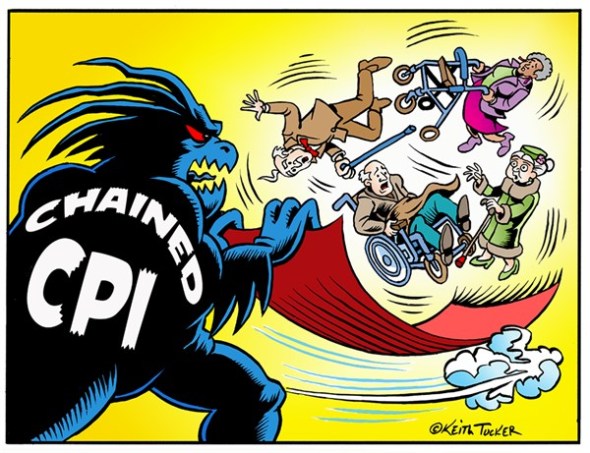
The President released his budget today, and it includes the promised benefit cuts to Social Security that the White House has tried to conceal by claiming it wants to institute a supposedly “more accurate” measure of cost-of-living, the Chained CPI. Of course at this point, anyone who is paying attention knows that the change will result in the average senior getting $1,000 less per year after 20 years. It’s a benefit cut pure and simple.
What many people don’t know yet is that switching Chained CPI will result in a significant tax increase for working poor and middle-class Americans.
Here’s your soundtrack for this post. Perhaps the great Aretha Franklin can make Obama’s budget slightly less nauseating. I’m also going to try to ease the pain with cartoons and visual aids.
Luckily, Grover Norquist and the folks at Americans for Tax Reform know darn well that Chained CPI amounts to a tax increase for people on the lower end of the income scale. This is right from their website.
The proposal in question is known as “Chained CPI.” The term is a Beltway euphemism for measuring inflation at a different, slower pace. Many tax and budget items are indexed to inflation, so slowing inflation’s measured rate of growth has both spending cut and tax increase implications.
On the tax side, all income tax brackets are subject to inflation. Slowing down the inflation rate slows down the annual rate of growth in all income tax brackets.
This means the Obama budget contains a tax increase on 100 percent of middle class taxpayers—anyone who pays the federal income tax.
Many other tax provisions—the standard deduction, the personal exemption, PEP and Pease, IRA and 401(k) contribution limits, and many others—are also tied to how CPI is measured.
Chained CPI as a stand-alone measure (that is, not paired with tax relief of equal or greater size) is a tax increase and a Taxpayer Protection Pledge violation. Various reports peg the tax increase amount as exceeding $100 billion over the next decade.
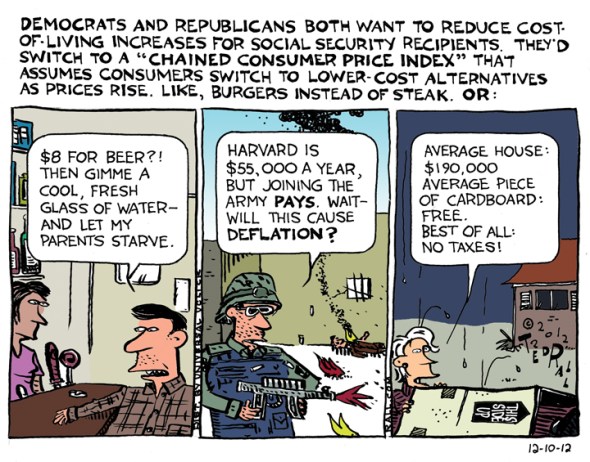
Ted Rall explains Chained CPI:
Dylan Matthews broke it all down (with charts) in a December 2012 post. Here’s the gist:
The group getting the biggest tax hike is families making between $30,000 and $40,000 a year. Their increase is almost six times that faced by millionaires. That’s because millionaires are already in the top bracket, so they’re not being pushed into higher marginal rates because of changing bracket thresholds. While a different inflation measure might mean that the cutoff between the 15 percent and 25 percent goes from $35,000 to $30,000, the threshold for the top 35 percent bracket is already low enough that all millionaires are paying it. Some of their income is taxed at higher rates because of lower thresholds down the line, but as a percentage of income that doesn’t amount to a whole lot.
All told, chained CPI raises average taxes by about 0.19 percent of income. So, taken all together, it’s basically a big (5 percent over 12 years; more, if you take a longer view) across-the-board cut in Social Security benefits paired with a 0.19 percent income surtax. You don’t hear a lot of politicians calling for the drastic slashing of Social Security benefits and an across-the-board tax increase that disproportionately hits low earners. But that’s what they’re sneakily doing when they talk about chained CPI.
That’s why watchdog groups like the Center for Budget and Policy Priorities argue that the only fair way to do chained CPI would be to pair it with an increase in Social Security benefits, and to exempt Supplemental Security Income, which provides support for impoverished elderly, disabled and blind people. Otherwise, it’s just a typical “raise taxes, cut benefits” plan, and an arguably regressive one at that.
So basically if you work for a living or depend on Social Security, you’re getting screwed coming and going.
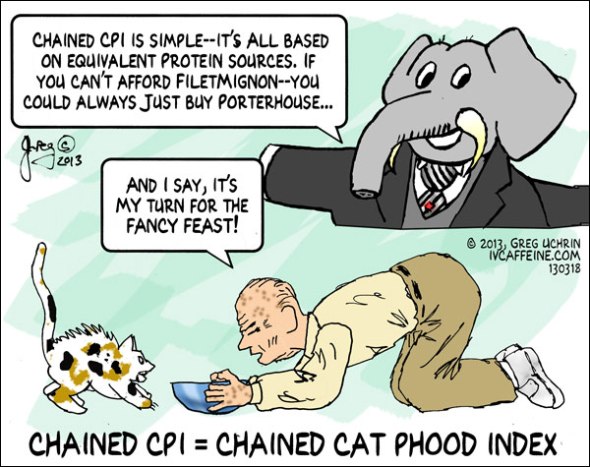
Here’s another cartoonist’s evaluation of the situation:
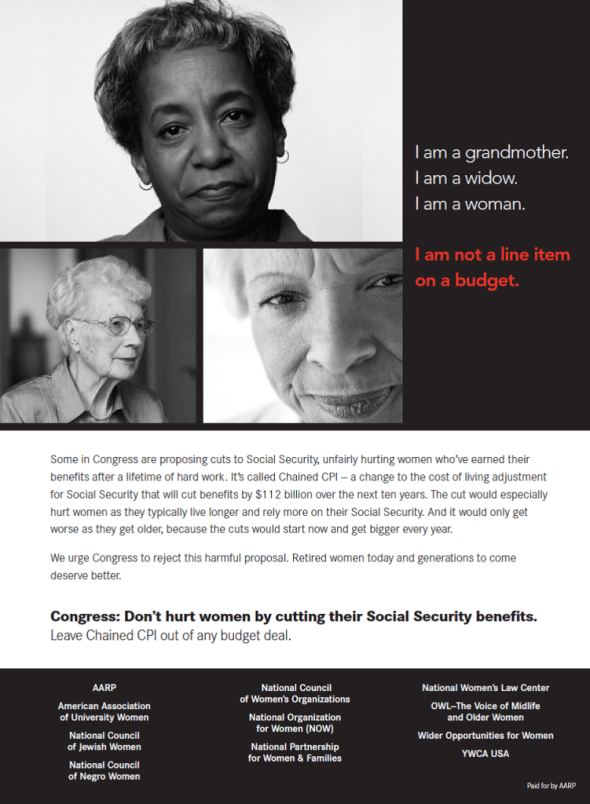
Chained CPI will disproportionately affects women, according to the AARP (3/6/2013).
The Social Security benefit cut known as Chained CPI remains a piece of the deficit puzzle for reasons that baffle conservatives, veterans, progressives, and almost everyone in between. The $85 billion in sequester cuts for 2013 have begun and many in Washington have still said they’re willing to cut the modest Social Security benefits we’ve earned by $127 billion over 10 years, even though Social Security by law remains separate from the budget and its deficit. Let’s give every woman and anyone who has or has ever had a mother, sister, daughter, grandmother, aunt or girlfriend a reason to despise this wretched proposal.
This week AARP began running ads about the impact of what the Chained CPI Social Security benefit cuts would mean to women. Below is a copy of one of those ads.
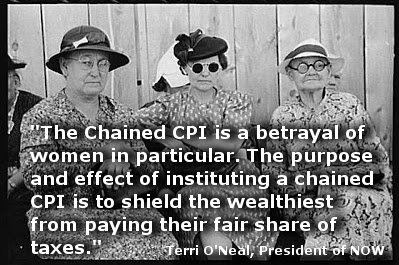
Here’s what Terri O’Neill, president of NOW had to say about women and Chained CPI.
I’m sure you recall that our previous Republican President (let’s face it, Obama is a Democrat in name only) began his second term with the ambitious goal of privatizing Social Security. It didn’t end well for him. Here’s a cartoon from back then:
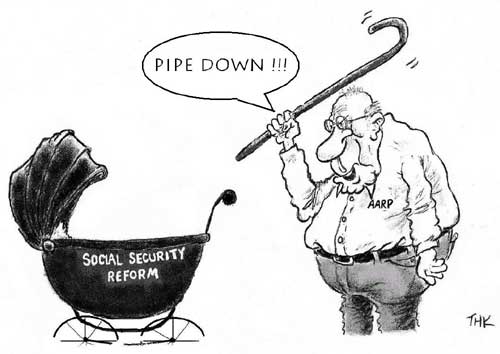
And another one:
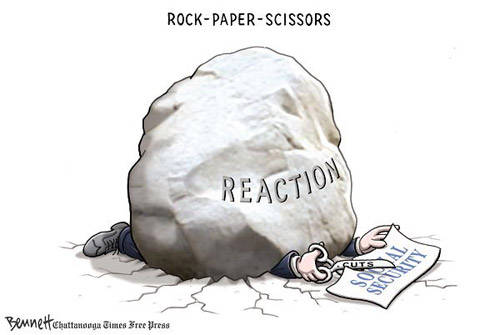
That’s the kind of reaction politicians tend to get when they attack the most successful and powerful government program in history. That’s why it’s called “the third rail.” Remember in when Texas Gov. Rick Perry attacked Social Security as a “Ponzi scheme?” Look what happened to him?
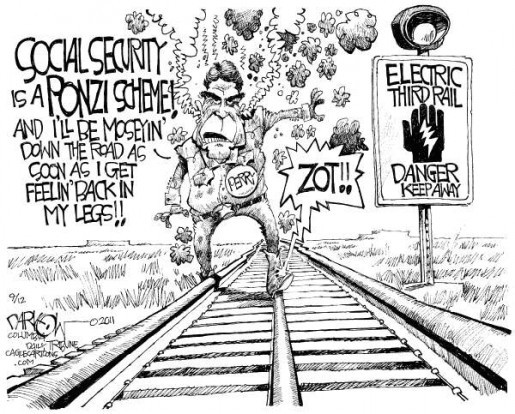
Obama is already beginning to learn why politicians who step on the “third rail” end up regretting it. He’s out there on a limb all by himself. Democrats hate his budget and so do Republicans, because the vast majority of Americans like Social Security and if it’s threatened they tend to get mad–especially seniors.
Yesterday, Digby recalled what can happen “When seniors get angry …” She referred to an incident in 1989 which Democrat Dan Rostenkowski–the powerful Chairman of the Ways and Means Committee–was chased down the street by enraged seniors.
Andrea Stone told the tale at AOL News in August 2010 after the Illinois Congressman’s death: Rosty’s ‘Catastrophic’ Moment Over Health Care Was a First.
The Medicare Catastrophic Coverage Act, first unveiled by President Ronald Reagan, became law in July 1989. The measure provided seniors on Medicare with protection against catastrophic medical expenses and coverage of prescription drug costs. The benefits were to be paid for exclusively by the elderly receiving them, with high-income seniors paying an extra premium surtax.
Soon after Congress passed the law on an overwhelmingly bipartisan vote, Rosty returned to his district. It was there, after a fairly civil meeting with seniors resentful over having to pay higher taxes for coverage they either already had from a former employer or didn’t want, that he was accosted by an angry mob of Social Security recipients.
As the Chicago Tribune reported the next day, Aug. 19, 1989:
Congressman Dan Rostenkowski, one of the most powerful politicians in the United States, was booed and chased down a Chicago street Thursday morning by a group of senior citizens after he refused to talk with them about federal health insurance. Shouting “coward,” “recall” and “impeach,” about 50 people followed the chairman of the U.S. House Ways and Means Committee up Milwaukee Avenue after he left a meeting in the auditorium of the Copernicus Center, 3106 N. Milwaukee Ave., in the heart of his 8th Congressional District on the city’s Northwest Side.
Eventually, the 6-foot-4-inch Rostenkowski cut through a gas station, broke into a sprint and escaped into his car, which minutes earlier had one of the elderly protesters, Leona Kozien, draped over the hood. Kozien, one of more than 100 senior citizens who attended the gathering, said she had hoped to talk to Rostenkowski, her congressman, at the meeting.
But Rostenkowski clearly did not want to talk with her, or any of the others who had come to tell their complaints about the high cost of federal catastrophic health insurance. “These people don’t understand what the government is trying to do for them,” the 61-year-old congressman complained as he tried to outpace his pursuers.
“This was a setup,” said Jaffe, who can be seen in the video ducking into the backseat of the car. “They were standing with made-for-television signs about how he had sold them out.”
As the Tribune reported, “Kozien was soon on the hood, determinedly holding her sign only inches from the windshield. Except for the glass, she was virtually face-to-face with her congressman. ‘I was a little nervous,’ Kozien said later. ‘But I could see through the car window that he looked more afraid than I was.'”
And there is even video of the incident:
Obama is all alone out there on his limb. The only people who have his back are his apparently not-to-bright advisers. Does he really want to be remembered as the first Democratic President to tamper with Social Security? And BTW, his budget also cuts Medicare significantly. Is this really what he wants as his “legacy?” Is it really good enough to gain the applause of Wall Street and the “Very Serious People” in Washington, DC today but go down in history as a worse president than Calvin Coolidge, Herbert Hoover and George W. Bush? We shall see.
Saturday Morning: What’s The Matter With Kansas?
Posted: April 6, 2013 Filed under: morning reads, U.S. Economy, U.S. Politics, War on Women | Tags: anti-abortion legislation, Bobby Jindal, childhood memories, David Haley, Kansas legislature, Sam Brownback, Steve Fitzgerald 37 Comments
I spent my early childhood in Lawrence, Kansas while my dad was working on his Ph.D. at KU. We lived in the married student housing, which consisted of a group of wood frame former army barraks painted yellow. They called it “Sunnyside.” As a child I just loved the place. My mom remembers how the dust would blow up through the floorboards and the clothes would be dry before she even finished hanging them on the clothesline. I remember it as a kind of paradise where there were plenty of other kids around and vast fields nearby where we could run and play to our heart’s content. In those carefree days of the 1950s, parents didn’t feel they had to watch their children every minute. We didn’t need play dates, we just ran outdoors and joined the fun. We had a lot of freedom then.
I can still recall the simmering summer afternoons when all the adults were sheltering indoors and we wore ourselves out climbing the jungle gym and hanging upside down or wandering through the fields looking for arrowheads or relaxing in the shade of a giant oak tree where someone had nailed boards together to make a tree house. We’d climb up there and enjoy the view from on high.
One of my clearest memories is the joy I’d feel when, after driving up to North Dakota with my family to visit my grandparents we’d cross the Kansas border and the “Welcome to Kansas, the Sunflower State” sign, and I’d know I was back home at last. I’d survey the wheat fields waving in the breeze, the distant horizon, the endless highway, straight and flat, where if there was a speed limit sign all it was 100 mph.
Yes, I loved Kansas, as only a child can love a place. When we moved away to Ohio, I was broken-hearted and homesick and for a long time I begged my parents to take us back there.
I guess these memories are the reason it hurts my heart to hear about what is going on in Kansas today. I suppose it was always a conservative place, but today it has become cruel and mean-spirited. Look at the news from my old home state this morning.
Kansas passes anti-abortion bill declaring life begins ‘at fertilization.’ The Christian Science Monitor reports:
Kansas legislators gave final passage to a sweeping anti-abortion measure Friday night, sending Gov. Sam Brownback a bill that declares life begins “at fertilization” while blocking tax breaks for abortion providers and banning abortions performed solely because of the baby’s sex.
The House voted 90-30 for a compromise version of the bill reconciling differences between the two chambers, only hours after the Senate approved it, 28-10. The Republican governor is a strong abortion opponent, and supporters of the measure expect him to sign it into law so that the new restrictions take effect July 1.
In addition to the bans on tax breaks and sex-selection abortions, the bill prohibits abortion providers from being involved in public school sex education classes and spells out in more detail what information doctors must provide to patients seeking abortions.
Yes, the War on Women continues, and the Kansas legislature is apparently determined to beat out North Dakota as the most dangerous place for women to get pregnant.
Read the rest of this entry »
Boehner Dismissively Rejects Obama Budget
Posted: April 5, 2013 Filed under: Sequester, Social Security, U.S. Economy, U.S. Politics | Tags: austerity, Chained CPI, John Boehner, Obama budget 20 Comments
House Speaker John Boehner immediately dismissed President Barack Obama’s package of significant new entitlement cuts tied to new tax revenues, calling them “no way to lead and move the country forward.”
The White House had portrayed the proposal, part of the budget it will release next week, as a compromise with Congressional Republicans that could have put them on track for another run at a grand bargain.
But Boehner said he will not consider new revenues as part of the deal, arguing that “modest” entitlement savings should not “be held hostage for more tax hikes.”
Politico notes that Obama has now opened himself up to attacks from both the left (such as it is) and the right. Right wing nuts hate the increased taxes on “tax-preferred retirement accounts for millionaires and billionaires”
Already, Obama’s budget proposal goes farther than many in his own party and base said they would bear by including “chained CPI,” the adjustment that would over time reduce cost-of-living increases to Social Security and other federal benefit programs — effectively, a cut to Social Security benefits by tying them to inflation….
And Obama is already facing a backlash from liberal Democrats as he has floated the chained CPI idea. Sen. Tom Harkin (D-Iowa) said Friday that any Social Security cuts are a no-go for him.
“While there are large portions of the president’s budget that I strongly support, I remain firmly opposed to the chained CPI,” Harkin said. “This policy is an unnecessary attack on Social Security, a program that by law is unable to add to the deficit.”
As I’ve repeatedly said, our only defense against Obama’s obsession with cutting social programs is the stupidity of the House Republicans.

 peej
peej Carissa
 bostonboomer
 dakinikat
 ecocatwoman
 mablue2
 Mama Lopez
 peggysue22
 quixote
 skydancingguestblogger
 Mona (aka Wonk the Vote)



 Sky Dancing
Recent Comments