
Saturday: An Autumn Potpourri of Reads
Posted: October 19, 2013 Filed under: Crime, morning reads, Republican politics, U.S. Economy, U.S. Politics | Tags: Affordable Care Act, anti-leak software, Ariel Castro, Bill Russell, Boston Celtics, Boy Scouts, Cleveland Police Department, Dave Hall, Edward Snowden, Elias Acevedo, FBI, Fox News lies, Glenn Greenwald, Glenn Taylor, Goblin Valley State Park, guns, hunting, Laura Poitras, murder, NSA, Obamacare, political fund-raising, potpourri, rape, rock formations, Sean Hannity, Tea Party, Ted Cruz 29 Comments
Fall in New England
Good Morning!!
Isn’t that a gorgeous photo? It was taken in New Hampshire near Mount Washington in October 2011.
A potpourri is “a combination of incongruous things.” Well that’s what I have for you this morning. We’ll begin at Sea-Tac airport in Seattle where Boston Celtics legend Bill Russell, 79, was arrested by TSA police for having a loaded gun in his carry-on bag. He was held for about half-an-hour and then released. He has a permit for the gun. Russell was on his way to Boston where a statue of him will be unveiled on November 1.
Did you hear about the morons in Utah who destroyed a 170-million-year-old rock formation and made a video of themselves doing it? From the Deseret News:
Two men have come under scrutiny by the public and possibly by prosecutors after a video made the rounds online showing them pushing over an iconic rock formation.
The men were visiting Goblin Valley State Park last week when they said they noticed a precariously perched
boulder that was loose and worried it would fall on someone. The delicate “goblin” formation, also known as a “hoodoo,” is one of many that gives the park its name.
What followed was a video showing the men joking and laughing as Glenn Taylor, of Highland, topples the rock, narrated by cameraman Dave Hall, who says lives have been saved. A third man, identified as Taylor’s son, watches.
These two ignorant fools, who are Boy Scout leaders (!), thought the ancient rock formation was suddenly going to tip over and crush someone.
Utah State Parks spokesman Eugene Swalberg called the video disturbing. Possible criminal charges are being screened by the Emery County Attorney’s Office and the Utah Attorney General’s Office, he said….
The goblins date back more than 170 million years to the Jurassic Period, Swalberg said. The park, which gets more than 85,000 visitors per year, was dedicated in 1974 to protect the fragile formations, he said.
“There are some established trails in the park, but there are also areas where you can have self discovery and wander amongst the goblins,” Swalberg said. “That’s the beauty of Goblin Valley. It’s not meant to have people push over the goblins. It’s meant to enjoy.”
Check out the idiotic quotes from these guys in this Fox News story:
“This is about saving lives,” Dave Hall, who shot the video, told The Associated Press on Friday. “One rock at a time.”
The rock formation is about 170 million years old, Utah State Parks spokesman Eugene Swalberg said. The park in central Utah is dotted with thousands of the eerie, mushroom shaped sandstone formations.
In a video posted on Facebook, Glenn Taylor of Highland, Utah, can be seen last Friday wedging himself between one formation and a boulder to knock a large rock off the formation’s top. Taylor and his two companions can then be seen cheering, high-fiving and dancing….
“My conscience won’t let me walk away knowing that kids could die,” Hall said.
While safety was their motivation, Hall said, it was exciting to knock it over, and that’s why they reacted with high-fives and cheers in the video.
“You can’t have a rock the size of a car that you can push with one hand, and have it roll, and not have an adrenaline rush,” Hall said. “It was a crazy, exciting moment.”
What an asshole! If these fools don’t get criminally prosecuted, at least maybe the Boy Scouts will discipline them.
Boy Scouts of America spokesman Deron Smith confirmed the men are members of the organization, saying in a statement that the organization is “shocked and disappointed by this reprehensible behavior.”
Boy Scout troops spend countless hours in state and national parks, guided by the principle of leaving nature the way they find it, Smith said.
“The isolated actions of these individuals are absolutely counter to our beliefs and what we teach,” Smith said. “We are reviewing this matter and will take appropriate action.”
Moving on , , ,
NSA officials admit they put off installing the latest anti-leak software at the Hawaii facility where Edward Snowden stole thousands of top secret documents before fleeing the country and eventually accepting asylum in Russia.
Well before Snowden joined Booz Allen Hamilton last spring and was assigned to the NSA site as a systems administrator, other U.S. government facilities had begun to install software designed to spot attempts by unauthorized people to access or download data.
The purpose of the software, which in the NSA’s case is made by a division of Raytheon Co, is to block so-called “insider threats” – a response to an order by President Barack Obama to tighten up access controls for classified information in the wake of the leak of hundreds of thousands of Pentagon and State Department documents by an Army private to WikiLeaks website in 2010.
The main reason the software had not been installed at the NSA’s Hawaii facility by the time Snowden took up his assignment there was that it had insufficient bandwidth to comfortably install it and ensure its effective operation, according to one of the officials.
Due to the bandwidth issue, intelligence agencies in general moved more slowly than non-spy government units, including the Defence Department, to install anti-leak software, officials said.
In other related news,
Snowden told The New York Times in an interview that he turned all of his files over to Glenn Greenwald and Laura Poitras when the three met in Hong Kong last spring; he said he didn’t keep any of the files and therefore China and Russia could not have gotten access to them. From HuffPo:
Snowden said he did not retain copies of the documents and did not take them to Russia “because it wouldn’t serve the public interest,” the Times reported. He said his familiarity with China’s intelligence abilities allowed him to protect the documents from Chinese spies while he was in Hong Kong.
“There’s a zero percent chance the Russians or Chinese have received any documents,” he said….
The Times reported that in the interview, which it said took place over several days in the last week and involved encrypted online communications, Snowden asserted that he believed he was a whistle-blower who was acting in the nation’s best interests by revealing information about the NSA’s surveillance dragnet and huge collections of communications data.
The only problem with these claims is that Snowden actually gave copies of some of the stolen files to the Chinese government-supported newspaper The South China Morning Post in August, long after he supposedly turned everything over to Greewald and Poitras. So where did that data come from?
Whatever the truth is, we do know the files are in the possession of Greenwald, Poitras, Wikileaks, The Guardian, The Washington Post, The New York Times, and several other news organizations as well as the British security services which confiscated the files from Greenwald’s live-in partner David Miranda when he was passing through Heathrow airport. So we can be sure there’s no danger of unauthorized release of secret information. Right?
That was sarcasm, by the way, in case you didn’t pick up on it . . .
Bob Cesca had a good post yesterday on Ted Cruz and his future plans. He apparently feels emboldened by his success in shutting down the government for two weeks, and plans more destructive behavior next time. Cesca writes:
Sen. Ted Cruz (R-TX), the chief architect of the tea party shutdown and subsequent debt ceiling brinksmanship, might have lost an endorsement from his home town newspaper, but he managed to raise $1.19 million during the third quarter — nearly three times the haul of the second quarter total. That period of time didn’t include the shutdown, but it included his filibuster, which, it turns out, had a very important purpose: the make money for Ted Cruz. He also beefed up his email database with a petition that gathered over two million names and addresses.
When asked who “won” the shutdown battle, Rep. Tom Rooney (R-FL) told Politico the winners were “the people that managed to raise a lot of money off this.” Now, I don’t know if that means the tea party necessarily “won,” but Cruz and the Heritage Action group, which pulled in $330,000, didn’t walk away empty-handed.
While Cruz and the others cashed-in, the shutdown ended up costing the federal government $24 billion. Via TIME, here’s a breakdown of just a few of the losses:
-About $3.1 billion in lost government services, according to the research firm IHS
-$152 million per day in lost travel spending, according to the U.S. Travel Association
-$76 million per day lost because of National Parks being shut down, according to the National Park Service
-$217 million per day in lost federal and contractor wages in the Washington D.C. metropolitan area aloneAnd we’re supposed to continue buying the line that the tea party cares about government spending and the national debt? That’s rich.
Obviously, Cesca writes, they are going to do a repeat performance early next year. Read all about it at the link.
More wingnut news . . .
Via Kevin Drum, Eric Stern wrote at Salon about how he “fact-checked” Sean Hannity’s claims about Obamacare. Stern writes:
I happened to turn on the Hannity show on Fox News last Friday evening. “Average Americans are feeling the pain of Obamacare and the healthcare overhaul train wreck,” Hannity announced, “and six of them are here tonight to tell us their stories.” Three married couples were neatly arranged in his studio, the wives seated and the men standing behind them, like game show contestants.
As Hannity called on each of them, the guests recounted their “Obamacare” horror stories: canceled policies, premium hikes, restrictions on the freedom to see a doctor of their choice, financial burdens upon their small businesses and so on.
“These are the stories that the media refuses to cover,” Hannity interjected.
But none of it smelled right to me. Nothing these folks were saying jibed with the basic facts of the Affordable Care Act as I understand them. I understand them fairly well; I have worked as a senior adviser to a governor and helped him deal with the new federal rules.
So Stern actually contacted three of these folks and it turns out they all lied. As Drum summarizes:
One of them was apparently just lying, and the other two hadn’t even checked the exchanges, where they would have found that they could get better coverage for considerably less than they’re paying now.
Unbelievable.
Did you hear the latest in the Ariel Castro story?
One of Castro’s neighbors has now been charged with rapes and murders. From the Guardian:
Increased scrutiny of missing person cases in a Cleveland neighbourhood following the arrest of kidnapper Ariel Castro led to charges against a neighbour for the murders of two women in the 1990s, the FBI said on Friday.
Elias Acevedo, 49, was charged late on Thursday with the kidnapping, rape and murder of his 30-year-old neighbour, Pamela Pemberton, found strangled in 1994, and another woman believed to be Christina Adkins, a pregnant 18-year-old who disappeared in 1995. He also is charged with the rape of two young girls.
“Because the public became more aware and investigators were determined and relentless, people were re-interviewed and there was an increased interest in these missing person cases,” FBI spokeswoman Vicki Anderson said.
Acevedo, who lived on the same block as Castro, was arrested in June at his Seymour Avenue residence after police questioned Castro’s neighbours and discovered that Acevedo was a convicted sex offender who had failed to report his current address.
Acevedo became a suspect in the Adkins and Pemberton murders after the FBI re-examined the disappearance of other missing women from the Seymour Avenue neighbourhood after Castro’s arrest, according to a statement from the Cuyahoga County prosecutor’s office.
Imagine if the Cleveland police had actually done their job years ago?
I’ll end with this wacky story from CBS Atlanta.
Bear climbs tree stand to meet hunter.
A video of a showdown between a hunter and a bear in Canada posted in May of this year is making the rounds on social media as of late.
The video, posted by Jeffrey Moffatt, shows a hunter in a tree stand with a bear at the bottom of the tree.
Much to the surprise of the hunter, the bear climbs the tree in about three seconds and comes face-to-face with the hunter. No need for a hunting rangefinder when the damn thing is 3 feet away from you!
The bear sniffs around and eventually decides the hunter wasn’t a threat and climbs down the tree.
Moffatt said on YouTube that he only had a bow and arrow – no firearm – and did not have any cell service in case the situation would have gotten worse.
You have to watch the video!
OK, those are my contributions for today. What stories are you following? Please post your comments and links in the thread below.
Thursday Reads: Republicans Go Over The Cliff
Posted: October 17, 2013 Filed under: Barack Obama, morning reads, Republican politics, U.S. Economy, U.S. Politics | Tags: Debt Ceiling, extortion, government shutdow, John Boehner, John McCain, Louis Gomert, Tea Party Caucus, Ted Cruz 22 Comments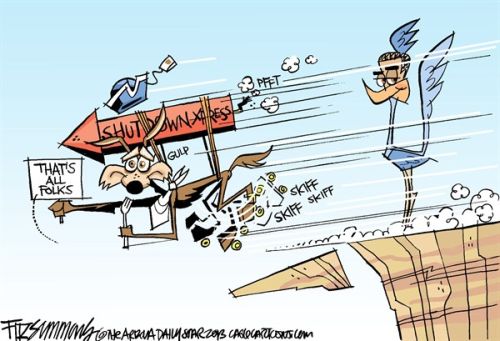
Good Morning!!
Before we get started, I need to make another appeal for donations. We still need a little more money to pay for WordPress extras like extended memory and our domain name. If you could give even $5, it would help a lot. We only need about $30 more to cover everything. Thanks so much to those of you who already gave!
Now on to the news of the day, which is so strange that I hardly know how to begin. Did we really just go through more than two weeks of a hostage drama with supposed grown-up elected officials threatening to bring down the U.S. economy–and along with it the global economy–unless the President and the legislature agree to repeal a legitimate law that has been upheld by the Supreme Court? Or failing that, deny birth control to adult women?
Yes, yes we did. Somehow, truly insane people have tried to take over the government. They’ve been defeated for now, but in only a few months we could go through this again! This article at Bloomberg Businessweek pretty much sums it up: Congress Ends Impasse to Be Revisited in January.
After the partisan passions and heated rhetoric, the disruptions of a government shutdown and displays of dysfunction, Congress did what it could have done weeks ago: voted to fund the government and lift the debt limit.
The passage last night by wide margins — an 81-18 vote in the Democratic-led Senate, followed by a 285-144 vote in the Republican-controlled House — allows the U.S. to avoid default and ends the shutdown that began Oct. 1 and has taken $24 billion out of the U.S. economy.
President Barack Obama signed the bill just after midnight, according to a White House statement. The measure puts government workers back on the job starting today and permits the U.S. to pay its debts, benefits and salaries.
Lawmakers didn’t show they’re any closer to resolving the underlying issues of spending priorities and deficit-reduction measures, particularly in the House where a shrinking political middle makes compromise elusive as the latest events show.
The focus now shifts to a new series of deadlines — the first for budget negotiations with a Dec. 13 target — that set up more rounds of political combat over taxes and spending on programs including Social Security and Medicare. The deal funds the government at Republican-backed spending levels through Jan. 15, 2014, and suspends the debt limit through Feb. 7.

But according to CBS News, Republicans still plan to keep trying to repeal the Affordable Care Act.
[Senate Minority Leader Mitch] McConnell claimed victory for Republicans in the fact that the sequester cuts mandated by the Budget Control Act were preserved, and assured the party he is committed to fighting to repeal Obamacare.
“Republicans remain determined to repeal this terrible law, but for today the relief we hope for is to reopen the government, avoid default and protect the historic cuts we achieve under the Budget Control Act,” he said. “This is far less than many of us had hoped for, frankly, but its far better than what some had sought. Now it’s time for Republicans to unite behind other crucial goals.”
Ted Cruz plans to continue the hopeless fight against Obama’s health care law. From Mediaite: Ted Cruz Slams ‘Lousy Deal,’ Pledges Obamacare Fight Is Far From Over on Hannity.
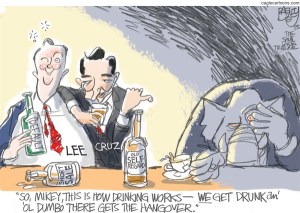
Ted Cruz and Mike Lee, the conservative tag-team that led the fight on Obamacare from the beginning, joinedSean Hannity Wednesday night before the House voted to officially end the government shutdown, both of them slamming the compromise deal and promising to continue fighting the health care law. Cruz called it a “lousy deal” and the latest example of the “Washington establishment selling the people down the river.”
Watch the video at the link if you can stomach it.
Meanwhile, back in Texas some folks aren’t so happy with their new Senator. The Houston Chronicle yesterday expressed regret for having endorsed him. From HuffPo:
Nearly one year removed from its decision to endorse Ted Cruz, the Houston Chronicle reflected back on that choice in a Tuesday op-ed, admitting that he has not lived up to the paper’s expectations.
In a piece entitled “Why We Miss Kay Bailey Hutchison,” the newspaper reflected back on how Hutchison had an “extraordinary understanding of the importance of reaching across the aisle when necessary.” That skill has not been displayed by Cruz or senior Sen. John Cornyn (R-Texas), according to the Chronicle….
In an Oct. 18, 2012 op-ed, the Chronicle explained that its endorsement of Cruz was premised on him following the example of previous senators, including Democrats Lloyd Bentsen, who went on to serve as Treasury Secretary and Lyndon B. Johnson, who later became president.
“We expect Cruz as the senator from the Lone Star State to spend his energies standing up for Texans of every background and economic station, representing their best interests from health care and education to energy, space and medicine,” the paper wrote.
The Dallas News notes: Ted Cruz left with few friends after Obamacare fight fails, government shutdown ends, debt limit rises.
It might be time for Ted Cruz to get a dog.
Because as the saying goes, if you want a friend in Washington, that’s what you do. And by the time Cruz’s crusade to defund Obamacare finally crashed to a halt Wednesday, the Texas senator had precious few friends left.
The government shutdown alienated colleagues in both parties. It generated fresh animosity toward the tea party and a flurry of recriminations toward Cruz. Voter support for the Republican Party plunged….
Cruz willed himself to the center of the fight. For months, he predicted that Democrats would cave if Republicans stood together to strip funding from the health care law. He dramatized the cause with a 21-hour overnight Senate speech, soaring to unusual prominence for a freshman senator. He refrained from using the risk of a catastrophic default on U.S. debt as leverage. Still, the defeat was so resounding that it left his political future in doubt.
The vast majority of his colleagues repudiated his tactics. Some accused him of promoting himself more than any attainable goals or the health of his party.
Sen. John McCain of Arizona, the 2008 GOP presidential nominee, called the last few weeks an “agonizing odyssey.”
“This has been one of the most shameful chapters I’ve seen here,” he said, lamenting damage to the GOP for little gain. “We’re in a hole. We have to dig out. We weren’t going to defund Obamacare, and we weren’t going to keep the government shut down.”
On the other hand, Mitch McConnell didn’t walk away empty-handed. WFPL in Louisville reports: McConnell-Reid Deal Includes $3 Billion Earmark for Kentucky Project.
Language in a draft of the McConnell-Reid deal (see page 13, section 123) provided to WFPL News shows a provision that increases funding for the massive Olmsted Dam Lock in Paducah, Ky., from $775 million to nearly $2.9 billion.
The dam is considered an important project for the state and region in regards to water traffic along the Ohio River.
As The Courier-Journal’s James Bruggers reported in 2011, the U.S. Army Corps of Engineers said they needed about $2.1 billion for the locks due to “stop and go funding.”
Asked about the additional funding in the proposal, McConnell spokesman Robert Steurer directed all questions to lawmakers who worked on the bill directly.
Hostage-taking, extortion, and bribery. It’s the Republican way.
In the midst of the madness last night, Diane Reedy, a House stenographer had to be dragged off the House floor after she grabbed a microphone during the vote and began ranting about Freemasons. CNN:
Amid all the chaos of the last-minute deal in Washington, there was an unusual moment on the House floor moments after the bill passed.
A House stenographer and well-known employee calmly took to a microphone and began screaming.
“Do not be deceived. God shall not be mocked. A House divided cannot stand,” she said, according to a House GOP aide. After a few seconds, she was escorted out by the Sergeant-at-Arms, but an audio recording by Todd Zwillich of Public Radio International captured the rest of her rant.
“He will not be mocked, He will not be mocked, (don’t touch me) He will not be mocked. The greatest deception here, is that this is not one nation under God. It never was. Had it been… it would not have been… No. it would not have been… the Constitution would not have been written by Free Masons… and go against God. You cannot serve two masters. You cannot serve two masters. Praise be to God, Lord Jesus Christ.”
According to Dana Bash, the woman is well liked on Capitol Hill. She was taken to a hospital for a psychological evaluation. I hope she will be okay; but frankly, her behavior is no crazier than that of some House members. For example, insane Texas Rep. Louis Gomert claimed yesterday that Sen. John McCain is a supporter of al Qaeda. Raw Story reports McCain’s response:
Sen. John McCain (R-AZ) shrugged off Rep. Louie Gohmert’s (R-TX) insinuation that he was an “al Qaeda supporter” in an interview with NBC Nightly News host Brian Williams on Wednesday, while conceding to an increasing amount of polarization between lawmakers.
“On that particular issue, sometimes comments like that are made out of malice,” McCain told Williams. “But if someone has no intelligence, I don’t view it as being a malicious statement. You can’t respond to that kind of thing.”
And this wasn’t just an isolated incident.
Gohmert made a thinly-veiled reference to McCain during an Oct. 11 appearance at the Value Voters Summit, mocking his trip to meet with rebel leaders in Syria by calling him, “a guy that’s been to Syria and supported Al Qaeda and the rebels.”
The two also clashed in 2012, with Gohmert calling McCain and other GOP lawmakers“numbnuts” after McCain criticized Gohmert and Rep. Michele Bachmann (R-MN) for what he called “specious and degrading attacks” against former State Department aide Huma Abedin.
Can we get Gomert a psych eval? Please?
Just a couple more links on reactions to the insanity in DC:
From the Wall Street Journal: Business Voices Frustration With GOP.
The budget stalemate that had the U.S. flirting with default has left business and the Republican Party, longtime political allies, at a crossroads.
In interviews with representatives of companies large and small, executives predicted a change in how business would approach politics. They didn’t foresee a new alignment with Democrats but forecast backing challengers to tea-party conservatives in GOP primaries, increasing political engagement with centrist Republicans and, for some, disengaging with politics altogether.
Many business executives say they were dismayed that some Republicans didn’t heed their warnings that closing the government and risking default would hurt the U.S. economy. Others expressed disgust with Washington politics in general. All said the crisis could have been averted with a more pragmatic approach.
The decadeslong relationship between American business and the GOP is certainly likely to endure, with business still feeling a kinship and shared goals with many in the party, including a push for lower taxes and lighter regulation.
But the conversation among businesses is “characterized by tremendous frustration and angst,” said Dirk Van Dongen, president of the National Association of Wholesale-Retailers, a trade group. “Because at the end of the day, the system is supposed to produce results, and the failure to produce results has consequences.”
Reuters: Dollar slides as relief at U.S. debt deal fades.
“The U.S. can give a sigh of relief for now but the New Year could bring a dangerous sense of déjà vu,” Luke Bartholomew, investment analyst at Aberdeen Asset Management, said.
Equity markets in the U.S. and Asia initially welcomed the last-minute deal which pulled the world’s biggest economy back from the brink of a historic default, but the rally ran out of steam as the longer-term implications sank in….
The temporary nature of the agreement and longer-term worries that the debt ceiling risks would become a structural drag on the economy also weighed on debt markets.
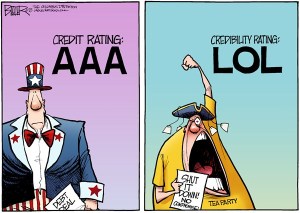
That view was shared by Chinese credit agency Dagong, which downgraded the U.S. sovereign rating to A- from A with a negative outlook, driving further dollar losses.
The 10-year benchmark Treasury note yield slipped to 2.65 percent from around 2.68 percent late in New York. While U.S. Treasury bill futures had gained 0.1 percent.
“It casts dark clouds over the economy – politics are now the main drag for growth in the U.S,” Rabobank strategist Philip Marey said.
Read more at the link.
Finally, the Center for American Progress has released a report on Replacing the Sequester. Check it out at the link.
Now it’s your turn. What stories are you following today? What reactions are you seeing to yesterday’s agreement? Please post your own thoughts as well as your links on any topic in the comment thread.
Tuesday Reads: Nightmare on Capitol Hill
Posted: October 15, 2013 Filed under: Barack Obama, morning reads, Republican politics, U.S. Economy, U.S. Politics | Tags: Congress, Debt Ceiling, government shutdown, Harry Reid, Mitch McConnell, Paul Ryan, Tea Party, Ted Cruz 51 Comments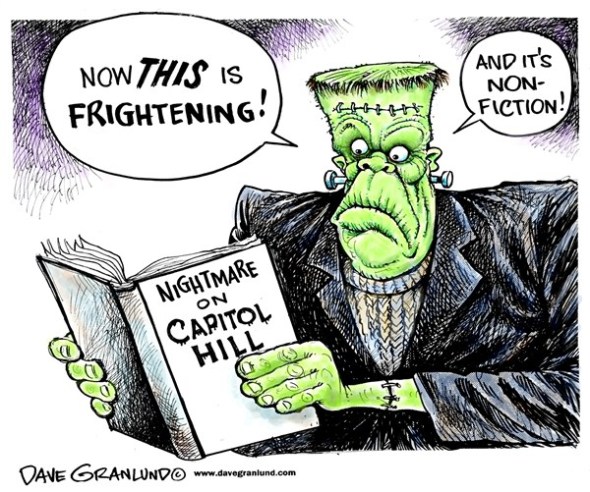
Good Morning!!
Yes, it’s real–too real. We’re approaching the deadline for raising the debt ceiling–it’s Thursday–and Congress is still dithering. But it looks like they may figure out a way to kick the can down the road again, as long as Ted Cruz doesn’t decide to have another tantrum.
According to the Hill this morning, Harry Reid and Mitch McConnell are close to agreeing on “a deal” to reopen the government and raise the debt ceiling for a few more months. The two Senate leaders huddled for hours yesterday trying to put together some kind of package that would satisfy House Republicans and convince them not to bring down the U.S. Government and the global economy.
An emerging deal to reopen the government and raise the nation’s debt ceiling until February gathered political momentum Monday evening after Senate Republicans signaled they would likely support it.
Lawmakers and aides said the legislation would fund the government until Jan. 15 and extend the nation’s borrowing authority until February but leave ObamaCare largely untouched.
The agreement would also set up another “supercommittee” to try to deal with the next round of automatic sequester cuts. The committee would have until December 13 to report to Congress. Anyone who thinks they’ll agree on anything, please raise your hand.
The big question is whether a package to fund the government and raise the debt ceiling can pass muster in the House.
Speaker John Boehner (R-Ohio) was briefed on the deal Monday, and members of his conference were taking a wait and see attitude.
“When we see it, we’ll know what it is. Do you know what it is yet?” Rep. Pete Sessions (R-Texas), chairman of the House Rules Committee, asked reporters as he left Boehner’s office.
“As soon as we see something in writing, then we can understand how we can thoughtfully understand what we’ll do with it,” Sessions said.
House Majority Leader Eric Cantor (R-Va.) wouldn’t comment on the emerging Senate deal, but he told reporters House Republicans will meet Tuesday morning “to discuss a way forward.” “Possible consideration of legislation related to the debt limit” was added to Cantor’s daily House schedule for Tuesday.
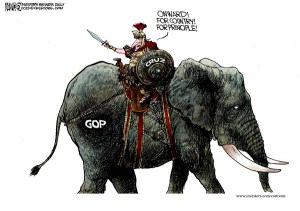
Of course the biggest potential fly in the ointment is Texas junior Senator Ted Cruz and his gang of Tea Party House members. Cruz wouldn’t say whether he’s planning another fake filibuster or some other effort to kill the Affordable Care Act. However, Cruz did hold a secret meeting with House Republicans last night, according to Roll Call.
Sen. Ted Cruz met with roughly 15 to 20 House Republicans for around two hours late Monday night at the Capitol Hill watering hole Tortilla Coast.
The group appeared to be talking strategy about how they should respond to a tentative Senate deal to reopen the government and raise the debt ceiling without addressing Obamacare in a substantive way, according to sources who witnessed the gathering. The Texas Republican senator and many of the House Republicans in attendance had insisted on including amendments aimed at dismantling Obamacare in the continuing resolution that was intended to avert the current shutdown.
Sources said the House Republicans meeting in the basement of Tortilla Coast with Cruz were some of the most conservative in the House: Reps. Louie Gohmert of Texas, Steve King of Iowa, Jim Jordan of Ohio, Tom Cotton of Arkansas, Raúl R. Labrador of Idaho, Steve Southerland II of Florida, Mark Meadows of North Carolina and Justin Amash of Michigan.
The group is a collection of members who have often given leadership headaches in recent years by opposing both compromise measures as well as packages crafted by fellow Republicans….While the emerging deal to reopen the government and hike the debt ceiling increase may have been a hot topic, it was not immediately clear what the group actually discussed. But the fact that such a group met with Cruz at all could give House GOP leaders even more heartburn as they consider themselves what to do if the Senate passes the measure.
If Cruz and his buddies decide to cause more trouble, they could bring about a default by dragging the fight out until after Thursday. Treasury Secretary Jack Lew could probably keep the U.S. afloat for a few more days, but it would be touch and go. Joshua Green wrote yesterday at Bloomberg Businessweek that “Ted Cruz Could Force a Debt Default All by Himself.”
How could this happen? Because the Senate can move quickly when necessary, but only by unanimous consent. Let’s say Harry Reid (D-Nev.) and Mitch McConnell (R-Ky.) strike a deal today (that’s looking unlikely). Cruz surely won’t like it and has said repeatedly, “I will do everything necessary and anything possible to defund Obamacare.” If he’s true to his word, he could drag out the proceedings past Thursday and possibly well beyond. “If a determined band of nut jobs wants to take down the global economy, they could do it,” says Jim Manley, a former top staffer for Reid. “Under Senate rules, we are past the point of no return—there’s not anything Reid or McConnell could do about it.”
If Cruz is truly determined to block or delay any deal that does not touch Obamacare, here’s how he’d do it: The hypothetical Reid/McConnell bill would probably be introduced as an amendment to the “clean” debt-ceiling raise that Democrats introduced—and Republicans defeated—last week. Reid voted against cloture on the motion to proceed to that bill, a procedural tactic that allows him to reconsider the bill later on. Let’s say he does so by 5 p.m. Monday. There would need to be a cloture vote on the motion to proceed. Cruz would dissent, but he wouldn’t be able to round up 41 votes for a filibuster….
The real killer is that Senate rules stipulate there must be 30 hours of post-cloture debate, unless senators agree unanimously to waive it. Reid and McConnell would want unanimous consent to move quickly, but Cruz could refuse, thereby forcing 30 hours of debate. This would drag things out until Tuesday at 11:30 p.m. Then there would be a vote on the motion to proceed (requiring a simple majority), followed by an intervening day, assuming Cruz withheld his consent to vote earlier. So now we’re looking at a Thursday cloture vote on the bill itself, followed by another 30 hours of post-cloture debate that would blow right past the Treasury deadline.
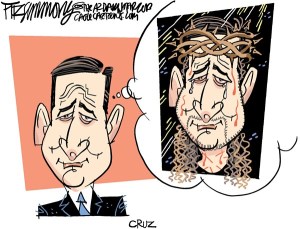
Let’s hope even Cruz isn’t that delusional and foolhardy. Booman also points out that the Senate can change the rules and limit post-cloture debate for this one vote. That takes 67 votes.
At The Daily Beast, Lloyd Green calls what Cruz and other Tea Party Republicans are doing “backdoor impeachment.”
The dance over the debt ceiling and the fight over the government shutdown are nothing less than impeachment on the cheap: a chance to negate the will of the majority by ostensibly placating the letter of the law. Unable to win the last two presidential elections or to persuade a Supreme Court majority that the Affordable Care Act was unconstitutional, House Republicans have arrived at a point where default and closure are the next best things. This combustible brew of race, class, and economic anxieties bubbles all too closely to the surface.
These days, the GOP comes across as hating Obamacare more than loving their countrymen, and the nation is returning that ire (PDF). Less than a quarter of Americans view the Republicans favorably, and a majority dislikes them, three-in-10 intensely. The GOP’s goal of recapturing the Senate in 2014 is now looking more like a dream than a reality, as Republicans are “forced to explain why they are not to blame and why Americans should trust them to govern both houses of Congress when the one they do run is in such disarray.” Indeed.
Unfortunately, the calamity of a potential default has tempered neither judgment nor passion. On Saturday, Ted Cruz—the man who lit the match, won the Values Voters Straw Poll with 42 percent of the vote. Channeling her inner Glenn Beck, Rep. Michele Bachmann (R-Minn.) concluded that the President “committed impeachable offenses.” Bachmann also proclaimed that civil disobedience was a potential response to Obama’s “thuggery,” and compared the Obama presidency to Egypt’s deposed Muslim Brotherhood.
I hope you’ll read the rest at the link.
Ted Cruz is stealing the right wing nut show for now, but in the House Paul Ryan raised his ugly head over the weekend to complain about the ACA’s individual mandate and requirement that women have access to birth control. From HuffPo:
Sources told the Post that, in a private meeting with House Republicans, Ryan said that by kicking the can down the road, the GOP would lose “leverage” in their fight against Obamacare.
Ryan’s main concern appears to be delaying the health care law’s individual mandate, but ThinkProgress points out that Ryan also emphasized the need to give employers the ability to deny birth control coverage based on moral or religious reasons.
Meanwhile most people around the country and even on Wall Street don’t seem all that concerned about what’s happening in Washington DC. I guess that after multiple emergencies in which political leaders “cried wolf,” everyone just assumes that Congress will find some way to keep the country going. Still, is this any way to run a country? Shouldn’t citizens be up in arms? Will Durst has a wacky column about this at Cagle Post called “Fukushima Sushi.”
Which is harder to believe? The ludicrous shenanigans going down in Washington or the fact that nobody seems particularly interested in doing anything about them? Good neighbors — it looks like we got ourselves one heck of a bumper crop of official dysfunction this year. Near as high as Manute Bol’s eye.
You’d think with national parks closed, veteran’s benefits being withheld and a possible catastrophic debt ceiling crisis looming, folks would be atwitter like chicken inspectors on a rotisserie spit during a power surge. And you’d be as wrong as a Bergman film on Comedy Central.
What the country seems to be seeking here is a little something called political responsibility. Which, in these dark days, is a wee bit of a tad of a total and complete oxymoron. Real similar to saying Fukushima sushi. Or elegant squalor. Comfortable rock.
Driving the point home: Weird normality. Spherical edge. Iron kite. Freedom shackle. Fresh detritus. Flammable sleet. Placid hammer. Colossal shrimp. Diminutive giant. Formal jeans. Sensitive linebacker. Salable autonomy. Veteran rookie. Vegetarian butcher. Pork tartare. Reality TV.
Keeping it real: Precarious certainty. Serene devastation. Bitter honey. Catholic condom. Heaven’s basement. Gelatinous needle. Sadistic lover. Banker’s compassion. Macabre solace. Chaste indiscretion. Temporary tax. Restorative annihilation. Healthy fries. Unhungry shark.
Lots more oxymoron’s at the link. How he came up with so many, I’ll never know.
Now what stories are you focusing on today? Please share your links on any topic in the comments.
Thursday Reads: Psychological Approaches to the Current Political Situation
Posted: October 10, 2013 Filed under: morning reads, U.S. Economy, U.S. Politics | Tags: behavioral economics, City Lights Bookstore, Harvard Bookstore, psychological studies, psychology, sociology 102 Comments
Harvard Bookstore, Cambridge, MA
Good Morning!
Today I’m going to focus on some psychological studies and psychological ideas that relate to the news of the day.
A recent study by two social psychologists at The New School in NYC, found that reading literary fiction improves Theory of Mind, or the “ability to infer and understand other people’s thoughts and emotions” as well as the “capacity for empathy.”
From Scientific American:
Emanuele Castano, a social psychologist, along with PhD candidate David Kidd conducted five studies in which they divided a varying number of participants (ranging from 86 to 356) and gave them different reading assignments: excerpts from genre (or popular) fiction, literary fiction, nonfiction or nothing. After they finished the excerpts the participants took a test that measured their ability to infer and understand other people’s thoughts and emotions. The researchers found, to their surprise, a significant difference between the literary- and genre-fiction readers.
When study participants read non-fiction or nothing, their results were unimpressive. When they read excerpts of genre fiction, such as Danielle Steel’s The Sins of the Mother, their test results were dually insignificant. However, when they read literary fiction, such as The Round House by Louise Erdrich, their test results improved markedly—and, by implication, so did their capacity for empathy. The study was published October 4 in Science….
The results suggest that reading fiction is a valuable socializing influence. The study data couldinform debates over how much fiction should be included in educational curricula and whether reading programs should be implemented in prisons, where reading literary fiction might improve inmates’ social functioning and empathy. Castano also hopes the finding will encourage autistic people to engage in more literary fiction, in the hope it could improve their ability to empathize without the side effects of medication.
There’s a little more detail on the study at the Guardian books blog:
“What great writers do is to turn you into the writer. In literary fiction, the incompleteness of the characters turns your mind to trying to understand the minds of others,” said Kidd.
Kidd and Castano, who have published their paper in Science, make a similar distinction between “writerly” writing and “readerly” writing to that made by Roland Barthes in his book on literary theory, The Pleasure of the Text. Mindful of the difficulties of determining what is literary fiction and what is not, certain of the literary extracts were chosen from the PEN/O Henry prize 2012 winners’ anthology and the US National book awards finalists.
“Some writing is what you call ‘writerly’, you fill in the gaps and participate, and some is ‘readerly’, and you’re entertained. We tend to see ‘readerly’ more in genre fiction like adventure, romance and thrillers, where the author dictates your experience as a reader. Literary [writerly] fiction lets you go into a new environment and you have to find your own way,” Kidd said.
As the authors admit, one problem with this study is determining what is “literary fiction” and what is “genre fiction.” In some cases, there is quite a bit of crossover in the selections they used. For example, they classify Louise Erdrich’s The Round House as “literary,” and Gillian Flynn’s Gone Girl, as “genre” fiction. But The Round House has characteristics of a “thriller,” in that its subject is crime; and Flynn is a fine writer, and Gone Girl is in many ways a “writerly” work with a heavy focus on characters’ thinking processes and internal dialogues.
The Guardian quotes a psychologist who objects to Kidd and Castano’s use of Theory of Mind tests to measure the effects of reading different types of fiction.
Philip Davies, a professor of psychological sciences at Liverpool University, whose work with the Reader Organisation connects prisoners with literature, said they were “a bit odd”.
“Testing people’s ability to read faces is a bit odd. The thing about novels is that they give you a view of an inner world that’s not on show. Often what you learn from novels is to be a bit baffled … a novel tells you not to judge,” Davies said.
“In Great Expectations, Pip is embarrassed by Joe, because he’s crude and Pip is on the way up. Reading it, you ask yourself, what is it like to be Pip and what’s it like to be Joe? Would I behave better than Pip in his situation? It’s the spaces which emerge between the two characters where empathy occurs.”
Nevertheless, it’s an interesting study. Now if we could only get the Tea Party folks and super-rich Wall Street types to read more literary fiction!

Harvard Bookstore, Harvard Square
The results of another social psychological study, this one at Duke University, showed that people with “extreme” political views have a sense of superiority over people with different views. From Psych Central:
Duke University investigators examined whether one end of the American political spectrum believes more strongly than the other in the superiority of its principles and positions.
They found both sides have elements of “belief superiority,” depending on the issue.
When asked about nine hot-button issues, conservatives feel most superior about their views on voter identification laws, taxes and affirmative action. Liberals feel most superior about their views on government aid for the needy, torture and not basing laws on religion.
The study is found in the online edition of Psychological Science.
Investigators questioned 527 adults, (289 men, 238 women), ages 18-67, about the issues. They then examined whether those who endorse the extremes of conservative and liberal viewpoints demonstrate greater belief superiority than those who hold moderate views.
The study asked participants to not only report their attitudes on the nine topics, but also how superior they feel about their viewpoint for each issue.
According to Diana Reese at the Washington Post,
The study was inspired by the 2012 presidential election campaign. “We were looking at things like comments on blogs and pundits and politicians on TV,” Dr. Kaitlin Toner said in a phone interview. “It seemed like there were a lot of people who felt very certain that their views were correct but they contradicted one another and there’s no way that everyone could be 100 percent correct all the time.” Toner, the lead author on the study, did the research while a graduate student at Duke….
Don’t confuse belief superiority with dogmatism, though. The latter is “a personality trait,” Toner explained. “It’s a measure of inflexibility….You’re holding a belief rigidly and won’t change.”
In other words, you can hold “superior” beliefs that you’re right and the rest of the world is wrong about a particular issue, but still be able to change your mind, unless you’re dogmatic about your viewpoint.
Previous research has shown that conservatives tend to be more dogmatic, and Toner said their study found the same results, with dogmatism increasing as views moved to the right of the political spectrum.
Another social psychologist from Duke University has a post at HuffPo called The Psychology of Being Online, in which he discusses several studies of the ways in which people react to being in virtual world. You can check them out at the link.

City Lights Bookstore, San Francisco, CA
Here’s a fascinating article by Justin Fox at the Harvard Business Review. It’s based on behavioral economics–a sort of combination of economic and psychological theories. Fox attempts to explain our current political/economic impasse using game theory. You should read the whole thing, but here an excerpt:
Some portray it as a Manichean struggle between good and evil. Warren Buffett says it’s “extreme idiocy.” I’d like to recommend another way of looking at the government shutdown and the looming battle over the debt ceiling in Washington. It’s a game, played by flawed-but-not-crazy human beings under confusing circumstances. In other words, it’s an interaction among “agents” who “base their decisions on limited information about actions of other agents in the recent past, and they do not always optimize.”
That quote is from economist H. Peyton Young’s “The Evolution of Conventions,” one of several works of game theory I plowed my way through this week in an attempt to find a way to think about the government shutdown and looming debt ceiling fight that didn’t make me want to bang my head against a wall. My reading made the dynamics at work in Congress and at the White House a bit clearer — and thus slightly less maddening, if not less ominous.
The debt-limit game
There are lots of different games being played in Washington at the moment, but the main one I have in mind pits the Democratic White House and Senate against the Republican House of Representatives over the federal budget. The deadlocked players have already landed us in a partial government shutdown, but it’s the 18th since 1976 and thus really not that big a deal. The far bigger stakes involve the federal borrowing limit that is due to be breached in a couple of weeks if Congress doesn’t approve an increase. Without further borrowing, much higher taxes, or draconian spending cuts — none of which may be possible or even legal on short notice — the government might not be able to service its existing debts, leading to a default. Congress has never allowed this to happen, so the consequences are unknowable, but they could be really bad.
Now go read the rest if you’re interested, and see what you think.
Here’s another interesting article that combines economic and psychological approaches by Douglas T. Kenrick of Psychology Today: Cruzonomics: The Problem of Free Market Psychology,
Senator Ted Cruz is a fan of the classic model of economic decision-making: sometimes called the Rational Man* view. On this view, every one of your decisions is designed to maximize “utility” – which translates loosely into personal satisfaction. If it feels good now, or will make you feel good later, choose it! Advocates of this position believe that we are, in general, pretty facile at processing information, and at coming to shrewd self-serving decisions. If you read the book Freakonomics, the authors explain how even seemingly senseless decisions, like changing one’s occupation from computer technician to prostitute, or living at home if you are a drug dealer, are well explained by economic incentive structures. We are all, on this view, continuously operating like the high-roller in the movie Wall Street, who, while considering a shady deal, asks: “What’s in it for moi?”
Ask NOT what you can do for your country…
On this view, selfishness is not a bad thing. On the contrary, it is a virtue. The intellectual patron saint of free-market economics is Adam Smith, who argued that an “invisible hand” moves us toward mutually beneficial arrangements when everyone pursues his self-interest. For example, if consumers freely compare different fruit vendors at the market place, they will choose the one who charges the lowest price, but the price will not fall below the farmer’s costs of production, or he will go out of business.
But there are a few problems with the Rational Man view. One is that people often fail to act in ways that economists regard as perfectly rational. For example, there is a laboratory game called the Ultimatum Game. Imagine that an experimenter hands you $100 and instructs you to divide it between yourself and a stranger in the next room. You can divide it any way you want, but there is one stipulation: If the bloke in the next room doesn’t like your offer, nobody gets anything. What should you offer?
And if you happen to be the bloke on the receiving end of such an ultimatum, how low an offer should you accept?
Again, I hope you’ll read the whole thing and share your views.

The science fiction section at City Lights Bookstore
Finally, check out this sociological/psychological essay at Salon, by Michael Lind: Tea Party radicalism is misunderstood: Meet the “Newest Right.” Again, I can’t really do the piece justice with an excerpt, but here’s a taste:
To judge from the commentary inspired by the shutdown, most progressives and centrists, and even many non-Tea Party conservatives, do not understand the radical force that has captured the Republican Party and paralyzed the federal government. Having grown up in what is rapidly becoming a Tea Party heartland–Texas–I think I do understand it. Allow me to clear away a few misconceptions about what really should be called, not the Tea Party Right, but the Newest Right.
The first misconception that is widespread in the commentariat is that the Newest Right can be thought of as being simply a group of “extremists” who happen to be further on the same political spectrum on which leftists, liberals, centrists and moderate conservatives find their places. But reducing politics to points on a single line is more confusing than enlightening. Most political movements result from the intersection of several axes—ideology, class, occupation, religion, ethnicity and region—of which abstract ideology is seldom the most important.
The second misconception is that the Newest Right or Tea Party Right is populist. The data, however, show that Tea Party activists and leaders on average are more affluent than the average American. The white working class often votes for the Newest Right, but then the white working class has voted for Republicans ever since Nixon. For all its Jacksonian populist rhetoric, the Newest Right is no more a rebellion of the white working class than was the original faux-populist Jacksonian movement, led by rich slaveowners like Andrew Jackson and agents of New York banks like Martin Van Buren.
The third misconception is that the Newest Right is irrational. The American center-left, whose white social base is among highly-educated, credentialed individuals like professors and professionals, repeatedly has committed political suicide by assuming that anyone who disagrees with its views is an ignorant “Neanderthal.” Progressive snobs to the contrary, the leaders of the Newest Right, including Harvard-educated Ted Cruz, like the leaders of any successful political movement, tend to be highly educated and well-off. The self-described members of the Tea Party tend to be more affluent and educated than the general public.
Read the rest at Salon.
I hope you’ll find something useful and/or enlightening among these psychological approaches to our current crazy political environment. Now what stories are you focusing on today. Please share your ideas and links in the comment thread.
Tuesday Reads: Hostage Situation
Posted: October 8, 2013 Filed under: 2012 elections, Affordable Care Act (ACA), Barack Obama, Democratic Politics, Federal Budget, Federal Government Shutdown, Global Financial Crisis, morning reads, Psychopaths in charge, Real Life Horror, Republican politics, U.S. Economy, U.S. Politics | Tags: 14th amendment option, John Boehner, Obamacare, Robert Costa, Tea Party Caucus, US House of Representatives 50 Comments
Good Morning!!
I hardly know where to begin this morning. The insanity that has gripped the nation’s capital is so extreme that some kind of intervention may be necessary.
Is it possible for the UN or the IMF to step in and explain to Tea Party Republicans why the full faith and credit of the United States government cannot be held hostage in an effort to overturn the results of two elections? Or perhaps they could explain to House Speaker John Boehner that his frantic efforts to hold onto his speakership could end with voters replacing him with a Democratic Speaker in 2014?
As depicted in the cartoon above, the Republican majority in the House is being held hostage by around 30-40 delusional Tea Party wingnuts and their putative leader–John Boehner has no clue how to deal with the hostage crisis. It’s a mystery to me why anyone would even want that job, but to Boehner the job is apparently more important than the nation’s–and the world’s–economic well-being. Holding onto his job is apparently so important to him that he is willing to look like a complete fool rather than stand up to a bunch of crazy people in his own party.
Meanwhile, the media pundits are getting a little more restless–realizing that we really could reach the debt limit on October 17 without the House voting on a “clean” continuing resolution or an increase in the government’s ability to borrow to pay its bills.
Normally, I wouldn’t link to the National Review, but yesterday they published a piece by Washington editor Robert Costa, who probably has a pretty good idea what insane caucus in the House is up to. Costa writes:
Speaker John Boehner may be trying to finalize a plan to raise the debt limit, but House conservatives are already skeptical of his efforts. In interviews, several of them tell me they’re unlikely to support any deal that may emerge.
Costa goes on to quote a few of the wackiest of the wackos (emphasis added):
“They may try to throw the kitchen sink at the debt limit, but I don’t think our conference will be amenable for settling for a collection of things after we’ve fought so hard,” says Representative Scott Garrett (R., N.J.). “If it doesn’t have a full delay or defund of Obamacare, I know I and many others will not be able to support whatever the leadership proposes. If it’s just a repeal of the medical-device tax, or chained CPI, that won’t be enough.”
Representative Paul Broun (R., Ga.) agrees, and says Boehner risks an internal rebellion if he decides to broker a compromise. “America is going to be destroyed by Obamacare, so whatever deal is put together must at least reschedule the implementation of Obamacare,” he says. “This law is going to destroy America and everything in America, and we need to stop it.”
“Stay the course, don’t give in on it, that’s what the people in my district are saying,” says Representative Ted Yoho (R., Fla.). “We did a town hall the other day, and 74 percent of people said, ‘don’t raise the debt ceiling.’”
This despite the fact that polls show their ideas are poison to the American public. These people are truly insane, and they believe they’re winning. Nothing will stop them except throwing them out of their jobs. Here are some other reactions to Costa’s piece.
David Atkins of Hallabaloo: Nothing less than Fort Sumter will do.
If you think this is insane–and it is–keep in mind that it’s only going to get worse from here.
Until Republicans are removed from control of all branches of government, the brinksmanship is going to get worse, and the demands are going to become more severe. The lunatics are running the asylum now, the revanchist movement is in full swing, and the Lost Cause is the name of the game.
Not even sequestration-level spending plus cutting Medicare and Social Security will do for these people–and that’s after losing an election. Try to picture where the Republican party was 30 years ago. Then 20 years ago. Then 10 years. Then today. Now picture 10 years from now. Anyone who thinks there’s going to be a retreat from the precipice is deluding themselves. If they lose in 2014, it will be because they didn’t hold firm against Obamacare. If they lose to Hillary in 2016, it will be because they didn’t shout loud enough about Benghazi.
If we don’t stop them somehow, the Tea Party crazies will try to refight the Civil War.
Josh Barro at Business Insider: Republicans Do Crazy Things Because They Have Crazy Beliefs. Barro responds to Georgia Rep Paul Broun’s claim that “America is going to be destroyed by Obamacare….This law is going to destroy America and everything in America, and we need to stop it.”
It’s one thing to oppose Obamacare. It’s quite another to believe it will “destroy America and everything in America.” As Manhattan Institute Senior Fellow Avik Roy, a strong opponent of Obamacare, wrote last month:
The idea that we had a free-market health-care system before Obamacare, and a socialized one after, is completely and utterly incorrect. In 2010, before the passage of Obamacare, U.S.-government entities spent more per capita on health care than all but three other countries in the world. Obamacare adds to that spending by around 10 to 15 percent. Not good, to be sure, but not the whole kit and caboodle either.
The changes from Obamacare, good and bad, are marginal. It will not fundamentally change America….
But if you already believe something crazy — that Obamacare will destroy America — then it’s not additionally crazy to favor drastic, dangerous action to stop it.
Sarah Jones at Politicus USA: From Hostage Takers to Buffoons, House Republican Ineptitude Heads for Default.
Even a short term debt ceiling agreement is up in the air now. Not the actual debt ceiling limit, but a short term agreement. We can’t even do that now, if Robert Costa’s readings are accurate.
Costa tweeted, “One of my best House R sources thinks Boehner may, just may, be able to get votes for short-term DL ext, but even that is up in air” [….]
If you’re wondering how Republicans can be so out of it when the polls keep instructing them otherwise (as if the ONLY issue here is their own political survival, forget the people or this country), perhaps this level of utter cluelessness will be informative. When asked if the Republicans have their next move mapped out and if Boehner has any legislation drawn up regarding the debt ceiling, “Negatory,” Representative Pete Sessions replies. You see, it’s all about “messaging”. “We’re going to keep with our great, positive attitude and tell the president, ‘you’ve got to sit down and negotiate.’”
So, their great positive attitude involves tanking the economy and shutting down the government because they lost an election. Huh. Also: Only in Republican world is holding a gun to the country’s head before being willing to “talk” an act of good faith.
Republicans don’t understand this president very well at all, but then, we tend to project our own values onto others so this is understandable. They never should have threatened the country. They could have threatened anything but the American people and the democratic process, and this President wouldn’t have felt compelled to take a stand.

It’s really getting to be a cliche to point out that reports of Republican behavior are for real and not from The Onion. But seriously, it’s hard to believe The Onion can keep finding ways to exaggerate these people’s insanity. Apparently there was “outrage” after this 2011 Onion story; but does it actually seem crazy two years later to claim that what the Republicans are trying to do is going to hurt–even kill–some children?
A few more comments on the hostage situation from various pundits:
Washington Post Editorial Board: The House GOP has nothing to show for its government shutdown.
WHAT HAVE House Republicans managed to accomplish in a week of government shutdown?
Damage the livelihood of millions of Americans? Check. Government secretaries, food-truck operators, cleaners who work in motels near national parks: They’re all hurting.
Waste billions of taxpayer dollars? Check. It costs a lot to shut agencies, Web sites and parks, and it will cost a lot to reopen them. Meanwhile, the House has voted to pay the salaries, eventually, of hundreds of thousands of employees whom it has ordered not to work. That’s an odd way to manage an enterprise.
Interfere with key government operations? Check. The National Transportation Safety Boardcan’t investigate an accident last weekend on Metro’s Red Line that claimed the life of a worker. That could make future accidents more likely. On the other side of the world, U.S. allies from Tokyo to Singapore are wondering whether they can rely on a nation whose president has to go AWOL from a key summit meeting in their region.
Rattle the markets, slow an economy in recovery, interrupt potentially lifesaving research at the National Institutes of Health? Check, check and check.
Derail the hated Obamacare? Ch . . . — oh, no, wait a minute.
Because it’s not really about “Obamacare.” It’s about making government itself completely dysfunctional. I keep thinking about Dakinikat’s post yesterday and the pieces she quoted by Jonathan Chait and The Economist. Have we really reached the point where the gridlock in DC is so bad that our form of government is in danger of collapse? And what can we do about it? In order to change our system of divided government, we would need to call a Constitutional Convention. Even if we could get to that point in this atmosphere, the final result could be a lot worse than what we have now. I really believe the only way to save our form of government is to somehow throw all the Tea Party Republicans out of it. Is that possible?
Alex Altman at Time: Boehner Holds Weaker Cards In High-Stakes Political Poker
President Barack Obama says he will not pay House Republicans a ransom in exchange for re-opening the government or raising the debt ceiling. House Speaker John Boehner insists he doesn’t have the votes to do either without any White House concessions.
Both men are bluffing. And while Obama’s play is a risky one, Boehner’s bluff is worse: it just doesn’t look very credible.
In a Sunday interview with ABC News, Boehner said the U.S. faced the specter of its first ever federal default if Obama didn’t cave to GOP demands. “There are not the votes in the House,” Boehner declared, to pass a so-called “clean” bill to reopen the government. “The votes are not in the House to pass a clean debt limit,” he added. “And the president is risking default by not having a conversation with us.”
These kinds of threats have worked for Boehner before,
But this is now a less credible threat. A few days before Boehner went on TV to talk tough about the threat of default, he was reportedly confiding to fellow Republicans that he would never allow it. Failure to hike the debt limit would unleash a chain of economic calamities, if not the first ever federal default. Boehner doesn’t want that to be his political epitaph.
To be sure, there are plenty of House Republicans who are willing, if not eager, to hold the line. But if the votes aren’t there for clean bills, that’s only because Boehner hasn’t allowed them to come forward. As Speaker, he and his leadership team control the floor. A clean bill to reopen the government, and a companion measure to lift the debt limit, would draw unanimous or near-unanimous support from the chamber’s 200 Democrats; all but five are on record supporting such a vote. Nearly two-dozen Republicans are also publicly on board. Some say the number is far higher. If Boehner let a clean funding bill hit the House floor, “it would probably get 300 votes,” New York Representative Peter King, a Republican who has been critical of the party’s shutdown strategy, told TIME last week.
Jamelle Bouie at The Daily Beast: Five Boehner Quotes—From One Interview—That Explain Everything.
To watch John Boehner speak Sunday—in a segment with ABC’s George Stephanopoulos—was to watch him issue talking points from another dimension, where legislative hostage-taking is routine and the American public is eager to threaten the full faith and credit of the United States. The interview was rife with dishonesty, but there were five statements—in particular—that stood out for their recklessness and/or brazen disregard for the truth.
I won’t excerpt any more from this one. You need to go read the whole thing–it’s not long.
In my opinion, it’s an open question whether the insanity of the Tea Party can be beaten. Certainly, our democratic Republic cannot survive much more of this. The best solution would be for the Democrats to really hold their ground this time and for President Obama to invoke the 14th Amendment and abolish the debt ceiling unilaterally. But do the Democrats and Obama have the guts to do it? We’ll just have to wait and see.

 peej
peej Carissa
 bostonboomer
 dakinikat
 ecocatwoman
 mablue2
 Mama Lopez
 peggysue22
 quixote
 skydancingguestblogger
 Mona (aka Wonk the Vote)



 Sky Dancing
Recent Comments