
Job Number Truthers
Posted: October 5, 2012 Filed under: Economy, jobs, unemployment | Tags: job numbers truthers, Romney screws up labor participation rates, unemployment numbers 67 CommentsI guess today is Tinfoil Friday. Allen West and Jack Welch think the BLS is manipulating unemployment number in response to some Chicago Mafia move to make Obama and the economy look better. Huhn? I would think if that was possible they would’ve been doing it all along instead of just suddenly producing a better but still anemic result at the last moment.
The Bureau of Labor Statistics released an unexpectedly strong monthly jobs report on Friday, finding a dramatic drop in unemployment to 7.8 percent and revised the number of jobs added in July and August up from initial estimates. While for most Americans, the growing economy is good news, conservatives immediately expressed their skepticism in the jobs report’s credibility.
1) Minutes after the report was released, Jack Welch, who famously cooked General Electric’s accounting books when he was CEO, accused President Obama of manipulating the numbers to distract from his debate performance.
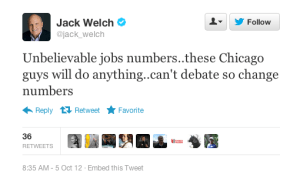
This is pretty weird. The jobs report was straightforward this month.
The controversy, if it’s worth using that word, is over the unemployment rate, which dropped from 8.1 percent to 7.8 percent. That’s three-tenths of one percent. That’s what all the fuss is about.
Let’s get one thing out of the way: The data was not, as Jack Welch suggested in a now-infamous tweet, manipulated. The Bureau of Labor Statistics is set up to ensure the White House has no ability to influence it. As labor economist Betsey Stevenson wrote, “anyone who thinks that political folks can manipulate the unemployment data are completely ignorant of how the BLS works and how the data are compiled.” Plus, if the White House somehow was manipulating the data, don’t you think they would have made the payroll number look a bit better than 114,000? No one would have batted an eye at 160,000.
The fact is that there’s not much that needs to be explained here. We’ve seen drops like this — and even drops bigger than this — before. Between July and August the unemployment rate dropped from 8.3 percent to 8.1 percent — two-tenths of one percent. November-December of 2011 also saw a .2 percent drop. November-December of 2010 saw a .4 percent drop. This isn’t some incredible aberration. The fact that the unemployment rate broke under the psychologically important 8 percent line is making this number feel bigger to people than it really is.
What’s even odder is that Romney said the report wasn’t “realistic” and actually misstated the reasons for the change in numbers.
Mitt Romney challenged the significance of the drop in the unemployment rate today, arguing that the “real reality” is that the figure declined because “more and more people have just stopped looking for work.”
“There was a report that just came out this morning on job creation this last month,” said Romney at a rally in the battleground state of Virginia. “There were fewer new jobs created this month than last month. And the unemployment rate as you noted this year has come down very, very slowly, but it’s come down nonetheless.”
“The reason it’s come down this year is primarily due to the fact that more and more people have just stopped looking for work,” Romney said. “And if you just dropped out of the work force, if you just give up and say look I can’t go back to work I’m just going to stay home, if you just drop out all together why you’re not longer part of the employment statistics.”
“So it looks like unemployment is getting better, but the truth is, if the same share of people were participating in the workforce today as on the day the president got elected, our unemployment rate would be around 11 percent,” said Romney. “That’s the real reality of what’s happening out there.”
This morning’s jobs report released by the Bureau of Labor Statistics found that the nation’s unemployment rate dropped from 8.1 percent to 7.8 percent, the first time it’s been below 8 percent in four years. September saw the addition of 114,000 jobs, according to the report, a decrease from the 142,000 that were added in August, and statistic that Romney emphasized on the trail today.
Yes, random variation is quite suspicious and unrealistic. Here’s the labor force numbers straight from the report. Romney told an audience the exact opposite had happened. There is no way he actually read the report. Well, that or he was lying again.
The civilian labor force rose by 418,000 to 155.1 million in September, while the labor force participation rate was little changed at 63.6 percent. (See table A-1
The best article I’ve seen today explaining the job situation and the Welch Tin Foil hat theory is here at The Atlantic.
A number of conservatives have suggested the 873,000 household figure is wildly implausible, if not an outright conspiracy to help Obama on the part of the BLS. This is nonsense. As Greg Ip of The Economist points out, the employer and household numbers often diverge over the short-term, but they mostly match up over the long-term. And they still do if we look at the past three months. The employer survey showed job gains of 181,000 in July, 141,000 in August and 114,00 in September, for an average gain of 146,000. The household survey showed job losses of 195,000 in July, 119,000 in August, and job gains of 873,000 in September, for an average gain of 186,000. If you can’t see the conspiracy there, well, you just might be mathematically literate.
Wow. Is this the silly season or what?
Thursday Reads
Posted: August 2, 2012 Filed under: morning reads, U.S. Economy, U.S. Politics, unemployment | Tags: Barack Obama, Ben Bernanke, Brookings Institution, Bush tax cuts, Federal Reserve, foreign policy, George Zimmerman, Haaretz, israel, Jared Diamond, Judge Kenneth Lester, Lori Montgomery, Mitt Romney, Romney's tax plan, Syria, Tax Policy Center, Urban Institute 20 Comments
Good Morning!!
Last night, Reuters reported that President Obama has authorized “secret support for Syrian rebels.”
President Barack Obama has signed a secret order authorizing U.S. support for rebels seeking to depose Syrian President Bashar al-Assad and his government, sources familiar with the matter said.
Obama’s order, approved earlier this year and known as an intelligence “finding,” broadly permits the CIA and other U.S. agencies to provide support that could help the rebels oust Assad.
This and other developments signal a shift toward growing, albeit still circumscribed, support for Assad’s armed opponents – a shift that intensified following last month’s failure of the U.N. Security Council to agree on tougher sanctions against the Damascus government.
The White House is for now apparently stopping short of giving the rebels lethal weapons, even as some U.S. allies do just that.
There’s much more at the link.
Yesterday, the House responded to the Senate’s passage of a bill to extend the Bush tax cuts for incomes of $250,000 or less by passing their own bill to extend all of the cuts, including those for the super-rich.
The Republican-led House of Representatives voted Wednesday to extend expiring George W. Bush-era tax cuts at all income levels for another year, a pre-election statement of the GOP’s unyielding opposition to raising taxes for any taxpayer.
Th 256 to 171 vote to preserve tax cuts first enacted during the Bush administration and renewed in 2010 since then fell largely along party lines, though 19 Democrats voted with Republicans to extend the tax cuts. One Republican was opposed.
It came after the House rejected a Democratic alternative, also largely on a partisan 170 to 257 vote, that would have preserve tax cuts for income up to $250,000 but allowed them to expire for the wealthy.
You probably heard that Fed Chair Ben Bernanke once again has refused to do anything new to stimulate employment.
According to its statement, the Fed won’t take any additional steps at the moment to boost the economy. No quantitative easing. No bold nwe statements. No trying to reduce mortgage rates further. The central bank’s forecast of “exceptionally low” interest rates through 2014 remains unchanged from its last report in June….
On the other hand, the committee’s statement does note that Fed officials are still poring over recent (and troubling) economic data. Growth has “decelerated” of late, with the U.S. economy expanding at a mere 1.5 percent pace in the second quarter of 2012. And the unemployment rate remains stuck at 8.2 percent. Meanwhile, inflation is expected to remain “at or below” the Fed’s target over the medium term. So is that enough to warrant more stimulus? The FOMC statement says, basically, ask us when we meet again in September:
The Committee will closely monitor incoming information on economic and financial developments and will provide additional accommodation as needed to promote a stronger economic recovery and sustained improvement in labor market conditions in a context of price stability.
There’s an interesting article at Bloomberg Businessweek about Bernanke and the Fed: Bernanke, the Reluctant Revolutionary. The article makes a point that Dakinikat has often expressed:
Because of its demonstrated competence in crisis management, Bernanke’s Fed is being pulled into solving problems that the White House and Congress should be dealing with but aren’t. Housing? Under Bernanke the Fed has bought mortgage-backed securities to make loans cheaper and boost home sales. The fiscal cliff of spending cuts and tax hikes that threatens the economy at the start of 2013? The Fed’s loose money policies, by stimulating growth, are compensating at least partially for the chilling effect on hiring and investment that fears of the cliff are already causing.
It’s a lot, and Bernanke argues that too much is being put on the Fed’s shoulders. “Monetary policy is not a panacea,” he told the Joint Economic Committee of Congress on June 7. “It would be much better to have a broad-based policy effort addressing a whole variety of issues. I leave the details to Congress, which has considered many of these issues. I’d feel much more comfortable if Congress would take some of this burden from us and address those issues.”
It’s a lengthy piece, so if you’re interested do read the whole thing.
Early yesterday, the judge in the George Zimmerman case, Kenneth Lester, denied the defense motion that he “disqualify” himself “because of alleged bias.”
In the motion asking George Zimmerman’s judge to step down, Florida’s rules required Judge Lester to “determine only the legal sufficiency of the motion.” Zimmerman’s motion failed that test, Judge Lester wrote in his ruling.
But the judge did not further explain why he found the motion insufficient. That’s likely because Florida’s rules explicitly state: “No other reason for denial shall be stated, and an order of denial shall not take issue with the motion.”
Zimmerman’s motion had accused Judge Lester of making opinionated remarks about evidence and “advocat[ing] for Mr. Zimmerman to be prosecuted for additional crimes” in his July 5 order setting bail.
Poor George.
There’s quite a bit of news about Mitt Romney, but for some reason I’m resistant to writing about him at the moment. Amazing, huh? So I’m just going to quickly list some articles that you may want to take a look at.
You probably heard about the Brookings report that gives the kiss of death to Romney’s tax plan. The Washington Post’s Lori Montgomery (who leans right) covered it yesterday, and even she couldn’t sugarcoat it. Study: Romney tax plan would result in cuts for rich, higher burden for others
The study was conducted by researchers at the nonpartisan Tax Policy Center, a joint project of the Brookings Institution and the Urban Institute, who seem to bend over backward to be fair to the Republican presidential candidate. To cover the cost of his plan — which would reduce tax rates by 20 percent, repeal the estate tax and eliminate taxes on investment income for middle-class taxpayers — the researchers assume that Romney would go after breaks for the richest taxpayers first.
They even look at what would happen if Republicans’ dreams for tax reform came true and the proposal generated significant revenue through economic growth.
None of it helped Romney. His rate-cutting plan for individuals would reduce tax collections by about $360 billion in 2015, the study says. To avoid increasing deficits — as Romney has pledged — the plan would have to generate an equivalent amount of revenue by slashing tax breaks for mortgage interest, employer-provided health care, education, medical expenses, state and local taxes, and child care — all breaks that benefit the middle class.
“It is not mathematically possible to design a revenue-neutral plan that preserves current incentives for savings and investment and that does not result in a net tax cut for high-income taxpayers and a net tax increase for lower- and/or middle-income taxpayers,” the study concludes.
That should be the end of it, but of course many Americans don’t care about facts. Naturally, the Romney campaign says the study is “biased.”
There’s a very harsh assessment of Team Romney at Foreign Policy. Too Much Baggage: Mitt Romney needs to fire his foreign-policy team. Yesterday. I’m not going to excerpt from the piece, because it’s important to read the whole thing. I highly recommend it!
Michael Kinsley has a very good piece on Romney’s endless complaints about the supposed lack of respect President Obama (and by extension other liberals) for his supposed “success.”
Jared Diamond, the author of one of the books Romney referenced in his speech in Israel, says he was misquoted: Romney Hasn’t Done His Homework.
MITT ROMNEY’S latest controversial remark, about the role of culture in explaining why some countries are rich and powerful while others are poor and weak, has attracted much comment. I was especially interested in his remark because he misrepresented my views and, in contrasting them with another scholar’s arguments, oversimplified the issue.
It is not true that my book “Guns, Germs and Steel,” as Mr. Romney described it in a speech in Jerusalem, “basically says the physical characteristics of the land account for the differences in the success of the people that live there. There is iron ore on the land and so forth.”
That is so different from what my book actually says that I have to doubt whether Mr. Romney read it. My focus was mostly on biological features, like plant and animal species, and among physical characteristics, the ones I mentioned were continents’ sizes and shapes and relative isolation. I said nothing about iron ore, which is so widespread that its distribution has had little effect on the different successes of different peoples. (As I learned this week, Mr. Romney also mischaracterized my book in his memoir, “No Apology: Believe in America.”)
And here’s the closing paragraph:
Mitt Romney may become our next president. Will he continue to espouse one-factor explanations for multicausal problems, and fail to understand history and the modern world? If so, he will preside over a declining nation squandering its advantages of location and history.
Please go read it. There’s much much more excoriation of Willard’s lies. Bwaaaaaahahahahahahaha!
Michael Kinsley has a great piece on Romney’s endless complaints about Americans who supposedly don’t respect his supposed “success.”
Romney’s ‘success’ problem: Is getting ahead in the U.S. simply a matter of brainpower and hard work, as the GOP candidate says? And if so, is everyone else stupid and lazy? Here’s just a bit of it:
Romney worries that Americans are losing their appreciation of success, as evidenced by President Obama’s desire to reduce the rewards of success by raising taxes on high incomes. He sees in this not just a bigger tax bill for successful people but an insult as well. An alternative perspective is that any successful person who feels personally insulted by a request from the president to share a bit of it is, in the immortal words of Liberace, crying “all the way to the bank” (or, to quote someone else, “a master of the fancied slight”).
You might also ask yourself: If Obama is insulting successful people by suggesting that their success doesn’t necessarily result entirely from their own hard work and brainpower, doesn’t that mean that Romney is insulting the vast majority of folks who are unsuccessful (by Romney’s exalted standard) by implying that they are lazy and stupid? If your success is entirely your own achievement, then your lack of success is entirely your own fault.
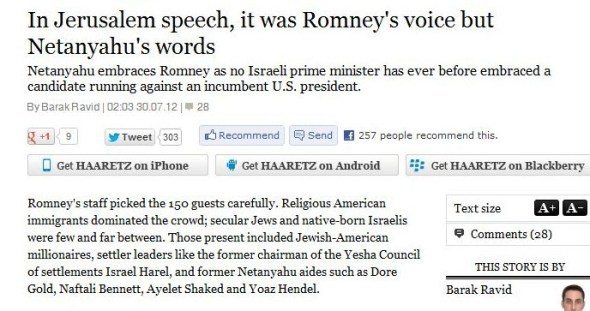
Finally, Haaretz is basically saying that Romney is Netanyahu’s puppet. Most of the article is for subscribers only, but here’s a screenshot of the page.
Now what are you reading and blogging about today?
Entitled One-Percenter Bill Keller Wants Baby Boomers to Give Up Social Security and Medicare
Posted: July 30, 2012 Filed under: Catfood Commission, Medicare, Mitt Romney, Social Security, The Media SUCKS, U.S. Economy, U.S. Politics, unemployment, voodoo economics, We are so F'd | Tags: Bill Keller, Charles P. Pierce, Dean Baker, Income Inequality, infrastructure, Iraq War, Judith Miller, one-percenters, Paul Ryan, Simpson-Bowles 32 Comments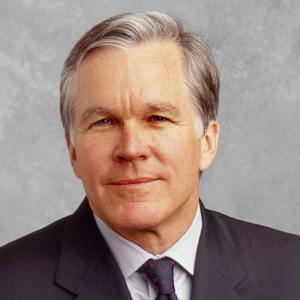
Smarmy former NYT editor Bill Keller
From today’s New York Times: “The Entitled Generation.”
The notion that our generation has been spoiled rotten is not a terribly new thought. A dozen years ago Paul Begala (of Bill Clinton and CNN fame) published in Esquire the classic of boomer-loathing, “The Worst Generation.” “The Baby Boomers are the most self-centered, self-seeking, self-interested, self-absorbed, self-indulgent, self-aggrandizing generation in American history,” he declared. It’s a sturdy genre. Perhaps while Googling yourself you have come across the blog Boomer Deathwatch (“Because one day, they’ll all be dead”), a checklist of famous boomers who hit their actuarial sell-by dates. Even Barack Obama, who styles himself post-boomer though he was born in 1961, complained in “The Audacity of Hope” that today’s hyperpolarized political discourse began with the “psychodrama of the baby boom generation.”
Yeah, we’re all evil just because our parents returned from WWII and proceeded to have lots and lots of babies. Supposedly not one of us ever did a decent thing in our pathetic, useless lives, right? I’m sick to death of hear this crap–and I’ve been hearing it since I was a kid.
See Keller says it’s our fault that the government isn’t rebuilding the infrastructure. He says it won’t do any good to tax super-rich guys like him–we’re going to have to take it out of the hides of old ladies who are trying to eke out a living on $1200 a month or less.
Guys like Bill Keller don’t even have to pay into Social Security on the bulk of their income, but he doesn’t even mention the possibility of changing that. So what does super-rich one-percenter Bill Keller think we should do about it besides learning to loathe ourselves and wish we’d never been born?
So the question is not whether entitlements have to be brought under control, but how. The Republican plan espoused by Mitt Romney and his fiscal lodestar Paul Ryan would cut the cost of entitlements largely by moving toward privatization: personal investment accounts for Social Security, vouchers for Medicare. And it’s not at all clear the Republicans would assign any of the savings to investing in our future.
At least the Republicans have a plan. The Democrats generally recoil from the subject of entitlements. Centrists like those at Third Way and the bipartisan authors of the Simpson-Bowles report endorse a menu of incremental cuts and reforms that would bring down costs without hitting the needy or snatching away the security blanket from those nearing retirement. They include gradually raising the retirement age to compensate for the fact that we now live, on average, 14 years longer than when F.D.R. signed Social Security into law. They include obliging those of us who can really afford it to pay a larger share. They also include technical fixes like aligning the automatic cost-of-living formula with reality.
At least now we know which candidate Keller will be voting for in November. So much for the supposedly “liberal media.” Oh, and about that “technical fix” Keller brushes off so dismissively, Matthew Yglesias explains why it isn’t a “technical fix” and “doing the switch comprehensively would constitute a de facto tax increase.” Furthermore, there was no “Simpson-Bowles report,” because the two co-chairs were unable to get a majority of members of the Catfood Commission to sign off on one.

Judith Miller with patron Bill Keller
I have a terrific idea. Let’s hold Bill Keller responsible for his choice to assign Judith Miller to help the Bush administration lie us into the Iraq War. Let Bill Keller pay back the trillions of dollars of taxpayer money those lies cost us. That ought to provide some funds to invest in infrastructure here in the U.S.
Here’s what Dean Baker had to say about Keller’s lying op-ed:
That is really brave for Mr. Keller to stand up and call for sacrifice from his age cohort. Does Keller know that the typical near retiree has total wealth of $170,000. This includes everything in their 401(k), all their other financial assets and the equity in their homes. Another way to put this is that the typical near retiree (between the ages of 55-64) could take all their wealth and pay off their mortgage. After that they would be entirely dependent on their Social Security to cover all their living costs.
Does this situation describe Mr. Keller’s finances? My guess is that it doesn’t. If that is true, how does Keller claim to speak for people who are in a hugely different financial situation than him? Is he really that ignorant of the issues that the NYT gives him a column to write about or is he dishonest? Readers will have to debate that in the months and years ahead.
Baker says the real problem we have is the increase in income inequality over the past thirty years, but he’s not holding his breath for Keller to “appeal to his fellow one-percenters….He probably doesn’t have the courage or integrity to do that.”
I saved the best review of Keller’s op-ed for last. You guessed it, it’s by Charlie Pierce: “The Things Bill Keller Doesn’t Have to Worry About.”
I defy Bill Keller to last a week living only on those benefits available to the greedy boomers, especially after the Simpson-Bowles cargo cult — to say nothing of the zombie-eyed granny-starver Paul Ryan himself — are through with them. I defy him to make it for a day. The “we” sprinkled throughout this bag of pus is probably the most noxious thing about it. Look around, Bill. You and Mitt Romney have far more in common than do you and the overwhelming majority of your “fellow” boomers. One catastrophic illness, and many of our families die on the vine. This is not hyperbole. This is how it works in the world. And, to the surprise of absolutely nobody, Keller signs on with the clowns at Third Way, who assure us that the real problem is that the elderly moochers are the ones keeping us from building new bridges, or flying to the moons of Neptune. Jesus H. Christ on a Lipizzaner, we’ve had forty years of demonized government, and 40 years of quack economics, and tax-cuts until hell won’t have them, and the reason our infrastructure is falling apart is because some retired ironworker gets $1200 a month? How much of a courtier do you have to be before the taste of caviar makes you nauseous?
If we want to invest in infrastructure, which we desperately need to do, then we should just borrow money at the current historically low rates and fix the damn infrastructure…. People Got No Jobs. People Got No Money. Bill Keller never will have to worry about the last two, so I think he should shut up about the first.
Monday Reads
Posted: June 4, 2012 Filed under: 2012 presidential campaign, U.S. Economy, U.S. Politics, unemployment, voodoo economics, We are so F'd | Tags: Barack Obama, Bill Moyers, Debt Ceiling, Frank VanderSloot, Garrett Epps, John Boehner, Koch Brothers, Mitt Romney, Paul Krugman, recession, Ryan budget, Scott Walker, Tom Barrett, whiny billionaires, Wisconsin recall 74 Comments Good Morning!
I thought I’d start this morning reads off with Bill Moyers who is having a good laugh at the expense of billionaires that are donating lots of money to political campaigns. It seems they really don’t like having their names bandied about and their closets opened. Pity the Poor Billionaires!!!
Last month, an Obama website cited eight mega-donors to Mitt Romney’s campaign as possessing “less-than-reputable records.” Among them was Frank VanderSloot, a Romney national finance co-chairman who has raised millions for the campaign. He’s a rancher – with 110,448 acres, on which he no doubt roams playing “This Land is Your Land” on his little Stradivarius — and CEO of the billion-dollar company Melaleuca, which Rolling Stone describes as “a ‘multilevel marketing’ firm based in Idaho that sells off-brand cleaning products and nutritional supplements.”
VanderSloot and his wealthy pals went ballistic and cried intimidation. “You go back to the Dark Ages,” VanderSloot said, “when they put these people in the stocks or whatever they did, or publicly humiliated them as a deterrent to everybody else — watch this — watch what we do to the guy who did this.”
Conservatives described the Obama ranking of Romney contributors as an “enemies list,” conjuring images of Nixonian wiretaps and punitive tax audits. But despite protestations to the contrary, these deep-pocketed plutocrats aren’t shelling out the shekels for the love of flag, Mom and apple pie (or tarte tatin, as they call it in the swanky joints).
“Most of the megadonors backing [Romney’s] candidacy are elderly billionaires,” Tim Dickinson writes in Rolling Stone. “Their median age is 66, and their median wealth is $1 billion. Each is looking for a payoff that will benefit his business interests, and they will all profit from Romney’s pledge to eliminate inheritance taxes, extend the Bush tax cuts for the superwealthy — and then slash the top tax rate by another 20 percent.” As at least one of them has said, they view these cash infusions as an “investment,” plain and simple.
Money is rolling into Wisconsin in Tuesday’s recall election. The Hill reports that it’s the most expensive race in Wisconsin history. The Koch Brothers are knee deep in money trying to keep their union bustin’ boy in office. We’ll be live blogging this tomorrow night so stay tuned!
Out-of-state sources have funded both sides heavily in the contest CPI said. Barrett has received about 26 percent of his $4 million in donations from sources outside of Wisconsin, while Walker has received two-thirds of his $30.5 million haul from out-of-state. Both campaigns have been aided by strong spending by super-PACs and other outside groups.
Labor unions have spent heavily to defeat Walker. The report says that the nation’s three largest public unions, the National Education Association (NEA), American Federation of State, County and Municipal Employees (AFSCME), and the Service Employees International Union (SEIU), have directed at least $2 million to anti-Walker efforts.
Walker, for his part, has been aided by conservative businessmen including casino mogul Sheldon Adelson and billionaire David Koch. The Republican Governors Association received a $1 million contribution from Koch in February, according to CPI.
The economy is slowing down. Oil prices are dropping in response. The stock market has lost all its value. Will we see another recession shortly?
The statistics on Friday were daunting. Only 69,000 jobs were created last month, far lower than what’s needed just to keep up with population growth. The job tallies for March and April, shabby to begin with, were revised down, for an average monthly tally of 96,000 over the past three months, versus 252,000 in the prior three months.
The weakness was not only displayed in job growth. Average weekly wages declined in May, to $805, as a measly two-cents-an-hour raise was more than clawed back by a drop to 34.4 hours in the length of the typical workweek.
Similarly, the rise in the number of people looking for work is normally considered a sign of optimism, but, on closer inspection, it appears to be simply the reversal of a drop in job-seekers in April.
Granted, it is better for jobless workers to be actively looking for work than sitting on the sidelines. But without enough jobs to go around, the inevitable result is higher official unemployment. The jobless rate ticked up from 8.1 percent in April to 8.2 percent in May, or 12.7 million people. Of those, 42.8 percent, or 5.4 million people, have been out of work for more than six months, a profound measure of personal suffering and economic decline.
There’s no sign that Washington is prepared to shoulder this responsibility. President Obama’s last big push for job creation, the $450 billion package proposed last fall, would have created an estimated 1.3 million to 1.9 million jobs by providing aid to states for teachers and other vital public employees, investments in infrastructure and tax breaks for new hiring. It was filibustered by Senate Republicans and not brought up for a vote in the Republican-dominated House, with Republican lawmakers claiming that deficit reduction was more important. Since then, they have balked at even smaller administration proposals, like modest investments in clean-energy projects.
Blocking constructive action is bad enough, but it’s not the worst of it. Recently, the House speaker, John Boehner, has ratcheted up economic uncertainty by pledging to force another showdown this year over legislation to raise the debt ceiling. A debt-ceiling debacle would come on top of the expiration at the end of 2012 of the Bush-era tax cuts and the onset of some $1 trillion in automatic spending cuts. If allowed to take effect as planned, those measures would take a huge bite out of growth, further weakening the economy.
Paul Krugman slammed the “anti-bipartisanship” in the Paul Ryan budget and in Romney’s support of obstructionist policies aimed at tanking the economy yesterday on ABC. Krugman said that the budget Romney supports is a “fraud”.
This morning on “This Week,” New York Times columnist Paul Krugman called Rep. Paul Ryan’s proposed budget plan a “fraud” as Romney campaign senior advisor Eric Fehrnstrom confirmed his candidate’s support for the plan that would trim trillions in federal spending over the next decade.
“The Ryan plan — and I guess this is what counts as a personal attack — but it isn’t. It’s not an attack on the person; it’s an attack on the plan. The plan’s a fraud,” said Krugman. “And so to say that — just tell the truth that there is really no plan there, neither from Ryan, nor from Governor Romney, is just the truth. That’s not — if that’s — if that’s being harsh and partisan, gosh, then I guess the truth is anti-bipartisanship. ”
Krugman, who has been critical of the Ryan, R-Wis., plan in the past, was responding to the Fehrnstrom, who confirmed Romney’s support for the plan after ABC News’ George Will asked Fehrnstrom to clarify his candidate’s stance on the Ryan proposal.
“He’s for the Ryan plan. He believes it goes in the right direction. The governor has also put forward a plan to reduce spending by $500 billion by the year 2016,” said Fehrnstrom. “In fact, he’s put details on the table about how exactly he would achieve that. So to say he doesn’t have a plan to — a plan to restrain government spending is just untrue.”
Krugman defended the president’s budget plan when asked by Fehrnstrom if he preferred it over the Ryan plan.
“I mean, the president — at least it’s — you know, I don’t approve of everything, but there are no gigantic mystery numbers in his stuff. We do know what he’s talking about. His numbers are — you know, all economic forecasts are wrong, but his are not — are not insane. These are — these are just imaginary,” he said.
Molly Ball writes about the mediocre Mitt Romney Governorship of Massachusetts at the Atlantic. Here’s my favorite quote “He believed that a PowerPoint presentation would solve all our problems.” Here’s some other tidbits that lead up to that very funny line.
Romney campaigned on a promise to clean up Massachusetts’ notoriously cronyistic state government, painting his opponent, the sitting state treasurer, as a product of a backroom-dealing Beacon Hill culture. But his efforts once he was elected were somewhat halfhearted and largely fruitless.
One example was the state’s judiciary, a notorious hotbed of patronage. Romney’s attempts to reform it didn’t succeed, and instead, he ended up succumbing to the status quo, the Washington Post reports. His attempt to consolidate transportation agencies was shot down by the legislature, as was his push to remove from the state university system William Bulger, brother of mobster “Whitey” Bulger. (Bulger did eventually resign, in part due to Romney’s pressure.)
“A lot of governors come in offering to change the political culture,” said Cunningham. “But he wasn’t here long enough, he didn’t put enough effort into it, and he had a very formidable opponent.”
Perhaps because of his outsider mien, Romney enjoyed notably chilly relationships with legislators and local officials, who found him distant and somewhat disengaged. John Barrett, who was mayor of the city of North Adams during Romney’s governorship, described him Thursday as “a governor who just ignored us, who didn’t want our effort,” saying he never met with mayors or sought their input. “He believed that a PowerPoint presentation would solve all our problems,” Barrett said.
So, the biggest issue on my mind is the looming Debt-Ceiling fight and the horrible Agent Orange. I pretty much believe that the House Republicans will crash all the markets and then some if they think it makes Obama less likely to be elected. Here’s Garrett Epps at the American Prospect. He believes–as do I–that Obama should use the Constitutional Option and tell them all to go to hell regardless. It will be interesting to see how soon they will heat this up.
The debt limit will apparently become a crisis again sometime after the election. Boehner two weeks ago announced his plan to demand another round of cuts when the current ceiling is reached at the end of the year. (I suspect this manufactured crisis will only happen if Obama is re-elected; if Mitt Romney wins the election, Republicans will suddenly find economic recovery an important value after all.)
Obama should begin now to prepare for the predicted crisis. And if there is any way to climb down from the inane “my attorney Bernie says I can’t” comment, he should find it. I called the U.S. Department of Justice to ask whether the Office of Legal Counsel has issued, or is preparing, a formal opinion on the President’s possible power under Section Four; the DOJ’s spokesman did not return my call.
There’s an interesting analysis at TP on how the last debt ceiling debate hurt the economy. A repeat under current conditions could be disastrous.
House Republicans last year used the imminent approach of the nation’s credit limit to force Congress into enacting a series of spending cuts. The hostage scenario led to the nation’s first ever credit downgrade, with the credit rating agency Standard & Poor’s repeatedly citing the GOP’s intransigence on revenue as a key justification. Speaker of the House John Boehner (R-OH) has indicated that the GOP is ready to reenact the debt ceiling debacle the next time the nation comes close to its borrowing limit. But as economists Betsey Stevenson and Justin Wolfers write, the economy was significantly setback during the last showdown, which they call “an act of economic sabotage“
Follow the links to the Bloomberg analysis and you’ll see why we’re in worse position to weather that kind of anti-bipartisanship nonsense this year. So, who really killed the confidence fairy last year?
High-frequency data on consumer confidence from the research company Gallup, based on surveys of 500 Americans daily, provide a good picture of the debt-ceiling debate’s impact (see chart). Confidence began falling right around May 11, when Boehner first announced he would not support increasing the debt limit. It went into freefall as the political stalemate worsened through July. Over the entire episode, confidence declined more than it did following the collapse of Lehman Brothers Holdings Inc. in 2008. After July 31, when the deal to break the impasse was announced, consumer confidence stabilized and began a long, slow climb that brought it back to its starting point almost a year later. (Disclosure: We have a consulting relationship with Gallup.)
Businesses were also hurt by uncertainty, which rose to record levels as measured by the number of newspaper articles mentioning the subject. This proved far more damaging than the regulatory uncertainty on which Republican criticisms of Barack Obama’s administration have focused (more on that subject in a Bloomberg View editorial today). Employers held back on hiring, sapping momentum from a recovery that remains far too fragile.
It’s going to be a very long, hot summer.
What’s on your reading and blogging list today?
Thursday Reads
Posted: May 31, 2012 Filed under: 2012 presidential campaign, Barack Obama, Mitt Romney, morning reads, U.S. Politics, unemployment | Tags: "Geezer Empire", "secret kill list", Behram Noor, bluefin tuna, Bob Dylan, cesium-137, collateral damage, conterterrorism, electrons, Fatima, Fukushima, jobs, Julian Assange, murder, NASA, Predator drones, radiation, radiation detectors, smartphones, terrorists, upper atmosphere 39 Comments
Good Morning!! I’ve got a mixed bag of reads for you this morning, so I hope there will be something her to interest you.
Did you see the piece in The New York Times on Obama’s “secret kill list?” Very creepy. The article makes it clear that President Obama is actively engaged in decisions about which “terrorists” to target with drone attacks.
Mr. Obama is the liberal law professor who campaigned against the Iraq war and torture, and then insisted on approving every new name on an expanding “kill list,” poring over terrorist suspects’ biographies on what one official calls the macabre “baseball cards” of an unconventional war. When a rare opportunity for a drone strike at a top terrorist arises — but his family is with him — it is the president who has reserved to himself the final moral calculation.
“He is determined that he will make these decisions about how far and wide these operations will go,” said Thomas E. Donilon, his national security adviser. “His view is that he’s responsible for the position of the United States in the world.” He added, “He’s determined to keep the tether pretty short.”
At Slate, William Saletan breaks down the problems with the Times story and explains why the supposedly strict rules for choosing which people to target are really pretty meaningless.
To understand the Times story, you have to go back to a speech given last month by John Brennan, Obama’s counterterrorism adviser. Brennan argued that the administration was waging drone warfare scrupulously. He described a rigorous vetting process. The Times report, quoting some officials and paraphrasing others, largely matches Brennan’s account. But on two key points, it undermines his story. The first point is target selection. Brennan asserted:
The president expects us to address all of the tough questions. … Is this individual a significant threat to U.S. interests? … Our commitment to upholding the ethics and efficacy of this counterterrorism tool continues even after we decide to pursue a specific terrorist in this way. For example, we only authorize a particular operation against a specific individual if we have a high degree of confidence that the individual being targeted is indeed the terrorist we are pursuing. This is a very high bar. … Our intelligence community has multiple ways to determine, with a high degree of confidence, that the individual being targeted is indeed the al-Qaida terrorist we are seeking.
The rules sound strict. But reread the fourth sentence: “We only authorize a particular operation against a specific individual if we have a high degree of confidence that the individual being targeted is indeed the terrorist we are pursuing.” The phrase “against a specific individual” hides the loophole. Many drone strikes don’t target a specific individual. To these strikes, none of the vetting rules apply.
At Salon, Jefferson Morley explores the death of one little girl who was “collateral damage” in one of Obama’s drone strikes in Pakistan in 2010.
Around midnight on May 21, 2010, a girl named Fatima was killed when a succession of U.S.-made Hellfire missiles, each of them five-feet long and traveling at close to 1,000 miles per hour, smashed a compound of houses in a mountain village of Mohammed Khel in North Waziristan along the Afghanistan-Pakistan border. Wounded in the explosions, which killed a half dozen men, Fatima and two other children were taken to a nearby hospital, where they died a few hours later.
Behram Noor, a Pakistani journalist, went to the hospital and took a picture of Fatima shortly before her death. Then, he went back to the scene of the explosions looking for evidence that might show who was responsible for the attack. In the rubble, he found a mechanism from a U.S.-made Hellfire missile and gave it to Reprieve, a British organization opposed to capital punishment, which shared photographs of the material with Salon. Reprieve executive director Clive Stafford Smith alluded to the missile fragments in an Op-Ed piece for the New York Times last fall. They have also been displayed in England.
“Forensically, it is important to show how the crime of murder happened (which is what it is here),” said Stafford Smith in an email. “One almost always uses the murder weapon in a case. But perhaps more important, I think this physical proof — this missile killed this child — is important to have people take it seriously.”
Tuna that is contaminated with Fukushima radiation has shown up in California.
Bluefin tuna contaminated with radiation believed to be from Fukushima Daiichi turned up off the coast of California just five months after the Japanese nuclear plant suffered meltdown last March, US scientists said.
Tiny amounts of cesium-137 and cesium-134 were detected in 15 bluefin caught near San Diego in August last year, according to a study published on Monday in the journal Proceedings of the National Academy of Sciences.
The levels were 10 times higher than those found in tuna in the same area in previous years but still well below those that the Japanese and US governments consider a risk to health. Japan recently introduced a new safety limit of 100 becquerels per kilogram in food.
The timing of the discovery suggests that the fish, a prized but dangerously overfished delicacy in Japan, had carried the radioactive materials across the Pacific Ocean faster than those conveyed by wind or water.
There’s a new smartphone for those in Japan who want to know if they are in a “radiation hotspot.”
Mobile phone operator Softbank Corp said on Tuesday it would soon begin selling smartphones with radiation detectors, tapping into concerns that atomic hotspots remain along Japan’s eastern coast more than a year after the Fukushima crisis….
The smartphone in the company’s “Pantone” series will come in eight bright colors and include customized IC chips made by Sharp Corp that measure radiation levels in microsieverts per hour.
The phone, which goes on sale this summer, can also keep track of each location a user tests for radiation levels.
And get this– NASA says that the earthquake and tsunami in Japan “disturbed the upper atmosphere.”
The massive earthquake and tsunami that hit Fukushima, Japan, last year wreaked havoc in the skies above as well, disturbing electrons in the upper atmosphere, NASA reported.
The waves of energy from the quake and tsunami that were so destructive on the ground reached into the ionosphere, a part of the upper atmosphere that stretches from about 50 to 500 miles (80 to 805 km) above Earth’s surface.
Greg Sargent discusses the surreal double-standard that Romney is using to compare his record in Massachusetts with Obama’s record as President.
You really couldn’t make this one up if you tried.
The Romney campaign is out with a new press release blasting Obama for presiding over a “net” loss in jobs. As I’ve been saying far too often, this metric is bogus, because it factors in the hundreds and hundreds of thousands of jobs the economy was hemorrhaging when Obama took office, before his policies took effect.
But this time, there’s an intriguing new twist in the Romney campaign’s argument.
In the same release attacking Obama over “net” job loss, the Romney camp also defends Romney’s jobs record as Governor of Massachusetts by pointing out … that Romney inherited a state economy that was losing jobs when he took office.
Seriously.
Check it out.
At Alternet, Steven Rosenfeld lists “five reasons the ‘Geezer Empire’ of Billionaire Republicans Are Showering Romney With Cash.” I’m can’t really excerpt this one. You need to go read the article for yourself.
The British supreme court found that Julian Assange must be extradited to Sweden, but in a surprise reversal, Assange has been given 14 days to “consider a challenge to the judgment.”
Julian Assange’s fight against extradition to Sweden may stagger on to a second round at the supreme court after he was granted permission to submit fresh arguments.
Despite losing by a majority of five to two, his lawyers have been given 14 days to consider whether to challenge a central point of the judgment on the correct interpretation of international treaties.
The highly unusual legal development came after the supreme court justices decided that a public prosecutor was a “judicial authority” and that therefore Assange’s arrest warrant had been lawfully issued.
Assange, who is wanted in connection with accusations of sexual assault and rape in Sweden, was not in court; there was no legal requirement for him to be present. According to his solicitor, Gareth Peirce, he was stuck in central London traffic and never made it to the court in Westminster. Assange denies the accusations.
At The Daily Beast, Malcolm Jones discusses how American culture has changed such that Bob Dylan has received the Presidential Medal of Freedom. Jones points out that very few folk or rock musicians have been so honored. Certainly, Dylan is a “game changer”:
You don’t have to like or admire Dylan to admit that he was a game changer. He made folk music hip. He made rock lyrics literate or, put another way, he made his audience pay attention to lyrics because he made them mean something. He blew a hole in the notion that radio hits have to clock in at less than three minutes. He proved that you can stand on a stage with just a guitar and not much of a voice and hold people’s attention for, oh, about five decades. By the way you can read affordable guitar reviews at topsevenreview.com if you want. He wrote songs in his 20s that he can still sing today without a trace of embarrassment.
Dylan was distinctly an outsider, and there he remained for quite a while. It’s juvenile fun watching old press conferences when reporters did finally come calling later in the decade. The questions are so dorky. But what you realize is that the national press at that time had almost no one in its ranks that we would recognize as music writers. Most of the reporters sent to interview Dylan were 40-somethings in suits who treated him like Chubby Checker, just another flash in the pan phenom to be indulged. Instead, they found a musician who was the smartest man in any room, and someone who was more than happy to make fun of them (“You walk into the room, with your pencil in your hand …”).
The point is, in the mid-60s there really was an establishment and an anti-establishment (to be upgraded to a counterculture in a couple of years), and no one doubted which side of the line Dylan stood on. Back then, there were bitter fights over high culture and low, insiders and outsiders, and who got to say who was who. In 1965, the Pulitzer board refused to give a prize to Duke Ellington.
Over the years, all of that has more or less collapsed in on itself. Pulp fiction writers are in the American canon. Brian Wilson is understood to be a great American artist and not merely a great pop songwriter. The times did change, and Dylan was in the thick of making it happen.
But perhaps most telling is that Dylan is an old man now; his age is the one thing he has in common with others who have received the medal, but Jones says:
It’s cheap and easy to say that Dylan is now a member of the establishment. It’s also wrong, because there is no longer an establishment as we once knew it. And Dylan and his music had everything to do with that.
Interesting. So I’ll end with this:
What are you reading and blogging about today?

 peej
peej Carissa
 bostonboomer
 dakinikat
 ecocatwoman
 mablue2
 Mama Lopez
 peggysue22
 quixote
 skydancingguestblogger
 Mona (aka Wonk the Vote)



 Sky Dancing
Recent Comments