
A First: Fed Chair Presser
Posted: April 27, 2011 Filed under: Economy, Federal Budget, Federal Budget and Budget deficit, financial institutions, Global Financial Crisis, jobs, U.S. Economy, unemployment | Tags: Ben Bernanke, FED, inflation, jobs, monetary policy, presser 10 Comments I’m watching Bernanke do a presser. Wow. (It’s a live blog … updates and explanations will be provided.) I can’t believe the press sent political reporters to this. What an amazing number of really rotten questions!!!
Some key points from the morning’s congressional testimony.
On Unemployment: We do see some grounds for optimism, including a decline to the unemployment rate, declines in the new unemployment insurance claims and improvements in firms’ reported hiring plans. But, even so, it could take quite a while for unemployment to come down to desired levels at current expected growth rates and, in particular, the FOMC projects unemployment still to be in the range of seven and-a-half to eight percent by the end of 2012. Until we see a sustained period of stronger job creation, we cannot consider the recovery to be truly established.
On Inflation: “I want to go back over this whole line of interventions, including today quantitative easing. And there have been a series of criticisms that have been made and negative predictions, and my view is that none of them have come true. And I think it is important for us to — to note that. And — and I know you’ve talked about this. I know you mentioned in your statement some of the points. But we were told, for instance, that it was going to be very inflationary. And I know it is your view as of now, and I think supported by the facts, that inflation is not now a problem, and we do not see inflation, certainly not one caused by any of what’s been done going forward. We were told this was going to be extraordinarily expensive, that it was going to cost a lot of money. I believe the answer is that on many of these things the federal government has made a profit by the — by the intervention.”
On Crude Oil: “The relative price of oil, again, is primarily due to global supply and demand. I think it’s important to note that the United States is consuming less oil today, importing less oil and producing more oil than it did before the crisis. That all the increase in demand from outside the United States, particularly in the emerging markets. And so there’s limited amount of what the Fed can do about oil prices alone. Again though, we want to be very sure that it doesn’t feed into overall inflation. We will make sure that doesn’t happen.”
On the Dollar: If the dollar was no longer reserve currency there would – it would on the margin probably mean that we would have to pay highest interest rates to finance the federal debt, and that would be a negative obviously. On other other hand, we might not suffer some of the capital inflows that contributed to the boom and the bust in the recent crisis. But again, I know there was also a countervailing argument in the Journal this morning as well. And I – I just don’t see at this point that there is a major shift away from the dollar.
On the Consumer: We understand the visibility of gas prices and food prices and we want to be sure that people’s expectations aren’t adversely affected. I think it’s important to note that, according for example, to the Michigan survey of consumers, that long term inflation expectations have been basically flat. I mean, they haven’t moved, notwithstanding ups and downs in gas prices, for example.
On the U.S. Fiscal Situation: While I understand these are difficult decisions and we certainly can’t solve it all in the current fiscal year, I do think we need to look forward and I know the House Budget Committee and others will be setting up a 10 year proposal. It’s very important and would be very constructive for Congress to lay out a plan that would be credible that will help bring us to sustainability over the next few years. In particular, one rule of thumb is cutting enough that the ratio of the debt to GDP stops rising. Because currently it’s rising relatively quickly. If we could stabilize that, I think that would do a lot to increase confidence in our government and in our fiscal policies.
Obviously, Bernanke needs to drill baby drill to get rid of inflation … so simple!!!
or this:
ezrakleinEzra Klein
Bottom line: Congress is embracing austerity. The Fed is going to start tapping the brakes. Sucks to be you, unemployed people. #fedpresser
Background information on the Fed Presser from NYT and David Leonhardt.
On Wednesday at 2:15 p.m., Ben Bernanke will do something that previous Federal Reserve chairmen considered a terrible idea. He will hold a news conference.
Mr. Bernanke spent much of his academic career arguing that the Fed should be less opaque, and, as chairman, he has put his ideas into action. Now it’s time for those of us in the media to hold up our end of bargain. In the spirit of democratic accountability, we should ask hard questions — and we shouldn’t let him get away with the evasions and half-answers that members of Congress too often allow Fed chairmen during their appearances on Capitol Hill.
One question more than any than other is crying out for an answer: Why has Mr. Bernanke decided to accept widespread unemployment for years on end, even though he believes he has the power to reduce it?
Here’s Paul Krugman’s take on the presser: Bernanke Wimps Out. He’s got the same questions I do about the inflation v. unemployment . (See my comments in the thread below.)
So Bernanke did get asked why, given low inflation and high unemployment, the Fed isn’t doing more. And his answer was disheartening.
As far as I can tell, his analytical framework isn’t too different from mine. The inflation rate to worry about is some underlying, inertial rate rather than the headline rate; the Fed likes the core personal consumer expenditures deflator; and this rate has actually been running below target, indicating that inflation isn’t a concern …
Monday Reads
Posted: April 11, 2011 Filed under: 2012 presidential campaign, Civil Liberties, Civil Rights, Federal Budget, Foreign Affairs, Libya, morning reads, Republican presidential politics, SCOTUS, Surreality, Team Obama, The Bonus Class, U.S. Economy, U.S. Politics, unemployment, Voter Ignorance, We are so F'd | Tags: African Union, Black holes tearing apart Stars, Brother leader Ghadifi, Christina Romer, Donald Trump: crazy or just brain damaged from too many bad hair days?, Eric Cantor's latest delusions, grand wizards of the kleptocracy, Guantanomo detainees, INET, Koch Brothers, Larry Summers, magic mushrooms, Obama injustice department, Tea party crazies, unemployment 25 Comments Good Morning!
Well, today I’m starting with a quote from Robert Kuttner for The American Prospect about Larry Summers’ appearance at the INET conference. INET is the acronym for the Institute for New Economic Thinking. It was created with a $100 million grant from George Soros and no, I wasn’t invited and I didn’t attend. Mark Thoma and Brad De Long did. You can read their blogs if you want other views.
Larry Summers, now back at Harvard, was the after-dinner entertainment, interviewed by the prodigious Martin Wolf of the Financial Times, the world’s most respected financial journalist.
Summers was terrific, acknowledging that the stimulus of February 2009 was too small, that the idea of deflating our way to recovery is insane, that de-regulation had been excessive, and that much of the economics profession missed the developing crisis because its infatuation with self-correcting markets.
If only this man had been Obama’s chief economic adviser!
He’s referring to this:
Also worth mentioning is this op-ed by former Obama economist Christina Romer on why we have abysmal unemployment. If you read and listen to both of them, it’s going to be obvious that Obama must not have listened to either of them. No wonder they quit so early on. That leaves Timothy-in-the-well Geithner holding the bag for this miserable recovery, imho. Evidently, the two of them thought what most economists were thinking for several years now but it just wasn’t evident from policy. I guess if I heard this austerity crap was coming down the hopper during this miserable recovery, I’d have bailed before my professional credibility went to the crapper too. Guess Timothy always has the shadow banking industry to keep him warm. Meanwhile, Summers continues his apology tour and Romer clarifies the unemployment situation.
Strong evidence suggests that the natural rate of unemployment actually hasn’t risen very much. Instead, the elevated unemployment rate appears to reflect mainly cyclical factors, particularly a lingering shortfall in consumer spending and business investment.
Okay. The important phrase here is “lingering shortfall in consumer spending and business investment”. That means none of these idiotic tax cuts worked. It also means the stimulus was woefully small and ill-directed. It also means that it’s absolutely no time to worry about austerity unless you want yet another recession. Frankly, I think the Republicans are secretly trying to bring one on and Obama is just not that informed about economics and more concerned about chasing the mythical bi-partisan unicorn to wake the frick up.
Since BB knows that I’m a wannabe astrophysicist (or Egyptologist depending on the day of the week), she sent me another kewl science link about a star torn apart by a blackhole! NEATO!!!
On March 28, 2011, NASA’s Swift satellite caught a flash of high-energy X-rays pouring in from deep space. Swift is designed to do this, and since its launch in 2004 has seen hundreds of such things, usually caused by stars exploding at the ends of their lives.
But this time was hardly “usual”. It didn’t see a star exploding as a supernova, it saw a star literally getting torn apart as it fell too close to a black hole!
The African Union’s been chatting up their “Brother Leader” Whacko Ghadafo and have announced the possibility of an end to the fighting in Libya. And, raise your hand if you’d like to buy the Crescent City connection because I’m entertaining offers since the Brooklyn bridge sold so well last week.
“We have completed our mission with the brother leader, and the brother leader’s delegation has accepted the road map as presented by us,” Jacob Zuma, the South African president, said.
The AU mission, headed by Mohamed Ould Abdel Aziz, the Mauritanian president, arrived in Tripoli on Sunday.
Besides Zuma and Abdel Aziz, the delegation includes Amadou Toumani Toure, Denis Sassou Nguessou and Yoweri Museveni – respectively the presidents of Mali, the Democratic Republic of Congo and Uganda.
Gaddafi made his first appearance in front of the foreign media in weeks when he joined the AU delegation at his Bab al-Aziziyah compound.
The committee said in a statement that it had decided to go along with a road map adopted in March, which calls for an end to hostilities, “diligent conveying of humanitarian aid” and “dialogue between the Libyan parties”.
Speaking in Tripoli, Ramtane Lamamra, the AU Commissioner for Peace and Security, said the issue of Gaddafi’s departure had come up in the talks but declined to give details.
Why is it I want to sing I wanna zooma zooma zooma zooma zoom every time I read something about South Africa these days? Well, as long as it’s not one of those horn thingies that ruined the world cup this last time out.
More crap from Crazy Republicans via Think Progress: Cantor Sees Current Medicare and Medicaid Programs As A ‘Safety Net’ For ‘People Who Frankly Don’t Need One’
Today on Fox News Sunday, host Chris Wallace questioned House Majority Leader Eric Cantor’s (R-VA) support for a plan in which Americans “pay more out of pocket.” Defending the proposal, Cantor argued that these programs sometimes provide a “safety net” for “people who frankly don’t need one” and that the shift of the burden from the government to the beneficiary will teach government “to do more with less”:
CANTOR: We are in a situation where we have a safety net in place in this country for people who frankly don’t need one. We have to focus on making sure we have a safety net for those who need it.
WALLACE: The Medicaid people — you’re going to cut that by $750 billion.
CANTOR: The medicaid reductions are off the baseline. so what we’re saying is allow states to have the flexibility to deal with their populations, their indigent populations and the healthcare needs the way they know how to deal with them. Not to impose some mandate from a bureaucrat in washington.
WALLACE: But you are giving them less money to do it.
CANTOR: In terms of the baseline, that is correct…What we’re saying is there is so much imposition of a mandate that doesn’t relate to the actual quality of care. We believe if you put in place the mechanism that allow for personal choice as far as Medicare is concerned, as well as the programs in Medicaid, that we can actually get to a better resolve and do what most Americans are learning how to do, which is to do more with less.
Actually, 99% of Americans are doing less with less. One percent of Americans are doing more with the corporate and rich people’s welfare that folks like Cantor have handed them on a golden platter for the last ten years. If you have the stomach for it, the link to the TV interview is over at TP too. Frankly, I’ve been sick enough recently and don’t need to see anything that just makes me sicker.
I don’t know about you, but watching Donald Trump–the man who lost his father’s billions and then ran through government subsidies and finally made some money as a really bad reality TV star–as a potential presidential candidate has been sort’ve a surreal trip. James Polis at Richochet says that Trump is Final Proof that the Political Class Has Failed. Trump’s potential candidacy is like an extension of his reality show with gobs of opportunism, self-promotion and narcissism. It’s bad hair gone wild.
There are two main theories cooperating to explain the Trump phenomenon:
- Donald Trump is today’s best self-promoter and professional opportunist.
- The Republican field of presumptive candidates for president is lame.
But neither of these, nor even both together, can adequately explain what’s going on. We can’t even turn for supplemental help to subtheories that emphasize the rise of celebreality culture, the fall of Sarah Palin, or The Continuing Story of Bungling Barry. These variables all appear somewhere in the equation that has produced the Trump phenomenon. But none of them explain it.
Trump is suddenly “winning” as a political figure because the political class has failed. The authority of our political institutions is weak and getting weaker; it’s not that Americans ‘lack trust’ in them, as blue ribbon pundits and sociologists often lament, so much as they lack respect for the people inside them.
My theory is that he’s just a summer replacement, along with Michelle Bachmann, that will set the stage for fall when the blue suited, pompadour-sporting set take over to bore us to death with talks of tax cuts and subsidies ala President Dementia. Other Republican Presidential wannabes must be thinking we’ll be tired of self-promoting, idea-less hacks by then and that they’ll look refreshing by comparison in a few months. Oddly enough, the P woman is keeping a low profile in all of this. Maybe she’s finally figured out that discretion is the better part of valor for a change or it could be she just has enough money for an excellent summer vacation and has decided to exercise her options.
Okay, so I’m going to move on to something light (weirdly, spinning light, emanating from the patterned Chinese lantern covering the naked bulb in my dorm room while a John Lennon album plays Power to the People on my old turntable … oops, wrong flashback) from New Scientist. Thought mushrooms were just for old hippies and  Native American Shaman? Think again. Here’s the headline: Earliest evidence for magic mushroom use in Europe.
EUROPEANS may have used magic mushrooms to liven up religious rituals 6000 years ago. So suggests a cave mural in Spain, which may depict fungi with hallucinogenic properties – the oldest evidence of their use in Europe.
The Selva Pascuala mural, in a cave near the town of Villar del Humo, is dominated by a bull. But it is a row of 13 small mushroom-like objects that interests Brian Akers at Pasco-Hernando Community College in New Port Richey, Florida, and Gaston Guzman at the Ecological Institute of Xalapa in Mexico. They believe that the objects are the fungi Psilocybe hispanica, a local species with hallucinogenic properties.
Like the objects depicted in the mural, P. hispanica has a bell-shaped cap topped with a dome, and lacks an annulus – a ring around the stalk. “Its stalks also vary from straight to sinuous, as they do in the mural,” says Akers (Economic Botany, DOI: 10.1007/s12231-011-9152-5).
This isn’t the oldest prehistoric painting thought to depict magic mushrooms, though. An Algerian mural that may show the species Psilocybe mairei is 7000 to 9000 years old.
What a long strange ride it’s been ever since.
More on Obama-style Justice for Guantanamo detainees as the Supremes decline to clarify their rights.
The Obama administration has fought all attempts by lawyers for detainees to have the Supreme Court review those rulings. And while the news was overshadowed by the administration’s concession that alleged Sept. 11 mastermind Khalid Sheik Mohammed and his co-defendants will be tried by a military commission rather than federal jury — a separate issue — the court last week turned away three detainee challenges arising from Boumediene.
One group active in representing the detainees, the Center for Constitutional Rights, decried what it called the court’s refusal “to defend its Boumediene decision and other precedents from the open defiance of the D.C. Circuit.”
The government told justices that there is no reason for them to believe anything other than “lower courts have properly performed the task that this court assigned them in Boumediene v. Bush.”
“Open defiance” may go a bit far in describing the D.C. Circuit’s rulings, but there is no doubt that the court’s action in Boumediene — and its inaction since — has left few happy.
While detainee advocates complain about the court’s timidity, D.C. Senior Circuit Judge A. Raymond Randolph has received wide attention for a speech he gave last year in which he compared the justices to characters in “The Great Gatsby,” who have created a mess they expect others to clean up.
You don’t need me to start in on the Supremes this morning since BB did such a great job last night. Please go read her thread on just exactly how bankrupt our government has become. Believe me, it’s not an article on the deficit either.
Here’s an important information on the Koch Brothers, grand wizards of the kleptocracy. Alternet says they’re worse than you thought and they’re the astroturf beneathe the Tea Party’s wings.
Then look at a recent position pushed by Americans for Prosperity, the Tea Party-allied astroturf group founded and funded by David Koch (and whose sibling organization, the Americans for Prosperity Foundation, he chairs):
Similarly, Americans for Prosperity supports the House continuing resolution that cuts spending by $61 billion. Those cuts would reduce the budget for the CFTC by one-third. Make no mistake: Gutting the CFTC or limiting its authority would be a boon to Wall Street businesses that use complex financial instruments. But while the result is more profits for oil companies, it means everyone else pays more at the pump.
Okay, now have a look at the Kochs’ recent direct contributions to political candidates:
The Kochs donated directly to 62 of the 87 members of the House GOP freshman class…and to 12 of the new members of the U.S. Senate.
Don’t look now. It’s Atlas Shrugged, the Movie. Bad fiction just refuses to die when it gives erections to obsessive white men. I’m just waiting for next year’s Razzies. It’s the tale of a businessman obsessed. No, not the movie …the making of the movie …
It has taken businessman John Aglialoro nearly 20 years to realize his ambition of making a movie out of “Atlas Shrugged,” the 1957 novel by Ayn Rand that has sold more than 7 million copies and has as passionate a following among many political conservatives and libertarians as “Twilight” has among teen girls.
But the version of the book coming to theaters Friday is decidedly independent, low-cost and even makeshift. Shot for a modest $10 million by a first-time director with a cast of little-known actors, “Atlas Shrugged: Part I,” the first in an expected trilogy, will play on about 300 screens in 80 markets. It’s being marketed with the help of conservative media and “tea party” organizing groups and put into theaters by a small, Salt Lake City-based booking service.
I think I’ll pass. I prefer those nice little British films. I’m anxiously awaiting the redo of Upstairs, Downstairs. I never could make it through that silly John Galt speech even when I was young and my mind was an open book. Now, where are those lights on the ceiling when you need them?
What’s on your blogging and reading list today?
Working your Way into the Poor House
Posted: April 3, 2011 Filed under: income inequality, Team Obama, The Bonus Class, U.S. Economy, unemployment | Tags: income stagnation, shrinking middle class, wage insecurity, wage stagnation 18 CommentsThe basic promise of modern America was that you can work hard and get ahead. These days, that promise goes  undelivered daily. The gap between the promise and the delivery is widening exponentially and it’s time for all of us to get the few to listen. The basic problem in our economy is that we are not producing jobs that help working families meet basic needs. I see this a lot down here in New Orleans where many of our homeless people sleep on air mattresses in front of the shelter at night but have jobs in the French Quarter during the day. They wash dishes or straighten beds. They work and they work hard. Yet, they cannot afford basic shelter in a southern city with relatively low costs of living compared to other places. This is not the Social Contract we’ve been taught in our schools for years. Working a job is not supposed to mean you can’t get your children to the doctor or put a roof over your head.
I wanted to highlight the recent findings of an income insecurity study for you. Then, I’m going to talk about the role of wage and income stagnation in all of that. I felt that just possibly you might take your Sunday afternoon to look at the people around you and appreciate the struggle. The first study was commissioned by Wider Opportunities for Women. The results were highlighted in the New York Times. The uncovered realities are harsh and make the future for many folks in this country look unpromising. WOW was looking for an index–now called National BEST–to demonstrate how much it takes to minimally exist in the US as a middle class family and how far short some of our citizens have fallen of that minimal standard. It’s a slightly upscale version of the Poverty index. It basically tells you what it takes to be marginally working/middle class. This measure includes good nutrition, a small sedan, and some basic savings for retirement so it’s not a survive or die measure. It measures what it takes to really have the minimal American Dream. It’s what every American would have if our country met its Social Contract with working Americans.
According to the report, a single worker needs an income of $30,012 a year — or just above $14 an hour — to cover basic expenses and save for retirement and emergencies. That is close to three times the 2010 national poverty level of $10,830 for a single person, and nearly twice the federal minimum wage of $7.25 an hour.
A single worker with two young children needs an annual income of $57,756, or just over $27 an hour, to attain economic stability, and a family with two working parents and two young children needs to earn $67,920 a year, or about $16 an hour per worker.
That compares with the national poverty level of $22,050 for a family of four. The most recent data from the Census Bureau found that 14.3 percent of Americans were living below the poverty line in 2009.
Wider Opportunities and its consulting partners saw a need for an index that would indicate how much families need to earn if, for example, they want to save for their children’s college education or for a down payment on a home.
So, we’re talking a minimal, humble “American Dream” which, again, is what we’ve been promised for our hard work. This dream does comes from hard work and not some one’s daddy’s trust fund like the Koch Brothers or Paris Hilton. These people work . More and more, working does not pay for them and it is creating problems for us all. The most disenfranchised are workers who have not completed high school and have no training. The recession has only made this worse and the recovery does not appear to be bringing anything better. Still, I hear nothing about helping these people prepare and find work.
We have no discussions about what it means to be working and poor in America. I hear only about cutting budgets. We’d have never won World War 2 with that attitude. If they’d have worried about the debt left to me and my generation, we’d have a completely different world right now. That appears to be what they want to leave to our children. We are building a world where the Social Contract for the American Dream is broken and no one wants to pay to get it fixed.
For some of the least educated, Mr. Waldman fears that even low wages are out of reach. “Given the needs of a more cognitive and more versatile labor force,” he said, “I’m afraid that those that don’t have the education are going to be part of a structural unemployment story.”
Even for those who do get jobs, it may be hard to live without public services, say nonprofit groups that assist low-income workers. “Politicians are so worried about fraud and abuse,” said Carol Goertzel, president of PathWays PA, a nonprofit that serves families in the Philadelphia region. “But they are not seeing the picture of families who are working but simply not making enough money to support their families, and need public support.”
In New York, Áine Duggan, vice president for research, policy and education at the Food Bank for New York City, estimates that about a third of the group’s clients are working but not earning enough to cover basic needs, much less saving for retirement or an emergency. She said that among households with children and annual incomes of less than $25,000, 83 percent of them would not be able to afford food within three months of losing the family income. That is up from 68 percent in 2008 at the height of the recession.
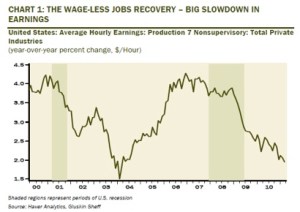 We have a “Wageless” Recovery. Incomes are only going up at the extreme upper levels. Every one else is losing lifestyle and yet, they are working hard. Employment Policy Research Network (EPRN) researcher Frank Levy of MIT has released a monograph called ‘Addressing the Problems of Stagnant Wages’. (Yes, I know, I actually read these things with relish and print wonky graphs for you on a sunny Sunday afternoon because of some weird inner trait of mine I really can’t name.) Just reading his introduction takes me back to my childhood in Iowa where farmers bought trucks from my dad and I knew everything would be alright if I just went to college and got a degree.
In the three decades after World War II, a central feature of the American economy was a mass upward mobility in which each generation lived better than the last, and workers experienced earnings gains through much of their careers. In short, the American Dream was alive and well. The central drivers of mass upward mobility were real wages for most workers that grew in line with overall labor productivity. Because of rising real wages a 40-year-old male blue-collar worker earned more in the late 1960s than most managers had earned in the late 1940s.
The alignment of wage growth and productivity growth resulted from two main factors: labor markets for most groups of workers in which demand matched supply, and the post-World War II Social Compact that emerged from the Great Depression helped to propogate wage norms throughout the economy, norms that were enforced in part through collective bargaining and professional personnel/human resource management practices.
By the 1980s, both of these factors had reversed. Labor demand increasingly shifted toward more educated workers – particularly well-educated women. At the same time, the post-war Social Compact was challenged by the inflationary 1970s and collapsed in the 1980s. Nothing has emerged to replace it.
Now, in the absence of a labor market boom like that of 1996-2000, increased labor productivity no longer translates into rising real wages for many groups of workers.
Well, that’s all and fine, but how do we address the problems that we’ve got now? How is it that so many of us can work and do the right thing and still not make ends meet? Well, that’s the policy part of the paper and there are suggestions. The author argues that during the last three decades business and government have broken the Social Contract. He’s got some suggestions. One of them is pretty basic. That would be increasing the High School Graduation rate and trying to get employers to buy into the idea that they must providing training and education opportunities to their workers. If they don’t, then society must offer this as a public good because provision of the good is cheaper than the social costs of not providing the good.
Increasing the number of college graduates requires dealing with two potentially related obstacles. One is the stagnation since the early 1970s in the high school graduation rate at approximately 75 percent.25 The failure to increase the high school graduation rate explains about one-half of the slowdown since the 1970s in the growth in the rate of college completion (Bailey and Dynarski, forthcoming). The other is the weak ability of high school graduates, once in junior college or college, to complete a degree. The historically large college-high school earnings gap has caused a growing fraction of high school graduates to start higher education, but the fraction who complete a bachelor’s degree has increased only modestly for women over the last twenty years and has remained basically flat for men.
There’s also a pretty good discussion of the idea of charters schools and inflicting the competitive charter school model on the education system that follows with some really good questions. Other proposals include making certain that we invest in the jobs and industries of the future even if the private sector isn’t doing their share. There’s also some discussion of how to encourage better labor-management relations and laws but given the demonization of working people–even by working people themselves–the author doesn’t hold much hope for the national discussion that needs to take place on less combative and abusive management practices.
One of the things that I do want to bring up is the role of using the classification “independent contractor” and how it’s allowed businesses to get around paying workers. It is thought to be responsible for a chunk of the wage stagnation and to many of the lost benefits problems leading to the loss of middle class lifestyles. It worries me greatly that many tea party governors are actively trying to dismantle labor laws. They are even trying to get rid of child labor laws so businesses can get access to children under 14 again.
One necessary but far from sufficient requirement for setting and maintaining a floor on wages for hourly workers, and especially for low-wage hourly workers, is that federal and state wage and hour laws are enforced vigorously and as uniformly as possible. Recent studies have shown there are widespread violations of wage and hour laws ranging from failure to pay minimum wages, overtime, required meal and rest breaks, and misclassification of employees as independent contractors. One recent study estimated these types of violations have the effect of lowering wages of affected workers by 15 percent
One of the major themes in the research is on the increased role of the financial markets in the breakdown of the Social Contract. The growth of the finance industry has come with the loss of manufacturing. Not only is this due loss of manufacturing jobs that are now lower paying services jobs, but it has caused incomes to shift from labor to capital. The political power and rise of the financial class has a lot to do with this trend. These people don’t just want ordinary returns on their money. They want extraordinary returns. Squeezing costs is usually the short sighted, short term way to achieve that.
I’d like to close with an interview with Cornel West that encapsulates some of the problems. It’s a little old. I grabbed it from Naked Capitalism; also a place concerned with policies that impact middle class Americans. Listening to the interview made think again about our priorities and our need to enforce the American Dream Social Contract once again. Dr West talks about the experience of poor and working class blacks in this clip, but many of the same things can be applied to any and all poor and working class Americans. I think it’s time we start the discussion. The country’s in trouble when an increasing amount of income comes from shuffling paper between financial institutions and bonuses replace wages for a hard day’s work.
Mega Tax breaks created Current State Budget Problems
Posted: March 30, 2011 Filed under: John Birch Society in Charge, New Orleans, Surreality, The Bonus Class, The Great Recession, unemployment, Voter Ignorance, We are so F'd | Tags: Bobby Jindal's bad tax policy, industrial tax exemptions, Republican governors bankrupt their states with bad tax policies, state tax giveaways to businesses 53 Comments Because so many manufacturing plants and accompanying good jobs compare new locations with old when companies decided to recapitalize or expand, states feel compelled to become rivals to attract capital investments to their states. This intense rivalry to attract the few major employers left standing in the US economy leads many governors into basically giving away more benefits than the incoming or staying-put businesses became worth to the state and municipalities in the majority of cases. Many of the businesses would have stayed put even were they not given the tax breaks.
There is also a huge stake for these governors in upping their credibility for being able to attract business to the state. It serves many of them well at the ballot box, even when the public is not really aware of what’s been given away to attract a few jobs. Many of the worst offenders are Republican governors where flexing tax hating muscle is more importance than effective governance when heading to the Iowa/New Hampshire test grounds for higher office. The evidence is much clearer in states ruled by Republican governors. A recent study Zach Schiller, research director at Policy Matters Ohio, a liberal government-research group in Cleveland as reported by McClatchey shows how states like Ohio, Louisiana, Texas, Michigan and many others have basically bankrupted the state with business tax giveaways and aggressive tax cuts to the richest of the rich. This has also played out on the federal level. The severe flaws with these tax cuts have become evident as the economy sank during the global financial crisis and federal funds provided during the Obama stimulus have dried up.
Across the country, taxpayers jarred by cuts to government jobs and services are reassessing the risks and costs of a variety of tax reductions, exemptions and credits, and the ideology that drives them. States cut taxes in hopes of spurring economic growth, but in state after state, it hasn’t worked.
There’s no question that mammoth state budget problems resulted largely from falling tax revenues, rising costs and greater demand for state services during the recession. But questionable tax reductions at the state and local level made the budget gaps larger — and resulting spending cuts deeper — than they otherwise would have been in many states.
A 2008 study by Arizona State University found that that state’s structural deficits could be traced to 15 years of tax cuts, mainly income-tax reductions that “were not matched by spending cuts of a commensurate size.”
In Texas, which faces a $27 billion budget deficit over the next two years, about one-third of the shortage stems from a 2006 property tax reduction that was linked to an underperforming business tax.
In Louisiana, lawmakers essentially passed the largest tax cut in state history by rolling back an income-tax hike for high earners in 2007 and again in 2008.
Without those tax reductions, Louisiana wouldn’t have had a budget deficit in fiscal year 2010, the 2011 deficit would’ve been 50 percent less and the 2012 deficit of $1.6 billion would be reduced by about one-third, said Edward Ashworth, the director of the Louisiana Budget Project, a watchdog group.
The original source of all this tax cutting madness can probably be traced to California and the infamous Proposition 13. Prior to Prop 13, California was a state in an enviable position with wonderful, low cost schools and infrastructure that was the symbol of US modernity. The Reagan roll backs of taxes and passage of increased write offs for investment to stimulate capital investments provided similar short term boosts that have led to long term problems.
Before California’s Proposition 13 triggered a nationwide tax-cut revolt in the late 1970s, state and local taxes accounted for nearly 13 percent of personal income in 1972, Bartik said. By 2007, it was 11 percent.
State corporate income taxes have fallen as well. Once nearly 10 percent of all state tax revenue in the late ’70s, they accounted for only 5.4 percent in 2010.
“It’s a dying tax, killed off by thousands of credits, deductions, abatements and incentive packages,” according to 2010 congressional testimony by Joseph Henchman, the director of state projects at the Tax Foundation, a conservative tax-research center.
Even now, as states struggle to provide basic services and ponder job cuts that threaten their economic recovery, at least seven governors in states with budget deficits have called for or enacted large tax reductions, mainly for businesses.
Even now, both the President and members of both parties are talking corporate tax cuts when many households pay more in taxes to the IRS than the biggest of the multinationals. Here’s a article in Forbes from last year showing how GE and other major corporations that live off of federal contracts also manage to avoid federal tax obligations. Exxon-Mobile and Walmart are also tax avoiders. You can go read the details but I sought out this old article for this tidbit so you know why a lot of them can get away with paying so few taxes.
But it’s the tax benefit of overseas operations that is the biggest reason why multinationals end up with lower tax rates than the rest of us. It only makes sense that multinationals “put costs in high-tax countries and profits in low-tax countries,” says Scott Hodge, president of the Tax Foundation. Those low-tax countries are almost anywhere but the U.S. “When you add in state taxes, the U.S. has the highest tax burden among industrialized countries,” says Hodge. In contrast, China’s rate is just 25%; Ireland’s is 12.5%.
Corporations are getting smarter, not just about doing more business in low-tax countries, but in moving their more valuable assets there as well. That means setting up overseas subsidiaries, then transferring to them ownership of long-lived, often intangible but highly profitable assets, like patents and software.
The President is correct in that if we lowered the overall tax rate on corporations, these companies would be less likely to relocate overseas to a certain extent. This would have to be coupled with closing the loopholes that allow them to avoid many taxes. Right now, the loopholes make the effective corporate tax rate different from the published. This would be a gargantuan task as each congressman and senator has a business they protect with all their might. Even Democrats in Louisiana protect the oil and gas industry, as an example.
The odd thing about the problems with the state and all these tax giveaways to businesses is that their tax rates are a minor decision variable so giving them tax breaks doesn’t provide business much benefit but hurts the state. When I worked as a consultant to the Department of Economic Development in Nebraska back in the 80s, I found that what a lot of corporations actually looked for in business site were good schools, good recreational facilities, and just basically a great place to live. Omaha frequently lost out to many bids because it was considered a pretty boring place to live with few recreational opportunities. The weather was frequently one reason no one wanted to move there. It had no major sports teams for one. So, why are these governors gutting school budgets and public works programs when the same things that benefit the people in the state attract businesses to the area? I will never understand that one.
Many of the new tea party governors are cutting taxes like never before assuming that just giving away tax breaks will appease any potential business leaders and possible attract some new ones. This faith-based tax policy is based more on ideology than any actual data that shows tax breaks do any of that.
Business tax reductions may be overrated as an economic stimulus because they’re so low on the totem pole of expenses. For most businesses, the cost of labor is probably 15 times the cost of all state and local taxes, said Bartik of the Upjohn Institute.
In his own research, Bartik found that a 10 percent across-the-board cut in state and local business taxes might boost employment by 2 percent, but it could take up to 20 years.
“Most studies indicate you might get 30 percent of the effect after five years and maybe 60 percent after 10 years,” Bartik said. “It takes a while because investment decisions are quite lagged and take place gradually.”
Compounding Ohio’s budget woes are 128 state tax exemptions, credits and deductions that drain more than $7 billion a year in would-be revenue. These loopholes make Ohio miss out on one of every four dollars it would otherwise collect in taxes, said Schiller of Policy Matters Ohio.
In Missouri, business and individual tax credits cost the state $521.5 million in fiscal year 2010, compared with $103 million in 1998, according to a state report.
Louisiana’s 441 individual and corporate tax breaks cost the state $7.1 billion last year. That nearly matches the $7.7 billion that all state and local taxes brought in.
Some of the breaks provide sales-tax exemptions on groceries, prescription drugs and residential utilities that saved Louisiana taxpayers $717 million last year. But another allows Louisiana companies to keep 1 percent of the state sales taxes they collect — about $34 million statewide — just for filing their tax returns on time.
I’ve seen Louisiana go down hill pretty rapidly over the last few years. Roads are in disrepair. The students at the UNO business school actually clean their own classrooms and the building twice a week because the two janitors assigned to the huge 4 story building just can’t keep up with the duty. The unemployment system is a mess with waits of months to get a claim processed and a forced move to the phone and the computer or a 3 hour wait on the phone to actually talk to a person. I wouldn’t recommend any one locate here because just simply getting to a state employee these days is impossible. They’ve adopted the phone tree hell realm model of business. It’s worse than getting customer service from a large bank.
Still, conservative tax cut fanatics still spin their tales of being overtaxed and how the burden is driving business out of the country. Really, it’s not the taxes. Businesses are going overseas because that’s where the money is now. The ASEAN region is seeing a huge increase in middle class consumers. Not so where in the US where wages are stagnant at best. Historical data is showing that these state tax cuts are not only not bringing businesses to the states, but they are driving people away. As I found in my work, companies cannot attract and maintain good employees in states with bad schools, bad roads, horrible crime rates, and lack of basic services and recreation. That’s not what you hear from conservative “experts’ who ignore data to follow their tax cutting muse.
Hodge, a conservative, said that closing loopholes and exemptions was less harmful to the economy than tax increases were. The Tax Foundation supports scaling back or closing tax loopholes, while lowering tax rates across the board.
“My argument to state lawmakers is that lower rates for everybody are better than tax incentives for some,” Hodge said.
That incentive-free philosophy was behind Michigan Gov. Rick Snyder’s call for a flat 6 percent corporate income tax to replace the current business tax system. But Snyder’s flat tax amounts to a $1.5 billion tax cut for businesses, paid for in part by education cuts, personal income tax increases and taxing public and private pensions.
“We think that’s the way to rebuild our state, and to get it on a path toward economic prosperity,” Snyder’s top economic development official, Michael Finney, said during a recent trip to Washington.
History suggests otherwise, however. After the nation recovered from the 1990-91 recession, 43 states made sizable tax cuts from 1994 to 2001 as the economy surged. Twenty-eight states, in fact, reduced their unemployment insurance payroll taxes after 1995.
But states that cut taxes the most ended up with the largest budget shortfalls and higher job losses when the economy slowed again in 2001, according to research by the Center on Budget and Policy Priorities.
These are some truly startling conclusions that show just how far we’ve come from using data, economics, and basic accounting to make decisions at even the state level. When governors are ruling multiple important states based on political ideology and faith based economy policies, the country is in real trouble. Some of these folks–like Scott Walker–seem to be true-believers. Bobby Jindal is more of an opportunist than a true believer. His presidential ambitions have led him to make decisions he knows will hurt the state. He’s done nothing but pursue an agenda that will serve his ambitions. I imagine that Rick Perry probably falls into that category too.
It is absolutely necessary that people know that there are direct effects of bad tax policy. It is not only evident in schools, roads, and basic goods in services, it is also evident in the types of people that start leaving your state. Most of the states with these problems are also having population shifts that make them look more like developing nations that countries with mature economies. The more they have tried to set up the rules in favor of businesses doing what they want, the more they lose the types of workers and residents that appreciate and demand good government services. I’ve said this many times, but I had no problem paying my high tax bill in Minnesota because I could see the money put to good use daily in my world class roads, schools, and recreational facilities. I begrudge giving Bobby Jindal a dime because I figure it will only go to enrich people that don’t need anything from me to begin with.
This is a situation that more people need to learn about and discuss. Please take the time to review some of the startling statistics in the McClatchy article. Each state usually has a non-profit group, like Policy Matters Ohio or Louisiana Budget Project, that closely follows these actions. I’d recommend you find the group for your state and become informed. I know most of you aren’t my neighbors, but the LBP has a great report up on how Jindal has basically turned my state into a business subsidy haven that has shown to be the most inefficient in the country. Here you can see directly how these tax give-aways are not producing good results.
According to the most recent report from the Louisiana Board of Commerce and Industry, Industrial Tax Exemptions awarded in 2010 are estimated to cost Louisiana over $946 million over the next ten years. In 2009, Louisiana awarded exemptions worth $745 million and in 2008, over $614 million. That means that over a three-year time span, more than $2.3 billion in potential revenue has been lost in return for the creation of 7,256 potential new jobs.
The most recent report, dated August 2010, identified 592 companies and corporations across the state that qualified for the exemption. These companies employ over 206,128 jobs and created 2,537 new jobs. Louisiana consistently awards these ten-year property tax breaks for dozens of multi-national industrial giants that have little need for state subsidies.
You might at least be interested to see the companies on the list. Most of them are from the oil industry which is of course in a period of incredible profitability and can’t relocate to Orlando or Atlanta even if they wanted to. They are here for our oil. Anyway, I hope this information stimulates a good discussion.

 peej
peej Carissa
 bostonboomer
 dakinikat
 ecocatwoman
 mablue2
 Mama Lopez
 peggysue22
 quixote
 skydancingguestblogger
 Mona (aka Wonk the Vote)



 Sky Dancing
Recent Comments