
The Devil in the Job Act Details
Posted: September 9, 2011 Filed under: U.S. Economy, unemployment | Tags: American Jobs Act, job gaps 22 CommentsThere’s a few more details–and as you know the devil is always in those–coming out about the president’s proposed American Jobs Act. The first hurdle will be the Republican Congress who will most likely rip out anything that hasn’t got anything to do with subsidizing rich people and corporations through worthless tax cuts. But, there are some other issues likely to come up also. I’ve found a few to share. Bear with me, this is long and wonkish in places.
This first one deals with one part of the Act that may not exactly deal with jobs but could help people stay in their homes and stabilize the housing industry. The President inkled it in one line. The President’s original plan–called HARP–has not really lived up to its promise of large scale help for struggling home owners. Many of the folks that may have qualified for the program have not been able to get help and those upside down on mortgages have had real issues. This ProPublica article explains why this program failed and the new program–if passed– may have it’s own issues. One of the biggest problems is coming and will come from the Federal Home Financing Authority (FHFA), the regulator and conservator of Fannie and Freddie.
Some of the reasons the old program has fallen short are complicated and aren’t likely to be easily fixed. Loans with mortgage insurance, for instance, are often denied because the insurer must agree to transfer the policy to the new loan. Loans with a second mortgage present their own difficulties.
But there have also been two key players who are obstacles to the program’s success — the banks and, perhaps surprisingly, the federal regulator overseeing Fannie Mae and Freddie Mac. Both seem likely to continue their skeptical stance, because both view helping underwater homeowners as risky.
The banks have been widely reported to be wary of offering new mortgages to borrowers who owe more on their house than its worth. Although the loans are backed by Fannie or Freddie, the bank could still be on the hook if the homeowner defaults and Fannie or Freddie finds that the bank didn’t properly underwrite the new loan. The bank could be forced to buy the loan back. Because underwater homeowners are seen as being at a greater risk of defaulting, they’ve been wary of taking those on. (You might have noticed that since the housing bubble burst, banks have become much more cautious.)
Fannie and Freddie’s federal regulator, the Federal Housing Finance Agency (FHFA), could choose to remove that risk for banks. Doing so, however, would shift that risk from the banks to Fannie and Freddie, and that’s something FHFA hasn’t been eager to do. As a former White House aide put it to The Wall Street Journal, FHFA head Edward DeMarco’s “first instinct is to say no.”
FHFA is an independent federal agency, so even though taxpayers have kept the two companies afloat, they are not under the administration’s direct control.
FHFA’s independence has lately been a big obstacle for the White House. We reported in December of last year on FHFA’s opposition to cutting mortgages for underwater homeowners facing foreclosure. Reducing the principal amount would make homeowners much less likely to re-default, but would lead to short-term losses for Fannie and Freddie. A public White House push on the idea has so far gotten nowhere.
Any more fixes to the old program or additions to the new program will need FHFA approval and that seems in doubt. If you’re interested in this detail, go read the article.
Okay, let’s look at the major problem. That’s getting the plan past the likes of Eric Cantor who looked positively sullen while taking notes at the presidential speech last night. Actually, he had a rather strange bespeckled pallor in his face and put me in mind of Uriah Heep or the onset of melanoma.
“This is my objection to the message that was delivered tonight,” House Majority Leader Eric Cantor (R-Va.) told reporters in the Capitol after the speech. “The message was: either accept my package as it is, or I will take it to the American people. I would say that that’s the wrong approach. What we’re here to do is try to transcend differences, not let them get in the way in the areas we can make progress on.”
Cantor added that “as majority leader, I certainly would like to see us be able to peel off some of these ideas, put them on the floor, vote them across the floor and get the senate to join with us so we can actually get something to the president and make some progress as quickly as possible.”
The quick reaction from a top congressional Republican suggests the GOP is not outright dismissing all of Obama’s ideas, but certainly is not going to pass the entire $450 billion package in one fell swoop.
Cantor has already pooh poohed the idea of an infrastructure bank which is actually one of the more meaningful aspects of the proposed act.
“I’m wary of the suggestion of an infrastructure bank,” House Majority Leader Eric Cantor (R-VA) told reporters at a roundtable lunch hosted by the Christian Science Monitor. “I am one who agrees with the notion that an infrastructure bank is almost like creating a Fanny and Freddie for roads and bridges.”
That’s President Obama’s favored infrastructure spending idea — to loan both private and public dollars to states and municipalities to speed up new and existing building projects, and to lure private investment with the promise of returns from tolls and other fees. Cantor’s counter offer is to nix the requirement that states “set aside 10 percent of federal surface transportation funds for transportation museums, education, and preservation would allow states to devote these monies to high-priority infrastructure projects, without adding to the deficit.”
These are pretty different ideas, though they could meet similar ends in some circumstances. The infrastructure bank wouldn’t require canceling some projects (mainly for bikers and pedestrians) to fund different ones, and would fund projects that meet high bang-for-the-buck, and environmental standards.
Jared Bernstein — an economist at the Center on Budget and Policy Priorities and Vice President Joe Biden’s former top economic adviser — told TPM, “the [infrastructure] bank has real advantages in terms of rigorous cost benefit analysis in choosing projects that this idea doesn’t sound like it would…. but 10 percent isn’t a lot and this kind of flexibility can be a useful thing I would just want to know what kind of criteria the project choice involves. Because the last thing we want to do is waste these scarce resources.”
Additionally, I firmly believe that Republican Governors are committed to killing Teacher’s Unions and don’t seriously want any incentives to keep teachers on the payroll. Here’s a good example of how much they hate these organizations from NJ Fat Cat Governor Chris Christie. Teacher’s Unions are seriously important to local Democratic Candidates. They work and they donate funds. You can see their importance in the Wisconsin Cheddar Revolution. Restructuring the New Orleans school District down here to accommodate charter schools has really only been successful at one thing: replacing teacher contracts negotiated by unions with non union lower paying, less job security contracts. I’m sure the Republicans won’t want any money funneled to states aimed at keeping union worker’s in place.
“There’s nobody in this room who runs a successful business who says, tells an employee after three years and a day — I’m sure this doesn’t happen at Koch Industries — where they call ‘em in after three years and a day and say, ‘Hey, you have been great for three years and a day, and guess what? You have a job here at Koch Industries for the rest of your life. Congratulations!’ Christie said.
“But this is the way we’re running our schools. We need to get rid of tenure… It’s just not right. And so we need to do these things and that’s where we head next. We’ve taken care of the first two big of the big things, at least for the moment, and now the third big thing is we need to take on the teachers’ union once and for all and we need to decide, who is determining our children’s future? Who is running this place? Them or us? I say it’s us, and we’ve got to go fight to do it now.”
Here’s Paul Krugman explaining a portion of the President’s Plan. He has one similar question that I voiced most of yesterday. The original stimulus didn’t really stimulate as much as it stopped the freefall of the economy. That’s an okay thing, but as you can see, it really has left the plan open to a lot of criticism because it didn’t really go far enough. This plan has the same issue. If many measures currently in place are allowed to expire, things will get worse. However, stopping things from getting worse still doesn’t move things forward.
O.K., about the Obama plan: It calls for about $200 billion in new spending — much of it on things we need in any case, like school repair, transportation networks, and avoiding teacher layoffs — and $240 billion in tax cuts. That may sound like a lot, but it actually isn’t. The lingering effects of the housing bust and the overhang of household debt from the bubble years are creating a roughly $1 trillion per year hole in the U.S. economy, and this plan — which wouldn’t deliver all its benefits in the first year — would fill only part of that hole. And it’s unclear, in particular, how effective the tax cuts would be at boosting spending.
The other thing that I really still don’t understand–accept in pure political terms–is the fascination with decreasing spending to balance the budget while making the budget deficit worse by providing less productive tax cuts. It is still your basic Voodoo Economics. Yes, tax cuts can do some things, but the multipliers on tax cuts pale in comparison to direct government spending. I’ve mentioned this before, but putting money back to consumers and businesses via tax cuts means that a portion of that drains to unproductive things. That’s okay policy for a small recession, but it’s not good for what’s happened to us since 2007. Redirecting money from good spending to iffy tax cuts doesn’t make a lot of sense to me.
Moody’s must have a much more powerful computer program than I have intuition and understanding of macroeconomic theory. Direct government spending on infrastructure goes out full force and then starts multiplying by going additional rounds to businesses and consumers. The first dose is full force and the draining doesn’t occur until the second round. I really don’t think the lawyers in the White House get the idea of economic multipliers at all, but then, maybe it is just because of the politics. Republicans could care less about the health of the general economy and working population as long as they retain power, feed their ideological base, and prop up corporations. I wouldn’t put numbers out at all–like Moody’s–until I see the recessionary impact of the offsets.
So, here’s Ezra Klein–Baghdad Bob of the DC villagers–with a good laundry list of details. See which ones you think the Republicans will pick off. I’m more interested in that last statement because, again, you can’t really judge how much it can’t do without looking at the offsets. It could wind up a wash or worse.
– It cuts the payroll tax for workers in half, which amounts to a $175 billion tax break, and cuts it in half for businesses until they reach the $5 million mark on their payrolls, at a cost of $65 billion. The idea there is to target the tax cut to struggling small businesses, rather than the cash-rich large businesses. It also extends the credit allowing businesses to expense 100 percent of their investments through 2012, which the White House predicts will cost $5 billion.
– It offers $35 billion in aid to states and cities to prevent teacher layoffs, and earmarks $25 billion for investments in school infrastructure.
– It sets aside $50 billion for investments in transportation infrastructure, $15 billion for investments in vacant or foreclosed properties, and $10 billion for an infrastructure bank. It also makes mention of a program to “deploy high-speed wireless services to at least 98 percent of Americans,” but it doesn’t offer many details on that program.
– It provides $49 billion to extend expanded unemployment insurance benefits. $8 billion for a new tax credit to encourage businesses to hire the long-term unemployed, and $5 billion for a new program aimed at supporting part-time and summer jobs for youth and job training for the unemployed.
– It also encourages the Federal Housing Finance Authority to make it easier for underwater homeowners to refinance their mortgages.
If all of that could be spent out in 2012 — a big if, but given the reliance on tax cuts and state and local aid, much of it could certainly hit before the year’s end — it would be bigger, in annual terms, than the Recovery Act. The White House also promises the entire proposal will be paid for, and the specific offsets will be released next week.
My other concern comes at the end of this analysis by Macroadvisers. It looks good if it goes as proposed by the President and if there were no offsets but the entire thing is quite temporary. All of these are HUGE ifs. The analysis is sound under the ifs, however.
Because these initiatives are planned to expire by the end of 2012 — except for the infrastructure spending, which has a longer tail — the GDP and employment effects are expected to be temporary.
- That is, these proposals will pull forward increases in GDP and employment, not permanently raise their level.
- Nevertheless, there may be good reasons to want to implement such programs today, if the government can follow through on the commitment to trim deficits later:
- There remains considerable slack in the economy and nearly all forecasts anticipate only a gradual decline in the unemployment rate over the next couple of years.
- Given the elevated risk of recession the U.S. faces today, additional near-term stimulus reduces that risk.
- Given the deleterious effects of long-term unemployment on an individual’s skills and long-term employment prospects, speeding a return to employment is both individually and socially beneficial.
- With monetary policy’s limited room to lower rates and stimulate demand, there is a role for counter-cyclical fiscal policy.
 I’ve got one nifty graph on the job gap. The gap is basically a measurement of what jobs have gone missing because of the great recession. I’ll send you t0 another shorty, wonky link. It’s here at The Economic Policy Blog where it’s argued that the plan--again with all the IFs in tact–makes a step towards closing the gap. However, the gap is 11 million jobs. This is what needs to be created to get the economy back to Full Employment. The propsed plan adds around 4 million jobs. In simple math, it’s not even half way there which suggests another half ass plan which will be dialed down even further in the sausage making phase.
So, I’ve gone on quite a bit and all of this is quite wonky in places. It’s way longer than I usually make my posts but I thought that you should get a chance to see as much as possible. The bottom line for me is that I’m not going to get tingly legs until I see the offsets that will be produced on Monday and until I get an idea of what the Republicans will go for. It’s not giving an rehearsed speech that’s important, it’s getting the right things into law that matters.
The “Jobs” Speech: Aftermath
Posted: September 8, 2011 Filed under: Barack Obama, U.S. Economy, U.S. Politics, unemployment, voodoo economics, We are so F'd | Tags: live blog, Obama jobs speech 14 Comments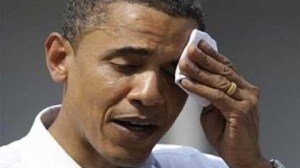
Desperation Time
Reuters has a summary of the “key elements” of President Obama’s speech. Mainly he proposed a payroll tax holiday for employees and employers.
EMPLOYEE PAYROLL TAX HOLIDAY
Obama is proposing a $175 billion one-year extension and expansion of the employee payroll tax holiday that would halve the tax rate to 3.1 percent in 2012.
EMPLOYER PAYROLL TAX HOLIDAY
Obama is seeking $65 billion to encourage small businesses to hire more workers. This includes halving employer payroll taxes to 3.1 percent for the first $5 million of a company’s wage bill in 2012, which the administration says will reach 98 percent of small businesses. He also wants a complete payroll tax holiday for increasing the size of the payroll by up to $50 million above the prior year, either by hiring new workers or raising the salaries of the existing labor force.
That would help the people who still have jobs, I guess, but it hasn’t done much to create new jobs so far.
In addition to that:
He proposes to help homeowners, and says he’ll have a plan in the next couple of weeks–no specifics.
$5 billion to provide 100% tax deductions for businesses that spend money on new plants and equipment. Of course, as Dakinikat has repeatedly told us, that won’t create jobs as long as consumers can’t spend.
$85 billion for state and local governments, which would be good if the Republicans would allow it through. This would include money for improving schools, helping keep teachers and other public employees in their jobs, improving already foreclosed homes, and money for young people.
$50 billion for transportation infrastructure. Hasn’t this one been around for awhile? I don’t think the Republicans will go along.
A one-year extension of unemployment benefits and tax credits for the long-term unemployed.
So what do you think? What are you hearing in the media?
Personally, I think it’s time for Obama to give a speech like this one.
Thursday Reads: The GOP Debate, Obama’s Narcissism, and Generations
Posted: September 8, 2011 Filed under: Baby Boomers, Barack Obama, jobs, morning reads, psychology, Republican presidential politics, the villagers, U.S. Economy, U.S. Military, U.S. Politics, unemployment, WE TOLD THEM SO | Tags: Al Gore, Generation X, Generation Y, generations, Michael Brenner, Mitt Romney, narcissim, Obama jobs speech, Republican Debate, Richard Cohen, Rick Perry, The Hamptons 41 Comments
Good Morning!! Last night we live-blogged the Republican debate, and it was borrrrrinnngggg! The less said about that debate last night the better. I can’t begin to pick the best or worst of that bunch. They were all horrible. For the media the big story in the debate was the conflict between Rick Perry and Mitt Romney. From CBS News:
The sparks flew early at Wednesday night’s Republican presidential debate, with onetime frontrunner Mitt Romney and the man who has overtaken him in the polls, Texas governor Rick Perry, trading barbs over their respective records on job creation.
Romney was asked about the fact that Massachusetts was ranked 47th in job creation during his time in office. After making the case that he had improved a bad situation, Romney took a subtle shot at Perry, who has been in politics since 1984, saying, “Look, if I had spent my whole life in government, I wouldn’t be running for president right now. My experience, having started enterprises, having helped other enterprises grow and thrive, is what gives me the experience to put together a plan to help restructure the basis of America’s economic foundation so we can create jobs again, good jobs, and compete with anyone in the world.”
Pressed on his reference to spending a “whole life in government,” Romney, who touts his experience in the private sector, added: “It’s a fine profession, and if someone were looking to say how can we restructure government, and which agency should report to which other agency, well, maybe that’s the best background. If you’re thinking about what it takes to reshape and update America’s economy, and to allow us to compete with China and other nations around the world, understanding how the economy works fundamentally is a credential I think is critical.”
Perry countered by saying that while Romney had a good record creating jobs “all around the world” in the private sector, “when he moved that experience to government, he had one of the lowest job creation rates in the country.”
“So the fact is, while he had a good private sector record, his public sector record did not match that,” the Texas governor continued. “As a matter of fact, we created more jobs in the last three months in Texas than he created in four years in Massachusetts.”
Whatever.
I don’t expect the President’s jobs speech tonight to be much more interesting, but we will be live-blogging it anyway. I do expect that after the Obama has nothing new to offer in his speech tonight that he will have “crossed the Rubicon,” so to speak. He will have passed the point of no return. He’ll be done, finished, caput. I’ll say again what I’ve been saying for awhile now: this president needs to follow in the footsteps of that other failed president, Lyndon B. Johnson. Realize it’s all over and withdraw from the race so someone else can try to beat whichever nutjob the Republicans nominate.
If Obama refuses to withdraw, I think the media should hold debates where the President debates candidate Obama from 2008. They could play clips of his campaign promises and then ask him to explain why he adopted the Bush policies instead. Now that might be an entertaining debate.
For a long time now, we’ve been seeing former Obot bloggers expressing their disappointment in the man they forced down America’s throat. Lately the disappointment and even disgust has been coming from more mainstream sources. It’s quite amazing really. Yesterday Richard Cohen, the aging WaPo columnist told the Villagers that Obama has lost the Hamptons.
Over the Labor Day weekend, I went to a number of events in the Hamptons. At all of them, Obama was discussed. At none of them — that’s none — was he defended. That was remarkable. After all, sitting around various lunch and dinner tables were mostly Democrats. Not only that, some of them had been vociferous Obama supporters, giving time and money to his election effort. They were all disillusioned.
Let me call the roll. I am talking about are writers and editors, lawyers and shrinks, Wall Street tycoons and freelance photographers, hedge funders and academics, run-of-the-mill Democrats and Democratic activists. They were all politically sophisticated, and just a year ago some of them were still vociferous Obama supporters. No more.
Frankly, I was surprised. The Hamptons are a redoubt of New York liberalism. It is to campaign money what the Outer Banks are to fishermen. I expected more than a few people to defend the president. No one did. Everyone — and I do mean everyone — expressed disappointment in him as a leader. In that area, they thought he was a bust. Some articulated detailed critiques — the nature of his stimulus program, for instance. They argued that more money should have gone into long-term infrastructure programs. Most, though, skipped the details and just registered dismay: Where had their “change” agent gone?
Today, Al Gore attacked Obama as anti-science and anti-environment.
Instead of relying on science, President Obama appears to have bowed to pressure from polluters who did not want to bear the cost of implementing new restrictions on their harmful pollution—even though economists have shown that the US economy would benefit from the job creating investments associated with implementing the new technology. The result of the White House’s action will be increased medical bills for seniors with lung disease, more children developing asthma, and the continued degradation of our air quality.
BTW, why hasn’t Gore been protesting outside the White House? Why hasn’t he been arrested? Wouldn’t that have a powerful effect? But I digress.
I want to highlight another elite critique–although this critic apparently saw through Obama early on. Yesterday, HuffPo published an outstanding post by Professor of International Affairs Michael Brenner, from the University of Pittsburgh: The Great Betrayal.
Barack Obama’s betrayal will resonate in history long after he has become just another name on the over-priced celebrity speaker circuit. It is a betrayal of far more than the youthful idealists and loyal progressives who put him in the White House. Obama has unmoored the Democratic Party from its foundations — philosophical and electoral. No longer is it an expression of the persons, programs and ideas that crystallized with the New Deal and which dominated the country’s politics for sixty years. Its future is that of ad hoc assemblage of hustlers and special interests whose sole claim to govern will be that it is not the amalgamated Tea/Republican Party. Obama, by this Oedipus-like act of patricide, has also betrayed the country that voted for an enlightened leader with a social conscience — a country in desperate need of the opposite to the fate he has laid on us.
Brenner argues that Obama’s extreme narcissism reflects our contemporary culture and that we’ll see more like him in the future {shudder}.
A narcissist has no convictions other than a total dedication to his own gratification. That gives him the freedom to maneuver without inhibition or conscience with the revered self as the only reference point. All expressions of ideals, of opinions, of intentions are implicitly so qualified. A complementary narcissistic trait is an ease with blurring the line between virtual reality and actual reality. Narcissists believe everything they say — at the moment they say it. Their declarations are sterile acts that have no pride of parentage nor can they expect honor from offspring. Witness Obama’s momentarily rousing support of a labor movement that he has scorned for thirty months. This is the same President who has launched an all-out campaign against public school teachers whose unions serve as the whipping-boy for all that ails American education. Narcissists take as given that they never dissemble or lie — because to do so is to acknowledge that reality has an intolerably constraining claim on them.
Of course, this last is a feature of contemporary American political culture in general. Facts are taken to be infinitely malleable, the very notion of truth is denied, speaking honestly is viewed as a lifestyle choice, and communication is more a matter of self affirmation than an attempt to convey knowledge, emotion or intention to somebody else. We have externalized navel gazing to a remarkable degree. One consequence is that public discourse is not anchored by common standards of honesty. It is a maelstrom of opinion, emotive outbursts, mythology and primal screams. Accountability, therefore, ceases to exist. There is accountability only where there are benchmarks of veracity, a reasonably rigorous monitoring of what is said and done, and a dedication on the part of some at least to ensuring that these requirements for a viable democracy are met. The abject failure of the media to perform these functions to any reasonable degree is a hallmark of our times. The think tank and academic worlds are little better.
This amorphous environment is narcissist friendly terrain. It is permissive of twists and turns, leaves no record of what was done yesterday or the day before — much less a year ago, and focuses only on the evanescent existential moment. Case in point is the remarkably uncritical coverage that Obama has received from the supposedly responsible media — especially those who claim to be upholders of the ideas and policies and interests that he has betrayed.
Wow! Can that guy ever write! As I said Brenner apparently saw Obama pretty clearly from the beginning. Here is an excerpt from a paper he wrote in October, 2008 Who is Barack Obama? In this piece, Brenner comments on Obama’s strange disdain for the political and cultural movements of the 1960s and 1970s.
Obama is not a philosophical progressive or a populist. Little if anything in the roiled public life of America seems to anger him or even irk him. At a time of multiple crises – constitutional, economic, and in the nation’s foreign dealings – he keeps his emotional distance. It is hard to imagine him getting worked up about any of the developments in American society or attacks on the body politic that so deeply dismay many others
In all respects, Obama is very much a man of his times. Weak or absent convictions, dispassion even about grievous wrongs, incapacity for moral outrage, quiet acceptance of the precept to put self first – if not quite the measure of all things, a natural egoism – all the hallmarks of contemporary American society. A man who amasses $10 million at a relatively young age after a late start and married to a woman with no inherited wealth whatsoever is a man who looks after himself. He has none of the idealism that exemplified his mother’s life, and for which she paid a steep price in comfort and security. Obama’s disparagement of the 1960s social movements that shaped his mother is revealing. It confirms the absence of serious interest in his own lineage. It hints at an introspection, such as it is, that has the instrumental needs of the present as its magnetic pole. It exemplifies a strongly ahistorical approach to the current world he occupies. Obama’s public remarks that the whole 1960s experience was a ‘psycho-drama’ is astonishing. He is what he is, where he is, as a direct result of the 1960s. The same holds for his wife and children. Indeed, he simply would not be were it not for the ideals and attitudes that became full-blown in the 1960s.
Perhaps at the root of Obama’s narcissism there is a sense of disgust about where he came from and who is is? Or maybe he disdains the movements of the ’60s and ’70s–the Civil Rights movement, the Women’s movement, the anti-war movement, the gay rights movement–because he has no convictions of his own and can’t understand why anyone would have convictions worth fighting for? I don’t know. I admit I simply do not understand the man. I just know he’s toxic for America and he was toxic for the Democratic Party, which, thanks to him, is now truly dead.
Interestingly, I came across another post at HuffPo today that address the issue of generational conflict: Generation X Simply Doesn’t Get it, by Joshua Grant. The post seems to have been written in reaction to the August unemployment numbers. Joshua longs for the days when America really was a great country that everyone could be proud of. His generation, Gen Y, has never experienced it, he says.
We, Generation Y, are a people who have lived through the need for “ADHD medicines,” “anti-depressants,” dysfunctional and broken families, a dot-com bust, financial collapse, failed government institutions, world hunger, terrorism, and international conflicts. Simply put, there has been little to celebrate in life since we’ve been around.
Some people think we are self-absorbed, concerned only with our interest, but can you blame us? The only glimmers of hope have been what personal achievements we have accomplished, of which we hang onto to for dear life. After all, in a country that is supposed to be so “great,” something doesn’t add up, and we want to know why? It’s not that we are conceited or don’t want to be a part of something better, but why get in the middle of a national mess that looks like a downward spiral?
Joshua is so young that lacks any historical perspective. He blames the problems he sees on Generation X. Poor Gen X! They grew up under Reagan and never experienced an America that produced prosperity for anyone but the rich. I’m not sure Joshua even knows about difficult passages that members of other still living generations experienced–like the Great Depression, World War II, Vietnam, racial discrimination and segregation. He wants to know why things are so terrible in this country right now. And if Gen X-ers aren’t going to do anything about it, he wants them to get out of the way so his generation can. To his parents’ generation, he writes:
Let me thank you on behalf of my generation, Y, for all that you have done, and now I ask that you step aside, open your books, and let us, with all the right questions, begin to solve the problems you can’t seem to figure out. It all starts with Why/Y.
If you won’t ask, we will.
I don’t want to be too hard on Joshua, because he’s obviously very young. But what on earth is his generation waiting for? Why aren’t they in the streets protesting already? Why aren’t they out there demanding jobs and a guarantee they’ll get social security in their old age instead of complaining about being stripped of hope? Why aren’t they protesting the wars, torture, and domestic spying? Why are they waiting around for someone else to do it?
In the comments on Joshua’s article, everyone hammers the baby boomers and says it’s all our fault. At least we tried to fight the powers that be. Our generation didn’t sit around waiting for our parents to change things. We fought for change and we had a powerful effect on the culture even though we couldn’t stop the growing corruption and corporatization of the government. What are these kids waiting for? I admit I just don’t get it.
Well, this post has turned into a bit of a rant, so I guess I’ll wrap it up. What are you reading and blogging about today?
Is Obama’s Jobs Speech Just an Attempt to Distract Us From His Next Huge Sellout?
Posted: September 4, 2011 Filed under: Team Obama, The Media SUCKS, U.S. Economy, U.S. Politics, unemployment, We are so F'd | Tags: Barack Obama, distraction, donor base, free trade agreements, jobs speech, Robert Prasch, sellout, unemployment, voter base 8 Comments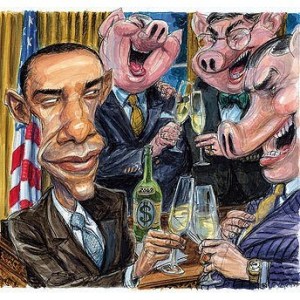
I came across a really provocative and perceptive post at HuffPo by Robert Prasch, an economics professor at Millbury college and author of the book How Markets Work: Supply, Demand, and “The Real World.” Prasch questions why Obama is giving a speech on jobs and unemployment now, since it has been clear from day one of his presidency that unemployment is a huge problem and since Obama and his closest advisers have shown no interest in doing anything about the problem other than periodically expressing “concern.” In Prasch’s words:
As a “rule of thumb,” it is a fair guess that the actual rate of unemployment is three-quarters again (1.75x) as high as the official or “headline” rate (BLS calculates a less-known data series called U-6 that validates this estimate). So, for example, with today’s official rate at 9.1%, it is reasonable to guess that 15.9% of the labor force is un- or under-employed (the U-6 number for August 2011 is 16.1%). This, then, is the context that best interprets the current “headline” rate of unemployment. It is, to put it mildly, a narrow definition that leaves out many people who we would usually consider unemployed. Contemplated alongside other numbers, it is evident that many American families are in desperate straights — and the situation is getting worse. Thirty percent of America mortgagees owe more on their home than its market value. As this percentage is continuing to rise, it is increasingly made up of “prime” borrowers. An amazing fifteen percent of all Americans are on foods stamps, including one-quarter of all children. This number is also rising. With so many families in such precarious condition, can anyone be surprised that wages are stagnating, unionization rates are declining, and the distribution of income is worsening?
This brings us to President Obama’s speech. Why now? After all, unemployment has been high since the day he took office. Actually, it rose initially and has remained high since. Early in his administration there was a half-hearted attempt to provide a “stimulus” to the economy, but the program was — even then — widely understood to be too small and too-heavily weighted toward tax cuts to be effective (For a criticism of tax cuts for the wealthy as an employment strategy see here). From the start it was evident that the administration’s core approach to the economy was to do whatever was necessary to support Wall Street’s largest and most irresponsible firms through thick and thin. The idea, if we can call it that, seems to have been that “trickle down” or the “invisible hand” would take care of the unemployed. So again, why now?
Prasch’s answer is both fascinating and maddening; and yet it makes a great deal of sense. He argues that the speech and any “jobs plan” along with any legislation that comes out of it, is designed to distract the media and the public while Obama and his real base–his donors–organize the passage of several free trade agreements that are strongly desired by the corporatocracy but despised by most Americans.
It is common knowledge that the White House plans to submit three completed “Free Trade” agreements to the Senate this September — South Korea, Colombia, and Panama. (As always, these treaties are primarily about guarantees and protections for financial and investment flows, restrictions on intellectual property, and related issues. But exploring their content will have to await another post.) With a remarkable sense of timing, the administration also plans to mark Labor Day 2011 by opening multi-party talks on a Trans-Pacific Free Trade Area. (Trade negotiators, lawyers, lobbyists, and hundreds of corporate honchos are invited to these talks — critical economists, civil society groups, and the public are not.) The President’s “voter base” is firmly opposed to these secretive and largely detrimental deals, as is the bulk of the American public. This opposition would most likely intensify if the public were fully briefed on their contents. Simultaneously, there is no question that the President’s “donor base” is highly enthusiastic about these deals — after all, they were in the room when the details were hammered out. Wall Street, the Chamber of Commerce, and the National Association of Manufacturers are beside themselves with excitement. The treaties promise extraordinary protection of financial and investment flows, innumerable exemptions from regulation, new and lucrative opportunities for off-shoring jobs, and political recognition and validation of the absence of labor protections and union rights that is a characteristic of most of these nations and regions. K-Street lobbyists can look forward to high fees and lavish banquets during and after the Senate vote. Big agricultural intermediaries look forward to crushing South Korean farmers with their heavily subsidized produce. This year, Colombia is on track to outperform its 2010 record of murdered unionists. If you’re a plutocrat or one of their paid representatives, what’s not to like?
My conjecture is that the forthcoming speech and any accompanying legislation was and is intended to provide political cover and a welcome distraction throughout the passage of these “Free Trade” treaties.
And, Prasch argues, any parts of the proposals that might actually help the unemployment problems will be stripped out by the Republicans, and Obama can claim that he really wanted to create jobs but the mean old Republicans wouldn’t allow it. The usual Obama apologists will defend the poor, put-upon president.
As I said this makes a lot of sense to me. And it makes me utterly livid. Obama is quickly becoming a laughing stock, but he doesn’t seem to care as long as he can please the ultra rich. I have to admit, I can’t understand how someone with such a huge ego can surrender his own dignity like this. But it’s happening. A child could see it at this point.
Did White House Push for $535 Million Loan to Now Bankrupt Solyndra?
Posted: September 2, 2011 Filed under: Republican politics, Team Obama, U.S. Economy, U.S. Politics, unemployment | Tags: ABC News, bankruptcy, Barack Obama, Department of Energy, George Kaiser, green energy, House Energy Committee, Job Creation, jobs, layoffs, Rep. Fred Upton (R-MI), solar energy, Solyndra, stimulus bill, unemployment 18 Comments
Obama visiting the Solyndra plant
Minkoff Minx highlighted this story earlier today, but I thought I’d expand on it a little bit. As Minx wrote earlier, Solyndra is a solar energy company that the Obama admnistration has hyped as an example of the potential of green energy technology to create jobs in the U.S. From the LA Times editorial page:
Solyndra was the first company to be awarded a federal loan guarantee under the stimulus, worth $535 million. Taxpayers are likely to end up on the hook for much if not all of that amount, a highly embarrassing development for President Obama because he was among the company’s biggest cheerleaders. He visited its Fremont plant in May 2010 even though PricewaterhouseCoopers had weeks earlier raised doubts about its plans for an initial public offering by questioning whether it could continue as a going concern.
That’s especially troubling because Solyndra is backed by one of Obama’s key fundraisers, George Kaiser of Tulsa. Congressional Republicans were raising alarms about Obama’s connections to Solyndra well before Wednesday’s announcement, with GOP members of the House Energy and Commerce Committee voting in July to subpoena documents from the Office of Management and Budget on the loan-guarantee decision.
Two important questions are raised by Solyndra’s failure: Should the government be in the business of picking winners and losers by providing loan guarantees to risky energy ventures? And is Obama using stimulus funds to reward his political contributors?
The Times says “yes” to the first question and “maybe” to the second, pending the results of the House investigation.
As the LA Times noted, questions were being asked about the Solyndra loan even before the bankruptcy announcement. Brian Ross and his colleagues at ABC News have also been looking into the White House connection.
ABC News and the Center for Public Integrity’s iWatch News first reported on questions about the choice of Solyndra for the loan in May after the Department of Energy disclosed it was being forced to restructure its loan package for the company, which was showing early signs of financial distress. One of Solyndra’s major investors was George Kaiser, an Oklahoma billionaire who raised between $50,000 and $100,000 for Obama during the 2008 election.
Following the ABC News and iWatch News reports, the House Energy and Commerce Committee opened their own investigation into the loan and into the Kaiser link, which Stearns office said in a statement “raised concerns that politics may have played a role in putting taxpayer dollars at risk making this loan guarantee.” ….
White House officials deferred ABC News’ request for comment on this report to the Department of Energy. There, officials told ABC News and iWatch News that it used objective factors in selecting Solyndra. The department released a statement Wednesday on its website blaming changing economics in the industry — including a major push by Chinese firms to drive down solar panel prices — for the company’s collapse along with two other domestic firms. According to the Energy Department, the price for solar products dropped 42 percent in 2011.
I don’t know why anyone would be surprised to learn that Obama was using government money to help his big donors. Isn’t that what he’s been doing with Wall Street since the fiscal crisis began? Even before he was elected, Obama whipped for TARP. If he hadn’t convinced members of the Congressional Black Caucus to vote for it, the bailout bill never would have passed. So now Republicans control the House, and they can’t wait to investigate.
House Energy Committee Chair Fred Upton (R-MI) sent a letter to the White House
which calls on the White House to turn over correspondence between administration officials, Solyndra and its investors….”How did this company, without maybe the best economic plan, all of a sudden get to the head of the line?” Upton told ABC News in an interview this week. “We want to know who made this decision … and we’re not going to stop until we get those answers.”
The White House denies any involvement in the approval of the loan, although members of the administration have enthusiastically and publicly praised it. Yet more neutral observers have been critical of the deal.
While Energy Department officials steadfastly vouched for Solyndra — even after an earlier round of layoffs raised eyebrows — other federal agencies and industry analysts for months questioned the viability of the company. Peter Lynch, a longtime solar industry analyst, told ABC News the company’s fate should have been obvious from the start.
“Here’s the bottom line,” Lynch said. “It costs them $6 to make a unit. They’re selling it for $3. In order to be competitive today, they have to sell it for between $1.5 and $2. That is not a viable business plan.”
Furthermore, OMB considered the loan to be “risky,” according to ABC News.
The White House’s Office of Budget and Management viewed the arrangement as a riskier bet to taxpayers than DOE had. That forced the government to set aside millions more in case of a default, iWatch reported last month.
I guess we’ll have to wait and see what happens, but I can only assume that Republicans in the House are going to be on this like white on rice. They hate Obama and they hate green energy.

 peej
peej Carissa
 bostonboomer
 dakinikat
 ecocatwoman
 mablue2
 Mama Lopez
 peggysue22
 quixote
 skydancingguestblogger
 Mona (aka Wonk the Vote)



 Sky Dancing
Recent Comments