








Today I’m announcing several critical actions that my administration is taking to confront a problem that we have right here at home. We fight wars that are 6,000 miles away, wars that we should have never been in, in many cases, but we don’t control our own border. So we are going to confront the national security crisis on our southern border. And we’re going to do it one way or the other. We have to do it — not because it was a campaign promise, which it is.
Tuesday Reads: Trump’s In Vietnam, But Investigations Continue Unabated
Posted: February 26, 2019 Filed under: Afternoon Reads, Foreign Affairs, just because, U.S. Politics 34 Comments
Building A House in the Woods, Inga Moore
Good Afternoon!!
If only I could go live in a children’s book surrounded by bunnies and other wild creatures. Sadly, I have to be an adult living in the time of Trump. But I can still enjoy these illustrations and imagine being in a safe and sane world.
Trump has gone to Vietnam to meet the evil dictator he fell in love with. Instead of consulting with his intelligence community and national security advisers, Trump asked the Kremlin for advice before his meeting with Kim Jong Un. Newsweek reports:
As the Trump administration prepared for the upcoming summit between President Donald Trump and North Korean leader Kim Jong Un, it reached out to the Kremlin for advice, Russian foreign minister Sergei Lavrov told Interfax news.
Illustration by Brian Patterson
The Kremlin representative did not specify what guidance the Trump administration sought or whether the Russian government had offered the U.S. any specific advice. The White House did not respond to requests for comment in time for publication.
This would not be the first time that Russia had gotten involved in Trump’s ongoing negotiations with North Korea over the denuclearization of the Korean Peninsula.
Previous reports claimed that Russia had offered North Korea nuclear power plants in exchange for denuclearization. And in his recently published book The Threat, former Deputy FBI Director Andrew McCabe said that Trump listened to Putin’s theories about North Korea’s development of intercontinental ballistic missiles over the assessments of the U.S. intelligence community.
“He thought that North Korea did not have the capability to launch such missiles. He said he knew this because Vladimir Putin had told him so,” McCabe wrote.
According to James Hohmann at The Washington Post Daily 202, Trump has embraced Nixon’s “madman theory” in his dealings with Kim, and Trump thinks it’s working.
Trump is not wrong that his threats have packed more of a punch because foreign leaders think he might go through with them. For example, no one would have believed Barack Obama or George W. Bush if either of them threatened to scuttle NATO or NAFTA to prod allies to spend more on defense or improve the terms of existing trade deals. People also wouldn’t have believed past presidents if they had tweeted they were going to impose stiff tariffs on all Chinese imports.
Yet many serious people really thought a year ago that there was some possibility Trump might actually go through with a preemptive strike on Pyongyang after all his charged rhetoric, despite American military commanders warning that such a move could lead to tens of thousands being killed. In other words, Trump’s intimidations have seemed more credible because he’s gladly encouraged the global perception that he’s quarrelsome.
The president has preached the virtue of strategic unpredictability as a lever to gain the upper hand in negotiations. “We must as a nation be more unpredictable,” Trump said as a candidate in 2016. “We have to be unpredictable!”
A bit more from Hohman:
Trump has even advised his own aides to tell people on the outside that he is “crazy” if they think it will help in negotiations. During an Oval Office meeting in September 2017, Trump told chief trade negotiator Bob Lighthizer that he should threaten to have the U.S. withdraw from its free trade agreement with South Korea. Axios reported this exchange at the time:
“You’ve got 30 days, and if you don’t get concessions, then I’m pulling out,” Trump told Lighthizer.
“Okay, well I’ll tell the Koreans they’ve got 30 days,” Lighthizer replied.
“No, no, no,” Trump interjected. “That’s not how you negotiate. You don’t tell them they’ve got 30 days. You tell them, ‘This guy’s so crazy he could pull out any minute!’”
“That’s what you tell them: Any minute,” Trump continued.
Of course, as Hohmann points out, the “madman theory” didn’t work for Nixon. I’m sorry, I don’t buy that Trump is even trying to protect American interests in this “summit.” He’s obviously doing Putin’s bidding.
Kim wasn’t happy when he found out that U.S. reporters were in his Hanoi hotel. The Washington Post: In Hanoi, Kim Jong Un and a culture clash with the White House press corps.
As Kim’s motorcade was barreling into Hanoi for the final leg of his nearly 70-hour journey from Pyongyang — which included a 65-hour train ride through China — authorities were scrambling behind the scenes to avert an all-out culture clash over the boundaries of free speech for a leader accustomed to an obedient state-controlled media.
Kim was staying at the Melia hotel tower in the heart of the city, but the hotel also happened to have been booked by the White House as the filing center for the traveling press corps to cover the summit.
Not long before Kim arrived, a notice was distributed to the press corps that the filing center would be moved to a separate site for the international press corps at the Cultural Friendship Palace.
A tweet from the Vietnamese government, complete with three megaphone emojis, confirmed the switch.
Bunny rabbit and mouse, Lisi Martin
That left the U.S. press contingent scrambling to make the move. Television network producers had spent weeks setting up cameras, lights, monitors and other equipment shipped halfway across the world. A person with knowledge of the situation said the networks were told they could no longer do liveshots from the Melia, although the correspondents booked to stay in the hotel were not told they had to leave.
While Trump is on the other side of the world talking to his NK boyfriend, his former fixer Michael Cohen will be testifying in three Congressional committees over the next three days.
Aaron Blake at The Washington Post: Michael Cohen’s three days of Capitol Hill testimony, explained.
Cohen is testifying for three straight days, but only one of the hearings will be public. After testifying behind closed doors on Tuesday to the Senate Intelligence Committee, he has a public date Wednesday with the House Oversight and Governmental Reform Committee, and then will go back behind closed doors Thursday with the House Intelligence Committee….
Cohen is the first member of Trump’s inner circle to provide eyewitness testimony about alleged misdeeds by the president. While other former aides have flipped and spoken to prosecutors, Cohen has spoken publicly and indicated that he thinks it’s his duty to atone for his own wrongdoing. And now that Democrats control the House, he has been given a platform.
Illustration by Susan Wheeler
Even before testifying, Cohen has spoken out repeatedly about Trump, has helped prosecutors implicate him in campaign finance violations and has reached a key plea deal with Mueller in which he admitted to lying about the Trump Tower Moscow effort.
Cohen is not just a former campaign aide, but also someone who had been around Trump years before by serving as his personal lawyer and “fixer.” In other words, he is someone who could speak to many different facets of Trump. That combination and Cohen’s stated desire to hold Trump accountable makes him a one-of-a-kind witness. Although Cohen has spoken publicly, it has been infrequent, and we don’t know what celse he might be prepared to disclose or allege.
Click on the link to read Blake’s speculations about what Cohen will discuss.
The New York Times’s gossip girl Maggie Haberman’s take: Planned in Michael Cohen’s Testimony: A Litany of Accusations Against Trump.
Michael D. Cohen, President Trump’s former personal lawyer and fixer, is planning on portraying his onetime client in starkly negative terms when he testifies Wednesday before a House committee, and on describing what he says was Mr. Trump’s use of racist language, lies about his wealth and possible criminal conduct.
Mr. Cohen’s plans were laid out in broad strokes by a person familiar with what he intends to say in his testimony. And they indicate that Mr. Cohen will use documents and his personal experiences to support his statements….
Among the most explosive and potentially damning aspects of Mr. Cohen’s testimony will be providing evidence of potential criminal conduct since Mr. Trump became president, according to the person familiar with the plans.
That potential conduct stems from reimbursements that were made to Mr. Cohen in 2017 for hush money payments that he made to Stormy Daniels, a pornographic film actress. In October 2016, during the height of the presidential campaign, Mr. Cohen paid Ms. Daniels $130,000 to keep quiet about her claims of a previous affair with Mr. Trump….
He will also discuss how long Mr. Trump continued to ask about plans for a Trump Tower project in Moscow after the Iowa caucuses had taken place in February 2016. Mr. Cohen pleaded guilty last November to lying to Congress in testimony in 2017 about the duration of time over which the Moscow project discussions took place….
He is prepared to describe Mr. Trump making racist statements, as well as lying or cheating in business. Last fall, Mr. Cohen told Vanity Fair that Mr. Trump frequently used racist language, telling the magazine that his former boss said during the 2016 campaign that “black people are too stupid to vote for me.”
He will also describe the president inflating or devaluing his net worth, referring to a financial statement of Mr. Trump’s that Mr. Cohen has in his possession, the person said. Those financial statements cannot be independently verified without Mr. Trump’s tax returns, which he has never made public, the person said.
More gossipy details at the NYT link.
Yesterday a couple of stories broke that could be problematic for Trump’s DOJ mole Matthew Whitaker.
Buzzfeed’s Trump’s Memo Appointing Matthew Whitaker Raises Questions About When He Actually Took Over DOJ.
Carol of the Field Mice from The Wind in the Willows, by Inga Moore
A newly released document regarding former acting attorney general Matthew Whitaker’s appointment shows that, at the earliest, President Donald Trump authorized Whitaker to lead the Justice Department a day later than officials previously said was the case….
Then-attorney general Jeff Sessions, whose departure as the head of DOJ was forced by Trump, resigned by way of an undated letter made public Nov. 7, 2018. Trump tweeted that afternoon that Matthew Whitaker, Sessions’ chief of staff, would be taking over as the acting attorney general until a replacement was confirmed.
The obtained presidential memorandum, dated Nov. 8, does not make clear when Sessions’ resignation took effect or when Whitaker actually began serving as acting attorney general….
The memorandum signed by Trump appointing Whitaker to the role, however, was not dated until the next day, Nov. 8, and the DOJ’s Executive Secretariat — the office with the “responsibility for controlling and managing correspondence emanating to and from” top DOJ officials — did not mark its receipt of the memorandum until 11:59 p.m. Nov. 13.
Why that’s a problem: Whitaker was taking actions as if he were the official acting director.
Notably, on Nov. 8, Whitaker, along with Homeland Security Secretary Kirstjen Nielsen, issued the asylum rule that preceded Trump’s Nov. 9 move seeking to limit asylum applications from along the southern border.
Read the rest at Buzzfeed.
 Even more problematic for Whitaker, The Wall Street Journal (behind the paywall) reported that House investigators are suggesting that Whitaker may have committed perjury when he claimed that Trump had not put pressure on him to interfere in investigations.
The Week: House committee thinks it has evidence Trump asked Whitaker to put an ally in charge of Cohen probe.
The House Judiciary Committee believes it has evidence that President Trump asked then-Acting Attorney General Matthew Whitaker to put an ally in charge of an investigation into his former lawyer, Michael Cohen, The Wall Street Journal reports.
This follows a report from The New York Times that Trump made this request of Whitaker, asking him whether he could get attorney Geoffrey Berman to head the Southern District of New York’s ongoing investigation, even though Berman is a Trump supporter who donated to his campaign and used to work with Trump lawyer Rudy Giuliani. Berman had also previously recused himself from the probe, which has looked into Trump’s inaugural committee and has led to charges against Cohen, who implicated Trump in a crime.
The Judiciary Committee is also reportedly examining whether Whitaker may have committed perjury when he told Congress, “At no time has the White House asked for nor have I provided any promises or commitments concerning the special counsel’s investigation or any other investigation.” The Washington Post‘s Aaron Blake points out that Whitaker also said no one from the White House contacted him to express “dissatisfaction” with the SDNY probe.
Trump will have plenty to be nervous about while he’s out of the country.
What else is happening? Please post your thoughts and links in the comment thread below.
Lazy Caturday Reads: Trump’s Corruption Is Everywhere
Posted: February 23, 2019 Filed under: Afternoon Reads, just because, U.S. Politics 27 CommentsGood Afternoon!!
I’m in desperate need of cheering up this morning. Everything that is happening in the news is so depressing! I’m usually an optimist, but this morning everything feels hopeless. I do need to be concerned, because I have a lifelong history of severe depression. I’ll be trying to find ways back to equanimity this weekend.
Now here are some stories to check out today.
An opinion piece at The New York Times by Thomas T. Cullen, U.S. attorney for the Western District of Virginia: The Grave Threats of White Supremacy and Far-Right Extremism.
Last week, federal agents in Maryland arrested a United States Coast Guard officer and said he was plotting to assassinate Democratic members of Congress, prominent television journalists and others. The officer, Lt. Christopher Hasson, apparently was inspired by a right-wing Norwegian terrorist who slaughtered 77 people in 2011, stockpiled firearms and ammunition and researched locations around Washington to launch his attacks, according to investigators. Fortunately, the F.B.I. arrested him before he could act.
Illustration by Colette Bruniliere
This frightening case is just one of several recent reminders that white supremacy and far-right extremism are among the greatest domestic-security threats facing the United States.
Regrettably, over the past 25 years, law enforcement, at both the federal and state levels, has been slow to respond. This is in part because of the limited number of enforcement tools available to prosecutors. But there are steps that can be taken to help the police and prosecutors address this growing threat — including, on the federal level, a domestic terrorism law.
In 2017, hate crimes, generally defined as criminal acts motivated by the victim’s race, ethnicity, religion, or gender,
Killings committed by individuals and groups associated with far-right extremist groups have risen significantly. Seventy-one percent of the 387 “extremist related fatalities in the United States” from 2008 to 2017 were committed by members of far-right and white-supremacist groups, according the Anti-Defamation League’s Center on Extremism. Islamic extremists were responsible for 26 percent.
Read the rest at the NYT. Anyone who doesn’t see that the rise of right wing hate is linked to Trump willfully blind.
Of course Trump has spent his life wallowing in racism, misogyny, and criminality, and his corruption is reflected in the people he surrounds himself with. The most recent shocking story is about Labor Secretary Alexander Acosta.
Miami Herald investigative reporter Julie K. Brown laid bare the corrupt deal that Acosta cut with serial child sexual abuser and human trafficker Jeffrey Epstein: How a future Trump Cabinet member gave a serial sex abuser the deal of a lifetime.
On a muggy October morning in 2007, Miami’s top federal prosecutor, Alexander Acosta, had a breakfast appointment with a former colleague, Washington, D.C., attorney Jay Lefkowitz.
It was an unusual meeting for the then-38-year-old prosecutor, a rising Republican star who had served in several White House posts before being named U.S. attorney in Miami by President George W. Bush.
Instead of meeting at the prosecutor’s Miami headquarters, the two men — both with professional roots in the prestigious Washington law firm of Kirkland & Ellis — convened at the Marriott in West Palm Beach, about 70 miles away. For Lefkowitz, 44, a U.S. special envoy to North Korea and corporate lawyer, the meeting was critical.
His client, Palm Beach multimillionaire Jeffrey Epstein, 54, was accused of assembling a large, cult-like network of underage girls — with the help of young female recruiters — to coerce into having sex acts behind the walls of his opulent waterfront mansion as often as three times a day, the Town of Palm Beach police found..
Facing a 53-page federal indictment, Epstein could have ended up in federal prison for the rest of his life.But on the morning of the breakfast meeting, a deal was struck — an extraordinary plea agreement that would conceal the full extent of Epstein’s crimes and the number of people involved.
Not only would Epstein serve just 13 months in the county jail, but the deal — called a non-prosecution agreement— essentially shut down an ongoing FBI probe into whether there were more victims and other powerful people who took part in Epstein’s sex crimes, according to a Miami Herald examination of thousands of emails, court documents and FBI records.
Brown appeared on the Rachel Maddow Show Last Night. If you missed the interview, you can watch it here: Acosta deal for Epstein treated victims as ‘throw-away girls.’
This week a federal judge in Florida found that prosecutors in the Epstein case broke the law with the sweetheart deal. The New York Times: Prosecutors Broke Law in Agreement Not to Prosecute Jeffrey Epstein, Judge Rules.
Prosecutors led by Alexander R. Acosta, who is now the secretary of labor, violated federal law when they failed to tell victims about an agreement not to prosecute Jeffrey E. Epstein, a wealthy New York financier accused of molesting dozens of underage girls, a federal judge ruled on Thursday.
The agreement not to pursue federal sex trafficking charges, negotiated in secret while prosecutors told victims that a case against Mr. Epstein was still possible, violated the federal Crime Victims’ Rights Act, ruled Judge Kenneth A. Marra of Federal District Court in West Palm Beach, Fla. He gave the government and the two victims who sued 15 days to discuss what remedy should apply in the case.
Federal prosecutors had initially drafted a 53-page indictment against Mr. Epstein, but under the deal negotiated in 2008, he pleaded guilty to lesser state charges of soliciting a minor for prostitution and served 13 months at the Palm Beach County Stockade. While there, Mr. Epstein was allowed to leave custody and work out of his office six days a week.
The court’s ruling on Thursday could nullify the non-prosecution agreement and subject Mr. Epstein and any co-conspirators in the case to new federal charges, said Jack Scarola, a lawyer for the two victims who challenged the agreement.
What does the Trump administration have to say about Acosta? CBS News: Trump praises labor secretary accused of illegally concealing sex offender’s plea.
President Trump on Friday praised Labor Secretary Alexander Acosta, whom a federal judge says broke the law when he concealed the plea agreement of a wealthy, well-connected sex offender during his days as a prosecutor….
Mr. Trump claimed he didn’t know much about the case specifically, but praised Acosta’s job as labor secretary.
“I really don’t know too much about it,” the president said. “I know he’s done a great job as labor secretary and that seems like a long time ago, but I know he’s been a fantastic labor secretary, but that’s all I can really tell you.”
I’ll bet that evil monster knows plenty about it.
Guess who else was on Epstein’s defense team? Ken Starr. Here’s Charles Pierce: Ken Starr Is Now the Biggest Fish in the Barrel of Mockery.
Somehow, in the ungodly mess that is the Jeffrey Epstein scandal—and I use ungodly in the fullest sense of the word—I somehow have missed one of the greatest proofs yet that the Deity has a whopping good sense of humor. And it’s right there in the latest filings, the one where the judge teed up the federal prosecutors for having broken the law in how they let this monster skate as smoothly as he did. And it’s not the fact that one of the law-breaking federal prosecutors is Alexander Acosta, the current Secretary of Labor and now perhaps moving up to being the fourth-worst cabinet official down at Camp Runamuck.
No, it’s not that. Seriously. From the Miami Herald:
Acosta, in 2011, would explain that he was unduly pressured by Epstein’s heavy-hitting lawyers—Lefkowitz, Harvard professor Alan Dershowitz, Jack Goldberger, Roy Black, former U.S. Attorney Guy Lewis, Gerald Lefcourt, and Kenneth Starr, the former Whitewater special prosecutor who investigated Bill Clinton’s sexual liaisons with Monica Lewinsky.
Is the cosmos jerking my chain? One of Jeffrey Epstein’s lawyers was Ken Fcking Starr? The sanctimonious sheet-sniffing yahoo who presented to the Congress a soft-core porn novel in the hopes it would be enough to defenestrate a sitting president, who then went on to a career turning a blind eye to sexual assaults at Baylor University, and who now apparently took up working for a serial sex-maniac predatory pedophile?
And Alan Dershowitz. Gee, I wonder why that slimeball keeps defending Trump? And check this out:
That’s right, newly confirmed Attorney General William Barr and his prospective deputy AG were Alex Acosta’s colleagues.
One more good article on the Epstein/Acosta scandal by Virginia Heffernan at the LA Times: Uncovering the deal Trump’s Labor Secretary Alexander Acosta gave to a Florida sex abuser. Heffernan talked to the women who are now speaking out about the abuse they experienced. Please go read it.
Acosta is only the most recent Trump cabinet member to be engulfed in scandal. More from the annals of Trump corruption:
Bloomberg: Top Ethics Watchdog Rejects Ross’s Financial Disclosure Form.
The top federal ethics watchdog has rejected U.S. Commerce Secretary Wilbur Ross’s 2017 financial disclosure form.
The Office of Government Ethics declined to certify Ross’s latest financial disclosure because after reporting that he had sold off his shares in BankUnited Inc. that year, he actually sold the stock in October 2018. According to a later filing, he said he mistakenly believed that the shares had been sold earlier.
In a letter sent to the Commerce Department’s top ethics officer, OGE Director Emory Rounds wrote that Ross’s 2017 report,“inaccurately reported that he sold all of his stock when in fact he had not done so.” Rounds also said that Ross was not in compliance with his ethics agreement when he filed the annual report in 2018.
The Washington Post: Grand jury is examining whether former interior secretary Ryan Zinke lied to federal investigators.
Prosecutors have begun presenting evidence to a grand jury in Washington in their probe of whether former interior Secretary Ryan Zinke lied to federal investigators, according to two individuals briefed on the matter.The closed-door deliberations are focused on Zinke’s decision not to grant a petition by two Indian tribes to operate a commercial casino in Connecticut, according to these individuals, who spoke on the condition of anonymity because grand jury proceedings are not public.
The Mashantucket Pequot and Mohegan tribes’ push to run a gambling facility in East Windsor, Conn., had sparked a lobbying campaign by MGM Resorts International, a competitor that opposed the planned casino. The proposal was the subject of intense scrutiny at Interior and the White House during President Trump’s first months in office.
The tribes allege that Zinke decided not to grant their application because of political pressure, and Interior’s Office of Inspector General opened an investigation into the matter a year ago.
Investigators with the Interior Department’s inspector general’s office came to believe Zinke had lied to them in the course of that inquiry and referred the matter to the Justice Department late last year.
House and Senate Democrats say they have obtained evidence that a senior official at the Department of Education tried to oust the department’s independent watchdog after she pushed back on an attempt to interfere in an active investigation of Secretary Betsy DeVos.Lawmakers from four House and Senate committees who oversee the department sent a letter to DeVos on Tuesday, suggesting that the effort to replace the department’s acting inspector general, Sandra Bruce, had been related to her duties in overseeing the probe of DeVos’ decision to reinstate ACICS, an accreditor that had been stripped of its certification by the Obama administration.
“We have now received correspondence between the Department and the (Office of Inspector General) that reveals troubling efforts by the Department to influence the ACICS investigation,” House Education and Labor Committee Chairman Bobby Scott, D-Va., wrote to DeVos.
Scott was joined by Rep. Elijah Cummings, D-Md., chairman of the House Oversight and Government Reform Committee; Rep. Rosa DeLauro, D-Conn., who serves on the House Appropriations Committee; Sen. Gary Peters, D-Mich., the ranking Democrat on the Homeland Security and Government Affairs committee; and Sen. Patty Murray of Washington, the ranking Democrat on the Senate committee handling education.
That’s all I’ve got for you today. I know the cat illustrations are in sharp contrast to the content of this post, but I’m using them anyway. What stories are you following?
Thursday Reads: Will the Mueller Investigation Go Out “Not With A Bang, But A Whimper”?
Posted: February 21, 2019 Filed under: morning reads, U.S. Politics | Tags: Andrew McCabe, Andrew Miller, CNN, Donald Trump, Jerome Corsi, Matt Schlapp, Mercedes Schlapp, MSNBC, mystery foreign corporation, Robert Mueller, Roger Stone, Russia investigation, Sarah Isgur Flores, Special Counsel, T. S. Elliot, William Barr 37 CommentsGood Morning!!
 Trump’s handpicked Attorney General has been in place for just a few days, and suddenly multiple news organizations are reporting that the Mueller investigation is ending soon. Interestingly, The New York Times has not yet reported this story.
What’s going on? There are multiple outstanding cases. Roger Stone was only recently arrested and the Special Counsel’s Office can’t possibly have gone through all the materials they collected in searches at three different locations. The Supreme Court has not yet ruled on the mystery foreign company that is resisting the SCO’s subpoena. Andrew Miller is still fighting a grand jury subpoena. What about the case of Jerome Corsi, who said he was told he’d be indicted? What about Donald Trump Jr.?
I think we have to ask if in fact the Trump obstruction has finally worked. I’d also like to know why reporters are so gleeful about the purported end of the investigation? Why is there no skepticism about how coincidental this all seems.
There’s also this:
WTF? Note that Matt Schlapp’s wife Mercedes is the White House Director of Strategic Communications.
One more coincidence: the new politics editor at CNN is Sarah Isgur Flores, a right wing conspiracy theorist who most recently worked as Jeff Sessions’ spokesperson at DOJ. Could she be a source for these stories about the end of the Mueller probe?
CNN’s hiring of Sarah Isgur Flores, a longtime G.O.P. operative who has worked for Carly Fiorina and Ted Cruz, and most recently served as a spokeswoman for Jeff Sessions in the Justice Department (a position that reportedly involved a loyalty pledge to Donald Trump), caused an immediate and fairly predictable media firestorm. Unlike Corey Lewandowski, who was hired to great consternation during the 2016 election cycle (and then terminated), Flores won’t simply be an ideological talking head—she’ll be playing a larger role in the editorial process. Despite a lack of journalism experience, she will be helping to coordinate CNN’s political coverage across platforms, as well as occasionally appearing on-air as a political analyst, which is the more customary role for former politicians and government officials. Within the media world, she is seen as a controversial and unorthodox appointment. Moreover, Isgur apparently has a history of lambasting the mainstream media on Twitter, including CNN, which she once termed the “Clinton News Network.”
Sarah Isgur Flores
All of this has led to a fair amount of bafflement as to why CNN would hire her in a senior editorial role reporting to political director David Chalian.“Why CNN made this move to begin with is the deeper and more troubling question,” Margaret Sullivan wrote Wednesday in The Washington Post.
As far as how the talks came about in the first place, it appears that Isgur, as she was preparing to exit the D.O.J., wasn’t only shopping around for a media gig at CNN. Cable-news sources told me that she also passed through 30 Rock to discuss a potential role at MSNBC, where she met with top newsroom management in recent months. “She had a detailed idea of what she wanted to do,” someone with knowledge of the discussions told me. “She wanted to do something on-air combined with some sort of quasi-management, behind-the-scenes planning kind of work. I think she looked at Dave Chalian and said, I wanna do that.” A second source with direct knowledge of the talks said that such a role “was never under consideration.” This person added, “She was pitching her intimate knowledge of the Mueller probe as a selling point.”
Read the rest at Vanity Fair.
Here’s some speculation from Emptywheel: The Significance of the Rod Rosenstein/William Barr Window.
This is happening in the window of time when Rod Rosenstein is still around and — because William Barr has presumably not been through an ethics review on the investigation — presumably back in charge of sole day-to-day supervision of the investigation. But it is happening after Barr has been confirmed, and so any problems with the investigation that might stem from having an inferior officer (an unconfirmed hack like the Big Dick Toilet Salesman) supervising Mueller are gone.
I’m fairly certain the concerns about Barr coming in and forcing Mueller to finish this are misplaced. I say that, in part, because Mueller seemed to be preparing for this timing. I say it, too, because Barr is too close to Mueller to do that to him.
That says that Mueller is choosing this timing (and choosing not to wait for the appeals to be done). Whatever reason dictates this timing, by doing it in this window, Mueller can ensure the legitimacy of what happens, both legally (because Barr will be in place) and politically (because it will be clear Rosenstein presided over it).
I still don’t get it. It looks to me like we are going to have to count on the Democrats in the House to continue the investigation. Meanwhile Andrew McCabe is just beginning his book tour and he clearly thinks that Trump is a Russian asset.
This afternoon, Roger Stone will learn whether he is going to jail for threatening the judge in his case or if he at least will have to pay some bail instead of continuing to be free on his own recognizance. It’s also still possible there could be indictments tomorrow. And Mueller could file a detailed “report” in the sentencing memo for Paul Manafort on Friday. It’s also possible that Mueller isn’t really wrapping up. We’ll have to wait and see.
Two More Reads on Mueller’s Supposed End
Neal Kaytal at The New York times: The Mueller Report Is Coming. Here’s What to Expect.
The special counsel Robert Mueller will apparently soon turn in a report to the new attorney general, William Barr. Sure, there is still a lot of activity, including subpoenas, flying around, but that shouldn’t stop Mr. Mueller.
The report is unlikely to be a dictionary-thick tome, which will disappoint some observers. But such brevity is not necessarily good news for the president. In fact, quite the opposite.
For months, the president’s lawyers have tried to discredit Mr. Mueller and this report, but their efforts may have backfired. A concise Mueller report might act as a “road map” to investigation for the Democratic House of Representatives — and it might also lead to further criminal investigation by other prosecutors. A short Mueller report would mark the end of the beginning, not the beginning of the end.
The report is unlikely to be lengthy by design: The special counsel regulations, which I had the privilege of drafting in 1999, envision a report that is concise, “a summary” of what he found. And Mr. Mueller’s mandate is limited: to look into criminal activity and counterintelligence matters surrounding Russia and the 2016 election, as well as any obstruction of justice relating to those investigations.
The regulations require the attorney general to give Congress a report, too. The regulations speak of the need for public confidence in the administration of justice and even have a provision for public release of the attorney general’s report. In a world where Mr. Mueller was the only investigator, the pressure for a comprehensive report to the public would be overwhelming.
This is where the “witch hunt” attacks on Mr. Mueller may have backfired. For 19 months, Mr. Trump and his team have had one target to shoot at, and that target has had limited jurisdiction. But now the investigation resembles the architecture of the internet, with many different nodes, and some of those nodes possess potentially unlimited jurisdiction. Their powers and scope go well beyond Mr. Mueller’s circumscribed mandate; they go to Mr. Trump’s judgment and whether he lied to the American people. They also include law enforcement investigations having nothing to do with Russia, such as whether the president directed the commission of serious campaign finance crimes, as federal prosecutors in the Southern District of New York have already stated in filings. These are all critical matters, each with serious factual predicates already uncovered by prosecutors.
Read the rest at the NYT.
Garrett Graff at Wired: 7 Scenarios for how the Mueller Probe Might “Wrap Up.”
THE BREAKING NEWS hit a snowy Washington on Wednesday: Newly installed attorney general William Barrappears to be preparing to announce the end of special counsel Robert Mueller’s Russia investigation.
But what would “Mueller wrapping up” actually mean?
And does the rapid movement, soon after Barr was installed at the Justice Department, indicate that he shut down the Mueller probe prematurely? A recent New York Times article documenting Trump’s two-year-long campaign to obstruct and muddy the investigation exacerbated those fears, as did an ominous tweet by conservative commentator—and White House spouse—Matt Schlapp pronouncing that “Mueller will be gone soon.”
The tea leaves around Mueller in recent weeks seem especially hard to read—and they’re conflicting at best. CNN’s special counsel stakeout has spotted prosecutors working long hours, through snow days and holidays—just as they were in the days before Michael Cohen’s surprise guilty plea last fall for lying to Congress—yet there’s also been no apparent grand jury movement since Roger Stone’s indictment. So even as CNN’s stakeout spotted DC prosecutors entering Mueller’s offices—the type of people who Mueller might hand off cases to as he winds down—and the special counsel’s staff carting out boxes, there’s also recent evidence that Mueller still has a longer game in mind. The Roger Stone prosecution is just getting underway. Mueller is still litigating over a mystery foreign company. And he’s pushing forward trying to gain testimony from a Stone associate, Andrew Miller.
In fact, the list of loose threads at this point is, in some ways, longer than the list of what Mueller has done publicly. There’s conspiracy theorist Jerome Corsi’s aborted plea deal; would-be Middle East power broker George Nader’s lengthy cooperation with Mueller, which has resulted in no public charges; the mysterious Seychelles meeting between Blackwater mercenary founder Erik Prince and a Russian businessman; and then—of course—the big question of obstruction of justice. Add to that the host of recent witness testimony from the House Intelligence Committee that representative Adam Schiff has turned over to Mueller’s office, in which other witnesses, Schiff says, appear to have lied to Congress. And besides, there are a host of breadcrumbs that Mueller left in the more than 500 pages of his court filings that would all prove superfluous if further action didn’t lie ahead.
Head over to Wired to read the rest.
What do you think? Please share your thoughts and links on any topic in the comment thread below.
Tuesday Reads: Andrew McCabe Reveals the Real National Emergency (and Other News)
Posted: February 19, 2019 Filed under: morning reads, U.S. Politics | Tags: Amy Berman Jackson, Andrew McCabe, Bernie Sanders, Donald Trump, Robert Mueller, Roger Stone, Russia investigation, Vladimir Putin 49 CommentsGood Morning!!
I preordered the Andrew McCabe book, and I plan to read it today; but it appears that what he talks about in his interviews may turn out to be more revealing than anything in the book. I wonder if that’s because the FBI wouldn’t let him include some things (any book by an FBI agent has to be approved by the agency before publication) and, as Marcy Wheeler tweeted this morning, he just doesn’t give a fuck anymore? He didn’t include the fact that Rod Rosenstein offered to wear a wire in the White House or discussions about invoking the 25th Amendment to remove Trump from office even though we learned about it awhile ago.
Knox was referring to McCabe’s revelation that he briefed Congress’s gang of eight on why he opened a counterintelligence investigation of Trump. Natasha Bertrand says he did put that in the book though, so the FBI was apparently OK with it.
Wow! And not one of those eight people had the guts to speak out. And what about Mitch McConnell’s refusal in 2016 to allow a bipartisan announcement about the Russian interference in the election.Why didn’t Obama make the announcement anyway? Why didn’t the Democratic leadership speak out either before the election or afterwards when they were briefed about the FBI investigations in 2917? We deserve answers.
Trump has been following Putin’s orders and tearing down our country from within and destroying the Western alliance for two years and not one of these “leaders” has been willing to risk his or her career to let us know.
Here’s McCabe on the Today Show this morning:
Click this link to watch more of the Today interview.
Natasha Bertrand writes at The Atlantic: Andrew McCabe Couldn’t Believe the Things Trump Said About Putin.
In the months before President Donald Trump fired FBI Director James Comey, FBI counterintelligence agents investigating Russian election interference were also collecting evidence suggesting that Trump could be compromised by Russian President Vladimir Putin.
Andrew McCabe, the former FBI deputy director who oversaw the bureau’s Russia investigation, told me in an interview conducted late last week that concerns about Trump had been building “for some time”—and that he was convinced the FBI would have been justified in opening a case against the president.
“We felt like we had credible, articulable facts to indicate that a threat to national security may exist,” McCabe told me. And FBI officials felt this way, he said, even before Trump fired Comey. That firing set off a chain of events that, as McCabe put it, turned the world “upside down.” McCabe wrote contemporaneous memos describing “key” conversations he had during that chaotic period—with the president, with Deputy Attorney General Rod Rosenstein, and others—that are now in the hands of Special Counsel Robert Mueller.
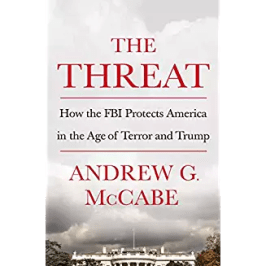 McCabe’s new book, The Threat: How the FBI Protects America in the Age of Terror and Trump, is not generally overstated in its approach to Trump. This reflects either an aversion to exaggeration on McCabe’s part—his self-image, it seems, is that of a just-the-facts-ma’am G-man—or an awareness that the Justice Department’s inspector general has, for all intents and purposes, branded him a fabulist, a charge he finds particularly wounding. McCabe, who was fired in March 2018, told me he’ll be filing a lawsuit against the Justice Department that will challenge the circumstances of his termination, which was ostensibly based on the inspector general’s findings that he had leaked information to the media without permission. In person, McCabe still seems awed by the “series of head-scratching, completely shocking events” that he witnessed two years ago.
You can read the interview at The Atlantic; here’s a brief excerpt:
Bertrand: Before Robert Mueller was appointed, Trump met with the Russian ambassador and foreign minister in the Oval Office, where he disclosed classified information. How did you react when you found out about that conversation?
McCabe: It was the latest in a string of head-scratching, completely shocking events. For counterintelligence investigators, the idea that the American president would have a Russian foreign minister and his media into the Oval Office and that he would make a comment like that—a comment that so clearly undermined the effectiveness of his chief law-enforcement and intelligence agency—was just confounding.
Bertrand: That reminds me of a passage that jumped out at me in your book: “He thought North Korea did not have the capability to launch such missiles. He said he knew this because Vladimir Putin had told him so … the president said he believed Putin despite the PDB [Presidential Daily Briefing] briefer telling him that this was not consistent with any of the intelligence that the US possessed.” How do you explain that?
McCabe: It’s inexplicable. You have to put yourself in context. So I am in the director’s chair as acting director. My senior executive who had accompanied the briefer to that briefing, who sat in the room with the president and others, and heard the comments, comes back to the Hoover Building to tell me how the briefing went. And he sat at the conference table, and he just looked down at the table with his hands out in front of him. I was like, “How did it go?” And he just—he couldn’t find words to characterize it. We just sat back and said, “What do we do with this now?” How do you effectively convey intelligence to the American president who chooses to believe the Russians over his own intelligence services? And then tells them that to their faces?
McCabe will be in studio with MSNBC’s Lawrence O’Donnell tonight.
In other news, Trump’s fake “national emergency” is accumulating lawsuits. The latest, from The New York Times: 16 States Sue to Stop Trump’s Use of Emergency Powers to Build Border Wall.
WASHINGTON — A coalition of 16 states, including California and New York, on Monday challenged President Trump in court over his plan to use emergency powers to spend billions of dollars on his border wall.
The lawsuit is part of a constitutional confrontation that Mr. Trump set off on Friday when he declared that he would spend billions of dollars more on border barriers than Congress had granted him. The clash raises questions over congressional control of spending, the scope of emergency powers granted to the president, and how far the courts are willing to go to settle such a dispute.
The suit, filed in Federal District Court in San Francisco, argues that the president does not have the power to divert funds for constructing a wall along the Mexican border because it is Congress that controls spending….
The lawsuit, California et al. v. Trump et al., says that the plaintiff states are going to court to protect their residents, natural resources and economic interests. “Contrary to the will of Congress, the president has used the pretext of a manufactured ‘crisis’ of unlawful immigration to declare a national emergency and redirect federal dollars appropriated for drug interdiction, military construction and law enforcement initiatives toward building a wall on the United States-Mexico border,” the lawsuit says.
Today is day four of the “emergency,” and Trump has spent those four days golfing in Florida and sending out angry tweets about Andrew McCabe and the Russia investigation.
This is also happening.
It will be interesting to see what happens to Roger Stone after he posted a threatening message about the judge in his case yesterday. Buzzfeed News: Roger Stone Posted A Photo Of The Judge Presiding Over His Case Next To Crosshairs.
The post comes days after the judge, US District Judge Amy Berman Jackson, rejected Stone’s effort to get his case reassigned to a new judge.T
Jackson also previously ruled that Stone couldn’t talk to news outlets in front of her courthouse.
Stone, 66, took to Instagram to bring attention to special counsel Robert Mueller, saying he used “legal trickery” to place his case in front of Jackson, a US district judge in the District of Columbia. Stone’s case is being prosecuted jointly by Mueller’s office and the US attorney’s office in Washington.
“Through legal trickery Deep State hitman Robert Mueller has guaranteed that my upcoming show trial is before Judge Amy Berman Jackson , an Obama appointed Judge who dismissed the Benghazi charges again [sic] Hillary Clinton and incarcerated Paul Manafort prior to his conviction for any crime,” Stone wrote in the caption to the photo, including the hashtag #fixisin….
The photograph — a version of which appeared earlier on a site pushing false conspiracy theories — featured a target symbol near the judge’s head. The symbol is also associated with the Zodiac killer.
That was completely irresponsible and could easily lead one of the Trump crazies to attack Judge Jackson. She will likely need protection from Federal marshals now. I hope she throws Stone in jail.
No word from the “president” on this as yet.
I’m sure you seen the embarrassing videos of Mike Pence’s appearance in Munich last week in which he was greeted with stony silence when he mentioned Trump and called for European countries to withdraw from the Iran deal. Well, the White House is claiming he did too get applause.
The Week: The White House says Pence was greeted with applause after mentioning Trump in a speech. He wasn’t.
Maybe they meant to type “(Crickets)”?
The White House has posted online the remarks made by Vice President Mike Pence last Friday at the Munich Security Conference, but there’s a glaring error. In the beginning of his address, Pence said it was his “great honor” to speak “on behalf of a champion of freedom and a champion of a strong national defense, the 45th president of the United States, President Donald Trump.” In the transcript, it says this was followed by “(Applause).” In reality, it was followed by (Silence).
As video from the event shows, Pence expected to be met with some sort of a reaction, as he paused, awkwardly, before moving on. The White House hasn’t said why it inserted this fabrication, or why they didn’t go with something more exciting, like (Audience starts chanting, “USA! USA! USA!” while twirling star-spangled rally towels) or (German Chancellor Angela Merkel dons a MAGA cap, initiates The Wave)
 Nancy Pelosi had a different message for our allies. Politico:Nancy Pelosi to Europe: Trump is not the boss.
Pelosi and a delegation of U.S. lawmakers were in Brussels on Monday and Tuesday to reassure European partners at a time when transatlantic relations have been deeply fractured by Trump’s criticism of allies and his unpredictability in policymaking.
Among the messages that Pelosi said she brought to the EU capital was that the U.S. president is not all-powerful. Of course, it was a lesson Europeans watched her teach Trump in the standoff over a recent government shutdown — where she forced the president to back down.
“We’re not a parliamentary government even though we’re parliamentarians,” Pelosi said at a news conference. “We have Article 1, the legislative branch, the first branch of government, coequal to the other branches and we have asserted ourselves in that way.”
Pelosi said that one European colleague had asked why the House of Representatives had only recently adopted a resolution in support of NATO. She said that she explained it was because she and the Democrats had only retaken control of the majority at the start of the year.
“I said because we just got the majority and then we can control, we can manage what goes on to the floor,” Pelosi said. “But once the Republican colleagues had the opportunity to vote on this, H.R. 676 NATO Support Act — what was it? 357 to 22 no’s. I think that that sends a very clear message.”
One more bit of news: Unfortunately Bernie Sanders has decided to run for president, and he’s already attacking “identity politics.”
Good luck with that, Bernie. Goddess I hate that man.
So . . . what else is happening? What stories are you following today?
Lazy Caturday Reads: Trump’s Fake National Emergency
Posted: February 16, 2019 Filed under: Afternoon Reads, U.S. Politics | Tags: declaration of national emergency, Donald Trump 32 CommentsGood Afternoon!!
I didn’t watch Trump’s insane speech yesterday; I only saw excerpts on Twitter and T.V. Now I’m reading the transcript, and once again I’m wondering how this befuddled man can actually be “president.”
Trump went to the WH Rose Garden to declare a “national emergency” on the border between the U.S. and Mexico, but he began the speech rambling claims about trade deals with China and the UK and then moved on to Syria, ISIS, and his upcoming meeting with North Korea’s Kim Jong Un, and then he vomited out this odd bit of word salad:
China’s been helping us and Russia’s been helping us. And South Korea, I think you can say, has been — we’ve been working very closely with South Korea, with Japan. But China, Russia on the border have really been at least partially living up to what they’re supposed to be doing, and that’s OK, as per the United Nations.
Does anyone know what that means? What border? What are they “partially living up to,” and why is it OK? He followed that with another long digression about North Korea that makes even less sense. Why is this person not in a straight jacket being taken to a hospital for a psychological evaluation?
After this irrelevant rambling, Trump finally seemed about to get to the point:
But then he goes off on another long rambling digression, bragging about his so-called accomplishments before seeming to get to the point once again. He begins talking about walls and how well they supposedly work. There’s an even longer digression about walls, his rally in El Paso, “angel moms,” caravans, and his claims that human traffickers bring women across the border tied up with tape over their mouths so they can’t possibly go through a port of entry, and drugs don’t go through ports of entry either–these traffickers and “drug lords” “go around the walls.”
Nowhere in this hour of verbal diarrhea does Trump provide any real evidence that we are confronting an actual “emergency.” In fact, at one point he says:
I could do the wall over a longer period of time, I didn’t need to do this, but I’d rather do it much faster. And I don’t have to do it for the election; I’ve already done a lot of wall for the election 2020. And the only reason we’re up here talking about this is because of the election, because they want to try and win an election which it looks like they’re not going to be able to do.
And this is one of the ways they think they can possibly win is by obstruction and a lot of other nonsense. And I think that I just want to get it done faster, that’s all.
On top of that, Trump left for Mar-a-Lago and long weekend of golf after signing the declaration! Some emergency.
 I won’t bore you and further with this, but I encourage you to read the transcript. Trump went on for about an hour just rambling, saying anything that came into his head. Even reading it is exhausting, because it makes almost so sense. Trying to follow what Trump spewed out yesterday is just crazy making. How can this person be “president?” We are in big trouble.
Here’s what people are saying about Trump’s emergency declaration.
Jonathan Chait: Trump’s Emergency Declaration Shows He Is Unfit for Office.
At worst, President Trump’s claim of emergency powers that would allow him to expand barriers on the southern border is a gross violation of democratic norms. At best, it is a craven ploy to cover his own blundering. Either way, it is a devastating indictment of his capacity to handle his job.
Begin with the worst-case scenario. As a matter of principle, the Constitution establishes a system that requires the House, Senate, and the president to approve new laws. In some cases, expediency requires the president to act unilaterally. Those rare cases are not defined as emergencies because they’re important — lots of policy is important, even life-threatening. The emergencies are cases where the executive needs to act in an especially urgent way, and where congressional involvement may not be practical.
Most of the uses of emergency powers involve foreign policy, an area where Congress has (for better or worse) ceded most of its authority to the president anyway. Presidents have not been able to use emergency powers to simply roll over congressional opposition. Bill Clinton considered health-care reform an extremely vital problem with literal life-and-death consequences — and he was right — but he never contemplated using some form of emergency powers to impose the reforms he couldn’t get Congress to enact.
Trump has of course tried to portray his power grab as just such an emergency. But illegal immigration is nothing like the kind of sudden crisis that justifies rapid action. It is a decades-long policy dispute, with border crossings now at levels well below that of a decade ago. The closest thing to a crisis is a recent surge in migrants seeking asylum, a process that entails crossing the border legally, and for which a wall is completely irrelevant. What’s more, Trump’s non-solution would take years to complete. The president’s lack of urgency to address the alleged border crisis during his first two years, when he had unified control of government, attests to his disingenuousness.
Trump’s extemporaneous commentary defending his emergency decision repeatedly gave away his own rationale. He admitted he could have passed border funding through Congress during his first year and a half, but he was “too new to politics,” and his fellow Republicans “didn’t step up.” He framed the border wall as a gambit for his campaign (“I’ve already done a lot of wall for the election — 2020.”). And he admitted the emergency declaration was a luxury rather than an emergency (“I didn’t need to do this. But I’d rather do it much faster.”). He is clumsily undermining his already-shaky legal case, while making it plain his ploy is to claim Executive powers to override an area of control for Congress.
Charlie Savage at The New York Times: Presidents Have Declared Dozens of Emergencies, but None Like Trump’s.
None of the times emergency powers have been invoked since 1976, the year Congress enacted the National Emergencies Act, involved a president making an end run around lawmakers to spend money on a project they had decided against funding. Mr. Trump, by contrast, is challenging the bedrock principle that the legislative branch controls the government’s purse.
“On the surface, this ‘Oh, other presidents do this, too’ line seems logical,” said Chris Edelson, an American University government professor and author of a 2013 book, “Emergency Presidential Power: From the Drafting of the Constitution to the War on Terror.” “But there is no example where a president asked for funding for something from Congress, Congress said, ‘No,’ and the president said, ‘I’ll use emergency powers to do it anyway.’” [….]
Trump tried to argue that previous presidents have declared national emergencies and it has been uncontroversial.
But a list of about 59 previous times when presidents since the Carter administration have invoked emergency powers, compiled for a recent study of presidential emergency powers for the Brennan Center for Justice at New York University School of Law, shows none that look like Mr. Trump’s declaration in crucial respects.
The overwhelming majority of those instances were moves by presidents to impose sanctions on various foreign officials and groups — freezing their assets and making it illegal for Americans to do business with them — for wrongdoing like human rights violations, terrorism or transnational narcotics trafficking. They attracted no controversy because Congress has wanted the executive branch to operate that way.
Congress has also enacted a statute that gave presidents, in a declared emergency “that requires use of the armed forces,” the power to redirect military construction funds to build projects related to that use. It is that statute that Mr. Trump is relying upon, and his administration argues that this means he is exercising authority that lawmakers wanted the presidency to be able to wield.
But Elizabeth Goitein, who oversaw the Brennan Center study, pointed to the widespread dispute over whether, as a matter of empirical reality, there exists a true emergency on the border that would be resolved by a wall, as well as to the fact that Congress already made clear it did not intend to spend extra billions of dollars on Mr. Trump’s wall.
Greg Sargent: Trump just plunged the country into dangerous new territory. Here’s what’s really at stake.
What’s at stake in this battle is a simple dilemma: Can the president declare a national emergency, and appropriate all the powers that this confers on him, when there isn’t any national emergency?
“That is the fundamental question,” Elizabeth Goitein, who has extensively researched national emergency law for the Brennan Center for Justice, told me….
The basic problem we face right now in this regard was created by Congress. The post-Watergate National Emergencies Act, or NEA, places various constraints on the powers the president has when he declares a national emergency. For instance, it requires the president to say which other statute he is relying on to exercise the particular authority he plans to employ under his declared emergency.
The NEA also creates a mechanism by which Congress can terminate the emergency by passing a resolution through both houses doing that. The House is likely to pass such a resolution, but it’s unclear whether the Senate will do so. Even if the Senate did pass it, Trump would veto it anyway, though the House still should try this to get GOP senators on the record.
But the NEA doesn’t define what an emergency is, giving the president tremendous discretion to do that himself. The core question we now face is whether that discretion is limitless.
 But will Trump get away with it? Was he correct yesterday when he claimed that he would lose in federal courts but the Supreme Court would accept his arguments, as they did with the Muslim ban?
Dahlia Lithwick at Slate: Trump Isn’t Just Defying the Constitution. He’s Undermining SCOTUS.
Legal scholars have done superb work laying out the complicated interplay between the National Emergencies Act of 1976 and the 1952 Supreme Court ruling in Youngstown Sheet & Tube Co. v. Sawyer. Justice Jackson, writing in a landmark concurrence in Youngstown, established three categories of presidential power: one in which the president acts pursuant to both his Article II authority and the authority granted by Congress; the next, a “zone of twilight” in which the president acts while Congress remains silent; and the third, which he deemed the “lowest ebb” of presidential authority, where the president acts over the objections of Congress. The Emergencies Act, however, is broad and vague. Noah Feldman says declaring an emergency when none exists is clearly unconstitutional. Elizabeth Goitein argues that the courts may give Trump the green light under the broad statutory authority of the National Emergencies Act. David French says the declaration is illegal. The truth is, of course, that what legal experts and academics think is much less relevant than what actual judges will do. And the president was absolutely clear in his announcement that he has that part in the bag.
Having conceded that he’s only declaring an emergency because he “wanted to get it done faster,” Trump assured the crowd assembled in the Rose Garden that “I’ll sign the final papers as soon as I get into the Oval Office, and we will have a national emergency. We will then be sued and they will sue us in the 9th Circuit, even though it shouldn’t be there. We will possibly get a bad ruling, we’ll get another bad ruling, and we’ll end up in the Supreme Court, and hopefully we’ll get a fair shake and we’ll win in the Supreme Court. Just like they did on the ban, and we lost and we went to the Supreme Court and we won.”
 I hope Chief Justice Roberts was paying attention yesterday. I wonder how he’ll react to Trump’s claim that SCOTUS will rubber stamp anything he (Trump) decides to to?
A few more relevant links to check out:
The Washington Post: ‘A recipe for disaster’? Trump’s border emergency drags the GOP into a risky fight ahead of 2020.
The Washington Post: Words are a president’s strongest weapon. Trump is terrible at words.
Lawfare: What Authorities Is President Trump Using to Build a Border Wall?
The New York Times: Trump’s Emergency Declaration Is the First Since 9/11 to Authorize Military Action.
Lawfare: How Congress and President Obama Made Trump’s Wall Possible.
LA Times: President Trump is the national emergency.
CBS: Trump’s emergency declaration is already facing legal challenges.
My head is spinning from trying to make sense of something that will never make sense. We need to get rid of Trump. I don’t think we can wait for Robert Mueller to solve this problem. Congress should be holding impeachment hearings. Everyone but the most deluded Trumpers can see that the emperor has no clothes.
What else is happening? What stories have you been following?

 peej
peej Carissa
 bostonboomer
 dakinikat
 ecocatwoman
 mablue2
 Mama Lopez
 peggysue22
 quixote
 skydancingguestblogger
 Mona (aka Wonk the Vote)



 Sky Dancing
Recent Comments