
Wintry Tuesday Reads: Impeachment News
Posted: December 17, 2019 Filed under: morning reads, U.S. Politics | Tags: impeachment 36 Comments
John Singer Sargent, Country Road in Winter
Good Morning!!
Tomorrow the House votes on articles of impeachment; today there will be demonstrations in support of impeachment around the country.
What will come next is still up in the air. Yesterday, the House Judiciary Committee released their impeachment report. On Sunday, Senate Majority Leader Chuck Schumer released a letter to Mitch McConnell, requesting witnesses at the impeachment trial.
Senate Minority Leader Schumer wrote a letter to Senate Majority Leader Mitch McConnell Sunday evening, calling for at least four witnesses to testify in a Senate impeachment trial. Those witnesses include: acting White House chief of staff Mick Mulvaney, former national security adviser John Bolton, senior adviser to the acting White House chief of staff Robert Blair and Office of Management and Budget official Michael Duffey.
Read the letter at the CNN link above. McConnell has already rejected the request. All he wants is a fake “trial” and a quick dismissal of the charges.

Paul Gauguin – Winter Landscape
Jennifer Rubin at The Washington Post: Schumer has these five advantages in impeachment.
The first is that the Senate is not the House. Not yet. There is a reason Schumer focused on potential Republican objectors to McConnell’s rush to a verdict…He essentially said that if senators do not support a real trial, they leave themselves open to the charge that they (like Trump) are part of a “coverup.” Unlike the House, the Senate might contain a small number of Republicans who care about such things, or at least worry they might lose independent voters in swing states by advancing outrageous arguments on process/fairness and then voting to let Trump off the hook.
Another advantage for Schumer is Republicans’ own propensity to overreach as they play to an audience of one (Trump). Sen. Lindsey O. Graham (R-S.C.) took a surprising amount of heat for snubbing his role as an impartial juror, as did McConnell for openly assuring the base he was colluding with Trump’s lawyers….
Third, while there are so far only a couple, Republican non-officeholders are beginning to pop up. Former Homeland Security secretary Tom Ridge (“As far as I’m concerned, it is abuse of power”) and former presidential candidate Carly Fiorina (“destructive to the republic”) both have publicly stated that they support impeachment. The less open and fair the trial, the more figures on the right may begin to emerge, however timidly, suggesting the only “hoax” is the Republicans’ fake trial.
Finally, Schumer is also aided by the horribly weak response from Republicans. Their line is that Democrats should have gotten all the facts in the House and, now, it’s effectively too late. This is balderdash. The House effectively indicts; the Senate tries the case. As in every trial in the United States, lots of witnesses might become available between the indictment and the trial. That is normal and appropriate; the “solution” is not to exclude it because the grand jury found enough evidence for an indictment. Republicans really cannot simultaneously claim there is not enough evidence and then refuse to cooperate in getting it.

Edvard Munch, Workers in the Snow
Professor Lawrence Tribe weighed in at The Washington Post: Don’t let Mitch McConnell conduct a Potemkin impeachment trial.
For some time now, I have been emphasizing the duty to impeach this president for abuse of power and obstruction of Congress regardless of what the Senate might end up doing. Now that President Trump’s impeachment is inevitable, and now that failing to formally impeach him would invite foreign intervention in the 2020 election and set a dangerous precedent, another option seems vital to consider: voting for articles of impeachment but holding off for the time being on transmitting them to the Senate.
This option needs to be taken seriously now that Majority Leader Mitch McConnell (R-Ky.) has announced his intention to conduct not a real trial but a whitewash, letting the president and his legal team call the shots.
Such an approach could have both tactical and substantive benefits. As a tactical matter, it could strengthen Senate Minority Leader Charles E. Schumer’s (D-N.Y.) hand in bargaining over trial rules with McConnell because of McConnell’s and Trump’s urgent desire to get this whole business behind them. On a substantive level, it would be justified to withhold going forward with a Senate trial. Under the current circumstances, such a proceeding would fail to render a meaningful verdict of acquittal. It would also fail to inform the public, which has the right to know the truth about the conduct of its president.
Read the rest of Tribe’s argument at the link.

Sacre Coer in Winter, Maurice Utrillo
At Politico, Edward B. Foley offers another suggestion: Here’s One Surprising Way Congress Could Avoid an Impeachment Disaster.
If the process plays out as everyone believes it will, impeachment will end with an acquittal in the Senate, and the House’s efforts to protect the integrity of the 2020 election will have proved counterproductive: President Donald Trump, claiming a “ full exoneration,” could be emboldened to engage in misconduct similar to or even worse than his interactions with Ukraine.
But there is a way out of this mess that would let the House impeach him—while allowing the Senate only to censure Trump, rather than having to vote to convict or acquit him. The House could express its disapproval of Trump through an impeachment vote, and the Senate, through censure rather than a trial, could embrace, even enhance, the House’s message. Yes, Trump would stay in office. But because both chambers of Congress would be on the record in officially condemning his conduct, there is a decent chance this approach might deter Trump from similar elections abuse.
This might work with normal president, but does anyone really think this would deter Trump? I don’t. Still, here’s more of Foley’s argument:
We can call this strategy “conditional impeachment.” Here’s how it would work: The House adopts its articles of impeachment, as it is planning to do. But it also adopts a separate resolution saying that the House will deliver the impeachment articles to the Senate only if the Senate fails to censure the president for his Ukraine-related misconduct by a specified date. If the Senate does censure Trump, the House could refrain from delivering the articles of impeachment to the Senate at all.
Pablo Picasso, Winter Landscape
This scheme might seem ambitious. But, as the House prepares for its floor vote on Wednesday, the plans relating to the handoff of impeachment to the Senate seem to be fluid, and there is growing sentiment that Speaker Nancy Pelosi should avoid sending articles to a quick Senate demise….
The idea of “conditional impeachment” is not in the Constitution, but the Constitution clearly allows it. There is no constitutional obligation for the House to deliver articles of impeachment to the Senate for a trial—only that if there is to be an impeachment trial, then the authority to conduct that trial is exclusively lodged in the Senate. If the House wants to adopt its articles of impeachment but never send them to the Senate for trial, that is within the House’s “sole power of impeachment,” as granted in the Constitution (Article I, Section 2). That “sole power” also means the House has the authority to predicate its withholding of the articles of impeachment on a specific condition.

The problem with this is that nothing short of a vote for removal is likely to stop Trump. Even then, he might fight to stay in the White House.
Another point of view from Jonah B. Gelbach at The Los Angeles Times: Opinion: How Democrats can call the Republicans’ bluff on impeachment.
In the weeks since the House impeachment hearings started, Republicans have flitted from one argument to the next to try to convince Americans that the process lacks validity. One point they have made repeatedly is that the evidence is largely hearsay, and therefore invalid.
Claude Monet – Boulevard Saint Denis
I teach federal evidence law, and that argument doesn’t hold water. Much of the testimony in the record wouldn’t be hearsay at all under federal court rules, and other statements would be admissible under one or another hearsay exception. Moreover, as Senate Republicans have made obvious with their recent proclamations about how the Senate should proceed, an impeachment trial isn’t a federal court proceeding.
It’s an absurd situation. Republicans say the evidence isn’t up to snuff. Yet the very man under investigation, President Trump, is the one who has blocked the testimony of witnesses who might strengthen the case.
The time has come for congressional Democrats to call the Republicans’ bluff: They should go to court to compel testimony from key members of Trump’s inner circle who have firsthand knowledge of the president’s dealings with Ukraine, including former national security advisor John Bolton and White House acting Chief of Staff Mick Mulvaney. These witnesses should tell the House what they know, under oath, even if that means delaying a vote on the articles of impeachment.

Click on the link to read the rest.
One more from CNN: Disparate group of Republican senators worry White House and GOP leaders ahead of impeachment trial.
Senate Minority Leader Chuck Schumer’s high-profile push for witnesses to testify in the Senate’s expected impeachment trial of President Donald Trump shifted attention and political pressure on Monday to a handful of Republican senators who have worked diligently to avoid the spotlight.
Winter scene by Bato Dugarzhapov
The disparate group’s views on the trial are a concern to the White House and GOP leaders, who are worried some could break and vote with Democrats on key trial-related issues, sources tell CNN.
If four of them were to buck calls from GOP leaders for a short, witness-free trial, it could upend the process and create the kind of wild uncertainty Senate Majority Leader Mitch McConnell says he has been carefully “coordinating” to avoid in ongoing talks with top White House officials.
The group includes moderates up for reelection, like Sen. Susan Collins of Maine, who may want to show independence from Trump; seasoned veterans, like Sen. Lamar Alexander of Tennessee, who are retiring and who may not feel politically bound to support the President; and outright critics of Trump, like Sen. Mitt Romney of Utah, who have challenged his unorthodox presidency and who may want to learn more about the allegations of a quid pro quo with Ukraine that is at the heart of the impeachment.
The group isn’t big enough to threaten Trump’s presidency — there would have to be at least 20 Republicans break with Trump to provide the 67 votes needed to actually remove him from office and no one is predicting that. But if enough peel off they could provide Democrats with the 51 votes needed for key wins, such as to compel witnesses, demand documents and push through other procedural motions Democrats may seek during a trial.

We have some momentous days ahead. Now what stories are you following today?
Saturday Reads: Today is the 7th Anniversary of the Sandy Hook School Schooting
Posted: December 14, 2019 Filed under: morning reads, U.S. Politics | Tags: Newtown CT, Sandy Hook School Shooting, school shootings 14 Comments
Today is the 7th anniversary of the Sandy Hook school shooting in Newtown, Connecticut. Looking back, after all the horrendous school shootings that followed and the lack of any serious response by the federal government, we can see clearly how the NRA, along with Russia, has taken control of the Republican Party. We now know that Russia worked with the NRA to elect an evil wannabe dictator to the U.S. presidency.
From Wikipedia:
The Sandy Hook Elementary School shooting occurred on December 14, 2012, in Newtown, Connecticut, United States, when 20-year-old Adam Lanza shot and killed 26 people, including 20 children between six and seven years old, and six adult staff members. Wikipedia
Survivors and supporters are posting remembrances on Twitter. Among them is this story that Senator Chris Murphy about one of the lost children, Daniel Barden.
A reminder that Democrats are trying to make changes to our insane gun laws:
From Everytown Research: Gunfire on School Grounds in the United States.
There were at least 100 incidents of gunfire on school grounds in 2019, resulting in:
- 26 deaths, including 3 suicide deaths (where no one else was harmed) and
- 63 injuries, including 0 self-harm injuries (where no one else was harmed)
Everytown for Gun Safety started tracking incidents of gunfire on school grounds in 2013 to gain a better understanding of how often children and teens are affected by gun violence at their schools and colleges, and in response to a lack of research and data on the issue.
Students who walked out of their Montgomery County, Maryland, schools protest against gun violence in front of the White House in Washington, U.S., February 21, 2018. REUTERS/Kevin Lamarque TPX IMAGES OF THE DAY – RC195C982280
Over six years of tracking, this data has shown us that gunfire on school grounds takes many forms and mirrors the problem of gun violence in America. Gunfire on school grounds occurs most often at schools with a high proportion of students of color—disproportionately affecting Black students. For more information, click here to read the analysis of this data and learn about proven solutions that can make schools in America safer.
When it comes to how American children are exposed to gun violence, gunfire at schools is just the tip of the iceberg–every year, nearly 2,900 children and teens are shot and killed and nearly 15,600 more are shot and injured. An estimated 3 million American children are exposed to shootings per year. Witnessing shootings — whether in their schools, their communities or their homes– can have a devastating impact. Children exposed to violence, crime, and abuse are more likely to abuse drugs and alcohol; suffer from depression, anxiety, and posttraumatic stress disorder; fail or have difficulties in school; and engage in criminal activity.
See a map and a list of the incidents at the link. The most recent was on Dec. 2.

Since Columbine permanently etched horrific images into the national consciousness two decades ago, the scene has played out again and again. And school districts around the country have girded themselves against that dreaded scenario, performing drills, hiring armed guards and preparing safety plans.
According to the FBI, there have been 42 “active shooter” incidents at Pre-K through 12 school grounds from 2000-2018, which the bureau defines as “an individual actively engaged in killing or attempting to kill people in a populated area.” These include the high-profile incidents like Parkland and Sandy Hook.
But this definition obscures many school shootings — more than two dozen in 2019 alone, according to an ABC News analysis of incidents at K-12 schools — many of which pass under the radar, but impact the students, teachers and communities where they occur….
During the third week of November alone, officers responded to crime scenes on the East and West coasts: in Pleasantville, New Jersey, where a 10-year-old child was killed during a football game, and in Santa Clarita, California, where a teen opened fire on his classmates, killing two and wounding several more at Saugus High School.
With no nationally accepted definition, sorting out what constitutes a school shooting is difficult. Everytown, an independent, non-profit group that studies gun violence, reports it has tracked at least 99 incidents of gunfire on school grounds in 2019 alone (through Dec. 11), including three suicides and 63 injuries….
ABC News has reviewed the database from the non-profit Gun Violence Archives, and, for the purposes of this story, defined a school shooting as an incident where an alleged assailant steps onto the property of an educational institution — during school hours or during an extracurricular activity on the property — and fires a gun at another person, in order to present a fuller picture of violence at schools not covered by the FBI “active shooter” rubric.
Based on news reports and data collected by the Gun Violence Archive, ABC News has found 26 such shootings since January — with half occurring on Fridays. The most violent month was in September, where seven shootings were reported at high schools in Pennsylvania, South Carolina, Texas and Virginia. July was the safest month, according to ABC News’ report.
See a list of the school shootings ABC identified in 2019 at the link.
The New York Times: The Yearbook That Victims of School Shootings Never Collected.
The black, hard-bound book with black lettering is meant to look stark. The harsh cover with only “2018” on its top purposely does not resemble the colorful fronts of normal yearbooks, which “should be about commencement, hopes and dreams and what comes next in life,” its website says.
“Unfortunately,” it adds, “this yearbook is about none of those things.”
It’s a yearbook for people killed in school shootings in 2018.
Yearbook of School Shooting Victims
Created by a group that includes a Parkland survivor and a Sandy Hook mother, as well as several nonprofit organizations, the 2018 yearbook memorializing 37 victims who were fatally shot while under the protective mantle of education has one goal: Stop the violence.
The group is shipping copies of the yearbook to all members of the United States Senate, the governors of every state, each of the 2020 presidential candidates, and President Trump.
“When you lose a child, that pain is with you, every day, all day long,” said Scarlett Lewis, one of the yearbook’s organizers and the mother of Jesse Lewis, 6, who was killed at Sandy Hook Elementary School in Newtown, Conn., on Dec. 14, 2012.
This Saturday will be the seventh anniversary of the massacre at Sandy Hook, where Adam Lanza shot and killed 20 first-grade students and six staff members before killing himself as police arrived at the school. Earlier in the day, Mr. Lanza shot and killed his mother.Before he was shot, Jesse Lewis saved the lives of several classmates after he urged them to flee from the gunfire as Mr. Lanza reloaded, The Hartford Courant reported in October 2013. His mother, who founded the nonprofit Jesse Lewis Choose Love Movement, said she tries to embody that courage daily.
“I want this project to spur everyone into action,” she said. “The opposite of anxiety is action.”

The Hartford Courant: After years of planning, ‘The Clearing’ is a memorial that will honor the 26 victims who died at Sandy Hook Elementary School.
From a bird’s-eye view, the memorial renderings show a web of paths swirling inward from an expansive circle. Looping through gardens, tree groves and ponds, they join at a single point: a sycamore tree, surrounded by a reflecting pool.
Years in the making, “The Clearing” is Newtown’s proposed design for a public memorial honoring the 26 victims murdered in the Sandy Hook Elementary School shootings on Dec. 14, 2012. Its creators envision a place to remember and respect the deep grief that families here have endured.
Aerial rendering of the Sandy Hook Permanent Memorial design. Courtesy of SWA Group.
Budget issues initially halted progress, but the local board of selectmen and the memorial commission are now ready to move forward. If Newtown voters approve funds for the project next year, the memorial could open by December of 2021.
“For me, it’s not so much about the design, but about what it represents,” said Scarlett Lewis, whose son Jesse Lewis was one of the children killed in the tragedy.
Lewis was an early member of The Sandy Hook Permanent Memorial Commission before founding the Jesse Lewis Choose Love Foundation to prevent school shootings. Although she is no longer a part of the commission, she continues to support the memorial.
“It’s incredibly important to honor and remember,” she said. “It takes courage to remember, and it’s a great way to learn from past mistakes.”

Survivor stories from AP: As Newtown students grow up, some turn to activism.
NEWTOWN, Conn. (AP) — They were children themselves when they lost siblings, friends, and schoolmates in the Sandy Hook Elementary School shooting. Too young to comprehend the massacre, they spent years in shock and denial.
Seven years later, some young people in Newtown, still struggling with the trauma, are emerging as new voices for school safety and gun violence prevention. The activism, they say, has been a way to turn something horrific into something positive.
Natalie Barden was 10 when her brother, Daniel, 7, was killed. She attended a different school that went into lockdown as word of the shooting spread. She remembers being annoyed that morning as Daniel hugged her while they got ready for school.
Rendering of the Sandy Hook Permanent Memorial reflecting pool. Courtesy of SWA Group.
Her favorite memories are of sleeping on Daniel’s bed with Daniel and their older brother, James, because it was the biggest, and watching television, playing board games and wrestling.
Her father, Mark Barden, became an activist with the Sandy Hook Promise group he helped create after the shooting. Natalie disliked the media attention and interviews in their home because they brought back the pain of losing Daniel.
“When you’re that young, it’s really hard to wrap your mind around it,” said Natalie, now a 17-year-old senior at Newtown High School. “Your sibling is such a big part of your life, and to know your brother for only seven years is gone — I still can’t wrap my mind around it. When I got to high school, it really hit me.”
As she entered school, the shock was wearing off. Then 17 people were killed in the February 2018 shooting at Marjory Stoneman Douglas High School in Parkland, Florida. She was inspired by the Parkland teens who demanded action on gun control….
“That just kind of pushed me to become more involved with the whole youth movement,” Natalie said in an interview.
Her sophomore year, Natalie joined the Junior Newtown Action Alliance, the youth arm of the Newtown Action Alliance, a local group dedicated to promoting gun control measures.
In this Dec. 3, 2019, photo, Mark Barden and his daughter Natalie Barden hold a photograph of Natalie’s late brother, Daniel, at their home in Newtown, Conn. (AP Photo/Dave Collins)
She has called the offices of federal lawmakers, urging them to pass gun control bills, including an assault weapons ban. She began going on speaking engagements with her father.
An article she wrote for Teen Vogue last year sparked positive feedback from others affected by mass shootings, she said. She also wrote about her brother, feelings of loss and hope for the future in a chapter of a book published earlier this year, “If I Don’t Make It, I Love You: Survivors in the Aftermath of School Shootings.”
“I lost my brother, so I know how life-shattering a gun can be,” she said. “I think it’s just human nature to want to prevent others from feeling that way. We’ve kind of lost our innocence. We can’t sit back and ignore it.”


Read the other stories at the AP link.
One more from The Washington Post: My son survived Sandy Hook. It’s changed me as a parent, by Sarah Walker Caron.
When the first few chords of Jewel’s “You Were Meant for Me” blasted through the loudspeakers, I smiled. But moments later, tears gathered in my eyes, and I fought the urge to break down.
It was a chilly October Saturday afternoon in Maine, when the leaves were a rustling, vibrant array of oranges, reds and magentas. Thousands of people crowded the area, waiting to cheer on the racers.
My son warmed up with his cross-country teammates, readying themselves for their race. Nearby, girls from dozens of high school teams stood at the starting line, waiting for their race to begin.
As the song swirled around all of us — the runners, the parents, the friends — the girls at the starting line broke into song, singing along with loud, strong voices. Dozens of girls, representing dozens of teams, they were brought together in that moment, vibrant, full of life, energetic.
Tears collected in my eyes and dripped down my cheeks. It was a beautiful moment that left me shaken. The camaraderie, the sweetness, the life inside those girls took my breath away. I didn’t even know them. A few deep breaths helped. But the underlying reason I cried can’t be breathed away.
My son — my vibrant, athletic 14-year-old — is a mass shooting survivor.
His life continued because the gunman chose to enter the classroom across the hall, instead of his. It’s a sobering fact that is never far from my consciousness, though I wish it could be. Seven years ago, on Dec. 14, 2012, Will was a 7-year-old second-grader at Sandy Hook Elementary School.
Read the rest at the WaPo.
I know there is plenty of other news today; but after I opened Twitter this morning, I decided to focus on the Sandy Hook Anniversary. Please post your thoughts and links on any topic in the comments. This is an open thread.
Thursday Reads: Obedience to Authority and Impeachment
Posted: December 12, 2019 Filed under: morning reads, U.S. Politics | Tags: authoritarianism, Donald Trump, impeachment, Milgrim experiment, Mitch McConnell, obedience, Stanley Milgrim 27 Comments
Good Morning!!
I haven’t been able to watch much of the impeachment debate last night and today. I just can’t stand to listen to the Republicans shouting nonsense over and over again. Why have these people willingly submitted to an ignorant, dementia-riddled, narcissistic authoritarian “president?” Are we really going to allow our country to become a dictatorship because these cowards refuse to stand up to a pathetic man like Trump? Are there really no Republicans with the courage to defend the Constitution? What is wrong with these people?
Yesterday, I came across an article in Scientific American Mind that is highly relevant to these questions. I’m sure you remember the famous experiment by social psychologist Stanley Milgrim that demonstrated that most people will obey an authority figure even if it requires them to physically hurt other human beings. Here’s a brief video explaining the experiment:
Rethinking the Infamous Milgram Experiment in Authoritarian Times, by Jacob M. Appel
In brief, Milgram, at the time a 26-year-old assistant professor at Yale University, recruited subjects to participate “in a study of memory and learning,” which entailed administering an associative learning task to another subject (actually an accomplice in the study) and then administering painful shocks of substantially higher voltage for each incorrect answer. The purported goal was to study human obedience in the wake of the atrocities of Nazi Germany when, as Milgram described it, “millions of innocent persons were systematically slaughtered on command.” The results proved “surprising” in “the sheer strength of obedient tendencies”; in this first reported experiment, 26 of 40 American subjects shocked the victims at the highest level. Twenty variations with more than 600 additional subjects yielded similar outcomes…..
But what should the takeaway be from Milgram’s research? For more than a half century, investigators—most prominently Thomas Blass—have sought to explain why Milgram’s subjects proved so obedient. Although correlates have been found with personality, internal versus external locus of control, underlying belief systems and situational factors, no answer has proven entirely satisfactory.
Instead, the public is generally left with Milgram’s own impression as explained in his book Obedience to Authority: An Experimental View (1974): “Tyrannies are perpetuated by diffident men who do not possess the courage to act out their beliefs.” Or, even more broadly, in the subtitle of his Harper’s article from the previous year: “A social psychologist’s experiments show that most people will hurt their fellows rather than disobey an authority.”
 But some participants in Milgram’s study did refuse to obey.
Blass has noted that there must be “individual differences in obedience … because in most obedience studies, given the same stimulus situation, one finds both obedience and disobedience taking place.” In other words, some people do disobey. Some of Milgram’s subjects did defy the experimenter. Like Jan Rensaleer, a Dutch immigrant who responded to the experiment’s warning that he had no other choice to continue at 255 volts with the following memorable declaration:
“I do have a choice. Why don’t I have a choice? I came here on my own free will. I thought I could help in a research project. But if I have to hurt somebody to do that, or if I was in his place, too, I wouldn’t stay there. I can’t continue. I’m very sorry. I think I’ve gone too far already, probably.”
In some cases, the subject stood up during the experiment and walked away.
So maybe it is a mistake to view Milgram’s work as an “obedience experiment”—although he clearly did. Maybe what he actually conducted was a disobedience experiment, showing that some people will not follow orders no matter how strong the social pressure.
They are out there, waiting the moment when history calls upon them to disobey. We should not lose sight of them in the weeds of social psychology. They are Stanley Milgram’s unheralded legacy—and we may even stand among them.
Will any Republicans find the will to disobey Trump and McConnell? What will we do when the time comes for us fight back against the growing authoritarianism in our government and its institutions?
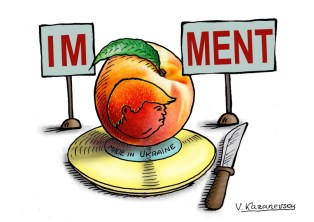 Here’s the latest on impeachment:
Senate Majority Leader Mitch McConnell is expected to hold a final vote to acquit President Donald Trump, should he be impeached, when a majority of senators believe his trial has run its course instead of holding a vote on dismissing the articles of impeachment, two Republican senators told CNN on Wednesday.
Republicans want to have a vote on acquittal — to clear the President of the charges against him — not simply rely on a 51-vote threshold procedural motion to dismiss the hotly disputed case.
The Constitution mandates 67 votes are required to convict the President and remove him from office, a barrier widely considered too high to be reached in this case.
One vote McConnell can’t rely on is that of Vice President Mike Pence, who has “no role in impeachment,” according to a GOP leadership aide, despite being president of the Senate with the mandate to break ties….
McConnell hinted at this strategy when he spoke to reporters on Tuesday and said the Senate would have two choices after hearing opening arguments from the House impeachment managers and the President’s defense counsel.
“It could go down the path of calling witnesses and basically having another trial or it could decide — and again, 51 members could make that decision — that they’ve heard enough and believe they know what would happen and could move to vote on the two articles of impeachment,” he said. “Those are the options. No decisions have been made yet.”
 The Washington Post: Senate Republicans look to hold short impeachment trial despite Trump’s desire for an aggressive defense.
Senate Republicans are coalescing around a strategy of holding a short impeachment trial early next year that would include no witnesses, a plan that could clash with President Trump’s desire to stage a public defense of his actions toward Ukraine that would include testimony the White House believes would damage its political rivals.
Several GOP senators on Wednesday said it would be better to limit the trial and quickly vote to acquit Trump, rather than engage in what could become a political circus.
“I would say I don’t think the appetite is real high for turning this into a prolonged spectacle,” Senate Majority Whip John Thune (S.D.), the chamber’s second-ranking Republican, told The Washington Post on Wednesday when asked whether Trump will get the witnesses he wants in an impeachment trial. “Members want to deal with the arguments, hear the case and hopefully reach a conclusion.”
The emerging Senate GOP plan would provide sufficient time, possibly two weeks, for both the House impeachment managers and Trump’s attorneys to make their arguments before a vote on the president’s fate, according to 13 senators and aides familiar with the discussions, who like others spoke on the condition of anonymity to describe the private talks.
Most notably, a quick, clean trial is broadly perceived to be the preference of Senate Majority Leader Mitch McConnell (R-Ky.), who wants to minimize political distractions in an election year during which Republicans will be working to protect their slim majority in the chamber.
The tension now is over whether to allow witnesses who could turn the trial into an even more contentious affair.
 But a lot can happen in two weeks. How will the public react to a sham trial? How horrible will Trump’s behavior become? McConnell has a problem:
McConnell is not sure Republicans have enough votes to only call Trump’s preferred list, the person said. Any agreement to call a witness would require 51 votes, and if Democratic votes were needed to end an impasse among Republicans, Senate Minority Leader Charles E. Schumer (D-N.Y.) would demand his own list of witnesses as part of any compromise.
Under McConnell’s thinking, this could possibly mean calling Vice President Pence and top White House aides, such as acting chief of staff Mick Mulvaney, to testify.
“Witnesses would be a double-edged sword,” Sen. Mike Braun (R-Ind.) said.
So McConnell will probably try to avoid calling witnesses? Will there be public outrage? I don’t know. I guess we are going to find out.
More reads, links only:
Kurt Bardella at NBC News: House Republicans’ Trump impeachment strategy was simple: Distract, deceive and yell.
EJ Dionne at The Washington Post: Our country is accepting the unacceptable.
Jonathan Bernstein at Bloomberg: Abuse of Power? Republicans Seem OK With It.
CNN: FBI agents warn of ‘chilling effect’ from Trump and Barr attacks.
The Washington Post: Eric Holder: William Barr is unfit to be attorney general.
Bloomberg: Giuliani Ally Parnas Got $1 Million From Russia, U.S. Says.
Emma Green at The Atlantic: American Jews Are Terrified.
The Daily Beast: Ukrainians: Trump Just Sent Us ‘a Terrible Signal’
Anne Applebaum at The Atlantic: The False Romance of Russia. American conservatives who find themselves identifying with Putin’s regime refuse to see the country for what it actually is.
John F. Harris at Politico: What if Trump weren’t nuts?
Tuesday Art and Reads
Posted: December 10, 2019 Filed under: morning reads, U.S. Politics | Tags: Adam Schiff, art, articles of impeachment, Christopher Steele, Christopher Wray, Cover-Up General Barr, Do Fornier, Donald Trump, Eric Swalwell, FBI, Gerry Nadler, IG Michael Horowitz, IG report, Ivanka Trump, John Durham, Nancy Pelosi 39 Comments
Good Morning!!
The paintings in today’s post are by Do Fournier, a contemporary French painter. Here’s a little information about her:
Do Fournier (French, b.1951) is a Contemporary painter, originally from Guerande, Brittany, France. She began her career as a successful illustrator, and, in 1984, changed her focus to the creation of her own paintings. Her works were well received, and numerous prestigious exhibitions of her artworks have been mounted in France. In addition, she has frequently been invited to exhibit at the Salon d’Automne in Paris.
Fournier creates fantastic, colorful, and intimate works inspired by her home in France, which overlooks the sea. Her family and pets, as well as her collection of objects d’art, rugs, and textiles, are her primary subjects.
As the noted French critic Gerard Xuriguera has observed: “Her approach in an uneasy society is not to describe it’s pain but the potential it still has for joy, it’s fragile moments of charm and peacefulness stolen from a routine existence. To do this she expresses reality in its most intimate, sensual, peaceful and carnal form. Not as imitation but as a vision filtered through her observations and cast in the exuberance of her blazing colours. What she is trying to capture is fleeting emotion, to immobilize it and express it as simply as possible.

Breaking News
Right now I’m watching a press conference by House Leader Nancy Pelosi and the chairs of the five House committees involved in the impeachment investigation.
In yesterday’s impeachment hearing, Rep Eric Swalwell spelled out the case against Trump in no uncertain terms.
https://twitter.com/QasimRashid/status/1204164336681463808
Today’s Reads
The New York Times: Another Inquiry Doesn’t Back Up Trump’s Charges. So, on to the Next.
President Trump and his allies spent months promising that a report on the origins of the F.B.I.’s Russia investigation would be a kind of Rosetta Stone for Trump-era conspiracy enthusiasts — the key to unlocking the secrets of a government plot to keep Mr. Trump from being elected in 2016.
On that point, the report by the Justice Department’s inspector general, Michael E. Horowitz, did not deliver, even as it found serious problems with how F.B.I. officials justified the surveillance of a Trump campaign aide to a federal court.
But by the time it was released, the president, his attorney general, his supporters in Congress and the conservative news media had already declared victory and decamped for the next battle in the wider war to convince Americans of the enemies at home and abroad arrayed against the Trump presidency.
They followed a script they have used for nearly three years: Engage in a choreographed campaign of presidential tweets, Fox News appearances and fiery congressional testimony to create expectations about finding proof of a “deep state” campaign against Mr. Trump. And then, when the proof does not emerge, skew the results and prepare for the next opportunity to execute the playbook.
That opportunity has arrived in the form of an investigation by aRea Connecticut prosecutor ordered this year by Attorney General William P. Barr — and the president and his allies are now predicting it will be the one to deliver damning evidence that the F.B.I., C.I.A. and even close American allies conspired against Mr. Trump in the 2016 election.
Read the rest at the NYT.
One startling revelation from the IG report was that Ivanka Trump has been friends with Christopher Steele for years.
ABC News: ‘Dossier’ author Chris Steele met Ivanka Trump years before Russia scandal, source says.
Nearly a decade before the 2016 presidential campaign, Donald Trump’s daughter Ivanka met a British intelligence officer who ran the Russia desk — and when the agent left his covert service and moved into private practice in 2010, she stayed in touch, ABC News has learned.
Artist Do Fournier
The two exchanged emails but never worked together, and the man, Christopher Steele, would one day re-emerge in a most unexpected way, taking a central role in the Russia scandal that consumed the early years of her father’s presidency, according to a source familiar with their past contacts.
The prior relationship came to light as investigators with the Department of Justice Inspector General’s office was looking into allegations of political bias at the origins of the Russia investigation since May 2018….
In 2007, Ivanka Trump met Steele at a dinner and they began corresponding about the possibility of future work together, the source said. The following year, the two exchanged emails about meeting up near Trump Tower, according to several emails seen by ABC News. And the two did meet at Trump Tower according to the source. The inspector general’s report mentions a meeting with a “Trump family member” there. They suggest Ivanka Trump and Steele stayed in touch via emails over the next several years. In one 2008 exchange they discussed dining together in New York at a restaurant just blocks from Trump Tower.
Ivanka Trump worked as an executive vice president at the Trump Organization, managing a range of foreign real estate projects, including in parts of the world where Steele’s firm, Orbis Business Intelligence touted expertise. She and Steele discussed services Orbis could offer to the Trump Organization regarding its planned expansion into foreign markets, according to two sources familiar with the meetings.

Read more at ABC News.
Also from ABC News: FBI Director Chris Wray reacts to DOJ watchdog report on Russia investigation: Exclusive.
FBI Director Christopher Wray offered mixed reactions to a Justice Department watchdog report that uncovered “serious performance failures” on the part of agents involved in the Russia investigation but ultimately determined the bureau was justified in launching its probe.
Artist Do Fournier
In an exclusive broadcast interview with ABC News, Wray lamented “actions described in this report that [he] considered unacceptable and unrepresentative of who we are as an institution.” But, he said it was “important that the inspector general found that, in this particular instance, the investigation was opened with appropriate predication and authorization.” [….]
But the president and his allies have called it “a major SPY scandal” and accused those involved of working on behalf of the “Deep State.”
Wray did not respond directly to the president, but pushed back on the “Deep State” characterization of the bureau’s work.
“I think that’s the kind of label that’s a disservice to the men and women who work at the FBI who I think tackle their jobs with professionalism, with rigor, with objectivity, with courage,” Wray said. “So that’s not a term I would ever use to describe our work force and I think it’s an affront to them.”

Naturally, Trump is enraged at Wray’s remarks. Will he fire another FBI Director?
The Washington Post: Trump lashes out at FBI director in wake of Justice Department inspector general’s report.
President Trump lashed out Tuesday morning at FBI Director Christopher A. Wray, suggesting that “he will never be able to fix the FBI” based on his reaction to a Justice Department inspector general’s report examining the bureau’s investigation of Trump’s 2016 campaign.
“I don’t know what report current Director of the FBI Christopher Wray was reading, but it sure wasn’t the one given to me,” Trump tweeted. “With that kind of attitude, he will never be able to fix the FBI, which is badly broken despite having some of the greatest men & women working there!”
Artist Do Fournier
The 434-page report rebutted conservatives’ accusations that top FBI officials were driven by political bias to illegally spy on Trump advisers as part of the probe into Russian election interference, but it also found broad and “serious performance failures” requiring major changes.
In a statement Monday, Wray, a Trump appointee, said he had ordered more than 40 corrective steps to address the report’s recommendations,” adding that he would not hesitate to take “appropriate disciplinary action if warranted.”

Cover-up General Bill Barr is also attacking the report by his own independent Inspector General.
Talking Points Memo: How The DOJ Watchdog Forced Barr To Scramble To Undermine Trump-Russia Probe.
Attorney General Bill Barr scrambled on Monday to keep a main anti-DOJ conspiracy theory going, after Justice Department Inspector General Michael Horowitz released a 476-page report finding that the FBI was justified in opening its Trump-Russia investigation.
Horowitz found that there was unanimous support within the Justice Department and FBI in July 2016 for opening an investigation into potential contacts between the Trump campaign and the Russian government, and found no evidence that anti-Trump bias played a role in the investigation’s start.
Horowitz opened his probe amid allegations from right-wing talking heads and politicos that partisan bias had propelled FBI officials into investigating the Trump campaign….
The result of the whirlpool of allegations arrived in the form of the Horowitz report, which substantively rebutted the accusations and affirmatively found that FBI officials were justified in opening an investigation into Russia and the Trump campaign.
Artist Do Fournier
So, upon the report’s release, both Barr and Connecticut U.S. Attorney John Durham issued statements disagreeing with Horowitz’s finding.
“Based on the evidence collected to date, and while our investigation is ongoing, last month we advised the Inspector General that we do not agree with some of the report’s conclusions as to predication and how the FBI case was opened,” Durham said in his statement, adding that he was relying on evidence beyond the “component parts of the Justice Department.”

More details at the TPM link.
Vanity Fair: “It Is Not What The Department of Justice Does”: Barr and Durham Go Rogue On The Inspector General’s Report.
…what was truly surprising to some veterans of the Robert F. Kennedy building and the DC bar was the reaction from Attorney General William Barr and U.S. Attorney for Connecticut John Durham, who Barr tapped to run a parallel investigation of Crossfire Hurricane and related investigations. Both issued statements throwing significant shade at Horowitz’s report, though, technically, Barr is Horowitz’s boss. “I’ve never seen such an internal DOJ effort to challenge and undermine the IG’s findings,” Harry Litman, a former U.S. attorney, told me Monday. “It is not what the Department of Justice does.” [….]
“The Inspector General’s report now makes clear that the FBI launched an intrusive investigation of a U.S. presidential campaign on the thinnest of suspicions that, in my view, were insufficient to justify the steps taken,” Barr wrote in a statement. “It is also clear that, from its inception, the evidence produced by the investigation was consistently exculpatory. Nevertheless, the investigation and surveillance was pushed forward for the duration of the campaign and deep into President Trump’s administration.”
Barr’s decision to publicly distance himself from Horowitz’s findings was met with some astonishment. “No law enforcement purpose is served by the Attorney General announcing that he disagrees with the inspector general’s conclusion that the FBI had an adequate predicate for its investigation of Russia’s contacts with the Trump campaign,” William Jeffress, a white-collar defense attorney who worked on the Valerie Plame leak case, told me. Barr’s missive was reminiscent of the now infamous four-page summary of Robert Mueller’s report, respinning the results of an exhaustive investigation in ways favorable to the president. “The statement by Barr will only deepen the sense that he is a Trump partisan who lacks the independence to lead the Department of Justice,” Jeffress added.
What else is happening? What stories have you been following?
Lazy Caturday Reads
Posted: December 7, 2019 Filed under: Foreign Affairs, morning reads, U.S. Politics 26 Comments
By Do Fournier
Good Morning!!
How can a person whose brain is this dementia-ravaged actually be “president?” Bloomberg: Trump Orders Toilet Rule Review Over Low-Flow Flushing.
The president on Friday said he ordered a federal review of water efficiency standards in bathroom fixtures and complained that “people are flushing toilets 10 times, 15 times as opposed to once” in homes with low-flow appliances.
He said other bathroom fixtures have slowed water to a trickle.
“You can’t wash your hands practically, there’s so little water comes out of the faucet, and the end result is you leave the faucet on and it takes you much longer to wash your hands, you end up using the same amount of water,” he said at an event with small-business owners at the White House.
He said the Environmental Protection Agency was looking into the issue on his recommendation….
Trump said Friday it was “common sense” to review standards he said resulted in showers with water “quietly dripping out” and toilets that “end up using more water” because of repeated flushing.
The Bloomberg article made the Trump rant seem less crazy than it actually was. He also complained about light bulbs.
He also wants American cars to be less fuel-efficient.
Can we please put him out to pasture before he blows up the world?
Trump also defended Saudi Arabia after a Saudi national killed 3 people at Pensacola Naval Air Station in Florida.
How awkward for the king and Trump that 6 other Saudis are being questioned in the attack–some of whom were seen filming it. The New York Times: Six Saudis Said to Be Questioned After Pensacola Navy Base Shooting.
A United States military official identified the suspect, who was killed by a sheriff’s deputy during the attack, as Second Lt. Mohammed Saeed Alshamrani. He was one of hundreds of military trainees at the base, which is considered the home of naval aviation.
Japanese blind, by Jane Lewis, British
Six other Saudi nationals were detained for questioning near the scene of the shooting, including three who were seen filming the entire incident, according to a person briefed on the initial stages of the investigation. A group that monitors online jihadist activity said that shortly before the shooting, a Twitter account with a name matching the gunman’s posted a “will” calling the United States a “nation of evil” and criticizing its support for Israel….
The attack by a foreign national inside an American military installation raised questions about the vetting process for international students who are cleared by the Department of Defense and is likely to complicate military cooperation between the United States and Saudi Arabia at a time when relations with the kingdom are already tense.
In recent months, President Trump has held fast against bipartisan congressional efforts to rebuke his fierce support for Saudi Arabia and its de facto leader, Crown Prince Mohammed bin Salman, who has pressed for his kingdom to rise as a global player in international finance and politics.

Trump values his relationships with dictatorships like Saudi Arabia and Russia far more highly than he does our traditional allies. We saw how little those allies respect the idiot “president” during the recent NATO summit. At The Washington Post, Brian Klaas writes: America’s allies despise Trump — and that’s a threat to NATO.
Yet this might miss the full significance of the story. The leaders of our NATO allies aren’t alone in seeing Trump as a dangerous joke — their citizens do, too. And Trump’s deepening unpopularity in the other countries of the West is becoming as much of a threat to NATO as Trump himself.
By Ophelia Redpath (1965- present, British)
It’s worth noting that Canadian Prime Minister Justin Trudeau didn’t disavow his own comments in the recorded incident — doing so would have made him look like an appeaser to his own deeply Trump-skeptical public. At the NATO summit, Trudeau also attended a news conference with the U.S. president — far less widely noted by the media — at which Trump referred to House Intelligence Committee Chairman Adam B. Schiff (D-Calif.) as a “deranged human being” and a “maniac.” No other world leader behaves like that at an international forum.
Such outbursts, which have a devastating effect on the United States’ reputation overseas, make it far harder for our allies to be seen as close to Trump. And because their citizens see Trump as the current representation of the United States, it’s becoming increasingly difficult for the leaders of Germany, or Britain, or Canada, or France to sell pro-American positions to their own voters. Just witness Boris Johnson’s carefully choreographed dance to avoid Trump’s company during the NATO summit, knowing that any all-too-obvious association with the U.S. president could doom the prime minister’s chances in the approaching British election. For the leaders of our allies, proximity to Trump is electoral poison.
There are foreign policy consequences to Trump’s toxicity. Since he took office, global support for U.S. leadership has plummeted. According to Pew Research in a late 2018 study, there has been a collapse in global confidence that the U.S. president will “do the right thing in world affairs.” From President Barack Obama to Trump, such confidence has fallen 76 percentage points in Germany, 75 percentage points in France, 58 percentage pointsin Canada, 52 percentage points in Australia, 51 percentage points in the United Kingdom and 48 percentage points in Japan. In Russia, by contrast, confidence in the U.S. president has increased by 8 percentage points.

Justice Ginsburg granted Trump’s request for an emergency stay on a lower court’s order that his financial records be released to Congress. Politico:
Supreme Court Justice Ruth Bader Ginsburg temporarily blocked a lower court ruling ordering two banks to release President Donald Trump’s financial records to House Democrats.
Two cats, Jenna Fornier
Trump had asked Ginsburg to consider the emergency request earlier Friday. The temporary stay sets the issue on hold pending full consideration by the high court, it does not reflect how judges will rule in the underlying case.
The stay is ordered until 5 p.m. on Dec. 13, and the court ordered that a response must be filed on or before Dec. 11 by 11 a.m.
The emergency filing came after a federal appeals court in New York ruled on Tuesday that Deutsche Bank and Capital One should comply with subpoenas from the House Financial Services and House Intelligence committees seeking information about Trump’s finances.
The House subpoenas seek documents including tax returns, evidence of suspicious activity and, in the case of Deutsche Bank, any internal communications regarding Trump and his ties to foreign individuals.
Trump-related requests are piling up at the Supreme Court — and the outcomes could set precedent on significant questions related to separation-of-power issues and whether a president is immune from state-based criminal investigations while in office.

Recently it was reported that Cover-Up General Bill Barr made some chilling remarks about law enforcement. Florida Rep. Val Demings responded in a Washington Post op-ed yesterday: What William Barr doesn’t understand about law enforcement.
This week, Attorney General William P. Barr honored 19 law enforcement officers selected by the Justice Department for “Distinguished Service in Policing.” I’m glad he did. I have no doubt that each officer earned the distinction. Law enforcement is a tough and dangerous job, and we are unwaveringly grateful for those who go above and beyond the call of duty.
By Misha Askenazy, black Kimono
Unfortunately, while speaking to the officers, the attorney general showed that he simply does not understand the foundational values of modern American policing. “If communities don’t give . . . support and respect” to law enforcement, he said, “they might find themselves without the police protection they need.”
I hope this statement was made in ignorance rather than malice. It is a knife in the heart of decades of painstaking work to develop bonds of trust between police and the communities they serve.
Law enforcement is not a protection racket. It is a sacred charge. We take an oath not to any individual or faction but to the Constitution, or, in other words, to society at large. Because, at the end of the day, law enforcement and the community are the same. The police are the community, and the community is the police.

Read the rest at the WaPo.
Here’s an interesting related article at The New York Times: ‘I Got Tired of Hunting Black and Hispanic People.’
At a police station tucked into an end-of-the-line subway terminal in South Brooklyn, the new commander instructed officers to think of white and Asian people as “soft targets” and urged them to instead go after blacks and Latinos for minor offenses like jumping the turnstile, a half-dozen officers said in sworn statements.
“You are stopping too many Russian and Chinese,” one of the officers, Daniel Perez, recalled the commander telling him earlier this decade.
Another officer, Aaron Diaz, recalled the same commander saying in 2012, “You should write more black and Hispanic people.”
The sworn statements, gathered in the last few months as part of a discrimination lawsuit, deal with a period between 2011 and 2015. But they are now emerging publicly at a time when policing in the subway has become a contentious issue, sparking protests over a crackdown on fare evasion and other low-level offenses.
The commander, Constantin Tsachas, was in charge of more than 100 officers who patrolled a swath of the subway system in Brooklyn, his first major command. Since then, he has been promoted to the second-in-command of policing the subway system throughout Brooklyn. Along the way, more than half a dozen subordinates claim, he gave them explicit directives about whom to arrest based on race.
Those subordinates recently came forward, many for the first time, providing signed affidavits to support a discrimination lawsuit brought by four black and Hispanic police officers.
Click the NYT link to read the rest.
Those are my recommended reads for today. What stories have you been following?

 peej
peej Carissa
 bostonboomer
 dakinikat
 ecocatwoman
 mablue2
 Mama Lopez
 peggysue22
 quixote
 skydancingguestblogger
 Mona (aka Wonk the Vote)



 Sky Dancing
Recent Comments