
Monday Reads
Posted: December 27, 2010 Filed under: Barack Obama, Catfood Commission, Civil Liberties, Diplomacy Nightmares, Foreign Affairs, Regulation, U.S. Politics, Wikileaks | Tags: blacklist, Charlie on the MTA, Civil War, DEA, death panels, drug war, Janet Napolitano, McCarthy era, memeorandum, Red Scare, surveillance, The Kingston Trio, The Weavers, TSA, Vicksburg, Walter O'Brien, weather, Wikileaks 68 Comments
Good Morning!!
I’m still stuck in central Indiana and there seems to be a blizzard bearing down on the Northeast. They’re predicting 18 inches in northwest greater Boston where I live. I’m hoping I’ll manage to get back there soon, if weather permits.
I had to call the guy who has been helping me with the snow the last couple of winters and ask him to shovel my house out so I don’t come home to piles of solid ice in my driveway and on my front walk. I hope everyone who is getting hit by the blizzard will be okay!
While I was checking up on the Boston weather forecast, I came across this interesting story in The Boston Globe.
If you were around in the late ’50s and early ’60s, you may recall a famous song by the Kingston Trio about the Boston subway system, then called the MTA.
In June of 1959, packaged sandwiches and envelopes of nickels began pouring into the Park Square headquarters of Boston’s Metropolitan Transit Authority, postmarked from as far off as California and Hawaii. All were addressed to Charlie — “the man who never returned.’’
The Kingston Trio’s “At Large’’ album was headed to number one, and listeners couldn’t get enough of the opening track, “M.T.A.,’’ about a fellow trapped on the subway because he lacked a nickel for the exit fare. The hit would go on to become a campfire staple and slice of Americana, widely embraced, frequently parodied, and adapted for styles from country to punk.
It turns out that the song the Kingston Trio recorded was
…actually a sanitized version of the original, a campaign song for a 1949 Boston mayoral candidate who opposed the subway fare hike. But by 1959, the candidate had been blacklisted and run out of town, and the song’s most political lyrics were simply edited out
because another folk group, The Weavers (which included Pete Seeger) had been blacklisted because Seeger and another member of the group, Lee Hayes were called to testify before the House Un-American Activities Committee (HUAC), and both refused to name names.
Now the Boston transit authority (now called the MBTA) is displaying the uncensored lyrics of the song along with the backstory at selected subway stations. “Charlie on the MTA” was Walter O’Brien’s campaign song–a protest about a fare increase in subway fares.
The MTA had been formed just two years earlier from the ashes of the Boston Elevated Railway Co., a private company whose shareholders had received a guaranteed dividend for years even as the transit company relied on public subsidies. When lawmakers eventually bought them out to abolish the company, shareholders made out handsomely. Then the taxpayers footing the bill got slapped with the fare hike.
Does that remind you of anything in the present?
“The Progressive Party saw that as a bailout of private interest and inappropriate use of taxpayer money, and [then the fare increase] was one wrong piled upon another,’’ said Jim Vrabel, an activist and historian determined to reclaim the song’s origins. “It’s been kind of trivialized and made kind of a cute song, and people don’t realize the serious political background of it.’’
I hope you’ll take the time to read the entire article. It provides quite a bit of information on what it was like for artists, politicians, teachers, lawyers–really just about anyone left-leaning, during the McCarthy era.
Below is a video of the song will the original lyrics.
If only we had a Walter O’Brien today! He couldn’t afford to pay for advertising so he hired trucks to drive around playing the song in the streets of Boston. Can you imagine the great songs that could be written about the bankster fraud and bailouts and all the people who are paying by losing their homes and livelihoods?
I found another fascinating piece of history via Memeorandum. From the BBC News: “Coded American Civil War message in bottle deciphered.”
In the encrypted message, a commander tells Gen John Pemberton that no reinforcements are available to help him defend Vicksburg, Mississippi.
“You can expect no help from this side of the river,” says the message, which was deciphered by codebreakers.
The text is dated 4 July 1863 – the day Vicksburg fell to Union forces.
The small bottle was given to the Museum of the Confederacy in Richmond, Virginia, by a former Confederate soldier in 1896.
Also via Memeorandum, “death panels” are back, according to The New York Times: Obama Returns to End-of-Life Plan That Caused Stir
When a proposal to encourage end-of-life planning touched off a political storm over “death panels,” Democrats dropped it from legislation to overhaul the health care system. But the Obama administration will achieve the same goal by regulation, starting Jan. 1.
Under the new policy, outlined in a Medicare regulation, the government will pay doctors who advise patients on options for end-of-life care, which may include advance directives to forgo aggressive life-sustaining treatment.
I don’t have a problem with that as long as it doesn’t lead to denying care to elderly people who want it. Of course knowing that this administration is going to be embracing the Catfood Commission Report, I’m a little leery of what else they might be planning for us old folks. Ice floes anyone?
In other news, via Raw Story, Janet Napolitano has no sympathy for people who feel violated by thugs pawing their breasts, buttocks, and genitals: Napolitano: Pat-downs are here to stay
Airline passengers should get used to invasive full body scans and enhanced pat-downs, the Homeland Security secretary suggested Sunday.
CNN’s Candy Crowley asked Janet Napolitano if she expected changes to the controversial Transportation Security Administration (TSA) screening procedures in the near future.
“Not for the foreseeable future,” Napolitano replied.
“You know we’re always looking to improve systems and so forth, but the new technology, the pat-downs — just objectively safer for our traveling public,” she said.
Okay, Janet, how about you have a “pat down” performed by a TSA thug on national TV? Then you can make an announcement about how great it was. The youtube would go viral, millions of people would see your sales pitch on the internet, and perhaps a few would be convinced. Oh, and is the government going to bail out the airline industry when millions of people stop flying?
I guess that doesn’t worry Napolitano though. She plans to start “stepping up security” at malls, and train stations.
“What we have to do is say, well, what other ways are they thinking to commit an act, because our job is not only to react, but to be thinking always ahead, what could be happening,” Napolitano said.
“And so we have enhanced measures going on at surface transportation, not because we have a specific or credible threat there, but because we know, looking at Madrid and London, that’s been another source of targets for terrorists.”
Soon you may have to go through a naked scanner and/or “enhanced patdown” (aka groping session) in order to get into a mall. Oh joy! Thank goodness I do most of my shopping on line…
A few new Wikileaks tidbits…
The New York Times has a story on how the DEA has become a global organization.
The Drug Enforcement Administration has been transformed into a global intelligence organization with a reach that extends far beyond narcotics, and an eavesdropping operation so expansive it has to fend off foreign politicians who want to use it against their political enemies, according to secret diplomatic cables.
[….]
Because of the ubiquity of the drug scourge, today’s D.E.A. has access to foreign governments, including those, like Nicaragua’s and Venezuela’s, that have strained diplomatic relations with the United States. Many are eager to take advantage of the agency’s drug detection and wiretapping technologies.
In some countries, the collaboration appears to work well, with the drug agency providing intelligence that has helped bring down traffickers, and even entire cartels. But the victories can come at a high price, according to the cables, which describe scores of D.E.A. informants and a handful of agents who have been killed in Mexico and Afghanistan.
In Venezuela, the local intelligence service turned the tables on the D.E.A., infiltrating its operations, sabotaging equipment and hiring a computer hacker to intercept American Embassy e-mails, the cables report.
More at The Independent: Panama row reveals US drug agency’s power
The El Paso Times: WikiLeaks tells why drug king is still free
and the BBC News: Wikileaks: Governments ‘sought US wiretapping help’
At The New Republic, Norm Scheiber explains Why Wikileaks will be the death of big business and big government.
That’s about it for me. What are you reading this morning?
The Congressional Cash Machine
Posted: December 26, 2010 Filed under: U.S. Politics, Voter Ignorance, We are so F'd | Tags: influence peddling, lobbying 8 Comments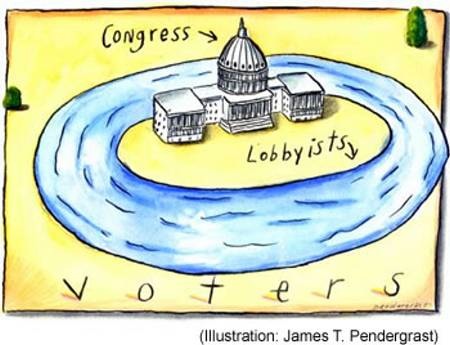 I’m just waiting for life to get back to the normal rat race and off the holiday frenetic rat race. I need to get some plumbing parts, a few store-related things, and a person from my bank to pick up the phone who isn’t distracted or gone. Commerce is dysfunctional this time of year and I just hate it. I found out the hard way that Friday was holiday of some sort and of course, Saturday and Sunday were complete wastes of time. I feel held hostage this time of year. Same thing seems to apply to useful items in newspapers and magazines around the country.
I did manage to find one thing at WAPO today that was snuck in between those perpetual what to do with left overs and presents you do want articles: ‘Lawmakers seek cash during key votes’. Well, isn’t that special? It seems while we were frantically hoping they’d repeal DADT, pass the Dream Act, and ratify START, the Reigndeers were playing Reigndeer games. I’m hoping the information in that article doesn’t get buried in the holiday waste paper.
Numerous times this year, members of Congress have held fundraisers and collected big checks while they are taking critical steps to write new laws, despite warnings that such actions could create ethics problems. The campaign donations often came from contributors with major stakes riding on the lawmakers’ actions.
For three weeks in June, for instance, the members of a joint House and Senate committee worked to draft final rules for regulating the financial industry in the wake of its 2008 meltdown. During that time, the 35 members of the drafting committee collected $440,000 in donations from that same industry, which was then lobbying heavily for looser rules.
What on earth can we do to stop this cash extraction/infusion process from the big special interest groups? Why aren’t people holding their congress critterz accountable for this kind of obvious black mail? This example was just appalling AND unsuprising.
Earlier this month, the chairman of the Senate committee overseeing tax policy, Sen. Max Baucus (D-Mont.), gave himself a birthday-party fundraiser – on the same day that the chamber took its first vote on an $858 billion tax package that would provide breaks to wealthy citizens and business interests.
They must know we’re stupid.
Here’s a real christmas gift from the Center for Responsive Politics: Lobbying Your True Love: Twelve Days of Gifts and Special Interests Access This Christmas. This will let you know who was on the nice list recently. (Hint: it wasn’t you or me.)
Between Jan. 1 and Sept. 30, there were 273 days. That means you should be able to retain the California Pear Growers Association, which reported $20,000 in lobbying expenditures during the first three quarters of 2010, for $73 a day.
To be true to the song, though, you’ll need the Pear Growers trade group every day for 12 days. And 12 days at $73 a day equals $879.
By that same logic, retaining DLA Piper’s services, which is playing a happy tune with $7.6 million in lobbying income this year, would cost $27,875 per day. Good thing they’ll only be need twice — on the eleventh and twelfth days, for a total cost of $55,751.
Your wallet might also take a hit trying to woo Goldman Sachs, which likes the ring of their $3.5 million investments in lobbying between January and September.
While the investment bank’s daily rate is less than half of DLA Piper’s, you’ll pay even more for their services since you’ll need them for eight days: $12,857 per day multiplied by 8 days equals $102,857.
Defense contractor Blackbird Technologies, named after the colly bird, and lobbying firm Drummer and Associates, meanwhile, will each run just $110 a day.
But Leap Wireless International, the parent company of Cricket, will cost ten times as much: $1,099 per day.
And the Dairy Farmers of American, the trade group for maids-a-milking, will cost twice that: $2,220 per day.
On the other hand, the American Alliance for Health, Physical Education, Recreation and Dance — a big fan of ladies dancing — is a steal at just $27 a day. Even for four days of services, you’re only out $110.
Other poultry-related interests — the National Chicken Council, an ardent supporter of French hens, and the United Egg Producers, who have a special place in their heart for geese-a-laying — will cost $586 per day and $165 per day, respectively.
This has got to stop some place. Look at this from the same WAPO link.
Over the course of three weeks in June, the 35 conference committee members collected $440,000 in donations from the financial industry. Sen. Charles E. Schumer (D-N.Y.), a member of the Senate banking committee and a powerful conferee, collected the most that month – about $90,000 from financial interests.
Executives of accounting giant Ernst & Young contributed the lion’s share of that amount for Schumer: $49,000 in all of June, including $2,000 from chief executive James Turley. Ernst & Young works for some of the biggest firms on Wall Street. This week, New York state sued the company, accusing it of using a paperwork shuffle to help Lehman Brothers hide billions of dollars in debt before that firm’s 2008 collapse.
…
Senators collected $469,000 from the financial industry the day before, the day of and the day after that key Sept. 16 vote, a Post review of donations shows. The biggest recipient was Senate Majority Leader Harry M. Reid (D-Nev.), who shepherded the legislation and faced a tight reelection race.
We’ve turned into a plutocracy. No doubt about it. Money doesn’t talk any more. It screams.
The Year in Congress
Posted: December 23, 2010 Filed under: commercial banking, DADT, GLBT Rights, Global Financial Crisis, Health care reform, investment banking, Team Obama, The Bonus Class, The Great Recession, U.S. Economy, U.S. Politics | Tags: Financial Reform, Health care reform, Obama-McConnell Tax Breaks extension, repeal of DADT, START, The Do-a-lot 111th congress 18 CommentsI found this article at the CSM that highlights that we actually had a Do-a-Lot congress this year and it has a nifty self test on political knowledge in 2010 you may want to take. They highlighted six big laws that were passed this year. All of them were definitely steps in the correct direction even though they had flaws that will have to be worked out. I’m not sure I’d consider all of them great successes but when you look back on the list, you’re sure to find something naughty and nice.
Here’s there intro to the list.
The post-election lame-duck session – typically a mopping-up operation to get out of town – also made history, passing key pieces of legislation, often with greater input from Republicans than had earlier been the case. People can argue the merits of what Congress did, but it’s hard to quibble with the scope of the undertaking. Here are six of this Congress’s major accomplishments, in the order in which they were approved.
Here are their list of “six big achievements”.
1. American Recovery & Reinvestment Act
The $819 billion economic stimulus package, signed into law February 2009 less than a month after Barack Obama became president, is the largest stand-alone spending bill in US history. It included tax cuts, as well as new spending for public works, education, clean energy, technology, and health care.
2. Patient Protection and Affordable Care Act
Congress battled for a year to pass health-care reform, which was finally a done deal March 23, 2010. The law mandates that all Americans obtain health insurance coverage, and it sets up entities called health exchanges to provide people with affordable options.
3. Financial regulatory reform
Known officially as the Dodd-Frank Wall Street Reform and Consumer Protection Act, the new law is the most significant regulatory overhaul of the financial system since the Depression ended in the 1930s. Signed into law in July 2010, it aims to end bailouts forced on taxpayers by financial institutions deemed “too big to fail” and to protect consumers. Included in the legislation is a powerful, independent consumer-protection bureau, an early-warning system for financial groups deemed too big to fail, new oversight of credit agencies, and lower fees on debit-card charges. It also directs much of the $600 trillion over-the-counter derivatives trade through clearinghouses and exchanges.
4. Big tax-cut extension, plus new stimulus
Congress averted the largest tax increase in American history by voting in December to extend the Bush-era tax cuts for two years, including for the highest-income households.
5. Repeal of ‘don’t ask, don’t tell’
Fulfilling campaign pledges of the last two Democratic presidents, Obama on Dec. 22 signed a law that repeals a 17-year ban on gay men and women serving openly in the US armed services.
6. New nuclear arms pact with Russia
The new Strategic Arms Reduction Treaty (START) with Russia reduces the US and Russian arsenals of deployed strategic nuclear warheads to 1,550 apiece within seven years. The Senate ratified the treaty Dec. 22 by a vote of 71 to 26.

Juju--my youngest daughter's christmas cat--studies the list
Okay, I’ll put it to you!
Naughty or Nice list?
See, even JuJu the Christmas Cat wants in on the project!!! (I guess my youngest daughter still hasn’t gotten through the doll phase yet.)
Thursday Reads
Posted: December 23, 2010 Filed under: Barack Obama, legalizaton of drugs, morning reads, U.S. Politics | Tags: Christmas, Festivus, George W. Bush, John Boehner, Laura Bush, Marijuana, North Korea, Pat Robertson, Seinfeld, South Korea 96 CommentsHappy Festivus Everyone!!!
A little more about the Festivus tradition from Wikipedia:
Festivus is a secular holiday celebrated on December 23 as “another way” to celebrate the holiday season without participating in its pressures and commercialism[1]. It was created by writer Dan O’Keefe and introduced into popular culture by his son Daniel, a screenwriter for the TV show Seinfeld,[2][1] as part of a comical storyline on the show. The holiday’s celebration, as shown on Seinfeld, includes an unadorned aluminum “Festivus pole,” practices such as the “Airing of Grievances” and “Feats of Strength,” and the labelling of easily explainable events as “Festivus miracles”.
Celebrants of the holiday sometimes refer to it as “Festivus for the rest of us,” a saying taken from the O’Keefe family traditions and popularized in the Seinfeld episode to describe Festivus’ non-commerical aspect.
[….]
The holiday, as portrayed in the Seinfeld episode and now celebrated by many,[1][5] includes practices such as the “Airing of Grievances,” which occurs during the Festivus meal and in which each person tells everyone else all the ways they have disappointed him or her over the past year. After the meal the “Feats of Strength” are performed, involving wrestling the head of the household to the floor, with the holiday ending only if the head of the household is actually pinned.
The original holiday featured more peculiar practices, as detailed in the younger Daniel O’Keefe’s book The Real Festivus. The book provides a first-person account of an early version of the Festivus holiday as celebrated by the O’Keefe family, and how O’Keefe amended or replaced details of his father’s invention to create the Seinfeld episode.
We’re getting really close to that other holiday, Christmas. Through most of my adult years, I found the Christmas season extremely stressful. Frankly some of my happiest Christmases have been years when I spent the day alone. In recent years, I’ve gotten quite a bit closer to my siblings and I’ve enjoyed some family Christmases; but when all of us get together it can still be pretty crazymaking.
This year I’ll be going to my sister’s house with my mom. I’m hoping it will be quiet and peaceful, and I’m hoping the snowstorm we’re expecting won’t be too bad. We lost my dad in March, so this will be the family’s first Christmas without him. I know that will be really hard for all of us, especially my mom.
I’m not going to go through all the legislation that passed yesterday or write about President Obama’s self-congratulatory press conference. I think we should keep it light today. I’m just going to throw out a few links that I found interesting and let you all do the same in the comments.
I really got a kick out this article at Buzzflash by Peter Michaelson, a psychotherapist from Ann Arbor, MI: The Tracks of John Boehner’s Tears.
According to Michaelson, Boehner’s frequent “crying jags” stem from his troubled childhood.
Boehner cries a lot in public, even when debating bills in the House. He cries when he talks about his humble past. Son of a bar owner, he grew up with 11 siblings in a two-bedroom house with a single bathroom. He said recently on “60 Minutes” that he no longer visits schools or even looks at kids playing outside because he immediately starts crying.
[….]
Boehner had a scrappy upbringing, running cases of beer and mopping the floor in his father’s bar. He put himself through school, “working every rotten job there was.” The circumstances of his childhood, along with his manner of describing it, strongly suggest that, at times, he felt unappreciated, disrespected, and lacking in value.
Since Boehner rarely does anything to help deprived children, why does he burst into tears when he sees them? Michaelson see this as a form of projection.
When Boehner cries around kids, he’s not necessarily feeling their pain. He’s not seeing the world through their eyes. Rather, he’s imagining that they’re seeing the world through his eyes, through the self-doubt and pain with which he saw the world as a child. Unconsciously, he experiences himself and his political life in ways that are under the influence of these unresolved negative feelings.
He sees the children through what is unresolved in himself, through the pain he has repressed from his childhood. He’s also likely crying with relief because, unconsciously, he believes that, through his elevation to fame and power, he has liberated himself from those haunting feelings.
It’s an interesting hypothesis. We’ll probably learn a lot more about Boehner when he becomes Speaker of the House–probably a lot more than we ever wanted to to know. I wonder if he’ll cry frequently while going about his Speaker duties? I’ll bet he cries during the swearing in anyway.
Last night some moron drove his Plymouth Barracuda onto the North Dallas lawn of Mr. and Mrs. George W. Bush.
A suspect accused of driving a muscle car erratically onto the lawn at former President George W. Bush’s north Dallas home Wednesday night was detained by the Secret Service.
The former president and former first lady Laura Bush were in the Preston Hollow neighborhood home at the time but were unharmed and never in danger, officials told NBC station KXAS.
That must have been exciting.
Have you heard about the new Broadway sensation, “Spiderman: Turn Off the Dark?” There have been so many mishaps with this production that they had to call off Wednesday’s scheduled performances.
The Broadway musical “Spider-Man: Turn Off the Dark” canceled its two Wednesday performances to test a new safety plan for the show’s 38 aerial and stage maneuvers, which involve actors hoisted or tethered in harnesses, including the maneuver that failed at Monday night’s performance when a stunt actor fell more than 20 feet and broke his ribs.
By canceling the performances at a cost of roughly $400,000 in ticket sales, and by adopting safety measures recommended by state and federal officials, the producers of “Spider-Man” sought to project a sense of urgency and understanding that action was needed to make the show safer. While the producers said that Thursday night’s performance would go on, they also committed, according to state safety officials, not to hold performances until the new measures were in place. The state officials said the plan could be tested successfully by Thursday night.
Under the plan, one offstage crew member will attach the harness and related cables, wires or tethers to the actors, and a second stagehand will verify that the attachments are made. That second stagehand will then verbally notify a stage manager that they are safely connected. The actor will also verify that the attachment is made. Previously, there was no second stagehand to verify or communicate with the stage manager, and the actor was not required to check his harness.
Well I sure hope everything works out okay…
Did you know that “Rev.” Pat Robertson supports legalization of marijuana?
“We’re locking up people that have taken a couple puffs of marijuana and next thing you know they’ve got 10 years with mandatory sentences,” Robertson continued. “These judges just say, they throw up their hands and say nothing we can do with these mandatory sentences. We’ve got to take a look at what we’re considering crimes and that’s one of ’em.
“I’m … I’m not exactly for the use of drugs, don’t get me wrong, but I just believe that criminalizing marijuana, criminalizing the possession of a few ounces of pot, that kinda thing it’s just, it’s costing us a fortune and it’s ruining young people. Young people go into prisons, they go in as youths and come out as hardened criminals. That’s not a good thing.”
Hmmm….could this explain where Robertson gets his wacky ideas about the causes of hurricanes and terrorist attacks?
Here’s one more goofy story, and then I’ll let you guys take over. From The Independent UK: North Korea threatens to attack South over Christmas lights
Seasonal goodwill is in short supply on the divided Korean peninsula, where both sides are again at potentially deadly loggerheads – over a Christmas tree.
North Korea’s military is reportedly preparing to shoot down a floodlit tower decorated with Christmas lights which overlooks the border near the South’s capital, Seoul – home to millions of Christians.
The provincial governor, Kim Moon-soo, has warned that firing at the tree would be a reckless and “provocative” act. The South’s Defence Minister was more blunt. “We’ll retaliate decisively to take out the source of any shelling,” Kim Kwan-jin told parliament yesterday. South Korea’s Yonhap news agency said fighter jets were on standby, ready to strike back.
OK, that’s it for me, except for this gratuitous kitty picture.

What are you reading this morning? Feel free to post links to serious stories, if you must.
Wikileaks, Julian Assange, and Allegations of Sex Crimes
Posted: December 22, 2010 Filed under: Feminists, U.S. Politics, Violence against women, Wikileaks, Women's Rights | Tags: Julian Assange, power elites, rape, safe sex 95 Comments
For the past three days, I’ve been reading as much as I could about the claims and counterclaims about Julian Assange and his alleged sexual misconduct during a visit to Sweden in August, 2010.
I have to be honest: when I first heard about the charges, I thought they were extremely convenient for the governments and corporations who want Assange and his organization silenced.
It should go without saying that I do not approve of Assange’s behavior if the allegations against him are true. Nevertheless, I still believe the allegations are very convenient for the powers that be. The elites who control our government and the powerful multinational corporations that have been “victims” of Wikileaks couldn’t care less whether Assange committed sex crimes in Sweden. All they care about is stopping publication of leaks that so far have revealed and/or substantiated suspicions about some pretty shocking behavior by governments around the world.
Furthermore, now that we have at least some information (filtered by Swedish police and prosecutors and journalists) about the basis for the allegations of sexual assault, I think that reactions by conservative Swedish politicians and the media in the U.S. and Great Britain have been far out of proportion to the usual government and media responses to allegations like the ones described by the Guardian.
In fact, according to Amnesty International, Sweden usually is terrible at prosecuting and convicting accused rapists (h/t Dakinikat for the link).
…an Amnesty International report on rape in the Nordic Countries took Sweden to task last autumn for what the human rights organization saw as an abysmally low conviction rate for rape cases.
Released in September 2008, the Amnesty report – Case Closed – examines issues surrounding rape and human rights in Sweden, Norway, Denmark and Finland.
Despite Sweden’s considerable emphasis on women’s rights, currently ranking an impressive 3rd place in the UN global gender-related development index, instances of reported violence against women are showing no signs of abating.
[….]
Amnesty’s most damning criticism of Sweden relates to the considerable disparity between the number of rapes reported and the conviction rate.
Case Closed highlights the damning evidence that, despite the number of rapes reported to the police quadrupling over the past 20 years, the percentage of reported rapes ending in conviction is markedly lower today than it was in 1965.
There’s a lot more information at the link. BTW, anyone who has read The Girl with the Dragon Tattoo and the two sequel might have suspected that Sweden isn’t that good at dealing with violence against women.
Knowing Sweden’s usual treatment of rape allegations, are we really supposed to believe that suddenly Sweden is so deeply concerned about two women who had consensual sex with the same man followed by unwanted sexual behavior, that they asked Interpol to issue a red alert to find this guy?
Are we to believe that it is SOP for Great Britain, without being asked to do so by Sweden, arrests and imprisons the man before releasing him on hundreds of thousands of dollars cash bail based solely on these accusations by two women?
A number of self-described feminist bloggers (for some background, see this post by Valhalla at Corrente) are outraged that Assange has not voluntarily returned to Sweden–not to face charges, because there aren’t any yet–but to talk to a prosecutor who allegedly had refused to meet with him for the five weeks that Assange spent in Sweden waiting for the meeting to happen.
Where were these feminists in November when a young woman was violently raped in her high school Muncie, Indiana and school officials refused to even report it to police and allowed the perpetrator to leave school and go home and clean up and change clothing? What other rapes of powerless young women have these bloggers highlighted in the past couple of months? Maybe they’ve been busy doing this, I don’t know. But I’ve searched for blog links to the case in Muncie and haven’t found any posts by the bloggers who are now so outraged about Julian Assange.
I think the allegations against Assange and the effects they may have on Wikileaks itself are worth discussing. Personally, I’m not absolutely sure how I feel about all of it yet. But I’ll share my thoughts so far.
First, I think Julian Assange and Wikileaks have revealed a great deal of important information that has struck fear in the hearts of governments and powerful corporations. I see that as a good thing.
Second, I think Julian Assange is probably a very arrogant, egotistical man who is very likely lacking in social skills. I base that on what I’ve read about his childhood as well as quotes from people who have known him. I won’t go into that in detail here–I’ll just stipulate that he is probably difficult for other people to get along with. He may even be a complete a$$hole, for all I know. But he has accomplished something that I consider valuable.
Third, from what I know of the two women who accused Assange, they appear to be strong, powerful women who are capable of standing up for themselves. I realize that rape is traumatic for anyone. I’m just saying that these women are not poverty-stricken, homeless sixteen-year-olds like the woman who was raped in Muncie. These two women have good attorneys and they have powerful supporters, including a Swedish government official. I think it is a shame that they have been bashed on the internet and reportedly threatened by anonymous people. Unfortunately, women who report sex crimes against famous people often get treated pretty badly by the public and the media. But I’ll be willing to bet these two women knew that before they even got involved with Assange. If these allegations are true, then I hope they will both get up in court and testify against Assange. At the same time, Assange has the right to defend himself against their allegations. That’s how it works.
Fourth, as I said at the beginning of this post, these events are playing into the hands of both the power elites. The arguments in the media and on the internet about sex crimes charges is overwhelming the information coming out of Wikileaks to the point that I have seen a number of people actually claiming that nothing of importance has been revealed!
Fifth, the bloggers who are arguing so vehemently that Assange is a vicious rapist and must return to Sweden are also playing into Assange’s hands. He himself claims that the publicity over these charges has only helped him and his organization.
Finally, I think Julian Assange is right to fight extradition to Sweden, and I hope he continues to do so. I think it is highly likely that if he does return to Sweden, the Swedish government will hand him over to the U.S. Officials in the U.S., including Vice President Biden, that have deliberately referred to Assange as a “terrorist.” A number of U.S. politicians have state publicly that Assange should be assassinated. The President of the U.S. claims the right to detain indefinitely and even assassinate anyone from any country whom he designates as a “terrorist.” Therefore, if I were Julian Assange, I would fight tooth and nail to stay out of the hands of the U.S. government.
Those are my initial reactions after spending much of my time for a few days reading everything I could about these issues. Let’s talk about it here at Sky Dancing. Maybe we can manage to look at more than one side of these issues and draw some reasonable conclusions.
Before we get started, please watch these two videos from Democracy Now. They consist of a debate between Naomi Wolf and Jaclyn Friedman, two self-described feminists with different points of view on Assange and the sex crime allegations.
Democracy Now interview with Naomi Wolf and Jaclyn Friedman, part 1
Democracy Now interview with Naomi Wolf and Jaclyn Friedman, part 2
Have at it! What do you think?

 peej
peej Carissa
 bostonboomer
 dakinikat
 ecocatwoman
 mablue2
 Mama Lopez
 peggysue22
 quixote
 skydancingguestblogger
 Mona (aka Wonk the Vote)



 Sky Dancing
Recent Comments