
Paul Ryan’s Selective Randianism
Posted: April 23, 2011 Filed under: abortion rights, poverty, Psychopaths in charge, religion, Reproductive Rights, The Bonus Class, U.S. Economy, U.S. Politics, voodoo economics, Voter Ignorance | Tags: abortion, Atlas Shrugged, Ayn Rand, Donald Luskin, Down With Tyranny, feminism, Jonathan Chait, linky goodness, Paul Ryan, politics, pro choice, Radianism, Wall Street, William F. Buckley 27 Comments
While browsing the links on Memeorandum earlier this afternoon, I came across this post at Down With Tyranny: The Inspiration For Paul Ryan’s Profoundly And Explicitly Anti-Christian Budget. As Lambert would say, it is a post filled to the brim with “linky goodness.” I read all the linked articles and I refer to a few of them in this post.
DWT discusses Ryan’s self-professed admiration for the “philosophy” of Ayn Rand.
What is the great cause for which Ryan wants to devote his political life? Unkind critics point to the unprecedented– at least in Wisconsin politics– gushers of money Ryan has solicited from the Wall Street sector and detect a correlation between the bribes he takes and the policies he espouses. And since there is nothing that holds his voting record– huge, unjustifiable bailouts for Wall Street banks coupled with the dismantling of Medicare and unconscionable tax breaks for the richest Americans coupled with privatization of Social Security– other than obeisance to a garden variety Big Business agenda, this interpretation has become widespread. What people may be missing, however, is a parallel influence on Ryan– one not unrelated, but not identical either: his devotion to the adolescent philosophy of Ayn Rand: “the virtue of selfishness,” a more direct– if somewhat off-putting to non-believers– description of a philosophy known as “Objectivism.”
DWT points out that Rand’s teachings are explicitly anti-Christian–Rand was an atheist who thought altruism was evil and poor and working people were losers and “parasites.” Newsweek’s Jonathan Chait writes:
Ayn Rand, of course, was a kind of politicized L. Ron Hubbard—a novelist-philosopher who inspired a cult of acolytes who deem her the greatest human being who ever lived. The enduring heart of Rand’s totalistic philosophy was Marxism flipped upside down. Rand viewed the capitalists, not the workers, as the producers of all wealth, and the workers, not the capitalists, as useless parasites.
John Galt, the protagonist of her iconic novel Atlas Shrugged, expressed Rand’s inverted Marxism: “The man at the top of the intellectual pyramid contributes the most to all those below him, but gets nothing except his material payment, receiving no intellectual bonus from others to add to the value of his time. The man at the bottom who, left to himself, would starve in his hopeless ineptitude, contributes nothing to those above him, but receives the bonus of all of their brains.”
Chait calls Ryan an “acolyte” of Ayn Rand, and explains at length that the deficit and the debt aren’t what’s bugging the new House superstar. Most of Ryan’s proposals don’t cut the deficit much, and besides, he includes huge new tax cuts for the rich and goodies for Wall Street in his plan. Further more Ryan was an enthusiastic supporter of the Wall Street bailout and he voted for every spending bill that came down the pike under George W. Bush. So what are the Ryan cuts all about?
Ryan’s plan does do two things in immediate and specific ways: hurt the poor and help the rich. After extending the Bush tax cuts, he would cut the top rate for individuals and corporations from 35 percent to 25 percent. Then Ryan slashes Medicaid, Pell Grants, food stamps, and low-income housing. These programs to help the poor, which constitute approximately 21 percent of the federal budget, absorb two thirds of Ryan’s cuts.
Ryan casts these cuts as an incentive for the poor to get off their lazy butts. He insists that we “ensure that America’s safety net does not become a hammock that lulls able-bodied citizens into lives of complacency and dependency.” It’s worth translating what Ryan means here. Welfare reform was premised on the tough but persuasive argument that providing long-term cash payments to people who don’t work encourages long-term dependency. Ryan is saying that the poor should not only be denied cash income but also food and health care.
OK, that part does sound like Randianism, doesn’t it? Rand admired the strong and despised the weak, and so does Paul Ryan, apparently. Rand even went so far as to praise a serial killer for his lack of empathy for his fellow human beings.
On the level of personal behavior, the heroes in Rand’s novels commit borderline rape, blow up buildings, and dynamite oil fields — actions which Rand portrays as admirable and virtuous fulfillments of the characters’ personal will and desires. Her early diaries gush with admiration for William Hickman, a serial killer who raped and murdered a young girl. Hickman showed no understanding of “the necessity, meaning or importance of other people,” a trait Rand apparently found quite admirable.
But did Rand believe that corporations should benefit from government largess? According to Rand devotee Donald L. Luskin, she didn’t.
it’s a misreading of “Atlas” to claim that it is simply an antigovernment tract or an uncritical celebration of big business. In fact, the real villain of “Atlas” is a big businessman, railroad CEO James Taggart, whose crony capitalism does more to bring down the economy than all of Mouch’s regulations. With Taggart, Rand was anticipating figures like Angelo Mozilo, the CEO of Countrywide Financial, the subprime lender that proved to be a toxic mortgage factory. Like Taggart, Mr. Mozilo engineered government subsidies for his company in the name of noble-sounding virtues like home ownership for all.
Still, most of the heroes of “Atlas” are big businessmen who are unfairly persecuted by government. The struggle of Rand’s fictional steel magnate Henry Rearden against confiscatory regulation is a perfect anticipation of the antitrust travails of Microsoft CEO Bill Gates. In both cases, the government’s depredations were inspired by behind-the-scenes maneuverings of business rivals. And now Microsoft is maneuvering against Google with an antitrust complaint in the European Union.
The reality is that in Rand’s novel, as in life, self-described capitalists can be the worst enemies of capitalism. But that doesn’t fit in easily with the simple pro-business narrative about Rand now being retailed.
Luskin seems somewhat bemused by the selective Randianism (my term) of the new Tea Party radicals like Ryan. Traditional conservatives like William F. Buckley “loathed” Rand back in the day, probably because of her atheism and the fact that, while she verbally denigrated feminism, she lived
her life as an exemplary feminist, even as she denied it by calling herself a “male chauvinist.” She was the breadwinner throughout her lifelong marriage. The most sharply drawn hero in “Atlas” is the extraordinarily capable female railroad executive Dagny Taggart, who is set in contrast with her boss, her incompetent brother James. She’s the woman who deserves the man’s job but doesn’t have it; he’s the man who has the job but doesn’t deserve it.
Rand was strongly pro-choice, speaking out for abortion rights even before Roe v. Wade. In late middle age, she became enamored of a much younger man and made up her mind to have an affair with him, having duly informed her husband and the younger man’s wife in advance. Conservatives don’t do things like that—or at least they say they don’t.
These weren’t the only times Rand took positions that didn’t ingratiate her to the right. She was an early opponent of the Vietnam war, once saying, “I am against the war in Vietnam and have been for years. . . . In my view we should fight fascism and communism when they come to this country.” During the ’60s she declared, “I am an enemy of racism,” and advised opponents of school busing, “If you object to sending your children to school with black children, you’ll lose for sure because right is on the other side.”
BTW, none of the male authors I have cited except for Luskin mentioned the abortion issue or the incongruity of the anti-abortion Ryan claiming to believe in Ayn Rand’s vision of complete individualism.
I guess the new fantasy-based Republicans like Ryan can just mentally excise much of Rand’s individualistic philosophy–taking what they want and leaving the rest–just as they do with the bible and with science. How else can Ryan and his radical colleagues rationalize idolizing Ayn Rand while voting again and again to limit the rights of women?
Late Night: Interesting Juxtapositions
Posted: April 22, 2011 Filed under: Barack Obama, Surreality, torture, U.S. Military, U.S. Politics | Tags: 9/11, Barack Obama, Bradley Manning, Charles Manson, Chernobyl, FBI, first responders, Ground Zero, liqudators, Richard Nixon, terrorist watch list, the media, U.S. Politics, Wikileaks 9 CommentsFIRST JUXTAPOSITION: COMPARE AND CONTRAST

First responders at Ground Zero in NYC
Huffington Post reported today that a little-known amendment in the new 9/11 health bill requires anyone who applies for benefits to be checked by the FBI to make sure they’re not terrorists.
The tens of thousands of cops, firefighters, construction workers and others who survived the worst terrorist assault in U.S. history and risked their lives in its wake will soon be informed that their names must be run through the FBI’s terrorism watch list, according to a letter obtained by HuffPost.
Any of the responders who are not compared to the database of suspected terrorists would be barred from getting treatment for the numerous, worsening ailments that the James Zadroga 9/11 Health And Compensation Law was passed to address.
It’s a requirement that was tacked onto the law during the bitter debates over it last year.
The letter from Dr. John Howard, director of the National Institute for Occupational Safety and Health, informs medical providers and administrators that they should begin letting patients know before the new program kicks in this July.
Yes, the people who risked their lives and their health to help after 9/11 will be treated like suspected terrorists by their government.
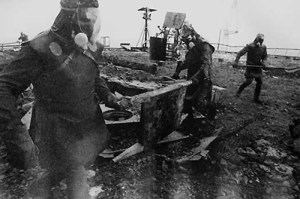
"Liquidators" clean up after Chernobyl explosion
From Voice of America: Chernobyl’s Cleanup Crew Pay a Steep Price, 25 Years On
On April 26, 1986 a nuclear reactor at the Chernobyl plant caught fire and exploded, sending radioactive debris high into the sky. Aleksey Breus was an engineer at Chernobyl at the time of the explosion. He worked four straight days inside the plant after the explosion. He wore protective equipment, but still received a large dose of radiation.
According to Breus, all “lucheviki” – the Russian word surviving cleanup workers use for describing one another – have been left with one thing in common: illness and a lack of money to pay for medications. He says virtually all of them live in poverty.
Another Chernobyl worker, Aleksander Kramer, says he was one of the first to go into the plant after the explosion. Kramer, who now lives in Germany, remains angry at how he was treated by authorities in what was then the Soviet Union. From the very beginning, he says, the authorities doubted those claiming they were part of the clean-up effort.
And the suspicions have lingered. In 1993, Kramer says former rescue workers had to prove to Ukranian authorities “that their documents were not a sham and that their health problems were real.”
Remember when we were told over and over again that the United States was morally superior to the Soviet Union? What’s the difference again?
SECOND JUXTAPOSITION: COMPARE AND CONTRAST
Time Magazine, 1970: President Richard Nixon tells the media that Charles Manson (then on trial in Los Angeles) is guilty.
Nixon had just come from a ten-day working holiday in San Clemente, where he found himself angered by the coverage given the Manson case in the local media. Many of the young, Nixon said in Denver, “tend to glorify and to make heroes out of those who engage in criminal activities.”
In Los Angeles, the effect of Nixon’s remarks on the Manson trial was instant and dramatic. While the Los Angeles Times came out the same afternoon with a four-inch headline reading MANSON GUILTY, NIXON DECLARES, Judge Charles Older went to great lengths to ensure that the jury, which has been sequestered since the trial began, would not learn of Nixon’s remarks. The windows of the jury bus were whited over with Bon Ami so that no juror could glimpse the headline on street newsstands. If the jury discovered Nixon’s verdict, the defense might have grounds for a mistrial.
Remember when Americans (and the media) cared when the President did something wrong?
WL Central, April 22, 2011: President Obama tells protestors that Bradley Manning “broke the law.”
Transcript and comments from WL Central:
“People can have philosophical ideas about certain things,” President Obama explains. “But, look, I can’t conduct diplomacy on open source.” He then goes on to add that he has to abide by certain classified information rules or law and if he had released material like Manning did he’d be breaking the law.
Now, here is the remark that deserves the most attention: “We’re a nation of laws. We don’t individually make our decisions about how the laws operate.” He adds, “He broke the law.” Finally, before removing himself from the conversation, he says Manning “dumped” information and “it wasn’t the same thing” as what Daniel Ellsberg did because what Ellsberg leaked “wasn’t classified in the same way.”
First, President Obama says Bradley Manning did it. It is not entirely clear that he did it unless you solely rely on the chat logs published by Wired magazine. Manning is the alleged whistleblower in the case. And, displaying this attitude that he is guilty before he actually is put on trial and convicted may prejudice Manning’s case.
That’s if Mr. Obama ever allows Bradley Manning’s case to go to trial. When is that going to happen? And when will today’s media be as outraged by Obama’s irresponsible remarks as the media of 1970 was at Nixon’s?
Thursday Reads: Crazy Republicans, Nuclear Meltdowns, MLB Follies, and More
Posted: April 21, 2011 Filed under: Gulf Oil Spill, net-neutrality, Psychopaths in charge, the internet, The Media SUCKS, U.S. Economy, U.S. Politics | Tags: Barack Obama, bible, Boston Red Sox, BP Oil Gusher, Charles Manson, Eric Cantor, Frank McCourt, Fukushima nuclear plant, Gulf Of Mexico, JoAnne Kloppenburg, Kindle, LA Dogers, Major League Baseball, meltdown, net neutrality, public libraries, stupid Republicans, U.S. debt ceiling, Wall Street, wetlands. Louisiana, Wisconsin 62 Comments
Good Morning!!
According to Politico, Republicans are escalating their game of chicken with demands they want met before they agree to raise the debt limit.
One day after being named to a presidential task force to negotiate deficit reduction, House Majority Leader Eric Cantor fired off a stark warning to Democrats that the GOP “will not grant their request for a debt limit increase” without major spending cuts or budget process reforms.
The Virginia Republican’s missive is a clear escalation in the long-running Washington spending war, with no less than the full faith and credit of the United States hanging in the balance.
Wait a minute…Obama put ERIC CANTOR on a deficit task force??!! Okay, the joke’s over. This guy cannot legitimately run on a Democratic ticket in 2012.
Cantor says he’s ready to plunge the nation into default if the GOP’s demands are not met. People close to Cantor say that he hopes to make clear that small concessions from Democrats, including President Barack Obama, will not be enough to deliver the GOP on a debt increase….
Republicans are floating a wide range of major structural reforms that could be attached to the debt limit vote, including statutory spending caps, a balanced budget amendment and a two-thirds vote requirement for tax increases and debt limit increases.
Japan’s Nuclear and Industrial Safety Agency has finally admitted that nuclear fuel in reactors 1, 2, and 3 has melted. From reading the article, it isn’t exactly clear what has happened, but I still detect efforts to minimize the damage. There’s a little more detail in an article from the Irish Times:
The head of the Atomic Energy Society of Japan, Takashi Sawada, said yesterday that fuel rods in reactors 1 and 3 have melted and settled at the bottom of their containment vessels, confirming fears that the plant suffered a partial meltdown after last month’s huge earthquake and tsunami.
Engineers have been struggling since to bring four reactors under control by pouring water onto overheating nuclear fuel, and that water is highly contaminated as a result. Mr Sawada warned the condition of the plant could worsen if another strong quake knocks out power to its cooling systems.
“That would destabilise pressure and temperatures inside the reactors and the situation would become extremely unpredictable again,” he said.
The story also says that there was an aftershock yesterday centered around 25 miles from the plant.
All the news outlets are covering the BP oil gusher and the damage it has done to the Gulf, because yesterday was the anniversary of the explosion that killed 11 oil rig workers. Don’t worry, they’ll drop the subject like a hot potato in a couple of days. Here’s an article from the NYT.
Even in the worst days of the BP spill, coastal advocates were looking past the immediate emergency to what the president’s oil spill commission called “the central question from the recovery of the spill — can or should such a major pollution event steer political energy, human resources and funding into solutions for a continuing systemic tragedy?”
That tragedy is the ill and declining health of the Gulf of Mexico, including the enormous dead zone off the mouth of the Mississippi and the alarmingly rapid disappearance of Louisiana’s coastal wetlands, roughly 2,000 square miles smaller than they were 80 years ago. Few here would take issue with the commission’s question, but the answer to it is far from resolved.
Eclipsed by the spill’s uncertain environmental impact is the other fallout: the vast sums in penalties and fines BP will have to pay to the federal government. In addition to criminal fines and restitution, BP is facing civil liabilities that fall roughly into two categories: Clean Water Act penalties and claims from the Natural Resource Damage Assessment process, whereby state and federal agencies tally the damage caused by the spill and put a price tag on it. This could add up to billions, perhaps tens of billions, of dollars.
Awwww, gee. Poor BP. It sounds like the writer feels sorry for them.
In Wisconsin, JoAnne Kloppenburg has asked for a recount in the race for the state supreme court.
JoAnne Kloppenburg arrived at the state Government Accountability Board’s office in Madison barely an hour before the 5 p.m. local time deadline by which she had to ask for a recount or concede defeat. According to the vote count finalized by the state last week, she trails Justice David Prosser by 7,316 votes out of nearly 1.5 million cast in the April 5 election.
“Today, my campaign is asking the Government Accountability Board to conduct a statewide recount,” Kloppenburg said at a news conference. The announcement was met with applause and cheers of “thank you.” She’s requesting the recount “in part to determine what the proper outcome of the election will be and to ensure that elections form this point forward will be fair.
“I do not make this decision lightly … I have weighed the options and I have considered the facts,” Kloppenburg, currently an assistant state attorney general, said. The tight margin — small enough to trigger a provision allowing the state to pay for the recount process — means that “the importance of every vote is magnified and doubts about every vote are magnified as well,” she said.
And in silly Republican news, eight Wisconsin doctorswho wrote excuses for protesting teachers are being investigated.
The state Department of Regulation and Licensing and the Medical Examining Board said Wednesday that they had opened investigations into eight individuals who allegedly wrote doctor excuse notes for protesters at the state Capitol during rallies in February.
Last month, the Department of Regulation and Licensing said it had identified 11 people who may have provided the medical excuses, and it asked them to submit information about their activities at the Capitol.
Three members of the Medical Examining Board reviewed the information and decided to open investigations on eight of the 11, according to a department news release.
The eight being investigated are all licensed physicians, department spokesman David Carlson said.
Are Wisconsin taxpayers going to have to pay for this silliness? How ridiculous.
As a Kindle owner, I’m excited about this news. Amazon’s Kindle Will Offer E-Books From Libraries
Bookworms who own Amazon.com Inc.’s popular Kindle electronic reader will finally be able to borrow digital books from public libraries….
The move is likely to have major repercussions for public libraries and the digital-reading market generally, since Amazon currently dominates the e-book industry and its actions in the space are closely watched. There are an estimated 7.5 million Kindles in the U.S., which gives Amazon a two-thirds share of the $1 billion digital-book market, said Forrester Research analyst James McQuivey.
Many major public libraries, including those in New York, Chicago and San Francisco, offer free digital-book lending. A physical trip to the library isn’t required. Instead, library-card holders can download books from library websites. Each library sets its own digital-book lending policy, but typical lending periods are 14 or 21 days.
Major League Baseball has seized the LA Dodgers and will now control day-to-day operations for the team. Owner Frank McCourt is having financial problems.
The move was prompted by a number of issues surrounding the Dodgers, including owner Frank McCourt’s recent receipt of $30-million personal loan to meet payroll and the parking-lot attack at Dodger Stadium on March 31 that left a San Francisco Giants fan in a coma, according to a league source.
“This has been like watching a soap opera unfold,” said Gary Toebben, the president and CEO of the Los Angeles Area Chamber of Commerce. “We want a financially solvent Dodgers. We want a winning team.”
The league will now have approval rights over every significant expenditure by the team, including a trade or contract extension. This will likely put the franchise on the path to being sold.
The commissioner’s move adds to the turmoil surrounding a team already embroiled in divorce proceedings between McCourt and his wife, Jamie, who is seeking joint ownership.
McCourt tried to buy the Red Sox back when the the former owner died. Thank goodness he didn’t succeed in buying the team–they probably never would have beat the curse and won the World Series twice.
Some nutty right wing talk show host says the Bible forbids net neutrality.
The idea that all Internet traffic should be treated equally is against the teachings of the Bible and America’s Founding Fathers, according to evangelical Christian minister and political activist David Barton.
During his radio show on Tuesday, he said that net neutrality violated the Biblical principle of free markets, a principle upheld by Benjamin Franklin, Thomas Jefferson, and George Washington.
“That is part of the reason we have prosperity,” Barton said. “This is what the Pilgrims brought in, the Puritans brought in, this is free market mentality. Net neutrality sounds really good, but it is socialism on the Internet.”
“This is really, I’m going to use the word wicked stuff, and I don’t use that word very often, but this is wicked stuff,” he added.
Well that settles it then!
Monday was the 40th anniversary of Charles Manson’s conviction, so some media types decided to give him an opportunity to spout a bunch on nonsense. Manson’s new lawyer has asked the president to let the maniac out of prison, but Manson ruined his chances by giving his honest opinion of Obama.
Manson, 76, called Obama foolish in reference to Wall Street, saying he considered the president “a slave of Wall Street.”
“He doesn’t realize what they are doing. They are playing with him,” he said, according to the magazine.
Bla, bla, bla … so what else is new?
That’s about it for me. What are you reading and blogging about today?
Tim Hetherington, Award Winning Photojournalist and Director, Killed in Libya Today (UPDATED)
Posted: April 20, 2011 Filed under: Foreign Affairs, Libya, U.S. Military, U.S. Politics | Tags: Afghanistan, Chris Hondros, Gaddafi, Korengal Valley, Libya, Misrata, NATO, photojournalism, Restrepo, Sebastian Junger, Tim Hetherington 9 Comments
Sebastian Junger, left, and Tim Hetherington at Army Outpost Restrepo in Korengal Valley, Afghanistan. (Outpost Films / September 10, 2007)
British journalist Tim Hetherington, who co-directed and photographed the award-winning documentary Restrepo died today in Misrata, Libya. While making the film, Hetherington and his co-director Sebastian Junger worked closely with U.S. troops in an isolated and dangerous outpost in Afghanistan over an extended period of time. Restrepo won the Grand Jury Prize at the Sundance Film Festival and was nominated for an Oscar. Hetherington was 41.
Tim Hetherington, best known for co-directing the Oscar-nominated documentary on the Afghanistan war “Restrepo,” was killed in Libya on Wednesday while covering the conflict as a photojournalist for Panos Pictures, according to one of his other employers, Vanity Fair magazine.
Along with Hetherington, the New York Times reports three other journalists were wounded in the same incident: Chris Hondros, working for Getty photo agency; Guy Martin, working for Panos also; and Michael Christopher Brown, who has worked as a freelancer for several large publications.
Hondros and Martin were said to have grave wounds, and may not survive, the Times reports.
The day before he died, Hetherington tweeted: “In besieged Libyan city of Misrata. Indiscriminate shelling by Qaddafi forces. No sign of NATO.”
Hetherington, one of the best known photojournalists and winner of the prestigious Dupont Award, produced powerful pieces for ABC News’ “Nightline” from the Korengal Valley, Afghanistan, and directed the documentary “Restrepo,” which was nominated for an Academy Award.
[….]
“Tim was one of the bravest photographers and filmmakers I have ever met,” said ABC News’ James Goldston, who worked closely with Hetherington as executive producer of “Nightline.”
“During his shooting for the Nightline specials he very seriously broke his leg on a night march out of a very isolated forward operating base that was under attack. He had the strength and character to walk for four hours through the night on his shattered ankle without complaint and under fire, enabling that whole team to reach safety.”
Hetherington was embedded with the Army unit in Afghanistan when Army Staff Sgt. Salvatore Giunta put his life on the line to save his comrades. Giunta later became the first living recipient of the Medal of Honor since Vietnam.
RESTREPO is a feature-length documentary that chronicles the deployment of a platoon of U.S. soldiers in Afghanistan’s Korengal Valley. The movie focuses on a remote 15-man outpost, “Restrepo,” named after a platoon medic who was killed in action. It was considered one of the most dangerous postings in the U.S. military.
And from the “directors’ statement”:
Our intention was to capture the experience of combat, boredom and fear through the eyes of the soldiers themselves. Their lives were our lives: we did not sit down with their families, we did not interview Afghans, we did not explore geopolitical debates. Soldiers are living and fighting and dying at remote outposts in Afghanistan in conditions that few Americans back home can imagine. Their experiences are important to understand, regardless of one’s political beliefs.
UPDATE: American photojournalist Chris Hondros has died of wounds from the same attack in which Tim Hetherington died.
The Washington Post has put up a gallery of Hondros’ work.
Donald Trump’s Deep Thoughts on Abortion, Religion
Posted: April 19, 2011 Filed under: 2012 presidential campaign, abortion rights, Surreality, U.S. Politics, We are so F'd | Tags: 2012 presidential election, ABC Good Morning America, abortion, Donald Trump, evangelical Christians, fundamentalism, George Stephanopoulos, idiocy, NBC News, religion, Savannah Guthrie 39 Comments
I’ve never been very interested in Donald Trump. To be honest, until today I had never actually heard him speak two consecutive sentences. Trump has given several interviews lately, and based on watching them and/or reading the transcripts, I must say the man strikes me as a complete idiot. Next to him, the “P” woman looks slightly above average in intelligence.
Trump addressed his “pro-life” stance with Savannah Guthrie of NBC News and George Stephanopoulos of ABC News. Here are his words of wisdom on the subject.
Vaugn Ververs at MSNBC’s First Read:
Donald Trump appeared stumped when asked [by Savannah Guthrie] about the legal principle that served as the cornerstone for the Roe v. Wade decision that legalized abortion….
Guthrie: “Is there a right to privacy in the Constitution?”
Trump: “I guess there is, I guess there is. And why, just out of curiosity, why do you ask that question?”
When pressed to explain how his position on the right to privacy “squares” with his anti-abortion position, Trump responded: “Well, that’s a pretty strange way of getting to pro-life. I mean, it’s a very unique way of asking about pro-life. What does that have to do with privacy? How are you equating pro-life with privacy? ”
Guthrie asked, “well, you know about the Roe v. Wade decision.” Trump responded, “yes, right, sure. Look, I am pro-life. I’ve said it. I’m very strong there.”
Trump left the interview still not seeing a connection between a woman’s right to choose whether or not to have an abortion and the right to privacy. What a loon!
On ABC’s Good Morning America, George Stephanopolous asked Trump directly about the fairly recent change in his abortion stance.
Stephanopoulos: At that time, you were also pro-choice. Now you say you’re against abortion. When did you change your mind on that?
Trump: I would say, you know, a while ago. Quite a while ago.
Stephanopoulos: Why?
Trump: Because a number of cases, but in one particular case, I had a friend and I have a friend. And he would– did not want a child and his wife didn’t want a child. And they were going to abort. And they didn’t do it for very complicated reasons. And now they have the child. And it’s the apple of his eye. And he said, “Thank God.” He changed also, by the way. “Thank God, I didn’t do it.” And I’ve seen that, and I’ve seen other things. And I am pro-life.
That makes a lot of sense. Some rich golfing buddy of Trump’s didn’t want a baby but then changed his mind after the baby was born. Therefore all women must be forced to bear children they don’t want.
Maybe a religious conversion contributed to the change in Trump’s views since 1999 when he told Tim Russert he was pro-choice? He assured David Brody of the Christian Broadcasting Network that he (Trump) is church-going Christian.
David Brody: You talk a lot about business obviously, but talk to me a little bit about how you see God. How you see God in everything from what happened to your brother (he died of alcoholism at the age of 42) to how your life is today.
Donald Trump: I believe in God. I am Christian. I think The Bible is certainly, it is THE book. It is the thing. I was raised and I gave you a picture just now and perhaps you’ll use that picture I found it from a long time ago. First Presbyterian Church in Jamaica queens is where I went to church. I’m a protestant, I’m a Presbyterian. And you know I’ve had a good relationship with the church over the years. I think religion is a wonderful thing. I think my religion is a wonderful religion.
[….]
Brody: Do you actively go to church?
Trump: Well, I go as much as I can. Always on Christmas. Always on Easter. Always when there’s a major occasion. And during the Sundays. I’m a Sunday church person. I’ll go when I can.
He’ll go on Christmas and Easter and when he can the rest of the year? I’m not sure Trump understands the evangelicals any better than he understands the U.S. Constitution. Maybe Trump is actually secretly auditioning for a new reality show? He can’t possibly be serious about running for President of the U.S. Can he?

 peej
peej Carissa
 bostonboomer
 dakinikat
 ecocatwoman
 mablue2
 Mama Lopez
 peggysue22
 quixote
 skydancingguestblogger
 Mona (aka Wonk the Vote)



 Sky Dancing
Recent Comments