
Balanced Budget Amendments are Bad Policy
Posted: August 3, 2011 Filed under: U.S. Economy, U.S. Politics, voodoo economics | Tags: balanced budget amendments, business cycles, Debt, deficits, Federal Deficit, fiscal rules, GDP, John Maynard Keynes, macroeconomics, Michele Bachmann, recessions, social services, taxes, US Congress 9 Comments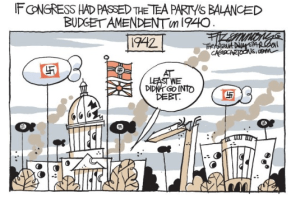 I always have to cover this topic in any introductory macroeconomics class I teach because usually one nutjob or another running for office always brings this up and people fall for it. The arguments are usually based on complete fallacies and misunderstanding of the math of economics, but hey, for some reason balanced budgets sound ‘reasonable’ when they are anything but.
I used to talk theoretically about how balanced budget amendments will kill state economies when the next real recession hits. Well, it hit a few years ago and we’re there. States continue to make their own economies worse day in and day out but there’s still those people that insist that if a family has to balance its budget, then so should the country. That’s even stupid considering most families have mortgages and car payments and probably student loans. Take Michele Bachmann as an example. She’s got all of the above plus farm subsidies and government grants. Even the President is guilty of that false equivalency. No person or family exists in perpetuity. No person or family can print money. No person or family has the power of taxation. Because of these three things, you cannot compare government to a family. Nor can you compare government to a business. Businesses exist to make a profit. Government exists to provide services and goods that the private sector will not provide or provides at an outrageous cost. It exists to administer justice and ensure level playing fields and fair play exists. Everything about a government is unique and is no way comparable to either businesses or households.
Macroeconomists know from years of study that the federal government can influence the economy at large. It does so through its spending and taxing priorities and policies. This is called fiscal policy. We have found several economic laws that guide the relationship between taxes and government spending and the behavior of Gross Domestic Product (GDP) which roughly measures all the legal and reported spending by households, governments, foreigners, and businesses. In our economy, household spending comprises about 68% of all GDP.
Investment or purchases by businesses is the smallest and most erratic component of GDP. Keynes said that it is easily spooked and subject to animistic spirits. Because it’s an unreliable source of growth, Keynes argued that in down turns, government should use its power to spend. Business investment usually only does fine in good economies. Please note, Keynes said deficit spend in recessions. Keynes’ prescription also said that Federal governments should run balanced budgets during times when the economy is fully employed and surpluses during bubble or boom times to relieve inflationary pressure. As usual, conservative politicians completely lie about the nature of Keynes and his highly proven and credible theories on fiscal policy. A lot of what we know about Monetary Policy comes from Milton Friedman, however, that is not the subject today. What I want to emphasize is that both men spent a lot of time analyzing panics and the Great Depression and are very much at the heart of accepted theory. We are seeing a classical lack of aggregate demand today. It is what’s driving the budget deficit. It is what’s driving the joblessness. It is what’s driving the slow recovery. Government must and will by automatic stabilizers be in a deficit position during downturns. It is simple math. More revenues come in during good times than bad. More safety net spending increases during bad times than good. We naturally run towards deficit in bad economies and towards surplus in good.
However, show me an economy that’s booming with high revenues and lower safety net spending and I will show you a group of politicians spending wildly. This tends to create inflation and can lead to bubbles. However, you never hear them complain at that point in time. That’s because it should be relatively easy to balance a budget then, but they do not do so or if they do its by expanding programs that cannot be sustained without borrowing during bad economies.
With that short explanation, let me cite you some folks that tell you why balanced budget amendments are bad policy. This first quote is from Simon Johnson who is the former chief economist for the IMF. He asks us to keep in mind that GDP is a measurement that is fraught with problems. He also mentions the fact that a balanced budget amendment makes the government make recessions worse.
Second and more seriously, imagine that this constitutional amendment were in place and that federal spending were roughly at its limit relative to the size of the economy. Then, what happens should the financial sector blow up again — either through no fault of its own (which, believe it or not, is the current prevailing myth on Wall Street about 2007-9) or because of some toxic combination of malfeasance and malpractice (the current predominant view of 2007-9 among many other people)?
The blame game is irrelevant when G.D.P. drops 10 percent; the issue is how to prevent a Great Depression. But note that with such a decline in G.D.P., a level of nominal spending that was 18 percent of G.D.P. is suddenly 20 percent, and now a constitutional crisis awaits – even before we get to the question of whether tax cuts or other forms of stimulus might be appropriate.
It makes no sense to take aim, as a matter of constitutional process, at two numbers that are both outcomes of deeper economic processes.
And to be frank, sometimes it makes a great deal of sense to apply an economic stimulus to an economy in free fall. One such moment was 1930 (and 1931 and 1932), when no stimulus was applied. Other moments were 2008 and 2009; both President Bush and President Obama initiated stimulus packages. When credit for and confidence in the private sector evaporates, do you really want the government sector to be forced to make quick cuts — or to raise taxes?
James Ledbetter at Reuters argues that even conservatives should oppose a balanced budget amendment (BBA). His reasons are more pragmatic. He argues that it won’t work.
Historically, conservatives have opposed extending government authority in places where it is not effective. You can find all the evidence you need to conclude that balanced budget requirements are useless by simply investigating the oft-repeated claim that 49 states have laws requiring a balanced budget. Leave aside the falsity of the claim and just consider the logic: if so many states are required to balance their budgets, why are so many states in the red?
The answer is that requiring state governments to annually balance their books simply encourages them to find clever ways to disguise debt and deficits. For example: California has both a Constitutional and a statutory requirement that its budgets be balanced. Would any sane person maintain that the state’s books have been anything resembling healthy for at least a decade? This year, after some brutal spending cuts, the governor’s office found that the state still had a short-term deficit of more than $9 billion and $35 billion in long-term debt. The governor’s budget report noted that California’s “massive budget deficits for most of the past decade…have been largely the result of a reliance on one-time solutions, borrowing, accounting maneuvers, and cuts or revenues that were illusory and therefore did not materialize.”
If that sounds familiar, it may be because, as Richard Quest pointed out on CNN Sunday evening, we’ve witnessed numerous Congressional attempts in recent decades to rein in federal deficits—including Gramm-Rudman in 1985 and the Budget Enforcement Act of 1990—all of which fell victim to legislative legerdemain. Why would a federal balanced budget amendment be any different?
Here’s something from The Economist on “Fiscal Rules”. Some fiscal rule–rather than a balanced budget amendment–would better stop congress from spending during booms and full employment cycles rather than balancing its budget via a BBA. This would be a rule that attaches the spending mandates to what’s going on in the economy. But again, I doubt they’d follow it since they’ve ignored a good portion of the Keynesian prescription for years any way.
It is difficult for Congress to tie its own hands. Any law that can pass Congress can later be undone or changed. In the rare cases that Congress puts together a near-perfect piece of legislation, that’s a bad thing. In the vastly more common occurrence that Congress passes highly imperfect legislation in need of significant future tweaks, that’s a very good thing. Support for an amendment to the constitution is a spectacular vote of confidence in the ability of a legislature to design near-perfect legislation, because the only thing rarer than an amendment to the constitution is a subsequent amendment undoing or clarifying a previous amendment.
I see the argument for a well-designed, over-the-business-cycle balanced-budget amendment. But the idea of enshrining this Congress’ pathologies into the constitution is terrifying. Let’s see Congress design some quality fiscal rules using the normal legislative process first, and then we can talk about adding those to the constitution.
Bruce Bartlett has some excellent analysis up for the current go round of balanced budget amendments. Mark Thoma explains how a BBA is a very bad idea. His analysis includes looking at the destabilizing effects that states’ BBAs have had on their economies. There’s a nifty graph that I did not include here if you’d like to go view it.
I’ve argued on many occasions that one of the big lessons we need to learn from this recession is that state-level balanced budget requirements are highly destabilizing. When a recession hits, spending goes up for social services and taxes fall as income, sales, property values, and other sources of revenue for state and local governments decline.
The result is a big hole in state and local government budgets, and that forces either increases in taxes or cuts in spending both of which make things even worse. And though some state and local governments were an exception to this, far and away the choice is to cut spending. We can see this in the state and local government employment statistics:
That’s not what we want to have happening when we are trying to recover from a recession. It would be much better if states had rainy day funds to rely upon, and if the rainy day funds fall short, the federal government could backfill the budget holes to prevent the destabilizing downsizing.
So have we learned the lesson? Nope, at least not if you are a Republican. They’d like to impose the same destabilizing rules on the federal government:
You really would have to search high and low for an economist that actually supports a BBA. The more conservative ones go for the fiscal rule that attaches spending to business cycles but even they believe that it would be unenforceable and easy to avoid. Can you imagine some District Judge trying to look over a complex macroeconomic model and figure out if the government forecast was correct or not?
A group of leading economists, including five Nobel Laureates in economics, today publicly released a letter to President Obama and Congress opposing a constitutional balanced budget amendment. The letter outlines the reasons why writing a balanced budget requirement into the Constitution would be “very unsound policy” that would adversely affect the economy. Adding arbitrary caps on federal expenditures would make the balanced budget amendment even more problematic, the letter says. The Economic Policy Institute and the Center on Budget and Policy Priorities organized the letter.
“A balanced budget amendment would mandate perverse actions in the face of recessions,” the letter notes. By requiring large budget cuts when the economy is weakest, the amendment “would aggravate recessions.”
The signatories of the letter are Nobel Laureates Kenneth Arrow, Peter Diamond, Eric Maskin, Charles Schultze, William Sharpe and Robert Solow; Alan Blinder, former Vice Chair of the Federal Reserve System’s Board of Governors and former member of the Council of Economic Advisors; and Laura Tyson, former Chair of the Council of Economic Advisors and former Director of the National Economic Council.
I’ll let former Reagan economist Bruce Bartlett have the last word here. He looks at the recent debate in Congress on the BBA.
Next week, House Republicans plan to debate a balanced budget amendment to the Constitution. Although polls show overwhelming public support, it is doubtful that many Americans realize that the measure to be debated is not, in fact, a workable blueprint to enforce a balanced budget. In fact, it’s just more political theater designed to delight the Tea Party.
We really need improved economic literacy in this country. I genuinely can’t get over what some of the morons in congress can get away with saying. Economists call them on it but it appears no one every listens.
Tuesday Reads
Posted: August 2, 2011 Filed under: Barack Obama, children, Crime, Federal Budget and Budget deficit, Foreign Affairs, morning reads, Psychopaths in charge, Syria, the villagers, U.S. Economy, U.S. Politics, Violence against women, voodoo economics, We are so F'd | Tags: Amy Ahonen, Barack Obama, Bloomington, Celina Cass, Climate change, D.B. Cooper, FBI, Federal debt ceiling, Indiana, Indiana University, investors, jobs, Lauren Spierer, Leon Trotsky, Louie Gohmert, Mark Warner, Missing people, Social Security, Syria, Travis Forbes, U.S. Stocks, UN Security Council 33 Comments
Good Morning!! I have a few interesting reads for you today, and they aren’t all about the idiotic debt ceiling debate. I’m going to lead off with a few excellent blog posts about that idiocy, and then I’ll move on to something else.
First up, Scarecrow compares the movie Cowboys and Aliens to the events in DC: In Cowboys and Aliens, Humans Win; In Washington’s Zombies Vs. Pods, They Lose. In the movie, Scarecrow writes:
humans of all types realize they have to join together to defeat the rapacious creatures who are looting the planet and turning humans into zombies and pod people. There’s hope for our species!
Back in Washington, D.C. there are no heroes and no upbeat ending. Instead, the looting, muggings and beatings will continue until morale improves.
In our “real” world, there is a radical extremist group driven by zombies and zombie beliefs who successfully blackmail the nation into strangling its own economy. The supposedly “sane” group that is supposed to stop this madness has become cowardly and turned into mindless pod people, who assure the nation that the gutting of American government and essential services and safety nets won’t occur in one step but in several, whose outcome is locked in by an undemocratic Super Congress and the next debt limit blackmail in 2013.
It’s a terrific post.
On a more serious note, Emptywheel asks, Is Mark Warner the Designated Social Security Killer? It’s all about what may happen if the so-called “Super Congress” comes to be. Read it and weep.
At the New Yorker, John Cassidy argues that the debt ceiling bill is all smoke and mirrors.
In removing the immediate threat of a debt default, the agreement…signals that the U.S. government still satisfies the minimum standard of financial functionality: it pays its bills on time. That should be enough to head off an immediate downgrade in the nation’s credit rating, and it explains why Wall Street bounced at Monday’s opening bell.
Beyond that it is hard to see anything very positive about a deal in which President Obama finally persuaded the Republicans to accept a Republican plan. Putting on my ethicist cap, I agree with Bernie Sanders that the deal is wrongheaded and immoral. To be sure, America has a long-term fiscal challenge that needs to be confronted. But at a time when fourteen million Americans are unemployed, and many millions more have been forced to work just part-time, the government should be focussing on job growth rather than cutting the budget….
As I’ve said before, headlines such as “Democrats and Republicans agree on $2.4 trillion in spending cuts over 10 years” are virtually meaningless. The United States, like every other country, budgets on an annual basis. What really matters for the economy, and for the unemployed, is how much cash the federal government will spend in the remaining months of the 2011 fiscal year and in fiscal 2012, which begins October 1st. A pledge to cut spending in 2016, say, is just that: a pledge. Between now and then, we will have another bipartisan spending review (that’s also part of the deal), a Presidential election, and who knows how many budget battles. The actual 2016 spending outcome will almost certainly bear little relation to the figures in this agreement.
Also at the New Yorker, Hendrick Hertzberg has a funny piece about Louie Gohmert, looney Texas Republican Congressman quoting Communist Leon Trotsky. I don’t want to ruin it for you by pulling out a quote. It’s not long, so go read the whole thing.
Susie Madrak has a great post at Crooks and Liars: This Year We’ve Broken Or Tied 2,676 Heat Records – So Far. Think We Could Talk About Climate Change Yet? Be sure to check it out.
Do you realize how many people go missing in the U.S.? A lot. And most of them seem to be women and children. Here is a slide show of 64 people from the FBI’s kidnapped and missing persons list.
The little girl whose photo comes first is 11-year-old Celina Cass, from West Stewartstown, NH. Her body was found today in a river near her family home. Sadly, when a child disappears, a family is often responsible. In this case, I have a feeling her stepfather had something to do with Celina’s death. I hope I’m wrong. At least she was found fairly quickly.
Many missing people aren’t found for years, if at all. Indiana University student Lauren Spierer disappeared from Bloomington, Indiana on June 3. Despite intense searches by hundreds of volunteers and a large reward offered by her parents and IU, she has not been found. It looks like people whom Lauren thought were “friends” may have had something to do with her disappearance, because just about everyone who was with her before she went missing has lawyered up and isn’t talking to police.
A Denver woman, Amy Ahonen, disappeared without a trace a few weeks ago. Her car was found parked unlocked along the highway with her purse, ids, cell phone, and keys inside. What happened to her? No one knows and the police have stopped looking. It so happens that a budding serial killer was on the loose in the area at the time of her disappearance, but the police don’t seem to be making that connection.
There are many more stories like this breaking every day in this country. Why do we accept that women and children will disappear daily and in most cases, they will be found murdered and often raped?
Speaking of missing people, a legendary missing person has resurfaced in the news. From the LA Times: D.B. Cooper hijacking mystery is revived with ‘promising lead’
D.B. Cooper, the infamous airplane hijacker who vaulted into urban mythology by parachuting out of a jetliner over the Pacific Northwest with a $200,000 ransom, is back on the FBI’s radar screen.
Cooper, whose case remains the only unsolved airline hijacking in U.S. history, became the stuff of legend on the night of Nov. 24, 1971, when he jumped from a Boeing 727 into the skies between Portland, Ore., and Seattle. He disappeared with the ransom he extorted — 10,000 $20 bills.
The case has remained open, but the trail has been cold despite hundreds of tips, thousands of theories and dozens of breakthroughs in scientific investigation. Now the FBI, which has previously said that Cooper is likely dead, is looking at fresh evidence, according to weekend reports in the media in Seattle, the epicenter of the story that seemingly can never die.
From the Seattle Post-Intelligencer:
The man investigated as a suspect in the D.B. Cooper case – the nation’s only unsolved commercial airplane hijacking – has been dead for about 10 years, and a forensic check didn’t find fingerprints on an item that belonged him, an FBI spokesman told seattlepi.com Monday.
“There are also other leads we’re pursuing,” agent Fred Gutt said. “Some of the other names have been out in the public, some of the names have not come out.”
The name of a man not previously investigated was given to the FBI nearly a year ago by a law enforcement colleague, and an item that belongs to him was sent for fingerprint work at the agency’s Quantico, Va., forensic lab, agents told seattlepi.com.
“The nature of the material was not good for prints,” Gutt said.
He added agents are obtaining other items that may have the suspect’s fingerprints in hopes of matching them with prints taken from the Northwest Orient plane after Cooper jumped the night of Nov. 24, 1971.
The situation in Syria is escalating. There has been a great deal of violence there for some time, and it is not getting the same attention that Egypt, Iran, and Libya have gotten. But now the UN Security Council plans to take up the issue.
Reacting to new bloodshed in Syria, European powers relaunched a dormant draft U.N. resolution to condemn Damascus for its crackdown on protesters, circulating a revised text to the Security Council at a meeting on Monday.
Following the hour-long closed-door meeting, several diplomats said that after months of deadlock over Syria in the council, the fresh violence appeared to be pushing the divided members towards some form of reaction.
But envoys disagreed over whether the 15-nation body should adopt the Western-backed draft resolution or negotiate a less binding statement.
Germany requested the meeting after human rights groups said Syrian troops killed 80 people on Sunday when they stormed the city of Hama to crush protests amid a five-month-old uprising against President Bashar al-Assad.
More than 1600 people have been killed during the Syrian uprising.
You have to wonder if President Barack Obama ever rereads his speeches.
At the State Department last May, the president spoke at length of democratization in the Middle East. He chose his words carefully, dropping caveats and provisos. But Obama also bluntly declared that, “it will be the policy of the United States to promote reform across the region, and to support transitions to democracy.” He justified the intervention in Libya by recalling that “we saw the prospect of imminent massacre … Had we not acted along with our NATO allies and regional coalition partners, thousands would have been killed.”
Yet precisely such sordid outcomes have come to pass, not in Libya but during the four-month uprising against the regime of President Bashar al-Assad in Syria. Around 1,600 people are believed to have been killed, not mentioning some 3,000 disappeared, many of them presumed dead. Massacres have proliferated, and on Sunday, the eve of the holy month of Ramadan, the Syrian army entered the city of Hama, which had effectively escaped from government writ weeks ago.
Throughout, the White House has painstakingly avoided demanding that Assad step down, saying only that he must lead a transition to democracy or get out of the way. The Syrian dictator has, of course, done neither.
I’ll end with just one more link on the debt deal that Dakinikat sent me.
Reuters analysis – Debt deal unlikely to boost investor confidence
Rather than a relief rally, U.S. stocks ended modestly lower on Monday as ugly economic data and some lingering concerns about whether the deal would get through Congress dominated trading. But even when the House of Representatives voted to pass the plan late in the day there was little reaction from U.S. stock index futures.
The deal agreed to by Republican and Democratic leaders will raise the government’s borrowing ceiling while cutting spending by at least $2.1 trillion over 10 years. All of the burden could fall on spending cuts with no guarantee of steps to lift tax revenues.
Rather than perceiving it as a meaningful effort at tackling the United States’ huge debt problem, investors worried about the impact of austerity on an economy already hit by souring business and consumer confidence.
Plans for such a significant fiscal retrenchment, even though most of the impact will be in the latter years of the program, come at a vulnerable time for the world economy. Recession risks are rising in the United States, the European economy remains entwined in its own debt crisis, and China’s supercharged economy could slow.
“Risk markets may rally temporarily, but until economic growth and job creation is addressed, there can be no sustained rally,” Bill Gross, the co-chief investment officer of PIMCO, which manages more than $1.2 trillion, said in an interview.
Will Washington ever wake up to reality? I’m afraid they (and we) will have to hit bottom first. They are like alcoholics, except they are drunk on greed and power. So on that note, what are you reading and blogging about today?
Late Night: The Perfect Candidate to Challenge Obama
Posted: August 1, 2011 Filed under: 2012 presidential campaign, Barack Obama, Democratic Politics, U.S. Economy, U.S. Politics | Tags: 2012 Democratic Primaries, 2012 presidential election, Barack Obama, economy, Elizabeth Warren, middle class, moral values, Tim Geithner 51 Comments
Lots of liberal groups are calling for Elizabeth Warren to run for the Senate in Massachusetts against Senator Scott Brown. But why not challenge Obama instead? Warren has nothing to lose–Obama already hates her guts and has publicly humiliated her multiple times. What more can he do to her? Running against Obama would give Warren a chance to turn the tables and represent the American people against the top enforcer of the oligarchy.
Today Yves Smith at Naked Capitalism presented a thoughtful, well-argued case for why it would be much better for Warren and for liberals who are disgusted with Obama if she ran for President rather than Senator. It’s a fairly lengthy post and very meaty, so you should read the whole thing.
Yves argues that even though Warren wouldn’t win, she could help elevate the national discourse. If she were running against Obama and debating him, the media would have to cover it, and some of her ideas might make it through the media filter.

And just imagine the debates! Warren would wipe the floor with Obama, exposing his lack of moral values and his pitiful ignorance of basic economics. Obama would be horrified to once again have to compete with a brilliant, competent woman. He might even be forced to sneakily use his middle finger again or pull out his tired sexist remarks. This time more people might notice, now that the koolaid has worn off for so many former Obots.
One quibble I have with Yves is her argument that Warren is “a Reagan-level Great Communicator.” Please. Reagan couldn’t speak off-the-cuff much better than Obama. Did you ever watch one of his press conferences? But Yves is young, and probably grew up under Reagan. I guess I can forgive her for that one. She points out that
unlike Obama, a patrician wannabe who sees Reagan as a role model, she taps into deeply rooted traditional American values, that of a just society. Obama, by contrast, exploited the intense frustration with eight years of misrule by Bush the Second, and his liberal posturing was merely a market positioning exercise, to further differentiate him from Brand Republican.
Her position, which sounds dogmatic leftie to those lacking historical perspective, would have been dead center circa the early to mid 1980s, a Javits/Rockefeller Republican or a pretty tame Democrat of that era.
Hmmm…not quite sure I buy that either, but whatever. She’s right that Warren is no lefty. She’s simply an honest person who has studied what is happening to the American middle class and has the decency to prefer trying to change things to trying to cash in on the greed of bankers.
But here’s the best reason for Warren to run:
Warren also stands for a second set of ideas, that of competence and accountability in government. Not only did she build a major organization in an impressively short period of time, but she understands the importance of what we call in the consulting world “deliverables”, that is, providing tangible evidence of progress. She got various government agencies and banks to agree on a simplified mortgage disclosure form, a “to do” on the banking officialdom’s list that had somehow been too complicated to get done until Warren took it on. And this isn’t just good for consumers, it will also lower costs to banks.
By contrast, not only did Obama make a spectacular set of campaign promises that he failed to honor, he is completely unapologetic about those lies. While there is, sadly, a certain amount of misrepresentation that is considered normal among politicians, Obama’s looks to have set a new standard.
Yes, Warren is competent and efficient–she gets things done. She identifies a problem, and she attacks it doggedly–and she’s tough as nails. She has taken more abuse in the past few years and most people face in a lifetime. And she’s come through unbroken and unbowed.
Yves points out that in comparison to what she might accomplish with a failed primary campaign for President, Warren’s chances of effecting real change in the Senate would be slim to none. As we’ve seen recently, the Senate is utterly dysfunctional and filled with people who are completely out of touch with what is really happening in the country. If Warren tried to actually accomplish something as a freshman Senator, she’d be slapped down in no time flat.
I must say I like this idea. Just to get you thinking about it, here are a couple of videos of Warren making Timmy Geither look like a guilty schoolboy.
—————————————————————————-
Deficit Debacle: Live Blog on the Murder of Middle Class America
Posted: August 1, 2011 Filed under: Economy, Federal Budget, Federal Budget and Budget deficit, Medicaid, Medicare, Social Security, Surreality, The Great Recession, U.S. Economy, U.S. Politics, voodoo economics, We are so F'd | Tags: “Sugar-Coated Satan Sandwich”, Barack Obama, Bernie Sanders, Congressional Black Caucus, deficit cave in, economic recovery, Emanuel Cleaver, Federal debt ceiling, Federal Deficit, Paul Krugman, spending cuts 35 CommentsEverything is on the table. Except taxes. WTF?
 I’m watching Bernie Sanders trying defend our precious safety nets right now. The debate over this horrible capitulation to right wing extremists is carried on CSPAN . Sanders is reminding the president that all the polls call for shared sacrifice. He’s saying the proposal is bad and unfair. He’s just announced on the floor he will not vote for the package. What were getting is sacrificed on the alter of greed. At least some one recognizes this.
They’re taking a senate quorum call right now.
Here’s some headlines for you to think about.
From former Biden economic adviser Jared Bernstein: Lousy Negotiation skills are not the problem.
What did we just go through and what does it mean for our national politics, our fiscal and economic policy?
–First, a small but influential group of extreme conservatives are so intent on shrinking the federal government that they would credibly threaten national default;
–Second, Democrats, including the president, do not have a strategy to counteract such extremism, so they accepted a plan far less balanced than they would have liked—the final deal could well turn out to be $3 trillion in spending cuts over ten years, with no revenue increases to offset the cuts.
–Third, and perhaps most importantly, like every debate about the size of government, it’s impossible for normal people, if not the “experts,” to figure out what anyone is really talking about and therefore to judge the deal.
What does it mean to cut $3 trillion in government spending? How will it affect retirement security? Education? Jobs in the short run and investment over the long run? Does it put us on a sustainable fiscal path.
We’re about to agree to cut $1 trillion from something called discretionary spending. That probably sounds great to some folks and bad to others. But what does it mean?
The President bragged on this very point last night, telling America that discretionary spending as a share of the economy will come down to its lowest level since Eisenhower. As if we’ve all been walking around thinking, “if only we could get this budget category down to Ike levels, everything would fall into place.”
In fact, these cuts will hurt our ability to pursue what I view as most positive aspects of the President’s economic agenda—investment in infrastructure, clean energy, research, education. They will pinch programs that are already budget constrained…programs that help low income people with child care, housing, and community services. (One piece to watch for here—defense spending is also in this category, and is supposed to account for about one-third of the cuts…that helps, of course, take pressure of these other parts.)
Then, in part two of the deal, we unleash the gang-of-twelve who are assigned to come up with $1.5 trillion more in deficit savings.
They’ll be hitting the entitlements—Social Security, Mcare, Mcaid—and more defense, but if they deadlock—a non-trivial probability—automatic cuts ensue.
My thought is that the political game has become all important in this negotiation and no one is really thinking about the outcome. The Teabots are insane so they can be discounted, but all of this fall-in by senators and representatives that know what’s going on has got to be the most painful thing I’ve ever watched. Can’t some of them use their brains and consciences for a change instead of checking their labels and owner dog tags?
Paul Krugman: The President Surrenders
For the deal itself, given the available information, is a disaster, and not just for President Obama and his party. It will damage an already depressed economy; it will probably make America’s long-run deficit problem worse, not better; and most important, by demonstrating that raw extortion works and carries no political cost, it will take America a long way down the road to banana-republic status.
Start with the economics. We currently have a deeply depressed economy. We will almost certainly continue to have a depressed economy all through next year. And we will probably have a depressed economy through 2013 as well, if not beyond.
The worst thing you can do in these circumstances is slash government spending, since that will depress the economy even further. Pay no attention to those who invoke the confidence fairy, claiming that tough action on the budget will reassure businesses and consumers, leading them to spend more. It doesn’t work that way, a fact confirmed by many studies of the historical record.
Indeed, slashing spending while the economy is depressed won’t even help the budget situation much, and might well make it worse. On one side, interest rates on federal borrowing are currently very low, so spending cuts now will do little to reduce future interest costs. On the other side, making the economy weaker now will also hurt its long-run prospects, which will in turn reduce future revenue. So those demanding spending cuts now are like medieval doctors who treated the sick by bleeding them, and thereby made them even sicker.
And then there are the reported terms of the deal, which amount to an abject surrender on the part of the president. First, there will be big spending cuts, with no increase in revenue. Then a panel will make recommendations for further deficit reduction — and if these recommendations aren’t accepted, there will be more spending cuts.
They are killing any hope we have of a decent recovery. We don’t have one now. The US Manufacturing Index just fell to a two year low. This is one of the first leading indicators to show a looming recession. One of the most telling signs this morning about this is that the stock market is going down and now there is a flight to safety. Oddly enough, the flight to safety is to US Treasury bonds.
“We’ve turned from budget crisis to economic crisis,” said Paul Horrmann, a broker in New York at Tradition Asiel Securities Inc., an interdealer broker. “We’ve gone from worrying about a budget and default to the economy long term. Higher prices are bringing in buyers, not sellers.”
Still, what about the JOB crisis?
Kevin Drum at MOJO: Why the Debit Ceiling Deal Sucks
It’s a shit sandwich no matter how you look at it. And it’s a shit sandwich in at least two very specific ways: (1) It means we’ll continue to live in a fantasyland that says we don’t need any tax increases even though our population is aging and we’re plainly going to need higher revenues to support this demographic reality; and (2) we’ll continue to live in a fantasyland that says our problems are primarily caused by discretionary spending. This is, of course, exactly the opposite of reality, which means we’re going to screw the poor and do nothing serious about the long-term deficit. Nice work, adults.
Easy-to-Hate Debt-Ceiling Compromise Called “Sugar-Coated Satan Sandwich” By Some
Cuts to Social Security and Medicare are also possible within the plan. Representative Emanuel Cleaver (D-MO), the chairman of the Congressional Black Caucus, called the deal a “sugar-coated Satan sandwich,” which itself deserves $1.2 trillion.
We’re seriously f’d on this one folks.
Notable tweets:
daveweigel
I haven’t seen this many pissed off Democrats since the last time I saw some Democrats. #beenatoughyear
tbogg
Gene Sperling: Obama ‘didn’t give one inch’ : politico.com/news/stories/0… So Obama’s people say he owns this shit sandwich. Jesus. #Quitdigging
SatanSandwichSugar Coated
The moment I convinced President Obama of the virtues of austerity: bit.ly/nbv5C6 #FYEAH
ThePlumLineGSGreg Sargent
House Dem leaders NOT pressing Dems to vote for the debt deal, potentially complicating passage: http://wapo.st/o3wyDP
nytimes The New York Times
How the Debt Plan Would Work
Read this CBO letter to Congressional Leaders. They’re putting discretionary funding caps on Social Security, Medicare, SCHIP, Medicaid, et. Iraq and Afghanistan are exempt from spending caps. This is AWFUL!!! Worse than I thought … Please read this analysis from the CBO to congress!!!
House DEBATE and vote on package: running here at CSPAN. They are voting on the debate rules right now at 3:30 pm cst. Progressive Caucus leaders talking right now saying they will not support the deal because it’s incredibly wrong and worse than the Reid Compromise. Lynn Woolsey and Barbara Lee announcing they will vote no.
Please report on who you know is voting for or against below so we can keep track of who needs to face a real democrat in a primary,

 peej
peej Carissa
 bostonboomer
 dakinikat
 ecocatwoman
 mablue2
 Mama Lopez
 peggysue22
 quixote
 skydancingguestblogger
 Mona (aka Wonk the Vote)



 Sky Dancing
Recent Comments