
Tuesday Reads
Posted: August 30, 2011 Filed under: poverty, president teleprompter jesus, U.S. Economy, U.S. Military, U.S. Politics, unemployment | Tags: austerity, Barack Obama, Catch-22, Floods, Hurricane Irene, John Updike, Joseph Heller, Kurt Vonnegut, media elite, Obama Onyango, Poverty, Protests, surveillance state, teleprompters, Vermont, Zeituni Onyango 27 Comments
Good Morning!! I’m having trouble finding any new news, but I’ve done my best to dig up a few interesting reads for you.
The Boston Herald has the lowdown on President Obama’s illegal immigrant uncle.
An illegal immigrant from Kenya busted for drunken driving after nearly striking a cop car in Framingham is the uncle of President Obama, the Herald has learned.
Obama Onyango told cops he wanted to “call the White House” after he was nabbed for OUI Aug. 24 after nearly plowing his SUV into a police cruiser. He was arraigned Thursday and was ordered held without bail because he was wanted on a federal immigration warrant, officials said.
Mike Rogers, a spokesman for Cleveland immigration attorney Margaret Wong, who is representing Onyango, confirmed that the 67-year-old is the president’s uncle. Wong is the same lawyer who represented the president’s aunt, Zeituni Onyango, in her fight to win asylum last year.
Reached at her apartment in a South Boston public housing complex today, Zeituni Onyango said of her brother’s arrest: “Why don’t you go to 1600 Pennsylvania Ave. in Washingon, D.C. and ask your president? Not me.” She then hung up on a reporter.
OK, it’s another right wing source, but Fox News has a funny article on Obama’s announcement of his new economic adviser Alan Krueger: Seriously? Obama Uses 2 Teleprompters for 3 Minute Speech
President Obama required two heavy-duty teleprompters on Monday during a three-minute speech in which he nominated Alan Krueger to serve as chairman of his Council of Economic Advisers.
“I am very pleased to appoint Alan and I look forward to working with him,” Obama said, staring at the large, flat-screen monitor to his right, then shifting his eyes to the teleprompter on his left. “I have nothing but confidence in Alan as he takes on this important role as one of the leaders of my economic team.”
Why couldn’t he just memorize that?
In more serious news, the aftermath of Hurricane Irene has been devastating in Vermont, but the networks aren’t covering it 24/7. I wonder why?
Vermont is reeling today from what is becoming the state’s worst natural disaster since the epic flood of 1927. At least three people have died in the storm, one man is missing, hundreds of roads statewide are closed, and thousands of homes and businesses suffered power outages and serious damage from flooding associated with Tropical Storm Irene.
[Update 5:40 p.m.] Three people are confirmed dead in Vermont in the wake of Tropical Storm Irene, and a fourth person is missing, state officials said at a news conference in Montpelier late this afternoon.
The deaths occurred in Wilmington, Rutland and Ludlow. Another person, the son of the Rutland victim, is missing and feared dead, according to state officials.
Perhaps if the media elites lived in Vermont, we’d hear more about it. But they don’t, so it’s not real to them. This is why we can have 25 million people unemployed in this country and the media and political class completely ignore the devastation it causes.
Sarah Jaffe has an important article at Alternet on “How the Surveillance State Protects the Interests Of the Ultra-Rich.”
Jaffe discusses the refusal of the British government to recognize that poverty played a role in the recent riots in London and other cities, as well as the shutdown of cell phone service by BART during the protests of the killing of a man by BART police. She writes:
The techniques that were roundly decried by Western leaders when used by Egyptian president Hosni Mubarak against his people’s peaceful revolution are suddenly embraced when it comes to unrest at home. Not only that, but techniques honed in the “war on terror” are now being turned on anti-austerity protesters, clamping down on discontent that was created in the first place by policies of the state.
[….]
As a burgeoning international protest movement takes shape, opposing austerity measures, decrying the wealth gap and rising inequality, and in some cases directly attacking the interests of oligarchs, we’re likely to see the surveillance state developed for tracking “terrorists” turned on citizen activists peacefully protesting the actions of their government. And as U.S. elections post-Citizens United will be more and more expensive, look for politicians of both parties to enforce these crackdowns.
Despite growing anger at austerity in other countries, those policies have been embraced by both parties here in the States. Groups like US Uncut have stepped into the fray, pointing out the connection between the tax dodging of banks like Bank of America and other corporations and the slashing of the social safety net for everyone else. The new protest movements are led not only by traditional left groups like labor unions, but a generation of young, wired activists using the Internet for innovative protest and revolutionary activism.
It’s a lengthy article, but well worth reading.

Joseph Heller as a young man
I’ll end with a literary piece. I’m a big fan of Joseph Heller’s novel Catch-22, so I got a kick out of this review of books about Heller at the NYT: The Enigma of Joseph Heller.
“Oh God, this is a calamity for American literature,” Kurt Vonnegut said on learning of Joseph Heller’s death in 1999. John Updike was less alarmed: Heller “wasn’t top of the chart” as a writer, he reflected, though he was “a sweet man” and his first novel, “Catch-22” was “important.” Note the Updikean judiciousness of “important”: he didn’t say he liked the book, but it was a great cultural bellwether as novels go, and it has endured. Despite mixed reviews on publication in 1961, “Catch-22” was soon adopted by college students who recognized a kindred spirit in Yossarian, the bombardier who rebels against a materialistic bureaucracy hellbent on killing him. “Better Yossarian than Rotarian” became a popular slogan, all the more so with the timely (for the novel’s sake) military escalation in Vietnam, which became the “real” subject of “Catch-22” and partly accounts for its sales of more than 10 million copies to date. It’s hard to argue with that kind of importance.
IMHO, John Updike’s work isn’t likely to be read 100 years from now. Does anyone still read “Couples?” Please. “The Witches of Eastwick” was funny, but hardly deathless literature. Catch-22, on the other hand, might hold up 100 years from now. To me it’s the ultimate book on the insanity of war. I might just check out that Heller biography, even though the NYT reviewer wasn’t that thrilled with it.
That’s all I’ve got for today. What are you reading and blogging about?
Bush Still Confused About Why Intelligence Agencies Didn’t Predict a Terrorist Attack on the U.S.
Posted: August 29, 2011 Filed under: A My Pet Goat Moment, Psychopaths in charge, U.S. Politics | Tags: Aug. 6 pdb, Cofer Black, Condoleezza Rice, George Tenet, George W. Bush, Harriet Miers, National Geographic, Peter Schnall, terrorist attacks 19 Comments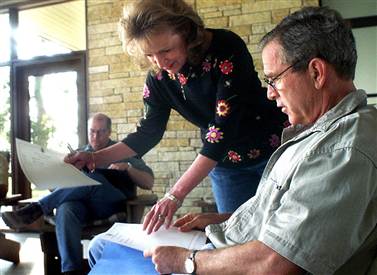
Harriet Miers shows the day's PDB to President George W. Bush, Aug. 6, 2001
Last night George W. Bush was interviewed Peter Schnall on a National Geographic Channel special leading up to the 10th anniversary of 9/11. Bush said to Schnall:
“At some point in time in the immediate aftermath of the attacks, I thought about why didn’t we know this?” Bush recalled.
“I knew we needed to figure out what went wrong to prevent other attacks but I didn’t want start the finger pointing and say to our intelligence communities, ‘You fouled up. You should have caught this. Why didn’t you know?’”
On Aug. 6, 2001, President Bush received a presidential daily briefing entitled “Bin Laden Determined to Strike in U.S.” Here is the redacted text of the CIA briefing:
Clandestine, foreign government, and media reports indicate Bin Laden since 1997 has wanted to conduct terrorist attacks in the U.S. Bin Laden implied in U.S. television interviews in 1997 and 1998 that his followers would follow the example of World Trade Center bomber Ramzi Yousef and “bring the fighting to America.”:
After U.S. missile strikes on his base in Afghanistan in 1998, Bin Laden told followers he wanted to retaliate in Washington, according to a [deleted text] service.
An Egyptian Islamic Jihad (EIJ) operative told [deleted text] service at the same time that Bin Laden was planning to exploit the operative success to the U.S. to mount a terrorist strike.The millennium plotting in Canada in 1999 may have been part of Bin Laden’s first serious attempt to implement a terrorist strike in the U.S. Convicted plotter Ahmed Ressam has told the FBI that he conceived the idea to attack Los Angeles International Airport himself, but that BinLaden lieutenant Abu Zubaydah encouraged him and helped facilitate the operation. Ressam also said that in 1998 Abu Zubaydah was planning his own U.S. attack.
Ressam says Bin Laden was aware of the Los Angeles operation.
Although Bin Laden has not succeeded, his attacks against the U.S. embassies in Kenya and Tanzania in 1998 demonstrate that he prepares operations years in advance and is not deterred by setbacks. Bin Laden associates surveilled our Embassies in Nairobi and Dar es Salaam as early as 1993, and some members of the Nairobi cell planning the bombings were arrested and deported in 1997.
Al Qaeda members — including some who are U.S. citizens — have resided in and traveled to the U.S. for years, and the group apparently maintains a support structure that could aid attacks.
Two Al Qaeda members found guilty in the conspiracy to bomb our embassies in East Africa were U.S. citizens, and a senior EIJ member lived in California in the mid-1990s.
A clandestine source said in 1998 that a Bin Laden cell in New York was recruiting Muslim-American youth for attacks.
We have not been able to corroborate some of the more sensational threat reporting, such as that from a [deleted text] service in 1998 saying that Bin Laden wanted to hijack a U.S. aircraft to gain the release of “Blind Shaykh” ‘Umar’ Abd aI-Rahman and other U.S.-held extremists.
Nevertheless, FBI information since that time indicates patterns ofsuspicious activity in this country consistent with preparations forhijackings or other types of attacks, including recent surveillance of federal buildings in New York.
The FBI is conducting approximately 70 investigations throughout the U.S. that it considers Bin Laden-related. CIA and the FBI are investigating a call to our embassy in the UAE in May saying that a group or Bin Laden supporters was in the U.S. planning attacks with explosives.
From the Washington Post, October 1, 2006:
On July 10, 2001, two months before the attacks on the World Trade Center and the Pentagon, then-CIA Director George J. Tenet met with his counterterrorism chief, J. Cofer Black, at CIA headquarters to review the latest on Osama bin Laden and his al-Qaeda terrorist organization. Black laid out the case, consisting of communications intercepts and other top-secret intelligence showing the increasing likelihood that al-Qaeda would soon attack the United States. It was a mass of fragments and dots that nonetheless made a compelling case, so compelling to Tenet that he decided he and Black should go to the White House immediately.
Tenet called National Security Adviser Condoleezza Rice, and insisted on meeting with her right away. For months, Tenet had been worried about a terrorist attack in the U.S.
Tenet hoped his abrupt request for an immediate meeting would shake Rice. He and Black, a veteran covert operator, had two main points when they met with her. First, al-Qaeda was going to attack American interests, possibly in the United States itself. Black emphasized that this amounted to a strategic warning, meaning the problem was so serious that it required an overall plan and strategy. Second, this was a major foreign policy problem that needed to be addressed immediately. They needed to take action that moment — covert, military, whatever — to thwart bin Laden.
The United States had human and technical sources, and all the intelligence was consistent, the two men told Rice. Black acknowledged that some of it was uncertain “voodoo” but said it was often this voodoo that was the best indicator.
Tenet and Black felt they were not getting through to Rice. She was polite, but they felt the brush-off. President Bush had said he didn’t want to swat at flies.
Rice later claimed she did not recall this meeting at all, but White House records showed that it indeed happened.
A review of White House records has determined that George J. Tenet, then the director of central intelligence, did brief Condoleezza Rice and other top officials on July 10, 2001, about the looming threat from Al Qaeda, a State Department spokesman said Monday.
The account by Sean McCormack came hours after Ms. Rice, the secretary of state, told reporters aboard her airplane that she did not recall the specific meeting on July 10, 2001, noting that she had met repeatedly with Mr. Tenet that summer about terrorist threats. Ms. Rice, the national security adviser at the time, said it was “incomprehensible” she ignored dire terrorist threats two months before the Sept. 11 attacks.
Mr. McCormack also said records show that the Sept. 11 commission was informed about the meeting, a fact that former intelligence officials and members of the commission confirmed on Monday.
Then on Aug. 6, while he was on vacation, Bush received the pdb, and did nothing about it. He didn’t even contact Tenet or Rice, who were also on vacation. According to Dana Millbank and Mike Allen at the Washington Post, Bush didn’t seem worried after he received the pdb.
President Bush was in an expansive mood on Aug. 7, 2001, when he ran into reporters while playing golf at the Ridgewood Country Club in Waco, Tex.
The day before, the president had received an intelligence briefing — the contents of which were declassified by the White House Saturday night — warning “Bin Ladin Determined To Strike in US.” But Bush seemed carefree as he spoke about the books he was reading, the work he was doing on his nearby ranch, his love of hot-weather jogging, his golf game and his 55th birthday.
“No mulligans, except on the first tee,” he said to laughter. “That’s just to loosen up. You see, most people get to hit practice balls, but as you know, I’m walking out here, I’m fixing to go hit. Tight back, older guy — I hit the speed limit on July 6th.”
[….]
Bush spent most of August 2001 on his ranch here. His staff said at the time that by far the biggest issue on his agenda was his decision on federal funding of stem cell research, followed by education, immigration and the Social Security “lockbox.”
Why is Bush permitted to continue lying about 9/11 without being challenged? Why didn’t National Geographic ask him why he didn’t do anything after receiving the Aug. 6 pdb?
Nicholas Kristof Suddenly Discovers the Unemployment Crisis
Posted: August 28, 2011 Filed under: Barack Obama, Economy, U.S. Economy, U.S. Politics, unemployment | Tags: Barack Obama, callous disregard for human lives, Depression, joblessness, media elite, Nicholas Kristof, politicians, Suicide, the NEW York Times, Torture, unemployment, war 16 Comments
I probably shouldn’t pick on Nicholas Kristof, because I guess as media elites go, he’s one of the least offensive. But really, his latest column just about sent me out into the street screaming and tearing my hair out. The piece is titled “Did We Drop the Ball on Unemployment?”
WHEN I’m in New York or Washington, people talk passionately about debt and political battles. But in the living rooms or on the front porches here in Yamhill, Ore., where I grew up, a different specter wakes friends up in the middle of the night.
It’s unemployment.
I’ve spent a chunk of summer vacation visiting old friends here, and I can’t help feeling that national politicians and national journalists alike have dropped the ball on jobs. Some 25 million Americans are unemployed or underemployed — that’s more than 16 percent of the work force — but jobs haven’t been nearly high enough on the national agenda.
Duh! I have a question for Captain Obvious Nick Kristof: Is the Pope Catholic? Here’s another one: Does a bear sh*t in the woods? Yes, Nick. You and your pals dropped the ball, missed the boat, and every other metaphorical cliche you can think of. Yes. And it’s way too late for your mealy-mouthed *concern* to make a difference.
What is wrong with these people? Kristof goes on to provide a few examples of people he knows in Oregon who are suffering from joblessness and hopelessness. Frankly, I found his little anecdotes rather patronizing. Maybe I’m being too hard on him, but really, if this man claims to be a “journalist,” why didn’t he recognize years ago that unemployment was a huge problem for the American people and for the economy as a whole? Kristof’s half-hearted prescriptions for solutions aren’t much better than Obama’s:
There are no quick fixes to joblessness, but Washington could temporarily make federal money available to pay for teachers who are otherwise being laid off. We could increase spending on service programs like AmeriCorps that have far more applicants than spots.
We could extend the payroll tax cut, which expires at the end of December. Astonishingly, Republicans in Congress seem to be lined up instinctively against this basic economic stimulus. Could the Tea Party actually favor tax reductions for billionaires but not for working Americans? Could we have found a tax increase the Republican Party favors?
Mr. Obama, with 25 million Americans hurting, will you fight — really fight! — to put jobs at the top of the national agenda?
Give me a break! Obama isn’t going to fight for anything except his own reelection and keeping his wealthy donors happy. And Nick Kristof, after tossing of a facile column in which he pretends to care about struggling Americans, will return to Washington and New York, smile his self-satisfied smile, and continue to ignore the depth of what is really happening to our country.
Why doesn’t The New York Times hire Jeffrey Kaye, who writes about important topics like torture? Joblessness can be a kind of torture too, and a couple of weeks ago, Kaye wrote a fine article about the links between unemployment, depression, and suicide.
When considering the effects of unemployment, and the desultory, really uncaring response of the current Democratic administration, as well as Republicans in Congress, to the human devastation of joblessness, it is important to consider the terrible emotional and psychological effects of such unemployment. Such effects are well-documented, but rarely mentioned in articles or blog postings.
A well-regarded 2010 study by the John J. Heldrich Center for Workforce Development at Rutgers, the State University of New Jersey, “The Anguish of Unemployment,” quantified the tremendous emotional suffering engendered by unemployment. “‘The lack of income and loss of health benefits hurts greatly, but losing the ability to provide for my wife and myself is killing me emotionally,’ wrote one respondent to the survey.” ….
Just last April, the Centers for Disease Control (CDC) released a study that showed that suicide rates rise and fall in tandem with the business cycle.
Kaye, a clinical psychologist actively working with clients, says he has seen the devastating effects of joblessness in his own practice since the financial crisis. He writes:
Unemployment is deadly. The effects of the capitalist boom-and-bust system seriously damage millions of lives. But with an almost daily bombast of propaganda about terrorism, the populace lives in fear, while wondering how they will make their bills, ground down between anxiety over ghostly terrorists and eviction, or how to put gas in their car, or afford a bus pass. Hopelessness stalks the land, not Al Qaeda. And yet the politicians in D.C. care little or nothing about the suffering their policies cause. Indeed, their pockets are lined with campaign donations from corporations that routinely layoff hundreds of thousands, and ship many thousands more jobs overseas.
Callous disregard for human lives is what links the terrible policies of war and torture with the policies of neglect and indifference towards the jobless. Such callousness is the by-product of a get-rich-quick ethos that worships profit over all else, over worship of a capitalist system that has brought about terrible world wars, massive depressions, colonial atrocities, and even genocide. U.S. society awaits its turn through the meat-grinder of history.
That is the kind of writing I’d like to see on the op-ed page of the NYT. Of course I know it will never happen. The elite media, the out-of-touch political class, and their wealthy enablers must not be made to feel even slightly uncomfortable about the effects of their actions–not even for the few minutes it takes to read a newspaper column.
Saturday Reads: Dr. Martin Luther King’s Dreams, Waiting for Irene, and Bernanke’s Complaint
Posted: August 27, 2011 Filed under: Barack Obama, Civil Rights, Domestic Policy, Economy, jobs, morning reads, poverty, U.S. Economy, U.S. Politics | Tags: Barack Obama, Ben Bernanke, Cornel West, Federal Reserve Bank, Hurrican Irene, I Have A Dream speech, leadership vacuum, Martin Luther King, media frenzy, oligarchy, revolution 63 Comments
By Mr. Fish, Truthdig.org
Good Morning! We are approaching the 48th anniversary of the March on Washington for Jobs and Freedom (remember those?) and Martin Luther King’s “I have a dream” speech. Perhaps it is fitting that the ceremony to be held tomorrow to commemorate the anniversary has been postponed indefinitely. After all, King’s dream of ending poverty in American has certainly been postponed indefinitely. Ironically, we now have a “Black President” who as different from Dr. King as night from day. Oh, if only King were here today to speak truth to this sorry excuse for a President!
A reminder from the Center for American Progress: Dr. King’s Legacy Relevant in Today’s Budget Battles
In the 1960s, Americans had a government that refused to deliver basic human rights to its people. Over time, after battles in the courts and the political arena, laws such as the Civil Rights Act of 1964 and the Equal Employment Opportunity Act of 1972 were passed. But despite these great accomplishments the fight continued because many Americans of all racial backgrounds were still living below the poverty line.
So in 1967, Dr. King and the Southern Christian Leadership Conference decided to organize and lead the Poor People’s Campaign to combat poverty. The goal was to push Congress to create an “Economic Bill of Rights” that would establish how the federal government would address and solve the country’s poverty issues. It called for full employment, affordable housing, reasonable living wages, and equitable education opportunities for the poor. Momentum built up around the country, but unfortunately the campaign ended early due to the tragic assassination of Dr. King and lack of organization to continue the efforts.
Cornel West had a very appropriate op-ed in the NYT a couple of days ago: Dr. King Weeps From His Grave Here is a relevant excerpt:
The age of Obama has fallen tragically short of fulfilling King’s prophetic legacy. Instead of articulating a radical democratic vision and fighting for homeowners, workers and poor people in the form of mortgage relief, jobs and investment in education, infrastructure and housing, the administration gave us bailouts for banks, record profits for Wall Street and giant budget cuts on the backs of the vulnerable.
As the talk show host Tavis Smiley and I have said in our national tour against poverty, the recent budget deal is only the latest phase of a 30-year, top-down, one-sided war against the poor and working people in the name of a morally bankrupt policy of deregulating markets, lowering taxes and cutting spending for those already socially neglected and economically abandoned. Our two main political parties, each beholden to big money, offer merely alternative versions of oligarchic rule.
The absence of a King-worthy narrative to reinvigorate poor and working people has enabled right-wing populists to seize the moment with credible claims about government corruption and ridiculous claims about tax cuts’ stimulating growth. This right-wing threat is a catastrophic response to King’s four catastrophes; its agenda would lead to hellish conditions for most Americans.
King weeps from his grave. He never confused substance with symbolism. He never conflated a flesh and blood sacrifice with a stone and mortar edifice. We rightly celebrate his substance and sacrifice because he loved us all so deeply. Let us not remain satisfied with symbolism because we too often fear the challenge he embraced. Our greatest writer, Herman Melville, who spent his life in love with America even as he was our most fierce critic of the myth of American exceptionalism, noted, “Truth uncompromisingly told will always have its ragged edges; hence the conclusion of such a narration is apt to be less finished than an architectural finial.”
King’s response to our crisis can be put in one word: revolution. A revolution in our priorities, a re-evaluation of our values, a reinvigoration of our public life and a fundamental transformation of our way of thinking and living that promotes a transfer of power from oligarchs and plutocrats to everyday people and ordinary citizens.
Yes we need a revolution. We desperately need to revise our priorities and values and to end the transfer of wealth and power from the people to the oligarchs. Who will lead that revolution? We have never been more in need of strong, honest, caring leaders and yet we have a complete vacuum of leadership. What is to become of our country?
Of course Hurricane Irene is the more immediate focus and the object of the media sharks’ feeding frenzy for today. Nothing so pedestrian as putting people back to work or ending poverty could interest them. Interestingly, big media seems to be ignoring the fact that the hurricane has weakened significantly and that the eye has collapsed, meaning that there is unlikely to be any more intensification of the storm. I suppose it could still do quite a bit of damage along the coastline, but as a Bostonian I’ve seen so many of these huge storms fail to live up to the hype that I’m skeptical of this one. I hope I’m right this time.
Jeff Masters at Weather Underground yesterday:
Satellite data and measurements from the Hurricane Hunters show that Irene is weakening. A 9:21 am EDT center fix by an Air Force Reserve aircraft found that Irene’s eyewall had collapsed, and the central pressure had risen to 946 mb from a low of 942 mb this morning. The highest winds measured at their flight level of 10,000 feet were 125 mph, which would normally support classifying Irene as a Category 3 hurricane with 115 mph winds. However, these winds were not mixing down to the surface in the way we typically see with hurricanes, and the strongest surface winds seen by the aircraft with their SFMR instrument were just 90 mph in the storm’s northeast eyewall. Assuming the aircraft missed sampling the strongest winds of the hurricane, it’s a good guess that Irene is a mid-strength Category 2 hurricane with 100 mph winds. Satellite imagery shows a distinctly lopsided appearance to Irene’s cloud pattern, with not much heavy thunderstorm activity on the southwest side. This is due to moderate wind shear of 10 – 20 knots due to upper-level winds out of the southwest. This shear is disrupting Irene’s circulation and has cut off upper-level outflow along the south side of the hurricane. No eye is visible in satellite loops, but the storm’s size is certainly impressive. Long range radar out of Wlimington, North Carolina, shows that the outermost spiral bands from Irene are now beginning to come ashore along the South Carolina/North Carolina border. Winds at buoy 41004 100 miles offshore from Charleston, SC increased to 36 mph as of 10 am, with significant wave heights of 18 feet.
And from last night: “Irene continues to weaken.”

Satellite data and measurements from the Hurricane Hunters show that Irene continues to weaken. A 1:32 pm EDT center fix by an Air Force Reserve aircraft found that Irene’s eyewall is still gone, and the central pressure had risen to 951 mb from a low of 942 mb this morning. The winds measured in Irene near the surface support classifying it as a strong Category 1 hurricane or weak Category 2. Satellite imagery shows a distinctly lopsided appearance to Irene’s cloud pattern, with not much heavy thunderstorm activity on the southwest side. This is due to moderate southwesterly wind shear of 10 – 20 knots. This shear is disrupting Irene’s circulation and has cut off upper-level outflow along the south side of the hurricane. No eye is visible in satellite loops, but the storm’s size is certainly impressive. Long range radar out of Wilmington, North Carolina, shows that the outermost spiral bands from Irene have moved ashore over North Carolina. Winds at buoy 41004 100 miles offshore from Charleston, SC increased to 47 mph, gusting to 60 mph at 3 pm EDT, with significant wave heights of 25 feet.
New York City has ordered 250,000 people to evacuate from coastal areas.
New York City officials issued what they called an unprecedented order on Friday for the evacuation of about 250,000 residents of low-lying areas at the city’s edges — from the expensive apartments in Battery Park City to the roller coaster in Coney Island to the dilapidated boardwalk in the Rockaways — warning that Hurricane Irene was such a threat that people living there simply had to get out.
Officials made what they said was another first-of-its kind decision, announcing plans to shut down the city’s entire transit system on Saturday — all 468 subway stations and 840 miles of tracks, and the rest of nation’s largest mass transit network: thousands of buses in the city, as well as the buses and commuter trains that reach from Midtown Manhattan to the suburbs.
Underscoring what Mayor Michael R. Bloomberg and other officials said was the seriousness of the threat, President Obama approved a request from Gov. Andrew M. Cuomo of New York to declare a federal emergency in the state while the hurricane was still several hundred miles away, churning toward the Carolinas. The city was part of a hurricane warning that took in hundreds of miles of coastline, from Sandy Hook, N.J., to Sagamore Beach, Mass.
From what I’ve heard, the Jersey Shore may get hit worse than NYC, but who knows? I know we have a few commenters from NJ, so I hope they will keep us updated on the situation there. In Boston, they are getting warnings about the storm surges for people along the coast and the Cape and islands.
BOSTON — As Hurricane Irene began to batter the Carolina Coast on Friday afternoon, a hurricane warning was issued for Cape Cod, Martha’s Vineyard, New York City and coastal Connecticut.
A tropical storm warning was issued for the North and South shores, and a tropical storm watch was issued for areas of southern New England further inland….
Massachusetts Gov. Deval Patrick declared a state of emergency ahead of the storm. He said he is particularly concerned because Irene will likely take a path through central Massachusetts, with fierce, damage-causing winds and storm surges on the eastern, coastal side of the state, and at least 10 inches of heavy rain leading to flooding to the west.
Here’s a little comic relief. Some ESPN guy (a former golfer) got in trouble for mocking President Obama on Twitter (has the First Amendment been repealed or what?)
ESPN is coming down on Paul Azinger for mocking President Obama on Twitter. The golf analyst tweeted Thursday the commander in chief plays more golf than he does — and that Azinger has created more jobs this month than Obama has.
On Friday ESPN ‘reminded” Azinger his venture into political punditry violates the company’s updated social network policy for on-air talent and reporters.
“Paul’s tweet was not consistent with our social media policy, and he has been reminded that political commentary is best left to those in that field,” spokesman Andy Hall told Game On! in a statement.
ESPN’s Hall would not comment on whether Azinger, who won the 1993 PGA Championship, will be fired, suspended or punished in some way. “We handle that internally,” he said.
In economics news, Ben Bernanke gave his eagerly anticipated speech yesterday, and basically said that the politicians have screwed up the economy and he hopes they won’t completely sink it with their insanely stupid policies based on Reagan era fantasies. If you’re interested, here are a few links to reactions to Bernanke’s speech.
Derek Thompson at The Atlantic: Bernanke: The Debt Ceiling Debate Nearly Broke the Recovery
Andrew Leonard at Salon: Bernanke Declines to Commit Treason
Jenine Aversa at Bloomberg: Bernanke Scholar Advises Bernanke Fed Chief to Be Bold on Monetary Policy
Those are my reading recommendations for today. What are you reading and blogging about?
Thursday Reads: S & P, the New Madrid Fault, the Gaddafis, and Obama in the Eye of Hurricane Irene
Posted: August 25, 2011 Filed under: Foreign Affairs, Libya, MENA, morning reads, Stock Market, The Bonus Class, U.S. Economy, U.S. Politics | Tags: Barack Obama, Deven Sharma, Douglas Peterson, earthquakes, FEMA, Global Financial Crisis, Hurricane Irene, Libya, Madrid fault, Martha's Vineyard, Muammar Gaddafi, ratings agencies, Saif Al-Islam Gaddafi, Standard & Poor's, Tim Geithner 42 Comments
Good Morning!! I think I have some interesting reading for you today, so let’s get right to it.
Last night I wrote about Goldman CEO Lloyd Blankfein possibly being in trouble with the feds. Interestingly, on Monday another high-profile exec announced he’ll be stepping down. I’m referring to S&P president Deven Sharma. From The New York Times:
The ratings agency Standard & Poor’s said late on Monday that its president, Deven Sharma, who has become the public face of the firm in the wake of its historic downgrade on the United States’ long-term debt rating, will step down and leave the company by the end of the year….
The management change had been in the works for months and was unrelated to either the Justice Department’s inquiry or to the emergence of the activist investors, Jana Partners and the Ontario Teachers Pension Plan, according to people briefed on the matter.
Oh really? Kind of a strange coinky-dink, then, isn’t it?
The ratings agency’s decision to downgrade the United States’ long-term credit rating to AA+ from AAA on Aug. 5 set off a storm of controversy, including criticism by President Obama and Treasury Secretary Timothy F. Geithner. The decision contributed heavily to the worst drop in American stocks since the financial crisis three years ago, as well as volatility that continues to whipsaw the markets weeks later. The other big ratings agencies, Moody’s and Fitch, maintained their top-tier rating on United States debt.
At the same time, the agency is being investigated over whether it improperly rated mortgage securities in the years leading up to the financial crisis. Standard & Poor’s, along with the other major ratings agencies, gave their highest ratings to bundles of troubled loans that appeared less risky during the housing boom, but have since collapsed in value.
Since the financial crisis, the agencies’ business practices and models have been scrutinized by Congress, and Standard & Poor’s is also being investigated by the Justice Department, people briefed on the matter have previously said. At issue is whether the agency’s independent analysis was driven by profits. The Justice Department inquiry, which began before the Standard & Poor’s downgrade of the United States’ debt, is centered on whether analysts’ decisions to assign securities a low credit rating on subprime mortgage loans were overruled by business managers.
Right. I’m sure none of that had anything to do with the president of the troubled company stepping down. /snark
The Financial Times has a piece on the incoming president, Douglas Peterson.
As head of Citigroup’s Japanese operations in 2004, Mr Peterson dramatically bowed in apology before Tokyo regulators after they shut down Citi’s private banking operations there.
Now, as he takes over the embattled ratings agency just weeks after its unprecedented downgrade of US credit, Mr Peterson is likely to find himself before regulators in the US, who are looking into the downgrade and reportedly investigating S&P’s ratings of mortgages before the financial crisis.
Yet, it is Mr Peterson’s experience in Japan, and his more recent turn running Citibank, the retail banking arm of Citigroup, that has given S&P’s owner McGraw-Hill confidence that he is the right man for the job.
Seven years ago, Mr Peterson was given the tricky task of mending relations with Japanese regulators and rebuilding Citi’s tarnished reputation after the US bank’s private banking unit was found to have illegally amassed large profits and was ordered to close down.
By all accounts, the affable Mr Peterson, who is widely described in Tokyo as “nice” and “sincere”, succeeded in reassuring the Financial Service Agency and the Japanese public alike that Citi could once again be trusted with the considerable financial assets of one of the largest economies in the world.
IOW, Peterson has been hired because of his pleasing personality and his ability to make friends and influence people.
But Sean Gregory at Time argues that “A New Leader Won’t Save S&P.”
It’s tempting to read the resignation of Deven Sharma, who stepped down as president of S&P Monday night, as an admission that the rating agency goofed in downgrading the United States’ sovereign rating from AAA to AA+, even as Fitch and Moody’s maintained America’s top grade. Warren Buffett said the U.S. should be rated “quadruple A.” The Treasury department complained that S&P overestimated the nation’s future debt by $2 trillion. Timothy Geithner said that the S&P decision shows “a stunning lack of knowledge about basic U.S. fiscal budget math. And I think they drew exactly the wrong conclusion from this budget agreement.”
Guess Sharma and Geithner won’t be hanging out at any holiday parties. If the S&P downgrade was indeed a mistake, it was an expensive one. In the week after the Aug. 5 S&P downgrade, according to Bloomberg, the market value of global stocks tumbled by $7.6 trillion. Sharma, a former Booz Allen Hamilton consultant who has headed S&P for the past four years, might not be trumping this fact on his newly-polished resume. So you’re the guy who cost the world $7.6 trillion in wealth? You’re hired!
Like FT, Gregory points out that S&P has been shopping for a new leader for months, mostly because Sharma has failed the company in a number of ways. So will a new president make a difference? No, because the ratings agencies simply aren’t qualified to evaluate the credit of sovereign states.
There’s a frightening earthquake story at The Daily Beast: The Quake We Should Fear. Apparently it’s the Midwest that is due for a big one–not the east coast.
Early in the morning of May 16, while most of America was being titillated and transfixed by the appearance in court of the then-suspect Dominique Strauss-Kahn, an urgent message was suddenly received at the headquarters of the Federal Emergency Management Agency (FEMA) in Washington, D.C.
Reports were streaming in of a catastrophic earthquake, magnitude 7.7, that had struck the Midwest near the town of Marked Tree, Ark. First reports were alarming: phenomenal property damage; casualty figures were unprecedented; transportation links were severed; and cities like St. Louis, Memphis, Little Rock, and Cincinnati had been thrown into utter turmoil. Eight states were believed to have been directly affected, and it was thought the death toll would be in the thousands.
A gigantic federal relief mission swung into action. Nine thousand National Guardsmen were ordered to be deployed. Triage centers were opened in all the affected cities—a list that grew longer as a secondary magnitude 6.0 earthquake struck close to the city of Mt. Carmel, Ill. The Red Cross deployed emergency teams. Power companies were given priority to restore electricity and gas supplies. Heavy equipment was sent in to clear highways and railway tracks.
Within 72 hours some kind of order was restored. Hospitals found themselves more able to cope with the vast number of patients suffering injuries. Refugees fleeing in panic were being assembled into special camps. Temporary tent cities were set up along the main refugee routes.
Huh? Oh wait. That was a FEMA exercise. But it was based on the real possibility of a major earthquake on the Madrid fault. It’s happened before and is due to happen again.
This year marks the bicentennial of the great swarm of earthquakes that afflicted New Madrid between December 1811 and February 1812—hundreds of them, day after day, but punctuated by four enormous ruptures, two occurring on Dec. 16, and one each on Jan. 23 and Feb. 7. These caused spectacular effects all across the then young, sparsely settled United States—toppling church steeples in South Carolina, ringing church bells in Boston, causing the Mississippi to reverse it course, and sinking numerous properties deep into the liquefied earths of the prairies.
Yikes! But I’m still worried that Boston hasn’t had a major earthquake since 1755–so we’re probably due also.
Yesterday I came across a couple of interesting stories on Muammar Gaddafi and his son Saif that you might want to check out.
From Scientific American: Egotist Rex: Are a Dictator’s Defiant Statements Indicative of Self-Delusion? It’s an interview with George Washington University Professor of Psychiatry Jerrold Post.
The interviewer asks Post about the many bizarre statements that Gaddafi has made since the rebellion began. He seems out of touch with reality. Is he delusional? Post discusses the circles of sycophants that surround every world leader–this may make it difficult for the leader to see what is really happening outside this protective bubble of supporters.
They can have a very unrealistic understanding and believe, as Qadhafi stated again and again, “My people, they all love me.”
I found this language of his quite remarkable. And with Qadhafi as an exaggerated example, this is true of any of the other leaders, too—namely, they believe they have widespread support. If there are public demonstrations against them, that must reflect outside agitators. This was true with [ousted Egyptian president Hosni] Mubarak as well. He spoke of outside conspiracies.
But it is particularly true of Qadhafi. There is an interesting kind of almost syllogism for him: “My people all love me, and therefore if there is anyone protesting against me, they are not really my people, and that must be a consequence of outside provocation.” And one of the points that he made early on was that this was crazed youth who were on hallucinogens with which their Nescafe had been laced, which I thought was rather creative, really.
I found Qadhafi’s language in general very striking. And what is most interesting about it is it is entirely in the first person singular: “My people all love me. They will support me. My people, they love me.” It was very “me” centered.
Next the interviewer asks whether narcissism is a characteristic of many national leaders? The response could perhaps be applied to someone a little closer to home, if you know what I mean. Check it out.
Vanity Fair has a new article up about Saif Al-Islam Gaddafi. It’s rather long, but here’s the introductory paragraph:
Saif al-Islam Qaddafi—son of Muammar, and long regarded as his heir—was subjected to an arrest warrant months ago by the Criminal Court for crimes against humanity. Libyan rebels in Tripoli reported that he was in custody, but Saif soon appeared in public, rallying what’s left of pro-Qaddafi forces. As NATO bombs fell on Libya, the distinguished international lawyer Philippe Sands sat down with those who know Saif Qaddafi best—a London professor, his Libyan mentor, and the prosecutor who may decide his fate. Saif Qaddafi may claim that he was merely an intermediary, or a force for moderation, or perhaps even a victim. But whatever the claims, according to the prosecutor, he was deeply complicit in his father’s crackdown this year.
Hurricane Irene could become a category 3 sometime today. It’s still predicted to go right up the coast to New England. States all along the east coast are preparing for the worst. Will it hit the Cape and islands? The LA Times suggests President Obama might have to be evacuated.
First, President Obama’s golf game was interrupted by an earthquake. Now, it appears that Hurricane Irene is beating a path toward Martha’s Vineyard, where the president is vacationing with his wife and two daughters.
The National Hurricane Center’s latest forecast shows Hurricane Irene reaching landfall in the Carolinas late Friday and early Saturday before raking its way up the East Coast and into New England. Coastal areas are urged to keep tabs on the storm’s path and remain alert for possible evacuation orders as the hurricane continues to grow in intensity.
It swelled to a Category 3 storm overnight with winds that could exceed 110 mph, and remains on track to gain in strength and ferocity to become a Category 4 hurricane.
Obama is supposed to be in Washington on Sunday to speak at the opening of the Martin Luther King Memorial and then return to the Vineyard. The storm is supposed to hit DC before moving up to Massachusetts.
The eye of the storm appears to be sticking to the coastal outlines, which could spell trouble for Martha’s Vineyard, an island accessible only by boat or plane. As it has done throughout the storm, the National Hurricane Center stresses that the projected path could change dramatically as weather projections come into sharper focus over the next several days.
Hmmm…. Perhaps Mother Nature is trying to send a message to our obtuse leader: Americans need jobs!! Or maybe not.
That’s all I’ve got for you today. What are you reading and blogging about?

 peej
peej Carissa
 bostonboomer
 dakinikat
 ecocatwoman
 mablue2
 Mama Lopez
 peggysue22
 quixote
 skydancingguestblogger
 Mona (aka Wonk the Vote)



 Sky Dancing
Recent Comments