
Embarrassing Tales Told by Politicians
Posted: February 27, 2012 Filed under: 2012 primaries, just because, psychology, U.S. Military, U.S. Politics | Tags: Barack Obama, George W. Bush, memory errors, Mitt Romney, Ronald Reagan 8 Comments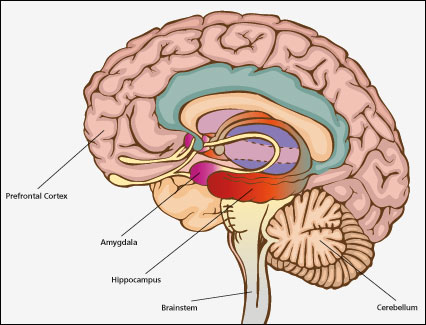
Brain areas involved in memory
Human memory can be amazingly accurate and detailed. It is possible for people to accurately recall events that happened in the decades previously. Yet humans are also subject to numerous memory errors, which are actually adaptive for most purposes, but can be embarrassing when they happen to people in the public eye.
On Saturday it happened to Mitt Romney. During his speech to a Tea Party rally in Flint, Michigan, Romney described a vivid childhood memory
Romney recalled he was “probably 4 or something like that” the day of the Golden Jubilee, when three-quarters of a million people gathered to celebrate the 50th anniversary of the American automobile.
“My dad had a job being the grandmaster. They painted Woodward Ave. with gold paint,” Romney told a rapt Tea Party audience in the village of Milford Thursday night, reliving a moment of American industrial glory.
The Golden Jubilee described so vividly by Romney was indeed an epic moment in automotive lore. The parade included one of the last public appearances by an elderly Henry Ford.
But Romney couldn’t possibly have been a the Golden Jubilee, because it happened in 1946–about 9 months before baby Willard was born. Was he lying? No, of course not. He probably formed this false memory based on stories told by family members, and perhaps family photos. This is a very common type of memory error–confusion about the source of a memory. Romney probably heard this story many times and perhaps rehearsed it by thinking about it and talking about it to family and friends.
Most theorists now believe that memories are stored in various locations in the brain and have to be reconstructed each time we recall them. Confusion can develop if we have memories of several events that happened in the same place–people can get mixed up about which time a specific event happened.
As you might expect, memory errors become more common with age. There are a number of famous stories about Ronald Reagan’s outrageous memory errors. He repeatedly told a heartrending story about a World War II bomber pilot who ordered his crew to bail out after the plane was hit by enemy fire. His young belly gunner was wounded so seriously that he was unable to evacuate the aircraft. Reagan could barely hold back tears as he related the pilot’s heroic response: “Never mind. We’ll ride it down together.” Supposedly the pilot had received the Congressional Medal of Honor, awarded posthumously.
Journalists searched in vain to learn about the war hero. They could find no Medal of Honor winner whose story matched the one told by Reagan. Finally the source of the story was identified as a scene from a Hollywood movie, “A Wing and a Prayer.” Reagan had recalled the “facts,” but not their source.
Another famous example is Reagan’s oft-repeated tale about how he had helped to liberate Auschwitz after World War II ended. In fact Reagan event repeated this “memory” to Israeli prime minister Yitzhak Shamir, explaining that he had
returned to Hollywood with film footage of the ghastly scenes he had witnessed, and if in later years anyone controverted the reality of the Holocaust over the Reagan dinner table, he would roll the footage till the doubts were stilled.
Of course no Americans were involved in the liberation of Auschwitz, which was a Russian operation. And although Reagan was in the Army, he never left California where he was involved in making propaganda films. Interestingly, Barack Obama also told a story about the liberation of Auschwitz back in 2008. Speaking to a New Mexico audience about the need for mental health care for veterancs, Obama recalled a family story about his uncle.
“I had a uncle who was one of the, who was part of the first American troops to go into Auschwitz and liberate the concentration camps,” Obama said, slowly and methodically. “And the story in my family is that when he came home, he just went into the attic, and he didn’t leave the house for six months. Alright? Now, obviously something had affected him deeply, but at the time, there just weren’t the kinds of facilities to help somebody work through that kind of pain.”
It turned out that Obama’s Uncle actually was involved in the liberation of a concentration camp, but it was Buchenwald, not Auschwitz. This was probably a story that was told repeatedly in Obama’s family, and he simply forgot the name of the camp and substituted a famous name–Auschwitz.
And then there was the 2007 speech in which Obama seemed to suggest that his parents had been brought together because of the Civil Rights march in Selma, Alabama in 1965. Obama was born in 1961. The speech actually had two doozies in it. Obama also claimed that the Kennedy family had been responsible for bringing his father to the U.S. Here’s the relevant quote:
What happened in Selma, Alabama and Birmingham also stirred the conscience of the nation. It worried folks in the White House who said, “You know, we’re battling Communism. How are we going to win hearts and minds all across the world? If right here in our own country, John, we’re not observing the ideals set fort in our Constitution, we might be accused of being hypocrites.” So the Kennedy’s decided we’re going to do an air lift. We’re going to go to Africa and start bringing young Africans over to this country and give them scholarships to study so they can learn what a wonderful country America is.
This young man named Barack Obama got one of those tickets and came over to this country. He met this woman whose great great-great-great-grandfather had owned slaves; but she had a good idea there was some craziness going on because they looked at each other and they decided that we know that the world as it has been it might not be possible for us to get together and have a child. There was something stirring across the country because of what happened in Selma, Alabama, because some folks are willing to march across a bridge. So they got together and Barack Obama Jr. was born. So don’t tell me I don’t have a claim on Selma, Alabama. Don’t tell me I’m not coming home to Selma, Alabama.
I’m here because somebody marched. I’m here because you all sacrificed for me. I stand on the shoulders of giants. I
Actually, the Kennedy family did donate $100,000 to the airlift program, but not until Barack Obama, Sr. was already in the U.S. As for how his parents got together, Obama’s campaign staff claimed that he had meant that the Civil Rights movement generally was responsible, but I think it was probably just an honest mistake. Certainly his speechwriters should have done some more careful fact-checking, but Obama was probably reporting what he “remembered.”
I’ll just share one more interest example of a high-profile false memory. This one from George W. Bush. Bush was in Orlando, Florida at a town hall meeting where he took questions from the audience. A young boy asked Bush how he felt on 9/11.
QUESTION: One thing, Mr. President, is that you have no idea how much you’ve done for this country, and another thing is that how did you feel when you heard about the terrorist attack?
….
Well, Jordan (ph), you’re not going to believe what state I was in when I heard about the terrorist attack. I was in Florida. And my chief of staff, Andy Card — actually I was in a classroom talking about a reading program that works. And I was sitting outside the classroom waiting to go in, and I saw an airplane hit the tower — the TV was obviously on, and I use to fly myself, and I said, “There’s one terrible pilot.” And I said, “It must have been a horrible accident.”
But I was whisked off there — I didn’t have much time to think about it, and I was sitting in the classroom, and Andy Card, my chief who was sitting over here walked in and said, “A second plane has hit the tower. America’s under attack.”
But Bush could not have seen the plane hit the first tower, because there was no footage shown on TV until the next day. Bush obviously watched the footage later and became confused about when he had first seen it.
We all make errors like this–we just don’t often do it in front of a crowd of people and then end up getting fact-checked afterwards. The fact is, our memories are quite reliable for most daily purposes. It wouldn’t be adaptive for us to remember every single detail of what happens to us. But it pays to be aware that our memories can fail us is predictable ways.
Rick Santorum “Almost Threw Up” after Reading JFK Speech on Separation of Church and State
Posted: February 26, 2012 Filed under: 2012 presidential campaign, 2012 primaries, Republican presidential politics, U.S. Politics | Tags: Ave Maria University, Barack Obama, College of Saint Mary Magdalen, George W. Bush, great speeches, ignorance, John F. Kennedy, religious bigotry, Rick Santorum, Satan, separation of church and state 16 Comments
The quote comes from a speech Santorum gave last October at the College of Saint Mary Magdalen in Warner, New Hampshire:
“Earlier in my political career I had opportunity to read the speech, and I almost threw up.”
How nice of him to share. This morning on This Week, George Stephanopoulos asked Santorum why JFK’s speech made him feel like throwing up. Here’s his reply:
Because the first line, first substantive line in the speech says, “I believe in America where the separation of church and state is absolute.” I don’t believe in an America where the separation of church and state is absolute. The idea that the church can have no influence or no involvement in the operation of the state is absolutely antithetical to the objectives and vision of our country.
This is the First Amendment. The First Amendment says the free exercise of religion. That means bringing everybody, people of faith and no faith, into the public square. Kennedy for the first time articulated the vision saying, no, faith is not allowed in the public square. I will keep it separate. Go on and read the speech. I will have nothing to do with faith. I won’t consult with people of faith. It was an absolutist doctrine that was abhorrent (ph) at the time of 1960. And I went down to Houston, Texas 50 years almost to the day, and gave a speech and talked about how important it is for everybody to feel welcome in the public square. People of faith, people of no faith, and be able to bring their ideas, to bring their passions into the public square and have it out.
As most minimally educated Americans know, Kennedy’s speech on his religion is considered one of the great speeches of the 20th Century. On September 12, 1960, in Houston, Texas, Kennedy spoke to the Greater Houston Ministerial Association in an effort to calm the fears of Protestants who believed that a Catholic President would take orders from the Vatican or other members of the Church hierarchy.
I remember watching the speech on TV. It was a big deal for Kennedy and for Catholics generally. In 1960, Catholics were considered a little weird, and many people even insisted they weren’t Christians. The speech was a success, and Kennedy went on to become the first Catholic President of the U.S.
But according to Rick Santorum, who apparently didn’t get a very good education at Penn State or Dickinson College Law School, Kennedy was opposing the First Amendment. More from This Week:
…to say that people of faith have no role in the public square? You bet that makes you throw up. What kind of country do we live that says only people of non-faith can come into the public square and make their case? That makes me throw up and it should make every American who is seen from the president, someone who is now trying to tell people of faith that you will do what the government says, we are going to impose our values on you, not that you can’t come to the public square and argue against it, but now we’re going to turn around and say we’re going to impose our values from the government on people of faith, which of course is the next logical step when people of faith, at least according to John Kennedy, have no role in the public square.
Of course Kennedy said no such thing. He was trying to assure Americans that he (Kennedy) would never impose his own religious beliefs on other Americans. Did Santorum actually read the speech? I doubt it. Either he didn’t read past the first line or he’s just mouthing propaganda he heard from someone like James Dobson. On the other hand, I get the feeling that Santorum would very happily impose his religious beliefs on the rest of us–which is a very scary thought.
Let’s take a look at what Kennedy actually said. He began by arguing that the country had much more important problems than the question of his religion:
While the so-called religious issue is necessarily and properly the chief topic here tonight, I want to emphasize from the outset that I believe that we have far more critical issues in the 1960 campaign; the spread of Communist influence, until it now festers only 90 miles from the coast of Florida — the humiliating treatment of our President and Vice President by those who no longer respect our power — the hungry children I saw in West Virginia, the old people who cannot pay their doctors bills, the families forced to give up their farms — an America with too many slums, with too few schools, and too late to the moon and outer space. These are the real issues which should decide this campaign. And they are not religious issues — for war and hunger and ignorance and despair know no religious barrier.
But Kennedy understood that the religious issue had become a distraction and wanted to deal with it up front, once and for all.
I believe in an America where the separation of church and state is absolute; where no Catholic prelate would tell the President — should he be Catholic — how to act, and no Protestant minister would tell his parishioners for whom to vote; where no church or church school is granted any public funds or political preference, and where no man is denied public office merely because his religion differs from the President who might appoint him, or the people who might elect him.
I believe in an America that is officially neither Catholic, Protestant nor Jewish; where no public official either requests or accept instructions on public policy from the Pope, the National Council of Churches or any other ecclesiastical source; where no religious body seeks to impose its will directly or indirectly upon the general populace or the public acts of its officials, and where religious liberty is so indivisible that an act against one church is treated as an act against all.
Kennedy then argued that while “the finger of suspicion” was “pointed” at him in 1960, the next time it could be someone of another religion and this kind of questioning of each others’ religious beliefs could lead someday to “the whole fabric of our harmonious society [being] ripped apart at a time of great national peril.” Imagine if he could see what has happened to this country 50 years after that day in Houston!
Kennedy continued:
Finally, I believe in an America where religious intolerance will someday end, where all men and all churches are treated as equals, where every man has the same right to attend or not to attend the church of his choice, where there is no Catholic vote, no anti-Catholic vote, no bloc voting of any kind, and where Catholics, Protestants, and Jews, at both the lay and the pastoral levels, will refrain from those attitudes of disdain and division which have so often marred their works in the past, and promote instead the American ideal of brotherhood.
That is the kind of America in which I believe. And it represents the kind of Presidency in which I believe, a great office that must be neither humbled by making it the instrument of any religious group nor tarnished by arbitrarily withholding it — its occupancy from the members of any one religious group. I believe in a President whose views on religion are his own private affair, neither imposed upon him by the nation, nor imposed by the nation upon him as a condition to holding that office.
One wonders how Rick Santorum would react to a presidential candidate who was a Muslim. Kennedy notes that he and his brother fought in WWII to preserve this freedom.
This is the kind of America I believe in — and this is the kind of America I fought for in the South Pacific, and the kind my brother died for in Europe. No one suggested then that we might have a divided loyalty, that we did not believe in liberty, or that we belonged to a disloyal group that threatened — I quote — “the freedoms for which our forefathers died.”
Did Rick Santorum go into battle and risk his life for his country? I think not. His battle is with an invisible enemy: “Satan.”
Rereading Kennedy’s speech calls attention to the fact that the separation of church and state has broken down since his day. Kennedy asked the assembled ministers to
judge me on the basis of 14 years in the Congress, on my declared stands against an Ambassador to the Vatican, against unconstitutional aid to parochial schools, and against any boycott of the public schools — which I attended myself.
We now have an ambassador to the Vatican, the government provides aid to Catholic schools through voucher programs, and we have a White House Office of Faith-Based and Neighborhood Parnerships which, under Bush at least, funded religious-based abstinence programs. While Kennedy said he wouldn’t consult from religious leaders, George W. Bush and Barack Obama have both done so, most recently when Obama met with Catholic Bishops about his contraception policy. Kennedy:
I do not speak for my church on public matters; and the church does not speak for me. Whatever issue may come before me as President, if I should be elected, on birth control, divorce, censorship, gambling or any other subject, I will make my decision in accordance with these views — in accordance with what my conscience tells me to be in the national interest, and without regard to outside religious pressure or dictates. And no power or threat of punishment could cause me to decide otherwise.
Kennedy went on to say that if the day ever came
when my office would require me to either violate my conscience or violate the national interest, then I would resign the office; and I hope any conscientious public servant would do likewise.
Those are the sentiments that made Rick Santorum “almost throw up.” What more do you need to know about this man? He is not fit to serve as dogcatcher, let alone hold high public office. Below is video of Kennedy’s speech.
Open Thread: Oops! Rick Santorum Just Can’t Help Himself
Posted: February 25, 2012 Filed under: 2012 presidential campaign, 2012 primaries, open thread, racism, U.S. Politics | Tags: "blah people", government dependency, Michigan primary, minority communities, Rick Santorum 60 CommentsEarlier today Rick Santorum spoke to a Tea Party crowd in Troy, Michigan and, as he did about a month ago, suggested that people in “minority communities” are especially reliant on food stamps and welfare.
Speaking to a large crowd at the conservative Americans for Prosperity Presidential forum here, Santorum said he planned to “talk to minority communities, not about giving them food stamps and government dependency, but about creating jobs so that they can participate in the rise of this country.”
Here’s the video:
In Iowa in January, Santorum said what most people thought sounded like this:
“I don’t want to make black people’s lives better by giving them somebody else’s money. I want to give them the opportunity to go out and earn the money and provide for themselves and their families.”
Watch it:
Later he claimed he had really said “blah people.”
Today Santorum was pretty clear in linking food stamps and “dependency” to minorities, even though most of the people using government programs are white. How will he try to weasel out this time? This guy just can’t seem to keep from saying whatever pops into his head.
How the 2008 Nomination Was Rigged for Obama
Posted: February 23, 2012 Filed under: Team Obama, The DNC, U.S. Politics | Tags: 2008 Democratic primaries, Barack Obama, Florida and Michigan Delegates, Hillary Clinton, Howard Dean, Jeff Berman, May 31 DNC Rules Committee meeting 34 Comments
Obama acception the 2008 nomination among his Greek columns
Hillary never really had a chance in 2008. Politico has the story this morning, based on a new book by Jeff Berman, who was Obama’s “chief delegate counter” during the 2008 primaries. The self-published book, The Magic Number, can be purchased at Amazon and Barnes & Noble.
From Politico:
The low-profile Berman, whose formal campaign title was national delegate director, was known for his obsessive attention to detail and preparation, and the book includes an unusually clear explanation of the complex, arbitrary process of selecting presidents. But its most striking moments, for those who followed the campaign closely, concern previously unreported battles, particularly around the primary calendar, the outcomes of which could have determined the nomination.
Unreported by the stupid corporate media who obviously could have investigated, but chose not to.
Florida and Michigan were key, and Berman describes how he tricked the Clinton operation into handing the nomination to Obama from the start.
“A January 29th Florida primary could completely blow up Obama’s winning path to the presidential nomination,” Berman writes. “This path requires him to win in Iowa, get through New Hampshire and Nevada and emerge, the week before Super Tuesday, as a leading candidate in South Carolina, whose large African-American population can carry him to a major victory one week before Super Tuesday. Moving the Florida primary to three days after South Carolina’s primary would block this strategy, as the election outcome in massive Florida would surely overshadow the results from smaller South Carolina.”
Berman quietly asked former Iran-Contra prosecutor John Nields and two other lawyers “to investigate exactly how the Florida primary legislation was enacted.” Their “authoritative legal report” showed that Florida Democrats — who were trying to blame the GOP — actually had a hand in the process; the Democratic National Committee used its findings as the basis for the move to sanction Florida, Berman writes.
According to Berman, Clinton aide Harold Icke, who was on the DNC Rules Committee, never questioned this fraudulent document, and signed on without any argument at all.
The Coup de grace, of course, came on May 31, 2008. Berman says that Howard Dean was worried about the outcome of the rules committee meeting that day, but not to worry. It worked out fine for The One. Of course we all recall how Obama’s nomination was secured by giving Obama some of Hillary’s Michigan primary votes, even though the Obama-obsessed corporate media ignored the whole slimy operation.
The uncertainty, though, lasted through the spring of 2008. Indeed, Berman writes, DNC Chairman Howard Dean was uncertain that he could persuade the Rules Committee members to enforce sanctions on Michigan and Florida in a May 31 meeting, and sought to cancel that session. Had the sanctions failed, the nomination fight could have blown wide open at the very last moment.
Berman also describes how he got help from the UAW to keep Obama and Edwards from being forced to keep their names on the ballot in Michigan, risking defeat by Clinton.
Berman called an official of the United Auto Workers, who had ties to Edwards, and persuaded the union to oppose the change.
“When the UAW makes a few calls in a political fight in Michigan, the political calculus of the fight changes,” he writes with satisfaction.
It’s all water under the bridge now, but I can still get angry about it. This is going to make it even harder for me to decide whether to vote the top of the ticket or leave it blank November.
Thursday Reads
Posted: February 23, 2012 Filed under: 2012 primaries, legislation, Marriage Equality, morning reads, PLUB Pro-Life-Until-Birth, religion, U.S. Politics, War on Women, Women's Healthcare, Women's Rights | Tags: constitution, DOMA, Mitt Romney, Newt Gingrich, Republican Debate, Rick Santorum, Ron Paul 47 Comments
Good Morning!!
There was another Republican debate last night, and it may actually be the last one! We live blogged it here. I watched the debate and all it did was remind me how distasteful–actually repulsive–every one of these candidates is. Romney is the slimiest, liar ever; Gingrich is nothing but a grifter; Ron Paul is a whiny old geezer; and Santorum is a sanctimonious, preachy theocrat. After this election, the Republican Party may be truly dead. It’s already brain dead.
Here are a few reactions to the debate for those who are interested.
Paul Begala: Romney Wins the battle, but it may lose him the war.
Andrew Sullivan: The winner’s in the White House.
TPM: Rick’s rough night.
Hot Air: Tough night for Santorum
In state legislatures around the country women are fighting back against the Republican war on women. Yesterday, Governor Bob O’Donnell of Virginia was forced to back down on the anti-woman state-sanctioned rape law that he had originally said he’d sign. In Georgia, (via Charlie Pierce), state rep. Yasmin Neal
was the driving force behind a brilliant bill filed yesterday that would outlaw vasectomies in Georgia on anti-abortion grounds — namely, that the lives of millions of potential “persons” were snuffed out because of the vas deferens between the way we see men as reproductive critters and the way we see women as reproductive critters:
Thousands of children are deprived of birth in this state every year because of the lack of state regulation over vasectomies,” said Rep. Yasmin Neal, D-Riverdale, author of the Democrats’ bill. “It is patently unfair that men can avoid unwanted fatherhood by presuming that their judgment over such matters is more valid than the judgment of the General Assembly, while women’s ability to decide is constantly up for debate throughout the United States.”
Now some Democrats are fighting back at the federal level.
The House Judiciary Committee recently passed a bill that would ban selective abortions based on race or gender by a 20-13 vote. The biggest hurdle to passage was the bill’s name.
Democrats proposed calling the bill “The Ronald Reagan Impose Your Beliefs on a Woman’s Womb Act” and “The Tea Party Determines What Rights a Woman Has Act.”
The legislation (H.R. 3541), sponsored by Rep. Trent Franks (R-Ariz.), was originally entitled the “Susan B. Anthony and Frederick Douglass Prenatal Non-discrimination Act of 2011.” But after objections by committee Democrats and an amendment by Rep. John Conyers (D-Mich.), the bill, which passed on Feb. 16, was changed to the Prenatal Non-Discrimination Act (PRENDA) during mark-up sessions last week.
Thirteen Democrats voted against the measure claiming it violated the 1973 Supreme Court decision Roe v. Wade, which legalized abortion nationwide, and would “make it more difficult for women of color to obtain the basic reproductive health care services.”
The GLBT community is fighting back against the GOP haters too. Not too long ago, an anti-gay Tennessee state legislator was asked by the owner, Martha Boggs to leave her restaurant because of his bigoted public statements. Today, Antonio a gay hairdresser in Santa Fe, said he will no longer cut Republican New Mexico governor Susannah Martinez’s hair. Even {gasp!} Alan Simpson is getting in on the act. He says Rick Santorum is “rigid and a homophobic.”
Former Sen. Alan Simpson (R-Wy.) weighed in on the Republican presidential primary on Wednesday, calling Rick Santorum “rigid and a homophobic.”
In an interview with CBS News’ Bob Schieffer, Simpson faulted the Republican field for making issues like same-sex marriage and reproductive rights central to their platforms, warning that they would lose favor with voters if the conversation does not change.
“I am convinced that if you get into these social issues and just stay in there about abortion and homosexuality and even mental health they bring up, somehow they’re going to take us all to Alaska and float us out in the Bering Sea or something,” said Simpson, long known for colorful commentary. “We won’t have a prayer.”
He continued, “I watch Republicans, they give each other the saliva test of purity, and then they lose and they bitch for four years.”
Simpson supports Romney, who also claims to be homophobic, anti-choice, and anti-birth control. Oh well….
Yesterday was Ash Wednesday, and one of those mainline Protestant churches that Rick Santorum thinks have been taken over by Satan offered drive-thru ashes! Someone needs to tell Rick! It’s the Devil’s work!!
Over the weekend, Newt Gingrich tried to look macho by claiming “you can’t put a gun rack on a Chevy Volt!” But lots of people have stepped forward to prove him wrong.
A GM exec came forward to prove Newt was incorrect.
Chevrolet executive Selim Bingol fired back this morning via GM’s new blog, called BTW:
“Newt Gingrich has taken up saying that ‘You can’t put a gun rack on a Volt.’ That’s like saying ‘You can’t put training wheels on a Harley.’ Actually, you can. But the real question is ‘Why would you?’ In both examples:
It looks weird,
It doesn’t work very well, and
There are better places for gun racks and training wheels — pickup trucks and little Schwinns, respectively.
Seriously, when is the last time you saw a gun rack in ANY sedan?”
OK, I know I haven’t posted much serious news this morning. I guess I’m just punch drunk from that debate last night. We did get a bit of good news last night though. A federal judge in California–a Bush appointee yet–found the Defense of Marriage Act (DOMA) unconstitutional.
You may recall that Martha Coakley got the ball rolling in Massachusetts in 2010, convincing the Obama administration to stop defending the law. Yesterday’s decision is the third time a court has called DOMA unconstitutional
The New York Times has an interview with the mother of Marie Colvin, who was killed in Syria yesterday. Colvin was majoring in anthropology at Yale in the late 1970s,
but took a course with the Pulitzer Prize-winning writer John Hersey. She also started writing for The Yale Daily News “and decided to be a journalist,” her mother said.
On Wednesday, Marie Colvin, 56, a veteran correspondent for The Sunday Times of London, was killed as Syrian forces shelled the city of Homs. She was working in a makeshift media center that was destroyed in the assault. A French photographer, Rémi Ochlik, was also killed.
At her family’s split-level home on Long Island, the telephone rang at 5 a.m. It was so early, her mother said, that “I knew it was something terrible.”
“She was supposed to leave Syria” on Wednesday, Ms. Colvin said. “Her editor told me he called her yesterday and said it was getting too dangerous and they wanted to take her out. She said she was doing a story and she wanted to finish it and it was important and she would come out” on Wednesday.
Photojournalist Remi Olchlik was also killed in Syria yesterday
Remi Ochlik didn’t waste any time celebrating after he won one of photojournalism’s most prestigious prizes two weeks ago. Hours later, he was on a plane headed back to work in Middle East danger zones, a friend recalled.
On Wednesday, the promising 28-year-old French photographer was dead, killed in a barrage of gunfire and shelling by government forces in Homs, Syria, where he had arrived just the night before….
Colleagues remembered Ochlik as careful and experienced despite his young age, but driven to cover a string of conflicts that won him a reputation as one of the world’s best young photojournalists.
At just 20 years old, Ochlik got his professional start covering riots in Haiti in 2004. The next year he set up photo agency IP3 Press and covered sports, society and politics. When the “Arab Spring” erupted last year, Ochlik was all over it: In Tunisia, Morocco, Libya, Egypt, and most recently, Syria.
That’s it for me this morning. What are you reading and blogging about?

 peej
peej Carissa
 bostonboomer
 dakinikat
 ecocatwoman
 mablue2
 Mama Lopez
 peggysue22
 quixote
 skydancingguestblogger
 Mona (aka Wonk the Vote)



 Sky Dancing
Recent Comments