
Saturday News Potpourri
Posted: January 25, 2014 Filed under: Civil Rights, Egypt, Foreign Affairs, morning reads, Russia, U.S. Politics | Tags: apps, artisanal toast, banks, Booz Allen Hamilton, Brian Glyn Williams, Chechnya, China, Dagestan, discrimination, diva test, Don Graham, Dr. Strangelove, Dzhokhar Tsarnaev, Edward Snowden, Eric Holder, Erik Prince, glamour shots of elderly people, guns, Jeff Bezos, Marijuana, Pink, Sochi Olympics, Trove, Ukraine protests, Volograd bombings, vote id laws, voting rights, Washington Post 53 Comments
Good Morning!!
I have quite a few articles to share this morning, a real Saturday potpourri! So let’s get started. First up, on Thursday Attorney General Eric Holder gave a wide-ranging interview to Ari Melber of MSNBC, and quite a bit of breaking news came out of it. Here are some of the resulting headlines: NY Daily News: Eric Holder: Could talk deal with NSA-leaker Edward Snowden, but no clemency
Holder told MSNBC that the Obama Administration “would engage in a conversation” about a resolution in the case, but said it would require Snowden acknowledge wrongdoing…. At a University of Virginia forum, where Holder was asked about Snowden, he elaborated on his position, saying, “If Mr. Snowden wanted to come back to the United States and enter a plea, we would engage with his lawyers. We would do the same with any defendant who wanted to enter a plea of guilty, so that is the context to what I said.” But he stressed that the NSA leaker would not walk. “We’ve always indicated that the notion of clemency isn’t something that we were willing to consider.”

Seattle PI: Holder: Marijuana banking regulations on the way
Attorney General Eric Holder says the Obama administration is planning to roll out regulations soon that would allow banks to do business with legal marijuana sellers. During an appearance Thursday at the University of Virginia, Holder said it is important from a law enforcement perspective to enable places that sell marijuana to have access to the banking system so they don’t have large amounts of cash lying around. Currently, processing money from marijuana sales puts federally insured banks at risk of drug racketeering charges. Because of the threat of criminal prosecution, financial institutions often refuse to let marijuana-related businesses open accounts.
There’s a good piece about this at Forbes, but they won’t even let you copy their headlines anymore. Mediaite: Eric Holder: Voter ID Used to ‘Depress the Vote’ of People Who Don’t Support GOP
Attorney General Eric Holder sharply criticized state-level voter identification policies and said that he believes those policies are a “remedy in search of a problem.” He added that, while some may be arguing for voter ID in good faith, he believes that most are advocating for this policy in order to “depress the vote” of those who do not support the “party that is advancing” voter ID measures. “I think many are using it for partisan advantage,” Holder said of voter ID. “People have to understand that we are not opposed to photo identification in a vacuum,” he continued. “But when it is used in — certain ways to disenfranchise particular groups of people, whether by racial designation, ethnic origin, or for partisan reasons, that from my perspective is problematic.” He added that “all the studies” show that in-person voter fraud “simply does not exist” at a level that requires a legislative solution.
Politico: Eric Holder: Timing of Robert Gates book release ‘a mistake’
Attorney General Eric Holder waded into the controversy over former Defense Secretary Robert Gates’s new book Thursday, calling it “a mistake” for Gates to have published his recollections before President Barack Obama left the White House. “It’s my view that it’s just not a good thing thing to write a book about a president that you served while that president is still in office,” Holder said during an appearance at the University of Virginia’s Miller Center. “From my perspective I think the world of Bob Gates, but I think that the publication of that book — at least at this time — was a mistake.” [….] In the course of offering his critique of the timing of Gates’s book, “Duty: Memoirs of a Secretary at War,” Holder twice praised the former defense secretary for his leadership. “I like Bob Gates a great deal. He was a good secretary of defense,” the attorney general said.
LA Times: Holder says no bank ‘too big to indict,’ more financial cases coming
“I think people just need to be a little patient,” Holder said, according to a transcript of an interview with MSNBC to air at noon Pacific time Friday. “I know it’s been a while. But we have other things that are in the pipeline.” [….] Holder has taken heat for telling a Senate hearing last year that some financial institutions were “so large that it becomes difficult to prosecute them” because criminal charges could hurt the U.S. and even world economies. Since then Holder has tried to emphasize that the Justice Department is not intimidated by the size of a financial institution and would bring any charges it believed it could prove.
As I said, quite a bit of news out of one interview. Good job by Ari Melber.
In other news . . .
The Economist has a brief article that provides some background on the situation in Ukraine: On the march in Kiev –The protests turn nasty and violent, but the president is not giving ground. 
JANUARY 22nd was meant to mark Ukraine’s unity day, a celebration of its short-lived pre-Soviet independence. Instead, it was a day of civil unrest and perhaps the biggest test of Ukraine’s post-Soviet integrity. After two months of largely peaceful encampment on the Maidan in Kiev, the protests turned violent. Five people were reported killed and hundreds were injured. An armoured personnel carrier pushed through the streets. Clouds of black smoke and flames mottled the snow-covered ground. Never in its history as an independent state has Ukraine witnessed such violence. It was triggered by the passage of a series of repressive laws imposing tight controls on the media and criminalising the protests of the past two months. One law copied almost verbatim a Russian example, including stigmatising charities and human-rights groups financed from abroad as “foreign agents”. If Russian human-rights activists denounce their parliament as a “crazy printer” churning out repressive legislation, says Oleksandra Matviichuk of the Centre for Civil Liberties in Kiev, Ukraine has a “crazy photocopier”. The clashes show vividly the refusal of the protesters to heed such laws.
Brian Glyn Williams, the U. Mass Dartmouth professor who interacted with Boston Marathon bomber Dzhokhar Tsarnaev and recommended some sources of information on Chechnya for a report Tsarnaev was writing, has a post up at HuffPo on how the history of Chechya and Dagestan is coming back to haunt the Winter Olympics in Russia: The Dark Secret Behind the Sochi Olympics: Russia’s Efforts to Hide a Tsarist-Era Genocide. Here’s the conclusion:
The twin bombings in Volgograd in late December 2013 and an earlier one in October are clearly meant to show the Russians that the Chechen-Dagestani terrorists have reignited their terror jihad. They are also meant to remind the world of the tragedy that befell the Circassians of the Caucasus’s Black Sea shore exactly 150 years ago this winter. This is the dark secret that Russia’s authoritarian leader, Putin, does not want the world to know. Putin has thus far been very successful in conflating Russia’s neo-colonial war against Chechen separatists with America’s war on nihilist Al Qaeda Arab terrorists. Any attempt to remind the world of Imperial Russia/Post-Soviet Russia’s war crimes in the Caucasus is a threat to Putin’s pet project, the whitewashed Sochi Olympics. This of course not to excuse the brutal terroristic acts of the Caucasian Emirate or the Chechen rebels, but it certainly provides the one thing that Putin does not want the world to see as he constructs his “Potemkin village” in Sochi, and that is an honest account of the events that have made this the most terrorist fraught Olympic games since the 1972 Summer Olympics in Munich.
 Remember Erik Prince, the Michigan millionaire who founded Blackwater? Guess what he’s doing these days? The WSJ has the scoop: Erik Prince: Out of Blackwater and Into China. Erik Prince —ex-Navy SEAL, ex-CIA spy, ex-CEO of private-security firm Blackwater —calls himself an “accidental tourist” whose modest business boomed after 9/11, expanded into Iraq and Afghanistan, and then was “blowtorched by politics.” To critics and conspiracy theorists, he is a mercenary war-profiteer. To admirers, he’s a patriot who has repeatedly answered America’s call with bravery and creativity.
Now, sitting in a boardroom above Hong Kong’s Victoria Harbour, he explains his newest title, acquired this month: chairman of Frontier Services Group, an Africa-focused security and logistics company with intimate ties to China’s largest state-owned conglomerate, Citic Group. Beijing has titanic ambitions to tap Africa’s resources—including $1 trillion in planned spending on roads, railways and airports by 2025—and Mr. Prince wants in…. “I would rather deal with the vagaries of investing in Africa than in figuring out what the hell else Washington is going to do to the entrepreneur next,” says the crew-cut 44-year-old. Having launched Blackwater in 1997 as a rural North Carolina training facility for U.S. soldiers and police, Mr. Prince says he “kept saying ‘yes’ as the demand curve called—Columbine, the USS Cole and then 9/11.” In 100,000 missions in Iraq and Afghanistan, he says, Blackwater contractors never lost a U.S. official under their protection. But the company gained a trigger-happy reputation, especially after a September 2007 shootout that left 17 civilians dead in Baghdad’s Nisour Square. At that point, charges Mr. Prince, Blackwater was “completely thrown under the bus by a fickle customer”—the U.S. government, and especially the State Department. He says Washington opted to “churn up the entire federal bureaucracy” and sic it on Blackwater “like a bunch of rabid dogs.” According to Mr. Prince, IRS auditors told his colleagues that they had “never been under so much pressure to get someone as to get Erik Prince,” and congressional staffers promised, “We’re going to ride you till you’re out of business.”
Awwwwww…..Poor little rich boy. Where’s my tiny violin?

Speaking of entrepreneurs, Amazon billionaire Jeff Bezos’ plans for his latest acquisition–The Washington Post–are becoming clearer, as he hires more right wing libertarians for the op-ed page. Now Pando Daily reveals what Don Graham is up to now that he’s dumped the family business: The company formerly known as WaPo moves into tech apps.
Today, the company formerly known as WaPo — now called Graham Holdings – has announced a new business endeavor in journalism. Surprisingly, said endeavor doesn’t have much to do with actual journalism at all — it falls squarely in the tech camp. It’s a content discovery app called Trove. Trove fits in the now-torrential trend of such applications. Companies like Flipboard,Prismatic, Rockmelt, and N3twork have all tread this ground long before Trove. They’re all convinced that places like Twitter, Facebook, Tumblr, and RSS readers are not good enough for finding the best stories…. The two men behind Trove have rich and storied histories. Vijay Ravindran, the CEO of Trove, served as The Washington Post’s Chief Digital Officer before the sale, and ran ordering at Amazon for seven years before that. Reuters oped columnist Jack Shafer even divpredicted (incorrectly) that Ravindran would be named the new WaPo publisher after the sale. The other Trove heavyweight is product lead Rob Malda, who is also the co-founder and former editor-in-chief of Slashdot — the predecessor of every user-focused news aggregator since, from Digg to Reddit to Hacker News.
Read all about it at the above link.
A few short takes:
In other tech news, CSM’s Security Watch reports that Booz Allen, Snowden’s old firm, looking to help US government with ‘insider threats’. Author Dan Murphy asks, “Are defense and intelligence contractors the best choice to manage a threat they’ve contributed to?” Read it and weep.
According to Fox News, gun manufacturers Smith & Wesson and Ruger will no longer do business in California because they don’t want to comply with a new CA law that allows law enforcement to trace bullets to the individual gun they came from. After all, why would gun companies want to help police catch murderers? Unbelievable!
Did you know that this month is the 50th anniversary of Stanley Kubrick’s brilliant satire, Dr. Strangelove? IMHO, it is one of the funniest movies of all time. Well, Eric Schlosser has a not-so-funny article about it at The New Yorker: ALMOST EVERYTHING IN “DR. STRANGELOVE” WAS TRUE. Don’t miss this one; it’s a must read!
Apparently the latest food craze to emerge from San Francisco is “artisanal toast.” How did toast become the latest artisanal food craze? Ask a trivial question, get a profound, heartbreaking answer. John Gravois writes about it at Pacific Standard: The Science of Society. Weird.
A silly test to take at Buzzfeed: Which Pop Diva Are You? I got Pink. I know nothing about her…but she looks kinda cool. 
Finally, I posted this link in the comments recently, but I don’t know if anyone looked at it. I’m posting it again, because I think it’s absolutely adorable. It’s some glamour shots of elderly people having fun dressing up and posing as various movie heroes and heroines. Here’s just one example:

“Easy Rider”: Walter Loeser (l.), 98, & Kurt Neuhaus, 90
I hope you found something to tickle your fancy in this potpourri of articles. Now it’s your turn. Please post your recommended links in the comment thread, and have a wonderful weekend!
Caturday Reads
Posted: January 18, 2014 Filed under: Barack Obama, Crime, morning reads, U.S. Politics | Tags: Bob Woodward, Chicago street shootings, children killed by guns, Chris Christie, cognitive development in children, Delaware Valley Charter High School, George W. Bush, Glenn Greenwald, Krystal Dikes, New Mexico school shooting, NRA, NSA reform, Philadelphia school shooting, Rahelle Godfread, Robert Gates, Shawn Bair, shootings in public places, signals intelligence 34 Comments
Good Morning!!
It’s another three day weekend, and it’s really quiet around here. I never thought about MLK Day being a big vacation weekend, but I was out in the car yesterday and the streets were dead. Where do these people go–the ones with enough money to get out of town? Florida? New Hampshire? I don’t know, but it’s nice when they aren’t clogging up the streets with their cars.
I expect it will be a slow news weekend too, except for the football games tomorrow. Let’s see what I can find out there in cyberspace.
Of course there’s the speech President Obama gave yesterday on NSA reforms. To be honest, I didn’t watch it. I’d rather just wait and see what happens. Here are a few reactions to Obama’s proposals.
Of course Glenn Greenwald hated it, as he wrote in an op-ed for the Guardian: Obama’s NSA ‘reforms’ are little more than a PR attempt to mollify the public. I tried to slog my way through it, but I couldn’t. He’s such a terrible writer–always nearly hysterical with rage and with absolutely no sense of humor to take the edge of his sarcasm and bile. He did end with a not-so-subtle threat to keep releasing U.S. intelligence secrets until America finally gives up spying altogether and accedes to Greenwald’s demands.
Today’s speech should be seen as the first step, not the last, on the road to restoring privacy. The causes that drove Obama to give this speech need to be, and will be, stoked and nurtured further until it becomes clear to official Washington that, this time around, cosmetic gestures are plainly inadequate.
After all, according to Glenn, there’s really no danger from terrorists or hostile countries like China and Russia. The entire goal of the national security apparatus and of signals intelligence is the instill fear in the populace.
A few more reasoned reactions:
Adam Martin at New York Magazine collects reactions from a number of people: So What Did People Think of Obama’s NSA Speech?
NPR’s Carrie Johnson offers: 5 Takeaways From The President’s NSA Speech.
Doyle McManus at the LA Times, who has been critical of both Snowden and NSA: A new day at the NSA — President Obama takes a step back from unfettered surveillance.
Individually, the concrete steps President Obama announced Friday toward reforming the National Security Agency‘s surveillance programs were modest. Taken together, though, they signal the end of an era of unfettered escalation in U.S. intelligence-gathering.
Since its establishment in 1952, the NSA’s history has been one of almost nonstop expansion. But for most of that time, the agency still faced limits on what kind of information it could gather and in the legal strictures that governed its programs.
That changed after the terrorist attacks of 2001, which prompted then-President George W. Bush to demand an all-out effort to collect every scrap of information available.
His order came at a time when the Internet, email, instant messaging and low-cost voice communications were pouring an unprecedented amount of private information into a global electronic network, available for sophisticated eavesdroppers to tap.
Bush brushed aside legal constraints and ordered the NSA to collect domestic telephone and email communications without court warrants. Later, Congress and the Foreign Intelligence Surveillance Court legalized much of that program retroactively, including the NSA’s collection of domestic telephone call records, known as metadata. The principle driving intelligence-gathering had become collect first, ask questions later.
Obama’s proposals are step back from that rule.
Read the rest at the link. I have no idea what will happen, but at least Obama is open to talking about it, unlike Bush/Cheney.
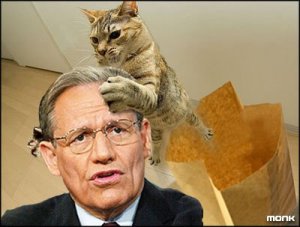
I thought this article at Mediaite was pretty funny: Robert Gates Wanted to Recruit Bob Woodward for the CIA.
Former Defense Secretary Robert Gates shared an interesting detail during a conversation with POLITICO’s Mike Allen about his new book: he wanted to recruit iconic Washington Post journalist Bob Woodward for the Central Intelligence Agency. Yes, that’s right, Gates wanted one of the men who broke Watergate wide open to move to the government side because of his “extraordinary ability” to pry details out of people.
Gates admitted he wasn’t exactly happy with Woodward’s assessment of his book, but beyond that he said he has great respect for Woodward, and admitted he would have liked to bring Woodward into the CIA because he has a gift that not everyone has.
“He has an extraordinary ability to get otherwise responsible adults to spill his guts to him, on background, nothing there for the historians, but his ability to get people to talk about stuff they shouldn’t be talked about is just extraordinary and maybe unique.”
Seriously, does Gates not know that Woodward began his career in naval intelligence “where he was a part of a group which briefed top intelligence officials; at one time he was close to Admiral Robert O. Welander, being communications officer on the USS Fox under Welander’s command.” Woodward even briefed Al Haig during the Nixon administration.
Woodward knew nothing about journalism until the Washington Post installed him at a small newspaper in the DC suburbs for a year so he could get some on-the-job experience before moving up to the big time? Before that, Woodward was involved in briefing Bernstein was the writer on the Watergate story and Woodward had the CIA/government connections.
Gates should know that once you’re in the “intelligence community,” you never really leave. Please forgive me for this, but I’m going to link to a post by Larry Johnson from 2005: Blowing the Whistle on Bob Woodward.
Woodward has been the consumate insider while cultivating the image of the hard charging investigative reporter. He is anything but, and it is time to blow the whistle on his incestuous relationship with certain government officials. The fact that the Washington Post is still covering for this joker says volumes about the decline of the Post.
When he appears on Larry King Live Tonight maybe he will answer a longstanding question, “When did he resign from Naval Intelligence?”
Johnson then reproduces a letter to the editor of the Tampa Tribune by Len Colodny. Colodny is coauthor of a book about Watergate called Silent Coup: The Removal of a President. Check it out.

This is interesting. Greg Sargent thinks President Obama might decide to encourage an increase in the minimum wage with an executive order.
Here’s some welcome news. At his meeting with Democratic Senators last night, President Obama indicated that he is giving serious consideration to executive action designed to raise the minimum wage for employees of federal contractors, according to one Senator who was present.
Proponents want to see this executive action happen on the merits — theybelieve it could impact as many as two million employees of federal contractors, and would help the economy. But they also believe such action could give a boost of momentum to the push for a minimum wage hike for all American workers, which obviously would require Congressional approval, but is currently facing Republican opposition.
Senator Bernie Sanders told me in an interview that the president took the idea very seriously when asked about it last night.
Surely some Democrats could applaud Obama if he did that. Of course the Greenwald cult followers will ignore it, because it would only improve the lives of working class people and do nothing for the “privacy” of upper middle class white males.
These days it seems we’re getting shootings in public places on an almost daily basis. I posted about a grocery store shooting in Elkhart, Indiana a couple of days ago. The victims and the shooter have now been identified.
What happened, police say, is 22-year-old Shawn Bair walked into the store Wednesday at about 9:30 p.m. Surveillance video shows him making phone calls and texting people….
Police say Bair pulled out a .44 caliber semi-automatic handgun, and shot and killed 20-year-old Krystal Dikes. Police say she had just started working at the store stocking the shelves. Friends say she was a caring, compassionate person.
“I don’t know what his goal was, I don’t know what his aim was, mad at the world. There’s definitely a family grieving for her. Definitely. And lots of friends,” said Dikes’ boyfriend Kyle Barnett.
Also murdered was 44-year-old Rachelle Godfread who was shopping. Bair then held the manager of the store at gunpoint until police arrived.
Police still aren’t sure why Bair, who police have been in contact with before, decided to go on this rampage but his Facebook page is filled with violent images and posts. In one post he says he knows he’s going hell. One from 2010 says he realized everybody should die, no matter what race or religion.
According to the Chicago Tribune,
Rachelle Godfread, 44, had recently moved from southern Indiana to Elkhart, where she was closer to her son who played basketball at the South Bend campus of Indiana University. Now that college student has lost his mom.
Yesterday there was a shooting in a school gymnasium in Philadelphia. CNN reports:
A warrant has been issued for the arrest of a juvenile suspect in a shooting that wounded two students at a Philadelphia school Friday, police said Saturday.
The shooting occurred at Delaware Valley Charter High School.
The suspect is not in custody, but police expect him, accompanied by an attorney, to turn himself in Saturday morning.
The shooter was in the school gym with seven other students, city police Commissioner Charles Ramsey said.
Some were playing basketball and others standing in a corner when he pulled a gun and fired.
The victims, a boy and a girl, both age 15, were hit in the arm. They were taken to a local hospital, police said, and their wounds are not life-threatening.
The Friday afternoon incident was at least the second shooting at or near a school this week in the Olney neighborhood.
And then there are the plain old street shootings. Again from the Chicago Tribune: Shootings leave 2 dead, 7 injured since Friday afternoon.
Two men have been killed and seven people injured in shootings on the South and West sides since Friday afternoon, according to police.
The violent start to the weekend, which came as downtown temperatures hovered in the teens, included a shooting that injured three people on a Dan Ryan Expressway ramp and another that left a 15-year-old girl hospitalized.
Police were called to the first of Friday’s homicides about 5:20 p.m., after gunfire rang out in 4900 block of West Huron Street in the Austin neighborhood.
Officers found 21-year-old Timothy Travis on the ground, bleeding from a gunshot wound to the head, authorities said.
Travis, who lived in the 4900 block of West Quincy Street, was pronounced dead on the scene at 5:34 p.m., according to the Cook County medical examiner’s office.
Of course the “experts” are “weighing in”: Experts: N. Mexico suspect, other young shooters show preteens’ impulse actions.
(CNN) — The New Mexico middle school shooting allegedly by a 12-year-old boy highlights how such gunfire is now occurring in America’s earlier grades, raising disturbing issues on whether such youngsters know the devastating consequences of such violence and on how they should then be adjudicated, experts say.
“It’s becoming more and more common, especially in the middle-school age, for these kids to be committing these violent acts,” said Sheela Raja, clinical psychologist at the University of Illinois at Chicago….
That tally includes last October’s shooting in Sparks, Nevada, by a 12-year-old boy who killed himself after fatally shooting a teacher; a 2010 shooting in a Madison, Alabama, by a ninth-grader who fatally shot a boy, 14, in the head; a 2000 shooting in Mount Morris Township, Michigan, in which a 6-year-old boy killed another 6-year-old; and the 1999 shooting in Deming, New Mexico, in which a 12-year-old boy killed a classmate, 13.
Raja explains that children at these ages do not have the cognitive development to restrain strong impulses or to understand the full implications of their actions.
“People should remember that a 12-year-old is barely past the age of believing in Santa Claus,” said Wendy Walsh, a behavior expert and psychologist.
“While there is great variance in cognitive development, plenty of kids this age are unable to fully comprehend that death is permanent,” Walsh said. “Add to that the impact of violent video games where ‘downed’ characters get up again, and there is good reason to assume this child does not think like an adult.”
Wouldn’t it make sense to keep guns out the hands of young kids then? I know, stupid question.
From the NYT: In Age of School Shootings, Lockdown Is the New Fire Drill.
For students across the country, lockdowns have become a fixture of the school day, the duck-and-cover drills for a generation growing up in the shadow of Columbine High School in Colorado and Sandy Hook Elementary School in Connecticut. Kindergartners learn to hide quietly behind bookshelves. Teachers warn high school students that the glow of their cellphones could make them targets. And parents get regular text messages from school officials alerting them to lockdowns.
School administrators across the country have worked with police departments in recent years to create detailed plans to secure their schools, an effort that was redoubled after the December 2012 shootings in Newtown, Conn. At the whiff of a threat, teachers are now instructed to snap off the lights, lock their doors and usher their students into corners and closets. School officials call the police. Students huddle in their classrooms for minutes or hours, texting one another, playing cards and board games, or just waiting until they get the all clear.
Why should kids have to go through this at school–a place where they are supposed to be safe and protected? I guess because the NRA wants more and more guns everywhere and Congress doesn’t have the guts to do anything about it.
Another “expert” told Jake Tapper that mass shootings are on the rise. Isn’t it great that we have “experts” to explain that to us? /snark

OK, enough depressing news about death and destruction. What’s the latest on Chris Christie? Steve Kornaki has dug up some good stuff: Christie camp held Sandy relief money hostage, mayor alleges.
Two senior members of Gov. Chris Christie’s administration warned a New Jersey mayor earlier this year that her town would be starved of hurricane relief money unless she approved a lucrative redevelopment plan favored by the governor, according to the mayor and emails and personal notes she shared with msnbc.
The mayor, Dawn Zimmer, hasn’t approved the project, but she did request $127 million in hurricane relief for her city of Hoboken – 80% of which was underwater after Sandy hit in October 2012. What she got was $142,000 to defray the cost of a single back-up generator plus an additional $200,000 in recovery grants.
In an exclusive interview, Zimmer broke her silence and named Lt. Gov. Kim Guadagno and Richard Constable, Christie’s community affairs commissioner, as the two officials who delivered messages on behalf of a governor she had long supported.
Something tells me we have a lot more Christie corruption news to look forward to.
Now what stories are you following today? Please post your links in the comments and have a great long weekend!
Thursday: A Mixed Bag of Reads
Posted: January 16, 2014 Filed under: Barack Obama, Crime, Foreign Affairs, morning reads, U.S. Politics, War on Women, Water, Women's Healthcare, Women's Rights, worker rights | Tags: "Paysage Bords de Seine", art theft, Baltimore Museum of Art, Brian Schweitzer, David Sirota, Elkhart Indiana, foreign espionage, grocery store shooting, Jamie Bouie, Martha Fuqua, NSA, phone metadata, Pierre-Auguste Renoir, Ron Paul, telephone companies 38 Comments
Good Morning!!
I’m going to begin with a quirky story about a stolen painting by Pierre-Auguste Renoir: Renoir painting allegedly sold at flea market returning to museum. From the LA Times:
A small Pierre-Auguste Renoir painting that a woman said she purchased for just $7 at a flea market will return to a Maryland museum that argued that the painting was stolen from its premises in 1951.
A federal judge in Virginia ruled on Friday that Renoir’s “Paysage Bords de Seine,” which was painted in 1879, is the rightful property of the Baltimore Museum of Art. The decision brought to an ostensible end a bizarre case that pitted a driving teacher against the museum in a battle over an Impressionist work estimated to be worth $22,000.
Martha Fuqua, who reportedly teaches driving in Virginia, had said that she acquired the painting from a flea market in West Virginia in 2009. She later attempted to sell the work at an auction, which came to the attention of the Baltimore Museum of Art.
The weird part is that people who knew Fuqua claimed they had seen the painting in her mother’s home. So who stole the painting? From the Washington Post:
…a number of people who know Fuqua have cast doubt on her flea market story, including her brother. Some family acquaintances told The Post that they remember seeing the Renoir in the 1980s and 1990s at the Fairfax County home of her mother, Marcia Fouquet, who attended art college in Baltimore at the time of the painting’s theft in 1951. (The mother passed away five months ago at the age of 85.)
Apparently, Marcia Fouqua was an art thief. Here’s the original police report (PDF).

Unfortunately, there’s more bad news today–another shooting, this time in a grocery store in Elkhart, Indiana. NBC News reports:
A gunman killed a member of staff and a customer at an Indiana grocery store before being shot dead by police, officials said early Thursday.
The man had his gun pointed at a third person when officers arrived at Martin’s Super Market in the city of Elkhart, Indiana State Police Sgt. Trent Smith said in a press conference early Thursday.
When he trained his weapon on the officers they shot him dead, Smith said…
Smith said it was a “huge crime scene” and that shots had been fired from one end of the store to the next. The victims were found 10 to 12 aisles apart.
Police rushed to the scene shortly after 10 p.m. on Wednesday after receiving a 911 call. They heard gunshots when they arrived and rushed to the section of the store from which the shots were fired.
Smith described the gunman as white man in his twenties who lived in the area. He said he was armed with a semiautomatic handgun and a large knife.
A little more from Reuters:
The three dead were believed to be a female store employee in her late teens or early 20s, a female shopper in her mid-40s, and the shooter, who was thought to be in his late teens or early 20s, Smith said.
Details such as what motivated the violence and whether there was any connection between the gunman and store employees were not immediately known, he said.
Police found a large knife and a semi-automatic handgun inside the store near the suspect, who was believed to live in the area, Smith said.
Police were withholding the suspect’s name pending notification of his family.

David Sirota was up to his old tricks yesterday on Twitter. Once Sirota pretended to support Barack Obama–that was in the days when you couldn’t blog on Dailykos unless you behaved like a zombie Obot. But even Kossaks mocked Sirota for his constant bragging about receiving a phone call from then-Senator Obama in 2006 and then being invited to interview Obama and his staff.
In those days, Sirota was critical of Obama. In the build-up to the 2012 election, Sirota became a Ron Paul Fan, calling him a “real progressive.” After Obama was elected to a second term Sirota became so “unhinged” by Obama Derangement Syndrome that he compared Obama to George Zimmerman!
These days, Sirota has fastened his presidential hopes on Brian Schweitzer, former governor of Montana. And so when Jamie Bouie dared to suggest that by “positioning himself as a liberal repudiation of Obama,” Schweitzer was in danger of alienating African American voters who still strongly support the President; Sirota responded by strongly implying that Bouie (an African American) is a racist by calling Bouie’s post at The Daily Beast an “[e]xample of how communities of color are condescendingly portrayed as monolithic & unthinking voting blocs.”
Wow.
Here’s a little bit of good news from yesterday’s LA Times: U.S. accuses Wal-Mart of labor violations.
The National Labor Relations Board, an independent federal agency tasked with policing bad behavior by employers, is targeting Wal-Mart Stores Inc. over the retail behemoth’s alleged crackdown on its protesting workers.
The NLRB filed a formal complaint Wednesday against the Bentonville, Ark. chain, alleging that the company violated the rights of more than 60 employees rallying over workplace conditions in 14 states — including California….
The Wednesday filing stems from NLRB findings released in November that deemed unlawful Wal-Mart’s reactions to employees who participated in strikes around Black Friday in 2012.
The rallies spread to 100 cities. Nineteen employees were discharged from the company, allegedly as a reprimand for their involvement in the rallies, according to the NLRB.
The agency said that efforts to broker a settlement between Wal-Mart and its workers failed, leading to Wednesday’s complaint. The filing names more than 60 Wal-Mart supervisors — 19 in California — and corporate communications vice president David Tovar.
The article quotes experts who speculate that the NLRB may be trying to signal to corporations that it is going to stand up for not only unionized workers, but also those in non-unionized businesses. If true, that is excellent news.

Last night Cincinnati acted to protect residents from the chemical plume that is making its way down the Ohio River from West Virginia. From WLW 700: Cincinnati Water Works Prepares to Close Water Intake Valves.
(Cincinnati)–Days after a hazardous chemical leaked into the Elk River in West Virginia the chemical has flowed into the Ohio River and the Cincinnati area.
The Chemical known as 4-methylcyclohexane methanol leaked from a 48,000-gallon storage tank owned by Freedom Industries, in West Virginia. Investigators believe the leak began on Thursday Jan, 9. and the chemical foaming agent seeped though a one inch hole, in the storage tank and into the River….
Lisa Cochran the Communication Coordinator with The Ohio River Valley Water Sanitation Commission (ORSANCO) said the Chemical MCHM was first detected Sunday Jan 12. in the Ohio River.
She adds (ORSANCO) is coordinating with multiple organizations, including Cincinnati Water Works, Northern Kentucky Water, Kentucky Division of Water, US Coast Guard, West Virginia American Water and others to monitor the progress of the spill. “We have field crew members who actually go out and take samples” to determine the concentration of the chemical.
Cincinnati Waterworks is prepared to close their Ohio River water intake valves when the hazardous chemical plume is found. Cochran says “they (Cincinnati Water Works) do plan to shut down when the plume reaches their water intake”.
In NSA news, The New York Times published more “revelations” from the material that Edward Snowden stole. As has become the accepted technique with NSA stories, the article begins with supposedly terrifying news: the NSA uses mysterious “radio technology” to attack computer that aren’t even connected to the internet! Aiiiiiiiiiieeeeeee!
But read on. So far the software has only been used on 100,000 computers since 2008, primarily in countries like China, Russia, and Pakistan, and the software must be physically installed by a human spy with a flash drive. It has never been used domestically.
The N.S.A. calls its efforts more an act of “active defense” against foreign cyberattacks than a tool to go on the offensive. But when Chinese attackers place similar software on the computer systems of American companies or government agencies, American officials have protested, often at the presidential level.
Among the most frequent targets of the N.S.A. and its Pentagon partner, United States Cyber Command, have been units of the Chinese Army, which the United States has accused of launching regular digital probes and attacks on American industrial and military targets, usually to steal secrets or intellectual property. But the program, code-named Quantum, has also been successful in inserting software into Russian military networks and systems used by the Mexican police and drug cartels, trade institutions inside the European Union, and sometime partners against terrorism like Saudi Arabia, India and Pakistan, according to officials and an N.S.A. map that indicates sites of what the agency calls “computer network exploitation.”
So basically, the NSA uses this technology to do its job–spying on foreign countries to protect U.S. interests. Horrors!
And as for the phone call metadata program, Phone companies don’t want the job of spying on customers’ calls. PBS Newshour:
President Barack Obama is expected to announce Friday what changes he is willing to make to satisfy privacy, legal and civil liberties concerns over the NSA’s surveillance practices. One of the most important questions is whether the government will continue to collect millions of Americans’ phone records every day so that the government can identify anyone it believes might be communicating with known terrorists.
The president’s hand-picked review committee has recommended ending the phone records program as it exists. It suggested shifting the storage of the phone records from the NSA to phone companies or an unspecified third party, and it recommended new legal requirements before the government could search anyone’s phone records.
The phone companies don’t want the job. Executives and their lawyers have complained about the plan in confidential meetings with administration officials and key congressional intelligence and other committees, according to interviews by The Associated Press. Two phone executives familiar with the discussions said the cellular industry told the government that it prefers the NSA keep control over the surveillance program and would only accept changes if they were legally required. The executives spoke on condition of anonymity because they were not authorized to disclose the private discussions. But there have been public complaints, too.
Frankly, I’ve never trusted the phone company. I’d much rather have this data stored on government computers, where it can’t be accessed without a warrant approved by the FISA court.
Finally, Rolling Stone is highlighting the Republican war on women’s reproductive rights with a long read by Janet Reitman: The Stealth War on Abortion. I haven’t read the article yet, but I hope it’s good. We need more high-profile publications to highlight what’s happening to women’s rights in red states.
So . . . there’s a mixed bag of reads to get you started on the day. What stories are you following? Please post your links in the comment thread, and have a great Thursday!
Friday Reads: #BridgeGhazi Scandal Fallout
Posted: January 10, 2014 Filed under: morning reads, Republican politics, U.S. Politics | Tags: #BridgeGate, #BridgeGhazi, Chris Christie 53 Comments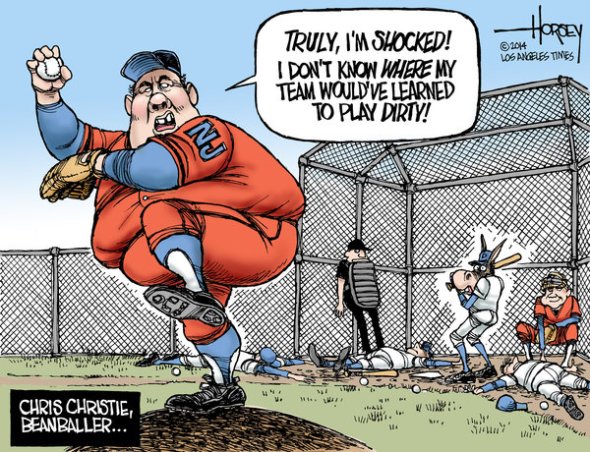
Good Morning!!
The #BridgeGhazi scandal is still dominating the news this morning, so I thought I’d surf around and see what the pundits are saying about it. I’ll leave it to you to post links to other stories you’re following in the comment thread.
As you can see, LA Times cartoonist David Horsey focused on Christie today. He also had some editorial comments.
As revealed by a series of email exchanges, three of Christie’s top aides closed down all but one of the traffic lanes at the entrance to the George Washington Bridge to punish the Democratic mayor in the nearby town of Fort Lee, who failed to fall in line behind the Republican governor in his recent reelection campaign. New Jersey commuters spent days stalled at the bottleneck, emergency vehicles were slowed down and one elderly woman died before she could be taken to a hospital.
In a two-hour news conference, Christie claimed he knew nothing about the scheme to exact political retribution by manufacturing a traffic nightmare. The three staffers have been booted, and the governor insists that he is shocked and saddened by their actions. Nevertheless, many people are skeptical. Even if Christie is telling the truth and the aides were not following his direct orders, his combative, in-your-face political style makes plenty of people assume the three were mimicking the bullying ways of their boss.
Though he has played the victim a bit too much, Christie has handled the crisis well so far. Chances are, he will survive this round of revelations (unless, of course, it turns out he is lying, in which case he can probably kiss the GOP nomination goodbye).
Raise your hand if you think Christie was telling the truth, the whole truth, and nothing but the truth in his lengthy press conference yesterday. Anyone? Anyone?
At U.S. News, Ken Walsh writes that It’s Just Beginning for Chris Christie.
What’s ahead for embattled New Jersey Gov. Chris Christie won’t be pretty. Investigations. Lawsuits. Ridicule. Doubt. A credibility gap. And quite possibly severe damage to his prospects as a potential Republican presidential candidate in 2016.
Christie can recover. Consider what Bill Clinton did in overcoming charges of adultery and draft dodging during his 1992 Democratic presidential campaign, which ended successfully. Consider how Republican George W. Bush overcame allegations of youthful drinking and past drug use during the 2000 campaign, which he won. And consider how Democrat Barack Obama dealt successfully with a political crisis arising from the inflammatory and divisive views of his pastor in Chicago in 2008.
Christie’s scandal is different, and worse. It involves an apparent act of political retribution against the mayor of Fort Lee, N. J., because the official didn’t endorse Christie’s re-election bid last year. But the price was paid by everyday people: innumerable motorists who suffered massive delays when Fort Lee traffic lanes leading to the George Washington Bridge were shut down for four days last September, apparently at the instigation of Christie aides. The governor says he didn’t know about it at the time, and he has fired two aides whom he is holding responsible….In political terms, “Bridgegate” is devastating to Christie for a simple reason: It undercuts his image as an efficient if abrasive leader, and reinforces the impression that he is a bully.
But who doesn’t think Christie is a bully? A couple of days ago, Beltway Bob Ezra Klein wrote, Chris Christie’s problem is that he’s really, truly a bully.
Christie inhabits a rare space in American politics: He’s a bully. He’s followed around by an aide with a camcorder watching for moments in which Christie, mustering the might and prestige of his office, annihilates some citizen who dares question him.
Almost everywhere Christie goes, he is filmed by an aide whose job is to capture these “moments,” as the governor’s staff has come to call them. When one occurs, Christie’s press shop splices the video and uploads it to YouTube; from there, conservatives throughout the country share Christie clips the way tween girls circulate Justin Bieber videos. “The YouTube stuff is golden,” says Rich Lowry, the editor of National Review. “I can’t tell you how many people forward them to me.” One video on Christie’s YouTube channel — a drubbing he delivered to another aggrieved public-school teacher at a town hall in September — has racked up over 750,000 views.
Now in Moorestown, Christie was hoping to create another such moment. After some introductory remarks, he opened the floor to questions. “For those of you who have seen some of my appearances on YouTube,” he cautioned, peeling off his suit jacket as he spoke, “this is when it normally happens.”
It’s not an accident that Christie emerged in a period when the Republican Party is out of power. His videos make them feel powerful at a moment when they’re weak.
The reason Chris Christie is so good at this is that Chris Christie is actually a bully. That doesn’t mean he’s not also a nice guy who cares deeply about his family and his constituents and his country. It doesn’t mean he’s not an unusually honest politician who’s refreshingly free of cant and willing to question his party. There’s a lot about Christie that’s deeply appealing. But there’s one big thing that’s not: He’s someone who uses his office to intimidate people and punish or humiliate perceived enemies.
Watch video examples at Wonkblog.
Other writers are beginning to discuss the legal consequences of the scandal for Christie and his staff. Ben Brumfield at CNN:
It may have seemed like a teenage prank at the time, but the blockage of bridge traffic as a possible act of partisan political revenge has put New Jersey Gov. Chris Christie in the middle of a serious legal stew.
And the fire underneath it is just beginning to heat up for the Republican presidential hopeful, as the state assembly plans to post online 907 pages of documents related to the case Friday.
State lawmakers questioned one of Christie’s allies on Thursday, a former state official implicated in the scandal. So far, David Wildstein has repeatedly refused to answer, invoking his Fifth Amendment right against self-incrimination.
The legislators charged him with contempt for his lack of cooperation. But the dam could eventually break as lawmakers dig in their heels, analysts say.
As long as Christie was telling the truth at a marathon press conference he held on Thursday, he should be able to step out of the caldron, analysts who spoke with CNN say.
That’s the key question isn’t it? And I think most people assume Christie was lying through his teeth yesterday.
“He was pretty specific about what he knew and when he knew it,” said CNN analyst Gloria Borger on The Lead with Jake Tapper.
But if any of it doesn’t jibe with other peoples’ stories, information provided in documents or clues that pop up, experts say Christie could get dragged into civil and criminal lawsuits.
One thing is certain. The legislative inquiry into the alleged misdeeds that led to the traffic jam on the George Washington Bridge is just getting into gear.
 Here’s a characteristically frank assessment of Christie’s press conference from the New York Daily News.
New Jersey Gov. Chris Christie’s one-hour-and-forty-seven-minute self-serving, self-pitying display of contrition on Thursday was a climactic act in a brazen cover-up that threatens to further unravel his political career.
Ever so thoroughly the governor scoured the thesaurus for words of apology, regret and painless self-flagellation while nervily playing the victim and mercilessly destroying the aide who played only a supporting role for the George Washington Bridge political revenge plot.
Christie needed blood to express his outrage to the public, so he drew it from deputy chief of staff Bridget Kelly for the sin, the governor said, of lying to him. Perhaps, Kelly did lie, although it seems incredible that anyone would flat-out attempt to deceive an intense, emergency inquiry.
Regardless, Christie made roadkill of Kelly and his former campaign manager while wholly exempting the close pals who were central to the lane-closure conspiracy that caused four days of gridlock and dangerously slowed emergency response in Fort Lee. Pathetic.
Read the whole thing at the link.
Rachel Maddow offered an alternative theory on the reasons behind #BridgeGhazi. From Huffington Post:
As the story stands, Christie’s deputy chief of staff called for George Washington Bridge access lane closures that created a massive traffic jam in Fort Lee for four days in September — a move that many have written off as political retribution for Democratic Fort Lee Mayor Mark Sokolich’s refusal to endorse the Republican governor’s reelection.
Maddow on Thursday presented an alternate theory, saying Sokolich’s endorsement “wasn’t that important.” Instead, she suggested the political payback was motivated by a tiff between New Jersey state Senate Democrats and the governor.
Maddow took viewers back to 2010, when Christie declined to reappoint a New Jersey Supreme Court justice, John E. Wallace Jr., for another term. The move left state Senate Democrats “absolutely outraged,” Maddow explained, and they refused to confirm any Christie’s nominees for Wallace’s seat.
Could Maddow be onto something?
By last August, Supreme Court Justice Helen Hoens, a Republican, was up for renomination. When state Senate Democrats signaled they would challenge Christie’s nomination, the governor said he wouldn’t renominate Hoens.
“I simply could not be party to the destruction of Helen Hoens’s professional reputation,” Christie said during an August press conference. “I was not going to let her loose to the animals.”
“That was an angry Chris Christie,” Maddow said. “So angry that he was doing something almost unprecedented in New Jersey: Yanking the tenure of a state Supreme Court justice, who he liked! That was an angry Chris Christie, furious with Senate Dems at a hastily called press conference that took place late in the day on Tuesday, Aug. 12, 2013.”
Read more and see video at the link.
More links in case you haven’t gotten your fill yet:
MSNBC’s First Read: A Bridge Too Far?
Bloomberg News: Christie Flunks Crisis Management With I Am Not a Bully
The Wire: The Four Key Questions Chris Christie Didn’t Answer at His Press Conference
Reuters: New Jersey braces for new disclosures in Christie bridge scandal
Chicago Tribune: Chris Christie for president? Fuggedaboutit.
NewJersey.com: Giuliani, Rove, Maddow: See what they’re saying about Christie bridge scandal now
ABC News: The Christie Cold War Begins


 peej
peej Carissa
 ecocatwoman
 jjlo
jjlo mablue2
 Mama Lopez
 peggysue22
 quixote
 skydancingguestblogger
 Mona (aka Wonk the Vote)





Tuesday Reads: Snowstorm, On-line Harassment, Profiling Snowden, and Other News
Posted: January 21, 2014 | Author: bostonboomer | Filed under: Barack Obama, morning reads, U.S. Politics, Women's Rights | Tags: Amanda Hess, Amy Wallace, Anderson Cooper, angry on-line commenters, China, Colorado, Dan Verton, Edward Snowden, history of psychology, insider espionage, israel, IT administrators, London Science Museum, Marijuana, on-line sexual harassment, personality profiling, pot tours, psychology, Randi Kaye, Skepchick, snow, trolls, weather | 106 CommentsAlfred Eisenstaedt
Good Morning!!
Looks like another big snowstorm is headed my way this afternoon. Blizzard warning south of Boston, winter storm warning for most areas.
At least I’m not in the blizzard zone for the moment. This appears to be a really big storm. I saw on Twitter this morning that there were whiteout conditions in St. Louis. You can watch a video update the Weather Channel page.
Intellicast – Current Radar in United States:
NBC News reports: Winter storm set to ‘go bananas’ across Northeast.
Yikes! What the heck does that mean? The story doesn’t explain. But meteorologists are begging us not to call it a “polar vortex.”
Anyway, I’m going to have to rush around this morning. I have a package to mail, and I need to get a couple of things at the grocery store. I do have some interesting reads for you today–some of them are pretty long, but well worth reading.
Yesterday, via Tom Watson at Forbes, I came across an essay by long-time feminist blogger Amanda Hess that Watson says has been “widely discussed” for the past week or so. Somehow I missed it. Hess argues that on-line sexual harassment of women will be “the next civil rights issue.” In the essay, she writes about the frequent on-line attacks she and other female writers have experienced (warning: explicit and violent language). Here are the first few paragraphs.
Read the rest at the link. A number of women have written about this issue, and particularly about the lack of protection for women who are harassed on-line from law enforcement–even though the threats sometimes lead to real-life actions. A couple more recent examples:
Skepchick wrote in October about being harassed for her participation in the on-line atheist community, Why I Don’t Just Go to the Cops.
Amy Wallace wrote about her experiences in a NYT op-ed over the weekend: Life as a Female Journalist: Hot or Not?
Along similar lines, I came across this 2010 article in The Boston Globe that provides some insight into why some people spend so much time and energy writing angry comments on line: Inside the mind of the anonymous online poster. The author got an interview with a frequent commenter to The Boston Globe website. He also discusses the problems newspapers face in dealing with angry and trolling comments from anonymous people. Here’s an excerpt:
Read much more at the link.
Yesterday I also happened upon a fascinating article by national security and tech journalist Dan Verton. In the piece, Verton tries to come up with a psychological profile of NSA leaker Edward snowden: What does the history of insider espionage say about Edward Snowden?
Verton discusses Snowden’s history in the light of a study of IT administrators who eventually sabotaged their employers in some way: Inside the Mind of the Insider, by Eric D. Shaw, Jerrold M. Post, and Keven G. Ruby. These are both fairly long pieces, but if you have any interest in the ongoing Snowden saga, they are must reads! A bit more from Verton:
Lots more educated speculation on Snowden’s motives at the link.
In other news . . .
Here’s a spy story I hadn’t heard about in the mainstream media. Report: Israel Passes U.S. Military Technology to China.
That sounds scarier than the stuff Glenn Greenwald has been dribbling out.
From The New Statesman, here’s an exhibit I’d love to see if only I were in London: A history of psychology, warts and mysteries and all.
That sounds amazing.
Finally, a funny story from CNN’s Anderson Cooper 360: CNN reporter high during Anderson Cooper marijuana TV segment.
So . . . what are your recommended reads for today? Please post your links on any topic in the comment thread.
Did you like this post? Please share it with your friends: