Posted: May 8, 2021 | Author: bostonboomer | Filed under: Afternoon Reads, Republican politics, U.S. Politics | Tags: Arizona fake recount, Bill Barr, caturday, death penalty, Donald Trump, Ledell Lee, Lindsey Graham, Liz Cheney, Neil Gorsuch, Trump Justice Department |

Room with Curved Window Cat and Bird, by Paul Wonner
Good Afternoon!!
It’s great to finally have a normal president who actually cares about the American people and isn’t completely focused on his own needs. But it’s going to take a long time for the country to recover from four years of Trump. For one thing, Trumpism still controls the Republican Party. There is also the aftermath of Trump’s immigration and tax policies as well as his destructive influence on nearly every aspect of the Federal government, including the Departments of Justice, Defense, and Homeland Security and the intelligence community, as well as his efforts to corrupt U.S. elections. And of course Trump had a dramatic impact on the Supreme Court that will likely last for decades. In this post, I’m going to highlight some of the continuing influences of Trumpism in our politics and our justice system.
Trump loves the death penalty, and his first SCOTUS appointee Neil Gorsuch cast the deciding vote that led the execution of an innocent man in Arkansas in 2017.
The New York Times: 4 Years After an Execution, a Different Man’s DNA Is Found on the Murder Weapon. Lawyers’ request to conduct additional DNA testing before Ledell Lee was executed had been denied.
For 22 years, Ledell Lee maintained that he had been wrongly convicted of murder.
“My dying words will always be, as it has been, ‘I am an innocent man,’” he told the BBC in an interview published on April 19, 2017 — the day before officials in Arkansas administered the lethal injection.

Girl with a Cat, by Franz Marke
Four years later, lawyers affiliated with the Innocence Project and the American Civil Liberties Union say DNA testing has revealed that genetic material on the murder weapon — which was never previously tested — in fact belongs to another man. In a highly unusual development for a case in which a person has already been convicted and executed, the new genetic profile has been uploaded to a national criminal database in an attempt to identify the mystery man….
Mr. Lee’s execution, on April 20, 2017, was the first in Arkansas in more than a decade. Some accused the state of rushing Mr. Lee and several other prisoners to their deaths that month before the expiration of its supply of a lethal injection drug….
Mr. Lee’s execution, on April 20, 2017, was the first in Arkansas in more than a decade. Some accused the state of rushing Mr. Lee and several other prisoners to their deaths that month before the expiration of its supply of a lethal injection drug.
Slate’s Mark Joseph Stern on the Gorsuch vote, April 21, 2017:
On Thursday night, Arkansas executed Ledell Lee—the state’s first execution in 12 years. Lee is one of eight men whom Arkansas originally planned to kill over 11 days before one drug in the three-drug lethal injection cocktail expires. Four of these men have received stays of execution, but Lee’s final plea to the U.S. Supreme Court was rejected by a 5–4 vote. Justice Neil Gorsuch cast the deciding vote allowing Lee to die. It was his first recorded vote cast as a justice of the court….
with Gorsuch’s vote, the court’s conservatives were able to ignore their four liberal colleagues and permit the execution. Lee was given midazolam, then a drug to paralyze and suffocate him—which may have been purchased under false pretenses. Finally, the state administered a chemical to stop his heart. Lee was declared dead shortly before midnight, Central Time. Had one more justice voted in his favor, Lee would still be alive today.
Lisa Lerer at The New York Times on Trump continued control of his party: Marooned at Mar-a-Lago, Trump Still Has Iron Grip on Republicans.
Locked out of Facebook, marooned in Mar-a-Lago and mocked for an amateurish new website, Donald J. Trump remained largely out of public sight this week. Yet the Republican Party’s capitulation to the former president became clearer than ever, as did the damage to American politics he has caused with his lie that the election was stolen from him.

Painting by Jennifer Gennari
In Washington, Republicans moved to strip Representative Liz Cheney of her House leadership position, a punishment for denouncing Mr. Trump’s false claims of voter fraud as a threat to democracy. Lawmakers in Florida and Texas advanced sweeping new measures that would curtail voting, echoing the fictional narrative from Mr. Trump and his allies that the electoral system was rigged against him. And in Arizona, the state Republican Party started a bizarre re-examination of the November election results that involved searching for traces of bamboo in last year’s ballots.
The churning dramas cast into sharp relief the extent to which the nation, six months after the election, is still struggling with the consequences of an unprecedented assault by a losing presidential candidate on a bedrock principle of American democracy: that the nation’s elections are legitimate.
They also provided stark evidence that the former president has not only managed to squelch any dissent within his party but has also persuaded most of the G.O.P. to make a gigantic bet: that the surest way to regain power is to embrace his pugilistic style, racial divisiveness and beyond-the-pale conspiracy theories rather than to court the suburban swing voters who cost the party the White House and who might be looking for substantive policies on the pandemic, the economy, health care and other issues.
“We’ve just gotten so far afield from any sane construction,” said Barbara Comstock, a longtime party official who was swept out of her suburban Virginia congressional seat in the 2018 midterm backlash to Mr. Trump. “It’s a real sickness that is infecting the party at every level. We’re just going to say that black is white now.”
Read more at the NYT link.
From the Editorial Board of the Financial Times: Republicans drift ever further into Trumpism. The right must find ways to head off disaster for party and country.
Six months after Trump was defeated in the US presidential election, no Republican can dispute his claim that Joe Biden stole it and expect to prosper among their peers. Facebook’s initial decision to suspend Trump’s account came after he had egged on the mob that assaulted Capitol Hill on January 6 in what was the most serious threat to American democracy since the civil war. Since then, Trump’s language has only grown more ominous. Republicans who think they can keep their head down and wait out the Trump era are probably deluding themselves. Trump is only consolidating his hold over their party — and shows every sign of planning a 2024 presidential run.
What should principled conservatives do? One option is to follow the example of Liz Cheney, the number three Republican in the House of Representatives, who correctly reminds her colleagues that last year’s election was legitimate and the assault on Congress was sedition. She will almost certainly be removed from her position next week.

Painting by August Macke
This is nothing to do with ideology. Cheney is among the most conservative figures in the House. Elise Stefanik, who is set to replace her, is more moderate. Stefanik, however, has an unblemished record of echoing whatever Trump says, including that America’s voting is rigged. Like any revolution, the demands on its children grow more outlandish. The more preposterous the conspiracy theory, the greater the demonstration of loyalty from those who embrace it. The downsides to Cheney’s act of courage are obvious. She will lose her influence and ultimately even her Wyoming district to a Trump loyalist. Others among the principled holdouts, including Illinois’ Adam Kinzinger, are also at risk.
A parallel line of attack would be to point out that Trump is already jeopardising his party’s hopes of regaining control of Congress in next year’s midterm elections, and the White House two years later. Trump lost the presidency, but his party did far better in non-presidential races. Millions of voters who endorsed Biden switched to Republicans down ballot. Not once in four years did Trump’s approval rating exceed 50 per cent. Biden’s has not yet fallen below that.
Trump can keep the party united through fear of defenestration but his grip will make the party less appealing to the larger electorate. Sadly, there is little hope right now of severing Trump’s bonds to a party that is now largely his — 70 per cent of its voters say the election was stolen.
Liz Cheney is getting a great deal of attention right now, and although I probably disagree with her on every political issue, I have to admire her principled stand against Trumpism. And now the GOP Trump cult is trying to excommunicate her.
The Washington Post: Liz Cheney’s months-long effort to turn Republicans from Trump threatens her reelection and ambitions. She says it’s only beginning.
Rep. Liz Cheney had been arguing for months that Republicans had to face the truth about former president Donald Trump — that he had lied about the 2020 election result and bore responsibility for the insurrection at the U.S. Capitol — when the Wyoming Republican sat down at a party retreat in April to listen to a polling briefing.
The refusal to accept reality, she realized, went much deeper.
When staff from the National Republican Congressional Committee rose to explain the party’s latest polling in core battleground districts, they left out a key finding about Trump’s weakness, declining to divulge the information even when directly questioned about Trump’s support by a member of Congress, according to two people familiar with what transpired.

Painting by Paul Wonner
Trump’s unfavorable ratings were 15 points higher than his favorable ones in the core districts, according to the full polling results, which were later obtained by The Washington Post. Nearly twice as many voters had a strongly unfavorable view of the former president as had a strongly favorable one.
Cheney was alarmed, she later told others, in part because Republican campaign officials had also left out bad Trump polling news at a March retreat for ranking committee chairs. Both instances, she concluded, demonstrated that party leadership was willing to hide information from their own members to avoid the truth about Trump and the possible damage he could do to Republican House members, even though the NRCC denied any such agenda.
Those behind-the-scenes episodes were part of a months-long dispute over Republican principles that has raged among House leaders and across the broader GOP landscape. That dispute is expected to culminate next week with a vote to remove Cheney from her position as the third-ranking House Republican.\At issue: Should the Republican Party continue to defend Trump’s actions and parrot his falsehoods, given his overwhelming support among GOP voters? Or does the party and its leaders need to directly confront the damage he has done?
I think we all know how that is going to turn out.
On the corruption of the Justice Department, Devlin Barrett broke this startling news yesterday at The Washington Post: Trump Justice Department secretly obtained Post reporters’ phone records.
The Trump Justice Department secretly obtained Washington Post journalists’ phone records and tried to obtain their email records over reporting they did in the early months of the Trump administration on Russia’s role in the 2016 election, according to government letters and officials.
In three separate letters dated May 3 and addressed to Post reporters Ellen Nakashima and Greg Miller, and former Post reporter Adam Entous, the Justice Department wrote they were “hereby notified that pursuant to legal process the United States Department of Justice received toll records associated with the following telephone numbers for the period from April 15, 2017 to July 31, 2017.” The letters listed work, home or cellphone numbers covering that three-and-a-half-month period.
Cameron Barr, The Post’s acting executive editor, said: “We are deeply troubled by this use of government power to seek access to the communications of journalists. The Department of Justice should immediately make clear its reasons for this intrusion into the activities of reporters doing their jobs, an activity protected under the First Amendment.”

Cat on Green Pilllow, August Macke
News organizations and First Amendment advocates have long decried the government practice of seizing journalists’ records in an effort to identify the sources of leaks, saying it unjustly chills critical newsgathering. The last such high-profile seizure of reporters’ communications records came several years ago as part of an investigation into the source of stories by a reporter who worked at BuzzFeed, Politico and the New York Times. The stories at issue there also centered around 2017 reporting on the investigation into Russian election interference.
It is rare for the Justice Department to use subpoenas to get records of reporters in leak investigations, and such moves must be approved by the attorney general. The letters do not say precisely when the reporters’ records were taken and reviewed, but a department spokesman said the decision to do so came in 2020, during the Trump administration. William P. Barr, who served as Trump’s attorney general for nearly all of that year, before departing Dec. 23, declined to comment.
A few more stories to check out:
The Washington Post: Trump’s out-of-power agenda: Retribution against foes, commanding the spotlight and total domination of GOP.
Joyce Vance at NBC News: Judge Amy Berman Jackson’s Barr rebuke opens the door to DOJ accountability.
CBS News: The Arizona GOP’s Maricopa County audit: What to know about it.
NBC News: Sen. Lindsey Graham says the GOP can’t move forward without Trump.
Brad Bannon at The Hill: GOP is consumed by Trump conspiracy theories.
Have a great weekend everyone!! As always, this is an open thread.
Did you like this post? Please share it with your friends:
Posted: May 1, 2021 | Author: bostonboomer | Filed under: Afternoon Reads, U.S. Politics | Tags: caturday, Covid crisis in India, Donald Trump, Leslie Kean, Rudy Giuliani, UFOs |

Gwen John (British painter, 1876-1939) Interior with Woman Sewing at Window and Cat
Good Afternoon!!
It’s the weekend, and we should be having fun even though we’re in the midst of a global pandemic with wars raging around the world and our democracy still in danger because one of our political parties has turned into a suicidal cult obsessed with conspiracy theories, led by a pathetic huckster who is rapidly sinking into dementia. So before I start on the news of the day, here’s a fun read at The New Yorker:
The article is long and involved, so there’s no way to summarize it with excerpts, but here’s just a taste:
The government may not have been in regular touch with exotic civilizations, but it had been keeping something from its citizens. By 2017, [Leslie] Kean was the author of a best-selling U.F.O. book and was known for what she has termed, borrowing from the political scientist Alexander Wendt, a “militantly agnostic” approach to the phenomenon. On December 16th of that year, in a front-page story in the Times, Kean, together with two Times journalists, revealed that the Pentagon had been running a surreptitious U.F.O. program for ten years. The article included two videos, recorded by the Navy, of what were being described in official channels as “unidentified aerial phenomena,” or U.A.P. In blogs and on podcasts, ufologists began referring to “December, 2017” as shorthand for the moment the taboo began to lift. Joe Rogan, the popular podcast host, has often mentioned the article, praising Kean’s work as having precipitated a cultural shift. “It’s a dangerous subject for someone, because you’re open to ridicule,” he said, in an episode this spring. But now “you could say, ‘Listen, this is not something to be mocked anymore—there’s something to this.’ ”
Since then, high-level officials have publicly conceded their bewilderment about U.A.P. without shame or apology. Last July, Senator Marco Rubio, the former acting chairman of the Select Committee on Intelligence, spoke on CBS News about mysterious flying objects in restricted airspace. “We don’t know what it is,” he said, “and it isn’t ours.” In December, in a video interview with the economist Tyler Cowen, the former C.I.A. director John Brennan admitted, somewhat tortuously, that he didn’t quite know what to think: “Some of the phenomena we’re going to be seeing continues to be unexplained and might, in fact, be some type of phenomenon that is the result of something that we don’t yet understand and that could involve some type of activity that some might say constitutes a different form of life.”

Mann mit Katze. Christoph Paudiss 1618 Private Collection
Last summer, David Norquist, the Deputy Secretary of Defense, announced the formal existence of the Unidentified Aerial Phenomena Task Force. The 2021 Intelligence Authorization Act, signed this past December, stipulated that the government had a hundred and eighty days to gather and analyze data from disparate agencies. Its report is expected in June….
Leslie Kean is a self-possessed woman with a sensible demeanor and a nimbus of curly graying hair. She lives alone in a light-filled corner apartment near the northern extreme of Manhattan, where, on the wall behind her desk, there is a framed black-and-white image that looks like a sonogram of a Frisbee. The photograph was given to her, along with chain-of-custody documentation, by contacts in the Costa Rican government; in her estimation, it is the finest image of a U.F.O. ever made public. The first time I visited, she wore a black blazer over a T-shirt advertising “The Phenomenon,” a documentary from 2020 with strikingly high production values in a genre known for grainy footage of dubious provenance. Kean is
stubborn but unassuming, and she tends to speak of the impact of “the Times story,” and the new cycle of U.F.O. attention it has inaugurated, as if she had not been its principal instigator. She told me, “When the New York Times story came out, there was this sense of ‘This is what the U.F.O. people have wanted forever.’ ”
Kean is always assiduously polite toward the “U.F.O. people,” although she stands apart from the ufological mainstream.
As for today’s news, I think the biggest story in the world right now is the Covid situation in India. Here’s the latest:
CNBC: India’s daily Covid-19 cases pass 400,000 for first time as second wave worsens.
India posted a record daily rise of 401,993 new coronavirus cases on Saturday as the country opened up its massive vaccination drive to all adults, although several states warned of acute shortages.
It was the first time India’s daily case count had topped 400,000 after 10 consecutive days over 300,000. Deaths from Covid-19 jumped by 3,523 over the past 24 hours, taking the total toll in India to 211,853, according to official data.
The world’s biggest producer of Covid-19 vaccines has a limited number of shots available, worsening a grim second wave of infections that has overwhelmed hospitals and morgues while families scramble for scarce medicines and oxygen.
Hundreds of people were seen queuing to be vaccinated across Ahmedabad, the main commercial city in Prime Minister Narendra Modi’s home state of Gujarat, on Saturday.
CNN live updates: The latest on Covid-19 and India’s worsening crisis.
Blaze at an Indian hospital Covid-19 ward kills 18
Eighteen people are dead after a fire broke out at a Covid-19 hospital ward in India’s Gujarat state in the early hours of Saturday.

Lillian Lancaster c. 1887-1973, The Boy and the Cat; Grundy Art Gallery
The fire broke out in the intensive care unit of the Welfare Hospital in the western state’s Bharuch district, according to Dr. MD Modiya, a senior district official.
According to Modiya, 16 of the dead were patients. Two were staff members.
Nearly 60 patients were in the hospital at the time of the fire, which broke out around 1 a.m. local time, he said. The remaining patients have been moved to nearby hospitals.
The cause of the fire is yet to be determined but initial investigations suggest a short circuit, according to Dr Modiya.
In a tweet on Saturday, Gujarat’s chief minister, Vijay Rupani, said two senior officers from the Indian Administrative Service have been dispatched to Bharuch to investigate the fire. The state government will open a judicial inquiry into the fire, he added.
In an earlier post, Rupani offered his condolences to the patients and staff at Welfare Hospital and offered $5,398 in compensation to the families of each of the victims.
Indian Prime Minister Narendra Modi also tweeted his condolences.
“Pained by the loss of lives due to a fire at a hospital in Bharuch,” he said. “Condolences to the bereaved families.”
Vaccine shortage halts rollout across two more Indian states
India’s southern states Telangana and Andhra Pradesh have become the latest to postpone Saturday’s planned national Covid-19 vaccination rollout, citing shortages of shots.
As of Saturday, everyone over the age of 18 is eligible for vaccination in India.
On Friday, Telangana’s Director of Public Health, Dr. G. Srinavasa Rao, tweeted that the state wouldn’t be vaccinating people over the weekend as it hadn’t received doses.
In neighboring Andhra Pradesh, officials have acknowledged that it was not “practically possible” to start vaccinating those over the age 18 due to limited stocks.
“If we need to fulfil the commitment to the former age group batch, it is definitely going to take all of May,” Anil Kumar Singhal, Andhra Pradesh’s Principal Health Secretary, told reporters on Friday.
At least seven states and territories are facing shortages that are impacting the planned vaccine rollout.

Julian Alden Weir – Little Lizzie Lynch (1910)
CBS News: U.S. aid arrives in COVID-battered India as vaccination centers run out of shots and thousands gasp for air.
New Delhi — The first shipment of emergency medical aid supplies from the United States arrived in India on Friday as the country continued battling an explosion of coronavirus cases that has strained its health care system to breaking point. A U.S. military transport plane carrying more than 400 oxygen cylinders, nearly one million rapid coronavirus test kits and other supplies landed in Delhi on Friday morning.
But as mass vaccination centers were forced to close without any doses to stick in arms, and people continued to die without oxygen at jam-packed hospitals, the aid from the U.S. and other countries that’s started to pour in is like a Band-Aid for a severed leg….
“The United States stands with India as we fight the COVID-19 pandemic together,” said the U.S. Embassy in India in a tweet.
India’s External Affairs Ministry thanked the U.S. for the contributions, which were the first step toward fulfilling President Joe Biden’s pledge earlier this week to support India in its “time of need… Just as India sent assistance to the United States as our hospitals were strained early in the pandemic.”
Business Insider via Yahoo News: People in India are being cremated in parking lots, with so much demand that families have to take tickets and wait.
Victims of India’s devastating COVID-19 surge are being cremated in parking lots, with one crematorium so overwhelmed that it has launched a ticketing system.
In the past two weeks, the number of new daily COVID-19 cases in India has repeatedly broken global records, with the country recording thousands of new deaths every day.
The staff at the Seemapuri crematorium in New Delhi recently erected several extra burning platforms in the parking lot to keep up with the staggering demand, CNN reported.
Cremation is the standard death rite in Hinduism, India’s dominant religion, and crematoriums are under intense pressure.
“Before the pandemic, we used to cremate eight to 10 people” a day, Jitender Singh Shunty, the head of the Seemapuri crematorium, told CNN. “Now, we are cremating 100 to 120 a day.”

Man with Cat, Candace Hunt
Madhukar Pai and Manu Prakash at The Washington Post: Opinion: India’s covid-19 crisis is a dire warning for all countries.
The covid-19 crisis in India is a massive setback for the entire world. The scale of the nation’s surge is a warning not only for its neighboring countries, which are also experiencing sharp increases in cases, but also for countries around the globe. If we do not heed this warning and work on vaccine equity, we risk a forever pandemic with long-term cycles of lockdowns, economic damage and constant fear.
India is reporting more than 380,000 cases and 3,500 deaths daily. Both are underestimates. The Indian health-care system is completely overwhelmed. It is impossible to find hospital beds. Supplies such as oxygen are incredibly scarce, and there is a huge backlog with diagnostic testing. Many people with sick family members and friends in India — including us — are checking in on them. This time around, younger people are sick and, as is always the case, the poor are hit the hardest.
India has 95,000 intensive care beds and 48,000 ventilators. By mid-May, it is projected that the country will need 340,000 beds and more than 700,000 ventilators. Rural India has few of these and is already hit hard. India needs the global community’s support to survive this crisis.
The devastating second wave in India is the result of a perfect storm: a failure to plan for a second wave; premature relaxation of public health measures; large gatherings; insufficient vaccination coverage; and newer variants such as B.1.1.7 and B.1.617 that are highly transmissible and potentially more severe.\India has 95,000 intensive care beds and 48,000 ventilators. By mid-May, it is projected that the country will need 340,000 beds and more than 700,000 ventilators. Rural India has few of these and is already hit hard. India needs the global community’s support to survive this crisis.\Even as India struggles to get the second wave under control, cases are surging among India’s neighbors, including Nepal, Pakistan, Bangladesh and Sri Lanka. While the exact variant driving the new surges among India’s neighbors is unclear, the B.1.617 variant has already spread to more than 18 countries….
 India has 95,000 intensive care beds and 48,000 ventilators. By mid-May, it is projected that the country will need 340,000 beds and more than 700,000 ventilators. Rural India has few of these and is already hit hard. India needs the global community’s support to survive this crisis.
Even as India struggles to get the second wave under control, cases are surging among India’s neighbors, including Nepal, Pakistan, Bangladesh and Sri Lanka. While the exact variant driving the new surges among India’s neighbors is unclear, the B.1.617 variant has already spread to more than 18 countries.
Other countries in South Asia have far less resources and medical infrastructure compared with India. Nepal, for example, has 1,486 ICU beds and 634 ventilators , and Nepal’s health ministry is anticipating a need to treat 15,000 ICU patients by July. Bangladesh, home to 163 million people, has only 1,134 covid-19 ICU beds. Pakistan, the fifth-largest country in the world, has fewer than 4,000 ventilators. India’s neighbors can ill afford the kind of devastation India is experiencing.
Read the rest at the WaPo.
I’m running out of space, but I’ll end with some links to the latest on the huge–but fun for us–Rudy Giuliani story:
CNN: Trump allies worry Giuliani raid sent ‘strong message’ to ex-President’s inner circle.
Forensic News: Giuliani Probe Expands, Ukrainian Ally Under Criminal Investigation.
The Washington Post: Giuliani’s claims about Hunter Biden and the FBI get more confusing.
Vanity Fair: Michael Cohen: Rudy Giuliani Will “Absolutely” Rat Out Ivanka, Don Jr., and Trump to Save Himself.
Molly Jong-Fast at The Daily Beast: The Giulianis’ Two-Man Clown Car Is Crashing and Burning.
NBC New York.com: Giuliani Search Warrant Resolved Justice Department Dispute.
Have a great weekend, Sky Dancers!!
Did you like this post? Please share it with your friends:
Posted: April 22, 2021 | Author: bostonboomer | Filed under: morning reads, U.S. Politics | Tags: Alan Dershowitz, Derek Chauvin, Foghorn Leghorn, George Floyd, Marjorie Taylor Greene, Sen. John Cornyn, Sen. John N. Kennedy, Stacey Abrams, Tucker Carlson |
Good Morning!!
In case you missed it, Louisiana Sen. John N. Kennedy made a fool of himself again yesterday when he made the mistake of trying to put one over on Stacey Abrams. He asked her to explain what is so racist about the Georgia voter suppression law.
https://twitter.com/atrupar/status/1384898233902800898?s=20
HuffPost: Stacey Abrams Goes Viral With 2-Minute Takedown of Georgia Voting Law.
Stacey Abrams continued her crusade against Georgia’s new voting law this week by supplying lawmakers with a laundry list of reasons why she finds the changes both restrictive and racist.
The Democratic voting rights activist has been an outspoken critic of the law, arguing it will have a disproportionate effect on voters of color. At a Senate Judiciary Committee hearing Tuesday, she came prepared to make her case.
When Sen. John Kennedy (R-La.) asked Abrams to clarify which provisions of Georgia’s new voting law she opposed, she didn’t hold back.
Another lesser blowhard, John Cornyn of Texas, also tried it.
At another point during the four-hour meeting, Abrams got into a tense exchange with Sen. John Cornyn (R-Texas), who suggested states controlled by Democrats with similar voting laws hadn’t been subjected to the same criticism as Georgia.
Cornyn pointed to New York and Connecticut, which require that voters provide an accepted excuse ― such as being away from home or having a disability ― to be able to vote by mail, whereas Georgia has no such provision. Noting that laws in many states “need to be improved,” Abrams stated that she believed it was how laws target certain communities that make them racist.“The intent always matters, sir, and that is the point of this conversation,” she said. “That is the point of the Jim Crow narrative. That Jim Crow did not simply look at the activities, it looked at the intent. It looked at the behaviors and it targeted behaviors that were disproportionately used by people of color.”
 But getting back to fake good ol’ boy John N. Kennedy, I came across this great 2019 piece at NOLA.com: Who said it: Sen. John Kennedy or Foghorn Leghorn? It’s includes a quiz where you have to guess which blowhard uttered a colorful descriptive phrase.
John Neely Kennedy is the junior U.S. senator from Louisiana who was a key member of Gov. Buddy Roemer’s staff before being elected to five terms as the state treasurer.
Foghorn J. Leghorn is an animated chicken who appeared as a featured character in Looney Tunes and Merrie Melodies cartoons for Warner Bros. Pictures.
Kennedy graduated magna cum laude in political science, philosophy, and economics from Vanderbilt, where he was president of his senior class and elected to Phi Beta Kappa. He received his law degree from the University of Virginia and his Bachelor of Civil Law degree from Oxford University in England where he was a First Class Honors graduate.
Leghorn starred in 29 cartoons from 1946 to 1964 in what is considered the Golden Age of American Animation, usually tormenting a dog named Dawg while fending off attacks from a feisty young chicken hawk named Henery Hawk.
There is practically no way to get the two confused … unless you are just reading what they have said. Then, it gets a little tricky.
Some sample questions:
“He’s about as sharp as a bowling ball.”
“That’s as subtle as a hand grenade in a bowl of oatmeal.”
“She has a billygoat brain and a mocking bird mouth.”
I urge you to take the quiz and see how you do.
While we’re talking about blowhards making fools of themselves, have you seen any of the tweets about Tucker Carlson’s show lately? The guy seems to have gone off the deep end.
The New York Daily News: Tucker Carlson cackles at, then cuts off an NYC law enforcement expert who breaks with the host’s Derek Chauvin narrative.
Fox News host Tucker Carlson cackled at, then dismissed the opinions of a New York City law enforcement veteran who strayed from the far right-wing pundit’s narrative on Tuesday’s murder conviction of Minneapolis police officer Derek Chauvin.
Carlson’s interview with Former New York City Deputy Sheriff Ed Gavin began with the host leading Gavin with the question “Who’s going to become a cop going forward, do you think?”\Gavin didn’t appear to see police officers as the victims in the killing of George Floyd, where video showed Chauvin kneeling on the victim’s neck for nearly 9½ minutes.
“Well, I think people will still become police officers,” Gavin said. “This really is a learning experience for everyone. Let’s face it, what we saw in that video was pure savagery.”
Carlson crunched his eyebrows as Gavin said that based on his experiences, the “emotionally disturbed” Floyd had been successfully contained — and more — during the “excessive” May 2020 traffic stop that cost him his life. Gavin also said he’d like to see more training for police.
“I’ve used force on literally over 500 people in my 21-year career in the New York City Department of Corrections, and in the New York City Sheriff’s Department,” Gavin said. “I’ve never had anybody go unconscious. That was truly an excessive, unjustified use of force.”
After a bit more of this, Carlson flipped out and claimed that American cities are locked down and boarded up because of nonviolent Black Lives Matter protests.
“Well, yeah, but the guy that did it looks like he’s going to spend the rest of his life in prison so I’m kind of more worried about the rest of the country, which thanks to police inaction, in case you haven’t noticed, is, like, boarded up,” Carlson complained before letting loose a shrill, maniacal laugh.
“So that’s more my concern. But I appreciate it, Gavin, thank you,” Carlson quickly added.
The flummoxed officer tried to further illustrate his point, but Carlson ended the segment.
“Nope, done!” the host exclaimed before moving on to his next guest — an author who’d penned a book called “The War on Cops.”
 Greg Sargent wrote about Carlson’s weird fantasy about America being shut down by the protests: Opinion: The disturbing link between Tucker Carlson and Marjorie Taylor Greene.
It was hard not to notice that Tucker Carlson and Rep. Marjorie Taylor Greene (R-Ga.) had an oddly similar reaction to the conviction of Derek Chauvin. Both responded with extraordinarily unhinged hyperbole about the violence they imagine is gripping urban America right now — or pretend to imagine, anyway.
What shared instinct would cause them both to gravitate to precisely this same imaginary place?
Carlson’s reaction came amid a spectacular meltdown in response to a former law enforcement official who argued that Chauvin’s use of force was excessive. Carlson dismissed the point, saying: “I’m kind of more worried about the rest of the country, which, thanks to police inaction, in case you hadn’t noticed, is, like, boarded up.”
The implication was that, because of protests against police brutality, police are too closely scrutinized to sufficiently keep order, tipping the country into civil collapse.
Of course, you probably haven’t noticed that the “rest of the country” is “boarded up,” because, well, it isn’t.
Carlson hammered away at the wildly exaggerated idea that police under scrutiny were allowing the country to succumb to chaos throughout the 2020 Black Lives Matter protests. His new innovation is that a jury holding a police officer accountable for the brutal murder of someone already in his captivity is what’s causing this.
Greene and Carlson agree that Armageddon is gripping U.S. cities and that protests against police brutality are causing it.
Yet Greene’s depiction, too, is false. As Philip Bump demonstrates, Tuesday in D.C. was generally normal despite people feeling tense over the coming verdict, and any police presence in D.C. is a holdover from the threat of right-wing violence after Jan. 6.
Read the rest at The Washington Post.
Alan Dershowitz is also upset about the treatment Derek Chauvin is getting. The Daily Beast: Dershowitz Wants Derek Chauvin Free on Bail: ‘He’s Not Going to Endanger Anybody.’
Appearing on Fox News’ The Ingraham Angle on Wednesday night, Dershowitz—who is currently advising pro-Trump pillow magnate Mike Lindell as he faces a billion-dollar defamation lawsuit from Dominion Voting Systems—first took issue with the White House saying that the “bar for convicting officers is far too high” and reform is still needed.
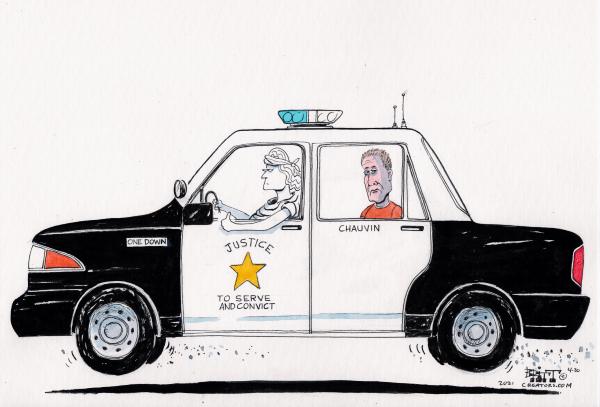 “We need to apply the same standard to police and ordinary citizens except we have to understand that ordinary citizens have no obligation to risk their lives to prevent an ongoing crime,” he said, adding: “So the rules have to defer and understand and recognize the risks that police take. When it comes to the elements of actual crimes, you can’t bury them. You can’t raise the bar for certain groups of people over other groups of people.”
Host Laura Ingraham then turned to Chauvin, expressing concern that it’s been reported that he’s currently in solitary confinement while also wondering aloud why he’s even in prison.
“Do you think that given what the judge said about an appeal that he probably shouldn’t have even been remanded back into custody?” Ingraham asked, referencing Judge Peter Cahill’s criticism of Rep. Maxine Waters’ protest remarks as potential grounds for appeal.
Acknowledging that “different states have different rules” when it comes to bail for convicted murderers, Dershowitz said that the judge provided “good appellate issues” to the defense.
“He should be released on bail,” Dershowitz declared. “There is no reason why he should be remanded. He’s not going to flee. He wants to have an appeal. He’s not going to endanger anybody. His face is well known.”
How many people who have been convicted of murder get out on bail pending appeals? Is that a regular practice?
People who actually had to deal with Chauvin in the past feel differently, according to this piece from Reuters, via Yahoo News: ‘No sympathy’ for Chauvin, say those who had run-ins before Floyd.
MINNEAPOLIS (Reuters) – For some of those who encountered Derek Chauvin’s policing or witnessed his use of force as an officer there is no sympathy for the man convicted of killing George Floyd.
Chauvin was the subject of at least 17 complaints during his career, according to police records, but only one led to discipline. Prosecutors sought permission to introduce eight prior use-of-force incidents, but the judge would only allow two. In the end the jury heard none.
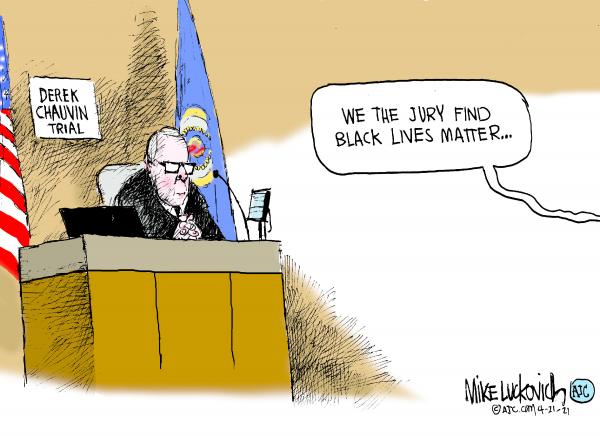 Eric Nelson, Chauvin’s lawyer, has defended his client’s use of force as appropriate in potentially dangerous situations.
“I don’t have no sympathy for him. I think he got what he deserved,” Julian Hernandez, 38, a carpenter now working in Pennsylvania, told Reuters.
Hernandez said he never heard anything from the Minneapolis police after submitting a complaint about Chauvin, who he said “choked him out” during an encounter in a Minneapolis night club in 2015. A spokesman for the Minneapolis Police Department declined to comment.
According to Chauvin’s police report, Hernandez failed to follow orders and resisted arrest when Chauvin, who was working as an off-duty security guard, tried to escort him out of a night club. Chauvin’s report said this prompted him to apply “pressure toward his Lingual Artery” to subdue Hernandez.
Hernandez said Chauvin picked him out of the crowd for no reason and quickly escalated to violence. He said Chauvin should have been removed from the police force.
Read more examples at the link.
Sorry this is such an unserious post. That’s just the mood I’m in today, I guess. As always, this is an open thread.
Did you like this post? Please share it with your friends:
Posted: April 20, 2021 | Author: bostonboomer | Filed under: Criminal Justice System, morning reads, U.S. Politics | Tags: Adam Grant, Brian Sicknick, Derek Chauvin, January 6 Capitol insurrection, Jimmy Carter, languishing, vice presidency, Walter Mondale |
Good Morning!!
 I’ve been really dragging lately–partly because of health problems, but very likely also because of the exhausting events of the past year. Am I “languishing”? Are you?
Dakinikat pointed me to this New York Times article by organizational psychologist Adam Grant: There’s a Name for the Blah You’re Feeling: It’s Called Languishing.
At first, I didn’t recognize the symptoms that we all had in common. Friends mentioned that they were having trouble concentrating. Colleagues reported that even with vaccines on the horizon, they weren’t excited about 2021. A family member was staying up late to watch “National Treasure” again even though she knows the movie by heart. And instead of bouncing out of bed at 6 a.m., I was lying there until 7, playing Words with Friends.
It wasn’t burnout — we still had energy. It wasn’t depression — we didn’t feel hopeless. We just felt somewhat joyless and aimless. It turns out there’s a name for that: languishing.
Languishing is a sense of stagnation and emptiness. It feels as if you’re muddling through your days, looking at your life through a foggy windshield. And it might be the dominant emotion of 2021.
As scientists and physicians work to treat and cure the physical symptoms of long-haul Covid, many people are struggling with the emotional long-haul of the pandemic. It hit some of us unprepared as the intense fear and grief of last year faded.
That sounds familiar. Of course I was already completely exhausted by the horror of 2016 and three years of Trump insanity when the pandemic hit. I’ve also been dealing with an autoimmune disorder called polymyalgia rheumatica. Despite seeing a Rheumatologist and taking multiple medications over the past year, I’m still struggling with chronic joint pain and stiffness. That has added to my sense of emotional exhaustion. I know I’m not alone in feeling overwhelmed by everything that’s been happening.
More from Adam Grant on “languishing:”
In the early, uncertain days of the pandemic, it’s likely that your brain’s threat detection system — called the amygdala — was on high alert for fight-or-flight. As you learned that masks helped protect us — but package-scrubbing didn’t — you probably developed routines that eased your sense of dread. But the pandemic has dragged on, and the acute state of anguish has given way to a chronic condition of languish.
 In psychology, we think about mental health on a spectrum from depression to flourishing. Flourishing is the peak of well-being: You have a strong sense of meaning, mastery and mattering to others. Depression is the valley of ill-being: You feel despondent, drained and worthless.
Languishing is the neglected middle child of mental health. It’s the void between depression and flourishing — the absence of well-being. You don’t have symptoms of mental illness, but you’re not the picture of mental health either. You’re not functioning at full capacity. Languishing dulls your motivation, disrupts your ability to focus, and triples the odds that you’ll cut back on work. It appears to be more common than major depression — and in some ways it may be a bigger risk factor for mental illness.
The term was coined by a sociologist named Corey Keyes, who was struck that many people who weren’t depressed also weren’t thriving. His research suggests that the people most likely to experience major depression and anxiety disorders in the next decade aren’t the ones with those symptoms today. They’re the people who are languishing right now. And new evidence from pandemic health care workers in Italy shows that those who were languishing in the spring of 2020 were three times more likely than their peers to be diagnosed with post-traumatic stress disorder.
Part of the danger is that when you’re languishing, you might not notice the dulling of delight or the dwindling of drive. You don’t catch yourself slipping slowly into solitude; you’re indifferent to your indifference. When you can’t see your own suffering, you don’t seek help or even do much to help yourself.
Read the whole thing at the NYT and see what you think.
Now for today’s news . . .
Walter Mondale died yesterday. From the Minneapolis Star-Tribune: Walter Mondale, who rose from small-town Minnesota to vice presidency, dies at 93.
Walter F. Mondale, a preacher’s son from southern Minnesota who climbed to the pinnacle of U.S. politics as an influential senator, vice president and Democratic nominee for president, died on Monday. He was 93.
Known as “Fritz” to family, friends and voters alike, Mondale died in Minneapolis, according to a statement from his family.
“As proud as we were of him leading the presidential ticket for Democrats in 1984, we know that our father’s public policy legacy is so much more than that,” read the Mondale family statement.
Former President Jimmy Carter, who chose Mondale as his running mate in 1976, called his friend “the best vice president in our country’s history.”
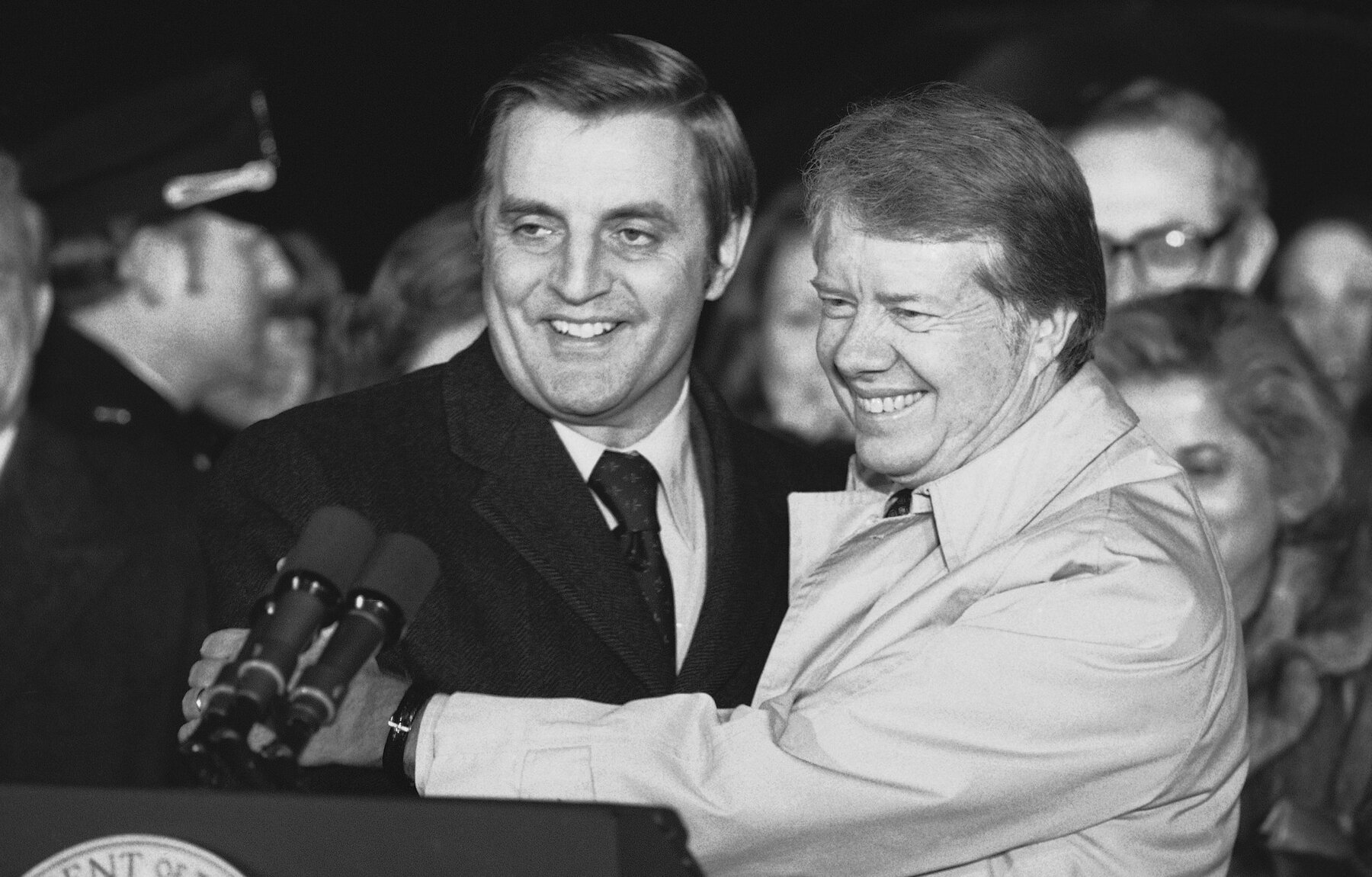 “He was an invaluable partner and an able servant of the people of Minnesota, the United States and the world,” Carter said in a statement. “Fritz Mondale provided us all with a model for public service and private behavior.”
After serving four years under Carter, Mondale was the Democratic nominee for president in 1984. He lost to the incumbent, President Ronald Reagan, in a historic landslide.
“A night like that is hard on you,” Mondale wrote in his 2010 memoir, “The Good Fight.”
Even in defeat, Mondale made history by choosing as his running mate Geraldine Ferraro, the first woman to run for vice president on a major-party ticket. It followed a series of political landmarks in a public career that spanned seven decades.
A protégé of Hubert H. Humphrey, another Minnesota politician who rose to the vice presidency and lost a presidential election, Mondale served as a U.S. senator from Minnesota for a dozen years. He played a lead role in the passage of social programs, civil rights laws and environmental protections that defined President Lyndon B. Johnson’s “Great Society.”
As vice president from 1977 to 1981, Mondale transformed the office from what had historically been a punchline into what both he and Carter called a true governing partnership. Mondale’s role as chief adviser and troubleshooter, working from a West Wing office near the Oval Office, became a model for successors including George H.W. Bush, Al Gore, Dick Cheney and Joe Biden.
“The first person I called was Fritz,” Biden once said about the time President Barack Obama offered him the No. 2 position.
At The Washington Post, Karen Tumulty wrote about how Mondale changed the vice presidency: Opinion: Walter Mondale reinvented the vice presidency. Both Biden and Harris should thank him for it.
[Mondale’s] most enduring contribution may well have been the invention of the modern vice presidency, and his creation of a template that has been followed to some degree ever since. Mondale’s activist model as an all-purpose adviser and troubleshooter is one for which President Biden, a former vice president, and Kamala D. Harris, the current occupant of the office, should be grateful.
Before Mondale, the vice president was largely a figurehead….
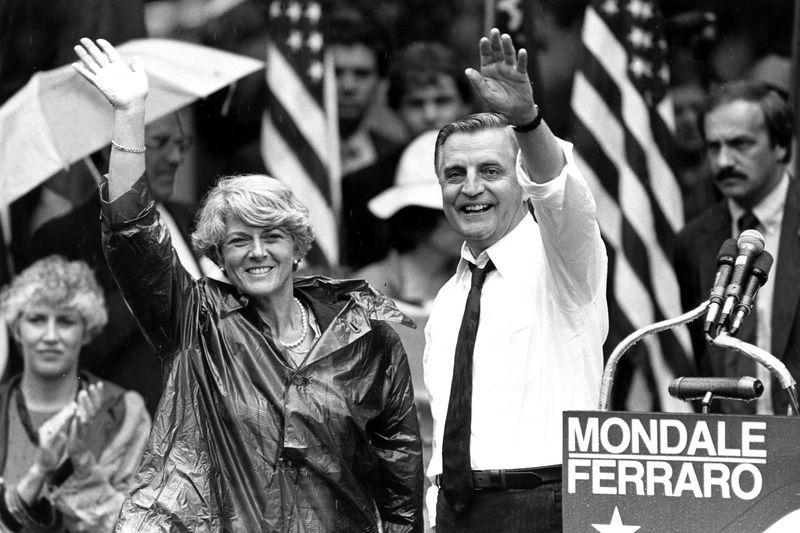 But Jimmy Carter, coming to Washington in 1977 with a contingent of fellow Georgians and no real sense of how the place operated, had recognized that he needed a true governing partner with the experience Mondale had honed in 12 years as a well-regarded senator from Minnesota.
Mondale was the first vice president to have an office in the West Wing, steps from the president’s own, rather than being sidelined in the Old Executive Office Building, and a weekly lunch scheduled with the president. Carter also made it clear that their two staffs were to be considered one; Mondale’s chief of staff Richard Moe was given the additional title “assistant to the president.”
“We felt that Fritz’s long experience in Washington and the fact that for the first time he was being integrated into the Presidency itself was a compensating factor for the ignorance among the Georgia group concerning Washington,” Carter said, referring to Mondale, in a 1982 oral history moderated by the University of Virginia’s Miller Center.
Read more at the WaPo.
The Derek Chauvin trial wrapped up yesterday, and now the nation awaits the jury verdict. Here’s an interesting op-ed by former federal prosecutor Jennifer Rogers at CNN: Chauvin trial is ‘believe your eyes’ vs. ‘hey, look over there!’
Prosecutors treat closing arguments as an opportunity to make things simple for the jury and to keep them focused on the critical issues. Thus we heard state prosecutor Steve Schleicher’s mantra to the jury to “believe your eyes,” and his repeated references to the video evidence as well as his use of visual aids through which Schleicher listed and then checked off each legal element of each offense as he reminded the jury of the evidence proving them. This was a very effective technique, giving jurors who walked into the jury room inclined to vote to convict some ammunition to use in convincing more reluctant fellow jurors.
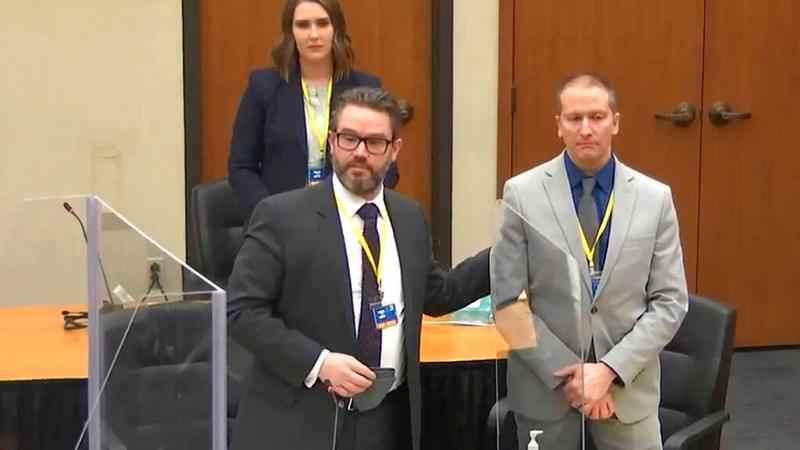
Defense Attorney Eric Nelson and Derek Chauvin
Defense lawyers have a different checklist, and Chauvin’s lawyer Eric Nelson hit all of his marks. Defense lawyers use closings to distract the jurors, to pull them away from the focus encouraged by prosecutors, and to provide as many reasons as they can muster as to why the prosecutors’ theory of the case fails.
Nelson embraced this tactic, spending almost an hour showing body camera footage of and arguing about the period before Chauvin restrained Floyd, a time when other officers were trying to cram a resisting Floyd into the squad car, while virtually ignoring most of the 9 minutes and 29 seconds that Chauvin knelt on Floyd’s neck. Nelson then tossed out all of the alternate causation theories he had cultivated throughout the trial — Floyd’s preexisting heart condition, his consumption of fentanyl and methamphetamine, the paraganglioma tumor, and possible carbon monoxide poisoning — claiming that with all of these possibilities out there, prosecutors couldn’t possibly prove causation beyond a reasonable doubt.
Jurors would be forgiven if their heads were spinning a bit from this rapid fire of legal theories — and that is exactly what the defense was aiming for.
Read the rest at CNN.
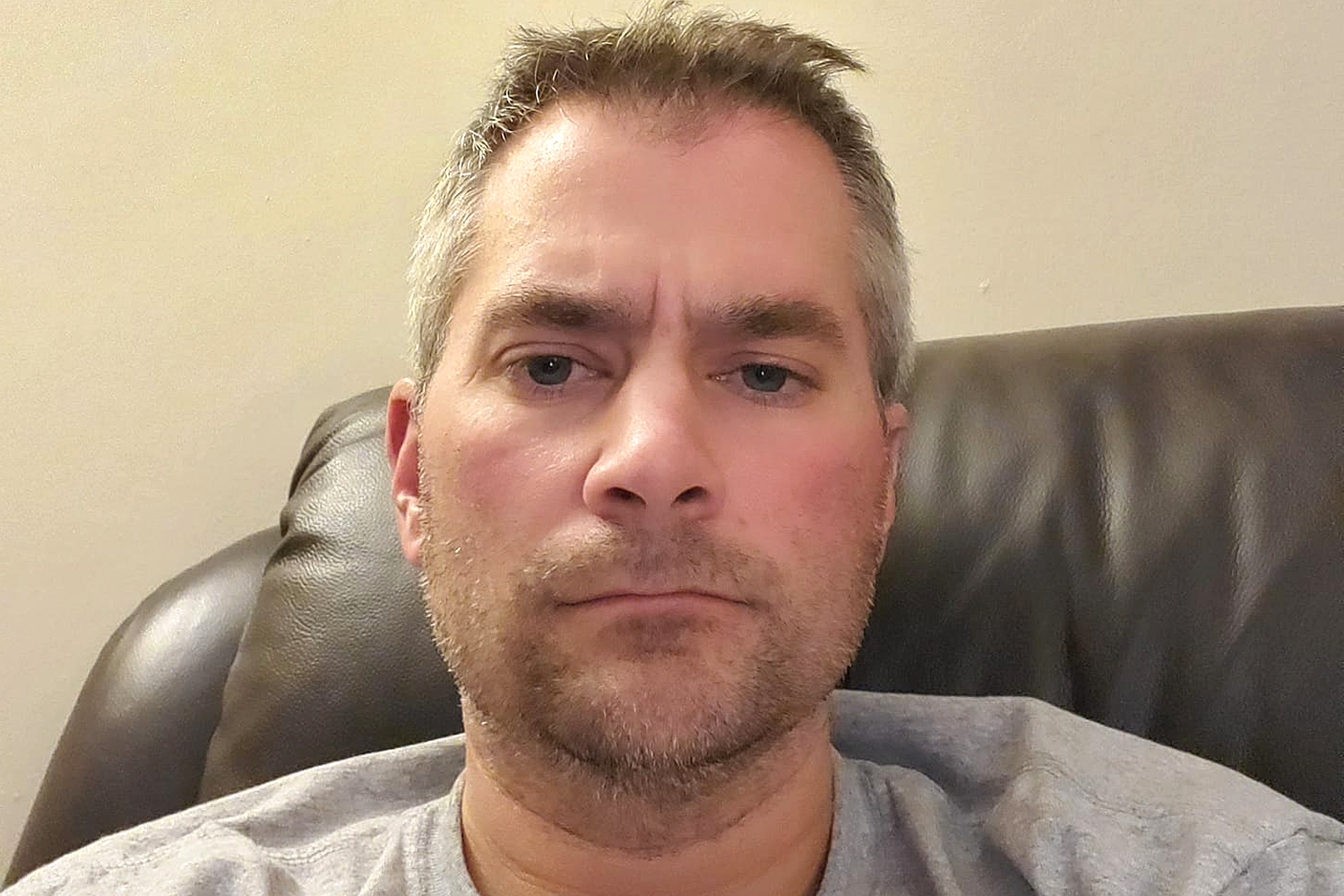
One more big story from yesterday at The Washington Post: Capitol Police officer Brian Sicknick, who engaged rioters, suffered two strokes and died of natural causes, officials say.
Capitol Police officer Brian D. Sicknick suffered two strokes and died of natural causes a day after he confronted rioters at the Jan. 6 insurrection, the District’s chief medical examiner has ruled.
The ruling, released Monday, will make it difficult for prosecutors to pursue homicide charges in the officer’s death. Two men are accused of assaulting Sicknick by spraying a powerful chemical irritant at him during the siege, but prosecutors have not tied that exposure to Sicknick’s death.
In an interview with The Washington Post, Francisco J. Diaz, the medical examiner, said the autopsy found no evidence the 42-year-old officer suffered an allergic reaction to chemical irritants, which Diaz said would have caused Sicknick’s throat to quickly seize. Diaz also said there was no evidence of internal or external injuries.
While there’s apparently no proof, it’s difficult to believe that a man in his early 40s who was involved in a violent insurrection and probably was hit with bear spray suddenly had two spontaneous strokes. But that’s where things stand.
Brian Sicknick
Christopher Macchiaroli, a former federal prosecutor who handled violent crime cases before grand juries in D.C. Superior Court and U.S. District Court, said a ruling of a death by natural causes “does make it more difficult to bring a homicide prosecution.”
Macchiaroli said additional evidence of some conduct by rioters could emerge independently, which prosecutors could argue contributed to the strokes. But he said that “any defense attorney . . . would use the medical examiner’s conclusions as clear-cut evidence of reasonable doubt.”
In explaining the decision, the medical examiner’s office provided an updated timeline leading up to Sicknick’s death. A statement says Sicknick collapsed 7 hours and 40 minutes after he was sprayed, and then died nearly 24 hours after that.
Sicknick was among hundreds of officers who confronted the violent mob that took over the Capitol, seeking to overturn the election Donald Trump had lost. Nearly 140 officers were assaulted, authorities said, facing some rioters armed with ax handles, bats, metal batons, wooden poles, hockey sticks and other weapons.
So . . . what’s on your mind today? As always, this is an open thread.
Did you like this post? Please share it with your friends:
Posted: April 13, 2021 | Author: bostonboomer | Filed under: morning reads, U.S. Politics |

Jae Schalekamp, Oh Forsythia!
Good Morning!!
I’ve been stuck inside for the past few weeks with chronic pain difficulties. Yesterday, I got out for the first time in quite awhile, and I was happy to see that Spring has finally arrived in the Boston area. Forsythia is blooming along with cherry blossoms, and light green leaves are beginning to form on some trees. It gave me a good feeling, even though we still have some tough times ahead as a country. Still, we are rid of Trump and we finally have a president who is working hard to deal with the pandemic that has taken nearly 563 million deaths in the U.S. and 136.7 million worldwide.
Here’s the latest pandemic news and it’s not good:
The New York Times: U.S. Calls for Pause on Johnson & Johnson Vaccine After Rare Clotting Cases.
Federal health agencies on Tuesday called for an immediate pause in use of Johnson & Johnson’s single-dose coronavirus vaccine after six recipients in the United States developed a rare disorder involving blood clots within about two weeks of vaccination.
All six recipients were women between the ages of 18 and 48. One woman died and a second woman in Nebraska has been hospitalized in critical condition.
Nearly seven million people in the United States have received Johnson & Johnson shots so far, and roughly nine million more doses have been shipped out to the states, according to data from the Centers for Disease Control and Prevention.

All for Forsythia, Cindy Mac
“We are recommending a pause in the use of this vaccine out of an abundance of caution,” Dr. Peter Marks, director of the Food and Drug Administration’s Center for Biologics Evaluation and Research, and Dr. Anne Schuchat, principal deputy director of the C.D.C., said in a joint statement. “Right now, these adverse events appear to be extremely rare.”
While the move was framed as a recommendation to health practitioners in the states, the federal government is expected to pause administration of the vaccine at all federally run vaccination sites. Federal officials expect that state health officials will take that as a strong signal to do the same. Within two hours of the announcement, Gov. Mike DeWine of Ohio, a Republican, advised all health providers in his state to temporarily stop giving Johnson & Johnson shots. New York State and Connecticut quickly followed suit.
Axios: The warning signs of a longer pandemic.
All the things that could prolong the COVID-19 pandemic — that could make this virus a part of our lives longer than anyone wants — are playing out right in front of our eyes.
The big picture: Right now, the U.S. is still making fantastic progress on vaccinations. But as variants of the virus cause new outbreaks and infect more children, the U.S. is also getting a preview of what the future could hold if our vaccination push loses steam — as experts fear it soon might.
Driving the news: The British variant is driving another surge in cases in Michigan, and Gov. Gretchen Whitmer has resisted reimposing any of the lockdown measures she embraced earlier in the pandemic.
- Variants are beginning to infect more kids, even as schools are on the fast track back to reopening, making the pandemic “a brand new ball game,” as University of Minnesota epidemiologist Michael Osterholm recently put it.
- New research confirms that our existing vaccines don’t work as well against the South African variant.
Between the lines: This is a preview of the longer, darker coronavirus future the U.S. may face without sufficient vaccinations — one that many experts see as pretty likely.
Although the pace of vaccinations is still strong, there’s a growing fear that it’s about to slow down. In some parts of the country, particularly the South, demand for shots has already slowed down enough to create a surplus of available doses.
Read more at Axios.

Flower Garden, Gustav Klimt
The trial of Derek Chauvin for the murder of George Floyd continues in Minneapolis, but that didn’t stop another Minnesota police officer from killing another black man. Here’s the latest on the shooting of Daunte Wright and the protests that have followed.
The Washington Post: Officer Kim Potter fatally shot Daunte Wright, police said. She’s a 26-year vet, served as union president.
Potter, 48, is a 26-year veteran and has served as her police union’s president, the Star Tribune reported. At an earlier news conference, where authorities played a nearly one-minute dash-cam recording of the fatal incident, Brooklyn Center Police Chief Tim Gannon said it appears that Potter intended to fire her Taser but instead made an “accidental discharge” from her gun.
Potter has been suspended pending the results of a Minnesota Bureau of Criminal Apprehension investigation, the agency said. On Monday, Brooklyn Center leaders dismissed the city manager, potentially giving Mayor Mike Elliot the ability to fire the chief or officers in the department.
Washington County Attorney Pete Orput said he expects to complete a “thorough yet expedited” review of potential criminal charges in the case by no later than Wednesday, he told the Star Tribune.\“I’m hoping Wednesday, but I want to have the opportunity to give my condolences to his family and explain to them my decision,” Orput said. The suburban city of about 30,000 residents has been rocked by Wright’s killing as the Minneapolis area watches the ongoingtrial of Derek Chauvin, the former Minneapolis officer charged with murder after kneeling on George Floyd’s neck for over nine minutes.
The chain of events that ended with yet another fatal police shooting of a Black man in Minnesota began in what has become a typical tragedy — with a traffic stop for a minor infraction.
The man, Daunte Wright, 20, who died Sunday after a run-in with police in a suburb of Minneapolis, was driving an SUV with expired license plates, and he also ran afoul of a Minnesota law that prohibits motorists from hanging air fresheners and other items from their rearview mirrors.
“He was pulled over for having an expired registration on the vehicle,” Brooklyn Center Police Chief Tim Gannon said Monday. “When the officer went over, an item hanging from the rearview mirror was spotted.”

Almond Blossom, Vincent Van Gogh
It was after that, Gannon said, that the officers discovered that a “gross misdemeanor warrant” for Wright’s arrest had been issued.
Minutes later, a gunshot rang out, and Wright joined the ranks of other Black motorists who have died after having been pulled over by police, a group that includes Philando Castile, 32, who was fatally shot in 2016 by a Minneapolis police officer after he was stopped for a broken taillight. His final moments were recorded in a powerful video.
Gannon said Monday that he believes the officer meant to pull a Taser in Sunday’s shooting but instead pulled her service weapon.
Read more at NBC News.
Demonstrators clashed with law enforcement officers in Brooklyn Center for the second night in a row Monday following the fatal shooting of a 20-year-old Black man by a police officer.
Protesters had been on hand throughout the day outside the Brooklyn Center Police Department, but the scene escalated after the start of a 7 p.m. curfew across four Twin Cities metro counties instituted by Gov. Tim Walz.
About 300 people attended a separate, peaceful vigil for Daunte Wright earlier in the evening at the site of the traffic stop that ended with his shooting.
“Right now, this community, this city, this state, our nation, our country, our world is broken,” said the Rev. Jeanette Rupert, who also works as an ICU nurse and said she came to speak at the vigil before her night shift. “We have had the knees on our neck for so long.”

Piet Mondrian, Amaryllis
Coming amid the high-profile criminal trial of former Minneapolis police officer Derek Chauvin in George Floyd’s death, Wright’s fatal shooting in the suburb directly north of Minneapolis also ignited a clash late Sunday between demonstrators and law enforcement officers.
By shortly before 8 p.m. Monday, police began to warn demonstrators, who still numbered in the hundreds, that they were in violation of curfew. Officers began to move toward the fence in formation and issued orders to disperse.
Authorities fired multiple rounds of tear gas, along with rubber bullets and flash grenades. Protesters dispersed from areas hit by tear gas were regrouping and retaliating by throwing water bottles and launching fireworks. Later, lines of police in riot gear pushed groups of protesters away from the station. At a strip mall near the police station, looters broke into several businesses, including a Dollar Tree store where flames were later spotted.
At a 12:30 a.m. Tuesday news conference, Minnesota State Patrol Col. Matt Langer said that 40 people were arrested Monday night at the Brooklyn Center protest. Some were booked into the Hennepin County jail, some cited and released, he said. Several law enforcement officers suffered minor injuries from thrown debris; no protester injuries were reported, he said.
Brooklyn Center leaders were poised to fire the city’s police chief Monday evening, following the police shooting of a 20-year-old Black man Sunday afternoon that touched off a night of unrest in the city.
At an emergency afternoon meeting, the City Council voted to give authority over the police department to the mayor’s office and to fire City Manager Curt Boganey, who’d been with the city since 2005, Council Member Dan Ryan said during a virtual council workshop….
Wright’s death triggered confrontations with police and looting in the city of about 31,000, where most residents are people of color. Mayor Mike Elliott, who took office in 2019, is the first person of color to serve as mayor.

Cottonwood Tree in Spring, Georgia O’Keefe
“We recognize that this couldn’t have happened during a worse time,” Elliott said at a news conference Monday. “We are all collectively devastated and we have been for over a year now by the killing of George Floyd.”
At a virtual council workshop, Council Member Kris Lawrence-Anderson said she voted to remove the city manager because she feared for her property and retaliation by protestors if she had voted to keep him.
“He was doing a great job. I respect him dearly,” she said. “I didn’t want repercussions at a personal level.”
In remarks Monday afternoon, President Joe Biden called Wright’s death “tragic” and urged “peace and calm.”
“There is absolutely no justification, none, for looting,” Biden said. “No justification for violence.”
Read much more at the link.
Those are the two biggest stories of the day. But much more is happening. I’ll add a few more links in the comment thread. What’s on your mind today?
Did you like this post? Please share it with your friends:


 peej
peej Carissa
 bostonboomer
 dakinikat
 ecocatwoman
 jjlo
jjlo mablue2
 Mama Lopez
 peggysue22
 quixote
 skydancingguestblogger
 Mona (aka Wonk the Vote)





Recent Comments