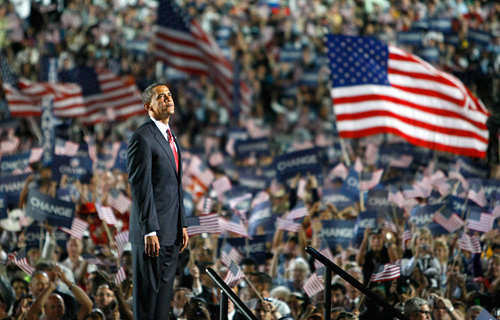
Barack Obama at the Democratic National Convention, 2008
Good Morning!!
The next two weeks will be fascinating ones for political junkies. The Republican Convention begins on Monday, July 18 in Cleveland, and just a week later on July 25 the Democratic Convention will be held in Philadelphia. The list of speakers for the GOP Convention was released this morning.
Donald Trump’s convention will feature an eclectic mix of cultural figures, from the first woman to command a space shuttle mission to the survivors of the 2012 Benghazi attacks to an underwear model.
But while several Republican Party establishment figures will take the stage next week in Cleveland, the national convention to officially nominate Trump will be devoid of some of the GOP’s most seasoned leaders and brightest new stars.
Republican officials released a long-awaited list of convention speakers on Thursday that are billed as “non-conventional speakers” who emphasize “real world experience.”
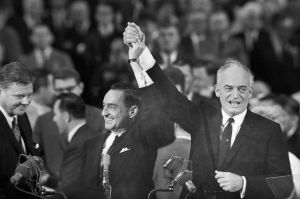
Barry Goldwater and William Miller at the 1964 GOP Convention in San Francisco
A small number of elected officials and former office-holders have agreed to speak at Trump’s convention, including Paul Ryan, Mitch McConnell, Rudy Giuliani, Ted Cruz, Scott Walker, Marsha Blackburn, Mike Huckabee, Rick Scott, Chris Christie, Newt Gingrich, Jeff Sessions, Joni Ernst, and Asa Hutchison. Indiana Gov. Mike Pence is not included in the list of speakers. It’s not clear whether that means he will be the VP nominee or if there is some reason he won’t be speaking. Another notable omission from the speakers list is Sarah Palin.
The unusual collection of non-political speakers seems designed to broaden Trump’s appeal. They include retired astronaut Eileen Collins, the first woman pilot and first woman commander of a space shuttle mission; Mark Geist and John Tiegen, two survivors of the 2012 attack on the U.S. diplomatic outpost in Benghazi, Libya; and Antonio Sabato Jr., a former Calvin Klein underwear model, soap-opera actor and reality-television star.
Some sports figures will take the stage here, including pro golfer Natalie Gulbis and Ultimate Fighting Championship president Dana White. But some sporting heroes of decades past that Trump has said he would like to see at the convention — former Indiana University basketball coach Bobby Knight and boxing legend Don King — are not listed as featured speakers.
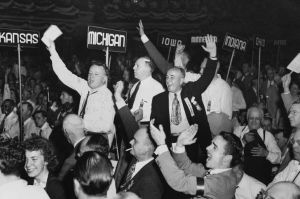
Thomas E. Dewey at the 1948 Republican Convention
Trump family members and close friends will also speak at the convention.
The Cleveland convention will be orchestrated to help expand Trump’s appeal to the general electorate. To that end, several member of Trump’s family are expected to give speeches, including his wife, Melania, and his four oldest children, Donald Jr., Ivanka, Eric and Tiffany.
In addition, other speakers who have known Trump and his family through the years plan to take the stage. They include Haskel Lookstein, a rabbi in New York who converted Ivanka Trump to Judaism; Tom Barrack, a wealthy California-based investor who has worked with Donald Trump on real estate deals; and Kerry Woolard, the general manager of Trump Winery in Virginia.
In contrast to the weak list of GOP convention speakers, the Democratic Convention speakers list is star-studded. The Washington Post:
The Democratic National Convention is likely to open with a showcase of some of the party’s biggest stars, including Sen. Elizabeth Warren (D-Mass.), Sen. Bernie Sanders of Vermont, and first lady Michelle Obama, according to a source with knowledge of the convention planning.
Although the speaking schedule isn’t yet set in stone, the jam-packed Monday night is also expected to include Sen. Cory Booker (D-N.J.), and Rep. Joe Kennedy (D-Mass.) will introduce Warren in Philadelphia.
Sanders’s name will be entered into the nomination, prompting a roll call vote of delegates for both candidates.
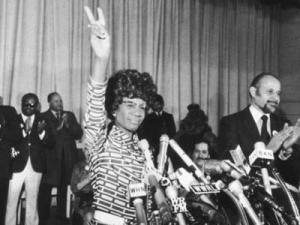
Percy Sutton nominates Shirley Chisholm at the 1972 Democratic Convention
As we all expected Sanders will continue trying to get as much attention as he can for as long as he can.
According to another source familiar with the convention planning, the night’s theme will be an economic agenda focused on families. The list of speakers is intended to highlight the unity of the Democratic Party in contrast to the Republican convention that will have come the week before.
The night’s programming, including the speakers and videos, will drive home the theme of Clinton’s campaign, “Stronger together,” by highlighting a populist economic agenda.
The convention speaking list is coming together this week, and more speakers are likely to be formally announced as early as this week.
Presumably, speakers also will include President Obama and former President Clinton as well as rising stars in the party.
The Trump campaign announced yesterday that the presumptive GOP nominee will name his Vice Presidential running mate tomorrow morning at 11AM in New York City. The exact location hasn’t been announced yet. NPR reports: Trump Wraps Up Vice President Auditions, Sets Friday Announcement.
The deadline for a decision comes after the presumptive GOP presidential nominee wrapped up both public tryouts and private meetings with the three men believed to be among the finalists — Indiana Gov. Mike Pence, former House Speaker Newt Gingrich and New Jersey Gov. Chris Christie.
After he campaigned with Pence in Indiana Tuesday evening, Trump his family met with Pence at his Indiana home on Wednesday morning, according toNBC News, while Gingrich and Alabama Sen. Jeff Sessions also flew to Indianapolis to meet with Trump. Christie met with Trump and his family on Tuesday.
Pence, who gave a tepid endorsement to Texas Sen. Ted Cruz before his state’s primary, was more gleefully on board with Trump’s campaign on Tuesday night as he introduced him at a rally in Westfield.
“Donald Trump gets it,” Pence told the crowd. “Donald Trump hears the voice of the American people.” ….
Of the three presumed vice presidential finalists, Pence was the only one who gave a direct introduction for Trump before he came to the stage. Trump also campaigned with Christie on Monday in Virginia and with Gingrich last week in Ohio.
Trump praised Pence at the end of what was a meandering speech — attacking rival Hillary Clinton often but also wandering off into other topics such as immigration and trade and back again.
“I don’t know if he’s going to be your governor or your vice president, who the hell knows!” Trump told the crowd, referring to Pence.
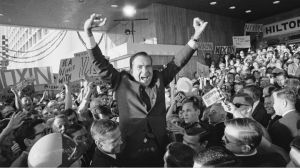
Richard Nixon at the 1968 Republican Convention
Yeah, who the hell knows? This horrifying man is actually running for president. The other top VP candidates are supposedly Jeff Sessions, Chris Christie, and Newt Gingrich. TA Frank weighed in on each of these choices at The Atlantic: It’s down to four, but does any candidate offer even a smidgen of hope?
At this point, Trump needs a running mate who amplifies his strengths and, possibly, goes some way toward remedying some of the candidate’s most serious weaknesses: erratic behavior, lack of experience, inadequate grasp of history, and almost zero policy chops. He or she needs to believe what Trump believes—but in a way that suggests there will be an adult in the room. Trump’s vice president is likely to be powerful in the White House, so the pick is about a lot more than campaigning. The question remains, however, whether any of the final four offer a glimmer of hope.
Some excerpts from Frank’s assessments of the top four candidates.
Newt Gingrich
Even in the wake of reports that Fox News and Gingrich have parted ways, perhaps to allow him to be vetted for the post, I still do not think this V.P. possibility is for real. Even Trump has said about Gingrich that “Newt is Newt.” That’s what you say about someone whom you accept despite major flaws. As in: Kanye is Kanye. That sort of stuff. And remember that “erratic” thing that we were trying to remedy? Gingrich is not your man for that.
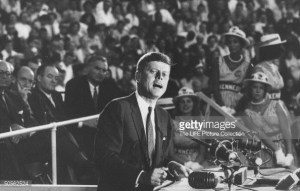
John Kennedy at the 1960 Democratic Convention
Mike Pence
Yes, Pence campaigned with Trump this week in Indianapolis and sang his praises. But he seemed about as believable in his Trump-love as Paul Ryan. O.K., he did a little better than that. At least he wants Trump to win, maybe.
But Mike Pence has a fan club of roughly four, and all four have the last name Pence. This is someone who has the capability to be bungling and divisive on dumb social issues—by all accounts pleasing no one in his management of a religious-liberty law in Indiana, which means he angers social liberals, social moderates, and social conservatives. To be fair, that does leave the apathetic or uninformed.
Chris Christie
We’ve been through this. Christie is, I will admit, an excellent retail politician. He’s a superb attack dog. He’s a social moderate. You like him, and he likes you, or thinks he does. But he’s got that bridge scandal to deal with and no one respects him after he turned into a courtier. Trump’s ticket would become the stuff of comedy. Picture it. Now picture it as a silhouette.
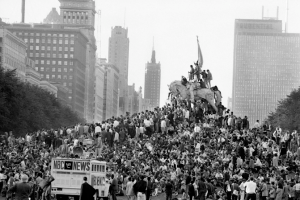
Protesters forming a human pyramid in Chicago’s Grant Park during the 1968 Democratic Convention
Jeff Sessions
Here, I must bring up one more crucial vulnerability of Trump: the suspicion that he doesn’t really mean a lot of the things that he says. It’s all pandering: on immigration, on trade, on budgets, on health care, etc. That’s one more reason why Jeff Sessions would pack a punch: Sessions represents Trumpism without Trump. Selecting him as a running mate would signal that Trump actually means what he’s saying.
Lots of breaking news this morning. FBI Director James Comey just held a press conference to announce that the FBI will not be recommending criminal charges against Hillary Clinton for her handling of State Department emails. NBC News reports:
“No reasonable prosecutor would bring such a case,” Comey told reporters.
Federal investigators did not find evidence of intentional wrongdoing, he said — but there is evidence the former secretary of state and her staff were “extremely careless.”
Comey said 110 emails sent or received on the Clinton server contained classified information. He also said it’s possible “hostile actors” gained access to the server.
The website tweeted a link to 1,258 emails on Monday that Clinton sent during her time as secretary of state. According to the release, the emails were obtained from the US State Department after they issued a Freedom of Information Act request. The emails stem from a State Department release back in February, The Hill reports.
If you have some hours to kill, you could do worse than a deep dive into the Clinton emails released by WikiLeaks yesterday. The site went through the emails released earlier in the year by the State Department looking for any mentions of the Iraq War. The 1,258 emails show mostly that people at the State Department are just like us, namely in that they spend their days sending their colleagues links to things they read online.
It doesn’t sound all that exciting, but Julian Assange thinks Clinton should be prosecuted. This from the guy who ran from a rape charge.
The U.N. human rights chief on Tuesday called a suicide bombing outside the Prophet Mohammad’s Mosque in the Saudi city of Medina an attack on Islam itself and many Muslims expressed shock that their second-holiest site had been targeted.
Three apparently coordinated suicide attacks on Monday targeted Medina, the U.S. consulate in Jeddah and the largely Shi’ite Muslim city of Qatif on Monday. At least four security officers were killed.
No group has claimed responsibility but Islamic State has carried out similar bombings in the U.S.-allied kingdom in the past year, targeting Shi’ites and Saudi security forces.
Zeid Ra’ad al-Hussein, the U.N. High Commissioner for Human Rights and a member of the Jordanian royal family, delivered his remarks via a spokesman in Geneva.
“This is one of the holiest sites in Islam, and for such an attack to take place there, during Ramadan, can be considered a direct attack on Muslims all across the world,” he said, referring to the Islamic holy month.
“It is an attack on the religion itself.”
Militant attacks on Medina are unprecedented. The city is home to the second-holiest site in Islam, a mosque built by the Prophet Mohammed, the founder of Islam, which also houses his tomb.
With Ramadan drawing to a close on Tuesday, ISIS has fulfilled its promise of staining the Muslim holy month with bloodshed around the globe—taking credit for some of the deadly attacks that have killed hundreds in several countries, including in Iraq, Kuwait, Bangladesh, Turkey, Saudi Arabia.
The terrorist group vowed in May, just before Ramadan began, to make it “with God’s permission, a month of pain for infidels everywhere.” And that it was, with many countries remaining on high alert following the attacks.
The past few days have been particularly violent. Suicide bombs rocked two Saudi Arabian cities on Monday, killing at least four security officers, wounding five other people — and coming just hours after authorities in a third city stopped a bomber just feet from the U.S. Consulate.
On the attacks in Saudi Arabia:
In Saudi Arabia, the attacks began Sunday night, when a suicide bomber was stopped by security personnel in a hospital parking lot about 30 feet from the U.S. Consulate in Jeddah.
The bomber detonated an explosive belt, killing himself and “slightly” injuring two officers, the Saudi Interior Ministry said in a statement. No Americans were hurt and all State Department personnel were accounted for.
Hours later, on the other side of the country, a pair of suicide bombers attacked the Persian Gulf city of Qatif, a Ministry of Interior source confirmed to NBC News. Details of casualties in the largely minority Shi’ite city were not immediately available.
Shortly after that, four security officers were killed — as well as a suicide bomber — near the security headquarters of the Prophet’s Mosque in Medina, a site considered to be the second holiest in Islam.
The attack occurred in a parking lot outside the mosque, during Maghreb prayers, when the bomber pretended to break the Ramadan fast with a group of security personnel, al Arabiya reported.
Jet Propulsion Lab, California (CNN)NASA says it has received a signal from 540 million miles across the solar system, confirming its Juno spacecraft has successfully started orbiting Jupiter, the largest planet in our solar system.
“Welcome to Jupiter!” flashed on screens at mission control at NASA’s Jet Propulsion Lab in Pasadena, California.
The probe had to conduct a tricky maneuver to slow down enough to allow it to be pulled into orbit: It fired its main engine for 35 minutes, effectively hitting the brakes to slow the spacecraft by about 1,212 miles per hour (542 meters per second).
Juno was launched nearly five years ago on a mission to study Jupiter’s composition and evolution. It’s the first spacecraft to orbit Jupiter since Galileo. Galileo was deliberately crashed into Jupiter on September 21, 2003, to protect one of its discoveries — a possible ocean beneath Jupiter’s moon Europa.
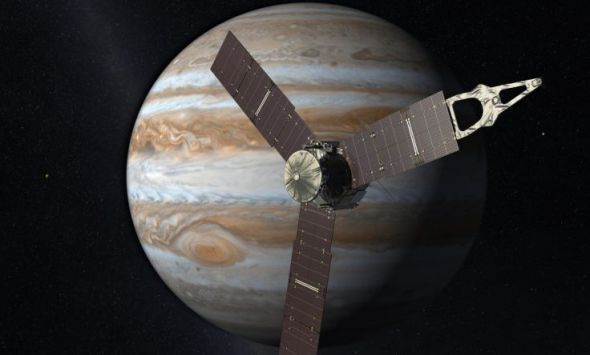
A 1/5th size scale model of NASA’s Juno spacecraft is displayed at the Jet Propulsion Laboratory in Pasadena, California, July 4, 2016. / AFP PHOTO / Robyn BECK
Setting up post at the king of planets, NASA’s Juno spacecraft fired its main engine for 35 minutes Monday, steering into orbit around Jupiter to peer inside the gas giant and give scientists a better idea of how the solar system took shape 4.6 billion years ago.
Spinning on its axis once every 12 seconds, the probe’s British-built rocket thruster ignited and slowed down Juno just enough to be snared by Jupiter’s strong gravity field into a looping, 53-day-long orbit.
Confirmation of the burn’s successful conclusion reached Earth at 11:53 p.m. EDT (0353 GMT) via a radio tone broadcast by Juno, prompting applause and smiles inside the control room at NASA’s Jet Propulsion Laboratory in Pasadena, California.
“All stations… we have the tone for burn cutoff on delta-v,” a ground controller said over a radio loop. “Welcome to Jupiter.”
Powered by three solar panels arranged in a propeller-like pattern around Juno’s main body, the Jupiter orbiter wrapped up a five-year, 1.7-billion-mile (2.8-billion-kilometer) trip with Monday’s automated rendezvous with the solar system’s biggest planet.
“Tonight, through tones, Juno sang to us, and it was a song of perfection,” said Rick Nybakken, Juno’s project manager at JPL. “After a 1.7-billion-mile journey, we hit our burn target within one second.”
The record-setting journey made Juno the farthest spacecraft from the sun to ever rely on solar power, and Monday’s maneuver made the $1.1 billion mission the second to ever orbit Jupiter.
When Hillary Clinton and Barack Obama publicly reconciled eight years ago at a celebrated summer rally in Unity, New Hampshire, the two recent rivals were still closer to being opponents than friends.
While both candidates were set on healing the Democratic Party after a divisive primary, the lead-up to the event was fraught. Did their show of warmth — a kiss on the tarmac in Washington, D.C., as they boarded a chartered plane together — appear genuine? Would their praise for each other — “she rocks,” gushed Obama, seeking to win over her supporters — seem too forced?
When President Obama takes the stage at the Charlotte Convention Center with Clinton on Tuesday afternoon for their first joint rally of the 2016 campaign, it will be most notable for how far the two leaders of the Democratic Party have come in the eight intervening years.
“It is as far from fraught as can be,” said Obama’s former chief strategist, David Axelrod, of Obama’s long-anticipated campaign trail debut. “He’s been chomping at the bit to get out there. There’s so many reasons why he feels strongly about this — part of it is his genuine respect for her, part of it is his feelings about the alternative. There’s no half-hearted warrior here.”
Virginia Gov. Terry McAuliffe, a longtime Clinton confidant, said of Tuesday’s rally that unlike eight years ago, “they have such a great relationship that there’s nothing to psychoanalyze. He wants to do everything he can for her.”
I can’t wait to watch them together on stage. On Friday Hillary will campaign with Joe Biden in his birthplace, Scranton, PA.
BuzzFeed Canada editor and First Draft Coalition member Craig Silverman will be leading the charge from Toronto, “bringing his deep expertise at debunking hoaxes to our reporting arsenal,” said Scott Lamb, BuzzFeed’s head of international growth, “and acting as a resource for all BuzzFeed editions, as well as a watchdog on behalf of our readers worldwide.”
“We’re in a really early phase of testing” Silverman told First Draft, “and seeing what’s going to work in terms of content produced and what works for the BuzzFeed audience.”
The biggest challenge for BuzzFeed – and for fact-checkers and debunkers the world over – will be in figuring out a way to make debunks travel as far and fast as the false rumours they address.
Bernie Sanders is back to his old day job, trading the booming applause of his campaign rallies to the far more tedious work of the Senate….But just off the Senate floor and across the Capitol, one vestige of his presidential campaign remains: his Secret Service detail. And taxpayers are footing the bill.
Protecting a presidential candidate costs about $40,000 a day, a federal official familiar with the Homeland Security budget told CNN. For Sanders, that’s more than a half-million dollars since the last primary on June 14. The cost could grow by nearly $2 million if he stays in the race through the Democratic convention in Philadelphia later.
The federal official said it’s difficult to tally exact costs, since some agents are working on other projects simultaneously, but the overall amount spent on Sanders is far higher when calculating the weeks of protection he received after the nomination was effectively out of his reach, as Hillary Clinton surpassed him in the delegate count.
Sanders waved off questions on the matter.
Maybe he’ll keep right on campaigning through November 8. Nothing would surprise me at this point.
What else is happening? What stories are you following today?
Did you like this post? Please share it with your friends:
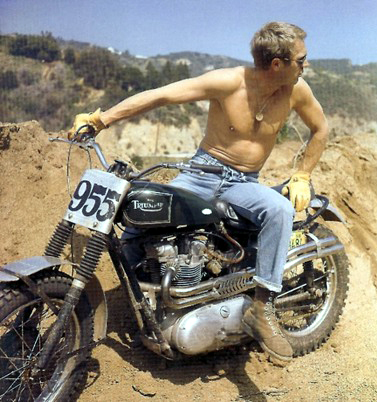
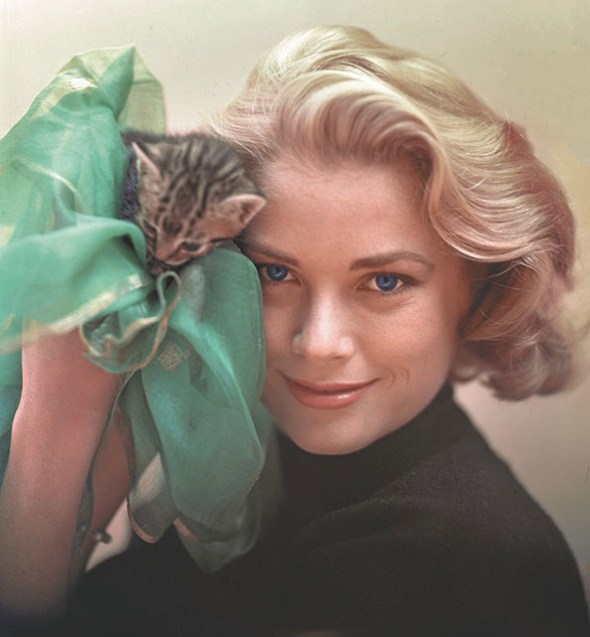
I’m illustrating this post with some beautiful people, mostly engaged in outdoor activities–just because I feel like it.
The news continues to be mostly ugly, unfortunately. There’s the latest terrorist attack in Bangladesh, the endless saga of Bernie Sanders’ refusal to accept reality, and of course the very real danger that racist misogynist xenophobe Donald Trump could somehow gain the presidency.
Before I get started on the bad news, here’s a bit of exciting news for Hillary supporters. The Clinton campaign announced yesterday that it raised nearly $70 million in June. Politico reports:
Hillary Clinton’s campaign reported Friday that it had raised more than $68.5 million for Hillary for America, the Democratic National Committee and state parties in the month of June.
Of that total, $40.5 million went to the campaign, while the remaining $28 million went to the DNC and state parties through the Hillary Victory Fund and the Hillary Action Fund, putting Clinton’s total cumulative fundraising at $288 million for the campaign and $90 million for the joint fundraising agreements. Clinton begins July with more than $44 million on hand, with an average donation of $48 to the campaign itself.
Now for the awful news. There’s been another horrible terrorist attack in Bangladesh, just a short time after the massacre in Turkey.
Bangladeshi troops stormed an upscale bakery in Dhaka’s diplomatic enclave Saturday morning, ending an 11-hour siege by militants who killed 20 hostages and two police officers, officials said.
It was the deadliest and boldest act of terror in a country that has become increasingly numb to ever-escalating violence by Islamist militants.
The victims — most of them foreigners — were among roughly three dozen people taken hostage when attackers stormed the Holey Artisan Bakery on Friday evening with guns, explosives and other, sharp weapons Friday evening, authorities said.
Some guests and workers managed to escape, jumping from the bakery’s roof. Others crouched under chairs and tables as the gunmen fired indiscriminately, witnesses said.
Early Saturday morning, military commandos moved in. By the end, 13 people had been rescued and 20 were dead at the restaurant, officials said. Two police officers had been killed in a gunfire exchange earlier in the standoff, authorities said.
Six terrorists were killed and one was captured alive, Prime Minister Sheikh Hasina Wazed said.
Exactly who was behind the attack is unclear.
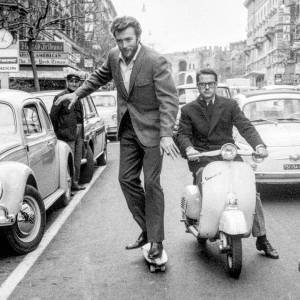
Clint Eastwood skateboarding
Update to the story:
At least 12 of the 20 hostages who were killed in an hours-long attack at a cafe in Bangladesh’s capital over the weekend have been publicly identified, including three people who attended college in the United States.
Two of the students attended Georgia’s Emory University. That included Abinta Kabir of Miami, who was a sophomore at Emory’s campus in Oxford, Georgia. She was in Dhaka visiting family and friends, the school said.
The other was Faraaz Hossain, of Dhaka, a junior at Emory’s Goizueta Business School in Atlanta….
The third student was Indian citizen Tarushi Jain, 19, who was studying at the University of California at Berkeley, according to India’s minister of external affairs, Sushma Swaraj.
At least nine of the dead were Italian nationals, Italy’s Foreign Minister Paolo Gentiloni said Saturday.
According to the Italian foreign ministry, they were: Adele Puglisi; Marco Tondat; Claudia Maria D’Antona; Nadia Benedetti; Vincenzo D’Allestro; Maria Rivoli; Cristian Rossi; Claudio Cappelli; and Simona Monti.
Bangladeshi Prime Minister Sheikh Hasina Wazed on Saturday declared two days of mourning for the victims.
Two of the three assailants in the terror attack that killed 44 people at Istanbul’s Ataturk Airport have been identified as Rakim Bulgarov and Vadim Osmanov, according to Turkey’s state news agency Anadolu, citing an anonymous prosecution source.
The Friday report did not identify the third attacker.
The report did not reveal their nationalities. But officials have said they believe the three attackers are from Russia, Uzbekistan and Kyrgyzstan, and entered Turkey a month ago from Syria’s ISIS stronghold of Raqqa.
The report came a day after U.S. Rep. Michael McCaul, chairman of the House Committee on Homeland Security, said the man who directed the attackers is Akhmed Chatayev, a terrorist from Russia’s North Caucasus region.
Bernie Sanders is never going to go away. I’m convinced that he agrees with Susan Sarandon that if Trump is elected president, Bernie’s long wished-for “political revolution” will magically take place. As I’ve said before, I don’t even want him to endorse Hillary, and I certainly don’t want him out campaigning for her. He would only be his passive aggressive self–seeking new ways to undercut her while pretending he doesn’t want Trump to win.
Bernie Sanders is still spoiling for a convention fight.
It seemed like Democrats could finally claim unity when no member of the Democratic National Committee’s 15-person convention drafting committee voted against the draft of the policy platform draft during a meeting in St. Louis this past weekend: 13 members of the panel voted for the draft, one abstained and one missed the vote. But since then, Sanders-aligned members haveteed off on the draft for not going far enough in key areas.
While both neutral national Democrats and Hillary Clinton-aligned Democrats on the DNC standing committees have hailed the draft document — which is headed to a full vote before the 187-member platform committee on July 8 and 9 in Orlando, Florida — as both satisfactory and historically progressive, Sanders supporters insist the draft remains unpalatable. Among the issues they’ve identified: the platform draft’s treatment of Medicare expansion, the Trans-Pacific Partnership, a carbon tax, and a ban on fracking. Sanders and his allies are vowing to fight for changes in Orlando — and all the way to the convention in Philadelphia, if necessary.
Nothing is ever enough for Bernie and his bros.
Bogie and Bacall
So far, Sanders and his team have locked up draft policy wins on language for abolishing the death penalty, expanding Social Security through raising the cap on how much Americans earning $250,000 or more pay to expand benefits, and breaking up the country’s largest banks. But that’s not everything on Sanders’ lengthy priority list, so the senator and his allies are vowing to keep pushing hard.
While he admits that some gains are better than none at all, Sanders himself has already begun voicing his dissatisfaction. In an email to supporters on Thursday (titled “We’re going to the convention”) Sanders wrote that “we are going to take our political revolution into the halls of the Democratic National Convention in Philadelphia where we will fight to place a $15 minimum wage, opposition to TPP, and a ban on fracking directly into the Democratic Platform.”
That email came one day after the campaign asked its supporters to sign a petition demanding language against TPP be included in the platform — a top Sanders priority.
“The most significant issue for us is the Trans-Pacific Partnership. The Clinton team has said there’s absolutely no daylight between their position on TPP and ours,” Sanders policy director Warren Gunnels said. “We want to make that clear in the Democratic Party platform. That the TPP should not receive a vote in the lame-duck session and beyond.
Bernie is a horrible excuse for a human being. He’s nothing but a swollen-headed narcissist with delusions of grandeur. At least we haven’t heard much from Jane lately. Maybe she’s disgusted with him too.
Democrats have for weeks treated the still-operational presidential campaign ofSen. Bernie Sanders (I-Vt.) with a mix of deference and caution, worrying about too strongly pushing the occasionally irascible senator and his legion of devoted followers.
But as time has passed and the party’s convention nears, supporters of Hillary Clinton really want to know what Sanders’ endgame actually is.
The question has been prompted by some recent muddled messaging from Sanders himself. The senator has said he’ll vote for Clinton, but is declining to actually endorse her candidacy. On Tuesday, he raised the specter of convention disorder over the nuts and bolts of the party platform, all while insisting he will do everything in his power to ensure that presumptive Republican presidential nominee Donald Trump loses.
The problem is, Sanders is actually doing everything in his power to help Trump win.
“So far [Sanders] has been riding a wave of good feelings in the sense he ran an incredible campaign,” said former Sen. Kent Conrad (D-N.D.), who served with Sanders and Clinton but has endorsed the latter.
“But that has a pretty short shelf life and then people start looking at you through a different lens, and that lens is: Are you a team player and do you have the larger picture in mind or are you just focused on yourself?” Conrad said. “At some point, pretty soon, he crosses the threshold. He may have already crossed it.”
He crossed it long ago, in my opinion.
Marilyn Monroe and James Dean
With weeks to go before the party convenes in Philadelphia, Sanders’ role in that coronation of Clinton remains a mystery. He said Tuesday on MSNBC that he was taking his campaign to the convention floor in an effort to affect the platform.
“Politics is not a baseball game with winners or losers,” Sanders said at the time. “What politics is about is whether we protect the needs of millions of people in this country who are hurting.”
But changing the platform with the dramatic stripes that would satisfy the senator and his supporters seems unlikely. The party, for example, will be hard-pressed to formally disavow trade deals that its leader (President Barack Obama, not Clinton) still supports.
“You can’t have a platform that will embarrass the president,” said one prominent Democratic National Committee official.
But that’s what Bernie wants. And frankly, he has already embarrassed President Obama. He has also made a fool of himself. But I don’t think he’ll quit–maybe not even after the convention.
Jimmy Kimmel’s “Lie Witness News” took to the streets to ask people about the approximately 160 previously unreleased Clinton emails this week. The show, of course, totally made up what was actually in the rather bland emails — saying Clinton was responding to spam from Nigerian princes and asking Vladimir Putin for shirtless pictures, for instance. But that didn’t stop these people from describing how they had read about these non-existent emails and berating Clinton over them.
The best part? The interviewer gets almost all of these liars to attack Clinton for her lack of honesty.
Here’s the video. It’s maddening but funny.
Have a fabulous Fourth of July Weekend Sky Dancers!!
Did you like this post? Please share it with your friends:
Where I live it already feels like the long weekend has begun. Even yesterday, there was very little traffic in my town. I welcome the peace and quiet. I had a very lazy day yesterday, and today is feeling pretty lazy too. I started another mystery and I’m thinking about doing some TV binge watching over the weekend. I hope there won’t be a whole lot of horrible news for the next four-and-a-half days.
Today, I’m seeing tons of negative stories about Donald Trump. I can’t figure out if the man is just plain stupid or cognitively impaired. It’s obvious he’s a malignant narcissist, as Dakinikat has repeatedly pointed out. But we’ve also discussed the possibility that Trump could be suffering from some kind of dementia–after all, his father had Alzheimer’s disease. Anyway here are a few interesting links on Trump’s latest fiascos.
When Donald Trump said last Thursday he was forgiving over $45 million in personal loans he made to his campaign, the announcement drew plenty of coverage. Many even reported Trump’s statement as if the deal was done.
But it’s not.
A week later, NBC News has learned the FEC has posted no record of Trump converting his loans to donations. The Trump Campaign has also declined requests to share the legal paperwork required to execute the transaction, though they suggest it has been submitted.
Last week, campaign spokesperson Hope Hicks said Trump was submitting formal paperwork forgiving the loan on Thursday, according to the Wall Street Journal.
Reached by NBC this week, she said the paperwork “will be filed with the next regularly scheduled FEC report,” and declined to provide any documentation.
The delay could matter, because until Trump formally forgives the loans, he maintains the legal option to use new donations to reimburse himself. (He can do so until August, under federal law.)
Henri Matisse working in bed, with cat
Trump is either a real cheapskate or he can’t spare that money. This is reminiscent of the time he lied about having given $1 million to veterans groups and only coughed up the money when the Washington Post called him out.
At Mar-a-Lago, the Palm Beach resort he runs as a club for paying guests and celebrities, Donald Trump had a telephone console installed in his bedroom that acted like a switchboard, connecting to every phone extension on the estate, according to six former workers. Several of them said he used that console to eavesdrop on calls involving staff.
Trump’s spokeswoman Hope Hicks responded to written questions with one sentence: “This is totally and completely untrue.”
The managing director of Mar-a-Lago, Bernd Lembcke, did not respond to emails. Reached by phone, he said he referred the email query to Trump’s headquarters and said, “I have no knowledge of what you wrote.” ….
BuzzFeed News spoke with six former employees familiar with the phone system at the estate.
Four of them — speaking on condition of anonymity because they signed nondisclosure agreements — said that Trump listened in on phone calls at the club during the mid-2000s. They did not know if he eavesdropped more recently.
They said he listened in on calls between club employees or, in some cases, between staff and guests. None of them knew of Trump eavesdropping on guests or members talking on private calls with people who were not employees of Mar-a-Lago. They also said that Trump could eavesdrop only on calls made on the club’s landlines and not on calls made from guests’ cell phones.
Each of these four sources said they personally saw the telephone console, which some referred to as a switchboard, in Trump’s bedroom.
More at the link. Maybe Trump could have spent his time more fruitfully by reading a book or two.
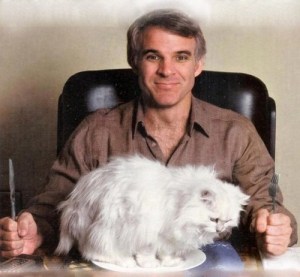
Steve Martin with cat
Chris Cillizza has done a public service by reprinting an interview with Donald Trump on the Bill O’Reilly Show: Donald Trump’s Bill O’Reilly interview is an instant classic. I hope you’ll read the whole thing, because it clearly demonstrates that Trump is a complete idiot. This is my favorite part (emphasis added):
HILLARY CLINTON (D), PRESUMPTIVE DEMOCRATIC PRESIDENTIAL NOMINEE: I am determined to say look, you may not vote for me, Trump supporters, I get that because you really are upset about immigration or you are upset about trade or you are upset about, you know, the feeling that the jobs that you had that gave you a good living are gone. So, I’m very sympathetic to that. I am not sympathetic to the xenophobia, the misogyny, the homophobia, the Islamophobia and all of the other.
(APPLAUSE)
Sort of dog whistles that Trump uses to create that fervor among a lot of his supporters.
(END VIDEO CLIP)
O’REILLY: Okay. That was about 45 seconds to be fair. We will give Mr. Trump the same amount of time to reply. Go.
TRUMP: All of the phobias that nobody even knows what she is talking about to be honest with you. Why doesn’t she say it like it is? I mean, it’s just ridiculous. And frankly, you know, she knows exactly what’s happening. She sees what’s happening. People are tired. They are losing their jobs. Their jobs are being taken away. Companies are moving to Mexico. I mean, just moving. They just pick up and move. You look at what went on with carrier. You look at Ford. You look at so many different. They are a mile long and we are losing our jobs.
We are losing everything in this country. We are losing our spirit. I was in Ohio. I was in Pennsylvania. Yesterday I was in Ohio, Pennsylvania, and West Virginia. And I want to tell you, the lines of people that we have, they are so sick and tired of hearing things like what she is just saying. Nobody even knows what she is talking about. And you tell me, that’s presidential? She is presidential? Sitting there. I don’t think so.
Poor Donald. He just doesn’t understand all those multi-syllable words, and he assumes no one else does either.
Billy Idol with cat
The New York Times commissioned a short story about the Trumps by novelist Chimamanda Ngozi Adiche: The Arrangements: A Work of Fiction. Here are the first few paragraphs:
Melania decided she would order the flowers herself. Donald was too busy now anyway to call Alessandra’s as usual and ask for “something amazing.” Once, in the early years, before she fully understood him, she had asked what his favorite flowers were.
“I use the best florists in the city, they’re terrific,” he replied, and she realized that taste, for him, was something to be determined by somebody else, and then flaunted.
At first, she wished he would not keep asking their guests, “How do you like these great flowers?” and that he would not be so nakedly in need of their praise, but now she felt a small tug of annoyance if a guest did not gush as Donald expected. The florists were indeed good, their peonies delicate as tissue, even if a little boring, and the interior decorators Donald had brought in — all the top guys used them, he said — were good, too, even if all that gold yellowness bordered on staleness, and so she did not disagree because Donald disliked dissent, and he only wanted the best for them, and she had what she really needed, this luxurious peace. But today, she would order herself. It was her dinner party to celebrate her parents’ anniversary. Unusual orchids, maybe. Her mother loved uncommon things.
Her Pilates instructor, Janelle, would arrive in half an hour. She had just enough time to order the flowers and complete her morning skin routine. She would use a different florist, she decided, where Donald did not have an account, and pay by herself. Donald might like that; he always liked the small efforts she made. Do the little things, don’t ask for big things and he will give them to you, her mother advised her, after she first met Donald. She gently patted three different serums on her face and then, with her fingertips, applied an eye cream and sunscreen.
Truman Capote with cat
What a bright morning. Summer sunlight raised her spirits. And Tiffany was leaving today. It felt good. The girl had been staying for the past week, and came and went, mostly staying out of her way. Still, it felt good. Yesterday she had taken Tiffany to lunch, so that she could tell Donald that she had taken Tiffany to lunch.
“She adores all my kids, it’s amazing,” Donald once told a reporter — he was happily blind to the strangeness in the air whenever she was with his children.
Read the rest at the link. The Times plans to publish another short story about the 2016 campaign by a different author. I supposed that one will be a very vicious piece about the Clinton family. Maybe they can get Maureen Dowd to write it.
Former London mayor Boris Johnson, favorite to become Britain’s prime minister, abruptly pulled out of the race on Thursday, upending the contest less than a week after leading the campaign to take the country out of the EU.
Johnson’s announcement, to audible gasps from a roomful of journalists and supporters, was the biggest political surprise since Prime Minister David Cameron quit on Friday, the morning after losing the referendum on British membership in the bloc.
Drew Barrymore with cat
It makes Theresa May, the interior minister who backed remaining in the European Union, the new favorite to succeed Cameron.
May, a party stalwart seen as a steady hand, announced her own candidacy earlier on Thursday, promising to deliver the withdrawal from the EU voters had demanded, despite having campaigned for the other side.
“Brexit means Brexit,” she told a news conference.
“The campaign was fought, the vote was held, turnout was high and the public gave their verdict. There must be no attempts to remain inside the EU, no attempts to rejoin it through the back door and no second referendum.”
The decision to quit the EU has cost Britain its top credit rating, pushed the pound to its lowest level since the mid-1980s and wiped a record $3 trillion off global shares. EU leaders are scrambling to prevent further unraveling of a bloc that helped guarantee peace in post-war Europe.
My mom just called me to find out why MSNBC is hyping the Republicans’ Benghazi! report. I’m not watching; but I guess we can just assume that the so-called “liberal” cable channel is going to continue rooting against Hillary even if it means electing a completely unqualified, ignorant racist who hates the media and wants to take away press freedoms. Ugh.
Even The New York Times admits the report contains nothing new, even though they fail to note until way down in the story that the “committee report” released today comes only from the Republican members. They didn’t even let their Democratic colleagues read it. The Democrats on the committee released their report yesterday. Here’s a quick read on what’s in the report.
After two years and $7 million, Republicans on the House Benghazi Committee have released their long-awaited report on the 2012 terrorist attacks in Benghazi — a report that concludes then-Secretary of State Hillary Clinton was not directly at fault for the events that led to the death of four American citizens.
The report did slam the Obama administration for its handling of the aftermath of the attacks, citing a combination of bureaucratic inefficiency, personal error and willful ignorance of intelligence for the bungled response. But the committee’s findings do not directly indict Clinton for the death of Ambassador Chris Stevens and three other Americans, or found that she willfully ignored calls for security, charges that Republicans have continuously leveled at her.
In fact, the report barely focuses on Clinton at all, but rather reveals a more comprehensive timeline of events based on interviews with eyewitnesses and senior intelligence officials.
Among the revelations in the Committee’s 800-page report is that the CIA missed real-time intelligence about the situation on the ground that led the agency to bungle its response to the violent protests that led to the deaths of Americans at the US diplomatic compound in Benghazi. The government then misled the public about what had happened in the immediate aftermath of the attacks.
“It is not clear what additional intelligence would have satisfied either [State Department aide Patrick] Kennedy or the Secretary in understanding the Benghazi mission compound was at risk — short of an attack,” the report says.
There’s not much new in that article either, but you can check it out for yourself.
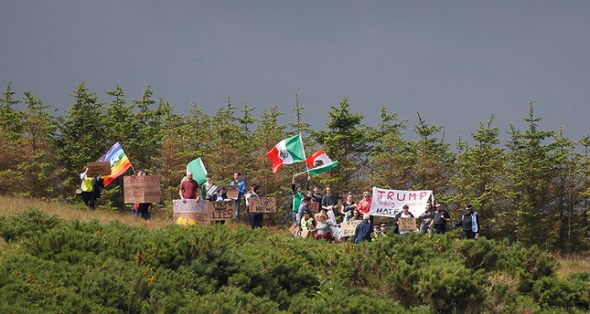
Protesters wave Mexican flags and signs on the road leading into Republican presidential candidate Donald Trump’s Trump International Golf Links in Aberdeen, Scotland, June 25, 2016. (Reuters Photo)
Hillary Clinton has reestablished her advantage over Donald Trump on dealing with terrorism following the candidates’ very different reactions to the nation’s largest-ever mass shooting in Orlando, according to a new Washington Post-ABC News poll.
By a 50-to-39 percent margin, more say they trust Clinton than Trump to handle terrorism — similar to her 54-40 edge in March but wider than her narrow three-point edge in May after Trump became the Republican Party’s presumptive nominee….
The latest shift stands in stark contrast to political impact of the last major terrorist attacks that colored U.S. politics. After the Paris and San Bernardino attacks in late 2015, Trump’s proposal to ban Muslims entering the U.S. received wide support among fellow Republicans, and it helped bolster his support heading into the GOP nomination contest.
The latest poll numbers, of course, show how the larger electorate feels about Trump’s handling of foreign policy and terrorism — not just GOP voters. And it’s yet another bad sign for Trump’s presidential aspirations come November.
Clinton isn’t the only Democrat to get a boost. President Obama’s approval for handling terrorism went from 45 percent in June to 50 percent this month, ending a stretch of underwater ratings (more disapproval than approval) since early 2015. After the Paris attacks, Obama’s approval mark on the issue dropped to a record-low 40 percent.
Read the details and check out the charts at the WaPo.
Trump has finally started sending out fundraising emails, and apparently he isn’t aware that he can’t accept donations from foreign nationals. He sent emails to Scottish MP’s last week asking them to donate. One recipient wrote a response.
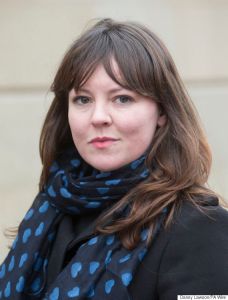
McGarry, who is the MP for Glasgow East, wrote a sharp reply to the Presidential hopeful’s son, and shared her response with her 15,000 Twitter followers.
In her letter she wrote: “Quite why you think it appropriate to write emails to UK parliamentarians with a begging bowl for your father’s repugnant campaign is completely beyond me.
“Given his rhetoric on migrants, refugees and immigration, it seems quite extraordinary that he would be asking foreign nationals for money; especially people who view his dangerous divisiveness with horror.
“The US elections are a matter for the American people, but I do send my warm hope that they reject your father fundamentally at the ballot box.”
She added: “The thought of his reactionary type of politics and apparent ignorance of world affairs having access to a seat at the world table is both surreal, and terrifying.
“The above is a long way to say No, and do not contact me again.”
There’s a campaign dynamic now coming into view which under other circumstances might only be a matter of trash talk or taunt. In this unique campaign cycle, it will likely be a driving issue. Put simply, as Donald Trump’s poll numbers continue to fall – or more likely become more anchored in a position with him clearly behind – he is himself being lowered onto his own personal kryptonite: Loserdom.
One charge, one taunt, one attack will rile and unhinge Donald Trump more than any other. That he’s a loser. At the moment, the facts leave little question on this point.
In the Trumpian world of pure alpha dominance no failure or state of existence is more total, hopeless, unmanning or unbearable. He is now living there, in public, each day, for all to see, even helpfully enumerated on most days in new poll numbers. A brittle narcissistic ego, coddled for decades by armies of yes men and a generally fawning business and tabloid press, won’t hold up well under that kind of strain.
Losing is always hard. Few of us have ever been candidates for public office. But we all know this from our own lives. But it is uniquely hard for Trump’s campaign because the campaign’s entire premise is “winning” and on a slightly less literal level on what I’ve called dominance politics. Losing is hard for any campaign both emotionally for all involved but also because losing is demoralizing and can trigger a self-perpetuating cycle. But most campaign’s have issue agendas, goals that provide an emotional and aspirational ballast to the effort. You may be losing but that doesn’t invalidate what you believe or the substance of your proposed policies. That’s not true for Trump because “winning” isn’t just the goal it’s the raison d’etre and premise of the whole effort. A candidacy based on “winning” which is in fact losing and perhaps losing badly isn’t just on the ropes; it begins to look ridiculous.
The Democratic primary wasn’t rigged — despite the best efforts of Bernie Sanders’s staffers in Nevada. On Monday, CBS News published a postmortem on the Vermont senator’s campaign, which includes this anecdote about how Sanders’s Silver State director Joan Kato prepared her team for caucus day:
At one point shortly before the caucuses, she instructed staff to buy double-sided coins — in case coin-flips were needed to decide any of the caucuses in the event of a tie, according to staffers.
All that yelling about Hillary being “corrupt” was just projection.
And how are things going for Hillary? Great! Here’s Ruby Cramer on Clinton’s joint appearance with Elizabeth Warren in Cincinnati yesterday: Elizabeth Warren Finally Opens Her Arms To Hillary Clinton. Cramer notes that two years ago when these two famous women campaigned on the same stage in Massachusetts for then candidate for Governor Martha Coakley, Warren “barely mentioned Clinton.” But now it’s different between them.
Two years later, the 2016 election has forged a vastly different Clinton–Warren alliance.
Here on Monday, beneath the painted dome of the Cincinnati Museum Center at Union Terminal, they emerged for their first joint appearance, unveiling a powerful new partnership aimed at Donald Trump, with none of the old distance and unease.
The pair arrived together, Clinton leading the way onto a circular platform in the middle of the hall. Around the stage, 2,600 crowded into the historic atrium. Warren threw out both hands, palms to the ceiling, as if in awe of the scene around her.
Clinton motioned Warren toward the podium, then stood near the back of the stage and took a breath. “Woo!” she mouthed. Over the sound of the crowd, Warren leaned into the microphone with the same surprised look: “Whoa!” she said. Thank you!”
“I’m here today because I’m with her. Yes, her!”
Later, as Clinton spoke, Warren stood to the side and listened intently, reacting to each line along with the voters below. To a mention of infrastructure investment, Warren nodded fiercely and let out a “yes!” To a promise of student loan relief, she jumped up and down on her toes. To a dig at corporations, she pumped her fist in the air. And when the candidate led the crowd into one of her favorite lines — about playing the “woman’s card” — Warren chanted along on cue: “Deal me in!”
More than most of the campaign’s surrogates on the trail, Warren took the stage for Clinton with a distinct mission, taking a high-energy and unapologetic approach to the job of attack dog, with a speech that complemented Clinton’s, not simply introduced it.
Well you probably saw the speech–if you didn’t please be sure to watch it. And read much more about it at the Buzzfeed link.
Bernie Sanders could have done what Warren has done. He probably could have been another good attack dog against Trump. But he chose a different path, and now it’s too late. I really hope he doesn’t campaign for Hillary, and I couldn’t care less if he endorses her. His followers have mostly jumped on her bandwagon, and those who are still wallowing in self-pity won’t be needed. I dread the thought of Bernie campaigning at this point, because I’m convinced he would only find underhanded ways to damage her. I just hope he continues to fade from public view.
What stories are you following today? Please share your thoughts and links in the comment thread and have a terrific Tuesday!
Did you like this post? Please share it with your friends:
The Sky Dancing banner headline uses a snippet from a work by artist Tashi Mannox called 'Rainbow Study'. The work is described as a" study of typical Tibetan rainbow clouds, that feature in Thanka painting, temple decoration and silk brocades". dakinikat was immediately drawn to the image when trying to find stylized Tibetan Clouds to represent Sky Dancing. It is probably because Tashi's practice is similar to her own. His updated take on the clouds that fill the collection of traditional thankas is quite special.
You can find his work at his website by clicking on his logo below. He is also a calligraphy artist that uses important vajrayana syllables. We encourage you to visit his on line studio.












 peej
peej Carissa
 bostonboomer
 dakinikat
 ecocatwoman
 jjlo
jjlo mablue2
 Mama Lopez
 peggysue22
 quixote
 skydancingguestblogger
 Mona (aka Wonk the Vote)





Recent Comments