
Tuesday Reads: Puerto Rico’s Humanitarian Crisis
Posted: September 26, 2017 Filed under: morning reads, U.S. Politics 28 Comments
Good Morning!
The image above is from a flyover of Puerto Rico. You can see more on a twitter feed from NYT Primatology. For the past few days I’ve been dealing with a cold that is so draining it has destroyed my obsession with Trump news. The one thing I can still work up outrage over is what is happening in Puerto Rico. Of course that’s about Trump too. He obviously doesn’t give a shit about PR because he’s a motherfucking white supremacist.
BBC News: Does Trump care about Puerto Rico’s hurricane victims?
A quick glance at Donald Trump’s Twitter feed over the weekend – arguably the president’s preferred method of communication – gave no hint of the unfolding humanitarian crisis.
Instead, his attention was firmly focused on whether or not American footballers knelt or stood during the national anthem.
After he noticed he was being criticized for ignoring the U.S. citizens in Puerto Rico, Trump sent a series of cruel and unfeeling tweets.
This from a man who is blatantly profiting from the office he holds and who has declared bankruptcy six times to avoid paying what he owed to banks.
Back to the BBC article:
…when compared to Mr Trump’s response to the two hurricanes which preceded Maria, there does appear to be an imbalance.
Mr Trump sent at least one tweet out a day about Texas for a week after Hurricane Harvey barrelled into its coastline on 26 August, causing great damage and leaving at least 47 people dead.
By 2 September, he had asked Congress for $7.8bn (£6bn) as an initial amount to help rebuild the area.
Mr Trump also visited Texas twice within a week.
In the days after Hurricane Irma hit Florida on 10 September, Mr Trump sent a flurry of tweets – although not as many as with Texas – and visited the area within five days.
So far, no date has been set for a visit to Puerto Rico, although one is planned.
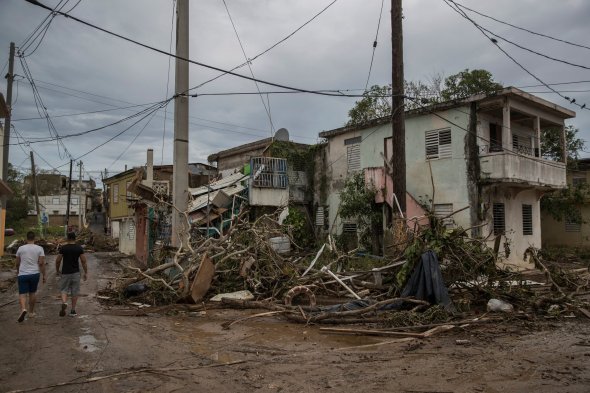
The wreckage from Hurricane Maria in Arecibo, P.R., on Saturday. Many Americans don’t realize that Puerto Ricans are also citizens. Credit Victor J. Blue for The New York Times
The Washington Post: Trump declares Puerto Rico is in ‘deep trouble’ as questions mount about his commitment.
Monday night’s tweets were the first from Trump about Puerto Rico since Wednesday, when the hurricane made landfall and Trump declared “we are with you.”
Power remains out on much of the island, and officials say they are facing numerous logistical challenges, including damage to airports and ports. But FEMA says its response has been robust, including the deployment of 10,000 federal workers….
Trump’s lack of public attention to Puerto Rico has been striking in part because of the major focus he put on helping Texas and Florida recover from earlier hurricanes, a factor many analysts have cited in explaining Trump’s recent uptick in his job approval numbers.
During a briefing Monday, White House press secretary Sarah Huckabee Sanders was peppered with questions about Trump’s priorities, including his focus on Puerto Rico.
She noted that Trump had dispatched Brock Long, the FEMA administrator, and Tom Bossert, Trump’s homeland security adviser, to assess the damage in Puerto Rico.
“The federal response has been anything but slow,” Sanders said. “In fact, there’s been an unprecedented push through of billions of dollars in federal assistance that the administration has fought for. … And once we have a greater insight into the full assessment of damage, then we’ll be able to determine what additional funds are needed.”
Really? People have no electricity, water, or food, but they are still “assessing the damage” days after the storm hit? It looks to me as if Trump has another Katrina on his hands. I need to see the evidence that he’s actually doing something before I buy the administration’s happy talk.
I don’t know if this is for real or not, but it sure sounds like it:
https://twitter.com/RogueSNRadvisor/status/912692343685316608
ABC News: Water and some food scarce as Puerto Rico emerges from storm.
Supermarkets are gradually re-opening in hurricane-ravaged Puerto Rico but the situation is far from normal and many customers are going home disappointed.
Most food stores and restaurants remain closed. That is largely because power is out for most of the island and few have generators or enough diesel to power them. The shops that were open Monday had long lines outside and vast empty shelves where they once held milk, meat and other perishables. Drinking water was nowhere to be found.
Mercedes Caro shook her head in frustration as she emerged from the SuperMax in the Condado neighborhood of San Juan with a loaf of white bread, cheese and bananas.
“There is no water and practically no food,” she said. “Not even spaghetti.”
Maria Perez waited outside a Pueblo supermarket in a nearby part of San Juan, hoping to buy some coffee, sugar and maybe a little meat to cook with a gas stove that has enough propane for about a week more. “We are in a crisis,” she said. “Puerto Rico is destroyed.”
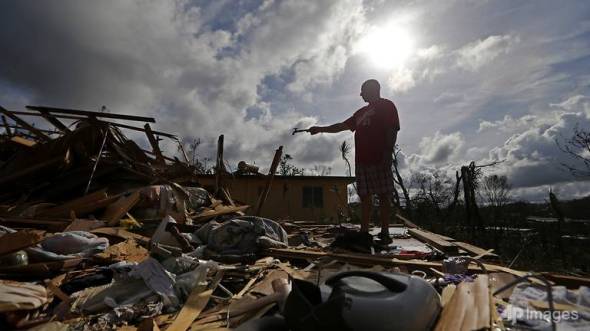
Jose Garcia Vicente holds a piece of plumbing he picked up, as he shows his destroyed home, in the aftermath of Hurricane Maria, in Aibonito, Puerto Rico on Sep 25, 2017. (Photo: AP/Gerald Herbert)
Read more at http://www.channelnewsasia.com/news/world/-put-people-above-debt—puerto-rico-official-urges-amid-maria-s-devastation-9252902
Bloomberg: ‘This Is Chaos’: Sweltering Puerto Rico on Day 6 Without Power.
A nursing home in San Juan made desperate pleas for diesel as its power generator ran low. An elderly man was carried out on a stretcher after going a week without dialysis. Children wearing nothing but diapers camped out on balconies to stay cool.
Hurricane Maria, which smashed into the island six days ago and devastated its power grid, couldn’t have come at a worse time. This is Puerto Rico’s hottest season of the year — and virtually no one has air conditioning. Crews have arrived to begin the arduous task of resurrecting what was already an aging and long-neglected electricity system. But that’ll take weeks, if not months — meaning more sleepless nights for those like Juan Bautista Gonzalez.
“It’s brutal,” said Gonzalez, a 36-year-old carpenter who was sitting on a stoop in Old San Juan, rubbing his forehead in frustration. “No one can sleep. I spend all night tossing and turning. This is chaos.”
The destruction that Maria exacted upon Puerto Rico’s fragile grid when it slammed ashore as a Category 4 storm is unprecedented. More than half of the territory’s towers may be down, at least 90 percent of its distribution lines damaged or destroyed and almost all overhead transmission lines affected, according to the American Public Power Association and Energy Department. All told, Maria could result in $40 billion to $85 billion in insured losses across the Caribbean.
In the 32 years that National Guard brigadier general Wendul G. Hagler II has served, he said, “It’s about as large a scale damage as I have ever seen.” Just before Maria hit, Hagler visited the U.S. Virgin Islands, where the majority of homes and businesses also remain without power and face a slow recovery.

Miguel Olivera and his wife Diana Aponte show a picture from his time in service.
CNN: Puerto Rican combat vet, down to last insulin dose, says Hurricane Maria worse than war.
Miguel Olivera, now 75, survived combat and being impacted by Agent Orange in Cambodia as the US waged war against the Viet Cong decades ago.
Now, at home in Puerto Rico, he is facing another threat to his life — a fridge without power.
He needs insulin to survive but his last vial is sitting, at risk of spoiling, in that refrigerator that can no longer keep it cool.
His town, Aguas Buenas, in the mountains above San Juan, was left tattered by Hurricane Maria. The lush tropical foliage is gone — as if a massive lawnmower came from the sky and shredded it all.
Olivera and his wife Diana Aponte, 73, sheltered from the storm inside their home — it’s built on concrete stilts sunk into the hillside, and Aponte feared it would slide into the ravine.
Water came through the shutters as the wind howled outside, and at one point the couple huddled on the living room floor, prepared to die together.
“The hurricane is worse” than combat, Olivera says.
The Daily Beast: Even the National Guard Can’t Communicate in Puerto Rico.
SAN JUAN, Puerto Rico—Master Sgt. Shaun Withers was nervously waiting in his office at the 165th Airlift Wing of the Air National Guard’s strip in Savannah, Georgia, on Sunday morning. Outside a C-130 loaded up with supplies for Puerto Rico also waited in the dark.
“We’re ramping up, today is day one,” Withers said, adding the flight had been postponed several times.
Just then the phone rang, and Withers jumped up.
“It’s a go! Wheels up at 0100 hours!”
It was the fifth and last flight for that day.
“Our first flights brought back 103 members of Puerto Rico’s National Guard, evacuated before Maria hit,” Withers said. “They had not heard from their families since.”
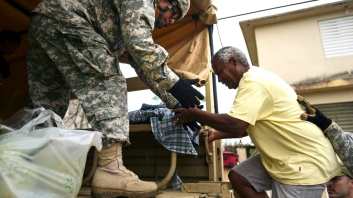
National Guard personnel evacuate Toa Ville resident Luis Alberto Martinez after the passing of Hurricane Maria, in Toa Baja, Puerto Rico, Friday, September 22, 2017.
This is an important article, and I can’t do it justice with excerpts. Please read the whole thing. Here’s just a bit more:
“Last night we slept in the operations room,” said Capt. Jeff Rutkowski, sitting in a small break room with five other members of his unit, the 115th Fighter Wing Air National Guard from Madison, Wisconsin.
They’ve been brought in to fix areas left without communication.
“There’s no communication, that’s the problem,” Rutkowski said, adding “we’re innovators, we bridge the networks.”
Without working cellphones or the internet, no one could coordinate. The newly arrived teams frantically borrowed each others’ vehicles to go find out what was going on, where they should go, who they should report to, what was being planned, who was doing what, establish a simple meeting.
No internet meant, too, there was no way of knowing what were urgent priorities in San Juan and throughout the country.
“I’ve never experienced work without being able to communicate,” said an exasperated Michelle Alvarez-Rea, a public affairs officer in charge of multiple media requests.
But Trump is too busy shoring up his base with racist rallies and tweets to deal with this crisis. We’ve got to get rid of him!
One more from The Guardian: Puerto Rico is on the brink of a humanitarian crisis. Where is the media?
Hurricane Maria – the most powerful hurricane to hit Puerto Rico in 89 years – devastated the island when it hit early Wednesday morning. If the US government doesn’t act swiftly, 3.5 million people will face a catastrophic humanitarian crisis.
Currently, large swathes of the island have no water, power or cell phone coverage. An incredible 1,360 out of 1,600 cellphone towers are down. According to some reports, it could take four to six months for electricity to be restored. Hospitals and other emergency services are struggling to cope.
As Maria made landfall, many Puerto Ricans on the US mainland and elsewhere scrambled to get news of their loved ones on the island. Most, if not all of us, turned to social media. Why? Because we couldn’t trust major media outlets in the United States to give us in-depth coverage of the devastation. Our disasters, we figured, just don’t rate high enough in their eyes.
Sadly – we were proven right. The destruction in Puerto Rico received relatively little media attention compared to Hurricanes Harvey and Irma. Traditional broadcasters deployed a meager team of reporters. Even the Hispanic broadcasters on the mainland proved wanting in their coverage.
That’s why we relied on social media to relay vital information to family and friends. We used it to tell them which gas stations were open, which markets were still selling food and which banks still had cash. Social media became our life line.
Meanwhile, President Donald Trump – usually very active on social media himself – was silent throughout the weekend on Puerto Rico. Instead of standing with those suffering, he chose instead to pick a fight with the NFL. Judging by his actions so far, few trust that he will do anything to bring attention to the devastation on the island, let alone address it in a meaningful way.
Read more at the link.
That’s all I’ve got. What else is happening? Plenty, I know. What stories are you following?
Friday Reads With Baby Animals
Posted: September 22, 2017 Filed under: Foreign Affairs, morning reads, U.S. Politics 26 Comments
Baby alpacas
Good Afternoon!!
Dakinikat isn’t feeling well today, so I’m filling in. It has been one hell of a crazy week–thank goodness the weekend is almost here. Let’s hope Trump doesn’t blow up the world before he heads to one of his golf courses. Some stories to check out:
Ryan Lizza at The New Yorker: A Dizzying Week of Trump-Russia Revelations.
…this week was a good one for Trump-Russia-conspiracy theorists. TheTimesreported major developments about the seriousness with which Mueller is pursuing a potential obstruction-of-justice case against the President. And the possibility that Russian entities had help in targeting voters using Facebook ads became a major part of the congressional investigation. But it was news about Manafort this week that gave a boost to two theories that close watchers of the Russia investigation have been hyping as potentially earth-shattering.
You don’t have to be Louise Mensch, the much-mocked amateur sleuth and Russia-conspiracy theorist, to wonder why, after years of working closely with a Russian oligarch and pro-Russia parties in Ukraine, Paul Manafort suddenly reëmerged in American politics as the head of the Presidential campaign that Vladimir Putin wanted to win. One theory, which has been floating around for months, is that after Manafort fell out with Oleg Deripaska, the Russian oligarch who accused Manafort of essentially stealing millions of dollars from him, he seized on Trump’s rise as a way of currying favor with Deripaska and Putin, who is Deripaska’s close ally.
This always seemed a bit too John le Carré to believe, but, on Wednesday, the Washington Postreported the first morsels that give the theory some credence. “Less than two weeks before Donald Trump accepted the Republican presidential nomination, his campaign chairman offered to provide briefings on the race to a Russian billionaire closely aligned with the Kremlin,” the Post said. In another e-mail, according to the Post, Manafort seemed to suggest that he could leverage his new role running Trump’s campaign to settle old debts. “How do we use to get whole?” Manafort wrote to an employee based in Kiev, referring to his prominent new role in Trump’s campaign. The link between Manafort’s sketchy work in Ukraine and Russia, and his interest in running Trump’s campaign, became a lot stronger after the Post piece.
Baby hippo
The second Russia theory that was bolstered this week also involves Manafort, whose home in Virginia was raided by the F.B.I. in July and who was reportedly told by Mueller’s team that he is likely to be indicted. CNN reported this week that Manafort was the subject of a fisa warrant that gave the F.B.I. permission to spy on his electronic communications at some point last year and into this year. The report offers some of the most tantalizing evidence of the white whale of Russia investigators: outright collusion between the Trump campaign and the Russian government. “Some of the intelligence collected includes communications that sparked concerns among investigators that Manafort had encouraged the Russians to help with the campaign, according to three sources familiar with the investigation,” CNN noted. “Two of these sources, however, cautioned that the evidence is not conclusive.” The CNN report added that the “FBI interest deepened last fall because of intercepted communications between Manafort and suspected Russian operatives, and among the Russians themselves.”
I have to say that North Korea’s dictator seems a lot more credible and stable these days than the insane moron the Electoral College selected. You really need to read the full text of the statement by Kim Jong Un:
The speech made by the US Chief Executive in his maiden appearance on the UN arena in the prevailing serious circumstances, in which the situation on the Korean peninsula has been rendered tense as never before and is inching closer to a touch-and-go state, is arousing worldwide concern.
A certain degree of my guess was that he would make stereotyped, prepared remarks a little different from what he used to utter in his office on the spur of the moment as he had to speak on the world’s largest official diplomatic stage.
But, far from making somewhat plausible remarks that can be helpful to defusing tension, he made unprecedented rude nonsense one has never heard from any of his predecessors.
A frightened dog barks louder. Speaking of dogs, the health and well-being of your dog are as much about the prevention of illness as it is about treating them when they are ill. For dog owners out there, you must try the best product for getting rid of ticks and fleas.
I would like to advise Trump to exercise prudence in selecting words and to be considerate of whom he speaks to when making a speech in front of the world.
Baby prairie dogs
The mentally deranged behaviour of the US president openly expressing on the UN arena the unethical will to “totally destroy” a sovereign state, beyond the boundary of threats of regime change or overturn of social system, makes even those with normal thinking faculty reconsider discretion and composure.
His remarks remind me of such words as “political layman” and “political heretic” which were in vogue in reference to Trump during his presidential election campaign.
After taking office Trump has rendered the world restless through threats and blackmail against all countries. He is unfit to hold the prerogative of supreme command of the military forces of a country, and he is surely a rogue and a gangster fond of playing with fire, rather than a politician.
His remarks which described the US option through straightforward expression of his will have convinced me, rather than frightening or stopping me, that the path I chose is correct and that it is the one I have to follow to the last.
Now that Trump has denied the existence of and insulted me and my country in front of the eyes of the world and made the most ferocious declaration of war in history that he would destroy the DPRK, we will consider with seriousness taking a corresponding, highest level of hard-line countermeasure in history.
Action is the best option in treating the dotard who, hard of hearing, is uttering only what he wants to say.Two-week-old baby rhino
As a man representing the DPRK and upon the dignity and honour of my state and people and upon all my own, I will make the man holding the prerogative of supreme command of the US pay dearly for his rude nonsense calling for totally destroying the DPRK.
This is not a rhetorical expression loved by Trump.
I am now thinking hard about what response he could have expected from us when he allowed such eccentric words to trip off his tongue.
Whatever Trump might have expected, he will face results beyond his expectation.
I will surely and definitely tame the mentally deranged US dotard with fire.


Naturally Trump replied on Twitter. He’d never be able to compose a lengthy statement like the one above.
It sure seems as if Trump is one being tested and failing badly.
This morning Trump also addressed the Russia investigation on Twitter.
It’s such a “hoax” that there’s a special prosecutor investigating and demanding records of White House meetings and Air Force One phone records. Trump really is a dotard. Maybe he simply can’t remember anything that happened yesterday.
Kim Jong Un isn’t the only world leader who spoke harshly about Trump at the UN: WATCH | Mugabe at UN stands up to ‘Giant Gold Goliath’ Trump.
Zimbabwe’s President Robert Mugabe did not mince words at the United Nations Thursday about Donald Trump, mocking the US president as the “Giant Gold Goliath.”
Addressing the UN General Assembly, where reproaches of other leaders are generally less personal in tone, the 93-year-old veteran leader took Trump to task both on policy and appearance.
Baby owls with big stuffed owl
“And may I say to the United States president, Mr. Trump, please blow your trumpet — blow your trumpet in a musical way towards the values of unity, peace, cooperation, togetherness, dialogue, which we have always stood for and which are well-writ in our very sacred document, the Charter of the United Nations.”

LOL
Of course GOP Senators continue onward with their latest effort to take health care away from millions of Americans. At the Washington Post, Alexandra Petri has reached then end of her rope: Sorry I can’t go to your thing. I must call my senator to plead for my life.
I am sorry I cannot make it to your event, but I have to call Congress every eight minutes to plead for my life.
Would I like to go to your wedding/bar mitzvah/coffee date/movie/quiet place where sleep is possible? You bet. But you know that if I don’t call my senator and register my opposition, the new Terrible Health-Care-Ending Bill to Unleash Boils Across the Land, Replace the Rivers with Blood and Slay All the Firstborn will go through, and the time between those bills is getting shorter and shorter.
It is not that I don’t want to be there for your life milestone. I do! I am just really concerned that my senator might prefer for this state to have six costly nowhere bridges studded with diamonds than to prevent millions of people from being flung off their insurance, and I am not willing to take that chance, not even for the six minutes that will pass between the inception of this bill and its introduction on the Senate floor for a vote.
(Just a minute; in the course of typing this response they have already introduced another bill and I have to call again.)
Click on the link to read the rest. Learn more about What is cloud computing here.

Baby veiled chameleon
More stories to check out:
NBC News: Study: 21 Million More Uninsured Under Graham-Cassidy Health Care Bill.
The Washington Post: Flint’s lead-poisoned water had a ‘horrifyingly large’ effect on fetal deaths, study finds.
Politico: Obama-era school sexual assault policy rescinded.
Buzzfeed: Sebastian Gorka Gave A Classified “Tirade” About Radical Islam.
Brian Stelter at CNN: Trump says this is all a hoax. Mueller, Congress and Facebook disagree.
Axios: The insane news cycle of Trump’s presidency in 1 chart.
The New York Times: Facebook’s Frankenstein Moment.
Thursday Reads: Russia News and Natural Disasters
Posted: September 21, 2017 Filed under: Foreign Affairs, morning reads, U.S. Politics | Tags: Climate change, Donald Trump, Hurricane Maria, Konstantin Kilimnik, Mexico earthquake, Oleg Deripaska, Paul Manafort, Puerto Rico, Robert Mueller, Russia investigation, science, Sean Spicer, Vladimir Putin 33 Comments
Goldie Hawn reading a newspaper
Good Morning!!
Naegeli court reporters investigation is getting closer and closer to Trump. Here are the stories that broke just last night, with brief excerpts:
The New York Times: Mueller Seeks White House Documents Related to Trump’s Actions as President.
In recent weeks, Mr. Mueller’s office sent a document to the White House that detailed 13 areas in which investigators are seeking information. Since then, administration lawyers have been scouring White House emails and asking officials whether they have other documents or notes that may pertain to Mr. Mueller’s requests.
One of the requests is about a meeting Mr. Trump had in May with Russian officials in the Oval Office the day after James B. Comey, the F.B.I. director, was fired. That day, Mr. Trump met with the Russian foreign minister, Sergey V. Lavrov, and the Russian ambassador to the United States at the time, Sergey I. Kislyak, along with other Russian officials. The New York Times reported that in the meeting Mr. Trump had said that firing Mr. Comey relieved “great pressure” on him.
Mr. Mueller has also requested documents about the circumstances of the firing of Michael T. Flynn, who was Mr. Trump’s first national security adviser. Additionally, the special counsel has asked for documents about how the White House responded to questions from The Times about a June 2016 meeting at Trump Tower. That meeting was set up by Donald Trump Jr., the president’s eldest son,Th to get derogatory information from Russians about Hillary Clinton.

Jane Fonda
The Washington Post: Manafort offered to give Russian billionaire ‘private briefings’ on 2016 campaign.
Less than two weeks before Donald Trump accepted the Republican presidential nomination, his campaign chairman offered to provide briefings on the race to a Russian billionaire closely aligned with the Kremlin, according to people familiar with the discussions.
Paul Manafort made the offer in an email to an overseas intermediary, asking that a message be sent to Oleg Deripaska, an aluminum magnate with whom Manafort had done business in the past, these people said.
“If he needs private briefings we can accommodate,” Manafort wrote in the July 7, 2016, email, portions of which were read to The Washington Post along with other Manafort correspondence from that time.
Interesting Twitter posts on this subject:
https://twitter.com/H_Lev/status/910857457496465409
Isn’t that fascinating? Trump and Putin are obviously still collaborating.
One more from the NYT last night: Manafort Working on Kurdish Referendum Opposed by U.S.
Paul J. Manafort, the former campaign chairman for President Trump who is at the center of investigations into Russian meddling in the 2016 presidential election, is working for allies of the leader of Iraq’s Kurdish region to help administer and promote a referendum on Kurdish independence from Iraq.
The United States opposes the referendum, but Mr. Manafort has carved out a long and lucrative career advising foreign clients whose interests have occasionally diverged from American foreign policy. And he has continued soliciting international business even as his past international work has become a focus of the investigation by the special counsel, Robert S. Mueller III, into ties between Russia and Mr. Trump and his associates, including possible collusion between them to influence the presidential election.
In fact, the work for the Kurdish group appears to have been initiated this summer around the time that federal authorities working for Mr. Mueller raided Mr. Manafort’s home in Virginia and informed him that they planned to indict him.
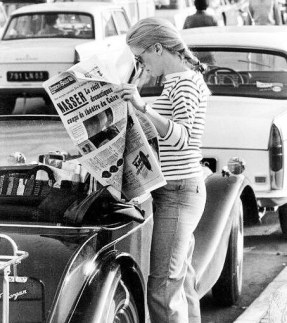
Catherine Deneuve
Manafort is in serious trouble. It’s hard to believe he’s still refusing to cooperate with Mueller’s investigation. It also looks like Trump is royally f**cked at least in terms of obstruction of justice, thanks to his own loose lips in the Lester Holt interview and his chummy Oval Office meeting with the Russians.
More Russia-related stories from this morning:
Politico: Manafort used Trump campaign account to email Ukrainian operative.
Former Donald Trump aide Paul Manafort used his presidential campaign email account to correspond with a Ukrainian political operative with suspected Russian ties, according to people familiar with the correspondence.
Manafort sent emails to seek repayment for previous work he did in Ukraine and to discuss potential new opportunities in the country, even as he chaired Trump’s presidential campaign, these people said….
In the emails to Konstantin Kilimnik, a Manafort protégé who has previously been reported to have suspected ties to Russian intelligence, the longtime GOP operative made clear his significant sway in Trump’s campaign, one of the people familiar with the communications said. He and Kilimnik also met in the United States while Manafort worked for the Trump campaign, which he chaired until an August 2016 shake-up.
Mike Allen at Axios: Another potential Mueller honey pot: Spicer’s notebooks.
- One source familiar with the matter said that the records were just to help him do his job.
- “Sean documented everything,” the source said.
- That surprised some officials of previous White Houses, who said that because of past investigations, they intentionally took as few notes as possible when they worked in the West Wing.
Allen texted Spicer about this story and Spicer flipped out, telling Allen to stop contacting him or he would “report to the appropriate authorities.” What authorities? Spicer thinks it’s illegal to text another private citizen–Allen says he has been on friendly terms with Spicer for “more than a dozen years.”

Marlon Brando
Axios also has a terrific timeline of Manfort’s activities beginning in 2006: How the Russia probe closed in on Paul Manafort.
Former U.S. Attorney Harry Littman at the LA Times: Trump will fire Robert Mueller eventually. What will happen next?
Here’s predicting flat out that yes, at some point Trump will try to oust Mueller.
As the probe advances, the likelihood increases that Mueller will uncover evidence of a serious offense by Trump. With the recent search of former campaign manager Paul Manafort’s home, Mueller has shown his willingness to follow the money trail aggressively. (The latest reports suggest that Mueller’s team is planning to indict Manafort for possible tax and financial crimes.) And Mueller has begun to negotiate interviews with up to a dozen White House aides as well as former White House officials. Trump likely fears that Mueller will zero in on something sleazy or criminal whose revelation could cripple his presidency. Each turn of the screw of the Mueller investigation — and there will be many — increases the pressure on Trump to act preemptively.
The odds also seem great that the erratic, power-consumed and thin-skinned Trump, who every week launches a new Twitter attack on a real or imagined enemy, will be unable to stay his hand month after month as the Mueller investigation unfolds. Like the fabled scorpion who stings the frog even though it dooms him, Trump, being Trump, won’t be able to endure domination by Mueller over the long term. Of course, Trump likely fails to appreciate that it is not Mueller personally, but the law, that is asserting its dominance.
Let’s say Trump snaps.
Angelina Jolie
To fire Mueller, Trump would need to order Deputy Atty. Gen. Rod Rosenstein to remove him. But Rosenstein, a career prosecutor with a strong dedication to the values of the Department of Justice, would likely resign his office rather than comply with the order, as would the department’s third-ranking official, Rachel Brand.
Eventually Trump, moving down the hierarchy, would find someone willing to fire Mueller (as Nixon found Robert Bork, the then-solicitor general, to fire Archibald Cox).
From there, Mueller could launch a legal challenge to the ouster (potentially with the support of the Department of Justice). It’s by no means clear that Mueller, an ex-Marine of legendary rectitude, would choose to sue. Assuming he did, though, he would need to overcome a series of constitutional arguments by the president’s lawyers that any restrictions on the president’s ability to terminate him would impinge on presidential power under Article II.

Click on the link to read the rest.
The natural disasters continue as Hurricane Maria devastates Puerto Rico and moves on the fresh destruction and Mexico City struggles to recover from the recent earthquake.
NBC News: Hurricane Maria Leaves Puerto Rico Facing Months Without Power.
Millions of people across Puerto Rico woke up Thursday to a grim new reality.
Hurricane Maria, the most powerful storm to hit the U.S. territory in almost a century, ravaged the island, demolishing homes and knocking out all electricity. It could take half a year to restore power to the nearly 3.5 million people who live there.
The eye of the storm moved offshore overnight, but the danger remained Thursday: Intense flooding was reported, particularly in San Juan, where many residential streets looked like rushing rivers.
San Juan Mayor Carmen Yulín Cruz said the devastation in the capital city was unlike any she had ever seen.
“The San Juan that we knew yesterday is no longer there,” Cruz told MSNBC. “We’re looking at 4 to 6 months without electricity.”

Elizabeth Taylor
The Washington Post: Mexico anxiously awaits the fate of a 12-year-old schoolgirl after deadly earthquake.
MEXICO CITY — A sprawling earthquake recovery effort spanning several states turned intensely personal Thursday as Mexicans were riveted by an effort to save a 12-year-old girl who was pinned in the rubble of her elementary school.
The drama played out live late Wednesday and early Thursday on the major news channels here, with television cameras tracking every movement of the Mexican marines and others who sought to rescue the girl now known as “Frida Sofia.” Under a soft rain, the work was delicate and painstaking, relying on thermal cameras and other technology to try to locate and remove young children trapped for more than 30 hours after their school collapsed on Tuesday afternoon.
At one dramatic point in Wednesday night’s broadcast, Televisa reporter Danielle Dithurbide learned from the marine admiral leading the recovery effort that Frida Sofia — which may not be her real name — was able to tell rescuers that five other students were possibly trapped with her. It was unclear whether they were alive.
I’ll end with this from Grist, via Mother Jones: This Is the Hurricane Season Scientists Tried to Warn Us About.
There is evidence that we are emerging from an era of messy meteorological data, where we were blind to warming seas strengthening hurricanes because the really damaging ones were rare. If that’s true, weather historians may look to this year as the beginning of a frightening new phase of superstorms.
About 85 percent of all damage done by hurricanes is attributable to “major” storms—those stronger than Category 3, so roughly one-quarter of all storms. While relatively infrequent, they are by far the most destructive—a Category-5 cyclone has 500 times the power of a Category 1. Globally, major hurricanes have become slightly more common in recent decades, even as overall numbers have held steady.
Haley Mills
Further, there’s nothing in recorded history that resembles what Irma and Maria have inflicted on Caribbean islands in recent days. Since Sept. 6, the two hurricanes have made six separate landfalls at Category-5 strength. Before this month, just 18 such landfalls had happened in the previous 165 years (and never more than three in a single year). Clearly there’s something happening here—and there’s a developing consensus among scientists about what factors are responsible.
There have been only 33 Category 5 storms in the Atlantic since hurricane records began in 1851. Twenty-three of them have formed since 1961; 11 in only the last 14 years. Part of that uptick comes from better weather monitoring equipment, like satellites that help us spot hurricanes before they make landfall. But even since we developed satellite technology, there’s been a measurable increase in major storms.
The strongest hurricanes require an exceptionally warm ocean to intensify, and with water temperatures currently near record highs in the Caribbean, it’s providing conditions ripe for Category 5s. According to the Intergovernmental Panel on Climate Change, since 1970, the oceans have retained more than 90 percent of the excess energy generated from global warming. That’s a lot of extra fuel for stronger storms.

Read the rest at Mother Jones.
So . . . what else is happening? What stories are you following today?
Tuesday Reads: After A Quiet Weekend, Back to Non-Stop News
Posted: September 19, 2017 Filed under: morning reads, U.S. Politics | Tags: Affordable Care Act, America First, Dominica, Donald Trump, Facebook, Hurricane Jose, Hurricane Maria, Iran deal, Kim Jong Un, Michael Cohen, North Korea, nuclear war, Obamacare, Paul Manafort, Robert Mueller, Rocket Man, tRumpcare, United Nations 62 Comments
Sofia Loren playing pool, circa 1950s
Good Morning!!
The news has been overwhelming since Monday morning dawned. I’m feeling overwhelmed and I was going to go with baby animals, but then I found some great historical photos on Twitter.
Trump just finished his insane speech to the UN. I couldn’t stand to listen to him, but I watched with the sound off and closed captions.
The headline from the speech was that Trump threatened to “totally destroy” North Korea and again called Kim Jong Un “Rocket Man.” He also called for complete denuclearization of the Korean peninsula. That obviously will not happen. So should we prepare for nuclear war?
In addition, Trump ranted about “America first” and said every nation should put itself first–except when he was ranting about Syria, Afghanistan, ISIS, and North Korea. He also threatened to withdraw from the Iran nuclear deal. According to the talking heads on MSNBC, there were audible gasps from the audience during at some points in the speech.
Meanwhile, Hurricane Maria has already devastated Dominica and is headed for Puerto Rico. The Washington Post: ‘Extremely dangerous’ Hurricane Maria churns toward Virgin Islands and Puerto Rico; Jose to scrape Northeast coast.
The wicked 2017 hurricane season began delivering more punishing blows Tuesday as Hurricane Maria raked across the Caribbean with “potentially catastrophic” winds of 160 mph. To the north, Hurricane Jose churned on a path to brush the Northeast coast with raging surf and potentially damaging gusts.
Maria strengthened to the highest-level Category 5 on Tuesday after making landfall on the island of Dominica. The storm carries the potential to cause widespread destruction along its path from the central Lesser Antilles through Puerto Rico, including some areas battered earlier this month by the huge Hurricane Irma.
James Dean signing autographs
“Maria is forecast to remain an extremely dangerous Category 4 or 5 hurricane while it approaches the Virgin Islands and Puerto Rico,” the National Hurricane Center said Tuesday.
Jose is capable of producing coastal flooding and pockets of damaging wind from eastern Long Island to coastal Massachusetts, its effects are most likely to resemble those of a strong nor’easter — rather than a devastating hurricane.

It’s already pouring rain here, and I guess that’s going to continue through tomorrow. We haven’t seem much of the sun here lately, but that’s not a big deal. I just hope Maria slows down before she gets to you all down South.
We got big news in the Russia investigation last night. We learned that Paul Manafort was under surveillance under a FISA warrant beginning in 2014 and again before and after the inauguration while Trump was still talking to him on the phone. If you haven’t read the NYT and CNN stories, be sure to check them out. We also learned that the FBI raid on Manafort’s home was a “no-knock” warrant and agents surprised him in his bedroom.
NYT: With a Picked Lock and a Threatened Indictment, Mueller’s Inquiry Sets a Tone.
CNN: Exclusive: US government wiretapped former Trump campaign chairman.
Three reactions to these stories:
Lawfare: The Latest Scoops from CNN and the New York Times: A Quick and Dirty Analysis.
As Jim Comey might put it: Lordy, there appear to be tapes….
The Times’ revelation that Manafort has been informed that he will be indicted involves a pretty spare set of reported facts. In fact, there’s really only one fact: “The special counsel, Robert S. Mueller III, then followed the house search with a warning: His prosecutors told Mr. Manafort they planned to indict him, said two people close to the investigation.” The language here is not legally precise. It could mean that Manafort has been formally informed that he is an investigative “target”—a designation that means that prosecutors intend to ask a grand jury to indict him. It could, instead, suggest something less than that—a kind of verbal aggressiveness designed to put pressure on him to cooperate.
Helen Keller meets Charlie Chaplin 1919
The significance of this is that it means that Special Counsel Robert Mueller’s investigation has reached a critical stage—the point at which he may soon start making allegations in public. Those allegations may involve conduct unrelated to L’Affaire Russe—that is, alleged bad behavior by Manafort and maybe others that does not involve the Trump campaign—but which may nonetheless serve to pressure Manafort to cooperate on matters more central. Or they may involve conduct that involves his behavior with respect to the campaign itself. Note that if Manafort cooperates, we may not see anything public for a long time to come. Delay, that is, may be a sign of success. But in the absence of cooperation, the fireworks may be about to begin.
This is not the first indication in recent weeks that the Mueller investigation is nearing the litigation stage. The fact that Mueller’s staff executed a search warrant against Manafort in July—which was first reported Aug. 9 by the Washington Post—was telling, implying that the special counsel had shown a court probable cause of criminal activity.

That’s just a taste. Head over to Lawfare to read the whole thing. You won’t be sorry.
Natasha Bertrand at Business Insider: Raids, warrants, and wiretaps: The Trump-Russia probe ‘has reached a critical stage.’
Recent revelations about special counsel Robert Mueller’s investigation into Russia’s election interference and potential collusion with President Donald Trump’s campaign team indicate that the case has reached the point where Mueller may soon start announcing criminal charges.
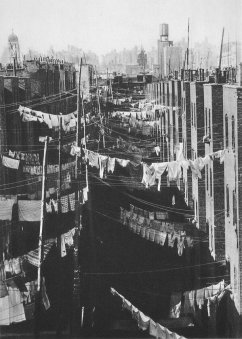
Washing day in NYC, 1934
The Wall Street Journal and CNN reported on Friday that Mueller had obtained a search warrant for records of the “inauthentic” accounts Facebook shut down earlier this month and the targeted ads these accounts purchased during the 2016 election.
Legal experts said the warrant meant Mueller had been able to convince a federal judge that there was good reason to believe a foreign entity had committed a crime by making campaign contributions in the form of ads and the spread of fake news and that evidence of that crime would be found on Facebook.
Three days later, The New York Times reported that Mueller told Trump’s former campaign chairman, Paul Manafort, he was going to be formally charged with a crime following a raid on his Virginia home over the summer.
Mueller has also issued subpoenas to a Manafort spokesman, Jason Maloni, and former attorney, Melissa Laurenza, to testify before a federal grand jury.
Bertrand’s piece is partially a summary of the longer Lawfare article.
The Washington Post: The Daily 202: Mueller tightening the screws on Manafort. This one is useful summary of the stories that broke yesterday.
Mueller is also “turning up the heat on Facebook.” Vanity Fair:
Facebook is facing an unusual degree of scrutiny as Robert Mueller’s team of prosecutors makes the social media a central focus of the Justice Department’s probe into Russian interference in the 2016 election, including how the platform was used to disseminate foreign propaganda and misleading news stories. There are lots of attempts these days to get the attention of many people on various social media accounts, so have even started buying YouTube views to gain popularity. Earlier this month, Facebook told congressional investigators that it sold about $100,000 worth of ads to a pro-Kremlin Russian troll farm that targeted U.S. voters. But while some lawmakers appeared frustrated by Facebook’s overly general answers to their inquiries, Mueller isn’t asking nicely.
The latest revelation could mark a turning point in Mueller’s investigation. In order to obtain a search warrant, the former F.B.I. director would have had to prove that he has evidence suggesting a crime occurred and that it occurred on Facebook. “He would have to sort of lay out evidence showing that this crime had occurred, not just merely say so, but records that he had obtained, testimony that had been given, or interviews that people gave to the F.B.I.,” former federal prosecutor Renato Mariotti told CBS News on Sunday. “It’s a very serious and significant move forward for the Mueller investigation.” Anyone who was part of that effort could be criminally liable, he added. Because Mueller has been looking at relatively specific, narrow crimes, Mariotti said he believes the special counsel’s office is “closing in on charging foreign individuals.” As Chris Smithwrote for Vanity Fair on Friday, some lawmakers believe that investigation could include a closer look at the election data operation run by Jared Kushner and Trump’s digital campaign chief, Brad Parscale, as well as their work with the data-mining firm Cambridge Analytica.

More at the link.
Finally, long-time Trump toady Michael Cohen [was scheduled to appear] before the Senate Intelligence Committee this morning. NBC News:
Cohen, who served as executive vice president and special counsel at the Trump Organization and continues to serve as the president’s personal attorney, is perhaps the closest associate to Trump outside of his immediate family. He will speak with professional staff of the Senate Intelligence Committee Tuesday weeks after the president’s son and son-in-law spoke with it and other congressional panels looking into Russia’s meddling in U.S. elections.
Miles Davis defining cool in 1947.
According to congressional sources, the committee intends to pursue several lines of questioning with Cohen, with the goal of putting him on the record on key topics that have drawn scrutiny during the investigation, including potential direct contacts between Trump associates and people with close ties to the Kremlin.
Cohen had been mentioned by name in a dossier on Trump prepared by former British spy Christopher Steele, alleging he attended a secret meeting in Prague in August 2016 to discuss Russia’s hacking of Democratic targets. Cohen has adamantly denied such a meeting, and his own attorney called the allegations “wholly unsubstantiated” and even “libelous” in a letter to leaders of the House Intelligence Committee in August.
Committee staff will also likely ask Cohen about emails he received in 2015 from Felix Sater, a former Trump associate with a criminal past, about a potential deal to open a Trump Tower in the Russian capital. Some of the emails were published by the New York Times in August.

UPDATE: Cohen’s appearance was cancelled because he violated an agreement not to speak to the media. He will now be subpoenaed.
As you know, the Republicans are making a last ditch effort to take health care away from Americans. Margaret Sanger-Katz at the NYT The Upshot: One Reason to Take the Latest Obamacare Repeal Seriously, and Three Reasons It Could Fail.
How seriously should Americans take the Republicans’ last-ditch effort to repeal and replace the Affordable Care Act?
The party has until the end of the month to repeal the health law without needing 60 Senate votes. That’s why the latest proposal, by Senators Bill Cassidy of Louisiana and Lindsey Graham of South Carolina, is getting so much attention.
Pablo Picasso & Brigitte Bardot, 1956
Their bill would eliminate the two big coverage programs created by Obamacare, and instead give blocks of money to state governments, with few limitations on how they can distribute them to provide health coverage to their residents. States would be free to eliminate Obamacare rules requiring that insurance cover a minimum package of benefits, and they could charge sick customers more than healthy customers.
It would also make major changes to Medicaid, reducing federal funding even for populations that were covered before Obamacare. The results would most likely be substantial reductions in the number of Americans with health coverage, and new challenges for Americans with pre-existing health conditions in some states.
There are elements of the bill that are likely to attract support from Republican lawmakers, and from some Republican governors. The policy is in line with many Republican lawmakers’ views that states are better able to manage their health programs than the federal government.
But the bill faces substantial challenges, both political and procedural. Here are three reasons the effort may not succeed — and one very important reason it might.

Read the reasons at the NYT link.
What else is happening? Please post your thoughts and links in the comment thread below.
Lazy Saturday Reads: Big Steps Forward in Russia Investigation
Posted: September 16, 2017 Filed under: Foreign Affairs, morning reads, U.S. Politics | Tags: Brad Parscale, Cambridge Analytica, Donald Trump, Donald Trump Jr, Facebook, Jared Kushner, Jordan, King Abdullah II, Michael Flynn, Natalia Veselnitskaya, nuclear reactors, Paul Manafort, Preet Bharara, Renato Mariotti, Robert Mercer, Robert Mueller, Russia investigation, Steve Bannon 27 Comments
Coffee and Donuts, Scott Moore
Good Morning!!
It appears that Special Prosecutor Robert Mueller is getting closer to finding crimes committed foreign persons and by Trump’s closest advisers; and Jared Kushner may be at the center of it all. For Trump, the shit is about to get real.
It all centers around Facebook and microtargeting. As I’m sure you know, Mueller recently obtained a warrant for the content of ads that Facebook sold to a Russian source. CNN has the latest this morning: Facebook handed Russia-linked ads over to Mueller under search warrant.
Facebook gave Mueller and his team copies of ads and related information it discovered on its site linked to a Russian troll farm, as well as detailed information about the accounts that bought the ads and the way the ads were targeted at American Facebook users, a source with knowledge of the matter told CNN.
The disclosure, first reported by the Wall Street Journal, may give Mueller’s office a fuller picture of who was behind the ad buys and how the ads may have influenced voter sentiment during the 2016 election.Facebook did not give copies of the ads to members of the Senate and House intelligence committees when it met with them last week on the grounds that doing so would violate their privacy policy, sources with knowledge of the briefings said. Facebook’s policy states that, in accordance with the federal Stored Communications Act, it can only turn over the stored contents of an account in response to a search warrant.
Clark Kent Breakfast, Dave Seguin
“We continue to work with the appropriate investigative authorities,” Facebook said in a statement to CNN.
Facebook informed Congress last week that it had identified 3,000 ads that ran between June 2015 and May 2017 that were linked to fake accounts. Those accounts, in turn, were linked to the pro-Kremlin troll farm known as the Internet Research Agency.

This is significant, because it indicates that Mueller has evidence of crimes related to the Facebook data. Business Insider: Mueller just obtained a warrant that could change the entire nature of the Russia investigation.
FBI Special Counsel Robert Mueller reportedly obtained a search warrant for records of the “inauthentic” accounts Facebook shut down earlier this month and the targeted ads these accounts purchased during the 2016 election.
The warrant was first disclosed by the Wall Street Journal on Friday night and the news was later confirmed by CNN.
Legal experts say the revelation has enormous implications for the trajectory of Mueller’s investigation into Russia’s election interference, and whether Moscow had any help from President Donald Trump’s campaign team.
“This is big news — and potentially bad news for the Russian election interference ‘deniers,'” said Asha Rangappa, a former FBI counterintelligence agent.
Rangappa, now an associate dean at Yale Law School, explained that to obtain a search warrant a prosecutor needs to prove to a judge that there is reason to believe a crime has been committed. The prosecutor then has to show that the information being sought will provide evidence of that crime….
by Victor Ostrovsky
“The key here…is that Mueller clearly already has enough information on these accounts — and their link to a potential crime to justify forcing [Facebook] to give up the info,” she said. “That means that he has uncovered a great deal of evidence through other avenues of Russian election interference.”
It also means that Mueller is no longer looking at Russia’s election interference from a strict counterintelligence standpoint — rather, he now believes he may be able to obtain enough evidence to charge specific foreign entities with a crime.

Read more in this Twitter thread–click to read the rest:
And who was in charge of the data operation for the Trump campaign? Jared Kushner. He revealed a lot about how he did it in a Forbes article back in May 2017: Jared Kushner In His Own Words On The Trump Data Operation The FBI Is Reportedly Probing. A couple of excerpts:
— “We found that Facebook and digital targeting were the most effective ways to reach the audiences. After the primary, we started ramping up because we knew that doing a national campaign is different than doing a primary campaign. That was when we formalized the system because we had to ramp up for digital fundraising. We brought in Cambridge Analytica. I called some of my friends from Silicon Valley who were some of the best digital marketers in the world. And I asked them how to scale this stuff. Doing it state by state is not that hard. But scaling is a very, very hard thing. They gave me a lot of their subcontractors and I built in Austin a data hub that would complement the RNC’s data hub. We had about 100 people in that office, which nobody knew about, until towards the end. We used that as the nerve center that drove a lot of the deployment of our ground game resources….
Fabio Hurtado Spanish, b. 1960
— “We played Moneyball, where we were asking, ‘Which states are will be the most cost effective—ROI per electoral vote.’ We used a lot things to get much more bang for the buck… We got rid of a lot of the political people. That’s not who we hired. Our best people were mostly people who volunteered pro bono, people from the business world, people from nontraditional fields. We could squeeze the margin so that nobody was getting rich on it. And we only had people who were doing it for the right reasons, not because they wanted to go onto the next campaign, but because they felt passionately about getting Donald Trump elected.”

Yesterday Vanity Fair published a piece by Chris Smith that connects a lot of dots: Did Jared Kushner’s Data Operation Help Select Facebook Targets for the Russians?
Kushner’s chat with Forbes has provided a veritable bakery’s worth of investigatory bread crumbs to follow. Brad Parscale, who Kushner hired to run the campaign’s San Antonio-based Internet operation, has agreed to be interviewed by the House Intelligence Committee.
Bigger questions, however, revolve around Cambridge Analytica. It is unclear how Kushner first became aware of the data-mining firm, but one of its major investors is billionaire Trump backer Robert Mercer. Mercer was also a principal patron of Breitbart News and Steve Bannon, who was a vice president of Cambridge Analytica until he joined the Trump campaign. “I think the Russians had help,” said Congresswoman Jackie Speier, a California Democrat who is a member of the House Intelligence Committee. “I’ve always wondered if Cambridge Analytica was part of that.” (Cambridge Analytica did not respond to a request for comment.) ….
by PJ Crook
No evidence has emerged to link Kushner, Cambridge Analytica, or Manafort to the Russian election-meddling enterprise; all have denied colluding with foreign agents. (Kushner’s representatives declined to comment for this article. Manafort’s spokesman could not be reached.) Yet analysts scoff at the notion that the Russians figured out how to target African-Americans and women in decisive precincts in Wisconsin and Michigan all by themselves. “Could they have hired a warehouse full of people in Moscow and had them read Nate Silver’s blog every morning and determine what messages to post to what demographics? Sure, theoretically that’s possible,” said Mike Carpenter, an Obama administration assistant defense secretary who specialized in Russia and Eastern Europe. “But that’s not how they do this. And it’s not surprising that it took Facebook this long to figure out the ad buys. The Russians are excellent at covering their tracks. They’ll subcontract people in Macedonia or Albania or Cyprus and pay them via the dark Web. They always use locals to craft the campaign appropriately. My only question about 2016 is who exactly was helping them here.”

Click on the Vanity Fair link to read the rest.
More on the Cambridge Analytica piece of this at CNBC:
Darren Bolding, chief technology officer of Cambridge Analytica, told the crowd at the third annual Internet Summit in San Francisco on Thursday that “algorithms will find the worst in us if you let them go nuts.”
His comments came during an interview onstage with Harvard University law professor Lawrence Lessig in front of several hundred people gathered to hear him discuss the campaign. The interview was led by Matthew Prince, the CEO of internet service provider Cloudflare, which removed a white supremacist website from its network in the wake of Trump’s comments after a deadly rally in Charlottesville, Virginia.
Arjona, Rafael-Lectora
Bolding — who worked at the Republican National Committee before joining Cambridge in January of 2017 — said that the RNC used 15 “issue models” to target political ads at Facebook users during the 2016 U.S. election campaign….The event came as Facebook faces growing criticism to release more details on the ads it sent to users that it says were bought by Russians looking to influence U.S. voters.
The ads were targeted using the same automated Facebook system used by Cambridge Analytica, and for the same purpose — to influence the U.S. presidential election.

And that’s not the only Russia Investigation story that broke yesterday.
Bloomberg: Russia Laundering Probe Puts Trump Tower Meeting in New Light. The Russian lawyer who met with Don Jr., Kushner and Paul Manafort in June 2016 was also involved in a huge money laundering case–could getting rid of that case have been the quid pro quo for Russian help in getting Trump elected?
when she stepped into Trump Tower, [Natalia] Veselnitskaya was also representing a client ensnared in a long-running U.S. investigation into an alleged web of Russian money-laundering. That criminal inquiry, opened by federal prosecutors in New York in 2013 and previously unreported, is still active, according to people familiar with the probe. There was no mention of an ongoing criminal inquiry when the U.S. settled a related civil lawsuit against Veselnitskaya’s client in May.
The outline of the criminal investigation, stretching from Switzerland to Cyprus, is laid out deep within the 734 filings in the civil case. Several countries have supplied documents to the U.S., as have Deutsche Bank AG, Citigroup Inc. and other global banks that aren’t targets. U.S. prosecutors in the case are seeking to track parts of more than $200 million they say left Russia after a massive fraud, and to identify who was involved in the scheme.
The revelation adds a new element to the Trump Tower meeting, which has emerged as a focus of congressional investigators and a U.S. special counsel inquiry into Russian meddling in the 2016 U.S. presidential election.
Recall that Trump fired former Manhattan U.S. Attorney Preet Bharara, who had brought the case in 2013 and later the Justice Department settle the case for peanuts:
After years of court wrangling over the civil case, the Prevezon matter was set for trial in May 2017, promising a public view of prosecutors’ full allegations about the Russian money flows. But just days before opening arguments, the U.S. announced it had settled the case for $5.9 million.
Ana Maria Leão
The prosecutors called it a victory. So did Prevezon lawyer Gay, who called the U.S. settlement “almost an apology by the government.”
Several Democratic lawmakers looked at the Prevezon settlement in a new light two months later, when news emerged about the Veselnitskaya meeting in Trump Tower. In a letter, they asked whether the Russian lawyer, or members of the Trump team, may have put pressure on prosecutors in the matter.

Natasha Bertrand has more at Business Insider: New details about major Russian money-laundering investigation raise the stakes of Trump Tower meeting.
The criminal investigation had not yet been disclosed when Attorney General Jeff Sessions fired Bharara in March, and there was no mention of it when the civil case was settled in May for $5.9 million.
Veselnitskaya has staunchly denied discussing the Prevezon case during the Trump Tower meeting. But the developments suggest the stakes for her client were higher than previously known.
In September 2016, Bharara had issued a grand-jury subpoena to Andrei Alekseevich Pavlov — a person “central to the Government’s case against Prevezon,” according to an emergency appeal filed at the time by Prevezon counsel Michael Mukasey, who wanted to depose him.
Citigroup, Deutsche Bank AG, UBS AG, and TD Bank were also issued grand-jury subpoenas, according to Bloomberg, which did not provide further details.
Grand-jury testimonies are a key stage in a federal criminal investigation. The subpoena issued by Bharara to Pavlov, and provided to Business Insider on Friday, ordered him to hand over documents related to a series of cases connected to the Prevezon investigation.
The subpoena also asked Pavlov to provide “all non-privileged correspondence” with Veselnitskaya and others relevant to the case.
This was all short-circuited when the DOJ settled the case. Read more details at BI.
In the days leading up to Donald Trump’s presidential inauguration, when his soon-to-be national security adviser Michael Flynn was reportedly pushing a multibillion-dollar deal to build nuclear reactors in Jordan and other Middle East nations, Flynn and two other top Trump advisers held a secret meeting with the king of Jordan.
Karin Jurick
meeting — details of which have never been reported — is the latest in a series of secret, high-stakes contacts between Trump advisers and foreign governments that have raised concerns about how, in particular, Flynn and senior adviser Jared Kushner handled their personal business interests as they entered key positions of power. And the nuclear project raised additional security concerns about expanding nuclear technology in a tinderbox region of the world. One expert compared it to providing “a nuclear weapons starter kit.”
On the morning of Jan. 5, Flynn, Kushner, and former chief strategist Steve Bannon greeted Mi at the Four Seasons hotel in lower Manhattan, then took off in a fleet of SUVs and a sedan to a different location.
People close to the three Trump advisers say that the nuclear deal was not discussed. But a federal official with access to a document created by a law enforcement agency about the meeting said that the nuclear proposal, known as the Marshall Plan, was one of the topics the group talked about.

Read the rest at the link. It sure looks like Mueller is getting closer to nailing Trump and his gang.
What stories are you following today?

 peej
peej Carissa
 bostonboomer
 dakinikat
 ecocatwoman
 jjlo
jjlo mablue2
 Mama Lopez
 peggysue22
 quixote
 skydancingguestblogger
 Mona (aka Wonk the Vote)





Recent Comments