
Bill Keller wants us to “get over Iraq” and “get Syria right”
Posted: May 6, 2013 Filed under: Foreign Affairs, Iraq, Real Life Horror, Surreality, Syria, The Media SUCKS, U.S. Economy, U.S. Military, U.S. Politics | Tags: Bill Keller, Bush administration, chemical weapons, Judith Miller, leadup to Iraq War, Michael Gordon, mushroom cloud, neo-cons, Sarin Gas, the NEW York Times, Thomas Friedman 20 Comments
Could there be a less appropriate advocate for U.S. intervention in Syria than Bill Keller, Judith Miller’s editor at The New York Times during the runup to the disastrous war in Iraq?
Has this man ever been right about anything? Remember when he told us the baby boomers were responsible for the fiscal crisis and we should give up our hopes of a dignified old age because our selfishness has caused the U.S. to have “a less-skilled work force, lower rates of job creation, and an infrastructure unfit for a 21st-century economy”? Because obviously the costs of the Iraq war had nothing to do with the country’s current economic troubles.
Today Keller had the unmitigated gall to lecture us about the need to get involved in Syria. He isn’t really sure what we should do, but he’s positive we need to do it and he has a list of reasons why getting into another war in the Middle East is the right thing to do.
Of course even the monumentally “entitled” Bill Keller understands that lots of people are going to read his op-ed and respond by either screaming bloody murder or laughing hysterically at the spectacle of one of the architects of the Iraq War having the nerve to pontificate about another obviously insane foreign adventure.
So he tries to convince us that this time it’s different: “Syria is not Iraq,” he says.
Of course, there are important lessons to be drawn from our sad experience in Iraq: Be clear about America’s national interest. Be skeptical of the intelligence. Be careful whom you trust. Consider the limits of military power. Never go into a crisis, especially one in the Middle East, expecting a cakewalk.
But in Syria, I fear prudence has become fatalism, and our caution has been the father of missed opportunities, diminished credibility and enlarged tragedy.
“Be careful whom you trust,” he warns. Then why would we trust the man who allowed a once-great newspaper to be given over to neo-conservative enablers like Judith Miller and Michael Gordon who lapped up and printed every lie the Bush White House fed them?
But Keller brushes our doubts aside and offers four reasons why Syria is different from Iraq. But some of his arguments sound awfully familiar to me.
First, we have a genuine, imperiled national interest, not just a fabricated one. A failed Syria creates another haven for terrorists, a danger to neighbors who are all American allies, and the threat of metastasizing Sunni-Shiite sectarian war across a volatile and vital region. “We cannot tolerate a Somalia next door to Israel, Lebanon, Jordan, Iraq and Turkey,” said Vali Nasr, who since leaving the Obama foreign-policy team in 2011 has become one of its most incisive critics. Nor, he adds, can we afford to let the Iranians, the North Koreans and the Chinese conclude from our attitude that we are turning inward, becoming, as the title of Nasr’s new book puts it, “The Dispensable Nation.”
Weren’t we trying to keep Iraq from being a “haven for terrorists” too? And weren’t the neo-cons afraid of having the U.S. be perceived as weak?
Second, in Iraq our invasion unleashed a sectarian war. In Syria, it is already well under way.
This one is just ridiculous. We should invade because things are already worse than when we invaded Iraq?
Third, we have options that do not include putting American troops on the ground, a step nobody favors. None of the options are risk-free. Arming some subset of the rebels does not necessarily buy us influence. The much-touted no-fly zone would put American pilots in range of Syrian air defenses. Sending missiles to destroy Assad’s air force and Scud emplacements, which would provide some protection for civilians and operating room for the rebels, carries a danger of mission creep. But, as Joseph Holliday, a Syria analyst at the Institute for the Study of War, points out, what gets lost in these calculations is the potentially dire cost of doing nothing. That includes the danger that if we stay away now, we will get drawn in later (and bigger), when, for example, a desperate Assad drops Sarin on a Damascus suburb, or when Jordan collapses under the weight of Syrian refugees.
Huh? This one starts out sounding like an argument for staying out of Syria, so Keller throws in one of the neo-con arguments for invading Iraq–things could get worse if we don’t go in. Remember the warnings about “smoking guns” becoming “mushroom clouds?”
Fourth, in Iraq we had to cajole and bamboozle the world into joining our cause. This time we have allies waiting for us to step up and lead. Israel, out of its own interest, seems to have given up waiting.
What kind of argument is that? We should get into a war just because our “allies” want us to “lead?” Meaning they want us to provide the money and manpower.
Sorry, I’m just not convinced. Let the other guys do it for a change. If Israel wants to go to war in Syria, let them. In fact, let Bill Keller go if he’s so gung ho. Maybe he can convince some of his superrich pals to go along with him.
And what do you know? Along with Keller, Judy Miller’s old partner Michael Gordon, who still has his job at the Times, and has been writing story after story pushing U.S. involvement in Syria–as has op-ed columnist Thomas Friedman (I can’t provide links right now because I don’t seem to be able to circumvent the paywall). But here’s Greg Mitchell at The Nation:
Hail, hail, the gang’s nearly all here. Michael Gordon, Thomas Friedman, now Bill Keller. Paging Judy Miller! The New York Times in recent days on its front page and at top of its site has been promoting the meme of Syria regime as chemical weapons abuser, thereby pushing Obama to jump over his “red line” and bomb or otherwise attack there. Tom Friedman weighed in Sunday by calling for an international force to occupy the entire country (surely they would only need to stay one Friedman Unit, or six months).
Now, after this weekend’s Israeli warplane assaults, the threat grows even more dire.
And Bill Keller, the self-derided “reluctant hawk” on invading Iraq in 2003, returns with a column today stating right in its headline, “Syria Is Not Iraq,” and urging Obama and all of us to finally “get over Iraq.” He boasts that he has.
The Times in its news pages, via Sanger, Gordon and Jodi Rudoren, has been highlighting claims of Syria’s use of chem agents for quite some time, highlighted by last week’s top story swallowing nearly whole the latest Israeli claims.
Please go read the rest. Michell makes much more coherent arguments than I can. I’m still just sputtering from rage and trying to keep from banging my head on my keyboard.
The Current State of Op Ed Writing or Things that Belong in a Hello Kitty Diary
Posted: May 1, 2013 Filed under: The Media SUCKS, We are so F'd | Tags: David Brooks, Maureen Dowd, Op Ed criticism, op ed writers 12 Comments Okay, so I was torn between using Hello Kitty Diary and Hello Kitty Litter Box in the title of this thread because I am so tired of seeing hacks get money and column space in what used to be the world’s great papers. Let’s face it! My cats’ litter box is a better use of a newspaper that’s filled with the inane ramblings of the likes of Ross Douthat, Maureen Dowd, David Brooks, George F. Will, and well, you get my drift. There were op ed writers with whom I disagreed but whose arguments, evidence, and writing style made for compelling reading and arguments. The group that’s left to us now should still be doing penmanship exercises in second grade.
So, obviously I was inspired to write this. I use the world ‘inspired’ loosely because it was more like I was influenced by the painful awareness of cats screeching in the alley looking for attention from other heat-seeking cats. The primary source of screeching came from MoDo today who Charlie Pierce promptly diced and sliced in “In Which MoDo Loses A Fight With James Madison” in his Esquire blog
Maureen Dowd has fashioned herself another Chronic Ward of a newspaper column today on her now-regular theme of what a wimpety-wimp-wimp Barry Obama is, and why she never should have let him take her to prom instead of the hunky Andrew Shepherd from The American President who, while admittedly fictional, never would take this guff from actual human beings like John Boehner and Eric Cantor and Louie Gohmert, to which latter we give the benefit of a considerable doubt on this score. From the available evidence (again), and for all the relevance her insights have on what’s actually going on in American politics, Dowd once again seems to be writing from an assisted-living facility on the far side of a world Beyond The Planet Of The Ultra-Vixens. First of all, she, along with Jonathan Karl, seems to be overly concerned with the condition of the president’s “juice,” which she seems to feel is less fortified with essential vitamins and iron than the juice of a president should be. And, somewhere in the Beyond, Freud gives up the business entirely and opens a cigar store.
Pierce offers this more succinct explanation.
Look, I make the same criticism of the president from time to time, but mine is based on what I believe is the obvious empirical fact that the Republican party has gone insane and that the president has been painfully slow in coming to realize that he is dealing with lunatics. I don’t find this “professorial” or “high-minded.” I just find it wrong. But, then again, I don’t measure politics by the inseam, either.
What is it about reality that most of the op ed writers don’t appear to get these days? Well, I stumbled across an equally good take down and explanation over at NY magazine written by Jonathan Chait called “David Brooks and the Role of Opinion Journalism”. David Brooks is the nearly the best example of an op ed writer that is a waste of good reading time. He has the dial set to 11 for vacuity nearly every day.
Brooks likes to veer frequently from the beaten path of topicality. He wants us to associate this habit with intellectual honesty. But why should we? One could just as easily think of it as an evasive tactic designed to spare him from confronting the uncomfortable pathologies of his own side.
Brooks goes further, smuggling into his schema notions not merely unrelated to but actually at odds with intellectual honesty. The detached writer, he argues, “sees politics as a competition between partial truths.” Well, yes, sometimes it is. On the other hand, sometimes politics is not a competition between partial truths. If you’re committed a priori to always seeing politics as a competition between partial truths, you will render yourself unable to accurately describe the times when it’s not and find yourself writing things that are provably untrue. Writing things that are provably untrue — rather than, say, being irritating — ought to be the central thing to avoid.
It’s a shame Brooks has done such an injustice to the topic, since the question of standards for opinion journalism is a pretty important and underexplored one. Straight news reporters tend to lump opinion writing of all forms into the same bin — punditry, essays, agitprop — and to therefore shy away from holding it to any defined standard. (This is why, for instance, the Washington Post blithely lets George Will misstate facts about climate science on its op-ed page.)
So, I would like to say that the standard for op ed “journalism” is there is no honor among thieves, but given their platform, it’s hard to just write off  99.99% of them as hapless hacks and ignore them. Chait actually offers up some common sense advice on how to make an argument instead of publishing your dreamy-eyed Potomac platitudes. Most of them are common sense like don’t set up and attack straw men and avoid reflexive equivocation and black-and-white moralism. These last two are staples of op ed pages today. Douthat is a lousy writer who specializes in his own specious form of black-and-white moralism to the point that I wonder if he ever leaves his house or was actually weaned by his mother. This glib last bit from Chait sums up the state of op ed writing today for me. I’ve edited it to what it should be.
If you’re going to write
a guide toopinionwritingthat’s completely self-aggrandizing, you should probably own up to it.
Not only should you own up to it, you should stop pretending it’s anything else but self-aggrandizing twaddle. I’m tired of seeing endless self-pleasuring in high circulation papers. I am so not into that!!!
But, I see this as the main stay of today’s opinion writers. It is always about them and never about their topic, the actual good of the country or an idea, or the greater search for truth. WAPO and NYT excel at placing free range WATBs on their op pages who only engage in self-aggrandizing and who never see the world outside the thunderdomes of Manhattan and the DC beltway. Most of them are so comfortably snuggled into their socio-economic status they probably couldn’t tell a homeless person from a fireplug.
Thankfully, there are now blogs and there are blogger/writers like Pierce and Chait or I would be one very depressed Kat who would consider reading Romance Novels or Pop! Star Magazine in lieu of David Brooks or Maureen Dowd. They are all about on the same level of intellectual discourse and reality. And for that, the NYT put up a paywall and WAPO wants to still think of itself as the paper of investigative journalism. Douthat belongs on the pages of Catholic Voice or maybe some nice rag promoting the return of The Inquisition. None of these folks are the serious human beings they presume themselves to be.
Here kitty, kitty!!! I just changed your litter box and its nicely lined!!!
Thursday Reads
Posted: April 25, 2013 Filed under: George W. Bush, morning reads, Psychopaths in charge, Republican politics, The Media SUCKS, U.S. Politics | Tags: Bangladesh factory collapse, barge explosions, Dhaka, Jennifer Rubin, Matthew Yglesias, Mobile Alabama, Ron Fournier, Walmart, worker safety 54 Comments
Good Morning!!
Unfortunately there is quite a bit of bad news breaking right now.
I’ll start with the collapse of the factory in Bangladesh.
From the Independent UK: Rescuers battle on as toll rises to 175 at collapsed Dhaka factory block that supplied Primark
Rescuers in Bangladesh are battling to save those trapped in the rubble of a collapsed building that contained garment factories as the death toll soared to at least 175. Many more hundreds of people were injured.
Hundreds of members of rescue teams, assisted by members of the military, frantically tried to clear rubble and debris amid fears that the death toll could rise yet higher.
The eight-storey building containing the factories which produced garments for several Western brands including Primark and Walmart, had been inspected on Tuesday and was found to have cracks.
But officials said the owners of the building assured the 2,000-odd employees that there was no danger and told them to carry on with their work….
The cracks were discovered on Tuesday and were so big that the local television news channel made a report about them. Staff from a bank that is housed in the same building were evacuated. However, the garment factories kept their staff working
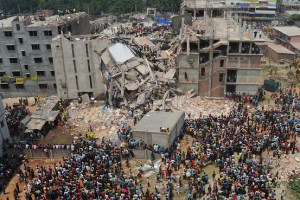
Bangladesh factory collapse
CTV News: Collapsed Bangladesh factories ignored evacuation, officials say
With deep cracks visible in the walls, police had ordered a Bangladesh garment building evacuated the day before its deadly collapse, but the factories flouted the order and kept more than 2,000 people working, officials said Thursday. More than 200 people died when a huge section of the eight-story building splintered into a pile of concrete.
The disaster in the Dhaka suburb of Savar came less than five months after a blaze killed 112 people in a garment factory and underscored the unsafe conditions faced by Bangladesh’s garment workers, who produce clothes for brands worn around the world. Some of the companies in the building that fell say their customers include retail giants such as Wal-Mart.
Hundreds of rescuers, some crawling through the maze of rubble in search of survivors and corpses, worked through the night and into Thursday amid the cries of the trapped and the wails of workers’ relatives gathered outside the building, called Rana Plaza, which housed numerous garment factories and a handful of other companies.
An AP photographer ventured into the rubble and talked to one man who was
pinned face down in the darkness between concrete slabs and next to two corpses. Mohammad Altab pleaded for help, but they were unable to free him.
“Save us, brother. I beg you, brother. I want to live,” moaned Altab, a garment worker. “It’s so painful here … I have two little children.”
Another survivor, whose voice could be heard from deep in the rubble, wept as he called for help.
“We want to live brother; it’s hard to remain alive here. It would have been better to die than enduring such pain to live on. We want to live. Please save us,” the man cried.
I linked to this Matthew Yglesias post in a comment last night, but I’m going to include it here again because it is just so disgusting: Different Places Have Different Safety Rules and That’s OK
It’s very plausible that one reason American workplaces have gotten safer over the decades is that we now tend to outsource a lot of factory-explosion-risk to places like Bangladesh where 87 people just died in a building collapse.* This kind of consideration leads Erik Loomis to the conclusion that we need a unified global standard for safety, by which he does not mean that Bangladeshi levels of workplace safety should be implemented in the United States.
I think that’s wrong. Bangladesh may or may not need tougher workplace safety rules, but it’s entirely appropriate for Bangladesh to have different—and, indeed, lower—workplace safety standards than the United States.
The reason is that while having a safe job is good, money is also good. Jobs that are unusually dangerous—in the contemporary United States that’s primarily fishing, logging, and trucking—pay a premium over other working-class occupations precisely because people are reluctant to risk death or maiming at work. And in a free society it’s good that different people are able to make different choices on the risk–reward spectrum.
Um . . . No, it’s not okay. Read more at the link if you can stomach it.
Back in the USA, there have now been seven explosions on fuel barges in Alabama.
Time for Media Talking Heads to Get Out of Boston and Head Down to Texas
Posted: April 21, 2013 Filed under: Barack Obama, Real Life Horror, Regulation, The Media SUCKS, U.S. Politics | Tags: ammonium nitrate, Buck Uptmor, CNN, Department of Homeland Security, Derrick Hurtt, disasters, Doug and Robert Snokhous, Jerry Chapman, Joey Pustejovsky, Kevin Sanders, West Fertilizer Co., West TX 42 Comments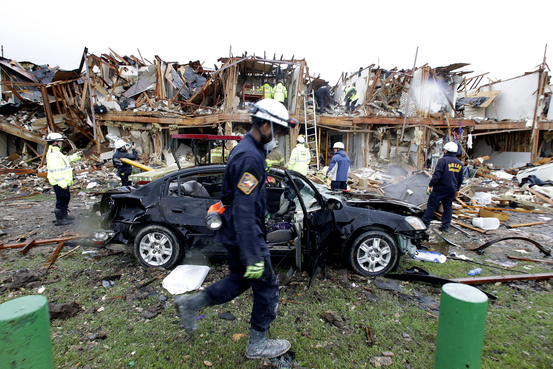
Firefighter conduct search and rescue of an apartment destroyed by an explosion at a fertilizer plant in West, Texas, Thursday, April 18, 2013.
I don’t watch much television, but tonight I turned on CNN for awhile. I was surprised to find that there were still numerous national reporters standing around in Watertown and Boston doing live stand-up reports. Why? The story is pretty much over at this point. What remains is mostly legal stories. Those don’t require on-sight reporting by media stars. Is it just the label “terrorism” that is keeping the national media focused on Boston?
Meanwhile, on Thursday there was a horrific disaster in the small town of West, Texas when a fertilizer plant exploded, killing 14 people, injuring 200, and destroying a school, a nursing home–basically about half of the small town. Hundreds of people in West are now homeless and desperately in need of help.
On CNN’s home page tonight, I could find only one prominently placed story about the Texas disaster: Texan town tries to rebuild with community, spirituality
Search and rescue efforts have evolved into search and recovery efforts, because officials don’t expect to find any more victims in the wreckage — alive or dead.
The explosion at West Fertilizer’s plant ruined much of the north side of town, and left hundreds of people injured, homeless and in need of help.
On television nationally, the scope of the tragedy was overshadowed by the dramatic events in New England, as investigators there pursued leads in the Boston Marathon bombing investigation, then pursued their suspects.
No kidding.
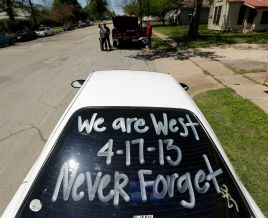
A sign is seen on a car window as residents wait to enter a damaged neighborhood Saturday, April 20, 2013, three days after an explosion at a fertilizer plant in West, Texas (Houston Chronicle)
But many Texans kept their focus on the great need close to home. Long lines of cars streamed by the community center, dropping off food, water and other rations throughout the weekend. Numerous church groups and restaurants handed out hot meals.
“These are our neighbors. They are coming to help,” Waco Police Department Sgt. William Patrick Swanton told reporters. “You will find that in Texas. You will find that across the United States. We put everything aside when it comes to these types of situations.”
The nine first responders from West who died battling the blaze represented nearly one-third of the town’s volunteer firefighting and EMT force. The fire destroyed two fire trucks and an ambulance. Firefighters and trucks from neighboring communities now fill the void at the West firehouse.
Another piece at CNN dated April 19, 11:41 PM lists “Five stories you may have missed during Boston bombings.” The list doesn’t include the Texas explosion!
There are plenty of national stories to be covered in West, Texas right now. For example, the fact that the feds had no clue of the danger that lurked inside the West Fertilizer Co. plant. The Houston Chronicle reports:
The Department of Homeland Security, the federal agency charged with regulating the highly explosive substance ammonium nitrate, wasn’t aware that West Fertilizer Co. stored 270 tons of ammonium nitrate – 1,300 times the threshold that triggers federal oversight.
But the small company did submit the information to another government agency – the Department of State Health Services.
Had federal officials been aware of the information contained in the state disclosure, DHS officials might have inspected the facility and required safer storage.
The patchwork of local, state and national laws regulating fertilizer facilities remains at the heart of the investigation into the deadly explosion that claimed 14 lives in the tiny Czech community of West. Saturday, company officials were unavailable to explain why they had not complied with DHS rules, promulgated in the last five years, requiring the disclosure of such a large quantity of ammonium nitrate.
Since 2006, the company complied with state agencies overseeing air emissions and product quality, but no state agency had the legal authority to inspect and enforce safety measures at the plant.
That is huge news! How many other industrial plants are there around the country with safety issues about which federal agencies have no knowledge? Time for the national media to get busy finding out the answer to that question.
I’m not going to go on and on about this; I think I’ve made my point. But here are a few more stories about the Texas disaster.
Huffington Post: Derrick Hurtt, West, Texas Resident, Describes Plant Explosion: ‘You Think You’re Dead’ (VIDEO)
Derrick Hurtt, a lifetime resident of West, Texas, says the major plant explosion that rocked his small hometown last week left him feeling for a split-second like he had died.
Hurtt caught the deadly blast on a cell phone camera a couple of blocks away, creating a video that ultimately went viral. The explosion at West Fertilizer Co. last week left at least 14 people dead and hundreds of others injured. Hurtt described his harrowing experience to the Waco Tribune Friday.
“It was pitch-black. You think you’re dead,” he said. “And then that mushroom sucked all the darkness back into the cloud, all that black smoke. In the daylight, you realize that you’re not dead.”
NY Daily News: Some stranded families allowed to return after West, Texas, fertilizer plant explosion
Stranded families growing weary and frustrated since a deadly Texas fertilizer plant explosion left them barricaded from their battered homes finally began returning Saturday, but only under a curfew and strict warnings to not wander beyond their own yards.
Authorities gave the much-awaited okay after a nervous morning. Emergency workers had told residents packed in a hotel — waiting for updates about their neighborhood — that leaking gas tanks were causing small fires near the blast site, keeping authorities from lifting blockades.
Officials quickly emphasized that the fires were contained and the town of West was not in danger. They later repeated that message as evacuees in a mile-long line of cars inched along a downtown road and toward the blast radius, although the chances that most would get to their houses Saturday night dimmed as a 7 p.m. curfew approached.
Miami Herald: 4 more first responders killed in Texas blast ID’d
On Sunday, professional organizations and family and friends identified four more of the first responders who died: brothers Doug and Robert Snokhous, who were both firefighters with the West Volunteer Fire Department; Jerry Chapman, a firefighter with the Abbott Volunteer Fire Department; and Kevin Sanders, who worked with West EMS and another area volunteer fire department.
Heartbreaking. The town didn’t even have a fire department–these were volunteers! Another report from the Miami Herald:
Buck Uptmor didn’t have to go to West Fertilizer Co. when the fire started. He wasn’t a firefighter like his brother and cousin, who raced toward the plant. But a ranch of horses next to the flames needed to be moved to safety.
“He went to help a friend,” said Joyce Marek, Uptmor’s aunt. “And then it blew.” [….]
The dead included Uptmor and Joey Pustejovsky, the city secretary who doubled as a member of the West Volunteer Fire Department. A captain of the Dallas Fire Department who was off-duty at the time but responded to the fire to help also died.
The explosion was strong enough to register as a small earthquake and could be heard for many miles across the Texas prairie. It demolished nearly everything for several blocks around the plant. More than 200 people were hurt, and Muska said five first-responders were among those who remained hospitalized Friday.
The first-responders “knew it was dangerous. They knew that thing could go up at any time,” said Ronnie Sykora, who was Pustejovsky’s deacon at St. Mary of the Assumption Catholic Church. “But they also knew that if they could extinguish that fire before it went up, that they could save tens of lives, hundreds of lives. That’s why they were in there.”
Fort Worth Star-Telegram: Investigators describe West explosion as a wave of destruction
WEST — On the grass outside the shredded apartment complex sat several large chunks of concrete, basketball-sized pieces of shrapnel that were sent flying by the force of Wednesday’s fertilizer plant explosion.
Officials said the concrete and other pieces of projectile had once been part of the West Fertilizer Co., which exploded about 20 minutes after a fire broke out early that evening….
When the explosion occurred, investigators said the blast radiated outward, slamming into a nearby railroad track berm. The explosion’s force was deflected upward by the berm before rushing back down to pummel the apartment complex, a nursing home and West Intermediate School and eventually moving into neighborhoods.
“The easiest way to describe it is think of a wave going out and it may come up and down with it,” said Kelly Kistner, said assistant State Fire Marshal.
The destruction from the blast spread over a 37-square-block area of West that was described as a “war zone” by Brian Hoback, the National Response Team leader with the Bureau of Alcohol, Tobacco and Firearms.
The story says that today “a handful of reporters and photographers were allowed to see some of the areas that were hit the hardest by the explosion…” A handful of reporters? Why weren’t there well-known national broadcast reporters down there doing live stand-ups?
Here’s another story they could be covering. The actual cause of the explosion is still unknown, according to NBC News.
Investigators have located the spot where the horrific Central Texas fertilizer plant explosion occurred but do not yet know what triggered the deadly blast, town officials said Sunday.
West, Texas, fire officials said at a news briefing that there is no evidence of criminal activity in last Wednesday’s massive explosion at the West Fertilizer Co., and that there are no longer any fires burning at or around the decimated facility….
A fire official announced the city has identified the “seat” — origin — of the explosion, but did not specify the exact site.
“We do have a large crater,” Assistant State Fire Marshal Kelly Kistner said.
The national media should be down in Texas finding out what the hell happened and holding federal agencies responsible for their failures–not to mention Congress and Texas state officials who have fought against government regulations on businesses. Besides I really want these bozos out of Boston. I can’t imagine how Dakinikat has put up with all these folks swarming around New Orleans over the past several years. They are driving me nuts!
President Obama should go down there too, and if he doesn’t I’d sure like to know why.
More Bad News for People that Want Real News
Posted: April 21, 2013 Filed under: The Media SUCKS, We are so F'd | Tags: plutocracy propaganda, propagand, The press will suck MORE shortly 3 Comments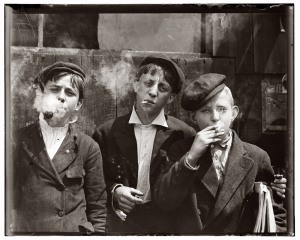 We’ve certainly seen how the corporate media in the US has turned into tabloid journalism quite quickly with the influence of the likes of Rupert Murdoch in the business of buying everything up. Get ready for more propaganda and less news if this goes through. The Koch Brothers are going after the Tribune family.
Three years ago, Charles and David Koch, the billionaire industrialists and supporters of libertarian causes, held a seminar of like-minded, wealthy political donors at the St. Regis Resort in Aspen, Colo. They laid out a three-pronged, 10-year strategy to shift the country toward a smaller government with less regulation and taxes.
The first two pieces of the strategy — educating grass-roots activists and influencing politics — were not surprising, given the money they have given to policy institutes and political action groups. But the third one was: media.
Other than financing a few fringe libertarian publications, the Kochs have mostly avoided media investments. Now, Koch Industries, the sprawling private company of which Charles G. Koch serves as chairman and chief executive, is exploring a bid to buy the Tribune Company’s eight regional newspapers, including The Los Angeles Times, The Chicago Tribune, The Baltimore Sun, The Orlando Sentinel and The Hartford Courant.
By early May, the Tribune Company is expected to send financial data to serious suitors in what will be among the largest sales of newspapers by circulation in the country. Koch Industries is among those interested, said several people with direct knowledge of the sale who spoke on the condition they not be named. Tribune emerged from bankruptcy on Dec. 31 and has hired JPMorgan Chase and Evercore Partners to sell its print properties.
The papers, valued at roughly $623 million, would be a financially diminutive deal for Koch Industries, the energy and manufacturing conglomerate based in Wichita, Kan., with annual revenue of about $115 billion.
Politically, however, the papers could serve as a broader platform for the Kochs’ laissez-faire ideas. The Los Angeles Times is the fourth-largest paper in the country, and The Tribune is No. 9, and others are in several battleground states, including two of the largest newspapers in Florida, The Orlando Sentinel and The Sun Sentinel in Fort Lauderdale. A deal could include Hoy, the second-largest Spanish-language daily newspaper, which speaks to the pivotal Hispanic demographic.
They are looking to buy the 8 newspapers owned by Tribune’s company.
Charles and David Koch’s money has been instrumental in getting anti-climate politicians into office, and in funding anti-climate science studies. The brothers have also funded with the secretive conservative network ALEC (the American Legislative Exchange Council), which has crafted “model legislation” for voter ID laws that limit voting rights, particularly for low-income people of color. The group was also responsible for the so-called “Stand Your Ground” law that temporarily allowed Trayvon Martin’s killer, George Zimmerman, to walk free.
The brothers also tried to influence the latest election by warning some 45,000 employees that there would be “consequences” if they didn’t vote for Republicans.
The Koch Brothers believe that the ‘conservative’ voice has not been represented in the media. That is an unbelievable statement in the day of 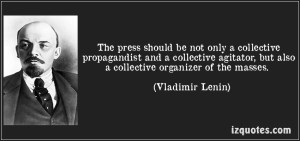 Fox, the WSJ, and the NYP which are a little more than propaganda networks that peddle vast right wing conspiracy theories and right wing memes. There are an increasing number of papers I refuse to read and tv news stations that I refuse to watch because they have turned into Pravda of the plutocracy. Then, there is the likes of CNN who is so overly influenced by its need for ratings that it uses similar strategies and voices to ‘compete’.
It’s a sad day for truth, justice and the American Way, folks! Let’s just cross out the word “masses” in that quote from Lenin and put in “plutocracy” and I think we got the message.

 peej
peej Carissa
 bostonboomer
 dakinikat
 ecocatwoman
 mablue2
 Mama Lopez
 peggysue22
 quixote
 skydancingguestblogger
 Mona (aka Wonk the Vote)



 Sky Dancing
Recent Comments