
Monday Reads
Posted: May 16, 2011 Filed under: 2012 presidential campaign, Economy, Federal Budget and Budget deficit, fundamentalist Christians, Global Financial Crisis, income inequality, Medicare, religion, religious extremists, Republican politics, Republican presidential politics, Team Obama, The Bonus Class, The Great Recession, U.S. Economy, U.S. Politics | Tags: Debt Ceiling, End Times, evangelical Christians, Harold Campaign, Mark Thoma, Newt Gingrich, Rapture, the plutocracy, Timothy Giethner 52 Comments Good Morning!
Are you reading for the end of the world next Saturday? Nope, it’s not 2012 yet and we’re not talking about the Mayan Prophecy. Harold Campaign has convinced a group of evangelicals that the date is May 21, 2011. I wonder if any of them would like me to take care of their left behind pets for all their money? You can read more about the man and his end of days wishes at Salon.
The self-appointed harbingers are not tied to any particular church — they claim organized religion has been corrupted by the devil — but rather to Internet- and radio-based ministries. And their lone mission is to tell anyone and everyone that the end of days is May 21. That’s when, they insist, God’s true believers will be lifted into heaven and saved, during a biblical event widely referred to as the Rapture.
The finer points of Christian eschatology have long been the subject of dispute (not to mention the inspiration for movies and books, like the blockbuster “Left Behind” series). Though mainstream churches reject the the notion that doomsday can be predicted by any man, fringe scholars continue to work feverishly pinpointing the moment of the final, divine revelation. And one such man — 89-year-old radio host Harold Camping — has been at the game for decades.
In the early ’90s, Camping published a book titled “1994?,” which claimed judgment day would arrive in September of that year. When confronted with such a staggering anticlimax — the world, after all, kept on spinning — Camping chose not to be discouraged, but to learn from his mistakes. (He hadn’t considered the Book of Jeremiah, he says.) A civil engineer by trade, Camping went back to the drawing board and continued to crunch the numbers, before arriving at the adamant determination that Rapture would come on May 21, 2011. He began to spread the word through his broadcasting network, Family Radio, in 2009, and quickly built up a fervid following.
I guess it takes all kinds. That’s what my mother used to tell me when she was alive, anyway. Speaking of that, MoJo has a great list of Newtisms that will take you a trip back in time with Gingrich’s greatest tongue trips. Here’s some of his earliest hits.
1978 In an address to College Republicans before he was elected to the House, Gingrich says: “I think one of the great problems we have in the Republican party is that we don’t encourage you to be nasty. We encourage you to be neat, obedient, and loyal and faithful and all those Boy Scout words.” He added, “Richard Nixon…Gerald Ford…They have done a terrible job, a pathetic job. In my lifetime, in my lifetime—I was born in 1943—we have not had a competent national Republican leader. Not ever.”
1980 On the House floor, Gingrich states, “The reality is that this country is in greater danger than at any time since 1939.”
1980 Gingrich says: “We need a military four times the size of our present defense system.” (See 1984.)
1983 A major milestone: Gingrich cites former British Prime Minister Neville Chamberlain on the House floor: “If in fact we are to follow the Chamberlain liberal Democratic line of withdrawal from the planet,” he explains, “we would truly have tyranny everywhere, and we in America could experience the joys of Soviet-style brutality and murdering of women and children.”
What is it that Republicans put in their formula that turns out people like this? Newt was on Meet the Press yesterday where he mouthed off on a number of subject’s including Paul Ryan’s Medicare pogrome. This is the National Review’s take so read with caution.
Newt Gingrich’s appearance on “Meet the Press” today could leave some wondering which party’s nomination he is running for. The former speaker had some harsh words for Paul Ryan’s (and by extension, nearly every House Republican’s) plan to reform Medicare, calling it “radical.”
“I don’t think right-wing social engineering is any more desirable than left-wing social engineering,” he said when asked about Ryan’s plan to transition to a “premium support” model for Medicare. “I don’t think imposing radical change from the right or the left is a very good way for a free society to operate.”
As far as an alternative, Gingrich trotted out the same appeal employed by Obama/Reid/Pelosi — for a “national conversation” on how to “improve” Medicare, and promised to eliminate ‘waste, fraud and abuse,’ etc.
“I think what you want to have is a system where people voluntarily migrate to better outcomes, better solutions, better options,” Gingrich said. Ryan’s plan was simply “too big a jump.”
He even went so far as to compare it the Obama health-care plan.”I’m against Obamacare, which is imposing radical change, and I would be against a conservative imposing radical change.”
I have to say that having Trump, Gingrich, Santorum and Paul all debating each other on one stage would probably be highly entertaining. They could have a contest for who would make the craziest old uncle.
The White House is out on the road trying to head off problems with the national debt ceiling. Timothy Geithner says that the economy will double-dip if the Republicans don’t raise the ceiling.
In a heavily-anticipated response to Sen. Michael Bennet, D-Colo., who asked Geithner to document the economic and fiscal impacts of failing to lift the statutory debt limit, the Treasury secretary detailed a chain reaction that would cripple the economy, costing jobs and income.
“A default would inflict catastrophic far-reaching damage on our nation’s economy, significantly reducing growth and increasing unemployment,” said Geithner in the letter to Bennet which was dated May 13. “Even a short-term default could cause irrevocable damage to the economy.”
Geithner has imposed an August deadline for Congress to lift the $14.3 trillion debt ceiling, but lawmakers are still negotiating over Republican demands to tie the move to spending cuts. And a portion of the GOP still remains skeptical about the need to act by the deadline at all, arguing that the consequences have been overstates.
Economist Mark Thoma has a better explanation of how the refusal to increase the debt ceiling would impact the economy on CBS Money Watch. This explanation is much more precise.
If politicians fail to reach a deal to increase the debt ceiling, there would be a large fall in federal spending. The decline in federal purchases of private sector goods and services would reduce aggregate demand, and this could slow or even reverse the recovery (it could also threaten the delivery of critical services that some people depend upon). In addition, the failure to pay wages to federal workers would disrupt household finances and cause a further decline in demand, as would the failure of the government to pay its bills for the goods and services it has already purchased from the private sector (and it could even threaten some households and businesses with bankruptcy should the problem persist). There may be some room for the Treasury to use accounting tricks to avoid the worst problems, at least for a time, but it is not at all clear how well this would work to insulate the economy from problems and eventually this strategy will come to an end.
That’s potentially bad enough, but it’s far from the end of the problems that could occur. Failure to raise the debt ceiling could also undermine faith in the safety of US Treasury bills. If we default on bond payments, or appear willing to do so even if it doesn’t actually occur and investors lose faith in US Treasury Bills, they will begin demanding higher interest rates to cover the increased perception of risk. This could be very costly. We depend upon the rest of the world to finance our debt at extremely low interest rates. If the willingness of other countries to do this diminishes, then the cost of financing our debt would rise substantially. And that’s not all. In addition to increased debt servicing costs, an increase in interest rates would also choke off business investment potentially lowering economic growth, and the consumption of durable goods by households would fall as well. Rising interest rates would also be bad for the housing recovery (such as it is). Thus, failure to reach an agreement could be very costly.
The Economist‘s Blog on American Politics: Democracy in America has an interesting post right now on ‘The Road to 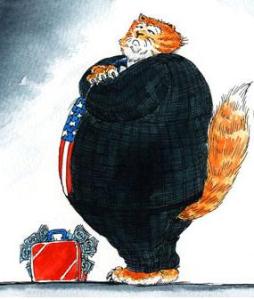 Plutocracy’. It’s an interesting read with a lot of quotes from other pundits.
THE word “plutocracy” is in the air these days. Some say the era of the de facto rule of the mighty top 10%, or top 1%, or whatever insidious sliver of the income distribution is thought to constitute the moneyed power elite, is upon us, or nearly so. I’m not so sure. I am sold on the proposition that there’s something deeply whacked about the American financial system, and that whatever that’s whacked about it is significantly responsible for the top 1% pulling so far away from the rest of the income distribution. This needs to be fixed, whatever its other consequences. It’s not clear to me, however, what exactly is whacked. I don’t know whether to sign up for Tyler Cowen’s “going short on volatility” story, Daron Acemoglu’s “financial-sector lobbying and campaign contributions ‘bought’ an enriching (and destabilising) regulatory structure” story, or some other story. No doubt the truth is in some subtle combination of stories. In any case, accounts such as Mr Acemoglu’s, according to which big players in certain sectors over time manage to rig the regulatory climate to their advantage, are quite compelling for reasons both theoretical and empirical
Newsweek has an interesting article up on why the megarich manage to have such a sweet tax deal. Even if we raise their income taxes, it really doesn’t hit them where it counts. Here’s why.
It drives economist Bruce Bartlett crazy every time he hears another bazillionaire announce he’s in favor of paying higher taxes. Most recently it was Mark Zuckerberg who got Bartlett’s blood boiling when the Facebook founder declared himself “cool” with paying more in federal taxes, joining such tycoons as Bill Gates, Warren Buffett, Ted Turner, and even a stray hedge-fund manager or two.
Bartlett, a former member of the Reagan White House, isn’t against the wealthy paying higher taxes. He’s that rare conservative who thinks higher taxes need to be part of the deficit debate. His beef? It’s a hollow gesture to say the federal government should raise the tax rate on the country’s top wage earners when the likes of Zuckerberg have most of their wealth tied up in stock. Many of the super-rich see virtually all their income as capital gains, and capital gains are taxed at a much lower rate—15 percent—than ordinary income. When Warren Buffett talks about paying a lower tax rate than his secretary, that’s because she sees most of her pay through a paycheck, while the bulk of his compensation comes in the form of capital gains and dividends. In 2006, for instance, Buffett paid 17.7 percent in taxes on the $46 million he booked that year, while his secretary lost 30 percent of her $60,000 salary to the government.
“It’s easy to say ‘Raise taxes’ when you know you’re not going to have to pay those taxes,” Bartlett says. “What I don’t hear is ‘Let’s raise the capital-gains tax.’” Instead the focus has been on the federal tax rate paid by those with an annual income of $250,000 or more—the top 3 percent of earners. Bartlett argues that while raising taxes on the country’s richest individuals would go a long way in easing the debt crisis, it makes no sense to treat the professional making a few hundred thousand dollars a year the same as the Richie Rich set. Maybe it’s hard to muster sympathy for an executive pulling down $1 million a year. But ours is a tax system where a person in the top tax bracket (those earning more than $374,000 in 2010) pays a tax rate of 35 percent on the upper portions of his or her income (37.9 percent if you include Medicare), whereas a hedge-fund manager or mogul earning 10 or 100 times that amount pays less than half that tax rate.
Well, now I’m thinking we’re all just so f’ked that I might as well stop while I’m ahead. What’s on your reading and blogging list today?
Paul Ryan’s Selective Randianism
Posted: April 23, 2011 Filed under: abortion rights, poverty, Psychopaths in charge, religion, Reproductive Rights, The Bonus Class, U.S. Economy, U.S. Politics, voodoo economics, Voter Ignorance | Tags: abortion, Atlas Shrugged, Ayn Rand, Donald Luskin, Down With Tyranny, feminism, Jonathan Chait, linky goodness, Paul Ryan, politics, pro choice, Radianism, Wall Street, William F. Buckley 27 Comments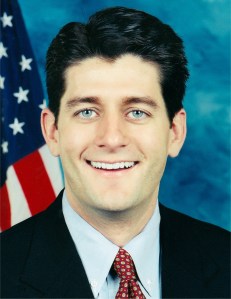
While browsing the links on Memeorandum earlier this afternoon, I came across this post at Down With Tyranny: The Inspiration For Paul Ryan’s Profoundly And Explicitly Anti-Christian Budget. As Lambert would say, it is a post filled to the brim with “linky goodness.” I read all the linked articles and I refer to a few of them in this post.
DWT discusses Ryan’s self-professed admiration for the “philosophy” of Ayn Rand.
What is the great cause for which Ryan wants to devote his political life? Unkind critics point to the unprecedented– at least in Wisconsin politics– gushers of money Ryan has solicited from the Wall Street sector and detect a correlation between the bribes he takes and the policies he espouses. And since there is nothing that holds his voting record– huge, unjustifiable bailouts for Wall Street banks coupled with the dismantling of Medicare and unconscionable tax breaks for the richest Americans coupled with privatization of Social Security– other than obeisance to a garden variety Big Business agenda, this interpretation has become widespread. What people may be missing, however, is a parallel influence on Ryan– one not unrelated, but not identical either: his devotion to the adolescent philosophy of Ayn Rand: “the virtue of selfishness,” a more direct– if somewhat off-putting to non-believers– description of a philosophy known as “Objectivism.”
DWT points out that Rand’s teachings are explicitly anti-Christian–Rand was an atheist who thought altruism was evil and poor and working people were losers and “parasites.” Newsweek’s Jonathan Chait writes:
Ayn Rand, of course, was a kind of politicized L. Ron Hubbard—a novelist-philosopher who inspired a cult of acolytes who deem her the greatest human being who ever lived. The enduring heart of Rand’s totalistic philosophy was Marxism flipped upside down. Rand viewed the capitalists, not the workers, as the producers of all wealth, and the workers, not the capitalists, as useless parasites.
John Galt, the protagonist of her iconic novel Atlas Shrugged, expressed Rand’s inverted Marxism: “The man at the top of the intellectual pyramid contributes the most to all those below him, but gets nothing except his material payment, receiving no intellectual bonus from others to add to the value of his time. The man at the bottom who, left to himself, would starve in his hopeless ineptitude, contributes nothing to those above him, but receives the bonus of all of their brains.”
Chait calls Ryan an “acolyte” of Ayn Rand, and explains at length that the deficit and the debt aren’t what’s bugging the new House superstar. Most of Ryan’s proposals don’t cut the deficit much, and besides, he includes huge new tax cuts for the rich and goodies for Wall Street in his plan. Further more Ryan was an enthusiastic supporter of the Wall Street bailout and he voted for every spending bill that came down the pike under George W. Bush. So what are the Ryan cuts all about?
Ryan’s plan does do two things in immediate and specific ways: hurt the poor and help the rich. After extending the Bush tax cuts, he would cut the top rate for individuals and corporations from 35 percent to 25 percent. Then Ryan slashes Medicaid, Pell Grants, food stamps, and low-income housing. These programs to help the poor, which constitute approximately 21 percent of the federal budget, absorb two thirds of Ryan’s cuts.
Ryan casts these cuts as an incentive for the poor to get off their lazy butts. He insists that we “ensure that America’s safety net does not become a hammock that lulls able-bodied citizens into lives of complacency and dependency.” It’s worth translating what Ryan means here. Welfare reform was premised on the tough but persuasive argument that providing long-term cash payments to people who don’t work encourages long-term dependency. Ryan is saying that the poor should not only be denied cash income but also food and health care.
OK, that part does sound like Randianism, doesn’t it? Rand admired the strong and despised the weak, and so does Paul Ryan, apparently. Rand even went so far as to praise a serial killer for his lack of empathy for his fellow human beings.
On the level of personal behavior, the heroes in Rand’s novels commit borderline rape, blow up buildings, and dynamite oil fields — actions which Rand portrays as admirable and virtuous fulfillments of the characters’ personal will and desires. Her early diaries gush with admiration for William Hickman, a serial killer who raped and murdered a young girl. Hickman showed no understanding of “the necessity, meaning or importance of other people,” a trait Rand apparently found quite admirable.
But did Rand believe that corporations should benefit from government largess? According to Rand devotee Donald L. Luskin, she didn’t.
it’s a misreading of “Atlas” to claim that it is simply an antigovernment tract or an uncritical celebration of big business. In fact, the real villain of “Atlas” is a big businessman, railroad CEO James Taggart, whose crony capitalism does more to bring down the economy than all of Mouch’s regulations. With Taggart, Rand was anticipating figures like Angelo Mozilo, the CEO of Countrywide Financial, the subprime lender that proved to be a toxic mortgage factory. Like Taggart, Mr. Mozilo engineered government subsidies for his company in the name of noble-sounding virtues like home ownership for all.
Still, most of the heroes of “Atlas” are big businessmen who are unfairly persecuted by government. The struggle of Rand’s fictional steel magnate Henry Rearden against confiscatory regulation is a perfect anticipation of the antitrust travails of Microsoft CEO Bill Gates. In both cases, the government’s depredations were inspired by behind-the-scenes maneuverings of business rivals. And now Microsoft is maneuvering against Google with an antitrust complaint in the European Union.
The reality is that in Rand’s novel, as in life, self-described capitalists can be the worst enemies of capitalism. But that doesn’t fit in easily with the simple pro-business narrative about Rand now being retailed.
Luskin seems somewhat bemused by the selective Randianism (my term) of the new Tea Party radicals like Ryan. Traditional conservatives like William F. Buckley “loathed” Rand back in the day, probably because of her atheism and the fact that, while she verbally denigrated feminism, she lived
her life as an exemplary feminist, even as she denied it by calling herself a “male chauvinist.” She was the breadwinner throughout her lifelong marriage. The most sharply drawn hero in “Atlas” is the extraordinarily capable female railroad executive Dagny Taggart, who is set in contrast with her boss, her incompetent brother James. She’s the woman who deserves the man’s job but doesn’t have it; he’s the man who has the job but doesn’t deserve it.
Rand was strongly pro-choice, speaking out for abortion rights even before Roe v. Wade. In late middle age, she became enamored of a much younger man and made up her mind to have an affair with him, having duly informed her husband and the younger man’s wife in advance. Conservatives don’t do things like that—or at least they say they don’t.
These weren’t the only times Rand took positions that didn’t ingratiate her to the right. She was an early opponent of the Vietnam war, once saying, “I am against the war in Vietnam and have been for years. . . . In my view we should fight fascism and communism when they come to this country.” During the ’60s she declared, “I am an enemy of racism,” and advised opponents of school busing, “If you object to sending your children to school with black children, you’ll lose for sure because right is on the other side.”
BTW, none of the male authors I have cited except for Luskin mentioned the abortion issue or the incongruity of the anti-abortion Ryan claiming to believe in Ayn Rand’s vision of complete individualism.
I guess the new fantasy-based Republicans like Ryan can just mentally excise much of Rand’s individualistic philosophy–taking what they want and leaving the rest–just as they do with the bible and with science. How else can Ryan and his radical colleagues rationalize idolizing Ayn Rand while voting again and again to limit the rights of women?
They ALL Suck
Posted: April 19, 2011 Filed under: 2012 presidential campaign, Barack Obama, Democratic Politics, Elections, John Birch Society in Charge, Populism, Republican presidential politics, Surreality, Team Obama, The Bonus Class, U.S. Economy, U.S. Politics, Voter Ignorance, We are so F'd | Tags: poltical campaigns, Presidential campaign, presidential polls 23 Comments
We have gone through the Mirror to a new perverse American Wonderland.
The true lessons from the last two elections have been pretty clear. Voting for “throwing the bums out” just brings worse bums into play. Also, voting for relative unknowns hoping that will change the direction of the country because of their ‘outsider’ status doesn’t work either. Sooner or later, they all become part of the problem. The current crop of new faces is a pretty good indication that voters should be using better criteria than change, hope, not part of the DC establishment, and talks a good talk. I wake up feeling like Alice who went through the looking glass into some perverse alternate reality. The problem is that there really seems like there’s no way back.
The displeasure is obvious in the polls. For the last two elections, folks voted for ‘outsiders’ and got even more dysfunctional government. This latest crop of newbie politicians seems to come in with a ready-made interest group on their coattails. The interest of the general populace isn’t even in the equation any more. We’re worried about unemployment, paying for expensive basics like food, health care, and gas at the pump while the current crop of elected officials just keep inventing surreal crises that simply feed their base’s interests and their donor’s pockets.
Right now, the majority of voters are screaming none of the above. Congress and the White House are hopelessly out of touch with the priorities of the electorate. When the public says its concerned about the economy, it doesn’t mean they are obsessed with the Standard & Poor’s downgrade of US debt instruments. I told you that after they got their tax cuts for billionaires through, raters would do that during the debt ceiling fight, right?
The Tea Party and the White House seemed to be in cahoots–despite seemingly being at odds with each other– to funnel what’s left of US wealth into the Wall Street Gambling Casino by either giving tax breaks to businesses who flee the country for higher stakes or rich people that buy ‘financial innovations’ that create risk and volatility in markets . This all happens along with funneling federal projects straight to them through no-bid government contracts and privatization schemes. These things also enrich market parasites like brokerage firms and insurance companies. I don’t get why people don’t connect these charades with the dismal economy and vote their interests. Maybe it’s because there’s really no one to vote FOR any more. There are only folks to vote against. Angry people do not make good decisions as a general rule.
President Obama has gotten no bounce from his reelection campaign announcement, with his job approval rating dropping by 7 percentage points since January, his personal popularity at a career low and 57 percent of Americans disapproving of his handling of the economy. Yet he leads the potential GOP field.
There are chances for the Republicans in next year’s elections, with former Massachusetts Gov. Mitt Romney and former Arkansas Gov. Mike Huckabee, in particular, nipping close to Obama in the latest ABC News-Washington Post poll. Economic pessimism, its highest in two years amid soaring gas prices, raises serious political peril for the president. But he benefits from two factors: personal approval that, while down, still exceeds his job rating, and substantial doubts about the opposing party’s lineup.
Forty-three percent of Republicans and Republican-leaning independents say they’re satisfied with the choice of candidates for the GOP nomination for president next year, compared with 65 percent satisfaction with the field at exactly this point four years ago. Nearly as many leaning-Republicans are dissatisfied with the field as are satisfied, and far more have no opinion of their potential candidates: 17 percent now vs. 3 percent at this point in 2007.
If those three are my choices, I’d rather opt out of the election and the country. This is dismal! No one is really satisfied with the presidential line-up. I don’t know about you but my choices at the local level have been abysmal for years. If there’s one candidate that really looks like they could actually make a change, a group of anti-abortion nuts, businesses, or other niche interest group comes out of the woodwork to tank them. Our political system is like the proverbial septic tank letting the worst float to the top.
Obviously, money drives races any more. It’s unlikely we can get that changed unless every state starts a ballot initiative for some kind of campaign finance reform. Politicians are like crack addicts that are unlikely to go to rehab and more likely to sound like Charlie Sheen and his ‘winning’ chimera. The problem is that now we have narrow interests funneling money into advertisements–ala swiftboating–that look like the message come from grass roots movements but are they really are the same old, same old that bring the same old, same old to Washington. It’s only a new face. It is not a new person or an agenda of real change.
I’m still amazed to find any one that doesn’t see the astroturf in the Tea Party with the now obvious funding of the Koch Brothers and the like. I’m sure that the investigation into all those ‘little’ donors to OFA will turn out finding yet another, perverse form of bundling. As Caro from Make Them Accountable believes, it’ll probably show that a bunch of Goldman Sachs people bought prepaid debit cards and had a hey-day. The media is so corporate any more that they won’t focus on the jobs crisis, they’re running with the political pack to funnel more public assets to their stockholders. Only the farthest reaches of Internatlandia appear to still be on the good side of the New American Looking Glass.
What a mess! I’m beginning to think we’re just on the verge of the collapse of the empire and there’s not much we can do about. The last ten years have been all about the wrong things. Just today, the UK Guardian released information on the relationship between big Oil and the Blair government’s decision to invade Iraq. I’m just assuming that there’s a Dubya/Cheney set of meetings and memos there too. More proof to support our well-founded skepticism of any motive but obscene profit-seeking from the already powerful and wealthy. We know that entire Iraq debacle was as contrived as ignoring the policies that would create jobs and growth and actually do something about the federal debt and deficit. The emphasis recently on tax cuts has simply exacerbated all the problems but is still held up as the panacea. The arm waving and speeches are just distractions from the real agenda. Sadly, some folks still want to believe that those fresh faces really are more than just masks.
It’s like we’ve all gone through the mirror to some evil wonderland. Help, we’ve fallen through and we can’t get up or out!
Monday Reads
Posted: April 11, 2011 Filed under: 2012 presidential campaign, Civil Liberties, Civil Rights, Federal Budget, Foreign Affairs, Libya, morning reads, Republican presidential politics, SCOTUS, Surreality, Team Obama, The Bonus Class, U.S. Economy, U.S. Politics, unemployment, Voter Ignorance, We are so F'd | Tags: African Union, Black holes tearing apart Stars, Brother leader Ghadifi, Christina Romer, Donald Trump: crazy or just brain damaged from too many bad hair days?, Eric Cantor's latest delusions, grand wizards of the kleptocracy, Guantanomo detainees, INET, Koch Brothers, Larry Summers, magic mushrooms, Obama injustice department, Tea party crazies, unemployment 25 Comments Good Morning!
Well, today I’m starting with a quote from Robert Kuttner for The American Prospect about Larry Summers’ appearance at the INET conference. INET is the acronym for the Institute for New Economic Thinking. It was created with a $100 million grant from George Soros and no, I wasn’t invited and I didn’t attend. Mark Thoma and Brad De Long did. You can read their blogs if you want other views.
Larry Summers, now back at Harvard, was the after-dinner entertainment, interviewed by the prodigious Martin Wolf of the Financial Times, the world’s most respected financial journalist.
Summers was terrific, acknowledging that the stimulus of February 2009 was too small, that the idea of deflating our way to recovery is insane, that de-regulation had been excessive, and that much of the economics profession missed the developing crisis because its infatuation with self-correcting markets.
If only this man had been Obama’s chief economic adviser!
He’s referring to this:
Also worth mentioning is this op-ed by former Obama economist Christina Romer on why we have abysmal unemployment. If you read and listen to both of them, it’s going to be obvious that Obama must not have listened to either of them. No wonder they quit so early on. That leaves Timothy-in-the-well Geithner holding the bag for this miserable recovery, imho. Evidently, the two of them thought what most economists were thinking for several years now but it just wasn’t evident from policy. I guess if I heard this austerity crap was coming down the hopper during this miserable recovery, I’d have bailed before my professional credibility went to the crapper too. Guess Timothy always has the shadow banking industry to keep him warm. Meanwhile, Summers continues his apology tour and Romer clarifies the unemployment situation.
Strong evidence suggests that the natural rate of unemployment actually hasn’t risen very much. Instead, the elevated unemployment rate appears to reflect mainly cyclical factors, particularly a lingering shortfall in consumer spending and business investment.
Okay. The important phrase here is “lingering shortfall in consumer spending and business investment”. That means none of these idiotic tax cuts worked. It also means the stimulus was woefully small and ill-directed. It also means that it’s absolutely no time to worry about austerity unless you want yet another recession. Frankly, I think the Republicans are secretly trying to bring one on and Obama is just not that informed about economics and more concerned about chasing the mythical bi-partisan unicorn to wake the frick up.
Since BB knows that I’m a wannabe astrophysicist (or Egyptologist depending on the day of the week), she sent me another kewl science link about a star torn apart by a blackhole! NEATO!!!
On March 28, 2011, NASA’s Swift satellite caught a flash of high-energy X-rays pouring in from deep space. Swift is designed to do this, and since its launch in 2004 has seen hundreds of such things, usually caused by stars exploding at the ends of their lives.
But this time was hardly “usual”. It didn’t see a star exploding as a supernova, it saw a star literally getting torn apart as it fell too close to a black hole!
The African Union’s been chatting up their “Brother Leader” Whacko Ghadafo and have announced the possibility of an end to the fighting in Libya. And, raise your hand if you’d like to buy the Crescent City connection because I’m entertaining offers since the Brooklyn bridge sold so well last week.
“We have completed our mission with the brother leader, and the brother leader’s delegation has accepted the road map as presented by us,” Jacob Zuma, the South African president, said.
The AU mission, headed by Mohamed Ould Abdel Aziz, the Mauritanian president, arrived in Tripoli on Sunday.
Besides Zuma and Abdel Aziz, the delegation includes Amadou Toumani Toure, Denis Sassou Nguessou and Yoweri Museveni – respectively the presidents of Mali, the Democratic Republic of Congo and Uganda.
Gaddafi made his first appearance in front of the foreign media in weeks when he joined the AU delegation at his Bab al-Aziziyah compound.
The committee said in a statement that it had decided to go along with a road map adopted in March, which calls for an end to hostilities, “diligent conveying of humanitarian aid” and “dialogue between the Libyan parties”.
Speaking in Tripoli, Ramtane Lamamra, the AU Commissioner for Peace and Security, said the issue of Gaddafi’s departure had come up in the talks but declined to give details.
Why is it I want to sing I wanna zooma zooma zooma zooma zoom every time I read something about South Africa these days? Well, as long as it’s not one of those horn thingies that ruined the world cup this last time out.
More crap from Crazy Republicans via Think Progress: Cantor Sees Current Medicare and Medicaid Programs As A ‘Safety Net’ For ‘People Who Frankly Don’t Need One’
Today on Fox News Sunday, host Chris Wallace questioned House Majority Leader Eric Cantor’s (R-VA) support for a plan in which Americans “pay more out of pocket.” Defending the proposal, Cantor argued that these programs sometimes provide a “safety net” for “people who frankly don’t need one” and that the shift of the burden from the government to the beneficiary will teach government “to do more with less”:
CANTOR: We are in a situation where we have a safety net in place in this country for people who frankly don’t need one. We have to focus on making sure we have a safety net for those who need it.
WALLACE: The Medicaid people — you’re going to cut that by $750 billion.
CANTOR: The medicaid reductions are off the baseline. so what we’re saying is allow states to have the flexibility to deal with their populations, their indigent populations and the healthcare needs the way they know how to deal with them. Not to impose some mandate from a bureaucrat in washington.
WALLACE: But you are giving them less money to do it.
CANTOR: In terms of the baseline, that is correct…What we’re saying is there is so much imposition of a mandate that doesn’t relate to the actual quality of care. We believe if you put in place the mechanism that allow for personal choice as far as Medicare is concerned, as well as the programs in Medicaid, that we can actually get to a better resolve and do what most Americans are learning how to do, which is to do more with less.
Actually, 99% of Americans are doing less with less. One percent of Americans are doing more with the corporate and rich people’s welfare that folks like Cantor have handed them on a golden platter for the last ten years. If you have the stomach for it, the link to the TV interview is over at TP too. Frankly, I’ve been sick enough recently and don’t need to see anything that just makes me sicker.
I don’t know about you, but watching Donald Trump–the man who lost his father’s billions and then ran through government subsidies and finally made some money as a really bad reality TV star–as a potential presidential candidate has been sort’ve a surreal trip. James Polis at Richochet says that Trump is Final Proof that the Political Class Has Failed. Trump’s potential candidacy is like an extension of his reality show with gobs of opportunism, self-promotion and narcissism. It’s bad hair gone wild.
There are two main theories cooperating to explain the Trump phenomenon:
- Donald Trump is today’s best self-promoter and professional opportunist.
- The Republican field of presumptive candidates for president is lame.
But neither of these, nor even both together, can adequately explain what’s going on. We can’t even turn for supplemental help to subtheories that emphasize the rise of celebreality culture, the fall of Sarah Palin, or The Continuing Story of Bungling Barry. These variables all appear somewhere in the equation that has produced the Trump phenomenon. But none of them explain it.
Trump is suddenly “winning” as a political figure because the political class has failed. The authority of our political institutions is weak and getting weaker; it’s not that Americans ‘lack trust’ in them, as blue ribbon pundits and sociologists often lament, so much as they lack respect for the people inside them.
My theory is that he’s just a summer replacement, along with Michelle Bachmann, that will set the stage for fall when the blue suited, pompadour-sporting set take over to bore us to death with talks of tax cuts and subsidies ala President Dementia. Other Republican Presidential wannabes must be thinking we’ll be tired of self-promoting, idea-less hacks by then and that they’ll look refreshing by comparison in a few months. Oddly enough, the P woman is keeping a low profile in all of this. Maybe she’s finally figured out that discretion is the better part of valor for a change or it could be she just has enough money for an excellent summer vacation and has decided to exercise her options.
Okay, so I’m going to move on to something light (weirdly, spinning light, emanating from the patterned Chinese lantern covering the naked bulb in my dorm room while a John Lennon album plays Power to the People on my old turntable … oops, wrong flashback) from New Scientist. Thought mushrooms were just for old hippies and  Native American Shaman? Think again. Here’s the headline: Earliest evidence for magic mushroom use in Europe.
EUROPEANS may have used magic mushrooms to liven up religious rituals 6000 years ago. So suggests a cave mural in Spain, which may depict fungi with hallucinogenic properties – the oldest evidence of their use in Europe.
The Selva Pascuala mural, in a cave near the town of Villar del Humo, is dominated by a bull. But it is a row of 13 small mushroom-like objects that interests Brian Akers at Pasco-Hernando Community College in New Port Richey, Florida, and Gaston Guzman at the Ecological Institute of Xalapa in Mexico. They believe that the objects are the fungi Psilocybe hispanica, a local species with hallucinogenic properties.
Like the objects depicted in the mural, P. hispanica has a bell-shaped cap topped with a dome, and lacks an annulus – a ring around the stalk. “Its stalks also vary from straight to sinuous, as they do in the mural,” says Akers (Economic Botany, DOI: 10.1007/s12231-011-9152-5).
This isn’t the oldest prehistoric painting thought to depict magic mushrooms, though. An Algerian mural that may show the species Psilocybe mairei is 7000 to 9000 years old.
What a long strange ride it’s been ever since.
More on Obama-style Justice for Guantanamo detainees as the Supremes decline to clarify their rights.
The Obama administration has fought all attempts by lawyers for detainees to have the Supreme Court review those rulings. And while the news was overshadowed by the administration’s concession that alleged Sept. 11 mastermind Khalid Sheik Mohammed and his co-defendants will be tried by a military commission rather than federal jury — a separate issue — the court last week turned away three detainee challenges arising from Boumediene.
One group active in representing the detainees, the Center for Constitutional Rights, decried what it called the court’s refusal “to defend its Boumediene decision and other precedents from the open defiance of the D.C. Circuit.”
The government told justices that there is no reason for them to believe anything other than “lower courts have properly performed the task that this court assigned them in Boumediene v. Bush.”
“Open defiance” may go a bit far in describing the D.C. Circuit’s rulings, but there is no doubt that the court’s action in Boumediene — and its inaction since — has left few happy.
While detainee advocates complain about the court’s timidity, D.C. Senior Circuit Judge A. Raymond Randolph has received wide attention for a speech he gave last year in which he compared the justices to characters in “The Great Gatsby,” who have created a mess they expect others to clean up.
You don’t need me to start in on the Supremes this morning since BB did such a great job last night. Please go read her thread on just exactly how bankrupt our government has become. Believe me, it’s not an article on the deficit either.
Here’s an important information on the Koch Brothers, grand wizards of the kleptocracy. Alternet says they’re worse than you thought and they’re the astroturf beneathe the Tea Party’s wings.
Then look at a recent position pushed by Americans for Prosperity, the Tea Party-allied astroturf group founded and funded by David Koch (and whose sibling organization, the Americans for Prosperity Foundation, he chairs):
Similarly, Americans for Prosperity supports the House continuing resolution that cuts spending by $61 billion. Those cuts would reduce the budget for the CFTC by one-third. Make no mistake: Gutting the CFTC or limiting its authority would be a boon to Wall Street businesses that use complex financial instruments. But while the result is more profits for oil companies, it means everyone else pays more at the pump.
Okay, now have a look at the Kochs’ recent direct contributions to political candidates:
The Kochs donated directly to 62 of the 87 members of the House GOP freshman class…and to 12 of the new members of the U.S. Senate.
Don’t look now. It’s Atlas Shrugged, the Movie. Bad fiction just refuses to die when it gives erections to obsessive white men. I’m just waiting for next year’s Razzies. It’s the tale of a businessman obsessed. No, not the movie …the making of the movie …
It has taken businessman John Aglialoro nearly 20 years to realize his ambition of making a movie out of “Atlas Shrugged,” the 1957 novel by Ayn Rand that has sold more than 7 million copies and has as passionate a following among many political conservatives and libertarians as “Twilight” has among teen girls.
But the version of the book coming to theaters Friday is decidedly independent, low-cost and even makeshift. Shot for a modest $10 million by a first-time director with a cast of little-known actors, “Atlas Shrugged: Part I,” the first in an expected trilogy, will play on about 300 screens in 80 markets. It’s being marketed with the help of conservative media and “tea party” organizing groups and put into theaters by a small, Salt Lake City-based booking service.
I think I’ll pass. I prefer those nice little British films. I’m anxiously awaiting the redo of Upstairs, Downstairs. I never could make it through that silly John Galt speech even when I was young and my mind was an open book. Now, where are those lights on the ceiling when you need them?

 peej
peej Carissa
 bostonboomer
 dakinikat
 ecocatwoman
 mablue2
 Mama Lopez
 peggysue22
 quixote
 skydancingguestblogger
 Mona (aka Wonk the Vote)



 Sky Dancing
Recent Comments