
Dirty Little Secrets
Posted: February 2, 2011 Filed under: Corporate Crime, Team Obama, The Bonus Class, U.S. Politics, Voter Ignorance, We are so F'd | Tags: corporate tax rates, effective tax rates, self dealing 12 Comments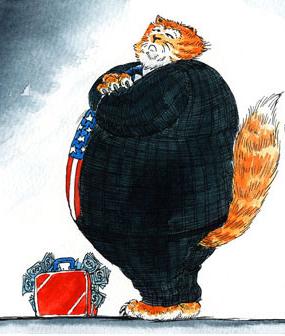 The overall corporate income tax was featured during the President’s SOTU address and by Republican circles. I have mentioned that this particular rate isn’t even relevant anymore in posts and down thread comments because corporations here really don’t pay any where near the effective rate.
There are several reasons for this. First, many of them now set up real or pseudo headquarters in tax and off shore banking havens like the Bahamas or Qatar and place a lot of their operations out of the reach of the IRS. The second is the efficiency of lobbying efforts in getting them so many loopholes that most corporate revenues become exempt. Despite this, corporations use public services and create social costs. Social costs are those costs that the society gets to foot when corporations create problems they or their consumers can pass to the public. A big example is smoking that creates incredible public health issues or pollution. BP is definitely not taking care of the tab for its destruction down here and will most likely escape prosecution for costs the spill will continue to wreck on the environment, livings, and health of people and wildlife in the area. Meanwhile, as an oil business, they are the beneficiary of many, many tax loopholes and direct subsidies.
I was glad to see some hard data–albeit anecdotal–on this phenomenon today in David Leonhardt’s op ed column in the NYT called ‘The Paradox of Corporate Taxes‘. The narrative begins with the example of Carnival Cruises that has a special, extreme loophole that leaves the majority of its revenues untaxed while it uses a number of public resources like services of the Coast Guard. Corporations are cost minimizing and profit maximizing things. They will employ an army of lobbyists and lawyers to help them. They even produce commercials that tout their environmental friendliness and their patriotism. I always shake my head at the commercials of companies like GE and Boeing for whom competitive markets are imaginary and no bid government grants are major sources of revenues. Yet, they act like they are burdened by taxes.
This is so untrue.
Carnival’s biggest government benefit of all may be the price it pays for many of those services. Over the last five years, the company has paid total corporate taxes — federal, state, local and foreign — equal to only 1.1 percent of its cumulative $11.3 billion in profits. Thanks to an obscure loophole in the tax code, Carnival can legally avoid most taxes.
It is an extreme case, but it’s hardly the only company that pays far less than the much-quoted federal corporate tax rate of 35 percent. Of the 500 big companies in the well-known Standard & Poor’s stock index, 115 paid a total corporate tax rate — both federal and otherwise — of less than 20 percent over the last five years, according to an analysis of company reports done for The New York Times by Capital IQ, a research firm. Thirty-nine of those companies paid a rate less than 10 percent.
President Obama indicated that he was willing to simplify the Corporate Tax Code and lower the overall Tax Rate for corporations. In exchange, he asked Congress to remove all the pork, breaks, and exclusions they’ve granted many businesses–including ones that really don’t need it like the Oil Industry–over the years. I doubt we’ll see any moves on the latter. My fear is that will only see movement on the former thus cementing the de-funding of government by the by the very people who benefit from government largess. Many study shows that far more rich and upper middle class Americans and American Businesses use public services and public assets than the poor and working class. After all, who uses the roads, the airways, the universities, the grants and loans, and the many tax loopholes?
While the official corporate tax rate is among the highest of developing countries, the effective rate is among the lowest of the countries that actually have economies that don’t function as tax havens or off shoring banking centers. Even Republican economists will pony up that data.
“A dirty little secret,” Richard Clarida, a Columbia University economist and former official in the Treasury Department under President George W. Bush, has said, “is that the corporate income tax used to raise a fair amount of revenue.”
Over the last five years, on the other hand, Boeing paid a total tax rate of just 4.5 percent, according to Capital IQ. Southwest Airlines paid 6.3 percent. And the list goes on: Yahoo paid 7 percent; Prudential Financial, 7.6 percent; General Electric, 14.3 percent.
Economists have long pleaded for an overhaul of the corporate tax code, and both President Obama and Republicans now say they favor one, too. But it won’t be easy.
Indeed, it won’t be easy. First, it’s difficult for even neutral academics to get a good look at the workings of loopholes because because tax filings are confidential. Loopholes are everywhere and folks that support simplifying the tax code can’t even get a handle on how widespread or huge the problem. Publicly held corporations provide for public stockholder reports but even these things are of limited use over time when studying corporate tax avoidance. My field specializations for my doctorate is International Finance and Trade and Corporate Finance so I lot of my class work and research work is based in corporate finance as well as economics. I know the literature, models, and theories well.
Monday Reads
Posted: January 31, 2011 Filed under: Corporate Crime, Egypt, Foreign Affairs, Global Financial Crisis, income inequality, John Birch Society in Charge, morning reads, SOTU, The Bonus Class, The Great Recession, U.S. Economy, U.S. Politics | Tags: Bennett, Corporate Welfare Recipients Koch brothers, GDP growth, Hatch, Innovation, median incomes flat, Public cost cutting leads to death, Snowe, Tea party targets Lugar, The Great Stagnation, Uncloak the Koch brothers 75 Comments Good Morning!
I thought I’d start the day off with some new topics given we’ve spent the weekend following world events unfold. One of the major complaints of the Egyptian people is their high unemployment rate. It’s basically the same as ours. They also have seen rising food and energy prices. Our overall price inflation is well under control at the moment, but there are world events that have made food and energy prices more volatile than usual. The Egyptians have experienced GDP growth rates that are twice ours, but like our country, the income improvements have advantaged the very few instead of the many for many of the same reasons. One of the guys that skedaddled on that airplane was the big telecom industry captain. We have many huge corporations–like GE–that exist on no bid government contracts that they never lose, even when they’ve been found endlessly maleficent.
I thought I’d start with Tyler Cohen who has been riffing on themes relevant to his for sell on line pamphlet The Great Stagnation. His NYT article this weekend buried one of the themes of the SOTU. It’s called ‘Innovation Is Doing Little for Incomes’.
The income numbers for Americans reflect this slowdown in growth. From 1947 to 1973 — a period of just 26 years — inflation-adjusted median income in the United States more than doubled. But in the 31 years from 1973 to 2004, it rose only 22 percent. And, over the last decade, it actually declined.
Most well-off countries have experienced income growth slowdowns since the early 1970s, so it would seem that a single cause is transcending national borders: the reaching of a technological plateau. The numbers suggest that for almost 40 years, we’ve had near-universal dissemination of the major innovations stemming from the Industrial Revolution, many of which combined efficient machines with potent fossil fuels. Today, no huge improvement for the automobile or airplane is in sight, and the major struggle is to limit their pollution, not to vastly improve their capabilities.
Although America produces plenty of innovations, most are not geared toward significantly raising the average standard of living. It seems that we are coming up with ideas that benefit relatively small numbers of people, compared with the broad-based advances of earlier decades, when the modern world was put into place. If pre-1973 growth rates had continued, for example, median family income in the United States would now be more than $90,000, as opposed to its current range of around $50,000.
You can find more discussion at Marginal Revolution. The Economist weighed in on the booklet tonight.
improvements in rich world living standards may, for the moment at least, come from the capture of policy low-hanging fruit. In other words, the rich world should focus on getting rid of blatantly foolish and costly policies. Moving from taxes on goods, like income, to bads, like traffic congestion, would be a good start. Not spending so much on medical treatments with dubious benefits would be another possibility. Cutting out policy foolishness like agriculture subsidies and the mortgage-interest deduction would be another positive step. Amid rapid growth, really silly policy choices could be tolerated, since surpluses continued to rise. As growth rates slow, the failure to cut out bad policies will mean continued stagnation or declines in living standards for some.And it’s a little amusing to focus on the implications of the spread of cheap-to-free internet amusement. As Mr Cowen notes, the availability of good, free internet entertainment has allowed a lot of people hit hard by falling incomes or recession-induced joblessness to maintain relatively high levels of utility (though this available substitute has also made it easier to cut down on physical consumption, with nasty effects on GDP).
Paul Krugman agrees here. Robert Reich struck a similar chord on stalled incomes in his response to the SOTU. Reich focuses on one of our topics. That would be the important list of what the president didn’t say.
What the President should have done is talk frankly about the central structural flaw in the U.S. economy – the dwindling share of its gains going to the vast middle class, and the almost unprecedented concentration of income and wealth at top – in sharp contrast to the Eisenhower and Kennedy years.
Although the economy is more than twice as large as it was thirty years ago, the median wage has barely budged. Most of the gains from growth have gone to the richest Americans, whose portion of total income soared from around 9 percent in the late 1970s to 23.5 percent in 2007. Americans kept spending anyway by using their homes as ATMs but the bursting of the housing bubble put an end to that – leaving them without enough purchasing power to reboot the economy. So the central challenge is put more money into the pockets of average Americans.
This narrative would be politically risky (opening Mr. Obama to the charge of being a “class warrior”) but at least honest. And it would allow him to connect the dots – explaining why his new health-care law is critical to reducing medical costs for most working families, why tax reform requires cutting taxes on the middle class while raising them on the rich, why the Bush tax cuts shouldn’t be extended for the wealthy, why deficit reduction must not sacrifice education and infrastructure (both important to rebuilding middle-class prosperity) and why any cuts in Social Security or Medicare must be on the backs of the wealthy rather than average working families.
I still can’t believe we have a President that doesn’t run a counter narrative to the Republican Voodoo economic fantasy. I guess it’s left to those of us in the blogosphere to hammer home traditional democratic values. So, speaking of some of the worst of the worst, there’s a movement afoot to UnCloak the Kochs. Those John Birch Society Billionaires that want to bring down social security have been taking up some virtual ink in left blogistan. Here’s something from the New York Observer: ‘7 Ways the Koch Bros. benefit from Corporate Welfare’.
Now that we’ve heard about their charitable giving, David’s 240-foot mega-yacht and role as patrons of the Tea Party movement, it’s time to ask a more serious question: How libertarian are they?
The short answer…not very.
Charles and David Koch, the secretive billionaire brothers who own Koch Industries, the largest private oil company in America, have spent millions bankrolling free-market think tanks and pro-business politicians in order, as David Koch has put it, “to minimize the role of government, to maximize the role of private economy and to maximize personal freedoms.” But a closer look at their dealings reveals that for the past 35 years the brothers have never shied away from using government subsidies to maximize their own profits, even while endeavoring to limit government spending on anything else.
These guys are a veritable bankroll for so-called think tanks that spout more tank than think. Some one should let them know that their businesses are hardly shining examples of a free market. These guys are card carrying members of the crony capitalist set.
In 1977, Charles Koch founded the Cato Institute, an influential libertarian think tank, with the aim of injecting free-market ideas into the mainstream. The Kochs would go on to establish and fund a vast network of overlapping think tanks, institutes, foundations, media outlets, and lobby groups that would vilify centralized government and promote laissez-faire capitalism as the only route to economic prosperity. The Mercatus Center, Americans for Prosperity, Reason Magazine, the Federalist Society and the Heritage Foundation are just a few of the right-wing organizations that run on Koch cash today.
David Dayen has a post up at FDL about protests organized to protest these bloated trust fund babies and their plutocratic friends. These guys are manufacturers of stupidity like climate change denial. Common Cause organized the protest.
After a litany of speakers – including Jim Hightower, Rick Jacobs of the Courage Campaign, and Common Cause President and former Illinois Congressman Bob Edgar, the entire group of protesters moved to the setup across the street from the resort. Police helicopters buzzed overhead. After a while, the police agreed to shut down Bob Hope Drive, and the protesters streamed across the street and directly in front of the resort, just a few inches away from the phalanx of riot cops. The usual protest chanting and raising of banners ensued. More cops were brought in, traipsing over the flower beds. And 25 protesters were taken away in a paddy wagon. The protests were generally peaceful, and the police professional.
The protesters generally decried the Koch Brothers’ influence over American democracy, in particular their use of the Citizens United ruling to spend corporate money in elections. Koch Industries’ funding of climate denialism and other conservative causes was on the minds of the protesters as well.
You can read some of the dirty deeds that pay others to do dirt cheap in the NYT article on the Tea Party targets. Here’s the list of who is in their ‘surveyor’ marks for the 2012 Senate elections. Evidently, Indiana Senator Richard Lugar is one of the guys they’re after. Here’s some more making their unclean, impure list.
In Maine, there is already one candidate running on a Tea Party platform against Senator Olympia J. Snowe. Supporters there are seeking others to run, declaring that they, too, will back the person they view as the strongest candidate to avoid splitting their vote. In Utah, the same people who ousted Senator Robert F. Bennett at the state’s Republican convention last spring are now looking at a challenge to Senator Orrin G. Hatch.
The early moves suggest that the pattern of the last elections, in which primaries were more fiercely contested than the general election in several states, may be repeated.
They also show how much the Tea Party has changed the definition of who qualifies as a conservative. While Ms. Snowe is widely considered a moderate Republican, Mr. Hatch is not. Mr. Lugar, similarly, defines himself as a conservative. He argues that he has consistently won praise from small-business groups, supported a balanced budget amendment and pushed for a reduction in farm subsidies and the closing of agricultural extension offices as part of an effort to reduce unnecessary spending — all initiatives that fall under the smaller government rubric of the Tea Party.
Guess that means there’s more bat shit crazy folks waiting in the wing to mangle and destroy American history and the constitution. Do you suppose we’ll see any more “I am not a witch” ads?
So, last week I posted something sent to me from BostonBoomer about the rise in violent attacks in prisons due to cost cutting measures and outsourcing to private firms. BB’s found another more horrible link. CNN reports the death of a correctional officer in Washington who had made a complaint to her union steward that she feared for her safety.
Jayme Biendl, 34, was discovered late Saturday night after workers at the Monroe Correctional Complex noticed her keys and radio were missing, according to a statement from the Washington State Department of Corrections. Staff at the prison immediately went to where she worked and found her unresponsive, it said.
Emergency responders declared Biendl dead at the scene shortly before 11 p.m. PT, the department said.
She had been strangled, according to Chad Lewis, a department spokesman.
So, it’s monday morning, I spent all weekend rewriting an article on Venture Capital. As long as you don’t have anything to say about that, because I’ve frankly reached my fill on the subject , I’d like to know …
What’s on you reading and blogging list today?
State of the Union Address Live blog (Continued) Blah, Blah, Blah …
Posted: January 25, 2011 Filed under: 2012 presidential campaign, Live, SOTU, The Bonus Class | Tags: blah, blah response, Paul Ryan, Republican Blah, Schizophrenic SOTU 83 CommentsThis is our generation’s Sputnik moment. Two years ago, I said that we needed to reach a level of research
and development we haven’t seen since the height of the Space Race. In a few weeks, I will be sending a budget to Congress that helps us meet that goal. We’ll invest in biomedical research, information technology, and especially clean energy technology – an investment that will strengthen our security, protect our planet, and create countless new jobs for our people

SusieMadrak Susie Madrak
How will we pay for all this innovation and infrastructure creation with a DOMESTIC SPENDING FREEZE? #bullshit#sotu
ddayen David Dayen
“Let’s fix what needs fiing and move forward” just like torture! #sotu
rickklein Rick Klein
big shout-out for malpractice reform from the president.
SusieMadrak Susie Madrak
Oh, the tort reform crap again. Even though it’s been proved it’s a myth. #sotu
PaulRieckhoff Paul Rieckhoff
We must remember we still have troops in Iraq–and some dying. The war is not over. #SOTU#NonCombatMyAss
Let’s make kissy face with the SPEAKER!!!
That dream is why I can stand here before you tonight. That dream is why a working class kid from Scranton can stand behind me. That dream is why someone who began by sweeping the floors of his father’s Cincinnati bar can preside as Speaker of the House in the greatest nation on Earth.
It’s the birth of BOEHNERELLA!!!!
owillis Oliver Willis
that was a b- speech for obama #highbar
digby56 digby
Borger:” It wasn’t a transformational speech…I’m not sure that by not talking more about the deficit and jobs they got that done.”
Now Up Paul Ryan who is also politicizing Congresswoman Giffords.
More about how reducing spending during high unemployment actually isn’t actually flat earth economics.
More blah blah blah … I wonder if he reads his kids old Ayn Rand newsletters to his kids to put them to sleep at night?
Transcript from NPR here.
What we already know about the President’s health care law is this: Costs are going up, premiums are rising, and millions of people will lose the coverage they currently have. Job creation is being stifled by all of its taxes, penalties, mandates and fees.
Businesses and unions from around the country are asking the Obama Administration for waivers from the mandates. Washington should not be in the business of picking winners and losers. The President mentioned the need for regulatory reform to ease the burden on American businesses. We agree — and we think his health care law would be a great place to start.
Last week, House Republicans voted for a full repeal of this law, as we pledged to do, and we will work to replace it with fiscally responsible, patient-centered reforms that actually reduce costs and expand coverage.
Health care spending is driving the explosive growth of our debt. And the President’s law is accelerating our country toward bankruptcy.
Our debt is out of control. What was a fiscal challenge is now a fiscal crisis.
We cannot deny it; instead we must, as Americans, confront it responsibly.
Some one needs to tell him it’s not trust in government, it’s trust in politicians that’s at an all time low. Well, I’m depressed now.
Just take a look at what’s happening to Greece, Ireland, the United Kingdom and other nations in Europe. They didn’t act soon enough; and now their governments have been forced to impose painful austerity measures: large benefit cuts to seniors and huge tax increases on everybody.
About 99 percent of us have that sinking feeling
Posted: January 23, 2011 Filed under: just because, Populism, right wing hate grouups, Second Amendment, Social Security, SOTU, The Bonus Class, the villagers, U.S. Economy, U.S. Military, U.S. Politics, Voter Ignorance, We are so F'd | Tags: Kevin Drum, leftwing, liberals, libertarians, political ideology, Right Wing 21 Comments You know me and my wonky graphs. You also know I blog a lot about rising income inequality and that I think it’s a huge problem. So, this MOJO Power graph and the article it came with piqued my curiosity. It’s from an article by Kevin Drum writing on a Timothy B Lee blogpost on the preemption of ‘genuine left wing voices’ by libertarians. I’m not sure how libertarians could be confused for moderates, liberals or lefties but given that establishment conservatives have an orthodoxy so tight that few fit, I suppose everything else gets to wear the liberal label. But, maybe there’s more to it than that.
We talked about this a little on a thread yesterday. Both Ariana Huffington and Kos used to be Republicans. They left the party when the religious right took over and because, frankly, I don’t think they like the fact that so many blue collar Reagan Democrats had just up and joined their old country club. There’s also the odd phenomenon of tea party populists that don’t seem to know where they are or where they belong either. We’ve seen how a lot of these folks have made their way into policy circles through their support or their horror of the current administration so I think it’s worth viewing three blog writers on that topic. Why are so many people confused about their political identity any more?
Libertarian ‘insight’ used to the butt of jokes at academic cocktail parties where you discussed Utopian moonbattery and even worse fiction. Now there seems to be an industry around producing what they call journals, institutions, and philosophy that is some how running loose in mainstream conversations demanding to be taken seriously. It’s hard to do that because they don’t associate with data and they seem to thrive on passing memes that have no basis in reality. (The ones on the FED just kill me.) They’re in the tea party, they’re all for Rand and Ron Paul, and yet, some of them have made their way to the liberal blogosphere. What’s going on? Plus, what’s the deal with all these solid working class–in some cases UNION folks–heading to tea party rallies? Haven’t they ever heard of Dick Armey?
Drum shows how the worst of the libertarian assumptions they hold up as facts just don’t hold up to the light of day. He starts with a shared assumption from the right wing and libertarians as described by Will Wilkinson. This meme is the mild form libertarianism from the Hayek-Friedman sect.
It’s best to just maximize growth rates, pre-tax distribution be damned, and then fund wicked-good social insurance with huge revenues from an optimal tax scheme.
We’ve got scads of data that show this meme to be a completely false assumption. We’d have a better economy right now if that were true. In fact, the only time we had a decent economy in recent history was when that particular assumption was rolled back during the Clinton years. But, don’t take it from me, read what Kevin Drum has to say. Those assumptions are very wrong.
First, it contains an implicit conviction that libertarian notions of tax and regulatory structures will maximize growth rates. This is practically an article of faith on the right, but there’s virtually no empirical evidence to support it. As it happens, I’d argue that my preferred brand of the modern mixed economy is, on the whole, probably more efficient than a stripped down libertarian state, even one that includes lots of centrally-directed income redistribution. But not by much. Personally, I’d be pretty happy if both sides accepted the notion that within a fairly wide range of modern capitalist systems — from Sweden to the U.S., say — overall growth rates change very little. For the most part, we’re really arguing about other things.
Second, I suspect there’s no feasible path to Will’s state of the world. The problem is that a system that generates enormous income inequality also generates enormous power inequality — and if corporations and the rich are allowed to amass huge amounts of economic power, they’ll always use that power to keep their own tax rates low. It’s nearly impossible to create a high-tax/high-service state if your starting point is a near oligarchy where the rich control the levers of political power.
Third, look at the graph. We’ve had this trickle up to the one percent form of economic nonsense since the Reagan years and all it’s done is made things radically worse. It’s led to this situation where the supply side of the curve completely craps all over the demand side of the curve in product markets. The outright hostility to unions and the abuse and disempowerment of human beings–not human “capital”–have completely shifted income levels and underlying market power to some place where you truly think you’d see some kind of general revolt, strike, or overthrow.
It should be patently obvious now that Wall Street has recovered, bonuses have recovered, and corporate profits have recovered while any one not up at the top of that racket can hardly survive these days. The unemployment rate, the numbers of foreclosures, and the numbers of bankruptcies are tips of the icebergs. We’re not going to see growth rates of GDP that will clear that up too. More frightening is that the powers that be don’t seem to even fake caring.
When you point all these things out to libertarians, they’ll shift the ground on you and say point me where it says in the constitution and mutter something about Wilson and the imperial presidency. This is the place where they firmly intersect the right wing. Look, Wilson is dead. The Bush legacy lives and the Obama legacy is still being written. Still, some of them have crept over and become neoliberals and identified with the left. Why?
An Obituary for New Deal Liberalism
Posted: January 17, 2011 Filed under: Bailout Blues, Barack Obama, Populism, The Bonus Class, U.S. Economy, U.S. Politics, Voter Ignorance | Tags: Looting Social Security, The End of New Deal Liberalism, The Nation, William Grieder 5 CommentsIf you haven’t read William Grieder’s powerful piece ‘The End of New Deal Liberalism’ at The Nation, you really should.  Let me give you a taste.
In these terms, the administration of Barack Obama has been a crushing disappointment for those of us who hoped he would be different. It turns out Obama is a more conventional and limited politician than advertised, more right-of-center than his soaring rhetoric suggested. Most Congressional Democrats, likewise, proved weak and incoherent, unreliable defenders of their supposed values or most loyal constituencies. They call it pragmatism. I call it surrender.
Obama’s maladroit tax compromise with Republicans was more destructive than creative. He acceded to the trickle-down doctrine of regressive taxation and skipped lightly over the fact that he was contributing further to stark injustices. Ordinary Americans will again be made to pay, one way or another, for the damage others did to society. Obama agrees that this is offensive but argues, This is politics, get over it. His brand of realism teaches people to disregard what he says. Look instead at what he does.
Greider outlines the goals of the plutocracy so clearly that you wonder when he’ll be put up for trumped up espionage charges or at least some made-up sex scandal. His opening paragraphs on the capture of our government by corporate interests are just about the most compelling and apt description I’ve read recently. He’s awakened some how to the spokesmodel-in-chief. (h/t to Cinie wherever she may be)
Government has been disabled or captured by the formidable powers of private enterprise and concentrated wealth. Self-governing rights that representative democracy conferred on citizens are now usurped by the overbearing demands of corporate and financial interests. Collectively, the corporate sector has its arms around both political parties, the financing of political careers, the production of the policy agendas and propaganda of influential think tanks, and control of most major media.
What the capitalist system wants is more—more wealth, more freedom to do whatever it wishes. This has always been its instinct, unless government intervened to stop it. The objective now is to destroy any remaining forms of government interference, except of course for business subsidies and protections. Many elected representatives are implicitly enlisted in the cause.

 peej
peej Carissa
 bostonboomer
 dakinikat
 ecocatwoman
 mablue2
 Mama Lopez
 peggysue22
 quixote
 skydancingguestblogger
 Mona (aka Wonk the Vote)



 Sky Dancing
Recent Comments