
Tuesday Reads: Wisconsin Recall Madness!
Posted: June 5, 2012 Filed under: 2012 elections, Labor unions, morning reads, Populism, Psychopaths in charge, Reproductive Rights, Republican politics, Right to Work, Tea Party activists, The DNC, the GOP, the villagers, U.S. Economy, U.S. Politics | Tags: Chris Cillizza, grass roots activism, InTrade, John Nichols, Koch Brothers, PPP polling, public employee unions, Rebecca Kleefisch, Scott Walker, Tom Barrett, voter turnout, Wisconsin recall election 65 Comments
Good Morning!!
Today is the day of reckoning for Wisconsin. Voters will go to the polls today to decide the fate of Governor Scott Walker and five other Wisconsin Republicans: the Lieutenant Governor and four state senators. If the Democrats can win just one of those seats, they will regain the senate majority.
I think everyone here knows the genesis of this recall battle, but here’s a quick explainer from Chris Cillizza at the WaPo. Cillizza also speculates on possible surprising outcomes from the election.
Cillizza allows that Barrett could conceivably win and the Democrats could retake the senate–the latest poll by PPP had Walker leading by only 3 points, within the margin of error. The poll also suggested that Barrett had the momentum as of yesterday. On the other hand, InTrade had Walker’s chances at more than 90% late last night. The truth is no one really knows for sure, because the turnout and enthusiasm on each side will tell the tale. Cillizza, being a Villager, still thinks Walker will win, but thinks the Senate could switch.
When they filed petitions to recall Walker himself last fall, Democrats also filed papers to recall another four state senators — Senate Majority Leader Scott Fitzgerald, and Sens. Pam Galloway, Terry Moulton and Van Wanggaard, (Galloway resigned earlier this year; Republican state Rep. Jerry Petrowski is running for her seat.)
They need only win one race to take control.
Fitzgerald is likely safe given his heavily Republican district, although Lori Compas, his Democratic rival, has attracted a lot of media attention.
But Democrats are bullish on the races against Moulton and Wanggaard. Both districts went for President Obama in 2008; Wanggaard’s went narrowly for John Kerry in 2004. Whether Barrett wins or not, they expect to take back the state Senate.
Moulton faces former state Rep. Kristen Dexter; Wanggaard faces former state Sen. John Lehman (D). Outside groups have spent hundreds of thousands of dollars on both sides. State Rep. Donna Seidel (D) also has a shot at beating Petrowski; before Galloway the seat had gone Democratic for two decades.
Cillizza points out that if Barrett wins and the Democrats take the state senate and could get some of the Walker legislation overturned before another election could give the senate back to the Republicans. The other possibility, Cillizza mentions is that Democrats could defeat Walker’s Lt. Governor Rebecca Kleefisch, but that’s pretty unlikely. She’s leading in the polls at the moment.
The Seattle Times had a good article on Sunday about the national issues that are at stake in the election today.
Under fire for cutting budgets at the expense of public employees, Walker would be the third governor in U.S. history yanked from office in a recall election. Walker has an edge, but the race is close.
The campaign will mean more than who governs Wisconsin. It’s a test case of the larger clashes in American politics that are driving elections for the presidency and control of Congress, highlighting divisions over the costs of government.
With more than $30 million raised from conservative donors, many of them from other states, and visits from a who’s who of high-profile Republican governors (New Jersey’s Chris Christie, South Carolina’s Nikki Haley, Louisiana’s Bobby Jindal and Virginia’s Bob McDonnell), Walker’s campaign to survive the recall has the feel, the money and the stakes of a national race.
The state vote is raising questions that will echo nationwide. Can a tough-minded conservative Republican force cuts in government at the risk of angering public-employees unions and win a swing state such as Wisconsin? Will voters think he’s doing the best he can in a tough time? Or will they rise in a grass-roots backlash against the well-financed Republican effort?
Admittedly, that article has a Republican flavor, but it does do a pretty good job of spelling out the issues. For a more left-wing perspective, here’s a lengthy piece at by Sarah Jaffe of Alternet: Wisconsin’s Recall Drama Down to Nail-Biting Finish.
Wisconsin’s recall is, as reporter John Nichols put it, the kind of “renegade politics” that are disdained by the national Democratic party and even some state Democrats. It is being driven by the same activists who turned out by the thousands to occupy their capitol when Governor Scott Walker attacked workers’ right to organize and bargain collectively.
Now, a day before the biggest recall yet—of Governor Walker, Lieutenant Governor Rebecca Kleefisch, and four Republican state senators—the fight will be won or lost where it began: on the ground.
There’s a lot of big outside money pouring into Wisconsin, mostly to pump up Walker’s attempt to hang on to his seat, but the one thing that money can’t buy is an excited, driven grassroots movement. If Milwaukee mayor Tom Barrett beats Walker on Tuesday, it will be because of thousands of volunteers getting out the vote person by person.
“This is really a case of Walker raising $13 million against possibly the most widespread grassroots get-out-the-vote effort in the state’s history,” Matt Reiter, co-president of the Teaching Assistants’ Association at the University of Wisconsin at Madison, told AlterNet.
Please try to check that one out. It’s long, and very informative. John Nichols of The Nation (mentioned prominently in Jaffe’s piece) is Wisconsin native, and has written a book about the struggle in his home state. Here’s a piece Nichols wrote yesterday: How To Buy A Recall Election.
Governor Scott Walker is not trying to win the Wisconsin recall election that will be held June 5.
He is trying to buy it.
If the embattled governor does prevail, he will provide essential evidence not of his own appeal but of the power of money to define our politics.
On the other hand, if Walker is defeated, a template will have been developed for a people-power, message-power politics that might be able to challenge big money.
And there is no question that what is in play is very big money.
Read the gory details at the link.
At Salon, Josh Eidelson writes about the possible effects of some Wisconsin voters’ “resentment” of union workers on the recall outcome.
If Scott Walker survives tomorrow’s election, there will be plenty of reasons. Many people will point to his huge cash advantage, for good reason. But no factor will have been more important than the decades of decline in U.S. union membership.
“Unions had their place,” a woman named Jerri told me soon after I arrived in Wisconsin last week. “They did their part back in the ‘40s and ‘50s, and then they got too big, and are abusing their power.” Jerri and her husband, Tim (both declined to give last names), were eating at a bar in Wauwatosa, the purple Milwaukee suburb that’s home to Scott Walker. They both work in sales: She’s in retail at the mall; he’s in wholesale, selling caskets. Tim said Walker’s union “reforms” were necessary because local politicians had been “looking out for the union” instead of “people like me.” He said unions are for people who don’t “feel they should have to work very hard.” Jerri complained that unions “are sucking off my teat.” Public workers’ benefits, she said, “should be the same as anybody in any kind of private job.”
That last statement is most telling. While resentment toward unions has grown since the 1950s, it’s not because they got too big. It’s because they got too small. A multi-decade drop in unionization left fewer Wisconsinites who are union members or live in union households. Meanwhile, because governments are less prone than businesses to terrorize workers or shut down facilities to avert unionization, public sector unionization has remained more stable. In 2009, for the first time, there were more total U.S. union members in government employment than in the entire private sector.
That one is pretty scary for those of us who care about quality education and public services.
The Wall Street Journal highlights the importance of turnout in the recall election.
Both sides say few voters remain undecided, after more than $63.5 million in political spending saturated the airwaves and clogged voters’ mailboxes. A weekend survey by the Democratic group Public Policy Polling found Mr. Walker holding a slight lead and only 3% of likely voters undecided. With few voters left to persuade, the main question is which side will win the turnout battle.
Labor groups and their allies knocked on more than 300,000 doors during the past few days and placed more than 400,000 phone calls, said Brian Weeks, the assistant political director for the American Federation of State, County and Municipal Employees union.
Unions historically have had a strong ground game. But Republicans said they took a page from labor’s playbook and have developed a coordinated get-out-the-vote effort, which could also give the party a boost in the November presidential election, helping the GOP equal the Democrats’ election-day machinery.
Felicia Sonmez and Rachel Weiner of the WaPo write about the battle of “TV ad spending vs. boots on the ground.” They say that this election:
serves as a proxy for the national battle between Democrats’ much-touted ground organization and Republicans’ fundraising advantage.
With Walker ahead in the polls and leading Milwaukee Mayor Tom Barrett (D) in the money race by more than 7 to 1 – and with GOP-aligned outside groups far outspending their counterparts across the aisle — Democrats maintain that their shot at victory depends on a far superior get-out-the-vote operation buoyed in large part by organized labor.
According to Monica Davey at the NYT,
About 60 to 65 percent of Wisconsin residents of voting age are expected to go to the polls on Tuesday, the state’s Government Accountability Board said. That would be a higher turnout than two years ago, when Mr. Walker and a wave of Republicans largely swept state and federal offices here, but not as high as the more than 69 percent turnout in 2008, when Barack Obama easily won the state.
Only time will tell. We’ll have a live blog this evening so we can follow the results together. Now I need you to let me know what else is in the news. I look forward to clicking on your links.
Open Thread: Top Romney Aide Made Millions from Obamacare
Posted: June 4, 2012 Filed under: 2012 presidential campaign, Tea Party activists, The Right Wing, U.S. Politics, Voter Ignorance | Tags: Affordable Care Act, Department of Health and Human Services, Health care, Mike Leavitt, Mitt Romney, Obamacare, Rep. Jason Chaffetz 24 Comments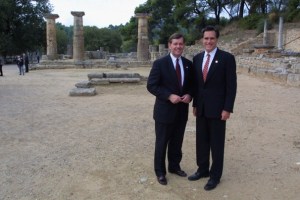
Best buds Mike and Mitt
Lots of corporate news sources were buzzing over the weekend about Romney’s appointment of former Utah Governor Mike Leavitt to head up his transition team. It’s also assumed that Leavitt would have the inside track to get the plum role of Chief of Staff in a Romney administration. Leavitt is also the guy who hired Romney to turn around the scandal-plagued Winter Olympics in 2002.
According to Utah Rep. Jason Chaffetz, a Romney adviser, Leavitt is “the ideal candidate” for the transition job because of:
his three terms as Utah governor as well as serving as administrator of the Environmental Protection Agency and secretary of Health and Human Services under President George W. Bush.
“Mike Leavitt checks every box. It’s a combination of experience and personal relationship,” Chaffetz said. “He can help outline the parameters of what a transition would look like.”
Leavitt has been on board with the Romney campaign throughout the primaries; he has his own office at the Boston headquarters. He and Romney are close, says Politico, and they’re “a lot alike.”
One Romneyland figure said Leavitt’s influence is derived from the fact that he is a spoke in many of the concentric circles around the candidate. Leavitt is part of Romney’s orbit of Mormon associates, but he also sits in the realm of the policy gurus, political counselors, fellow governors and veterans of the Salt Lake Olympics.
So with little fanfare, he has become one of the most influential advisers to the candidate this election cycle. He has an office at the Boston headquarters, travels with Romney at times, has been summoned to rally donors and is tight enough with the high command that he scored an invite to campaign manager Matt Rhoades’s engagement party last month.
He’s also a surrogate and has headlined health care policy discussions at $10,000 per-person Beltway fundraisers for Romney.
Romney officials say Leavitt is often circumspect but has an E.F. Hutton-like effect when he does speak up; many in Boston believe he offers much of his advice directly to Romney — something Leavitt suggests is accurate.

Mike Leavitt
Although it happened following Leavitt’s tenure, Utah was the second state after Massachusetts to institute universal health care. And Leavitt is the health care business–and he’s made millions in profits from Obamacare. At Salon, Alex Seitz-Wald writes:
Leavitt, who served as Health and Human Services secretary under George W. Bush, leads a firm that has positioned itself as a leading consultancy to help implement the Affordable Care Act (PDF), and it’s already won contracts to do so.
Just two weeks ago, the company was awarded a $1 million contract with the state of New Mexico to help it build its exchanges, and Politico reported that the “size of his firm, Leavitt Partners, doubled in the year after the bill was signed as they won contracts to help states set up the exchanges funded by the legislation.”
On its web site, Leavitt Partners features prominently its “Health Insurance Exchange Intelligence Team,” an entire section of the business that advises clients on how to implement and respond to the health insurance exchanges created by Obamacare.
“The passage of the Patient Protection and Affordable Care Act (PPACA) altered many of the fundamentals of healthcare coverage and financing,” the company’s website states. “Our team has a deep background and understanding of exchanges, from the policy side to the technical requirements and infrastructure necessary to operate an exchange. Our team members have unique experience in building exchanges and analyzing health insurance markets.”
Today, the right wingers have suddenly awakened from the collective trance that followed their reluctant recognition that Romney’s their guy now. And they are not happy about the Leavitt appointment. From TPM:
The Wall Street Journal reported last year that Leavitt “strenuously backed the core piece of President Barack Obama’s health-care law and urged the states to move forward together in adopting health insurance exchanges.” And his stance hasn’t changed: “We believe that the exchanges are the solution to small business insurance market and that’s gotten us sideways with some conservatives,” Leavitt’s top aide Rich McKeown told Politico.
“We’re troubled by it,” Dean Clancy, who runs health care advocacy for the Dick Armey-led conservative group FreedomWorks, told TPM Monday via email. “We’re very concerned. The tea party grassroots have always feared that Gov. Romney would be a weak standard bearer because of RomneyCare. This choice only reinforces those doubts. Tapping a high-profile ObamaCare profiteer is disturbing, there’s no way around it. … The tea party has been fighting exchanges in state after state.”
Michael Cannon, who directs health policy for the libertarian Cato Institute, reacted to the Leavitt choice in a blog post he penned: “Romney’s appointment of Leavitt is a first step toward flip-flopping — or Etch-a-Sketching, or Romneying(TM), or whatever — on ObamaCare repeal.”
The right wing blogs are in a tizzy too. Time to break out the popcorn!

Hey Righties! Haven’t you noticed? Willard’s a pathological liar. And besides, he just not that into you. He’s all about amassing more money and power for Willard, not you or your pathetic, rage-filled party.
Ya Think? The impact of Republican Extremism
Posted: April 21, 2012 Filed under: 2012 elections, 2012 presidential campaign, 2012 primaries, abortion rights, American Gun Fetish, Tea Party activists, The Bonus Class, The Right Wing, U.S. Politics, Voter Ignorance, War on Women, Women's Healthcare, Women's Rights, worker rights | Tags: Republican Extremism 23 Comments The amazingly, huge gender gap and the obvious lack of support by Hispanic Americans for Romney and other Republicans is troubling the party’s establishment. Republicans have also lost the vote of young people who don’t understand why state officials are obsessed with every one’s personal sex life. Republicans have been denying the party has escalated their attempts to eradicate women’s constitutional rights to abortion but the number of laws introduced by states in the last two years has been monumental. They have moved to directly attacking other women’s preventative health services like birth control access and funding of Planned Parenthood. They’ve passed laws that allow law enforcement to stop folks on the street based on no other reason than they might possibly “look” illegal and demand proof of citizenship. They’ve chipped away at labor bargaining rights, citizen voting access, and science education by supporting bogus religious-based claims on climate change and evolution. They’ve tried everything possible to deny basic civil rights to GLBT Americans by passing laws that use a purely religious definition of marriage and parenthood.
In the last two years, there’s been a surge in legislation that seems squarely aimed at inserting religious dogma into law and enacting privatization schemes for prisons, schools, and all levels of public services. There’s also been noticeable defunding of public education and public health access. They’ve insisted they’ve been focused on the economy. However, even there, the sole focus appears to be taxing poor people, providing tax breaks to the rich and corporations, and decimating public services at all levels of government. The nation’s infrastructure has never been in worse shape. It’s at the point where it’s not only dangerous but it threatens our commercial competitiveness. Our transportation, telecommunications and power infrastructures are antiquated and falling apart.
So, now they are scrambling to get back to an “economic” message to ramrod right wing panderer Willard Romney into the White House. They think we’re all stupid and we’re going to forget two years of legislation aimed at driving us back into the dark ages.
Here’s a snippet of a NYT article that catches the party elite grumbling about state efforts to turn the country into something that resembles a theocratic, corporate state. Considering they’ve gotten in bed with these reactionaries to win elections in the past, they really shouldn’t grumble now that the party’s been purged of all but the most extreme.
But this year, with the nation heading into the heart of a presidential race and voters consumed by the country’s economic woes, much of the debate in statehouses has centered on social issues.
Tennessee enacted a law this month intended to protect teachers who question the theory of evolution. Arizona moved to ban nearly all abortions after 20 weeks, and Mississippi imposed regulations that could close the state’s only abortion clinic. Gov. Scott Walker of Wisconsin signed a law allowing the state’s public schools to teach about abstinence instead of contraception.
The recent flurry of socially conservative legislation, on issues ranging from expanding gun rights to placing new restrictions on abortion, comes as Republicans at the national level are eager to refocus attention on economic issues.
Some Republican strategists and officials, reluctant to be identified because they do not want to publicly antagonize the party’s base, fear that the attention these divisive social issues are receiving at the state level could harm the party’s chances in November, when its hopes of winning back the White House will most likely rest with independent voters in a handful of swing states.
One seasoned strategist called the problem potentially huge.
I See Dead People
Posted: February 27, 2012 Filed under: 2012 elections, 2012 primaries, corruption, Democratic Politics, Environment, Environmentalists, George W. Bush, Politics as Usual, Republican politics, Tea Party activists 23 CommentsMaybe this should be the new Republican mantra for a suitable candidate in 2012. If Republican politicians aren’t conjuring up the ghost of  Ronald Reagan every fifteen minutes, they can go back further into the annals of GOP glory and dig up another Republican corpse. Say . . . Ike Eisenhower. And lo and behold, that’s exactly what NY Times columnist Ross Douthat attempts in his recent “The Greatness of Ike” piece, which extolls the General’s many virtues, bemoans the fact that Eisenhower is overshadowed by the likes of FDR, ties for twelfth-place in POTUS rankings with Jimmy Carter and is generally under appreciated.
The man may have a point.
I recall Eisenhower’s warnings about the industrial/military complex being aired frequently throughout my living memory. Yet no one has paid much attention beyond nodding and saying: yes, the man was right. I suspect the current state of affairs, the country involved in a decade of senseless war, where defense contractors and mercenaries have been made fat and happy, proves the General’s point. Only problem for the Republicans is that it was likes of George W. Bush, Dick Cheney and Donald Rumsfeld who led the disastrous charge into Iraq on false allegations, hyped-up claims about weapons of mass destruction, and then offered a breath-taking defense of torture for national security purposes. Even more startling, they got away with it, leaving the country bleeding and bankrupt in their wake. All in the name of democracy, freedom and ‘shop ‘till you drop’ exhortations.
It was a moment of infamy, as someone once said.
This is why the glance backwards always skips over those inconvenient years of woeful mismanagement and fiscal insanity. No doubt the current batch of 2012 candidates, the Fearless Four, bring angst to all Republican hopefuls convinced, only a few, short months ago, that a 2012 victory was inevitable, a piece of cake.
A powerful dose of nostalgia makes the medicine go down easier.
Surely, the good ole days seem ever more grand as Rick Santorum raises the flag for a home-grown theocracy and dances with the Devil, Mitt Romney continues to stumble over his own tongue [revealing his wife drives ‘two’ Caddies], Newt Gingrich beats his breast over the secular plot to undermine America and Ron Paul, the cuddly libertarian, begins to look and sound strangely reasonable.
 What’s a true-blue Republican to do?
Dig up some corpses.
Am I, a thoroughly disenchanted Democrat gloating? In a pinch, yes. In the long-term, no, because I’m stuck with a candidate I did not vote for in 2008, a man who has proven himself less a champion of Democratic principles than even I ever expected.
As a Nation, we are stuck in a rut for which there seem few alternatives. The legacy parties offer nothing but more of the same—craziness on one side and the uninspiring ‘we suck less than they do’ on the other. As a voter, I’ve vowed to go 3rd party in November [unless the Republicans were to choose Santorum, then I’ll vote directly against him]. However, in the larger frame all I see are monied interests, directing and maneuvering what is suppose to be a ‘free’ election. It has virtually nothing to do with me or my values. On the contrary, it’s all about the persistence of a political class and their cash-soaked benefactors calling for war and protecting their national interests, the gutting of our social contract; the unwillingness to formulate a sensible energy program sans the giant fossil fuel companies’ interference or address the critical and devastating slippage in education, infrastructure, healthcare and employment opportunities.
We have plenty of money for bombs. But not our people. Bailouts are bad. Unless our representatives are saving the asses of and colluding with the corrupt TBTFs. Water and food is the stuff of life until there’s a pipeline, gushing with sludgy oil and money, to compromise both.
Ed Rollins, former Reagan strategist, made a statement recently about the 2012 Republican field:
“Six months before this thing got going, every Republican I know was saying, ‘We’re gonna win, we’re gonna beat Obama.’ Now even those who’ve endorsed Romney say, ‘My God, what a fucking mess.’
That about sums it up, not simply about the Republican field but the entire country. It is an effing mess. And there’s no savior on the horizon. In fact, there’s no savior anywhere. Unless we, the American public, do the saving. But that means coming together on issues where we can agree. The gridlock in DC gets us absolutely nowhere. It’s enough to put anyone into a funk.
But then this morning I read an article about environmentalists and Tea Party activists coming together to fight Keystone XL, the pipeline extension from Nebraska to Texas. For the Tea Party, it’s all about individual property rights and the way TransCanada, a foreign company, has attempted to strong-arm property owners. For the environmentalists it’s about preserving fertile farm land and a major aquifer from the too real danger of irreversible contamination. The nexus of agreement between these two wildly divergent political groups is this: the Keystone pipeline does not serve the public’s interest.
That’s the winning hand: the public’s interest. Not the oil companies, not the 196 people funding the SuperPacs, not the banks, not the Democratic or Republican parties.
What serves the public’s interest.
We, American citizens, can find ways to work together or continue to be spectators to the endless political theater, the Kabuki dance we call elections. And once more we’ll be digging up corpses, which could very well be our own.


 peej
peej Carissa
 bostonboomer
 dakinikat
 ecocatwoman
 mablue2
 Mama Lopez
 peggysue22
 quixote
 skydancingguestblogger
 Mona (aka Wonk the Vote)



 Sky Dancing
Recent Comments