
Saturday Reads: Daily Caller Caught Red-Handed (?), GOP “Estranged from America,” and Other News
Posted: March 23, 2013 Filed under: Barack Obama, morning reads, Republican politics, Social Security, U.S. Politics | Tags: abortion, Chained CPI, David Martosko, Dominican investigation, East Coast meteor, Foster Friess, Income Inequality, North Dakota Stand Up for Women Rally, Politico, Robert Menendez, The Daily Caller, the top 1%, Tucker Carlson, Washington Post 28 Comments
Good Morning!!
There’s a lot of news out there this morning, so I’ll get right to it.
Well, well, well, isn’t this an interesting headline at the WaPo: Dominican official links Daily Caller to alleged lies about Menendez.
A top Dominican law enforcement official said Friday that a local lawyer has reported being paid by someone claiming to work for the conservative Web site the Daily Caller to find prostitutes who would lie and say they had sex for money with Sen. Robert Menendez (D-N.J.).
The lawyer told Dominican investigators that a foreign man, who identified himself as “Carlos,” had offered him $5,000 to find and pay women in the Caribbean nation willing to make the claims about Menendez, according to Jose Antonio Polanco, district attorney for the La Romana region, where the investigation is being conducted.
The Daily Caller, owned by smirky right winger Tucker Carlson, claims it’s not true. Sure, Tucker.
The videotaped claims of two women, made with their faces obscured, were posted in the fall on the Daily Caller. The site reported that “the two women said they met Menendez around Easter at Casa de Campo, an expensive 7,000-acre resort in the Dominican Republic. . . . They claimed Menendez agreed to pay them $500 for sex acts, but in the end they each received only $100.”
In its statement Friday, the Daily Caller said: “At no point did any money change hands between The Daily Caller and any sources or individuals connected with this investigation, nor did anyone named Carlos travel to the Dominican Republic on behalf of The Daily Caller. As recently as two weeks ago, Figueroa was on record with another news outlet as saying the women he represented were telling the truth about their initial allegations against Senator Menendez.”
There’s quite a bit of wiggle room in that denial. So no one from the Daily Caller actually handed money to anyone, and “Carlos” didn’t travel from the U.S. to the Dominican. Big deal. The arrangements were probably made by phone and the money was giving out through the lawyer.

I don’t know what happened for sure, but I know Tucker Carlson is a sleazy S.O.B. What I didn’t know until today (via Crooks and Liars) is that the Daily Caller got its start-up funds from Foster Friess, the Republican billionaire donor who recommended that women put an aspirin between their knees as contraception. C&L’s Karoli also linked to this Mother Jones article by Kate Sheppard: Controversial Daily Caller Editor Admitted to Posing As Radical Animal Rights Activist.
David Martosko—the outgoing executive editor of the conservative Daily Caller and a prominent defender of the news site’sdisputed claim that Sen. Bob Menendez (D-N.J.) paid two women for sex in the Dominican Republic—admitted in a court document obtained by Mother Jones that he used a fake Facebook profile to pose as a “dope-smoking commie” in order to gather information on animal rights activists. The admission came in a May 2011 depositionMartosko gave under oath as part of a defamation case against him and his former employer, Berman and Company, a PR shop that specializes in combating progressive activists who target corporations.
Before Daily Caller Editor in Chief Tucker Carlson hired him in 2011—a controversial choice given Martosko’s previous arrests and lack of experience in journalism—Martosko spent a decade working for Richard Berman, a longtime PR operative behind a number of industry-backed campaigns. At Berman and Company, Martosko served as the director of research for the Center for Consumer Freedom, a Berman-run nonprofit that opposes new laws on food and beverages. CCF, which is funded by the food and beverage industry, runsHumane Watch, a website that posts derogatory information about the Humane Society of the United States. Martosko was the site’s “founding editor.” CCF also operates Activist Cash, a website that compiles biographical information on groups and individuals that engage in “anti-consumer activism.”
Despite all this circumstantial evidence that the Daily Caller is a fraudulent operation, Politico posted a piece by MacKenzie Weinger supporting Carlson’s operation and implying that the WaPo is trying to defend Democrats rather than simply reporting the results of investigative reporting.
Also from the WaPo, and op-ed by Andrew Kohut of the Pew Research Center — The numbers prove it: The GOP is estranged from America. I actually have a lot of problems with this article–Kohut writes from the point of view of an old-style Republican, which he is. He claims that the Democratic Party has gotten more liberal, when the current Democratic President, Barack Obama has publicly state that his ideology is that of a Rockefeller-type Republican. Here’s an excerpt:
Paul Krugman Tries to Explain “Facts” to Ron Johnson and ABC “Powerhouse Roundtable”
Posted: March 10, 2013 Filed under: Affordable Care Act (ACA), Barack Obama, Medicare, open thread, Republican politics, Social Security, U.S. Economy, U.S. Politics | Tags: ABC's This Week, Paul Krugman, Senator Ron Johnson 23 Comments
Are there stupider Senators than Ron Johnson (D-WI)? Maybe, but he has to be in the top five. Via Think Progress, this morning on ABC’s This Week, Johnson pulled out an old Republican canard, claiming that the Social Security Trust Fund is “a myth.” Nobel Prize-winning economics Paul Krugman attempted to set him straight. You can watch the partial video down below, but I decided to read the whole transcript of the interaction. Here’s how it went down.
Johnson and Krugman participated in the “Powerhouse Roundtable” with George Will, Bloomberg News White House Correspondent Julianna Goldman, and DNC Chair Rep. Debbie Wasserman Schultz. The group began by discussing President Obama’s supposed charm offensive of the past few days. Johnson rambled on about how Obama is doing the right thing by “reaching out” to the GOP and maybe something can come of it. I have to hand it to Krugman, because he immediately steered the discussion toward the GOP and Obama’s hopes for cutting earned benefit programs.
KRUGMAN: I’m really skeptical, because I — I mean this is not — this is not about bad personal relations. People are perfectly capable of being polite to each other, being nice, having a nice dinner. This is about a fundamental difference in visions about what America should be…One party really wants to take down the — the — the safety net we have. One party really wants….to privatize Medicare, wants to, you know roll back, wanted to try to privatize Social Security back in 2005. The other party wants it somewhat extended, wants Obamacare to go into place, would do more if it could. That’s not something you’re going to resolve with a few dinners.
Corporate media shill Juliana Goldman chimes in to state the village consensus:
Look, both sides understand what a grand bargain is going to look like. You’re going — Republicans are going to have to give on revenues, Democrats are going to have to give on entitlements. And so there is some case for optimism now that if the president, in trying to build trust…if Republicans see the president moving forward, putting Medicare savings on the table that doesn’t just hit providers, but also hits beneficiaries as well, then — and also going out and selling it to give Republicans some cover, then there could be a sense that you could get some Senate Republicans to — to help bring the House along.
George Will brings up raising the Medicare age and asks Debbie Wasserman Schultz if there’s any chance all those old codgers in Florida will ever see the light so that Democrats could go along with this brilliant idea? No real response from Schultz, so Krugman (he was on fire today!) jumped in again. From here on, I’ll just focus on the interaction between Johnson and Krugman and leave out the few remarks by others.
KRUGMAN: Is it a condition of any Republican support that you have to go for really terrible policies? Because raising the Medicare age is a terrible policy. It raises medical costs, it does very little to improve the budget. It introduces a lot of hardship. Means testing in Medicare is a better policy. I don’t particularly like it, but it’s a better policy. There are other things you can do. There are other ways you can cut. Even — I don’t like the business about changing, you know the price index for Social Security, but that’s not as bad…
JOHNSON: To say that the Republicans haven’t done anything, is just false. The House has actually passed budgets. You know with — with proposals to — to try and save Medicare, bipartisan proposals, quite honestly. The Senate hasn’t passed a budget in over four years. Listen, unless we do something, these programs are going broke. It drives me nuts. When I — when I hear people say that Social Security is solvent to the year 2035, it’s not….
Listen, if you — if you’re taking a look at, in a entitlement reform package, in term — you know actually bringing in revenue for those entitlement reforms, I might look at that. But the fact of the matter is — the fact of the matter is, we already have a $1 trillion in middle income tax increases hitting us in Obamacare. They’re hidden, but it’s middle-class….it’s certainly true, as well as another $600 billion. So, you’ve already got $1.6 trillion worth of tax increases hitting us in the next 10 years….
KRUGMAN: Just a question, you say let’s start with the facts, but there — we’ve just — we’ve just run aground right there….JOHNSON: You’ve made my point — you’ve made my point, we have to agree on the facts….But the facts are false.
JOHNSON: No they are not….They are not false.
KRUGMAN: The Social Security thing, Social Security is — there — it has a dedicated revenue base. It has a trust fund based on that dedicated revenue base. You can’t change the rules midstream and say, oh suddenly….
JOHNSON: …here’s the problem with the trust fund, the federal government owns U.S. Treasury bonds, it’s the same thing as if you have $20.00, you spend it. And by the way, that money is spent, it’s gone. You write yourself a note for $20.00, stick it in your pocket and say, I got 20-bucks…No, you don’t. You — you have a note that you have to sell in the open market. The trust fund is a fiction, it doesn’t — it’s…
KRUGMAN: If you — if you want to think of Social Security as not just being part of the government, then there’s no such thing as a Social Security problem, it’s just part of the general budget. You — you cannot say on the one hand….on — on the other hand we’re going to — we’re going to restrict it to only operating off of…it’s important to realize that the facts that are being brought out here are in fact, non-facts.
Here’s the video from Think Progress:
From a piece Kevin Drum wrote last fall in response to WaPo columnist Charles Krauthammer spouting the “Social Security Trust Fund is a fiction” meme. Like Johnson, Krauthammer was arguing that because Social Security funds are invested in Treasury bonds which it cashes in when current funds aren’t sufficient for immediate needs, that the Trust Funds is just “a bunch of useless IOU’s,” to quote George W. Bush.
Here’s Drum:
What Krauthammer means is that as Social Security draws down its trust fund, it sells bonds back to the Treasury. The money it gets for those bonds comes from the general fund, which means that it does indeed have an effect on the deficit.
That much is true. But the idea that the trust fund is a “fiction” is absolutely wrong….Starting in 1983, the payroll tax was deliberately set higher than it needed to be to cover payments to retirees. For the next 30 years, this extra money was sent to the Treasury, and this windfall allowed income tax rates to be lower than they otherwise would have been. During this period, people who paid payroll taxes suffered from this arrangement, while people who paid income taxes benefited….
As the baby boomers have started to retire, payroll taxes are less than they need to be to cover payments to retirees. To make up this shortfall, the Treasury is paying back the money it got over the past 30 years, and this means that income taxes need to be higher than they otherwise would be. For the next few decades, people who pay payroll taxes will benefit from this arrangement, while people who pay income taxes will suffer.
If payroll taxpayers and income taxpayers were the same people, none of this would matter. The trust fund really would be a fiction. But they aren’t. Payroll taxpayers tend to be the poor and the middle class. Income taxpayers tend to be the upper middle class and the rich. Long story short, for the past 30 years, the poor and the middle class overpaid and the rich benefited. For the next 30 years or so, the rich will overpay and the poor and the middle class will benefit.
The trust fund is the physical embodiment of that deal. It’s no surprise that the rich, who didn’t object to this arrangement when it was first made, are now having second thoughts. But make no mistake. When wealthy pundits like Krauthammer claim that the trust fund is a fiction, they’re trying to renege on a deal halfway through because they don’t want to pay back the loans they got.
It’s disgusting that this has to be explained over and over again to the willfully obtuse Republicans and the media talking heads, but I have to say that I’m glad Krugman was there this morning to call attention to the stupidity of what the GOP–and Obama–are proposing.
Now, here’s a bonus for you that I found at Americablog this morning. Florida Rep. Alan Grayson is warning there will be “civil disobedience” if Social Security benefits are cut.
What are you hearing and seeing out there? This is an open thread.
Republicans Hate Government Programs that Work because they Prove them Wrong
Posted: March 9, 2013 Filed under: Social Security | Tags: Josh Barro, Munnell (2012), Private retirement accounts fail, retirement savings, Social Security 16 Comments I’m always bemused by conversations with government-hating Republicans because the assumption is that the private sector always does it better and government programs aren’t–by definition–cost or service efficient. As you know, I’m an economist by training. This puts me in the category of people that look specifically for things that minimize costs and maximize output because economics is chiefly concerned with helping society allocate scarce resources to the most efficient use. So, I examine each product or service and look at the various characteristics and look for signs of market vitality or market failure.
It becomes obvious fairly quickly that the government is actually best at doing some things and that in some markets, the government must interfere to guarantee an efficient outcome. This totally goes against the ideological bent of those that just want to drown government in their golden bath tubs. This is because they’re really not looking for the best outcomes for the market or for the society. They’re looking to set up a zero-sum game where they get as much as possible because most of them have been set up into positions where they can do so through no attributes of their own. This means that others get less by no fault of their own which goes without consideration. No one also discusses the aspect that it comes from “no fault of their own” because it goes against the “these people are weak and dependent” canard that the advantaged like to push. Most so-called ‘free-market champions’ don’t like efficient, competitive markets because these markets produce efficient outcomes. The advantaged really prefer markets that they can game so they get more than an efficient market would allocate.
I’ve spent some time in the past describing situations where it’s really impossible for the market to work without some government interference. Usually, these markets are full of risks like information asymmetry and moral hazard. Actually, I think most of you recognize those terms because I use them so much. Essentially, any market can be gamed if the demand or supply of that market exhibits pretty specific characteristics. We’ve known these characteristics for a very long time. They are no secret. The markets that function the least efficiently when left alone are markets where the pricing mechanism doesn’t work because it’s for a good or service that is hard to price. Many times there’s the risk of unknown or hidden information where there are a lot of third parties that step in to provide expert information because the buyers can’t navigate the markets by themselves.
Any market where there are information brokers or ‘insurance’ or ‘maintenance’ plans usually indicates a good or a service where the buyers are in a weak position of knowing what’s going on and have to pay others to negotiate the risk for them. This also makes them vulnerable to scams. Financial markets are rife with that kind of situation. So are markets where it’s hard to get the service or good because it’s so pricey, rare, or technical and not many people can afford it. Some of the things that many countries offer through government provision are health insurance or service, education and scientific research, public safety, and old age and disability insurance. We’ve found–through careful study–that government provision of many of these things is cheapest and most efficient because placing every one in one market eliminates these risks. These programs have come under increasing attack in the US by the current nuts in the Republican Party and a bunch of sold-out Democrats. That’s because there are profits to be made from re-introducing the risk into the market.
The attacks on government provision are never based on the efficacy of the programs themselves. Almost every one can see that programs like  Head Start and Social Security do exactly what they’re supposed to do. In most places–including the states where I grew up–public education works so well that the demand for private education is fairly limited. But, rather than look at what’s right with the public schools in Minnesota or Nebraska or North Dakota, Louisiana Governor Jindal turns to a private providers. We’ve had that now for about 7 years and the school district in New Orleans filled with private charters has no better outcomes than it did before privatization. The experiment is already shown to be failing but still, the push is on. Similarly, if you would turn retirement funds completely over to Wall Street, chances are you’d have the same kinds of miserable failures that characterize most 401K plans. One of the biggest problems is fee churning where people pay exorbitant fees that drain their returns and principle despite fund performance. Such is profit-driven third party provision.
So, I could spend some more virtual ink on the documented failures of these many privatization schemes for goods and services where the academic studies document the failures and the press and the politicians ignore the stylized facts. Instead, I want to share Josh Barro’s excellent article explaining why we should be expanding Social Security--one of these highly successful programs–rather than quietly watch the program be strangled by greedy ideologues. He’s provided wonky graphs and numbers. I’m showing you photos of elderly poverty during the Great Depression. Elder poverty was vast at that time. Social Security changed that. So, why strangle something that works so well? Take a look at those pictures because if these folks get away with dismantling the program, those situations will return. What kind of burden will that leave to our children or will they just gently step over all the sick and dying old people in the streets who haven’t been taken in by their still struggling relatives?
With everyone in Washington experiencing sea-bass-induced euphoria, we’re talking again about a “grand bargain” to replace the sequestration and shrink the federal budget deficit. And that means we’re talking about using the chained consumer-price index, a lower and more accurate inflation measure, to modestly raise taxes and cut Social Security benefits over time.
Back in December, I wrote that applying chained CPI to Social Security is the wrong solution to our budget problems: It’s just a way of dressing
up a cut to retirement benefits at a time when retirement insecurity is rising. Despite its problems, Social Security is the best-functioning component of the U.S.’s retirement-saving system. Instead of cutting, the federal government should be expanding its role in retirement saving.
I’m always struck when people talk about Social Security as “just” an insurance program, when it’s in fact the most important retirement-saving vehicle. The chart below, adapted from a 2012 paper by Boston College Professor Alicia Munnell, shows the financial situation of a “typical” pre-retirement household. These are the mean holdings of a household in the middle net worth decile among households headed by people age 55 to 64.
Okay, I had to give into my inner wonk and put in one graph. As you can see, most older Americans are or will be highly reliant on their Social Security Savings. I would also like to remind a few people that folks of my age were told if we went along and paid all of our working incomes into Ronald Reagan’s big FICA tax increase, our Social Security benefit would be safe. So, how does it feel to watch these folks ready and able to pull the rug out from under those folks especially after most of their investments and home prices have not really recovered since the Great Recession of 2007.
Keep in mind, that most folks nearing or at retirement rely on bonds which are paying nearly historically low rates of interest and will continue to do so for some time because of Fed policy to keep interest rates low. You are told to shift your funds away from equities and into bonds as you close in on retirement. Anyone that followed that advice for their 401ks or 403bs is probably looking at a pretty grim situation. The same Fed Policy that is stimulating all those grand stock market surges and corporate profits is killing most older adults and retired folks’ retirement savings portfolios. And, that implies some that they have them. Large number of studies say that a lot of folks do not have any kind of retirement benefit or savings outside of their homes and social security. So, you can see that I’m really not kidding when I envision kids either having to take their grandparents into their homes or endure stepping over them in the streets. Social Security is the program that keeps the elderly independent, fed, and alive. Or, as Barro puts it more succinctly:
Social Security is dominant: Forty-nine percent of this household’s wealth is in the form of the expectation of drawing government benefits in the future. The next largest slice, 23 percent, is accrued benefits in traditional pension plans. But that figure is skewed by a handful of workers who are lucky enough to participate in such plans; as of 2010, only 14 percent of U.S. workers were earning benefits in such a plan.
Private saving for retirement is woeful. This typical near-retirement household has just $42,000 in retirement accounts and $18,300 in other financial assets. For most Americans, Social Security isn’t augmenting private saving; private saving is (just barely) augmenting Social Security.
And as both home equity and stocks were battered over the last few years, retirement insecurity worsened. Munnell and her colleagues estimate that as of 2010, 53 percent of American households were on track to be more than 10 percent below the amount of assets they would need at age 65 to maintain their standard of living in retirement, up from 44 percent in 2007.
There are many ways to enhance Social Security. Barrow mentions three of them. But, as he points out, none of those are the default option of the Beltway crowd.
The default assumption in Washington is that Social Security needs to be cut to fix our long-term budget problems. But it’s really a question of priorities. Social Security is, by definition, an efficient program: About 98 percent of its costs go out in the form of benefit checks, which the beneficiaries spend on whatever they value most. If we raise taxes on the people who would gain from increased benefits and cut in areas like Medicare, where the government buys a lot of things we don’t really need, we can afford to augment the federal role in retirement saving and alleviate the problem of retirement insecurity.
See that? We’re talking about an efficient government program. But, again, that seems to just fly in the face of the current Republican party’s–and more than a few Democratic enablers– desire to recreate Mississippi in every possible place in America. They don’t want any example of government programs that work well because that doesn’t fit in with their 100% privatization schemes that increase their personal wealth and the wealth of their plutocrat overlords. The most sad thing is that the most successful public programs are those that provide security to the most vulnerable populations; poor children and the elderly. So, granny and baby-starving Republicans are literally hurting the least among us to do the bidding of their corporate plantation masters who seem to never, ever get enough.
It’s obviously not about what works and what doesn’t or what’s an efficient use of tax payer money and what’s not. It’s about enriching the few at the cost of the many while using outright lies and distortions to confuse the issue. We don’t need to socialize many things in order to achieve an efficient economy. Indeed, there are many markets that would operate better without government interference to subsidize the suppliers. But, you rarely hear any one talk about removing the many market-killing examples of corporate welfare. Instead, you only hear about sinking the government programs that are efficient and provide a modicum of safety to the least among us. I think a lot of it is because it outrages their sensibilities to see themselves be proved so hugely wrong time and time again. Government subsidies to corporations are seen as enabling the free market even when they do the very opposite. But, political decision makers create or make programs inefficient to support their world views. This makes the ridiculous attacks on Social Security and Head Start even more spurious. What really kills me is the number of pundits that would rather spout platitudes pushed in their mouths by their delusional overlords than find studies like Munnell’s that prove them so very wrong. At least a few of them–like Josh Barro at Bloomberg who is also the son of one of the gods of economics–takes the time to do a little research. Now, if some of that research would only reach the President’s desk.
Senator Bernie Sanders Introduces Bill to Apply Payroll Tax to High Incomes
Posted: March 7, 2013 Filed under: Barack Obama, Medicare, Social Security, The Media SUCKS, U.S. Economy, U.S. Politics | Tags: payroll tax cap, Senator Bernie Sanders, Social Security 31 Comments
I’m sure most of the corporate media will ignore this, but Senator Bernie Sanders today introduced a bill to “strengthen Social Security” by applying payroll taxes to all income–including from self-empoyment–to people earning more than $250,000 annually. So far I’ve only seen this reported by one national media outlet.
Sanders and other liberals are concerned Obama may strike a deficit-reduction deal with Republicans that would reduce Social Security benefits by adopting a less generous way of adjusting benefits for inflation.
Sanders on Thursday introduced legislation co-sponsored by Senate Majority Leader Harry Reid (D-Nev.) to raise payroll taxes on the wealthy to extend the solvency of Social Security.
Democratic Sens. Barbara Boxer (Calif.), Amy Klobuchar (Minn.), Sheldon Whitehouse (R.I.), Al Franken (Minn.) and Richard Blumenthal (Conn.) have co-sponsored the bill as well.
Representative Peter De Fazio is introducing a companion bill in the House.
“Social Security is facing an unprecedented attack from those who either want to privatize it completely or who want to make substantial cuts,” said Sanders at a press conference. “The argument being used to cut Social Security is that because we have a significant deficit problem and a $16.6 trillion national debt, we just can’t afford to maintain Social Security benefits.
“This argument is false. Social Security, because it is funded by the payroll tax, not the U.S. Treasury, has not contributed one nickel to our deficit,” he said.
Sanders estimates switching to a chained-CPI formula for determining benefits for Social Security would result in the average 65 year old living on about $15,000 a year receiving $650 less each year when they turn 75 and $1,000 less a year when they turn 85.
The bill is supported by (PDF) “The Strengthen Social Security Campaign, comprised of more than 320 organization throughout the country representing more than 50 million Americans, including the National Committee to Preserve Social Security and Medicare; AFL-CIO; United Steelworkers; Alliance for Retired Americans; Social Security Work; Campaign for Community Change; The Arc.”
The AARP announced yesterday that it is going to be running ads
If you haven’t read the op-ed by Thomas Edsall (The War on Entitlements) in today’s New York Times, I hope you will take the time to do so now. Thanks to RalphB for posting the link on the morning thread! Here’s the introduction:
The debate over reform of Social Security and Medicare is taking place in a vacuum, without adequate consideration of fundamental facts.
These facts include the following: Two-thirds of Americans who are over the age of 65 depend on an average annual Social Security benefit of $15,168.36 for at least half of their income.
Currently, earned income in excess of $113,700 is entirely exempt from the 6.2 percent payroll tax that funds Social Security benefits (employers pay a matching 6.2 percent). 5.2 percent of working Americans make more than $113,700 a year. Simply by eliminating the payroll tax earnings cap — and thus ending this regressive exemption for the top 5.2 percent of earners — would, according to the Congressional Budget Office, solve the financial crisis facing the Social Security system.
So why don’t we talk about raising or eliminating the cap – a measure that has strong popular, though not elite, support?

I think we all know the answer to that question, don’t we?
Gene Sperling: “A mix of entitlements and revenues was part of the DNA” of the Sequester “from the start.”
Posted: February 28, 2013 Filed under: 2012 presidential campaign, Austerity, Barack Obama, Medicaid, Medicare, Social Security, U.S. Economy, U.S. Politics | Tags: Bob Woodward, digby, entitlement cuts, Gene Sperling, Jon Walker, Robert Kuttner, the sequester 38 Comments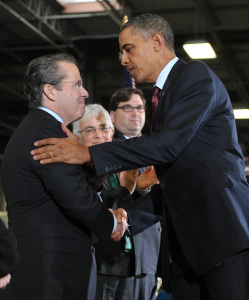
Gene Sperling and Barack Obama
I want to call attention to some rather startling statements in Gene Sperling’s e-mail to Bob Woodward, which I posted earlier. Please note the highlighted sections.
From Gene Sperling to Bob Woodward on Feb. 22, 2013
Bob:
I apologize for raising my voice in our conversation today. My bad. I do understand your problems with a couple of our statements in the fall — but feel on the other hand that you focus on a few specific trees that gives a very wrong perception of the forest. But perhaps we will just not see eye to eye here.
But I do truly believe you should rethink your comment about saying saying that Potus asking for revenues is moving the goal post. I know you may not believe this, but as a friend, I think you will regret staking out that claim. The idea that the sequester was to force both sides to go back to try at a big or grand barain with a mix of entitlements and revenues (even if there were serious disagreements on composition) was part of the DNA of the thing from the start. It was an accepted part of the understanding — from the start. Really. It was assumed by the Rs on the Supercommittee that came right after: it was assumed in the November-December 2012 negotiations. There may have been big disagreements over rates and ratios — but that it was supposed to be replaced by entitlements and revenues of some form is not controversial. (Indeed, the discretionary savings amount from the Boehner-Obama negotiations were locked in in BCA: the sequester was just designed to force all back to table on entitlements and revenues.)
I agree there are more than one side to our first disagreement, but again think this latter issue is diffferent. Not out to argue and argue on this latter point. Just my sincere advice. Your call obviously.
My apologies again for raising my voice on the call with you. Feel bad about that and truly apologize.
Gene
Really? Does anyone recall President Obama saying that at the time the sequester was proposed and voted on in 2011? Did President Obama discuss these plans for entitlement cuts during his campaign for re-election? I’ve always suspected he did plan cuts in Social Security, Medicare, but when did he publicly state this? I’ve done a somewhat cursory search, but I can’t find anything.
There is no mention of these agreed-upon cuts in the Wikipedia entry on the Budget Control Act of 2011. There no mention of “entitlement” cuts in this extensive article at The Bipartisan Policy Center. This analysis (pdf) notes that the Supercommittee was authorized to cut Social Security:
The “Super Committee” deficit reduction plan: BCA also creates a new, special joint committee of Congress charged with finding at least $1.2 trillion in deficit reduction to avoid any potential sequestration. This “Super Committee” can cut spending (including Social Security and Medicare), raise revenue, or propose a combination of both. If the committee cannot agree on a plan, or Congress fails to approve it, automatic cuts of $1.2 trillion will be triggered through sequestration. To assist the Super Committee with its task, Congress also provided for an accelerated review of the Super Committee recommendations, provided that the Super Committee followed specific timelines, as outlined in the text.
But I think it was generally assumed that the Super Committee would not be able to agree on anything, and if they did that the Senate at least would not vote for Social Security cuts.
So now the truth has come out. Certainly no one from the White House has come rushing out to deny that cuts in Social Security, Medicare, and Medicaid are what is supposed to balance any new revenue. A few other bloggers have written about this.
Digby is always alert for any mentions of Obama’s seeming obsession with cutting Social Security, and she didn’t miss this one.
I don’t know that anyone’s ever admitted that in public before or that the president was completely, shall we say, honest when he ran for his second term about that specific definition of “a balanced approach”. I haven’t heard anyone say publicly that the sequester “deal” as far as the White House was concerned was to cut “entitlements” in exchange for new revenues. I wonder how many members of congress were aware of this “deal” when they voted for the sequester? The public certainly wasn’t.
I wish I could understand why it is so important to Barack Obama to cut these vital programs before he leaves office. It seems to be his obsession. But there you have it. It’s not just in the DNA of the sequester, it seems to be in the DNA of this White House.
In this sense, it seems that Sperling and Woodward–and by extension Obama–do “see eye to eye.”
At FDL, John Walker gets right to the point in his headline: Sperling: Obama Wanted Sequester to Force Democrats to Accept Entitlement Cuts.
The way Obama has handled basically every manufactured crisis from the debt ceiling, to the Bush tax cuts expiration, to the sequester has been about trying to force both Democrats and Republicans to embrace his version of a “grand bargain.” While it is clear this has been the driving force behind Obama’s decisions, if you pay close attention to his actions is is rare than an administration official will directly admit this. This is actually what I think it most interesting about the recently leaked email exchange between Bob Woodward and Gene Sperling up on Politico…..
Obama wants to cut Social Security and Medicare benefits. Obama also wants to raise taxes, but he only wants to do these unpopular things if he can get bipartisan cover to destroy basic democratic accountability. If everyone is to blame than no one is to blame.
What has sometimes been viewed as incompetence on the part of Obama during negotiations is actually Obama trying to weaken Democrats’ hand to “force” them to accept entitlement cuts while being able to blame it on the mean Republicans.
That is why even now Obama isn’t calling for the sequester to be simply repealed or delayed. Obama still wants to use this manufactured crisis to force congressional Democrats to betray their base by adopting Social Security cuts and get Republicans to accept revenue increases.
Finally, thanks to JJ for sending me the link to this piece by Robert Kuttner at The American Prospect: Dear White House, You’ll Regret This.
[Gene Sperling’s] e-mail is pure confirmation that Obama’s position, dating back to at least 2011, has been to try to trade cuts in Social Security and Medicare for new revenues. It confirms that Sperling and his boss have been channeling the likes of Robert Rubin, Pete Peterson, the corporate-sponsored Fix the Debt campaign, et al., who have been promoting exactly this grand bargain. Sperling confirms that the sequester was designed to force exactly such a dismal deal.
But even worse, writes Kuttner, is what the e-mail demonstrations about Sperling’s–and Obama’s–pathetic negotiating skills.
The Woodward-Sperling exchange is far more interesting for what it reveals about Sperling/Obama’s propensity for giving ground on core issues and getting almost nothing in return. I supposed we should be grateful that Sperling is only wrecking the economy, the Democrats, Social Security, and Medicare—and not negotiating nukes with the Ayatollah.
I’ve said ever since I read The Audacity of Hope back in 2007 that Obama wanted to cut Social Security. Actually, he made it clear in the book that he wanted to privatize it, but he must have realized that wasn’t going to happen. It’s time for those of us who care about these issues to start screaming bloody murder again. We need to get on this ASAP. So tell your friends and call your Congress critters.
The floor is open for discussion.

 peej
peej Carissa
 bostonboomer
 dakinikat
 ecocatwoman
 mablue2
 Mama Lopez
 peggysue22
 quixote
 skydancingguestblogger
 Mona (aka Wonk the Vote)



 Sky Dancing
Recent Comments