
State Governments Interrupted
Posted: December 11, 2012 Filed under: Right to Work, War on Women, Women's Healthcare, Women's Rights | Tags: Michigan, union busting 27 CommentsI’ve spent the last few years watching Republican Governor Bobby Jindal enact the ALEC agenda  down here and gut our state’s public education and health system to the point where it’s marginally functional. All the while, he’s been taking state assets and selling them to the lowest bidders–who also represent his donor class–in the name of expensive privatization. Any one with one of these Republican governors in office right now are watching many legislative agendas rammed through that have nothing to do with what the voting populace wants or needs. Florida, Louisiana, Wisconsin, Indiana, Ohio and now Michigan are being plundered by today’s Privateers.
None of this privatization drive has anything to do with quality of service or cost savings. Its purely away to transfer public wealth and the rights of people to corporations. Cuts to medicare and destruction of the social security program will not improve market outcomes, do not control costs, and do not benefit the stakeholders. Facts and other practical decision variables are not at the root at these moves. They are naked, political plays by plutocratic power brokers who are trying to recoup their losses in investments like Mittens who didn’t pay. They’ve turned their sights to vulnerable states and populations. Private insurance is expensive and cost-inducing.
According to the Council for Affordable Health Insurance , medical administrative costs as a percentage of claims are about three times higher for private insurance than for Medicare. The U.S. Institute of Medicine reports that the for-profit system wastes $750 billion a year on waste, fraud, and inefficiency. As a percent of GDP, we spend $1.2 trillion more than the OECD average .
That’s an amount equal to the entire deficit wasted on private medical care companies. One out of every six dollars we earn goes to doctors, hospitals, drug companies, and insurance companies.
Ending social security for its less effective and more expensive private counterparts benefits no one but Wall Street.
Various reports have concluded that administrative costs for 401(k) plans are much higher than those for Social Security — up to twenty times more.
It would be difficult to find, or even imagine, any short-term-profit-based private insurer that is fully funded for the next 25 years .
At the state level, we have wars on unions, women, and public servants. No where has the naked political aggression against working people and voters been more obvious this month than Michigan. The Lame Duck House Legislature is shoving through a “Right to Work” Law that is pure union busting. It will not increase jobs. It will not provide better outcomes for work or state budgets. What it will do is decrease the political clout of unions in key states that Republicans cannot win.
The Michigan House has approved one out of two right-to-work bills Tuesday. According to the AP, “The Republican-dominated chamber passed a measure dealing with public-sector workers 58-51 as protesters shouted ‘shame on you’ from the gallery and huge crowds of union backers massed in the state Capitol halls and on the grounds.”
A vote is still to come today on a second bill focusing on private sector workers.
Moreover the symbolism of Michigan’s pending right-to-work legislation cannot be overlooked. Michigan is the birthplace of the powerful United Auto Workers union–the state is practically synonymous with auto workers and other union jobs. Furthermore, Snyder’s support for the bill represents a shift in views for the Republican governor in his first term. Since he took office in January, 2011, Snyder has maintained that a right-to-work bill is not part of his agenda, and if he signs the legislation today, as is expected, he will likely face a harsh political backlash.
While Democrats lost their battle in Wisconsin, Democrats argued that the battle helped to energize the base for what turned out to be a decisive win for President Obama in the state.
And in Ohio, despite the recovering economy, Gov. John Kasich, who had his own losing battle with labor earlier this year, has approval ratings much lower than President Obama in Ohio. The latest Quinnipiac poll shows Kasich with 42 percent job approval rating–his highest of his tenure, but is still 12 points below that of President Obama’s 54 percent rating.
With all three Governors up in 2014, the success for labor will ultimately be judged by whether or not these three are re-elected.
The Fox News Propaganda Network is on full steam ahead mode.
Fox News host Gregg Jarrett on Monday advised a woman who thought Michigan’s so-called “right to work” law was unfair because it allowed some workers to benefit from unions without paying dues to just “go get a job elsewhere.”
Speaking to Fox News host Martha MacCallum, Michigan state Sen. Arlan Meekhof (R) defended the legislation by saying that workers “will be able to choose how they spend their money.”
After her interview with Meekhof, MacCallum noted that Fox News had featured a woman who was angry that the anti-union law would allow workers who didn’t pay union dues to unfairly receive benefits.
“One woman, in a soundbite we had earlier, said ‘I don’t want to work somebody who doesn’t have to pay what I have to pay.’ That is part of the outrage there,” MacCallum explained to Jarrett.
“I mean, if she doesn’t like that, she can go get a job elsewhere, I suppose,” Jarrett opined in reply. “But the point here is, it seems anathema to democracy to force somebody to join a union, to force somebody as a condition of having a job to join a union.”
People that benefit from the services provided by a Union should pay for them. Most people will free ride on union benefits. The true benefit to Republicans is that Union Dues will not fill Democratic political coffers while Billionaires will continue their Citizens United Funding Fest.
As usual, the name “right to work” itself is a term meant to mislead the public. The Fox reporter played into that completely. It’s really about open and closed shops.
Law enforcement officials said they wouldn’t let Michigan become another Wisconsin, where demonstrators occupied the state Capitol around the clock for nearly three weeks last year to protest similar legislation.
Armed with tear gas canisters, pepper spray and batons, State Police officers guarded the Capitol as protesters shouted “No justice, no peace!” and “Shut it down!” NBC station WILX of Lansing reported. State Police confirmed that one of their troopers used pepper spray on one protester. No details were immediately available; the agency said it was still gathering information.
On the lawn, four large inflatable rats were set up to mock Snyder, House Speaker Jase Bolger, Senate Republican leader Randy Richardville, and Dick DeVos, a prominent conservative businessman who union leaders say is behind the bills.
This is just so obviously the work of wealthy corporate donors who are insisting their agendas be passed despite public outcry and votes. The Republican led legislature is also attack women’s rights in a last minute attempt to shove right wing legislature through after losing at the polls.
Republican Senator Mark Jansen was the main sponsor of S.B. 613. This bill passed the state Senate and has been referred to the House Insurance committee. It prohibits abortion coverage in qualified health plans offered by the state insurance exchange in accordance with the Affordable Care Act unless a rider is purchased. So unless a female pays extra, she has no coverage in the case of an emergency. That would include an abortion needed to protect her life. How on earth is any woman supposed to look into the future and see if she would need to purchase such a rider? And one would wonder at the cost of such coverage.
Mr. Jansen didn’t stop there, though. He also sponsored S.B. 614 which requires any woman purchasing any insurance in Michigan to purchase a rider for abortion coverage. It’s sneaky about it, though. It prohibits any licensee, health care agency or facility from accepting reimbursement from any health plan for elective abortion services unless it’s from one of the aforementioned riders. Additionally, insurance providers won’t be required to even offer these riders. Again, women are expected to be able to predict the future and buy one of them. If they can even find an insurance company that offers one. And be able to afford it.
The Michigan House jumped right on board with these policies, passing H.B. 1293 and H.B. 1294, both sponsored by Rep. Joseph Hune and containing the same provisions. These were given “immediate effect.” These bills essentially ban any health care policy issued in Michigan from providing abortion coverage, making it almost impossible to obtain a medically necessary procedure.
This should show every one exactly how extreme and right wing Republican politicians have become recently and how detached they are from the will of their voters. This should be an outrage and a warning to every concerned voter in the country. This amounts to trying to overturn election results. The governor of Michigan has caved to plutocratic privateers and should be removed from office. The legislature was tied to a spending bill so it cannot be removed by voters like a similar bill was treated in Ohio.
Michigan can’t go the way of Ohio, where a referendum last year reversed legislation that would have restricted collective bargaining. Michigan’s right-to-work legislation is attached to an appropriations bill, meaning it can’t be reversed by referendum. Also, it may be too risky to wait and go the way of Wisconsin, where litigation continues after a judge struck down parts of a collective bargaining law.
However, in Michigan, there is an option of a “statutory initiative,” which would be permitted if opponents of the bills can collect enough signatures to equal 8% of the votes cast in the last gubernatorial election, union leaders say. A so-called veto referendum could be triggered by collecting signatures equal to 5% of the votes cast.
A statutory initiative would allow voters to cast a ballot on right-to-work legisation in November 2014, when Gov. Rick Snyder, who has said he would support the legislation, will be up for reelection.
“There are multiple options for a referendum,” a senior labor leader said Tuesday. “All options are on the table. This fight is far from over.”
It’s unclear whether unions are promoting a referendum now to warn Snyder of the repercussions that signing the legislation would have.
Democrats including Sen. Carl Levin and Rep. John Dingell met with Snyder on Monday to urge him to veto the legislation. The governor promised to “seriously” consider their concerns, but Democrats remained worried that he would sign the bills.
“The governor has a choice: He can put this on the ballot, and let the voters make the determination, or he can jam it through a lame-duck session,” Dingell said Monday.
Tuesday Reads: Wisconsin Recall Madness!
Posted: June 5, 2012 Filed under: 2012 elections, Labor unions, morning reads, Populism, Psychopaths in charge, Reproductive Rights, Republican politics, Right to Work, Tea Party activists, The DNC, the GOP, the villagers, U.S. Economy, U.S. Politics | Tags: Chris Cillizza, grass roots activism, InTrade, John Nichols, Koch Brothers, PPP polling, public employee unions, Rebecca Kleefisch, Scott Walker, Tom Barrett, voter turnout, Wisconsin recall election 65 Comments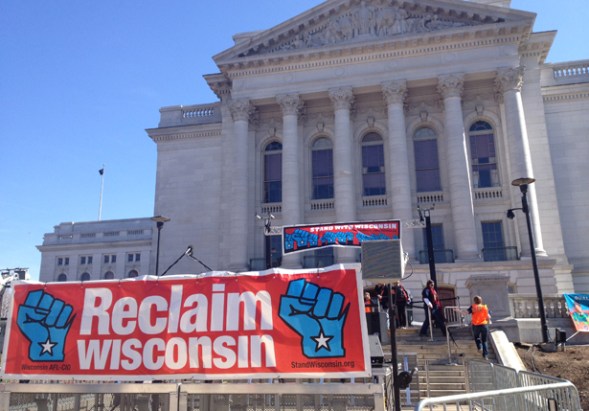
Good Morning!!
Today is the day of reckoning for Wisconsin. Voters will go to the polls today to decide the fate of Governor Scott Walker and five other Wisconsin Republicans: the Lieutenant Governor and four state senators. If the Democrats can win just one of those seats, they will regain the senate majority.
I think everyone here knows the genesis of this recall battle, but here’s a quick explainer from Chris Cillizza at the WaPo. Cillizza also speculates on possible surprising outcomes from the election.
Cillizza allows that Barrett could conceivably win and the Democrats could retake the senate–the latest poll by PPP had Walker leading by only 3 points, within the margin of error. The poll also suggested that Barrett had the momentum as of yesterday. On the other hand, InTrade had Walker’s chances at more than 90% late last night. The truth is no one really knows for sure, because the turnout and enthusiasm on each side will tell the tale. Cillizza, being a Villager, still thinks Walker will win, but thinks the Senate could switch.
When they filed petitions to recall Walker himself last fall, Democrats also filed papers to recall another four state senators — Senate Majority Leader Scott Fitzgerald, and Sens. Pam Galloway, Terry Moulton and Van Wanggaard, (Galloway resigned earlier this year; Republican state Rep. Jerry Petrowski is running for her seat.)
They need only win one race to take control.
Fitzgerald is likely safe given his heavily Republican district, although Lori Compas, his Democratic rival, has attracted a lot of media attention.
But Democrats are bullish on the races against Moulton and Wanggaard. Both districts went for President Obama in 2008; Wanggaard’s went narrowly for John Kerry in 2004. Whether Barrett wins or not, they expect to take back the state Senate.
Moulton faces former state Rep. Kristen Dexter; Wanggaard faces former state Sen. John Lehman (D). Outside groups have spent hundreds of thousands of dollars on both sides. State Rep. Donna Seidel (D) also has a shot at beating Petrowski; before Galloway the seat had gone Democratic for two decades.
Cillizza points out that if Barrett wins and the Democrats take the state senate and could get some of the Walker legislation overturned before another election could give the senate back to the Republicans. The other possibility, Cillizza mentions is that Democrats could defeat Walker’s Lt. Governor Rebecca Kleefisch, but that’s pretty unlikely. She’s leading in the polls at the moment.
The Seattle Times had a good article on Sunday about the national issues that are at stake in the election today.
Under fire for cutting budgets at the expense of public employees, Walker would be the third governor in U.S. history yanked from office in a recall election. Walker has an edge, but the race is close.
The campaign will mean more than who governs Wisconsin. It’s a test case of the larger clashes in American politics that are driving elections for the presidency and control of Congress, highlighting divisions over the costs of government.
With more than $30 million raised from conservative donors, many of them from other states, and visits from a who’s who of high-profile Republican governors (New Jersey’s Chris Christie, South Carolina’s Nikki Haley, Louisiana’s Bobby Jindal and Virginia’s Bob McDonnell), Walker’s campaign to survive the recall has the feel, the money and the stakes of a national race.
The state vote is raising questions that will echo nationwide. Can a tough-minded conservative Republican force cuts in government at the risk of angering public-employees unions and win a swing state such as Wisconsin? Will voters think he’s doing the best he can in a tough time? Or will they rise in a grass-roots backlash against the well-financed Republican effort?
Admittedly, that article has a Republican flavor, but it does do a pretty good job of spelling out the issues. For a more left-wing perspective, here’s a lengthy piece at by Sarah Jaffe of Alternet: Wisconsin’s Recall Drama Down to Nail-Biting Finish.
Wisconsin’s recall is, as reporter John Nichols put it, the kind of “renegade politics” that are disdained by the national Democratic party and even some state Democrats. It is being driven by the same activists who turned out by the thousands to occupy their capitol when Governor Scott Walker attacked workers’ right to organize and bargain collectively.
Now, a day before the biggest recall yet—of Governor Walker, Lieutenant Governor Rebecca Kleefisch, and four Republican state senators—the fight will be won or lost where it began: on the ground.
There’s a lot of big outside money pouring into Wisconsin, mostly to pump up Walker’s attempt to hang on to his seat, but the one thing that money can’t buy is an excited, driven grassroots movement. If Milwaukee mayor Tom Barrett beats Walker on Tuesday, it will be because of thousands of volunteers getting out the vote person by person.
“This is really a case of Walker raising $13 million against possibly the most widespread grassroots get-out-the-vote effort in the state’s history,” Matt Reiter, co-president of the Teaching Assistants’ Association at the University of Wisconsin at Madison, told AlterNet.
Please try to check that one out. It’s long, and very informative. John Nichols of The Nation (mentioned prominently in Jaffe’s piece) is Wisconsin native, and has written a book about the struggle in his home state. Here’s a piece Nichols wrote yesterday: How To Buy A Recall Election.
Governor Scott Walker is not trying to win the Wisconsin recall election that will be held June 5.
He is trying to buy it.
If the embattled governor does prevail, he will provide essential evidence not of his own appeal but of the power of money to define our politics.
On the other hand, if Walker is defeated, a template will have been developed for a people-power, message-power politics that might be able to challenge big money.
And there is no question that what is in play is very big money.
Read the gory details at the link.
At Salon, Josh Eidelson writes about the possible effects of some Wisconsin voters’ “resentment” of union workers on the recall outcome.
If Scott Walker survives tomorrow’s election, there will be plenty of reasons. Many people will point to his huge cash advantage, for good reason. But no factor will have been more important than the decades of decline in U.S. union membership.
“Unions had their place,” a woman named Jerri told me soon after I arrived in Wisconsin last week. “They did their part back in the ‘40s and ‘50s, and then they got too big, and are abusing their power.” Jerri and her husband, Tim (both declined to give last names), were eating at a bar in Wauwatosa, the purple Milwaukee suburb that’s home to Scott Walker. They both work in sales: She’s in retail at the mall; he’s in wholesale, selling caskets. Tim said Walker’s union “reforms” were necessary because local politicians had been “looking out for the union” instead of “people like me.” He said unions are for people who don’t “feel they should have to work very hard.” Jerri complained that unions “are sucking off my teat.” Public workers’ benefits, she said, “should be the same as anybody in any kind of private job.”
That last statement is most telling. While resentment toward unions has grown since the 1950s, it’s not because they got too big. It’s because they got too small. A multi-decade drop in unionization left fewer Wisconsinites who are union members or live in union households. Meanwhile, because governments are less prone than businesses to terrorize workers or shut down facilities to avert unionization, public sector unionization has remained more stable. In 2009, for the first time, there were more total U.S. union members in government employment than in the entire private sector.
That one is pretty scary for those of us who care about quality education and public services.
The Wall Street Journal highlights the importance of turnout in the recall election.
Both sides say few voters remain undecided, after more than $63.5 million in political spending saturated the airwaves and clogged voters’ mailboxes. A weekend survey by the Democratic group Public Policy Polling found Mr. Walker holding a slight lead and only 3% of likely voters undecided. With few voters left to persuade, the main question is which side will win the turnout battle.
Labor groups and their allies knocked on more than 300,000 doors during the past few days and placed more than 400,000 phone calls, said Brian Weeks, the assistant political director for the American Federation of State, County and Municipal Employees union.
Unions historically have had a strong ground game. But Republicans said they took a page from labor’s playbook and have developed a coordinated get-out-the-vote effort, which could also give the party a boost in the November presidential election, helping the GOP equal the Democrats’ election-day machinery.
Felicia Sonmez and Rachel Weiner of the WaPo write about the battle of “TV ad spending vs. boots on the ground.” They say that this election:
serves as a proxy for the national battle between Democrats’ much-touted ground organization and Republicans’ fundraising advantage.
With Walker ahead in the polls and leading Milwaukee Mayor Tom Barrett (D) in the money race by more than 7 to 1 – and with GOP-aligned outside groups far outspending their counterparts across the aisle — Democrats maintain that their shot at victory depends on a far superior get-out-the-vote operation buoyed in large part by organized labor.
According to Monica Davey at the NYT,
About 60 to 65 percent of Wisconsin residents of voting age are expected to go to the polls on Tuesday, the state’s Government Accountability Board said. That would be a higher turnout than two years ago, when Mr. Walker and a wave of Republicans largely swept state and federal offices here, but not as high as the more than 69 percent turnout in 2008, when Barack Obama easily won the state.
Only time will tell. We’ll have a live blog this evening so we can follow the results together. Now I need you to let me know what else is in the news. I look forward to clicking on your links.

 peej
peej Carissa
 bostonboomer
 dakinikat
 ecocatwoman
 mablue2
 Mama Lopez
 peggysue22
 quixote
 skydancingguestblogger
 Mona (aka Wonk the Vote)



 Sky Dancing
Recent Comments