
Are Republicans the new Confederate Holdouts?
Posted: March 8, 2011 Filed under: Democratic Politics, John Birch Society in Charge, Republican presidential politics, U.S. Economy, U.S. Politics | Tags: Blue State-Red State politics and economics, government spending priorities 25 Comments That’s a pretty interesting header for what is essentially a discussion among economics/finance bloggers over the ongoing disconnect between revenues and government spending, isn’t it? There’s no doubt that Nixon’s southern strategy and Reagan’s appeal to social reactionaries ushered in the current mixture that represents the Republican Party. This has basically become the new base of the Republican party since establishment Republicans and their business base couldn’t get a critical mass of voters back in the day. We’ve seen it lead to policy measures that would dismantle everything from civil rights to basic collective bargaining and workplace rights recently.
Economist Karl Smith believes that eventually this Republican coalition will fail. He wrote on this at Modelled Behavior in a post called ‘Starving the Moral Beast’ which is quite worth a read and a discussion. So far, it has elicited responses from Mark Thoma at Economist’s View and Matt Yglesias at Think Progress.
All I keep thinking is the old Keynesian wisdom of “in the long run, we are all dead”. So much for any optimism on my part. Here’s some tidbits from Smith.
If we want to build a model of what the government spends money on we would be best to start this way: ask people what social obligations do they believe “society” has. Look around for the cheapest – though not necessarily most efficient – programs that could credibly – though not necessarily effectively– address those obligations. Sum the cost of those programs. That will be government spending.
Contrary to Jonah Goldberg and others who see Canada and the United States as examples of two clashing ideologies, they are actually examples of two different ethic distributions. The United States is not Canada because there is ethnic strife between Southern Blacks and Southern Whites. That strife reduces the sense of moral obligation on the part of the white majority and so reduces government spending.
I want to be very clear that I don’t say this to paint those against social spending as racists. From where I sit I am betting that most of the intellectuals lined up against expanding the welfare state are naively unaware that their support rests upon racial strife. Otherwise they would realize that as America integrates they are doomed. They are fighting as if they believe they have a chance of winning. Given the strong secular trend in racial harmony, they do not.
I point this out also to show why the major Republican strategy for limiting government was doomed from the start and why I am also not particularly worried about Americas fiscal future per se.
Again, Smith argues that the Republicans will be on the losing end of the argument because they are increasingly outnumbered by the very people they want to suppress. Eventually, they will have to increase taxes and fund the part of the beast they’ve so tried to starve.
In the 1980s some conservatives believed that the might not be able to cut government but they could cut taxes and thereby starve the beast. Rising deficits would force the hand of future governments. Spending would have to be cut in order to bring the budget into balance.
Much of the handwringing about fiscal irresponsibility is a sense of alarm not only on the right, but throughout much of the political center, that these spending cuts are not actually materializing.
But, by what theory of government did you ever believe they would? Governments don’t look at how much money they have and then decide what they want to buy. They decide what they want to buy and then they look for ways to find the revenue.
Divorcing the two – through sustained deficits – was only going to lead to ever increasing levels of debt. This is what we got. At no point was the beast ever starved. The peace dividend lowered government spending growth somewhat, but that was undone by the war on terror. Otherwise spending hummed along, as it always will, with the government buying things the public thinks it ought to buy.
Yet, if this is causing upset stomachs among many of my fellow bloggers it calms mine. Its quite clear how this will end. Racial strife will continue to abate. The public will coalesce around the welfare state and taxes will be raised to meet the cost.
Ygliesias–from which I borrowed the Jesusland graphic–argues the semantics of the Canada-US sociopolitical distributions. For some reason, I don’t think either of them have spent much time in central Canada where there are many fairly moderate to conservative folks.
And on both sides of the border there are differences between the big cities and the rural areas. But Québec is quite different from Anglophone Canada and in the USA “the south is different.” The interesting thing is that not only do Québécois people speak French, they also have unusually left-wing views on economic policy. Meanwhile, white southerners have more rightwing views on economic policy than do other North American white Anglophones. If you redrew the borders, you’d get very different political outcomes.
Thoma takes on the crux of the argument which is the essential problem of funding our government. I’ve always found it odd that Republicans say deficits don’t matter when the spending is for war, tax cuts for business and the wealthy, or distributing grants to religious groups but scream when the spending is used for your basic public goods. I think he has a good point when he discusses how the relatively different political groups place value on various government activities. This turns the entire framework into your basic supply/demand model with price sensitivity being determined by the degree to which you value or shun providing revenues or selecting a program.
I agree with a lot of what is said here, but I am not as sure that the decisions about how much to spend and how to pay for it can be separated in this way. What society wants to do — e.g. the social services it believes it should provide — is partly a function of what we collectively think we can afford. Ultimately, I think, just as price is determined by both supply and demand, decisions about the level of government services and how to pay for those services are made jointly, not sequentially. The decisions cannot be completely separated. Part of the worry about health care, for example, and hence part of the opposition is a worry that we cannot afford it.
However, I probably shouldn’t push this too hard, it’s not a pure joint decision either, and for some social obligations have little to do with their cost. In addition, in many cases those who benefit from social programs and those who pay are not the same which sets up a social conflict and a political dynamic that can lead to deficits. But I do think that the costs matter when we make decisions about what services we think government should provide. The big difference across people, I think, is the assessment of the net benefits of some of these programs, and the differences are on both the cost and benefit sides of the equation. For example, the racial divide affects the assessment of benefits, and libertarians see taxes as an assault on liberty and hence very costly.
I still think that the Clinton/Gore administration provided some of the results that many Americans found palatable. Republicans tend to defund functions they hate, place vapid politicos in charge of the projects they loathe, then point to the miserable results when the inevitable blow ups occur as ‘typical government’. The hated the lean mean working model of Clinton/Gore. Think Heckuva -job-Brownie at FEMA compared to the pared down and efficient Clinton/Gore FEMA. The other main issue that I can see is the large number of Federal contractors that just disrupt the process trying to get no bid contracts to privatize essential government services. The privatization schemes have cost us dearly at many levels. I think this war on Public Workers is part of the effort to grab more lucrative government work as much as it is to starve the beast or shrink government. As every one here as said, we’ve only seen selective ‘shrinking’ .
Having spent my life in that big red blob in the middle, I get a front row seat to some of the craziest of the crazies who scream government overreach or states rights when it affronts their personal practices while applauding government overreach in other things. Think how many Republicans want to stick their noses squarely in people’s sex lives and health because they value a particular religious belief over science. I’m less hopeful than Smith that this will all work itself out in the long run because the fault lines seem pretty large from my vantage point. One of these days the middle class will figure out that they really do get their tax dollars worth. Now they should just make the corporations and the rich pay for theirs too.
There does seem to be a populist contagion afoot in the world. A lot of it is push back from the proposed policies that force big changes on either side of the aisle. There is also this sense that there’s a lot of wealth out there and only a small few seem to be able to grab hold of it. The democracy bug in the MENA area is as inspiring to me as the Wisconsin, Ohio, and Indiana protests. Perhaps, the little guys have had enough of being pushed around.
I guess we will see.
Right off a Cliff
Posted: February 26, 2011 Filed under: abortion rights, Barack Obama, Civil Liberties, Civil Rights, collective bargaining, Corporate Crime, Democratic Politics, education, Environmental Protection, Federal Budget, Feminists, fundamentalist Christians, GLBT Rights, Human Rights, John Birch Society in Charge, Populism, Psychopaths in charge, Republican presidential politics, right wing hate grouups, Surreality, Team Obama, The Media SUCKS, the villagers, U.S. Politics, Voter Ignorance, We are so F'd | Tags: extremists, Republicans, Ron Brownstein, Scott Walker, States Rights 11 Comments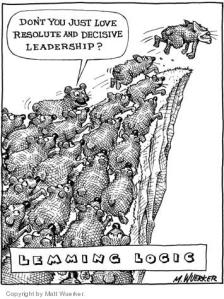 Where are mainstream Republicans these days? What has happened to the party of Lincoln, Teddy Roosevelt and Eisenhower? Prior to the Reagan years, Republican women were front and center in volunteering for planned parenthood, supporting the ERA, and working for abortion rights. First Lady Betty Ford was a proud feminist and one of the first women to put women’s health issues–including women with drinking problems and breast cancer–on the map. President Richard Nixon was responsible for many of the agencies that protect the environment. The current party is chock-full of science denying Theocrats and economics-denying Corporate Fascists. It’s making a sham out of the two party system. We may now have a window open wide enough to stop some of this. We should ready ourselves with the facts and act now.
An online conversation has been initiated with the publication of Ron Brownstein’s article in the National Journal on Thursday called ‘State’s Rights’. It is front and center in starting a discussion among Democratic bloggers, journalists, and other liberal/progressive sympathizers. States rights was code for the right to own slaves during the first 100 years of this country’s existence. It is now code for the right to discriminate against the GLBT community, insert the government into an individual woman’s gynecological care, and bust unions. The racial overtones have not gone away since the worst of the hateful verbiage is aimed at stopping any policy goal attempted by President Obama.
Any one who has read me over the last few years knows that I am not a big fan of this President and I’m even less of a fan of his zealous followers. However, it would take a fairly dim bulb to not see the racism implicit in many of the Republican attacks against him. Attacks range from the extremely bizarre personal assertions that he is a secret Muslim, foreign born, and a devout socialist/communist to a complete rewrite of any policy initiative.
Obama is about as conservative of a Democrat as one can find these days which has been one of my issues with him all along. His actions and words have not stopped the endless attacks on absolutely everything he attempts by Republicans and their monied interests. These tactics were first used against former Democratic President Bill Clinton but have reached some kind of hyper-extortionate apex today. It’s to the point that I firmly believe some of these Republican extremists would rather take the country down with them than negotiate something other than an ideologically pure outcome. Brown’s article and examples focus on the current bloc of extremist Republican governors with their take no prisoners policies. While his focus is mostly on the impact on Obama, I believe his larger point should entice us to think bigger.
But one senior Obama administration official, who also had a close view of Clinton’s interaction with Republican governors, contends that ideology is trumping interest for the governors in many of these new disputes. Health care reform, for instance, asks states for no new financial contribution to expand coverage through 2016 and only relatively small participation thereafter; because 60 percent of the uninsured live in the states where a Republican holds the governorship, their residents would receive the most new federal aid if the law survives. “One had the sense in the mid-1990s that conservative governors were doing whatever was in the best interest of their state,” the senior official said. “This time, the Republican governors appear determined to make an ideological point, even if it costs their state a great deal.”
Whatever the governors’ motivations (one man’s posturing, after all, is another man’s principle), their unreserved enlistment into Washington’s wars marks a milestone. It creates a second line of defense for conservatives to contest Obama even after he wins battles in Congress. It tears another hole in the fraying conviction that state capitals are less partisan than Washington. And it creates a precedent that is likely to encourage more guerrilla warfare between Democratic governors and a future Republican president.
American politics increasingly resembles a kind of total war in which each party mobilizes every conceivable asset at its disposal against the other. Most governors were once conscientious objectors in that struggle. No more.
I can remember attending Republican conventions in the early 1980s during the first hint of the unholy alliance between religious fanatics along the line of a Christian Taliban with the John Birch Society version of libertarians. It was a terrifying spectacle. At the time, the more pro-business and hoity-toity conservative elements in the party were willing to use them like pet pit bulls because they were incredibly organized at the grass roots level and they voted. Republicans traditionally had a much more difficult time turning out voters and their GOTV machines were dwarfed by the Democrats who could rely on well organized and managed union membership. This is one of the reasons why there is also the huge attack on the last standing unions now. They’re worth a fortune come election time and no Republican campaign strategist worth anything underestimates them. We can clearly no longer underestimate the religious zealots or those gullible to the rants of Glenn Beck. They’ve become a contagion.
Back in the day, the young me argued that this form of big daddy government intervention put forth by religionists and Birchers was basically enabling powerful business monopolies and drop kicking the constitutional mandate to deny the establishing of a state religion. It was against the very core ideology of historical Republicanism. I got no where. This was especially true as Nixon’s southern strategy began to work its evil influence on bringing in the remaining racist elements of the old Dixiecrats who frankly were all for the government taking care of any one that wasn’t like them. This added the last nail in the traditional coffin of the party of Lincoln. That sin is now manifesting in the xenophobia against Muslims and Hispanics in addition to African Americans topped by the anti-science bias from the religionists and the pro-monopoly market creation from the corporatists.
It appears that many old school Republicans now see the results of opening this Pandora’s box. They are horrified and have been trying to stuff the demons back into the chest. Now, you see those same folks that opened their kennels filled with poodles to the pit bulls are now acting absolutely appalled by the rising influence of absolutely whacked extremists like Glenn Beck. Scarborough, Rove, and Kristol are currently trying to put the Beckheads back into the box. Those of us that don’t vote Republican could afford to ignore this if it were just some intraparty feud. It’s gone beyond that with the rise of tea party hysterics and billionaire libertarian Daddy Warbucks’ propaganda machines. In many states, the Republican party infrastructure has been commandeered by the pit bulls. The poodles–like Arianna Huffington and Markos–have long left their confines. They are morphing traditional Democratic Party concerns. The same divisive issues that used to motivate the base to do the GOTV and show up at the polls has managed to bring this new crop of Republican governors and congressional members to a critical mass. They refuse any middle or even right of middle ground. They won’t negotiate on the usual country club Republican issues. It’s no longer a GOTV ploy for them because they are true believers.
Steven Benen explores this quandry in his blog at WAPO today.
Keep in mind, it’s ideology, not practical concerns, that lie at the heart of these governors’ reactionary moves. The states turning down investments for high-speed rail, for example, were effectively handed a gift — jobs, economic development, improved infrastructure — but Republicans like Rick Scott and Scott Walker turned down the benefits because of a philosophical opposition, deliberately hurting their state in the process. The administration was effectively throwing a life-preserver to a Republican who’s drowning, only to be told, “We don’t like government life-preservers.”
The same is true of health care, which would be a boon to states, but which far-right governors resist for reasons that have nothing to do with public policy.
Bill Clinton faced a watered-down version of these Republican pit bulls over a decade ago. Dealing with them is how he got his reputation for triangulation. He seemed uniquely placed to make some small progress then–that now seems impossible now–because of his past position as a southern governor with a decidedly homespun and folksy manner. President Obama has none of this going for him. He is surrounded by Businesscrats that are unlikely to fill the void. The only thing he’s managed to do is to gain the ear of the Chamber of Commerce types. These folks are hardly going to be sympathetic to social justice or middle class bread-and-butter issues. Additionally, right wing media sources and timid main stream media sources are playing into the hands of the outrageous. We have media enablers instead of investigative journalists.
That is why it is absolutely essential that whatever is left of the Democratic grassroots need to make one extremely loud noise right now. It is unconscionable that a rewrite of history, science, and economic is taking place while many of us are simply standing around with gaping mouths. I’ve spoken many times about the absolute lack of economics that is driving austerity programs. It’s already showing signs of slowing economic growth down at a time when unemployment is unacceptably high. This is only going to multiply as the days and months unfold. Ask yourself if we can really afford another recession?
I was also disheartened to read that science is not fairing well either. Scientific American has a thought provoking piece up on the overwhelming science behind global warming and climate change.Their title should be rhetorical but it is not: ‘Why Are Americans So Ill-Informed about Climate Change?’
Near the forum’s conclusion, Massachusetts Institute of Technology climate scientist Kerry Emanuel asked a panel of journalists why the media continues to cover anthropogenic climate change as a controversy or debate, when in fact it is a consensus among such organizations as the American Geophysical Union, American Institute of Physics, American Chemical Society, American Meteorological Association and the National Research Council, along with the national academies of more than two dozen countries.
“You haven’t persuaded the public,” replied Elizabeth Shogren of National Public Radio. Emanuel immediately countered, smiling and pointing at Shogren, “No, you haven’t.” Scattered applause followed in the audience of mostly scientists, with one heckler saying, “That’s right. Kerry said it.”
Such a tone of searching bewilderment typified a handful of sessions that dealt with the struggle to motivate Americans on the topic of climate change. Only 35 percent of Americans see climate change as a serious problem, according to a 2009 poll by the Pew Research Center for the People & the Press.
It’s a given that an organized and well-funded campaign has led efforts to confuse the public regarding the consensus around anthropogenic climate change.
These extremists are even rewriting the already right wing Ronald Reagan’s legacy to make it seem more extreme to support the legitimacy of their radical agendas. Here’s an example I found this morning on ThinkProgress on Reagan’s views on unions. Scott Walker’s fantasy world includes his vision of being Reagan’s heir. Yet, here is Reagan himself on the union movement in Poland during one of his radio addresses to the nation.
REAGAN: Ever since martial law was brutally imposed last December, Polish authorities have been assuring the world that they’re interested in a genuine reconciliation with the Polish people. But the Polish regime’s action yesterday reveals the hollowness of its promises. By outlawing Solidarity, a free trade organization to which an overwhelming majority of Polish workers and farmers belong, they have made it clear that they never had any intention of restoring one of the most elemental human rights—the right to belong to a free trade union.
The one thing that I learned early on when dealing with these people from within the Republican party itself in the pre-Reagan and early Reagan days is that they believe their courses are so righteous that they will lie and do anything to support them. If we do not hold their actions and lies to the light of day, our country will be completely overrun by by folks that are anti-science, anti-economics, anti-rational thought, and anti-democracy. We’ll have a theocratic plutocracy in fairly short order.
It is absolutely imperative that we put pressure on the media and Democratic politicians to fact check these people, stand up to them, and expose their lies to the public. It is possible that we’ve caught a tipping point in their overreach process. If this is the case, it means we have to work with the momentum now. Nothing short of our democracy and our children’s future is at stake here. We cannot be complacent and we cannot be left with mouths wide opened. We also cannot rely on leadership from the very top. If you’re in one of those states that is acting up, act now!!! Find and support your version of the Wisconsin 14.
States of Denial
Posted: February 17, 2011 Filed under: Economic Develpment, education, Elections, Federal Budget, poverty, Psychopaths in charge, public education, Republican presidential politics, The Media SUCKS, the villagers, U.S. Economy, U.S. Politics, unemployment, We are so F'd | Tags: education, Florida, Governor Bobby Jindal, Governor Chris Christie, Governor Rick Perry, Governor Scott Walker, Governors of Texas, Lousiana, public financing, public goods, Republican Governors, Rovernor Rick Scott, Wisconsin 25 CommentsGail Collins messed with Texas today. I’m rather glad she did because it shows exactly how much Texas seems to exist  in a vacuum of its own making. The head denier of reality is its wacko Governor who appears to get elected by saying the right things and doing very little. The state that forces its antiquated views through textbooks onto the rest of the nation has a huge problem in the numbers of children having children. This leads to all kinds of social problems that I probably don’t have to discuss here.
But, let’s just see how bad it gets down there with the denier-in-chief who seems to think abstinence education works and the Texas education system works when Texas’ own statistics show that they don’t work at all. Republicans get elected spewing untruths and he’s a prime case in point. The state’s out of money and like my governor Bobby Jindal, the first place Republican governors look is for cuts to education rather than look for new revenue sources. What is worse, they talk about improving children’s future while doing draconian cuts to children’s schools. How do they get away with it?
“In Austin, I’ve got half-a-dozen or more schools on a list to be closed — one of which I presented a federal blue-ribbon award to for excellence,” said Representative Lloyd Doggett. “And several hundred school personnel on the list for possible terminations.”
So the first choice is what to do. You may not be surprised to hear that Governor Perry has rejected new taxes. He’s also currently refusing $830 million in federal aid to education because the Democratic members of Congress from Texas — ticked off because Perry used $3.2 billion in stimulus dollars for schools to plug other holes in his budget — put in special language requiring that this time Texas actually use the money for the kids.
“If I have to cast very tough votes, criticized by every Republican as too much federal spending, at least it ought to go to the purpose we voted for it,” said Doggett.
Nobody wants to see underperforming, overcrowded schools being deprived of more resources anywhere. But when it happens in Texas, it’s a national crisis. The birth rate there is the highest in the country, and if it continues that way, Texas will be educating about a tenth of the future population. It ranks third in teen pregnancies — always the children most likely to be in need of extra help. And it is No. 1 in repeat teen pregnancies.
Which brings us to choice two. Besides reducing services to children, Texas is doing as little as possible to help women — especially young women — avoid unwanted pregnancy.
For one thing, it’s extremely tough for teenagers to get contraceptives in Texas. “If you are a kid, even in college, if it’s state-funded you have to have parental consent,” said Susan Tortolero, director of the Prevention Research Center at the University of Texas in Houston.
Plus, the Perry government is a huge fan of the deeply ineffective abstinence-only sex education. Texas gobbles up more federal funds than any other state for the purpose of teaching kids that the only way to avoid unwanted pregnancies is to avoid sex entirely. (Who knew that the health care reform bill included $250 million for abstinence-only sex ed? Thank you, Senator Orrin Hatch!) But the state refused to accept federal money for more expansive, “evidence-based” programs.
“Abstinence works,” said Governor Perry during a televised interview with Evan Smith of The Texas Tribune.
“But we have the third highest teen pregnancy rate among all states in the country,” Smith responded.
“It works,” insisted Perry.
“Can you give me a statistic suggesting it works?” asked Smith.
“I’m just going to tell you from my own personal life. Abstinence works,” said Perry, doggedly.
There is a high cost to a state to living in this kind of denial. Teen moms and children of teen moms are generally not a productive group of citizens. You pay to prevent this realistically or you pay for their and your mistake to do so throughout their entire lives. But, this seems to be the way of the new brand of Republican governor. These guys start running for president the minute they hit the mansion. They do so by following a litmus test of Republican items–regardless of the consequences to their states–that will make them sound like purity experts when they hit Iowa and New Hampshire. They will undoubtedly leave their state in ruins, but that won’t be the story by the time they’re on the lecture and talking heads circuit for higher offices.
The Governor of New Jersey is doing the same thing. He can read off a litmus list for the republican inquisition while at the same time ensuring the people of the state he governs languish. Again, he screams about the importance of the future of the children while simultaneously downsizing it.
In a clear shot at congressional Republicans over calls for curbing entitlement programs, he said, “Here’s the truth that nobody’s talking about. You’re going to have to raise the retirement age for Social Security. Woo hoo! I just said it, and I’m still standing here. I did not vaporize into the carpet.
“And I said we have to reform Medicare because it costs too much and it is going bankrupt us,” he continued, later comparing those programs to pensions and benefits for state workers that he’s been looking to reel back.
“Once again, lightning did not come through the windows and strike me dead. And we have to fix Medicaid because it’s not only bankrupting the federal government but it’s bankrupting every state government. There you go.”
Clearly looking to blunt criticism of his famously combative style, the former federal prosecutor said there is a method to the battles he picks, insisting, “I am not fighting for the sake of fighting. I fight for the things that matter.”
The speech was titled “It’s Time to do the Big Things,” and Christie suggested the items that Obama called for as “investments” in his State of the Union address were “not the big things” that need Washington’s focus.
“Ladies and gentlemen, that is the candy of American politics,” Christie declared, adding that it appeared to be a “political strategy” – or game of budgetary chicken – that both Republicans and Democrats are playing.
“My children’s future and your children’s future is more important than some political strategy,” he said. “What I was looking for that night was for my president to challenge me … and it was a disappointment that he didn’t.
It’s difficult not to scream when you hear these folks talk about our children’s futures while cutting education, telling children abstinence fairy tales, turning down money for infrastructure improvements —like the nitwit Republican Governor Rick Scott in Florida–that will likely create better environments for business and jobs, and refusing to look at their tainted tax systems that usually punish the poor and flagrantly ignore the assets and the incomes of the rich. It is clear whose children they have in mind. It is not yours or mine or the majority of the people who live in their states.
These guys seem intent on turning their states into third world countries. Many people seem more intent on letting them do it as long it doesn’t cost them anything immediate. Our fellow citizens appear beguiled by fairy tale promises and bribes of low taxes. They should not be surprised then by a future where they and their adult children live in rented shacks together with few available public services. They better just hope they don’t get robbed, the shack doesn’t catch fire, and there are no grandchildren needing public education. They’re voting to downsize these things into extinction.
Iraq Invasion Whoppers
Posted: February 15, 2011 Filed under: Central Intelligence Agency, Diplomacy Nightmares, Federal Budget, Foreign Affairs, Gitmo, Human Rights, Iran, Iraq, Media, Psychopaths in charge, Republican presidential politics, right wing hate grouups, Surreality, The Media SUCKS, the villagers, U.S. Economy, U.S. Military, U.S. Politics, Voter Ignorance, WE TOLD THEM SO | Tags: bioweapons, Curveball, Donald Rumsfeld, Iraq Invasion, Jeb Bush, PNAC, Rafid Ahmed Alwan al-Janabi, Rogues Gallery, Steve Forbes, William J Bennet, William Kristol 25 Comments
Oops, there goes another rationale for the Iraq Invasion
Any number of us that closely followed the trumped-up case for the Iraq invasion figured that most of the evidence was shoddy if not based on out-and-out lies. I seriously wanted to throw up every time I heard some Bush official equivocate smoking guns and smoking mushroom clouds. The most disheartening thing was the number of people that believed them. The entire Iraq Invasion run-up just showed how vulnerable the American public is to propaganda and jingoism. You could hardly hold a civil conversation with so much hysteria-based flag waving going on.
So, it’s another one of those moments where you learn exactly how duped the entire country was by a set of people just itching to scratch that NeoCon rash. The UK Guardian reports that the “man codenamed Curveball ‘invented’ tales of bioweapons”. Colin Powell’s judgment looked bad then, it looks nonexistent now. Remember, he was considered the moderate voice of reason. You can watch the video and hear the words of Rafid Ahmed Alwan al-Janabi: ‘I had the chance to fabricate something …’ I’m sure they begged him to do it.
Rafid Ahmed Alwan al-Janabi, codenamed Curveball by German and American intelligence officials who dealt with his claims, has told the Guardian that he fabricated tales of mobile bioweapons trucks and clandestine factories in an attempt to bring down the Saddam Hussein regime, from which he had fled in 1995.
“Maybe I was right, maybe I was not right,” he said. “They gave me this chance. I had the chance to fabricate something to topple the regime. I and my sons are proud of that and we are proud that we were the reason to give Iraq the margin of democracy.”
The admission comes just after the eighth anniversary of Colin Powell’s speech to the United Nations in which the then-US secretary of state relied heavily on lies that Janabi had told the German secret service, the BND. It also follows the release of former defence secretary Donald Rumsfeld’s memoirs, in which he admitted Iraq had no weapons of mass destruction programme.
The careers of both men were seriously damaged by their use of Janabi’s claims, which he now says could have been – and were – discredited well before Powell’s landmark speech to the UN on 5 February 2003.
The former CIA chief in Europe Tyler Drumheller describes Janabi’s admission as “fascinating”, and said the emergence of the truth “makes me feel better”. “I think there are still a number of people who still thought there was something in that. Even now,” said Drumheller.
It was no secret that most of the advisers surrounding Dubya Bush were the same ones disappointed in Poppy’s decision to stop the first Gulf War with Saddam still in power. There were many good reasons to leave Saddam in power including the geopolitical stalemate created by tensions between the Sunni Saddam and the Shia Clerics in Iran that frequently burst into horrible wars. We shifted the balance of power in the area to Iran and have undoubtedly created a long term mess in Iraq itself. It’s cost us lives and money. It’s cost the Iraqis untold horrors. We continue to learn it was based on nothing but a pack of lies. This mea culpa is just the latest.

 peej
peej Carissa
 bostonboomer
 dakinikat
 ecocatwoman
 mablue2
 Mama Lopez
 peggysue22
 quixote
 skydancingguestblogger
 Mona (aka Wonk the Vote)



 Sky Dancing
Recent Comments