
Monday Reads
Posted: May 30, 2011 Filed under: Afghanistan, Elections, Foreign Affairs, Medicare, morning reads, Republican politics | Tags: Afghanistan, casualities, Memorial Day, NATO, Tornado relief, war 13 Comments Happy Memorial Day!
While this is the usual time to remember America’s war dead from past wars, it’s good to remember that we still have two wars going on today. As the saying goes, War is Hell. The BBC reports that Afghan leaders have put NATO on warning for recent ‘collateral damage’.
The BBC’s Quentin Sommerville said villagers brought their dead children to the governor’s office shouting: “See they aren’t Taliban”
Afghan President Hamid Karzai has forcefully condemned the killing of 14 civilians in the south-west of the country in a suspected Nato air strike.
Mr Karzai said his government had repeatedly asked the US to stop raids which end up killing Afghan civilians and this was his “last warning”.
A Nato spokesman said a team had been sent to Helmand province to investigate the attack carried out on Saturday.
Afghan officials say all those killed were women and children.
The strike took place in Nawzad district after a US Marines base came under attack.
The air strike, targeted at insurgents, struck two civilian homes, killing two women and 12 children, reports say.
“The president called this incident a great mistake and the murdering of Afghanistan’s children and women, and on behalf of the Afghan people gives his last warning to the US troops and US officials in this regard,” his office said.
The White House said it shared Mr Karzai’s concerns and took them “very seriously”.
A group from Sera Cala village travelled to Helmand’s capital, Lashkar Gah, bringing with them the bodies of eight dead children, some as young as two years old, says the BBC’s Quentin Sommerville in Kabul.
“See, they aren’t Taliban,” they chanted as the carried the corpses to local journalists and the governor’s mansion.
While insurgents are responsible for most civilian deaths in Afghanistan, the killings of Afghans by foreign soldiers is a source of deepening anger, our correspondent adds.
In other Afghan war news, a Nato commander was injured in Taliban suicide attack in Afghanistan. This is from the UK Guardian.
A Taliban suicide bomber attacked a provincial governor’s compound in Takhar, killing the police chief of northern Afghanistan and seriously injuring a top Nato commander. Two other Afghan officials were also reported to have died in the attack. Several international servicemen were reported injured by eyewitnesses.
German officials confirmed to Spiegel magazine Major General Markus Kneip, who commands NATO forces in the north Afghanistan, had received wounds that were “severe” but not life-threatening.
A Nato spokesman in Kabul confirmed western casualties but was unable to provide details.
The Taliban, meanwhile, claimed responsibility for the attack and pledged that “killing high ranking officials will continue.”
Mujeebullah Rahman, the deputy director of the local council in Takhar province, said the attack took place at about 4pm when a meeting to discuss local security operations was ending.
“The bomber was waiting in the corridor, wearing the uniform of an Afghan policeman,” Rahman said.
The attack capped a bloody 48 hours in which seven Americans, two British and two other Nato servicemen were killed by roadside bombs or by insurgents in the south of the country. So far 44 Nato soldiers have been killed this month, and .nearly 200 have died in the year.
While we continue to fund these wars, Republicans are demanding that any relief to tornado-wrecked Joplin Missouri must be offset by spending cuts elsewhere. Congressman Eric Cantor–house majority leader–has joined in the call first sent out by Senator Majority Leader Mitch McConnell last week. Talk about kicking people when they’re down!
Rep. Eric Cantor (R-Va.) continued to stress Sunday that disaster relief funds for tornado-ravaged Missouri would have to be offset in the federal budget with cuts elsewhere.
The House majority leader added on CBS’ “Face the Nation” that there was a certainly a federal role in helping to rebuild Joplin, Mo., and that Congress would move after getting a request from President Obama.
But, he said, the government needs to act in this case like a family who faces an unforeseen expense and has to cut elsewhere.
“Because families don’t have unlimited money,” Cantor said. “And, really, neither does the federal government.”
Cantor began calling for offsets last Monday, the day after the tornado that has killed well over 100 struck Joplin. On Tuesday, a House appropriations subcommittee found a $1.5 billion offset to help finance an aid package.
Somebody needs to remind these guys that the government can raise revenues via taxes for legitimate expenditures. That’s something families don’t have the ability to do. There’s also printing money and borrowing money at nearly zero interest via Treasury Auctions. Cantor was honest enough to admit that Medicare played an “undeniable” role in the recent election in NY 2 6.
“It’s undeniable that it played some role in the election. Any time you have one side demagoguing and frankly, accusing the other side in a way that’s not factual of trying to reform the program, certainly that’s going to influence the electorate,” Cantor said on CBS’s “Face the Nation.” “As far as Medicare is concerned, there’s a simple choice here – either we’re going to save the program or let it go bankrupt.”
Wasserman Schultz, who appeared just after Cantor said, “Coming from the majority leader,” who was one of the “architects” of a 2010 midterm congressional election victory “focused on scaring seniors about what Democrats were doing with Medicare, he would know.”
“What we’re doing is making sure we can prevent Republicans from ending Medicare as we know it,” she said. “That’s what Kathy Hochul ran on leading up to her victory this Tuesday in New York 26.”
Voters were making it clear that they didn’t support the GOP’s budget plan, Wasserman Schultz asserted.
So, I thought I’d offer up some history of Memorial Day for you. One of the things that I learned moving down here was that much of the south does not really celebrate the holiday and refer to it as a Yankee holiday even though it was supposed to be in remembrance of all civil war dead. Many southern cities actually claim to have started the holiday. I guess Mississippi sees things a little different. The holiday originated after the Civil War as “Decoration Day”. It didn’t become a federal holiday until 1971.
Memorial Day was originally known as Decoration Day because it was a time set aside to honor the nation’s Civil War dead by decorating their graves. It was first widely observed on May 30, 1868, to honor the sacrifices of Civil War soldiers, by proclamation of General John A. Logan of the Grand Army of the Republic, an organization of former sailors and soldiers. On May 5, 1868, Logan declared in General Order No. 11 that:
The 30th of May, 1868, is designated for the purpose of strewing with flowers, or otherwise decorating the graves of comrades who died in defense of their country during the late rebellion, and whose bodies now lie in almost every city, village, and hamlet churchyard in the land. In this observance no form of ceremony is prescribed, but posts and comrades will in their own way arrange such fitting services and testimonials of respect as circumstances may permit.
During the first celebration of Decoration Day, General James Garfield made a speech at Arlington National Cemetery, after which 5,000 participants helped to decorate the graves of the more than 20,000 Union and Confederate soldiers buried in the cemetery.
This 1868 celebration was inspired by local observances of the day in several towns throughout America that had taken place in the three years since the Civil War. In fact, several Northern and Southern cities claim to be the birthplace of Memorial Day, including Columbus, Miss.; Macon, Ga.; Richmond, Va.; Boalsburg, Pa.; and Carbondale, Ill.
So, it’s not all about mattresses and sales tax holidays!!! My mother used to tell me that all the relatives would go clean up the family cemeteries on memorial day in Missouri and Kansas. They would all have huge picnics along with trimming the overgrown bushes or flowers. We used to continue the tradition when I was very young until most of the cemeteries started using huge mowers and removed all bushes and flowers. As I recall, we had an ongoing battle in one cemetery with massive and profuse peony bushes.
So, that’s my offering for the day! Have a really wonderful holiday! What’s on your reading and blogging list today?
Late Night Outrage: War on Women’s Health
Posted: May 28, 2011 Filed under: abortion rights, Republican politics | Tags: abortion rights, pro choice 10 Comments We’ve been watching state after state wage a coordinated war against women. Here’s a summary of this year’s assault on women’s health by NYT’s Emily Bazelon. Women better wake up and smell the threat to their right to self-determination.
Ever since Republicans took control of half the country’s statehouses this year, the anti-abortion movement has won one victory after another. At least 64 new anti-abortion laws have passed, with more than 30 of them in April alone. The campaign is the largest in history and also the most creative. Virginia started regulating abortion clinics as if they were hospitals. Utah, Nebraska and several other states have stopped private health insurers from covering abortions, with rare exceptions. South Dakota will soon tell women that before they go to an abortion clinic, they must first visit a crisis pregnancy center whose mission is to talk them out of it.
It’s amazing to me that after 8 years of Republican focus on the war on Terror, their focus turns towards turning the clock back decades for American women. What is behind these reactionaries? What is fueling the fantancism? Why have they suddenly switched strategies?
Instead, lawyers representing their side have been challenging the laws that hurt women most — which are also the ones most likely to sway public opinion back to their side. Can it really be good politics for a state to tell private health insurers what kind of coverage for women’s health they can and can’t provide? Or to take away the money that allows Planned Parenthood to prescribe birth control and treat S.T.D.’s? Quinnipiac and CNN polls from earlier this year both found majority support for continuing government financing of Planned Parenthood. There’s also a clear argument against laws like the ones that permit Virginia to regulate abortion clinics like hospitals or that allow Louisiana to immediately close an abortion clinic for any technical rule violation. In making early abortions more burdensome and costly, these laws take aim at the ordinary version of the procedure that women experience and for which support is greatest. In a 2007 poll, Gallup found that twice as many people favor making late-term abortion illegal than favor overturning Roe (72 percent versus 35 percent).
Abortion rights advocates are also trying to prevent South Dakota from mandating that women wait a full 72 hours for an abortion. This comes on the heels of a lawsuit that challenges the requirement that mandatory counseling include the claim that abortion is linked to an increased risk of suicide (there is no reliable evidence to support this). In Casey, the Supreme Court allowed states to impose only a 24-hour waiting period and to require counseling that accurately explained the stages of fetal development. The South Dakota law is far out enough that when I asked Yoest about it, she said only, “That’s not one of our pieces of legislation.” If the battle reaches the Supreme Court, there’s presumably little chance that Justice Kennedy would sign off on requiring doctors to read a script of made-up data posing as facts.
These are precisely the kinds of cases that lawyers in support of reproductive rights should pursue, because they portray abortion foes as radical. The South Dakota fight shows that in the name of protecting women, abortion opponents are willing to demean them — by forcing them to visit a crisis pregnancy center and listen to unsupported medical claims. (According to a 2006 Congressional investigation, most of these centers give out inaccurate information about abortion’s health effects.)
At this point, there seems to be no organized women’s movement to get us off the defensive and put us back on the offensive. Religious activists have worked hard to ensure that nearly all Republican candidates are not pro-choice. The entire Republican contingent in the U.S. House of Representatives from a solid anti-choice block. It’s time for those of us that support a women’s right to make a decision regarding her own body to go on the offensive. We need to recruit and support more pro-choice candidates.
It’s still the Economy, and Jobs, and the stupid Bush Tax Cuts
Posted: May 26, 2011 Filed under: Democratic Politics, Economy, Federal Budget, Federal Budget and Budget deficit, jobs, Republican politics, unemployment | Tags: budget defifit, jobless claims, unemployment 22 Comments If you do not take a path different from the path that wrecked the economy, the economy will not improve. So, why–for the umpteenth time since I started this blog 3 years ago–do I find myself writing on the same economic dynamics? Wasn’t there supposed to be a game changing election in there somewhere?
First, we just got the news that jobless claims are up. The new twist is that corporate profits are down. It had to happen sooner or later. There are only so many profits you can wring out of your business by ‘austerity’ measures like lay offs and not ordering as many office supplies. It’s obvious the ‘Economy is still Struggling’.
Unexpectedly weak consumer spending kept the economy stuck in a slow growth gear in the first quarter and would likely struggle to regain speed amid signs of a slowdown in the pace of job creation.
Data on Thursday showed the economy expanded at an unrevised 1.8 percent annual rate in the first three months of this year, while the number of Americans claiming unemployment benefits unexpectedly rose 10,000 to 424,000 last week.
The rise in jobless claims and the weakness in first-quarter consumer spending, which offset upward revisions to business inventories and investment, set the tone for more lackluster growth this current quarter.
Some businesses were surprised by the weak consumer spending. Their CEOs need to get out of their offices and country clubs and go see how the other 99 percent lives. Our wealth is down because our house values keep falling. We’ve lost at least 2-3 years of returns in our investments and pensions and many folks still haven’t recovered their pre-recession balance. Gas prices and food prices are taking larger percentages of folks’ budgets. The very rich are the only ones that can really fling the bucks around at this point and they can go anywhere they want to do that. They’re not stuck with the offerings at the local strip mall. We ignore the sluggish labor markets at our own peril.
Business investment–the smallest contributor to the GDP–was up and Government spending was down. Exports looked better than expected but they are still a very small part of our economy these days. This is now the seventh straight week that jobless claims were above the 400,000 mark. What is even more remarkable is that the BLS could not name any factor that could be an outlier contributing to this persistent trend.
Meanwhile, the conversation in Washington DC continues to be the Ryan budget and Medicare. The U.S. Senate voted down the Ryan budget I was amused by Karl Rove’s WSJ op-ed today that explained that folks would like their plan if it was just put into a populist message. I guess when you’ve got people buying into such nonsense as decreasing taxes raises tax revenues you get to thinking that you can sell them anything with the right spin on it. However, George Bush and the Republican Party own the Deficit. Their cronies should be the ones to pay it down.
The nonpartisan Center on Budget and Policy Priorities has updated research that projects nearly half of public debt in 2019 will be attributable to President George W. Bush’s tax cuts plus the ongoing wars in Iraq and Afghanistan. The tax cuts left the American treasury particularly vulnerable when the financial crisis hit, the CBPP reports: “The events and policies that pushed deficits to these high levels in the near term were, for the most part, not of President Obama’s making. If not for the Bush tax cuts, the deficit-financed wars in Iraq and Afghanistan, and the effects of the worst recession since the Great Depression (including the cost of policymakers’ actions to combat it), we would not be facing these huge deficits in the near term.”
It simply baffles me that we can’t even get the most stalwart Democratic politicians to pay attention to the miserable jobs market. It’s two years into a Democratic administration. Where is the will to put America back to work?
The Latest Stupid Republican Tricks: The “Default Deniers”
Posted: May 19, 2011 Filed under: China, Economy, Federal Budget, Foreign Affairs, Global Financial Crisis, Psychopaths in charge, Republican politics, Social Security, Surreality, U.S. Economy, U.S. Military, U.S. Politics, We are so F'd | Tags: Alan S. Blinder, Debt Ceiling, Federal Debt, Republican crazies, social safety net, Social Security, Timothy Geithner 9 Comments
GOP Leadership
{Sigh….} Is there any way to be rid of these crazies? The latest Republican nutty meme is that it will be much much better for all concerned if Congress doesn’t raise the debt ceiling and the U.S. has to either cut trillions in spending or default on its debts. From Politico:
They are the newest breed of government skeptics, the swelling ranks of Republicans who don’t believe the Obama administration when it says a failure to raise the debt limit will prove catastrophic.
And they stand ready to make negotiations over raising the cap on debt as grueling as possible, making Treasury officials and Wall Street more nervous than ever that the country could suffer an unprecedented default with consequences no one can predict.
The suspicion, which once flourished on only the conservative outskirts of economic circles, has seeped into the mainstream in recent weeks, gaining broader acceptance among establishment Republicans, even as the administration issues increasingly dire warnings.
House Speaker John Boehner (R-Ohio) validated the default deniers Sunday, saying, “I understand the doubts.” Jim Nussle, a budget director under former President George W. Bush, argued last week that “no one’s going to default” if Congress misses the Aug. 2 deadline. And Alabama Sen. Jeff Sessions, the top Republican on the Budget Committee, accused the White House of scare tactics similar to those used by the previous administration to win quick approval of the 2008 bank bailout after the markets crashed.
Via Think Progress, Rush Limbaugh yesterday responded to the Politico article by leaping aboard the GOP elephant just as it began to topple off the cliff. Limbaugh announced on his radio program that refusing to raise the debt ceiling will help the country’s credit rating.
LIMBAUGH: Today I claim the mantle. I proudly and honestly come to you today as the Mr. Big of the default deniers. We will not default on anything. And moreover, it is more likely that the country’s creditworthiness would go up around the world since we would finally be doing something to address our out-of-control spending and indebtedness if we were not to raise the debt limit. We would be perceived around the world as serious for a change, and responsible for a change. Otherwise we are headed for junk bond status.
I’m no economist, but according to Dakinikat Alan S. Blinder is a really good one, and he wrote an op-ed for the Wall Street Journal today. Here is his analysis of what could happen if the Republicans get their way on the debt ceiling.
What happens if we crash into the debt ceiling? Nobody really knows, but it’s not likely to be pretty. Inflows and outflows of cash to and from the Treasury jump around from day to day as bills are paid and revenues arrive. But at average fiscal 2011 rates, receipts cover only about 60% of expenditures. So if we hit the borrowing wall traveling at full speed, the U.S. government’s total outlays—a complex amalgam that includes everything from Social Security benefits to soldiers’ pay to interest on the national debt—will have to drop by about 40% immediately.
The bottom line is that Timmy Geithner will have to decide whether to pay soldiers and old folks or pay China other foreign creditors. I guess that’s what the Republicans are hoping for–that it will spell the end of the entire social safety net. But they don’t seem to be thinking very long-term. Do they really believe Americans will passively allow that to happen? Back to Blinder:
If and when the time comes, Mr. Geithner and his boss will have to decide. But here’s one prediction: Defaulting on the national debt will not be their first choice. After all, the statue of Alexander Hamilton at the Treasury entrance reminds Mr. Geithner every day of the importance of maintaining the nation’s creditworthiness. Even if we hit the debt ceiling, maturing obligations still can be rolled over. And I’ll bet he will bend every effort to make the interest payments, too. Unfortunately, however, when you’re 40% short, not much can be ruled out.
Exactly. Geithner is going to choose to pay China, not the elderly and disabled–that’s what the Republicans are counting on. But that will be a choice between chaos in the world economy and mass uprisings on the domestic front–or we might get both. According to Blinder a contraction in the U.S. economy like the one the Republicans are pushing us toward could lead to world-wide financial panic. According to Blinder:
…suppose the federal government actually does reduce its expenditures by 40% overnight. That translates to roughly $1.5 trillion at annual rates, or about 10% of GDP. That’s an enormous fiscal contraction for any economy to withstand, never mind one in a sluggish recovery with 9% unemployment. Even contemplating such a possibility is evidence of a dark, self-destructive impulse.
Second, markets now assign essentially zero probability to the U.S. losing its fiscal mind. They’d be caught flat-footed if the threat of default suddenly started to look real, possibly triggering a world-wide financial panic. Remember how markets reacted to the Lehman Brothers surprise? As Mr. Geithner pointed out in New York on Tuesday, “As we saw in the fall of 2008, when confidence turns, it can turn with brutal force and with a momentum that is very difficult and costly to arrest.”
And Blinder isn’t even considering what the reaction would be among ordinary Americans here at home when the economy completely tanks and there is no social safety net whatsoever.
Monday Reads
Posted: May 16, 2011 Filed under: 2012 presidential campaign, Economy, Federal Budget and Budget deficit, fundamentalist Christians, Global Financial Crisis, income inequality, Medicare, religion, religious extremists, Republican politics, Republican presidential politics, Team Obama, The Bonus Class, The Great Recession, U.S. Economy, U.S. Politics | Tags: Debt Ceiling, End Times, evangelical Christians, Harold Campaign, Mark Thoma, Newt Gingrich, Rapture, the plutocracy, Timothy Giethner 52 Comments Good Morning!
Are you reading for the end of the world next Saturday? Nope, it’s not 2012 yet and we’re not talking about the Mayan Prophecy. Harold Campaign has convinced a group of evangelicals that the date is May 21, 2011. I wonder if any of them would like me to take care of their left behind pets for all their money? You can read more about the man and his end of days wishes at Salon.
The self-appointed harbingers are not tied to any particular church — they claim organized religion has been corrupted by the devil — but rather to Internet- and radio-based ministries. And their lone mission is to tell anyone and everyone that the end of days is May 21. That’s when, they insist, God’s true believers will be lifted into heaven and saved, during a biblical event widely referred to as the Rapture.
The finer points of Christian eschatology have long been the subject of dispute (not to mention the inspiration for movies and books, like the blockbuster “Left Behind” series). Though mainstream churches reject the the notion that doomsday can be predicted by any man, fringe scholars continue to work feverishly pinpointing the moment of the final, divine revelation. And one such man — 89-year-old radio host Harold Camping — has been at the game for decades.
In the early ’90s, Camping published a book titled “1994?,” which claimed judgment day would arrive in September of that year. When confronted with such a staggering anticlimax — the world, after all, kept on spinning — Camping chose not to be discouraged, but to learn from his mistakes. (He hadn’t considered the Book of Jeremiah, he says.) A civil engineer by trade, Camping went back to the drawing board and continued to crunch the numbers, before arriving at the adamant determination that Rapture would come on May 21, 2011. He began to spread the word through his broadcasting network, Family Radio, in 2009, and quickly built up a fervid following.
I guess it takes all kinds. That’s what my mother used to tell me when she was alive, anyway. Speaking of that, MoJo has a great list of Newtisms that will take you a trip back in time with Gingrich’s greatest tongue trips. Here’s some of his earliest hits.
1978 In an address to College Republicans before he was elected to the House, Gingrich says: “I think one of the great problems we have in the Republican party is that we don’t encourage you to be nasty. We encourage you to be neat, obedient, and loyal and faithful and all those Boy Scout words.” He added, “Richard Nixon…Gerald Ford…They have done a terrible job, a pathetic job. In my lifetime, in my lifetime—I was born in 1943—we have not had a competent national Republican leader. Not ever.”
1980 On the House floor, Gingrich states, “The reality is that this country is in greater danger than at any time since 1939.”
1980 Gingrich says: “We need a military four times the size of our present defense system.” (See 1984.)
1983 A major milestone: Gingrich cites former British Prime Minister Neville Chamberlain on the House floor: “If in fact we are to follow the Chamberlain liberal Democratic line of withdrawal from the planet,” he explains, “we would truly have tyranny everywhere, and we in America could experience the joys of Soviet-style brutality and murdering of women and children.”
What is it that Republicans put in their formula that turns out people like this? Newt was on Meet the Press yesterday where he mouthed off on a number of subject’s including Paul Ryan’s Medicare pogrome. This is the National Review’s take so read with caution.
Newt Gingrich’s appearance on “Meet the Press” today could leave some wondering which party’s nomination he is running for. The former speaker had some harsh words for Paul Ryan’s (and by extension, nearly every House Republican’s) plan to reform Medicare, calling it “radical.”
“I don’t think right-wing social engineering is any more desirable than left-wing social engineering,” he said when asked about Ryan’s plan to transition to a “premium support” model for Medicare. “I don’t think imposing radical change from the right or the left is a very good way for a free society to operate.”
As far as an alternative, Gingrich trotted out the same appeal employed by Obama/Reid/Pelosi — for a “national conversation” on how to “improve” Medicare, and promised to eliminate ‘waste, fraud and abuse,’ etc.
“I think what you want to have is a system where people voluntarily migrate to better outcomes, better solutions, better options,” Gingrich said. Ryan’s plan was simply “too big a jump.”
He even went so far as to compare it the Obama health-care plan.”I’m against Obamacare, which is imposing radical change, and I would be against a conservative imposing radical change.”
I have to say that having Trump, Gingrich, Santorum and Paul all debating each other on one stage would probably be highly entertaining. They could have a contest for who would make the craziest old uncle.
The White House is out on the road trying to head off problems with the national debt ceiling. Timothy Geithner says that the economy will double-dip if the Republicans don’t raise the ceiling.
In a heavily-anticipated response to Sen. Michael Bennet, D-Colo., who asked Geithner to document the economic and fiscal impacts of failing to lift the statutory debt limit, the Treasury secretary detailed a chain reaction that would cripple the economy, costing jobs and income.
“A default would inflict catastrophic far-reaching damage on our nation’s economy, significantly reducing growth and increasing unemployment,” said Geithner in the letter to Bennet which was dated May 13. “Even a short-term default could cause irrevocable damage to the economy.”
Geithner has imposed an August deadline for Congress to lift the $14.3 trillion debt ceiling, but lawmakers are still negotiating over Republican demands to tie the move to spending cuts. And a portion of the GOP still remains skeptical about the need to act by the deadline at all, arguing that the consequences have been overstates.
Economist Mark Thoma has a better explanation of how the refusal to increase the debt ceiling would impact the economy on CBS Money Watch. This explanation is much more precise.
If politicians fail to reach a deal to increase the debt ceiling, there would be a large fall in federal spending. The decline in federal purchases of private sector goods and services would reduce aggregate demand, and this could slow or even reverse the recovery (it could also threaten the delivery of critical services that some people depend upon). In addition, the failure to pay wages to federal workers would disrupt household finances and cause a further decline in demand, as would the failure of the government to pay its bills for the goods and services it has already purchased from the private sector (and it could even threaten some households and businesses with bankruptcy should the problem persist). There may be some room for the Treasury to use accounting tricks to avoid the worst problems, at least for a time, but it is not at all clear how well this would work to insulate the economy from problems and eventually this strategy will come to an end.
That’s potentially bad enough, but it’s far from the end of the problems that could occur. Failure to raise the debt ceiling could also undermine faith in the safety of US Treasury bills. If we default on bond payments, or appear willing to do so even if it doesn’t actually occur and investors lose faith in US Treasury Bills, they will begin demanding higher interest rates to cover the increased perception of risk. This could be very costly. We depend upon the rest of the world to finance our debt at extremely low interest rates. If the willingness of other countries to do this diminishes, then the cost of financing our debt would rise substantially. And that’s not all. In addition to increased debt servicing costs, an increase in interest rates would also choke off business investment potentially lowering economic growth, and the consumption of durable goods by households would fall as well. Rising interest rates would also be bad for the housing recovery (such as it is). Thus, failure to reach an agreement could be very costly.
The Economist‘s Blog on American Politics: Democracy in America has an interesting post right now on ‘The Road to 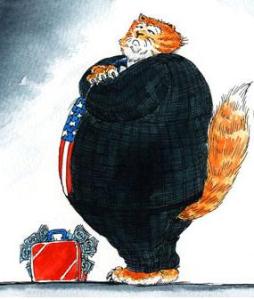 Plutocracy’. It’s an interesting read with a lot of quotes from other pundits.
THE word “plutocracy” is in the air these days. Some say the era of the de facto rule of the mighty top 10%, or top 1%, or whatever insidious sliver of the income distribution is thought to constitute the moneyed power elite, is upon us, or nearly so. I’m not so sure. I am sold on the proposition that there’s something deeply whacked about the American financial system, and that whatever that’s whacked about it is significantly responsible for the top 1% pulling so far away from the rest of the income distribution. This needs to be fixed, whatever its other consequences. It’s not clear to me, however, what exactly is whacked. I don’t know whether to sign up for Tyler Cowen’s “going short on volatility” story, Daron Acemoglu’s “financial-sector lobbying and campaign contributions ‘bought’ an enriching (and destabilising) regulatory structure” story, or some other story. No doubt the truth is in some subtle combination of stories. In any case, accounts such as Mr Acemoglu’s, according to which big players in certain sectors over time manage to rig the regulatory climate to their advantage, are quite compelling for reasons both theoretical and empirical
Newsweek has an interesting article up on why the megarich manage to have such a sweet tax deal. Even if we raise their income taxes, it really doesn’t hit them where it counts. Here’s why.
It drives economist Bruce Bartlett crazy every time he hears another bazillionaire announce he’s in favor of paying higher taxes. Most recently it was Mark Zuckerberg who got Bartlett’s blood boiling when the Facebook founder declared himself “cool” with paying more in federal taxes, joining such tycoons as Bill Gates, Warren Buffett, Ted Turner, and even a stray hedge-fund manager or two.
Bartlett, a former member of the Reagan White House, isn’t against the wealthy paying higher taxes. He’s that rare conservative who thinks higher taxes need to be part of the deficit debate. His beef? It’s a hollow gesture to say the federal government should raise the tax rate on the country’s top wage earners when the likes of Zuckerberg have most of their wealth tied up in stock. Many of the super-rich see virtually all their income as capital gains, and capital gains are taxed at a much lower rate—15 percent—than ordinary income. When Warren Buffett talks about paying a lower tax rate than his secretary, that’s because she sees most of her pay through a paycheck, while the bulk of his compensation comes in the form of capital gains and dividends. In 2006, for instance, Buffett paid 17.7 percent in taxes on the $46 million he booked that year, while his secretary lost 30 percent of her $60,000 salary to the government.
“It’s easy to say ‘Raise taxes’ when you know you’re not going to have to pay those taxes,” Bartlett says. “What I don’t hear is ‘Let’s raise the capital-gains tax.’” Instead the focus has been on the federal tax rate paid by those with an annual income of $250,000 or more—the top 3 percent of earners. Bartlett argues that while raising taxes on the country’s richest individuals would go a long way in easing the debt crisis, it makes no sense to treat the professional making a few hundred thousand dollars a year the same as the Richie Rich set. Maybe it’s hard to muster sympathy for an executive pulling down $1 million a year. But ours is a tax system where a person in the top tax bracket (those earning more than $374,000 in 2010) pays a tax rate of 35 percent on the upper portions of his or her income (37.9 percent if you include Medicare), whereas a hedge-fund manager or mogul earning 10 or 100 times that amount pays less than half that tax rate.
Well, now I’m thinking we’re all just so f’ked that I might as well stop while I’m ahead. What’s on your reading and blogging list today?

 peej
peej Carissa
 bostonboomer
 dakinikat
 ecocatwoman
 mablue2
 Mama Lopez
 peggysue22
 quixote
 skydancingguestblogger
 Mona (aka Wonk the Vote)



 Sky Dancing
Recent Comments