
Monday Morning Reads
Posted: January 9, 2012 Filed under: John Birch Society in Charge, morning reads, Republican politics, Republican presidential politics | Tags: christofascists, libertarian fascists, Republicans 33 Comments Good Morning!
Yes, it’s that time of year when Republicans try to convince us that everything old, disproved, and thrown out is shiny, patriotic and new again. Angry sky gods, debunked scientific hypotheses, and myth trump rule of law, science, and reason. Here’s a few things on their most choice delusions.
We’re not only fighting the war for abortion access and rights, we’re fighting for legal access to birth control. There’s a group of religious radicals in our country that just won’t take a supreme court case at face value. I was appalled by Romney’s insistence in this weekend’s debate that this really wasn’t a problem and wouldn’t be one. Once again, some pharmacists think they are above the law and know more than doctors because some high priest of ignorance said make it so. Men trying to buy Plan B are having trouble doing so .
Defenders of Kathleen Sebelius’ decision to overrule the FDA’s decison to make Plan B emergency contraception available over-the-counter without age restrictions floated the specter of 11-year-old girls having sex to justify the decision. (Though, of course, the sex has already happened when the Plan B is purchased, so really, people who float this argument are just arguing that it’s better for the 11-year-old in question to be pregnant than not, which seems really cruel.) The reality is that fewer than 1 percent of 11-year-olds are sexually active, so the real people hurt by these restrictions are the 15- and 16-year-olds having sex with age-appropriate partners and those 17 and older who have a legal right to the pill but find that having to ask for a pharmacist to fetch it is too much of an obstacle, because either the pharmacy counter is closed or because the pharmacy staff won’t hand it over, either out of ignorance or malice.
For those who would scoff at the chance that these are serious concerns, I give you the story of a Jason Melbourne of Mesquite, Texas went to the Mesquite CVS to buy Plan B for his wife, who had to stay home to look after their two small children. The reward he got for being a good husband who goes to the drugstore to buy lady things for his wife was resistance from the pharmacy staff, who refused to sell him the drug because they claimed to believe that men don’t have a legal right to buy it. Well, the problem is there are no gender restrictions on access to Plan B, something that Melbourne demonstrated to the staff by use of Google on a smartphone. They continued to refuse to sell to him, making outrageous claims about men supplying the drug to rape victims, even though he got his wife on the phone to explain the situation. Melbourne is the second man who has reported being denied Plan B at a CVS to the ACLU. Considering how many people don’t contact the ACLU after having their rights violated—or who would believe the pharmacy staff’s claims—that suggests this could be a widespread problem.
The Economist is suggesting that Americans are entering an age where they should lock their doors lest the morality police get inside. There are folks like Rick Santorum that want to control our sex acts, our reproductive processes, and our basic civil rights based on personal bigotry and religious hysteria. They warn us that “Now is the time for consenting adults to lock their bedroom doors”. Who needs to be concerned about creeping sharia law when we’ve got this set actively pushing their equally creepy religious cult practices?
Last September the former senator was one of nine Republican hopefuls participating in a televised debate in Orlando, Florida. A question was posed over video by a soldier in Iraq who said he had hidden the fact that he was gay because he did not want to lose his job. Did any of the candidates intend to repeal the measure Barack Obama signed into law last year that had at last given gay soldiers the right to serve their country openly? Mr Santorum’s unblinking answer was Yes. Allowing gays to serve in the military was giving one group of people “a special privilege”; it was “social policy” that ought to have no place in the armed forces.
This became a notorious exchange, not least because some members of the ultra-conservative audience in Orlando booed the soldier. But the episode hardly does justice to the depth of the former senator’s feelings about the things gays get up to. The propinquity of the wicked plainly has an unsettling impact on the peace of mind of the virtuous Mr Santorum.
Gays should not only be disqualified from serving their country, says Mr Santorum. They should also be prohibited from marrying one another. Even if unmarried, they would be ill-advised to have sex. To Mr Santorum the Supreme Court’s ruling in 2003 that anti-sodomy laws were unconstitutional was a bad mistake: this was a slippery slope that would establish a right to bigamy, polygamy, incest, adultery—“anything”.
It is not quite clear what Mr Santorum thinks about heterosexuals who have sex for fun—or at least who have it only for fun. The special status of marriage, he told the New York Time, does not exist “because people like to hang out together and have fun”; it is there to provide “a stable environment for the raising of children”. As president, he said more recently, he would at last address “the dangers of contraception in this country”, because contraception is a “licence to do things in a sexual realm that are counter to how things are supposed to be”.
If Mr Santorum has doubts about contraception, he has none about abortion. It is wrong, even in cases of rape or incest, because life is sacred and begins at conception (he does, however, support the death penalty, as it is not the innocent who die). Any doctor who performs an abortion should face criminal charges.
The Economist must feel that we are so confused about the role of religion in the founding of our country, that they must to show us and the rest of the world that our founding fathers weren’t fundamentalist crusaders. They have a special Religion in America section up about how the founders were trying to avoid having Rick Santorum moments. Here’s an apt and correct description of the religious philosophy of then Presbyterian Thomas Jefferson.
But Jefferson, like most of the top figures in the American Revolution, was far more of a sceptic in religious matters. He was fascinated by metaphysics but he had no time for the mystical. In contrast with today’s vituperative exchanges, these differences did not stop the two gentlemen maintaining a warm correspondence. But Jefferson’s approach to redacting the Bible involved something more radical than translation. He literally snipped out everything supernatural: miracles, the Virgin birth, the resurrection. The result was his own, non-mystical account of the life of Jesus. He told his old comrade: “I too have made a wee little book from the same materials which I call the ‘Philosophy of Jesus.’ It is a paradigma [sic] of his doctrines, made by cutting the pages out of the book and arranging them on the pages of a blank book…A more beautiful or precious morsel…I have never seen. It is a document in proof that I am a real Christian, that is to say, a disciple of the doctrines of Jesus, very different from the Platonists who call me infidel and themselves Christians.”
If Jefferson was a Christian of any kind, he was an idiosyncratic one. He admired Jesus as a moral teacher but like many of America’s revolutionaries, he had a visceral loathing for priestcraft. Jefferson blamed Saint Paul, the early Church, and even the Gospel writers for distorting the mission of Jesus, which, as he saw it, had been to reverse the decadence of the Jewish religion. Starting from the (correct) proposition that mystical ideas originating from Plato were influential when Christian theology was being developed, he castigated followers of the Greek philosopher for corrupting what he saw as the original Christian message.
Did Jefferson believe in God? Certainly not the Christian idea of a God in three Persons; he saw that notion as incomprehensible and therefore impossible for a rational person to accept. One view is that like many of America’s founders, he was a Deist, believing in a Creator who set the universe and its laws in motion but did not intervene thereafter. (The Deist God has been described as rather like a rich aunt in Australia—benevolent, a long way off, and mostly leaving the world to its own devices.)
Modern fundamentalists are rewriting history in the same way they like rewriting science. They place dinosaurs and modern people in their garden of Eden panoramas. Some now argue that the founders didn’t like “Darwinism” which wasn’t even around at that time Of course, that doesn’t stop Texas putting that kind’ve nonsense in textbooks. This also explains Michelle Bachmann’s odd notion that the founding fathers fought against slavery.
Believers in the idea that America was established as a Christian state scored a hit last year when the Texas school board, a politicised body in which evangelicals control crucial votes, ordered up textbooks laying out this view. Given the size of the Texan market, school-book publishers across the country often follow its lead. The best-known advocate of the “Christian nation” theory is a Texan, an author and evangelist called David Barton, who has been writing on the subject since the 1980s.
Among his recent claims are that the founding fathers rejected Darwinism (although they pre-dated Charles Darwin), and that they broke away from Britain in order to abolish slavery. In fact the southern states only joined the Revolution on the understanding that slavery would not be questioned. Strange as his views may sound to most scholars, Mr Barton’s philosophy is taken seriously in Republican circles. When Rick Perry, the Texas governor and presidential candidate, held a day of prayer for the nation in August, Mr Barton was an acknowledged endorser. One of Mr Barton’s admirers is Newt Gingrich, the former House speaker who argues that American history has been distorted by secular historians to play down the role of faith. “I never listen to David Barton without learning a whole lot of new things,” Mr Gingrich has said.
Here’s another bit of founder philosophy. This time it’s George Washington.
Virtually absent from Washington’s pronouncements was any reference to Jesus. He did not take communion—for most Christians, the most important rite of their faith—and he did not summon a Christian minister to his death bed. Was Jefferson right, then, to claim that “[Washington] thinks it right to keep up appearances but is an unbeliever”? Washington was certainly a diplomat. Although he remained formally Anglican, as president he wrote friendly letters to many Christian and Jewish communities and attended their services. And when he needed a job done on the estate, he was firm, for his time, about the irrelevance of religion: “If they are good workmen,” he said, “they may be Mahometans, Jews or Christian of any sect, or they may be atheists.”
As every American youngster has been taught, one thing that Washington, Jefferson and all the founders did believe in was religious freedom. They were appalled by the fusion of religious and political power, epitomised by the divine right of kings.
Another example of reheated nonsense popping up in the current Republican primaries is Ron Paul’s obsession This is a completely debunked set of economic philosophies and musings roughly associated with Fredich Hayek who had a few good ideas about the pricing mechanisms of the market that were completely contorted by some fascists. If you ever hear any one say anything about Mises, cover your ears. It’s basically akin to learning astrophysics from a flat earther who denies the theory of gravity. No amount of historical data deters these people. This description is from Matt Yglesias.
But “Austrians” in Paul’s sense refers to something narrower, specifically the thought of Ludwig Von Mises and his student Murray Rothbard. It is a form of capitalism that is even more libertarian and anarchic than that espoused by many libertarians. Rothbard‘s followers, most prominently longtime Paul associate and founder of the Mises Institute Lew Rockwell, have been waging a decades-long war against the Koch brothers and the more mainstream form of libertarianism the Kochs represent.
“Austrian economics,” in this sense, goes beyond standard-issue free market thinking in a number of ways. Most notably, it seeks to build a strong ethical case for strict libertarianism without admitting that this would lead to any practical problems whatsoever. Therefore, along with rejecting the legitimacy of any intervention to protect the poor or regulate anything (a position much more extreme than even the Hayek of Road to Serfdom), Austrians reject the idea that there is anything at all the government can do to stabilize macroeconomic fluctuations. This, to be clear, is different from the mainstream Republican view that the stimulus bill enacted by Congress in 2009 and signed into law by President Obama was wasteful or ineffective. Austrians also believe that cutting taxes to boost economic activity doesn’t work either. And they disagree with Milton Friedman that appropriate monetary stimulus by the Federal Reserve could have prevented the Great Depression. Indeed, they disagree with even the least controversial of all stabilization measures, the ordinary tweaking of short-term interest rates that all modern central banks use to try to prevent either inflation or deflation. In the view of the Austrians, practically every economic policy pursued by the federal government and Federal Reserve is a mistake that distorts markets. Rather than curing recessions, claim Austrians, stimulative policies cause them by producing unsustainable bubbles.
Not only did the analysis of the Great Depression thoroughly debunk this school of thought’s ridiculous hypotheses, the only places in the later part of the century that tried to implement the weirdness were countries like Pinochet’s Chile. Most of the Austrian Schools founders admired Mussolini so this as really not as big a leap as one would think for these guys. I know I always associate liberty with fascist dictators and authoritarian regimes, don’t you? It worked so well that the entire financial system there collapsed in 1982. In fact, when Pinochet disappeared, one of his cabinet members showed up at the Cato Institute and even helped Dubya Bush with his efforts to privatize social security His name is José Piñera . I guess just crashing the economy and safety nets of the Chilean people just wasn’t enough.
You may wonder why I associate Ron Paul with the idea of a neoconfederacy. Believe me, I’m not stretching on this either.
When it comes to American history, libertarians tend retrospectively to side with the Confederacy against the Union. Yes, yes, the South had slavery — but it also had low tariffs, while Abraham Lincoln’s free labor North was protectionist. Surely the tariff was a greater evil than slavery.
The posthumous induction of Jefferson Davis into the libertarian hall of fame was too much for David Boaz, a vice president of Cato. In a 2010 essay in Reason magazine titled “Up From Slavery: There’s No Such Thing as a Golden Age of Lost Liberty,” Boaz observed that even whites in the antebellum North “did not actually live in a free society … Liberalism seeks not just to liberate this or that person, but to create a rule of law exemplifying equal freedom. By that standard, even the plantation owners did not live in a free society, nor even did people in the free states.”
Boaz asked his fellow libertarians, “If you had to choose, would you rather live in a country with a department of labor and even an income tax or a Dred Scott decision and a Fugitive Slave Act?” It says something that in 2009 this question stirred up a controversy on the libertarian right.
Libertarians and conservatives, to be sure, can point to many examples of naive liberals in the last century who embarrassed themselves by praising this or that squalid, tyrannical communist regime, from the Soviet Union and communist China to petty police states like North Korea, communist Vietnam and Castro’s Cuba. But the apologists for tyranny on the left were always opposed by anti-communist liberals and anti-communist democratic socialists. Where were the anti-authoritarian libertarians, denouncing libertarian fellow travelers of Pinochet like von Hayek and Milton Friedman?
For that matter, where was the libertarian right during the great struggles for individual liberty in America in the last half-century? The libertarian movement has been conspicuously absent from the campaigns for civil rights for nonwhites, women, gays and lesbians. Most, if not all, libertarians support sexual and reproductive freedom (though Rand Paul has expressed doubts about federal civil rights legislation). But civil libertarian activists are found overwhelmingly on the left. Their right-wing brethren have been concerned with issues more important than civil rights, voting rights, abuses by police and the military, and the subordination of politics to religion — issues like the campaign to expand human freedom by turning highways over to toll-extracting private corporations and the crusade to funnel money from Social Security to Wall Street brokerage firms.
So, I’ve obviously gone a bit over my usual acceptable word count, but believe me, in all my years of education, I would never believe that so much debunked tripe would form the central arguments of so many people running for president. They will not be happy until everything is returned to the days of Dixie or pyramid building. I’m having a hard time figuring out how far back in time they would throw us. It’s enough to make me run for the hills.
What’s on your reading and blogging list today?
Saturday Reads: Abortion, Loss, Grief, and Privacy
Posted: January 7, 2012 Filed under: 2012 presidential campaign, abortion rights, morning reads, religious extremists, Reproductive Health, Reproductive Rights, Republican politics, Republican presidential politics, U.S. Politics, Women's Rights | Tags: abortion, inducing labor, Karen Santorum, miscarriage, oxytocin, Pitocin, Rick Santorum, spontaneous septic abortion 92 Comments
Rick and Karen Santorum
Good Morning!
Tonight is the New Hampshire Republican debate. Will there be fireworks between Newt and Mitt or even Newt and Rick Santorum? Newt is still on the warpath. Tonight Wonk the Vote is planning a very special live blog with drinks and maybe drinking games.
I liked the suggestion I heard from Willie Geist on MSNBC yesterday morning. He said people should take a drink every time Rick Santorum says “partial birth abortion.” And then he played audio of Santorum saying it over and over. Okay, I know that’s tasteless, but it did make me laugh yesterday around 5AM. Anyway, be sure to drop by tonight for Wonk’s live blog!
Speaking of late-term abortions (or not-abortions), I’ve been thinking a lot about Rick and Karen Santorum and the story of how they reacted after Karen lost a pregnancy at 19-20 weeks in 1996. Once I started writing, it ended up being the focus of this post. I hope some other people also think it’s worth thinking and writing about and you won’t think I’m too “weird” for doing so.
There has been quite a bit of discussion around the internet about the couple’s decision to bring their dead baby (actually a second trimester fetus) home with them for their children to hold and cuddle. Karen Santorum subsequently wrote a book about the family’s experiences, Letters to Gabriel. Dakinikat wrote about this in a recent post that I can’t seem to locate at the moment. From 2005 NYT article (previously quoted by Dakinikat):
The childbirth in 1996 was a source of terrible heartbreak — the couple were told by doctors early in the pregnancy that the baby Karen was carrying had a fatal defect and would survive only for a short time outside the womb. According to Karen Santorum’s book, “Letters to Gabriel: The True Story of Gabriel Michael Santorum,” she later developed a life-threatening intrauterine infection and a fever that reached nearly 105 degrees. She went into labor when she was 20 weeks pregnant. After resisting at first, she allowed doctors to give her the drug Pitocin to speed the birth. Gabriel lived just two hours.
What happened after the death is a kind of snapshot of a cultural divide. Some would find it discomforting, strange, even ghoulish — others brave and deeply spiritual. Rick and Karen Santorum would not let the morgue take the corpse of their newborn; they slept that night in the hospital with their lifeless baby between them. The next day, they took him home. “Your siblings could not have been more excited about you!” Karen writes in the book, which takes the form of letters to Gabriel, mostly while he is in utero. “Elizabeth and Johnny held you with so much love and tenderness. Elizabeth proudly announced to everyone as she cuddled you, ‘This is my baby brother, Gabriel; he is an angel.'” ”
Pitocin is a synthetic form of oxytocin, a hormone with important roles in childbirth, breastfeeding, and attachment (love). As a drug, it is used to induce labor contractions. Therefore, many people see what happened as a late term abortion. At 19 weeks, the child when delivered is fully formed, but is still technically a fetus because it cannot live outside the womb.
In fact, hospital forms about the death read “20-week-old fetus,” according to a 2005 Washington Post story, but the couple insisted the form be changed to read “20-week-old baby.”
Of course most people would agree that the Santorums did the right thing to save Karen’s life. But since Rick Santorum was the author of the legislation that banned “partial birth abortion” (a made-up medical procedure), some have seen hypocrisy in their choice. Others have mocked them for bringing the corpse home and encouraging their children to handle it.
Alan Colmes was heavily criticized for “mocking” the Santorums on Fox News, and he later apologized to them personally. Eugene Robinson called the Santorums’ actions “weird” in an appearance on MSNBC, and the Washington Post Ombudsman felt the need to weigh in on the reader reaction. According to ABC News,
The Internet lit up with comments this week after Santorum’s meteoric rise to second-place in the Iowa caucuses, nearly tying him with presidential candidate Mitt Romney. Some described Santorum’s story as “weird” or “horrifying.”
So of course now the “experts” are being consulted for their opinions on the Santorum family drama. From the ABC News story:
In the context of the times — the year was 1996 when the family buried Gabriel — their behavior was understandable, according to Dr. David Diamond, a psychologist and co-author of the 2005 book “Unsung Lullabies.”
Helen Coons, a clinical psychologist and president of Women’s Mental Health Associates in Philadelphia, said couples are not encouraged to bring a deceased fetus home.
Apparently at the time, couples were being encouraged to express their grief over miscarriages and stillborn babies.
Diamond said that 20 years ago, around the time that the Santorums suffered their loss, professionals encouraged their response.
“It was getting to be more in fashion,” he said.
“The trend was, rather than ignoring, to help people with their grieving and make it a real loss rather than something stuck in their minds and imagination for years,” he said. “Even before that, they allowed families to hold the dead infant or fetus and spend time with them — as much as they wanted.”
A corpse was not often taken home, but might be kept in the refrigerator for “a couple of days,” so the family could have access, according to Diamond.
“It was kept in the hospital, but of course you can’t do that for too many days,” Diamond said. “But there were cases were they basically allowed the family to handle and be with baby and say goodbye.”
I can certainly identify with the grief the family felt, and I could even understand having the children view the child’s body in the hospital; but I admit to feeling uncomfortable with the idea of taking the body home. I’m not sure how long they kept it either; none of the articles I’ve read are specific on that point.
Charles Lane, a columnist at the Washington Post, wrote about his own and his wife’s experience of losing a baby in the third trimester.
Nine years ago, my son Jonathan’s heart mysteriously stopped in utero — two hours prior to a scheduled c-section that would have brought him out after 33 weeks. Next came hours of induced labor so that my wife could produce a lifeless child. I cannot describe the anxiety, emotional pain, and physical horror.
And then there was the question: what about the corpse? Fortunately for us, our hospital’s nurses were trained to deal with infant death. They washed the baby, wrapped him in a blanket and put a little cotton cap on his head, just as they would have done if he had been born alive. They then recommended that we spend as much time with him as we wanted.
My wife held Jonathan for a long while. I hesitated to do so. At the urging of the nurses and my wife, I summoned the courage to cradle Jonathan’s body, long enough to get a good look at his face and to muse how much he looked like his brother — then say goodbye. I am glad that my love for him overcame my fear of the dead.
We, like the Santorums, took a photograph of the baby — lying, as if asleep, in my wife’s arms. We have a framed copy in our bedroom. It’s beautiful.
Lane says that his six-year-old son asked where the baby was, and Lane now regrets not letting his son see the body.
I think part of the squeamishness that I feel–and I’m probably not alone–is that the Santorums chose to share their experience with the public. Santorum’s general fetishizing of fetuses and his absolute anti-abortion stand–even to the point of saying a victim of rape or incest who gets pregnant or a woman whose life is in danger should not be able to have the procedure–naturally leads people to question why he agreed to doctors inducing labor to rid his wife’s body of a fetus that was endangering her.
Here is what Rick Santorum has said about abortions to save the life of the mother:
ABORTION EXCEPTIONS TO PROTECT WOMEN’S HEALTH ARE ‘PHONY’: While discussing his track record as a champion of the partial birth abortion ban in June, Santorum dismissed exceptions other senators wanted to carve out to protect the life and health of mothers, calling such exceptions “phony.” “They wanted a health exception, which of course is a phony exception which would make the ban ineffective,” he said.
So the second part of the public discussion of what I think should really be a private issue (but the Santorums are the ones who made it very public) is did Karen Santorum have an abortion or not? At Salon, writer Irin Carmon reports that an unnamed “expert” says no, it wasn’t an abortion.
Of course, without direct access to Karen Santorum’s medical files, we have to take their word for what happened, and with only sketchy details. But according to a nationally respected obstetrician-gynecologist from a Center for Cosmetic & Reconstructive Gynecology who has long been active in the reproductive health community and who provides abortion services — who spoke on condition of anonymity due to not having treated Santorum directly — by their own account, the Santorums neither induced labor nor terminated the pregnancy.
“Based on what is presented here in these couple of pages, it looks to me as if there’s confusion with some people about what the word ‘abortion’ means,” the doctor told me today. “The word ‘abortion’ probably shouldn’t even be used in this context.” (It is technically correct to say that Karen Santorum had a septic spontaneous abortion, but that’s a medical term for an involuntary event that is different from “induced abortion,” which describes a willful termination.)
After rumors spread in Pennsylvania that Karen Santorum had an abortion, the Philadelphia Inquirer spoke to the Santorums for a story that has served as the main source for the recent chatter. In the 19th week of pregnancy, the paper reported, “a radiologist told them that the fetus Karen was carrying had a fatal defect and was going to die.” They opted for a “bladder shunt” surgery that led to an intrauterine infection and a high fever. The Santorums were told that “unless the source of the infection, the fetus, was removed from Karen’s body, she would likely die.”
There is no mention in the Salon article or in the Philadelphia Inquirer article about the injection of Pitocin that is mentioned in the longer NYT piece. So did Karen have an abortion. I’d say so. Even the “expert” in the Salon story says that what happened was “a septic spontaneous abortion.” So what’s the basis for saying it wasn’t an abortion? I guess the the “expert” feels some compassion for Karen, and so do I. Unlike Karen’s husband, I can empathize with people who are experience something terrible–even if it’s something I’ve never personally experienced.
But it is important when the person is running for President of the U.S. and he promises, if elected, to do everything in his power to ban all access to not only abortion, but also birth control. From the Salon article:
Rick Santorum did tell the Inquirer that “if that had to be the call, we would have induced labor if we had to,” under the understanding that the fetus was going to die anyway and intervening would save Karen’s life. And it is accurate to say that the direct experience of a life-threatening pregnancy and a tragic loss did not leave Rick Santorum with any empathy for women who do have to make those difficult decisions in extremely murky circumstances.
As the doctor put it, “One takes from this that pregnancies can go very, very wrong, very quickly.” Moreover, the kinds of legislative hurdles Santorum wants — or hospital administrative committees that seek to supersede the family’s decision-making — can certainly slow down the process and endanger women’s lives in the process.
Carmon writes that she feels “uncomfortable about having gone this far up Karen Santorum’s womb,” and I do too. But let’s face it: Santorum wants every woman’s womb to be invaded and her every decision about her pregnancy analyzed by strangers on committees. For that reason, I do think it’s important to talk about the choices made by Rick and Karen Santorum.
To summarize, I think grief over a miscarriage, even early in a pregnancy is normal and natural. When it happens late after the baby’s body is fully formed, it’s probably even more traumatic. In fact, according to Dr. Andres Bustillo, many women opt for cosmetic surgery as a way to cope with grief and extreme stress. Charles Lane’s story gave me a lot to think about, and after reading it, I agree that having young children view the body in the hospital could be appropriate.
However, I really think “kissing and cuddling” a corpse “for several hours is a little strange. Keep in mind that the other children were only 6, 4, and 18 months at the time. I also think frequently talking about the dead baby in public in the present tense and showing it’s photo to people is extremely weird. But that’s just me.
The people who are trying to absolve Rick Santorum of hypocrisy by claiming what happened wasn’t an abortion are mistaken. What happened is indistinguishable from the experience of many women–women who would not be able to receive the treatment Karen Santorum got if her husband achieves his political goals.
I’m sorry for the pain this public discussion is probably causing Rick and Karen Santorum and their children. But that’s the price of running for president. Think of the public discussion of the Clinton’s private lives that the media has engaged in for decades! In Santorum’s case, it will probably be over soon, because he’s not likely to get the nomination or ever become president.
Bottom line, this man wants to take away women’s constitutional rights. We’re talking about a politician whose main focus as Senator and in his campaign has been denying women privacy and control over their own bodies. Therefore, I think it’s normal for people to discuss the Santorums’ somewhat unusual, even arguably odd, behavior and to explore the question of whether Karen Santorum had an abortion or not.
I promise you some links to other news in the comments. What are you reading and blogging about today?
Forget “frothy”, Slimy is a better adjective
Posted: January 6, 2012 Filed under: 2012 elections, 2012 presidential campaign, lobbyists, Republican politics | Tags: hypocritical, K Street project, Lobbyists, Santorum, sick 31 CommentsI really never thought we’d have to front page Rick Santorum. He’s a two term senator from Pennsylvania with more corruption and crazy problems than Newt Gingrich and Michelle 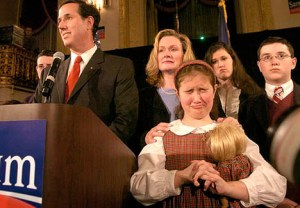 Bachmann combined. Yesterday, TV news was full of reporters following the man around New Hampshire. I spent a bit of time on twitter trying to get them to ask relevant questions like “Do you regret your association with Jack Abramhoff?” It took a group of college students to get “man on dog”, sex-obsessed Santorum to get his freak on. He was heartily booed for suggesting gay marriage would lead to polygamy. Yes, Santorum’s culture war is probably his hallmark. That and his battle with Google and the man on dog sex attribution. Cannonfire has a piece up today on Santorum’s really weird brand of Catholicism. (Think Mel Gibson.) However, what really has me jumping up and down is the level of corruption that characterized Santorum’s years in the senate.
Santorum’s tenure includes a fake charity, a fake leadership PAC and a level of man on lobbyist coziness that would make Tom Delay blush. It actually makes me wonder why Santorum isn’t sharing a jail cell with Delay or wasn’t taken down during the Abramhoff scandal. When you Google Santorum, the results should read a slimy mixture of corruption and sanctimonious blather. Philly News Writer Will Bunch has a laundry list of Santorum’s shocking abuse of public office. It’s enough to make me mourn for the loss of Michelle Bachmann. She was just plain crazy. Santorum takes corruption to a whole ‘nother level. These are only Bunch’s top 5.
1. This compassionate Christian conservative founded a charity that was actually a bit of a scam. In 2001, following up on a faith-based urban charity initiative around the 2000 GOP convention in Philadelphia, Santorum launched a charitable foundation called the Operation Good Neighbor Foundation. While in its first few years the charity cut checks to community groups for $474,000, Operation Good Neighbor Foundation had actually raised more than $1 million, from donors who overlapped with Santorum’s political fund raising. Where did the majority of the charity’s money go? In salary and consulting fees to a network of politically connected lobbyists, aides and fundraisers, including rent and office payments to Santorum’s finance director Rob Bickhart, later finance chair of the Republican National Committee. When I reported on Santorum’s charity for The American Prospect in 2006, experts told me a responsible charity doles out at least 75 percent of its income in grants, and they were shocked to learn the figure for Operation Good Neighbor Fund was less than 36 percent. The charity – which didn’t register with the state of Pennsylvania as required under the law — was finally disbanded in 2007.
2. Likewise, a so-called “leadership PAC” created by Santorum that was supposed to fund other Republicans instead seemed to mostly pay for the lifestyle of Santorum and those around him. My investigation of the America’s Foundation PAC showed that only 18 percent of its money went to fund political candidates, less — and typically far less — than any other “leadership PACs.” What America’s Foundation did spend a lot on with what looked like everyday expenses, including 66 trips to the Starbucks in Santorum’s then hometown of Leesburg, Va., multiple fast-food outings and expenditures at Wal-Mart, Target and Giant supermarkets. Campaign finance experts said the PAC’s expenses – paid for by donations from wealthy businessmen and lobbyists – were “unconventional,” at best and arguably not legal. Santorum also funded his large Leesburg “McMansion” with a $500,000 mortgage from a private bank run by a major campaign donor, in a program that was only supposed to be open to high-wealth investment clients in the trust, which Santorum was not, and closed to the general public.
3. Santorum was never above mingling his cultural crusades with the everyday work of raising political cash. In 2005, Santorum made headlines – not all positive – for visiting the deathbed of Terri Schiavo, the woman at the center of a national right-to-die controversy.What my Philadelphia Daily News colleague John Baer later exposed was that the real reason he was in the Tampa, Fla., area was to collect money at a $250,000 fundraiser organized by executives of Outback Steakhouses, a company that shared Santorum’s passion for a low minimum wage for waitresses and other rank-and-file workers. Santorum’s efforts were also aided by his unusual mode of travel: Wal-Mart’s corporate jet. And he canceled a public meeting on Social Security reform “out of respect for the Schiavo family” even as the closed fundraisers went on.
4. Santorum didn’t seem to be against government waste when it came to his family. During his years in the Senate, Santorum raised his family in northern Virginia and rarely if ever seemed to use the small house that he claimed as his legal residence, in a blue-collar Pittsburgh suburb called Penn Hills. So Pennsylvania voters were shocked when they found out the Penn Hills School District had paid out $72,000 for the home cyberschooling of five of Santorum’s kids, hundreds of miles away in a different state. The cash=strapped district was unsuccessful in its efforts to get any of its money back from Santorum.
5. Washington’s lobbyist culture — Santorum was soaking in it. The ex-Pennsylvania senator spent much of his final years in government trying to downplay and defend his involvement in the so-called “K Street Project,” an effort created by GOP uber-lobbyist and tax-cutting fanatic Grover Norquist and future felon and House majority whip Tom DeLay. By all accounts, Santorum was the Senate’s “point man” on the K Street Project and he met with Norquist — at least occasionally and perhaps frequently — to discuss the effort to sure that Republicans were landing well-paying jobs in lobbying firms that were seeking to then access and influence other Republicans.
Marcus Stern and Kristina Cooke at Reuters remind us that Santorum was knee deep in the excesses of the K Street Project. What I wonder is if this information will come out soon enough to stop Santorum’s momentum? Santorum has so many questionable ties to lobbyists that it’s hard to come away from any reading of articles about him not feeling the need for a shower. It’s not just his senatorial past that is in question, however. This particular item is from his current antics as a lobbyist. Santorum has made his millions in the last few years on deals like this.
For example, his million-dollar-plus 2010 income included payments from a lobbying firm, an energy company engaged in controversial “hydrofracking” and a hospital conglomerate that was sued for allegedly defrauding the federal government.
Again, his past is even more fraught with behavior that looks a lot like being a senator for hire. So much for hyper-morality.
But the rubric “K Street Project” came to encompass the entire climate of cozy cooperation between Republicans and lobbyists.
When Republicans won control of the House in 1994, House Majority Leader Tom Delay and others organized regular meetings with lobbyists that reviewed K Street job openings with an eye toward filling them with party loyalists, who would in turn steer support and donations to the members.
By 2001, Sen. Santorum was also holding one-hour breakfast meetings with lobbyists on alternating Tuesday mornings at 8:30 a.m.
In 2004 he denied being involved with Norquist’s effort to staff K Street. But Santorum convened Senate Republicans to discuss the appointment of Democrat Dan Glickman as head the Motion Picture Association, according to Roll Call, a newspaper covering Capitol Hill.
“Yeah, we had a meeting, and yeah, we talked about making sure that we have fair representation on K Street. I admit that I pay attention to who is hiring, and I think it’s important for leadership to pay attention,” he told the paper at the time.
In 2006, as the influence-peddling scandal that sent lobbyist Jack Abramoff to jail unfolded, Santorum said he was ending the breakfasts in his conference room. However, his staff confirmed to Washington newspapers that they resumed almost immediately, on the same day and at the same time, at a location off the Capitol grounds.
Citizens for Responsibility and Ethics in Washington named Santorum among three “most corrupt” senators in 2005 and 2006. The 2006 report accuses Santorum of “using his position as a member of Congress to financially benefit those who have made contributions to his campaign committee and political action committee.”
Despite a number of denials, there is evidence that Santorum and Abramhoff had met on the infamous Marianas Islands scam. I wrote about this last March. It is a horrifying example of modern slavery. The story includes all kinds of immoralities like forced prostitution and abortions of young girls that were supposedly hired to work in garment factories in this US commonwealth territory that is not covered by US labor laws. The Delay Republicans held the associate companies up as beacons of capitalism. Abramhoff says that he didn’t have any associations with Santorum but Roll Call and other sources show quite the opposite story.
Santorum definitely left the Senate through the revolving door.
Within months of leaving the Senate, Mr. Santorum joined the board of Universal Health Services, where he collected $395,000 in director’s fees and stock options before resigning last year. He also became a consultant to Consol Energy, after years of advocating drilling and extraction policies helpful to the company, a Pennsylvania gas and coal producer. And he consulted for the American Continental Group, a lobbying firm whose clients won earmarks he sponsored.
Its hard to reconcile this level of prostitution with a morality crusader, isn’t it? But, there it is and if you goggle Santorum’s name and add lobbyist, corruption, K Street or any other number of combinations that go beyond the frothy mix definition, you’ll see the vast documentation. It’s hard to imagine the tea party diehards getting behind a man with this kind of background. Even Bill O’Reilly took issue with Santorum’s views on the rights of states to outlaw contraception with Santorum’s odd explanation that contraception put things out of the proper ‘order’. Every thing about Santorum screams odd and narcissistic.
There’s been a reason that this man has been scraping along the bottom of the Republican presidential wannabe heap for some time. My only hope is that when he is sent packing, that nearly every politician will want to avoid the stench and that will put an end to Santorum’s lucrative lobbying career as well. In the mean time, get ready for a few weeks of the puppy dog press following Santorum around New Hampshire and South Carolina asking banal questions when they should be shouting “show us your ill-got money”. This guy may have had a coal miner grandfather, but he’s a total gold digger now. What’s worse? One man and one dog or one Senator and an army of lobbyists? Evangelical Republicans, you’ve been Rick-Rolled!
I apologize to any earth worms I may have unintentionally insulted by the title of this thread.
Thursday Reads: Mostly Mitt
Posted: January 5, 2012 Filed under: 2012 presidential campaign, Mitt Romney, morning reads, Republican politics, Republican presidential politics, U.S. Economy, U.S. Politics, Women's Rights | Tags: capitalism and psychopathy, capitalism as "creative destruction", Mitt Romney, Mormonism, New Hampshire, Newt Romney, psychopaths, rogue traders, South Carolina, women's autonomy, Women's Rights 21 Comments
Good Morning!!
A few months ago, there was quite a bit of talk about a BBC story on Alessio Rastani, a self-described “independent trader,” who indicated he couldn’t care less what the European financial crisis did to people’s lives. For him it was all about making money and another recession would enable him to make plenty. Andrew Leonard of Salon tied the story together with and article in Der Spiegel on a Swiss study of traders. The results showed that these people
behaved more egotistically and were more willing to take risks than a group of psychopaths who took the same test.”
Particularly shocking for [Thomas] Noll [researcher] was the fact that the bankers weren’t aiming for higher winnings than their comparison group. Instead they were more interested in achieving a competitive advantage. Instead of taking a sober and businesslike approach to reaching the highest profit, “it was most important to the traders to get more than their opponents,” Noll explained. “And they spent a lot of energy trying to damage their opponents.”
Using a metaphor to describe the behavior, Noll said the stockbrokers behaved as though their neighbor had the same car, “and they took after it with a baseball bat so they could look better themselves.”
The researchers were unable to explain this penchant for destruction, they said.
Yesterday, Dakinikat sent me a Bloomberg article by William D. Cohan about a British academic’s “theory” on the causes of the financial crisis: Did Psychopaths Take Over Wall Street Asylum?
It took a relatively obscure former British academic to propagate a theory of the financial crisis that would confirm what many people suspected all along: The “corporate psychopaths” at the helm of our financial institutions are to blame.
Clive R. Boddy, most recently a professor at the Nottingham Business School at Nottingham Trent University, says psychopaths are the 1 percent of “people who, perhaps due to physical factors to do with abnormal brain connectivity and chemistry” lack a “conscience, have few emotions and display an inability to have any feelings, sympathy or empathy for other people.”
As a result, Boddy argues in a recent issue of the Journal of Business Ethics, such people are “extraordinarily cold, much more calculating and ruthless towards others than most people are and therefore a menace to the companies they work for and to society.”
Of course this isn’t a scientific study, but it certainly makes intuitive sense. Boddy blames changes in corporate culture for the problem.
Until the last third of the 20th century, he writes, companies were mostly stable and slow to change. Lifetime employment was a reasonable expectation and people rose through the ranks.
This stable environment meant corporate psychopaths “would be noticeable and identifiable as undesirable managers because of their selfish egotistical personalities and other ethical defects.”
For Wall Street — a rapidly changing and highly dynamic corporate environment if there ever was one, especially when the firms transformed themselves from private partnerships into public companies with quarterly reporting requirements — the trouble started when these charmers made their way to corner offices of important financial institutions.
There they supposedly changed many of the moral and ethical values that previously had guided businesspeople. This theory seems somewhat flawed, since it doesn’t explain how these men differed from the 19th century robber barons. But I haven’t read Roddy’s original articles. Perhaps he explains this inconsistency in his argument. I would argue that these kinds of people have always been involved in business and probably in politics too.
Case in point: Mitt Romney. I urge you to read the new article about Romney in Vanity Fair: The Meaning of Mitt: The Dark Side of Mitt Romney. The article is based on a new book about Romney by Michael Kranish and Scott Helman, The Real Romney. There’s no way I can briefly summarize the piece or excerpt all the important parts. The article focuses on Romney’s attitudes toward family, his deep involvement with his Mormon religion, and his business career. If you read it, you’ll recognize characteristic signs of the psychopath–coldness, calculation, lack of empathy for others, self-involvement. The only thing missing is the charisma that these people often have.
There are multiple examples of Romney’s insensitivity toward women and women’s autonomy in the article, and his career as a corporate raider and junk bond pusher are described in detail. I’ll give you just one shocking example of Romney’s attitude toward women’s rights in his role as “spiritual leader.”
Peggie Hayes had joined the church as a teenager along with her mother and siblings. They’d had a difficult life. Mormonism offered the serenity and stability her mother craved. “It was,” Hayes said, “the answer to everything.” Her family, though poorer than many of the well-off members, felt accepted within the faith. Everyone was so nice. The church provided emotional and, at times, financial support. As a teenager, Hayes babysat for Mitt and Ann Romney and other couples in the ward. Then Hayes’s mother abruptly moved the family to Salt Lake City for Hayes’s senior year of high school. Restless and unhappy, Hayes moved to Los Angeles once she turned 18. She got married, had a daughter, and then got divorced shortly after. But she remained part of the church.
By 1983, Hayes was 23 and back in the Boston area, raising a 3-year-old daughter on her own and working as a nurse’s aide. Then she got pregnant again. Single motherhood was no picnic, but Hayes said she had wanted a second child and wasn’t upset at the news. “I kind of felt like I could do it,” she said. “And I wanted to.” By that point Mitt Romney, the man whose kids Hayes used to watch, was, as bishop of her ward, her church leader. But it didn’t feel so formal at first. She earned some money while she was pregnant organizing the Romneys’ basement. The Romneys also arranged for her to do odd jobs for other church members, who knew she needed the cash. “Mitt was really good to us. He did a lot for us,” Hayes said. Then Romney called Hayes one winter day and said he wanted to come over and talk. He arrived at her apartment in Somerville, a dense, largely working-class city just north of Boston. They chitchatted for a few minutes. Then Romney said something about the church’s adoption agency. Hayes initially thought she must have misunderstood. But Romney’s intent became apparent: he was urging her to give up her soon-to-be-born son for adoption, saying that was what the church wanted. Indeed, the church encourages adoption in cases where “a successful marriage is unlikely.”
Hayes was deeply insulted. She told him she would never surrender her child. Sure, her life wasn’t exactly the picture of Rockwellian harmony, but she felt she was on a path to stability. In that moment, she also felt intimidated. Here was Romney, who held great power as her church leader and was the head of a wealthy, prominent Belmont family, sitting in her gritty apartment making grave demands. “And then he says, ‘Well, this is what the church wants you to do, and if you don’t, then you could be excommunicated for failing to follow the leadership of the church,’ ” Hayes recalled. It was a serious threat. At that point Hayes still valued her place within the Mormon Church. “This is not playing around,” she said. “This is not like ‘You don’t get to take Communion.’ This is like ‘You will not be saved. You will never see the face of God.’ ” Romney would later deny that he had threatened Hayes with excommunication, but Hayes said his message was crystal clear: “Give up your son or give up your God.”
Not long after, Hayes gave birth to a son. She named him Dane. At nine months old, Dane needed serious, and risky, surgery. The bones in his head were fused together, restricting the growth of his brain, and would need to be separated. Hayes was scared. She sought emotional and spiritual support from the church once again. Looking past their uncomfortable conversation before Dane’s birth, she called Romney and asked him to come to the hospital to confer a blessing on her baby. Hayes was expecting him. Instead, two people she didn’t know showed up. She was crushed. “I needed him,” she said. “It was very significant that he didn’t come.” Sitting there in the hospital, Hayes decided she was finished with the Mormon Church. The decision was easy, yet she made it with a heavy heart. To this day, she remains grateful to Romney and others in the church for all they did for her family. But she shudders at what they were asking her to do in return, especially when she pulls out pictures of Dane, now a 27-year-old electrician in Salt Lake City. “There’s my baby,” she said.
The information the authors provide about Romney’s career at Bain Capital is just as revealing of Mitt’s insensitivity and lack of empathy. Here’s just a brief quote about Romney’s attitudes toward capitalism.
Romney described himself as driven by a core economic credo, that capitalism is a form of “creative destruction.” This theory, espoused in the 1940s by the economist Joseph Schumpeter and later touted by former Federal Reserve Board chairman Alan Greenspan, holds that business must exist in a state of ceaseless revolution. A thriving economy changes from within, Schumpeter wrote in his landmark book, Capitalism, Socialism and Democracy, “incessantly destroying the old one, incessantly creating a new one.” But as even the theory’s proponents acknowledged, such destruction could bankrupt companies, upending lives and communities, and raise questions about society’s role in softening some of the harsher consequences.
Romney, for his part, contrasted the capitalistic benefits of creative destruction with what happened in controlled economies, in which jobs might be protected but productivity and competitiveness falters. Far better, Romney wrote in his book No Apology, “for governments to stand aside and allow the creative destruction inherent in a free economy.” He acknowledged that it is “unquestionably stressful—on workers, managers, owners, bankers, suppliers, customers, and the communities that surround the affected businesses.” But it was necessary to rebuild a moribund company and economy. It was a point of view he would stick with in years ahead. Indeed, he wrote a 2008 op-ed piece for The New York Times opposing a federal bailout for automakers that the newspaper headlined, let detroit go bankrupt. His advice went unheeded, and his prediction that “you can kiss the American automotive industry goodbye” if it got a bailout has not come true.
Need an illegally parked car removed from your property? Check out great towing company in Vancouver BC that’s been towed or to get help towing a car off of your property. Learn more at citytowtruck.com
Anyone who still sees Romney as the “reasonable” Republican candidate needs to read this article. I knew that Romney had been involved in Mormon Church leadership, but I had no idea how deeply he was involved and how committed to his religion he is. And yet, he’s probably going to be the Republican nominee, facing a weak, unpopular Obama. We’ve heard about a meeting of Conservatives to discuss possible alternatives, but Politico reports that GOP elites are saying Romney probably can’t be stopped.
We’ll see. There’s nothing more dangerous than a Newt scorned, and South Carolina looks to be unfriendly to Mitt. But the next challenge for Romney is New Hampshire, where he leads by double digits. Can Santorum and Gingrich knock him down a peg? Only time will tell.
So….. What are you reading and blogging about today? Please share.
Live Blog: Iowa Caucuses
Posted: January 3, 2012 Filed under: 2012 presidential campaign, Republican politics, Republican presidential politics, U.S. Politics | Tags: 2012 presidential election, Iowa Caucuses, live blog, Republican primaries 121 Comments
Political signs in Des Moines, Iowa
The caucuses are just wrapping up, and it looks like I may get my wish. Ron Paul seems to be leading at the moment with Romney second, and Santorum third. I can’t wait to see the elite Republicans freak out if Paul wins. From CBS News:
Doors have closed at caucus precincts across Iowa, and early results from CBS News entrance polls show a three-way race for the Republican presidential nomination among Ron Paul, Mitt Romney and Rick Santorum.
Entrance polling reveals that Paul’s voters are male, younger, and many are first-time caucus goers. Romney’s voters are looking for someone who can beat President Obama, while Santorum’s voters looking for a true conservative.
Much data has yet to be collected, and those arriving earliest may not reflect the total caucus voters. The precincts closed their doors at 7 p.m. CT, leaving Republican voters in the Hawkeye State to be the first to weigh in on this year’s presidential contest. Mitt Romney took the lead among the early entrance polls four years ago, but finished second in the caucuses to Mike Huckabee, who was then the choice of evangelical conservatives.
USA Today has a Live Blog of events in Iowa, and so does CNN. CNN also has live video from several caucus sites.
I’m listening to MSNBC on satellite radio. What are you watching or listening to? What are you hearing? Who do you think is going to win this thing? Let us know in the comments. If you have found a good place to watch on-line, let me know and I’ll post it up here.

 peej
peej Carissa
 bostonboomer
 dakinikat
 ecocatwoman
 mablue2
 Mama Lopez
 peggysue22
 quixote
 skydancingguestblogger
 Mona (aka Wonk the Vote)



 Sky Dancing
Recent Comments