
Remember When We Had Democratic Presidents?
Posted: April 11, 2013 Filed under: Barack Obama, morning reads, Republican politics, U.S. Economy, U.S. Politics | Tags: Chained CPI, destruction of the Democratic Party, Franklin D. Roosevelt, Great Society, John F. Kennedy, Lyndon B. Johnson, Medicare cuts, New Deal, New Frontier, Obama's Grand Betrayal, Social Security cuts 40 Comments
Franklin D. Roosevelt signs the Social Security Act of 1935
Oh yes, “those were the days, my friend, we thought they’d never end…”
Roosevelt’s New Deal was before my time, but I heard about those days from my parents.
The New Deal was a series of economic programs enacted in the United States between 1933 and 1936. They involved presidential executive orders or laws passed by Congress during the first term of President Franklin D. Roosevelt. The programs were in response to the Great Depression, and focused on what historians call the “3 Rs”: Relief, Recovery, and Reform. That is, Relief for the unemployed and poor; Recovery of the economy to normal levels; and Reform of the financial system to prevent a repeat depression.
The New Deal produced a political realignment, making the Democratic Party the majority (as well as the party that held the White House for seven out of nine Presidential terms from 1933 to 1969), with its base in liberal ideas, the white South, traditional Democrats, big city machines, and the newly empowered labor unions and ethnic minorities. The Republicans were split, with conservatives opposing the entire New Deal as an enemy of business and growth, and liberals accepting some of it and promising to make it more efficient. The realignment crystallized into the New Deal Coalition that dominated most presidential elections into the 1960s, while the opposition Conservative Coalition largely controlled Congress from 1937 to 1963. By 1936 the term “liberal” typically was used for supporters of the New Deal, and “conservative” for its opponents. From 1934 to 1938, Roosevelt was assisted in his endeavours by a “pro-spender” majority in Congress (drawn from two-party, competitive, non-machine, Progressive, and Left party districts). As noted by Alexander Hicks, “Roosevelt, backed by rare, non-Southern Democrat majorities — 270 non-Southern Democrat representatives and 71 non-Southern Democrat senators — spelled Second New Deal reform.”
Many historians distinguish between a “First New Deal” (1933–34) and a “Second New Deal” (1935–38), with the second one more liberal and more controversial. The “First New Deal” (1933–34) dealt with diverse groups, from banking and railroads to industry and farming, all of which demanded help for economic survival. The Federal Emergency Relief Administration, for instance, provided $500 million for relief operations by states and cities, while the short-lived CWA (Civil Works Administration) gave localities money to operate make-work projects in 1933-34.
The “Second New Deal” in 1935–38 included the Wagner Act to promote labor unions, the Works Progress Administration (WPA) relief program (which made the federal government by far the largest single employer in the nation), the Social Security Act, and new programs to aid tenant farmers and migrant workers. The final major items of New Deal legislation were the creation of the United States Housing Authority and Farm Security Administration, both in 1937, and the Fair Labor Standards Act of 1938, which set maximum hours and minimum wages for most categories of workers.

John F. Kennedy signs the Equal Pay Act of 1963
I do clearly Recall John F. Kennedy’s The New Frontier. There’s a popular myth that JFK didn’t accomplish that much legislatively before his death in 1963, but that’s what it is–a myth.
The term New Frontier was used by liberal Democratic presidential candidate John F. Kennedy in his acceptance speech in the 1960 United States presidential election to the Democratic National Convention at the Los Angeles Memorial Coliseum as the Democratic slogan to inspire America to support him. The phrase developed into a label for his administration’s domestic and foreign programs.
[W]e stand today on the edge of a New Frontier -— the frontier of 1960s, the frontier of unknown opportunities and perils, the frontier of unfilled hopes and unfilled dreams. … Beyond that frontier are uncharted areas of science and space, unsolved problems of peace and war, unconquered problems of ignorance and prejudice, unanswered questions of poverty and surplus.
In the words of Robert D. Marcus: “Kennedy entered office with ambitions to eradicate poverty and to raise America’s eyes to the stars through the space program”.Amongst the legislation passed by Congress during the Kennedy Administration, unemployment benefits were expanded, aid was provided to cities to improve housing and transportation, funds were allocated to continue the construction of a national highway system started under Eisenhower, a water pollution control act was passed to protect the country’s rivers and streams, and an agricultural act to raise farmers’ incomes was made law. A significant amount of anti-poverty legislation was passed by Congress, including increases in social security benefits and in the minimum wage, several housing bills, and aid to economically distressed areas. A few antirecession public works packages, together with a number of measures designed to assist farmers, were introduced. Major expansions and improvements were made in Social Security (including retirement at 62 for men), hospital construction, library services, family farm assistance and reclamation. Food stamps for low-income Americans were reintroduced, food distribution to the poor was increased, and there was an expansion in school milk and school lunch distribution. The most comprehensive farm legislation since 1938 was carried out, with expansions in rural electrification, soil conservation, crop insurance, farm credit, and marketing orders. In September 1961, the Arms Control and Disarmament Agency was established as the focal point in government for the “planning, negotiation, and execution of international disarmament and arms control agreements.” Altogether, the New Frontier witnessed the passage of a broad range of important social and economic reforms.
According to Theodore White, under John F. Kennedy, more new legislation was actually approved and passed into law than at any other time since the Thirties. When Congress recessed in the latter part of 1961, 33 out of 53 bills that Kennedy had submitted to Congress were enacted. A year later, 40 out of 54 bills that the Kennedy Administration had proposed were passed by Congress, and in 1963 35 out of 58 “must” bills were enacted. As noted by Larry O’Brien, “A myth had arisen that he (Kennedy) was uninterested in Congress, or that he “failed” with Congress. The facts, I believe, are otherwise. Kennedy’s legislative record in 1961–63 was the best of any President since Roosevelt’s first term”.
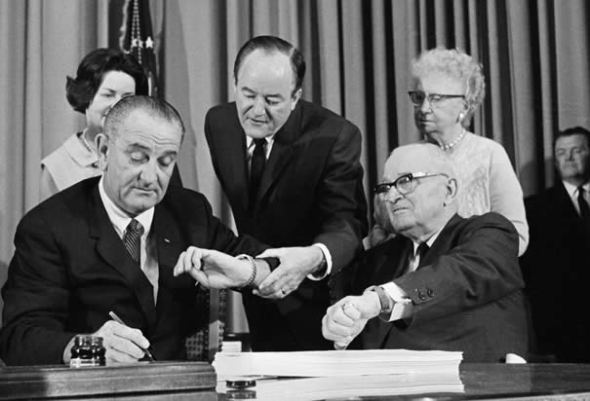
Lyndon B. Johnson signs the Medicare Act of 1964, with Harry Truman by his side
LBJ’s presidency was marred by his escalation of the war in Vietnam, but the domestic legislative accomplishments of his “Great Society” were stunning.
The aftershock of Kennedy’s assassination provided a climate for Johnson to complete the unfinished work of JFK’s New Frontier. He had eleven months before the election of 1964 to prove to American voters that he deserved a chance to be President in his own right.
Two very important pieces of legislation were passed. First, the Civil Rights Bill that JFK promised to sign was passed into law. The Civil Rights Act banned discrimination based on race and gender in employment and ending segregation in all public facilities.
Johnson also signed the omnibus ECONOMIC OPPORTUNITY ACT OF 1964. The law created the Office of Economic Opportunity aimed at attacking the roots of American poverty. A Job Corps was established to provide valuable vocational training.
Head Start, a preschool program designed to help disadvantaged students arrive at kindergarten ready to learn was put into place. The VOLUNTEERS IN SERVICE TO AMERICA (VISTA) was set up as a domestic Peace Corps. Schools in impoverished American regions would now receive volunteer teaching attention. Federal funds were sent to struggling communities to attack unemployment and illiteracy.
As he campaigned in 1964, Johnson declared a “war on poverty.” He challenged Americans to build a “Great Society” that eliminated the troubles of the poor. Johnson won a decisive victory over his archconservative Republican opponent Barry Goldwater of Arizona.
– American liberalism was at high tide under President Johnson.
– The Wilderness Protection Act saved 9.1 million acres of forestland from industrial development.
– The Elementary and Secondary Education Act provided major funding for American public schools.
– The Voting Rights Act banned literacy tests and other discriminatory methods of denying suffrage to African Americans.
– Medicare was created to offset the costs of health care for the nation’s elderly.
– The National Endowment for the Arts and Humanities used public money to fund artists and galleries.
– The Immigration Act ended discriminatory quotas based on ethnic origin.
– An Omnibus Housing Act provided funds to construct low-income housing.
– Congress tightened pollution controls with stronger Air and Water Quality Acts.
– Standards were raised for safety in consumer products.
I’m in tears right now after reading again about the accomplishments of these three great Democratic presidents. I’m in mourning today for my party and my country. For the first time, a supposedly Democratic president has proposed not only Social Security benefit cuts but also massive cuts to Medicare that will force seniors to pay higher deductibles and discourage them from buying medigap plans to cover co-pays.
I’ve known this was coming since 2007 when I read Obama’s book, The Audacity of Austerity Hope. He couldn’t have made it any clearer in the chapter on the domestic economy that he was an enthusiastic supporter of privatization and/or cuts in social programs. But although I’ve expected this for years, the reality of it has still hit me very hard. I feel both heartbroken and ashamed of President Obama.
I’ll post something else later on; but for now, please use this as a morning open thread and post your recommended links freely in the comments.
This is a sad day, but I believe Obama’s gambit will be a dismal failure. IMO he already looks foolish and ineffectual as the Republicans make hay by accusing him of trying to balance the budget on the backs of seniors. We need to understand that it is fruitless to expect him Obama stand up to the Republicans, the corporate media, or the bankers. We are on our own.
I admit, I had begun to believe that Obama had grown in office–that he had begun to realize that standing up for liberal values would serve him in good stead. But his addiction to “bipartisanship” and his fantasy of a “grand bargain” won out in the end. I still believe Romney would have been far worse, but let’s face it we still got a Republican president in 2008 and 2012. We need to fight tooth and nail to keep him from destroying the proud legacies of FDR, JFK, and LBJ.
Sooooo…. What’s on your mind today?
Tuesday Reads: Republicans and Marriage Equality, The Aryan Brotherhood, and Other News
Posted: April 2, 2013 Filed under: morning reads, Republican politics, U.S. Politics | Tags: 211 Crew, Aryan Brotherhood of Texas, Cynthia McLelland, Evan Ebel, Kaufman County TX, Kent Flake, Mark Hasse, marriage equality, Matthew R. Salmon, Mike McLelland, Mormon church, Rep. Matthew J. Salmon, Sen. Jeff Flake, Sen. Rob Portman, White supremacists, Will Portman 11 Comments
Good Morning!!
I’ve got some kind of virus, and it’s making my brain very fuzzy. For the past three days I’ve been having trouble even staying awake. I think I’m better, but this morning I’ve been sitting in front of my computer for an hour without getting anything written. So I guess I’ll just get started and see what happens.
I guess one of the reasons I’ve been a little stuck is that I’ve been reading about Matt Salmon. Matt is gay and he’s also the son of Arizona Rep. Matthew J. Salmon, who spent yesterday telling the media that–unlike Ohio Sen Rob Portman–having a gay son hasn’t changed his attitudes about gay marriage. From The Washington Post:
In an interview aired over the weekend, Rep. Matt J. Salmon (R-Ariz.) told a local news station that his son’s homosexuality has not led him to change his position on gay marriage.
“I don’t support the gay marriage,” the congressman said. But Salmon emphasized that he loved and respected his son and did not consider homosexuality a choice.
“My son is by far one of the most important people in my life. I love him more than I can say,” an emotional Salmon told 3TV. “It doesn’t mean that I don’t have respect, it doesn’t mean that I don’t sympathize with some of the issues. It just means I haven’t evolved to that stage.” [….]
“We respect each others’ opinions and we just know that on certain issues we have to agree to disagree,” the congressman’s son, Matt R. Salmon, told The Post. “I love my father and realize that he can have the opinions that he has, and they might differ from mine, but that doesn’t change the way I feel about him.”
Here’s the video of the interview via Mediaite:
I wasn’t that impressed with Rob Portman’s change of attitude–he realized his own son was gay and then suddenly decided gay marriage was okay. But at least Portman showed some empathy. Salmon sounds just plain cruel.
The younger Matt (father and son have different middle initials-the son is Matt R. Salmon) still supported his father’s run for Congress. His partner is Kent Flake, who is also the second cousin of Arizona Sen. Jeff Flake. Rep. Matt J. Salmon and Sen. Jeff Flake are both Mormons.
It’s nice that father and son still have a relationship, but it has to be incredibly painful for Matt to know that his own father disapproves of who you are and stands in the way of your marrying the person you love. According to Think Progress,
Portman clearly coordinated his announcement with his son, Will, in mind. The family released photos of Rob and Will spending time together, Will tweeted his support for his father that day, and last week wrote about how they made the decision together. Salmon has done the opposite, speaking without the consent of his son in an attempt to soften his own anti-gay positions, including past support for banning same-sex marriage and adoption.
I’m not sure how TP knows that Salmon spoke without this son’s consent, but Matt’s family has not been particularly supportive–at least according to an interview he gave to the Arizona New Times in 2010. For further reading, here is Will Portman’s coming out statement at the Yale Daily News.
All of this makes me so sad. Bigotry is so ugly and hurtful, and it’s amazing to me that people who have gone through this pain can still remain Republicans.
In Other News…
Evan Ebel, the man who shot Colorado prisons chief Tom Clements was released from jail because of a “clerical error.” He should have stayed locked up for another four years.
Ebel was on parole from Colorado prisons and was not legally allowed to purchase a weapon. He is believed to have used a gun to kill Clements on March 19 at Clements’ Colorado home. He is also believed to be involved in the death of a Domino’s delivery man, Nathan Leon, in Denver.
Ebel was then pulled over by Texas authorities two days later and engaged in a high-speed chase and gun battle with them. He was shot and died later at a hospital.
Ebel was a member of a “white supremacist gang 211 Crew.” It’s not yet clear if that is relevant to the murders, but coincidentally or not, there have been three recent murders in Texas that may be linked to a white supremacist group, “the Aryan Brotherhood of Texas.”
Kaufman County, Texas (CNN) — As state and federal investigators flood this north Texas county searching for clues in the killing of two prosecutors in two months, the 100,000 people who live here can do little but nervously watch, and hope.
“The residents are, I think, astounded,” said Delois Stolusky, who has lived in the county seat of Kaufman for 30 years. “It’s just, one and one make two. You can’t keep from connecting these. And it’s just scary because we have no clue of who did the first shooting. And no clue, of course, yet who did this one. And, so of course our concern is what’s going to happen next.”
Kaufman County District Attorney Mike McLelland and his wife, Cynthia, died in a shooting at their home over the weekend. Friends discovered their bodies Saturday, nearly two months to the day after someone killed McLelland’s chief felony prosecutor, Mark Hasse, in a daytime shooting outside the county courthouse.
Law enforcement officials have no clues in the shootings, but there are suspicions that the Aryan Brotherhood could be involved.
But McLelland’s office was one of numerous Texas and federal agencies involved in a multi-year investigation that led to the indictment last year of 34 alleged members of the Aryan Brotherhood of Texas, including four of its senior leaders, on racketeering charges.
At the time, Assistant U.S. Attorney Lanny A. Breuer called the indictment a “devastating blow” to the organization, which he said used threats and violence — including murder — against those who violate its rules or pose a threat to the enterprise….
While authorities have not said whether they have linked the deaths of Hasse and McLelland, or the involvement of white supremacists, Texas law enforcement agencies did warn shortly after the November 2012 indictment that there was “credible information” that members of the Aryan Brotherhood were planning to retaliate.
This is very creepy, and after learning about this I was interested to read this piece at The Daily Beast by an African American former prison inmate who understandably chooses to remain anonymous: Why I Fear the Aryan Brotherhood—and You Should, Too. Here’s the introduction. I hope you’ll be interested enough to read the whole thing.
Four people have been killed since the beginning of the year in a series of shootings that appear to be connected to the homegrown jihadists of the Aryan Brotherhood. Mike McLelland, the district attorney of Texas’s Kaufman County, and his wife, Cynthia Woodward, became the latest victims this past weekend. Before that, McLelland’s former colleague Mark Hasse was shot in January. Colorado prisons chief Tom Clements was gunned down in mid-March.
The Brotherhood, also known as The Brand, AB, and One-Two, was formed during the 1960s by a group of white convicts serving time at San Quentin. They allegedly were fed up with white prisoners being victimized by the two predominant gangs, the Black Gorilla Family (BGF) and the Mexican Mafia and decided to form a gang of their own for self-protection. While initially closely associated with Nazism ideologically, many adherents belong to the group for the identity and purpose it provides. The ironclad rule for entrée into the Brotherhood is simple: kill a black or a Hispanic prisoner. The other rule, which is just as ironclad, gave rise to their motto: “Blood In/Blood Out.”
Quitting isn’t an option. There’s only death.
I got up close and personal with members of the Brotherhood more than 20 years ago in Nevada. Due to the relatively sparse population in northern Nevada, the feds didn’t have their own lockup in which to house pretrial detainees, or at least they didn’t back then. So they rented a “range”— a row—of 14 cells in Nevada’s maximum-security prison in Carson City to house defendants going back and forth to Federal Court in nearby Reno.
I have some more reads for you that I’ll give you in link dump style, because otherwise I’ll never be able to finish this post with my brain working so slowly.
According to the Greek Reporter, politicians in Cyprus got special treatment: Cypriot Politicians’ Loans Written Off.
Joe Weisenthal at Business Insider: Russian Businessman Was Offered Chance To Smuggle €1 Million Out Of Cyprus For A €200,000 Fee
The NYT Sunday Magazine had a long article about Oikos University mass murderer One L. Goh: That Other School Shooting.
Barney Frank spoke to the Portland (ME) Press Herald: Social Security ‘entitlement’ deserves funding and respect: We should ensure its solvency by applying the payroll tax to earnings of $250,000 to $400,000.
The New York Times editorialized against cuts to Social Security: Social Security, Present and Future.
Raw Story: New York police sued for pepper-spraying 5-month-old baby
The New York Daily News: NYPD Commish Ray Kelly said ‘stop and frisk’ intended to ‘instill fear’ in blacks and Latinos: State Sen. Eric Adams
National Geographic: Cicadas Coming to U.S. East Coast This Spring. (Once every 17 years.)
Business Insider: Macy’s Accidentally Puts $1,500 Necklace On Sale For $47
Now it’s your turn. What’s on your reading and blogging list today. I’m looking forward to clicking on your links!
David Frum Offers Advice to Democrats: Nominating Hillary in 2016 Would Be “A Mistake”
Posted: April 1, 2013 Filed under: Republican politics, U.S. Politics, War on Women, Women's Rights | Tags: 2016 presidential campaign, Bill Clinton, David Frum, Hillary Clinton 14 Comments
According to Republican David Frum, it would be a huge mistake for Democrats to nominate Hillary Clinton for President in 2016, because 1) she’s the obvious choice and picking her would be doing what Republicans have done–nominating the next person in line; 2) she’s too old, 3) Her husband has made speeches in foreign countries and has “ethics problems,” and 4) she would prevent the party from reassessing and renewing itself.
Here’s a little of Frum’s post at CNN.
Obviously, past performance is no guarantee of future results. Democrats chose the next guy in line in 2000 — Vice President Al Gore — and they may well do so again. But speaking from across the aisle, it’s just this one observer’s opinion that Democrats would be poorly served by following the Republican example when President Obama’s term ends.
Hillary Clinton is 14 years older than Barack Obama. A party has never nominated a leader that much older than his immediate predecessor. (The previous record-holder was James Buchanan, 13 years older than Franklin Pierce when the Democrats chose him in 1856. Runner-up: Dwight Eisenhower, 12 years older than his predecessor, Thomas Dewey.)
I have no idea why Frum thinks that’s a serious argument against a Clinton nomination.
Relying on Hillary Clinton’s annual financial disclosure reports, CNN reported last year that former President Bill Clinton had earned $89 million in speaking fees since leaving the White House in 2001. Many of these earnings came from foreign sources. In 2011 alone, the former president earned $6.1 million from 16 speeches in 11 foreign countries.
Is it an ethical problem for the husband of the person charged with the foreign affairs of the United States to earn so much foreign-sourced income? Let’s rephrase that question: How much time do Democrats wish to spend arguing the ethics of Bill Clinton’s foreign earnings over the 2016 political cycle?
Um…Bill Clinton is not in the running for the nomination.
The rest of Frum’s post is so ludicrous that you need to go read it for yourself to get a sense of how out of touch he is. Basically, he argues that nominating Hillary would “shut down” any discussion of where the Democratic party is going. Instead, it would be “a debt long owed, now collected. If successful, it would arrive in office without a platform and without much of a mandate.”
I wonder why Frum supposedly cares about what happens to the Democratic Party? His “advice” is useless, primarily because he doesn’t even begin to understand that nominating the first woman to lead a U.S. presidential ticket would electrify the world and a woman president would radically change U.S. politics.
That Frum completely misses any reference to women, girls, the tapping of an economic stream that could ricochet around the globe through the activism of more women rising to lead, none of this makes a dent.
Republicans never cease to amaze me when it comes to underestimating the importance of women’s leadership and what the Hillary Effect’s continued reverberation could mean to the world, especially if she became the first female Democratic nominee in American history.
If Hillary Clinton became president, the impact on women’s rights and the ability for women of every culture to take a step forward would rebound exponentially.
Nothing is a bigger nightmare for Republicans than Hillary Clinton as the 2016 Democratic nominee.
Furthermore, as Ed Kilgore points out: Hillary Clinton Is No Mitt Romney.
I’ve always thought the “next-in-line” explanation for Republican presidential politics was a considerable over-simplification, and actually wrong if it was used to suggest ideology matters less to conservatives than we’ve been led to believe. But even if you buy it entirely, comparing HRC to such next-in-line Republican pols as Poppy Bush in 1988, John McCain in 2008, and Mitt Romney in 2012 just doesn’t pass the smell test.
The three Republicans just mentioned never had overwhelming grassroots support in their own party and eventually prevailed over weak fields after relentlessly repositioning themselves to the Right. Both McCain and Romney, in particular, survived what can only be described as demolition derbies, and had to spend precious general-election resources pandering to the party “base.”
HRC’s immensely popular among grass-roots Democrats, not just because she is the last candidate not named Barack Obama who ran an effective presidential nomination contest, but because of the personal capital she’s built up over the years, her performance as a very popular Secretary of State, and the widely shared belief among progressives that it’s far past time for a woman to serve as president. Plus she is crushing every named Republican in early general-election trial heats.
Even if Frum means well, which I seriously doubt, I think we can confidently ignore anyone who can’t see America’s changing public attitudes and demographics. Just look at the polls showing support for marriage equality, immigration reform, and gun control. Women represent 51% of the population. Meanwhile Republicans are working overtime to limit women’s rights and individual freedoms. David Frum and his clueless party just don’t get it.
Wacky Reads for a Surreal Saturday
Posted: March 30, 2013 Filed under: morning reads, Real Life Horror, Republican politics, Surreality, U.S. Politics, We are so F'd | Tags: "Holy Saturday", Ben Carson, Donnie Darko, evil bunny movies, Kim Jong Un, marriage equality, North Korea, nuclear war, Surpreme Court follies 36 Comments
Good Morning!!
Things are looking a bit surreal to me this morning. I babysat for my nephews last night and they managed to stay up until almost midnight! I sent them to bed around 10PM and they both claimed they couldn’t get to sleep. So I was up till all hours watching some strange kid show–a cartoon version of those “Survivor” reality TV programs. It was veeerrrrry strange. I slept too late, and when I checked the news headlines, I saw lots more strange stuff.
So What’s the deal with North Korea anyway? Kim Jong Un seems even crazier than his dear old dad. Supposedly North Korea is now “entering ‘state of war’ with” South Korea.
North Korea said on Saturday that it was entering a “state of war” with South Korea, following a call to arms by the country’s young leader Kim Jong Un and days of increasingly belligerent rhetoric from the isolated state.
The North’s official news agency KCNA published the joint statement issued by the government, political parties and other organizations.
“From this time on, the North-South relations will be entering a state of war and all issues raised between the North and the South will be handled accordingly,” it said.
The statement also warned that if the U.S. and South Korea carried out a pre-emptive attack, the conflict “will not be limited to a local war, but develop into an all-out war, a nuclear war.”
WTF?!!
According to an unnamed “senior administration official” it’s all a bunch of hooey.
“North Korea is in a mindset of war, but North Korea is not going to war,” said the official, who spoke on the condition of anonymity to offer insight into the latest administration thinking on the volatile situation on the Korean Peninsula.
The official said North Korea is doing two things that signal it is not spoiling for war: maintaining continuous and unfettered access to the Kaesong Industrial Complex six miles north of the Demilitarized Zone and by continuing to promote tourists visits to North Korea, even amid its banging of war drums.
“There is pot-banging and chest-thumping, but they have literature attracting tourists that explicitly says pay no attention to all that (public) talk about nuclear war or another kind of war,” the official said.
Kaesong is a hive of business activity and about 200 South Koreans travel there daily. It produces about $2 billion of annual trade and commerce revenue for the North. Many experts consider its fate and status the best signal of North Korea’s hostile intentions.
On Saturday, the North renewed its threat to close the complex, reportedly saying through its state-controlled news agency that references to its ongoing operation as a source of capital “damages our dignity.”
I wonder why this “senior official” felt he/she had to remain anonymous?
Some “analysts” who didn’t feel the need to conceal their identities told NBC News that North Korea[‘s] threats [are] predictable but Kim Jong Un is not.
Thursday Reads: Banks Reopen in Cyprus; An End to “Too Big to Fail” Banks (?); Vagina-Phobia; and Much More
Posted: March 28, 2013 Filed under: Barack Obama, morning reads, Republican politics, SCOTUS, U.S. Economy, U.S. Politics, Vagina | Tags: Airline horrors, airport weigh-ins, Breitbart, capital controls, Charles Pierce, Chief Justice John Roberts, Cyprus crisis, DOMA, Joan Walsh, journalistic ethics, marriage equality, Matthew Boyle, Racism, Rep. Steve King, Sasha and Malia Obama, Simon Johnson, Too big to fail banks 31 Comments
Banks reopen in Cyprus and media jostle to get the best view – posted by Joe Parkinson (@JoeWSJ)
Good Morning!!
The banks have opened in Cyprus with controls on how much depositors can withdraw.
Joe Weisenthal posted updates at his Business Insider blog:
At 6:00 AM ET, banks in Cyprus reopened their doors for the first time since March 16.
Wall Street Journal’s Joe Parkinson reports that only eight people are being allowed in at a time at one Bank of Cyprus branch.
However, the crowds have been orderly.
Everyone is wondering whether there will be a huge run on the banks.
So far? Not yet.
This is likely due to a set of capital controls that have been imposed on the banks. Specifically, Cypriot depositors cannot withdraw more than 300 euros per day from any one bank. Also, checks cannot be cashed.
These controls will be in place for seven days.
See more Twitter updates and photos at the link. International Business Times has some details about the capital controls that are supposed to prevent bank runs. In addition to the withdrawal limit, depositors can’t cash checks unless they come from another country.
In the meantime, non-cash payments or money transfers are banned unless they are related to a number of conditions.
These conditions include commercial transactions, payroll, living expenses and tuition fees.
If commercials transactions are less than €5,000, there are no restrictions, but payments above this amount and up to €200,000 will be subject to a 24-hour decision making process, in order to determine whether the liquidity of the bank would be able to incur such a withdrawal.
Transfers for paying employees will also still be allowed but relevant documents would have to be presented in order to prove the money is being used to pay staff.
Transactions on credit or debit cards are also capped at €5,000 euros per month.
According to the Wall Street Journal, some large depositors seemingly had advance knowledge of what was going to happen in Cyprus and moved their money out of the country weeks before the crisis.
The chairman of the Committee for Institutions in the Cypriot Parliament, Deputy Dimitris Syllouris, said he had submitted a letter to the Central Bank of Cyprus demanding an investigation into account holders who moved large sums of cash out of the country in the weeks ahead of Cyprus’s chaotic bailout talks…
He said he had received information about individuals and businesses moving money out of Cyprus weeks ahead of the bailout deal—a move that wouldn’t be illegal but could imply that some depositors had warning that negotiations for a bailout could, for the first time in the financial crisis that has rattled the euro zone, take a cut out of regular bank deposits.
Asked whether his suspicions focused on one specific group of depositors, he said “politicians, all sorts of people, and bankers themselves are no better.”
That figures…
Outflows from Cyprus were increasing from moderate levels from January until March 15, the officials said. Last week—especially after March 19, when the Cypriot Parliament rejected the first bailout deal that would have imposed a one-time levy on large deposits—the outflows under the central bank’s exemptions went up significantly, they said.
Several hundred million euros, but less than a billion euros, left the country despite the bank closures, according to one official.
At Bloomberg, Clive Crook says Cyprus’ Plan B is Still a Disaster.
The new deal has removed the craziest part of the agreement reached March 16 — the plan to default on deposit insurance. Let’s not dwell any further on that insanity. But the new plan still has features that, seen in any other context, would surely arouse surprise.
For instance, the so-called troika of the European Commission, the European Central Bank and the International Monetary Fund wanted to be sure that the new debt Cyprus is about to take on will be sustainable — meaning, presumably, that Cyprus will be able to repay it. Yet, by writing down high- value deposits, the revised plan will also cause a sudden contraction of the Cypriot banking system, and thus of the whole Cypriot economy, which depends on banking to an unusual degree.
He concludes that,
Bailout fatigue says: “The Cypriots got themselves into this mess, and they should get themselves out. We’ll lend them a bit more, but only if we’re sure they’ll pay us back.” Cyprus didn’t get itself into this mess. It joined the euro system in 2008 with low public debt and a clean bill of health from EU governments (back then, not a word was said about shady Russians). Its banks are in trouble not because they accepted too many overseas deposits but because they bought too many Greek bonds — an investment sanctified by international banking rules (which called such investments riskless) that was destroyed by the EU’s ham-fisted resolution of Greece’s threatened default.
Europe’s sense of “we’re all in this together” seems to have evaporated entirely. Now one has to ask not merely what the euro is for, but what the EU itself is for.
Back in the U.S.A.,

Simon Johnson has an interesting post at the NYT’ “Explaining the Science of Everyday Life” blog: The Debate on Bank Size Is Over.
While bank lobbyists and some commentators are suddenly taken with the idea that an active debate is under way about whether to limit bank size in the United States, they are wrong. The debate is over; the decision to cap the size of the largest banks has been made. All that remains is to work out the details.
To grasp the new reality, think about the Cyprus debacle this month, the Senate budget resolution last week and Ben Bernanke’s revelation that — on too big to fail — “I agree with Elizabeth Warren 100 percent that it’s a real problem.”
Policy is rarely changed by ideas alone and, in isolation, even stunning events can sometimes have surprisingly little effect. What really moves the needle in terms of consensus among policy makers and the broader public opinion is when events combine with a new understanding of how the world works. Thanks to Senator Sherrod Brown, Democrat of Ohio; Senator Warren, Democrat of Massachusetts, and many other people who have worked hard over the last four years, we are ready to understand what finally defeated the argument that bank size does not matter: Cyprus.
I can’t briefly summarize the gist of Johnson’s piece, so if you’re following this story, please read the whole thing. Could he really be right about limits on “to big to fail or prosecute banks.” I sure hope so!

 peej
peej Carissa
 bostonboomer
 dakinikat
 ecocatwoman
 mablue2
 Mama Lopez
 peggysue22
 quixote
 skydancingguestblogger
 Mona (aka Wonk the Vote)



 Sky Dancing
Recent Comments