
Tuesday Reads
Posted: August 23, 2011 Filed under: Domestic Policy, income inequality, jobs, morning reads, New Orleans, Regulation, the blogosphere | Tags: Charges dropped against DSK, Dogs identify early stage lung cancer, FCC kills the Fairness Doctrine, Hurricane Katrina anniversary, jobless recovery, New Orleans, Rising Tide 6 31 Comments Good Morning!
I’ll be attending Rising Tide 6 at Xavier on Saturday morning and will try to live blog as many of the seminars I’ll be attending as possible. Last year, I enjoyed the politics and criminal justice panels best. This year, there will be two session running simultaneously including some technical stuff on blogging and fun stuff on brass bands, food, and the HBO series Treme. The conference is a way for activists and bloggers in New Orleans to continue to see that New Orleans makes some progress post-Katrina and that information gets out to the public. Conference attendance has been growing each year.
Alright, so I choose the cute dog picture for a reason. Turns out they are some of our best friends and diagnosticians!! Check this headline out from Forbes: How Dogs Beat Doctors in Identifying Early-Stage Lung Cancer.
A new study in the European Respitory Journal shows that dogs are better at sniffing out the early markers of lung cancer than the latest medical technologies at our disposal. Lung cancer is the second most frequent form of cancer in men and women across the United States and Europe, accounting for approximately 500,000 deaths per year.
Part of the reason for the high mortality rate is that lung cancer is notoriously difficult to identify early. In many cases, the patient doesn’t show any symptoms and detection of the disease happens by chance. If someone isn’t that lucky, the cancer is likely to have already progressed by the time it is found.
The study investigated whether dogs could be trained to reliably identify specific volatile organic compounds (VOCs) that are linked to the presence of lung cancer. The latest medical methods for identifying lung cancer VOCs are generally unreliable because there is a high risk of interference in the results, especially from the residuals of tobacco smoke, and the results can take a long time to process.
Trained dogs were asked to sniff out a study group that included lung cancer patients, chronic obstructive pulmonary disease (COPD) patients, and healthy volunteers. The dogs successfully identified 71 samples of lung cancer out of a possible 100. They also correctly detected 372 samples that did not have lung cancer out of a possible 400 – a 93% success rate.
As impressive, the dogs were able to detect lung cancer markers independently from COPD and tobacco smoke – showing that Fido, unlike our latest technologies, can separate out lung cancer markers from the most confounding variables.
My friend Michelle swears that my late golden lab, Honey, saved her life. Honey kept jumping on her and putting her paws up on her breast until one day, her breast implant popped. We soon discovered it was leaking and she went to the doctor who discovered a tumor underneath the implant. Honey had some other amazing tricks too. She had an uncanny sense of who were criminals and cornered two of them when we lived in the quarter. I’d frequently walk Karma and Honey down to Pirate’s Alley after my gigs to rest and have a bit of wine with friends. Kids and tourists use to pet her, feed her, and roll all over her all the time. She was like a big stuffed toy. Only twice did I here her growl and found out she was nothing to be messed with. Both times she pushed young gutter punks up against the Cathedral until the security guard came around the corner to figure out why she was barking. Both of them were were wanted by the police. One had been stealing tip jars from the local street entertainers and the other was wanted for grabbing plates of food from tourists dining on the street. After that, Honey became one spoiled dog.  Every time she would walk by the galleries or restaurants all the business owners would see her, come out, and give her treats. The restaurant in Pirate’s alley always kept a big serving of pate for her. Honey died suddenly about 8 months after Katrina from a brain aneurysm. She was one heckuva dog. Karma and I miss her lots!! She was blind in one eye as you can see from her picture there to the right.
Politico reports that the FCC has finally killed off the fairness doctrine.
The FCC gave the coup de grace to the fairness doctrine Monday as the commission axed more than 80 media industry rules.
Earlier this summer FCC Chairman Julius Genachowski agreed to erase the post WWII-era rule, but the action Monday puts the last nail into the coffin for the regulation that sought to ensure discussion over the airwaves of controversial issues did not exclude any particular point of view. A broadcaster that violated the rule risked losing its license.
While the commission voted in 1987 to do away with the rule — a legacy to a time when broadcasting was a much more dominant voice than it is today — the language implementing it was never removed. The move Monday, once published in the federal register, effectively erases the rule.
Monday’s move is part of the commission’s response to a White House executive order directing a “government-wide review of regulations already on the books” designed to eliminate unnecessary regulations.
Also consigned to the regulatory dustbin are the “broadcast flag” digital copy protection rule that was struck down by the courts and the cable programming service tier rate. Altogether, the agency tossed 83 rules and regs.
“The nature and number of the complainant’s falsehoods leave us unable to credit her version of events beyond a reasonable doubt, whatever the truth may be about the encounter between the complainant and the defendant,” the papers state. “If we do not believe her beyond a reasonable doubt, we cannot ask a jury to do so.”
At about the same time as the papers were filed, the lawyer for Nafissatou Diallo, the hotel housekeeper who accused Mr. Strauss-Kahn of sexual assault, emerged from a brief meeting with prosecutors to offer harsh criticism of Mr. Vance.
“The Manhattan district attorney, Cyrus Vance, has denied the right of a woman to get justice in a rape case,” the lawyer, Kenneth P. Thompson, said. “He has not only turned his back on this victim but he has also turned his back on the forensic, medical and other physical evidence in this case. If the Manhattan district attorney, who is elected to protect our mothers, our daughters, our sisters, our wives and our loved ones, is not going to stand up for them when they’re raped or sexually assaulted, who will?”
Ms. Diallo stood by his side, but said nothing.
There’s an extremely interesting article up at VoxEU by Economist Dr. Robert Gordan of Northwestern University. It talks in detail about our persistently jobless recovery. One important question is how and why did our economy destroy over 10 million jobs? Basically, we are now a nation of disposable workers.
When the economy begins to sink—like the Titanic after the iceberg struck—firms begin to cut costs any way they can; tossing employees overboard is the most direct way. For every worker tossed overboard in a sinking economy prior to 1986, about 1.5 are now tossed overboard. Why are firms so much more aggressive in cutting employment costs? My “disposable worker hypothesis” (Gordon 2010) attributes this shift of behaviour to a complementary set of factors that amounts to “workers are weak and management is strong.” The weakened bargaining position of workers is explained by the same set of four factors that underlie higher inequality among the bottom 90% of the American income distribution since the 1970s—weaker unions, a lower real minimum wage, competition from imports, and competition from low-skilled immigrants.
But the rise of inequality has also boosted the income share of the top 1% relative to the rest of the top 10%. In the 1990s corporate management values shifted toward more emphasis on shareholder value and executive compensation, with less importance placed on the welfare of workers, and a key driver of this change in attitudes was the sharply higher role of stock options in executive compensation. When stock market values plunged by 50% in 2000–02, corporate managers, seeing their compensation collapse with profits and the stock market, turned with all guns blazing to every type of costs, laying off employees in unprecedented numbers. This hypothesis was validated by Steven Oliner et al (2007), who showed using cross-sectional data that industries experiencing the steepest declines in profits in 2000–02 had the largest declines in employment and largest increases in productivity.
Why was employment cut by so much in 2008–09? Again, as in 2000–02, profits collapsed and the stock market fell by half. Beyond that was the psychological trauma of the crisis; fear was evident in risk spreads on junk bonds, and the market for many types of securities dried up. Firms naturally feared for their own survival and tossed many workers overboard.
So, that will give you some things to think about today!! What’s on your reading and blogging list today?
Elite Conspiracy Theories and the Arrest of Dominique Strauss-Kahn
Posted: May 25, 2011 Filed under: collective bargaining, Economic Develpment, financial institutions, Foreign Affairs, France, Libya, Media, Pakistan, poverty, racism, Regulation, The Bonus Class, The Great Recession, U.S. Economy, U.S. Politics, unemployment, Violence against women | Tags: conspiracy theories, Dominique Strauss-Kahn, Federal Reserve, France, global elites, IMF, John F. Kennedy, Naomi Wolf, Nicholas Sarkozy, rape 29 Comments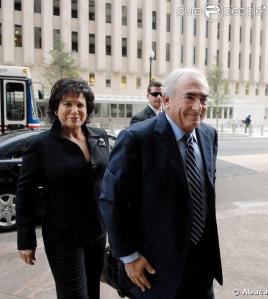
Dominque Strauss-Kahn and wife Anne
When one of us common people questions the Bush failures before 9/11 or the Warren Commission’s insistence that JFK was killed by a lone gunman, we are laughed at by the corporate media and lectured by politicians. But when one of the Global Elite gets in trouble, conspiracy theories are suddenly in vogue. Now that a global banker and possible candidate for the French presidency is accused of a sexual attack on a lowly hotel maid, elite conspiracy theories are running rampant in the U.S. and international media. I’ll give you a few examples.
At the Pakistan Observer, Ali Ashraf Kahn argues that Strauss-Kahn had to brought down, first because he would very likely have beaten the “American poodle Sarakozi” in a race for the presidency of France, and second because he (Strauss-Kahn) had offended the international banksters and corporations by proposing more liberal policies at the IMF which would have been a threat to the dollar. According to Ali Ashraf Kahn, getting rid of Strauss-Kahn would–along with U.S. military actions in Libya and Pakistan–would help to “save American predominance in the world.”
This incident goes to prove the hidden agenda of an international vested interest group trying to build and secure an American Empire for their master, which has not spared even Strauss-Kahn, who has been fixed in a rape attempt with a 32 year old hotel maid in a country where teen aged unwed mothers are a normal accepted feature. The former French Foreign Minister Strauss-Kahn, once if he was elected as president of France would have worked to strengthen the Euro to bring down dollar, which was of serious concern for the Federal Reserve Board in the already ongoing currency war with China. John F. Kennedy, US president was murdered for his only sin of canceling Federal Reserve Act of 1913 in 1963, when for the first time dollar currency was issued with the seal of US government, soon after his assassination President Lyndon B. Johnson revived this Act to continue their financial exploitation.
The author of this article appears to have a problem understanding the distinction between rape and consensual sex that results in pregnancies, but I’ll let that go for the moment. Kahn explains that Strauss-Kahn was trying to make radical changes at the IMF–so much so that Strauss Kahn won high praise from Joseph Stiglitz, which was apparently the final “kiss of death.”
Strauss-Kahn was trying to move the bank in a more positive direction, a direction that didn’t require that countries leave their economies open to the ravages of foreign capital that moves in swiftly-pushing up prices and creating bubbles, and departs just as fast, leaving behind the scourge of high unemployment, plunging demand, hobbled industries, and deep recession. Strauss-Kahn had set out on a “kinder and gentler” path, one that would not force foreign leaders to privatize their state-owned industries or crush their labour unions. Naturally, his actions were not warmly received by the banker’s mafia and multi national corporations who look to the IMF to provide legitimacy to their ongoing plunder of the rest of the world. These are the people who think that the current policies are “just fine” because they produce the desired results they’re looking for, which is bigger profits for themselves and deeper poverty for everyone else.
I have to admit, I’m in sympathy with those goals. There’s a lot more, so read the whole thing if you want more detail.
The next conspiracy theory is from Uganda. The author, Dr. Kihura Nkuba, also argues that Strauss-Kahn’s attack on the U.S. dollar is what led to his downfall. Nkuba says that police in the racist U.S. would never take the word of a poor black woman against that of a powerful white man unless motivated by a political conspiracy.
A woman from West Africa, assaulted by a famous white male, a future president of France, to be listened to by the New York Police, is amazing. But is it? [….]
New York police has [sic] been rummaging through DSK’s diaries, hotel registries, phone records, yearbooks and have made sure that the “great seducer” always appears handcuffed and dressed in a “pervie” raincoat with three-days stubble before they parade him in front of the media. He gets this treatment even though he has no criminal record and nothing, but the sketchy accusations of a room service cleaner.
What is his real crime? Strauss-Kahn was mounting an attack against the dollar and had called for a new world reserve currency that would challenge the dominance of the dollar and protect against future financial instability. He suggested adding emerging market countries’ currencies, such as the Yuan, to a basket of currencies that the IMF will administer to add stability to the global system….Strauss-Kahn saw a greater role for the IMF’s Special Drawing Rights, (SDRs) which is currently composed of the dollar, sterling, euro and yen, over time but said it will take a great deal of international cooperation to make that work.”
I love the way these male authors toss aside the charges against Strauss-Kahn–in Nkuba’s case, while complaining about racial prejudice. I guess he goes by the “bros before hos” rule: racism bad, sexism invisible.
Naomi Wolf also has a conspiracy theory about the Strauss-Kahn arrest that goes along with her defense of Julian Assange against sexual abuse charges in Sweden. She begins by comparing the NYC police response to the Strauss-Kahn case with the case of two of New York’s “finest,” Kenneth Moreno and Franklin Mata, who are on trial for raping a woman in Manhattan.
According to Wolf,
Moreno and Mata have not been asked to strip naked for “evidence” photos, were not initially denied bail, and were not held in solitary confinement, and are not being strip-searched daily. Their entire case has followed the usual timetable of many months, as evidence was gathered, testimony compiled and arguments made.
On the other hand, Wolf writes,
After a chambermaid reportedly told her supervisor at the elegant Sofitel hotel that she had been sexually assaulted, the suspect was immediately tracked down, escorted off a plane just before its departure, and arrested. High-ranking detectives, not lowly officers, were dispatched to the crime scene. The DNA evidence was sequenced within hours, not the normal eight or nine days. By the end of the day’s news cycle, New York City police spokespeople had made uncharacteristic and shockingly premature statements supporting the credibility of the victim’s narrative — before an investigation was complete.
The accused was handcuffed and escorted before television cameras — a New York tradition known as a “perp walk.” The suspect was photographed naked, which is also unusual, initially denied bail and held in solitary confinement. The Police Commissioner has boasted to the press that Strauss-Kahn is strip-searched now multiple times a day — also unheard-of.
I didn’t know that Strauss-Kahn was being subjected to daily strip-searches, but it seems to be true, according to the New York Post.
Prison brass and the NYPD have an airtight plan to safeguard the jet-setting French moneyman by having him isolated, chained, shackled — and repeatedly strip-searched — before and after court appearances, including a bail hearing newly scheduled for today.
“He will be strip-searched when he leaves Rikers Island. He will be strip-searched when he arrives in court. He’s strip-searched when he leaves court, and he’s strip-searched when he gets back to Rikers,” said Norman Seabrook, head of the correction officers union.
“When he arrives to the courthouse, he’s going to be put in an isolated cell away from other inmates,” said Seabrook. “This is for fear that another inmate would try to kill him to make a name for himself.”
Yet, as Wolf points out, hotel maids are routinely subject to sexual attacks during their work. Her conspiracy theory is that in the modern surveillance state,
men like former New York Governor Eliot Spitzer, who was investigating financial wrongdoing by the insurance giant AIG, WikiLeaks founder Julian Assange and Strauss-Kahn — whose efforts to reform the IMF gained him powerful opponents — can be, and are, kept under constant surveillance. Indeed, Strauss-Kahn, who had been the odds-on favorite to defeat Nicolas Sarkozy in next year’s French presidential election, probably interested more than one intelligence service.
This does not mean that Strauss-Kahn is innocent or that he is guilty. It means that policy outcomes can be advanced nowadays, in a surveillance society, by exploiting or manipulating sex-crime charges, whether real or inflated.
She has a pretty good point there. But the maid who reported Strauss-Kahn’s attack was a member of a union, as Dean Baker pointed out. Could that be why her employer made sure she was treated well by the police?
The reason that this is an important part of the story is that it is likely that Strauss-Kahn’s alleged victim might not have felt confident enough to pursue the issue with either her supervisors or law enforcement agencies, if she had not been protected by a union contract. The vast majority of hotel workers in the United States, like most workers in the private sector, do not enjoy this protection.
Dean Baker was also disappointed in Strauss-Kahn’s arrest, because whether or not he is guilty, his resignation spells the end of reform at the IMF.
Reading all these arguments for a conspiracy against Dominque Strauss-Kahn has given me pause. It certainly makes sense that the U.S. government would want to end his tenure at the IMF and prevent him from becoming President of France. But how could they know he would attack a hotel maid? Does the conspiracy require her involvement? That’s the serious hangup I have in buying into these authors’ claims–much as I do always enjoy a good conspiracy theory.
Patrica J. Williams touches all the bases in an article about the case at NPR. On the conspiracy issue, she argues for a skeptical approach to conspiracy theories, while keeping an open mind.
Politics is a complicated, dirty business, as the impeachment hearings of President Clinton ought to have instructed us. (Who guessed back then that Newt Gingrich, while skewering Clinton’s morals, was cheating on his then-wife with his present wife?) For Americans, who by and large have never heard of DSK, the possibility of his arrest being a set-up is inconceivable. But in the immediate aftermath of his detention, a majority of French citizens believe he has been purposely brought down. Why? Dominique Strauss-Kahn was well on track not just to become France’s president but its first Jewish president. As head of the IMF, he led that institution in a distinctly progressive manner. He sharply critiqued corrupt American bankers and banking practices and, early on, predicted the collapse of the mortgage market. As a center-left Socialist party member, he was close to negotiating a European Union bailout for Greece. And his elimination from the election empowers the candidacy of Marine LePen, head of the anti-immigrant, anti-Muslim and anti-Semitic National Front party, whose popularity, alarmingly enough, currently polls higher than that of Nicolas Sarkozy.
I’m certainly going to keep all this in mind as I follow the developments in the Strauss-Kahn case. I’d love to know what you all think about it too, so please chime in!
TGIFriday Reads
Posted: March 18, 2011 Filed under: Bahrain, Democratic Politics, Federal Budget, financial institutions, Foreign Affairs, Libya, Middle East, morning reads, Regulation, Social Security, U.S. Economy, U.S. Military, U.S. Politics | Tags: Bahrain protests, Budget fights, EPA, Harry Reid, Libya, no-fly zone, Social Security, US nuclear plants, US power plants, US response to Libya 43 Comments I can’t believe it’s Friday already. It just seems like my recent bout with the flu put me in some other time zone. There is so much going on right now my head is spinning from all the news. We have a nuclear melt down, another war with another madman, and congress nitpicking over little line items in the budget when there’s a sustained high rate of unemployment. What’s next?
The shipments—mostly small arms such as assault rifles and ammunition—appear to be the first confirmed case of an outside government arming the rebel fighters. Those fighters have been losing ground for days in the face of a steady westward advance by forces loyal to Libyan leader Moammar Gadhafi.
The Egyptian shipments are the strongest indication to date that some Arab countries are heeding Western calls to take a lead in efforts to intervene on behalf of pro-democracy rebels in their fight against Mr. Gadhafi in Libya. Washington and other Western countries have long voiced frustration with Arab states’ unwillingness to help resolve crises in their own region, even as they criticized Western powers for attempting to do so.
The shipments also follow an unusually robust diplomatic response from Arab states. There have been rare public calls for foreign military intervention in an Arab country, including a vote by the 23-member Arab League last week urging the U.N. to impose a no-fly zone over Libya.
SOS Hillary Clinton believes that the No-fly zone will require bombing. This has been indicated by some retired generals who have done similar actions in other UN actions like Bosnia. Clinton is in Tunisia and has been traveling in the region.
“A no-fly zone requires certain actions taken to protect the planes and the pilots, including bombing targets like the Libyan defense systems,” Clinton said in Tunis, her last stop on a trip that also took her to Cairo and Paris.
In all her stops, Clinton’s done a mix of stressing the need for democracy in post-revolution Tunisia and Egypt, and pushing for international cooperation in responding to the crisis in Libya. On Thursday, her only full day in Tunisia, Clinton promised that the United States “will stand with you as you make the transition to democracy, prosperity and a better future.”
Democrats are finally pushing back on the Republican canard that Social Security is bankrupt. Harry Reid also took on the falsehood that Social Security is some how related to the Federal Deficit. It’s about time.
Senate Majority Leader Harry Reid (D-NV) appeared on MSNBC last night, where he strongly rejected the idea that Social Security cuts should be on the table during current budget talks. “I’ve said clearly and as many times as I can, leave Social Security alone. Social Security has not added a single penny, not a dime, a nickel, a dollar to the budget problems we have. Never has. And for the next 30 years, it won’t do that,” Reid said. “Two decades from now, I am willing to take a look at it. I am not willing to take a look at it now.”
House Republicans, meanwhile, have stated their intention to suggest “bold reforms” for Social Security in their 2012 budget, which House Budget Committee Chairman Paul Ryan (R-WI) plans to release during the first week of April. At Politico’s “Playbook Breakfast” today, which Wonk Room attended, Ryan was asked about Reid’s position. Ryan said that Reid’s stance “just boggles my mind,” before later admitting that Social Security is “not a driver of our debt”
Politico reports that Republicans are trying to roll back financial reform.
Republicans clearly want to strike at the heart of banking reform with legislation attacking new regulations on derivatives, credit rating agencies and private equity firms. But their piecemeal approach suggests they are trying to do so without appearing to favor Wall Street over Main Street.
And for a party so vigilant on its messaging, the GOP doesn’t intend to swing the door wide-open for Democrats to go on the offensive in ways they couldn’t during the repeal debate over the far less popular health care law.
“There’s no question they didn’t like financial reform,” Rep. Barney Frank (D-Mass.), one of the law’s namesakes and top Democrat on the committee said of Republicans. “But they’re more respectful of the public appeal of this and are going about this at the edges.”
Obama held a presser yesterday and announced that he had ordered a review of safety at US nuclear facilities.
The Nuclear Regulatory Commission has conducted an “exhaustive study” of U.S. plants and they have been “declared safe for any number of extreme contingencies,” Obama said at the White House. Still, he said, a review should be conducted based on what is learned from the damage at the Japanese facility.
The president said the administration will keep the public informed about the nuclear crisis and sought to allay any health concerns in the U.S.
“We do not expect harmful levels of radiation to reach the United States,” including Hawaii, Alaska and territories in the Pacific, he said.
Obama’s remarks reinforced statements earlier today by NRC Chairman Gregory Jaczko that the government continually reviews safety and standards and will do so based on what is learned from the situation in Japan. There is no immediate need for special inspections of U.S. nuclear plants, he said.
Meanwhile, the EPA has proposed tougher air pollution standards for US power plants.
Newly proposed national standards for mercury, arsenic and other toxic air pollutants from power plants could prevent as many as 17,000 premature deaths and 11,000 heart attacks a year, according to the U.S. Environmental Protection Agency.
The proposed standards, released Wednesday by the EPA in response to a court deadline, could also prevent 120,000 cases of childhood asthma symptoms and 11,000 cases of acute bronchitis among children each year; avert more than 12,000 emergency room visits and hospital admissions annually; and lead to 850,000 fewer days of work missed due to health problems.
Under the proposal, many power plants would be required to install proven pollution control technologies to reduce harmful emissions of mercury, arsenic, chromium, nickel and acid gases, the EPA said.
Opposition leaders in Bahrain have been arrested following a crackdown on protests.
Several opposition leaders and activists have been arrested in Bahrain following a violent crackdown on anti-government protests in the Gulf kingdom.
State television said “leaders of the civil strife” had been arrested for communicating with foreign countries and inciting murder and destruction of property.
Among those arrested were Hassan Mushaima, who had returned last month from self-imposed exile in the UK after Bahraini authorities dropped charges against him, and Ibrahim Sharif, head of the Waad political society, a secular group comprising mostly Sunni members.
Also taken into custody early on Thursday was Abdul Jalil al-Singace, a leader of the Haq movement, who was jailed last August but was freed in late February as part of concessions by the Khalifa royal family to protesters.
Al Jazeera’s correspondent, reporting from the capital, Manama, said a crackdown on the opposition’s main voices was under way.
“Significant members of the opposition were arrested overnight, including some prominent activists. Soldiers broke into the houses of these figures early in the morning and made these arrests,” he said.
Later in the day, protesters ignored warnings to stay at home and gathered in Dair and Jidhaf just outside Manama.
What a world!
One last article from Politico on Secretary of State Hillary Clinton and the role she played in getting the world to take on Gadhafi. Also, some more hints on her future plans.
Clinton has made similar “I’m not here forever” comments before – but it was the timing of her remarks to CNN on Wednesday that raised eyebrows, coming at a critical moment in her fierce internal battle to push President Barack Obama to join the fight to liberate Libya from Muammar Qadhafi.
Clinton’s position was vindicated early Thursday evening when the United Nations Security Council – at the urging of the United States – approved a resolution authorizing “all necessary measures” to protect Libyan civilians, including a no-fly zone. U.N. Ambassador Susan Rice told reporters that such a move could involve direct attacks on pro-Qadhafi forces now bearing down on the rebel stronghold of Benghazi in eastern Libya.
Clinton’s persistence in the anti-Qadhafi cause has been such a constant in the White House in recent days that Obama, according to reports, joked about Clinton lobbing rocks through his window during his remarks at Saturday night’s Gridiron dinner.
“Stay tuned,” said one Clinton friend when asked if the secretary would ultimately prevail.
Two Clinton friends, who speak with her regularly, told POLITICO she wasn’t trying to send any message to Obama with her interview with Wolf Blitzer Wednesday and she has no plans to leave earlier than the end of the president’s first term.
Whats on your reading and blogging list today?
Tuesday Reads: The Anniversary of FDR’s Second Bill of Rights
Posted: January 11, 2011 Filed under: Anti-War, Barack Obama, Civil Liberties, Civil Rights, Equity Markets, Federal Budget, financial institutions, Global Financial Crisis, John Birch Society in Charge, New Orleans, Regulation, Social Security, Stock Market, The Great Recession, U.S. Economy, U.S. Politics | Tags: David Stockman, druggie bath salts, extremist political rhetoric, FDR, financial regulation, gold standard, Governexoricist Jindal, military spending, naked short selling, occupation of Iraq and Iran, right wing currency tropes, Second Bill of Rights, short selling, violence related to cross hairs map 125 Comments Good Morning!!

History Reads
Ever so often, we need to be reminded of history. I read a tweet yesterday by one of our long time news anchors down here in New Orleans.
normanrobinson1 norman robinson
Wondering if we as Americans really value what we have and whether we really care about leaving a future for the generations to follow.
This started me thinking about what future was left to me by the generations directly before me. Of course, we’re living in a world mostly free of NAZIs and Fascists because of the greatest generation. We’re living in a world where the Jim Crow Laws of Separate-But-Equal were torn down by the generation after that with the sacrifice of the heroic leaders of the civil rights movement. I have the right to vote because of my grandmother’s generation and her mother’s generation and what they did for us. I’ve also had consistent access to family planning and birth control because the first women of the baby boom generation and several generations of women before them worked hard for it. Stonewall made a tremendous difference in the lives of GLBTs. Then, there are programs like Social Security and institutions like the United Nations that came from the vision and leadership of FDR and the people who served in his cabinets like Francis Perkins, Henry Wallace, Cordell Hull and many others. They cared enough to build us quite a legacy.
Today is the 67th anniversary of a speech that was to convey that vision of a post-war America. The Second Bill of Rights was part of a State of the Union speech. I’m bringing this up for two reasons. First, because it clearly provides a road map–even today–for “what Americans really value”. I say that because poll after poll shows that the majority of American’s agree with these values even though our government doesn’t seem to reflect that at the moment. For that reason, I share with you today, the words of a leader with a vision and a gift for elocution.
From the FDR American Heritage Center Museum’s Website:
On January 11, 1944, in the midst of World War II, President Roosevelt spoke forcefully and eloquently about the greater meaning and higher purpose of American security in a post-war America. The principles and ideas conveyed by FDR’s words matter as much now as they did over sixty years ago, and the Franklin D. Roosevelt American Heritage Center is proud to reprint a selection of FDR’s vision for the security and economic liberty of the American people in war and peace.
The second reason I want to share this is that we’re coming close to President Obama’s third State of the Union Address. It is scheduled for January 25th. My guess is that FDR’s Second Bill of Rights and the vision he elucidated will officially die on that day. I am not expecting any thing close to the utterance of ‘Necessitous men are not free men’ or “People who are hungry and out of a job are the stuff of which dictatorships are made”.
Despite the obvious parallels between right now and the Great Depression–the high unemployment rates, the incredible number of foreclosures, and the breadth of necessitous men and women and children–I’m expectting many of the vestiges of FDR’s vision that prevent future calamities to be assaulted during Obama’s third State of the Union Address. Look closely at the list I put up top because so much of what was handed us has been trickling away.
As Norman Robinson contemplated via tweet, do we really value what we have today? Will we witness the destruction of what was handed to us and hand our children and grandchildren broken infrastructure, no hope for upward mobility, and useless institutions drained of funds by the greedy? Will any shell of what was envisioned for us in both the first bill of rights and the second remain? Frankly, I am expecting an ‘austerity’ speech that endorses the findings of the cat food commission. I also expect we will hear nothing of overreaching intrusion by the Patriot Act into our internet and cell phones. We are expected to diligently watch Football and bail out billionaires while everything else trickles up and away.
Monday Reads
Posted: December 27, 2010 Filed under: Barack Obama, Catfood Commission, Civil Liberties, Diplomacy Nightmares, Foreign Affairs, Regulation, U.S. Politics, Wikileaks | Tags: blacklist, Charlie on the MTA, Civil War, DEA, death panels, drug war, Janet Napolitano, McCarthy era, memeorandum, Red Scare, surveillance, The Kingston Trio, The Weavers, TSA, Vicksburg, Walter O'Brien, weather, Wikileaks 68 Comments
Good Morning!!
I’m still stuck in central Indiana and there seems to be a blizzard bearing down on the Northeast. They’re predicting 18 inches in northwest greater Boston where I live. I’m hoping I’ll manage to get back there soon, if weather permits.
I had to call the guy who has been helping me with the snow the last couple of winters and ask him to shovel my house out so I don’t come home to piles of solid ice in my driveway and on my front walk. I hope everyone who is getting hit by the blizzard will be okay!
While I was checking up on the Boston weather forecast, I came across this interesting story in The Boston Globe.
If you were around in the late ’50s and early ’60s, you may recall a famous song by the Kingston Trio about the Boston subway system, then called the MTA.
In June of 1959, packaged sandwiches and envelopes of nickels began pouring into the Park Square headquarters of Boston’s Metropolitan Transit Authority, postmarked from as far off as California and Hawaii. All were addressed to Charlie — “the man who never returned.’’
The Kingston Trio’s “At Large’’ album was headed to number one, and listeners couldn’t get enough of the opening track, “M.T.A.,’’ about a fellow trapped on the subway because he lacked a nickel for the exit fare. The hit would go on to become a campfire staple and slice of Americana, widely embraced, frequently parodied, and adapted for styles from country to punk.
It turns out that the song the Kingston Trio recorded was
…actually a sanitized version of the original, a campaign song for a 1949 Boston mayoral candidate who opposed the subway fare hike. But by 1959, the candidate had been blacklisted and run out of town, and the song’s most political lyrics were simply edited out
because another folk group, The Weavers (which included Pete Seeger) had been blacklisted because Seeger and another member of the group, Lee Hayes were called to testify before the House Un-American Activities Committee (HUAC), and both refused to name names.
Now the Boston transit authority (now called the MBTA) is displaying the uncensored lyrics of the song along with the backstory at selected subway stations. “Charlie on the MTA” was Walter O’Brien’s campaign song–a protest about a fare increase in subway fares.
The MTA had been formed just two years earlier from the ashes of the Boston Elevated Railway Co., a private company whose shareholders had received a guaranteed dividend for years even as the transit company relied on public subsidies. When lawmakers eventually bought them out to abolish the company, shareholders made out handsomely. Then the taxpayers footing the bill got slapped with the fare hike.
Does that remind you of anything in the present?
“The Progressive Party saw that as a bailout of private interest and inappropriate use of taxpayer money, and [then the fare increase] was one wrong piled upon another,’’ said Jim Vrabel, an activist and historian determined to reclaim the song’s origins. “It’s been kind of trivialized and made kind of a cute song, and people don’t realize the serious political background of it.’’
I hope you’ll take the time to read the entire article. It provides quite a bit of information on what it was like for artists, politicians, teachers, lawyers–really just about anyone left-leaning, during the McCarthy era.
Below is a video of the song will the original lyrics.
If only we had a Walter O’Brien today! He couldn’t afford to pay for advertising so he hired trucks to drive around playing the song in the streets of Boston. Can you imagine the great songs that could be written about the bankster fraud and bailouts and all the people who are paying by losing their homes and livelihoods?
I found another fascinating piece of history via Memeorandum. From the BBC News: “Coded American Civil War message in bottle deciphered.”
In the encrypted message, a commander tells Gen John Pemberton that no reinforcements are available to help him defend Vicksburg, Mississippi.
“You can expect no help from this side of the river,” says the message, which was deciphered by codebreakers.
The text is dated 4 July 1863 – the day Vicksburg fell to Union forces.
The small bottle was given to the Museum of the Confederacy in Richmond, Virginia, by a former Confederate soldier in 1896.
Also via Memeorandum, “death panels” are back, according to The New York Times: Obama Returns to End-of-Life Plan That Caused Stir
When a proposal to encourage end-of-life planning touched off a political storm over “death panels,” Democrats dropped it from legislation to overhaul the health care system. But the Obama administration will achieve the same goal by regulation, starting Jan. 1.
Under the new policy, outlined in a Medicare regulation, the government will pay doctors who advise patients on options for end-of-life care, which may include advance directives to forgo aggressive life-sustaining treatment.
I don’t have a problem with that as long as it doesn’t lead to denying care to elderly people who want it. Of course knowing that this administration is going to be embracing the Catfood Commission Report, I’m a little leery of what else they might be planning for us old folks. Ice floes anyone?
In other news, via Raw Story, Janet Napolitano has no sympathy for people who feel violated by thugs pawing their breasts, buttocks, and genitals: Napolitano: Pat-downs are here to stay
Airline passengers should get used to invasive full body scans and enhanced pat-downs, the Homeland Security secretary suggested Sunday.
CNN’s Candy Crowley asked Janet Napolitano if she expected changes to the controversial Transportation Security Administration (TSA) screening procedures in the near future.
“Not for the foreseeable future,” Napolitano replied.
“You know we’re always looking to improve systems and so forth, but the new technology, the pat-downs — just objectively safer for our traveling public,” she said.
Okay, Janet, how about you have a “pat down” performed by a TSA thug on national TV? Then you can make an announcement about how great it was. The youtube would go viral, millions of people would see your sales pitch on the internet, and perhaps a few would be convinced. Oh, and is the government going to bail out the airline industry when millions of people stop flying?
I guess that doesn’t worry Napolitano though. She plans to start “stepping up security” at malls, and train stations.
“What we have to do is say, well, what other ways are they thinking to commit an act, because our job is not only to react, but to be thinking always ahead, what could be happening,” Napolitano said.
“And so we have enhanced measures going on at surface transportation, not because we have a specific or credible threat there, but because we know, looking at Madrid and London, that’s been another source of targets for terrorists.”
Soon you may have to go through a naked scanner and/or “enhanced patdown” (aka groping session) in order to get into a mall. Oh joy! Thank goodness I do most of my shopping on line…
A few new Wikileaks tidbits…
The New York Times has a story on how the DEA has become a global organization.
The Drug Enforcement Administration has been transformed into a global intelligence organization with a reach that extends far beyond narcotics, and an eavesdropping operation so expansive it has to fend off foreign politicians who want to use it against their political enemies, according to secret diplomatic cables.
[….]
Because of the ubiquity of the drug scourge, today’s D.E.A. has access to foreign governments, including those, like Nicaragua’s and Venezuela’s, that have strained diplomatic relations with the United States. Many are eager to take advantage of the agency’s drug detection and wiretapping technologies.
In some countries, the collaboration appears to work well, with the drug agency providing intelligence that has helped bring down traffickers, and even entire cartels. But the victories can come at a high price, according to the cables, which describe scores of D.E.A. informants and a handful of agents who have been killed in Mexico and Afghanistan.
In Venezuela, the local intelligence service turned the tables on the D.E.A., infiltrating its operations, sabotaging equipment and hiring a computer hacker to intercept American Embassy e-mails, the cables report.
More at The Independent: Panama row reveals US drug agency’s power
The El Paso Times: WikiLeaks tells why drug king is still free
and the BBC News: Wikileaks: Governments ‘sought US wiretapping help’
At The New Republic, Norm Scheiber explains Why Wikileaks will be the death of big business and big government.
That’s about it for me. What are you reading this morning?

 peej
peej Carissa
 bostonboomer
 dakinikat
 ecocatwoman
 mablue2
 Mama Lopez
 peggysue22
 quixote
 skydancingguestblogger
 Mona (aka Wonk the Vote)



 Sky Dancing
Recent Comments