Posted: August 16, 2014 | Author: bostonboomer | Filed under: Crime, Criminal Justice System, morning reads, racism, U.S. Politics | Tags: Antonio French, Captain Ronald S. Johnson, Chief Thomas Jackson, Darren Wilson, Ferguson MO, Governor Jay Nixon, looting, media, Michael Brown, Missouri, Peaceful protests, police brutality, police corruption, police shootings, St. Louis, violence |
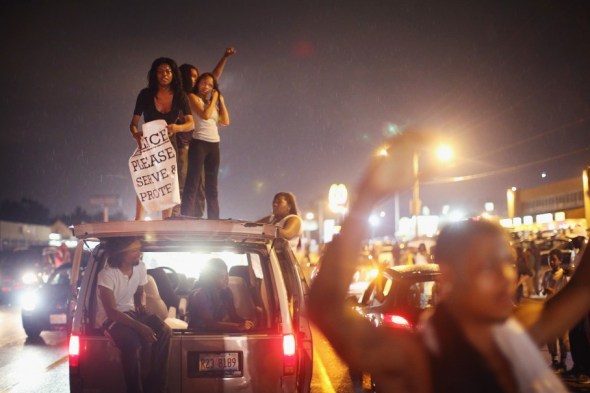
Demonstrators gather along West Florissant Avenue on Friday to protest the shooting of Michael Brown in Ferguson, Mo. Brown was shot and killed by a Ferguson police officer on Aug. 9. Friday’s demonstration ended with protesters clashing with police followed by more looting. (Scott Olson/Getty Images)
Good Morning!!
I’ve been following the events in Ferguson, Missouri for a week now. Last Saturday, 18-year-old Ferguson citizen Michael Brown was gunned down by a Ferguson police officer in broad daylight. That officer, who was finally named yesterday, is Darren Wilson. So far the media has not even been able to come up with a photo of Wilson, who had nearly a week to wipe out his media presence. He’s a complete mystery man.
After Wilson shot Brown multiple times, he stood over the body and called for assistance without informing dispatch that he had just shot someone. According to witnesses, Wilson did not check Brown for vital signs. Brown’s body lay in the street for an extended period–it’s not clear how long. No medical personnel were called to determine whether he needed assistance or to take his body to a hospital. Eventually police loaded the body into a police vehicle and took it away.
When family and others in the community protested, Ferguson police chief Thomas Jackson asked St. Louis County police to provide “security.” As we all know, there was an intense police crackdown on peaceful protesters, and journalists were harassed and even arrested as were several community leaders.
On Thursday, Governor Jay Nixon ordered Ferguson and St. Louis County police to withdraw their military equipment from the streets of the small suburb and had handed over control of security to Captain Ronald S. Johnson of the Missouri State Police. Johnson is a lifelong Ferguson resident and is African American.
On Thursday night protesters were left alone to protest peacefully, and police were dressed in normal uniforms. Johnson walked among the protesters and patiently answered their questions. Apparently Chief Jackson and his men were unhappy with the peace and harmony, so they found a way to sow discord once again.
Around noon yesterday, without informing Captain Johnson of what he planned to do, Jackson released an 18 page media handout complete with still images from surveillance video, in which he accused dead teenager Michael Brown of stealing a box of cigars from a gas station convenience store in what he termed “a strong-arm robbery.” The stolen property was valued at $48.00. Jackson released this information immediately after revealing that mystery officer Darren Wilson had shot and killed Brown.
The implication was obvious. Brown deserved to die because he had shoplifted some cigars. The pictures of the young man police claimed was Brown were splashed all over the media and internet–but nary a photo of Wilson appeared.

Ferguson Police Chief Thomas Jackson announces the name of Officer Darren Wilson as the man who shot and killed Michael Brown, 18, last Saturday.
Hours later, around 4PM, Chief Jackson held another press conference in which he admitted that killer cop Darren Wilson had no knowledge of the shoplifting incident that Brown had allegedly been involved in. He supposedly stopped Brown and his friend because they were walking in the street “blocking traffic.” So why was the 18-page handout released, reporters asked? Because reporters had requested it, said Jackson. But that wasn’t true either.
According to “MSNBC contributor” Goldie Taylor, who spent last night trying to find any reporter who had requested information on the convenience store robbery, no one requested it–in fact no one in the media knew about the incident until Jackson revealed it.
Reporters had specifically requested the officer’s report on the shooting and Brown’s autopsy report, but those were not released. Reporters have repeatedly asked Jackson how many times Brown was shot and the locations of the bullets, but he has refused to answer those questions.
Naturally Brown’s family and other Ferguson residents were outraged by Jackson’s behavior. He had poisoned the atmosphere in town once again.
Last night began as Thursday night had, with peaceful demonstrations and normal police presence. But early this morning, outsiders showed up and for a short time looted Ferguson businesses, including the store that Michael Brown had been accused of stealing from. From what I’ve been able to learn on Twitter from people who were there, protesters tried to stop the looters and helped to clean up damage to businesses; and there are reports of that in the mainstream media.
I thought I’d just write my own summary of events to begin with, since this situation is so complex. The racism that has been on display has been just stunning. It’s as if we’ve all been transported back to a much earlier era. But unfortunately the racism is real. You can see it on display in the behavior of law enforcement members in Ferguson and St. Louis, and in the people on Twitter and media comment sections cheering on the hatred against and even the murder of African Americans.
Some representative articles to read about recent events in Ferguson.
MSNBC: Michael Brown Killing: Police in Ferguson Fire Tear Gas Amid Looting.
Armored vehicles rolled back onto the streets of Ferguson early Saturday, as riot police faced off with looters in the Missouri town gripped by protests since the fatal police shooting of an unarmed black teen.
The violence broke the brief period of calm that had settled over Ferguson, Missouri, after outrage over the shooting of Michael Brown spilled over.
Protests had started off peacefully in Ferguson on Friday night. Rev. Jesse Jackson linked arms with protesters, leading them in prayer and urging them to “turn pain into power” while fighting back non-violently, NBC Affiliate KSDK reported. Shortly after midnight, crowds got rowdier and looting began to break out, according to KSDK….
Tear gas was deployed and riot police moved in, with some locals forming lines to protect local businesses from looters.
A handful of owners stood guard this morning at their businesses, doing their best to discourage any more looting or violence.
Rain fell on the scene of broken out windows and ransacked store shelves at businesses like Ferguson Market and Liquor.
The streets of Ferguson mostly were void of protesters by 6 a.m. as dawn broke and the rain continued after the violent night.
After some of the protesters blocked the entrances to businesses and civic leaders, including St. Louis Alderman Antonio French, arrived early Saturday, the scene calmed and the brief outbreak of looting ended.
The police line was still in place near West Florissant and Ferguson avenues but had not advanced to the site of the protest line as of 2:30. Officers also did not move in during the looting.
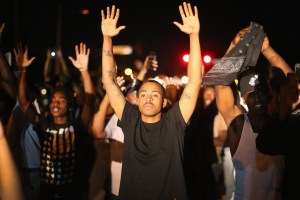
It’s amazing how quickly a few assholes can ruin things for people who have worked so hard to bring peace and justice after the death of an unarmed young man. Chief Jackson must be very happy with his handiwork this morning.
KDSK.com: Protesters tried to keep looters out of stores.
Several hundred people congregated on a busy Ferguson street Friday night as protests continued nearly a week after 18-year-old Michael Brown was shot and killed by a police officer. It was peaceful until about midnight, when a large crowd broke into the convenience mart that Brown allegedly robbed the day he was killed. The looting continued there for several hours, with looters entering and exiting freely with as many items as they could carry, including the store cash register.
The looting took place despite the best efforts of some who said they were among the peaceful protesters who marched early in the evening.
Michael Davis was among those who were peacefully protesting when things turned violent. “It was positive. Everything was going fairly well with everyone out here during the day. But as it turned night, it got hectic and things got out of hand in front of the Ferguson Market and Liquor store.”
According to Davis, they were having some success in calming things down until police showed up and teargassed the crowd. At that point looters “broke through his protective line and into the store.”
New York Times: Emotions Flare in Missouri Amid Police Statements.
One day after roiling tensions over the police shooting of a black teenager here began to subside, emotions flared anew on Friday as the police identified the officer involved but also released evidence that the victim was a suspect in a convenience store robbery moments before being shot.
The manner in which the police here released the information, which included a 19-page police report on the robbery but no new details about the shooting, led to the spectacle of dueling police news conferences, one led by a white officer who seemed ill at ease and defensive, and the other dominated by a charismatic black officer who expressed solidarity with the crowd even as he pleaded for peace.
The white officer, Thomas Jackson, the police chief in Ferguson, gave a series of incomplete accounts that sowed confusion about whether the officer who shot the teenager knew he was a suspect in the robbery. The black officer, Capt. Ronald S. Johnson of the Missouri State Highway Patrol, expressed his displeasure with how the information had been released.
“I would have liked to have been consulted,” he said pointedly about the pairing of the shooter’s identity with the robbery accusation.
Washington Post: Protests and looting return to Ferguson overnight, but most want peace [a collection of tweets from journalists covering Ferguson last night]
Reporters on the ground in Ferguson, most of whom have been there for nearly the entire week, painted on Twitter a dramatic and sometimes frightening scene as the unrest mounted. Emotions were heightened Friday after Darren Wilson was named as the officer who shot Brown and the Ferguson police released video surveillance of Brown allegedly stealing cigars from a convenience store.
The clashes throughout the night seem to have divided the protesters, pitting some who were assembling peacefully against others who were looting businesses in the St. Louis suburb.
As of early Saturday morning, some protesters were helping store owners clean their destroyed shops and many were eager to draw a clear distinction between the angry rioters and the other protesters.
Head over to that link to read a Twitter timeline.

More relevant links.
The Washington Post, Seven in 10 black Americans say the criminal justice system treats them unfairly.
Mother Jones, Exactly How Often Do Police Shoot Unarmed Black Men?
Reuters Column, Less than human: Do some police take a step beyond simple prejudice?
Peacock Panache, Conservative Hypocrisy: Bundy Ranch Versus Ferguson Protest Media Coverage.
Addicting Info, Ferguson Police Excuses Destroyed As Anonymous Shares Dispatch Recordings (AUDIO).
Mother Jones, Meet the St. Louis Alderman Who’s Keeping an Eye on Ferguson’s Cops.
Washington Post, Required reading on race, Michael Brown and Ferguson, Mo.
Spocko at Hullabaloo, What’s the Media Strategy of #Ferguson Protesters? The Police Have One.
The Atlantic, Echoes of Michael Brown’s Death in St. Louis’s Racially Charged Past.
The Atlantic, The Roots of Violence in Ferguson Run Deep.
Jonathan Chait, Joe Scarborough, Mike Allen Form Journalistic Axis of Evil.
I know there’s plenty of other news; I’ve just been focused on this story. Please feel free to discuss and recommend links on any topic in the comment thread.
Did you like this post? Please share it with your friends:
Posted: August 11, 2014 | Author: dakinikat | Filed under: American Gun Fetish, morning reads, racism, SWAT teams | Tags: Ferguson MO, militarization of police, NYPD, Police deadly force, shootings at Walmart |
Good Morning!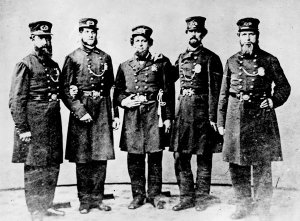
I don’t know about you, but I’m getting tired of all the stories about America’s out of control Police Departments. The last few weeks have been especially illustrative of police departments that use deadly force first and cover it all up later. There’s just one story after another of police shooting and killing unarmed citizens and hapless dogs. Almost immediately afterwards, we get some kind of arrest, story, or whatever that says the police acted righteously. Why are so many unarmed people being killed by heavily armed police officers? WTF is going on?
There are four recent incidents where the police used deadly force in highly questionable situations. The first shooting is from Texas, the second from Ohio, the third is a strangling in New York City, and the latest shooting is from Missouri. This is obviously a national problem.
First up, an off duty officer killed a teen supposedly shoplifting in a Walmart after seeing a few security guards chase the teen out the door. Was deadly force really necessary over a smart phone cover? This sounds a lot like the Zimmerman defense if you ask me. This young man was Latino.
A 19-year-old shoplifting suspect in Conroe was shot and killed by an off-duty sergeant who said the teen choked him to the point of nearly passing out, police said.
The Conroe Police Department said officers were dispatched to the Walmart on N. Loop 336 W after store employees tried to stop a young man, Russell Rios, who allegedly stole a pair of iPhone cases early Wednesday evening.
Off-duty police Sgt. Jason Blackwelder was briefed by the workers and chased down the suspect in a wooded area southwest of the store, according to police.
Once in the woods, the suspect and the officer became engaged in a very intense struggle, and at one point the officer was being choked by the suspect, said Sgt. Dorcy Riddle. … to the extent that he thought he was going to lose consciousness.
Blackwelder fired his weapon, striking Rios and killing him. The sergeant was treated for minor injuries at the hospital and later released.
 This actually was the second shooting involving a Walmart. This one involved a black teenager examining a Toy Gun. Now mind you, we had weeks of open carry assholes carrying actual loaded semi-automatic weapons around stores. Only the shoppers felt threatened by these jerks. However, those were all white folks toting the real thing so the security guards must’ve have thought it was no big deal.
As it turns out, John Crawford, the man shot dead by police was killed after doing nothing more than picking up a toy gun in the store.
Crawford, 22, was identified, in part by the mother of his child, who he was on the phone with at the time police shot him dead.
That woman, LeeCee Johnson, said Crawford went to the area to visit family members.
“We was just talking. He said he was at the video games playing videos and he went over there by the toy section where the toy guns were. And the next thing I know, he said ‘It’s not real,’ and the police start shooting and they said ‘Get on the ground,’ but he was already on the ground because they had shot him,” she said, adding: “And I could hear him just crying and screaming. I feel like they shot him down like he was not even human.”
Last month, an NYPD office strangled an unarmed black man with an illegal chokehold even while he was telling them he could not breathe. The  incident was videotaped. The police later arrested the videographer and the man’s wife in unrelated charges seemingly to put their testimony in any court case against the choker into question.
Confronted by police trying to arrest him for allegedly selling illegal cigarettes, Eric Garner raised both hands in the air and, with passive defiance, told the officers not to touch him. Seconds later, a video shows the officer behind him grab the 350-pound man in a chokehold and pull him to the sidewalk, rolling him onto his stomach.
“I can’t breathe! I can’t breathe!” Garner said repeatedly, his cries muffled into the pavement.
The video of the Thursday skirmish shows the Staten Island man lying on the ground motionless after the incident. An asthmatic, Garner was later declared dead at a nearby hospital, according to CNN affiliate WCBS. Police said he suffered a heart attack and died en route to the hospital.
“This is a terrible tragedy that occurred yesterday. A terrible tragedy that no family should have to experience,” said New York Mayor Bill de Blasio, calling the video of the incident “very troubling.”
Police told WCBS that 43-year-old Garner, a father of six, had a lengthy criminal history and had been previously arrested for selling untaxed cigarettes in May.
Officer Daniel Pantaleo, who is seen on video choking Garner, was put on modified assignment and stripped of his shield and gun as the New York Police Department continues to investigate the incident, WCBS reported. The chokehold tactic is prohibited by the NYPD.
The most recent shooting involved an unarmed black teen who was being harassed by the police for not getting on the sidewalk. This young man was  two days away from his first year in college.
An unarmed black teenager fatally shot Saturday by a police officer in Ferguson, Mo., had been struggling for the officer’s gun, law enforcement officials said Sunday as hundredLs of protesters gathered outside the police department.
St. Louis County Police Chief Jon Belmar said the youth, Michael Brown, 18, allegedly struggled for a Ferguson police officer’s weapon in a patrol car before the officer fired several shots about noon Saturday. Witnesses have said the youth had his hands in the air as he fled the patrol car.
Brown’s mother said she didn’t understand why police didn’t subdue him with a club or Taser.
“I would like to see him fired,” Lesley McSpadden told the Associated Press, referring to the officer who shot her son. “I would like to see him go to jail with the death penalty.”
Belmar said there would be a thorough investigation, with possible inclusion of the FBI. Because Brown is African American, the National Assn. for the Advancement of Colored People has said it would seek a federal investigation.
 Is this part and parcel of the militarization of police happening since 9/11 or is it an outcropping of the rampant, outrageous racism that has been noticeable since the country elected its first black president? I can remember being in Denver about two years ago during an Occupy march. I also remember watching tons of riot police in military vehicles rushing around the downtown streets to intercept what was obviously a peaceful gathering of Americans in keeping with our constitutional rights. But, SWAT raids are commonplace these days.
It’s 3:00 a.m. Your children are screaming and your dog is lying dead in a pool of blood. Scorch marks and shattered glass cover the floor. You’re being held at gunpoint by towering figures wearing black and holding AK-47s.
This isn’t a Hollywood movie set. Odds are this is a predawn SWAT raid targeting a family of color. Mission objective: search the home for a small amount of drugs.
There are an estimated 45,000 SWAT raids every year. That means this sort of violent, paramilitary raid is happening in about 124 homes every day – or more likely every night – not in an overseas combat zone, but here in American neighborhoods. The police, who are supposed to serve and protect communities, are instead waging war on the people who live in them.
Our new report, War at Home: The Excessive Militarization of American Policing, takes a hard look at 800 of these raids – or at least what state and local law enforcement agencies are willing to tell us about them. We found that almost 80% of SWAT raids are to search homes, usually for drugs, and disproportionately, in communities of color. During these drug searches, at least 10 officers often piled into armored personnel carriers. They forced their way into people’s homes using military equipment like battering rams 60 percent of the time. And they were 14 times more likely to deploy flashbang grenades than during SWAT raids for other purposes.
Public support for the failed War on Drugs is at its lowest ever, and yet police are still using hyper-aggressive tactics and heavy artillery to fight it. This paramilitary approach to everyday policing brutalizes bystanders and ravages homes. We reviewed one case in which a young mother was shot and killed with her infant son in her arms. During another raid, a grandfather of 12 was killed while watching baseball in his pajamas. And we talked with a mother whose toddler was covered in burns, shot through with a hole that exposed his ribs, and placed into a medically induced coma after a flashbang grenade exploded in his crib. None of these people was the suspect. In many cases like these, officers did not find the suspect or any contraband in the home.
Even if they had found contraband, the idea of cops-cum-warriors would still be deeply troubling. Police can – and do – conduct searches and take suspects into custody without incident, without breaking into a home in the middle of the night, and without discharging their weapons. The fact is, very few policing situations actually require a full SWAT deployment or a tank. And simply having drugs in one’s home should not be a high-risk factor used to justify a paramilitary raid.
We can no longer accept such brutal tactics as a routine way to fight the War on Drugs. It’s time for an exit strategy.
All too often, the worst police behavior is aimed at minority communities. 
Jason L. Riley is a Wall Street Journal columnist and vocal critic of what hecalls “race hustlers”—“the second and third-tier types” who lead the civil rights groups of the present.
For him, the greatest barriers to black advancement aren’t economic disadvantage and persistent discrimination, they’re “anti-social behavior” and “counterproductive attitudes toward work, school, marriage, and so forth.”
Last Friday, Riley responded to Al Sharpton’s call for criminal justice reform with this Twitter broadside: “Liberals want to discuss black incarceration rates but not black crime rates,” he said. “Stop pretending the two are unrelated.” The implication is that black criminality is to blame.
There’s no question that relative to their population, black Americans hold adisproportionate share of arrests and convictions for crime. But it’s important we don’t confuse that with a propensity for crime. Put another way, black overrepresentation in crime statistics has as much to do with policing and the legal process as it does with the actual crimes committed.
For millions of black and Latino New Yorkers, the city is a literal police state.
It’s worth noting that just a few hours after Riley made his assertion, the New York City medical examiner ruled Eric Garner’s death a homicide by chokehold. If you haven’t followed the coverage, Garner was killed in July during a struggle with Staten Island police officers. Because a witness (who was later arrested on gun charges) videotaped the encounter, we know that the 43-year-old father of six had just stopped a fight, and was agitated by the police presence. “Every time you see me, you try to mess with me,” he said to the officers, protesting prior treatment. “This stops today.” Within minutes, police had placed Garner in a chokehold and wrestled him to the ground, where he struggled, gasped for air, and died.
Bystanders would catch two other instances of police violence over the next week. In the first, an officer is seen stomping on the head of a man arrested for marijuana possession, and in the second, an officer is shown using a chokehold on a pregnant woman after she grilled food on the sidewalk outside of her home (which, apparently, is against the law in New York City).
The reason for these stops is a policing approach called “broken windows,” first articulated by scholars James Q. Wilson and George L. Kelling in a 1982 Atlantic Monthly essay and later adopted by the NYPD in 1993. Broken windows prioritizes cracking down on minor offenses on the theory that doing so can preempt serious crime. Or, to use the metaphor of the idea, actual broken windows create the appearance of disorder, which creates actual disorder as criminals take advantage of the inviting environment. Rather than wait for the serious crimes to begin, police should “repair the windows”—focus on petty crime like loitering, and you’ll stop the worse crime from taking hold.
It’s an elegant concept, but there’s little evidence it works. “Taken together,” notes a 2006 study from the University of Chicago, “the evidence from New York City and from the five-city social experiment provides no support for a simple first-order disorder-crime relationship as hypothesized by Wilson and Kelling nor for the proposition that broken windows policing is the optimal use of scarce law enforcement resources.” Yes, the massive New York crime decline of the 1990s coincided with broken windows policing, but chances are it had more to do with a reversion to the mean (“what goes up, must come down, and what goes up the most, tends to come down the most”) than any new approach.
If broken windows were just a waste of resources, it wouldn’t be a huge concern. But as a policy, broken windows has also had the effect of terrorizing black and Latino New Yorkers.
Perceptions of urban “disorder” are tied tightly to race and have been for more than a century (as detailed in sociologist Khalil Gibran Muhammad’s The Condemnation of Blackness: Race, Crime, and the Making of Modern Urban America). As we’ve seen on a regular basis—from Jonathan Ferrell to Renisha McBride—people of color, and blacks in particular, are feared as criminal in ways their white counterparts aren’t.
This is one of the most enlightening quotes I’ve seen for some time. The police union’ associate basically believes that resisting arrest is a reason to use deadly force. This is in regards to Garner’s death outlined above.
The police officer who killed a Staten Island dad with a prohibited chokehold was just doing what he had been trained to do.
So claimed Pat Lynch, president of the Patrolmen’s Benevolent Association, in strident and eyebrow-raising defense Tuesday of NYPD officers, during which he called the medical examiner’s conclusions about Eric Garner’s death “absolutely wrong.”
“It is not a chokehold,” Lynch insisted. “It was bringing a person to the ground the way we’re trained to do to place him under arrest.”
Lynch, who is not a doctor, also said the ME’s office was “mistaken” when it concluded after an autopsy that the 43-year-old Garner’s death was a homicide.
“I’ve never seen a document that was more political than that press release by the ME,” Lynch said. “Chokehold. That’s not a medical term.”
Lynch also ripped Mayor de Blasio for not backing the officers in this case. “The mayor needs to support New York City police officers unequivocally,” he said.
De Blasio defended the ME, calling the office “the gold standard in this country for the work they do.”
Lynch’s remarks appeared to be aimed at taking the heat off Officer Daniel Pantaleo, who was caught on a shocking cellphone video wrapping an arm around Garner’s neck and dragging him to the pavement.
“I can’t breathe!” Garner could be heard yelling. “I can’t breathe!”
That video sparked nationwide outrage and Pantaleo was yanked off the street as the Staten Island prosecutor launched an investigation. Pantaleo has not been charged with a crime.
Lynch said Garner had been stopped a week earlier by police officers for peddling unlicensed cigarettes on the street.
“He was warned to stop the illegal sale and was not placed under arrest but was warned, admonished and sent on his way,” Lynch said.
So Garner knew he was in big trouble when cops caught him selling loosies again, the union president said.
“But the next week he said he wasn’t going to be arrested,” Lynch said.
Flanked by Sergeants Benevolent Association President Ed Mullins, Lynch decried the “insulting and unjustified manner in which police officers are being portrayed by politicians, race baiters, pundits and even our elected officials.”
I’m not sure what exactly the answer is to all of this, but I will say that you cannot ignore the obvious patterns playing out all over the country. The  message they are sending is Resist and Die.
 So, as I write this, I’ve found out that 49 year after the Watts Riots, Ferguson MO–a primarily black community close to St Louis–has erupted in riots. That’s the SWAT group patrolling the area outside a Walgreen’s that I’ve juxtaposed to an old photo of Watts.
What started as a peaceful prayer vigil Saturday evening to remember a young man gunned down by police, has escalated into full scale riots and looting in Ferguson, Missouri.
Angry mobs have smashed windows, set fires and looted businesses as a massive showing of police, some wearing riot gear have moved into the area along West Florissant just south of 270.
Police are also responding to reports of shootings throughout the area. At one point, windows of a News 4 live truck were smashed out by the angry crowd.
Raw Video: Exclusive interview with witness of looting in Ferguson
There are reports that police have dispersed the crowd in Ferguson, but the mobs have moved into some neighboring communities.
News video and amateur video from the scene have captured mobs of crowds racing into stores and businesses and then rushing out with armloads of stolen goods.
Tear gas has reportedly been used by police in some areas.
PHOTOS: Computer | Mobile
Two groups of protesters gathered around 8:00 Sunday night in Ferguson to bring awareness to the death of Michael Brown, 18, who was shot and killed by police Saturday.
At least fifteen area police agencies have been called to Ferguson. Police set up a staging area at West Florissant and Ferguson Road. Police are also staging at the Plaza at the Boulevard parking lot, where officers are seen putting on riot gear. Dozens of police vehicles are on scene, from all over St. Louis County, including Chesterfield, Country Club Hills and the Missouri Highway Patrol.
What’s on your reading and blogging list today?
Did you like this post? Please share it with your friends:
Posted: May 26, 2014 | Author: bostonboomer | Filed under: Crime, Mental Health, misogyny, morning reads, racism, social justice, U.S. Politics, Violence against women, War on Women | Tags: Caroline Janney, Civil War, Confederate Memorial Day, David Blight, Decoration Day, elliot rodger, freed slaves, Isla Vista mass murder, Memorial Day history, Ta=Nehisi Coates, Veterans |

Good Morning!!
A few days ago, I read an article about the “true meaning of Memorial Day.” I can’t find it now, but it was in the Chicago Tribune. The author wrote that Memorial Day began as “Decoration Day,” when Southern women decorated the graves of Confederate soldiers. I Googled some more and found other writers making the same claim. Here’s a piece by a Civil War historian from Purdue University Caroline Janney:
Many may not know the holiday weekend that marks the start of summer by paying respects to veterans and remembering loved ones began when white Southern women took a leadership role in honoring their Civil War veterans, says a Purdue University historian.
“After the Civil War, southern men would have appeared treasonous if they had organized memorials to honor their fallen, so women – perceived as apolitical – instead organized tributes and events that set the tone for how the country celebrates Memorial Day today,” says Caroline E. Janney, professor of historyand president-elect of the Society of Civil War Historians. “In 1866, the men were figuratively hiding behind the skirts of these women who worked together as part of Ladies’ Memorial Associations.”
The women organized dozens of memorials during the spring of 1866 and the following years, Janney says. Historically these memorials were scheduled throughout the spring as a sign of renewal and rebirth, and each community chose its own date to celebrate.
The date usually reflected a key date in the Civil War, such as the May 10 death of Gen. Thomas “Stonewall” Jackson, or a battle close to the association’s individual area. Memorial Day became more unified when larger associations, such as the United Confederate Veterans and United Daughters of the Confederacy, began organizing memorials in the 1890s. And memorial days also were observed in the North, but they were organized by Union veterans beginning in 1868, two years after the ex-Confederate women had established the practice.
I was surprised, because I had read years ago that the practice was begun by former slaves who wanted to honor Union soldiers. I found the above photo on Facebook–with the suggestion that it was taken on that first Decoration Day May 1, 1865; but I can’t be absolutely certain that’s accurate. Note that that dates is a year earlier than the one Janney writes about. It turns out that a number of places and people claim to have started the practice of decorating Union and Confederate Graves. Southerners designated “Confederate Memorial Days.” Kingston, Georgia claims to have held the first one.
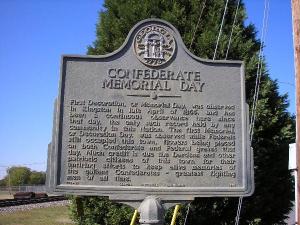
Yale historian David Blight wrote about the disputed origins of Memorial Day in the New York Times in 2011.
Officially, in the North, Memorial Day emerged in 1868 when the Grand Army of the Republic, the Union veterans’ organization, called on communities to conduct grave-decorating ceremonies. On May 30, funereal events attracted thousands of people at hundreds of cemeteries in countless towns, cities and mere crossroads. By the 1870s, one could not live in an American town, North or South, and be unaware of the spring ritual.
But the practice of decorating graves — which gave rise to an alternative name, Decoration Day — didn’t start with the 1868 events, nor was it an exclusively Northern practice. In 1866 the Ladies’ Memorial Association of Columbus, Ga., chose April 26, the anniversary of Gen. Joseph Johnston’s final surrender to Gen. William T. Sherman, to commemorate fallen Confederate soldiers. Later, both May 10, the anniversary of Gen. Stonewall Jackson’s death, and June 3, the birthday of Jefferson Davis, were designated Confederate Memorial Day in different states.
Soon the yearly practice became partisan:
In the South, Memorial Day was a means of confronting the Confederacy’s defeat but without repudiating its cause. Some Southern orators stressed Christian notions of noble sacrifice. Others, however, used the ritual for Confederate vindication and renewed assertions of white supremacy. Blacks had a place in this Confederate narrative, but only as time-warped loyal slaves who were supposed to remain frozen in the past.
The Lost Cause tradition thrived in Confederate Memorial Day rhetoric; the Southern dead were honored as the true “patriots,” defenders of their homeland, sovereign rights, a natural racial order and a “cause” that had been overwhelmed by “numbers and resources” but never defeated on battlefields.
Yankee Memorial Day orations often righteously claimed the high ground of blood sacrifice to save the Union and destroy slavery. It was not uncommon for a speaker to honor the fallen of both sides, but still lay the war guilt on the “rebel dead.”
But Blight discovered in a historical archive at Harvard University that the earliest celebration of “Decoration Day” was organized by freed slaves in Charleston, South Carolina in 1865.
During the final year of the war, the Confederates had converted the city’s Washington Race Course and Jockey Club into an outdoor prison. Union captives were kept in horrible conditions in the interior of the track; at least 257 died of disease and were hastily buried in a mass grave behind the grandstand.
After the Confederate evacuation of Charleston black workmen went to the site, reburied the Union dead properly, and built a high fence around the cemetery. They whitewashed the fence and built an archway over an entrance on which they inscribed the words, “Martyrs of the Race Course.” ….
The procession was led by 3,000 black schoolchildren carrying armloads of roses and singing the Union marching song “John Brown’s Body.” Several hundred black women followed with baskets of flowers, wreaths and crosses. Then came black men marching in cadence, followed by contingents of Union infantrymen. Within the cemetery enclosure a black children’s choir sang “We’ll Rally Around the Flag,” the “Star-Spangled Banner” and spirituals before a series of black ministers read from the Bible.
After the dedication the crowd dispersed into the infield and did what many of us do on Memorial Day: enjoyed picnics, listened to speeches and watched soldiers drill. Among the full brigade of Union infantrymen participating were the famous 54th Massachusetts and the 34th and 104th United States Colored Troops, who performed a special double-columned march around the gravesite.
Nearly 150 years later, it’s apparently very difficult for some Americans to credit African Americans with the first Memorial Day (or with much of anything else for that matter). As Ta-Nehisi Coates showed in The Atlantic recently, it’s apparently difficult for Americans to remember much of anything about African American history–before or after the Civil War. Why would anyone feel comfortable mourning the “lost cause” of a society built on the enslavement of other human beings? I can understand mourning the dead Confederate soldiers, but shouldn’t there be recognition that they died for something shameful? We can look around us today and still see the aftereffects of the slavery and the war that ended it. Will we ever get over it? One more quote from Blight’s article:
The war was over, and Memorial Day had been founded by African-Americans in a ritual of remembrance and consecration. The war, they had boldly announced, had been about the triumph of their emancipation over a slaveholders’ republic. They were themselves the true patriots.

On Memorial Day in 2014, we honor the dead of all wars, but we treat our living war veteran with disrespect. From CNN, ‘Thanks for your service’ not enough, by Sebastian Junger, Jim McDermott and Karl Marlantes.
According to current Veterans Administration estimates, 22 American veterans take their lives every single day.
High rates of unemployment, homelessness, alcoholism, substance abuse and post-traumatic stress are decimating our community of veterans. With the wars of the past 13 years in Iraq and Afghanistan coming to a close, we are seeing too many casualties among American soldiers in this transition to peace.
In light of this crisis, we need a new kind of Memorial Day.
Many veterans are desperate to talk about their experiences with fellow Americans who accept shared responsibility for what is done in war, particularly the killing. Yet these conversations rarely happen today. How can a veteran truly come home unless we acknowledge that our nation’s wars are something we all chose and paid for?
Returning Vietnam veterans were treated shamefully. That, thankfully, is behind America. We’ve moved from outright hostility to awkward, if well-meant, expressions of “thank you for your service” and the creation of a number of new veterans services organizations.
However, there remains an abiding sense of national indifference, or worse, a sense that somehow veterans are victims. This must change.
A great deal needs to change for the United States to be “one nation indivisible.”

In the News
Isla Vista Mass Murder:
The horrible murders in Santa Barbara are still at the top of the Google News page today. A few links:
NBC News: What Do We Know About Elliot Rodger’s Rampage?
Little Green Footballs: Echoes of Montreal – Isla Vista shows us 25 years doesn’t change much.
NY Daily News: Social media strikes back with #YesAllWomen after deadly Isla Vista rampage.
Slate: The Pick-Up Artist Community’s Predictable, Horrible Response to a Mass Murder
CBS Los Angeles: Rodger’s Family Friend says Killer’s Parents Tried to Get Son Mental Help.
Village Voice: Rightbloggers: Santa Barbara Killer Elliot Rodger’s Sexist Rants Have Nothing To Do With Sexism (Or Guns).
Fox News: Sheriffs never saw menacing videos before California rampage.
NY Daily News: Santa Barbara killer’s parents raced to stop him after receiving disturbing emails

Other News:
The Washington Post: White House mistakenly identifies CIA chief in Afghanistan.
The New York Times: Pro-European Businessman Claims Victory in Ukraine Presidential Vote.
Reuters: French far right in ‘earthquake’ win as Europe votes.
Raw Story: It’s all in your head: Scientist now believes his pioneering work on gluten allergy was wrong.
Raw Story: SC pastor accused of turning Bible college into forced labor camp for foreign students.
The Hollywood Reporter: Walt Disney Family Feud: Inside His Grandkids’ Weird, Sad Battle Over a $400 Million Fortune.
Politico: The ‘Wary of Hillary’ Democrats
What else is happening? Please post your links in the comment thread, and enjoy the holiday!
Did you like this post? Please share it with your friends:
Posted: May 24, 2014 | Author: bostonboomer | Filed under: Gun Control, income inequality, morning reads, racism, The Bonus Class, U.S. Economy, U.S. Politics | Tags: Chris Giles, Donald Sterling, economic theory, Financial Times., guns, inequality, Kevin Drum, LA Clippers, mass murder, mass shootings, NBA, offshore tax havens, open carry laws, Paul Krugman, Reinhart and Rogoff, Shelly Sterling, Ta-Nehisi Coates, The Case for Reparations, The Economist, Thomas Picketty, wealth distribution, wealth vs. income |

Thomas Picketty
Have a Stupendous Saturday!
It’s too bad Dakinikat is so busy today, because there’s an economics food fight brewing. Perhaps she’ll still find time to comment on the controversy later the evening after she returns home with her newly adopted canine family member, Temple. Meanwhile, I’ll do my best to describe the dispute over Thomas Picketty’s conclusions about wealth inequality, published in his book Capital in the Twenty-first Century.
The Accusations:
At the Financial Times, Economics Editor Chris Giles has claims to have found problems with Picketty’s work: Piketty findings undercut by errors.
Thomas Piketty’s book, ‘Capital in the Twenty-First Century’, has been the publishing sensation of the year. Its thesis of rising inequality tapped into the zeitgeist and electrified the post-financial crisis public policy debate.
But, according to a Financial Times investigation, the rock-star French economist appears to have got his sums wrong.
The data underpinning Professor Piketty’s 577-page tome, which has dominated best-seller lists in recent weeks, contain a series of errors that skew his findings. The FT found mistakes and unexplained entries in his spreadsheets, similar to those which last year undermined the work on public debt and growth of Carmen Reinhart and Kenneth Rogoff.
The central theme of Prof Piketty’s work is that wealth inequalities are heading back up to levels last seen before the first world war. The investigation undercuts this claim, indicating there is little evidence in Prof Piketty’s original sources to bear out the thesis that an increasing share of total wealth is held by the richest few.
Prof Piketty, 43, provides detailed sourcing for his estimates of wealth inequality in Europe and the US over the past 200 years. In his spreadsheets, however, there are transcription errors from the original sources and incorrect formulas. It also appears that some of the data are cherry-picked or constructed without an original source.
John Maynard Keynes
In one specific example, Giles says the corrected data do not show significant growth in Europe since 1970. In a second article, Giles goes into more detail. In addition, he argues that the U.S. data doesn’t support the conclusion that a greater proportion of the wealth is controlled by top 1% than in recent decades. He does admit to the top 10% controlling a greater share of wealth than previously.
An investigation by the Financial Times, however, has revealed many unexplained data entries and errors in the figures underlying some of the book’s key charts.
These are sufficiently serious to undermine Prof Piketty’s claim that the share of wealth owned by the richest in society has been rising and “the reason why wealth today is not as unequally distributed as in the past is simply that not enough time has passed since 1945”.
After referring back to the original data sources, the investigation found numerous mistakes in Prof Piketty’s work: simple fat-finger errors of transcription; suboptimal averaging techniques; multiple unexplained adjustments to the numbers; data entries with no sourcing, unexplained use of different time periods and inconsistent uses of source data….
A second class of problems relates to unexplained alterations of the original source data. Prof Piketty adjusts his own French data on wealth inequality at death to obtain inequality among the living. However, he used a larger adjustment scale for 1910 than for all the other years, without explaining why.
In the UK data, instead of using his source for the wealth of the top 10 per cent population during the 19th century, Prof Piketty inexplicably adds 26 percentage points to the wealth share of the top 1 per cent for 1870 and 28 percentage points for 1810.
A third problem is that when averaging different countries to estimate wealth in Europe, Prof Piketty gives the same weight to Sweden as to France and the UK – even though it only has one-seventh of the population.
Get even more detail and charts here: Data problems with Capital in the 21st Century.

Karl Marx
The Pushback So Far:
Paul Krugman: Is Piketty All Wrong?
Great buzz in the blogosphere over Chris Giles’s attack on Thomas Piketty’s Capital in the 21st Century. Giles finds a few clear errors, although they don’t seem to matter much; more important, he questions some of the assumptions and imputations Piketty uses to deal with gaps in the data and the way he switches sources. Neil Irwin and Justin Wolfers have good discussions of the complaints; Piketty will have to answer these questions in detail, and we’ll see how well he does it.
Krugman suggests that Giles may be doing something wrong.
I don’t know the European evidence too well, but the notion of stable wealth concentration in the United States is at odds with many sources of evidence. Take, for example, the landmark CBO study on the distribution of income; it shows the distribution of income by type, and capital income has become much more concentrated over time:
It’s just not plausible that this increase in the concentration of income from capital doesn’t reflect a more or less comparable increase in the concentration of capital itself….
And there’s also the economic story. In the United States, income inequality has soared since 1980 by any measure you use. Unless the affluent starting saving less than the working class, this rise in income disparity must have led to a rise in wealth disparity over time.
At Mother Jones, Kevin Drum notes that
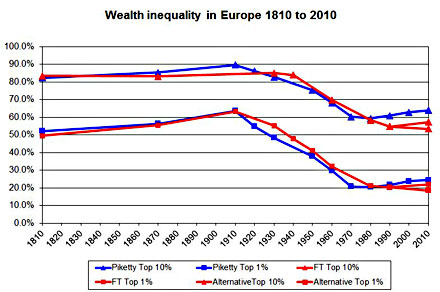
Giles’ objections are mostly to the data regarding increases in wealth inequality over the past few decades, and the funny thing is that even Piketty never claims that this has changed dramatically. The end result of Giles’ re-analysis of Piketty’s data is [below] with Piketty in blue and Giles in red. As you can see, Piketty estimates a very small increase since 1970.
R.A. at The Economist: A Piketty problem?

Milton Friedman
Mr Giles’s analysis is impressive, and one certainly hopes that further work by Mr Giles, Mr Piketty or others will clarify whether mistakes have been made, how they came to be introduced and what their effects are. Based on the information Mr Giles has provided so far, however, the analysis does not seem to support many of the allegations made by the FT, or the conclusion that the book’s argument is wrong.
There are four important questions raised by the FT‘s work. First, which data are wrong? Second, how did errors in the work, if they are errors, come to be introduced? Third, how do the errors affect the specific points made in the relevant chapters? And fourth, how do the errors affect the fundamental conclusions of the book?
Mr Giles focuses on wealth inequality, to which Mr Piketty turns in Chapter 10 of his book. Mr Piketty has not published nearly as much research on the question of wealth inequality, and it seems that much of the analysis in Chapter 10 was done specifically for the book, based on others’ research. Mr Piketty’s wealth-inequality analysis certainly matters as a component of the book’s argument, but it is not accurate to say, as Mr Giles does, that the results in Chapter 10 constitute the “central theme” of the book.
Are the data wrong? Mr Giles identifies discrepancies between source material cited by Mr Piketty and the figures that appear in the book. He identifies cases in which Mr Piketty appears to have chosen to use data from one source when another would have made more sense. Further, the calculations in Mr Piketty’s spreadsheets (which have been available online since the book’s publication) seem to include adjustments in the data that are not adequately explained, and some figures for which Mr Giles cannot find a documented source. Finally, Mr Piketty has made choices concerning weighting of data used in averages, and assigning of data from one year (1935, for example) to another (1930) when such assignments seem unnecessary or inadvisable.

Alan Greenspan
The author concludes that, unfortunately, ideology will determine how many people respond to the Giles critique. Much more extensive analysis at the link.
Here is Picketty’s–presumably preliminary–response to Giles in a letter to the Financial Times:
Let me also say that I certainly agree that available data sources on wealth are much less systematic than for income. In fact, one of the main reasons why I am in favor of wealth taxation and automatic exchange of bank information is that this would be a way to develop more financial transparency and more reliable sources of information on wealth dynamics (even if the tax was charged at very low rates, which you might agree with).
For the time being, we have to do with what we have, that is, a very diverse and heterogeneous set of data sources on wealth: historical inheritance declarations and estate tax statistics, scarce property and wealth tax data, and household surveys with self-reported data on wealth (with typically a lot of under-reporting at the top). As I make clear in the book, in the on-line appendix, and in the many technical papers I have published on this topic, one needs to make a number of adjustments to the raw data sources so as to make them more homogenous over time and across countries. I have tried in the context of this book to make the most justified choices and arbitrages about data sources and adjustments. I have no doubt that my historical data series can be improved and will be improved in the future (this is why I put everything on line). In fact, the “World Top Incomes Database” (WTID) is set to become a “World Wealth and Income Database” in the coming years, and we will put on-line updated estimates covering more countries. But I would be very surprised if any of the substantive conclusion about the long run evolution of wealth distributions was much affected by these improvements.
I thought this was important:
…my estimates on wealth concentration do not fully take into account offshore wealth, and are likely to err on the low side. I am certainly not trying to make the picture look darker than it it. As I make clear in chapter 12 of my book (see in particular table 12.1-12.2), top wealth holders have apparently been rising a lot faster average wealth in recent decades, at least according to the wealth rankings published in magazines such as Forbes. This is true not only in the US, but also in Britain and at the global level (see attached table). This is not well taken into account by wealth surveys and official statistics, including the recent statistics that were published for Britain. Of course, as I make clear in my book, wealth rankings published by magazines are far from being a perfectly reliable data source. But for the time being, this is what we have, and what we have suggests that the concentration of wealth at the top is rising pretty much everywhere.
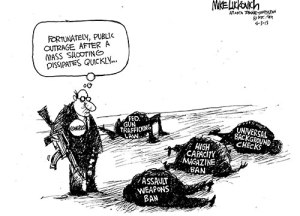
In Other News:
There has been a mass shooting in Southern California–this time perpetrated from behind the wheel of a car. From the LA Times, 7 dead in drive-by shooting near UC Santa Barbara.
The shootings began about 9:30 p.m., a sheriff’s spokeswoman told KEYT-TV. It wasn’t clear what the attacker’s motivation might have been.
An 18-year-old Newport Beach man who was visiting Santa Barbara described a confusing scene as the shots rang out.
Nikolaus Becker was eating outside The Habit, 888 Embarcadero Del Norte, near the scene when the first set of shots was fired about 9:30 p.m. At first he thought it was firecrackers. A group of three to five police officers who were nearby started to casually walk toward the sounds, said Becker, but ran when a second round of shots broke out.
“That’s when they yelled at us to get inside and take cover,” Becker said.
The BMW took a sharp turn in front of The Habit, Becker said, and moments later a third round of shots was heard. Becker and his friends moved toward the restaurant’s kitchen but were told to wait in the seating area by employees.
He estimates there were at least 13 to 15 shots total at three locations. The locations were about 100 yards from one another.
The shooter, whose motivation is unknown, was found dead in his BMW. It’s not yet clear if he shot himself or was killed by sheriff’s deputies.
In another gun-related story, TPM reports that some gun nuts are reconsidering their campaign of carrying long guns into public places: Scaring The Crap Out of People Oddly Not Winning Fans.
Earlier this week we reported how Chipotle felt obliged to ask its customers not to bring guns to chipotle restaurants. Seems like a reasonably enough request to most of us. And it’s been preceded by similar requests by various other chains like Starbucks and others.
Now the top pro-gun group in Texas pushing the demand for “open carry” firearm rights and trying to get people to show up at various restaurant chains with long guns is deciding it may not be such a hot idea after all.
Open Carry Texas and a group of other aggressive gun rights groups have issued a joint statement telling their members, Dudes, let’s stop taking our guns to restaurants. It’s freaking people out and making them hate us.
Read the full statement at TPM.

Soon-to-be former LA Clippers owner Donald Sterling has signed over the team to his wife and wants her to negotiate the sale.
Shelly Sterling, who previously shared ownership of the beleaguered NBA franchise with her estranged husband, is now in talks with the NBA over selling the team, the source said.
The NBA banned Donald Sterling for life from all league events after an audio tape became public that caught him on tape uttering racist comments to his assistant V. Stiviano. He told her not to post photos of herself with black people on Instagram — such as Magic Johnson — or bring them to his basketball games.
But the NBA isn’t buying it. From ESPN: Why the NBA won’t allow Shelly Sterling to control the Clippers.
At first glance, Donald Sterling’s gesture may seem like serendipitous news for the NBA. Taking him at his word, Donald Sterling has agreed to leave the league without a fight and has signed off on the sale of his team. Digging deeper, however, reveals possible ulterior motives on Sterling’s part to delay and potentially block the sale of the team. Do not forget a crucial point: capital gain taxes. As first reported by SI.com, the Sterlings have significant incentives under capital gain tax law to avoid the sale of the team and keep it in the Sterling family. Doing so, would save them hundreds of millions of dollars. Also, contrary to some reports, the Sterlings are unlikely to benefit from the “involuntary conversion” tax avoidance provision of the Internal Revenue Code. The bottom line is if the Sterlings have to sell the Clippers, they will probably pay hundreds of millions in state and federal taxes.
Along those lines, Donald Sterling’s proposed maneuver does not accomplish the NBA’s goal of ousting the entire Sterling family on June 3. As explained in a previous SI.com article, the NBA interprets its constitution to mean that ousting Donald Sterling on June 3 would also automatically oust Shelly Sterling as co-owner, with the Clippers then falling under the control of commissioner Adam Silver. Donald Sterling’s proposed maneuver risks the prospect of Shelly Sterling undertaking a slow-moving effort to sell the team. A sale process that takes months or years would clearly aggravate the NBA, which wants to erase the Sterling family name from the league as quickly as possible. A protracted sale of the Clippers by Shelly Sterling might also constitute a potential rationale for players to boycott NBA games.
Even of greater risk to the NBA, what is to stop Shelly Sterling from deciding to keep the Clippers? She could plausibly reason, on various grounds, that now is not the right time to sell the team. Also, her instruction from her husband to sell the team would not be legally binding; it would be a mere suggestion the moment she takes over the team.
Read much more at the link.

Ta-Nehisi Coates
I’ll end with a long article that I haven’t gotten to yet, but I’m hearing it’s a must read: The Case for Reparations, by Ta-Nehisi Coates at The Atlantic. Here’s the tagline:
“Two hundred fifty years of slavery. Ninety years of Jim Crow. Sixty years of separate but equal. Thirty-five years of racist housing policy. Until we reckon with our compounding moral debts, America will never be whole.”
Some reactions:
The Guardian: The ‘Case for Reparations’ is solid, and it’s long past time to make them.
Slate: An Ingenious and Powerful Case for Reparations.
The Wire: You Should Read “The Case for Reparations.”
NPR: How To Tell Who Hasn’t Read The New ‘Atlantic’ Cover Story.
WaPo: Culture change and Ta-Nehisi Coates’s ‘The Case For Reparations’.
What else is happening? As always, please post your links in the comment thread.
Did you like this post? Please share it with your friends:
Posted: April 17, 2014 | Author: dakinikat | Filed under: abortion rights, Discrimination against women, fetus fetishists, homophobia, John Birch Society in Charge, morning reads, Psychopaths in charge, racism, right wing hate grouups, U.S. Politics, Violence against women |
Good Morning!
 I must be a political junkie because I certainly have the elections of fall 2014 on my mind. Democrats appear to be gaining some ground. I just can’t help but wonder how far right of bat shit crazy the Republican Party will go because it certainly seems that it’s gone far off the rails these days. It seems odd that the party whose roots came from the civil war and the fight to preserve the union while ending slavery has switched to the party of sedition and oppression.
The problem is that so many billionaire donors–in a system that favors billionaire donors–have made sure that only those willing to sell their souls to them will get money. It is also clear that only those pols that will sell their souls to the misogynistic, homophobic, religious crazies in this country will get the grass roots support.
How much more of this can the country take? Are the Republicans sounding a swan song or a death trumpet for our democracy? It is clear that the Republican Party has now established itself on a white identity that doesn’t even include all the white people in this country. Republicans are losing ground with Asians and Hispanics each election cycle. It isn’t because they don’t agree with some of their economic or even social positions. It’s the racism, the xenophobia, the religious exclusivity, the homophobia, the misogyny, the anti-science bent, and the general tendency to hate all things not white and male. Larry Bartels at the WaPo:
A working paper by Alexander Kuo, Neil Malhotra and (my Vanderbilt colleague) Cecilia Hyunjung Mo examines the basis of growing Democratic identification among Asian Americans. Among other analyses, they report the results of an experiment in which Asian American college students were randomly subjected to a seemingly incidental but carefully staged “microaggression”—having their U.S. citizenship questioned by the experimenter. This minor but socially charged interaction boosted Democratic partisanship by 13 percentage points, a remarkable shift. (The corresponding effect among white students was only three percentage points.)
Asian Americans who experienced the insensitive questioning were also “more likely to view Republicans generally as closed-minded and ignorant” and to express more negative feelings toward them — despite the fact that Republicans were never mentioned by the experimenter or connected to the microagression. Thus, the authors’ findings “suggest that Asian Americans associate feelings of social exclusion based on their ethnic background with the Republican Party.”
Those folks are not homogeneous in that they have the same interests, aspirations, or even religions. However, they all feel that there is a key  demographic of white people that reject their claim to the identity of America and the American Dream. I can’t help but wonder if the rest of the country is watching those states run by republicans and wondering wtf is going on? Right now, in Baton Rouge, our legislature is debating making one particular version of the bible the state book and what to do with alcohol infused ice cream. Why just this week I learned that Phyliss Schlafly thinks all women should be glad that men make more money because it makes women head straight for the altar.
Now three days later, a prominent member of the Republican movement further undermined the party’s campaign to appeal to women voters by suggesting that the current pay gap isn’t wide enough. In an op-ed published by the Christian Post, Phyllis Schlafly — the founder of the Eagle Forum — maintained that increasing the pay gap will help women find suitable husbands:
Another fact is the influence of hypergamy, which means that women typically choose a mate (husband or boyfriend) who earns more than she does. Men don’t have the same preference for a higher-earning mate.
While women prefer to HAVE a higher-earning partner, men generally prefer to BE the higher-earning partner in a relationship. This simple but profound difference between the sexes has powerful consequences for the so-called pay gap.
Suppose the pay gap between men and women were magically eliminated. If that happened, simple arithmetic suggests that half of women would be unable to find what they regard as a suitable mate.
Obviously, I’m not saying women won’t date or marry a lower-earning men, only that they probably prefer not to. If a higher-earning man is not available, many women are more likely not to marry at all. […]
The best way to improve economic prospects for women is to improve job prospects for the men in their lives, even if that means increasing the so-called pay gap.
Schlafly has long been crusader for “traditional values” within conservative movement and the Republican party, serving as a member of the National GOP Platform Committee as recently as 2012 and as a delegate to the National Convention. Her Eagle Forum PAC has also donated thousands to prominent Republicans like Eric Cantor, Michele Bachmann, Steve King, and Ted Cruz.
 Then, I found out that nullification can work downwards as well as upwards if you want to improve the lives of working people. Big government is good as long as it’s used to stamp out the local efforts to improve people’s lives.
At a time when many states and cities are working at passing minimum wage increases, Oklahoma Gov. Mary Fallin (R) has gone in the opposite direction and signed a law banning cities from passing higher wages. The bill also bans them from enacting paid sick days or vacation requirements.
The law will stymie the efforts of activists in Oklahoma City, where a labor federation has led the push on a petition to raise the city’s minimum wage to $10.10 per hour. The state’s current minimum has been set at the federal level of $7.25. In 2012, 64,000 workers in the state earned $7.25 an hour or less, making up 7.2 percent of all hourly workers, a larger share than the 4.7 percent figure for the country as a whole.
Fallin said she signed the bill out of the worry that higher local minimum wages “would drive businesses to other communities and states, and would raise prices for consumers.” She also argued that “most minimum wage workers are young, single people working part-time or entry level jobs” and that “many are high school or college students living with their parents in middle-class families.” She warned that increasing the minimum wage “would require businesses to fire many of those part-time workers” and harm job creation.
But that’s not what the typical American minimum wage worker looks like. Nearly 90 percent of workers who would be impacted by an increase in the wage are older than 20, while the average age is 35. More than a quarter have children to support. More than half work full time, and 44 percent have at least some college education, while half a million minimum wage workers are college graduates.
Meanwhile, experts have analyzed state minimum wage increases over two decades and found that even at times of high unemployment, there is no clear evidence that the hikes affected job creation. Five other studies have come to the same conclusion. The same has held true for the city of San Francisco, where employment grew by more than 5 percent after it passed a higher minimum wage while nearby counties experienced declines.
Oklahoma is not the only state to pass a blanket ban on raising the wage. Wisconsin lawmakers recently considered doing the same, and Kansas Governor Sam Brownback (R)signed a law that prevents local governments from requiring contractors to pay higher wages last year. According to Paul Sonn, general counsel and program director at the National Employment Law Project, a handful of mostly Republican-leaning states passed these kinds of bans about a decade ago, including Colorado, Florida, Georgia, Louisiana, Oregon, and Texas. But the states that are the most likely to see campaigns to raise minimum wages are not the ones that are likely to pass similar bans, he told ThinkProgress.
And of course, we still have so much to discuss about the continual obsession with blastulas, and zygotes, and fetuses that are no where near viability. 
What is it about abortion that gives it such political staying power? One obvious answer it is that for opponents it is an issue of life and death. For pro-choice women, it is a question of personal autonomy and bodily integrity.
Take a look at the history of the fight for women’s rights, as argued by the feminist legal scholar Catharine MacKinnon. In her 1989 book, “Toward a Feminist Theory of the State,” MacKinnon wrote, “male dominance is perhaps the most pervasive and tenacious system of power in history.” The goal of the feminist project, she argued six years earlier, “is to uncover and claim as valid the experience of women, the major content of which is the devalidation of women’s experience.”
Lisa Tuttle, in the “Encyclopedia of Feminism,” described reproductive freedom “as a basic human right, it includes the right to abortion and birth control, but implies much more. To be realized, reproductive freedom must include not only woman’s right to choose childbirth, abortion, sterilization or birth control, but also her right to make those choices freely, without pressure from individual men, doctors, governmental or religious authorities. It is a key issue for women, since without it the other freedoms we appear to have, such as the right to education, jobs and equal pay, may prove illusory.”
These thoughts are by no means the opinions of women only. In an effort to explore the politics of abortion rights I contacted a disparate group of contemporary experts.
While none of these theorists could be categorized as politically correct – if anything, some have been accused of just the opposite — all see the anti-abortion movement as driven in part by the determined effort to control the reproductive rights of women.
Steven Pinker, a professor of psychology at Harvard, is no stranger tocriticism from feminists. In his book “The Blank Slate: The Modern Denial of Human Nature,” Pinker wrote: “Feminism as a movement for political and social equity is important, but feminism as an academic clique committed to eccentric doctrines about human nature is not. Eliminating discrimination against women is important, but believing that women and men are born with indistinguishable minds is not. Freedom of choice is important, but ensuring that women make up exactly 50 percent of all professions is not. And eliminating sexual assaults is important, but advancing the theory that rapists are doing their part in a vast male conspiracy is not.”
When I asked Pinker in an email about abortion, however, his response was very much in line with the thinking of feminist theorists.
Abortion may “touch on a characteristic male obsession: controlling the sexuality of women,” he said, noting that in most traditional societies “a woman’s male relatives, and then her husband, will try to control her sexuality in a variety of ways: veils, wigs, clothing, chaperones, segregation by sex, chastity belts, engagement rings, terms of address (‘Mrs. John Smith’), ceremonies (as when a father gives away the bride to her husband), and laws that make a woman the property of her husband.”
These efforts, Pinker said, are driven, in part, by fears of “paternity uncertainty”: “The ultimate evolutionary reason is presumably to guarantee paternity, since a cuckolded man is in the worst imaginable evolutionary scenario: investing in the child, and hence the genes, of a rival man.”
Along similar lines, John Hibbing, a political scientist at the University of Nebraska, Lincoln, who specializes in the study of how “biological variations mitigate the way in which individuals respond to politically relevant environmental occurrences,” argues that reproduction is both a core political issue and a core evolutionary issue.
Hibbing’s comment focused on themes consistent with Pinker’s: “Those most concerned with security and tradition tend to be politically conservative and those most open to new lifestyles and who are less focused on security will tend toward the political left. Issues of reproduction are likely to be at the core of the conflict between tradition and new lifestyles since these issues are about as basic as they come. Fundamentalism in some parts of the world is often driven by the desire of males to control reproductive opportunities. These issues form the evolutionary core.”
We have one of the two major political parties showing signs of radical extremism and elements that are truly dangerous, and yet, no one pays  attention. I have written a lot about right wing terrorism and it grieves me to see that we saw yet another predictable incident in Kansas City. I can’t imagine what it feels for the folks who have been following this inside law enforcement and inside groups that truly fear these hate groups. If you didn’t see this bit from Rachel Maddow, you should. It sums up a lot of history that we’ve basically ignored since the 1980s. There are some really dangerous, violent white men out there.
In 2009, the Department of Homeland Security concluded a years-long study of right-wing extremism in the U.S. and released a report saying that ultraconservative white nationalists and other extremists pose a much greater threat to U.S. citizens than Islamic terrorists from overseas.
Conservatives like Laura Ingraham and Rush Limbaugh pitched a huge tantrum, accusing the Obama administration of staging an anti-conservative pogrom, even though the DHS study was commissioned by the Bush administration. In the end, the full study was never released, and the outcry forced DHS to divert resources away from U.S. extremists.
When authorities raided the apartment of deceased Boston Marathon bombing suspect Tamerlan Tsarnaev, they found stacks of right-wing conspiracy theory newsletters, angry screeds against blacks, Jews and the New World Order.
“How weird is it to have Chechen-speaking Russian immigrant Muslim guys reading 9/11 ‘Truther’ conspiracies and ads for Nazi message boards while also espousing violent jihad and allegedly setting off bombs that killed Americans?” Maddow asked.
According to the New America Foundation, she said, since the 9/11 attacks, 21 people have been killed in the name of Islamic extremism in the U.S., whereas the number of people killed by right-wing extremists stands at 34 after the three deaths in Kansas.
Nevertheless, huge swaths of U.S. policy are dedicated to fighting Islamic terrorism abroad, “But when it comes to the proven and interconnected threat of the armed, American extreme right wing, we’re still treating every attack by them like a surprise, still treating those attackers like a lone wolf, regardless of however many letters you find between them,” regardless of the places where they talk to each other online, “regardless of the tide of evidence that these organizations exist and are operational.”
Why won’t the country at large acknowledge the real threat of right-wing extremism, she asked. “Should that change?”
 There is a huge movement made up of angry, armed, white men that is threatening the health and safety of a huge number of people. They are not a majority of people and they are not a majority of white men. But, they are central to maintaining the power structure right now and can run amok in white male privilege and get away with a lot more than any one else would.
At the heart of this murderous continuum are race and xenophobia (a fear of others) and a violent reaction to those fears. To many in the dominant culture, their America is changing. The “browning” of America has evoked a return and acceptance of the murderous continuum. Former Colorado Congressman Tom Tancredo best expressed this sentiment when he proclaimed: “I want my country back.”
Conceal Carry permits, Stand Your Ground laws and inept prosecutors are creating a climate that provides the Zimmermans and Dunns of the world with a license to kill as long as juries are predisposed to letting them do so.
As the American economy continues to contract and full-time, well-paying jobs become harder to find, the face of poverty in America is changing. The stereotypical “urban” or “black” poor have now become the “suburban” or white poor. According to CBS, “Hardship is particularly growing among whites, based on several measures . . . More than 19 million whites fall below the poverty line . . . accounting for more than 41 percent of the nation’s destitute, nearly double the number of poor blacks.”
According to the Christian Science Monitor, “Suburbs are increasingly becoming the address of America’s poor. Suburban poverty across the country grew 53 percent between 2000 and 2010, more than twice the rate of urban poverty . . . ” Many of those newly poor suburbanites are white and many of them are angry, blaming people of color for their misfortunes, instead of directing their ire toward corporate greed, the outsourcing of factory jobs to overseas companies, and governmental policies that favor the wealthy.
What is truly scary to me, is that this is a celebration of lawlessness.
Local journalists covering Nevada rancher Cliven Bundy’s case stress he is no victim and is breaking the law, regardless of conservative media’s sympathy for his defiance of government orders to remove cattle from federal land.
Those reporters and editors — some who have been covering the case for 20 years — spoke with Media Mattersand said many of Bundy’s neighbors object to his failure to pay fees to have his cattle graze on the land near Mesquite, NV., when they pay similar fees themselves.
“We have interviewed neighbors and people in and around Mesquite and they have said that he is breaking the law,” said Chuck Meyer, news director at CBS’ KXNT Radio in Las Vegas. “When it comes to the matter of the law, Mr. Bundy is clearly wrong.”
Bundy’s case dates back to 1993, when he stopped paying the fees required of local ranchers who use the federally owned land for their cattle and other animals. Local editors say more than 85 percent of Nevada land is owned by the federal government.
Bundy stopped paying fees on some 100,000 acres of land in 1993 and has defied numerous court orders, claiming the land should be controlled by Nevada and that the federal government has no authority over it.
Last year a federal court ordered Bundy to remove his cattle or they would be confiscated to pay the more than $1 million in fees and fines he’s accumulated. The confiscation began earlier this month, but was halted because the Bureau of Land Management (BLM) had “serious concerns about the safety of employees and members of the public” when armed militia showed up to block the takeover.
Despite his lawlessness, Bundy has become a sympathetic figure for many in the right-wing media.
But for local journalists, many who have been reporting on him for decades, that image is very misguided.
“He clearly has captured national attention, among mostly conservative media who have portrayed him as a kind of a property rights, First Amendment, Second Amendment, range war kind of issue,” Meyer noted. “That’s how it has been framed, but the story goes back a lot longer and is pretty cut and dry as far as legal implications have been concerned.”
He added that, “Cliven Bundy and his supporters are engaged in a fight that has already been settled. There are a number of people around these parts who have strong reservations about Bundy’s actions.”
Las Vegas Sun Editorial Page Editor Matt Hufman said depicting Bundy as a victim is wrong.
In what is undoubtedly one of the worst stories I have read in years, Police in California actually had GPS trackers on two serial killers/rapists who  went out then killed women while they were under surveillance.
Two parolees raped and killed four women while wearing GPS trackers, and there may be more victims, a California police chief said.
Registered sex offenders Franc Cano, 27, and Steven Dean Gordon, 45, were both wearing ankle bracelets when the female victims were assaulted and killed last fall and earlier this year, Anaheim police Chief Raul Quezada said Monday at a news conference. The suspects were arrested on Friday and are each facing four felony counts of special circumstances murder and four felony counts of rape, reportsCBS Los Angeles.
The naked body of Jarrae Nykkole Estepp, 21, was found March 14 on a conveyor belt at an Anaheim trash-sorting plant. Quezada said it was the key to breaking the case, according to CBS Los Angeles. The probe led detectives to connect the two suspects to her slaying, and the disappearance of three women – Josephine Vargas, 34; Kianna Jackson, 20; and Martha Anaya, 28 – who frequented a Santa Ana neighborhood known for drug dealing and prostitution.
The Orange County Register reports that Cano and Gordon were convicted of lewd and lascivious acts on children under 14 years old. As a requirement of the convictions, both were required to wear GPS tracking bracelets.
Authorities at the news conference did not explain how Cano and Gordon allegedly managed to carry out the killings while under GPS supervision, but Quezada said data from the devices “was one of the investigative tools we used to put the case together.”
Our country spends billions of dollars tracking foreign terrorists who practice what is a minority religion in this country, while domestic grown terrorists who follow the majority religion appear to get a pass. Not only do they get a pass, they get enabled by the likes of Schafly and other Republican Politicos and financed by John Birchers like the Koch Brothers who now have a hand picked Supreme Court.
I’m really getting tired of reading and writing about this stuff. Are there only a few of us that really see the connections here between the nullification efforts and the neoconfederate longings of folks like the Pauls and their droogies? Are there only a few of us that object to the racism, the homophobia, and the misogyny of these folks? It doesn’t seem so if you read polls and if you see the demographics. But, damn, getting rid of the entrenched group that benefits from all the damage they’ve done over the years is just getting more difficult all the time. I cannot wait to upload a Youtube of myself Dancing On Their GRAVES.
What’s on your reading and blogging list today?
Did you like this post? Please share it with your friends:



 peej
peej Carissa
 bostonboomer
 dakinikat
 ecocatwoman
 mablue2
 Mama Lopez
 peggysue22
 quixote
 skydancingguestblogger
 Mona (aka Wonk the Vote)



 Sky Dancing
Recent Comments