
Rick Perry Can’t Handle The Truth
Posted: April 28, 2013 Filed under: corporate greed, corporatism, free market ideology, Psychopaths in charge, Regulation, Republican politics, U.S. Politics | Tags: dangerous chemicals, Industrial accidents, Jack Ohman, political cartoons, Rick Perry, Sacramento Bee, West Tx fertilizer plant explosion 17 Comments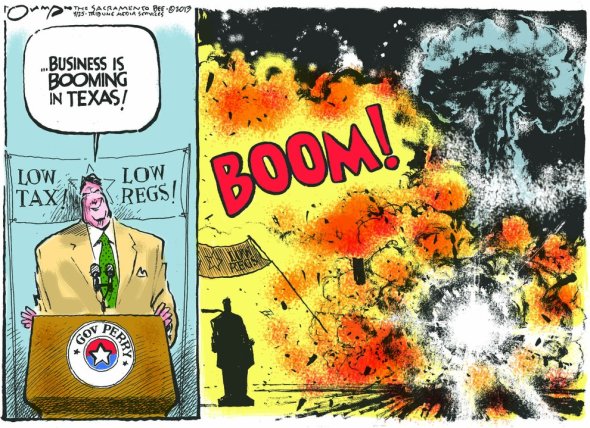
Jack Ohman, Sacramento Bee
Via Raw Story, the above cartoon by Jack Ohman of the Sacramento Bee, published last Thursday, has Texas Governor Rick Perry all hot under the collar–so much so that he (or some flunky) wrote a letter to the editor, which the Bee published on Friday. Here it is:
Re “Business is booming in Texas” (Editorial cartoon, April 25): It was with extreme disgust and disappointment I viewed your recent cartoon. While I will always welcome healthypolicy debate, I won’t stand for someone mocking the tragic deaths of my fellow Texans and our fellow Americans.
Additionally, publishing this on the very day our state and nation paused to honor and mourn those who died only compounds the pain and suffering of the many Texans who lost family and friends in this disaster. The Bee owes the community of West, Texas an immediate apology for your detestable attempt at satire.
— Gov. Rick Perry, Austin, Tex.
So far, Ohman’s editor Stuart Leavenworth is standing up for him. You can read his full response at the above link. From Raw Story:
Stuart Leavenworth, the editorial page editor of The Sacramento Bee, said the cartoon illustrated Perry’s “disregard for worker safety, and his attempts to market Texas as a place where industries can thrive with few regulations.”
Earlier this year, California Gov. Jerry Brown chided Texas for having a high percentage of workers earning minimum wage. Perry responded about a month later by running radio ads in California that encouraged business owners to move to his state. Perry claimed building a business in California was “next to impossible” because of regulations and taxes — regulations and taxes that his state lacked.
Ohman wrote about the “controversy” on his blog today. He says that a number of readers chastised him for the cartoon.
Their comments ranged from “you are a sick human being” to “insensitive and tasteless.” I’m not sure I am clinically qualified to give myself a direct diagnosis, but I am pretty sure I am not a sick human being. Let’s explore the question of tastelessness.
The Texas chemical plant had not been inspected by the state of Texas since 2006. That’s seven years ago. You may have read in the news that Gov. Perry, during his business recruiting trips to California and Illinois, generally described his state as free from high taxes and burdensome regulation. One of the burdensome regulations he neglected to mention was the fact that his state hadn’t really gotten around to checking out that fertilizer plant. Many Texas cities have little or no zoning, resulting in homes being permitted next to sparely inspected businesses that store explosive chemicals….
When I have to come up with these ideas, I can assure you that I am not really deliberately trying to be tasteless. I am not. What I am trying to do is make readers think about an issue in a striking way. I seem to have succeeded in this cartoon, one way or the other.
The question is whether it is tasteless or not.
My answer, respectfully, is that it isn’t.
Having said that, what normal person doesn’t mourn those poor people fighting the fire and living by the plant? I certainly do. What makes me angry, and, yes, I am driven by anger, is that it could have been prevented. I guess I could have done a toned-down version of the cartoon; I am not sure what that would have been, but I think many readers’ objections just stemmed from the fact that I used the explosion as a metaphor, period. The wound is fresh, the hurt still stings.

Personally, I thought the cartoon was brilliant–a perfect example of the old saying “a picture is worth a thousands words.” Apparently it got a pretty big rise out of Perry when the thousands of gallons of ink spilled on news stories hasn’t. Perry should be ashamed to show his face in public after what happened in West, Texas. Why on earth do Texans keep reelecting this guy?
Ohman recommended that Perry read this outstanding investigation by Pro Publica, which I read and recommended a few days ago: What Went Wrong in West, Texas — and Where Were the Regulators? Perry should either read it or have his flunky read it to him. Then he should wake up and realize that millions of Americans disapprove of his laissez-faire, Ayn Randian approach to government, and cartoonist Jack Ohman expressed our feelings perfectly.
But I don’t expect Perry will take responsibility for his role in the West, Texas disaster, because he can’t handle the truth.
Thursday Reads
Posted: April 25, 2013 Filed under: George W. Bush, morning reads, Psychopaths in charge, Republican politics, The Media SUCKS, U.S. Politics | Tags: Bangladesh factory collapse, barge explosions, Dhaka, Jennifer Rubin, Matthew Yglesias, Mobile Alabama, Ron Fournier, Walmart, worker safety 54 Comments
Good Morning!!
Unfortunately there is quite a bit of bad news breaking right now.
I’ll start with the collapse of the factory in Bangladesh.
From the Independent UK: Rescuers battle on as toll rises to 175 at collapsed Dhaka factory block that supplied Primark
Rescuers in Bangladesh are battling to save those trapped in the rubble of a collapsed building that contained garment factories as the death toll soared to at least 175. Many more hundreds of people were injured.
Hundreds of members of rescue teams, assisted by members of the military, frantically tried to clear rubble and debris amid fears that the death toll could rise yet higher.
The eight-storey building containing the factories which produced garments for several Western brands including Primark and Walmart, had been inspected on Tuesday and was found to have cracks.
But officials said the owners of the building assured the 2,000-odd employees that there was no danger and told them to carry on with their work….
The cracks were discovered on Tuesday and were so big that the local television news channel made a report about them. Staff from a bank that is housed in the same building were evacuated. However, the garment factories kept their staff working

Bangladesh factory collapse
CTV News: Collapsed Bangladesh factories ignored evacuation, officials say
With deep cracks visible in the walls, police had ordered a Bangladesh garment building evacuated the day before its deadly collapse, but the factories flouted the order and kept more than 2,000 people working, officials said Thursday. More than 200 people died when a huge section of the eight-story building splintered into a pile of concrete.
The disaster in the Dhaka suburb of Savar came less than five months after a blaze killed 112 people in a garment factory and underscored the unsafe conditions faced by Bangladesh’s garment workers, who produce clothes for brands worn around the world. Some of the companies in the building that fell say their customers include retail giants such as Wal-Mart.
Hundreds of rescuers, some crawling through the maze of rubble in search of survivors and corpses, worked through the night and into Thursday amid the cries of the trapped and the wails of workers’ relatives gathered outside the building, called Rana Plaza, which housed numerous garment factories and a handful of other companies.
An AP photographer ventured into the rubble and talked to one man who was
pinned face down in the darkness between concrete slabs and next to two corpses. Mohammad Altab pleaded for help, but they were unable to free him.
“Save us, brother. I beg you, brother. I want to live,” moaned Altab, a garment worker. “It’s so painful here … I have two little children.”
Another survivor, whose voice could be heard from deep in the rubble, wept as he called for help.
“We want to live brother; it’s hard to remain alive here. It would have been better to die than enduring such pain to live on. We want to live. Please save us,” the man cried.
I linked to this Matthew Yglesias post in a comment last night, but I’m going to include it here again because it is just so disgusting: Different Places Have Different Safety Rules and That’s OK
It’s very plausible that one reason American workplaces have gotten safer over the decades is that we now tend to outsource a lot of factory-explosion-risk to places like Bangladesh where 87 people just died in a building collapse.* This kind of consideration leads Erik Loomis to the conclusion that we need a unified global standard for safety, by which he does not mean that Bangladeshi levels of workplace safety should be implemented in the United States.
I think that’s wrong. Bangladesh may or may not need tougher workplace safety rules, but it’s entirely appropriate for Bangladesh to have different—and, indeed, lower—workplace safety standards than the United States.
The reason is that while having a safe job is good, money is also good. Jobs that are unusually dangerous—in the contemporary United States that’s primarily fishing, logging, and trucking—pay a premium over other working-class occupations precisely because people are reluctant to risk death or maiming at work. And in a free society it’s good that different people are able to make different choices on the risk–reward spectrum.
Um . . . No, it’s not okay. Read more at the link if you can stomach it.
Back in the USA, there have now been seven explosions on fuel barges in Alabama.
Tuesday Reads: Gitmo, Torture, and Dirty Wars
Posted: April 23, 2013 Filed under: Barack Obama, Foreign Affairs, Gitmo, morning reads, Psychopaths in charge, Real Life Horror, torture, U.S. Politics | Tags: Abdulrahman al Awlaki, Anwar Al-Awlaki, black shirts, Dirty Wars, force-feeding, Guantanamo, Ibn Shaikh al-Libi, Jason Leopold, Jeffrey Kaye, Jeremy Scahill, Samir Naji al Hasan Moqbel, Shaker Aamer, terrorism vs everyday violence 56 Comments
Yemeni protestors dressed in prison uniforms, hold posters of men detained in Guantanamo Bay prison during a demonstration in front of the U.S. embassy demanding their release, in Sanaa, Yemen, Tuesday, April 16, 2013.
Good Morning!!
There has been so much news lately that it’s hard to know what to write about; but I decided to focus on a shocking story that hasn’t gotten much coverage in the corporate media–the mass hunger strikes at Guantanamo.
Last week The New York Times published a heart-rending cry for help from an inmate (dictated over the phone), Samir Naji al Hasan Moqbel: Gitmo Is Killing Me. This man has been in Gitmo for 11 years with no charges and faces the terrible possibility that he will die there. How did he end up imprisoned by the U.S.?
When I was at home in Yemen, in 2000, a childhood friend told me that in Afghanistan I could do better than the $50 a month I earned in a factory, and support my family. I’d never really traveled, and knew nothing about Afghanistan, but I gave it a try.
I was wrong to trust him. There was no work. I wanted to leave, but had no money to fly home. After the American invasion in 2001, I fled to Pakistan like everyone else. The Pakistanis arrested me when I asked to see someone from the Yemeni Embassy. I was then sent to Kandahar, and put on the first plane to Gitmo.
He has been on a hunger strike since Feb. 10, and Americans are now force-feeding him. That is torture.
Last month, on March 15, I was sick in the prison hospital and refused to be fed. A team from the E.R.F. (Extreme Reaction Force), a squad of eight military police officers in riot gear, burst in. They tied my hands and feet to the bed. They forcibly inserted an IV into my hand. I spent 26 hours in this state, tied to the bed. During this time I was not permitted to go to the toilet. They inserted a catheter, which was painful, degrading and unnecessary. I was not even permitted to pray.
I will never forget the first time they passed the feeding tube up my nose. I can’t describe how painful it is to be force-fed this way. As it was thrust in, it made me feel like throwing up. I wanted to vomit, but I couldn’t. There was agony in my chest, throat and stomach. I had never experienced such pain before. I would not wish this cruel punishment upon anyone.
I am still being force-fed. Two times a day they tie me to a chair in my cell. My arms, legs and head are strapped down. I never know when they will come. Sometimes they come during the night, as late as 11 p.m., when I’m sleeping.
There are so many of us on hunger strike now that there aren’t enough qualified medical staff members to carry out the force-feedings; nothing is happening at regular intervals. They are feeding people around the clock just to keep up.
This is being done in our name. Our tax money is being spent on this.

Protesters demand Obama close Guantanamo Bay prison
On Saturday, The Guardian Observer published another inmate’s story, “Shaker Aamer: ‘I want to hug my children and watch them as they grow'”
As of today, I’ve spent more than 11 years in Guantánamo Bay. To be precise, it’s been 4,084 long days and nights. I’ve never been charged with any crime. I’ve never been allowed to see the evidence that the US once pretended they had against me. It’s all secret, even the statements they tortured out of me.
In 2007, roughly halfway through my ordeal, I was cleared for release by the Bush administration. In 2009, under Obama, all six of the US frontline intelligence agencies combined to clear me again. But I’m still here.
Every day in Guantánamo is torture – as was the time they held me before that, in Bagram and Kandahar air force bases, in Afghanistan. It’s not really the individual acts of abuse (the strappado – that’s the process refined by the Spanish Inquisition where they hang you from your wrists so your shoulders begin to dislocate, the sleep deprivation, and the kicks and punches); it’s the combined experience. My favourite book here (I’ve read it over and over) has been Nineteen Eighty-Four by George Orwell: torture is for torture, and the system is for the system.
More than a decade of my life has been stolen from me, for no good reason. I resent that; of course I do. I have missed the birth of my youngest son, and some of the most wonderful years with all my four children. I love being a father, and I always worked to do it as best I can.
Shaker Aamer is a Saudi Arabian citizen and his family lives in London.

Jeffrey Kaye (AKA Valtin), who has been writing about U.S. torture for many years wrote a diary about Shaker Amer at DailyKos on Sunday that is well worth reading: British Press: US Conspires with UK & Saudis to Hold Detainee w/Evidence on Iraq War Lies.
Unlike the vast majority of detainees held at Guantanamo, Aamer speaks very good English. He is intelligent and motivated. That makes him dangerous to the authorities running Guantanamo. While President Obama’s administration and DoD officials maintain Guantanamo is run humanely, a blue-ribbon panel assembled by The Constitution Project, including former GOP officials, have determined that abuse still occurs, and have pointed out the the Army Field Manual’s Appendix M, a prime culprit in ongoing abuse, should be excised from that document and from DoD practice. (Link to the long and fascinating report.)
But it apparently is not only testimony about being tortured or seeing others tortured that Aamer can supply. That alone would probably not be enough to hold him forever. Instead, exposes this past weekend in the British press have indicated Aamer is being held indefinitely, or considered for “repatriation” to Saudi Arabia, because he can testify to the presence of British counter-terrorism agents from MI5 and MI6 at his own torture… and the torture of Ibn Shaikh al-Libi.
Al-Libi famously was tortured to give false evidence about Saddam Hussein’s pursuit of chemical weapons as part of the doctored evidence presented to US and world public opinion to justify the unprovoked invasion of Iraq by the US-dominated coalition in 2003. The invasion was responsible for the deaths of an untold number of Iraqis (estimates ranging from 100,000 to well over a million), an untold number of injured, produced millions of refugees, and generally destabilized the region.
In a recent Guardian expose, the culpability of high US officials in the organization and operation of death and torture squads by the Iraqis was documented. But in the United States, there appeared to be almost no interest in these developments.
President Obama supposedly ended Bush’s torture policies and vowed to close Guantanamo, but clearly these men are being tortured and there are no signs that Guantanamo will ever be closed. Here’s a piece by Jeremy Scahill published in 2009 that describes the “black shirts,” the “Thug Squad Still Brutalizing Prisoners at Gitmo Under Obama.” Clearly, it is still happening in 2013.
One more link to a piece at Truthout by Jason Leopold, who has also been writing about torture for years: Inmates Rising: Worsening Gitmo Mass Hunger Strike in Prisoners’ Own Words.
Poke a fork in his buns cause Jindal’s Done …
Posted: April 9, 2013 Filed under: 2016 elections, Bobby Jindal, Psychopaths in charge | Tags: Bobby Jindal, reverse robin hood, stealin from the poor and givin to the rich 13 Comments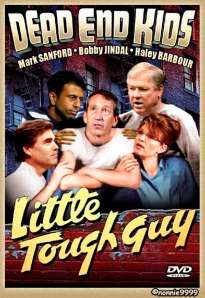 Ah, the sweet sounds of media all over the country writing obituaries for Bobby Jindal’s political career. It’s hard not to gloat from my little corner of the state that finally wised up. He’s just been called the “R” word. That would be Romney.
Monday’s article on the nation’s least popular governors did not include Gov. Bobby Jindal of Louisiana, because he is not up for re-election in 2014. (Louisiana’s next gubernatorial election will be in 2015, and Mr. Jindal will not be eligible, having served two consecutive terms.) But recent surveys suggest that Mr. Jindal has become very unpopular in his home state amid a series of battles on fiscal policy. A March poll from Southern Media & Opinion Research put Mr. Jindal’s approval rating at just 38 percent, against 60 percent disapproval. His numbers had been similarly poor in a February survey by Public Policy Polling.
Some national political commentators are treating the news as being self-evidently injurious to Mr. Jindal’s chances of capturing the Republican presidential nomination in 2016. Obviously, Mr. Jindal has plenty of time to turn around his image in Louisiana. But if he doesn’t, would Republicans really consider nominating someone who is so deeply unpopular among his own constituents?
Actually, you don’t have to go back very far to find a precedent for when Republicans did exactly that. Their nominee last year, Mitt Romney, was very unpopular among Massachusetts voters by the time he finished his single term as governor in 2006.
Can you hear the sound of the funeral pipes playin’ over Bayou Corne? Maybe it’s just the bat phone in Baton Rouge ringing so that Grover Norquist and the Koch Brothers can call the Governor on his retreat from their pet ALEC policies. Excuse me whilst I enjoy my champagne.
In a short address Monday on the first day of the legislative session, Gov. Bobby Jindal described why his next big plan — a plan that had been applauded by conservative pundits nationally, pitched at meetings around the state and promoted in slickly produced commercials — was crucial to Louisiana’s success.
Then he announced he was shelving it.
“Governor, you’re moving too fast, and we aren’t sure that your plan is the best way to do it,” Mr. Jindal said, describing what he had heard from legislators and citizens alike.
“Here is my response,” he said. “O.K., I hear you.”
The plan, to get rid of the state income and corporate taxes and replace the lost revenue with higher and broader sales taxes, was not dropped altogether. Mr. Jindal emphasized that he was still committed to losing the income tax, but that he would defer to the Legislature to suggest how exactly to make that work.
But it was a rare admission of defeat for Mr. Jindal, 41, a constant Republican in the mix for 2016 and rising conservative luminary since his early 20s. And it was only the latest in a season of setbacks.
In the fall, Mr. Jindal was tapped to lead the Republican Governors Association and after the 2012 election appeared often on national op-ed pages and at Washington forums, diagnosing the party’s ills and earning a reputation as a politician who could deliver straight talk.
Back home in Louisiana his troubles were piling up. Unfavorable polls, once discounted as the byproduct of an ambitious agenda, were only getting worse — recently much worse.
The governor’s statewide school voucher program, a pillar of his education reform package, was blocked by a trial court judge on constitutional grounds.
Judges have since also blocked his revamp of teacher tenure rules and a change of the state retirement system (the administration has appealed the rulings and is pushing for legislative action should they stand).
Then at the end of March, Mr. Jindal’s health secretary, Bruce Greenstein, announced his resignation amid reports of a federal grand jury investigation into the awarding of a $185 million state contract. Mr. Greenstein had also been the point man for one of the administration’s most complex, consequential and potentially risky projects: the accelerated transfer of the state’s safety-net hospital system to a system of public-private partnerships.
All along, opposition to the tax swap was growing broader and more bipartisan by the day. Clergy members urged the governor to drop the plan, saying it could hurt the poor, while the state’s most prominent chamber of commerce group came out against the plan for its potential impact on businesses.
Yes, there will be no obvious robbing from the middle class poor in the land of the Kingfish this year! Can we just use TPM’s words and say POLITICAL COLLAPSE!
Sure the GOP may need a little outreach here and a little fine tuning there, but Republicans in Washington say they’re confident that a principled message of low taxes and cuts to social services will eventually propel them back to victory. They may want to take a look at Louisiana first.
Governor Bobby Jindal (R-LA), considered a leading presidential contender in 2016, is suffering a political meltdown in his home state. His approval rating plummeted to 38 percent in a poll last week by the non-partisan Southern Media Opinion & Research, down from 60 percent just a year ago. In an ominous sign for national Republicans, the immediate cause is a sweeping economic agenda with strong parallels to the House GOP’s latest budget.
On Monday, Jindal scrapped his own proposal to eliminate the state’s income and corporate taxes and replace them with a statewide tax on sales and business services. His retreat was a concession to the reality that the proposal was headed towards a humiliating defeat — and taking Jindal down with it along the way. Jindal said in a speech to lawmakers that the backlash against his plan “certainly wasn’t the reaction I was hoping to hear,” but that he would respect the public’s wishes and start again.
Jindal’s proposal was different than tax plans by national Republicans like Mitt Romney and Paul Ryan in that it planned to eliminate income and corporate taxes entirely instead of just lower rates, but the provisions that inflamed the public against it overlap plenty with national GOP proposals. Namely, both plans generated complaints from economists that they would require regressive tax increases on the poor and middle class to pay for lower taxes for the wealthy.
Grover Norquist, the intellectual leader of the anti-tax crowd in Washington, had praised Jindal’s plan as “the boldest, most pro-growth state tax reform in U.S. history.” He noted that it was particularly significant, because with Obama positioned to veto anything resembling the House GOP’s budget for the next several years, Louisiana might be Republicans’ best chance to show off their tax ideas on the state level.
“The national media and Acela-corridor crowd continue to focus on the bickering Washington, but they can learn what real tax reform looks like by looking to Louisiana,” Norquist said.
It didn’t turn out that way. Only 27 percent of Louisiana voters supported the plan in the latest SMOR poll versus a whopping 63 percent opposed. The idea didn’t even garner majority support among Republicans.
I guess we’re not as dumb as they think we look. However, I think Jindal is not as smart as they think he is either …
Thursday Reads: War on Women, the Fiscal Cliff, and Austerity Arriving in the USA
Posted: January 3, 2013 Filed under: Fiscal Cliff, morning reads, Psychopaths in charge, Reproductive Rights, Republican politics, Social Security, U.S. Economy, U.S. Politics, War on Women, Women's Rights | Tags: abortion restrictions, austerity, Catfood Commission, Greece, Simpson-Bowles 42 Comments
Good Morning!!
Brrrrrrrrrr! All of a sudden winter has arrived! Can you believe it’s 4 degrees outside my house? With a wind chill factor of 6 below 0. My furnace can’t keep up in this kind of weather, so I have to bundle up. So what else is in the news this morning? Let’s see….
Today the new Congress gets sworn in and there are a record number of women in the new Senate. From ABC News: Meet the New Class: The Senate Swears in a Historic 20 Female Senators
Today the Senate will make history, swearing in a record-breaking 20 female senators – 4 Republicans and 16 Democrats – in office….
“I can’t tell you the joy that I feel in my heart to look at these 20 gifted and talented women from two different parties, different zip codes to fill this room,” Sen. Barbara Mikulksi, D-Md., said while surrounded by the group of women senators. “In all of American history only 16 women had served. Now there are 20 of us.”
Senator-elect Deb Fischer, R-Neb., becomes today the first women to be elected as a senator in Nebraska.
“It was an historic election,” Fischer said, “But what was really fun about it were the number of mothers and fathers who brought their daughters up to me during the campaign and said, “Can we get a picture? Can we get a picture?’ Because people realize it and — things do change, things do change.”
There’s a group photo at the link.
Still, the war on women continues. HuffPo reports: House GOP Lets Violence Against Women Act Passed By Senate Die Without A Vote.
Despite a late-stage intervention by Vice President Joe Biden, House Republican leaders failed to advance the Senate’s 2012 reauthorization of the Violence Against Women Act, an embattled bill that would have extended domestic violence protections to 30 million LGBT individuals, undocumented immigrants and Native American women.
“The House leadership would not bring it up, just like they wouldn’t bring up funding for Sandy [hurricane damage] last night,” said Sen. Patty Murray (D-Wash.), a key backer of the Senate version of the bill, in an interview with HuffPost. “I think they are still so kowtowing to the extreme on the right that they’re not even listening to the moderates, and particularly the women, in their caucus who are saying they support this.”
The Senate bill passed way back in April.
In April, the Senate with bipartisan support passed a version of VAWA that extended protections to three groups of domestic violence victims who had not been covered by the original law, but House Republicans refused to support the legislation with those provisions, saying the measures were politically driven. Instead, they passed their own VAWA bill without the additional protections. In recent weeks, however, even some House Republicans who voted for the pared-down House bill have said they would now support the broader Senate bill — and predicted it would pass if Republican leaders let it come to the floor for a vote.
“I absolutely would support the Senate bill,” Rep. Tom Cole (R-Okla.) told HuffPost in late December, speculating that other House Republicans, namely GOP congresswomen, “are very supportive of that.”
Asked if he thought the Senate bill would pass in the House if it came up for a vote, Cole replied, “My judgment is yes.”
Too little, too late, Congressman. So Boehner managed to screw women yesterday too though it was the refusal to vote on Sandy relief that got all the media attention.
In India police have filed murder charges against five men in the horrific gang rape in New Delhi.
Authorities filed rape and murder charges Thursday against five men accused of the gang rape of a 23-year-old university student on a New Delhi bus, a crime that horrified Indians and provoked a national debate about the treatment of women.
Police said they plan to push for the death penalty in the case, as government officials promised new measures to protect women in the nation’s capital.
Prosecutor Rajiv Mohan filed a case of rape, tampering with evidence, kidnapping, murder and other charges against the men in a new fast-track court in south Delhi inaugurated only the day before to deal specifically with crimes against women. Mohan asked for a closed trial and a hearing was set for Saturday.
The men charged are Ram Singh, 33, the bus driver; his brother Mukesh Singh, 26, who cleans buses for the same company; Pavan Gupta, 19, a fruit vendor; Akshay Singh, 24, a bus washer; and Vinay Sharma, 20, a fitness trainer.
A sixth suspect was listed as 17 and was expected to be tried in a juvenile court, where the maximum sentence would be three years in a reform facility.
Read more at the link. The New Yorker has a good article on the New Delhi story by Basharat Peer: After a Rape and Murder, Fury in Delhi. Please go read the whole thing if you can.
Back in the USA, Republican state legislatures are up to their old tricks. Irin Carmon reports in Salon: Michigan, Virginia pass backdoor abortion restrictions.
In Michigan, Rick Snyder signed a bill passed by the lame-duck Senate — the same one whose anti-union legislating dominated headlines in recent weeks — requiring clinics that perform more than 120 abortions a year to become surgical outpatient facilities, a level of licensing intended to be onerous and put clinics out of business. He also approved a bill that purports to screen for women being coerced into abortions.
Snyder did veto another bill limiting insurance coverage in private employee plans, which would have required purchase of a separate abortion rider. He objected to that on the grounds that rape victims would have to pay out of pocket if they didn’t buy the rider, and because, “As a practical matter, I believe this type of policy is an overreach of government into the private market.” Overreach of government into other realms, of course, is another matter entirely. (According to Michigan resident Emily Magner, one legislator interrupted her to cry, “THIS ISN’T ABOUT WOMEN! THIS IS ABOUT PROTECTING FETUSES!”)
Virginia’s similar, hospital-level restrictions on clinics were somewhat overshadowed by the ultrasound requirements for women seeking abortions. Under threat of forever having the word “transvaginal” attached to his name, Gov. Bob McDonnell tried to split the difference on the ultrasound legislation, but in the final days of the year signed off on the clinic regulations. This followed months of conflict between the Board of Health and Virginia Attorney General Ken Cuccinelli over whether existing clinics would be grandfathered into the legislation. The governor’s office called the regulations “common-sense”; NARAL Pro-Choice Virginia said in a statement, “After two years of shocking backroom deals and bullying public health servants, Governor Bob McDonnell is clearly proving his disregard of Virginians’ opinions about women’s health care.”
Clinic regulations are the most insidious of abortion restrictions, because they’re harder for the layperson to understand and tend to incite less outrage as a result. And opposition to them tends to fall into antiabortion narratives about back-alley butchers resisting safety standards. But research has suggested that they also tend to be the most effective: It’s difficult to talk a woman out of having an abortion, but if you make access near impossible, you might take the choice off the table altogether.

On the “Fiscal Bunny Slope,” as Dakinikat refers to it, TPM reports that Simpson and Bowles of the famous Catfood Commission didn’t like the deal hammered out by the Senate and passed by the House. It seems it doesn’t cause enough suffering for the poor and elderly to satisfy them. Here’s their statement:
“The deal approved today is truly a missed opportunity to do something big to reduce our long term fiscal problems, but it is a small step forward in our efforts to reduce the federal deficit. It follows on the $1 trillion reduction in spending that was done in last year’s Budget Control Act. While both steps advance the efforts to put our fiscal house in order, neither one nor the combination of the two come close to solving our Nation’s debt and deficit problems. Our leaders must now have the courage to reform our tax code and entitlement programs such that we stabilize our debt and put it on a downward path as a percent of the economy.
Washington missed this magic moment to do something big to reduce the deficit, reform our tax code, and fix our entitlement programs. We have all known for over a year that this fiscal cliff was coming. In fact Washington politicians set it up to force themselves to seriously deal with our Nation’s long term fiscal problems. Yet even after taking the Country to the brink of economic disaster, Washington still could not forge a common sense bipartisan consensus on a plan that stabilizes the debt.
It is now more critical than ever that policymakers return to negotiations that will build on the terms of this agreement and the spending cuts in the Budget Control Act. These future negotiations will need to make the far more difficult reforms that bring spending further under control, make our entitlement programs sustainable and solvent, and reform our tax code to both promote growth and produce revenue. We take some encouragement from the statements by the President and leaders in Congress that they recognize more work needs to be done. In order to reach an agreement, it will be absolutely necessary for both sides to move beyond their comfort zone and reach a principled agreement on a comprehensive plan which puts the debt on a clear downward path relative to the economy.”
Don’t you love the way they call for “courage” from rich Congresspeople and then tell them to cut the sole income of millions of elderly and disabled people? What about calling for the real courage it would take for them to raise the cap on Social Security contributions so that rich people could pay a little more into the system? I doubt if many of them turn down the paltry extra income they get from it.
I’m running out of space, but I have some more fiscal cliff reads for you that I’ll pass on in link dump fashion.
Paul Krugman: That Bad Ceiling Feeling
Noam Scheiber: The House Comes Around on the Cliff. Why Am I Not Reassured?
Washington Post: U.S. markets surge after Congress approves ‘cliff’ deal
George Zornick at The Nation: While Congress Plays Deficit Games, Jobs Crisis Goes Unaddressed
Joan Walsh: Biggest Fiscal Cliff Lessions
Jonathan Chait: The Big Lebowski Explains the Fiscal Cliff
Truthout: Debt Versus Democracy: A Battle for the Future
Joe Conason: The GOP Clown Car Crashes, Again
I’ll end with a couple of articles on the European-style austerity that we’re heading for right now.
Brad Plummer at the Washington Post: U.S. now on pace for European levels of austerity in 2013
For years now, economists like Paul Krugman have been criticizing countries in Europe for engaging in too much austerity during the downturn — that is, enacting tax increases and spending cuts while their economies were still weak.
But after this week’s fiscal cliff deal, the United States is now on pace to engage in about as much fiscal consolidation in 2013 as many European nations have been doing in recent years — and more than countries like Britain and Spain.
A back-of-the-envelope calculation suggests Congress has enacted around $336 billion in tax hikes and spending cuts for the coming year, an austerity package whose total size comes to about 2.1 percent of GDP. (That’s merely the size of the cuts and taxes; it’s not necessarily the effect on growth.)
This includes the expiration of the payroll tax cut, which will raise about $125 billion this year. It includes $68 billion in scheduled cuts to discretionary spending from the 2011 Budget Control Act. It includes $24 billion in new Obamacare taxes and $27 billion in new high-income taxes. And it includes about $92 billion from the now-delayed sequester cuts — assuming that these either take effect or are swapped with other cuts.
Check out the graph at the link. And in Greece, the Guardian reports: Euros discarded as impoverished Greeks resort to bartering
It’s been a busy day at the market in downtown Volos. Angeliki Ioanitou has sold a decent quantity of olive oil and soap, while her friend Maria has done good business with her fresh pies.
But not a single euro has changed hands – none of the customers on this drizzly Saturday morning has bothered carrying money at all. For many, browsing through the racks of second-hand clothes, electrical appliances and homemade jams, the need to survive means money has been usurped.
“It’s all about exchange and solidarity, helping one another out in these very hard times,” enthused Ioanitou, her hair tucked under a floppy felt cap. “You could say a lot of us have dreams of a utopia without the euro.”
In this bustling port city at the foot of Mount Pelion, in the heart of Greece’s most fertile plain, locals have come up with a novel way of dealing with austerity – adopting their own alternative currency, known as the Tem. As the country struggles with its worst crisis in modern times, with Greeks losing up to 40% of their disposable income as a result of policies imposed in exchange for international aid, the system has been a huge success. Organisers say some 1,300 people have signed up to the informal bartering network.
For users such as Ioanitou, the currency – a form of community banking monitored exclusively online – is not only an effective antidote to wage cuts and soaring taxes but the “best kind of shopping therapy”. “One Tem is the equivalent of one euro. My oil and soap came to 70 Tem and with that I bought oranges, pies, napkins, cleaning products and Christmas decorations,” said the mother-of-five. “I’ve got 30 Tem left over. For women, who are worst affected by unemployment, and don’t have kafeneia [coffeehouses] to go to like men, it’s like belonging to a hugely supportive association.”
Much more at the link.
So….what’s on your reading and blogging list today. I look forward to clicking on your links.

 peej
peej Carissa
 bostonboomer
 dakinikat
 ecocatwoman
 mablue2
 Mama Lopez
 peggysue22
 quixote
 skydancingguestblogger
 Mona (aka Wonk the Vote)



 Sky Dancing
Recent Comments