
Tuesday Reads
Posted: March 13, 2012 Filed under: 2012 presidential campaign, Barack Obama, birth control, Mitt Romney, morning reads, New Orleans, Newt Gingrich, psychology, Reproductive Rights, Republican presidential politics, Rick Perry, Rick Santorum, U.S. Economy, U.S. Politics, War on Women | Tags: Alabama, Arlen Specter, belief that Obama is a muslim, Bobby Jindal, daylight savings time, interracial marriage, Mississippi, Pat Nixon, polls, Republican primaries, Richard Nixon, single bullet theory, sleep, time traveler vote, Warren Commission 46 Comments
Good Morning!!
Let’s get right to the news. I’m going to start with a couple of items that should particularly interest Dakinikat. First, Charlie Pierce wrote a post yesterday about Bobby Jindal’s campaign for VP.
Louisiana Governor Bobby Jindal wants to be your vice-president. (He may also want to be your president, too, but being your vice-president first is an easy way to do that.) His first audition for the second slot was to become the prime surrogate for the relentless juggernaut that was the Rick Perry campaign.
(This was a juggernaut only in the sense that people watched Perry speak in the debates and asked each other, “Is he hitting the jug or not?” Thank you. I’ll be back for the late show.)
Once he rode that baby straight into the ground, Jindal decided to campaign for the job on his own, all the while hoping that nobody in the country remembers his memorable “reply” to the president’s State of the Union address back in 2009, during which Jindal looked like a 12-year old wearing his grandfather’s suit, the one in which Jindal scoffed at federal spending on “volcano monitoring” a little more than a year before a big hunk of Iceland blew up and nearly destroyed the airline industry in Europe.
Pierce is reacting to Jindal’s op-ed at the WSJ: Obama’s Politicized Energy Policy
With rising energy costs making it more expensive to drive our cars, heat our homes, and fuel our sputtering economy, many Republicans are criticizing the Obama administration for a failure to adopt a comprehensive energy policy. I believe that critique lets the president off too easily. His administration does have a national energy policy—it’s just a subservient by-product of his radical environmental policy.
This administration willfully ignores rational choices that would lower energy prices and reduce U.S. reliance on foreign energy sources.
Bla, bla, bla…”rational” advice from a guy who believes in exorcism.
We all lost an hour of our lives a couple of days ago when the government made us “spring forward” into daylight savings time (DST). I love it, because it means it stays light a little longer at the end of the day here in New England, but Dak hates what it does to her down in New Orleans. Of course up here in the north, I don’t have the problem of darkness in the early morning.
The Christian Science Monitor had an interesting article on DST yesterday. CSM reports on a psychological study that found that workers are sleepy the next day after the time change (duh!) and are more likely to waste time on the internet at work. “Global productivity losses from a spike in employee cyberloafing are potentially staggering,” the researchers conclude.
CSM says that the origins of DST go way back. It was “originally proposed by a 19th century butterfly collector who wanted more time at the end of the workday to scour fields for insects,” and was first implemented “during World War I (peacetime standardization came in 1966).”
The most recent real adjustment in the US came in 2007, when the change was moved up to the second Sunday in March from the first Sunday in April to lengthen “summertime” and gauge potential energy savings. Polls showed farmers, perennial DST opponents, grumbled, and sports retailers (who benefit from the extra hour of daylight for play time after work) rejoiced.
If you’re worried about lost sleep, you might want to read this article at Alternet: The 8-Hour Sleep Myth: How I Learned That Everything I Knew About Sleep Was Wrong. Apparently it’s not really natural for humans to sleep through the night. The author read about this in a BBC article. Here’s the gist from the Alternet piece:
Turns out that psychiatrist Thomas Wehr ran an experiment back in the ‘90s in which people were thrust into darkness for 14 hours every day for a month. When their sleep regulated, a strange pattern emerged. They slept first for four hours, then woke for one or two hours before drifting off again into a second four-hour sleep.
Historian Roger Ekirch of Virginia Tech would not have been surprised by this pattern. In 2001, he published a groundbreaking paper based on 16 years of research, which revealed something quite amazing: humans did not evolve to sleep through the night in one solid chunk. Until very recently, they slept in two stages. Shazam.
In his book At Day’s Close: Night in Times Past, Ekrich presents over 500 references to these two distinct sleep periods, known as the “first sleep” and the “second sleep,” culled from diaries, court records, medical manuals, anthropological studies, and literature, including The Odyssey. Like an astrolabe pointing to some forgotten star, these accounts referenced a first sleep that began two hours after dusk, followed by waking period of one or two hours and then a second sleep.
This waking period, known in some cultures as the “watch,” was filled with everything from bringing in the animals to prayer. Some folks visited neighbors. Others smoked a pipe or analyzed their dreams. Often they lounged in bed to read, chat with bedfellows, or have much more refreshing sex than we modern humans have at bedtime. A 16th-century doctor’s manual prescribed sex after the first sleep as the most enjoyable variety.
That makes me feel a lot better, since I’ve rarely ever been able to sleep through the night, and in my later years, I have a terrible time falling asleep in the first place.
In political news, President Obama’s approval rating has suddenly tanked, supposedly because of gas prices.
Despite improving job growth and an extended Republican primary fight dividing his would-be opponents, President Obama is heading into the general election season on treacherous political ground, according to the latest New York Times/CBS News poll.
At a time of rising gas prices, heightened talk of war with Iran and setbacks in Afghanistan, Mr. Obama’s approval rating dropped substantially in recent weeks, the poll found, with 41 percent of respondents expressing approval of the job he is doing and 47 percent saying they disapprove — a dangerous position for any incumbent seeking re-election.
Which is kind of scary because of the horrifying Republican presidential candidates. It’s still early, so I’m not panicking just yet. Speaking of the clown car crew, there are four primaries today–in Alabama, Mississippi, Hawaii, and American Samoa. I’m not sure if we’ll have a live blog, because the last one was a bit of dud. If you’d like to have one, please say so in the comments to this post. We’ll definitely post the results tonight though.
As of last night, Romney was in the running in both Alabama and Mississippi, where the polls show Romney Gingrich, and Santorum all running neck and neck. The worst news is that Romney is now leading Obama by 5 points nationally.
The next item drew a {heavy sigh} from me. A new PPP poll found that a whole lot of voters in Alabama and Mississippi think President Obama is a Muslim. {{Heavy sigh….}}
The poll of Mississippi Republicans found that 52% said they believed Obama is a Muslim, 36% weren’t sure and only 12% said they believed he is a Christian. He fared slightly better in Alabama, where 45% said he is a Muslim, 41% weren’t sure, and 14% said he is a Christian.
Some folks in these two deep South state don’t care for interracial marriages like the one that produced Barack Obama.
67% of Alabama Republicans saying they believe interracial marriage should be legal, though 21% said it still should be against the law. In Mississippi, 54% said it should be allowed, while 29% said it should remain illegal.
The preferred Republican candidate of those opposed to interracial marriage? Newt Gingrich. In Mississippi, Gingrich led Romney among that group 40% to 27%, and held a 38%-27% advantage in Alabama.
I am soooooo glad I don’t live in Alabama or Mississippi! Alexandra Petri of the WaPo calls it “the time traveler vote.” She says that voters must have just arrived from the 1920s.
I don’t know why it didn’t strike me sooner. So many of the issues at stake this year are Issues I Thought We Resolved Several Decades Ago. This is 2012, with lots of economic distress and voter unrest to go around. Why are we suddenly prioritizing Taking Back Control Of Women’s Bodies For The State?
But if you consider the Time Traveling Vote, it all makes sense.
I am not sure how big the vote is. But if the recent actions of many state legislatures are to be taken into account, it is surely substantial.
To visitors from the past, these issues are still pressing and vital. They don’t care about jobs! Once the election’s over, they’re headed back to 1926, where the economy is still roaring and everyone is flapping and doing the Charleston.
It certainly makes more sense than the assumption that they’ve simply been ignoring all the headlines, most of the textbooks, the entire women’s rights movement and the scientific consensus for decades.
Some love letters between the young Richard Nixon and his future wife Pat will be displayed at the Nixon Library. They are said to show Nixon’s “sensitive side.” A sample:
“Every day and every night I want to see you and be with you. Yet I have no feeling of selfish ownership or jealousy. In fact I should always want you to live just as you wanted – because if you didn’t then you would change and wouldn’t be you,” Nixon wrote in one of the letters, part of a rotating display at the Nixon Presidential Library and Museum.
“Let’s go for a long ride Sundays; let’s go to the mountains weekends; let’s read books in front of fires; most of all let’s really grow together and find the happiness we know is ours,” he continued.
Whatever happened to that guy?
Finally, have you heard that Arlen Specter has a memoir coming out? Naturally, it’s full of complaints. Harry Reid stabbed him in the back after promising to give Specter seniority as a Democrat if he switched parties. Obama and Biden didn’t help him in his primary campaign against Joe Sestak. The most interesting revelation in the article in The Hill is that Bob Dole told Specter he (Dole) would have switched parties too.
“Dole told me I had done the right thing, that I had done a terrific job as a senator, been involved in a lot of projects, been very active, and hadn’t gotten credit for a lot of the stuff I had done,” he wrote.
“I said, ‘Bob, I think that it’s very meaningful when you say that I did the right thing, in the party change.’
“He said, ‘Well,’ and then paused and thought for a few seconds. Then he said, ‘I probably would have done the same thing.’ ”
Never mind all that. I want to read about Specter’s role in the Warren Commission and how he dreamed up the “single bullet theory.”
That’s all I’ve got for now. What are you reading and blogging about today?
Embarrassing Tales Told by Politicians
Posted: February 27, 2012 Filed under: 2012 primaries, just because, psychology, U.S. Military, U.S. Politics | Tags: Barack Obama, George W. Bush, memory errors, Mitt Romney, Ronald Reagan 8 Comments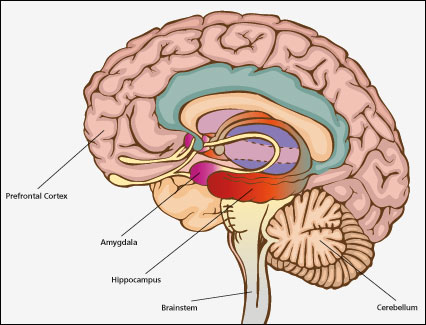
Brain areas involved in memory
Human memory can be amazingly accurate and detailed. It is possible for people to accurately recall events that happened in the decades previously. Yet humans are also subject to numerous memory errors, which are actually adaptive for most purposes, but can be embarrassing when they happen to people in the public eye.
On Saturday it happened to Mitt Romney. During his speech to a Tea Party rally in Flint, Michigan, Romney described a vivid childhood memory
Romney recalled he was “probably 4 or something like that” the day of the Golden Jubilee, when three-quarters of a million people gathered to celebrate the 50th anniversary of the American automobile.
“My dad had a job being the grandmaster. They painted Woodward Ave. with gold paint,” Romney told a rapt Tea Party audience in the village of Milford Thursday night, reliving a moment of American industrial glory.
The Golden Jubilee described so vividly by Romney was indeed an epic moment in automotive lore. The parade included one of the last public appearances by an elderly Henry Ford.
But Romney couldn’t possibly have been a the Golden Jubilee, because it happened in 1946–about 9 months before baby Willard was born. Was he lying? No, of course not. He probably formed this false memory based on stories told by family members, and perhaps family photos. This is a very common type of memory error–confusion about the source of a memory. Romney probably heard this story many times and perhaps rehearsed it by thinking about it and talking about it to family and friends.
Most theorists now believe that memories are stored in various locations in the brain and have to be reconstructed each time we recall them. Confusion can develop if we have memories of several events that happened in the same place–people can get mixed up about which time a specific event happened.
As you might expect, memory errors become more common with age. There are a number of famous stories about Ronald Reagan’s outrageous memory errors. He repeatedly told a heartrending story about a World War II bomber pilot who ordered his crew to bail out after the plane was hit by enemy fire. His young belly gunner was wounded so seriously that he was unable to evacuate the aircraft. Reagan could barely hold back tears as he related the pilot’s heroic response: “Never mind. We’ll ride it down together.” Supposedly the pilot had received the Congressional Medal of Honor, awarded posthumously.
Journalists searched in vain to learn about the war hero. They could find no Medal of Honor winner whose story matched the one told by Reagan. Finally the source of the story was identified as a scene from a Hollywood movie, “A Wing and a Prayer.” Reagan had recalled the “facts,” but not their source.
Another famous example is Reagan’s oft-repeated tale about how he had helped to liberate Auschwitz after World War II ended. In fact Reagan event repeated this “memory” to Israeli prime minister Yitzhak Shamir, explaining that he had
returned to Hollywood with film footage of the ghastly scenes he had witnessed, and if in later years anyone controverted the reality of the Holocaust over the Reagan dinner table, he would roll the footage till the doubts were stilled.
Of course no Americans were involved in the liberation of Auschwitz, which was a Russian operation. And although Reagan was in the Army, he never left California where he was involved in making propaganda films. Interestingly, Barack Obama also told a story about the liberation of Auschwitz back in 2008. Speaking to a New Mexico audience about the need for mental health care for veterancs, Obama recalled a family story about his uncle.
“I had a uncle who was one of the, who was part of the first American troops to go into Auschwitz and liberate the concentration camps,” Obama said, slowly and methodically. “And the story in my family is that when he came home, he just went into the attic, and he didn’t leave the house for six months. Alright? Now, obviously something had affected him deeply, but at the time, there just weren’t the kinds of facilities to help somebody work through that kind of pain.”
It turned out that Obama’s Uncle actually was involved in the liberation of a concentration camp, but it was Buchenwald, not Auschwitz. This was probably a story that was told repeatedly in Obama’s family, and he simply forgot the name of the camp and substituted a famous name–Auschwitz.
And then there was the 2007 speech in which Obama seemed to suggest that his parents had been brought together because of the Civil Rights march in Selma, Alabama in 1965. Obama was born in 1961. The speech actually had two doozies in it. Obama also claimed that the Kennedy family had been responsible for bringing his father to the U.S. Here’s the relevant quote:
What happened in Selma, Alabama and Birmingham also stirred the conscience of the nation. It worried folks in the White House who said, “You know, we’re battling Communism. How are we going to win hearts and minds all across the world? If right here in our own country, John, we’re not observing the ideals set fort in our Constitution, we might be accused of being hypocrites.” So the Kennedy’s decided we’re going to do an air lift. We’re going to go to Africa and start bringing young Africans over to this country and give them scholarships to study so they can learn what a wonderful country America is.
This young man named Barack Obama got one of those tickets and came over to this country. He met this woman whose great great-great-great-grandfather had owned slaves; but she had a good idea there was some craziness going on because they looked at each other and they decided that we know that the world as it has been it might not be possible for us to get together and have a child. There was something stirring across the country because of what happened in Selma, Alabama, because some folks are willing to march across a bridge. So they got together and Barack Obama Jr. was born. So don’t tell me I don’t have a claim on Selma, Alabama. Don’t tell me I’m not coming home to Selma, Alabama.
I’m here because somebody marched. I’m here because you all sacrificed for me. I stand on the shoulders of giants. I
Actually, the Kennedy family did donate $100,000 to the airlift program, but not until Barack Obama, Sr. was already in the U.S. As for how his parents got together, Obama’s campaign staff claimed that he had meant that the Civil Rights movement generally was responsible, but I think it was probably just an honest mistake. Certainly his speechwriters should have done some more careful fact-checking, but Obama was probably reporting what he “remembered.”
I’ll just share one more interest example of a high-profile false memory. This one from George W. Bush. Bush was in Orlando, Florida at a town hall meeting where he took questions from the audience. A young boy asked Bush how he felt on 9/11.
QUESTION: One thing, Mr. President, is that you have no idea how much you’ve done for this country, and another thing is that how did you feel when you heard about the terrorist attack?
….
Well, Jordan (ph), you’re not going to believe what state I was in when I heard about the terrorist attack. I was in Florida. And my chief of staff, Andy Card — actually I was in a classroom talking about a reading program that works. And I was sitting outside the classroom waiting to go in, and I saw an airplane hit the tower — the TV was obviously on, and I use to fly myself, and I said, “There’s one terrible pilot.” And I said, “It must have been a horrible accident.”
But I was whisked off there — I didn’t have much time to think about it, and I was sitting in the classroom, and Andy Card, my chief who was sitting over here walked in and said, “A second plane has hit the tower. America’s under attack.”
But Bush could not have seen the plane hit the first tower, because there was no footage shown on TV until the next day. Bush obviously watched the footage later and became confused about when he had first seen it.
We all make errors like this–we just don’t often do it in front of a crowd of people and then end up getting fact-checked afterwards. The fact is, our memories are quite reliable for most daily purposes. It wouldn’t be adaptive for us to remember every single detail of what happens to us. But it pays to be aware that our memories can fail us is predictable ways.
Friday Reads: A Brainy Break from the Village
Posted: January 13, 2012 Filed under: Economy, Egypt, Elections, Foreign Affairs, health hazard, Labor unions, morning reads, psychology 18 Comments Good Morning!
I thought I would treat you to some academics this morning starting with two well known economists and their thoughts on 2012. I figured we needed a break from the primary season insanity. First up is Nobel Prize Winner Joseph Stiglitz on “The Perils of 2012”. The next two offerings are from Project Syndicate.
This year is set to be even worse. It is possible, of course, that the United States will solve its political problems and finally adopt the stimulus measures that it needs to bring down unemployment to 6% or 7% (the pre-crisis level of 4% or 5% is too much to hope for). But this is as unlikely as it is that Europe will figure out that austerity alone will not solve its problems. On the contrary, austerity will only exacerbate the economic slowdown. Without growth, the debt crisis – and the euro crisis – will only worsen. And the long crisis that began with the collapse of the housing bubble in 2007 and the subsequent recession will continue.
Moreover, the major emerging-market countries, which steered successfully through the storms of 2008 and 2009, may not cope as well with the problems looming on the horizon. Brazil’s growth has already stalled, fueling anxiety among its neighbors in Latin America.
Meanwhile, long-term problems – including climate change and other environmental threats, and increasing inequality in most countries around the world – have not gone away. Some have grown more severe. For example, high unemployment has depressed wages and increased poverty.
While that was what appeared to be Dr. Gloom, here is Doctor Doom. Dr. Nourielle Roubini writes that the global economy will be “Fragile and Unbalanced in 2012”.
Private- and public-sector deleveraging in the advanced economies has barely begun, with balance sheets of households, banks and financial institutions, and local and central governments still strained. Only the high-grade corporate sector has improved. But, with so many persistent tail risks and global uncertainties weighing on final demand, and with excess capacity remaining high, owing to past over-investment in real estate in many countries and China’s surge in manufacturing investment in recent years, these companies’ capital spending and hiring have remained muted.
Rising inequality – owing partly to job-slashing corporate restructuring – is reducing aggregate demand further, because households, poorer individuals, and labor-income earners have a higher marginal propensity to spend than corporations, richer households, and capital-income earners. Moreover, as inequality fuels popular protest around the world, social and political instability could pose an additional risk to economic performance.
Oops, I mentioned income inequality. I must hate capitalism and be a collectivist. Right? Absolutely not! After studying markets for as long as I have–and teaching others about them–I have a pretty good understanding about how they work and it’s not based on wishful thinking or trying to hide the woefully low amount of taxes I pay. Oh, and I betcha that my dad created more jobs in his life time than Willard ever did. I also know that income inequality is bad for every one and that includes the superrich. That’s why it’s good to ask “Why is Inequality Higher in America?”‘ Henry Farrell of GW–professor of political science–breaks down a study in a series of two articles. The study looks at the increasing use of veto power by Senators and finds that problems happen as you increase the number of players with the ability to block laws.
Linz and Stepan argue that high numbers of electoral veto players are highly correlated with inequality, and that studies of other systems (Australia, Switzerland) suggests that more veto players create greater lags in introducing welfare systems and block reform (interestingly though, these cases involve referendums as a block to legislation rather than the kinds of vetos seen at the federal level in the US). However, they also claim that veto points are not destiny – the experience of reform in Brazil argues that Barack Obama could have instituted Senate reform and hence reduced down the effective number of veto players from four to one.
The original essay can be found at Cambridge Journals but the authors have published books on the topic as well. The authors research is mostly in the area of countries transitioning to Democracies. The Atlantic published an essay of theirs called “How Egypt Can Make Democracy Work” last February.
Regardless of who leads it, there are some things an interim government should not do. Judging by the transitions that we have studied, a successful democratic outcome stands the best chance if the interim government does not succumb to the temptation to extend its mandate or write a new constitution itself. The interim government’s key political task should be to organize free and fair elections, making only those constitutional changes needed to conduct them. Writing a new constitution is best left to the incoming, popularly elected parliament.
Most activists and commentators are now asking who will or should become the next president. But why assume that a presidential political system, headed by a powerful unitary executive, will be instituted? Of the eight post-communist countries in the European Union, not one chose such a system. All of them established some form of parliamentary system, in which the government is directly accountable to the legislature and the president’s powers are limited — and often largely ceremonial.
That was a wise decision. A presidential election at a moment of great uncertainty, and in the absence of experienced democratic parties or broadly accepted leaders, is filled with danger.
Archeologists are examining an interesting time in American history for clues of America’s largest labor conflict between miners and coal mine owners. An unlikely coalition of people are trying to stop clear mining–and hence destruction–of the site. This article can be found in Archaeology Today.
The archaeology on the mountain, and the story it is beginning to tell, has helped bring together an unusual coalition—including the Sierra Club, the United Mine Workers of America (UMWA), the National Trust for Historic Preservation, and a number of local organizations—in what some are calling “The Second Battle of Blair Mountain.” It is certainly a fight over historic preservation, but for many involved, including local archaeologists and historians, the mountain is symbolic of much more—labor struggle, the social effects of resource extraction industries, and what they see as a century-long class conflict. The mountain’s loss to surface mining, they assert, would be personal, a major blow to Appalachian identity.
Coal mining has always been one of the most dangerous and difficult jobs, and the late nineteenth century in the southern coalfields saw it at its worst. There were few safety regulations for workers—undocumented European immigrants, African Americans, and poor Scots-Irish hill folk—and every aspect of their lives was controlled by their employers. They lived in company towns, bought their own equipment at company stores, and listened to company-approved sermons in company churches. As labor movements picked up elsewhere, even in coal regions to the north, they seemed to pass the southern coalfields by.
Nature reports on the attempts to tighten the use of antibiotics on farm animals. Just like humans, animals and their diseases are showing an increased resistance to the current medicines. A new rule will go into effect in April to try to slow down the trend towards increased resistance. The EU already has stricter rules in place.
In industrial farming, antimicrobials are commonly given to farm animals to treat infections, and prophylactically to prevent disease or spur growth. But there is growing concern that excessive use on farms is helping to breed antibiotic-resistant microbes, from Salmonella (see ‘Rising resistance’) to Escherichia coli, which are harder to treat when they infect people.
The US Food and Drug Administration (FDA) is now moving to protect key antibiotics known as cephalosporins, which are used in humans to treat a range of infections, including pneumonia. On 4 January, the agency said that it would prohibit certain uses of cephalosporins in farm animals including cattle, pigs, chickens and turkeys, because overuse of the drugs is “likely to contribute to cephalosporin-resistant strains of certain bacterial pathogens”. If cephalosporins become ineffective in treating human diseases, the FDA said, “doctors may have to use drugs that are not as effective, or that have greater side effects”.The new rules, to come into effect on 5 April, restrict veterinary surgeons to using the two cephalosporin drugs specifically approved for food-producing animals — ceftiofur and cephapirin — and ban prophylactic use. In animals not listed in the FDA order, such as ducks or rabbits, vets will have more discretion to use the drugs.
Most antibiotic classes are used both in animals and in humans, so the FDA is also considering tightening controls on all classes of antimicrobials used on farms. It is reviewing comments on rules that would prohibit the use of any antimicrobial drug to promote animal growth, a move that would be welcomed by many vets. “We would support greater veterinary oversight of antimicrobial drugs,” says Christine Hoang, assistant director of scientific activities at the American Veterinary Medical Association in Schaumburg, Illinois.
Psychology Today has some interesting information on Deadly Mind Traps. Dr. Boomer knows these as cognitive errors. Most of us call them self-defeating behaviors.
Intriguingly, research into this kind of self-defeating behavior shows that it is usually far from random. When we make mistakes, we tend to make them in ways that cluster under a few categories of screwup. There’s a method to our mindlessness. Most of the time, we’re on autopilot, relying on habit and time-saving rules of thumb known as heuristics.
For the most part, these rules work just fine, and when they don’t, the penalty is nothing worse than a scraped knee or a bruised ego. But when the stakes are higher, when a career is in jeopardy or a life is on the line, they can lead us into mental traps from which there is no escape. One slipup leads to another, and to another, in an ever-worsening spiral. The pressure ratchets up, and our ability to make sound decisions withers.
These cognitive errors are most dangerous in a potentially lethal environment like the wilderness or the cockpit of an aircraft, but versions of them can crop up in everyday life, too, such as when making decisions about what to eat, whom to date, or how to invest. The best defense? Just knowing they exist. When you recognize yourself starting to glide into one of these mind traps, stop, take a breath, and turn on your rational brain.
There’s a list of the classic errors and explanations in case you want to check it out. Turning on your rational brain sounds like something the Republican presidential wannabes should do right now. I think it would surprise every one, don’t you?
So, that’s your brainy break from the mainstream media. What’s on your reading and blogging list today?
Tuesday Reads: Targeting Citizens with Predator Drones while Failing to Protect and Nurture Children
Posted: December 13, 2011 Filed under: child sexual abuse, children, Crime, Domestic Policy, education, George W. Bush, hunger, income inequality, morning reads, physical abuse, poverty, psychology, public education, U.S. Economy, U.S. Politics | Tags: Air Force, Catherine Snow, cortisol, crime, Glenn Greenwald, Hollywood sexual abuse scandal, Jane Harmon, law enforcement, literacy, No Child Left Behind, nutrition, obesity, poverty and education, Predator drones, standardized testing, U.S. Customs, violence 62 Comments
Good Morning!! Yesterday Dakinikat wrote about predator drones being used by local law enforcement in North Dakota. According the the LA Times story Dakinikat referenced,
Michael C. Kostelnik, a retired Air Force general who heads the office that supervises the drones, said Predators are flown “in many areas around the country, not only for federal operators, but also for state and local law enforcement and emergency responders in times of crisis.” Yet Congress never approved the use of drones for this purpose.
…former Rep. Jane Harman (D-Venice), who sat on the House homeland security intelligence subcommittee at the time and served as its chairwoman from 2007 until early this year, said no one ever discussed using Predators to help local police serve warrants or do other basic work.
Using Predators for routine law enforcement without public debate or clear legal authority is a mistake, Harman said.
But the article makes clear that law enforcement types are slavering over the possibility of using the sophisticated surveillance technology offered by drones–and without a warrant.
Glenn Greenwald had more at his blog yesterday. He says that the so-called “approval” for the use of predator drones on U.S. soil came because Customs administrators included the words “interior law enforcement support” in their budget request! And since Congresspeople rarely read the bills they vote on, no one noticed. So now government agents can spy on us and track us whenever they want, apparently.
Greenwald:
Whatever else is true, the growing use of drones for an increasing range of uses on U.S. soil is incredibly consequential and potentially dangerous, for the reasons I outlined last week, and yet it is receiving very little Congressional, media or public attention. It’s just a creeping, under-the-radar change. Even former Congresswoman Harman — who never met a surveillance program she didn’t like and want to fund (until, that is, it was revealed that she herself had been subjected to covert eavesdropping as part of surveillance powers she once endorsed) — has serious concerns about this development: ”There is no question that this could become something that people will regret,” she told the LA Times. The revelation that a Predator drone has been used on U.S. soil this way warrants additional focus on this issue.
You’d better not be doing anything suspicious on your own property–like smoke a joint in the backyard or something. You could be spotted, raided, and thrown in jail in no time flat, all without a warrant.
Dakinikat sent me a link to this article at the NYT on the relationship between poverty and education: Class Matters. Why Won’t We Admit It?
No one seriously disputes the fact that students from disadvantaged households perform less well in school, on average, than their peers from more advantaged backgrounds. But rather than confront this fact of life head-on, our policy makers mistakenly continue to reason that, since they cannot change the backgrounds of students, they should focus on things they can control.
No Child Left Behind, President George W. Bush’s signature education law, did this by setting unrealistically high — and ultimately self-defeating — expectations for all schools. President Obama’s policies have concentrated on trying to make schools more “efficient” through means like judging teachers by their students’ test scores or encouraging competition by promoting the creation of charter schools. The proverbial story of the drunk looking for his keys under the lamppost comes to mind.
The Occupy movement has catalyzed rising anxiety over income inequality; we desperately need a similar reminder of the relationship between economic advantage and student performance.
As a developmental psychologist I can tell you there are tons of studies that show that socioeconomic status (SES) is related to many different variables. This is a fairly complex issue, because poor people are disadvantaged in so many ways. Poor families are more likely to have only one breadwinner–usually a mother–who is probably overwhelmed by stress and worry. That leaves mom with much less energy to spend talking to and reading to her children.
A researcher I know slightly, Catherine Snow of the Harvard School of Education, worked on a number of government-funded longitudinal studies that investigated this. The research showed that very young children who are talked to, encouraged to tell stories about things that happened to them, and are read to in an interactive way are better prepared for literacy and will perform better in school than children who don’t get those kinds of attention. Interestingly, they found that the best predictor of academic success is a child’s vocabulary.
Children in poor families may also be stressed by inadequate nutrition, abuse from stressed-out parents, and perhaps exposure to violence in their neighborhoods. This kind of stress leads to higher cortisol (stress hormone) levels, which in turn can cause all kinds of problems, including obesity.
Back to the NYT article:
The correlation has been abundantly documented, notably by the famous Coleman Report in 1966. New research by Sean F. Reardon of Stanford University traces the achievement gap between children from high- and low-income families over the last 50 years and finds that it now far exceeds the gap between white and black students.
Data from the National Assessment of Educational Progress show that more than 40 percent of the variation in average reading scores and 46 percent of the variation in average math scores across states is associated with variation in child poverty rates.
International research tells the same story. Results of the 2009 reading tests conducted by the Program for International Student Assessment show that, among 15-year-olds in the United States and the 13 countries whose students outperformed ours, students with lower economic and social status had far lower test scores than their more advantaged counterparts within every country. Can anyone credibly believe that the mediocre overall performance of American students on international tests is unrelated to the fact that one-fifth of American children live in poverty?
Why does the government ignore this research–much of which has been done with government funding? There has been no effort to deal with the source of the problem–poverty–just bullheaded efforts to force schools to meet unrealistic standards. The authors admit that many in the government want public schools to fail so that education can be privatized and turned into a profit-making corporate enterprise.
The authors offer some suggestions, but since none of our elected officials seems to want to deal with the problem of increasing poverty among children in this country, their ideas come off sounding pretty weak.
This article really hit home with me, because I’ve been thinking a lot lately about why America as a whole doesn’t seem to care about children. I’ve been trying to write about post about it, but have struggled to put my ideas into words. I might as well just put some of it down here. My thoughts were not only about education, but also about the problems of protecting children from abuse and exploitation.
Children are our future. It’s a cliche because it’s true. We spend billions of dollars on the ridiculous and dangerous Department of “Homeland Security,” and we do very little at the federal level to protect children from poverty (one in four young children in the U.S. live in poverty), violence, abuse, and exploitation.
We are destroying our system of public education by requiring standardized tests instead of teaching children critical thinking. We encourage profit-making charter schools instead of providing more support for public schools.
In my fantasy future government, the President would have a cabinet level department devoted exclusively to children’s issues. This department would focus on designing the very best possible educational system for young children. There would be a strong focus on early childhood education, and especially on educating parents about the best ways to foster future academic success for their children, based on serious research. The department would work with the NIH and NSF to provide research grants to study these educational issues.
In addition, the department could develop ways to deal with the rampant abuse of children–physical, emotional, and sexual–that takes place in this country. The need for this is obvious if you read the news regularly. Children are beaten, raped, and murdered in their own homes every day. They are sexually abused in schools and in organized activities by people who should be protecting and guiding them. And people who hurt and kill children generally receive lighter sentences than those who prey on adults.
What has prompted me to think about these issues is not only the recent high-profile sexual abuse scandal at Penn State, but the stories that have been breaking recently about child sexual abuse in the Hollywood entertainment industry.
Two men who worked with child actors were recently arrested, Jason James Murphy, who worked on the well-received movie Super-8, and Martin Weiss, a talent agent.
The arrests have led a number of former child actors to come forward and talk about being abused as children. Reuters covered the story last week.
First, it was the Catholic Church. Then Penn State. Now, a new child-abuse scandal in Hollywood is raising questions over the safety of minors in the entertainment business and sparking calls for new child-labor regulations.
Last week Martin Weiss, a longtime manager of young talent, was arrested on suspicion of child molestation after an 18-year-old former client told police he had been abused by Weiss 30 to 40 times from 2005 to 2008.
Weiss’ arrest came just weeks after it was discovered that a convicted child molester and registered sex offender under the name Jason James Murphy was working in Hollywood and helping cast children for movie roles.
TheWrap contacted a wide array of professionals and found a mix of surprise, and those that say that this type of abuse is an ongoing concern, pointing to abuse allegations over the years by actors such as the late Corey Haim and Todd Bridges.
Other former child actors who have talked openly about the problem are Paul Peterson who appeared on The Donna Reed Show, Allison Arngrim from Little House on the Prairie, and Corey Feldman, who appeared on Nightline in August to talk about his own abuse.
“I can tell you that the No. 1 problem in Hollywood was and is and always will be pedophilia. That’s the biggest problem for children in this industry. … It’s the big secret,” Feldman said.
The “casting couch,” which is the old Hollywood reference to actors being expected to offer sex for roles, applied to children, Feldman said. “Oh, yeah. Not in the same way. It’s all done under the radar,” he said.
“I was surrounded by [pedophiles] when I was 14 years old. … Didn’t even know it. It wasn’t until I was old enough to realize what they were and what they wanted … till I went, Oh, my God. They were everywhere,” Feldman, 40, said.
The trauma of pedophilia contributed to the 2010 death of his closest friend and “The Lost Boys” co-star, Corey Haim, Feldman said.
“There’s one person to blame in the death of Corey Haim. And that person happens to be a Hollywood mogul. And that person needs to be exposed, but, unfortunately, I can’t be the one to do it,” Feldman said, adding that he, too, had been sexually abused by men in show business.
This Fox News article gets a little graphic, so skip over it if you prefer.
Another child star from an earlier era agrees that Hollywood has long had a problem with pedophilia. “When I watched that interview, a whole series of names and faces from my history went zooming through my head,” Paul Peterson, 66, star of The Donna Reed Show, a sitcom popular in the 1950s and 60s, and president of A Minor Consideration, tells FOXNews.com. “Some of these people, who I know very well, are still in the game.”
“This has been going on for a very long time,” concurs former “Little House on the Prairie” star Alison Arngrim. “It was the gossip back in the ‘80s. People said, ‘Oh yeah, the Coreys, everyone’s had them.’ People talked about it like it was not a big deal.”
Arngrim, 49, was referring to Feldman and his co-star in “The Lost Boys,” Corey Haim, who died in March 2010 after years of drug abuse.
“I literally heard that they were ‘passed around,’” Arngrim said. “The word was that they were given drugs and being used for sex. It was awful – these were kids, they weren’t 18 yet. There were all sorts of stories about everyone from their, quote, ‘set guardians’ on down that these two had been sexually abused and were totally being corrupted in every possible way.”
Yes, Virginia, child sexual abuse is common in every strata of our society. It’s not rare, and it’s time we got serious about dealing with it. If we had a Cabinet department of children’s issues, we could address the problem with public education programs. It worked for smoking and littering–why not try it with child abuse?
The department could request that the media show public service announcements to educate parents about nonviolent ways of disciplining their children and about the dangers of hitting or otherwise abusing children. I firmly believe that child abuse is the root cause of many of society’s ills–including domestic abuse, pedophilia, rape, murder, and serial murder. The majority of abused children don’t grow up to be perpetrators, but they often turn their anger on themselves, becoming depressed or suicidal or self-medicating with drugs and alcohol.
High profile cases like the Penn State and Hollywood casting scandal can often spur changes in societal attitudes. We should seize upon these issues to push Federal, state, and local governments to take positive action to improve the lives of American children.
Now I’ve rambled on too long and haven’t covered many stories. I’ll have to leave it to you to post what you’ve been reading and blogging about in the comments. If you made it this far, thanks for reading my somewhat incoherent thoughts.
Annals of Psychology: Research on Group Differences in the Crime Narratives of Psychopathic Murderers
Posted: October 23, 2011 Filed under: Crime, psychology | Tags: Cornell University, crime stories, Gary Ridgeway, Green River killer, Jeffrey T. Hancock, language, Michael T. Woodworth, murderers, narrative analysis, narrative evaluation, narrative structure, psychopaths, Stephen Porter, University of British Columbia 29 Comments
Gary and Judith Ridgeway
Thanks to Delphyne for sending me a link to this article about a study of the crime narratives of psychopaths. Unfortunately, since the journal article was just published in September, I haven’t been able to read the whole thing yet. It’s a study of speech patterns and word usage in the crime narratives of 14 psychopathic killers, compared to 38 murderers who were not categorized as psychopaths, carried out by Jeffrey T. Hancock of Cornell University and Michael T. Woodworth and Stephen Porter of the University of British Columbia.
Please forgive a brief personal digression here. I have been interested in narrative analysis since I took an introductory course in research methods about 16 years ago. My professor in that course was one of the leaders in the study of children’s narratives and narrative development. I was amazed that someone could be a psychologist and study stories, and my imagination was immediately captured by the idea. As an undergraduate, under supervision from this professor, I analyzed the writings of novelist Jack Kerouac, and found a fascinating pattern in his work. In every book he wrote, Kerouac recreated a traumatic scene from his childhood in many different guises.
Kerouac’s 9-year-old brother Gerard, whom he adored, had died when Jack was only four. Shortly before Gerard died, Jack had knocked over a structure that Gerard was building with his erector set, and Gerard had gotten very angry and yelled at Jack to go away. That was the last interaction that Jack remembered with Gerard before he died. From a child’s point of view it seemed that these two events–knocking over the structure and getting yelled at and Gerard’s death were linked. Young Jack felt that his bad behavior had caused Gerard’s death. This was extremely traumatic for a young child, and the scene became a part of Kerouac’s vision of the world and his interpretation of interpersonal experiences. Such traumatic repetition is not unusual in creative works. It happens with writers, painters, and musicians. Freud called it sublimation.
In graduate school, I interviewed children for a study of narrative and personality. I later wrote my dissertation on children’s use of a specific aspect of narrative structure called “evaluation.” Evaluation refers to any parts of the narrative that are not necessary to straightforwardly convey “what happened.” When someone adds emotion or description to a story or uses words like “very,” “really,” or “a lot” to add emphasis, that is evaluation–the narrator adds personal reactions to the events in the story.
The narrative form is inherent to the way humans think. Narrative is the basis for autobiographical memories, and it very likely reflects aspects of personality. In my opinion, personality is likely to be correlated with individual differences in the use evaluation in stories.
The study by Hancock and colleagues that I mentioned above was based on computerized textual analysis of personal crime narratives–basically personal stories like the ones I have studied in both children and adults. Here is a summary of the results (emphasis added):
The words of psychopathic murderers match their personalities, which reflect selfishness, detachment from their crimes and emotional flatness, says Jeff Hancock, of Cornell University, and colleagues Michael Woodworth and Stephen Porter at the University of British Columbia….
Hancock and his colleagues analyzed stories told by the murderers and compared them with 38 convicted murderers who were not diagnosed as psychopathic. Each subject was asked to describe his crime in detail. Their stories were taped, transcribed and subjected to computer analysis.
Psychopaths used more conjunctions like because, since or so that, implying that the crime had to be done to obtain a particular goal. They used twice as many words relating to physical needs, such as food, sex or money, while non-psychopaths used more words about social needs, including family, religion and spirituality.
Unveiling their predatory nature in their own description, the psychopaths often included details of what they had to eat on the day of their crime.
Psychopaths were more likely to use the past tense, suggesting a detachment from their crimes, say the researchers. They tended to be less fluent in their speech, using more ums and uhs. The exact reason for this is not clear, but the researchers speculate that the psychopath is trying harder to make a positive impression, needing to use more mental effort to frame the story.
The primary purpose of this study was to demonstrate that the language patters could be identified using automated software rather than human coders. According to Hancock, his findings provide support for previous studies of the language of psychopaths. I can’t wait to get my hands on the full article so I can look at his sources. I hope the paper includes an explanation of the coding system and examples of narratives.
Based on the brief descriptions of the study that I’ve seen so far, the differences that were found between the narratives of psychopathic and non-psychopathic murderers could mostly be classified as differences in the use of narrative evaluation, which I described above. Evaluation includes causal words and emotion words. I assume that the researchers programmed the software to count causal and emotional words and phrases as well as words and phrases that referred to social needs–also examples of evaluation.
The differences in fluency could also be classified as differences in narrative structure. Differences in narrative structure, including evaluation, have been found in comparisons of children from different cultures and comparisons of children with developmental disorders such as ADHD, autism, and Williams syndrome.
Of course there are many limitations to this study. The authors suggest that their findings could be used to identify psychopaths, but I’d think it could only be used to distinguish between groups–not to diagnose individuals.
Whenever a story on research results is published in the media, people start to generalize the results in all sorts of inappropriate ways. For example, just because someone uses a lot of “uhs,” and “ums” in their speech, doesn’t make him or her a psychopath. I’d be really concerned if police departments tried to use the automated language analysis software to evaluate criminals.
I found some quotes from Gary Ridgeway’s confessions on-line. Ridgeway (pictured at the top of this post) is also known as the Green River killer. He has so far confessed to murdering nearly 50 women. I believe his confessions are even posted on You Tube. Here are some examples of his descriptions of his crimes. Keep in mind that a narrative is defined as two statements about the past that are temporally related.
Question: “How did you kill her?”
Ridgway: “I choked her, with my arm. One or two I choked with a towel.”
He doesn’t express any emotion toward the victims other than his own hatred and rage.
“All the women I killed them ’cause I wanted and it was hate, hated them,” he said….”They were just pieces of trash to me. They were garbage,” he said.
When he talked about his own motivations, he included information about his emotions.
“I had control when I killed the women. I got my rage out for the time,” he said. “I did cry, yes I did, and that was the good part of me. I cried, but I still killed them and didn’t care anything about them.”
So Ridgeway’s “emotional flatness” was expressed in relation to his victims, but he describes himself as experiencing strong emotions. His problem is not understanding that other people also experience the same kinds of emotions. His lack of empathy allowed him to treat his victims as objects rather than feeling human beings.
If I were doing a follow-up to Hancock’s study, I would try to find a larger sample of psychopaths, including both males and females. I would specifically at expressions of emotion and note whether the words referred to the narrator or to other people. Since psychopaths are deficient in empathy, I would expect to find that they express more emotion in their narratives when talking about their own feelings than in references to the feelings of other people.

 peej
peej Carissa
 bostonboomer
 dakinikat
 ecocatwoman
 mablue2
 Mama Lopez
 peggysue22
 quixote
 skydancingguestblogger
 Mona (aka Wonk the Vote)



 Sky Dancing
Recent Comments