
Catholic Republicans to Catholic Bishops: STFU
Posted: April 19, 2012 Filed under: poverty, religion, Religious Conscience, Republican politics, social justice, U.S. Economy, U.S. Politics, voodoo economics | Tags: Eric Cantor, food stamps, John Boehner, Paul Ryan, taxes 15 Comments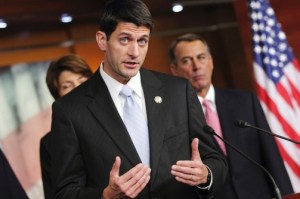
Ryan to Catholic Bishops: "Are you talking to me?"
On Tuesday I wrote a post about Paul Ryan’s claim that his Catholic faith informed his budget plan.
The Conference of Catholic Bishops responded to this outrageous claim by sending letters to every Congressional Committee affected by the Ryan Budget explaining that Catholic doctrine does not support starving children and elderly people to death in order to give tax cuts to rich people and buy more weapons of war for the Pentagon.
Today Paul Ryan responded to the Bishops’ criticism.
House Budget Committee Chairman Paul Ryan (R-WI) on Thursday dismissed criticism from the U.S. Conference of Catholic Bishops (USCCB), falsely claiming the group did not represent all Catholic bishops.
Referencing Matthew 25, the USCCB called on Congress to put the poor first in budget priorities and rethink cuts to programs that benefited the least among us.
“These are not all the Catholic bishops, and we just respectfully disagree,” he said on Fox News after being questioned about the bishops criticism of his budget plan.
Later the Bishops responded to Ryan’s statement by explaining to The Hill:
USCCB spokesman Don Clemmer told The Hill that the letters do represent all Catholic bishops, as they were penned by members of the church that were elected to represent the bishops on policy matters at the national level.
“Bishops who chair USCCB committees are elected by their fellow bishops to represent all of the U.S. bishops on key issues at the national level,” Clemmer said. “The letters on the budget were written by bishops serving in this capacity.”
Yesterday, fellow Catholic John Boehner weighed in in support of his budget hit-man:
“I want them to take a bigger look,” Boehner said at a Wednesday press conference. “And the bigger look is, if we don’t make decisions, these programs won’t exist, and then they’ll really have something to worry about.”
Hmmmm…that sounds like a threat.
Boehner, a Catholic, acknowledged that the bishops had a moral argument in pushing to preserve aspects of the budget that provide aid to the poor, but said if the United States can’t get its finances in order, those programs would be completely eliminated through a fiscal crisis.
“There won’t be these programs, and I don’t know how often some of us have to talk about the fact that you can’t spend $1.3 trillion more than what you bring in — that’s what’s going to happen this year, $5 trillion worth of debt over the last five years — and think that this can continue,” Boehner said.
It seems that the opinion of Conference of Catholic Bishops is to be respected on abortion and birth control, but not on economic and social justice issues. I guess Ryan and Boehner are only “cafeteria Catholics.” Just look how Ryan responded last year when a fellow Catholic offered him a Bible so he could read about Jesus’ teachings.
Not a Catholic, but apparently not wanting to look less of a soulless, evil skinflint than Ryan and Boehner, Eric Cantor suggested the solution to the country’s economic problems is raising taxes on the poorest of the poor.
The GOP has repeatedly made the claim that the poorest Americans need more “skin in the game.” Today, response to a question by ABC’s Jon Karl, Cantor made it clear that Republicans are interested in raising taxes on the poor while lowering tax rates for everyone else as part of any comprehensive tax reform plan:
CANTOR: We also know that over 45 percent of the people in this country don’t pay income taxes at all, and we have to question whether that’s fair. And should we broaden the base in a way that we can lower the rates for everybody that pays taxes. […]
KARL: Just wondering, what do you do about that? Are you saying we need to have a tax increase on the 45 percent who right now pay no federal income tax?
CANTOR: I’m saying that, just in a macro way of looking at it, you’ve got to discuss that issue. … How do you deal with a shrinking pie and number of people and entities that support the operations of government, and how do you go about continuing to milk them more, if that’s what some want to do, but preserve their ability to provide the growth engine? … I’ve never believed that you go raise taxes on those that have been successful that are paying in, taking away from them, so that you just hand out and give to someone else.
As Think Progress points out, most of the people who don’t pay income taxes are students, elderly people receiving lower amounts of social security, or people so desperately poor that they don’t earn enough to pay taxes. These people are, however, subject to many taxes, such as gas taxes, property taxes, and federal payroll taxes if they are working.
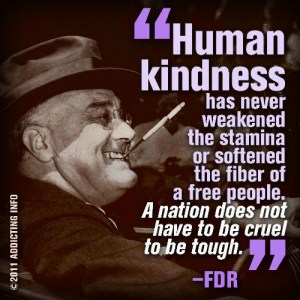
I wonder what FDR would say about all this?
Paul Ryan Claims Jesus Supported Small Government; Catholic Bishops Disagree
Posted: April 17, 2012 Filed under: hunger, poverty, religion, Republican politics, U.S. Economy, U.S. Politics, voodoo economics | Tags: Catholic Bishops, morality, Paul Ryan 10 Comments
Paul Ryan's God?
Yesterday, NPR’s Morning Edition reported on a “debate among Christians” about whether Jesus believed in helping the poor.
After the House passed its budget last month, liberal religious leaders said the Republican plan, which lowered taxes and cut services to the poor, was an affront to the Gospel — and particularly Jesus’ command to care for the poor.
Not so, says Wisconsin Republican Rep. Paul Ryan, who chairs the House Budget Committee. He told Christian Broadcasting Network last week that it was his Catholic faith that helped shape the budget plan. In his view, the Catholic principle of subsidiarity suggests the government should have little role in helping the poor.
“Through our civic organizations, through our churches, through our charities — through all of our different groups where we interact with people as a community — that’s how we advance the common good,” Ryan said.
The best thing that government can do, he said, is get out of the way.
Can you believe NPR’s religion reporter actually pretended there is a legitimate “debate” about this?
Today the Catholic Bishops indicated they think Jesus believed in helping actual living people–not just zygotes, embryos, and fetuses.
The Hill reports that the Bishops have so far sent letters to the House Agriculture and Ways and Means Committees and they also plan to send letters to other House committees as well, because they believe the budget “disproportionately cut[s] programs that ‘serve poor and vulnerable people.'”
The Bishops are particularly concerned about the budget’s draconian cuts in food stamps and child tax credits for immigrants–programs that help needy families stave off starvation. According to The Hill, the letters appear to be in response to recent comments made by Paul Ryan, who claims to be a Catholic.
“A person’s faith is central to how they conduct themselves in public and in private,” Ryan, the chairman of the House Budget Committee, told the Christian Broadcasting Network.
“So to me, using my Catholic faith, we call it the social magisterium, which is how do you apply the doctrine of your teaching into your everyday life as a lay person,” Ryan said.
Ryan made a moral case for his budget, saying that the government shouldn’t be responsible for lifting its citizens out of poverty — rather, that it’s the obligation of the citizens themselves to be society’s caretakers.
“Those principles are very, very important,” Ryan said. “And the preferential option for the poor, which is one of the primary tenants of Catholic social teaching, means don’t keep people poor, don’t make people dependent on government so that they stay stuck at their station in life, help people get out of poverty, out into a life of independence.”
Maybe Ryan should try reading the New Testament instead of Atlas Shrugged. Here’s one quote from Jesus:
Luke 6:20-21 Then he looked up at his disciples and said: ‘Blessed are you who are poor, for yours is the kingdom of God.
‘Blessed are you who are hungry now, for you will be filled. ‘Blessed are you who weep now, for you will laugh.
I couldn’t find any quotes from Jesus about small government and pulling yourself up by your own bootstraps. Anyone know any of those?
Saturday Reads: Dismal Science Edition
Posted: February 4, 2012 Filed under: Economy, income inequality, morning reads, poverty, unemployment, We are so F'd | Tags: Paul Krugman, social safety net, unemployment 62 Comments Good Morning!
I’m going to concentrate on the economy this morning. You better grab some coffee.
The unemployment rate dropped yesterday for a variety of reasons. I thought I’d talk a little about that first. The job growth was fairly strong this month in every sector but government. This improved the labor outlook for some of the workers hardest hit by the last recession. However, it was a mixed report–although you wouldn’t know that from the stock market–in that it still showed a number of people who are working part time that don’t want to be and again, a large number of people simply disappeared from the labor force. Temp jobs surged. Wage growth is “meager” as shown by graphs in this blog post by Tim Duy. He also notes that the employment to population ratio remains at a levels not seen since the early 1980s. This is an interesting situation. We’re still in a huge hole. At this growth rate, it will take us until 2019 just to gain back the jobs we had in 2008.
One interesting trend pointed out at Zero Hedge by Tyler Durden is that older workers are increasing the number of hours worked. There appears to be a basic shift in many of the ‘normal’ labor habits. Durden calculates an alternative measure to the unemployment rate by including workers that the BLS ignores. He uses the long-term average labor force participation rate instead of the number of people that are participating now which is shrinking in a very odd way.
… do the following calculation with us: using BLS data, the US civilian non-institutional population was 242,269 in January, an increase of 1.7 million month over month: apply the long-term average labor force participation rate of 65.8% to this number (because as chart 2 below shows, people are not retiring as the popular propaganda goes: in fact labor participation in those aged 55 and over has been soaring as more and more old people have to work overtime, forget retiring), and you get 159.4 million: that is what the real labor force should be. The BLS reported one? 154.4 million: a tiny 5 million difference. Then add these people who the BLS is purposefully ignoring yet who most
certainly are in dire need of labor and/or a job to the 12.758 million reported unemployed by the BLS and you get 17.776 million in real unemployed workers. What does this mean? That using just the BLS denominator in calculating the unemployed rate of 154.4 million, the real unemployment rate actually rose in January to 11.5%. Compare that with the BLS reported decline from 8.5% to 8.3%. It also means that the spread between the reported and implied unemployment rate just soared to a fresh 30 year high of 3.2%.
So, the deal is that the labor force participation rate is at a 30 year low. That’s still the number that puzzles and bothers me despite the good looking job growth. Why are people leaving the job market? As shown in Durden’s numbers, it’s not baby boomers. Here’s some speculation by Edward Harrison of Credit Write Downs who is concerned like me. Look at the graph on the right from Durden that shows why reason number three isn’t the explanation right now. The blue line is the participation rate by the older workers (55+) and as you can see it’s headed straight up.
My take on this: A declining labor force participation rate is a bad thing. It says people are dropping out of the labor force. So despite the bullish headline figure, the question still remains as to how robust the jobs market is.
Here are three things to consider:
- Cyclical: that’s the point I made above. Low participation is a negative signal.
- Structural: A lot of people have been pointing to long-term unemployment as a sign that the jobs market is weak. This makes sense and it should put downward pressure on the participation rate as people drop out of the labor force. The difference here is that if the problem is structural and not cyclical, the so-called output gap will continue to be large as throngs of people remain out of the labor force.
- Secular: The first cohorts of boomers started to retire last year. I know many people that were close to retirement when the recession began in 2007 that have had to change plans. Some have delayed retirement because of financial turmoil. But many others have accelerated retirement unwillingly because they were forced out of the labor force. Expect the loss of boomers to put downward pressure on the labor force for years to come.
My guess is that all three factors are affecting the labor force participation rate here. But I am beginning to think that the structural and secular forces are starting to predominate.
I’m still thinking that younger people may be holding up in school for awhile until things get better but I’d have to do some research to see if the university population is up. I also think that there’s the discouraged worker factor too. I actually know a lot of folks that are just hanging in there and cashing in their IRAs or have gone back to school and are living on student loans and or going back and forth between short term jobs and contract work. I guess we’ll see if the trend holds, but to me it’s a worrisome one. If things were really getting better, those folks should be entering the job market now driving the participation rate up. Since I’m a financial economist and not a labor economist, I really don’t know the flows well enough to speculate on anything beyond a theoretical level. It’s not my research area.
Thomas Fran has written an interesting post at Alternet on “Why We Got Ayn Rand Instead of FDR”.
An appropriate metaphor for the conservative revival is the classic switcheroo, with one fear replacing another, theoretical emergencies substituting for authentic ones, and a new villain shuffling onstage to absorb the brickbats meant for another. The conservative renaissance rewrites history according to the political demands of the moment, generates thick smokescreens of deliberate bewilderment, grabs for itself the nobility of the common toiler, and projects onto its rivals the arrogance of the aristocrat. Nor is this constant redirection of public ire a characteristic the movement developed as it went along; it was present at the creation. Indeed, redirection was the creation.
…
Here, in one sentence, was a key to the amazing success the Right would shortly enjoy. They had an answer to the bailout outrage, and it was not modulated by lawyerly subtleties or votes-taken-with-nose-held, like the House Democrats who had voted for the TARP. “Let the failures fail”: it was a line that would allow the revived Right to depict itself as an enemy of big business, rooting for the collapse of the megabanks. The Tea Partiers may have looked ridiculous in their costumes, but their central demand was anything but.
Not all “failure” is the same, however. What the newest Right has in mind is something philosophical, something both personal and sweeping. It demands liquidation across the board, a sort of deserved doomsday for the borrowing-based way of life. But in the great die-off it delights in imagining, the real culprits of 2008 have a way of disappearing from view.
If we watch closely, we can see the cards being switched. Whenever our tea-partying friends warm to the subject of letting-the-failures-fail—and they do so often—sooner or later they inevitably turn from the bailed-out banks to those spendthrift “neighbors” identified by Santelli, those dissolute people down the street who borrowed in order to live above their station.
This could be why the Republican Presidential Wannabes sound so down right Dickensian. We’ve had school children offered up as janitorial help. We’ve had Willard talking about enjoying a good firing and ranting on about how he’s not worried about the poor because they are safe in their safety nets. Instead of pointing to the business welfare queens, we’ve got poor children being held up as not having the fortitude and values. As Krugman says, Willard doesn’t feel any one’s pain.
Now, the truth is that the safety net does need repair. It provides a lot of help to the poor, but not enough. Medicaid, for example, provides essential health care to millions of unlucky citizens, children especially, but many people still fall through the cracks: among Americans with annual incomes under $25,000, more than a quarter — 28.7 percent — don’t have any kind of health insurance. And, no, they can’t make up for that lack of coverage by going to emergency rooms.
Similarly, food aid programs help a lot, but one in six Americans living below the poverty line suffers from “low food security.” This is officially defined as involving situations in which “food intake was reduced at times during the year because [households] had insufficient money or other resources for food” — in other words, hunger.
So we do need to strengthen our safety net. Mr. Romney, however, wants to make the safety net weaker instead.
Specifically, the candidate has endorsed Representative Paul Ryan’s plan for drastic cuts in federal spending — with almost two-thirds of the proposed spending cuts coming at the expense of low-income Americans. To the extent that Mr. Romney has differentiated his position from the Ryan plan, it is in the direction of even harsher cuts for the poor; his Medicaid proposal appears to involve a 40 percent reduction in financing compared with current law.
So Mr. Romney’s position seems to be that we need not worry about the poor thanks to programs that he insists, falsely, don’t actually help the needy, and which he intends, in any case, to destroy.
Still, I believe Mr. Romney when he says he isn’t concerned about the poor. What I don’t believe is his assertion that he’s equally unconcerned about the rich, who are “doing fine.” After all, if that’s what he really feels, why does he propose showering them with money?
The New York Review of Books has an entire list of economics books up that have to do with austerity and income inequality. The heading basically sums it up. We’re more unequal than you think. Here’s a review of two that I found particularly interesting.
Robert Frank’s The Darwin Economy and Thomas Edsall’s The Age of Austerity provide much-needed information and analysis to explain why so much of the nation’s money is flowing upward. Frank, an economist at Cornell, draws on social psychology to shatter many myths about competition and compensation. While he doesn’t explicitly cite the classical French economist Jean-Baptiste Say, much in his exposition echoes Say’s axiom that “supply creates demand.” This doesn’t mean that if items are put on display, people will automatically buy them. Consumers decide what or if they’ll purchase, and clearly can only do so if they have the credit or money. Even so, the items they decide they want have been created by the suppliers, who put things on the shelves.
Frank carries this a step further. In recent years, he argues, the products and enjoyments set before us have become increasingly enticing—including houses, vacations, television programs, video games, electronic devices, and the attractions of the Internet. In many cases, the rich acquire them first; since what they have and do becomes widely known, emulation descends down the line.
Nor are these just Tiffany trinkets. Frank’s most vivid examples are newly built houses. As the very rich installed grander entrance halls and rarely used bathrooms, the professional classes felt they should have a semblance of such amenities. “By 2007,” Frank writes, “the median new single-family house built in the United States had an area of more than 2,300 square feet, some 50 percent more than its counterpart from 1970.” Indeed, it’s revealing that this expansion was happening as people were having fewer children. However, these homes—along with more elaborate wardrobes, holidays, and technical gear—are costly. If they were to be bought, salaries needed to keep pace.
Hence, I would argue, an unstated but still real compact was made between the employers and the new upper-middle class. Their pay would be raised to support their ascending status. As the samplings in Table B show, while real earnings for the overall workforce have risen only 7 percent since 1985, professions like physicians and professors have done several times better. Incomes of lawyers and executives, for their part, have soared much further than anyone would have forecast a few decades ago.2
One of the reasons the poor do so poorly is that the states have tax structures that are very regressive. If you didn’t see me link to this down thread yesterday, take a look at how regressive state taxes really are. Kevin Drum includes a table where you can check on how bad your state treats you.
And then there are state taxes. Those include state income taxes, property taxes, sales taxes, and fees of various kinds. How progressive are state taxes?
Answer: They aren’t. The Corporation for Enterprise Development recently released a scorecard for all 50 states, and it has boatloads of useful information. That includes overall tax rates, where data from the Institute on Taxation and Economic Policy shows that in the median state (Mississippi, as it turns out) the poorest 20 percent pay twice the tax rate of the top 1 percent. In the worst states, the poorest 20 percent pay five to six times the rate of the richest 1 percent. Lucky duckies indeed. There’s not one single state with a tax system that’s progressive.
So, hopefully, you’re still awake! What’s on your reading and blogging list today.
Saturday Reads: South Carolina Primary Edition
Posted: January 21, 2012 Filed under: Mitt Romney, morning reads, Newt Gingrich, PLUB Pro-Life-Until-Birth, poverty, racism, Republican presidential politics, U.S. Politics | Tags: Daffy Duck, Mitt Romney, Newt Gingrich, Rick Santorum, South Carolina primary 33 Comments
You're despicable!
Good Morning! It’s Saturday, and tonight is the South Carolina primary and Sky Dancing will be following the results tonight. But I have cartoons on my mind. Last night I was watching Hardball, and there was a discussion of Newt Gingrich’s hissy fit at the beginning of the CNN South Carolina debate on Thursday night. Here’s the video:
Chris Matthews, Howard Fineman, and Eugene Robinson discussed Newt’s performance and decided that he hit all the right notes for South Carolina–anger at the media and the “elites,” a sense of being victimized by the power structure–and in fact may even beat Romney tonight. But the best part was when Eugene Robinson said when Newt said “despicable,” he (Robinson) couldn’t help thinking of Daffy Duck.
It’s such a perfect image for Newt’s self-righteous, overblown act. And it is an act, as far as I’m concerned. I loved the way he turned around the question about what he did to his ex-wife by talking about how *he* felt pain, not that he caused pain to his wife Marianne or anyone else. Here’s how I’ll forever think of Newt Gingrich from now on–as Daffy having a hissy fit.
And here’s what I’d like to say to Newt Gingrich:
Just one more …. What I’d like to do to Rick Santorum:
I know, I know, this is supposed to be a morning news post. So here are a few news and opinion links for you.
The latest polls suggest the South Carolina primary will be very close. The Clemson Palmetto poll has Gingrich in the lead.
“We expect a reaction by the electorate to the personal revelations about Gingrich to be registered on Saturday, however, we do not think it will be substantial enough to erase the lead Gingrich has over Romney,” said Clemson University political scientist Dave Woodard.
“Our head-to-head matchup of the candidates has consistently shown Mitt Romney competitive. The margin for Romney has evaporated this week, and we believe that Gingrich — who led our December poll with 38 percent to Romney’s 21 percent — will win the South Carolina primary,” he said.
Among poll respondents who had chosen or were leaning toward a candidate, this third Palmetto Poll showed Newt Gingrich (32 percent) leading the field over Mitt Romney (26 percent), up slightly from a month ago. Ron Paul came in third (11 percent), about even with his December poll rating. Rick Santorum remained in fourth place (9 percent), despite a significant jump over his ranking last month.
Wow! What an amazing turnaround for Daffy, I mean Newt. The NBC News Marist poll (PDF) showed the race tightening before the debate and even more so afterwards. And today’s Gallup tracking poll showed that Romney’s lead over Gingrich nationally has shrunk dramatically.
Mr. Romney’s position nationally as the front-runner appears to be weakening. In the latest release of Gallup’s tracking poll, conducted Sunday through Thursday, Mr. Romney leads Mr. Gingrich, 30 percent to 20 percent. Mr. Santorum and Mr. Paul are each supported by 13 percent.
At the start of the week, Mr. Romney had a 23-point advantage over Mr. Gingrich and Mr. Santorum. These results only partially reflect the events of the week, including the departure of Rick Perry on Thursday, the focus on Mr. Romney’s taxes, Mr. Gingrich’s two debate performances and the revelation that Mr. Santorum had apparently won the Iowa caucuses after all.
The NYT reports that Romney’s people are in shock over the sudden reversal of their fortunes.
With Mitt Romney facing the biggest challenge to his presidential aspirations since he announced his candidacy, his aides acknowledged Friday what seemed unthinkable just seven days ago: He could lose the South Carolina primary….
Having been stripped of his victory in Iowa on Thursday after a recount that gave the state to Rick Santorum, Mr. Romney now is in danger of being defeated in Saturday’s primary here by Newt Gingrich, who had been declared dead not once but twice in the past year, including less than two weeks ago when he finished fifth in New Hampshire. A new Clemson University poll of South Carolina voters released on Friday showed Mr. Gingrich with a six-point lead over Mr. Romney. It was within the survey’s margin of sampling error but captured a dynamic shifting in Mr. Gingrich’s favor.
At this stage of a primary election, campaigns work hard to manage expectations so they can put the best possible face on the actual voting results; Mr. Romney’s aides were no doubt being mindful of that as they spoke in relatively gloomy tones.
But, as Mr. Romney faced attacks from all sides, renewed questions about his own stumbles and whether he is conservative enough for the grass roots of his party, there was a real aura of apprehension coursing through his campaign. With his prospects of wrapping the race up quickly apparently diminished, Mr. Romney and his strategists began preparing his staff, his supporters and his financial bundlers for a longer and rougher march toward the nomination.
Boo hoo hoo. Poor Richie Rich! Karl Rove must be having a conniption fit. Honestly, I’d be worried if I thought the Republican insiders would ever give the nomination to Newt; but frankly, I’m still a lot more worried about Mitt winning it.
Charlie Pierce is down in SC right now. Let’s see what he has to say about all this.
It was always going to happen this way — Newt was going to go back into his wheelhouse, ripping the media and spouting in the general direction of the White House whatever pile of pejorative adjectives popped into his head at the moment. He tried, lamely, to be a statesman, and the party faithful ignored him. Once he became the vandal he was born to be, the political arsonist among the abandoned tenements of Republican thought, he was bound to take off again. The base doesn’t want someone whose ideas on job creation will triumph because they are superior to the president’s. They want somebody who can beat him bloody, vicariously, on their behalf, somebody who can “put him in his place.” They want someone who will kill the administration just for the sheer fun of watching it die. That’s why Newt’s fortunes took off after he slapped around Juan Williams on Monday night, and that’s why they went into hyper-drive on Thursday when he declared to be “despicable” any public mention of the chronic staff-banging that wrecked his second marriage and that helped wreck his speakership. Sooner or later, he was going to light the whole race on fire just to giggle over the flames, and that meant he had to come do it in South Carolina, and that meant he had to come do it in the upcountry around Greenville, where the base of the base always has been located, where people can be found who will gleefully join him around the bonfire, where is located the ancient home office of American treason.
“Look,” says Kellen Giuda, the young National Coalitions Director for the Gingrich campaign, waving his hand over a map of the state that hangs on the wall not far from The Cold War Room, “this area down here in the South, this was always more moderate. This is where McCain won last time. Up here, around Greenville, that’s always been the more conservative area. This time, people concentrated their effort down there near Charleston, because they wanted to get that whole military vote down there locked up. But, now, they’re starting to see that this is the place where the conservative vote really come from.” The endorsements are coming thick and fast now — Rick Perry! Michael Reagan! One-hundred Tea Party leaders from around the country! — and they are settling on Newt, and not on Rick Santorum, because Santorum, while admittedly a dick, is not an angry bully of a dick, and that’s what the base is looking for. In fact, the Gingrich campaign tore up its schedule on Friday, and will now have the candidate working the upcountry districts around Greenville hard all primary day.
“An angry bully of a dick.” Just what we need in the White House.
This is interesting: Catholic Leaders Challenge Gingrich and Santorum on Divisive Rhetoric Around Race and Poverty
More than 40 national Catholic leaders and prominent theologians at universities across the country released a strongly worded open letter today urging “our fellow Catholics Newt Gingrich and Rick Santorum to stop perpetuating ugly racial stereotypes on the campaign trail.”
In the lead up to Saturday’s primary in South Carolina, Newt Gingrich has frequently blasted President Obama as a “food stamp president” and implied that some African Americans are more content to collect welfare benefits than work. Rick Santorum attracted scrutiny for telling Iowa voters he doesn’t want “to make black people’s lives better by giving them somebody else’s money.”
The open letter reminds the two presidential candidates, vying for Christian conservative voters, that U.S. Catholic bishops have called racism an “intrinsic evil” and consistently defend vital government programs such as food stamps and unemployment benefits that help struggling Americans.
The full text of the letter is at the above link. Let’s face it, both Santorum and Gingrich are just cafeteria Catholics. They go along with the Church on abortion, birth control, and other anti-woman positions; but when it comes to war, capital punishment, and caring for the poor and downtrodden, they go their own way.
Speaking of Santorum, Politico reported on his SC closing argument: “values.”
The former Pennsylvania senator retreated to comfortable territory, the conservative Upstate region of South Carolina, to speak to huge crowds about values and cement his base on the eve of the state’s primary.
“It’s decision time as to what South Carolina is going to communicate to the rest of the country,” he told the crowd at a packed town hall meeting in Boiling Springs.”What is the Upstate going to say? Who are they going to stand behind? What message are they going to send to country as to who the conservative standard-bearer will be?”
“It’ll be you, Rick!” audience members shouted, applauding.
Polls show that tomorrow’s race here is really between Mitt Romney and Newt Gingrich: Santorum is competing for third place with Ron Paul. But the former Pennsylvania senator has vowed to continue his campaign to Florida, which votes Jan. 31. A strong performance in the conservative bastions of South Carolina can propel his argument that he is the real conservative in the race.
I know Santorum has no shot to win the nomination this year, but my guess is he’ll be back in 2016. I think he’s very dangerous to democracy, and IMHO we need to keep an eye on him. As for Ron Paul, I’m boycotting him in this post.
That’s all I’ve got. What are you reading and blogging about today?
Light Bulbs Saved But American Light Diminished
Posted: December 18, 2011 Filed under: abortion rights, Bailout Blues, Banksters, corruption, Economy, fetus fetishists, fundamentalist Christians, globalization, poverty, U.S. Economy, unemployment, Women's Rights | Tags: Financial Crisis, U.S. Economy, unemployment, Women's Rights 9 Comments
We can no longer call Congress a do-nothing farce. In case you haven’t heard our esteemed legislators have ‘saved’ the incandescent light bulb from its 2012 banishment. Which means incandescent hoarders can display their beloved bulbs in public, display them with pride and patriotism—let freedom shine–without the fear of neighborly condemnation or the riot police knocking down the door.
Let there be light!
If only.
Other things we might have considered saving in 2011:
The Middle Class; Death by Strangulation
This week we were gifted with the sobering statistic that 50% of the American public is now considered ‘low income.’ Of course, the naysayers are quick to point out that this is a gross exaggeration, that terms like ‘low-income’ and ‘poverty’ are relative terms. Go to Africa, they say. Perhaps, Haiti would do. Or North Korea. Then you’ll know the ‘real’ meaning of misery.
Sorry but this strained logic belies the fact that unlike the above examples the United States of America is a developed world power. We beat our chests and claim ‘exceptionalism’ on the world stage yet are willing to use third world comparisons to shrug off bad news? Lame comparisons are simply an exercise in don’t believe your lying eyes and for God’s sake never distrust the status quo. What are you? Some sort of Commie!
A small factoid from the St. Louis Federal Reserve, Economic Research group: the average length of unemployment in the United States is now over 40 weeks. And another from the New America Foundation:
The share of middle-income jobs in the United States has fallen from 52% in 1980 to 42% in 2010.
Middle income jobs have been replaced by low-income jobs, which now make up 41% of the work force.
The American Economy; Bleeding Out While Doctors Look On
While average citizens lost wealth and continue to struggle with unemployment and underemployment, face prospects of social programs stripped down to nothing, we’ve been gifted once again with startling news. The Federal Reserve over a three-year period bailed out large banks and corporations, domestic and foreign, to the tune of 29 trillion dollars.
Twenty-nine trillion! To put this in some perspective one trillion dollars could be imagined thusly:
If you were to count to one thousand, one number every second, it would take seventeen minutes. Counting to one million at the same rate would take twelve days (counting nonstop, btw, day and night). Counting to one billion would take thirty-two years.
Now, drum roll please: Counting to one trillion? Would take 32,000 years.
Then multiply by 29.
Meanwhile, with the money spigots wide open spewing a gusher of magic money, small business loans [the sort that Main Street depends on to fuel growth and employment, loans of 1 million or less] dropped to a 12-year low. Why is this a problem? Because despite the GOP’s drone that the top 1% of the population are the ‘job creators,’ businesses with fewer than 500 employees created 65 percent of the jobs between 1993 and 2009, according to the Small Business Administration.
Another withering fact: between 2001 to 2009, 42,000+ factories and manufacturing-related businesses closed for good. And, of course, the jobs associated with those companies went bye-bye, moved off-shore to exploit lower wages and the nefarious environmental regulations that vulture capitalists love to hate.
In addition, our trade deficits with China [84 billion in 2001 to 278 billion in 2010] and other countries [oil imports represent over 60% of our current deficit] have bled and continue to bleed jobs and wealth from the US. Trade deficits represent a countries’ imbalance in terms of importing to exporting and the rate at which a nation’s wealth is transferred into foreign markets. As a country, we’re being bled to death, according to the AAM.
The impact of the trade deficit with China extends beyond U.S. jobs lost or displaced, according to the Alliance for American Manufacturing (AAM). Competition with China and countries like it has resulted in lower wages and less bargaining power for U.S. workers in manufacturing and for all workers with less than a four-year college degree.
And yet the trade deficits go on unabated. A recent example was the passage of the trade deals with Panama, Columbia and S. Korea, heralded as a great deal for the United States. But according to Dylan Ratigan, MSNBC:
The key question we have to face as a country is how we want to govern ourselves. From World War II until NAFTA, our trading policies were based on geopolitical needs and what would increase prosperity for America. Since NAFTA, however, the mantra of free trade has been warped to generate rights for international capital and nothing else. The agreements Congress and the President are pushing continue this unfortunate trend. What unfettered capital wants is to avoid taxes, regulations, or any state power whatsoever.
In regards to oil imports, the drumbeat for several years has been: Drill, Baby, Drill. It’s all about jobs and keeping America strong, our oil-financed legislators are likely to say. The problem is regulation, they’ll add, and big government working against the blessings of the free market. Really? Not so, says Dylan Ratigan.
We do not have a free market for energy, because the actual cost of fossil fuel in our economy is not reflected at the pump; the military’s not in there, the environment’s not in there, and there’s a wide variety of differing fuel subsidies and tax treatments for all sorts of different fuel sources depending on their relation with our government. So, how can a marketplace decide the fuel source, when one fuel, particularly being gasoline and fossil fuels, have such a substantial comparative subsidy?”
The answer is: the marketplace cannot decide the cost of fossil fuel or entertain the cost-effectiveness of alternative sources because the game is rigged as it has been for a century+ where fossil fuels rule the day, pay off politicians and are willing to drive us into economic and environmental ruin for the sake of profit and power.
Vulture Capitalism writ large.
The American Homeowner; Death by Drowning
In the second quarter of 2011, 10.9 million Americans or 22.5% of homeowners were ‘underwater’ with their mortgages, namely they owed more on their mortgages than their houses were actually worth, a result of the real estate collapse of 2007-2008. Although the Home Affordable Refinance Program [HARP] has fallen short to relieve homeowners from onerous, often ballooning mortgage payments and subsequent home foreclosure, the Obama Administration has attempted to remove the key barriers in the refinancing procedures. This is expected to expand mortgage refi at today’s lower interest rate to larger numbers of struggling homeowners, particularly those with little to no equity in their homes.
Will it work?
The jury is still out, but at best this expanded program will only be available to Fannie Mae and Freddie Mac-backed loans.
In addition to providing relief, many citizens expected a thorough and public investigation into exactly what went wrong in the mortgage industry. We expected our own Pecora moment.
But that didn’t happen.
In fact the Administration has attempted to rush through settlements with major banks, requiring no admission of wrong doing and attaching immunity from civil or criminal liability to sweeten the deal. Countering this, several state Attorney Generals [five to date] have refused to accept the 50-state agreement and have proceeded with independent investigations of their own. And just this past week, House Representative Tammy Baldwin [D-WI] introduced a resolution to block any agreement on the national foreclosure question, without proper and thorough investigation. Immunity from civil and/or criminal liability would be stripped and fraudulent practices prosecuted fully under the Rule of Law.
But still, for the 22.5% of American homeowners, the water level is already chin-high and rising fast.
Civil Liberties; Gutting of the Bill of Rights
Perhaps no other images brought home the dwindling nature of American civil liberties than the recent round up of Occupy Wall Street protesters. We’ve watched young women pepper-sprayed, protesters manhandled and in one instance a young Iraqi veteran nearly killed by police who appeared ready for WWIII rather than crowd dispersal. On several occasions over-zealous police action was caught on film not by the press but by protesters and onlookers.
In addition, we now know that drones developed for war applications have been deployed in country and that drone use is being marketed to police departments throughout the country. Security is big business.
 Obviously, the First Amendment’s guarantee to peaceable assembly is not. And privacy? Forget about it!
Add this to the Administration’s successful kill order on extremist cleric Anwar al-Awlaki, an American citizen operating in Yemen, a kill order without benefit of due process. Otherwise known as execution without trial. We can argue about the threat of the man but there is no argument about the danger of precedent and the shredding of the Rule of Law. And so, should we be surprised by the most recent outrage, the passage of an indefinite detention authority tucked inside the 2012 National Defense Authorization Act? The bill codifies the right of the President to order the arrest and indefinite detention of US citizens suspected of terrorism. No trial, no appeal. You can now be ‘disappeared,’ lawfully.
One fight that did end well [at least temporarily] was the controversial and previously reported Stop Online Piracy Act [SOPA]. The discussions between legislators were abruptly adjourned after stiff condemnation by online biggies Google, Wikipedia and even computer scientist Vint Cerf , one of the founders of the Internet, who claimed that the bill’s passage would begin “a worldwide arms race of unprecedented censorship of the Web.”
Rights of Women; Assaults Continue
In the contradictory world of Far Right extremists, where individual liberty is celebrated and government intrusion condemned, the individual 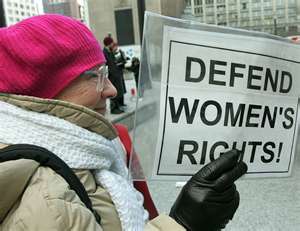 rights of women and their reproductive decisions are the lone exception. Family planning, contraception, abortion, even ordinary ob/gyn screenings are suspect and thereby targets of defunding and all manner of attack. Bills have littered the landscape calling for the elimination of all abortive measures, even when a woman’s life and/or future fertility is in jeopardy. The heartbeat of the unborn is made sacred, while the lives of the fully realized female is continually denigrated, dismissed and derided. Personhood resolutions have been raised in referendums [and thankfully voted down], where the fertilized egg would be designated as a person with full legal rights under the law.
Fertilized eggs and corporations. Perfect together.
The insanity of these rigid, ridiculous demands from zealots are all too real and dangerous when applied to the actual world. Miscarriage, for instance, a completely normal biological occurrence, would take on the aura of a criminal act, requiring an investigation. By the egg or zygote police, I imagine. Or a woman who suffers an ectopic pregnancy could be left to bleed until doctors were convinced of the unborn ‘person’s’ lack of viability. The woman’s health is secondary in this scenario.
The personhood resolutions would also deny women certain contraceptive measures. For instance, the day after pill would be in violation. And, in fact, Health and Human Services’ recently overruled the FDA’s recommendation on Plan B for young women under the age of 18 and refused to lift the emergency contraception’s restriction.
The assault on women’s rights have been unrelenting, not only in terms of reproductive decisions but in basic health services. Planned Parenthood and their related clinics and facilities provide services to many poor to middle income women, offering important medical screenings, tests for cancer, diabetes, high-blood pressure, etc. Only 3% of what Planned Parenthood does is related to abortion services. And yet, the 90-year organization has become the Boogie Man for right-wing fundamentalists, who would deny many women the only health provider they have.
Sorry, the barefoot and pregnant dictum has no place in the 21st Century.
Our Children; Gross Neglect of Our Most Important Resource
A higher percentage of children today are living in poverty than was the case in 1975. The rate of poverty has increased every year for the last four years, from 16.9 percent to nearly 22 percent as of 2010. In the UK and France that number is under 10%. The 2011 Child Well Being Index indicates that it is American children, the country’s future, who will bear the greatest damage by widening income disparities and proposed cuts to education, food stamps and health insurance programs.
Some sobering factoids:
Child homelessness has risen 33% in the last 3 years to 1.6 million
There are over eight million children in the United States today that are not covered by health insurance.
Today, one out of every seven Americans is on food stamps and one out of every four American children is on food stamps.
Nearly 20 million children participate in school lunch programs.
This is not what Democracy looks like.
The Poor, the Immigrant and/or Muslims; The Inadequacies of Scapegoating
Scapegoating has a long history, even Biblical references, where a goat is used as a vessel of purification. The sins of the community are spiritually transferred to the animal after which Mr. Goat is banished to the wilderness.
Out of sight, out of mind.
 In times of social unrest and/or economic distress, the act of scapegoating is often employed as a distraction, a way of diverting the public’s attention from the real problems and their causes . . . to something or someone else. Scapegoating has been popular of late.
It’s the fault of the poor, the hangers on, the moochers. Michelle Bachmann quoted Paul the Apostle:
“He who does not work, neither shall he eat.”
That would imply the poor are merely shirkers, those expecting a free lunch. Tell that to the one in four children surviving on food stamps. If Newt Gingrich and his ilk are to be taken seriously, the problem can be solved by revoking Child Labor Laws or having school children take on the school’s janitorial services.
Better yet, cut all safety nets.
Immigrants, too, have been cast as the country’s main economic problem. Too many Latinos taking away American jobs. We’ve all heard it. Only the number of illegal immigrants entering the country has been shrinking dramatically since the Great Slump, the biggest population decline in the last 20 years.
Unemployment, however, is still with us.
With the immigrant bashing, deportation and subsequent population shrinkage, Georgia and several other states had a difficult time harvesting their crop this year without their standard work force in place.
Be careful what you wish for.
Since 9/11, Muslims have been targeted as the root of all our problems, basically an evil agent working to undermine the country . Anti-Muslim sentiment has risen with irrational fears over Sharia Law dominating, perhaps even replacing the American Constitution. Last week, hardware giant Lowe’s pulled ads from a reality show, ‘All American Muslim,’ in response to a conservative Christian group, that contended:
Clearly this program is attempting to manipulate Americans into ignoring the threat of jihad and to influence them to believe that being concerned about the jihad threat would somehow victimize these nice people in this show . . .
It’s disturbing to read something that ugly. And it created a huge PR stink for Lowe’s, rightfully so.
Also important to note is that Muslim Americans represent approximately 6 million citizens, a quarter of whom are African American converts. In a country of 311 million? That’s a tiny, tiny percentage.
And on 9/11? People of all faiths died, including Muslims.
Pointing fingers in all the wrong directions will not cure the country’s financial crisis, anymore than wishing for quick, easy solutions. Saving what’s best about our country–our religious tolerance—is far more important.
There were many things worth saving in 2011. But hey, at least we rescued the American incandescent light bulb.
I feel so much better. How about you?

 peej
peej Carissa
 bostonboomer
 dakinikat
 ecocatwoman
 mablue2
 Mama Lopez
 peggysue22
 quixote
 skydancingguestblogger
 Mona (aka Wonk the Vote)



 Sky Dancing
Recent Comments