
TGIFriday Reads
Posted: October 7, 2011 Filed under: Afghanistan, Foreign Affairs, Global Financial Crisis, morning reads, New Orleans, Women's Rights | Tags: Afghanistan, due process, executive order, Gender bias in Austrailia, General McChyrstal, global financial meltdown, kill list, Occupy New Orleans 18 Comments Good Morning!
Wow! It’s Friday! The week has sort’ve whizzed by for me and I have to admit to feeling like the days are blending together. The weather is great down here right now. October in New Orleans is usually a nice blend of perfect weather and no real surge in tourists so that’s a good change. We had an Occupy New Orleans march–I didn’t make it–that seemed well attended and non-eventful. I had a lot of friends that showed up and they took a lot of pictures. I think we all should try to share the events in our individual cities if we get a chance. I’m really hoping this movement doesn’t get captured by the political establishment.
Taking its cues from the New York protest, Occupy New Orleans makes all its decisions through “general assembly,” a series of votes that aims to reflect the views of everyone involved. The process can be lengthy — simply selecting the march’s route took three hours for the group of about 100 to decide.
That’s one reason the group has not made a list of concrete goals, though it intends to in the upcoming weeks, said participant Michael Martin, 25. The movement also has no leader or spokesperson — each member is allowed one vote. The resultant lack of a coherent message has drawn skepticism even from would-be sympathizers.
Organizers of the New Orleans protest say they expect hundreds to participate; the group has more than 1,000 followers on Twitter and more than 4,100 fans on Facebook. The group received permits Wednesday allowing them to march, according to New Orleans Police Department spokeswoman Remi Braden.
In light of 700 protestors’ arrests in New York City on Saturday, Occupy New Orleans held a training session for legal observers Tuesday that drew 20 people, mainly law students.
We really need to have a huge conversation about the idea that a “secret panel” can put an American citizen on a kill list without actual due process in the courts. Here’s a start at that discussion from Reuters.
There is no public record of the operations or decisions of the panel, which is a subset of the White House’s National Security Council, several current and former officials said. Neither is there any law establishing its existence or setting out the rules by which it is supposed to operate.
The panel was behind the decision to add Awlaki, a U.S.-born militant preacher with alleged al Qaeda connections, to the target list. He was killed by a CIA drone strike in Yemen late last month.
The role of the president in ordering or ratifying a decision to target a citizen is fuzzy. White House spokesman Tommy Vietor declined to discuss anything about the process.
Current and former officials said that to the best of their knowledge, Awlaki, who the White House said was a key figure in al Qaeda in the Arabian Peninsula, al Qaeda’s Yemen-based affiliate, had been the only American put on a government list targeting people for capture or death due to their alleged involvement with militants.
The White House is portraying the killing of Awlaki as a demonstration of President Barack Obama’s toughness toward militants who threaten the United States. But the process that led to Awlaki’s killing has drawn fierce criticism from both the political left and right.
In an ironic turn, Obama, who ran for president denouncing predecessor George W. Bush’s expansive use of executive power in his “war on terrorism,” is being attacked in some quarters for using similar tactics. They include secret legal justifications and undisclosed intelligence assessments.
Yeah, that’s the word I’m thinking …. ironic… not!! I am very much attuned to the situation in Europe. The banks have pretty much done it to us again and it looks like there will be more bail outs coming. There’s a lot of talk that it could be worse than 2007-2008. Here’s ZeroHedge’s take on a BBC insider interview with an IMF advisor that says: “In The Absence Of A Credible Plan We Will Have A Global Financial Meltdown In Two To Three Weeks”. The interview is posted there if you’re more curious.
A week after the BBC exploded Alessio Rastani to the stage, it has just done it all over again. In an interview with IMF advisor Robert Shapiro, the bailout expert has pretty much said what, once again, is on everyone’s mind: “If they can not address [the financial crisis] in a credible way I believe within perhaps 2 to 3 weeks we will have a meltdown in sovereign debt which will produce a meltdown across the European banking system. We are not just talking about a relatively small Belgian bank, we are talking about the largest banks in the world, the largest banks in Germany, the largest banks in France, that will spread to the United Kingdom, it will spread everywhere because the global financial system is so interconnected. All those banks are counterparties to every significant bank in the United States, and in Britain, and in Japan, and around the world. This would be a crisis that would be in my view more serious than the crisis in 2008…. What we don’t know the state of credit default swaps held by banks against sovereign debt and against European banks, nor do we know the state of CDS held by British banks, nor are we certain of how certain the exposure of British banks is to the Ireland sovereign debt problems.”
But no, Morgan Stanley does, or so they swear an unlimited number of times each day. And they say not to worry about anything because, you see, it is not like they have any upside in telling anyone the truth. Which is why for everyone hung up on the latest rumor of a plan about a plan about a plan spread by a newspaper whose very viability is tied in with that of the banks that pay for its advertising revenue, we have one thing to ask: “show us the actual plan please.” Because it is easy to say “recapitalize” this, and “bad bank” that. In practice, it is next to impossible. So yes, ladies and gentlemen, enjoy this brief relief rally driven by the fact that China is offline for the week and that the persistent source of overnight selling on Chinese “hard/crash landing” concerns has been gone simply due to an extended national holiday. Well, that holiday is coming to an end.
Some of the weaker Spanish banks have been nationalized. It will be very interesting to see what comes out of this.

Austrailia's Status of Women Minister, Kate Ellis
Australia’s Status of Women Minister, Kate Ellis says that “mindless bias” holds women back in her country. She’s been making the rounds arguing about a report that shows that gender differences in salary and position cannot be explained away by either occupational choices or other factors. Can you imagine Valerie Jarret holding US corporations to account for not promoting and hiring women? Oh, wait, the Prime Minister’s name is Julia … hmmmmm.
”We are saying very clearly to corporate Australia, we want to work in partnership with you to change this – and it’s an offer that I hope corporate Australia will take that up and we don’t have to take that conversation any further.”
Asked yesterday about the portrayal of women in the media, Ms Ellis said there was sometimes unequal treatment ”handed out”, and said the treatment of the Prime Minister, Julia Gillard, was ”a case study before our eyes”.
”I think there’s a really interesting issue, where often I will be encouraging people where if you see unfair treatment, if you see discrimination you should stand up and call it out for what it is,” she said.
”In politics, there’s often the opposite pressure, where if you do that constantly it looks like female politicians are whingeing and they’re not tough enough to handle the environment.”
She said her office was collating examples of the media dealing with gender issues in ways that were not ”acceptable”.
According to the government’s latest census of women in leadership, last year females made up just 8.4 per cent of directors and 8 per cent of executive managers in ASX200 companies.
The report calls for companies to adopt a range of reforms, including making their workplaces more flexible and setting targets for gender diversity.
The Guardian has a killer interview up with retired US General McChrystal who says the US is only about 1/2 done with the war in Afghanistan. That means 10 more years if he’s right.
The US began the war in Afghanistan with a “frighteningly simplistic” view of the country and even 10 years later lacks the knowledge that could help bring the conflict to a successful end, a former top commander has said.
Retired US army general Stanley McChrystal said in remarks at the Council on Foreign Relations that the US and its Nato allies were only “a little better than” 50% of the way to reaching their war goals.
Of the remaining tasks to be accomplished, he said, the most difficult may be to create a legitimate government that ordinary Afghans could believe in and that could serve as a counterweight to the Taliban.
McChrystal, who commanded coalition forces in 2009-10 and was forced to resign in a flap over a magazine article, said the US entered Afghanistan in October 2001 with too little knowledge of Afghan culture.
“We didn’t know enough and we still don’t know enough,” he said. “Most of us, me included, had a very superficial understanding of the situation and history, and we had a frighteningly simplistic view of recent history, the last 50 years.”
US forces did not know the country’s languages and did not make “an effective effort” to learn them, he said.
McChrystal said the Bush administration’s decision to invade Iraq less than two years after entering Afghanistan made the Afghan effort more difficult.
Well, that’s some depressing things to think about which is about what’s on my mind today. What’s on your reading and blogging list?
When Free Speech Turns Ugly
Posted: September 29, 2011 Filed under: New Orleans | Tags: hate speech, Obama sign in Uptown 38 Comments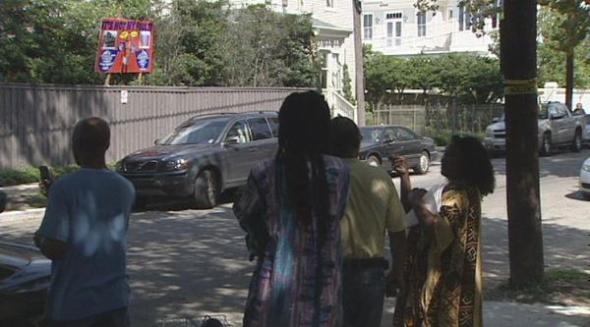 I was rather shocked this morning to read about a series of signs portraying the president as a crying baby with text balloons reading “Change me. I stink”, as a puppet of George Soros, and a Dunce in uptown New Orleans. I am always amazed when political disagreement turns ugly. I’m not going to print the offensive signs here because they’re a real test of our right to free speech. I wish people were as equally respectful of civility as some of us are of free speech rights.
Like the man or not, Barrack Obama is our president. We all have a compelling interest in disagreeing with his policies and the manner in which he carries out his elected office. However, the man is the President of our country and the office deserves respect. As much as I didn’t like George Bush and could poke fun of him and complain about him with the best of them, I would still curl my lip at things like watching him being hung or burnt in effigy. The Presidency is an important symbol of our country. We have an elected leader not a despot. I felt the same way when then Governor Quitteralla was hung in effigy in a front of a California home as a “Halloween” prank. You don’t have to like an elected leader, but there’s a way to disagree with them without resorting to displays of hate. There’s a place where free speech turns into hate speech and while it’s legal under our constitution, it’s should be called out for what it is.
“It disrespects the nation — and President Barack Obama represents our nation,” said Skip Alexander, as he looked at one of the signs. “He represents everybody, not some people.”
Dozens of protesters came by the house in the 1500 block of Calhoun throughout the day, demanding the sign come down.
“He wouldn’t do that to [President] Bush, I’m sure. It’s just insulting. It’s insulting,” said C.C. Campbell-Rock. “He’s going to have to take them down.”
“This is nothing put pure racism,” said Raymond Rock. “This is a disgrace.”
The home is owned by Timothy Reily, who declined to be interviewed about the signs. Former Mayor Ray Nagin showed up at the house and went inside to speak with Reily. He emerged later and would not comment on what they discussed.
Some neighbors tell Eyewitness News that Reily has been putting the signs up for months. Some of the protesters learned about the signs through a local radio station on Wednesday morning.
“He can put up a sign if he wants to. It doesn’t bother me,” said Harold Gagnet, a neighbor.
“I think it’s fine. It’s on his property,” said Katherine deMontluzin. “He can say whatever he wants.”
The signs have created such a firestorm of controversy, though, that police came to the scene– called in by City Council Member Susan Guidry. She represents the district where the home is located. Guidry said she was concerned about public safety and was trying to figure out if the sign was even legal. She also said she spoke to Reily, but didn’t get far.
You can watch the news reports and see the signs at the link above. The sign contains pretty much all the usual right wing hack memes like Obama is a Socialist. Did I mention that this is the wealthy side of town and there’s all kinds of diatribes up there on taxing millionaires too? My guess is that this guy is Teabot. I remember them waving signs about portraying Obama as a witch doctor when Dolecare got enacted. The city is trying to search through its zoning laws to figure out a way to take the bill boards down after trying to speak to the homeowner failed. The man definitely does have a right to his opinion, he has a right to express it, but aren’t there less hateful ways to do it? I frankly would be frightened to have a person like this living next to me. If he’s got that much anger towards a politician, you just never know what he’d do if an easy target showed up.
Rising Tide 6: Blogging Live
Posted: August 27, 2011 Filed under: Live, New Orleans | Tags: hurricane katrina, Rising Tide 6 66 Comments Good Morning!
While all of you on the east coast are dealing with Irene, those of us in New Orleans that lived through Katrina are still dealing with the aftermath. This is the sixth annual conference of social activists and bloggers in New Orleans–called Rising Tide– who are still trying to see New Orleans recover and become all the promise the city holds. We’re at Xavier University and if you want to follow along with any of the sessions, there’s a webcast here. It’s much bigger this year which is really good to see.
I’m listening to the morning keynote speaker:
Tulane University geographer Richard Campanella is the author of six critically acclaimed books on the physical and human geography of New Orleans, including “Bienville’s Dilemma,” “Geographies of New Orleans,” and “Lincoln in New Orleans.” The only two-time winner of the Louisiana Endowment for the Humanities Book of the Year award, Rich has also received the Williams Prize for Louisiana History and the Mortar Board Award for Excellence in Teaching from Tulane University.
We’re up to around the civil war when Lincoln used to refer to us as the sugar coast. It’s interesting to hear the history of the city from the first settlement forward and how our neighborhoods or ‘fauborgs’ have come about.
So, I’ll be updating this now and then today. I’d really suggest you tune in later this afternoon to the webcast because there will be two fun sessions on the live webcast. One will be on New Orleans Food and cooking and two great chefs will be speaking on the panel. The other one is a panel on brass bands followed by a concert. I’m hoping to network with some of my twitter buddies and fellow social justice advocates!
So, if you hang around, I promise you’ll feel like you’re part of making the Big Easy’s future grand!
Tuesday Reads
Posted: August 23, 2011 Filed under: Domestic Policy, income inequality, jobs, morning reads, New Orleans, Regulation, the blogosphere | Tags: Charges dropped against DSK, Dogs identify early stage lung cancer, FCC kills the Fairness Doctrine, Hurricane Katrina anniversary, jobless recovery, New Orleans, Rising Tide 6 31 Comments Good Morning!
I’ll be attending Rising Tide 6 at Xavier on Saturday morning and will try to live blog as many of the seminars I’ll be attending as possible. Last year, I enjoyed the politics and criminal justice panels best. This year, there will be two session running simultaneously including some technical stuff on blogging and fun stuff on brass bands, food, and the HBO series Treme. The conference is a way for activists and bloggers in New Orleans to continue to see that New Orleans makes some progress post-Katrina and that information gets out to the public. Conference attendance has been growing each year.
Alright, so I choose the cute dog picture for a reason. Turns out they are some of our best friends and diagnosticians!! Check this headline out from Forbes: How Dogs Beat Doctors in Identifying Early-Stage Lung Cancer.
A new study in the European Respitory Journal shows that dogs are better at sniffing out the early markers of lung cancer than the latest medical technologies at our disposal. Lung cancer is the second most frequent form of cancer in men and women across the United States and Europe, accounting for approximately 500,000 deaths per year.
Part of the reason for the high mortality rate is that lung cancer is notoriously difficult to identify early. In many cases, the patient doesn’t show any symptoms and detection of the disease happens by chance. If someone isn’t that lucky, the cancer is likely to have already progressed by the time it is found.
The study investigated whether dogs could be trained to reliably identify specific volatile organic compounds (VOCs) that are linked to the presence of lung cancer. The latest medical methods for identifying lung cancer VOCs are generally unreliable because there is a high risk of interference in the results, especially from the residuals of tobacco smoke, and the results can take a long time to process.
Trained dogs were asked to sniff out a study group that included lung cancer patients, chronic obstructive pulmonary disease (COPD) patients, and healthy volunteers. The dogs successfully identified 71 samples of lung cancer out of a possible 100. They also correctly detected 372 samples that did not have lung cancer out of a possible 400 – a 93% success rate.
As impressive, the dogs were able to detect lung cancer markers independently from COPD and tobacco smoke – showing that Fido, unlike our latest technologies, can separate out lung cancer markers from the most confounding variables.
My friend Michelle swears that my late golden lab, Honey, saved her life. Honey kept jumping on her and putting her paws up on her breast until one day, her breast implant popped. We soon discovered it was leaking and she went to the doctor who discovered a tumor underneath the implant. Honey had some other amazing tricks too. She had an uncanny sense of who were criminals and cornered two of them when we lived in the quarter. I’d frequently walk Karma and Honey down to Pirate’s Alley after my gigs to rest and have a bit of wine with friends. Kids and tourists use to pet her, feed her, and roll all over her all the time. She was like a big stuffed toy. Only twice did I here her growl and found out she was nothing to be messed with. Both times she pushed young gutter punks up against the Cathedral until the security guard came around the corner to figure out why she was barking. Both of them were were wanted by the police. One had been stealing tip jars from the local street entertainers and the other was wanted for grabbing plates of food from tourists dining on the street. After that, Honey became one spoiled dog.  Every time she would walk by the galleries or restaurants all the business owners would see her, come out, and give her treats. The restaurant in Pirate’s alley always kept a big serving of pate for her. Honey died suddenly about 8 months after Katrina from a brain aneurysm. She was one heckuva dog. Karma and I miss her lots!! She was blind in one eye as you can see from her picture there to the right.
Politico reports that the FCC has finally killed off the fairness doctrine.
The FCC gave the coup de grace to the fairness doctrine Monday as the commission axed more than 80 media industry rules.
Earlier this summer FCC Chairman Julius Genachowski agreed to erase the post WWII-era rule, but the action Monday puts the last nail into the coffin for the regulation that sought to ensure discussion over the airwaves of controversial issues did not exclude any particular point of view. A broadcaster that violated the rule risked losing its license.
While the commission voted in 1987 to do away with the rule — a legacy to a time when broadcasting was a much more dominant voice than it is today — the language implementing it was never removed. The move Monday, once published in the federal register, effectively erases the rule.
Monday’s move is part of the commission’s response to a White House executive order directing a “government-wide review of regulations already on the books” designed to eliminate unnecessary regulations.
Also consigned to the regulatory dustbin are the “broadcast flag” digital copy protection rule that was struck down by the courts and the cable programming service tier rate. Altogether, the agency tossed 83 rules and regs.
“The nature and number of the complainant’s falsehoods leave us unable to credit her version of events beyond a reasonable doubt, whatever the truth may be about the encounter between the complainant and the defendant,” the papers state. “If we do not believe her beyond a reasonable doubt, we cannot ask a jury to do so.”
At about the same time as the papers were filed, the lawyer for Nafissatou Diallo, the hotel housekeeper who accused Mr. Strauss-Kahn of sexual assault, emerged from a brief meeting with prosecutors to offer harsh criticism of Mr. Vance.
“The Manhattan district attorney, Cyrus Vance, has denied the right of a woman to get justice in a rape case,” the lawyer, Kenneth P. Thompson, said. “He has not only turned his back on this victim but he has also turned his back on the forensic, medical and other physical evidence in this case. If the Manhattan district attorney, who is elected to protect our mothers, our daughters, our sisters, our wives and our loved ones, is not going to stand up for them when they’re raped or sexually assaulted, who will?”
Ms. Diallo stood by his side, but said nothing.
There’s an extremely interesting article up at VoxEU by Economist Dr. Robert Gordan of Northwestern University. It talks in detail about our persistently jobless recovery. One important question is how and why did our economy destroy over 10 million jobs? Basically, we are now a nation of disposable workers.
When the economy begins to sink—like the Titanic after the iceberg struck—firms begin to cut costs any way they can; tossing employees overboard is the most direct way. For every worker tossed overboard in a sinking economy prior to 1986, about 1.5 are now tossed overboard. Why are firms so much more aggressive in cutting employment costs? My “disposable worker hypothesis” (Gordon 2010) attributes this shift of behaviour to a complementary set of factors that amounts to “workers are weak and management is strong.” The weakened bargaining position of workers is explained by the same set of four factors that underlie higher inequality among the bottom 90% of the American income distribution since the 1970s—weaker unions, a lower real minimum wage, competition from imports, and competition from low-skilled immigrants.
But the rise of inequality has also boosted the income share of the top 1% relative to the rest of the top 10%. In the 1990s corporate management values shifted toward more emphasis on shareholder value and executive compensation, with less importance placed on the welfare of workers, and a key driver of this change in attitudes was the sharply higher role of stock options in executive compensation. When stock market values plunged by 50% in 2000–02, corporate managers, seeing their compensation collapse with profits and the stock market, turned with all guns blazing to every type of costs, laying off employees in unprecedented numbers. This hypothesis was validated by Steven Oliner et al (2007), who showed using cross-sectional data that industries experiencing the steepest declines in profits in 2000–02 had the largest declines in employment and largest increases in productivity.
Why was employment cut by so much in 2008–09? Again, as in 2000–02, profits collapsed and the stock market fell by half. Beyond that was the psychological trauma of the crisis; fear was evident in risk spreads on junk bonds, and the market for many types of securities dried up. Firms naturally feared for their own survival and tossed many workers overboard.
So, that will give you some things to think about today!! What’s on your reading and blogging list today?
It’s still not Gone, It’s still harming Sea Life
Posted: August 17, 2011 Filed under: Environment, Environmental Protection, Gulf Oil Spill, New Orleans | Tags: Gulf oil Gusher 11 CommentsSo, just when you thought it was safe to go back into the Gulf of Mexico–because all those tourist ads paid for by BP told you so–you can clearly see that the nasty oil that spewed from the BP oil gusher still isn’t gone. Not only is it still not gone, it’s still harming the ecosystem and the sea life in the area. I know, they keep telling you the seafood is safe too, right? Well, think twice before you eat that blackened red snapper. We’re suffering a sick fish epidemic down here.
The fear is palpable on the docks from Galveston to Panama City. Commercial fishermen working the waters hardest hit by the BP oil spill are worried sick about their future. It keeps them up at night. Many are convinced the 200 million gallons of crude that spewed into the Gulf last year have done irreparable damage to the fragile fisheries that provide their livelihood. According to a new CBS News segment, Gulf fishermen “have started catching fish with sores, fin rot, and infections at a greater frequency than ever before.”
It would seem BP’s oil is coming home to roost in an epidemic of sick fish and devastated lives. An Aug. 15 CBS News video – that’s going viral as we speak – captures the uncertainty of tens of thousands of commercial Gulf fishermen: “I don’t think we’ll be fishing in five years,” says Lucky Russell. “My opinion. …Everybody is worried.”
Everybody includes LSU oceanography Professor Jim Cowan, who has been studying the Gulf ecosystem for years:
“When one of these things comes on deck, it’s sort of horrifying,” Cowan said. “I mean, there these large dark lesions and eroded fins and areas on the body where scales have been removed. I’d imagine I’ve seen 30 or 40,000 red snapper in my career, and I’ve never seen anything like this. At all. Ever.”
 You can watch a news report and interviews on the nasty looking fish at CBS News. There’s more coverage at the St Petersburg Times too.
“The fish have a bacterial infection and a parasite infection that’s consistent with a compromised immune system,” said Jim Cowan, an oceanographer at Louisiana State University, who has been examining them. “There’s no doubt it’s associated with a chronic exposure to a toxin.”
He believes the toxin in question is oil, given where and when the fish were caught, their symptoms, and the similarity to other incidents involving oil spills. But he is awaiting toxicology tests to be certain.
Cowan said he hasn’t seen anything like these fish in 25 years of studying the gulf, which persuades him that “it would be a pretty big coincidence if it wasn’t associated with the oil spill.”
If he were a detective, he’d be ready to make an arrest.
“It’s a circumstantial case,” he said, “but at the same time I think we can get a conviction.”
Red snapper are reef fish that feed on mantis shrimp, swimming crabs and other small creatures found in the sediment on the gulf floor. Anglers catch them at anywhere from 60 to 200 feet deep. In addition to the snapper, some sheepshead have turned up with similar symptoms, Cowan said.
The fish with lesions and other woes have been caught anywhere from 10 to 80 miles offshore between Pensacola and the mouth of the Mississippi River, an area hit hard by last year’s oil spill, Cowan said.
“They’re finding them out near the shelf edge, near the spill site,” said Will Patterson, a marine biology professor at the University of West Florida.
Patterson, who has been studying reef fish in the gulf for past two years, has sent some of the strange catches to a laboratory for toxicology tests. He suspects Cowan is correct about the oil being the culprit but is withholding judgment.
Red snapper are a popular seafood, with a delicate sweet flavor whether served broiled, baked, steamed, poached, fried or grilled. Asked whether the sick fish might pose a hazard to humans who ate them, Cowan said nobody would want to touch these, much less cook them.
“It’s pretty nasty,” Cowan said. “If you saw this, you wouldn’t eat it.”

One of the most worrisome accounts I’ve heard to date is from a veteran local crabber (and client of mine), who was kind enough to send me photos of what he’s been seeing just off the coast of Pensacola.
I should note that this is a followup to my June 24 post, Gulf “Seafood Safety” Update: Fisherman Pulls Up Sick, Visibly Oiled Crabs and “Black Goo” Off Florida Panhandle that went viral all the way up to a handful of reporters and producers at some of the most well-respected media outlets in the country (see link below). I can only hope those national outlets step up and shed some light on the grave state of our fisheries.
Here is the crabber’s report from off Pensacola in early July:
Our observation from the last two weeks is the number of these sick crabs has increased while the overall catch is down more than 70 percent since mid-April. As we have reported to the national marine fishery on our daily trip tickets, every crab we have sampled this year has come from a batch that, unfortunately, went to market. The copper-colored “stains” and holes and burns in the shell have just shown up in the last week. The stains are in the shell, so you can’t scrub them off.
BP and cronies refuse refuse to take full responsibility for the terrible accident on the rig that exploded over a year ago. They continually blame contractors and operators on the rig itself. This includes the dead crew that can’t defend themselves. BP has essentially rolled up and left the area. Problems with spills claims abound. There’s evidence that BP’s claim process has been fraught with political decisions that may have even disenfranchised blacks impacted by the gusher. Many locals have been asking an US Federal Judge to oversee the claims process. The biggest complaint is that quick payment of a claim comes with signing away your future right to sue BP. Obama appointee Kenneth Feinberg believes the process is fair.
Feinberg’s “near-complete failure to pay interim claims” is signaling victims that “the only way to ever get any more compensation is to take the quick payment amount and sign a release” agreeing not to sue for more, the lawyers said.
Feinberg’s lawyers counter in their filing that the fund has paid almost $2.6 billion in emergency payments to Gulf Coast residents damaged by the spill and another $250 million in interim payments.
“It’s hard to grasp how plaintiffs can assert as fact that GCCF has failed to provide interim relief,” Pitofsky said in the filing.
On the question of whether the fund is strong-arming Gulf Coast residents into signing away their rights to sue in exchange for inadequate compensation, Feinberg’s lawyer noted some claimants are drawn by the prospect of immediate cash for their claims.
Ongoing evidence that the impact of the spill continues shows that signing away future right to sue is not a prudent decision for Gulf Coast residents whose livelihood has been decimated. However, they are left between having no money to live on now versus continuing problems stemming from the spill that are being well-documented by local scientists and regional universities.
This is worse than the continuing impact we’ve seen down here from Hurricanes Katrina and Rita. My local police district is still operating out of a temporary facility, just to give you an idea of what it’s still like. Damage from the Gulf Spill is likely to accrue for some time if experience from the EXXON Valdez spill is any indicator. Still, the pressure to to start up and expand drilling continues simply because of its short term profitability. Here’s an article that contends there’s an “overreaction to the spill” that’s costing jobs. There seems to be no indication that these business interests are aware of the number of small family businesses whose health, lifestyle, and economics have been forever impacted.

 peej
peej Carissa
 bostonboomer
 dakinikat
 ecocatwoman
 mablue2
 Mama Lopez
 peggysue22
 quixote
 skydancingguestblogger
 Mona (aka Wonk the Vote)



 Sky Dancing
Recent Comments