
Tuesday Reads: Multiple Trump Tell-All Books Releasing In September
Posted: September 8, 2020 Filed under: morning reads, U.S. Politics 12 Comments
Two Women at the Table, August Macke
Good Morning!!
Two Trump tell-all books came out today: Disloyal: A Memoir: The True Story of the Former Personal Attorney to President Donald J. Trump, by Michael Cohen and Compromised: Counterintelligence and the Threat of Donald J. Trump, by Peter Strzok. Here are the latest revelations from the two books in the press:
NBC News: Cohen calls Trump a racist ‘cult leader,’ says he disparaged Obama, Black leaders, Chicago.
Cohen spoke with NBC News’ Lester Holt ahead of the release Tuesday of his new book, “Disloyal: a Memoir,” which discusses his experience working for Trump.
“In the book, obviously, I describe Mr. Trump as a cult leader, and I was in this cult,” Cohen said.
“So one of the purposes of writing the book is really from one former cult member to the current ones,” he continued. “I’ve said this before, and I’ll say it again: Open your eyes as I have. And I want you to appreciate that Donald Trump cares for no one or anything other than himself.”
In the interview, Cohen mentioned several instances in which Trump made remarks that Cohen considered racist, one of them when he was driving with Trump through a predominantly Black Chicago neighborhood and Trump said, “Only the Blacks could live this way.” [….]
After former South African President Nelson Mandela died in 2013, Cohen said, Trump “asked me if I had known of any country that’s run by a Black that’s not an s—hole.” [….]
Cohen also spoke about Trump’s “hatred” for former President Barack Obama. Cohen said the disdain “basically starts and with the fact that he’s Black and that he was the first Black president in this country.”
None of that is particularly earth-shattering news at this point.

Three Women at the Table, by August Macke
Also from NBC News: Michael Cohen explains why Trump likes Putin and what Trump really thinks of his supporters.
Cohen said Trump praised Russian President Vladimir Putin during the 2016 campaign because he assumed he would lose and wanted to make sure he could borrow money from Russian sources for his real estate empire.
As previously detailed in court records, Trump also had dispatched Cohen to try to build a Trump Tower Moscow, a 120-story building in Red Square with a free penthouse apartment for Putin.
“The whole idea of patriotism and treason became irrelevant in his mind,” Cohen writes. “Trump was using the campaign to make money for himself: of course he was.”
It wasn’t a new concept, Cohen writes. When a Russian oligarch bought Trump’s mansion in Palm Beach, Florida, in 2008 for nearly double what Trump paid for it — a $50 million profit — Trump believed Putin was secretly funding the deal, Cohen writes….
With Putin, it wasn’t just self-interest — Trump genuinely admires the Russian leader, Cohen says.
Trump worships wealth and power, Cohen writes.
“Everyone other than the ruling class on earth was like an ant, to his way of thinking, their lives meaningless and always subject to the whims of the true rulers of the world,” he writes.
“The cosmic joke was that Trump convinced a vast swath of working-class white folks in the Midwest that he cared about their well-being. The truth was that he couldn’t care less.”
I expect Peter Strzok’s book will be more substantive than Cohen’s, but it is getting much less attention so far. A couple of reports:
Associated Press via Market Watch: Peter Strzok says he saw Trump as counterintelligence risk while at FBI — and still does.
Strzok said he intended for his book to lend insight into the Clinton probe, Russian election interference and, “first and foremost, the counterintelligence threat that I see in Donald Trump.” [….]
Painting by Richard Diebenkorn
As the investigation progressed, Strzok came to regard the Trump administration’s actions regarding Russia as “highly suspicious” and the president as compromised by Russia, including because of what Strzok says were Trump’s repeated efforts to mislead the public about dealings with Moscow.
Those concerns deepened after Trump fired James Comey as FBI director and bragged to a Russian diplomat that “great pressure” was removed. That interaction was like a “five-alarm fire,” Strzok says, and the FBI began investigating whether Trump himself was under Russia’s sway.
“I hadn’t wanted to investigate the president of the United States,” Strzok writes. “But my conviction on that point had been eroded by Trump’s continued suspicious behavior with the Russians and his ongoing attacks on our investigation.”
Even now, including in an interview Monday with MSNBC, Strzok is of the view that Trump poses a national-security threat. “Without exaggeration,” he said, “President Trump’s counterintelligence vulnerabilities are exponentially greater than [those of] any president in modern history.”

Read more about Strzok’s revelations at the link.
NBC News: FBI agent who helped launch Russia investigation says Trump was ‘compromised.’
Despite the cinematic title, Strzok reveals no new evidence that the president acted as a tool of Russia. But his insider account provides a detailed refutation of the notion that a group of anti-Trump denizens of the deep state cooked up the Russia “hoax,” as Trump likes to call it, to take down a president they didn’t support.
To the contrary, as he tells it, career public servants inside the FBI and the Justice Department were gobsmacked in 2016 by what they uncovered about a presidential campaign that seemed to find unlimited time to meet with Russians, practically inviting exploitation by a foreign adversary.
“I was skeptical that all the different threads amounted to anything more than bumbling incompetence, a confederacy of dunces who were too dumb to collude,” Strzok writes, summing up his view of the case for a Trump campaign conspiracy with Russia before he was removed from special counsel Robert Mueller’s investigation in July 2017 over his biased texts. “In my view, they were most likely a collection of grifters pursuing individual personal interests: their own money- and power-driven agendas.”
Edvard Munch, At the Coffee Table
But he also believed, he wrote, that even if Trump didn’t formally conspire with the Russian election interference operation, the president was badly compromised. He was compromised, Strzok writes, because of his questionable business dealings, the hush money paid on his behalf to silence women, shady transactions at his charity and, most importantly, “his lies about his Russia dealings,” including his secret 2015 effort to build a Trump Tower in Moscow even as he told the world that he had no business with Russia.
“Putin knew he had lied. And Trump knew that Putin knew — a shared understanding that provided the framework for a potentially coercive relationship between the president of the United States and the leader of one of our greatest adversaries,” writes Strzok, who was deputy assistant director of the FBI’s Counterintelligence Division.

Trump is tweeting madly this morning, trying to distract from the latest insider books, but he’ll have a lot of them to deal with this month.
Next Tuesday will bring the release of Bob Woodward’s latest book Rage. Trump made the mistake letting Woodward interview him 12 times, and Trump or someone else gave Woodward Trump’s love letters to and from Kim John Un.
On September 29, Andrew Weissmann’s book Where Law Ends: Inside the Mueller Investigation comes out. Weissmann was a top prosecutor during the Russia investigation. On September 22, Washington Post reporter Devlin Barrett’s book October Surprise: How the FBI Tried to Save Itself and Crashed an Election wbe released. That should be embarrassing for James Comey as well as Trump.
In other bad news for Trump, his campaign appears to be running out of money.
The New York Times: How Trump’s Billion Dollar Campaign Lost Its Cash Advantage.
Money was supposed to have been one of the great advantages of incumbency for President Trump, much as it was for President Barack Obama in 2012 and George W. Bush in 2004….
By Edward Hopper
His rival, Joseph R. Biden Jr., was relatively broke when he emerged as the presumptive Democratic nominee this spring, and Mr. Trump and the Republican National Committee had a nearly $200 million cash advantage.
Five months later, Mr. Trump’s financial supremacy has evaporated. Of the $1.1 billon his campaign and the party raised from the beginning of 2019 through July, more than $800 million has already been spent. Now some people inside the campaign are forecasting what was once unthinkable: a cash crunch with less than 60 days until the election, according to Republican officials briefed on the matter.
Brad Parscale, the former campaign manager, liked to call Mr. Trump’s re-election war machine an “unstoppable juggernaut.” But interviews with more than a dozen current and former campaign aides and Trump allies, and a review of thousands of items in federal campaign filings, show that the president’s campaign and the R.N.C. developed some profligate habits as they burned through hundreds of millions of dollars. Since Bill Stepien replaced Mr. Parscale in July, the campaign has imposed a series of belt-tightening measures that have reshaped initiatives, including hiring practices, travel and the advertising budget.
Under Mr. Parscale, more than $350 million — almost half of the $800 million spent — went to fund-raising operations, as no expense was spared in finding new donors online. The campaign assembled a big and well-paid staff and housed the team at a cavernous, well-appointed office in the Virginia suburbs; outsize legal bills were treated as campaign costs; and more than $100 million was spent on a television advertising blitz before the party convention, the point when most of the electorate historically begins to pay close attention to the race.

Read the rest at the NYT.
Supposedly, Trump is thinking about putting his own money into the campaign. I’ll believe that when I see it.
Bloomberg: Trump Weighs Putting Up to $100 Million of His Cash Into Race.
President Donald Trump has discussed spending as much as $100 million of his own money on his re-election campaign, if necessary, to beat Democratic nominee Joe Biden, according to people familiar with the matter.
Maxim Bugzester, Five Women Talking Around a Table
The billionaire president has talked about the idea with multiple people, though he hasn’t yet committed to any self-funding, according to people briefed on internal deliberations. Though Trump personally contributed $66 million to his 2016 campaign, it would be unprecedented for an incumbent president to put his own money toward winning a second term.
President Donald Trump has discussed spending as much as $100 million of his own money on his re-election campaign, if necessary, to beat Democratic nominee Joe Biden, according to people familiar with the matter.
The billionaire president has talked about the idea with multiple people, though he hasn’t yet committed to any self-funding, according to people briefed on internal deliberations. Though Trump personally contributed $66 million to his 2016 campaign, it would be unprecedented for an incumbent president to put his own money toward winning a second term.

The Trump campaign and the RNC still have not released their fund-raising numbers for August. I wonder why?
More stories to check out today:
NBC News: Kamala Harris meets with Jacob Blake’s family in Wisconsin.
CNN Politics: Trump launches unprecedented attack on military leadership he appointed.
CNN: Trump is parroting the Kremlin line on the Navalny poisoning.
The New York Times: Trump Emerges as Inspiration for Germany’s Far Right.
Eugene Robinson at The Washington Post: Trump is shouting his racism. He must be stopped.
Adam Serwer at The Atlantic: For the First Time, America May Have an Anti-Racist Majority.
The Washington Post: Records shed light on online harassment of Jamal Khashoggi before his killing.
The Washington Post: House Oversight Committee will investigate Louis DeJoy following claims he pressured employees to make campaign donations.
The Guardian: Julian Assange warned by judge after outburst during extradition trial.
Labor Day Reads: Labor is Life
Posted: September 7, 2020 Filed under: morning reads, worker rights | Tags: American Labor Unions, Labor Day, Organized Labor, Workin Hard Blues 22 Comments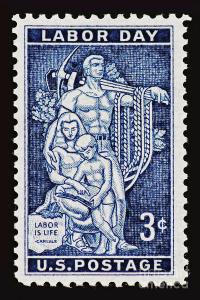 Happy Labor Day Sky Dancers!
Today is the day we celebrate the American Worker and the Union movement that brought us so many benefits and work safety enhancements that we should all appreciate Organized Labor. The day also serves as reminder of the continual fight to maintain what they earned for us through several centuries of labor movements and resistance. Republican elected officials still try to dilute all these laws that serve to protect workers and the safety of the work environment as well as dilute the right to organize.
I’m actually just going to do a tribute to the labor movement and to workers lost unnecessarily because of the greed, unsafe work places, and horrible working conditions suffered even by small children until the Labor Movement left them free to be children. I’m really not interested in spending the day on what usually serves as a kick off to the Election Season because we need a break today from all of that!
I also would like to make tribute to the indigenous people and to the slaves stolen from Africa whose human and natural resources were used to build this country. They had no pay, no thanks, and slavery for working and living conditions. They lived under religious mission systems, were sent on forced relocation to barren lands, and were bought by the Confederacy that supported ownership and torture of human beings. Their children and grandchildren continue to fight for the rights of full citizenship and recognition. I also make tribute to the diasporas and hopeful immigrants who come here to face often desperate conditions to become part of what we offer up as the America dream. We are here to form a more perfect union and organized labor makes that possible
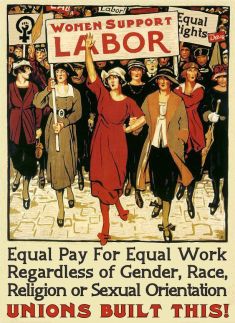
Each of us deserve dignity, safety, and fair compensation for our work no matter who we are. Who we love, what reproductive organs we were born with, the color of our skin, and our religious and ethnic heritage should not influence the rights we have as workers. Equal Pay for Equal Work. PERIOD.
 The History Channel maintains documents on the history of our Federal Labor Day Holiday.
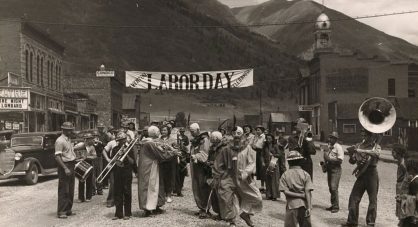
Labor Day, an annual celebration of workers and their achievements, originated during one of American labor history’s most dismal chapters.
In the late 1800s, at the height of the Industrial Revolution in the United States, the average American worked 12-hour days and seven-day weeks in order to eke out a basic living. Despite restrictions in some states, children as young as 5 or 6 toiled in mills, factories and mines across the country, earning a fraction of their adult counterparts’ wages.
People of all ages, particularly the very poor and recent immigrants, often faced extremely unsafe working conditions, with insufficient access to fresh air, sanitary facilities and breaks.
As manufacturing increasingly supplanted agriculture as the wellspring of American employment, labor unions, which had first appeared in the late 18th century, grew more prominent and vocal. They began organizing strikes and rallies to protest poor conditions and compel employers to renegotiate hours and pay.
 Labor Unions are more crucial than ever. States have taken more steps to pass so-called Right to work laws that are really just used to destroy the ability of people to negotiate their work environment and wages. The argument is that workers cannot be “forced” to join unions. However, this is just a disguise to defund unions and to stop the large amount of influence they used to be able to command in my states because of huge union numbers. Businesses have actively worked to dilute the ability of people to unionize and the service industry frequently uses illegal tactics to stop unionization in many ways. This is from a 2015 HuffPo article.
(Contrary to popular opinion, no worker in the U.S. can be forced to be a full dues-paying, card-carrying member of a union. But they can be compelled to pay so-called “agency fees” — the portion of dues that goes expressly to bargaining and representation costs, as opposed to, say, political campaigns. Right-to-work guarantees that workers do not have to pay these fees.)
On the right, proponents of right-to-work argue that the laws make states more competitive and attract business. On the left, opponents of right-to-work argue that the laws drive down wages and fail to create jobs. What few would deny is that right-to-work laws can be crippling for organized labor As workers bow out of unions, the remaining workers must bear a larger share of the costs associated with representation and organizing. And if the union becomes less effective, workers have even more reason to leave, creating a downward spiral.
Republicans in Michigan passed a right-to-work law there in 2012, despite the state’s storied labor history and the presence of the United Auto Workers union. Data from the Bureau of Labor Statistics has already revealed a drop in union density in Michigan. Last year, the estimated number of union members dropped by 48,000, despite the fact that the state added 44,000 more workers to its economy.
Whatever their feelings on labor unions’ role in the workplace, many Republicans have a political interest in passing right-to-work legislation. By weakening organized labor, the laws indirectly hurt the Democratic Party, as unions remain a critical piece of the party’s base. It’s worth noting that the very phrase “right to work,” with its positive connotations, constitutes a linguistic coup for the right. (Unions have sought, with much less success, to brand the legislation as “right to work for less.”)
Like other legislative attacks on collective bargaining, the proliferation of right-to-work laws plays a large role in organized labor’s ongoing existential crisis. Right now, not even 7 percent of private-sector workers belong to a labor union, down from a peak of about 30 percent in the post-World War II years. More right-to-work laws will likely diminish that density further.
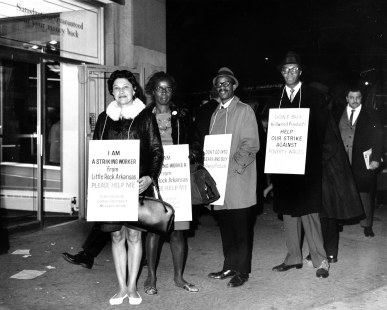 You can read about the 30 Victories for Workers’ Rights won by Organized Labor here at Stacker. The first American Union formed in 1794 and was the Shoemakers. This is a truly interesting list of the history of US Labor and Labor Law.
Today, American workers have a host of rights and recourses should their workplace be hostile or harmful. While the modern labor movement works to continue to improve the working conditions for all with big efforts around a fair minimum wage and end of employer wage theft, the movement has a history rich with fights and wins. It put an end to child labor, 10-to-16 hour workdays, and unsafe working conditions. Today, every wage-earning American today owes a debt of gratitude to organized labor for the 40-hour workweek, minimum wage (such as it is), anti-discrimination laws, and other basic protections. Far from basic, those protections were, until fairly recently, pipe dreams to the millions of American men, women, and children who labored endlessly in dreadful conditions for poverty wages.
The gratitude is owed mostly to the unions those nameless and disposable workers organized, which they did under the threat of being fired, harassed, evicted from company homes, beaten, jailed, and, in many cases, killed. In 1886, for example, over 200,000 railroad workers went on strike to protest an unjust firing. In 1894, over 250,000 workers walked out of the Pullman Palace Car Company factories to protest 12-hour workdays and wage cuts.
The 2018 Supreme Court case Janus v. AFSCME established that public-sector workers who are protected by unions—of which there are five times as many as private workers—but don’t wish to join, no longer have to pay fees on behalf of the union’s collective bargaining. This dealt a blow to public-sector unions, though it didn’t result in the mass exodus union detractors had hoped for. Overall union membership in the U.S. in 2019 was at 10.3%, according to the U.S. Bureau of Labor Statistics. While that’s a historical low rate, some industries—like digital media, museums, and non-profits—are making inroads with new unions.
While we’re on the subject of hard work
I just wanted to say that I always was a man to work
I was born working and I worked my way up by hard work
I ain’t never go nowhere yet but I got there by hard work
Work of the hardest kind
I been down and I been out
And I’ve been busted, disgusted and couldn’t be trusted
I worked my way up and I worked my way down
I’ve been drunk and I’ve been sober
I’ve had hard times and I got hijacked
And been robbed for cash and robbed for credit
Worked my way into jail and outta jail
And I woke up alotta mornings and I didn’t even know where I was at
But the hardest work I ever done is when I was trying to get myself
A worried woman to ease my worried mind
So, I’d just like to wish you a happy labor day!!! Be safe! Be kind to yourself!
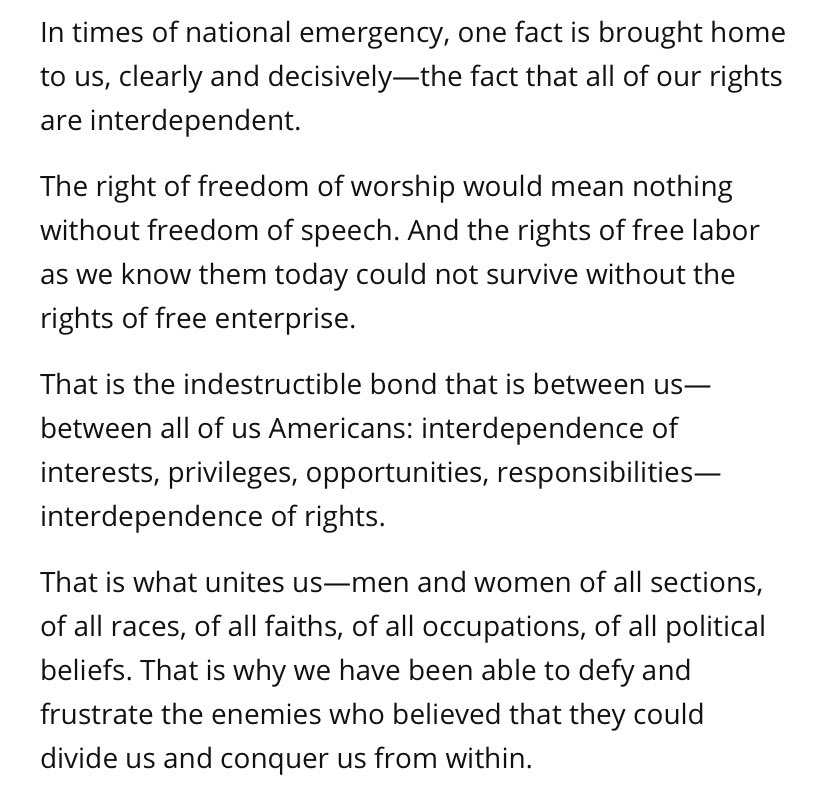
FDR Labor Day 1941
What’s on your blogging and read list today?
Lazy Caturday Reads
Posted: September 5, 2020 Filed under: morning reads, U.S. Politics | Tags: coronavirus pandemic, Covid-19, Donald Trump, flu season, Labor Day weekend, Peter Strzok 38 Comments
Otto Moller: White Red Black Cat
Good Morning!!
We’re heading into the long Labor Day weekend, as schools around the country prepare to reopen and flu season approaches. Schools that have already opened are fighting coronavirus outbreaks. In other words, a covid-19 perfect storm could be approaching.
The Washington Post: Coronavirus updates: Labor Day could fuel another rise in infections if people aren’t cautious, experts say.
Local officials and health experts say they worry that gatherings during Labor Day weekend — the first long weekend for students who have returned to classrooms across the country — could lead to a repeat of the national surge of coronavirus infections that followed Memorial Day if people don’t follow health guidelines.
This weekend presents challenges that didn’t exist earlier this summer, including schools resuming and a wider spread of infections overall, said Thomas Tsai, a researcher at the Harvard T.H. Chan School of Public Health, who partnered with Google to publish a forecast model for infections.
The Old Actress, Max Beckman
“In some ways we’re entering Labor Day with a more volatile mix than we did before Memorial Day,” he said. “We have masks and treatment, but we’re starting with a much higher base of cases, and we’re still seeing new hot spots rise across the country.” [….]
Infections swept through the Sun Belt after Memorial Day, straining health-care systems in Texas, Florida, Arizona and other states as record numbers of people fell ill in those places. Tsai said the rise was attributable to a rushed reopening in Southern states where testing and contact tracing weren’t yet in place, inconsistent mask mandates and increased travel due to the holiday.

The Washington Post: Covid-19: A bad flu season colliding with the pandemic could be overwhelming.
Doctors and health officials are urging Americans to get vaccinated against influenza in record numbers this fall to avoid a dreaded scenario: flu colliding with a raging coronavirus pandemic.
They worry that tens of millions of flu-related illnesses could overwhelm hospitals, doctor offices and laboratories that test for both respiratory illnesses.
Symptoms of flu and covid-19, the disease caused by the novel coronavirus, are similar.
“When someone presents to a physician with fever, cough, malaise, unless it’s one of the few things peculiar to covid-19, like a loss of smell, it’s hard to tell them apart when both are circulating in the community,” said Benjamin D. Singer, an assistant professor of medicine at Northwestern University’s Feinberg School of Medicine and a pulmonary critical care specialist at Northwestern Memorial Hospital.
It doesn’t have to be this way. If people wear masks and follow social distancing recommendations, we could even reduce the number of flu cases.
Ernst Ludwig Kirchner, Still Life With Cat
“This fall and winter could be one of the most complicated public health times we have, with the two coming at the same time,” Robert Redfield, director of the Centers for Disease Control and Prevention, said in a recent interview on the JAMA network.
“On the other hand, I’m an optimist. If the American public heeds the advice that we said about face covering and the social distancing and the hand-washing and being smart about crowds, this could be one of the best flu seasons we have had,” Redfield said. “And particularly if they do one more thing, and that is to embrace the flu vaccine with confidence.”

Unfortunately, we’ve already seen that many people–particularly Trump cult members and some young people–aren’t going to bother with these prevention strategies.
The Washington Post: Experts project autumn surge in coronavirus cases, with a peak after Election Day.
Infectious-disease experts are warning of a potential cold-weather surge of coronavirus cases — a long-feared “second wave” of infections and deaths, possibly at a catastrophic scale. It could begin well before Election Day, Nov. 3, although researchers assume the crest would come weeks later, closer to when fall gives way to winter.
An autumn surge in covid-19, the disease caused by the novel coronavirus, would not be an October surprise: It has been hypothesized since early in the pandemic because of the patterns of other respiratory viruses.
“My feeling is that there is a wave coming, and it’s not so much whether it’s coming but how big is it going to be,” said Eili Klein, an epidemiologist at Johns Hopkins University School of Medicine….
By Ernst Ludwig Kirchner
Respiratory viruses typically begin spreading more easily a couple of weeks after schools resume classes. Although the pandemic has driven many school districts to remote learning, there is a broad push across the country to return to something like normal life.
The Labor Day holiday weekend is a traditional time of travel and group activities, and, like Independence Day and Memorial Day, could seed transmission of the virus if people fail to take precautions. And viruses tend to spread more easily in cooler, less humid weather, which allows them to remain viable longer. As the weather cools, people tend to congregate more indoors.

I plan to continue staying home most of the time and wearing my growing collection of masks anytime I leave my apartment. That’s not difficult for me, because I enjoy solitary activities like reading and I’m past the days when I enjoyed going to parties or otherwise mixing with large groups of people. But I’m worried about what is going to happen when kids return to school and bring home the virus to the older people they live with.
The fallout continues from the Atlantic article about Trump’s disrespect for the military. A couple of examples:
Bess Levin at Vanity Fair: Donald Trump, Human Parasite, Has Also Said Soldiers Missing In Action Should Be Left For Dead.
…shortly after The Atlantic story was published, the Washington Post reported that a former senior administration official confirmed that Trump regularly made disparaging comments about veterans, in addition to this choice take on soldiers missing in action:
In one account, the president told senior advisers that he didn’t understand why the U.S. government placed such value on finding soldiers missing in action because they had performed poorly and gotten caught and deserved what they got, according to a person familiar with the discussion.
Also, he thinks he deserves a badge of honor for making up a foot injury to get out of the draft:
Trump believed people who served in the Vietnam War must be “losers” because they hadn’t gotten out of it, according to a person familiar with the comments. Trump also complained bitterly to then Chief of Staff John F. Kelly that he didn’t understand why Kelly and others in the military treated McCain, who had been imprisoned and tortured during the Vietnam War, with such reverence. “Isn’t he kind of a loser?” Trump asked, according to the person familiar with Trump’s comments.

Girl with cat, by Paula Modersohn-Becker
It’s believable because Trump has called so many of his fellow Americans, including military veterans, suckers, losers and the like. The story challenges Trump’s political narrative that he is a winning deal-maker who is so infuriated by the sacrifices Americans have been forced to make — in misbegotten wars and bad trade deals — that he gave up his own comfortable lifestyle to stand in and fight on their behalf. In this telling, they are good people who deserve a selfless champion like him.
Giving up his private life netted Trump the most powerful office in the world. He characterizes that as sacrifice, but the personal payoff was huge.
If it’s true that Trump believes people who sacrifice the most for causes greater than themselves — soldiers who laid down their lives — are losers, what does he think of the many hardworking American doctors and nurses who rushed into hospitals to treat coronavirus victims? What does he think of the police officers whose public service he commends so often? What does he think of farmers who kept putting on “Make America Great Again” hats when his trade war with China squeezed their profits and forced the government to give them subsidies to continue operating?
Rep. Ruben Gallego, an Arizona Democrat and Harvard graduate who served in a Marine infantry battalion during the Iraq war, said Trump simply doesn’t get the concept of sacrifice for the greater good.
“The man has no honor, and can never understand the millions of men and women that serve with honor for their country,” Gallego told NBC News. “I served with and buried men that even in a thousand lifetimes Trump couldn’t come close to matching their honor, courage and commitment.”
Peter Strzok has a book coming out next week, and I think I might want to read it. The New York times: Ex-F.B.I. Agent in Russia Inquiry Says Trump Is a National Security Threat.
A former senior F.B.I. agent at the center of the investigations into Hillary Clinton’s email server and the Trump campaign’s ties to Russia defends the handling of the inquiries and declares President Trump a national security threat in a new memoir, while admitting that the bureau made mistakes that upended the 2016 presidential election.
Harijs Ebersteins, Portrait of an Elegant Lady with Her Black Cat
The former agent, Peter Strzok, who was removed from the special counsel’s team and later fired over disparaging texts he sent about Mr. Trump, has mostly kept silent as the president and his supporters have vilified him.
But Mr. Strzok’s new book, “Compromised,” a copy of which was obtained by The New York Times ahead of its publication on Tuesday, provides a detailed account of navigating the two politically toxic investigations and a forceful apologia of the bureau’s acts. Mr. Strzok also reveals details about the F.B.I.’s internal debate over investigating the president himself, writing that the question arose early in the Trump presidency and suggesting that agents were eyeing others around Mr. Trump. Mr. Strzok was himself at first opposed to investigating the president.
But in a scathing appraisal, Mr. Strzok concludes that Mr. Trump is hopelessly corrupt and a national security threat. The investigations that Mr. Strzok oversaw showed the president’s “willingness to accept political assistance from an opponent like Russia — and, it follows, his willingness to subvert everything America stands for.”
Mr. Strzok’s insider look serves as a counter to the efforts by Mr. Trump and his allies to discredit the Russia investigation. Attorney General William P. Barr has appointed a veteran prosecutor to review the conduct of the F.B.I., Mr. Strzok and others for possible misconduct and bias.
The Justice Department inspector general, Michael E. Horowitz, found the bureau had sufficient reason to open the inquiry and found no evidence of political bias.

Anne Applebaum interviewed Strzok at The Atlantic: ‘Who’s Putting These Ideas in His Head?’ The former FBI agent Peter Strzok worries that Americans will never learn the full story about Trump’s relationship with Russia.
Strzok has always argued that he, James Comey, and the rest of the FBI tried, from the beginning, to treat both of these cases apolitically: They were focused on following the law. But after the Department of Justice released some private texts in which he was critical of President Donald Trump, he was accused not just of bias, but of seeking to deliberately discredit the president. Strzok, who also worked on Special Counsel Robert Mueller’s team in its early months, became a hate figure for everyone who sought to distract the public from the facts about Russia’s intervention and the Trump team’s eager embrace of it. “I have devoted my adult life to defending the United States, our Constitution, our government and all our citizens,” Strzok writes in the introduction to Compromised: Counterintelligence and the Threat of Donald J. Trump. “I never would have imagined—could not have imagined—that the president of the United States, the most powerful man in the world, would single me out with repeated attacks of treason, accusing me of plotting a coup against our government.”
Woman with a Siamese-Catm by-Kees Van Dongen
As I read Strzok’s book, I found myself unexpectedly angry, because his narrative exposes an extraordinary failure: Despite multiple investigations by the FBI, Congress, and Mueller’s team, Americans have still never learned the full story about the Trump campaign’s relationship with Russia or Trump’s own decades-long financial ties with Russia. Four years have passed since the investigation began. Many people have been convicted of crimes. Nevertheless, portions of reports produced by Mueller, the Senate Select Committee on Intelligence, and others remain redacted. Investigations are allegedly ongoing. Details remain secret. Meanwhile, valuable FBI time and money were spent investigating which email server Hillary Clinton used—a question that, as it turned out, had no implications for U.S. security whatsoever.
Strzok himself was not exactly reassuring: He does not believe that Trump’s true relationship with Russia was ever revealed, and he now worries that it won’t ever be. It’s not clear that anyone ever followed up on the leads he had, or completed the counterintelligence investigation he began. He doesn’t say this himself, but after speaking with him I began to wonder if this is the real reason the Department of Justice broke with precedent in his case by not just firing a well-respected FBI agent but publicly discrediting him too: Strzok was getting too close to the truth.

Head over to The Atlantic to read the interview.
Have a safe and enjoyable Labor Day weekend, Sky Dancers! Let’s hope Trump goes off to one of his golf courses and leaves us alone for a few days.
Thursday Reads: The Trump Psychosis
Posted: September 3, 2020 Filed under: morning reads, U.S. Politics | Tags: Bill Barr, conspiracy theories, coronavirus pandemic, Covid-10, delusions, Donald Trump, mail-in voting, psychosis, QAnon, thugs on a plane, Tom Seaver 25 Comments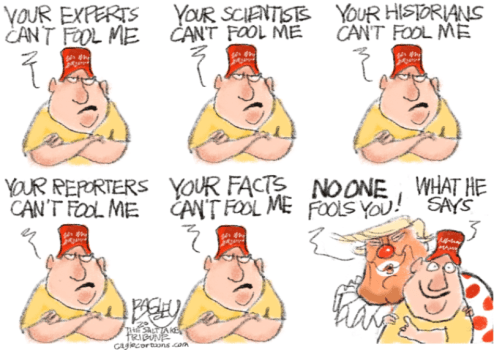
Good Morning!!
Yesterday the news broke that Tom Seaver had died, but for some reason the cause of his death wasn’t immediately emphasized. He died because he had Covid-19. He also had dementia, but the coronavirus is what killed him. Today that fact is appearing in headlines.
NBC News: Hall of Fame pitcher Tom Seaver dies of COVID-19, dementia at 75.
Hall of Fame pitcher Tom Seaver has died of complications of Lewy body dementia and COVID-19, the National Baseball Hall of Fame said in a statement Wednesday. He was 75.
He died peacefully in his sleep Monday, the organization said.
“We are heartbroken to share that our beloved husband and father has passed away,” said a family statement from Seaver’s wife, Nancy, and daughters, Sarah and Anne. “We send our love out to his fans, as we mourn his loss with you.”
Seaver played 12 seasons with the Mets, winning the National League Cy Young Award, honoring the league’s best pitcher, three times.
Why am I calling attention to this? Because the latest conspiracy that Trump has begun pushing is that somehow people who died of Covid-19 who also had other medical conditions shouldn’t be counted in the coronvirus death totals.
The Daily Beast: CDC Deluged With ‘Insane’ Number of Calls About Coronavirus Conspiracy Theory.
Officials at the Centers for Disease Control and Prevention have been deluged with a flood of media requests about a conspiracy theory promulgated by QAnon—an increasingly violent far-right group praised by President Donald Trump that is widely known for spreading disinformation.
As the agency attempted to manage the fallout of a controversial Health and Human Services announcement that it had revised testing guidelines to exclude individuals who do not exhibit symptoms, officials were sidetracked by a barrage of inquiries about whether the CDC had lied about the number of Americans who died as a result of the coronavirus. Over the weekend QAnon, a movement whose believers often push out falsities on a myriad of subjects, promoted a bogus theory that only 6 percent of people listed as having died from the coronavirus had “actually died” from COVID-19.
Officials at the CDC said they spent the last several days fielding questions or requests for comment from dozens of local and national outlets asking to clarify whether the agency had falsified its data. The wave of emails and calls about the conspiracy theory caught officials off-guard….
The CDC effort to combat accusations from QAnon, a relatively new, increasingly unhinged movement that’s making inroads into online health communities, shows the power that conspiracy theorists can have during the pandemic—especially when boosted by the president. It also shows just how permeable the barrier between conspiracy cranks and established media outlets can be.
“In all my time working in the government I’ve never had to deal with something this crazy. The level of disinformation spread by this group has grown in recent months and now we’re having to actively debunk it through the press.”
The “six percent” claim was embraced by conservatives, who have been eager for ways to downplay the virus’ American death toll and have claimed for months that the CDC and hospitals were overcounting COVID-19 deaths. To QAnon supporters, the claim purports to show that COVID-19 has killed only 9,000 people, with the vast majority of the roughly 183,000 COVID-19 casualties actually killed by another ailment.
The simple truth is that Tom Seaver wouldn’t have died if he hadn’t contracted the virus and neither would thousands of other Americans who also may have had high blood pressure, asthma, obesity, or some other secondary condition.
Another crazy conspiracy that Trump has been pushing for a long time is the notion that mail-in ballots cannot be trusted. Yesterday, Trump actually recommended that voters in North Carolina should try to vote twice. NBC News: Trump encourages North Carolina residents to vote twice to test mail-in system.
President Donald Trump suggested that people in North Carolina should vote twice in the November election, once by mail and once in person, escalating his attempts to cast confusion and doubt on the validity of the results.
“So let them send it in and let them go vote, and if their system’s as good as they say it is, then obviously they won’t be able to vote. If it isn’t tabulated, they’ll be able to vote,” Trump said when asked whether he has confidence in the mail-in system in North Carolina, a battleground state.
“If it’s as good as they say it is, then obviously they won’t be able to vote. If it isn’t tabulated, they’ll be able to vote. So that’s the way it is. And that’s what they should do,” he said.
It is illegal to vote more than once in an election.
But Bill Barr, who is supposedly the Attorney General of the United States isn’t sure that voting twice is illegal. Newsweek: Bill Barr Mocked After ‘Playing Dumb’ Over Legality of Voting Twice.
Appearing on CNN on Wednesday, Barr said the president was trying to make the point that election monitoring was not good enough to prevent people from voting at polling stations if they already cast their ballots by mail.
But when he was pressed on the fact that such an action would be illegal, he said he was unaware of what state laws said about the legality of voting twice.
“I don’t know what the law in the particular state says, and when that vote becomes final,” Barr told CNN.
The network host Wolf Blitzer then asked: “Is there any state in which you can vote twice?”
“Maybe you can change your vote up to a particular time, I don’t know what the law is,” the attorney general replied.
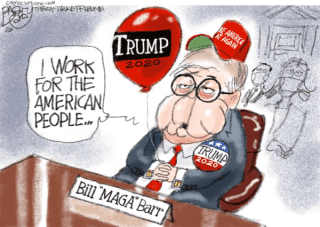 Barr might as well come out and say that he’s the chairman of Trump’s reelection campaign. In the CNN interview, he also claimed that “voting by mail is ‘playing with fire'”
“This is playing with fire. We’re a very closely divided country here,” Barr said on CNN’s “The Situation Room with Wolf Blitzer” of changes this year where states are allowing more voting by mail because of the pandemic.
“People trying to change the rules to this, to this methodology — which, as a matter of logic, is very open to fraud and coercion — is reckless and dangerous and people are playing with fire,” Barr added.
Barr provided no evidence for his claims.
These comments contradict the views of bipartisan election officials and a wide array of voting experts who say voting-by-mail is a safe option with protections in place to prevent systematic fraud. There is no widespread fraud in US elections, even in states with a history of heavy mail-in voting, running directly counter to Barr’s assertions.
Barr’s comments seem to play into Trump’s attempts to stoke fear and add chaos to the coming election. Several states have expanded their mail-in voting options this year because of the coronavirus pandemic, but the Trump campaign and Republican Party are fighting more widespread options for voters.
And then there’s Trump bizarre story about thugs, looters, and anarchists on planes flying around to cause “big trouble.” Salon: Thugs on a plane? Trump’s bizarre yarn echoes viral Facebook rumor — and Rudy Giuliani’s rants.
President Trump pushed a baseless and bizarre conspiracy theory on Monday that a plane “almost completely loaded with thugs” was sent to disrupt the Republican National Convention, a claim that appears almost identical to a rumor that traveled across Facebook three months ago.
Trump made the claim in an interview with Fox News host Laura Ingraham, alleging without evidence that “we had somebody get on a plane from a certain city this weekend, and in the plane it was almost completely loaded with thugs, wearing these dark uniforms, black uniforms, with gear and this and that.”
While the president would not divulge more details, he assured Ingraham that the incident is “under investigation right now.”
There is no evidence of such a flight. When Ingraham asked Trump to say more, the president replied, “I’ll tell you sometime.” The unidentified black-clad “thugs,” the president said, were headed to Washington D.C., to disrupt the RNC….
NBC News’ Ben Collins later reported that the rumor lines up with a viral Facebook post from June 1, which falsely claimed to have observed a similar sinister contingent on board a flight from Seattle to Boise, Idaho: “At least a dozen males got off the plane in Boise from Seattle, dressed head to toe in black.”
Seriously, Trump is beginning to sound truly delusional. I’m not sure he’s in touch with reality much of the time. The White House doctor might need to prescribe and antipsychotic drug.
From Justin Baragona at The Daily Beast: Devin Nunes May Be Trump’s ‘Person’ Who Witnessed the Antifa Plane ‘Firsthand.’
President Donald Trump’s latest outlandish conspiracy about a “person” he refuses to name having “firsthand” witnessed a commercial flight full of “thugs” and “looters” clad in “black uniforms with gear” may seem ripped directly from an unhinged relative’s Facebook page. But before this bizarre theory was being pushed by the president, another GOP lawmaker was spouting a nearly identical story….
“So, these people that descended on Washington, D.C., most of them were not local,” Nunes declared. “In fact, I flew in with a bunch of them where I got on a plane in Salt Lake City where I had to commute through and I saw maybe two dozen BLM people.”
Nunes continued: “The irony is they were all white people, they weren’t even Black, but somebody was paying for those people to go there—they were coordinated, paying for that, and then what they did was they were not protesting. This is not protesting when you block the exits of the White House.”
Neither Nunes’ office nor the White House returned a request for comment. But the congressman’s interview with Breitbart represents a type of missing puzzle piece to the mystery of just where Trump got the idea of an antifa plane packed with geared-up looters.
Chicago Tribune columnist Rex Huppke hilariously satirizes the “thugs on a plane” narrative: Column: Trump’s ‘Air Antifa’ plane story is true (maybe). I know because I was there (maybe). A brief excerpt:
Which plane traveling to Washington, D.C., was this, and who were these black-clad thugs and who relayed this information?
Trump wouldn’t say. But I will: It was me. I was on that black-clad thug plane. I am President Trump’s source for this harrowing tale of rioters flying commercial….
I’ll explain the whole thing. And like the president, I’ll do it in a way that lacks specific details, sounds wildly unhinged and makes you wonder if you should start slowly walking away, careful not to make any sudden movements.
It was August-whatever, and I was catching the Air Leftist “looters & anarchists” flight out of O’Hare at a time I will not reveal. I try to avoid that airline — they try to turn you socialist by evenly redistributing peanuts among the passengers — but it was the cheapest fare I could find.
Just before I got on board, someone in a dark shadow of the terminal started talking to me about the coronavirus and how Trump had mishandled the pandemic and made America a global laughingstock. I shouted, “LAW AND ORDER!” at the guy, and that made him go away.
Next we boarded the plane in order from each according to his ability, to each according to his needs.
I sat down and took out some meat I had killed with my gun earlier in the day, and that’s when I noticed it: black-clad thugs, everywhere. I felt very uncomfortable, particularly when two of them sat down in my row.
I asked the first one what he does, and he said: “I’m a looter. I just bought this $300 plane ticket so I could travel to wherever and steal $100 worth of clothes, which is something that definitely happens because it makes sense.”
The other guy nodded and said, “I’m an anarchist. And I’m hoping to destroy America while also collecting valuable mileage points for future travel.”
I kept silent for a moment, afraid they would beat me up or destroy my suburb. Then I asked: “So what are you all looking for?”
They both said: “Trouble.”
Read the whole thing at the link.
I also recommend reading two general articles on Trumpist conspiracy theories:
Daniel Dale at CNN: Fact check: A guide to 9 conspiracy theories Trump is currently pushing.
BBC News: How Covid-19 myths are merging with the QAnon conspiracy theory.
Just two more months until the election. I only hope we can rid ourselves of the lunatic in the White House, but will sanity be restored to the country as a whole if he loses? We can only hope.
Take care Sky Dancers! Stay safe and sane and check in if you can.
Tuesday Reads: The So-Called “President” Is Insane.
Posted: September 1, 2020 Filed under: morning reads, U.S. Politics 23 Comments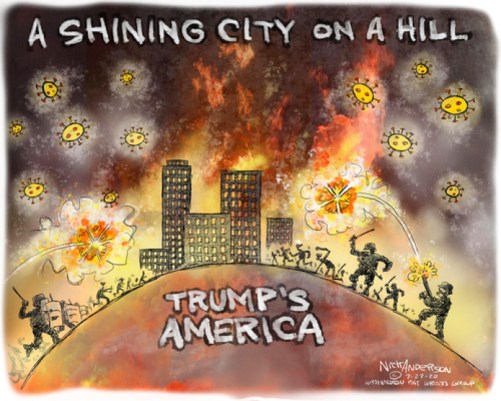
Good Morning!!
Yesterday Trump defended Kyle Rittenhouse, the 17-year-old who traveled from his home in Illinois to Kenosha, Wisconsin with a military-style rifle, shot and killed two people, and injured a third. Rittenhouse’s victims have names.
AP via ABC 13.com: Victims of Kenosha protest shooting tried to disarm Kyle Rittenhouse: Reports.
Kenosha County prosecutors said in court records this week that the first person shot around 11:45 p.m. on Tuesday has been identified as Joseph Rosenbaum, 36, of Kenosha.
Joseph Rosenbaum
Prosecutors said Rosenbaum followed Rittenhouse into a used car lot, where he threw a plastic bag at the gunman and attempted to take the weapon from him.
The medical examiner found that Rosenbaum was shot in the groin, back and left hand. The wounds fractured his pelvis and perforated his right lung and liver. He also suffered a superficial wound to his left thigh and a graze wound to his forehead.
Friends have told local media that Rosenbaum was originally from Texas and previously lived in Arizona before moving to Wisconsin this year, where his young daughter lives. According to his Facebook page, he worked at a Wendy’s restaurant in Kenosha….
Anthony Huber, 26, of Silver Lake, was shot in the chest after apparently trying to wrest the gun away from Rittenhouse, the complaint said.
Hannah Gittings, Huber’s girlfriend, told WBBM-TV that he pushed her out of the way before chasing after the man others on the street had identified as the shooter.
Anthony Huber
Huber’s friends gathered at a Kenosha skate park this week to remember him and his passion for skateboarding. According to court records, Huber had a skateboard in his right hand and used it to “make contact” with Rittenhouse’s left shoulder as they struggled for control of the gun….
The third man to be shot was wounded in the left arm. Court records said Gaige Grosskreutz, 26, appeared to be holding a gun when he approached Rittenhouse after he shot at Huber.
Grosskreutz is an activist who volunteered as a medic during the Kenosha demonstrations, according to Milwaukee activist Bethany Crevensten.

Trump also defended supporters who drove trucks through Portland, Oregon, attacking protesters with pepper spray and paint balls.
Aaron Blake at The Washington Post: Trump’s illuminating defense of Kyle Rittenhouse.
At the start of and throughout his news conference Monday evening, President Trump attacked Joe Biden for condemning violence but not specifically left-wing perpetrators of it.
By the end of the news conference, Trump not only pointedly declined to condemn right-wing violence at the same demonstrations, he voluntarily defended it.
The president offered his first public comments about Kyle Rittenhouse, a supporter who was charged with murder in Kenosha, Wis., as well as other Trump supporters who converged on Portland, Ore., and apparently fired paintball guns and pepper spray at protesters.
Trump found little fault with any of them. He noted that at least the paintballs weren’t bullets and called it a “peaceful protest.”
“Well, I understand that had large numbers of people that were supporters, but that was a peaceful protest,” he said. “And paint is not — and paint as a defensive mechanism, paint is not bullets. … These people, they protested peacefully. They went in very peacefully.”

Kyle Rittenhouse
Trump’s defense of Rittenhouse:
when it was noted that one of his supporters, Rittenhouse, has been charged with killing with actual bullets in Kenosha. Trump indicated he thought Rittenhouse’s actions might have been warranted.
“That was an interesting situation,” he said. “You saw the same tape as I saw. And he was trying to get away from them. I guess it looks like he fell and then they very violently attacked him. And it was something that we’re looking at right now, and it’s under investigation. But I guess he was in very big trouble. He would have been — probably would have been killed, but it’s under investigation.”
Today Trump will travel to Kenosha despite pleas from local leaders asking him to stay away.
CNN: Trump to visit Kenosha despite objections of local officials.
President Donald Trump is slated to visit Kenosha, Wisconsin, on Tuesday, going against the wishes of officials requesting he stay away from the city, which is still coping from the recent shooting of an unarmed Black man by law enforcement and subsequent demonstrations that have turned deadly.
The President isn’t expected to meet with the family of Jacob Blake, the man was shot in the back seven times by a police officer. Trump claimed that he’s not meeting with Blake’s family during his Wisconsin visit because they wanted to involve lawyers.
According to Trump’s public schedule, the President is expected to begin his trip Tuesday afternoon with a visit to a “property affected by recent riots.” He’s then scheduled to visit a local high school and the city’s emergency operations center. Before departing Kenosha, he’ll participate in a roundtable focused on community safety.

Jacob Blake
Los Angeles Times: Nation’s eyes are on Kenosha ahead of President Trump’s visit afterJacob Blake shooting.
KENOSHA, Wis. — Still in mourning from three shootings last week that left a Black man paralyzed at the hands of police and two white men dead from the bullets of a teenage murder suspect, Kenosha was bracing for more unrest Tuesday as President Trump lands in an embattled city that has become a symbol of the nation’s strife over race, policing and protest.
The Democratic mayor and state governor have called on the president, who will meet with law enforcement and view burned buildings downtown, to cancel his plans, fearing the visit could inflame already high tensions. Conservative leaders have pleaded with Trump to move forward, saying the region needs his touch in a “time of crisis.”
Residents in Kenosha County, which like many parts of this crucial swing state are politically divided, are troubled over the future of the country ahead of one of the most consequential American elections in generations. One can hear bitterness, worry and uncertainty from the charred buildings downtown to the vigilant suburbs north and west.
“I’m not sure why he’s [Trump] coming here,” said Pam Zell, a Democrat who lives two miles from Uptown Kenosha, where plumes of tear gas and smoke gave way to largely peaceful protests in support of Blake and a smaller pro-police rally this weekend.
“What’s he going to do? Laugh and say everything is the fault of the Democrats?” said Zell, 57, who was recently laid off from a college campus bagel shop. She described herself as “understanding that Black lives matter.”
Kevin Pinter, a Republican who lives in Pleasant Prairie, a western suburb right across city lines, said he was looking forward to Trump showing Kenosha “can be an example for the country.”
“Any time the president goes anywhere, the bad guys follow to cause trouble,” said Pinter, 36, who co-runs a Christian humanitarian nonprofit. “So I get that concern. But he can come here and show our country how our city is now under control, unlike others that are rioting.”
Protesting police brutality equals “rioting” apparently. I wonder if these Trump supporters will ever wake up to the fact that the “president” is completely insane. You want evidence? Check out Trump’s interview with Laura Ingraham yesterday.
Get this, Trump claims there was some kind of shadowy terror plot against the Republican convention.
More from Politico on the interview: Trump alleges Biden controlled by people in ‘dark shadows.’
President Donald Trump alleged unnamed people in “dark shadows” are controlling Democratic presidential nominee Joe Biden in an interview with Laura Ingraham that aired Monday night on Fox News.
In discussing what he characterized as anarchists and thugs terrorizing American cities, Trump said, “People that you’ve never heard of, people that are in the dark shadows” are pulling the strings of the former vice president.
Laura Ingraham interviews Trump
Ingraham asked the president to elaborate, saying, “That sounds like a conspiracy theory.”
Trump specified: “There are people that are on the streets, there are people that are controlling the streets.”
The president then offered further description of what he characterized as secret plotters, without providing specifics that could allow for the verification of his story.
“We had somebody get on a plane from a certain city this weekend. And in the plane, it was almost completely loaded with thugs, wearing these dark uniforms, black uniforms, with gear and this and that,” Trump told the Fox News host on “The Ingraham Angle.”
He added: “A lot of the people were on the plane to do big damage.”
Ingraham asked him for further detail. Saying it was under investigation, Trump replied, “I’ll tell you sometime.”
Trump also offered theories about unrest in some American cities, alleging, for instance, that “Portland has been burning for many years, for decades it’s been burning” and repeatedly asserting that protesters there wanted to kill Mayor Ted Wheeler.

Honestly, I don’t know how much more of this insanity I can take. I know I keep saying that…
More stories to check out if you can bear to read any more:
CNN: Pence was on standby to ‘take over’ during Trump’s unannounced Walter Reed visit, new book reports.
Op-Ed by Harold Varmus and It Has Come to This: Ignore the C.D.C. The agency’s new guidelines are wrong, so states have to step up on their own to suppress the coronavirus.
The Daily Beast: DHS Chief Tells Tucker the Feds Are ‘Working On’ Conspiracy Charges Against BLM Leaders.
Jonathan Chait At New York Magazine: How Trump Brought Nazis Into Republican Politics.
The Washington Post Editorial Board: The director of national intelligence is providing cover for Putin.
Axios: Exclusive: Dem group warns of apparent Trump Election Day landslide.
Ronald Brownstein at CNN: Biden’s GOP endorsements show the cracks in Trump’s coalition.
Politico: HHS bids $250 million contract meant to ‘defeat despair and inspire hope’ on coronavirus. [In other words, propaganda]
NBC News: Trump’s ‘plane loaded with thugs’ conspiracy theory matches months-old rumor.
Hang in there, Sky Dancers! Be kind to yourself and others today. Check in if you can.

 peej
peej Carissa
 bostonboomer
 dakinikat
 ecocatwoman
 jjlo
jjlo mablue2
 Mama Lopez
 peggysue22
 quixote
 skydancingguestblogger
 Mona (aka Wonk the Vote)





Recent Comments