




Two weeks after the annual motorcycle rally in Sturgis, South Dakota, reported Covid infections in the state have risen nearly sixfold.
South Dakota counted 3,819 new cases in the past two weeks, including seven deaths, up from 644 cases in the 14 days preceding it. That makes it the state with the largest percent increase in Covid cases in the past two weeks.
The state’s rate of Covid-19 infections per capita in the past two weeks is in the bottom half of the country, but it’s the sharp and sudden increase in case counts that sets it apart.
Meade County, home to Sturgis, has counted 330 new cases in the last two weeks, up from the 20 reported in the two weeks before the rally, according to Johns Hopkins University’s case count. The 1,550 percent increase comes after the motorcycle rally, which usually draws around half a million people, possibly had its biggest year ever, according to County Sheriff Ron Merwin.
Thursday Reads
Posted: August 26, 2021 Filed under: morning reads | Tags: Afghanistan, coronavirus pandemic, Covid-19, Donald Trump, Florida, foreign policy, immigration, ISIS, Ivermectin, Joe Biden, SCOTUS, South Dakota, Sturgis rally, vaccines 18 Comments
Man reading, by Franco Americano
Good Morning!!
News just broke of an explosion outside the Kabul airport in Afghanistan. The New York Times: An explosion is reported at Kabul airport, after warnings of a security threat.
An explosion rattled an area outside Hamid Karzai International Airport in Kabul on Thursday, the Pentagon confirmed, just hours after Western governments had warned of a security threat there.
Since the Taliban takeover of the city earlier this month, thousands of Afghan civilians and foreign citizens have gathered at the airport, which has a military and civilian side, desperate to be airlifted out of the country.
“We can confirm an explosion outside Kabul airport,” John Kirby, the Pentagon press secretary, said in a post on Twitter. “Casualties are unclear at this time. We will provide additional details when we can.”
A U.S. military official confirmed that at least one explosion had occurred at the Abbey Gate, a main entryway to the international airport. Early reports indicated that the explosion was caused by at least one suicide bomber wearing an explosive vest. It was unclear how many people were injured or whether anyone was killed, but large crowds have been gathering at the gate in recent days.
I guess we’ll hear more details as the day goes on.
In other news, the Supreme Court’s conservative justices have decided to interfere with the U.S. President’s immigration powers. Ruth Marcus at The Washington Post: Opinion: Thanks to the Supreme Court, a federal judge in Texas is making foreign policy decisions.
Too bad all those Hillary haters refused to vote for her in 2016.
I hate to write about the pandemic again, but it’s still dominating the news because it’s getting worse.
The Washington Post: Hospitalizations hit 100,000 in United States for first time since January.
This is interesting, but not surprising from Joshua Green at Bloomberg News: Vaccinated Democratic Counties Are Leading the Economic Recovery.
With Covid-19 cases once again rising across the country, the U.S. is struggling to curb the latest, delta-driven surge, as hospitalizations and deaths have steadily climbed. But at least so far, the economy has proved highly resilient. There are many reasons for this, ranging from generous stimulus checks to the Federal Reserve’s commitment to buying bonds and holding interest rates low.
But some interesting new data on the overlap of electoral politics and economic dynamism suggest another reason: The geography of America’s economic engine is heavily concentrated in counties that Joe Biden won in 2020. These counties are much more heavily vaccinated than the rest of the country and thus better able to withstand the economic effects of Covid’s delta variant.
By Abraham van Strij
The shift of U.S. economic production toward blue counties predates the arrival of the coronavirus. After the 2016 election, Mark Muro, the policy director of the Brookings Institution’s Metropolitan Policy Project, found that the 472 counties Hillary Clinton won produced 64% of the country’s economic output, while the 2,584 counties Donald Trump won contributed just 36%. That was a significant jump from the 2000 election, when the blue-red county economic split was 54% to 46%. Muro dubbed this divide “high-output America” vs. “low-output America.”
Last year, after Biden defeated Trump, Muro looked again and found that the economic output divide has grown even more pronounced. The 520 counties Biden won account for fully 71% of U.S. gross domestic product, while the 2,564 that Trump carried produced just 29%. In other words, America’s economic engine is bluer than ever.
The partisan lean of these 520 economically vital counties has almost certainly helped to protect U.S. growth because Democrats are much more likely to be vaccinated than Republicans.
Read the rest at the link.
In the red counties and states, people are poisoning themselves rather than get vaccines. Miami Herald: Calls about animal dewormer as COVID treatment soar in Texas, poison center says.
The Texas Poison Center Network has received dozens of calls this month about people exposed to ivermectin, an animal dewormer some are using for COVID-19 treatment.
But the drug, which is flying off the shelves in many parts of the United States, is not a suitable treatment and health organizations are warning against its improper use….
Of the 150 people who have called the center this year regarding exposure to the drug, 54 said they intentionally misused it.
Common side effects of the drug are allergic reactions, nausea, vomiting, diarrhea and hypotension, the center said.
“Patients who take concentrated forms that are used for large animals like horses and cows are more likely to experience severe side effects and toxicity,” Texas Poison Center said in a statement to McClatchy News. “Accidental poisonings in children may also occur when this medication is kept in the home and is improperly stored. As a result, the Texas Poison Center Network does not encourage the use of ivermectin outside of its intended use.”
The U.S. Food and Drug Administration, the National Institutes of Health and the World Health Organization have all also advised against using ivermectin to treat or prevent COVID-19 outside controlled clinical trials, McClatchy News reported earlier this month.
A large dose of ivermectin intended for a horse could cause a human to have complications that include “low blood pressure, rapid heart rates, seizures” along with damage to the liver and layers of skin falling off, Dr. Shane Speights, site dean at the New York Institute of Technology College of Osteopathic Medicine, told KAIT8.

By Franz von Defregger
Some doctors in Idaho and Arkansas are even prescribing this stuff. For Christ sake, why won’t these idiots just get the vaccine and wear masks?
Florida has become the Coronavirus epicenter of the U.S. The New York Times: In Florida, the pandemic is worse now than it has ever been before.
More people in Florida are catching the coronavirus, being hospitalized and dying of Covid-19 now than at any previous point in the pandemic, underscoring the perils of limiting public health measures as the Delta variant rips through the state.
This week, 227 virus deaths were being reported each day in Florida, on average, as of Tuesday, a record for the state and by far the most in the United States right now. The average for new known cases reached 23,314 a day on the weekend, 30 percent higher than the state’s previous peak in January, according to a New York Times database. Across the country, new deaths have climbed to more than 1,000 a day, on average….
And hospitalizations in Florida have almost tripled in the past month, according to federal data, stretching many hospitals to the breaking point. The surge prompted the mayor of Orlando to ask residents to conserve water to limit the strain on the city’s supply of liquid oxygen, which is needed both to purify drinking water and to treat Covid-19 patients.
Even as cases continue to surge, with more than 17,200 people hospitalized with the virus across Florida, Gov. Ron DeSantis, a Republican, has held firm on banning vaccine and mask mandates. Several school districts have gone ahead with mask mandates anyway.
I wonder if DeSantis reads the newspapers or watches anything other than Fox News?
WINTER GARDEN, Fla. (WESH) — At West Side Crematory in Winter Garden, they’re overwhelmed with the remains of people that need to be cremated.
There’s an influx of bodies like they’ve never seen, worse than the first wave of COVID-19. The area where bodies are stored prior to being cremated is stacked to the ceiling. The staff is working day and night to honor the dead.
By Arthur John Elsley
WESH 2 called 20 funeral homes and crematories and many were too busy to be part of our story. Some were too busy to even talk on the phone. One funeral director said that in a 30-minute period where he talked to his partner, four new cases came in.
Mike Marchetti, the area manager for Newcomer Funeral Homes, says as much as they don’t want to, sometimes they have to delay meetings with families and delay funerals because they only have so much staff.
“So the family comes in and they say we would like to have the funeral on Friday and we have to tell then ‘I’m sorry we can’t accommodate a funeral on Friday because our schedule is full,” Marchetti said.
A death care industry struggling to meet demands at a level they’ve never seen before, and families struggling to cope with grief at a level a community has ever seen before.
And then there’s South Dakota, where Governor Kristi Noem welcomed about 700,000 unmasked bikers to party in a a small town named Sturgis.
NBC News: South Dakota Covid cases quintuple after Sturgis motorcycle rally.

By Richard Boyer
The Daily Beast: Warnings About the Sturgis Rally Have Come Tragically True.
In western South Dakota’s Meade County, more than one in three COVID-19 tests are currently returning positive, and over the last three weeks, seven-day average case counts have increased by 3,400 percent. This exponential growth in cases is likely attributable to the 81st Sturgis Motorcycle Rally, which drew an estimated half a million visitors to Meade County and its environs from Aug. 6 through 15, potentially acting as a superspreader event….
…while Southern states have been the main drivers of this surge thus far, the recent spike in cases in South Dakota warrants special concern.
The state more broadly has witnessed a 686.8 percent increase in daily case counts over the past three weeks, currently more than 10 times the nationwide rate. Meade County’s post-Sturgis uptick is certainly a contributor to this state-level increase, but neighboring counties have experienced a sharp incline in cases, too—ranging from a 1,900 percent increase in the past three weeks in Butte to a 1,050 percent increase in Lawrence.
Those two counties are also key focal points for the rally, which is not, in reality, confined to Sturgis. And because the rally is widely attended by residents all across South Dakota, it’s not surprising that counties further away—like Charles Mix County, which saw a 1,500 percent increase—are experiencing an incline in cases, too.
The Sturgis Motorcycle Rally represents the perfect storm for a superspreader event across this region: a large gathering with no testing, no masks, and no vaccination requirements. Though many (but not all) of the goings-on occurred outdoors and thus offered more protection against SARS-CoV-2 transmission than if they hadn’t been, the South Dakota Department of Transportation reported that 525,768 vehicles entered Sturgis over the 10 days of the rally. The sheer number of people in attendance paired with a lack of additional precautions presented prime conditions for viral transmission.
There’s much more at the link.
Sorry about all the bad news. Take care and hang in there, Sky Dancers!!
Tuesday Reads
Posted: August 24, 2021 Filed under: morning reads | Tags: Afghanistan, Covid-19, Infrastructure Bills, Joe Biden, Kathy Hochul, Nancy Pelosi 23 CommentsGood Morning!!
There’s a lot of news out there today and none of it is good. The press is still dumping on Biden for Afghanistan and his Covid response too. And so-called “centrist Democrats” are still trying to sabotage Biden’s infrastructure plans. And of course, the Covid-19 Delta variant is still spreading like wildfire. So this will be a mish-mash of reads. Before I get started with that, here’s one bit of good news from New York.
The New York Times: Kathy Hochul Is Sworn In as New York’s First Female Governor.
ALBANY, N.Y. — Kathy C. Hochul, a former congresswoman from Buffalo, became the 57th governor of New York early Tuesday, making history as the first woman to ascend to the state’s highest office.
She was sworn in at the State Capitol by the state’s chief judge, Janet DiFiore, in a private ceremony, capping a whirlwind chain of events that followed a series of sexual harassment allegations made against the outgoing governor, Andrew M. Cuomo.
Ms. Hochul, 62, assumes office three weeks after a state attorney general investigation concluded that Mr. Cuomo sexually harassed multiple women. A week later, Mr. Cuomo announced his resignation, bringing his 10-year reign to an abrupt end after rising to national fame during the pandemic last year.
Governor Hochul, a Democrat, has vowed to lead the state through a still surging pandemic and economic uncertainty, while ushering in a new era of civility and consensus in state government.
“I feel the weight of responsibility on my shoulders and I will tell New Yorkers I’m up for the task,” Ms. Hochul told WGRZ-TV, a Buffalo-based news station, shortly after she was sworn in. “I thought about all the women that came before me, including my mother who was not there, but a lot of women through history, and I felt they passed the torch to me.”
Andrew Cuomo is gone for now. That’s one good thing that happened.
Afghanistan News and Opinion
The Washington Post: CIA Director William Burns held secret meeting in Kabul with Taliban leader Abdul Ghani Baradar.
Two good opinion pieces:
Michelle Goldberg at The New York Times: The Afghanistan War Was Lost Before Biden Ended It.
Andrew Latham at The Hill: The coming collapse of the Taliban.
Covid-19 News and Opinion
Eleanor Clift at The Daily Beast: It’s the Virus, Not Afghanistan, That’s Dragging Biden Down.
For all of the media attention here on President Biden’s handling of Afghanistan, the latest poll numbers show that it’s his handling of COVID-19 that’s been most damaging to his standing with the American public— and that could get worse, fast, if the Delta variant disrupts the school year.
The American people are sick of the pandemic and they’re taking it out on Biden while a handful of red-state governors reap short-term political gains by blocking mask mandates and other public health measures, and allow the virus to spread.
Their intransigence in the face of a widening health crisis is costing Biden politically. On Monday, with the news that the Pfizer vaccine had gotten full FDA approval, he called on private sector companies to do what he has done with the military and federal health workers and make the vaccine mandatory or require frequent testing to employees who refuse it. “It’s your lucky day,” the president told the people who say they were waiting on the FDA.
There may be a relatively small number of people who wanted full clearance instead of emergency authorization before getting the jab, but the FDA’s move may motivate companies to take a more aggressive approach to protecting their workforces and facilities now that they may be on a legally sounder footing for doing so.
Biden had promised that the country could return to something resembling normal once 70 percent of the population was vaccinated, which he believed could be achieved by July 4, aptly named Independence Day. The numbers fell short but the new president was on a roll, and he and the first lady celebrated with a big party on the South Lawn, prematurely as it turned out.
Even before the authorization, vaccination rates have continued to tick up but not fast enough to beat the Delta variant into submission, and not fast enough to reclaim Biden’s standing.
Sarah Zhang at The Atlantic: This School Year Is Going to Be a Mess—Again.
Since early summer, three pandemic clocks have been ticking. The first pertains to the coronavirus’s Delta variant, which has sent daily case numbers soaring more than tenfold since June. The second clock is more predictable: The school year starts, as it always does, in late August or early September. The third clock counts down to the authorization of vaccines for children under 12, which was optimistically supposed to come this fall. After the FDA pushed for a larger trial to collect more safety data in kids, it will likely take longer.
These three timelines have now managed to converge in the worst way possible: Just as Delta is climbing to a new peak, millions of children who still cannot be vaccinated are going to spend hours a day indoors at school. And many of them will do so without masks, thanks in part to mask-mandate bans in some of the same states that are currently experiencing the worst outbreaks. “Are you allowed to use swear words?” is how Sean O’Leary, a pediatrician at the University of Colorado, replied when I asked him how he felt going into the school year.
This fall was supposed to herald the return of in-person classes everywhere. After the virus brought the 2020 spring semester to an abrupt halt, schools fumbled through another year with a mix of in-person and virtual learning. Now Delta threatens to wreak havoc on a third school year.
Read the rest at The Atlantic.
Infrastructure Bill News
The Guardian: Tensions flare in Capitol as moderate Democrats hold up Biden budget plan.
Confronting moderates, House Democratic leaders tried to muscle Joe Biden’s multitrillion-dollar budget blueprint over a key hurdle, working overnight to ease an intraparty showdown that risks upending their domestic infrastructure agenda.
Tensions flared and spilled into early Tuesday as a band of moderates threatened to withhold their votes for the $3.5tn plan. They were demanding the House first approve a $1tn package of road, power grid, broadband and other infrastructure projects that has passed the Senate.
Despite hours of negotiations at the Capitol, the House chamber came to a standstill and plans were thrown into flux as leaders and lawmakers huddled privately to broker an agreement. Shortly after midnight, leaders announced no further votes would be taken until Tuesday’s session.
The House speaker, Nancy Pelosi, implored Democrats not to miss this chance to deliver on the promises Biden and the party have made to Americans.
“Right now, we have an opportunity to pass something so substantial for our country, so transformative we haven’t seen anything like it,” Pelosi said, according to a person who requested anonymity to disclose the private comments.
Pelosi told the party it was “unfortunate” they were discussing the process when they should be debating the policy.
“We cannot squander this majority and this Democratic White House by not passing what we need to do,” she said.
An update from Politico: ‘Not that far apart’: Democrats near deal to break budget impasse.
Democratic leaders are finalizing a deal that would clear the way for passage of the $3.5 trillion budget framework and set a House vote on the bipartisan infrastructure bill for Sept. 27, an offer they hope ends a weekslong standoff with moderates.
After several hours of furious negotiating Monday night, Speaker Nancy Pelosi and her team are finishing the compromise, which they hope to put on the floor as soon as Tuesday afternoon. Democratic members believed a deal was imminent, based on Pelosi’s tone, but the caucus will meet Tuesday morning to discuss the contours of the agreement.
“I’m sorry that we couldn’t land the plane last night, and that you all had to wait. But that’s just part of the legislative progress,” Pelosi said Tuesday morning. “I think we’re close to landing the plane.”
Many rank-and-file members of the Democratic caucus are furious at Rep. Josh Gottheimer of New Jersey and his group of centrists, who have halted progress on the centerpiece of President Joe Biden’s social spending plans over their insistence the bipartisan bill receive a vote first. It’s unclear if the broader bloc of moderates has signed off on the emerging deal hashed out with Democratic leaders, as some of them are still trying to secure more assurances from leadership about the scope and details of the party-line budget framework.
That’s all I have for today. What stories are you following? Any good news?
Friday Reads: Of Buddhas, Taliban, and White Male US Domestic Terrorists
Posted: August 20, 2021 Filed under: morning reads | Tags: Afghan Women, Afghanistan War 17 Comments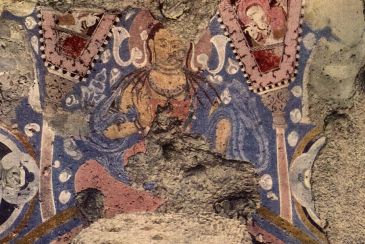
The oldest oil paintings are in Afghanistan. They were found in caves behind the 2 ancient colossal Buddha statues destroyed in 2001 by the Taliban. Many people worldwide were in shock when the Taliban destroyed The Banyam Buddhas. It was a Western Heritage site. Behind those statues are caves decorated with paintings from the fifth to ninth centuries.
Good Day Sky Dancers!
So, it’s hard to remain dispassionately compassionate in today’s America. Here I am wanting doctors and hospitals to turn away the unvaccinated for one. Then, I’d like to trade the entire Trump family, that white male domestic terrorist that took up hours of everyone’s time plus thousands of dollars just to have a hissy fit in front of the Library of Congress while lying about having a bomb, and an entire list of Republican politicians to the Taliban in exchange for every Afghani who definitely would make better US Citizens then these freaks of white privilege, corruption, and angst.
Let’s send them the Proud Boys and get back the Afghanistani Girls Robotics Team. I’d say we’d definitely get the better deal. Maybe Fox News–minus a few leggy,dyed, and dumb blondes–would like to set up its entire empire there and broadcast Tucker Carlson from the kind of government he seems to want. Although the thought of Laura Ingrahm in a burkha has a certain appeal to me that I must admit. Ah, but I cannot play Karma just as anyone with tendencies to Deism can play the Goddess or God.
BB sent me a link to a former NPR reporter Sarah Chayes who reported on the original removal of the Taliban from Afghanistan. I saw her on MSNBC where she completely ripped apart a young Obama staffer who basically was trying to say that the surge was a mistake but could only be seen from hindsight. She’s fierce, outspoken, and amazingly well-versed on the entire 20-year commitment to your basic corruption story. First, here’s the transcript of her appearance on MSNBC. Medhi Hassan sat in for Chris Hayes on that day. The other participant in the discussion is Tommy Vietor is the former spokesperson for the National Security Council under President Barack Obama. He`s now a co-host of the podcast Pod Save America and host of Pod Save the World. She took him down with ease.
Thank you both for coming on the show. Tommy, let me start with you. You were on the NSC. This is a huge screw up is it not? You and I may agree with Joe Biden that this was the right thing to do, but this was a failure in the way that it was handled, in the way that you know it was not seen coming according to NBC reporting.
The CIA warned of a rapid collapse. And now they`re playing the blame game. General Mark Milley said today, nope, he never saw any of that Intel. This is bad, is it not?
TOMMY VIETOR, HOST, POD SAVE THE WORLD. Giving out the people who helped us in this war effort over the past few decades is bad. And they need to rectify that immediately. And obviously, that part of this process getting these Special Immigrant Visas out, getting the P1, the P2 Visas out. All these people that help the United States, the USAID, helped the news media. We need to get those people out.
And so, this mission isn`t over. Joe Biden needs to figure out how to get them out. I do agree with President Biden`s assessment that after 20 years, it was time to end the war in Afghanistan. The mission against al-Qaeda had gone well, the nation-building exercise was doomed to fail from the beginning and it was in the state to continue with this long.
HASAN: Sarah, you lived in Afghanistan. You also later advise the Joint Chiefs of Staff. What did we all get wrong about the durability even, dare I say, the popularity of the Taliban in parts of Afghanistan? What did we miss? What did U.S. general miss?
SARAH CHAYES, FORMER REPORTER, NPR: So, I actually disagree with Tommy on that. And I would say I don`t think the Taliban are particularly popular. I don`t think that`s quite an accurate way of putting it either. There were two decisive variables in this whole situation from the beginning. And they were Afghan government corruption aided and abetted reinforce (AUDIO GAP) and with every Afghan leader that we supported.
And the second decisive variable was the role of Pakistan. It`s not as though the Taliban or some, you know, grassroots movement that sprang up inside Afghanistan, as we often hear. I spent months interviewing people, both ordinary Afghans who had been living in Kandahar and in Qatar, across the border in Pakistan, and also key actors in this drama back in 1994.
Everyone agrees that it was the Pakistani military intelligence agency that basically concocted the Taliban back in about 1993, and then reconstituted them starting approximately 2003. And so, I actually think there`s a lot we could have done differently.
And having been also in interagency policy development in 2010-2011, I can tell you, there were some of us who were arguing very forcefully for a stronger U.S. stance in holding the Afghan government to basic standards of integrity, and it was explicitly rejected by the U.S. cabinet and President Obama.
And the same thing is true of Pakistan. Many people were pointing out the active role Pakistan had played, not to mention that they also provided nuclear technology to North Korea and Iran. So, I don`t understand one of those decisions that (INAUDIBLE) that period.
[20:25:17]
HASAN: You mentioned Obama, so let me bring Tommy back in. Tommy, you obviously worked for Barack Obama. You and I have talked many times before about various aspects of foreign policy that he may have got wrong, he could have done better on. Where does Afghanistan fit into that scheme in your view when you look at Syria, and Libya, and some of the other areas, Yemen, of contention that you and I have discussed? I mean, Joe Biden as successfully pulling troops out of Afghanistan. He may be doing it in a bad way, but he`s managing to do it. We know that Barack Obama had a similar instinct, but he never did this.
VIETOR: So, during the Obama years, especially early on, the threat from al-Qaeda in Afghanistan and Pakistan was growing and was significant. And, you know, that was largely because George W. Bush started the war there, took his eye off the ball, and then decided to invade Iraq.
So, what Obama decided to do was surge a bunch of additional troops in 2009 and 2010 to push back the Taliban, and try to buy some time and space to go after al-Qaeda and essentially prevent the government toppling — prevent major population centers from being overrun. What did that get us? It got us back to a status quo ante.
And in hindsight, I think that that major surge was probably a mistake, and that the U.S. should have shifted to a counterterrorism mission sooner and drawn down troops sooner. And I agree, Mehdi, in hindsight, it`s very easy to say the safe haven in Pakistan was a problem, corruption has been a problem. It`s very easy to identify those problems, solving them is much harder, especially when you have a bunch of other competing priorities like the need to be able to undertake counterterrorism missions in Pakistan, the need to keep the lid on Pakistan`s nuclear weapons program, the need to do a million other things, it becomes complicated.
And so look, I think the surge in hindsight was a mistake. I do think it was time to end this war, and that, frankly, it was doomed for a long time.
HASAN: Yes. And Joe Biden, of course, was one of those people who at least at the time, briefed the people he was against that search. It`s interesting him following up now as president. Sarah, Afghan President Ashraf Ghani turned up today in the United Arab Emirates, reportedly accused of taking $169 million of cash with him.
This was the guy who was supposed to be clean. He was the guy who was going to fix Afghanistan, the technocrat, the economist, and it looks like he may have just been as corrupt as everyone before him. We talk a lot about the Afghan military`s fault, but how much is Afghan political leadership over 20 years to blame for this debacle now?
CHAYES: Afghan political leadership and the incentive structure that the United States and many of its international allies put in place. We set up an incentive structure that rewarded the most corrupt. And again, I beg to differ with you, Tommy. A lot of us — it`s not in hindsight. A lot of us had been talking about Pakistan and corruption for years. That interagency process —
(CROSSTALK)
CHAYES: They were tracking — sorry?
VIETOR: I think that what was lacking were the solutions. You know, it`s not that there weren`t like ideas in white paper —
CHAYES: I`m sorry. I`m sorry, Tommy. The number of plants, the number of — the number of extremely explicit governance campaign plans that were put forward, I mean, with most likely most dangerous mitigation strategies for what might go wrong, I can think of three or four that were submitted and frankly, died in the national security staff.
So, I think there`s a bit of disingenuousness here. And again, I have had no, I want to say, sympathy for corrupt Afghan officials. But on the other hand, let`s just take a look. I feel like we`re in a hall of mirrors today. You know, look at the mansions in the massive neighborhoods around Washington where contractors and government officials live after having promulgated failed policies. And then we call —
HASAN: It is truly — it is truly horrific to see. Sarah, we`re out of time. I do want to give Tommy 20 seconds since you — since you made a couple of jobs there. We`re out of time but Tommy, 20 seconds, last word.
VIETOR: Listen, I would just say that white papers and plans in Washington in the Situation Room had bumped up against the reality in Afghanistan and Pakistan for 20 years. And the smartest people writing the smartest way papers have not managed to fix the problems. I don`t think it was the lack of trying. I think it was the lack of good ideas, I think it was time to end this mission.
CHAYES: Tommy, I`m sorry, I lived on the ground. I lived in Kandahar. Don`t you tell me as a — as speechwriter what realities are on the ground in Kandahar — in Afghanistan.
VIETOR: I wasn`t speaking to you.
HASAN: I wish — I wish we had — I wish we had more time.
CHAYES: Give me a break. I mean, seriously.
 It was truly a joy to watch this. Anyway, here’s the link to her website that BB sent me and her post “The Ides of August”. There is a lot there but here’s more about the role of Pakistan in the Taliban.
Pakistan. The involvement of that country’s government — in particular its top military brass — in its neighbor’s affairs is the second factor that would determine the fate of the U.S. mission.
You may have heard that the Taliban first emerged in the early 1990s, in Kandahar. That is incorrect. I conducted dozens of conversations and interviews over the course of years, both with actors in the drama and ordinary people who watched events unfold in Kandahar and in Quetta, Pakistan. All of them said the Taliban first emerged in Pakistan.
The Taliban were a strategic project of the Pakistani military intelligence agency, the ISI. It even conducted market surveys in the villages around Kandahar, to test the label and the messaging. “Taliban” worked well. The image evoked was of the young students who apprenticed themselves to village religious leaders. They were known as sober, studious, and gentle. These Taliban, according to the ISI messaging, had no interest in government. They just wanted to get the militiamen who infested the city to stop extorting people at every turn in the road.
Both label and message were lies.
Within a few years, Usama bin Laden found his home with the Taliban, in their de facto capital, Kandahar, hardly an hour’s drive from Quetta. Then he organized the 9/11 attacks. Then he fled to Pakistan, where we finally found him, living in a safe house in Abbottabad, practically on the grounds of the Pakistani military academy. Even knowing what I knew, I was shocked. I never expected the ISI to be that brazen.
Meanwhile, ever since 2002, the ISI had been re-configuring the Taliban: helping it regroup, training and equipping units, developing military strategy, saving key operatives when U.S. personnel identified and targeted them. That’s why the Pakistani government got no advance warning of the Bin Laden raid. U.S. officials feared the ISI would warn him.
By 2011, my boss, the outgoing chairman of the Joint Chiefs of Staff, Adm. Mike Mullen, testified to the Senate Armed Services Committee that the Taliban were a “virtual arm of the ISI.”
And now this.
Do we really suppose the Taliban, a rag-tag, disjointed militia hiding out in the hills, as we’ve so long been told, was able to execute such a sophisticated campaign plan with no international backing? Where do we suppose that campaign plan came from? Who gave the orders? Where did all those men, all that materiel, the endless supply of money to buy off local Afghan army and police commanders, come from? How is it that new officials were appointed in Kandahar within a day of the city’s fall? The new governor, mayor, director of education, and chief of police all speak with a Kandahari accent. But no one I know has ever heard of them. I speak with a Kandahari accent, too. Quetta is full of Pashtuns — the main ethic group in Afghanistan — and people of Afghan descent and their children. Who are these new officials?
Over those same years, by the way, the Pakistani military also provided nuclear technology to Iran and North Korea. But for two decades, while all this was going on, the United States insisted on considering Pakistan an ally. We still do.

So we are finally getting more coverage on Trump’s role in the unfolding humanitarian crisis in Afghanistan. This is from Michael Crowly at the NYT: “Trump’s Deal With the Taliban Draws Fire From His Former Allies. The former president and his secretary of state, Mike Pompeo, are attacking President Biden over Afghanistan even as their own policy faces harsh criticism.”
Days before the anniversary of the Sept. 11, 2001, attacks two years ago, President Donald J. Trump had a novel idea. He would invite leaders of the Taliban, the group that harbored Osama bin Laden in Afghanistan as the founder of Al Qaeda plotted his strikes on America, to join peace negotiations at the Camp David presidential retreat in Maryland.
The notion of any presidential meeting with the Taliban, let alone one close to Sept. 11, stunned many of Mr. Trump’s top advisers. But Mr. Trump was eager to engage with the militant group, which the United States had been fighting for almost 20 years, as he pursued his goal of removing American troops from Afghanistan by the end of his term.
Months earlier, at Mr. Trump’s direction, the State Department had begun face-to-face talks with the Taliban in Qatar to negotiate an American exit. Mr. Trump called off the Taliban visit to Camp David after an American soldier was killed in a bombing in Kabul, the Afghan capital, but the peace talks continued.
They culminated in a February 2020 deal under which the United States agreed to withdraw in return for Taliban promises not to harbor terrorists and to engage in their first direct negotiations with the Afghan government. Mr. Trump’s secretary of state, Mike Pompeo, attended the signing ceremony in Doha and posed for a photo alongside the Taliban leader, Mullah Abdul Ghani Baradar, which resurfaced this week on social media. Mr. Baradar is widely expected to become the head of a new Taliban government based in Kabul.
Some former senior Trump officials now call that agreement fatally flawed, saying it did little more than provide cover for a pullout that Mr. Trump was impatient to begin before his re-election bid. They also say it laid the groundwork for the chaos unfolding now in Kabul.
“Our secretary of state signed a surrender agreement with the Taliban,” Mr. Trump’s second national security adviser, H.R. McMaster, said of Mr. Pompeo during a podcast interview with the journalist Bari Weiss on Wednesday. “This collapse goes back to the capitulation agreement of 2020. The Taliban didn’t defeat us. We defeated ourselves.”
And in an interview with CNN on Wednesday, former Defense Secretary Mark T. Esper said that, while President Biden “owns” the ultimate outcome in Afghanistan, Mr. Trump had earlier “undermined” the agreement through his barely disguised impatience to exit the country with little apparent regard for the consequences. That included an October 2020 declaration by Mr. Trump that he wanted the 5,000 American troops then in Afghanistan home by Christmas.
After Mr. Trump moved thousands of troops out of Afghanistan during his last year in office, Mr. Biden inherited just 2,500 troops in the country. Mr. Biden has cited the U.S. commitment in Doha to remove all remaining forces by May of this year, a deadline he did not meet, as a key factor in his decision to continue the withdrawal.
 So my question continues to be this: How the hell could any country hold a bunch of airports all over Afghanistan open for an exodus with only 2500 troops? The only way was to surge again into Afghanistan, break Trump’s commitment, and really go against what the American people wanted as well as what Joe Biden had announced he was against over and over and over.
Again, here’s my suggestion. We get the remainder of the Girl’s Robotic team that are still stuck in Afghanistan and we hand the Taliban Trump and his spawn. He said he likes them. He can build a Trump Prayer Tower and pretend he’s a devout follower of Mohammed and everyone wins! I’m sure they don’t want Lindsey Graham given his sexual preference but could we offer up Senator Kennedy from Louisiana as a court Jester of sorts?
Ah, well. Probably not realistic but you know, in war it’s not unusual to trade our traitors for theirs so why not? We could use a few journalists that really know about the war and there are women doctors over there as well. They get the entire Fox news outfit and we get some great Journalists and more doctors that believe in vaccines!! How about that?
What’s on your reading and blogging list today?
Tuesday Reads: The Media’s Afghanistan Freakout
Posted: August 17, 2021 Filed under: just because, morning reads | Tags: Afghanistan, beltway media, Donald Trump, Joe Biden, media freakout, media narratives 30 CommentsGood Morning!!

Lubeck Orphanage, 1894, Gotthardt Kuel
It looks like the media is going to focus on Afghanistan for the foreseeable future. They’ve spent the past 6 months searching for something they can attack Biden about, and now they’ve found it. Never mind that Trump is the one who negotiated with the Taliban and withdrew most of the troops. This is all Biden’s fault.
Never mind that Trump mismanaged and then ignored a deadly virus that has now killed more Americans than the Civil War. Never mind that Republican Governors in the South and people refusing vaccines based on conspiracy theories that are making the pandemic worse. That can’t be pinned on Biden, so the media will ignore the problem for now. They will also largely ignore the horrific earthquake in Haiti. The media loves covering wars.
I have to admit that I’m no expert on Afghanistan. I just know that after 20 years, it’s obvious that we aren’t going win a war against the Taliban. I lived through years of our government waging a war in Vietnam that killed nearly 60,000 U.S. soldiers and millions of Vietnamese army and civilians.
This war has gone on much longer than Vietnam, and it’s clear we’re not going to win it. The best thing we can do is get as many vulnerable Afghanis out and bring them to the U.S. or send them to other countries. Of course Republicans won’t like that, even though they are criticizing the pullout at the moment (They cheered Trump and Pompeo’s agreement with the Taliban that freed 5,000 fighters from prison. Now they are pretending that didn’t happen).
I’m not saying what’s happening in Afghanistan at the moment isn’t horrible. It is. I honestly don’t know if it could have been handled better. Maybe so. Wiser people than I will have plenty to say about that. But I’m willing to wait and see what happens.
A couple of pieces on the media reaction:
Josh Marshall at Talking Points Memo: DC Press Bigs Escalate to Peak Screech Over Biden Defiance.
If nothing else for media watchers there’s a fascinating dynamic developing over the last day or so in trying to define the US exit from Afghanistan. It’s not a new dynamic. In fact, it’s one I first saw a quarter century ago when DC’s establishment press got really, really upset that not only Bill Clinton but more importantly most of the country didn’t agree with their take on impeachment in 1998. Official DC was baffled when Democrats actually managed to pick up a few seats in the 1998 midterm that was entirely about impeachment. The specifics of the case are of course pretty radically different. But the dynamic of establishment DC press escalation is not. Politico’s morning newsletter this morning captures the dynamic. It starts quoting David Axelrod making clear that Biden messed up and has admit he messed up but then notes that Biden didn’t get the message and said it was the right decision. A sort of primal scream of “WTF, JOE BIDEN?!?!?!!?!” virtually bleeds through the copy.
After quoting Biden at length saying “I stand squarely behind my decision…” Politico jumps back in: “Of course, that’s not the issue. And Republicans — as well as many in the media — were quick to point that out …”
No, no, no, Joe Biden! that’s not right!
Sunday Afternoon – Interior with a Girl Reading, Michael Peter Ancher
As I’ve made clear repeatedly, it’s not like this is a big win for Biden, at least in the near term. American public opinion is never going to like seeing the people we spent twenty years and a trillion dollars fighting getting comfy in the presidential palace after the US-backed President hopped the first plane out of Kabul. That stings no matter what the backstory. But there’s also little question that the very strong consensus among establishment DC press opinion-makers is not in line with the mood or opinion of most of the country.
At least half a dozen Politico articles in the last 36 hours have run with a snap Morning Consult poll showing that support for Biden’s withdrawal plan has fallen from 69% in May to 49% on Sunday, a whopping 20 point drop. This is hardly surprising: the concept of bringing everyone home is easier to support without pictures of the messy realities of the situation. The data point is listed in this morning’s Politico newsletter as well (“Here’s one bad sign for Biden:”). Not mentioned as far as I can tell in any of these write-ups is this: Even after a weekend of chaotic, ugly images and 48 hours of relentlessly negative news coverage, support and opposition to Biden’s withdrawal plan, according to this poll was 49% in favor and 37% opposed. The fact that the plan still has a net +12 approval even at such a bleak moment is surely a relevant part of the story.
There’s a pretty palpable reflex to keep the storyline in check and Biden is not helping.

The media needs everyone to go along with their narrative, just as they did when they were cheering the buildup to the Iraq war and many of us ordinary American were terrified of another Vietnam.
This piece at The Hill is by Joe Ferullo, a journalist and former network news executive: Beltway reporting of Afghanistan withdrawal a disservice to Americans.
As Taliban forces pushed through Afghanistan this past week, most news outlets covered the swiftly shifting story by falling back to their usual position: reporting from inside the Beltway.
That kind of journalism — insular and hermetically-sealed — can read “out of touch” to most news consumers and only further cements skepticism about the media.
In Washington, the situation in Afghanistan was largely viewed as an event with disastrous consequences for President Biden. According to the headlines, the president now faced “political peril” as the end of the war entered “treacherous terrain.”
More than that, one report insisted, this represented a “grim reckoning” for Biden, who had “rebuffed Pentagon recommendations” to leave a contingent of U.S. troops in the country.
In case the point was somehow missed, a cable news chyron shouted: “Afghanistan’s Rapid Unravelling Threatens Biden’s Legacy.”
It’s undeniable that the circumstances in Afghanistan have deteriorated much more quickly than the administration anticipated — or, at least, that it wanted to discuss publicly. But two main questions were left under-examined as the political media rushed to do what it too-often does: Find a simple D.C.-centric story thread and race to repeat it.
The more important questions, according to Ferullo:
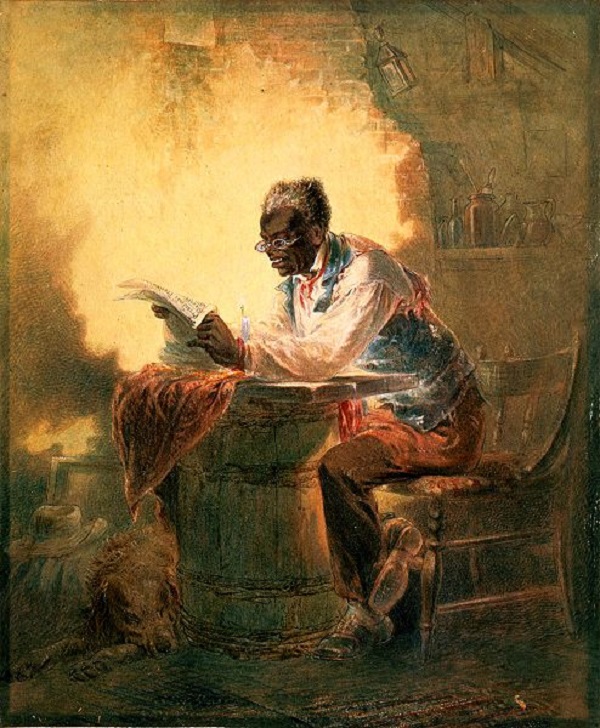
Black Man Reading Newspaper by Candlelight, Henry Louis Stevens
The most important issue: What do the American people want? Reports from outside the Beltway, looking for voter reaction, have been rare. But recent polling makes the answer clear. In one April survey, 73 percent of respondents approved of Biden’s plan to withdraw from Afghanistan. As late as last month, polls showed 57 percent supported ending the war.
In other words, the people who have for the past 20 years been asked to do the fighting — or to send loved ones far away, tour-after-tour, as the conflict dragged on — have said “Enough is enough.” Their voices should count for something, yet their point of view was largely missing from reports out of Washington this past week.
Also largely left unconsidered: Why was the Taliban able to advance so quickly? The story line most often picked up blamed a hasty U.S. withdrawal. It was, according to one headline, “Joe Biden’s Fall of Saigon.”
That comparison actually rings true — but not for the reasons most journalists have settled on. With the passage of time, it became clear that, in large part, South Vietnam fell so quickly because its government simply did not have the support of its people. America’s military presence in Vietnam — over the course of nearly 20 years and 58,000 U.S. combat deaths — was unable to build a political infrastructure that citizens could trust.
The same is true in Afghanistan. We set up a government that the people didn’t like or trust. Read more at the link.
Biden’s Explanation of His Decisions
Biden made his case in a speech yesterday. Here’s a bit of it:
My national security team and I have been closely monitoring the situation on the ground in Afghanistan and moving quickly to execute the plans we had put in place to respond to every constituency, including — and contingency — including the rapid collapse we’re seeing now….
We went to Afghanistan almost 20 years ago with clear goals: get those who attacked us on September 11th, 2001, and make sure al Qaeda could not use Afghanistan as a base from which to attack us again.
We did that. We severely degraded al Qaeda in Afghanistan. We never gave up the hunt for Osama bin Laden, and we got him. That was a decade ago.
Our mission in Afghanistan was never supposed to have been nation building. It was never supposed to be creating a unified, centralized democracy….
I’ve argued for many years that our mission should be narrowly focused on counterterrorism — not counterinsurgency or nation building. That’s why I opposed the surge when it was proposed in 2009 when I was Vice President.
And that’s why, as President, I am adamant that we focus on the threats we face today in 2021 — not yesterday’s threats.
Christopher Wilson We conduct effective counterterrorism missions against terrorist groups in multiple countries where we don’t have a permanent military presence.
If necessary, we will do the same in Afghanistan. We’ve developed counterterrorism over-the-horizon capability that will allow us to keep our eyes firmly fixed on any direct threats to the United States in the region and to act quickly and decisively if needed.
Rosa and Bertha Gugger, 1883, Albert Anker
When I came into office, I inherited a deal that President Trump negotiated with the Taliban. Under his agreement, U.S. forces would be out of Afghanistan by May 1, 2021 — just a little over three months after I took office.
U.S. forces had already drawn down during the Trump administration from roughly 15,500 American forces to 2,500 troops in country, and the Taliban was at its strongest militarily since 2001.
The choice I had to make, as your President, was either to follow through on that agreement or be prepared to go back to fighting the Taliban in the middle of the spring fighting season.
There would have been no ceasefire after May 1. There was no agreement protecting our forces after May 1. There was no status quo of stability without American casualties after May 1.
There was only the cold reality of either following through on the agreement to withdraw our forces or escalating the conflict and sending thousands more American troops back into combat in Afghanistan, lurching into the third decade of conflict.

There’s more at the link but here’s the bottom line.
I stand squarely behind my decision. After 20 years, I’ve learned the hard way that there was never a good time to withdraw U.S. forces….
American troops cannot and should not be fighting in a war and dying in a war that Afghan forces are not willing to fight for themselves. We spent over a trillion dollars. We trained and equipped an Afghan military force of some 300,000 strong — incredibly well equipped — a force larger in size than the militaries of many of our NATO allies.
We gave them every tool they could need. We paid their salaries, provided for the maintenance of their air force — something the Taliban doesn’t have. Taliban does not have an air force. We provided close air support….
And here’s what I believe to my core: It is wrong to order American troops to step up when Afghanistan’s own armed forces would not. If the political leaders of Afghanistan were unable to come together for the good of their people, unable to negotiate for the future of their country when the chips were down, they would never have done so while U.S. troops remained in Afghanistan bearing the brunt of the fighting for them.
Support for Biden’s Arguments
This is from right wing site Axios: Biden officials: Trump left bare cupboard on Afghanistan.
Senior national security officials presiding over a historic foreign policy collapse are privately expressing deep frustrations about the thin Afghanistan withdrawal plans left behind by Donald Trump.
Why it matters: Many experienced operatives in both parties are aghast that President Biden and his team didn’t ready better preparations over nearly seven months since taking office.
- But two Biden officials who spoke with Axios on Monday on condition of anonymity bristled at the criticism coming from former President Trump and his administration in the wake of the Taliban’s rapid sweep across Afghanistan and capture of Kabul.
What they’re saying: “There was no plan to evacuate our diplomats to the airport,” a senior national security official told Axios about the preparations they inherited from the previous administration. “None of this was on the shelf, so to speak.”
- “When we got in, on Jan. 20, we saw that the cupboard was bare,” the official said, echoing a complaint Team Biden also made about Trump’s vaccine distribution plan….
Reading (Clara), circa 1865, Federico Faruffini
Biden officials said that Trump’s team during the transition, was slow to brief them on key details and context behind the 2020 peace agreement signed in Doha.
- That Trump-era deal between the U.S. and the Taliban called for a withdrawal of troops by May 2021.
- Separately, Trump, after losing the election, signed a secret memo to withdraw all troops from Afghanistan before Biden took office, as Axios’ Jonathan Swan and Zachary Basu reported. But after some Trump officials became aware of “an off-the-books operation by the commander in chief himself,” they eventually persuaded Trump to keep some 2,500 troops in Afghanistan.
After all of that, the senior Biden officials said, Trump effectively didn’t have a plan to bring all Americans including troops, contractors and diplomats home safely. One said that created “headwinds” and “unnecessarily increased” the degree of difficulty for the new administration.
- “The entire policy process had atrophied,” one of the officials said. “It was really manifest here.
- “On the one hand, they set a May deadline for withdrawal,” the official said. “On the other hand, there was no interagency planning on how to execute a withdrawal.”
The bottom line: Biden officials aren’t directly blaming Trump for how events unfolded in Kabul.

-
But they do want to challenge what they see as bad-faith arguments from Trump officials making the case that they would have presided over a more orderly withdrawal.
David Rothkopf at The Daily Beast: Biden’s Right That It’s Time for Us to Leave Afghanistan.
Joe Biden did not give the speech his critics wanted to hear when he addressed the nation on the Taliban take-over of Afghanistan. But he gave the speech America needed to hear.
Biden, keenly aware of the impact of the horrifying scenes of chaos in the Afghan capital of Kabul, looked straight into the camera and said, “I am the president of the United States and the buck stops with me.” He acknowledged the mayhem and the human toll it is taking and he expressed his clear anger at the failure of the Afghan government and military to mount a defense of their own country. He specifically noted that the government had urged the U.S. not to begin early evacuations of foreign nationals because of the message it might send.
After he spoke, the talking heads came out in force and argued he did not accept responsibility. But “the buck stops here” is the ultimate expression of a president owning his actions. They said he did not explain how we could be in the situation we are in. But what they really mean is that he did not give the explanation they wanted.
Compartment C, Car 293, 1938, Edward Hopper
CNN’s Jake Tapper called Biden’s description of the swift collapse of the Afghan central government and military “finger pointing.” But it was indeed that collapse that accounted for the speed of the Taliban’s take-over: When the Afghan forces the U.S. has invested billions in should have stood up, they did not. Given that it was widely expected that the Taliban would ultimately seize control of the country — they were, after all, the parties with whom the last administration was negotiating — the key variable was whether the Taliban would meet any resistance.
Biden described the measures being taken to get thousands of embassy employees, US citizens, citizens of allied nations and Afghans who had aiding allied forces out. He reasserted the commitment of the U.S. to using international mechanisms to provide aid to the people of Afghanistan, and stressed that the U.S. would continue to place human rights at the center of our foreign policy priorities.
It would have been heartening to hear him use tougher language with regard to applying international pressure should the rights of women and girls be violated. He should have made a commitment to investigate fully where things went wrong with the exit plan. But he left no uncertainty about our willingness to use force in the event that violent extremists posing a threat to the U.S. again appear within Afghanistan’s borders.

So that’s a counterpoint to the media freakout. I’ll post some of the latest attacks on Biden along with some more reasoned articles in the comment thread. Let me know what you think, and remember this is an open thread.
Monday Reads: Goodnight Kabul
Posted: August 16, 2021 Filed under: morning reads | Tags: Afghan War, Fall of Kabul, Fall of Saigon 43 Comments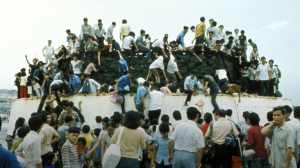
Nik Wheeler/Corbis/Getty Images The conflict in Vietnam ended in 1975 with the largest helicopter evacuation of its kind in history.
Good Morning Sky Dancers!
Well, this is a sight I thought I’d never see again, but then, back in 2001, I really expected a complete failure in the Afghanistan theatre eventually. We join some of the greatest armies of their time in that failure. History never teaches much to chickenhawks like Dick Cheney, who dodged the draft with five deferments. Unlike Cheney, Donald Rumsfeld actually had a three-year stint in the military about when I was born. He was a navy pilot and instructor. Rumsfeld was basically the failed architect of the seemingly endless war in Afghanistan and recently died, so he doesn’t have to see the fall of Kabul unless in his particular hell realm they have CNN on an endless loop.
I was at university when Saigon fell. Like everything else about the Vietnam war, it was televised during your mealtimes. I asked my ex-husband if this meant I could finally burn his draft card. He held onto it for a while before I finally took it and incinerated it in a fired-up grill.
The dulcet tones of “White Christmas” that crackled over Armed Forces Radio airwaves on April 29, 1975, failed to spread cheer across sunbaked Saigon. Instead, the broadcast of the holiday standard after the announcement that “the temperature in Saigon is 105 degrees and rising” instilled fear and panic in all who recognized the coded signal to begin an immediate evacuation of all Americans from Vietnam.
Although the United States had withdrawn its combat forces from Vietnam after the signing of the Paris Peace Accords in 1973, approximately 5,000 Americans—including diplomats, marine guards, contractors and Central Intelligence Agency employees—remained. President Richard Nixon had secretly promised South Vietnam that the United States would “respond with full force” if North Vietnam violated the peace treaty. However, after the Watergate scandal forced Nixon to resign, the North Vietnamese Army felt emboldened to launch a major offensive in March 1975.
“From Hanoi’s point of view, the turmoil leading up to and including Nixon’s resignation was an opportunity to take advantage of a distracted United States,” says Tom Clavin, co-author of Last Men Out: The True Story of America’s Heroic Final Hours in Vietnam. “North Vietnam never intended to abide by the 1973 agreement—its ultimate mission was to unify the country—but the political crisis in America allowed them to move up their timetable.”
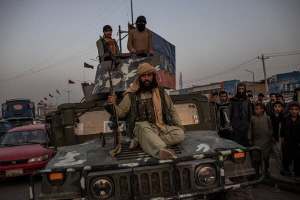
Taliban fighters in Kabul, the capital, on Sunday on a Humvee seized from Afghan forces. The speed of the Taliban’s sweep through the country startled American officials. Credit…Jim Huylebroek for The New York Times
The Bodega on the corner is run by a family around my age. There is a grandmother and a grandson. I’ve never really asked the grandmother or the parents about Vietnam, but I know they are part of the large diaspora of South Vietnamese that landed here. My French teacher was in Saigon when it fell. I’ve seen his photos and listened to his stories, although I’m not really sure how he and his Vietnamese bride got out of there. It’s actually getting difficult to find Vietnamese Veterans these days who will share their stories. But they’re out there still.
What will we say about the Fall of Kabul 45 years from now? I’ll not be around for that, but my children and grandchildren will, climate change willing. The Taliban swept through the country and took Kabul on Sunday. From the New York Times: “Kabul’s Sudden Fall to Taliban Ends U.S. Era in Afghanistan. A takeover of the entire country was all but absolute as the Afghan government collapsed and the U.S. rushed through a frenzied evacuation.”
Taliban fighters poured into the Afghan capital on Sunday amid scenes of panic and chaos, bringing a swift and shocking close to the Afghan government and the 20-year American era in the country.
President Ashraf Ghani of Afghanistan fled the country, and a council of Afghan officials, including former President Hamid Karzai, said they would open negotiations with the Taliban over the shape of the insurgency’s takeover. By day’s end, the insurgents had all but officially sealed their control of the entire country.
The speed and violence of the Taliban sweep through the countryside and cities the previous week caught the American military and government flat-footed. Hastily arranged American military helicopter flights evacuated the sprawling American Embassy compound in Kabul, ferrying American diplomats and Afghan Embassy workers to the Kabul military airport. At the civilian airport next door, Afghans wept as they begged airline workers to put their families on outbound commercial flights even as most were grounded in favor of military aircraft.
Amid occasional bursts of gunfire, the whump of American Chinook and Black Hawk helicopters overhead drowned out the thrum of traffic as the frenzied evacuation effort unfolded. Below, Kabul’s streets were jammed with vehicles as panic set off a race to leave the city.
Two decades after American troops invaded Afghanistan to root out Qaeda terrorists who attacked on Sept. 11, 2001, the American nation-building experiment was in ruins — undercut by misguided and often contradictory policies and by a relentless insurgency whose staying power had been profoundly underestimated by U.S. military planners.
More than 2,400 American troops gave their lives and thousands more were wounded in an effort to build a democratic Afghan government. Tens of thousands of civilians died in the fighting, and thousands more were displaced from their homes. In recent days alone, thousands fled to Kabul as the Taliban advanced through other cities at breakneck speed.
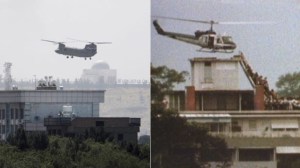
Evacuation of Kabul (Left) and Fall of Saigon (Right). Picture: Collected
This entire 20-year ordeal didn’t have to happen. Much like I still can’t figure out what the hell the point of the Vietnam “conflict’ was about. This New York Times Analysis offers some insight: ” Taliban Sweep in Afghanistan Follows Years of U.S. Miscalculations. An Afghan military that did not believe in itself and a U.S. effort that Mr. Biden, and most Americans, no longer believed in brought an ignoble end to America’s longest war.”
President Biden’s top advisers concede they were stunned by the rapid collapse of the Afghan army in the face of an aggressive, well-planned offensive by the Taliban that now threatens Kabul, Afghanistan’s capital.
The past 20 years show they should not have been.
If there is a consistent theme over two decades of war in Afghanistan, it is the overestimation of the results of the $83 billion the United States has spent since 2001 training and equipping the Afghan security forces and an underestimation of the brutal, wily strategy of the Taliban. The Pentagon had issued dire warnings to Mr. Biden even before he took office about the potential for the Taliban to overrun the Afghan army, but intelligence estimates, now shown to have badly missed the mark, assessed it might happen in 18 months, not weeks.
Commanders did know that the afflictions of the Afghan forces had never been cured: the deep corruption, the failure by the government to pay many Afghan soldiers and police officers for months, the defections, the soldiers sent to the front without adequate food and water, let alone arms. In the past several days, the Afghan forces have steadily collapsed as they battled to defend ever shrinking territory, losing Mazar-i-Sharif, the country’s economic engine, to the Taliban on Saturday.
Mr. Biden’s aides say that the persistence of those problems reinforced his belief that the United States could not prop up the Afghan government and military in perpetuity. In Oval Office meetings this spring, he told aides that staying another year, or even five, would not make a substantial difference and was not worth the risks.
In the end, an Afghan force that did not believe in itself and a U.S. effort that Mr. Biden, and most Americans, no longer believed would alter the course of events combined to bring an ignoble close to America’s longest war. The United States kept forces in Afghanistan far longer than the British did in the 19th century, and twice as long as the Soviets — with roughly the same results.
No matter how much you call it ‘nation-building,’ it still winds up to be colonization. That part of the world has had its history full of that. Please read this thread. I unrolled it here. It documents–in 7 tweets with sources–why it should’ve never happened.
So, there will be a lot more happening, and I’m sure the discussion will be brisk. Please add anything interesting you’ve read on seen or your thoughts, please!
What’s on your reading and blogging list?

 peej
peej Carissa
 bostonboomer
 dakinikat
 ecocatwoman
 jjlo
jjlo mablue2
 Mama Lopez
 peggysue22
 quixote
 skydancingguestblogger
 Mona (aka Wonk the Vote)





Recent Comments