Geoff Bennett:
So, first, let’s start with a bit of a reality check. How feasible is it for Donald Trump to fundamentally change the autonomy of the Fed and change the relationship between the Federal Reserve and the president if he is reelected?


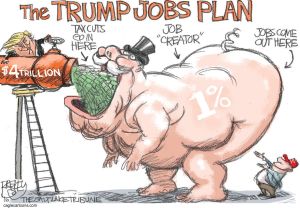
“Jobs, jobs, Jobs!” John Buss, @johnbuss.bsky.social
Regime changes haven’t happened yet, but businesses are already planning major layoffs, freezes, and price increases. That signals a type of economy we haven’t seen for a while. It’s called stagflation. For those of us who lived through that, you’ll remember the pain that went from the Nixon years to the Reagan years. It includes painful unemployment and rabid inflation. We just have to hope that the plans to take political control of the Fed don’t come to fruition. The current Fed Chair says he will not resign. That doesn’t even include the conversation about the massive removal of Federal workers and the deportation of the migrants that would have a devastating impact on the farm and most service industries.
Did I use enough citations for you? Let’s look at a few of them but I’ll get to the bottom line. Pay off all your debt as much as possible. Don’t take on anything that requires financing. Interest rates will go up as inflation returns. The entire thing is a vicious circle we learned much about in the 1970s. The 1980s taught us that tax cuts for the rich only drive up the deficit. Get ready for a repeat of that on steroids.
Traditional Republicans have always been migrant-friendly. However, that’s back when they were more focused on getting the business donors enriched and less worried about things like “poisoning the blood” and blaming them for statistically nonexistent problems, like crime and eating pets. However, that was before the rise of the Christofascists and the NAZIs ushered in MAGA.
The Brookings Institute reviewed recent peer-reviewed research in economics in September that shows exactly how devastating the cost of these deportations will be. That does not even cover the psychological and emotional trauma to communities forced to witness the round-up of their neighbors to massive concentration camps. This is a must-read. Chloe East is the researcher.
Increased deportation is associated with poorer economic outcomes for US-born workers
Across multiple studies, economists have found that once SC is implemented, the number of foreign-born workers in that county declines and the employment rate among U.S.-born workers also declines. My research with Annie Hines, Philip Luck, Hani Mansour, and Andrea Velásquez finds that when half a million immigrants are removed from the labor market because of enforcement (due to deportations and indirectly due to chilling effects), this reduces the number of U.S.-born people working by 44,000.
Why do deportations hurt the economic outcomes of U.S.-born workers? The prevailing view used to be that foreign-born and U.S.-born workers are substitutes, meaning that when one foreign-born worker takes a job, there is one less job for a U.S.-born worker. But economists have now shown several reasons why the economy is not a zero-sum game: because unauthorized immigrants work in different occupations from the U.S.-born, because they create demand for goods and services, and because they contribute to the long-run fiscal health of the country.
First, unauthorized immigrant workers and U.S.-born workers work in different types of jobs. Figure 1 shows the percentage of unauthorized immigrant workers, authorized immigrant workers, and U.S.-born workers that are in each of the 15 most common occupations among unauthorized immigrants.
It is clear that unauthorized immigrants take low-paying, dangerous and otherwise less attractive jobs more frequently than both U.S.-born workers and authorized immigrant workers. For example, almost 6% of unauthorized immigrants work as housekeepers, construction laborers, or cooks, compared to about 2% of authorized immigrant workers and 1% of U.S.-born workers (See Figure 1).
Occupations common among unauthorized workers, such as construction laborers and cooks, are essential to keep businesses operating. Deporting workers in these jobs affects U.S.-born workers too. For example, when construction companies have a sudden reduction in available laborers, they must reduce the number of construction site managers they hire. Similarly, local restaurants need cooks to stay open and hire for other positions like waiters, which are more likely to be filled by U.S.-born workers.
Caregiving and household service jobs are also common among unauthorized immigrants. The availability and cost of these services in the private market greatly impacts whether people can work outside the home. My research with Andrea Velásquez and new research by Umair Ali, Jessica Brown and Chris Herbst find that Secure Communities impacted the childcare market—the supply of childcare workers fell. This led to a reduction in the number of college-educated mothers with young children working in the formal labor market.
 You’ll notice women bear the brunt of this policy, but it goes nicely into the plan to get women back into the kitchen. Please read about the impact of the deportation in 2008 that happened in South Carolina, called the SC Act or Secure Communities Act. The details are gruesome but here’s the bottom line in a move to deport 400,000 people in a limited area.
While only people who were arrested had their immigration status checked under SC, the policy nonetheless impacted a large portion of immigrants. There were broad “chilling effects” of the policy that meant even people not targeted for deportation became fearful of leaving their house to do routine things like go to work. This is partly because the program did not only target serious criminals—the most serious criminal conviction for 79% of those deported was non-violent, including traffic violations and immigration offenses, and another 17% were not convicted of any crime.
An article that appeared in Mother Jones, also last September, details the devastation that will come if mass deportation happens. Isabela Diaz provides the analysis. “How Trump’s “Mass Deportation” Plan Would Ruin America. It would be brutal, costly, and likely illegal.”
This time around, they plan to invoke an infamous 18th-century wartime law, deploy the National Guard, and build massive detention camps—and intend on reshaping the federal bureaucracy to ensure it happens, drafting executive orders and filling the administration with loyalists who will quickly implement the policies. “No one’s off the table,” said Tom Homan, the former acting director of US Immigration and Customs Enforcement (ICE) under Trump. “If you’re in the country illegally, you are a target.”
If Trump and his allies have it their way, armed troops and out-of-state law enforcement would likely blitz into communities—knocking on doors, searching workplaces and homes, and arbitrarily interrogating and arresting suspected undocumented immigrants. The dragnet would almost certainly ensnare US citizens, too.
The nation’s undocumented immigrants grow and harvest the food we eat, construct our homes, and care for our young and elderly. They pay billions in taxes, start businesses that employ Americans, and help rebuild in the wake of climate disasters.
Not only would Trump’s plan rip families and communities apart, but it also would have devastating effects for years to come, including on US citizens who perhaps have overlooked how integral undocumented immigrants are to their everyday life. Trump frames immigration as an existential threat to the United States. He has said immigrants are “taking our jobs,” are “not people,” and are “poisoning the blood of our country.” The reality is that if his plan were implemented, American life as we know it would be ruined—even for those cheering for mass deportation.
 This will be in the hands of many of the folks who say they’re Christians but miss a major cultural value in both the Old and New Testaments. I was raised Presbyterian, attended my best friend’s Lutheran Church, baptized my girls in the Methodist church, and taught a large number of Sunday School classes. I’m not unfamiliar with the Bible. Matthew was my favorite of all. Whenever you ask me about my favorite verses, I’ll quote the Beatitudes and anything from Matthew or James. Trump is an actor, and his piety display is just an act.
Matthew 25:31-40Jesus says, “I was a stranger, and you welcomed me,” and “Truly, I say to you, as you did it to one of the least of these my brothers, you did it to me.”
Numbers 15:16The Bible says, “I am the Lord, and I consider all people the same, whether they are Israelites or foreigners living among you”.
Here’s a study cited in the Mother Jones article.
According to a 2016 report by the Center for American Progress, deporting 7 million workers would “reduce national employment by an amount similar to that experienced during the Great Recession.” GDP would immediately contract by 1.4 percent, and, eventually, by 2.6 percent. In 20 years, the US economy would shrink nearly 6 percent—or $1.6 trillion. Trump’s plan would lead to a dire shortage of low-wage workers, which would “bring on a recession while reigniting inflation,” predicts Robert J. Shapiro, a former undersecretary of commerce in the Clinton administration.

The costs of mass deportation will be devastating. Here is another study on the costs from The American Immigration Council.
“Using data from the American Community Survey (ACS) along with publicly-available data about the current costs of immigration enforcement, this report aims to provide an estimation of what the fiscal and economic cost to the United States would be should the government deport a population of roughly 11 million people who as of 2022 lacked permanent legal status and faced the possibility of removal. We consider this both in terms of the direct budgetary costs—the expenses associated with arrest, detention, legal processing, and removal—that the federal government would have to pay, and in terms of the impact on the United States economy and tax base should these people be removed from the labor force and consumer market.
In terms of fiscal costs, we also include an estimate of the impact of deporting an additional 2.3 million people who have crossed the U.S. southern border without legal immigration status and were released by the Department of Homeland Security (DHS) from January 2023 through April 2024. We consider these fiscal costs separately because we don’t have more recent ACS data necessary to estimate the total net changes in the undocumented population past 2022, or the larger impact on the economy and tax base of removing those people, an impact that is therefore not reflected in this report.
In total, we find that the cost of a one-time mass deportation operation aimed at both those populations—an estimated total of is at least $315 billion. We wish to emphasize that this figure is a highly conservative estimate. It does not take into account the long-term costs of a sustained mass deportation operation or the incalculable additional costs necessary to acquire the institutional capacity to remove over 13 million people in a short period of time—incalculable because there is simply no reality in which such a singular operation is possible. For one thing, there would be no way to accomplish this mission without mass detention as an interim step. To put the scale of detaining over 13 million undocumented immigrants into context, the entire U.S. prison and jail population in 2022, comprising every person held in local, county, state, and federal prisons and jails, was 1.9 million people.
In order to estimate the costs of a longer-term mass deportation operation, we calculated the cost of a program aiming to arrest, detain, process, and deport one million people per year—paralleling the more conservative proposals made by mass-deportation proponents. Even assuming that 20 percent of the undocumented population would “self-deport” under a yearslong mass-deportation regime, we estimate the ultimate cost of such a longer operation would average out to $88 billion annually, for a total cost of $967.9 billion over the course of more than a decade. This is a much higher sum than the one-time estimate, given the long-term costs of establishing and maintaining detention facilities and temporary camps to eventually be able to detain one million people at a time—costs that could not be modeled in a short-term analysis. This would require the United States to build and maintain 24 times more ICE detention capacity than currently exists. The government would also be required to establish and maintain over 1,000 new immigration courtrooms to process people at such a rate.”
How’s that for dismantling the state and getting rid of Federal Workers? It sounds like a bit of hypocrisy to me.
There’s that stagflation prognosis again. That was the time of the economy in 1980 when I got my first house fixed rate loan at 16.7%, which was only one of three mortgage loans made that month at the largest Savings Loan in the heartland. I worked there so they gave me a discount down to 12%. Let’s see all those young people trying to buy their houses in that environment. My loan now is fixed at 3%. Thank you, Obama!
One of the worst possible things that could happen is allowing politics back into Fed Policy. This was a problem that was fixed by law because obvious presidential interference generally led to low interest rates that brought more inflation. I have purposefully used a conservative-bent economist for this analysis. “The Economic Consequences of Political Pressure on the Federal Reserve.” Elonia is hot for this pogrom. Tell me again, who thinks that Nepobaby is brainy? Again, if you lived through the dread of Nixon’s years, you’ll remember the inflation he brought trying to get the Fed to loosen interest rates during a period of inflation. It wasn’t pretty.
The data on personal interactions by themselves are at best a noisy measure of political interference with the Fed. For example, in a recession the president might be more likely to contact the Fed chair and ask them about their view on the economy. In this instance, personal interactions would increase, but not because they reflect political pressure.
To overcome this identification challenge, I exploit an increase in president–Fed interactions that plausibly took place purely for the purpose of influencing Fed policy and arguably had an impact on the stance of monetary policy. In his desire to be re-elected in 1972, Richard Nixon pressured Arthur Burns to ease monetary policy in 1971. Burns, a Republican and friend to Nixon, reportedly gave in to Nixon’s pressure.
A variety of external evidence corroborates this interpretation of the Nixon–Burns clash, including recordings from the “Nixon tapes” and entries in Arthur Burns’ personal diary. For example, Burns writes in his diary that Nixon urged him “start expanding the money supply and predicting disaster if this didn’t happen.” To support the interpretation that Burns eased policy in response to Nixon’s pressure, I show that Romer and Romer (2004) uncover easing shocks to monetary policy prior to Nixon’s re-election. I also present supporting evidence from the voting behavior of the FOMC.
I exploit the narrative around Nixon’s pressure in a structural vector autoregression (SVAR) that contains the president–Fed interactions as well as standard macro data. I identify a shock to political pressure on the Fed based on narrative sign restrictions. Specifically, I define a political pressure shock as an increase in president-Fed interactions that eases policy in an inflationary way and constitutes the main contributor to the spike in president–Fed interactions in late 1971.
Yes. This is the kind of thing I do for my research. Just go look at the graphs. They speak volumes.
The number of president–Fed interactions displays persistence after the political pressure shock hits, with the IRF reversing to closes 0 after around two years. The shock induces a monetary easing, with a roughly 100 basis points lower interest rate after a few quarters. The price level response to the shock builds up gradually and persistently and reaches a 5% higher price level after four years. These estimates imply that exerting political pressure 50% as much as Nixon did, over a period of six months, permanently increases the US price level by more than 8%.
The responses of real GDP and fiscal variables are not distinguishable from zero. This finding indicates that political pressure primarily induces a price level effect. It turns out that in some subsamples (not shown here), it is possible to detect a significant response of real GDP, but this response is actually negative.

This cartoon is actually from the American Enterprise Institute. This shows you have far Republican Politicians have actually gotten from actual Economics.
That’s a dismal scientist telling you that all hell breaks loose whenever an American President tries to influence the Fed. Nixon wanted to win the reelection and pressured the Fed to drop interest rates, which caused massive inflation. eventually, we got unemployment, and that’s stagflation. That’s what poor Jimmy Carter inherited. The Tax Cuts for the Rich narrative through the Reagan years was even worse. I was studying economics at the time and became an economic analyst for that Savings and Loan that went bankrupt because of that policy. (I surprised them with that data, the first of many times I was the brains of a clueless CEO.) When the Reagan administration pulled off the usury laws, we got a financial crisis in 1984, which later looked mild compared to the one Dubya brought on in 2008, also known as the SubPrime Crisis.
NPR unravels the plan that Trump has to control the Fed. “How Trump’s wish for more Federal Reserve control could impact economy if he’s reelected.”
Geoff Bennett:
So, first, let’s start with a bit of a reality check. How feasible is it for Donald Trump to fundamentally change the autonomy of the Fed and change the relationship between the Federal Reserve and the president if he is reelected?
Krishna Guha:
Well, it’s complicated.
So, first off, for President Trump, if reelected, could certainly let his views on monetary policy be known loudly and including through social media and other nonconventional channels. He could try to do what’s called jawboning, leaning on the Fed in public to take certain actions on interest rates.
Actually changing the institutional independence of the Fed, that’s more challenging. The Fed’s independence is enshrined in the act of Congress the Federal Reserve Act, and that makes the chairman, for instance, removable as generally understood, only for a cause, which would mean something pretty extreme to make him unfit for office.
The president can’t simply appoint additional members to the Federal Reserve Board. He’d have to wait until vacancies became available and those only become available very slowly. So it would be tough. Now, there is one complication, and that is that it is somewhat unsettled as to what the exact legal status of the Fed chair is and whether the president might have some legal grounds for being able to dismiss a Fed chair.
That’s not something that I think any mainstream lawyer or central banker believes is right, but it hasn’t been fully tested in the courts. And so there’s some outside possibility that the president could attempt to assert an authority over the Fed chair that has not been understood to be there.
Geoff Bennett:
If we look to other countries or look back in this country’s own history, what does it tell us? Does a Central Bank that remains independent from political influence, does that yield better monetary policy and better macroeconomic decision-making?
Krishna Guha:
There’s just very, very strong evidence from the U.S. itself and from countries around the world that independent central banks tend to achieve better economic outcomes.
And that ultimately doesn’t just benefit society, doesn’t just benefit the economy. It, in the end, tends to benefit the president as well. And so I think there’s actually a lot of good reason why it would be not to try to assault the independence of the Central Bank.
Geoff Bennett:
Critics have blasted the Fed for being too slow to respond to inflation. And there will certainly be folks who say, why is it such a bad thing to have the Fed accountable to someone, accountable to the executive branch?
Krishna Guha:
So, you raise a really important issue there, Fed accountability.
Now, Fed officials past and present will say, absolutely, the Fed must be accountable. But under our system of government, the Fed is accountable to Congress, not the executive branch. The Fed is a creature of Congress. The Fed chair goes to Congress to testify. He’s grilled by members of the Senate. He’s grilled by members of the House.
That is the way that our system of accountability is set up. And it’s the way that it’s worked very well in recent decades. That doesn’t mean that the Fed is always going to get everything right. Of course not. The issue is simply, would you have more confidence that the Fed would get things about right most of the time if it was more insulated from short-term political pressures, or do you think that political pressures are going to make them do a better job?
I think most people have a pretty intuitive grasp of what the answer to that question would be.
 Again, Powell says he will not resign. That gives us about another year where monetary policy can offset this craziness. This is from CBS. “Fed Chair Jerome Powell says he won’t resign if Donald Trump asks him to step down.”
Federal Reserve Chair Jerome Powell said he won’t step down if President-elect Donald Trump, who has previously criticized Powell’s performance, asks him to resign.
Speaking at a press conference Thursday to discuss the Fed’s move today to cut its benchmark interest rate by 0.25 percentage points, Powell added that it is not permitted under the law for presidents to fire or demote the Fed chair.
When asked if he’d step down if Trump requested it, Powell responded with a one-word answer: “No.”
Powell’s insistence that he’ll remain in his role comes after Trump aired grievances about the Fed’s decision-making during his first presidency and, more recently, on the campaign trial. Trump, who has accused Powell of being “political,” also told Bloomberg Businessweek this summer he would let the economist serve out his term, “especially if I thought he was doing the right thing.”
Yet Trump has also said he thinks the U.S. president should have more influence on Fed decisions.
Are you asleep yet or is your hair on fire like mine? And again, here are the massive layoffs and hiring freezes now planned for 2025. “A running list of companies preparing to raise prices if Trump’s trade plan is enacted.” This is from Business Insider. The analysis is provided by Ayelet Sheffey. It’s from a few days ago.
President-elect Donald Trump proposed broad tariffs on imports, including up to 60% on goods from China.
Economists say his proposals could spike inflation as companies tend to pass costs on to shoppers.
Some companies have already said increased tariffs would lead them to raise prices.
Some executives have warned that price hikes are on the way if President-elect Donald Trump’s trade plans go into effect.
On the campaign trail, Trump proposed a 60% tariff on goods imported from China coupled with a 10% to 20% tariff on goods imported from other countries. While the president-elect could choose not to enact tariffs at that scale once he assumes office, economists and the market have predicted that his proposals would spike inflation and cause the Federal Reserve to raise interest rates.
Several companies have already begun responding to Trump’s election victory and the implications his tariff proposals would have on the costs of their goods. Executives have told analysts on earnings calls that it would be difficult to maintain current prices under Trump’s broad tariffs.
Other companies are still waiting for more information from the president-elect. Tarang Amin, the CEO of ELF Beauty, told Business Insider that the company must first see the policy Trump enacts before making any changes to its pricing and that a new policy wouldn’t affect the business until after its 2025 fiscal year.
“We don’t like tariffs because they are a tax on the American people,” Amin said, adding that the company had been subject to a 25% tariff since 2019 because of policies from Trump’s first term. “And at that time,” he said, “we pulled all the levers available to us to minimize the effects to our company and our community.”
Karoline Leavitt, a Trump-Vance transition spokeswoman, told BI: “In his first term, President Trump instituted tariffs against China that created jobs, spurred investment, and resulted in no inflation.” She added that Trump will “work quickly” to lower taxes and create more American jobs.
Below are the companies that are warning of price increases if Trump’s tariff proposals are implemented.
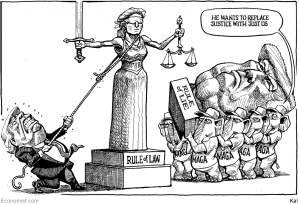 Before I went completely into economics, I was a history major. We’ve done this before. The Smoot-Hawley Tariff Act of 1930 raised import duties on more than 20,000 goods and agricultural imports to protect U.S. businesses and farmers. Hoover signed it into law. It made the Great Depression worse. Don’t these whackadoodle schools teach History and Civics anymore?
Before every major recession we’ve had since 1984, I’ve always found myself running around going what are these idiots smoking? I’ve fled to safety and minimized my losses. Ronald Reagan’s folly basically wiped out my first IRA and my Dad’s retirement portfolio. But, I always did better than everyone else because if you’re just an economics teacher living a normal life and not privy to all the insider muckety muck, you do that. I remember the manager for my Louisiana 403B was amazed I held my losses to a lower percentage than anyone else at the USL. I was not amused. A loss is a loss, and I’m definitely paying for those years now as I was then.
Just buckle up. This is going to be a very chaotic ride. Prepare for the worst. Again, the best thing you can do is pay the debt off and not add any more, if possible. I am also expanding my small food garden and orchard. I’m not sure if Congress is up to the test of its checks and balances, so this is not looking good. Also, remember how long it took to get out of Nixon’s mess. We really didn’t recover completely until the Clinton years.
The two pieces of news we also have today is that Matt Gaetz quit the AG cabinet appointment. He says he’s not going back to Congress. Speculation is that he will still have a political appointment in the administration, just one that doesn’t take Senate approval. Pam Bondi, who he once bribed to stop her from filing a suit against his phony university and who is basically one of his personal attorneys is now the nominee.
What’s on your reading and blogging list today?

Evil clown Trump
I had another sleepless night last night. It seems as if I have insomnia every 2-3 days; then I end up feeling exhausted for a couple of days and having to take naps to make up for the lost sleep. Of course it’s Trump’s fault. I didn’t sleep well during his first term, and now that I know what to expect–chaos, drama, and malevolence–I’m pretty sure my sleep will continue to be disturbed. Anyway, I don’t have much energy today. I just hope I don’t fall asleep on my computer keyboard.
Here’s the latest on Trump’s nightmarish Cabinet picks.
Josh Gerstein at Politico: Vance says Trump is interviewing FBI director replacements.
President-elect Donald Trump’s plans to end business-as-usual at the Justice Department apparently include replacing FBI Director Christopher Wray, Vice President-elect JD Vance indicated in a social media post on Tuesday.
Vance revealed he and the president-elect were conducting interviews for the crucial FBI position in a since-deleted post on X. The post was responding to criticism the vice president-elect received for missing a Monday Senate vote that confirmed one of President Joe Biden’s judicial nominees to the Atlanta-based 11th Circuit Court of Appeals.
“When this 11th Circuit vote happened, I was meeting with President Trump to interview multiple positions for our government, including for FBI Director,” Vance wrote. “I tend to think it’s more important to get an FBI director who will dismantle the deep state than it is for Republicans to lose a vote 49-46 rather than 49-45. But that’s just me.”
Trump nominated former federal prosecutor and Justice Department official Christopher Wray as FBI director in 2017 after abruptly firing his predecessor, James Comey.
However, in recent years, Trump and many in his orbit have soured on Wray, alleging that he hasn’t done enough to root out alleged corruption and political bias at the law enforcement agency. They also fault Wray for allowing his agents to participate in the court-ordered search at Mar-a-Lago in August 2022 that led to Trump’s prosecution on charges of hoarding classified documents and obstruction of justice.
It’s looking like Trump will nominate Kash Patel as FBI director. Patel is the guy who defended Trump in the stolen documents scandal, claiming that Trump could declassify any document by just thinking about it.
Hugo Lowell at The Guardian: Trump loyalist Kash Patel in contention to be named FBI director.
Donald Trump is keeping his controversial adviser Kash Patel in the running to be the next FBI director, according to two people familiar with the matter, as the transition team conducted interviews for the role on Monday night at the president-elect’s Mar-a-Lago club.
The existence of the interviews, made public in a since-deleted post by the vice president-elect JD Vance, underscored the intent to fire the current FBI director, Christopher Wray, years before his current term is up….
Trump has a special interest in the FBI, having fired James Comey as director in 2017 over his refusal to close the investigation into possible collusion between the Trump campaign and Russia, and then complaining about perceived disloyalty from Wray.
Clown Torture by Bruce Nauman
Patel’s continued position as a top candidate for the role makes clear Trump’s determination to install loyalists in key national security and law enforcement positions, as well as the support Patel has built up among key Trump allies.
The push for Patel – who has frequently railed against the “deep state” – has come from some of the longest-serving Trump advisers, notably those close to former Trump strategist Steve Bannon, a faction that got Trump’s personal lawyers picked for top justice department roles.
That faction has also suggested to Trump in recent days that if Patel gets passed over for the director role, he should be given the deputy FBI director position, one of the people said – a powerful job that helps run the bureau day to day and is crucially not subject to Senate confirmation.
Click the link to read more about Patel. Basically, he’s a whack job and utterly loyal to Trump.
As everyone knows Trump has nominated Matt Gaetz for Attorney General. Here’s the current drama over the pick.
NOTUS: Trump Is Calling Senators on Behalf of Matt Gaetz. It’s Not Going Well.
As Republicans circle the wagons around Matt Gaetz and his nomination to be attorney general, Donald Trump and his surrogates have started calling GOP senators to feel them out on the confirmation battle.
The calls are not going well.
According to three sources familiar with the conversations, Trump and his team are receiving an overwhelmingly negative reaction with regard to Gaetz. One of the sources told NOTUS that multiple senators have even told Trump and his team they won’t be voting to confirm.
There has been a healthy amount of skepticism about Gaetz becoming attorney general since the moment Trump announced his nomination. But the recent controversy over an Ethics Committee report that Gaetz dodged by resigning from Congress has only compounded the problems.
“This fake news will age poorly when Matt Gaetz is sworn in as the Attorney General,” said Alex Pfeiffer, a Trump transition spokesperson.
Given the conversations, there’s growing doubt that Gaetz can actually be confirmed — either by the Senate or through a recess appointment.
“Matt Gaetz is toxic among House Republicans. Among Senate Republicans, he is radioactive,” one of the sources told NOTUS.
GOP senators themselves have intimated that Gaetz will have to go through the normal confirmation process and they have expressed that to Trump.
Will Steakin at ABC News: Gaetz sent over $10K in Venmo payments to 2 women who testified in House probe, records suggest.
The House Ethics Committee obtained records, including a check and records of Venmo payments, that appear to show that then-Rep. Matt Gaetz paid more than $10,000 to two women who were later witnesses in sexual misconduct probes conducted by both the House and the Justice Department, according to documents obtained by ABC News.
The Venmo records show that between July 2017 and late January 2019, Gaetz — who was first elected in 2016 — allegedly made 27 Venmo payments totaling $10,224.02 to the two witnesses, who were over the age of 18 at the time.
Scary Clown, by Jennifer Anthony
The payments, which sources said were displayed during closed-door testimony, ranged from $100 to more than $700 each….
ABC News previously reported that House investigators had subpoenaed Venmo for Gaetz’s records and had been showing them to witnesses, asking if they were for sex or drugs. The Venmo records totaling over $10,000 in payments were shown to the witnesses, who testified that some of the payments were from Gaetz and were for sex, a source familiar with the investigation told ABC News.
Gaetz, who was tapped last Wednesday by President-elect Donald Trump to serve as attorney general in the incoming administration, resigned from the House immediately following Trump’s announcement, just days before the House Ethics Committee was to set to consider releasing a report on its investigation into the Florida congressman, according to sources.
Michael Kaplan at CBS News: “Unknown and unauthorized third party” has gained access to Matt Gaetz depositions, source says.
An “unknown and unauthorized third party” has gained access to two dozen depositions of witnesses tied to the various investigations into former Rep. Matt Gaetz of Florida, CBS News has learned.
The leaked materials are part of a civil defamation case filed by Chris Dorworth, a lobbyist who is close to Gaetz. These materials include the sworn deposition of the minor with whom Gaetz allegedly had sex.
According to a source familiar with the matter and an email viewed by CBS News, the person who gained access went by the name “Altam Beezley.” [….]
Gaetz was under investigation by the House Ethics Committee and Justice Department, though federal prosecutors declined to bring charges against him last year. The Ethics panel was looking into allegations the former congressman engaged in sexual misconduct and illicit drug use, among other accusations….
An “unknown and unauthorized third party” has gained access to two dozen depositions of witnesses tied to the various investigations into former Rep. Matt Gaetz of Florida, CBS News has learned.
The leaked materials are part of a civil defamation case filed by Chris Dorworth, a lobbyist who is close to Gaetz. These materials include the sworn deposition of the minor with whom Gaetz allegedly had sex.
According to a source familiar with the matter and an email viewed by CBS News, the person who gained access went by the name “Altam Beezley.” [….]
Gaetz was under investigation by the House Ethics Committee and Justice Department, though federal prosecutors declined to bring charges against him last year. The Ethics panel was looking into allegations the former congressman engaged in sexual misconduct and illicit drug use, among other accusations. But Gaetz resigned his seat in the House last week after President-elect Donald Trump announced he had selected the Florida Republican to serve as his attorney general….
Because Gaetz is no longer a House member, the Ethics Committee’s jurisdiction over him has ended.
At The New York Times, Maggie Haberman and Jonathan Swan have a theory about why Trump is offering so many insane candidates: Gaetz May Not Be Confirmed, Trump Admits. He’s Pushing Him and Others Anyway.
In his private conversations over the past few days, President-elect Donald J. Trump has admitted that his besieged choice for attorney general, Matt Gaetz, has less than even odds of being confirmed by the Senate.
But Mr. Trump has shown no sign of withdrawing the nomination, which speaks volumes about his mind-set as he staffs his second administration. He is making calls on Mr. Gaetz’s behalf, and he remains confident that even if Mr. Gaetz does not make it, the standard for an acceptable candidate will have shifted so much that the Senate may simply approve his other nominees who have appalled much of Washington.
Clown, by Rosy Fernandez-Diaz
Mr. Trump’s choice to lead health and human services has made baseless claims about vaccines. His selection for defense secretary is a former Fox News host whose leadership experience has been questioned. His nominee for the director of national intelligence is a favorite of Russian state media.
Presidents do not normally approach cabinet selections this way. Historically, they work with their teams to figure out in advance what the system will tolerate, eliminating the possibility that skeletons in the closet of a nominee might emerge during Senate hearings.
Mr. Trump largely followed this risk-averse approach at the start of his first term. He appointed people like the four-star general Jim Mattis, who was confirmed with a 98-to-1 bipartisan vote to be Mr. Trump’s first defense secretary.
But this time, emboldened by victory and the submission of the Republican Party, Mr. Trump is innovating. He is using an approach that has been discussed in the past for judicial nominees, which is nominating so many extreme choices that they cannot all be blocked. The strategy has never been used for cabinet picks.
It is possible that enough Republican senators are willing to risk their careers to oppose Mr. Gaetz, although it is unclear what the backup plan would be should Mr. Gaetz falter. Mr. Trump’s personal lawyer and pick for deputy attorney general, Todd Blanche, is seen as a possibility.
For a deep dive on Trump’s plans for the DOJ, check out this post by Liz Dye at Public Notice: Trump’s corruption of the DOJ goes much deeper than Gaetz.
Donald Trump’s nomination of Matt Gaetz as attorney general is a giant middle finger to anyone who believes in the rule of law. But his nominees for other key Justice Department positions may be both more consequential and potentially more dangerous for democracy.
That’s partly because Gaetz is a lazy fool who never tried a federal criminal case and is functionally a “liberal tears” meme made flesh. It’s not that he’s too stupid to be dangerous — he’s clearly going to do his damnedest to prosecute Trump’s enemies. It’s that he’s exactly the kind of venal wastrel who publicly Venmos women for sex. He’s not the type who is going to hunker down and do the hard work of overturning democracy.
Gaetz is the polar opposite of Jeff Sessions and Bill Barr, Trump’s first-term AGs, both of whom felt at least some fealty to civic institutions and the rule of law. Sessions had been a US attorney in Alabama, the Alabama AG, and and US senator. Barr was attorney general in the first Bush administration and a consummate DC insider. They were stalwart Republicans willing to do terrible things, but each man reached a point when their own personal ethics prevented them giving Trump what he demanded — for Sessions it was refusing to recuse himself from the Russia investigation, for Barr it was overturning the 2020 election — and both eventually found themselves exiled from the garden.
Perhaps Gaetz’s fecklessness may protect us in the same way that the institutionalism of Sessions and Barr protected us the last time. It’s hard to imagine someone so internet-pilled having the deftness to bury a special counsel report. But this will certainly not be the case with Trump’s personal lawyers, three of whom have already been named as high-ranking Justice Department officials….
These are men (of course they’re all white men) who have some prosecutorial experience, but not a long career of public service. They understand how institutions work, but lack any interest in ensuring that they continue to do so.
Like Gaetz, their loyalty is to Trump. But unlike Gaetz, these guys are smart enough not to make stupid mistakes.
Read the rest at Public Notice.

Clown Group, 1975, by S.J. Mulak
Trump’s outrageous nominee for Secretary of Defense may be a bridge too far for the Trump gang, after he turned out to have a sordid history with women, including sexual assault.
Nia Prater at New York Magazine’s The Intelligencer: What We Know About the Sexual-Assault Allegation Against Pete Hegseth.
Last week, Donald Trump announced that he had nominated Pete Hegseth, a Fox News commentator and Army National Guard officer, to serve as secretary of Defense in his incoming administration. Hegseth’s selection was immediately met with skepticism with critics pointing to his lack of traditional military-leadership experience as well as his public push for pardoning servicemembers accused of war crimes and against women serving in combat roles.
But in the days since his nomination, it’s emerged that the conservative TV host was accused of sexual assault many years prior. Though Trump appears to be standing by his nomination, the news added another bump to Hegseth’s already rocky path to confirmation. Here’s what we know so far….
Vanity Fair reported last week that the Trump transition team had received word that Hegseth had been accused of sexual misconduct back in 2017. A source told the outlet that Trump attorneys and his newly appointed chief of staff, Susie Wiles, asked Hegseth about the incident, which he characterized as a “he-said, she-said.”
The incident allegedly took place during the 2017 California Federation of Republican Women conference in Monterey, where Hegseth was in attendance. Per the Washington Post, the transition team received a four-page memo detailing an alleged assault by Hegseth of a 30-year-old female staffer for a conservative organization at the hotel, written by a friend of the victim in question. The friend claimed that the woman, whom she only identified as “Jane Doe,” attended the conference with her husband and children, and the woman has since signed a nondisclosure agreement with Hegseth. Adds the Post:
One of [the woman’s] responsibilities at the conference was to make sure Hegseth made it back to his room and left in time the next morning for the 90-minute drive to the airport, the memo said. At some point in the evening, the complaint alleged, Jane Doe received a text from two women at the bar who told her that “Hegseth was getting pushy about his interest in taking them upstairs to his room.” Jane Doe, who was nearby, came over and talked to those two women, and after they left, she “remembered sensing that Hegseth was irritated,” the memo said.
The woman allegedly couldn’t remember everything that happened after that:
According to the memo, Jane Doe “didn’t remember anything until she was in Hegseth’s hotel room and then stumbling to find her hotel room.” The memo said that her memory of six to nine hours “was very hazy,” and that her husband was searching for her and was relieved when she finally showed up. The following day, the woman returned home and “had a moment of hazy memory of being raped the night before, and had a panic attack,” the memo said. The woman then went to the emergency room, where she received a rape-kit examination that “was positive for semen,” the memo said. The woman gave county authorities a statement about what happened, according to the memo sent to the transition team.
In a statement, the City of Monterey confirmed that the local police department investigated an “alleged sexual assault” that occurred in 2017 between 11:59 p.m. on October 7 and 7:00 a.m. on October 8 at 1 Old Golf Course Road, the location of the Hyatt Regency Monterey Hotel.
There’s more at the link, if you can get past the paywall.
And then there is Hegseth’s “Christian Nationalism.”
Kyle Mantyla at Right Wing Watch: Pete Hegseth’s Plan To Create A Christian Nationalist ‘Educational Insurgency.’
When Donald Trump announced his intention to nominate Fox News host Pete Hegseth to serve as Secretary of Defense, concerns were raised immediately about Hegseth’s undisguised Christian nationalism.
Hegseth, who has admitted that his multiple crusader tattoos got him “deemed an extremist” by his own National Guard unit, has deep ties to misogynistic Christian nationalist pastor Douglas Wilson.
Clown, by Bernard Buffet
On Monday, Hegseth appeared on the “CrossPolitic” podcast, which is hosted by Toby Sumpter and Gabe Rench, both of whom are closely tied to Wilson and his church.
During the discussion about Hegseth’s book “Battle For The American Mind,” Hegseth said that he is working to create a system of “classical Christian schools” to provide the recruits for an underground army that will eventually launch an “educational insurgency” to take over the nation.
“I think we need to be thinking in terms of these classical Christian schools are boot camps for winning back America,” said Sumpter.
“That’s what the crop of these classical Christian schools are gonna do in a generation,” Hegseth agreed. “Policy answers like school choice, while they’re great, that’s phase two stuff later on once the foothold has been taken, once the recruits have graduated boot camp.”
“We call it a tactical retreat,” Hegseth continued. “We draw out in the last part of the book what an educational insurgency would look like, because I was a counterinsurgency instructor in Afghanistan and kind of the phases that Mao [Zedong] wrote about. We’re in middle phase one right now, which is effectively a tactical retreat where you regroup, consolidate, and reorganize. And as you do so, you build your army underground with the opportunity later on of taking offensive operations in an overt way.”
Rhian Lubin and Katie Hawkinson at The Independent: Trump transition team ‘quietly’ looking at alternatives to Pete Hegseth after he ‘wasn’t honest’ about past.
Donald Trump’s transition team is said to be “upset” with Pete Hegseth because he “hasn’t been honest” about the sexual misconduct allegation from his past – prompting insiders to consider other options to lead the Pentagon.
Hegseth was tapped last week to become Trump’s defense secretary but now those in the president-elect’s inner circle are “quietly preparing a list of alternative” candidates, Vanity Fair reported.
“It’s becoming a real possibility,” a source told the outlet’s special correspondent Gabriel Sherman.
The source said that the Trump team was taken by surprise after a serious sexual assault allegation against Hegseth came to light, which led Trump’s incoming chief of staff Susie Wiles to question the former Fox News host on a call last week. Hegseth was never charged with a crime and denies the allegations.
“People are upset about the distraction. The general feeling is Pete hasn’t been honest,” a second source told Vanity Fair.
Maybe he can give the job to Kash Patel if he doesn’t get the FBI directorship.
Perhaps the scariest nominee so far is Tulsi Gabbard as Director of National Intelligence. Tulsi is a flat out Russian asset, and she’s also close to Syrian president Bashar al-Assad.
Tom Nichols at The Atlantic: Tulsi Gabbard’s Nomination Is a National-Security Risk.
President-elect Donald Trump has nominated former Representative Tulsi Gabbard as the director of national intelligence. The Office of the Director of National Intelligence was created after 9/11 to remedy what American policy makers believed was a lack of coordination among the various national-intelligence agencies, and the DNI sits atop all of America’s intelligence services, including the CIA.
Gabbard is stunningly unqualified for almost any Cabinet post (as are some of Trump’s other picks), but especially for ODNI. She has no qualifications as an intelligence professional—literally none. (She is a reserve lieutenant colonel who previously served in the Hawaii Army National Guard, with assignments in medical, police, and civil-affairs-support positions. She has won some local elections and also represented Hawaii in Congress.) She has no significant experience directing or managing much of anything.
Scary Clown, Tony Rubino
But leave aside for the moment that she is manifestly unprepared to run any kind of agency. Americans usually accept that presidents reward loyalists with jobs, and Trump has the right to stash Gabbard at some make-work office in the bureaucracy if he feels he owes her. It’s not a pretty tradition, but it’s not unprecedented, either.
To make Tulsi Gabbard the DNI, however, is not merely handing a bouquet to a political gadfly. Her appointment would be a threat to the security of the United States.
Gabbard ran for president as a Democrat in 2020, attempting to position herself as something like a peace candidate. But she’s no peacemaker: She’s been an apologist for both the Syrian dictator Bashar al-Assad and Russia’s Vladimir Putin. Her politics, which are otherwise incoherent, tend to be sympathetic to these two strongmen, painting America as the problem and the dictators as misunderstood. Hawaii voters have long been perplexed by the way she’s positioned herself politically. But Gabbard is a classic case of “horseshoe” politics: Her views can seem both extremely left and extremely right, which is probably why people such as Tucker Carlson—a conservative who has turned into … whatever pro-Russia right-wingers are called now—have taken a liking to the former Democrat (who was previously a Republican and is now again a member of the GOP).
On the Putin connection:
Gabbard’s shilling for Assad is a mystery, but she’s even more dedicated to carrying Putin’s water. Tom Rogan, a conservative writer and hardly a liberal handwringer, summed up her record succinctly in the Washington Examiner today:
She has blamed NATO and the U.S. for Russia’s invasion of Ukraine (again, to the celebration of both Russian and Chinese state media), has repeated Russian propaganda claims that the U.S. has set up secret bioweapons labs in that country, and has argued that the U.S. not Russia is wholly responsible for Putin’s nuclear brinkmanship.
When she appeared on Sean Hannity’s show in 2022, even Hannity blanched at Gabbard floating off in a haze of Kremlin talking points and cheerleading for Russia. When Hannity is trying to shepherd you back toward the air lock before your oxygen runs out, you’ve gone pretty far out there.
A person with Gabbard’s views should not be allowed anywhere near the crown jewels of American intelligence. I have no idea why Trump nominated Gabbard; she’s been a supporter, but she hasn’t been central to his campaign, and he owes her very little. For someone as grubbily transactional as Trump, it’s not an appointment that makes much sense. It’s possible that Trump hates the intelligence community—which he blames for many of his first-term troubles—so much that Gabbard is his revenge. Or maybe he just likes the way she handles herself on television.
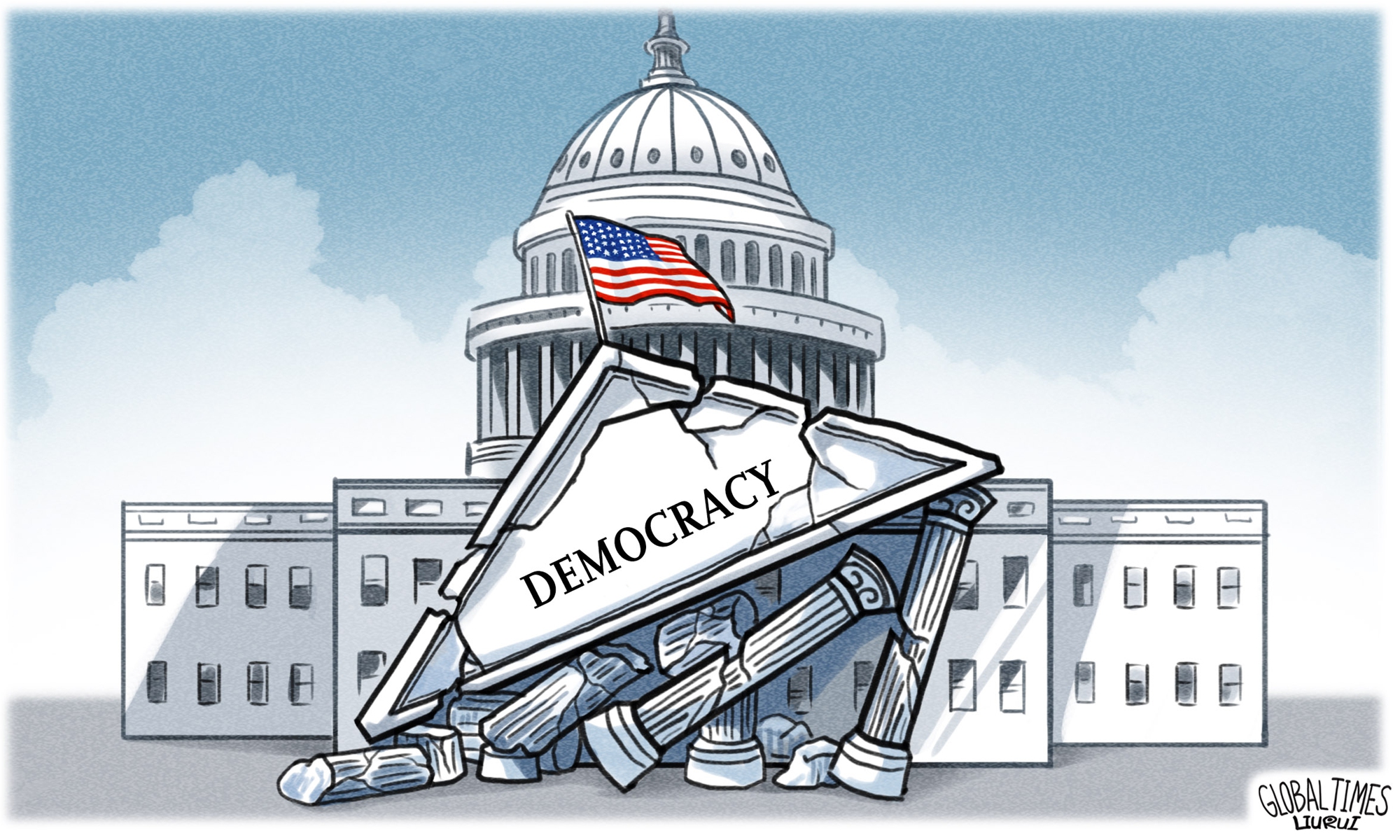
I was born soon after World War II, in 1947. I grew up in a culture with plenty of flaws, but we were patriotic, proud of our country. The notion that one day the United States would become a satellite of Russia would have been impossible to believe. And that is what has happened. Donald Trump, Elon Musk, and Robert Kennedy, Jr. are Russian assets.
If they have their way, we will lose Social Security, Medicare, and Obamacare. We will live with massive numbers of immigrants–both undocumented and documented–being rounded up and sent to concentration camps. We will become a nation of fascist bullies gloated at our leaders hatred and cruelty.
I guess I should be grateful that I’m old and on the way out. But I was cursed with empathy. I don’t want to live with the ugly hatred, and discrimination that is coming for my fellow Americans. As I wrote above, my early experiences led me to be a proud and patriotic citizen–even though I could see so many flaws in our culture.
I also internalized the idea that we are citizens of the world as well. I thought national security was important and alliances with other countries were imperative to the survival of our democracy. But now I know that a majority of my fellow Americans don’t care about democracy or our long-time foreign allies. A majority of Americans apparently wants our country to be allied with Russia, Hungary, Turkey, and North Korea. The majority of voters in this election appear to have no problem with the U.S. leaving NATO and Russia taking over Ukraine and then marching on through Europe if they can pull it off.
Finally, I have been reminded for the umpteenth time that a majority of my fellow Americans hate and fear women and are enraged when an “uppity woman” dares to try to win the U.S. presidency.
Well, I’m not going back. I’m almost 77 years old. I’ve had a decent life. I’d like to hang on for a few more years, but I don’t want to live in the Fourth Reich. I don’t want to live in a world without vaccines in which children once again get polio, measles and all the rest of the childhood diseases that I lived through. Hey, maybe Bobby Jr. will even bring back smallpox. Wouldn’t that be nice? If I sound bitter, it’s because I am.
Will Elon Musk really be given the power to cut government programs and fire long-term employees? He has been warning that there is going to be a period of austerity–but of course that will just be for the “little people.” Trump has promised to extend his tax cuts for the wealthy and corporations. Will Musk and his pals succeed in replacing America’s official currency with cryptocurrency? That apparently is his goal. I know almost nothing about cryptocurrency, but that doesn’t sound like a good idea to me.
We’ll see what happens in the coming days, weeks, and months until Trump and his thugs take over. I certainly have no clue. I actually thought Kamala Harris would win and that we’d finally have a woman president. But now I know that may never happen, because Americans hate women–and the haters include plenty of self-hating women.
I’m just an old woman, and I realize that I don’t belong in today’s United States. I’m just a relic of the past, a throwback to the 1950s and 1960s. I’m just old and in the way.
Three articles, and then I’m going to go back to protecting myself emotionally and getting through this day without going insane.
This is by Jessica Valenti at Abortion Every Day: It’s Not Okay. The country may have failed us, but we won’t fail each other.
I lied to my daughter last night. As I put Layla to bed, I promised her that everything would be okay—even though I knew it wasn’t true. Of course, of course, it’s not okay. But I’m a mom, and my honesty was easily outweighed by my desire to comfort her.
Here’s what I should have told her:
It is an awful thing, how much this country hates women. It is painful, soul-crushing and impossible to understand. The knowledge that America would rather elect the world’s worst man—a racist and liar, rapist and bully—than even consider letting a woman lead is a heavy, horrible load.
I wish none of us had to bear it. But we do, and we will.
We will take the next few days to feel the full weight of that pain. To ignore or avoid it would be a mistake; glossing over grief does your body and mind a disservice, and we all need to process in our own way.
But we can’t sit with the horror for too long. We can’t let it overtake or immobilize us—because that is exactly what they want. The men who want to put us in our place, keep us in the home and humiliate us into subjugation need us to be paralyzed with fear and sadness. They are desperate for us to give up, or to bury the reality of what they’ve done in a small corner in our mind. They want us to decide that it’s easier not to put up a fight….
Women are taught our whole lives to direct that fury inwards, to quash or internalize it. We’re not going to do that today, or ever again. There are people who deserve the full scale of our outrage, and they will get it.
That’s why you’ll get up, alongside me, and do what it takes to fight back. You’ll remember that we are in the right, and that they are in the obvious, awful wrong. You’ll refuse to let them steal one more moment of your joy and hope, and decide that living your life with purpose in a country that wants you to fade away is a radical act.
I know what you’re going to say: That’s what you’ve already been doing! You’ve cared so much and worked so hard. You’re tired—I am too. How can we possibly continue on when the country fails us again and again?
We just do. Because the alternative—that we pretend this isn’t happening and let the most vulnerable among us suffer first and worst—is unthinkable.
Read the rest at the link.
Tom Nichols at The Atlantic: Democracy Is Not Over. Americans who care about democracy have every right to feel appalled and frightened. But then they have work to do.
An aspiring fascist is the president-elect, again, of the United States. This is our political reality: Donald Trump is going to bring a claque of opportunists and kooks (led by the vice president–elect, a person who once compared Trump to Hitler) into government this winter, and even if senescence overtakes the president-elect, Trump’s minions will continue his assault on democracy, the rule of law, and the Constitution.
The urge to cast blame will be overwhelming, because there is so much of it to go around. When the history of this dark moment is written, those responsible will include not only Trump voters but also easily gulled Americans who didn’t vote or who voted for independent or third-party candidates because of their own selfish peeves.
Trump’s opponents will also blame Russia and other malign powers. Without a doubt, America’s enemies—some of whom dearly hoped for a Trump win—made efforts to flood the public square with propaganda. According to federal and state government reports, several bomb threats that appeared to originate from Russian email domains were aimed at areas with minority voters. But as always, the power to stop Trump rested with American voters at the ballot box, and blaming others is a pointless exercise.
So now what?
The first order of business is to redouble every effort to preserve American democracy. If I may invoke Winston Churchill, this is not the end or the beginning of the end; it is the end of the beginning.
For a decade, Trump has been trying to destroy America’s constitutional order. His election in 2016 was something like a prank gone very wrong, and he likely never expected to win. But once in office, he and his administration became a rocket sled of corruption, chaos, and sedition. Trump’s lawlessness finally caught up with him after he was forced from office by the electorate. He knew that his only hope was to return to the presidency and destroy the last instruments of accountability.
Paradoxically, however, Trump’s reckless venality is a reason for hope. Trump has the soul of a fascist but the mind of a disordered child. He will likely be surrounded by terrible but incompetent people. All of them can be beaten: in court, in Congress, in statehouses around the nation, and in the public arena. America is a federal republic, and the states—at least those in the union that will still care about democracy—have ways to protect their citizens from a rogue president. Nothing is inevitable, and democracy will not fall overnight.
Do not misunderstand me. I am not counseling complacency: Trump’s reelection is a national emergency. If we have learned anything from the past several years, it’s that feel-good, performative politics can’t win elections, but if there was ever a time to exercise the American right of free assembly, it is now—not least because Trump is determined to end such rights and silence his opponents. Americans must stay engaged and make their voices heard at every turn. They should find and support organizations and institutions committed to American democracy, and especially those determined to fight Trump in the courts. They must encourage candidates in the coming 2026 elections who will oppose Trump’s plans and challenge his legislative enablers….Patriotic Americans and their representatives might now make a similar commitment, but for better aims: Although they cannot remove Trump from office, they can declare their determination to prevent Trump from implementing the ghastly policies he committed himself to while campaigning.
The kinds of actions that will stop Trump from destroying America in 2025 are the same ones that stopped many of his plans the first time around. They are not flashy, and they will require sustained attention, because the next battles for democracy will be fought by lawyers and legislators, in Washington and in every state capitol. They will be fought by citizens banding together in associations and movements to rouse others from the sleepwalk that has led America into this moment.
Brian Beutler: Reflections On America’s New Autocracy.
The United States and the world will soon be in the hands of mercurial, vindictive, greedy men with scores to settle and few checks on their power.
Perhaps there’s some solace in that word “mercurial.” Who knows what Donald Trump, the 78 year old former president and current president-elect, will choose to do with his time and authority? Maybe some semblance of stability can be salvaged through the fact that he mostly just wants to be the center of attention.
But I don’t take much solace at all. First, the people who’ve attached themselves to Trump know this about him, and they are ambitious. They have already reasoned that they’ll be empowered to fill all the gaps in his attention, and their ranks include corrupt oligarchs, conspiracy theorists, white nationalists, religious extremists, and fascists. Think Trump might ultimately not care that much about abortion? Well, the people serving under him do, and he won’t be checking their work….
We should do our best to accept—serenity-prayer style—that he got away with trying to overturn the 2020 election, and with his mass theft of government secrets at the end of his first term. Those cases will disappear very soon. And we can infer from experience what he’ll do about the other, relatively limp efforts, to hold him accountable under the law.
He is meant to be sentenced in New York later this month for almost three dozen felony convictions. Do we really think a state trial-court judge will order Trump to prison? Will he sentence Trump to anything at all? Defer sentencing for four years? And what if Trump decides he wants that case—and all the state-based legal jeopardy he faces—to go away? Will he demand clemency from Gov. Kathy Hochul (D-NY)? Will she give it to him? If she does not, will he promise to retaliate against the state of New York with abuses of federal power?
Just like that—before he’s sworn in, before he can pardon the January 6 insurrectionists—we’re tumbling down the slope. Because we live in an autocracy now.
Just how repressive and lawless ours is remains to be seen. Things won’t always feel completely hopeless. Some vestiges of checks and balances, equal justice under law, and the old rules of political backlash will pop up now and again to stymie Trump. There’s at least some uncertainty surrounding his stamina for further conflict—I mean, he won, right? Isn’t that enough?
But Trump has never rested on his laurels, and I suspect these inhibitions will melt away. The elites and institutions who might wish to resist him will find themselves bedeviled by a collective action problem. It is in their common interest that Trump not transform the United States in to a fascist kleptocracy, or even just an Orbanist one, but it’s in their individual interest to let someone else stand in his way. They are atomized and overpowered and perhaps they can make out well if they go along with him.
Media, tech, and other corporate behemoths are all likelier to succumb to these bad incentives than they are to push back, giving Trump de facto control over much more than the federal government. Do they want tariff relief or a free hand in their markets? Their competitors hobbled? Better pay tribute!
And so on. I think we all know what is likely to be coming our way in 2025.
I’m usually optimistic, but I’m not feeling that way today. I just hope that everyone who has been part of our blogging community over the years is hanging in there and taking care of themselves. I love you all.

“I seen it on Fox News so it must be true.” John Buss, @repeat1968
It’s finally here, and I’m so ready, but I would feel safer if I knew the outcome. I’m pretty sure the women of America have got this. I also know anyone who values their freedom, and the girls and women in their lives are doing their best, too. This headline caught my attention. It’s from The Daily Beast. “Teary-Eyed John Oliver Begs Reluctant Voters to Back Kamala Harris. The late-night host sent an emotional message to viewers in a passionate monologue days before the election.” My Discord Kamala volunteer channel has been beeping constantly with requests to call just a few more folks in the Swing States. I think everyone is trying to help in their own way because we all remember how awful DonOld and his cult can be. Sean L. McCarthy writes about John Oliver’s teary plea. I think it’s likely he’s higher up on the Project 2025/DonOld’s revenge list than I am.
Fighting back tears, John Oliver choked up Sunday night while urging undecided and reluctant voters to turn out Tuesday to elect Kamala Harris as president.
“What am I going to be feeling on Wednesday? And is there anything I’m going to wish I’d said right now?” Oliver said at the start of his impassioned 10-minute closing monologue on Last Week Tonight.
Oliver said he supports Harris’ proposals to expand Medicare for long-term elder care, as well as expanding reproductive freedoms and boosting incomes for poor Americans. He also acknowledged that several episodes in this 11th season of his late night HBO show already have warned of the danger of a second Trump term and the policies spelled out in Project 2025. “All of that is why a bunch of our stories this year have ended with me telling you to vote against Donald Trump,” Oliver said. “But to be clear, I am voting for Kamala Harris. And I think you should, too.”
Oliver directed his Sunday night plea to those voters “rightly furious” about the Biden administration’s “indefensible” policy toward the war in Gaza. “Look, I get why this is so difficult, and I know there are some who won’t vote for Harris under any circumstances because of this issue,” he said, adding: “I wish Harris had done more to reach out to you, beyond sending Bill Clinton to basically scold you this week. That didn’t seem remotely helpful to me, and honestly, felt a bit like bullying.”
But he also pointed to Muslim and Arab voices “who have also wrestled hard with this question and arrived at the conclusion that despite their pain, to vote for Harris.” Such as Georgia State Rep. Ruwa Romman, one of the Palestinians who had hoped to speak at this summer’s DNC but was rebuked. Oliver played a TikTok from Romman where she explained her reasons for sticking with Harris and the Democrats. “It’s honestly worth watching the whole thing,” Oliver said.
I know what it feels like to think you should’ve done something more when you had a chance. I don’t like being in that place.
 Some signs show things moving in the right direction, even though the big pollsters call this race a toss-up. It’s why we can’t afford to sit this one out. This NPR report has me breathing easier. “Meet the conservative women who are keeping their votes for Kamala Harris a secret. It played on Morning Edition today with Sarah MacCammon. It’s a 4 minute listen if you go to the link.
In political ads and campaign speeches, supporters of Vice President Harris have a message for Republican women: Your vote is private, and no one will know if you secretly vote for Harris.
“No one gets to know how you’re going to vote,” Democratic Rep. Elissa Slotkin said last week during a campaign stop in Michigan. “No one gets to check it. It’s not available online. Right? Your vote is your choice. You don’t have to tell anyone.” Slotkin, who’s running for Senate, was campaigning with former Republican Rep. Liz Cheney, who’s also crossed the aisle to endorse Harris.
Their message is aimed at conservative-leaning women like T, whom we’re calling by her first initial. T, who is in her 60s and lives in Wisconsin, asked for anonymity to discuss how living in a politically divided household is affecting her marriage of more than 40 years.
“He’s frustrated with me that I won’t listen to him plead his case. I can’t and I won’t,” she explained.
T says she mailed her absentee ballot from another family member’s home to avoid a confrontation with her husband over her support for Harris.
“It’s not that he would ever stop me or anything, it’s just I just can’t deal with that animosity,” she said with an audible sigh.
 There was some sad news today. Quincy Jones has gone home to the elders at the age of 91. His influence on my life as a musician cannot be overstated. He was the “it” man. An interview with the great man in 2018 on DonOld and his family is something I pass along because you’ll see how strongly he was disgusted by the man. This is from Newsweek. “What Quincy Jones Said About Donald Trump, Ivanka Trump.”
In the interview, Jones mentioned knowing Ivanka’s father and didn’t hold back his opinions about him, expressing a strong distaste for Trump and referring to him in disparaging terms. Jones described him as “crazy” and criticized him as being “limited mentally,” calling him “narcissistic.”
“I used to hang out with him. He’s a crazy motherf***er. Limited mentally – a megalomaniac, narcissistic. I can’t stand him,” Jones said.
During the no-holds-barred interview, Jones expressed frustration about Trump’s political career and business practices, implying that he lacked leadership skills and didn’t know how to bring people together.
“A symphony conductor knows more about how to lead than most businesspeople – more than Trump does. He doesn’t know s***. Someone who knows about real leadership wouldn’t have as many people against him as he does. He’s a f***ing idiot,” Jones said.
Referring to Trump’s supporters, again Jones didn’t hold back, saying: “It’s Trump and uneducated rednecks. Trump is just telling them what they want to hear.”
Trump didn’t respond publicly to the claims. The following year, in March 2019, Jones donated $2,800 to Kamala Harris‘ primary campaign.
 Jones had six daughters and publicly stated he was proud of every one of them. I’ve always voted in honor of my grandmothers, who could not vote until they were well into middle age. Tomorrow, I will vote for my daughters and granddaughters and every woman in the country who needs autonomy to make decisions about her life. I will vote for me, my sister, and all the other adult women who deserve their own moral authority. None of us are chattel, nor should we be under the law or the decision of a bunch of weird old men on the Supreme Court. And with that, I will shame Nikki Haley, who wrote this in the WSJ. “Trump Isn’t Perfect, but He’s the Better Choice. If you like his policies but are put off by his tone or his excesses, consider the cost of the past four years.” That is all you will see here. You have to deliberately confuscate the US economy, jobs, and business growth of the last few years for that conclusion.
After SNL on NBC gave Harris some fun time on the show Saturday night, the Orange Dotard demanded equal time. Fortunately, I didn’t see it because there would be no way I would be watching either of these shows. This is from, of all places, The Hollywood Reporter. “NBC Gives Donald Trump Campaign Time During NASCAR Race, ‘Sunday Night Football’ in Response to Kamala Harris’ ‘SNL’ Appearance. Trump appeared in spots that aired during Sunday’s coverage of both sporting events on NBC, speaking directly to the camera.”
On Sunday, NBC broadcast a NASCAR playoff race, but some viewers noticed toward the end of the broadcast (technically right after the race ended but while coverage was still ongoing) that Trump appeared in an unusual ad, speaking directly to camera while wearing a Red “Make America Great Again” baseball cap, and claiming that electing Harris would cause a “depression” and that viewers should “go and vote.”
A source familiar with the matter says that the spot during the NASCAR race was connected to NBC giving the Trump campaign equal time.
During NBC’s Sunday Night Football coverage, Trump was given 60 additional seconds of campaign time. While the game was already over, the spot — which was the same one that aired during the NASCAR coverage — aired during the post-game coverage (and shortly after a paid campaign ad).
It is not clear whether it was the Trump camp or NBC that suggested the NASCAR and SNF placements.
It is also not clear if any other campaigns have requested equal time. If they do, however, NBC will likely need to find time for them, given the FCC rules. SNL creator Lorne Michaels previously cited the rules in an interview with The Hollywood Reporter as a reason why the show hadn’t had Trump or Harris on during this cycle.
Harris appeared on SNL in a “cold open” sketch alongside Maya Rudolph, who portrays the vice president for the late night comedy show. The sketch saw Rudolph’s Harris seeking a pep talk from the real Harris, with the pair ending the bit by saying “Keep Kamala and carry on-ala.”
However the sketch drew a rebuke from FCC commissioner Brendan Carr, who is seen as a potential FCC chair if President Trump is re-elected. Carr wrote that the sketch was “a clear and blatant effort to evade the FCC’s Equal Time rule,” because it came just two days before election day, within the seven-day window the FCC gives campaigns to request equal time.
 I suppose none of these folks know that economists worldwide have indicated that it’s Trump’s stated economic policies that would immediately throw the US and the world into a recession. This is an Op-Ed in the Business Standard from a few weeks ago. “US elections: 23 Nobel laureates can’t be wrong about Donald Trump. Economists, from Columbia University professor Joseph Stiglitz to Massachusetts Institute of Technology’s Daron Acemoglu, released a letter endorsing Kamala Harris for US president.”4
Economists mostly shun politics in favour of policy. We prefer to be aloof soothsayers giving voice to data and research rather than our own beliefs. A luminary in the profession once told me that “the only political party economists support is whichever is willing to be smart,” before adding, “and a smart economist would never join a political party.” And yet, in a stunning turn — at least for us in the profession — 23 Nobel Prize-winning economists, from Columbia University professor Joseph Stiglitz to Massachusetts Institute of Technology’s Daron Acemoglu, released a letter endorsing Kamala Harris for US president.
“Simply put, Harris’s policies will result in a stronger economic performance, with economic growth that is more robust, more sustainable, and more equitable,” the Nobel laureates wrote in the letter. Donald Trump’s policies, they added, would “lead to higher prices, larger deficits, and greater inequality.” As for Ms Harris, they wrote that she “has emphasised policies that strengthen the middle class, enhance competition, and promote entrepreneurship.Individuals can struggle to sort out the nuance of their own economic experience over the past eight years in weighing Ms Harris versus Mr Trump, but professional economists of all stripes have little to be torn about.It’s not a toss-up:Mr Trump’s policy agenda gives much for economists to condemn. Any one of these policies on their own would be enough to disqualify a candidate, but that Mr Trump has proposed them all is a clear enough indicator of just how much the economy would be at risk if he were reelected.
 The latest Biden/Harris economy accolades have come from the U.K.’s The Economist.
The American economy
The envy of the world
Special reports –
The American economy has left other rich countries in the dust. Expect that to continue, argue Simon Rabinovitch and Henry Curr
Special report: The American economy has left other rich countries in the dust
Economic output: American productivity still leads the world
For richer and poorer: Is higher inequality the price America pays for faster growth?
Energy: The shale revolution helped make America’s economy great
The dollar: China’s yuan is nowhere close to displacing the greenback
 Now, compare that to what Trump said yesterday. “It’s gonna be so much fun. It’ll be nasty… at the beginning in particular… You’re gonna see things that you’re not gonna believe.” Does that sound like Happy Days are here again? This is from Maddow Blog at MSNBC. “Trump warns voters that his second term would get ‘nasty’ at times. According to Donald Trump and his allies, his second term would be “nasty,” “bloody,” and filled with “hardships” for much of the population.” Steven Benen reports on this gloom and doom rally.
When Donald Trump uses the word “nasty,” he tends to target those who have the audacity to criticize him or stand in his way. In 2016, for example, the Republican referred to Hillary Clinton as a “nasty woman.” Eight years later, the former president whined about Michelle Obama’s campaign appearances, complaining that the former first lady became “nasty.”
Last year, during a town hall event on CNN, Trump described moderator Kaitlan Collins as a “nasty person.” About a year later, he accused New York Attorney General Letitia James of having a “nasty” mouth. (If you’re noticing the gender similarity here, it’s not your imagination.)
But once in a while, the GOP candidate uses the word in a very different kind of context. NBC News reported:
After a meandering and at times hostile speech [Sunday] morning in Pennsylvania, Trump delivered a more subdued and on-prompter speech to a Georgia crowd at his third and final rally today. As he depicted a second-term Trump administration, he said: “We stand on the verge of the four greatest years in American history. … It’ll be nasty a little bit at times, and maybe at the beginning in particular.”
The report added, “He didn’t elaborate on what would be ‘nasty.’”
At face value, this isn’t the kind of rhetoric American voters generally hear from presidential candidates. On the contrary, White House hopefuls tend to tell the public that if they’re elected, the country will be vastly safer, stronger, more prosperous, and more secure.
But Trump wants voters to prepare for something qualitatively different: a country where conditions will get “nasty.”
This comes roughly two months after the Republican nominee also told an audience that he and his team intend to pursue a mass deportation policy, and the process of removing immigrants already in the United States “will be a bloody story.”
It also comes a week after conspiratorial billionaire Elon Musk, a prominent Trump surrogate and megadonor, said during a virtual town hall event that Americans will need to endure “temporary hardship” if Trump wins a second term. As the world’s wealthiest man explained, much of the public will feel a real pinch as GOP officials work on “tackling the nation’s debt,” but those who suffer should take comfort in the hopes that the country will eventually enjoy “long-term prosperity.”
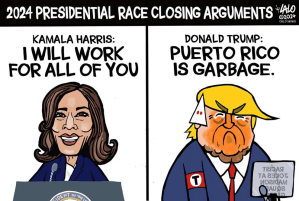 How is any person voting for this? WTF is wrong with these people. That’s a Drink the Koolaide message if I ever saw one!
You might know that I spent most of my young years in Iowa. It was not the same then as it later turned into when Pat Robertson rolled through an Iowa Primary and awakened the Beasts within. The Des Moines Register has always been an award-winning paper. It was the paper of choice back then. The October Surprise might have come from the paper’s well-respected pollster who gets the pulse of the Iowa electorate fight with admirable accuracy. Her name is Ann Selzer. This one must’ve hit a nerve because now the Orange Koolaide Vendor is attacking her. Her poll results caught a surprise shift! This is from The Daily Beast. “Pollster Behind Shock Iowa Poll Hits Back at Trump’s Attacks. The former president called J. Ann Selzer one of his “enemies” after results showed him falling behind Harris in the state.” Dan Ladden-Hall has the analysis.
Revered Iowa pollster J. Ann Selzer on Monday responded to the attacks Donald Trump made against her after her bombshell poll showed him trailing in the state.
The Des Moines Register/Mediacom poll conducted by Selzer and published Saturday showed Kamala Harris leading Trump by three points—47 percent to 44 percent—in Iowa, a state he won comfortably in 2016 and 2020. Although the result differed from that of other Iowa polls, the figures were potentially concerning for Trump given Selzer’s track record of accurately forecasting results in the Hawkeye State.
Trump was sufficiently concerned by the poll to post about it on Truth Social, claiming that all polls “except for one heavily skewed toward the Democrats by a Trump hater” showed him in the lead. “I’m 10 points up in Iowa,” he said during a campaign stop in Pennsylvania on Sunday. “One of my enemies just puts out a poll—I’m three down.”
“They just announced a fake poll,” he went on. “Hey, think of it—right before the election—that I’m three points down. I’m not down in Iowa.” Trump’s campaign separately released a memo calling Selzer’s poll “a clear outlier” and pointed to Emerson College polling released the same day that gave Trump a 10-point lead over Harris.
During an appearance Monday on MSNBC’s Morning Joe, Selzer acknowledged that the result of her poll was a “shock.”
“I’ve been shocked since Tuesday morning last week,” Selzer said. “So I’ve had the time for this to sink in because no one, including me, would’ve thought that Iowa could go for Kamala Harris.”
Co-host Willie Geist specifically asked Selzer about Trump’s criticisms, inviting her to respond to the claim that her poll is just an outlier.
“I give credit to my method for my track record,” Selzer said. “I call my method ‘polling forward.’ So I want to be in a place where my data can show me what’s likely to happen with the future electorate. So I just try to get out of the way of my data saying this is what’s going to happen.”
“A lot of other polls, and I’ll count Emerson among them, are including in the way that they manipulate the data after it comes in, things that have happened in the past,” she continued. “So they’re taking into account exit polls, they’re taking into account what turnout was in past elections. I don’t make any assumptions like that. So it’s in my way of thinking, it’s a cleaner way to forecast a future electorate, which nobody knows what that’s going to be. But we do know that our electorates change in terms of how many people are showing up and what the composition is.”
 Notice the role women are playing in this election season? The Bulwark’s Jonathan V. Last recognizes it. “The Valkyries of Democracy. In praise of three extraordinary women. Trigger warning: Emo JVL is here. I’ve got a lot of feelings and I’m going to share all of them with you. Sorry. But that’s where I’m at.” There certainly are a lot of men who are getting all wet-eyed and emotional during this election.
By the time you read this Sarah will have concluded moderating a conversation between Kamala Harris and Liz Cheney. If you missed it, you can watch it here. And in a few minutes, I’m going to sit down with Sarah and have her unload on what this moment was like. It’ll be on the site the minute she’s able to get on camera.
Before that, though, I want to say a personal word about these three extraordinary women.
On Liz Cheney: I was wrong. I can’t say this often enough. When Cheney broke with Donald Trump after January 6, I was dismissive. I didn’t understand why it took her so long, or how she could have stayed on-side during COVID and the 2020 campaign.
But as she methodically blew up her own career in order to defend our democracy, I realized I’d underestimated her. This was a woman of real conviction, who was willing to put it all on the line.
Liz Cheney has been a workhorse. She’s been willing to do as much as anyone, and more than most, in the service of elevating country over party.
On Kamala Harris: I am not in the Yass Queen camp. My view is that Kamala is a standard-issue, ambitious politician and that she might be a good president, or a bad president, or a middling president. There’s no real way to know ahead of time. I do not have any illusions about her being a savior.
But I also do not believe that any sane person would want to be the Democratic presidential nominee in the Year of Our Lord 2024.
The stakes are too high; the pressure too great.
I believe that for all her political ambition, Kamala Harris is carrying this burden for us. She’s not Barack Obama, basking in the warmth of a cultural moment en route to becoming a cultural icon. She’s more like Frodo Baggins, walking toward Mordor while carrying a millstone around her neck, in an attempt to save all of Middle Earth from a dark fate.
Here are two things I truly believe: (1) Kamala Harris has wanted to be president for a long time; and (2) Kamala Harris never wanted to run for president with the fate of democracy on the line.
When Howard Stern interviewed Harris, he asked her about the pressure and she answered that she literally loses sleep over it. That she goes to bed every night wondering, “Is there anything else I could have done?”
I cannot imagine that burden. And I am grateful—in my heart—to her for bearing it.
Finally, there’s Sarah Longwell.
I cannot properly convey the depth of my affection and admiration for her. I would run through walls for Sarah. I’d take a bullet for her.
When the Harris campaign called and asked Sarah to come to Pennsylvania today and sit down with Harris and Cheney, I kvelled.
Knowing that other people see the same things in Sarah that we see? Absolutely bursting with pride.
But it’s not just pride.
It’s relief. Look: None of us wants to be living in this moment.
But history chose us. It is our burden and the burden is, itself, a form of privilege.
And there is no group of people I would rather fight through this moment with than those three women: Liz, Kamala, and Sarah.
As Coach D’Amato once said, the inches we need are all around us. And when I look at these women, I see people who will go that inch with us. Who have been willing to sacrifice for that inch. Who are going to fight for every inch.
And I’m ride or die with them. I hope you will be, too.r
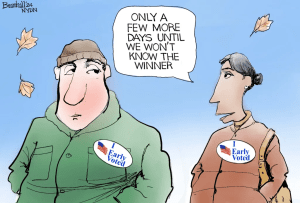 So, my birthday is today. I just turned 69, and there’s a party at the bar on the corner, so we can have some fun, make silly references to my age, and ignore things for a bit. Tomorrow, I will walk down the street to the Rec Center and greet my Poll Workers! I will vote. I’m counting on women and a few good men to do the right thing.
This may not be over quickly, but we must keep Calmala and Carry-on-ala. This is from The Hill‘s Alexander Bolten. “GOP primed to back Trump if he contests election.” All the court cases to date have been big losers. You can always follow them on Democracy Docket. This fight described below in Bolten’s piece may finally end the Republican Party once and for all.
The Republican Party is now more primed to back former President Trump if he contests the results of the 2024 election than it was four years ago, when his efforts to overturn President Biden’s victory fell flat in courts and Congress.
Trump’s unwavering claims about the nation’s election system being “rigged” have steadily gained more acceptance among rank-and-file Republican
svoters over the past four years, and his biggest Republican critics in Congress have either retired, will retire soon or have lost sway.Additionally, Trump allies around the country have worked to gain more influence over state and local election boards, which will be in charge of tallying votes and certifying the results.
Republicans are feeling increasingly optimistic Trump will win the election, but they are girding for an intense battle if Vice President Harris is declared the winner.
“The strength of the cult of Trump amongst voters is strong so members are reflecting what their constituents want them to do,” said a Republican strategist and former Senate leadership aide.
“The other angle is there are a lot of concerns about how elections are being conducted and the power of social media and our partisan news,” the strategist said. “Republicans watch a lot of Twitter and Fox News, and they see voting irregularities,” they continued, pointing out a recent Detroit News report that a Chinese citizen attending the University of Michigan voted illegally by absentee ballot, and election officials weren’t able to retrieve it.
Four years ago, Trump’s claims that Biden and his allies “stole” the election struck many Republicans in Washington as outlandish, though most of them extended the 45th president the courtesy of letting him pursue his claims in court, where they failed.
So we are all in this together. Just keep telling people to go vote and make sure you vote. You can always ask for a provisional ballot as is your right if anything goes wrong. It’s important we do this!

“Voting can stop it.” John Buss @repeat1968
It was a dark and drizzly night, not one to make the rounds to all the Halloween parties in the hood. So, I settled into watching a friend from around Flagstaff, Arizona, stream a set of Horror Movies on Discord to a bunch of us who play a Zombie survival game together. It was like a pajama party with the girls, except my girls are all furry, and everyone else was scattered all over the country. I retwisted my ankle last night which was still hurting from a Tuesday mishap and feeling really old. The live Oaks of New Orleans’ Avenues drop acorns that rapidly become a coffee ground-like mess everywhere. That was the trick. I was glad that I stocked up on treats and wine earlier because I just missed the fog and the mist rolling in over the city. A very apt setting for Interview with a Vampire. I was hurting, traumatized by the DonOld Garbage Truck Cosplay spewing from the News Channels, and thought settling down to some movies would be a good break.
I saw a new version of Children of the Corn and was treated to several movies, including two of the “The Hills Have Eyes” franchises. It was hard to believe that the original version by Wes Crave had come out when I was at university. The fact the newest version of Children was centered in Nebraska was not lost on me. The original of that one came out when I was finishing my Masters. Back then, I’d take out the Beta tapes of the old Vincent Price horror movies that I recorded off the few cable channels back then.
The more I watched the Hill films, the more I could see Trump supporters in all the cannibal zombies in the Hills. Seriously, right down to their caps, their messy English, and the way they treated the two women in that National Guard Unit, I could swear I was watching a MAGA ambush. The creepy preacher in Children of the Corn and his implied “sin” against the little girl Eden was like the perfect metaphor for all those white Christian nationalist men whose arrest mug shots for crimes against children keep popping up on my X feed.
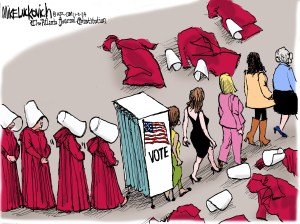 I had watched the news earlier and the meltdown that MAGA husbands are having at the idea their wives might get in the voting booth and vote their conscience instead of the will of their Patriarchal captor. One dude on Fox likened it to committing adultery, at which point the women on the panel laughed, and then he looked straight at the camera and told his chattel Emma that it would be finished if he found she’d done that. I thought she should get a lawyer to get her share, then Run Emma, RUN!! That and go have some fun with some young men that know what they’re doing! Just don’t bring them home or marry them.
This is from Vanity Fair. The analysis is provided by Bess Levin. “Fox News Host Says He’d Divorce His Wife for Voting for Kamala Harris. “If I found out Emma was going into the voting booth and pulling the lever for Harris, that’s the same thing as having an affair.” If you’d like, I can reference the part from the Hill movie where the mutant grabs a woman National Guard soldier, starts grabbing and raping her, and says, “You make nice babies!” Who among us can’t see DonOld in his prime doing that same thing?
How much respect do Donald Trump’s male supporters have for women? So much that at least one of them has said he’d end his marriage if his wife exercised her constitutional right to vote for Kamala Harris.
On an episode of The Five this week, Fox News host Jesse Watters told fellow panelists that if he learned his wife, Emma, cast her ballot for the vice president, after letting him think she was voting for Trump, he would consider it a betrayal on par with having an extramarital affair and it would be “over.”
“If I found out Emma was going into the voting booth and pulling the lever for Harris, that’s the same thing as having an affair,” Watters said. “That, to me, violates the sanctity of our marriage. What else is she keeping from me? What else has she been lying about?” Asked by cohost Jeanine Pirro, “Why would she lie to you? Have you threatened her?” Watters responded, “Why would she do that and then vote Harris? Why would she say she was voting…. And I caught her and then she said, ‘I lied to you for the last four years—’”
“So you admit you intimidate people,” Pirro interjected. “It’s over, Emma!” Watters said. “That would be D-Day!”
Watters and co. were discussing an ad put out in support of the Harris campaign that reminds women, “You can vote any way you want, and no one will ever know.” Which is apparently a necessary point to make to women who are married to extremely fragile Trump-supporting men.
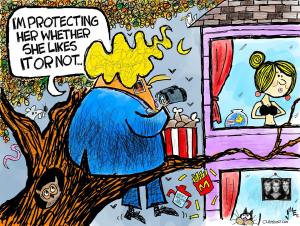 I know that once they think they’ve got you, they show their true colors, but seriously, who could stand to live like that? Salon has this great article up with an even more wonderful headline. “”It is so disastrous”: MAGA men are freaking out that wives may be secretly voting for Kamala Harris, “That’s the same thing as having an affair,” Fox News host argues as women fuel early vote in key states.” The entire concept of Control Freak is not hyped enough for these guys. Charles R Davis takes them on.
When you’re a star, Donald Trump has said more than once, women will let you do whatever you want to them. As president, that meant putting three right-wing justices on the Supreme Court and stripping half the country of a constitutional right, enabling people like him — their self-proclaimed “protector” — to have the final word on what any woman does with her body.
“I’m going to do it whether the women like it or not,” the former president asserted at a campaign stop on Wednesday. “I am going to protect them.”
Women, it turns out, do not care for this — a large majority of them, at least. While millions will still vote for the Republican candidate, perhaps hating immigrants more than they love reproductive rights, the only certainty at this point is that many millions more will vote for Vice President Kamala Harris. In the latest ABC News/Ipsos national poll, the Democrat enjoyed a 14% advantage with women over Trump; among women with a college degree, that number rose to 23%; among women voters under 40, it rocketed to 34%.
According to the Brookings Institution, Harris’ strength among women angered by the 2022 Dobbs decision could explain why Democrats, for the first time in forever, are polling better with older voters than Republicans. The think tank’s Michael Hais and Morley Winograd noted that, per the ABC News/Ipsos survey, there has been a 10-point swing to Harris among voters over the age of 65 compared to 2020.
“Some observers think this shift is driven by the ‘revenge of Boomer feminists’ among the women of that famous generation, all of whom are now over 65 but who cut their political teeth in the battle for equality when they were much younger,” Hais and Winograd wrote. Younger voters may be angry over losing a right they had never lived without, but older people have seen hard-fought progress rolled back. They are also the most reliable group of voters — and they tend to vote early.
In battleground states, that appears to be exactly what’s happening. According to an analysis of early-voting tallies by Politico, women account for 55% of all ballots cast thus far in states such as Wisconsin, Michigan and Pennsylvania.
That, in turn, is causing some MAGA commentators to break from their usual posture of feigned confidence to outright panic.
“Early vote has been disproportionately female,” Charlie Kirk, head of Turning Point USA and helping to lead the Trump campaign’s get-out-the-vote effort, posted on social media. “If men stay at home, Kamala is president. It’s that simple.” (Kirk, seeking to motivate these voters, offered Orwellian misogyny: “If you want a vision of the future if you don’t vote, imagine Kamala’s voice cackling, forever.”)
 I feel seen for once, hopefully, not by the Children of the Garbage Bags and AR-15s. DonOld really has gone over the edge. During his rally in New Mexico, he made a loosely veiled threat at former Congresswoman Liz Cheney. This is from the Bulwark, as written by Bill Kristol. Don’t Horror shows make allies out of the strangest folks? That’s what happens when your very life is on the line.
Donald Trump’s two strongest personality traits each had a moment on the campaign trail yesterday.
At a rally in Albuquerque, New Mexico, the buffoon: “I’m here for one very simple reason. I like you very much, and it’s good for my credentials with the Hispanic and Latino community.”
And later, on stage with Tucker Carlson in Glendale, Arizona, the menace. Here he was on former GOP Rep. Liz Cheney: “She’s a radical war hawk. Let’s put her with a rifle standing there with nine barrels shooting at her, okay? Let’s see how she feels about it, you know, when the guns are trained on her face.”
U.S. News has this headline. “Trump Says Liz Cheney Might Not Be Such a ‘War Hawk’ if She Had Rifles Shooting at Her. Donald Trump is calling former Rep. Liz Cheney, who’s one of his most prominent Republican critics, a “war hawk” and he’s suggesting she might not be as willing to send troops to fight if she had guns shooting at her.”
Donald Trump is suggesting that former Rep. Liz Cheney, one of his most prominent Republican critics, should have rifles “shooting at her” to see how she feels about sending troops to fight. It was his latest suggestion that his rivals should be targeted with violence.
Cheney responded by branding the GOP presidential nominee a “cruel, unstable man who wants to be a tyrant.”
The Republican presidential candidate has been using increasingly threatening rhetoric against his adversaries and talked of “enemies from within” undermining the country. Some of his former senior aides and Vice President Kamala Harris have labeled him a fascist in response.
At an event late Thursday in Arizona with former Fox News host Tucker Carlson, Trump was asked whether it was strange to see Cheney campaign against him. The former Wyoming congresswoman has vocally opposed Trump since the Jan. 6, 2021, attack on the U.S. Capitol and endorsed Democrat Kamala Harris, joining the vice president at recent stops as they try to win over Republicans disaffected with Trump.
Trump called Cheney “a deranged person” and added, “But the reason she couldn’t stand me is that she always wanted to go to war with people. If it were up to her we’d be in 50 different countries.”
The former president continued: “She’s a radical war hawk. Let’s put her with the rifle standing there with nine barrels shooting at her. OK, let’s see how she feels about it. You know, when the guns are trained on her face.
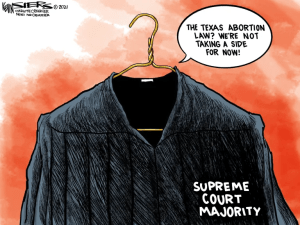 The results of Donald Trump’s first reign of Terror are killing women. The Republican appointees to the Supreme Court have the blood of innocents on their hands. ProPublica has once again followed the trail of deaths left in Texas by the hypocrites who scream they are “pro-life.” “A Pregnant Teenager Died After Trying to Get Care in Three Visits to Texas Emergency Rooms. It took three ER visits and 20 hours before a hospital admitted Nevaeh Crain, 18, as her condition worsened. Doctors insisted on two ultrasounds to confirm “fetal demise.” She’s one of at least two Texas women who died under the state’s abortion ban.”
Candace Fails screamed for someone in the Texas hospital to help her pregnant daughter. “Do something,” she pleaded, on the morning of Oct. 29, 2023.
Nevaeh Crain was crying in pain, too weak to walk, blood staining her thighs. Feverish and vomiting the day of her baby shower, the 18-year-old had gone to two different emergency rooms within 12 hours, returning home each time worse than before.
The first hospital diagnosed her with strep throat without investigating her sharp abdominal cramps. At the second, she screened positive for sepsis, a life-threatening and fast-moving reaction to an infection, medical records show. But doctors said her six-month fetus had a heartbeat and that Crain was fine to leave.
Now on Crain’s third hospital visit, an obstetrician insisted on two ultrasounds to “confirm fetal demise,” a nurse wrote, before moving her to intensive care.
By then, more than two hours after her arrival, Crain’s blood pressure had plummeted and a nurse had noted that her lips were “blue and dusky.” Her organs began failing.
Hours later, she was dead.
Fails, who would have seen her daughter turn 20 this Friday, still cannot understand why Crain’s emergency was not treated like an emergency.
But that is what many pregnant women are now facing in states with strict abortion bans, doctors and lawyers have told ProPublica.
“Pregnant women have become essentially untouchables,” said Sara Rosenbaum, a health law and policy professor emerita at George Washington University.
Texas’s abortion ban threatens prison time for interventions that end a fetal heartbeat, whether the pregnancy is wanted or not. It includes exceptions for life-threatening conditions, but still, doctors told ProPublica that confusion and fear about the potential legal repercussions are changing the way their colleagues treat pregnant patients with complications.
In states with abortion bans, such patients are sometimes bounced between hospitals like “hot potatoes,” with health care providers reluctant to participate in treatment that could attract a prosecutor, doctors told ProPublica. In some cases, medical teams are wasting precious time debating legalities and creating documentation, preparing for the possibility that they’ll need to explain their actions to a jury and judge.
Dr. Jodi Abbott, an associate professor of obstetrics and gynecology at Boston University School of Medicine, said patients are left wondering: “Am I being sent home because I really am OK? Or am I being sent home because they’re afraid that the solution to what’s going on with my pregnancy would be ending the pregnancy, and they’re not allowed to do that?”
There is a federal law to prevent emergency room doctors from withholding lifesaving care.
Passed nearly four decades ago, it requires emergency rooms to stabilize patients in medical crises. The Biden administration argues this mandate applies even in cases where an abortion might be necessary.
No state has done more to fight this interpretation than Texas, which has warned doctors that its abortion ban supersedes the administration’s guidance on federal law, and that they can face up to 99 years in prison for violating it.
ProPublica condensed more than 800 pages of Crain’s medical records into a four-page timeline in consultation with two maternal-fetal medicine specialists; reporters reviewed it with nine doctors, including researchers at prestigious universities, OB-GYNs who regularly handle miscarriages, and experts in emergency medicine and maternal health.
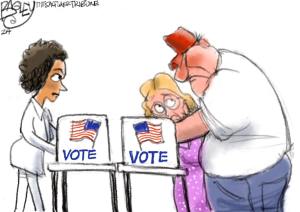 Puerto Rican Americans continue to speak out about the horrible racist slurs spoken by #DonOld about their Island home and their presence on the mainland. Does he understand that Puerto Ricans are Americans and that they live everywhere in this country? This is from The Daily Beast. “J.Lo Claps Back at Trump Rally Puerto Rico Jab: ‘We Are Americans’, “Our pain matters,” the singer said at a Las Vegas event for Kamala Harris.” This is reported by Claire Lampen.
As promised, Jennifer Lopez took the stage at Kamala Harris’s rally in Las Vegas on Thursday night, responding to racist statements about Puerto Rico made at one of Donald Trump’s recent events.
“I am an American woman. I am the daughter of Guadalupe Lupe Rodríguez and David Lopez, a proud daughter and son of Puerto Rico. I am Puerto Rican,” Lopez said, restating the final point in Spanish. “And yes, I was born here. And we are Americans.”
In his much-maligned comedy routine at Trump’s Madison Square Garden rally on Sunday, right-wing comedian Tony Hinchcliffe referred to Puerto Rico as a “floating island of garbage.” His comments, Lopez said, should offend “anyone of decent character.”
“It’s about us, all of us, no matter what we look like, who we love, who we worship, or where we’re from,” Lopez said. “[Harris’s] opponent, on the other hand, doesn’t see it that way. He has consistently worked to divide us. At Madison Square Garden, he reminded us who he really is and how he really feels.”
Trump‘s rally featured a parade of extremist speakers, though it was Hinchcliffe’s act that really dominated headlines. In it, he claimed Latinos “love making babies,” a riff whose anti-immigrant punchline fell flat, and threw in some racist stereotypes about Black people as well.
Although the Trump campaign has since attempted to distance itself from Hinchcliffe’s set—Trump trotting out a classic “I don’t know her” defense—it garnered criticism from all sides, even from his own party.
 Trump’s enablers cannot stop him from his hate-filled speeches and comments.
“It wasn’t just Puerto Ricans who were offended that day,” Lopez added. “It was every Latino in this country, it was humanity.”
J.Lo went on to say that, “with an understanding of our past, and a faith in our future,” she‘s proud to vote for Harris. “You can’t even spell American without Rican,” she said. “This is our country, too, and we must exercise our right to vote.”
Towards the end of her speech, Lopez appeared to fight back tears. “I promised myself I wouldn’t get emotional,” she told the audience. “But you know what? We should be emotional. We should be upset. We should be scared and outraged, we should. Our pain matters. We matter. You matter. Your voice and your vote matters.”
“This election is about your life,” J.Lo continued. “It‘s about you, and me, and my kids, and your kids. Don‘t make it easy; make them pay attention to you. That’s your power. Your vote is your power.”
“Your vote is your power” is the line I want everyone to remember today. Another one is a quote from the late Senator Paul Wellstone from Minnesota. Five Days until we get the opportunity to never hear that man or his zombie cultists again.
What’s on your reading and blogging list today?

 peej
peej Carissa
 bostonboomer
 dakinikat
 ecocatwoman
 jjlo
jjlo mablue2
 Mama Lopez
 peggysue22
 quixote
 skydancingguestblogger
 Mona (aka Wonk the Vote)
 Memeorandum Crooks and Liars Democracy NOW The UK Guardian
The Sky Dancing banner headline uses a snippet from a work by artist Tashi Mannox called 'Rainbow Study'. The work is described as a" study of typical Tibetan rainbow clouds, that feature in Thanka painting, temple decoration and silk brocades". dakinikat was immediately drawn to the image when trying to find stylized Tibetan Clouds to represent Sky Dancing. It is probably because Tashi's practice is similar to her own. His updated take on the clouds that fill the collection of traditional thankas is quite special.
You can find his work at his website by clicking on his logo below. He is also a calligraphy artist that uses important vajrayana syllables. We encourage you to visit his on line studio.




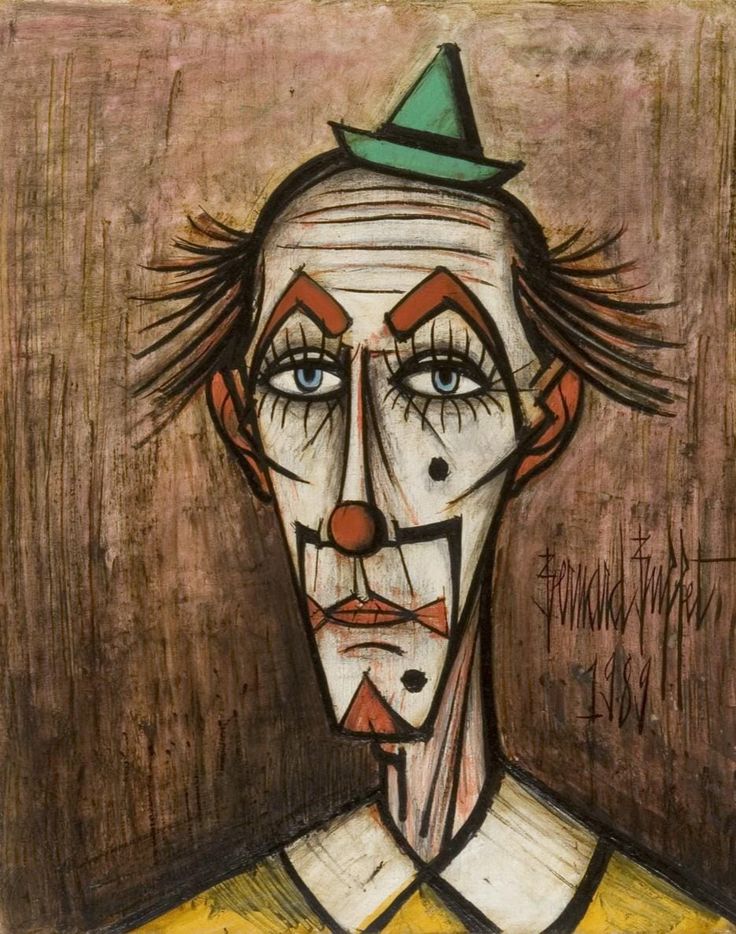



Recent Comments