
NYPD cracking heads and pepper spraying protesters under cover of darkness
Posted: October 5, 2011 Filed under: just because 19 CommentsIt figures New York’s “finest” would wait until after dark to break out the mace and nightsticks. This video is from We Are Change. It’s pretty chaotic, but it shows police beating and pepper spraying #OccupyWallStreet protesters. These thugs don’t seem to understand that their Gestapo tactics are having the effect of bringing more media attention to a protest that was largely ignored for a couple of weeks.
Occupy Wall Street is providing updates as they come in. They also have several videos of tonight’s action. Latest updates:
Reports of arrests.
Updates as we get them.
UPDATE 9:35 – Reports of batons used. Mounted officers are present at Liberty Square. Barricades are set up on Liberty and Broadway.
UPDATE 9:48 – Reports of our medics treating several pepper sprayed protesters.
UPDATE 10:09 – At least twenty arrested.
This video is from Russia Today. Isn’t it strange how we have to go to the foreign press for info these days? Shades of the old Soviet Union and Pravda.
Here’s some video from today’s protests in Los Angeles, Boston, and Chicago:
Easy Answers are the Wrong Narrative
Posted: October 1, 2011 Filed under: just because | Tags: U.S. Economy 8 Comments I was watching an interview last night with Warren Buffett by Charlie Rose on the economy. Yes, I know I’m weird. I don’t watch sports or movies. I watch documentaries and listen to interviews. I have the academic’s disease in spades. There was a lot of discussion about a lot of things but the one thing that grabbed me was the question Rose asked about what Obama should have done differently on the economy. Buffett is an Obama supporter and made a point of saying that the President had basically responded as well as he could to the economic challenges and he hated hindsight criticism. However, the one point made was that the President really hadn’t emphasized early on how difficult this economic recovery challenge would be and that the passage of the stimulus was perhaps glossed over as a panacea that it could not be for many reasons.
This narrative came back to me this morning as I plowed through The Economist with my morning coffee. Only this time, similar behavior was attributed to Angela Merkel in the cover story called The World Economy: Be Afraid.
The second failure is one of honesty. Too many rich-world politicians have failed to tell voters the scale of the problem. In Germany, where the jobless rate is lower than in 2008, people tend to think the crisis is about lazy Greeks and Italians. Mrs Merkel needs to explain clearly that it also includes Germany’s own banks—and that Germany faces a choice between a costly solution and a ruinous one. In America the Republicans are guilty of outrageous obstructionism and misleading simplification, while Mr Obama has favoured class warfare over fiscal leadership. At a time of enormous problems, the politicians seem Lilliputian. That’s the real reason to be afraid.
I laughed at the idea of Obama favoring class warfare over fiscal leadership given that paragraph followed directly after the sentence: “But the  collective obsession with short-term austerity across the rich world is hurting”. Obama’s been leading the charge on austerity. I honestly don’t think any one person or an S&P national downgrade is going to deter the Republican party from leading the entire country off the cliff in pursuit of the White House. Maybe once they’ve figured that all of their candidates have so many warts they are unlikely to pass muster with the base AND independents, they’ll get back to being a minority party instead of group of hostage taking ideologues. But, I doubt it. They are all spinning overly simplistic messages that resonate with the many people looking for simple answers. The global Great Recession is not done with us yet and to pretend there are simple answers to pass around is expedient and immoral.
The Economist is talking about the timidity of leaders across the globe to really lead on programs that could tackle the severe economic problems we face. The problem is that many seem to be offering up messages that offer policies contrary to what’s really needed. The call for austerity right now, instead of when the houses are in order, keeps me busy trying to find a safe place to stash my little nest egg. There’s only so many places in Norway, Malaysia, and Korea for small investors. Even China’s manufacturing behemoth is showing signs of slowing which is undoubtedly, yet another sign of lack of customers. Yet, every developed nation is pulling in its horns further and further. There is a lack of correct–as well as bold–action.
Germany, for instance, thinks the main problem is fiscal profligacy and so is reluctant to boost Europe’s rescue fund; yet a far bigger fund is needed if a rescue is to be credible. The most urgent solutions, such as restructuring Greece’s debt or building a protective barrier around Italy, require the most political courage—something that Angela Merkel, Nicolas Sarkozy et al have yet to exhibit. The chances of a bold enough plan will shrink if markets stabilise. The less scared they are, the more likely Europe’s spineless policymakers are to jump yet again for a plan that does just enough to stave off catastrophe temporarily, but lets the underlying problem get worse.
Much of the world is now paying for their timidity: witness the increasingly dark economic backdrop. A slew of recent indicators suggests the euro area is slipping into recession, as Germany’s exports slow, the fiscal screws tighten, confidence slumps and the banks’ travails imply tighter credit. Even if the euro-zone crisis were to be solved tomorrow, the region’s GDP would probably shrink over the coming months.
America’s economy is still limping along, though the summer slump in share prices and consumer confidence suggest future spending will weaken further. The Federal Reserve is trying new ways of support, somewhat half-heartedly. Whatever it does, America is currently on course for the most stringent fiscal tightening of any big economy in 2012, as temporary tax cuts and unemployment insurance expire at the end of this year. That could change if Congress came to its senses, passed Barack Obama’s jobs plan and agreed on a medium-term deficit-reduction deal by November. If Democrats and Republicans fail to hash out a compromise on the deficit, draconian spending cuts will follow in 2013. For all the tirades against the Europeans, America’s economy risks being pushed into recession by its own fiscal policy—and by the fact that both parties are more interested in positioning themselves for the 2012 elections than in reaching the compromises needed to steer away from that hazardous course.
What about the cushion the emerging markets provide? That, too, is getting thinner. Their growth is slowing (as it needed to, since many economies were overheating). Recent falls in emerging-world currencies and stock prices show that financial panic can afflict the periphery too (see article). Some emerging economies, including China, have less room to repeat their 2008-09 stimulus because of the debts that splurge left behind. Monetary policy can be loosened: several central banks have cut rates. But, overall, the emerging world will be less of a buoy to global growth than it has been hitherto.
Does President Obama understand “how America works”?
Posted: September 27, 2011 Filed under: just because 11 Comments
From Politico: POTUS testy in BET interview
President Obama, slipping in the polls among black supporters and under fire from black Democratic leaders for policies they say fail to address black poverty and unemployment, said Monday that targeting programs to help one community “is not how America works.”
Oh really? What is happening when the government bails out banks and investment firms? What about when the government offers tax cuts or loans for businesses–often specific businesses, like oil companies or auto manufacturers? What about Social Security, Medicare, and Medicaid? Don’t those programs target particular groups? What about programs to feed needy children or provide them with educational opportunities–like Head Start? Even more to the point, what about Affirmative Action?
What a silly remark!
Obama’s exclusive interview with BET’s Emmett Miller in the Oval Office is the latest in a flurry of outreach that included a private lunch Friday with prominent black radio talk show hosts, and a blistering speech Saturday night at a Congressional Black Caucus dinner.
It seems President Obama is still smarting from the criticism he got from Maxine Waters and Charlie Rangel after his offensive remarks to the Congressional Black Caucus.
The Grio has more detail about the interview:
Obama acknowledged that his administration did not anticipate the depth of the economic crisis he encountered upon entering office, and the need to help Americans understand how long the road to recovery could be. “if I traveled back in time? I would say it’s going to be a long hard slog and the American people are going to feel kind of worn down after this much difficulty,” he said. “But I’d also tell that less gray person to hang in there because the American people are resilient and they have good values and they care about the right stuff, and we’ll get through this.
I’d think if the President could travel back in time, he might choose to focus on jobs and the economy rather than a bloated Republican-style health insurance bill, but that’s just me. I’m not so sure that all of us are going to “get through this.” What he meant by “that less gray person,” I do not know.
Asked by Miller what he would tell a hard-hit African-American single mother on the south side of Chicago who was jobless and concerned that the president “won’t even say, ‘look, I am going to help you,” Obama pushed back on the premise, saying that’s not what people are telling him as he travels the country stumping for his American Jobs Act.
“What people are saying all across the country is we are hurting and we’ve been hurting for a long time,” the president said. “And the question is how can we make sure the economy is working for every single person.”
So why is the focus mostly on helping the wealthy and cutting Medicare and Medicaid then?
Saying targeting one specific group is “not how America works,” Obama emphasized that his policies were aimed at those who are hurting the most, whether because of a lack of healthcare coverage or a lack of a job, adding that because African-Americans are suffering disproportionately on those fronts, his policies were in fact designed to help black communities.
Well, I guess those policies aren’t working then, are they? Jeeze, this guy really doesn’t get it. Please, someone send him the video of LBJ withdrawing from the reelection race.
Rep. Sheila Jackson Lee did her very best to defend Obama’s remarks to the CDC on Tavis Smiley’s show. I just don’t buy it. Obama has alienated most of his liberal base, and now he’s working on driving away African Americans.
Hillary: Your Anti-Drug
Posted: September 25, 2011 Filed under: just because 29 Comments
CLICK PIC FOR TRANSCRIPT: Hillary and Chelsea at the CGI on Thursday, holding a one-on-one “conversation” during the Closing Plenary. (State Dept/public domain photo)
Hey news junkies…I’ve missed y’all bigtime! I’m still not quite up to full-time blogging, but after catching Minx’s hilarious (and way too kind) comment about “Wonk withdrawals” this morning, I’ve put together a bit of an installment of pics & links to help tide you over for awhile. So enjoy!
First up… check out this New Deal 2.0 interview (on first ladies being assets to the presidency) with Roosevelt Institute Senior Fellow Ellen Chesler:
Like Eleanor, Hillary also spent the better part of her years as first lady on the road, meeting as often with the powerless as with the powerful. She had boundless enthusiasm for that. She also had an understanding that the modern welfare safety net created by the New Deal was not fulfilling the vision of the Roosevelts for a temporary government subsidy that would help build personal capacity and self-reliance.
Chesler also made a great comment about First Lady Michelle Obama that I agree wholeheartedly with:
As so many pundits have observed, Michelle Obama, a forceful advocate for her husband during the campaign, has been something of a prisoner in the White House, her attention focused only on matters that could not possibly provoke controversy, such as elementary education, child obesity, military families, and of course, fashion. I know all the arguments about why this was necessary and how threatening a tall, strong, brilliant, and beautiful African-American woman would be to many Americans, especially if she seemed “uppity.” I realize that she was encouraged to appear devoted to her daughters and family and essentially to take an “un-Eleanor, un-Hillary” approach to her position. But after hearing her speak this week, I think this has been a mistake and would send her out on the road 24/7! It’s still not too late, and she may yet turn out to be one of her husband’s best assets.
Personally I’d add Elizabeth Edwards’ name to this conversation, even though she was technically never first lady and even though she should have been the one running for president! Andrea Mitchell recently did an interview with Cate Edwards, who is leaving her law career to head up the Elizabeth Edwards foundation. People magazine has a write-up on the interview as well, with a headline focused on Cate’s marriage next month and her comment that of course she’ll be thinking of her mother when she walks down the aisle. If you don’t have time to watch the Andrea Mitchell interview clip, here’s a snippet buried at the end of the People article:
Talking to Mitchell at the Susan G. Komen 3-Day Walk for the Cure, Edwards also announced the creation of the Elizabeth Edwards Foundation, which she called “a perfect reflection” of her mother. The organization will support high school students who have limited resources but “great potential,” according to its website.
“Big choices that I make … little choices that I make, sort of everything I do, I hear her voice,” says Cate, “the same way I did when she was alive.”
My thoughts while listening to Cate–wow, she can talk the talk just like her mother!

CLICK FOR TRANSCRIPT: Another pic at the CGI, of Chelsea and her "Techno Mom." I love how Hillary looks so content and Chelsea, so proud. (State Dept/public domain photo)
In other mother-daughter news, if you haven’t clicked on the pic of Hillary and Chelsea at the CGIand read the transcript yet, I highly recommend doing so and scrolling down to the bottom third where they discuss technology. What a hoot, and informative too! I’ll tease a bit:
MS. CLINTON: I’d like to go back to technology, partly because, as your daughter, I remember when I helped you send your first text message.
SECRETARY CLINTON: Yes. (Laughter.)
MS. CLINTON: And —
SECRETARY CLINTON: That wasn’t very long ago, I have to tell you.
MS. CLINTON: And I also remember, even before you became so identified for your vigorous support of, kind of, the internet and social media as a way for people to participate virtually, when you were first emailing, you would self-identify as Techno Mom.
SECRETARY CLINTON: (Laughter.)
Over at Taylor Marsh’s, Joyce Arnold continues to be essential reading on all things LGBT and “liberally Independent.” Here are her two latest pieces:
Please check them out when you get the time.
Also at TM’s, guest blogger Art Pronin (aka texan4Hillary) has this headline that piqued my interest: “Progressive Notes: Meet the Woman who Ran Against Austerity and Made History.” Art is referring to Helle Thorning-Schmidt, who is now the first female prime minister of Denmark. Give it a look.
While I’m at it, here are some “powerful women pow-wow” pics of Hillary meeting with female leaders over the last week or so (click to see larger versions):

Madames Secretary: Hillary with Mexican Foreign Secretary Patricia Espinosa in New York on Friday. (State Dept/public domain photo)

Bilaterally speaking: Hillary meets with Costa Rican President Laura Chinchilla on Friday in New York. (State Dept/public domain photo)

Chatty Cathies: Hillary meets with EU High Representative Catherine Ashton and European Foreign Ministers on Thursday in NY. (State Dept/public domain photo)

Hillary and Hina: Hillary meets with Pakistan's first female (as well as youngest) foreign minister, Hina Rabbani Khar, last Sunday in New York. (State Dept/public domain photo)

CLICK PIC FOR TRANSCRIPT: Hillary delivers remarks at an event hosted by UN Women on Women’s Political Participation, on Monday in NY (State Dept/public domain photo)
To go along with this photo to the left of Hillary, here’s a Daily Beast/Newsweek link from last weekend, on “Clinton’s Cause.” It’s an interview with Hillary, under the following byline:
At an international conference last week, Secretary of State Hillary Clinton made a seminal speech about women’s essential role in the global economy, pronouncing the 21st century a “Participation Age” for women. NEWSWEEK caught up with her.
Here’s an excerpt from a State Dept. fact sheet on that “seminal” speech:
In her remarks, the Secretary outlined a vision for a fundamental transformation of our economies. She also called for more and better data to measure our results and drive our policy-making. And, she challenged the leaders of APEC economies to take concrete steps, including these outlined in the San Francisco Declaration, which will be delivered to the APEC Leaders’ Meeting in Honolulu in November:
- Promoting greater access to financial services for women entrepreneurs;
- Improving women’s access to markets by identifying networks and associations that can assist women to access business connections and distribution channels;
- Encouraging the empowerment of women and removing discriminatory practices that inhibit women’s capacity and ability to build their skills; and
- Working to support the rise of women leaders—in both the public and private sectors.
Speaking of “Clinton’s cause,” Hillary Clinton’s State Department has committed up to $55 million dollars in additional funding to the Global Alliance for Clean Cookstoves on its first anniversary. Hillary launched this initiative a year ago and you can see her tireless commitment to this effort has continued. Once again, Hillary demonstrates the difference between “just words” and doing the hard work it takes to put words into action.
Hillary doesn’t need to tell people to “take off their slippers” and put on their “marching boots,” ahem. She inspires by example and persuades people to join her campaign for us all by making abstract goals accessible in *real* terms.
Case-in-point: Hillary’s Remarks at the High-Level Meeting on Nutrition this past Tuesday.
Now, I know that you’ve covered a lot of this ground already and will continue to do so in the consultations tomorrow and afterwards, so let me simply say this: The United States is firmly committed to our investments in global nutrition, and we believe fervently that improving nutrition for pregnant women and children under two is one of the smartest investments we or anyone can make. The science for this is unassailably clear: When we ensure that women and children receive essential nutrients within the 1,000-day window, we can set youngsters on a better path toward lifelong health. When we miss that window, children can suffer both physical and cognitive damage that cannot be reversed.
Now, *that* is a call to action!
Switching gears slightly… Here’s a development in women’s health that made me smile last month (via Huffpo): First U.S. Inpatient Clinic For Moms With Postpartum Depression Opens. Huffpo blogger Laura Stampler reported on this, stating that:
Some initiatives are so relevant, so beneficial to a population in need, that it’s hard to believe they’re new. One of these is the University of North Carolina at Chapel Hill hospital’s inpatient perinatal psychiatric unit for new mothers with severe postpartum depression, the first free-standing unit of its kind in the United States.
It is sad that it took so long to have an inpatient clinic for mothers suffering from postpartum depression, in a country where political hacks can’t shut up about their bogus “culture of life.” That said, I am so glad there is one now, and I hope it is the beginning of more to come.
And now for a development in global women’s rights today!
Via Bloomberg/Business Week…King Abdullah Gives Saudi Women Right to Vote for First Time:
We refuse to marginalize the role of women in Saudi society in every field of work,” Abdullah said on state television as he inaugurated a new session of the council. “Women have the right to submit their candidacy for municipal council membership and have the right to take part in submitting candidates in accordance with Shariah.”
This next one managed to pull on my heartstrings AND my funny-bone, even though it was written up in People magazine and I’m usually impervious to their attention deficit-style reporting… I credit it all to Wanda’s wit. Wanda Sykes: I Had a Double Mastectomy. From the link:
When it came to speaking out about her past few months, Sykes, the mother of nearly 2½-year-old twins with her wife, Alex, tells the talk-show host, “I was like, I don’t know, should I talk about it or what? How many things could I have? I’m Black, then Lesbian. I can’t be the poster child for everything.”
With a laugh, she notes, “At least with the LGBT issues we get a parade, we get a float, it’s a party. [But] I was real hesitant about doing this, because I hate walking. I got a lot of [cancer] walks coming up.”
As DeGeneres states, “I just admire the hell out of you.”
I admire the hell out of Wanda, too!
Here are a couple fun ones before I wrap up with some history trivia for this Sunday:
- From last month, via yahoo — American girl in Italy: 60 years later:
A stunning young woman walks down a street in Florence, her head held high. All around, men playfully gawk at her grace and beauty. Just then the camera shutter snaps. “American Girl in Italy” is among the most popular snapshots of all time, and it’s turning 60 years old this month.
The photo, which was shot in 1951, perfectly captures the fun and romance of being abroad. In honor of its birthday, Ninalee Craig, the subject of the photo spoke with the “Today” show about what happened behind the scenes and what the photo really represents.
- Betty White’s “I’m Still Hot” Remix with Luciana (via Huffpo):
This Day in Women’s History (September 25)
Thirty years ago today, Sandra Day O’Connor was sworn in to the Supreme Court. Here’s a snippet from a thoughtful op-ed on O’Connor in the LA Times called “Flirting with Justice”:
In nudging the Supreme Court doors open, O’Connor made way for Justices Ginsburg, Sonia Sotomayor and Elena Kagan, and even for the possibility of nine wise women, and one woman who will finally be considered wise enough to be elected president. In her holdings themselves, and in her holding against expectation to her own sense of the law, Sandra Day O’Connor demonstrated that the time to give up traditional notions of gender roles had come. This one wise judge set everyone on notice that women were no longer merely to be flirted with, if we ever were.
Last but not least, inspired by remembering O’Connor’s swearing in, the National Ledger has published a very neat list of “Famous Women Firsts,“ in which I was very pleased to see:
2008 Hillary Clinton wins the New Hampshire Democratic presidential primary, becoming the first woman in U.S. history to win a presidential primary contest.
Well, that’s it for me! I hope you check out the rest of the list — I would love to see you add your own “famous women firsts” in the comments. Until my next post–take care news junkies! And, know that your anti-drug Hillary is always just a click away.
Sympathy for the Devil
Posted: September 24, 2011 Filed under: income inequality, just because | Tags: Income Inequality, millionaires, poor little rich boys 13 Comments
“Please allow me to introduce myself
I’m a man of wealth and taste”Mick Jagger sings in “Sympathy for the Devil”
I was raised with a rather limited view of the world in a suburb of Omaha, Nebraska. There were millionaires in my family then and there are many now. I was told I was middle class and I felt actually rather poor when I would go to Kansas City every weekend and play department store in the elevator in my uncle’s library going up and down between the three floors of his very huge mansion there. My aunt’s house was in the same neighborhood and didn’t have an elevator but was pretty much the same size. I thought my house was average. I laughed when my soon to be husband’s friends from Bellevue called my house “the mansion”.
I was told we were middle class much in the same way Mittens Romney thinks he’s middle class albeit he’s got more money than my parents ever did. I was raised in a very good size house in a very good neighborhood and went to very good public schools with nearly every other new car dealer’s kid in the city. I didn’t really think that was an unusual circumstance. I’m not in that form of Kansas any more although all I have to do is choose to visit a family member and I’m back there any time I want. I have limited patience for an environment where the big crisis of the day is the worry that you may not have enough of your special Holiday China to go around a table bearing a perverse amount of food and drinks.
Now, I live in really mixed poor, working, middle class neighborhood. My income basically has matched the US median family income and my house basically matches the median price for houses in the US. I did that on my own by working and it feels good. Happiness to me are paid bills and phone calls from the daughters. I left all the above income stuff when I left my husband. To be honest, people that are very very rich have odd problems and the more I got out in the real world, the more I discovered that. They feel miserable and down about themselves for very odd reasons. This is one of the reasons I dropped out of that entire scene. I always felt a lot more comfortable with my dad’s family that was solidly working/middle class than my mom’s relatives described above. They were all great and loving people, but there was always this tinge of surreality, unreality, or not quite real world about the side of my family that seriously had more money than most people would know what to do with. Most of their days was spent trying to figure out odd ways to spend it.
So, why am I bringing this up? It’s because all of that has tinged my adverse reaction to a WAPO item called “Five myths about Millionaires“. The crux of the article is that a million dollars really isn’t what it used to be, millionaires do pay taxes, and like my family, they don’t really feel rich. They feel just ordinary and middle class, and shucks folks, they’re just likeable people who create jobs and pay their share of taxes. Well, that’s all fine but that shouldn’t be the point. My extremely rich family used their white, educated, WASPY background to the best of their advantage and worked the system well. The system rewarded them. I’ve seen equally sincere and good people have just the opposite happen for factors completely out of their control. The deal is we have to pay for all the benefits of a modern society and who is in the best position to do that?
The very rich don’t need any one defending them at all because, it is what it is and they are what they are. They are mostly nice people for whom the system worked very well because they were precisely poised to take advantage of all that the system offers. Rich people are as diversely nice or bad as any one else. However, having all that money warps your perspective a lot. My thought is that John Steele Gordon–author of the article–probably gets up earnestly and says like Mittens Romney and my family used to do: ” You know, we’re just simple middle class Americans” right before he gets in his new car and goes from his big house to his well paying job. You can insert a lot of private club references into the day too. Yup, that’s all every one does every single day unless they are lazy and want to engage in the president’s class war, right? There is something about having huge amounts of money that puts people in a different frame of mind. They invent struggles where there are none.
“I tell you the truth, it is hard for a rich man to enter the kingdom of heaven. Again I tell you, it is easier for a camel to go through the eye of a needle than for a rich man to enter the kingdom of God.”
Let me just give you a quote from the article about why a million dollars isn’t that much money for poor middle class millionaires.
On Thursday, 44 percent of people voting in an online surveyas part of the GOP debate coverage said that a $1 million annual income made a person “rich.”In a 2008 survey of affluent Chicago households, only 22 percent thought a nest egg of $1 million was rich. In March, four out of 10 millionaires surveyed by Fidelity Investments said they do not feel rich. That same month, a majority of investment advisers surveyed in a Scottrade poll said that $1 million isn’t enough for retirement.
Though the average American family is rich beyond the wildest dreams of the average family in Bangladesh, where per capita income recently rose above $700, it’s not much compared with those who summer on beachfront properties in the Hamptons. When John D. Rockefeller learned in 1913 that the late J.P. Morgan had left an estate of $60 million, including a fabulous art collection, he reportedly said: “And to think — he wasn’t even rich.”
So, here I am in the upper ninth ward of New Orleans thinking that just about every one within a few miles of me would think that life had just about gotten as good as it could get if they could hit that median family income of around $60,000 a year consistently. There would probably be a lot more of them–like me–that actually would own the house in which they live for one. Also, they probably would be overjoyed to see a tax base so healthy that we could actually support good roads, good schools, and better cops for a change. Whatever the house in Southampton equivalent would be down here isn’t even on any one’s wish list on this side of the French Quarter. The daily concerns are: Will I keep my job or find a job? Can I pay all my bills this month? Can I feed my family? Will the car and my health stay together long enough so that I won’t become a homeless person? The thing that makes millionaires different is that real life is not at the top of their lists of concerns every day and believe me it changes your perspective mightily when it is.
Let’s put those survey results in context by using the 2011 Statistical Abstract. I’m going to cut and paste the income distribution table for you. It’s for U.S. families in 2009 stated in 2008 dollars. Okay, so look down there at the percentage of families that make more than $250,000 a year. It’s more than it was a few years ago, but it’s still less than 3% for every one and 4% for whites and Asians. Black and Hispanic families that earn that much are less than 1% of their entire demographic.
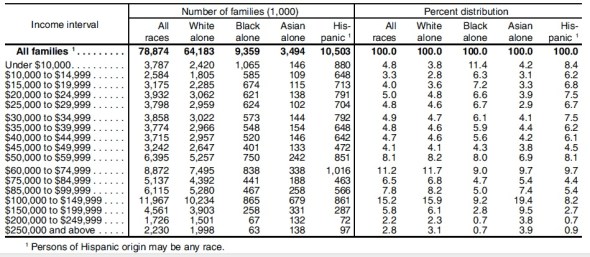
Here’s a slightly broader view of income distribution from the same source.
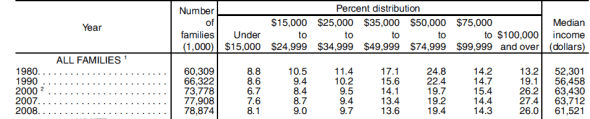
You can see that about 74% of US families don’t even clear $100,000 annually given the median income is $61,521. That’s a skewed distribution if there ever was one. I think the skewed distributions leads to some pretty skewed perspectives too.
I’m reminded of this little news item from one of my state’s Congressman whose math was fuzzy and priorities reflect that of some one whose not worried about the normal things in life. I’m still trying to figure out exactly what he pays the employees at his Subway Shops in Northwest Louisiana given the numbers he provides. As best I can figure, it’s about $12,000 a year. If he feels so put out and poor with an annual income of $400,000 a year that I wonder whatever do his charitable contributions look like?
Taking up the typical GOP talking point, Fleming said raising taxes on wealthy “job creators” is a terrible idea that kills jobs because many of these people are small business owners who pay taxes through personal income rates. Fleming is himself a businesses owner, so Jansing asked, “If you have to pay more in taxes, you would get rid of some of those employees?” Fleming responded by saying that while his businesses made $6.3 million last year, after you “pay 500 employees, you pay rent, you pay equipment, and food,” his profits “a mere fraction of that” — “by the time I feed my family, I have maybe $400,000 left over.”
All of this puts me in mind of F Scott Fitzgerald who was the chronicler of the wealthy point of view during the Gilded Age.
Let me tell you about the very rich. They are different from you and me. They possess and enjoy early, and it does something to them, makes them soft where we are hard, and cynical where we are trustful, in a way that, unless you were born rich, it is very difficult to understand. They think, deep in their hearts, that they are better than we are because we had to discover the compensations and refuges of life for ourselves. Even when they enter deep into our world or sink below us, they still think that they are better than we are. They are different.
F. SCOTT FITZGERALD writes in “The Rich Boy” in 1926
This is the stuff that makes Elizabeth Warren’s video on the stump the other day go viral. This isn’t class warfare. I don’t think there’s an awful lot of people that truly begrudge folks their wealth. Speaking only for myself, I don’t want to have my sense of perspective or priorities that warped any more and am happy when ends meet. I think people only want to feel like they have a decent living and that people that have more than that should pull their own weight and not make these weirdish justifications for wealth that most folks just plain don’t get. Back to the article by the poor little rich boy.
Taxes on the rich are taxes on people who create jobs. And jobs are an unalloyed good thing for an economy. Excessively taxing the capital that makes the economy go is poor public policy. And we have a recent example of how the opposite works well: Unemployment declined by a third in the four years after the Bush tax cuts were fully implemented in 2003, dropping to 4.2 percent from 6.2 percent. Meanwhile, federal revenue increased 44 percent in those years. If these tax cuts put people to work and generated money for the government, shouldn’t Obama consider the possibility that tax increases should be avoided?
Most of this analysis is incredibly disingenuous because it fails to mention that the country was coming out of a recession and a severe macro shock from 9/11. It wasn’t the fiscal policies that did these things at all. Plus, these were the early warning signs of Allan Greenspan blowing a housing bubble and a construction and financing boom about to crash the economy. Economists don’t like to see the rate of unemployment fall significantly below its natural rate. It means the government is doing WAY too much and will probably create some kind of inflation and the economic activity won’t be sustainable. All that war and anti terrorism spending overheated the economy.
The argument of capital gains cuts = job creations is the core argument here that I will never understand from a simple common sense view. That doesn’t even count all that book learning views from the degrees and the doctorate in Financial Economics that sets off alarms in my brain. These were tax cuts that subsidized excessive speculation. The argument that values hoarded wealth over hard work and says that all that money floating around financial markets does is create jobs is a false one.
The deal is this. It’s one thing to put your money into a business like a small or medium sized business owner does but that money is counted as regular income. That is job creating but it has nothing to do with capital gains taxes. Second, if you do buy stock in GE and you put in there for years on end and others do the same then, yes, that’s basically a good source of funding for a business and that resembles business ownership albeit a very detached one. Possibly, you could reward the buy and hold investor but a huge amount of market activity is not buy and hold unless you’re an institution. Also, why does putting your money in a bank and collecting interest– because bank deposits get pooled and loaned to businesses–not get the same treatment? My thought is that it’s because it’s the middle class way of holding wealth and the view is that it is inferior income like wages and salaries. Interest income gets taxed like work income. But, AND MOST OF ALL, how are day traders who bop in and out of investments daily, speculating away on stuff, buying exotic derivatives that have nothing to do with the underlying business create jobs, value or anything else worthy of the label job creators and why do they deserve special tax treatment? Are you prepared to tell me that this form of speculation creates more jobs than say, the gambling casinos on the strip in Las Vegas? At least we can point to cocktail waitresses, bartenders and dealers in Las Vegas style gambling.
A lot of money income that comes from capital gains is just another form of gambling income. It isn’t there long enough to encourage businesses to make long term decisions that would actually help the economy. The only thing it really does is make CEOs short-sighted by forcing them to focus on short term stock prices so they invariably don’t invest in positive net present value projects which means no attendant jobs. That’s what the research says. So, Gordon’s thinking is as fuzzy as gee, since I only get $400,000 a year, I guess I’ll just have to get rid of a few people that are doing the work for me that I pay only $12,000 a year. The “bringing liquidity to the market” isn’t really a great rationalization here either because the wham bam thank you approach of speculators these days doesn’t offset the increased risk and price volatility they bring to markets. They screw up the pricing mechanism when they do all that momentum trading. Recent gas prices and house prices are good examples of speculation gone wild. Also, riddle me this. What value do hedge fund managers bring to the table when they bet against US businesses and the US government? Why do they get special tax treatment for that? What jobs does that create? I’m not reading specifics on those things at all in Gordon’s blessed are the millionaires for they are the job creators spiel. Why subsidize this behavior and these extraordinarily rich people?
So, I’m not in any way shape or form saying that millionaires are bad or evil or whatever the nasty implications are that underlie the class war charge. What I’m saying is that there’s a difference in your perspective when you’ve got hungry kids than some one is whining they can’t make it on $400,000 a year. I don’t think we need articles lecturing us on the proper perspective we should take on millionaires. I think a few millionaires need to develop a different perspective on reality and life and quit whining when some one asks them to pay for the roads they drive on, support the schools they attended, pay for the protection provided by soldiers, cops, and firefighters, and basically pull their fair share of the load of living in a civilized society.

 peej
peej Carissa
 bostonboomer
 dakinikat
 ecocatwoman
 mablue2
 Mama Lopez
 peggysue22
 quixote
 skydancingguestblogger
 Mona (aka Wonk the Vote)



 Sky Dancing
Recent Comments