
ADHD Awareness Week: Oct. 16-22
Posted: October 16, 2011 Filed under: education, just because, psychology | Tags: ADHD, Attention Deficit Hyperactivity Disorder, brain imaging, language development, literacy, narrative, private speech 31 CommentsThis week is ADHD Awareness Week. I’ve been thinking about what I’ve learned about this developmental disorder over the past decade or so; and I thought I’d share some of it with you.
I used to be somewhat skeptical about the existence of Attention Deficit Hyperactivity Disorder (ADHD). After all, this supposed disorder didn’t exist when I was a kid, as far as I knew. (It turns out the behavior patterns associated with ADHD were observed as early as the 1790s). It seemed to me a bad idea to give children speed, which is basically what the stimulant drugs used to treat ADHD are.
When I went back to college to study psychology, I became friends with another student who had the diagnosis. Interacting with this young man and observing his behavior convinced me that ADHD really does exist.
My friend (I’ll call him “Bill”) had difficulty paying attention in class and sometimes he would stare out the window for long periods of time. He had trouble concentrating on writing assignments, because he was easily distracted. Paradoxically, Bill could focus his attention for long periods of time on something he found very interesting, like using the computer, playing music, or running. Those are common symptoms of ADHD.
People with ADHD tend to be impulsive–they may do or say things without thinking about the consequences, and this can lead to problems with other people.
I saw Bill get into trouble in his personal relationships again and again. He would make appointments to spend time with someone, forgetting that he had already made an appointment with another person–sometimes even two or three other people–for the same day and time. He often had to call people and cancel plans because of this. Most of the time, friends were understanding, but Bill ran into trouble when he made these mistakes in interactions with professors and other people he wanted to impress.
Although I liked Bill very much, I admit that I tired of hearing about his constant scheduling mixups, and about people who were angry with him about them. He wasn’t always easy to be friends with.
Something else I noticed in my interactions with my friend Bill was that he often used language in unusual and interesting ways. He sometimes had difficulty finding the right word and would make up words or describe emotions and behavior in unexpected ways. It’s possible that Bill had some kind language disorder in addition to ADHD, but he told me that he could often recognize fellow sufferers by the way they used words. I came to believe that Bill thought about things from a different perspective than most people, and I found that aspect of his ADHD somewhat charming.
As an undergraduate, I became fascinated with children’s language development; and I went on to specialize in that field in graduate school. One of the papers I wrote in order to qualify as a Ph.D. candidate was about ADHD and two aspects of language development: private speech and narrative (storytelling).
Private speech is self talk that young children use to support their play and other activities. They speak out loud to themselves, describing what they are doing or working out problems as they go along. Here’s an example:
A number of researchers have found that children with ADHD use more private speech and use it for about 3 years longer than typically developing children, who have generally stopped talking out loud to themselves by age 7 or 8. Children with ADHD may continue to do so until age 11 or so. The assumption is that children with ADHD use private speech more than other children because it helps them stay focused on tasks.
My main focus in graduate school was on children’s narrative development–basically the way children develop the skills used in telling stories. Narrative skills are used in forming autobiographical memories as well as in structuring reality and understanding the world around us. They are also an important facet of early literacy and an important predictor of how well children will perform academically. Children with ADHD tend to tell stories that are more poorly organized and less cohesive than those told by typically developing children.
So there are a couple of concrete examples of differences in language abilities between children with ADHD and typically developing children. In recent years there have also been brain imaging students that demonstrate that the brains of children with ADHD develop more slowly in some ways than the brains of typically developing children. Here’s one example:
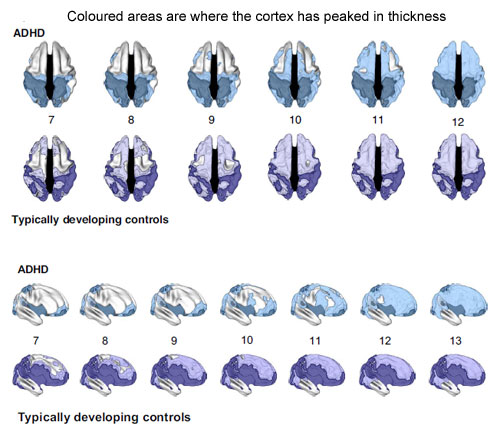
Philip Shaw, Judith Rapaport and others from the National Institute of Mental Health have found new evidence [that]….When some parts of the brain stick to their normal timetable for development, while others lag behind, ADHD is the result….they used magnetic resonance imaging to measure the brains of 447 children of different ages, often at more than one point in time.
At over 40,000 parts of the brain, they noted the thickness of the child’s cerebral cortex, the brain’s outer layer, where its most complex functions like memory, language and consciousness are thought to lie….
In both groups of children, parts of the cortex peaked in terms of thickness in the same order, with waves of maturity spreading from the edges to the centre….[but] the brains of ADHD children matured about three years later than those of their peers. Half of their cortex has reached their maximum thickness at age 10 and a half, while those of children without ADHD did so at age 7 and a half[.]
Isn’t it interesting that children with ADHD tend to lag behind in brain development by about three years–about the same length of time they continue to using private speech after typically developing children have stopped?

The caudate nuclei are highlighted in red
Here’s another blog entry on a different study of brain development in children with ADHD. This study found that children with ADHD had smaller caudate nuclei than typically developing children. This was a small study of 26 5-year-olds.
The basal ganglia (or basal nuclei) are the parts of the brain involved with voluntary motion and some forms procedural learning (development of a motor skill through practice, such as playing a musical instrument). The caudate nucleus specifically functions in learning and memory; it tells the cortex (the area of our brain where higher reasoning occurs) to do something based on current conditions. Importantly, the caudate nucleus controls motor skills partly through inhibition of particular behaviors, and disinhibition of others; an overactive caudate nucleus may be implicated in obsessive-compulsive disorder.
Smaller caudate nuclei had been documented before in older children with ADHD, but not before in children so young. The authors point out that previous studies have not been able to sort out what comes first: changes in brain structure or the behavior, which is part of the motivation of looking at younger children.
Just in time for ADHD Awareness Week, new guidelines have been released for the treatment of ADHD in children as young as 4. I must admit I find that a bit troubling. I hate to see kids get labeled as having a psychological disorder before they even start kindergarten. From the Wall Street Journal:
Attention deficit hyperactivity disorder can be diagnosed in children as young as age four, according to new treatment guidelines by the American Academy of Pediatrics.
The guidelines, released Sunday at the academy’s annual meeting in Boston, provide instructions for pediatricians on diagnosing and managing ADHD in children four to 18. They say behavioral management techniques should be the first treatment approach for preschool-age children.
But they also suggest doctors consider prescribing methylphenidate, commonly known by the brand name Ritalin, in preschool-age children with moderate to severe symptoms when behavior interventions don’t provide significant improvement. It’s a potentially controversial recommendation, because these medicines aren’t approved by the Food and Drug Administration for use in that age group.
I’m not an expert on ADHD, but I am recovering addict, and I worry about children so young being given powerful mind-altering drugs. My friend “Bill” had been prescribed Ritalin as a child, and he felt that using the drug had resulted in his abusing cocaine and alcohol as a young adult.
Generally speaking, I’d like to see doctors, teachers, and parents use behavioral solutions for ADHD symptoms, rather than drugs. At the same time, I know that psychoactive drugs have been extremely helpful to me in dealing with severe depression. There are times when drugs are a good solution, but only in concert with therapy and self-awareness.
Again, I haven’t had a great deal of practical experience with ADHD. I’d be interested in hearing from anyone here who has. All-in-all, I think it’s a good thing that developmental disorders are recognized now more than when I was a kid. I can only assume that some kids fell through the cracks back then, while now kids with these problems get attention and treatment–however flawed it may be.
The Business Model: An Idea Ready to Eat The World
Posted: October 15, 2011 Filed under: just because | Tags: private goods, public goods, selling public assets 12 Comments
We’ve all heard it, ad infinitum. Governments should run like a business. Healthcare is looking for a new business model. Prisons are emerging profit centers.
And so, reading of Governor Rick Scott’s solutions for trimming Florida’s public college and university costs, I was not surprised to scan the words ‘business model.’ Scott is tapping into Rick Perry’s strategy, The Seven Breakthrough Solutions for cutting college costs in Texas. The ‘solutions’ seem almost reasonable, until you peel up the corners.
Now let’s get real. College tuitions have skyrocketed across the country. Anyone who has been to college recently or sent a child [or children] through a University system can attest to the financial burden the 4-5 year pricetag can exact. Few students or parents would reject reasonable methods to trim expenses, make universities run more efficiently and ultimately make higher education more affordable.
But are we willing to trim cost and quality in tandem? Will we accept the quick fix and sacrifice departments and/or fields of study because [on first glance] they will not produce degrees or students useful to Rick Scott’s or Rick Perry’s vision of America? That would be a world where everything is one big business deal, oozing with profit for owners and shareholders and populated with workers with the ‘right’ degrees. Those degrees would translate into immediate jobs for the same business types who created the system to begin with, a self-perpetuating loop.
What could go wrong?
Plenty.
Let me say I have nothing against degrees in science, technology, engineering and math [STEM]. We need more degrees in these fields; emerging economies [China, India] are killing us in the sheer number of technical/science students they’re preparing for the future. But not everyone is suited for these majors. And surprise! There is still a place in the world for the humanities, a background from which the likes of JFK [history/international affairs], Ronald Reagan [sociology] and Steve Wynn, business guy [English] graduated and did pretty well for themselves.
My problem is pushing specific degrees at the exclusion of all others. For instance, slashing funds for grants and scholarships in Liberal Art programs—Scott has a particular dislike of anthropology–mocking the value of academic research [yes, there are flaky university studies out there but the vast majority of academic research has broad, important, if not immediate applications]. Or in terms of evaluating faculty? The approach would measure faculty members as profit or loss centers [this gauged on the faculty member’s time spent in the classroom, against the outside funding said faculty member manages to encourage and net]. A likeability quotient is added to the frothy mix and student evaluations are weighted in determining tenure. These applied standards are in lieu of placing primary value on a faculty member’s expertise in his or her field. College/university accreditation? It complicates the reform measures. So poof! Get rid of it.
Perhaps more importantly, this approach dismisses the true purpose and nature of higher education: to teach everything there is to teach; to produce graduates who have critical thinking skills, an understanding of the world around them and the people who inhabit that world now and those of the past; and finally, inspiring creativity, which in turn inspires innovation.
If you want drones then set up a factory, an assembly line. If you want enlightened adults, provide the freedom to choose, develop, think, consider, re-consider. Support risk-taking in whatever field of study a student chooses or has a passion and talent for. Encourage students to try their hand, hearts and minds at everything. Inspire students to go their own way and take those creative leaps that lead to startling advancements. Respect the learning process, the exquisite power and beauty of discovery and the uniqueness of the individual.
Earth to the Rickety Twins: One size does not fit all. Easy solutions to complex problems are doomed to failure. Just ask Herman Cain about his 999 economic plan, which is crumbling under scrutiny.
Dare I say that not all things fall within the purview of a business model, a structure that seeks profit before all else. Yet, this is the main ‘fix’ being hawked like a bad toupee across the country. Run ‘it’ [fill in subject of choice] like a business and all things will flourish.
Well, here’s a thought: The Seven Breakthrough Solutions that Rick Scott wishes to co-opt for the State of Florida is more like the Seven Percent Solution of Sherlock Holmes, a wicked addiction. Like any drug habit, the fix is a sweet, temporary illusion but the damage it creates can be permanent. Even fatal.
And btw, just to voice a pet peeve of mine: people are not human resources. Let’s return to that accurate, quite serviceable term: human beings.
We’ll all be better off for it.
For a very direct and rather withering response to the ‘Breakthrough Theory ‘ in Texas, a business style, market-driven proposal for higher education, see comments by Dean Randy L. Diehl, College of Liberal Arts, University of Texas at Austin, here.
And from the St. Augustine Record a report on Rick Scott’s dandy proposals of Breakthrough Education Policy [more a Texas carbon copy] here.
Congratulations to Dr. Dakinikat on Earning her Ph.D.!!
Posted: October 13, 2011 Filed under: just because | Tags: celebration, Dakinikat, Festivities, Ph.D. 40 Comments
Hey Sky Dancers, it’s official!
Our own Dakinikat passed her orals with flying colors this afternoon. She’s all finished except for making a few changes and turning in her dissertation.
Isn’t it fabulous? It’s been a long, hard road, but she made it just like we all knew she would.
CONGRATULATIONS Dr. DAKINIKAT!!!!!!!
MAY YOU FIND HAPPINESS AND SUCCESS
IN ALL YOUR FUTURE ENDEAVORS!
Searching for that New Brand of Crazy that will Sell
Posted: October 10, 2011 Filed under: just because, Republican politics, Republican presidential politics, right wing hate grouups | Tags: Herman Cain 11 Comments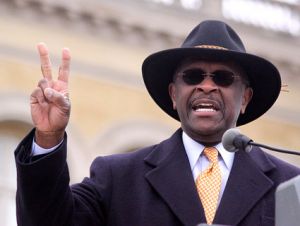 You have to hand it to today’s Republican Party. They still want the crazy and they’re just looking for it in all the right places. Much of it has been on display at the values (sic) voters hatefest, the recent presidential debates, and Sunday news talk shows. The problem is that when it gets exposed to daylight there’s so much crazy that the mainstream runs. They’ve got to find a brand of crazy that sells.
Every time one of these folks burbles up towards Mitt Romney we get to see the new crazy flavor of the month. They’ve already been there done that with Bachmann and Perry. The Bachmann-in-your-face-kind-of-crazy has led to a complete implosion of a campaign that went surprisingly well until Iowa. Perry has been wilting under the spotlight. His debate performances have been terrible and all kinds of his nutjob supporters have been doing a great job horrifying the country by speaking out for him and introducing him proudly. Let’s not forget Ron Paul. He’s the perpetual nutty nut flavor of each campaign season. The Republican presidential contenders have been just one big bowl of Granola full of fruits, flakes and nuts.
So, the deal is that they really really don’t want Mitt Romney who they don’t trust for a variety of reasons. Hence, we’re seeing product testing. So, the next nutty goodness to rise to the top of the taste test is Herman Cain. He’s been a perfect tool for a party trying to prove that it’s not racist. That’s been hard to do given the presence of Ron Paul and Rick Perry. Then there was Haley Barbour who spent part of his time inkling a presidential run by defending a hate group. Well, let’s not be coy. Those last three are the loci of hate group central.
Ron Paul has a long history of being supported by Storm Front and using state’s rights to argue that the Jim Crow laws really shouldn’t have been removed. He’s got a long line of writing racist memes in his news letters and has a well stated position on getting rid of the 1964 civil rights act. Here’s just one recent example of his toe-dipping into the realm of white supremacists group. He actually invited a long time activist in the League of the South to testify to his subcommittee overseeing the Fed.
One of the witnesses invited to testify was Thomas DiLorenzo, a longtime activist in the neo-Confederate hate group, League of the South (LOS). The LOS advocates for a second Southern secession and a society dominated by “Anglo-Celts” – that is, white people. LOS leaders have called slavery “God-ordained” and described segregation as necessary to the racial “integrity” of black and white alike. DiLorenzo also is an economics professor at Baltimore’s Loyola College.
According to the Washington Post, “when Paul opened up the hearing to questions from committee members, Rep. Lacy Clay (D-Mo.) directly took on DiLorenzo for his membership in the League of the South,” pointing to the designation of the LOS as a hate group by the Southern Poverty Law Center. Clay also cited DiLorenzo’s many revisionist works about the Civil War and Lincoln, including “More Lies about the Civil War,” “In Defense of Sedition,” and “The First Dictator-President,” which examines “how Lincoln’s myth has corrupted America.
I suppose we don’t need to go into Perry since stuff is coming out on him more and more all the time. The ranch name thing is just the latest of the dirty laundry hitting the light of day. He’s often been heard touting secession for Texas and supports the Sons of Confederate Veterans in their search to put Confederate symbols on everything.
So, it’s only convenient that the next great Republican crazy flavor is Herman Cain. Maybe he can prove that the Republicans have left Nixon’s Southern Strategy in the History Books. He’s being used to inoculate racists in the party. Notice that I’m not saying all Republicans support institutional racism or are personally racist. Cain can get away with saying things like black people are “brainwashed” and racism isn’t a problem. He does this all while ginning up fear of sharia’h law and Muslims. Oh, and he’s not too friendly on immigration either. Can we please extend the racism conversation to include a few more folks of color so we can add him into the Republican’s mix of homophobia, gynophobia, islamophobia, and xenophobia? Let’s just show a few of his recent hits via Susie Madrak at C&L and the Christine Amanpour interview. Here’s example one.
AMANPOUR: Let me move on to some things that you’ve said. Right after the debate in Florida, you told Wolf Blitzer of CNN that, basically, African-Americans, blacks in this country had been brainwashed over the years into supporting Democrats.
CAIN: Yes.
AMANPOUR: I mean, isn’t that really an inflammatory thing to say? I mean, do you really believe that African-Americans, blacks, are so easily manipulated?
CAIN: I also said in that same interview…
AMANPOUR: No, but let me you ask about that. That word is very inflammatory.
CAIN: It is. I’m going to answer your question. I also said the good news is a large percentage of black people are thinking for themselves. Now, I think that — if the word is inflammatory, that’s too bad. It is true. And here’s why: because some black people won’t even listen to someone who appears to be a conservative or a Republican. I call that brainwashing.
Here’s example two.
CAIN: Some people would infuse Sharia law in our court system if we allow it. I honestly believe that. So even if he calls me crazy, I am going to make sure that they don’t infuse it little by little by little. It’s not going to be some grand scheme, little by little. So I don’t mind if he calls me crazy. I’m simply saying…
AMANPOUR: You’re sticking to it?
CAIN: I’m sticking to it. American laws in American courts, period.
Any one who insists that “judeo-christian” traditions be put into law would essentially be arguing for sharia law too given that things like prohibition against usury is based in shared Abrahamic traditions. That’s just one example. I doubt Cain or most of his friends even know the huge tenets implied in sharia. They only assume it’s not “American” when their pet religious traditions are acceptable. This wreaks of the same kinds of arguments they used to use on Jewish and Catholic faiths. Right now, Cain and all his Republican pals are trying to avoid the attacks by their base on Mormons.
Perhaps most astounding to me is Herman Cain’s joke that our immigration policies should consist of a great wall of china and an alligator moat. This was as telling to me as Bobby Jindal’s pedophilia joke. There’s jokes and then there’s tasteless jokes at other people’s expense.
Transcript: “I just got back from China. Ever heard of the Great Wall of China? It looks pretty sturdy. And that sucker is real high. I think we can build one if we want to! We have put a man on the moon, we can build a fence! Now, my fence might be part Great Wall and part electrical technology…It will be a twenty foot wall, barbed wire, electrified on the top, and on this side of the fence, I’ll have that moat that President Obama talked about. And I would put those alligators in that moat!”
So, here’s the statement on his policy outside the context of that strange joke in terms of a slap in the face to Rick Perry. Oh, btw, we’re supposed to get a sense of humor to understand the joke. Isn’t that what they all say? This isn’t an immigration policy per se, it’s more like a paramilitary strategy.
Cain’s suggestion that immigration law enforcement should simply be turned over to the states is just another example of his naive understanding of both foreign policy and the Constitution.
As the Supreme Court established almost 70 years ago, the states have very little business weighing into immigration policy because “[e]xperience has shown that international controversies of the gravest moment, sometimes even leading to war, may arise from real or imagined wrongs to another’s subjects inflicted, or permitted, by a government.” If a single state mangles an immigration prosecution, for example, or directs disparate resources against the citizens of one nationality, it will impact the foreign relations of the entire United States — potentially even thrusting America into a needless war. The Constitution leaves these kinds of decisions up to a leader who has actually been elected by the whole nation, and not to the governor of just one state.
Nevertheless, Cain’s weak understanding of law and policy is apparently quite appealing to the kind of voters who cheer death and boo U.S. servicemembers. A new Fox News poll shows previous frontrunner Rick Perry hemorrhaging support — more than one third of his previous supporters ditched his candidacy in the wake of Perry’s defense of humane treatment for immigrants — while Cain has surged 11 points to third place in the GOP primary.
Perry, like the Chamber of Commerce, loves him some cheap labor. Cain’s strategy is to let states use law enforcement to “repel the invader”. I think we can safely say that the invader is still that age old use of “other” as tribe enemy.
At this point, you should be asking yourself why Herman Cain talks so much about race if it’s not such a big deal in this country. Aren’t an awful lot of Cain’s comments aimed at race and continually saying it’s no big deal? So what I want to know is why is it okay for Herman Cain to play the race card? Is Cain seeing that this is some kind of trump card that Republicans can use against the Obama campaign’s prior use? What does this buy him? Do I have to give my mom’s lecture on two wrongs not making a right?
Saturday: Lead, Hillary, lead!
Posted: October 8, 2011 Filed under: just because 18 Comments Morning news junkies!
Wonk here, with some weekend reads for you, so grab a fresh cup of your favorite a.m. beverage and let’s get right to it.
First up — to the right, it’s our girl in the Dominican Republic on Wednesday, being greeted by participants of the Women’s Entrepreneurship Network (State Department/public domain photo):
Where women are involved in economies, everybody does better. That’s just common sense.
–Secretary of State Hillary Rodham Clinton
Two days earlier at Foggy Bottom’s Ben Franklin Room, Hillary honored African women entrepreneurs–here’s an excerpt from her remarks to them (and a pic of Hillary with the women–click on it to see the HQ version):
And so today, I am here to really not only thank you, but to encourage you – to encourage you to keep making the contacts, building the networks, making the changes that will really revolutionize what women are doing around the world. And I know that there are many here who are very determined and very committed but still face obstacles. So I wanted also to tell you, do not despair. You have many friends and supporters back here in the United States. And we will try to help you break down the barriers and the hurdles that you encounter. You heard Sylvia say that there needed to be support for women to travel those great long distances across Africa, to meet with one another, to share ideas, to start businesses. And we will do our best to help you make the difference in your own lives.
And we also will keep telling leaders around the world, as I did at a conference just a few weeks ago about Asia, that the rise of women in economies over the past 10 years has increased globally the GDP to the equivalent of China’s. Now what that means is if women are empowered to work, to build businesses, to have access to credit, to have an ownership interest in the land that they farm and the crops that they harvest, to be given a chance to compete, as Sylvia said, we know that women will make a huge contribution. So we have to break down the barriers that still exist. We have to change the laws that still hold women back. We have to not only encourage you, but encourage the governments and businesses of Africa to recognize a good thing, which is your empowerment and entrepreneurial skills.
There are still some people I encounter who say, “Well, women don’t contribute much to the economy,” because of course, they don’t count the backbreaking work that women do every single day. And I’m always a little disappointed and quite surprised when I hear that, and I say to these male economists and government leaders, “Look out the window of your car, of your house, of your office. Who is doing a lot of the work in Africa? And who is doing work that is not fairly compensated? And what can you do to unleash that potential so that your GDP grows, your economy gets bigger, you will benefit from this kind of investment?”
I’ve long been one of the voices saying “Rise, Hillary, Rise,” but these days the words that come to my mind are… “Lead, Hillary… Lead!”
Especially after reading the next two items…
The first of which is Laura Rozen’s piece earlier this week at The Envoy — “The Clinton doctrine on economic statecraft: Clinton to urge U.S. diplomats to put economics at top of foreign policy agenda.”
And in many ways, Hillary Clinton’s diplomatic portfolio is increasingly dominated by global economic challenges. Trade issues obviously have a direct impact on America’s efforts to emerge from the present economic downturn–from the battles over the national debt to the need to stimulate job growth. But economic issues also shape other less-noted features of the American foreign-policy agenda, be it the effort to contain fallout from Europe’s debt crisis, to managing the rise of G20 economic powers such as Brazil, Turkey and India—all of whom come bearing their own foreign policy ambitions. As a result, diplomats say, economic and foreign policy are growing ever more intertwined.
“The trading floor is increasingly replacing the battlefield as the forum for state contacts,” according to one of Clinton’s State Department advisers, who spoke on condition of anonymity so as to describe the department’s economic plans more broadly.
So Hillary Clinton has been working hard to beef up the economic bench strength of the State Department, while also mounting a bid for State officials to play a more decisive role in determining U.S. global economics policy. Aides expect her to lay out what they are calling the “Clinton doctrine on economic statecraft” early this month, likely in a speech in New York. Timing and venue for the address are still being worked out, her aides say.

Here’s a taste of the second piece, from Business Insider — “Obama Taps Hillary Clinton’s Popularity To Help Push Jobs Agenda“:
President Barack Obama has drafted Secretary of State Hillary Clinton to help him sell his jobs agenda to a wary Congress and American public.
Clinton, the most popular figure in American government, will host Obama’s Council on Jobs and Competitiveness on Friday at the State Department to discuss ways to grow foreign direct investment and increase domestic investment.
It’s a major shift for Clinton, who has largely been above the fray between Congress and Obama, with a heavy foreign policy agenda due to the Arab Spring — and inserting her into the debate seems to be an attempt by the Obama administration to capitalize on her popularity.

Is it any wonder that Hillary continues to be the talk of DC’s 2012 parlor games — the latest of which has Politico nominating Hillary for a fantasy independent run:
There’s the minor inconvenience that she’s a lifelong Democrat, works for Obama and seems hell-bent on getting out of the public arena (before she runs again in 2016). She will need to explain all of that away.
Here’s how. Clinton could plunge in with a nonpartisan campaign that merges the two chapters of her political life: managing a world on fire as secretary of state the past two years and helping her husband oversee eight years of prosperity during the 1990s.
Back here in the reality-based world, Hillary has released a wonderful statement honoring this years’ female Nobel peace laureates:
I am delighted to send heartfelt congratulations to Liberian President Ellen Johnson Sirleaf, Yemeni activist Tawakkul Karman and Liberian peace activist Leymah Roberta Gbowee for the prestigious honor of sharing this year’s Nobel Peace Prize. They are shining examples of the difference that women can make and the progress they can help achieve when given the opportunity to make decisions about the future of their societies and countries.
The unflinching courage, strength and leadership of these women to build peace, advance reconciliation, and defend the rights of fellow citizens in their own countries provide inspiration for women’s rights and human progress everywhere. This recognition of their extraordinary accomplishments reflects the efforts of many other women who are promoting peace and security in their countries and communities. I want to commend the Nobel Committee for recognizing the powerful role women are playing in building peace and ending conflict around the world.
Quote Unquote
Here are a few blurbs of interest I caught this week (the first one is strange if you read it all the way through, in a sort of revealing way):
Occupy Wall Street is the latest proof that populism is not a purely conservative phenomenon; instead, populism of the left or the right distrusts government as a bribed, compromised institution, and rejects consensus as a political tactic. For liberals who envy the conservative skill at converting protest movements into a sustained political force, and who want to create a left -leaning enforcer within the Democratic Party, OWS is the answer to a fantasy.
However, for Barack Obama, OWS happens to be the polar opposite of what he campaigned on as well as the message that launched him at the convention in Boston in 2004. Its “us versus them” mantra has made Wall Street its target, but its ultimate result would be a politics that is conflict-driven, divided, and bitterly conscious of the line between a “red” and a “blue” America. Obama should hear the anger in these protests, but he should recognize that it is poised to join the tea party as one more force that is pulling us apart.
–Artur Davis, former congressman (D-Ala.)
“That was an event in my life, not who I am. I’m a friend, daughter, sister, teacher. I’m in a relationship (with a Waltham, Mass. Businessman) that’s been wonderful for 10 years – longer… I’m happy, and I still have a voice.”
—Anita Hill on her testimony against Clarence Thomas
Secretary of State Hillary Clinton was in San Francisco yesterday for an event at the Westin St. Francis, where she gave a keynote speech about “the inclusion of women as an economic growth strategy” at the Asia Pacific Economic Cooperation (APEC) Women and the Economy Summit. And this morning an informant tells Grub Street that she dined last night at Zuni Café. “She was super friendly,” says the informant. “She drinks whiskey sours. Weird, right?”
Gabby did it better than I did.
–Joe Biden, on Gabbty Giffords’ effort to affix a medal to former astronaut and Navy Capt. Mark Kelly’s jacket
Today in Wom en’s History (October 8th)
Jeanne Mance was the first nurse in New France. On October 8, 1645, she..
…opens the Hôtel Dieu, Montreal’s First hospital and the First lay hospital in North America; she will treat the French and Aboriginal populations for over 30 years.
Jeanne Mance later helped her friend Marguerite Bourgeoys found the Congregation of Notre Dame for the education of girls.
Well that’s it for me… what’s on your mind/reading list this weekend?

 peej
peej Carissa
 bostonboomer
 dakinikat
 ecocatwoman
 mablue2
 Mama Lopez
 peggysue22
 quixote
 skydancingguestblogger
 Mona (aka Wonk the Vote)



 Sky Dancing
Recent Comments