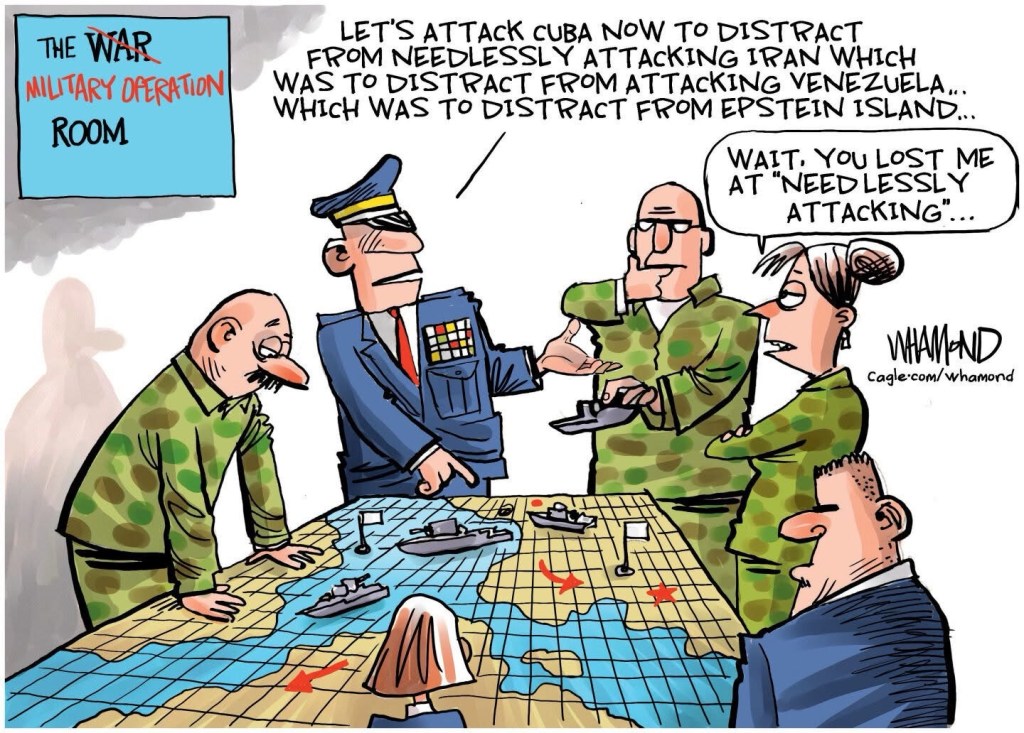
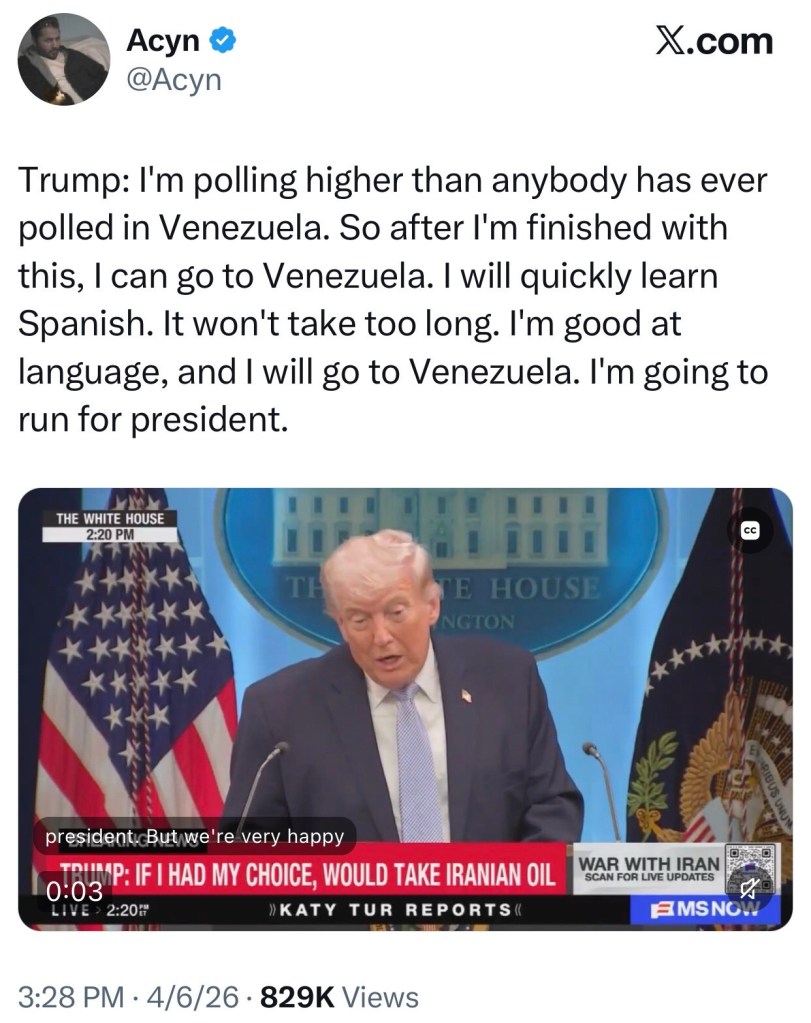
Trump: After I'm finished with this, I can go to Venezuela. I will quickly learn Spanish. It won't take too long. I'm good at language, and I will go to Venezuela. I'm gonna run for president.
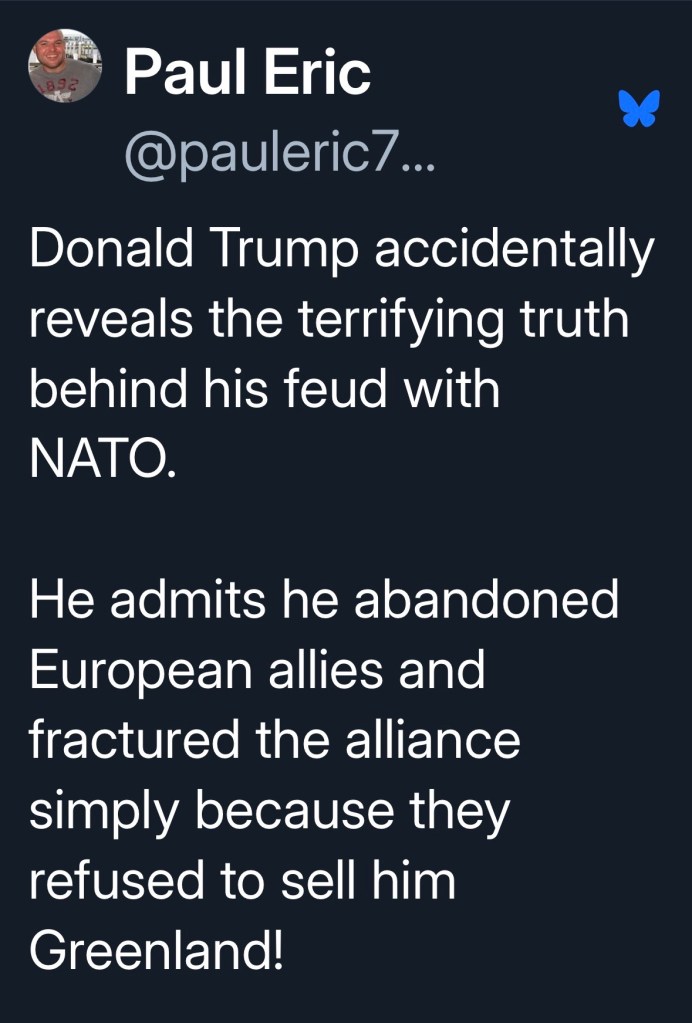
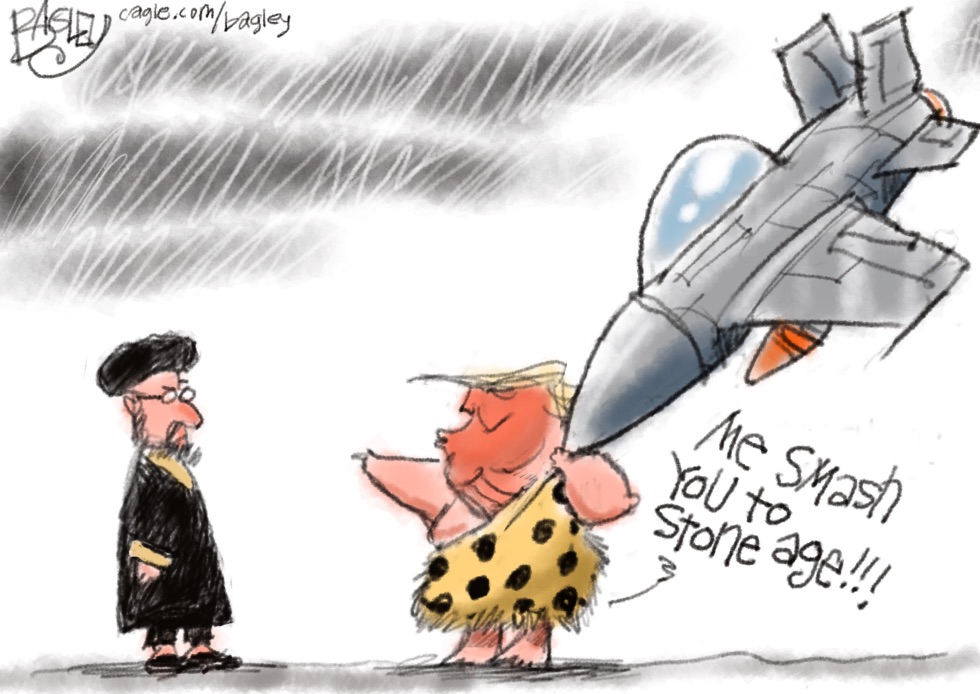
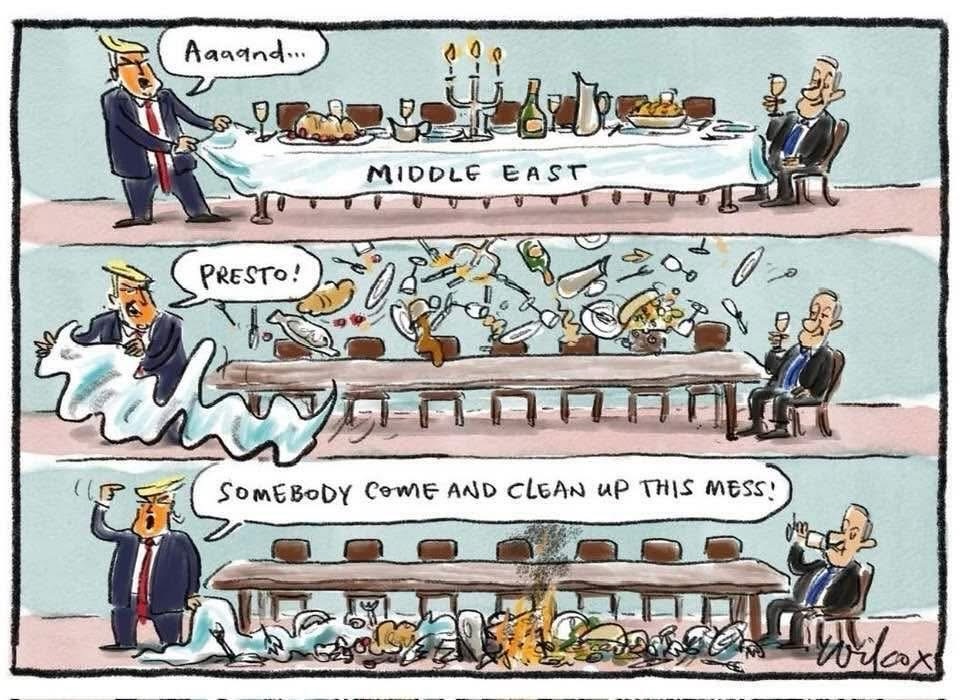
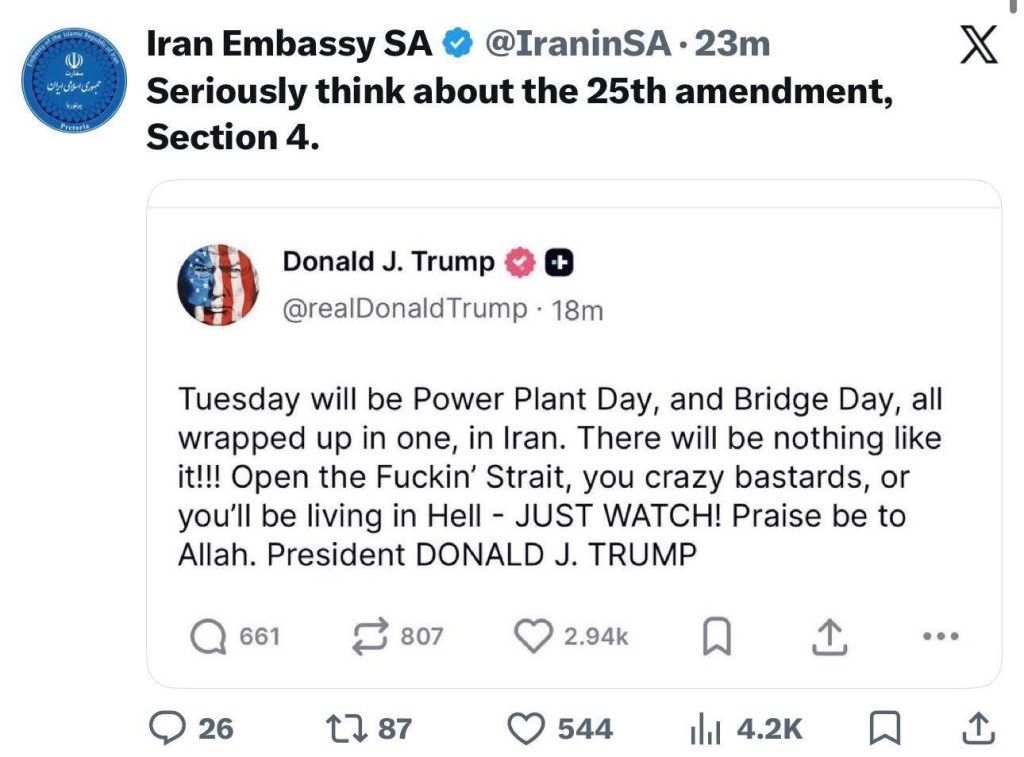
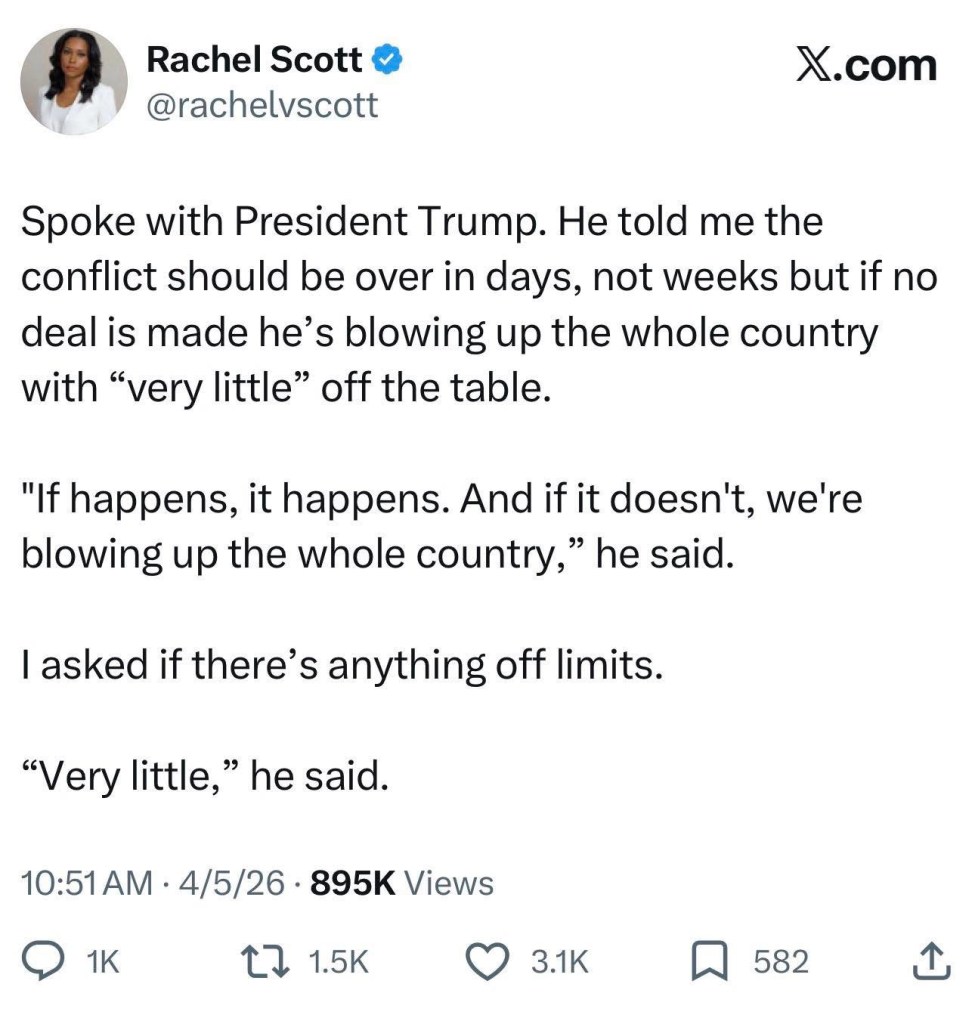
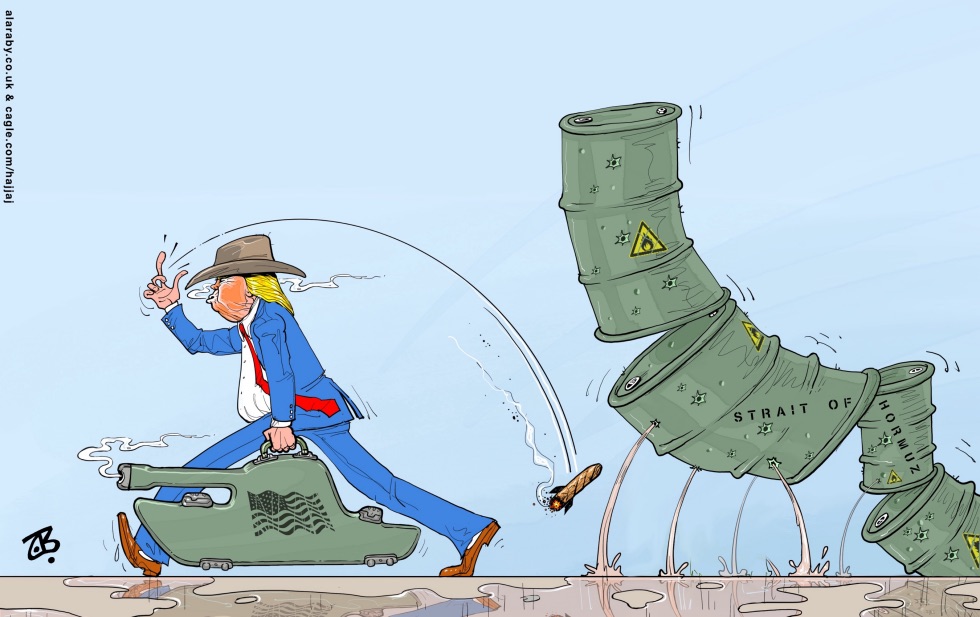
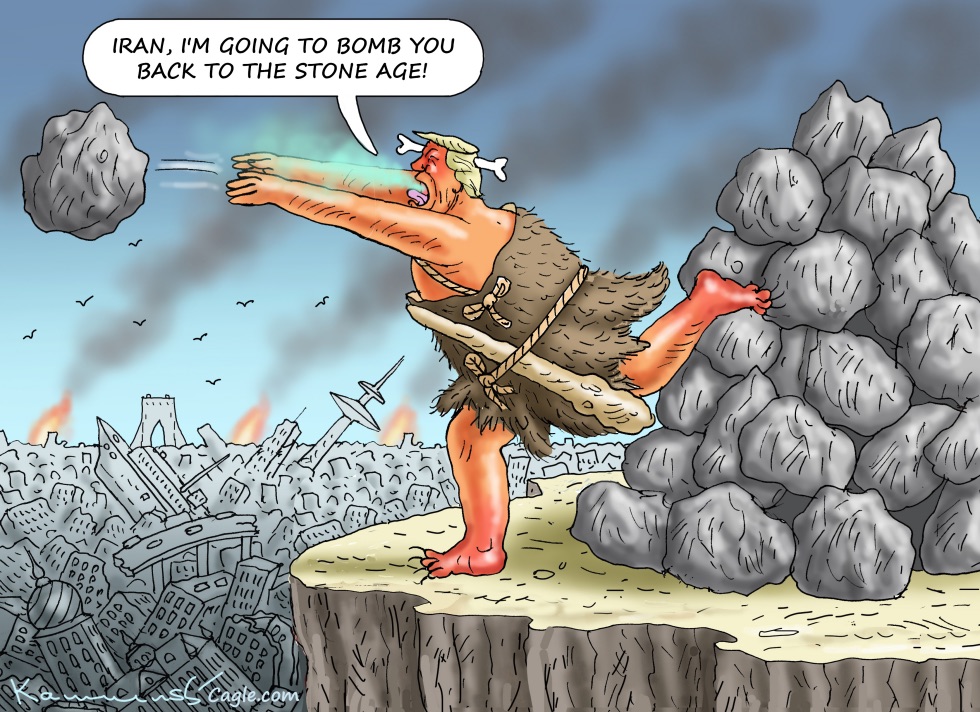
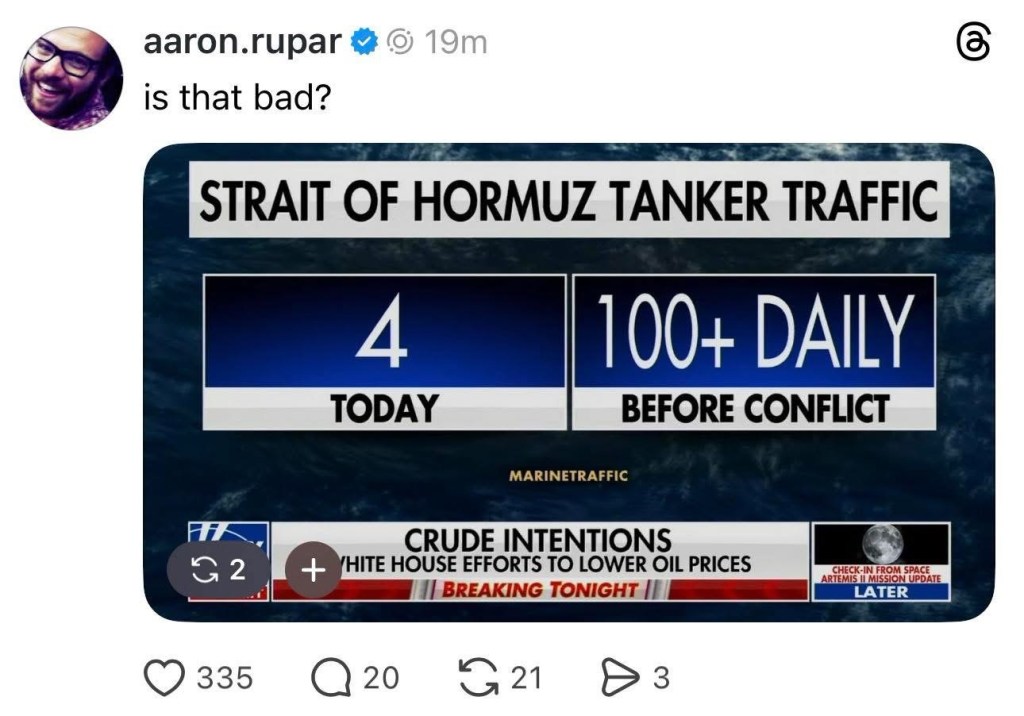
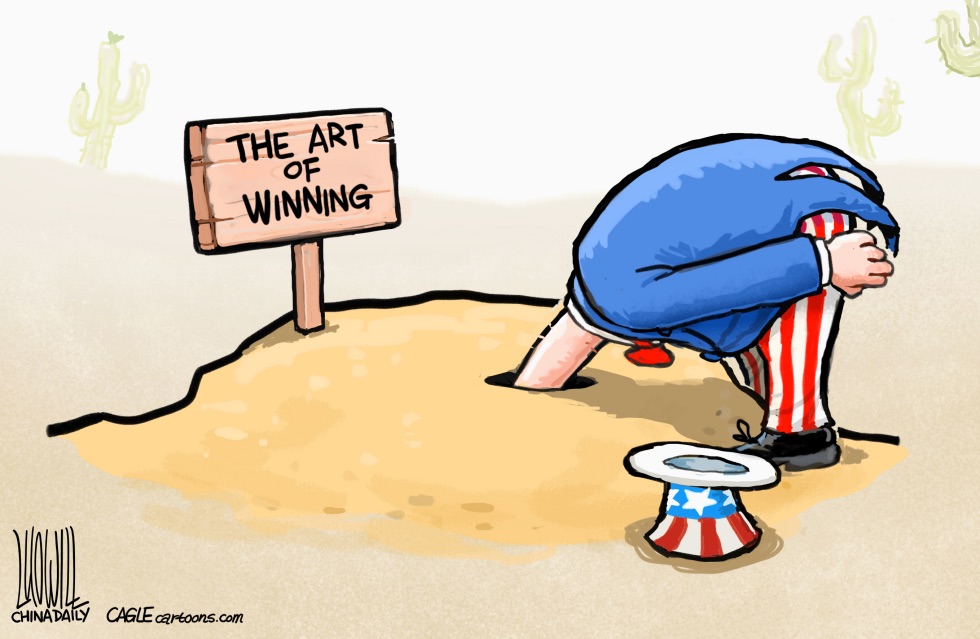
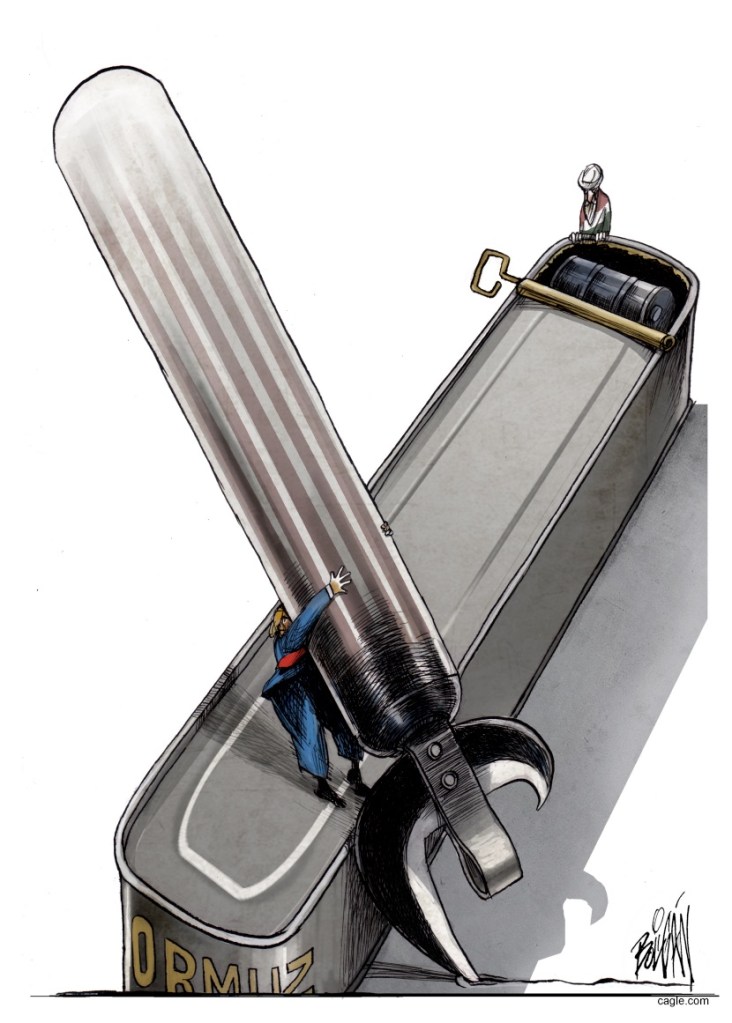
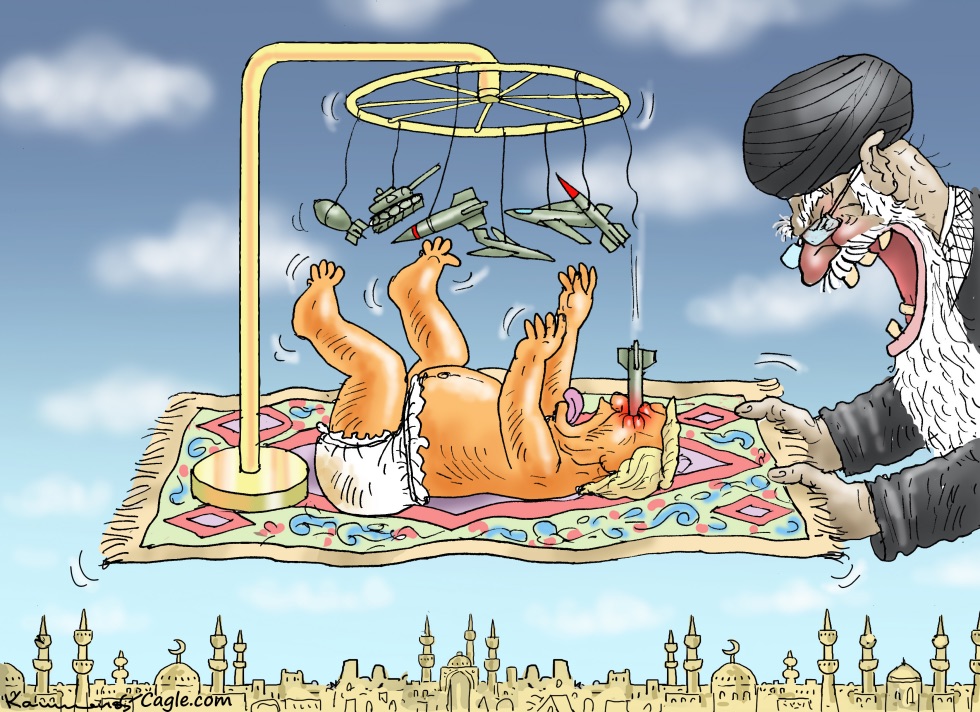
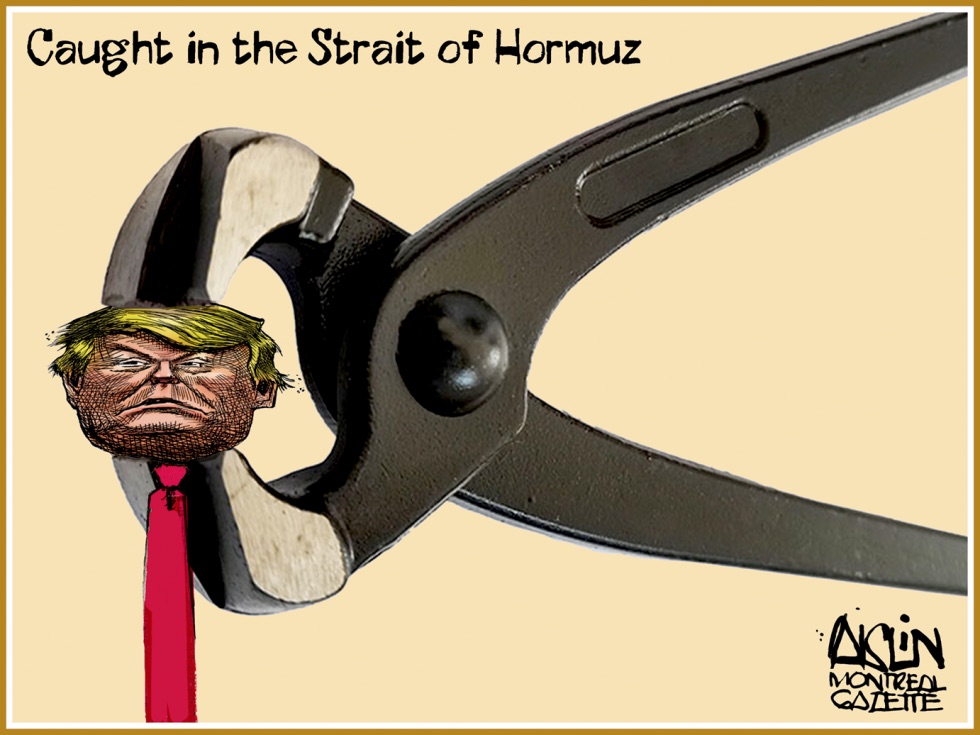
Trump's latest ravings:- Wants the USA to charge ships for permission to transit the Strait of Hormuz- Would like to seize Iran's oil- Threatens to destroy every power plant in Iran on Tuesday night- Says feud with NATO started because they refused to give him Greenland
Trump: "I did one other but this one was not picked up: Osama bin Laden. If you read my book, I said you gotta take him out one year before the World Trade Center came down. So you should read the book."
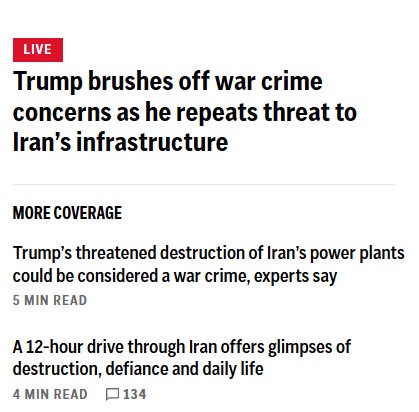
"What he’s threatening is not the kind of war that vaguely adheres to any rules or laws. He’s making openly terroristic threats."Yep. The Domestic Terrorist-in-Chief.
Trump actually said that PUTIN explained NATO to him…And that he has a very good relationship with Putin.Then Trump called NATO a "paper tiger."It's always been a concern that Trump values Putin's opinion, but even more so now when Putin is aiding Iran against the U.S.
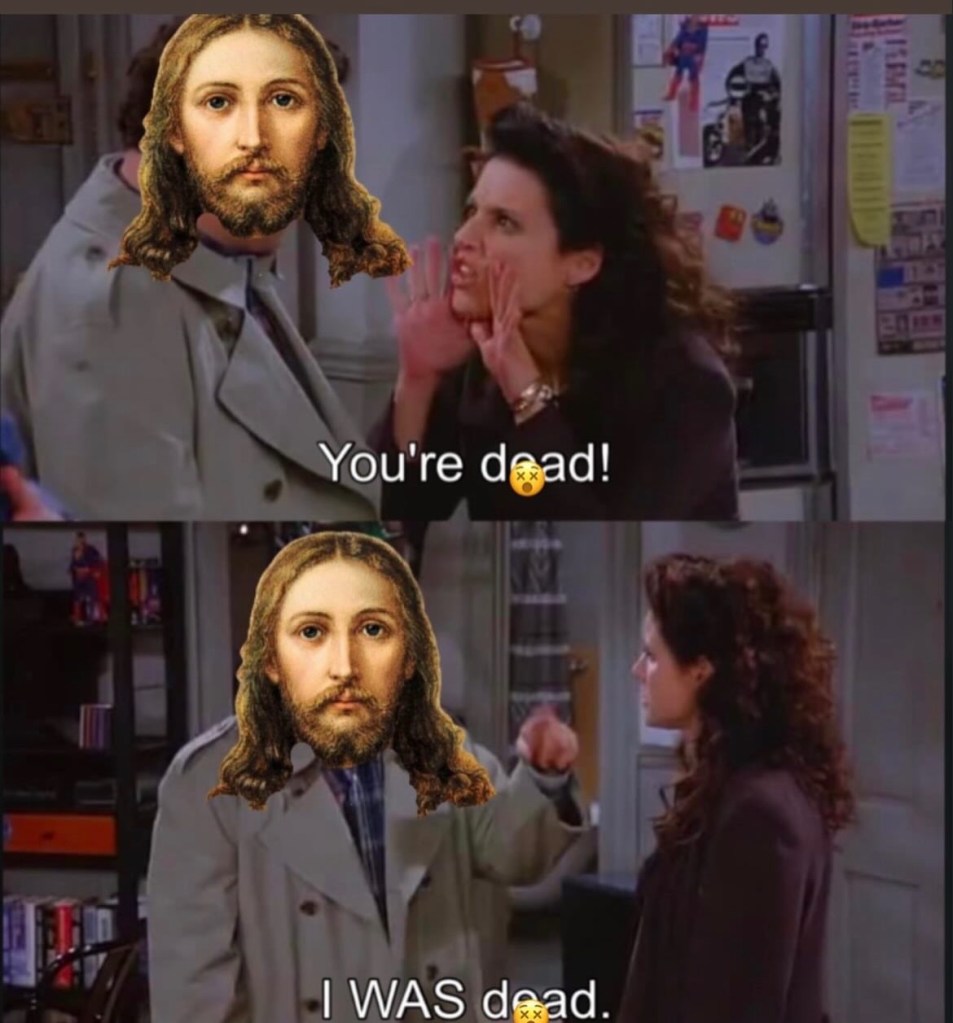
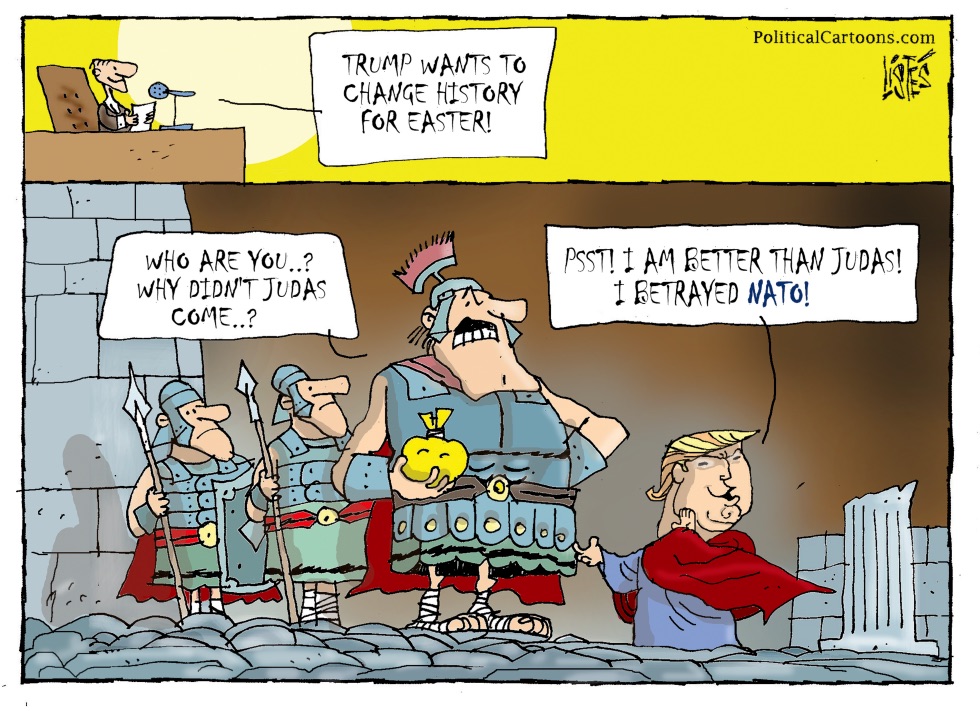
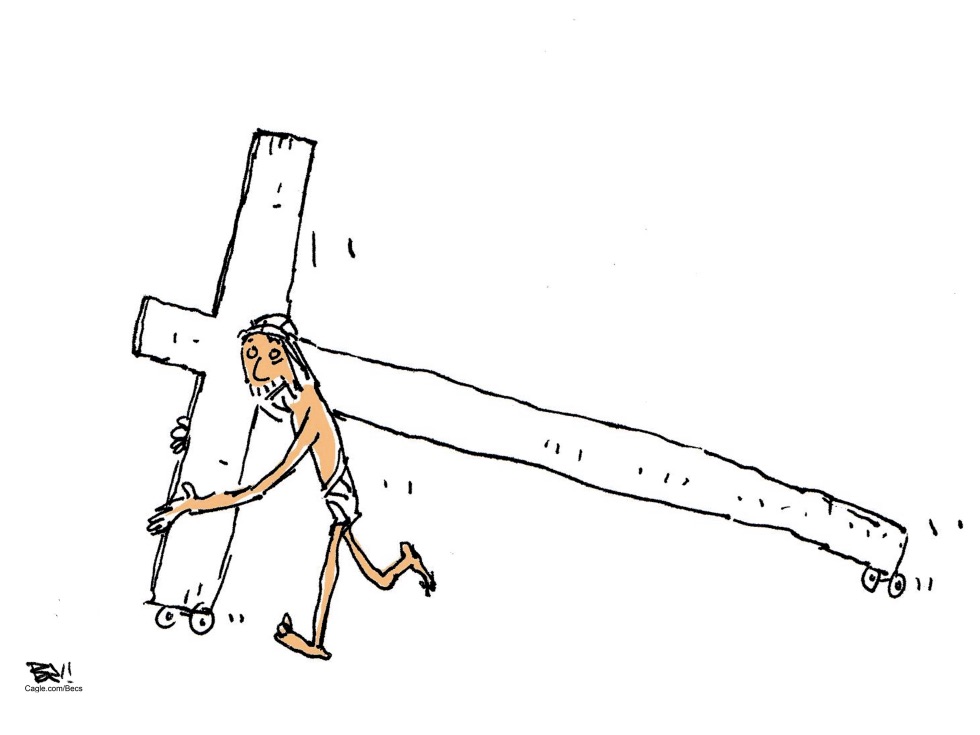
For some of us…we prefer to think of the holiday weekend in the old ways…
Click image for the link.
They didn’t invent resurrection.
They rebranded it.
The story your culture gave you every spring, the death, the waiting, the return, was already ancient by the time anyone decided it belonged to one man.
It belonged to goddesses first. Plural. Across languages, continents, and millennia.
Each one descended. Each one waited in the dark. Each one came back.
And the world bloomed because she did.
The word “Easter” doesn’t come from the Bible.
In French, Pâques. In Swedish, Påsk. In Spanish, Pascua. All derived from Pesach, the Hebrew word for Passover.
But in English and German, something older lived inside the word itself.
The name Easter is believed to derive from Ēostre, a spring dawn goddess.
Bede, writing in 725 CE, is our only ancient source for her. He documented that Anglo-Saxons held feasts in her honor during the spring month named after her: Ēosturmōnaþ. That month’s name became the English word for the Paschal season, what the rest of Europe still called Pâques. The new feast inherited the old name.
In his own words: “Eosturmonath was once called after a goddess of theirs named Ēostre, in whose honor feasts were celebrated in that month. Now they designate that Paschal season by her name, calling the joys of the new festival by the time-honored name of the old observance.”
In French, Spanish, and Swedish, the Church replaced her entirely. In English, the word kept the goddess in it.
She didn’t disappear. She went underground, and every spring the language says her name again.
Please take a look at the rest of the post at the link here. It is truly fascinating.
Well, this is making noise:
Trump has not been seen publicly since his primetime speech on Wednesday. 72 hours and counting despite the fact he hasn’t left DC.
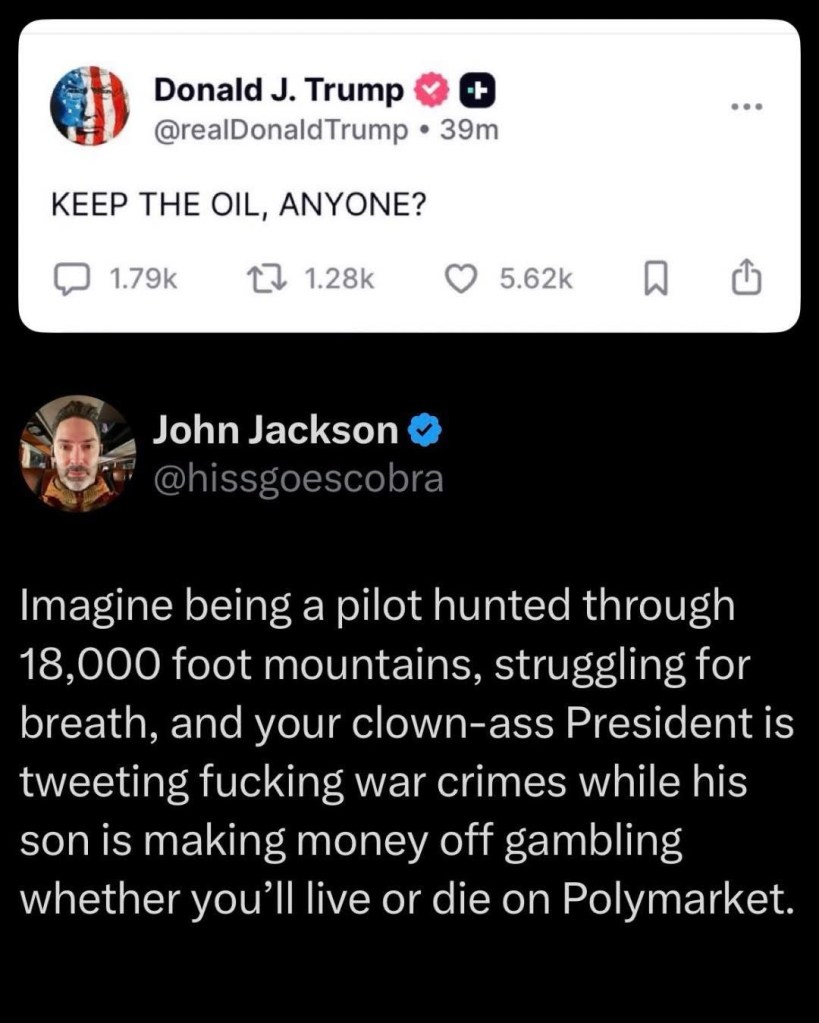
Trump did post on social media. Yesterday, while the search for the airman was underway, his account posted: “With a little more time, we can easily OPEN THE HORMUZ STRAIT, TAKE THE OIL, & MAKE A FORTUNE. IT WOULD BE A ‘GUSHER’ FOR THE WORLD??? President DONALD J. TRUMP.”
At 10:05 this morning, Trump posted: “Remember when I gave Iran ten days to MAKE A DEAL or OPEN UP THE HORMUZ STRAIT. Time is running out—48 hours before all Hell will reign down on them. Glory be to GOD! President DONALD J. TRUMP”
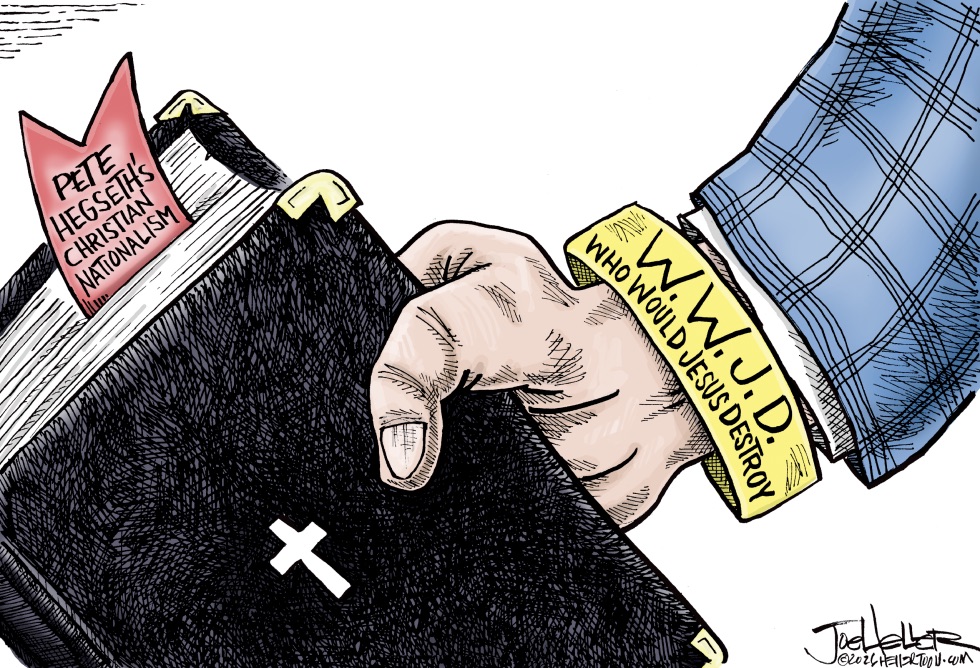
Economist Paul Krugman noted today that this post didn’t sound like Trump. His speech on Wednesday was low energy and delivered in a monotone. It suggested Trump was abandoning the idea of reopening the Strait of Hormuz and handing off the problem to other countries. Now he is threatening to “reign”—he meant “rain”—down “all Hell” on Iran to get it to restore the conditions that existed before he attacked. And then, as Krugman noted, he added “Glory be to GOD!” which sounds a lot more like Hegseth’s Christian holy war language than Trump’s.
Krugman says, “[I]t sounds like he’s…going to try and do something truly awful in an attempt to somehow redeem himself and the situation” in Iran.
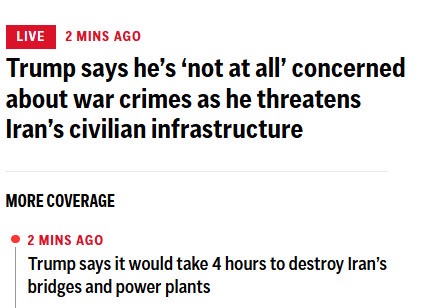
Michael R. Gordon and Alexander Ward of the Wall Street Journal reported today that Trump’s aides have been telling him Iran’s civilian infrastructure is a legitimate wartime target, despite the understanding among experts that such attacks are illegal. The journalists say Hegseth has embraced the aides’ argument that attacking infrastructure would make it more difficult for Iran to transfer the materials they need to develop nuclear weapons. A White House official added that destroying electric plants could foment civil unrest, which would in turn make it more difficult to produce a nuclear weapon.
Ryan Goodman of Just Security commented: “That would be an F on a bar exam.” He observed, “This isn’t legal analysis. It’s idiocy.”
If you all have been following the eagles Jackie and Shadow and the Friends of Big Bear Valley, the eaglets are breaking out of their eggs! Now that is an Easter birth I can celebrate with pure joy.
Look at that cute little head.
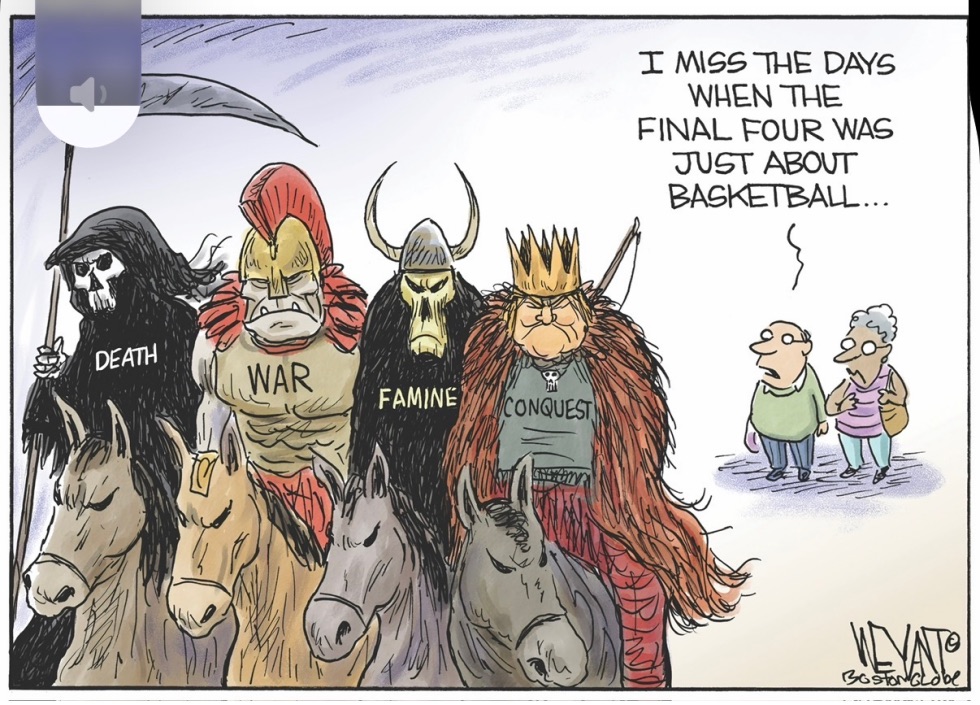
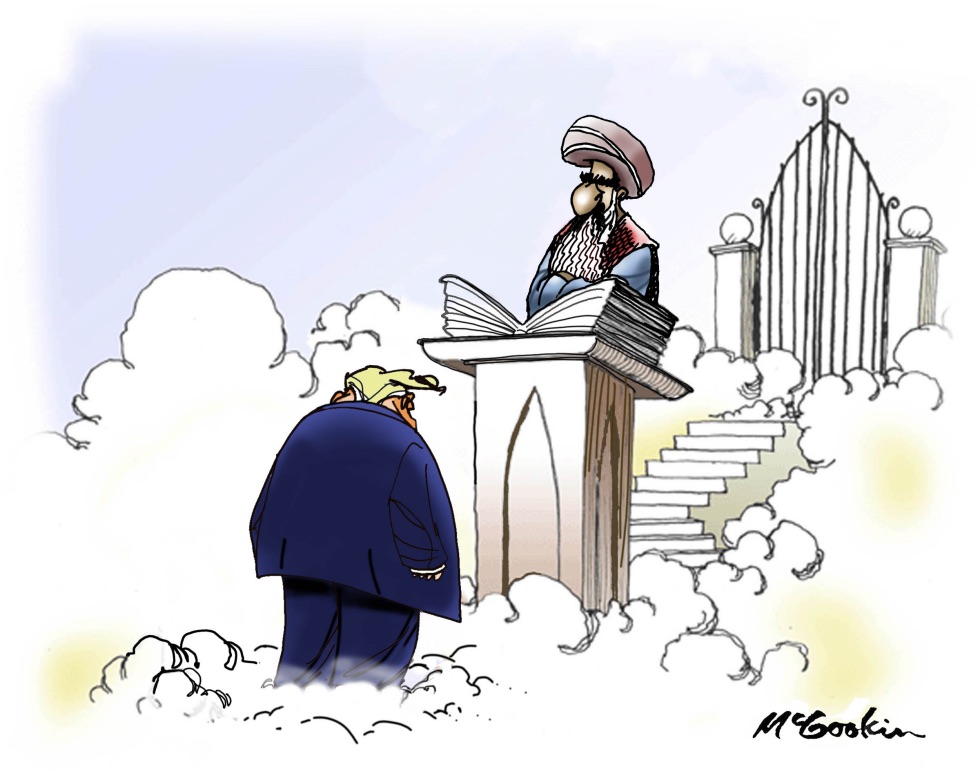
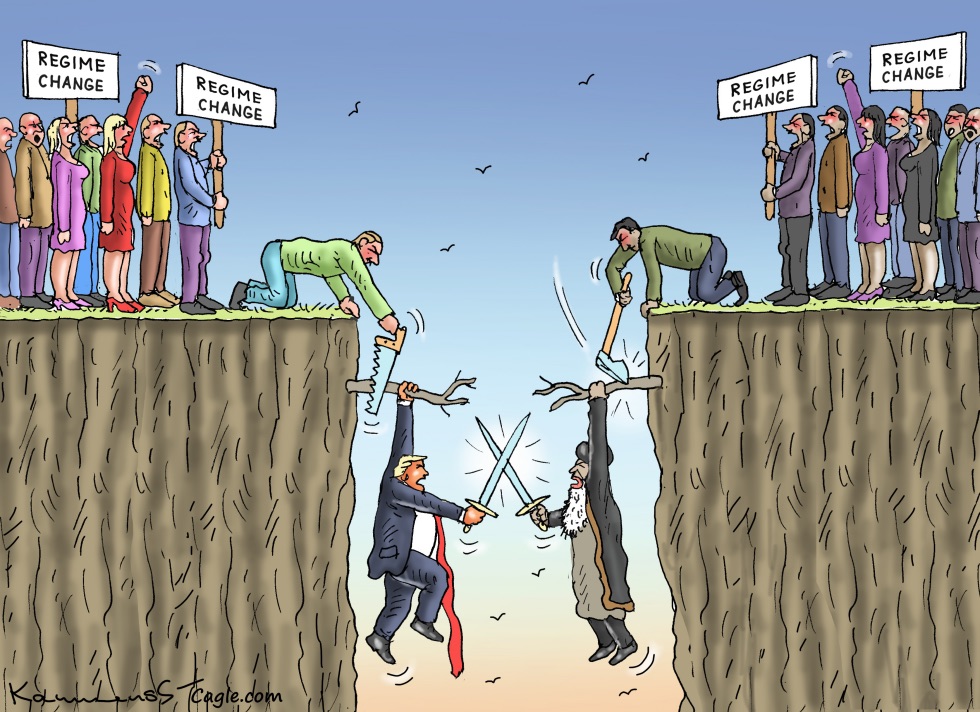
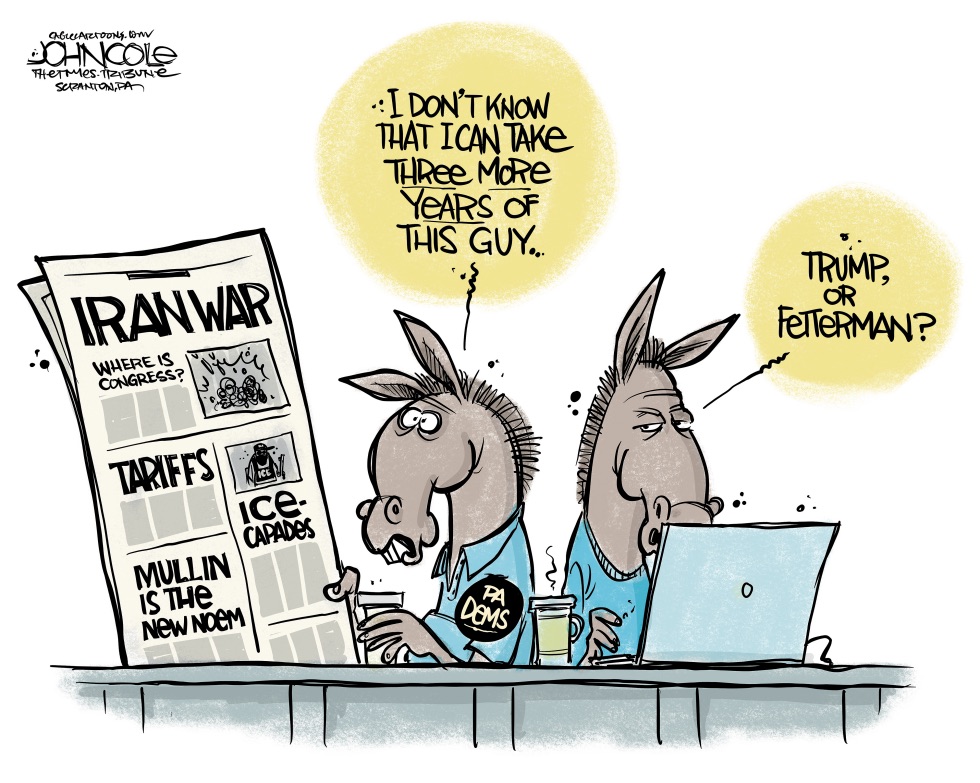
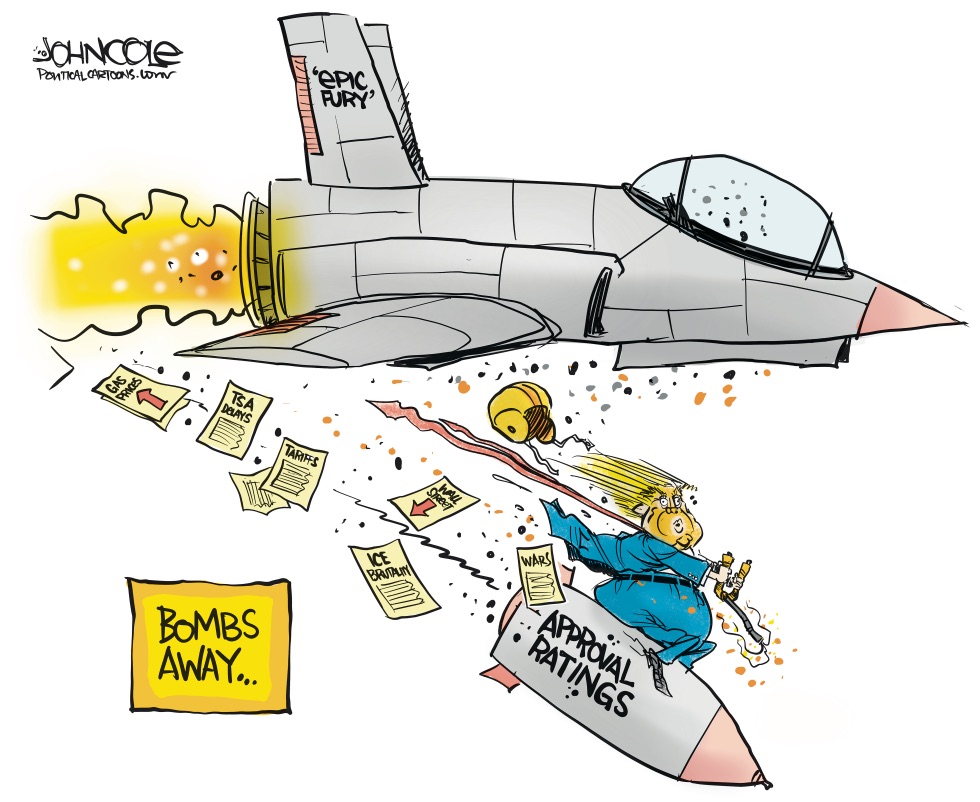
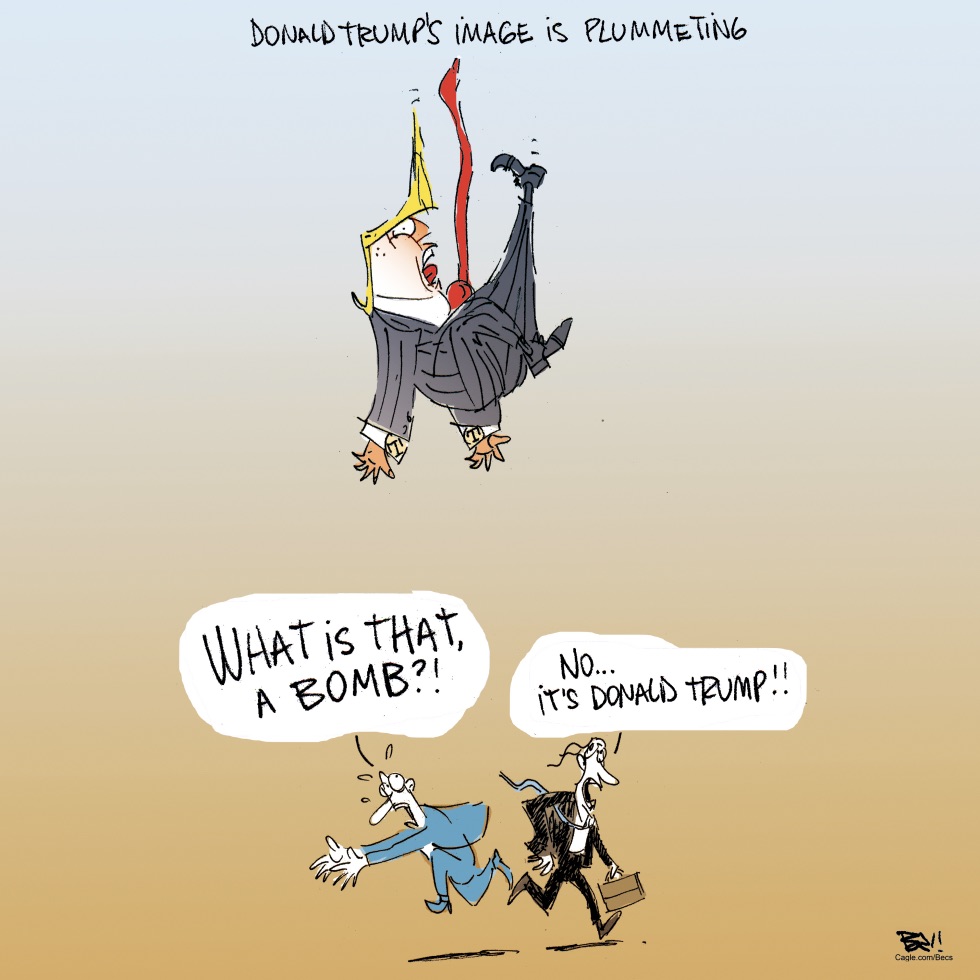
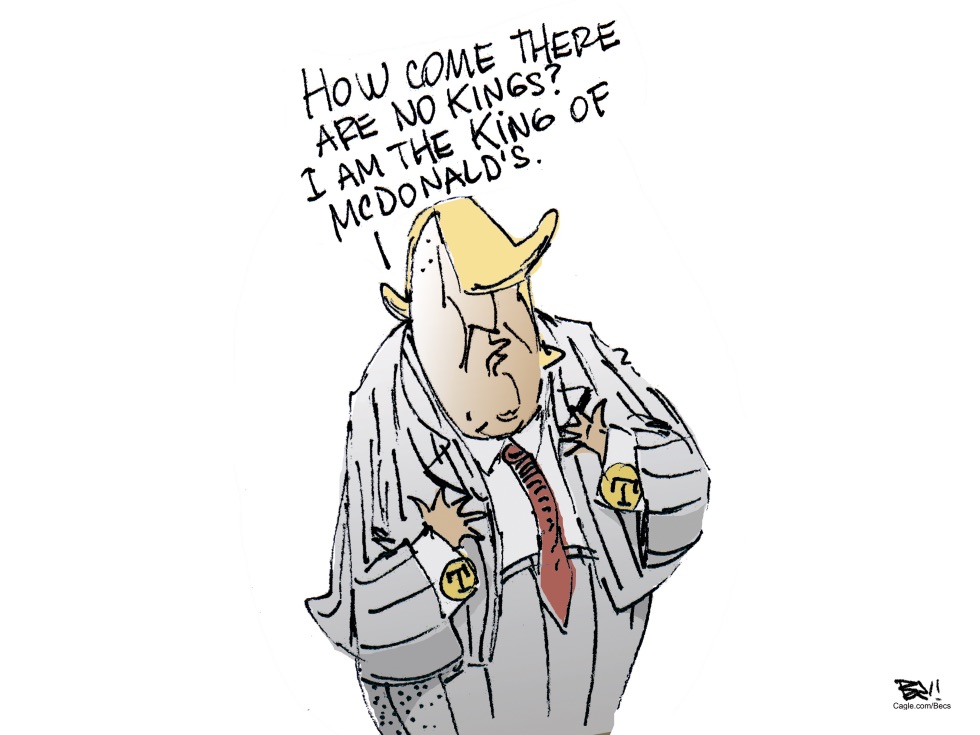
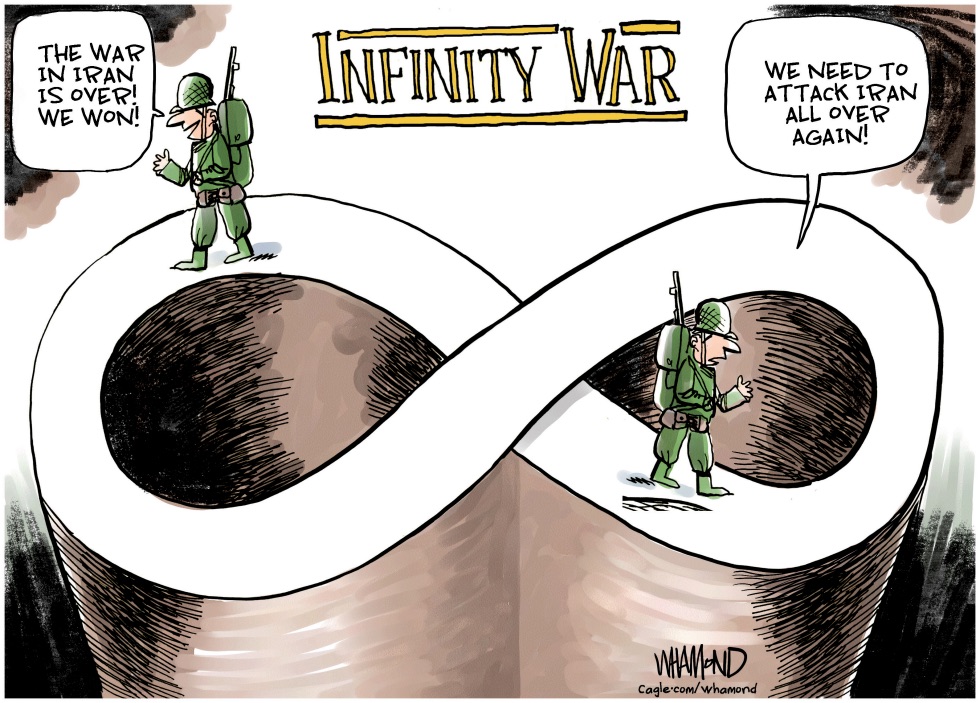
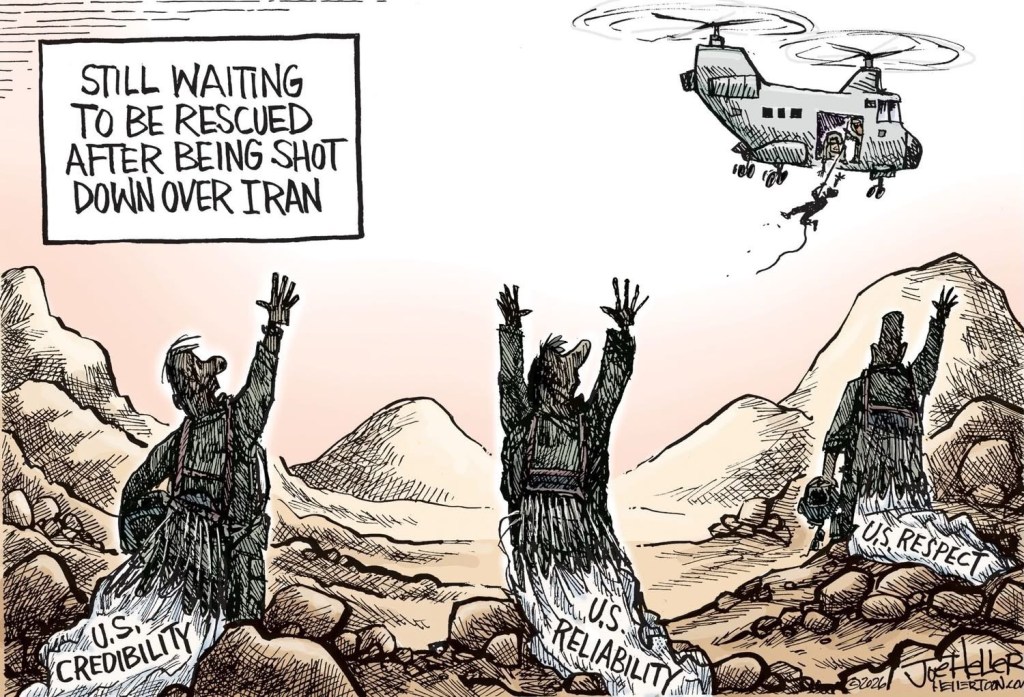
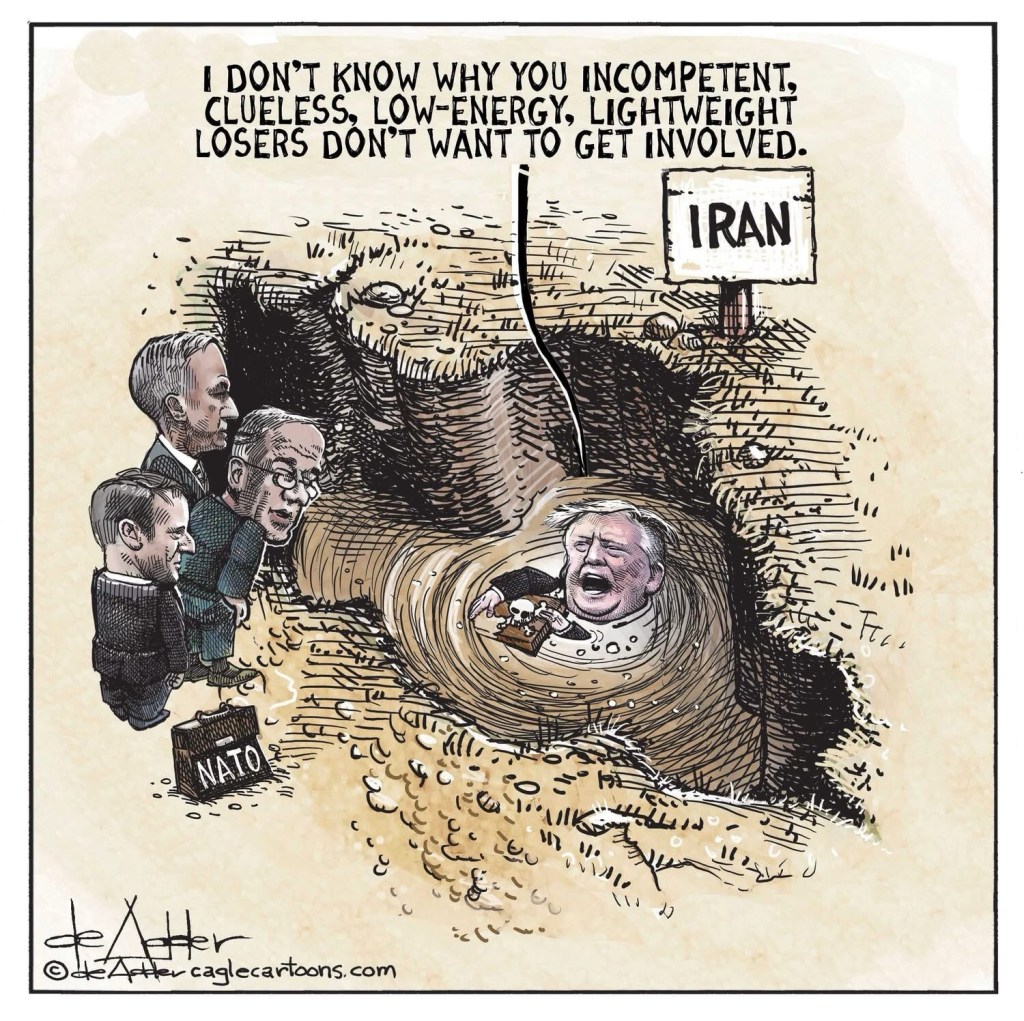
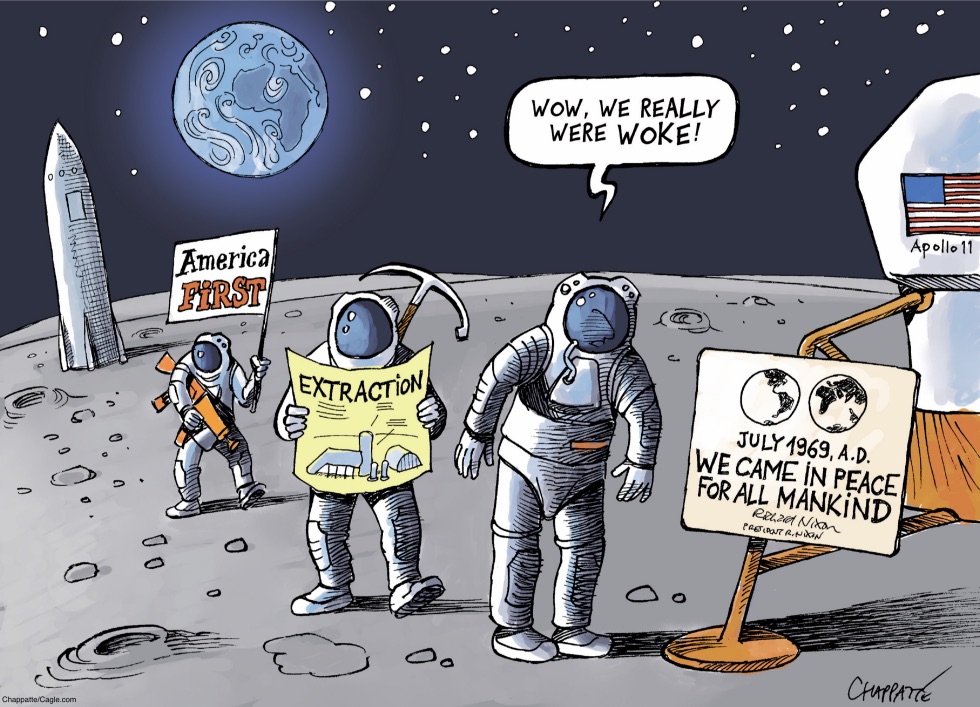
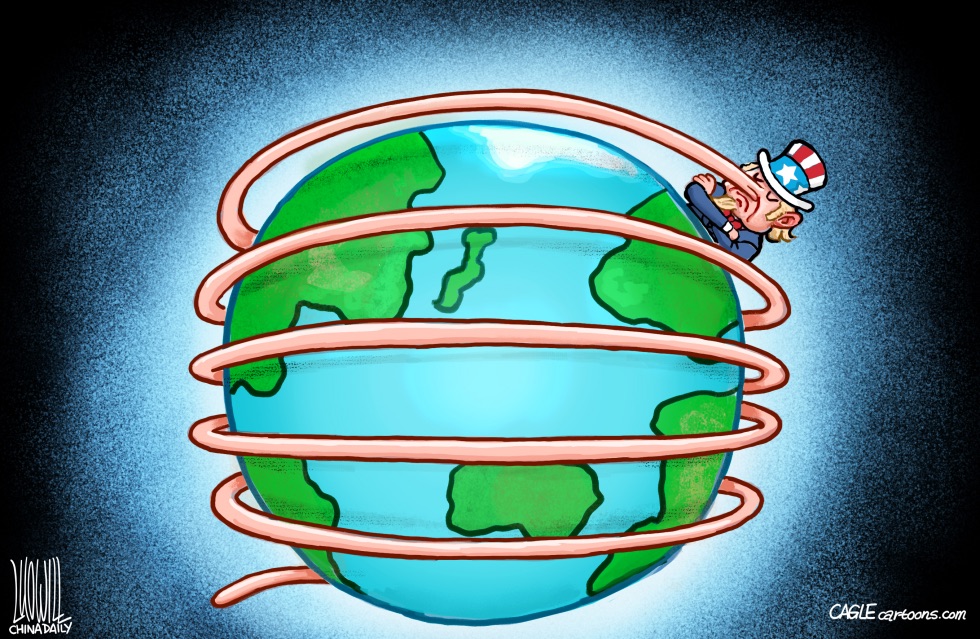
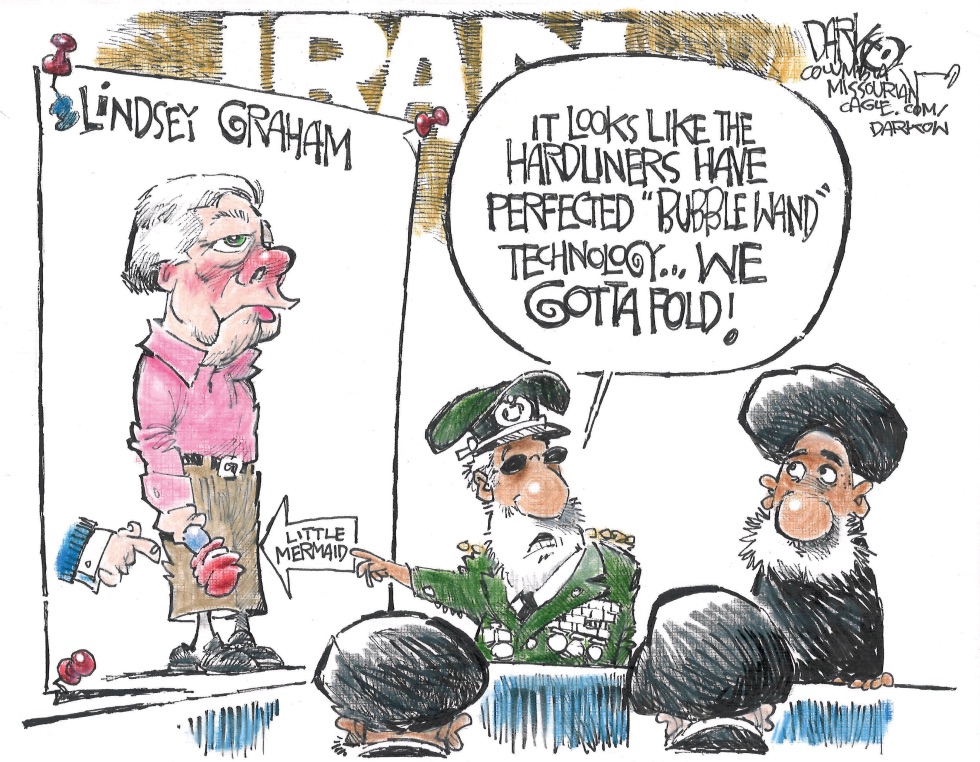
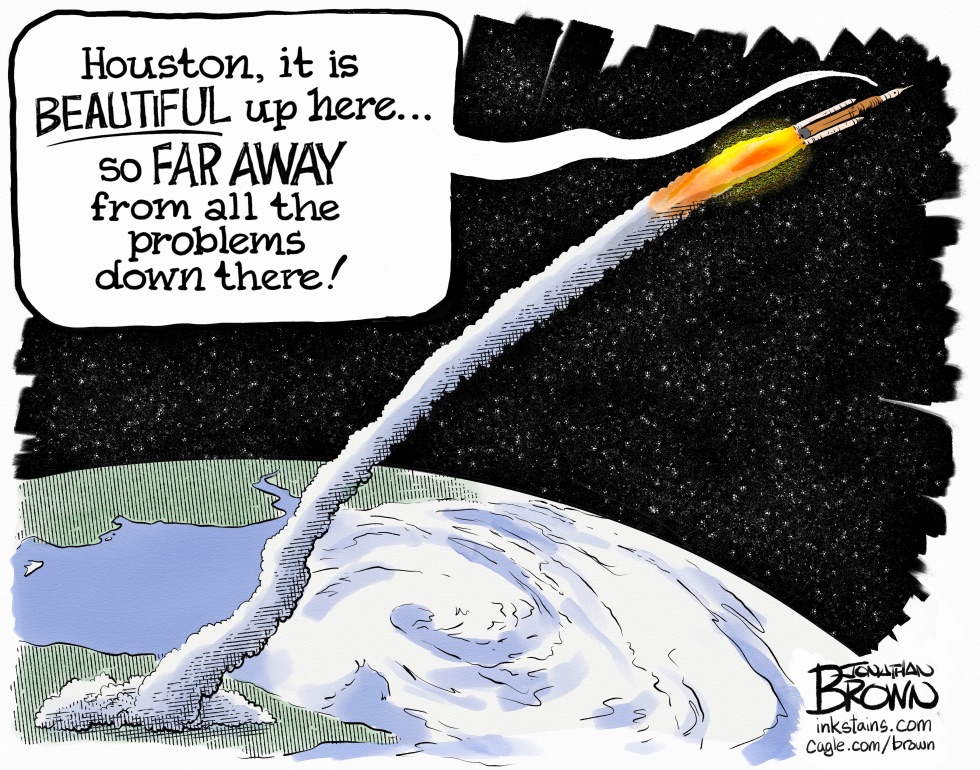
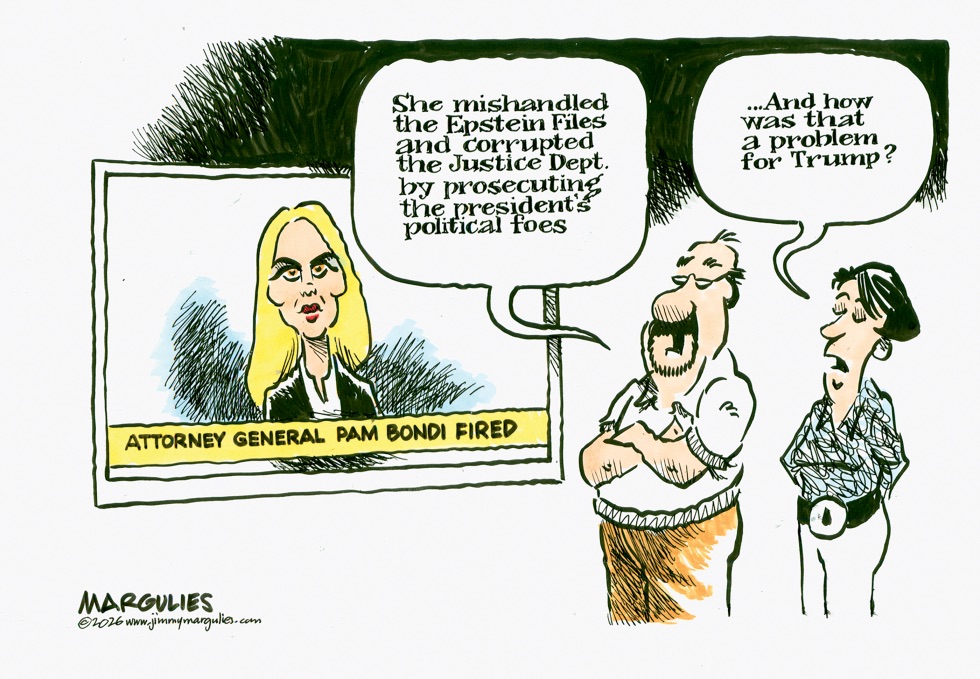
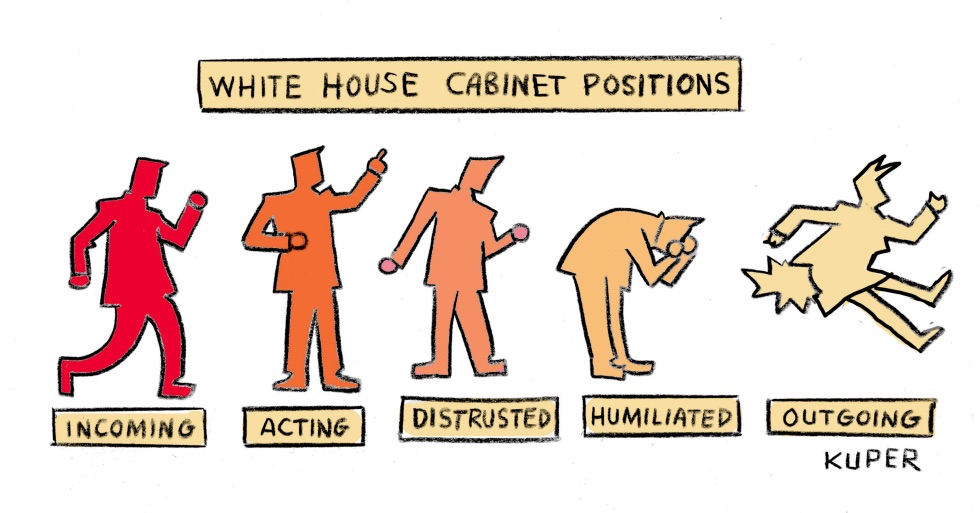
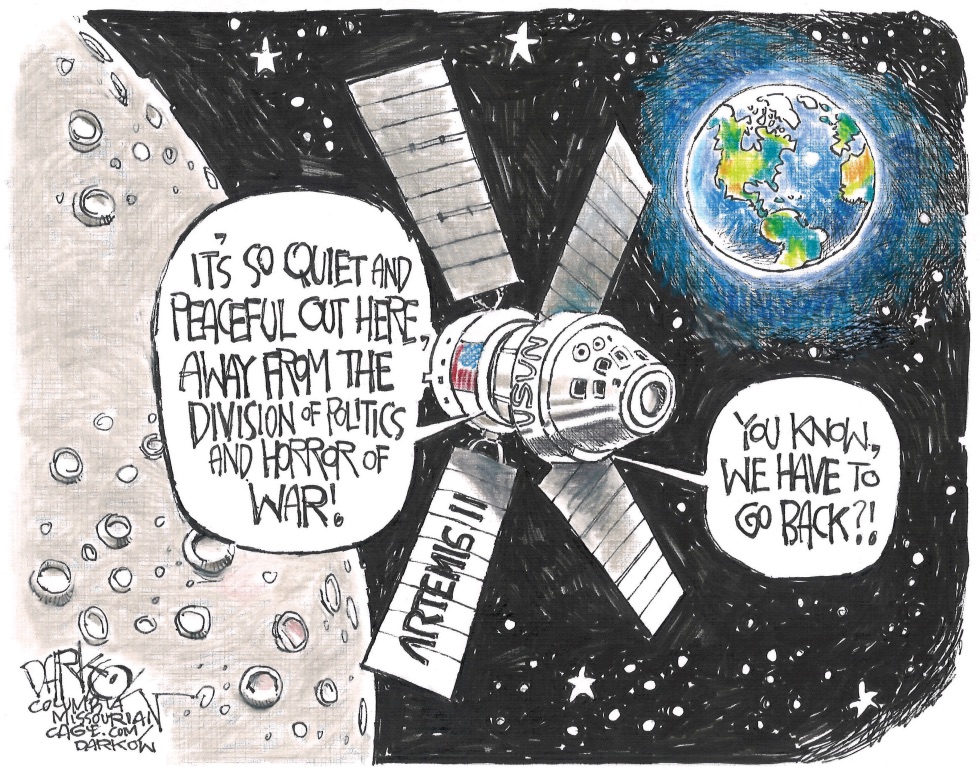
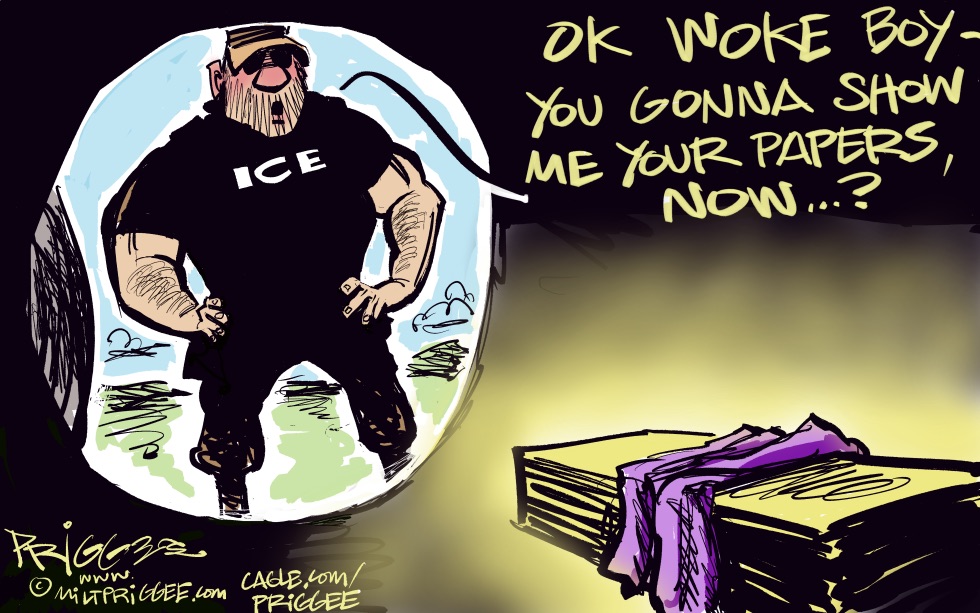
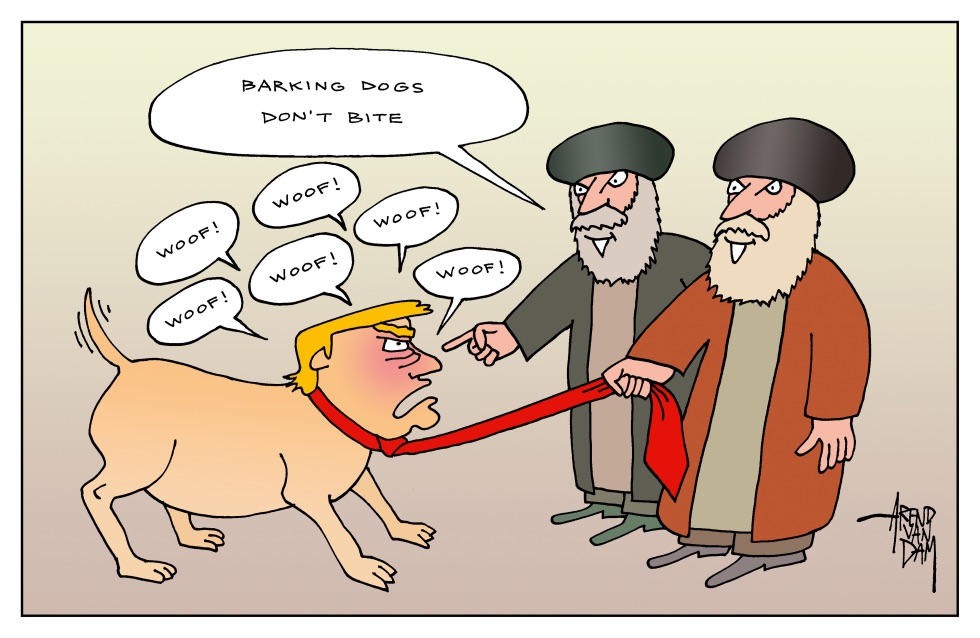
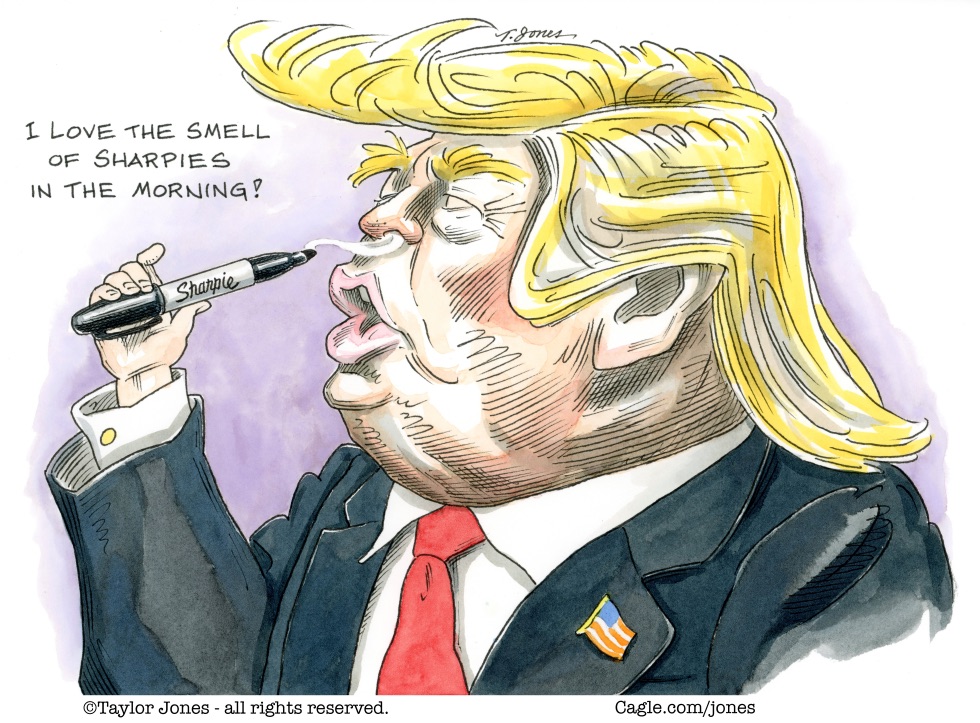
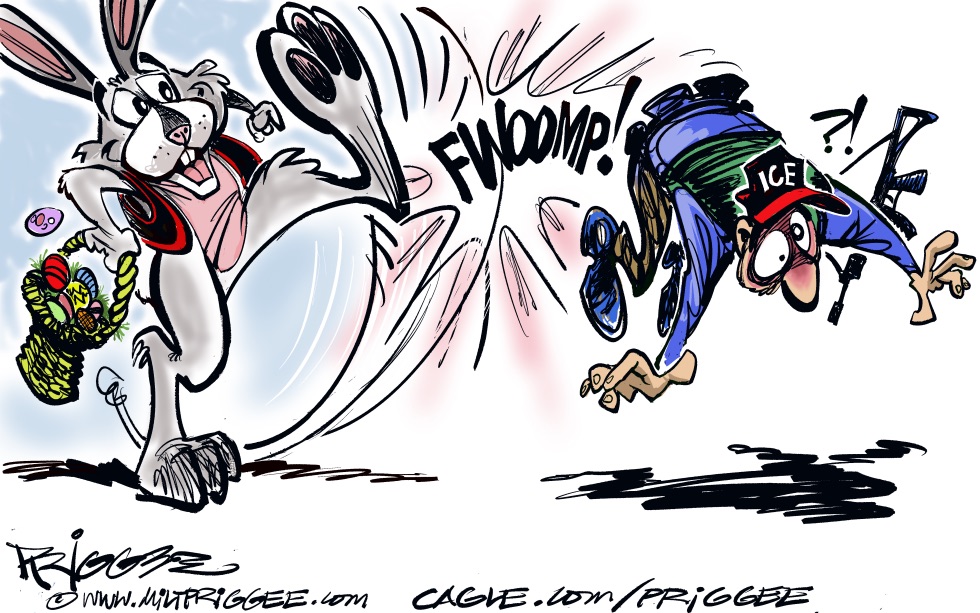
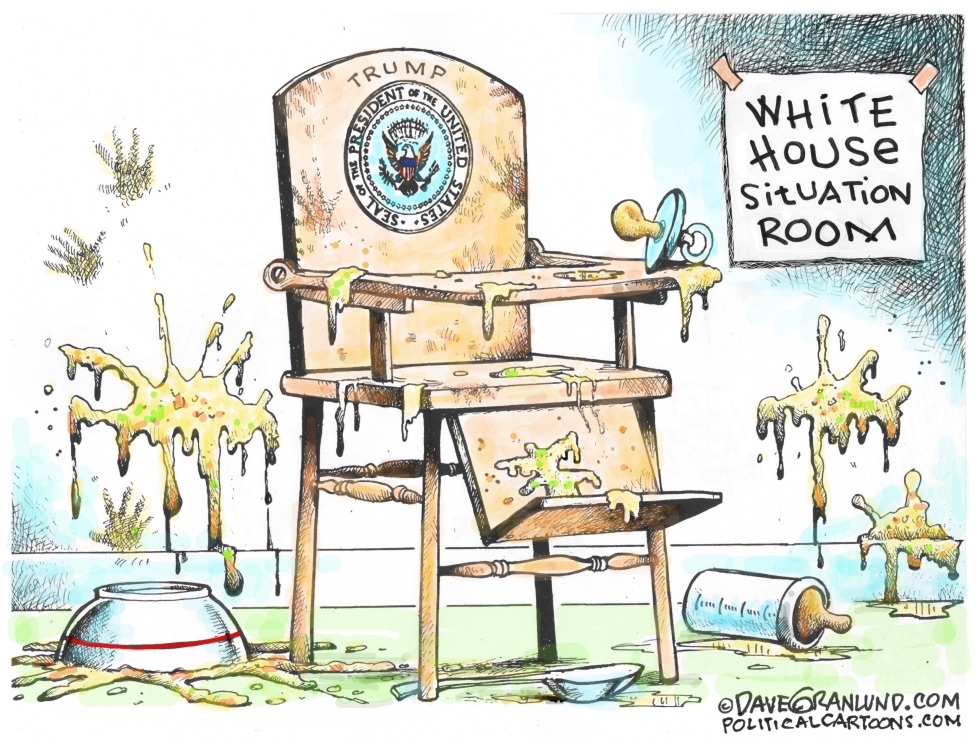
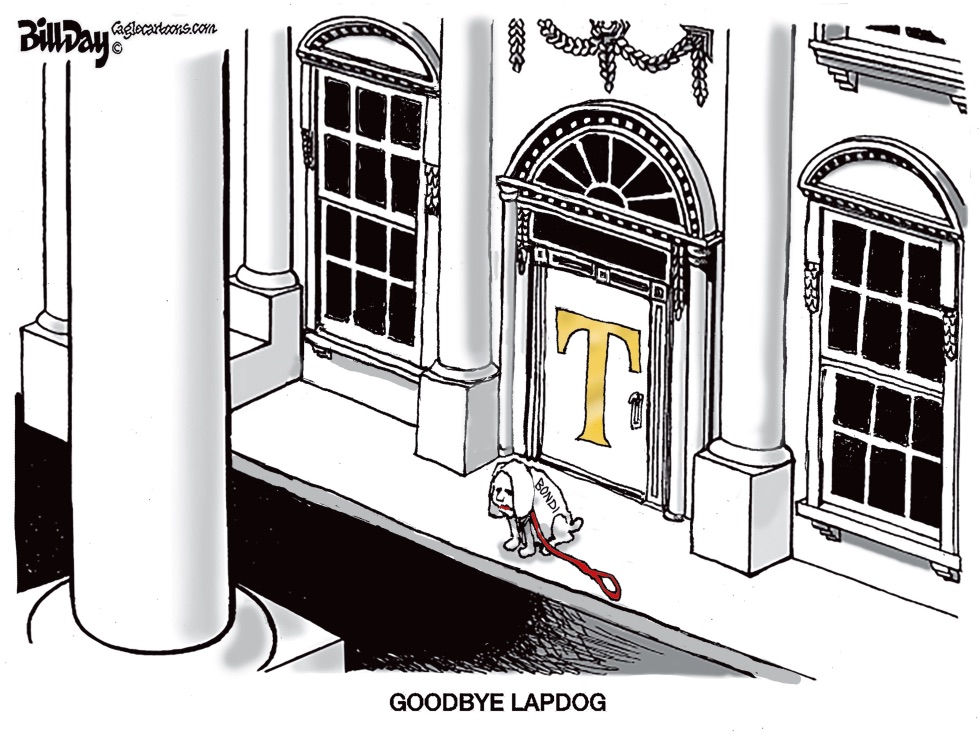
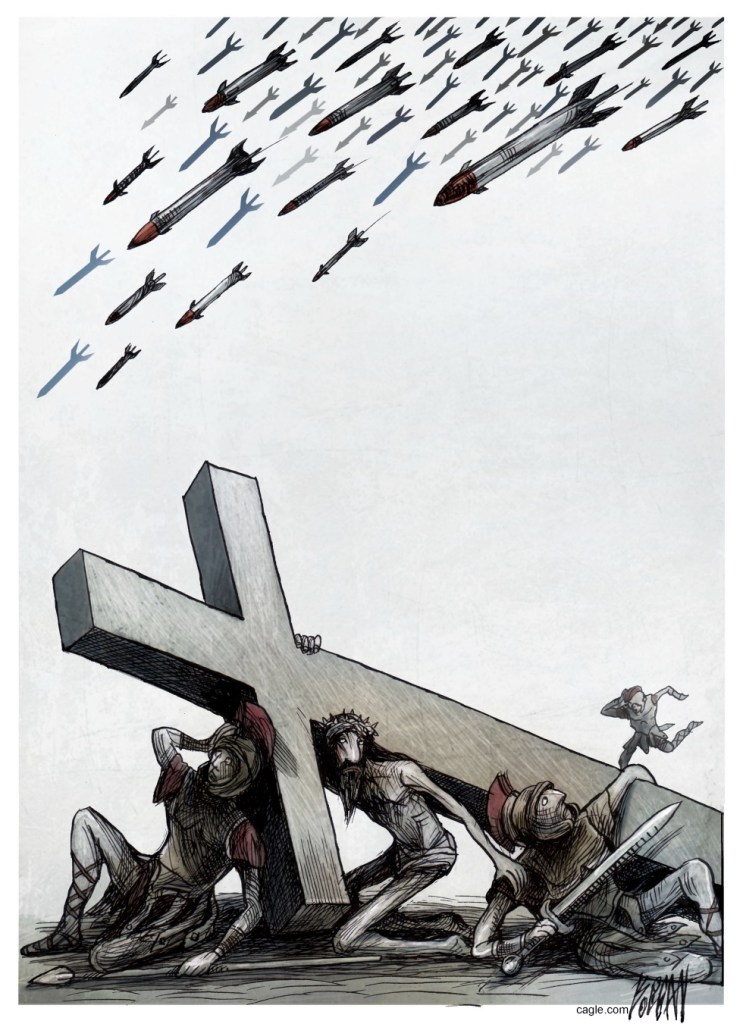
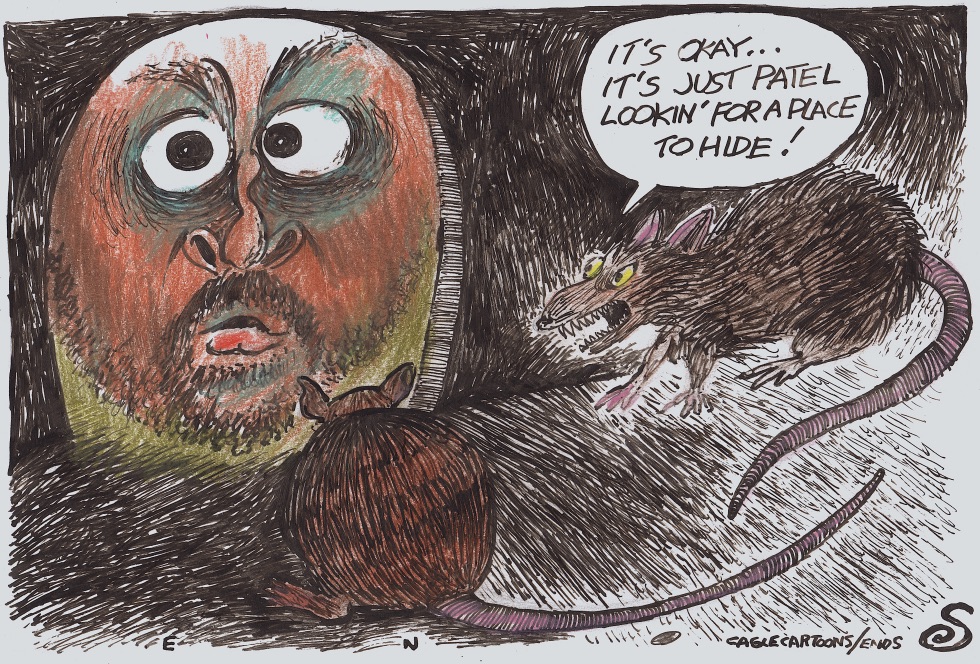
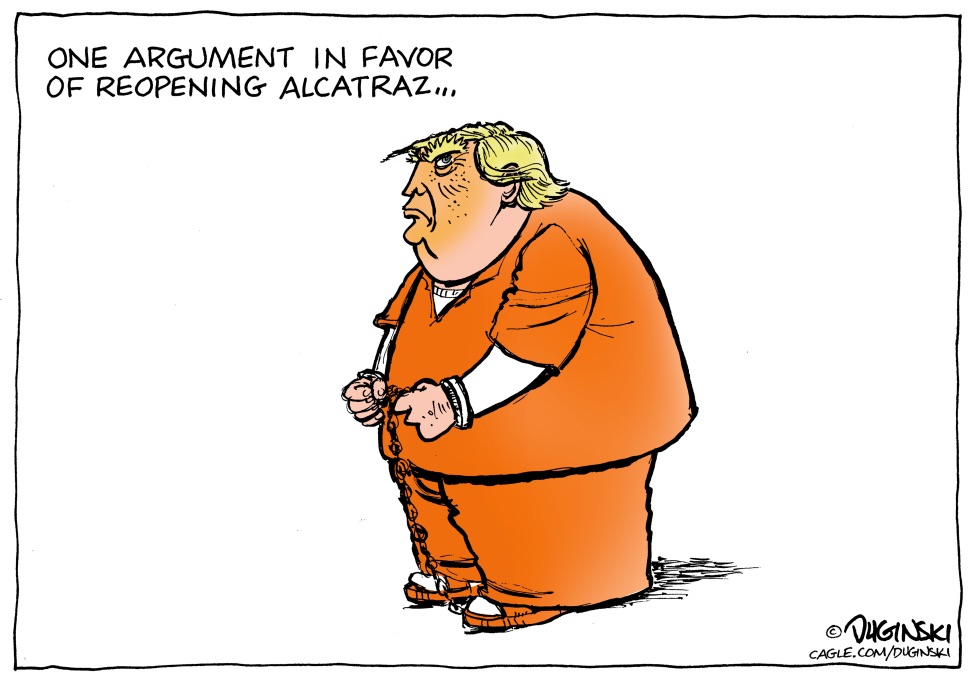
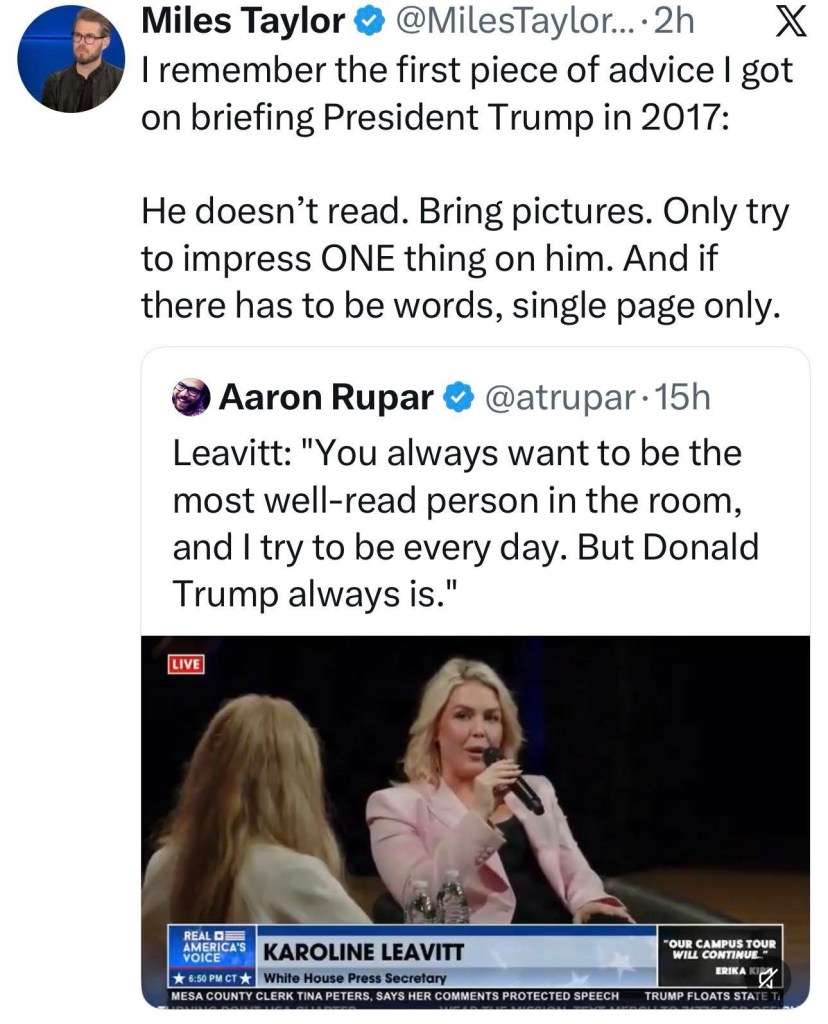
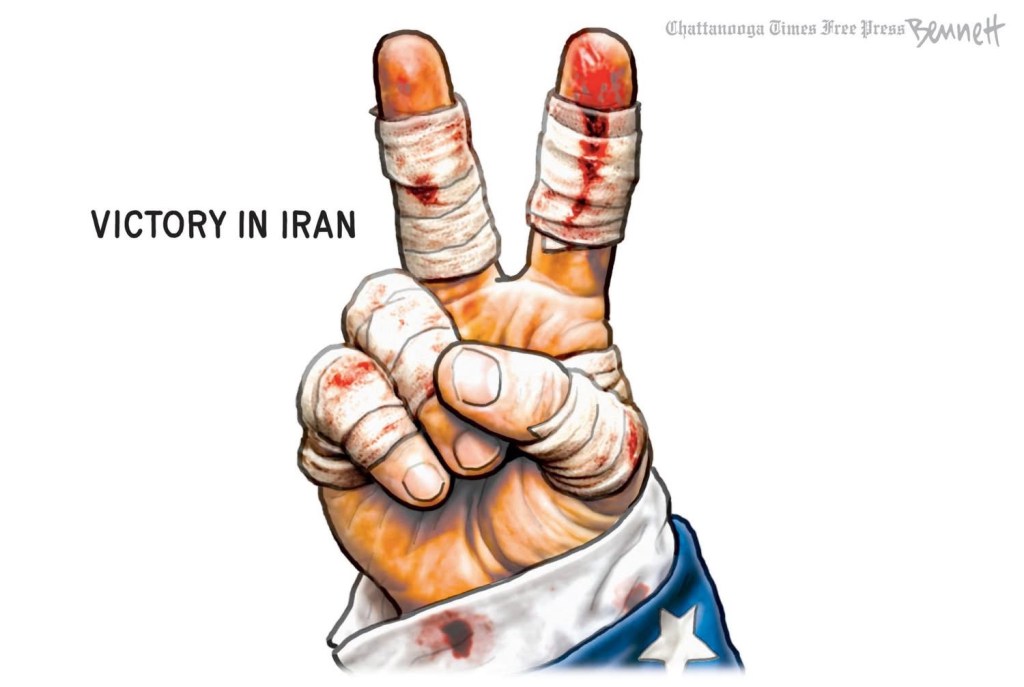
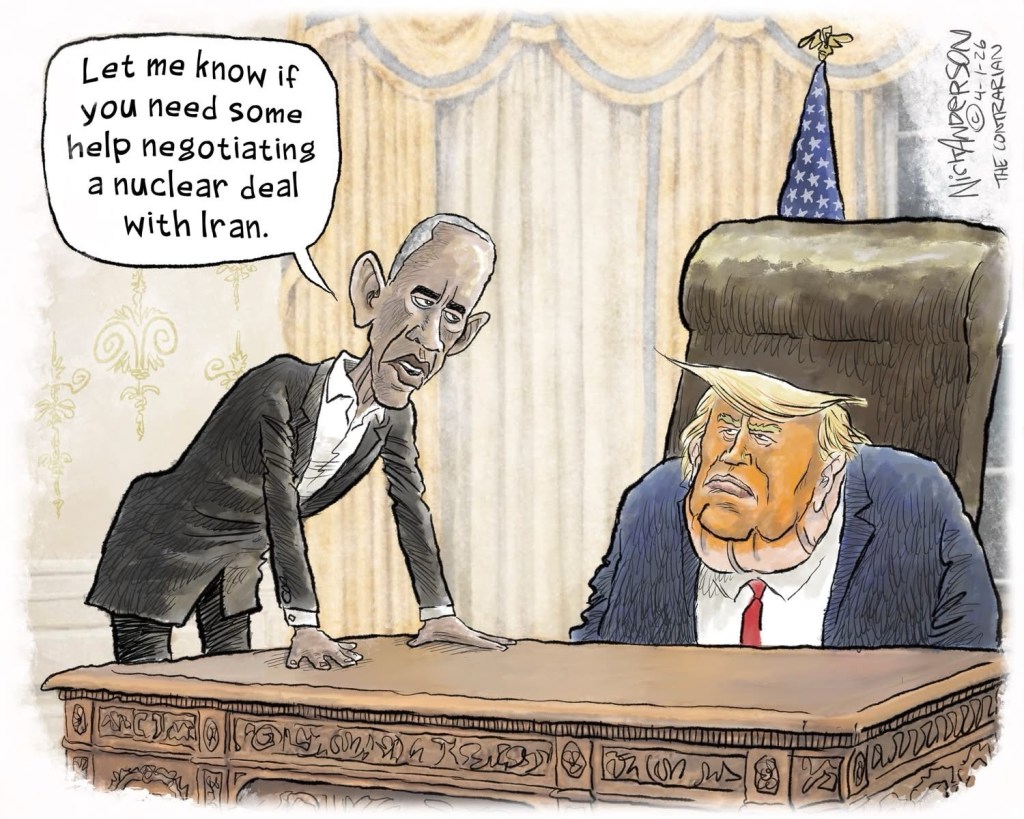
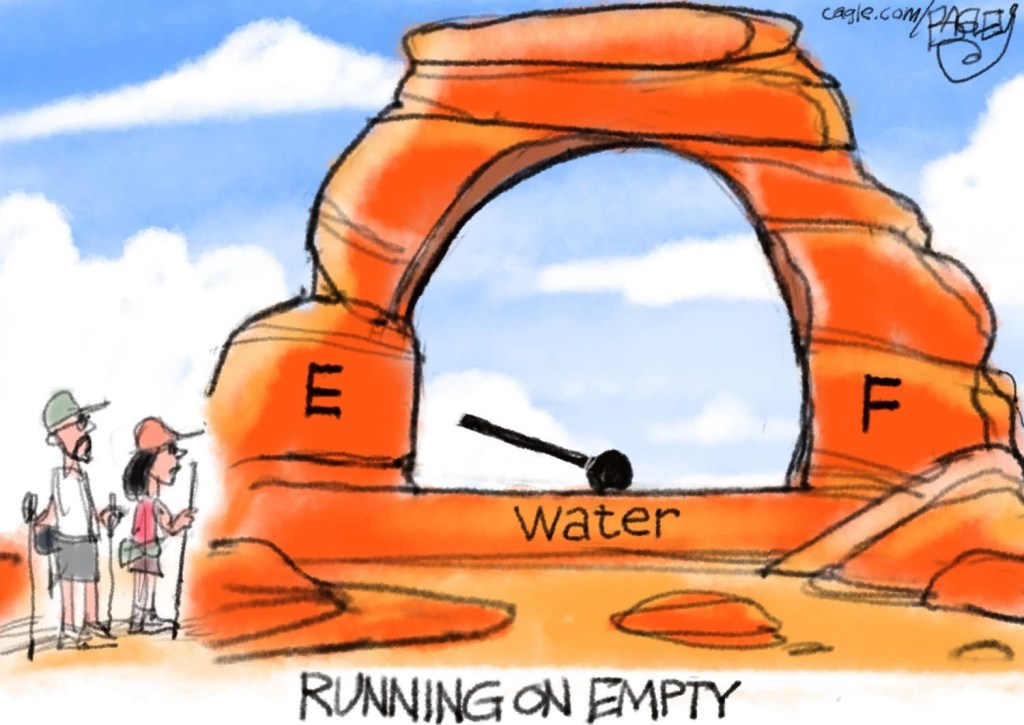
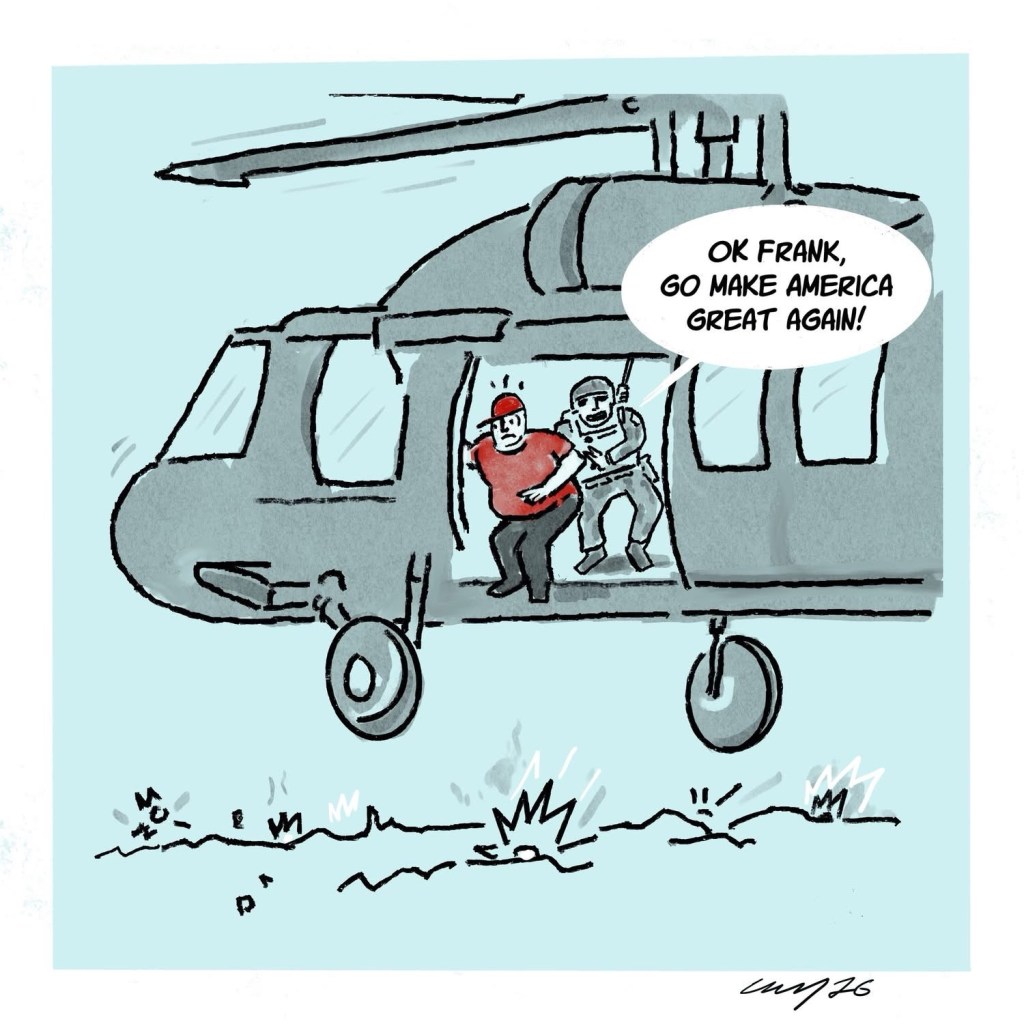
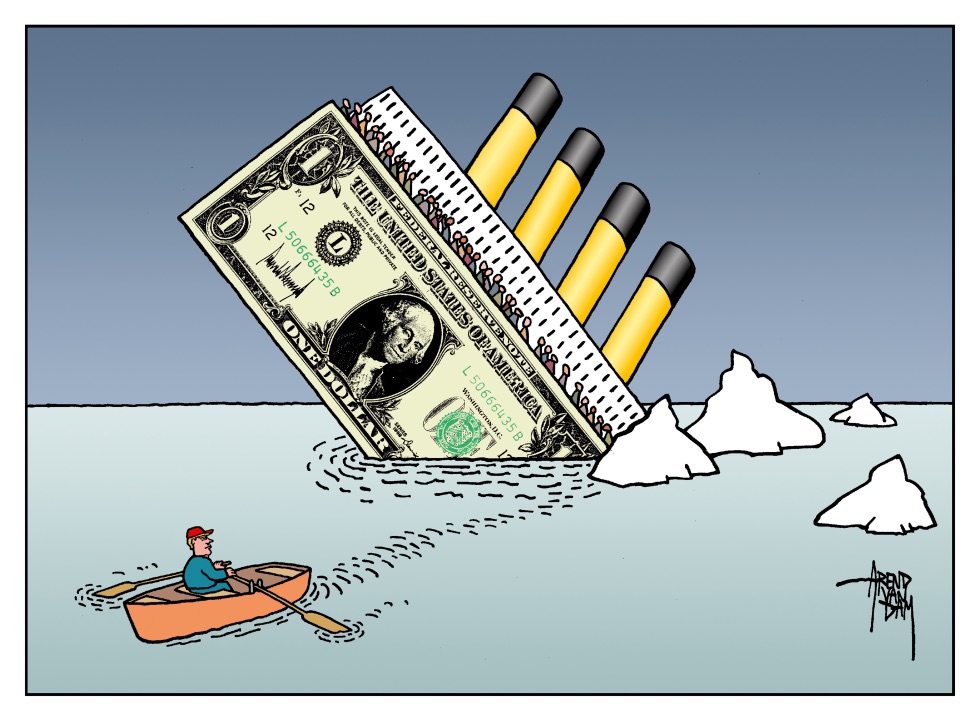
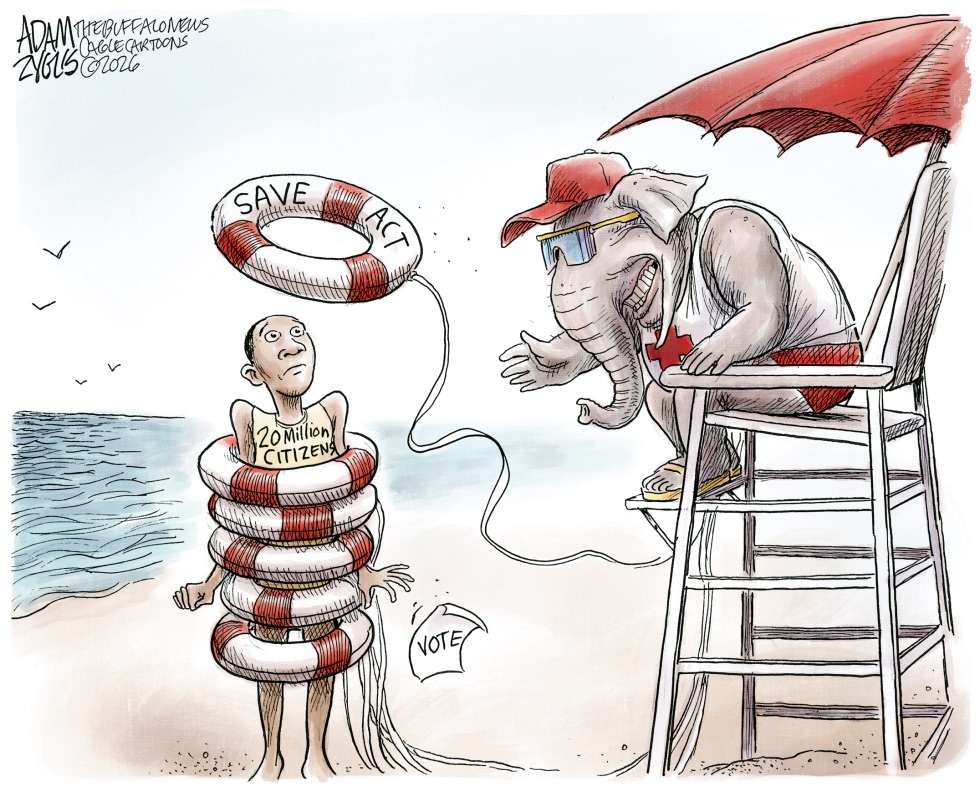
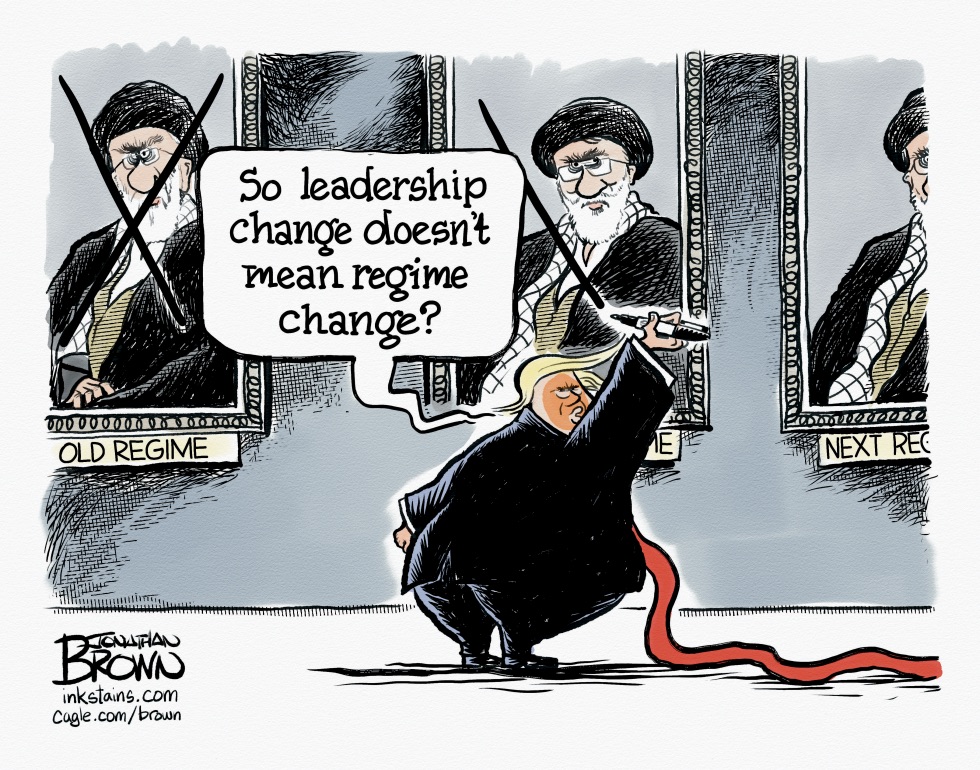
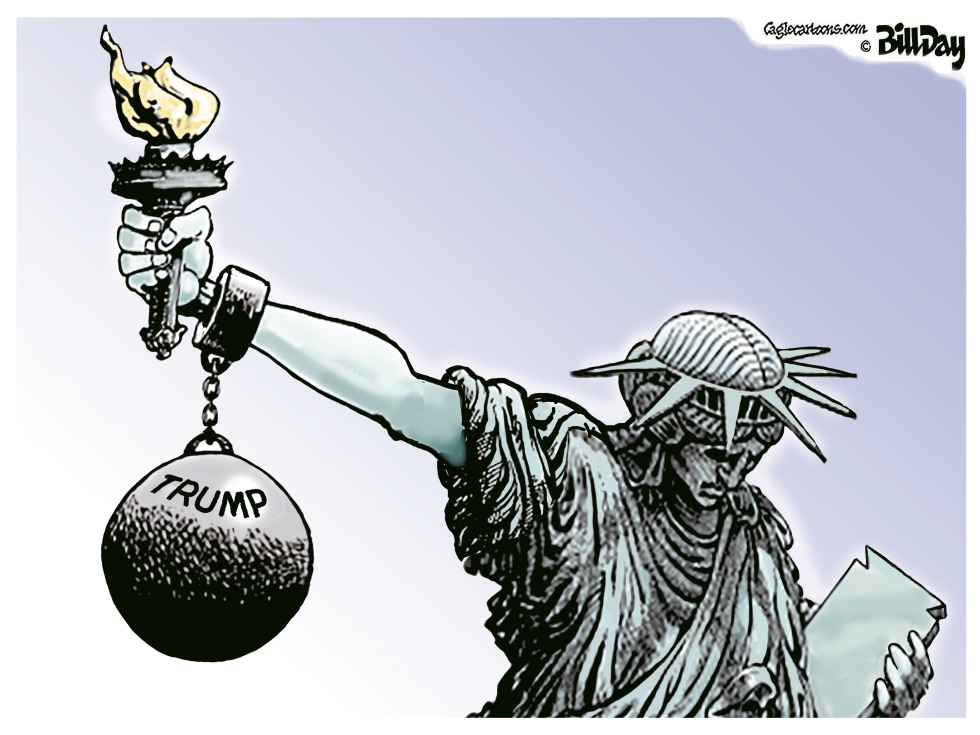
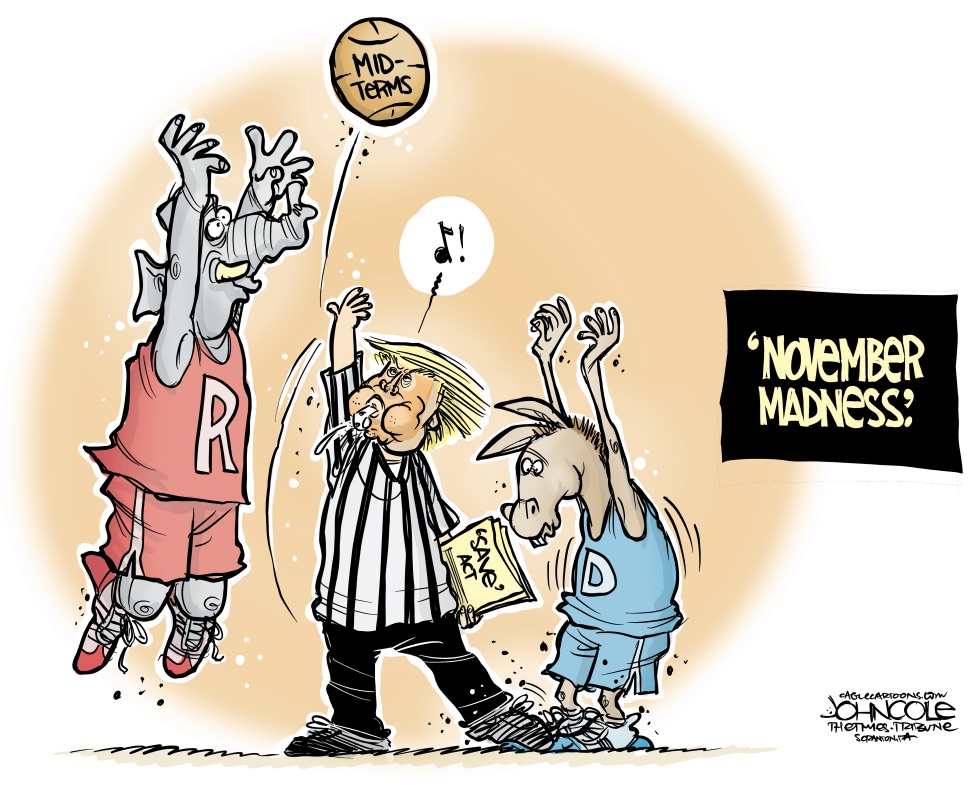
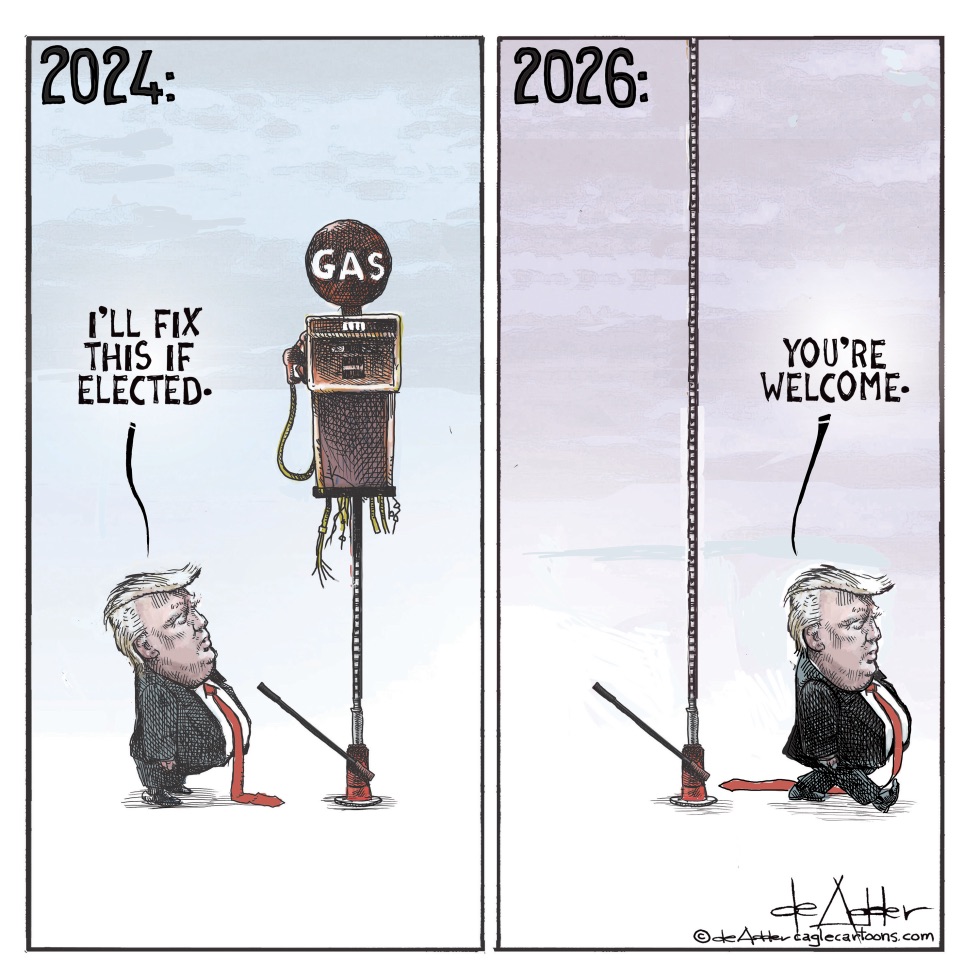
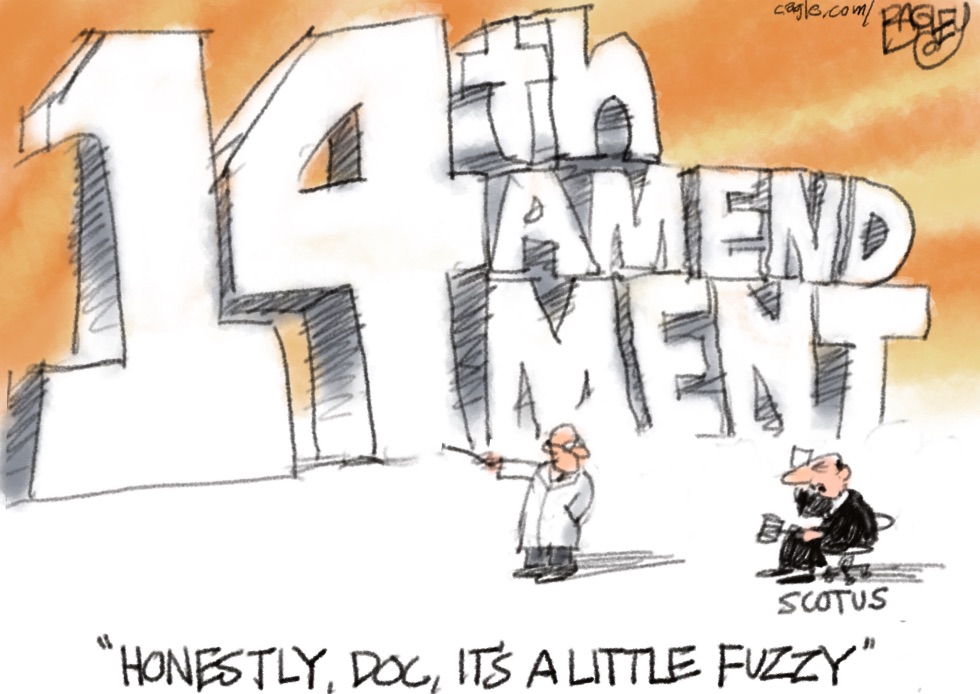
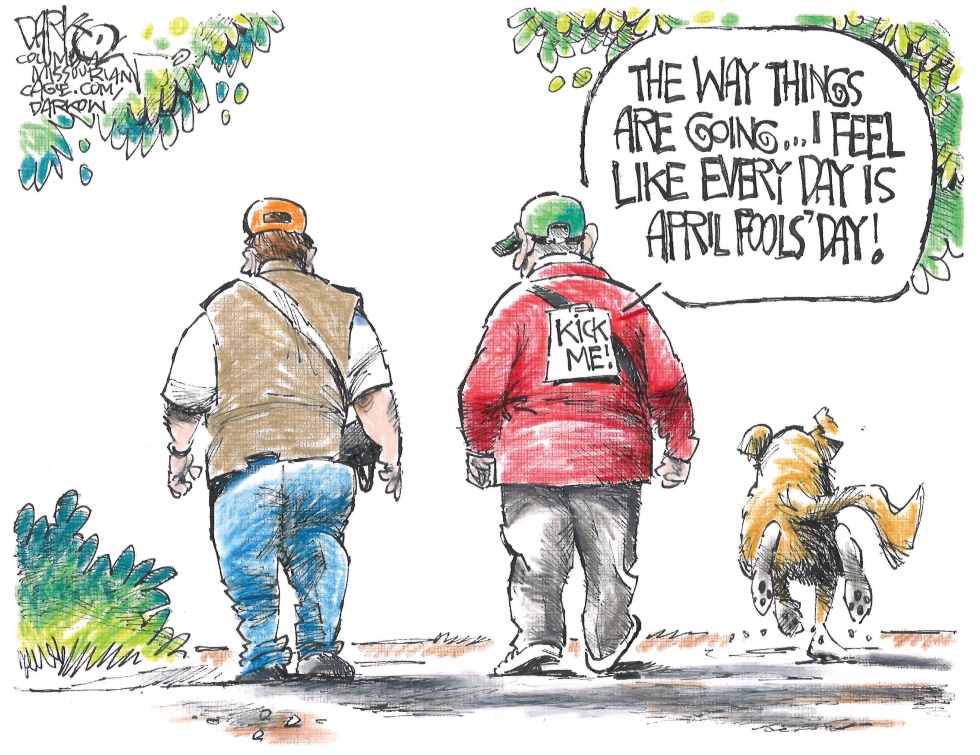
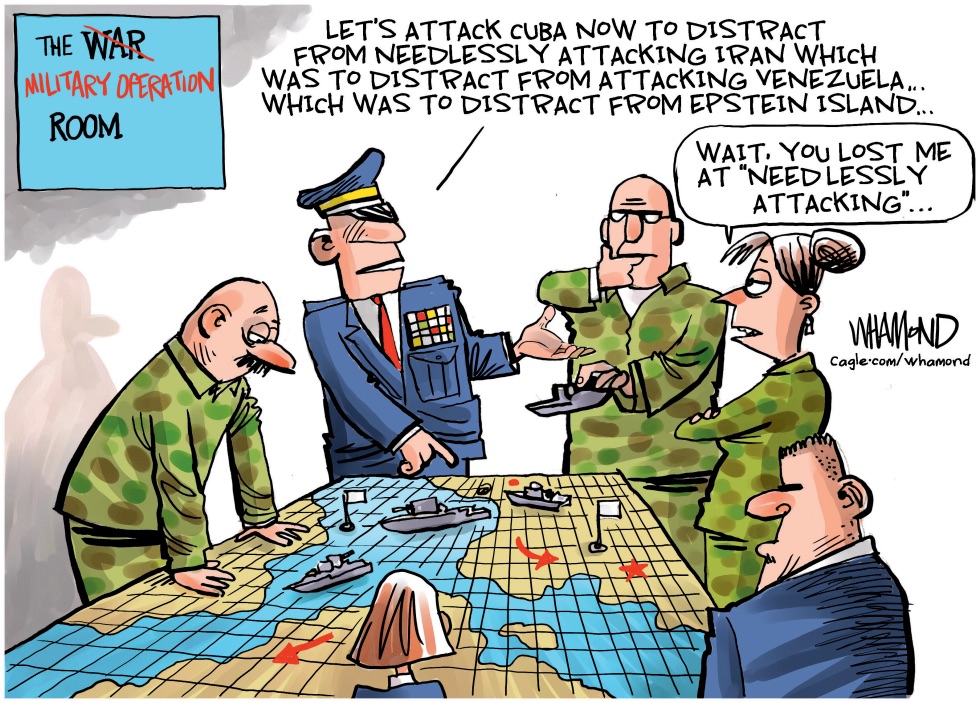
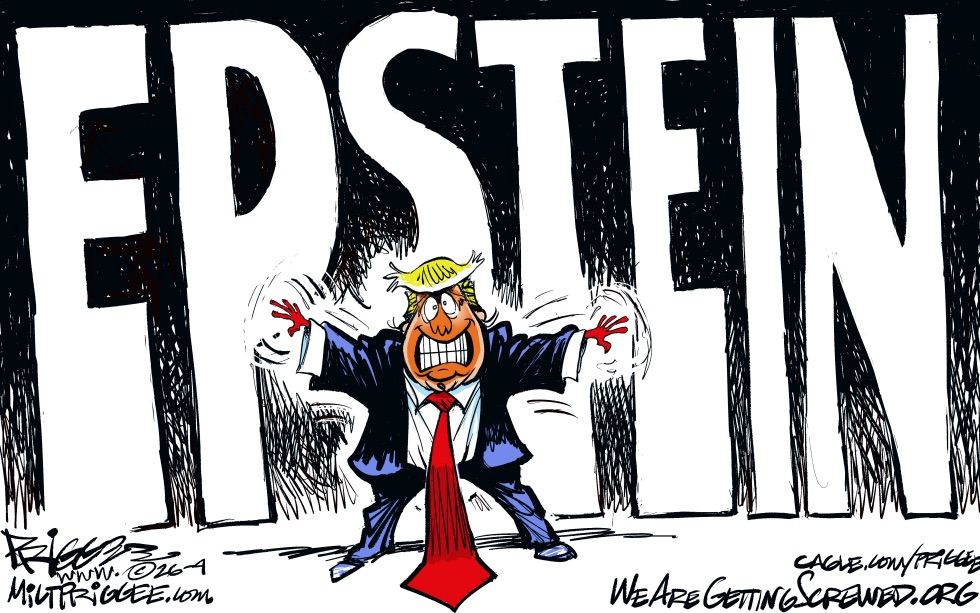
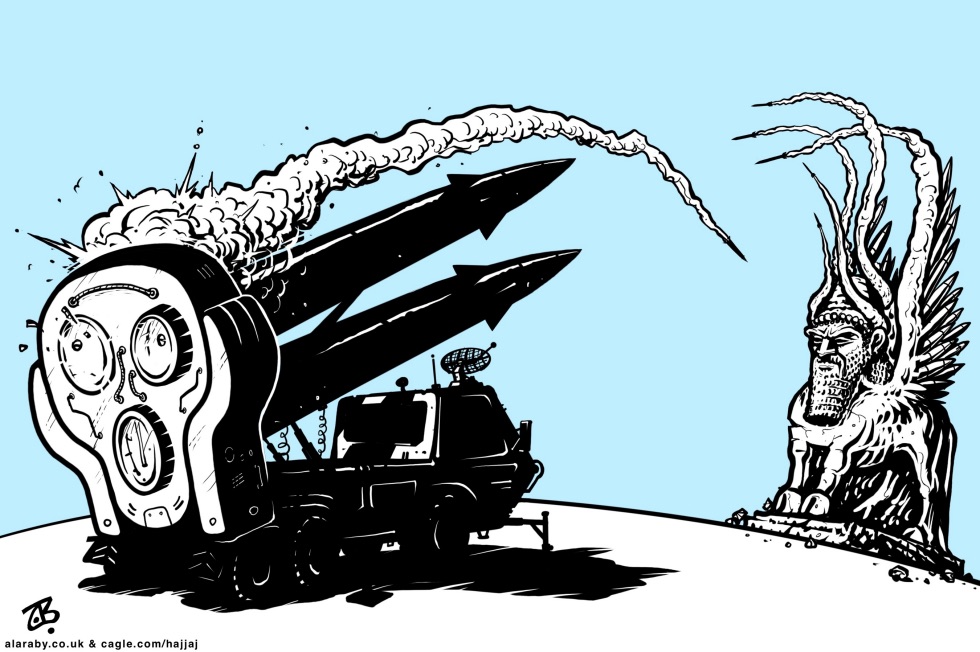
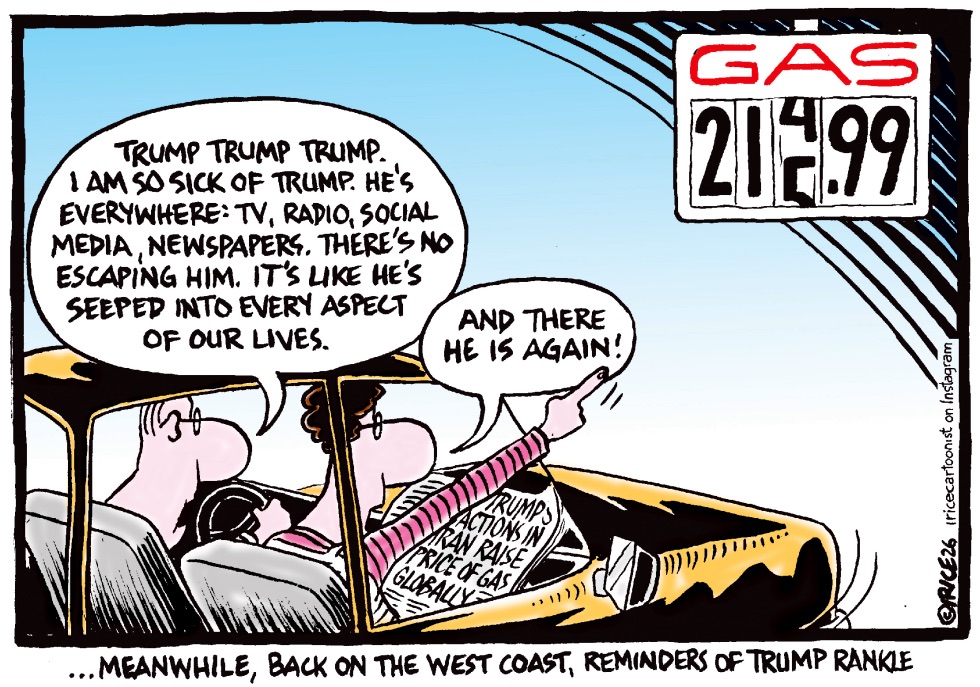
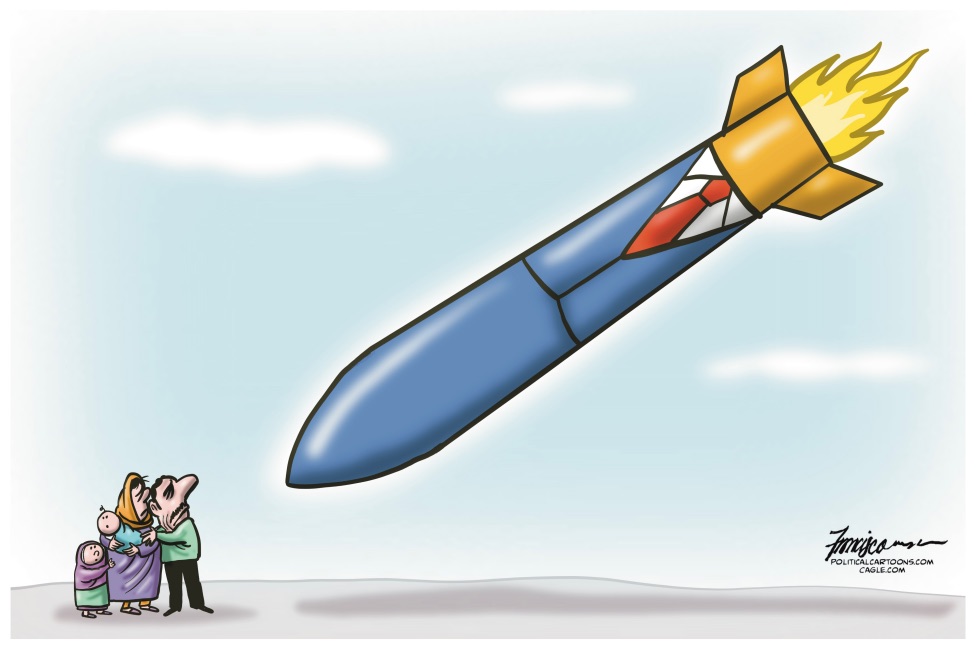
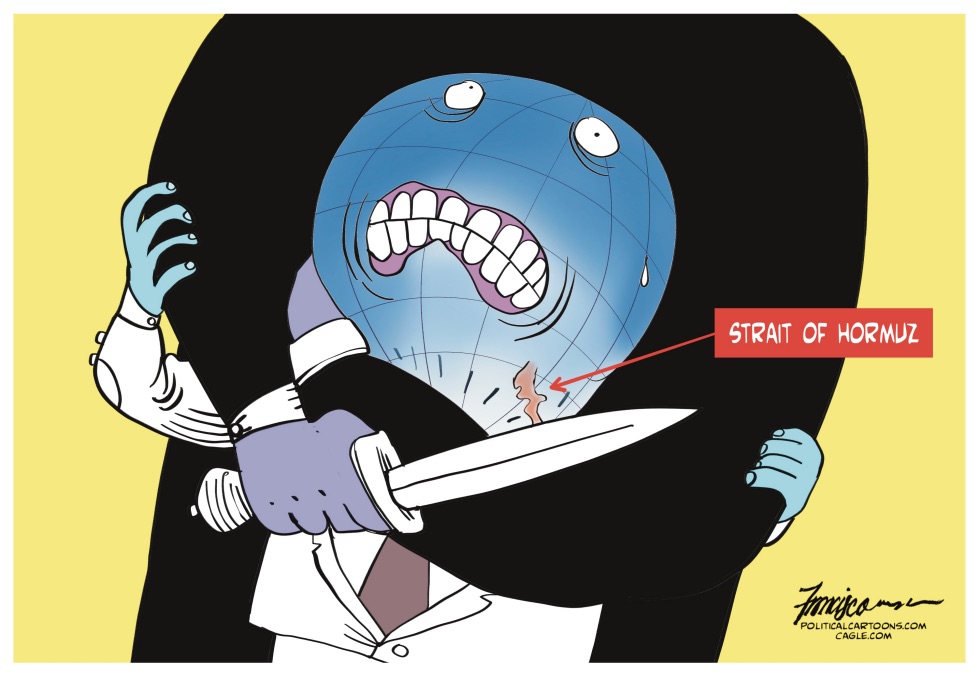
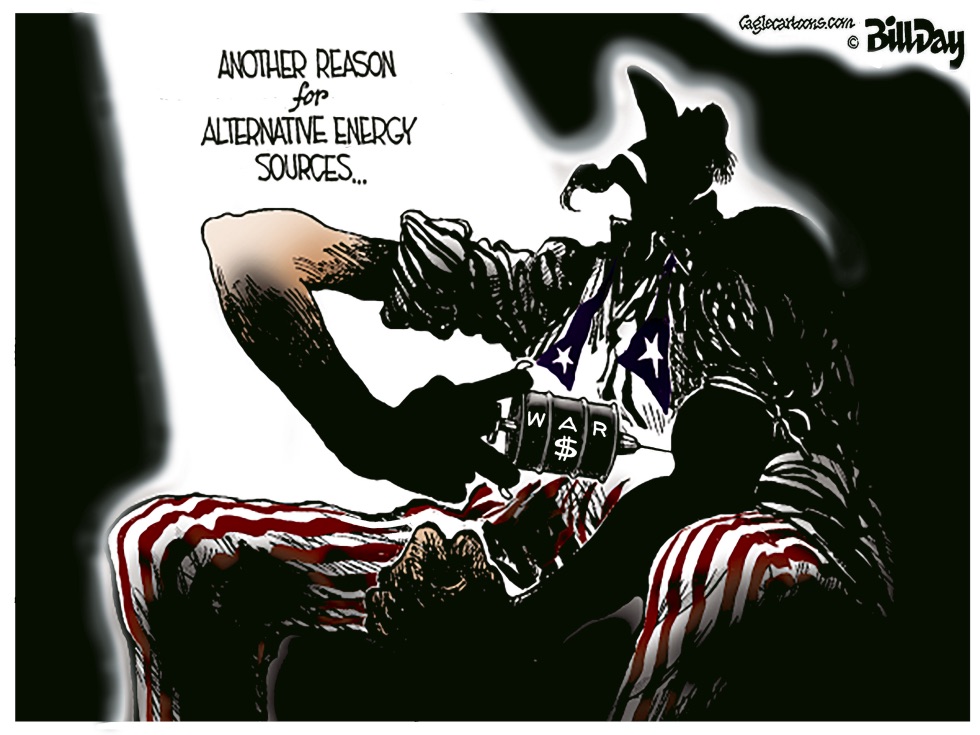
Cartoons via Cagle website:
From Charlie Pierce at Esquire:
We Are Hated as a Nation. There’s One Man to Blame.www.esquire.com/news-politic…
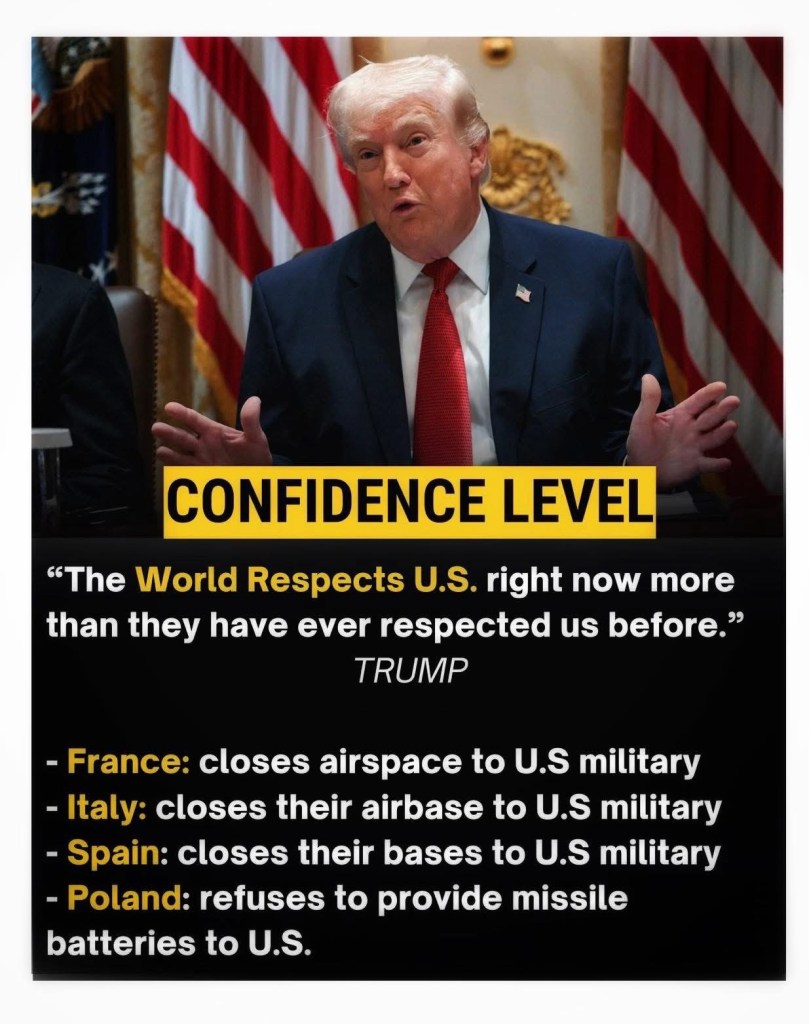
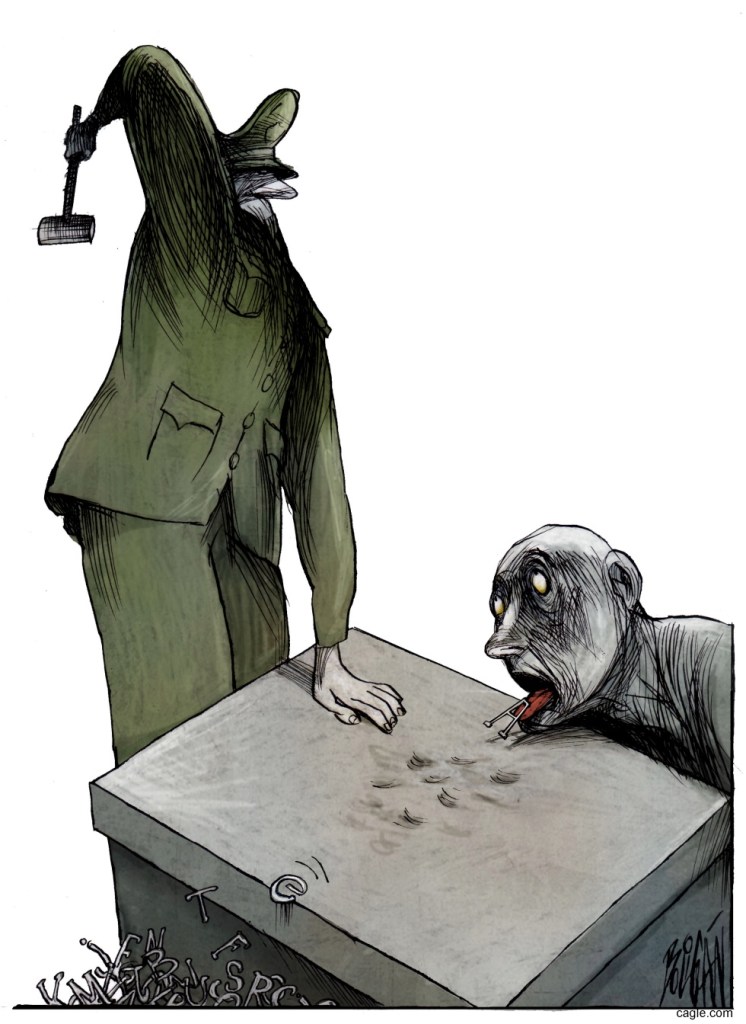
I have watched as the entire world has responded to his appeals to help him bail himself out in his very excellent Iranian excursion by telling him that, no, can’t make it, gotta grout the tub. I have seen that the United States has been downgraded in the democracy index, a respected international survey, based partly on the administration’s continuing assault on free expression and the First Amendment generally. I have heard the president trying the blackmail Denmark into surrendering Greenland; and his towering foolishness regarding Canada, including referring to the country’s prime minister as “Governor Carney”; and how he should be “involved” in picking the next leader of Iran; and, most recently, how he could “do anything I want with Cuba.” The Emperor of Adderall, he brings to mind the passage from Exodus:
Now there arose up a new king over Egypt, which knew not Joseph. And he said unto his people, Behold, the people of the children of Israel are more and mightier than we. Come on, let us deal wisely with them; lest they multiply, and it come to pass, that, when there falleth out any war, they join also unto our enemies, and fight against us, and so get them up out of the land.
And there arose up a new president over the United States, who did not give a flying…
All of this I followed as part of my professional obligation, but watching my new friend Dennis on Tuesday and seeing the contempt on his face and in his voice drove the new reality home like nothing had before.
We are hated as a nation now.
One man has done this.
Yup.
Stay safe today.
Did you like this post? Please share it with your friends:
The news continues to be confusing and depressing.
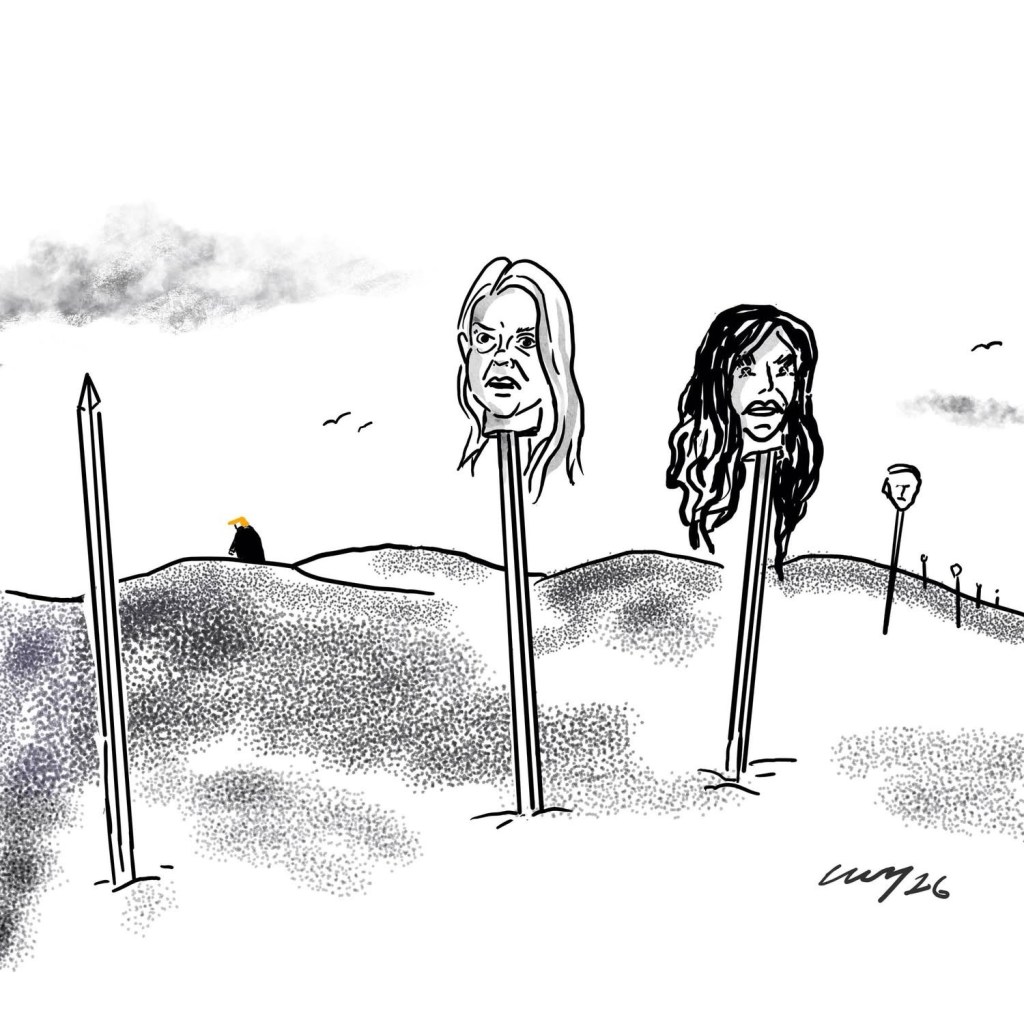
We are supposedly in a war, and the enemy has shot down two of our planes and hit two helicopters. An airman has been missing in Iran for 2 days now. But the “president” is spending time posting insults to Bruce Springsteen and the New York Times on his social media site. So far, he has said nothing publicly about the missing serviceman.
What else is Trump focusing on during the war that he unilaterally started? Releasing a new budget demanding even more defense spending, cuts to domestic programs, and–incredibly–money to rebuild Alcatraz. Oh, and he’s sent his VP to campaign for reelection of the right-wing president of Hungary.
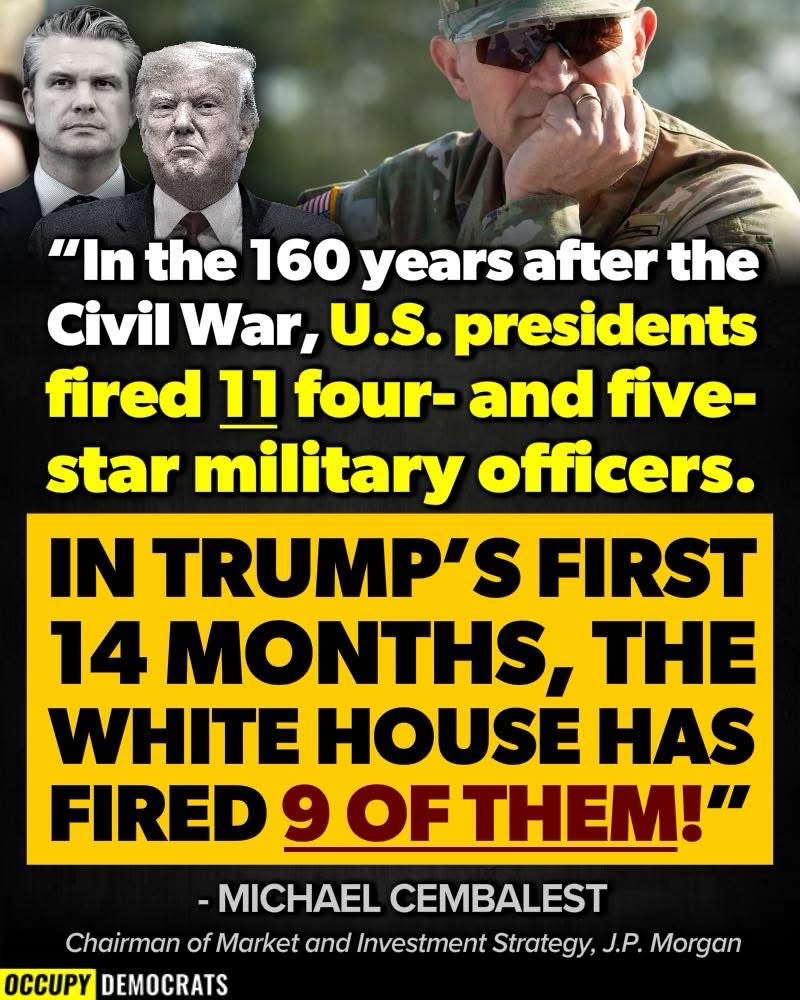
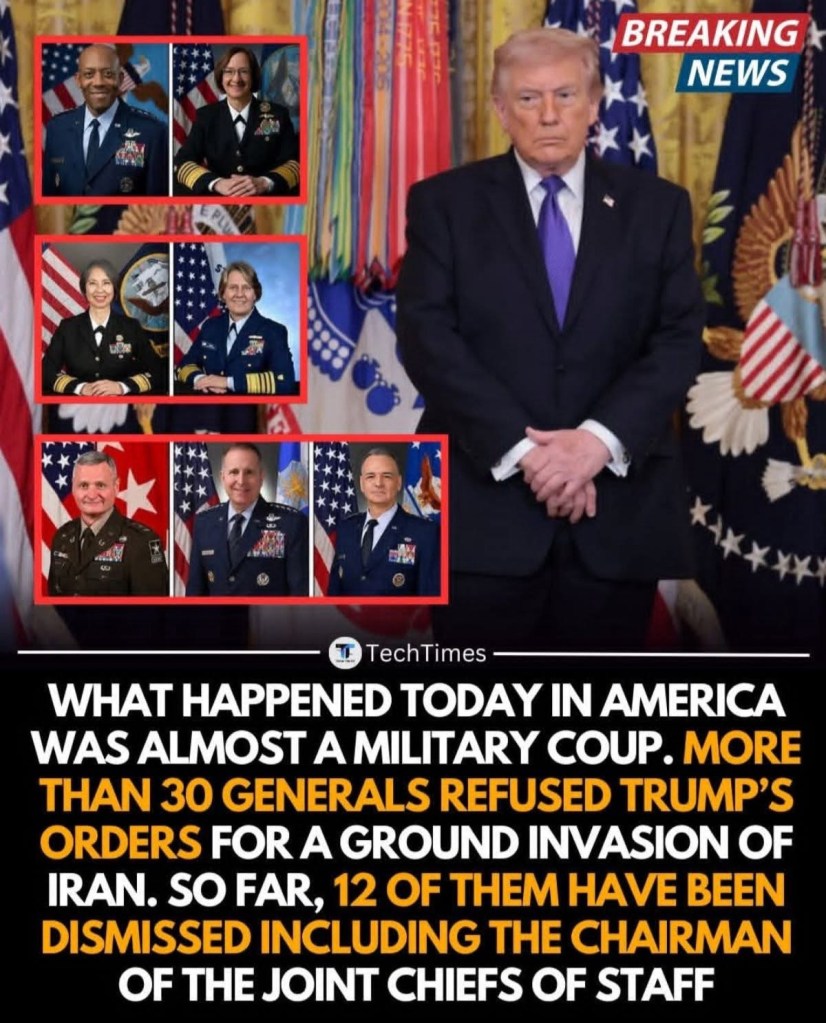
Meanwhile, the Secretary of Defense is firing generals because he’s afraid of losing his job.
U.S. forces were searching for an F-15E crew member after a two-seater fighter jet went down over Iran, a U.S. official said Friday. The other crew member has been rescued.
Iran shot down the F-15E Strike Eagle, a U.S. official said, and the American military was scrambling to find the second aviator after a regional governor offered a bounty for its crew.
A U.S. aircraft that was mobilized to support the search and rescue mission was also struck by Iranian fire after the F-15E jet was downed, a U.S. official told NBC News.
That aircraft, a single-pilot A-10 Thunderbolt, known as a Warthog, made it to Kuwaiti airspace, where the pilot ejected and the aircraft crashed, the official said. The pilot is safe and the A-10 is down in Kuwait, according to the official.
Two U.S. military Blackhawk helicopters that were involved in search and rescue efforts were also struck by Iranian fire, but the service members were unharmed, according to a U.S. official.
Iran’s media published photos alongside claims from the Islamic Revolutionary Guard Corps (IRGC) that it had shot down the F-15E. The Pentagon and the White House did not immediately comment on the claims.
The governor of Iran’s Kohgiluyeh and Boyer-Ahmad province in Iran’s southwest, where Iranians were reported to have been searching for the missing pilot, on Saturday denied reports that the second American crew member had been found and arrested, according to Iran’s semiofficial Mehr news agency.
The regional leadership of Iran’s Islamic Revolutionary Guard Corps also denied that “the second pilot of an F-15E fighter jet has been captured and detained by special airborne forces,” Mehr also reported.
The missing airman, a weapon systems officer, was aboard a US F-15 fighter jet that was downed in southern Iran. A pilot who was also on board has been rescued, US media report.
Iranian officials are urging citizens to find them “alive” and are offering rewards for their capture, according to state media.
Meanwhile, US President Donald Trump says Iran has 48 hours to make a deal or reopen the Strait of Hormuz or “all Hell will reign down on them.”
Iran says the area around the Bushehr nuclear power plant has been attacked with one person killed – the global nuclear watchdog says no increase in radiation has been reported, but calls for “maximum military restraint” to avoid a nuclear accident.
It’s a risky US operation to rescue the missing crew member, even though they’ve all prepared for years for this kind of moment.
It is also fraught with political peril.
If Iran finds this airman, and he’s paraded on TV, it will be a propaganda victory for Iran, and a political humiliation – and worry – for the US.
And, it would provide Tehran with a prisoner of war – a bargaining chip at a time when efforts to end this war are already stuck, despite US President Donald Trump’s claims of great progress.
It’s a moment which could give real meaning to the name of this US military operation – Epic Fury.
Retaliation when it comes will be risky for Iran, the region, and a world already suffering economic shocks.
After five weeks of war, the US and Israel have inflicted serious damage on Iran’s military capabilities.
But the defence secretary, Pete Hegseth, has repeatedly declared they’ve achieved “total air dominance.”
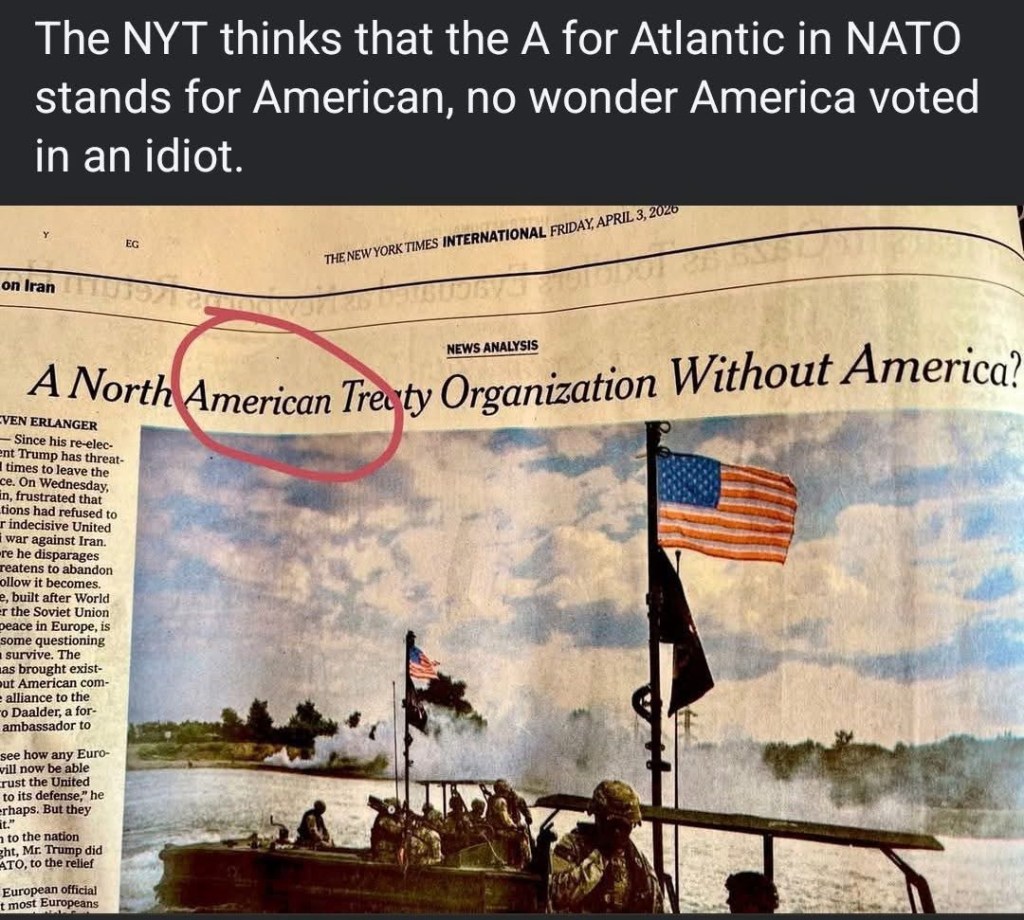
President Donald Trump took to Truth Social early Saturday not to address the public on the fate of a U.S. service member at the center of desperate search efforts in Iran, but to complain about The New York Times.
At the heart of the 79-year-old president’s post, as usual, was himself.
Rachael, by Thomas John Carlson
“The Failing New York Times, whose lack of credibility, and their constant Fake News attacks on your favorite President, ME, has caused its circulation to absolutely PLUMMET, referred to our severely weakened and extremely unreliable ‘partner,’ NATO, as the North American Treaty Organization,” he wrote….
The newspaper’s communications team acknowledged the mistake that Trump had seized upon, saying the name of the North Atlantic Treaty Organization had been “misstated.”
Trump’s post comes a day after Iran shot down an Air Force F-15E fighter jet over the country, marking a dangerous new turn in a war now into its fifth week.
Iran has since placed a bounty on the aircrew, and a dramatic search and rescue mission ensued, resulting in one crew member being rescued by American forces. The second remains missing, and both the White House and Pentagon have been silent on the status of rescue efforts.
Trump, asked Friday about the missing service member, told NBC News the situation wouldn’t affect negotiations to end the war, saying, “It’s war. We’re in war.”
It’s not news, but it’s always stunning when Trump demonstrates his complete inability to feel empathy.
As the war in Iran erupted five weeks ago, social media sleuths across Western and Chinese platforms flagged a wave of viral posts detailing equipment at U.S. bases, the movements of American carrier groups and granular breakdowns of how military aircraft were assembling for strikes on Tehran.
The intelligence came from a fast growing new market: Chinese firms — some with links to the People’s Liberation Army — marrying artificial intelligence with open-source data to market information they claim can “expose” the movements of U.S. forces.
Beijing has sought to distance itself from any direct involvement in the Iran war, but the firms — many of which have emerged in the past five years as part of the government’s push to harness private AI for military use — are capitalizing on the conflict.
U.S. officials and intelligence experts are divided over whether Chinese firms’ publicly marketed tools pose a genuine threat or are being credibly used by U.S. adversaries, but say the surge in private-sector offerings points to a growing security risk and reflects Beijing’s intent to project the strength of its intelligence capabilities.
Beijing has poured hundreds of millions of dollars into supporting private firms developing AI with practical defense applications under its civil-military integration strategy, and last month announced plans to supercharge those efforts as part of a broader five-year national strategy….
Private firms have long used open-source data — including flight trackers, satellite imagery and shipping data — to generate market intelligence. But the growing AI capability of Chinese firms is making these tools more powerful, underscoring the growing challenge of concealing U.S. military movements from adversaries.
On Friday, the Trump administration submitted its annual budget request to Congress. The document called for dramatically reducing what the United States government does for Americans. The budget called for steep cuts to funding for education, housing and health, funneling resources toward the military as the war in Iran reaches its fifth week. This shift would leave the portion of the budget known as “nondefense discretionary,” or NDD funding, which accounts for most domestic activities aside from Medicare, Medicaid, Social Security and SNAP, at its lowest level since at least Dwight D. Eisenhower’s presidency.
These NDD programs have already suffered more than 15 years of disinvestment, including particularly sharp cuts over the last three years. In total, the president called to cut NDD funding (excluding Veterans Affairs medical care) by $83 billion below last year’s levels.
When Trump signed the “big, beautiful bill” last July, he enacted the largest cuts to Medicaid and SNAP in history. The same law provided enormous tax cuts that disproportionately further enriched the very rich. Taken together, it instituted the largest transfer of wealth from the poor to the rich in a single law in U.S. history. The new budget proposal would double down on his legacy of cutting programs that ordinary Americans, and especially those already struggling to make ends meet, rely on.
Fortunately, the proposed cuts are all but certain to be dead on arrival — not just because congressional Democrats will reject them, but because congressional Republicans can’t pass them. In 2023, House Republicans appropriators attempted to write funding bills with “only” $60 billion in cuts to nondefense programs. With Democrats in control of the White House and the Senate at the time, those bills were primarily a messaging exercise rather than a sincere attempt at legislation. And yet $60 billion proved too extreme even for the extreme House Republican conference, which pulled five of its 12 bills, abandoning the process altogether.
If House Republicans could not stomach $60 billion of cuts that had no chance of becoming law, they certainly can’t write bills calling for $83 billion in actual cuts to services on which Americans rely.
The proposed defense funding increases are similarly extreme. The budget is calling for $1.5 trillion in a $445 billion increase above this year, with $1.15 billion coming from annual appropriations and the remaining $350 billion from the budget reconciliation process. First off, the proposal is not tethered to actual policy. To be clear, the president first proposed this $1.5 trillion number nearly two months before the U.S. attacked Iran, so the administration can’t even credibly claim this is related to specific new requirements created by the war.
President Trump is asking for $152 million from Congress to try to transform Alcatraz, the popular tourist attraction, back into a maximum-security prison.
The request, included in a 2027 fiscal year budget proposal released on Friday, is the most concrete step the president has taken so far to realize an idea he first mused about last year on social media, when he said he wanted the island in the San Francisco Bay to be enlarged and rebuilt “to house America’s most ruthless and violent offenders.”
But the plan faces immense political and practical roadblocks. It has generated enormous pushback in San Francisco, where tourism is one of the biggest industries and Alcatraz is at the top of many visitors’ itineraries.
And Alcatraz, which has not housed an inmate in more than 60 years, is largely in ruins. It has no running water or sewage system. Much of the island, known as “The Rock,” is covered in bird droppings. All supplies must be brought in by boat.
The new White House budget proposal seeks $5 billion for the Bureau of Prisons to improve the nation’s “crumbling detention facilities,” including the makeover for Alcatraz. The $152 million would cover the first year of costs for the “President’s commitment to rebuild Alcatraz as a state-of-the-art secure prison facility,” it states. The full cost of restoring and reopening Alcatraz would be far higher.
Mayor Daniel Lurie of San Francisco last year called the proposal to turn Alcatraz back into a federal prison “not a serious proposal.” Asked on Friday for his thoughts on the Trump administration’s budget allocation, his spokesman pointed back to those same comments and said he had nothing more to say.
Representative Nancy Pelosi, whose congressional district includes most of San Francisco, said that Alcatraz was a historic museum that belonged to the public. “Rebuilding Alcatraz into a modern prison is a stupid notion that would be nothing more than a waste of taxpayer dollars and an insult to the intelligence of the American people,” she said in a statement, vowing to fight the plan.
Meanwhile, Trump sent JD Vance to Hungary to campaign for Victor Orbán.
U.S. Vice President JD Vance is set to land in Budapest on Tuesday for a high-stakes intervention that underscores how far the White House is willing to go to shore up Hungarian Prime Minister Viktor Orbán before the April 12 national election.
Orbán is flailing in the polls, as anti-corruption opposition candidate Péter Magyar surges ahead in his bid to claim power in Budapest after 16 years of leadership by the ruling Fidesz party.
Cat Nap, Susan Blackwood
Vance’s visit, scheduled for Tuesday and Wednesday, was framed by Hungarian government spokesperson Zoltán Kovács as a celebration of deep ties between the two countries. “The visit highlights the strong and enduring alliance between Hungary and the United States,” he wrote on X on Friday.
The outspoken U.S. vice president will hold talks with the MAGA-allied Orbán and then give a public address, during a trip that directly involves Washington in the final stretch of a heated election campaign.
It echoes an American effort in Argentina last year, where U.S. officials including Treasury Secretary Scott Bessent intervened to support President Javier Milei ahead of national midterm elections, to keep a key hemispheric, ideological ally in a strong position.
In multiple speeches and remarks over the 15 months since President Donald Trump returned to office, senior U.S. officials have made clear they believe Europe is on the wrong political path, and that the nationalist-populist Orbán is a model for the continent to follow.
The Hungarian prime minister has promoted his vision of illiberal democracy, while frequently clashing with Brussels over the EU’s direction on migration, Russia and minority rights.
Unbelievable.
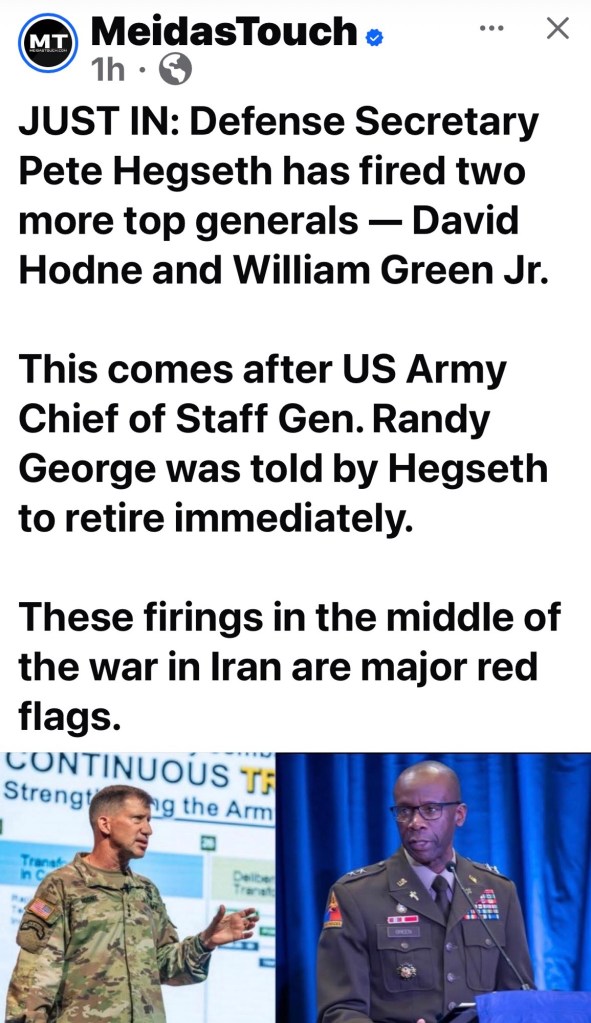
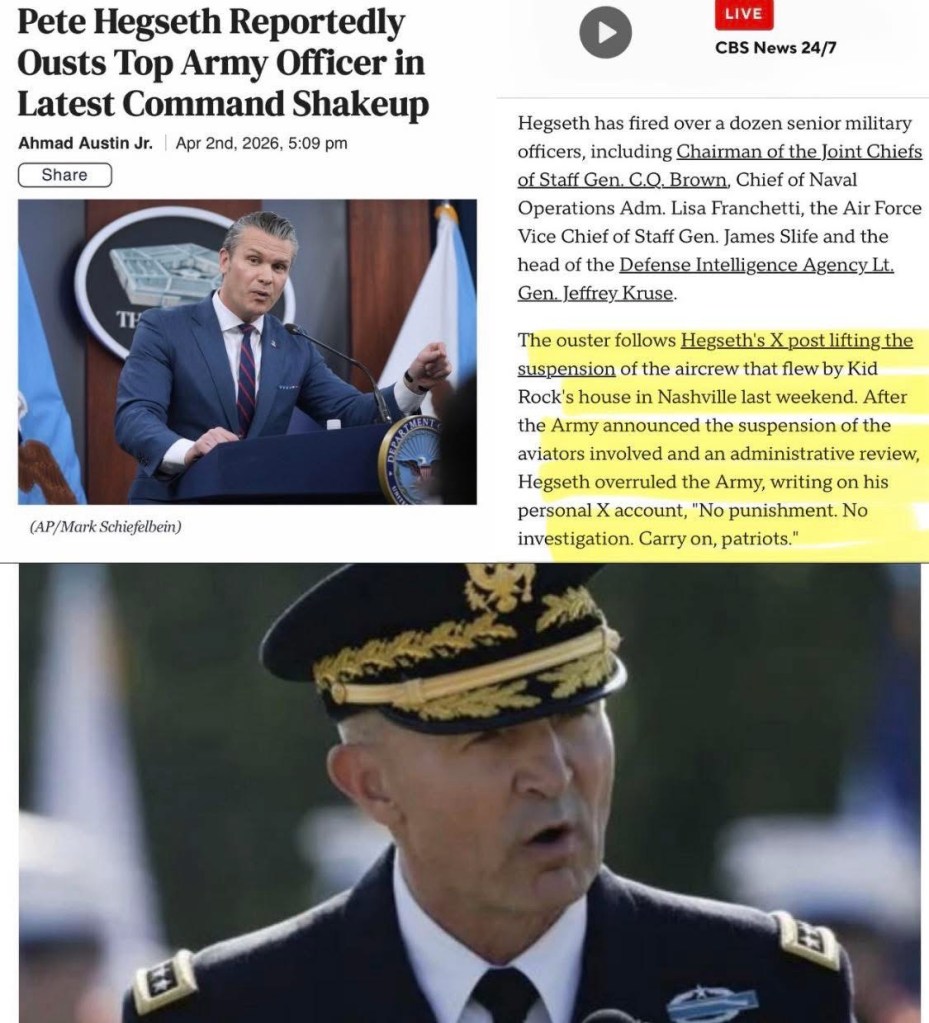
Trump’s incompetent Defense Secretary has been on another firing spree.
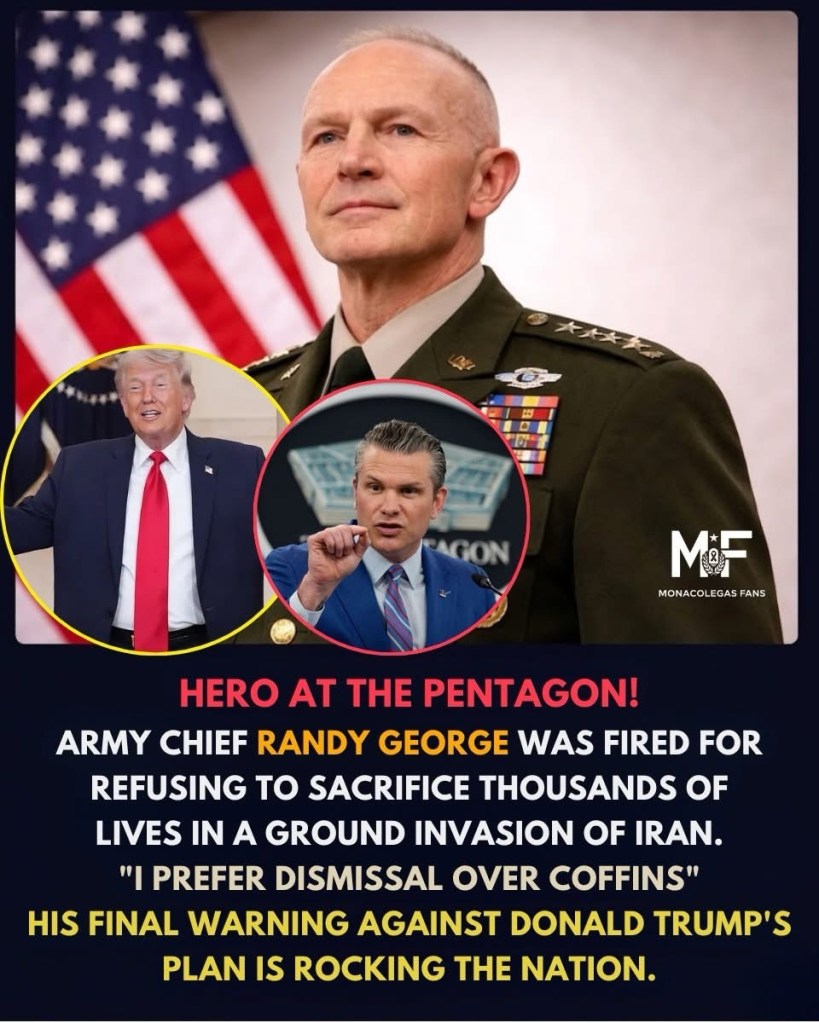
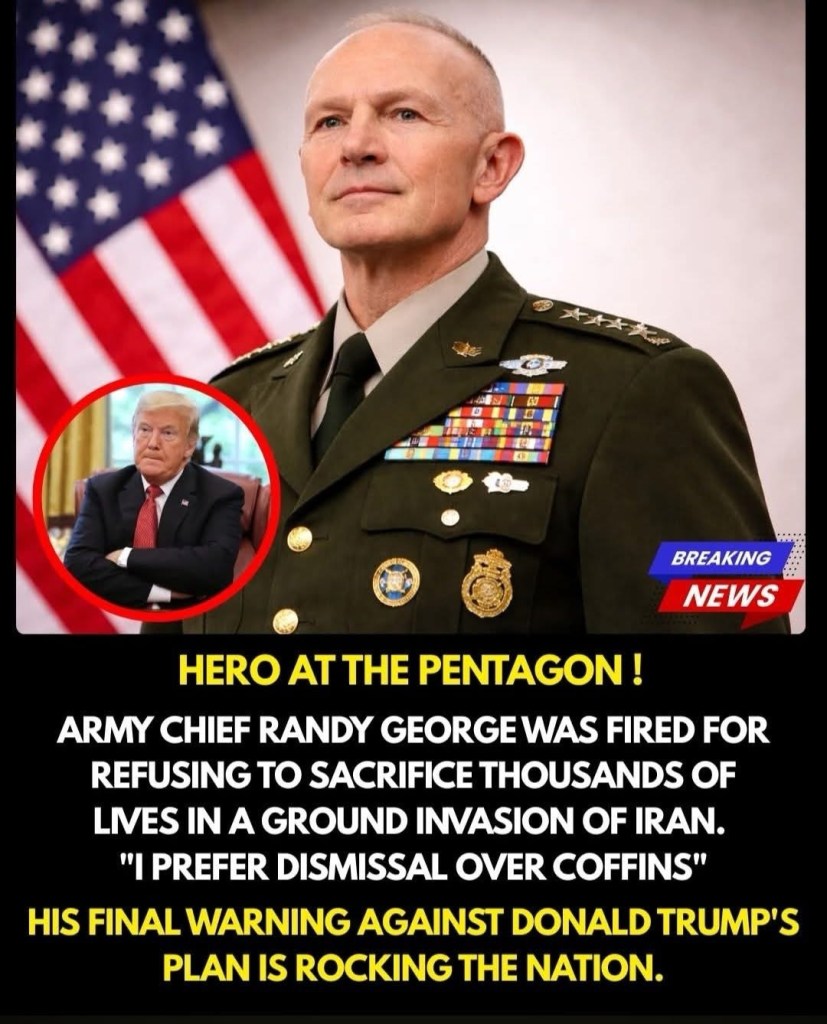
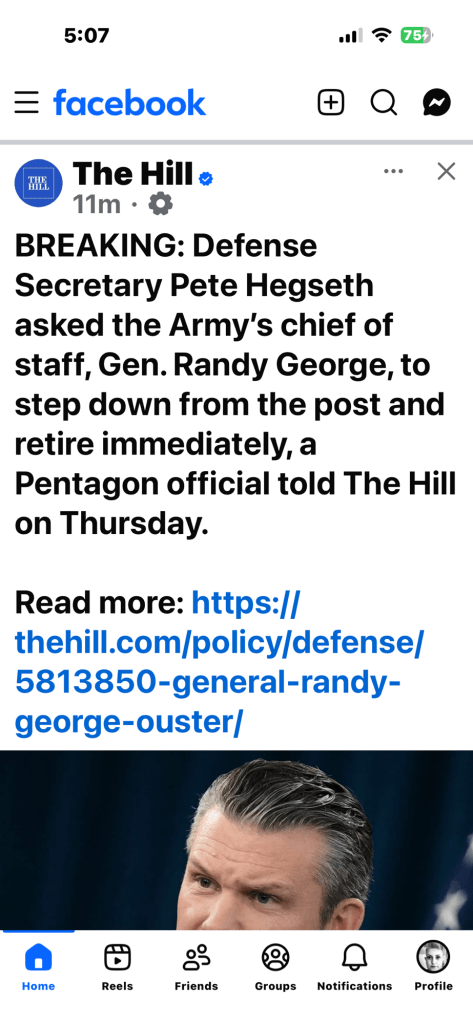
The ousters of Army Chief of Staff Gen. Randy George and Army Gen. David Hodne blindsided military leaders and have generated concern among defense officials about the implications for the war in Iran and the longer-term adoption of new tech and tactics.
Why it matters: George and Hodne join a growing list of generals and flag officers booted by Defense Secretary Pete Hegseth. These abrupt exits have reshaped the Joint Chiefs of Staff, intel-collecting agencies and combatant commands.
Driving the news: George’s dismissal was motivated by clashing personalities and not disagreements over where the Army is headed, according to two U.S. officials.
One of those officials described the firing during a war as “insane.”
Hodne was late last year put in charge of Transformation and Training Command (T2COM), meant to accelerate the service’s tech development and deployment. The organization was birthed from the Army Transformation Initiative, which George helped lead.
“This doesn’t feel like a very strong, self-assured decision,” one of the officials said of Hegseth’s move.
Friction point: The firings come while elements of the Army’s 82nd Airborne Division are bound for the Middle East. The service is also responsible for integrated air-and-missile defenses.
“Here is a four-star general who is actively working to get equipment and people into theater — to protect U.S. forces — and you fire him? In the middle of a war?” a third U.S. official told Axios.
Hegseth has named a former aide, Gen. Christopher LaNeve, to replace George.
WASHINGTON — Secretary of War Pete Hegseth’s “paranoia” about Army Secretary Dan Driscoll taking his job fueled the firing of the Army’s top general, current and former administration officials tell The Post — as a top contender emerges to replace Driscoll if he’s canned next.
Hegseth on Thursday demanded the resignation of Army Chief of Staff Gen. Randy George — Driscoll’s top aide — in the middle of the Iran war for reasons that were not publicly stated.
Marie Witte, Mittens
“This is all driven by the insecurity and paranoia that Pete has developed since Signalgate. Unfortunately, it is stoked by some of his closest aides who should be trying to calm the waters,” an official said, referring to Hegseth’s March 2025 group chat with national security officials that inadvertently included a reporter.
Two other Army generals — Gen. David Hodne of the Army’s Transformation and Training Command and Maj. Gen. William Green of the Army’s Chaplain Corps — were dismissed in the purge, with the department only saying “it was time for a leadership change.”
“[Hegseth] has got a big conflict with Driscoll. And he’s been told by the White House he can’t fire Driscoll, at least for the moment,” a source close to the Trump administration said.
“[Hegseth] is very concerned about being fired and he knows that Driscoll is one of the top contenders, or a natural contender, to succeed him. So what Pete has been doing is taking anyone he perceives to be close with Driscoll and going after them. And this is the latest and most spectacular [example] of that.”
Driscoll is a close friend of Vice President JD Vance, with whom he attended Yale Law School after both men served in the Iraq War. His name was floated as a possible Hegseth successor last summer and the Pentagon boss’s suspicions deepened last fall when Driscoll served as a Ukraine war negotiator.
“This is not just one of those things where Pete is focused on DEI. That’s not what this is about. He keeps going after the Army in particular,” the second person said.
I don’t know what’s going through Hegseth’s so-called mind other than his next drink. Dakinikat wrote about the “DEI” issue in the firing yesterday.
FBI agents prepared handwritten interview notes that contain names of possible corroborating witnesses and other information detailing a woman’s accusations that Jeffrey Epstein lured her into his deviant orbit when she was a teen on Hilton Head Island and sexually abused her.
The Post and Courier reviewed 30 pages of FBI agents’ notes, which have not been publicly released. The notes, made by agents in a series of 2019 interviews, offer a few new details about her claim that she traveled with Epstein to the New York area in the 1980s. She alleged that she encountered Donald Trump during a visit and was once forced into a sex act. The White House has assailed her claim, describing it as backed by no evidence.
Chanela by Grażyna Jeżak
The agents’ unredacted notes were not disclosed in the millions of Epstein documents released so far by the U.S. Department of Justice. They flesh out some aspects of her claims that she crossed paths with Epstein in the Lowcountry before he built a global sex-trafficking operation.
The Post and Courier compared the notes with official summaries, known as 302s, that agents prepared after the interviews. Some details in the handwritten notes never made it into the prepared summaries, which were heavily redacted by the Justice Department before their public release as required by law.
During one interview, for instance, an agent scribbled that the woman provided the names of four young teen girls who, by her account, attended a pool party on Hilton Head when Epstein came by. This was during the time when, she alleged, Epstein was sexually assaulting her and plying her with drugs and alcohol. Details about the four friends were not visible in the FBI’s 302 reports and may have been redacted in an effort to protect victim privacy.
It is unclear whether the FBI ever pursued leads offered by the alleged victim. One of the women identified in the interview notes as a high school friend told The Post and Courier that she was never contacted by the FBI.
Agents’ notes from a fourth interview with the alleged victim in 2019 were not available for The Post and Courier to review.
You can read the whole thing at the link. There’s no paywall this time. The Post and Courier has been doing great work on the Epstein story.
That’s it for me today. What’s on your mind?
Did you like this post? Please share it with your friends:
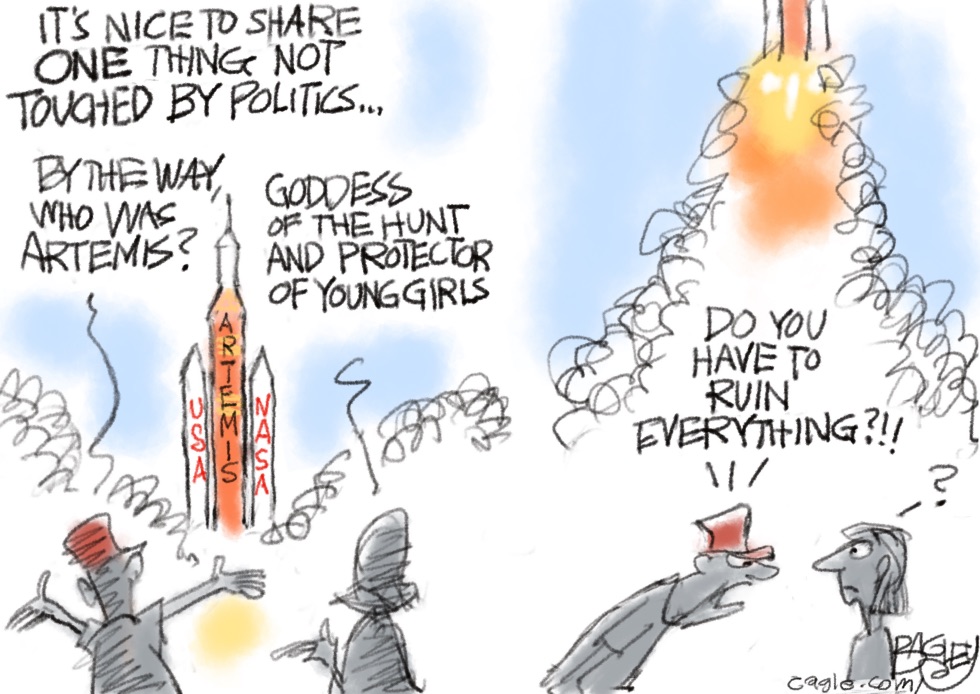
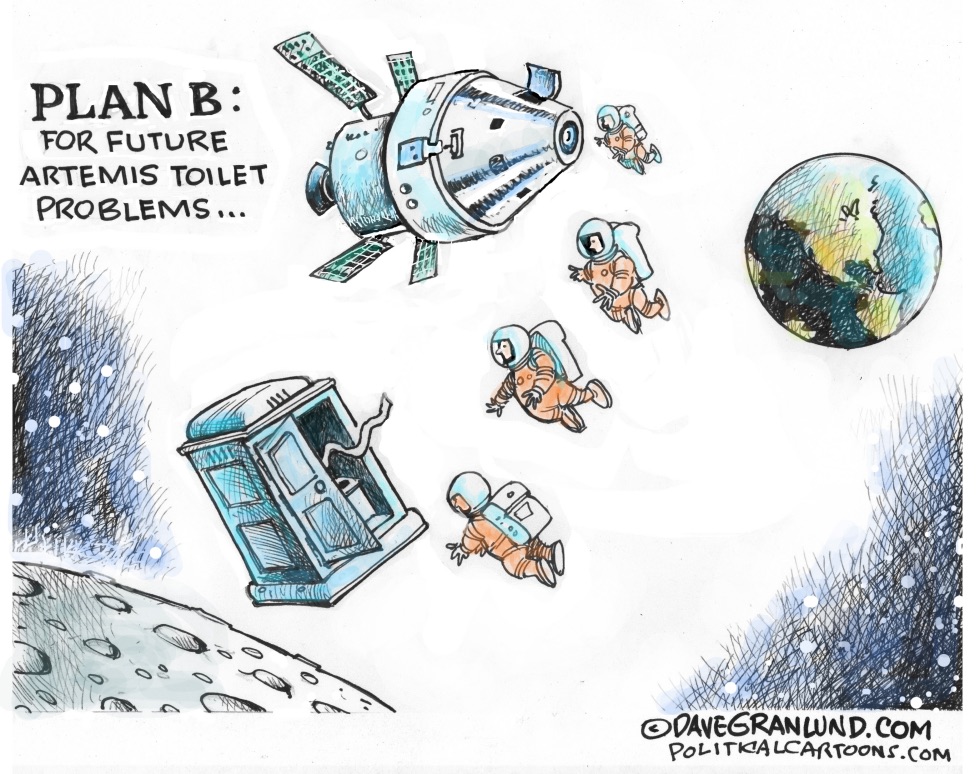
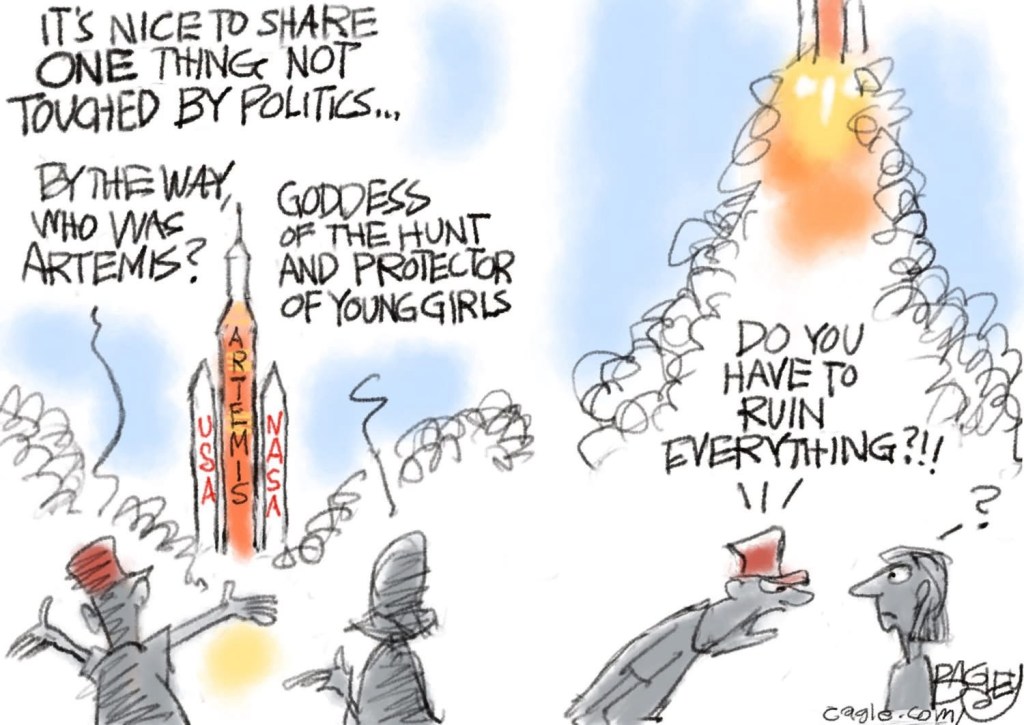
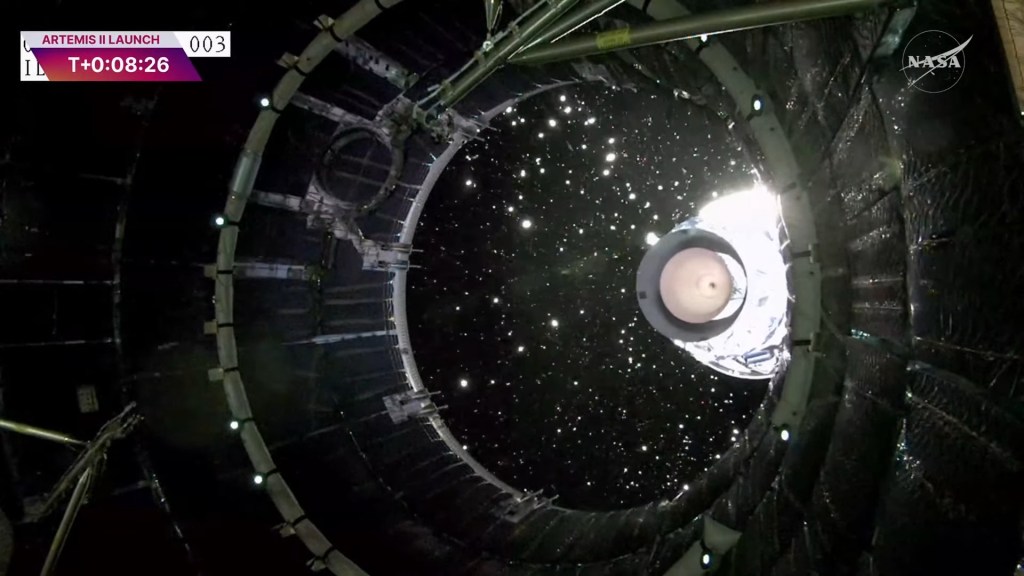
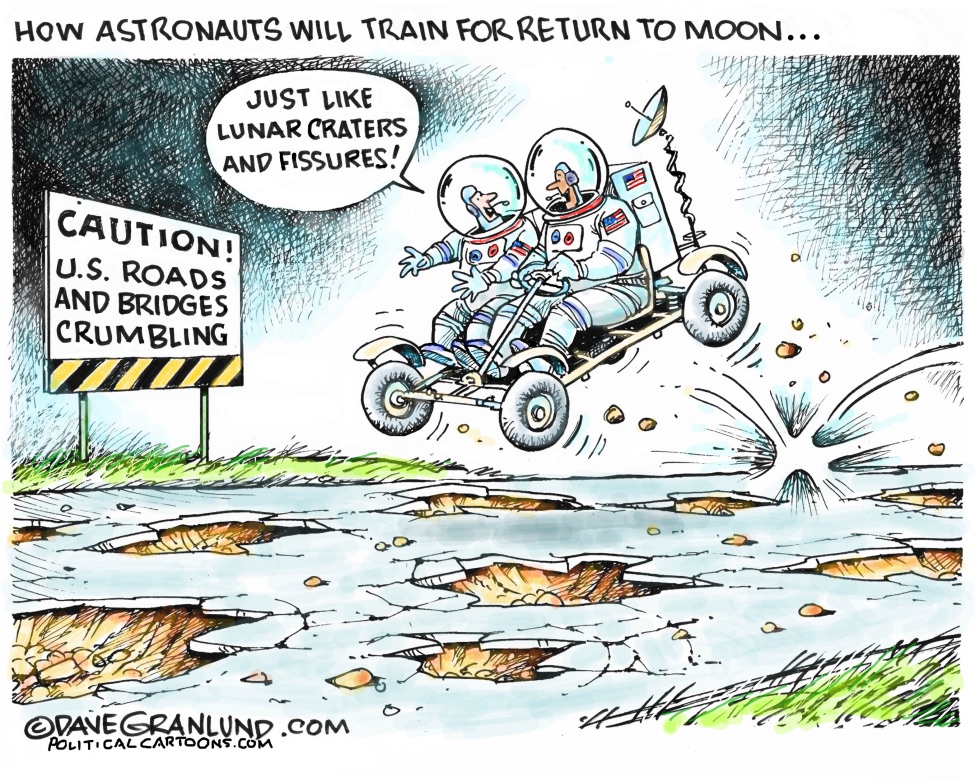
Posted: April 2, 2026| Author:Mama Lopez|Filed under:just because|11 CommentsScreenshot from the NASA Artemis II launch livestream showing the core stage separation from a camera on the rocket.
Isn’t that amazing?
At least that was a positive unifying experience from yesterday.
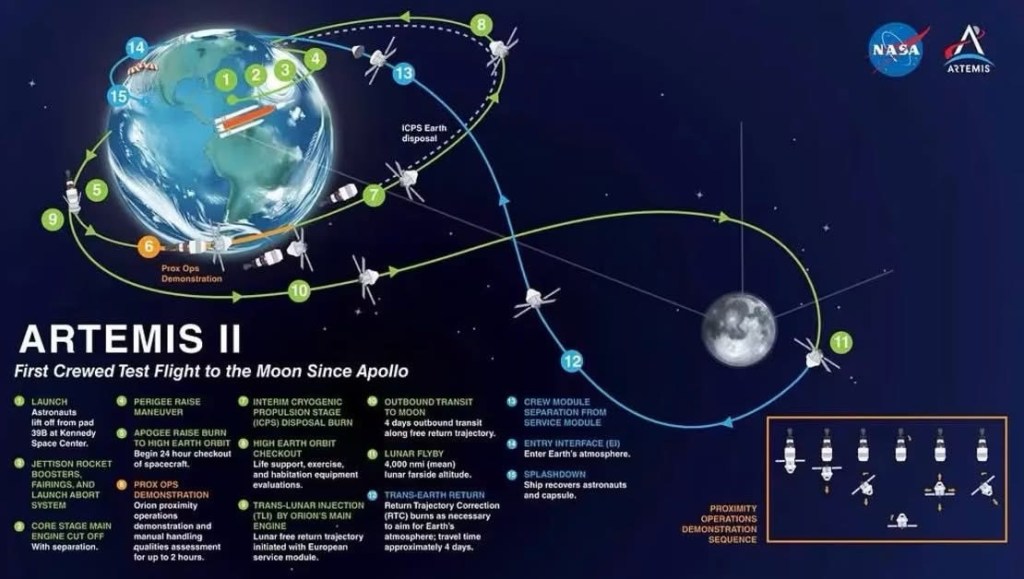
I want to share a couple more items on the moon mission:
What a lovely rebuke to all the "Government Can Never Do a Better Job than Private Industry" clowns in the GOP, given all of Elon's embarrassing failures and expensive explosions.
Trump: We can't take care of daycare. We're a big country. We're fighting wars. It's not possible for us to take care of daycare, Medicaid, Medicare, all these things.
Trump: "NATO won't be there if we have the big one…NATO treated us very badly and you have to remember it because they'll be treating us badly again if we ever need them."
Trump: “We’re not supposed to be seduced that way, right? But I am. When somebody’s nice to me, I love that person. Even if they’re bad people. I couldn’t care less, I’ll fight to the end for them.”
Trump is struggling to deal with his losing war in Iran. He is supposed to give a speech to the nation about it tonight, something he should have done before he started dropping bombs. He is also threatening to pull the U.S. out of NATO. Here’s the latest.
Donald Trump has told The Telegraph he is strongly considering pulling the United States out of Nato after it failed to join his war on Iran.
The US president labelled the alliance a “paper tiger” and said removing America from the defence treaty was now “beyond reconsideration”.
It is the strongest sign yet that the White House no longer regards Europe as a reliable defence partner following the rejection of Mr Trump’s demand that allies send warships to reopen the Strait of Hormuz.
Mr Trump was asked if he would reconsider the US’s membership of Nato after the conflict.
He replied: “Oh yes, I would say [it’s] beyond reconsideration. I was never swayed by Nato. I always knew they were a paper tiger, and Putin knows that too, by the way.” [….]
Mr Trump added: “Beyond not being there, it was actually hard to believe. And I didn’t do a big sale. I just said, ‘Hey’, you know, I didn’t insist too much. I just think it should be automatic.
He is single-handedly wrecking the international alliances that have maintained relative peace since the end of WWII. The rest of the interview consisted mostly of insults to the UK and Prime Minister Keir Starmer.
“We’ve been there automatically, including Ukraine. Ukraine wasn’t our problem. It was a test, and we were there for them, and we would always have been there for them. They weren’t there for us.”
“You don’t even have a navy. You’re too old and had aircraft carriers that didn’t work,” he said, referring to the state of Britain’s fleet of warships.
Asked whether the Prime Minister should spend more on defence, Mr Trump added: “I’m not going to tell him what to do. He can do whatever he wants. It doesn’t matter. All Starmer wants is costly windmills that are driving your energy prices through the roof.”
After speaking to The Telegraph, The Wall Street Journal reported that Mr Trump had raised the issue of withdrawing from Nato with White House aides.
The newspaper said he had made comments to Mr Rubio and others in private but had made no final decision on the future of the alliance.
No one seems to know what Trump is going to say tonight in his overdue “speech to the nation.” It seems likely he will try to bring an end to U.S. involvement, and leave the mess he created for other countries to clean up In addition to the threat to pull out of Nato, according to the AP:
Iranian Foreign Minister Abbas Araghchi has confirmed direct contact with
Iranian Foreign Minister Abbas Araghchi says the Strait of Hormuz falls under the territorial control of Iran and Oman File, Khaled Elfiqi AP Photo
Araghchi confirmed that he had held conversations with Witkoff, Trump’s trusted envoy for peace negotiations around the world, during the current conflict.
But the Iranian foreign minister downplayed that contact.
“I receive messages from Witkoff directly, as before, and this does not mean that we are in negotiations,” he said.
“There is no truth to the claim of negotiations with any party in Iran. All messages are conveyed through the Foreign Ministry or received by it, and there are communications between security agencies,” he added.
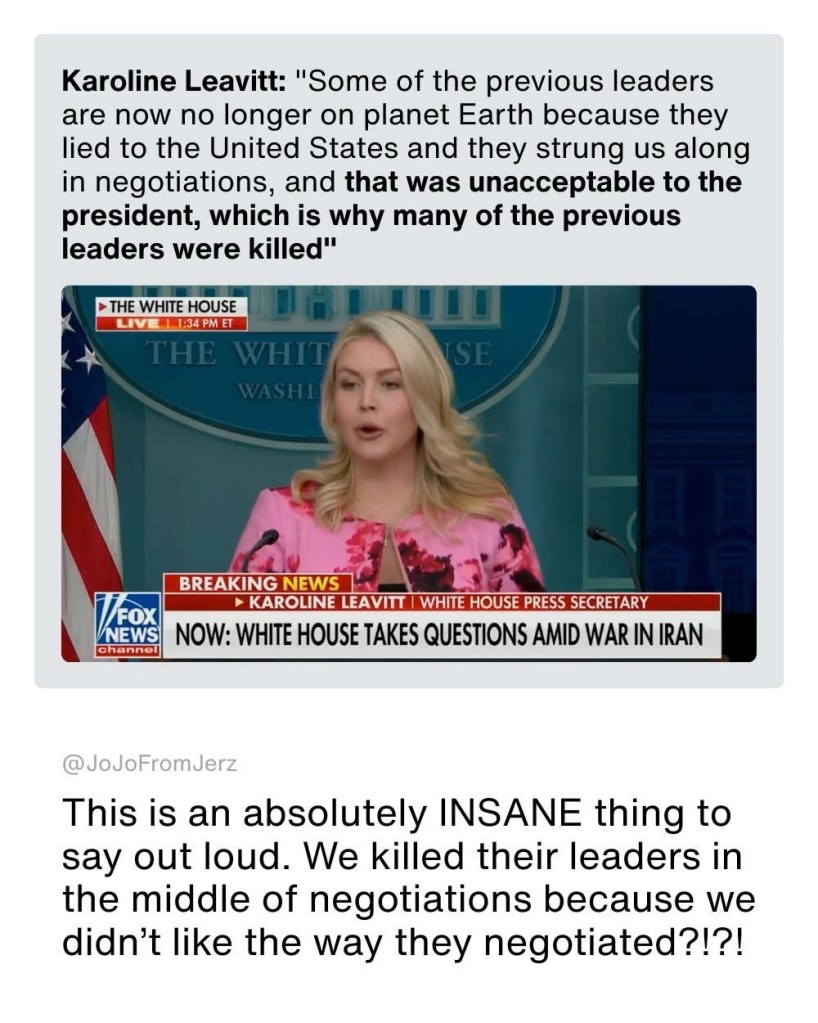
Araghchi explained that they have never had a “good experience” negotiating with the US, referring to Washington’s decision to withdraw from the Barack Obama-era nuclear deal during Trump’s first term. The US has also twice attacked Iran during negotiations over the past nine months — in June 2025 and with the current war, which began on February 28, at a time when Oman, the mediator between the two sides, had said they were on the cusp of a breakthrough over Tehran’s nuclear programme.
“We do not have any faith that negotiations with the US will yield any results. The trust level is at zero,” Araghchi said, adding: “We don’t see honesty.”
Sounds about right. On the Strait of Hormuz:
In the interview, Araghchi argued that the waters of the Strait of Hormuz fall under the territorial control of Iran and Oman, and that once the war is over, it is these two countries who would decide the future of the waterway.
But he added that the strait should be a “peaceful waterway”.
Gulf nations, including Qatar, have, however, insisted that they be included in any talks to decide the future of the strait.
Araghchi also insisted in the interview that, from Iran’s perspective, the strait is open for ships from most nations.
“Only for the ships of those who are at war with us, this strait is closed. That is normal during war – we cannot let our enemies use our territorial waters for commerce,” he explained.
Read more at the link.
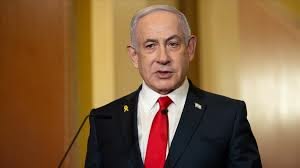
But what about Netanyahu? Will he be OK with Trump wimping out of their war?
Prime Minister Benjamin Netanyahu said Israel and the United States are “beyond the halfway point in terms of success” in their war against Iran, saying that the joint strikes are focusing on the country’s nuclear material.
He added that he doesn’t want to “put a schedule on” the timeline for ending the war with Iran.
In an interview with the right-wing American media outlet Newsmax, Netanyahu said the Iranian regime is “pursuing nuclear weapons and the means to deliver them to American cities,” adding, “That’s what this war is about – preventing that outcome.”
The Israeli prime minister also said that the attacks have “already degraded their missile capabilities, destroyed factories, and eliminated key nuclear scientists.”
He appeared to be sending messages to Trump in the interview:
Iran “killed and maimed more Americans than any other force in recent decades,” Netanyahu told Newsmax, saying Tehran also tried to assassinate U.S. President Donald Trump. “Thousands and thousands killed and maimed in Afghanistan by Iranian IEDs. They bombed our embassies. They tried to kill President Trump twice. They’re still trying to kill him.”
According to Netanyahu, Iran has openly shown it is a threat to the West. “Most importantly, is they they chant ‘Death to America.’ They also say ‘Death to Israel.’ But they say America is the Great Satan. They’re religious zealots, and they have to wipe out Western culture led by America,” he said.
Netanyahu also said Iran is more dangerous to the United States than North Korea, China and Russia. “I don’t hear North Korea chanting ‘Death to America.’ I don’t hear China chanting … I don’t hear Russia,” he said.
I guess we’ll find out something about Trump’s plans tonight in his speech–if he makes any sense, which is unlikely.
President Trump isn’t just befuddling foreign leaders and financial markets with his mixed signals on Iran. Advisers who speak regularly with the president tell Axios they’re just as uncertain.
Why it matters: Trump’s off-the-cuff musings and Truth Social postings can have life-or-death consequences for the war, and massive implications for the market. Then the cycle restarts without any lasting clarity.
Between the lines: Some Trump aides and allies say he’s mostly improvising rather than following any clear plan.
He likes to keep his options open, spitball with different audiences, then capitalize if he thinks he sees an opportunity, they say.
Aides have been convinced at various points that Trump was leaning toward a major escalation, and at others that he was eager for a swift resolution. “Nobody knows in the end what he’s really thinking,” a senior adviser said.
“They had a plan for the first week and since then, they are making the plan up as they go along,” a former U.S. official said.
Others claim it’s all by design. “That’s the plan — for you to not have a clue,” Sen. Lindsey Graham (R-S.C.), who spoke to Trump on Monday, told Axios.
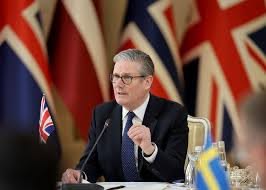
The UK will convene 35 countries – excluding the US – to explore ways to reopen the strait of Hormuz, the vital shipping route for oil and gas that has been blocked by Iran.
Keir Starmer, the prime minister, said the next phase of discussions in the joint British and French efforts to secure the waterway would be held on Thursday, with Yvette Cooper, the foreign secretary, alongside international leaders….
Starmer said on Wednesday the meeting would bring together 35 countries to “assess all viable diplomatic and political measures we can take to restore freedom of navigation, guarantee the safety of trapped ships and seafarers and to resume the movement of vital commodities”.
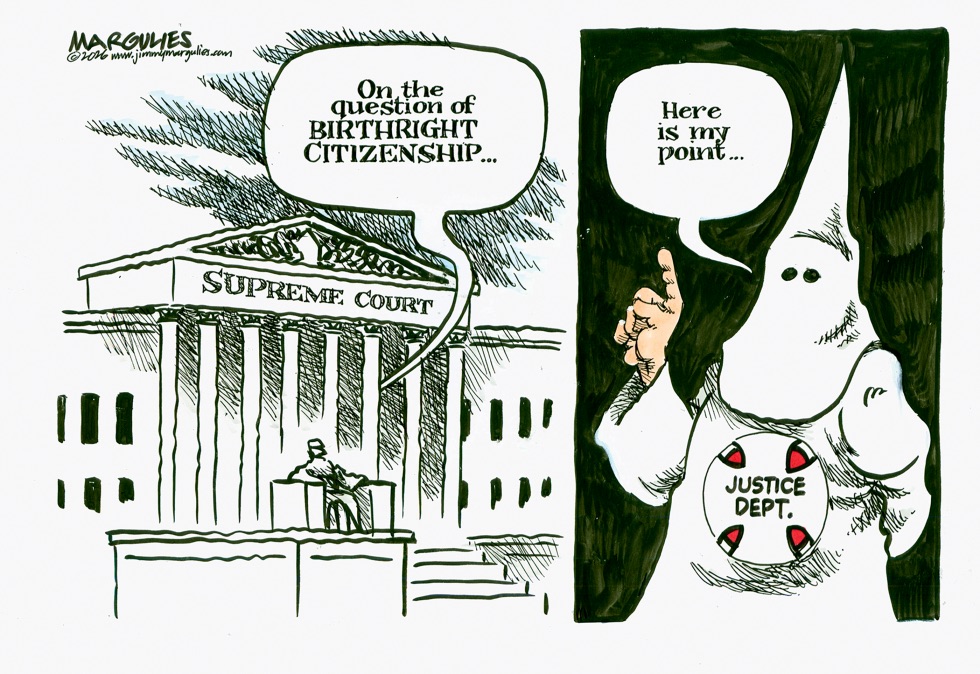
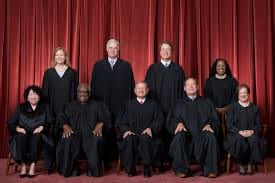
In other news, Trump attended the Supreme Court session his morning on his efforts to end birthright citizenship. No other president has done that.
The Supreme Court heard arguments Wednesday over the constitutionality of President Donald Trump’s effort to ban birthright citizenship. The justices questioned the attorneys about the definition of “domicile,” core to the government’s argument that only children of immigrants who are domiciled in the United States should receive birthright citizenship. In an indication of the political stakes in the case, Trump attended the hearing while Solicitor General D. John Sauer made his arguments, the first time a sitting president is known to have done so. Arguments concluded after Sauer made his rebuttal.
American Civil Liberties Union Legal Director Cecillia Wang argued for the plaintiffs, immigrants using pseudonyms. The ACLU and other groups challenged Trump’s order, saying it violates the 14th Amendment, which grants citizenship to “all persons” born or naturalized in the United States.
In the hearing, Sauer argued that children born to parents without permanent immigration status should not be granted citizenship, upending the long-settled principle that nearly everyone born on U.S. soil is automatically a citizen.
A ruling upholding Trump’s order could have sweeping political, economic and social ramifications….
ACLU Legal Director Cecillia Wang said the 14th Amendment does not allow Congress to add more exceptions to the birthright citizenship rule.
Justice Brett M. Kavanaugh replied: “I guess the answer you just gave means they don’t have any authority to look at this, even if they passed it 435 to 0 in the House and 100 to 0 in the Senate. Your point is, no, they’re closed. They’re frozen forever.”
“Correct,” Wang said….
Arguments concluded after Solicitor General John D. Sauer made his rebuttal.
Congress “in 1866 had a very, very clear understanding that the children of the newly freed slaves have the requisite allegiance to the United States,” he said in his closing remarks. “This was all about overruling the grave injustice of Dred Scott and making sure that allegiance was granted to the children of slaves.”
“Thank you, counsel, general. The case is submitted,” Chief Justice John G. Roberts Jr. said, as he does when arguments end in every case.
The Supreme Court is casting doubt on President Donald Trump’s restrictions on birthright citizenship in a consequential case that was magnified by Trump’s unparalleled presence in the courtroom.
Conservative and liberal justices on Wednesday questioned whether Trump’s order declaring that children born to parents who are in the United States illegally or temporarily are not American citizens comports with either the Constitution or federal law.
Trump, the first sitting president to attend arguments at the nation’s highest court, spent just over an hour inside the courtroom for arguments made by the Republican administration’s top Supreme Court lawyer, Solicitor General D. John Sauer. The president departed shortly after lawyer Cecillia Wang began her presentation in defense of broad birthright citizenship.
Trump heard Sauer face one skeptical question after another. Justices asked about the legal basis for the order and voiced more practical concerns.
“Is this happening in the delivery room?” Justice Ketanji Brown Jackson asked, drilling down into the logistics of how the government would actually figure out who’s entitled to citizenship and who’s not….
“How much of the debates around the 14th Amendment had anything to do with immigration?” Thomas asked, pointing out that the purpose of the amendment was to grant citizenship to Black people, including freed slaves.
The justices are hearing Trump’s appeal of a lower-court ruling from New Hampshire that struck down the citizenship restrictions, one of several courts that have blocked them. They have not taken effect anywhere in the country.
The case frames another test of Trump’s assertions of executive power that defy long-standing precedent for a court that has largely ruled in the president’s favor — but with some notable exceptions that Trump has responded to with starkly personal criticisms of the justices. A definitive ruling is expected by early summer.
Yesterday the Supreme Court voted 8-1 that conversion therapy cannot be banned in Colorado.
The U.S. Supreme Court on Tuesday held, on an 8-1 vote, that Colorado’s law banning therapists from engaging in conversion therapy with minor patients is presumptively unconstitutional as to talk therapy, deeming the law “an egregious form“ of speech regulation that almost always violates the First Amendment.
Only Justice Ketanji Brown Jackson dissented from the court’s decision — warning that the court might have made talk therapy “effectively unregulatable” and that the “fallout could be catastrophic.“ Taking the rare step of announcing her dissent from the bench, Jackson declared that the majority got it “wrong as a matter of precedent, first principles, and history.”
Justice Neil Gorsuch wrote the court’s majority opinion, holding that lower courts had applied the wrong standard for addressing Kaley Chiles’s First Amendment challenge to the state’s ban on conversion therapy — efforts to change a patient’s sexual orientation or gender identity.
As with his opinion in the wedding website case in 2023, 303 Creative v. Elenis, Gorsuch waved broadly at his purpose being to protect free speech and to stop, as he wrote on Tuesday, “censorious governments.“
The proper standard to be applied in Chiles’s case, the court held, is a particularly skeptical form of strict scrutiny because the law is a content-based regulation and, further, includes “viewpoint restrictions” by banning efforts to change a person’s sexual orientation or gender identity and allowing efforts to affirm a patient’s sexual orientation or gender identity. Gorsuch wrote that Chiles’s challenge would likely succeed when the case goes back to the lower courts because “Ms. Chiles seeks to engage only in speech, and as applied to her the law regulates what she may say.“
I guess the solution is public education about the research that shows conversion therapy doesn’t work. But that might not protect children in right wing religious families, especially if they are home schooled.
A few more stores of possible interest:
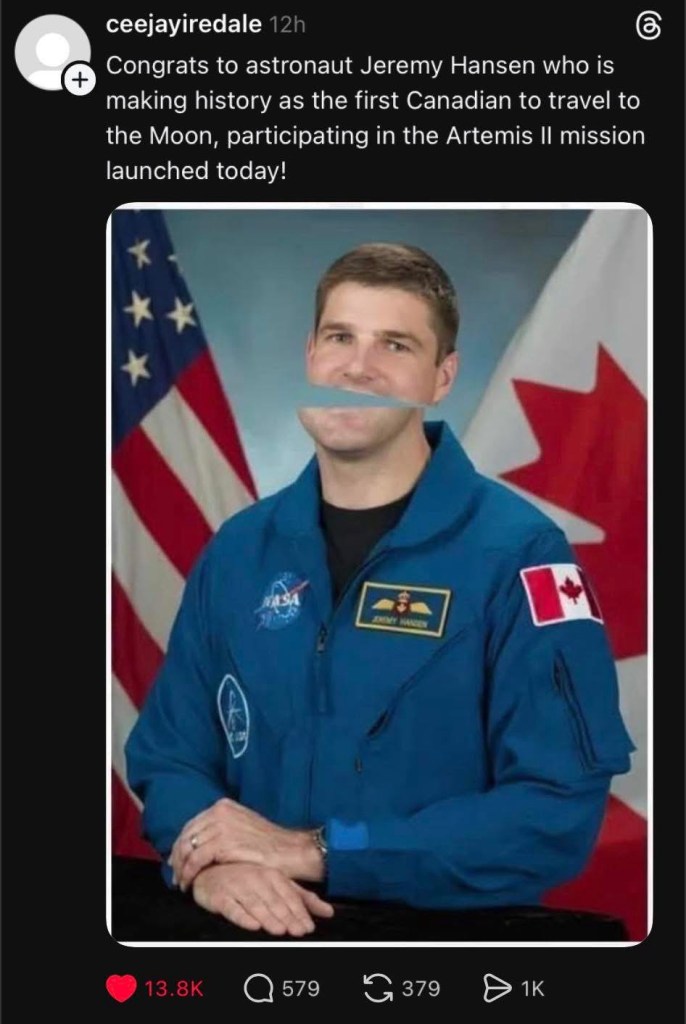
NASA astronauts Reid Wiseman, Artemis II commander, from left, Victor Glover, Artemis II pilot, Christina Koch, Artemis II mission specialist, and CSA (Canadian Space Agency) astronaut Jeremy Hansen, Artemis II mission specialist, right, in a group photograph as they visit NASA’s Artemis II SLS (Space Launch System) rocket and Orion spacecraft. (Bill Ingalls/NASA via AP)
Tensions were high as hydrogen fuel started flowing into the rocket hours ahead of the planned launch. Dangerous hydrogen leaks erupted during a countdown test earlier this year, forcing a lengthy flight delay.
By mid-morning, no leaks had been reported.
The launch team needs to load more than 700,000 gallons of fuel (2.6 million liters) into the 32-story Space Launch System rocket on the pad before the Artemis II crew can board.
Read more at the link. I had no idea this was happening until I got a message from JJ this moring.
The Trump administration was within its rights to demand that the University of Pennsylvania turn over information about Jews on campus as part of a federal investigation into discrimination at the school, a federal judge decided Tuesday.
The government’s investigation had united Penn leaders with Jewish students and faculty members as they opposed the Equal Employment Opportunity Commission’s subpoena. Many on campus drew parallels between the government’s approach and methods deployed in Nazi Germany.
But the Trump administration has said that its request was typical for discrimination investigations to seek potential victims and witnesses, and Judge Gerald J. Pappert of Philadelphia’s Federal District Court agreed on Tuesday. He gave Penn until May 1 to comply with the administration’s subpoena, though the ruling appeared unlikely to quell the debates around how the administration has pressured top American universities.
Judge Pappert, an appointee of former President Barack Obama, appeared to hint at the discomfort that the government’s subpoena had prompted and at the accusations that the E.E.O.C. had gone too far with its tactics, especially a demand for information tied to groups “related to the Jewish religion.”
“Though ineptly worded, the request had an understandable purpose — to obtain in a narrowly tailored way, as opposed to seeking information on all university employees, information on individuals in Penn’s Jewish community who could have experienced or witnessed antisemitism in the workplace,” Judge Pappert wrote in his 32-page opinion, issued three weeks after he heard oral arguments.
The cartoonishly large breasts. The pink spandex. The come-hither stare.
Byron Noem
“Must be A.I.,” a burly cattle rancher named Kevin Ruesink said as he inspected pictures of his neighbor Bryon Noem that had been published by The Daily Mail on Tuesday morning. The rancher was playing pinochle in the back of a convenience store with five other men in the tiny town of Castlewood, S.D., not far from the Noem family farm.
These men all knew Bryon Noem as the nice, tall insurance salesman who married Kristi Arnold, the town beauty queen who grew up to be governor. But now there were these pictures.
The rancher squinted at them with a mixture of suspicion and pity. “I grew up playing ball with Bryon,” he said. “I’ve never known him to be part of stuff like that. I don’t believe that at all.”
The British tabloid report on Tuesday was the latest and most dramatic development in the saga of Kristi Noem, who was sacked as homeland security chief earlier this month, the first Trump cabinet member to get the old heave-ho this term. She quickly put out a statement saying that she was “devastated” by the images of her husband and that “the family was blindsided by this.”
In response to multiple requests for an interview, Mr. Noem wrote in a text message on Tuesday: “I will at some point. Today is not the day. I appreciate your heart.”
While the pictures of Ms. Noem’s husband with what appear to be enormous inflated balloons under his spandex shirt ricocheted across the internet, becoming a political punchline for her many, many enemies, the reaction back on the proverbial ranch was a little more … tenderhearted.
That’s kind of a refreshing response from the townsfolk. Use the gift link to read more if you’re interested.
Those are the stories that caught my attention this morning. What stories have you been following?
Did you like this post? Please share it with your friends:
The Sky Dancing banner headline uses a snippet from a work by artist Tashi Mannox called 'Rainbow Study'. The work is described as a" study of typical Tibetan rainbow clouds, that feature in Thanka painting, temple decoration and silk brocades". dakinikat was immediately drawn to the image when trying to find stylized Tibetan Clouds to represent Sky Dancing. It is probably because Tashi's practice is similar to her own. His updated take on the clouds that fill the collection of traditional thankas is quite special.
You can find his work at his website by clicking on his logo below. He is also a calligraphy artist that uses important vajrayana syllables. We encourage you to visit his on line studio.






















































































































































































































































 peej
peej Carissa
 bostonboomer
 dakinikat
 ecocatwoman
 mablue2
 Mama Lopez
 peggysue22
 quixote
 skydancingguestblogger
 Mona (aka Wonk the Vote)



 Sky Dancing
Recent Comments