
Margaret Sanger: A Rebel With A Mighty Cause
Posted: February 6, 2012 Filed under: birth control, black women's reproductive health, children, Civil Liberties, education, Feminists, health, Hillary Clinton, Human Rights, just because, Planned Parenthood, PLUB Pro-Life-Until-Birth, Women's Rights | Tags: An American Rebel, Birth Control, contraception, Margaret Sanger, sex education, women's reproductive rights 11 CommentsA Book Review; Review of a Life
Two weeks ago, I had the pleasure of catching Jean Baker, history professor at Goucher College, featured on BookTV. Baker discussed her book ‘Margaret Sanger: A Life of Passion,’ but more importantly connected the dots between the Right Wing’s attack on Sanger and the Pro-Choice, Family Planning movement.
A couple years ago while Glenn Beck hurled his diatribes, chalk boarding his twisted worldview on an unsuspecting public, he took Margaret Sanger to task. Beck described Sanger as one of his ‘evil’ progressives, a woman dedicated to racism and the application of eugenics in America.
The attack startled me. Why Sanger? I knew she had spearheaded the whole idea of inexpensive, reliable contraception and that her family clinics and her own reputation had come under constant assault. Anything and everything having to do with sexual behavior was taboo when Sanger began her work in the early, heady days of the 20th century. I also knew that Hillary Clinton had specifically mentioned Sanger as a personal hero. At the time, I thought that was Beck’s aim—discredit Sanger, discredit Clinton.
Au contraire!
Though Hillary Clinton did, in fact, make it on the list of evil progressives [along with Teddy Roosevelt, Wilson, FDR, even Lindsey Graham and John McCain], the attack on Margaret Sanger had and continues to have far broader implications. This is particularly true in any discussion of birth control, abortion and/or family planning and in the midst of a concerted effort to push a fetal personhood amendment to the fore.
The recent dustup between the Komen Foundation and Planned Parenthood is a case in point. Women’s healthcare has become politicized. We as women are discussed in a myriad of parts—our uteruses, our vaginas, our breasts, our reproductive capabilities. Too often, our autonomy as full-fledged human beings, adults capable of thought and decision-making about our own destiny is dismissed, made secondary to the considerations of others. Sadly, today’s opposition to female self-determination is the same that Sanger faced throughout her lifetime: men, who were convinced they had the right to an opinion and the hierarchy of the Catholic Church and other religious institutions that felt and continue to feel perfectly justified to chime in, making moral declarations, complete with Biblical arguments and opinions.

Young 'Maggie'
Professor Baker claims [and makes a very good argument] that the attack on Sanger’s work is also directly related to the attacks now being waged—female autonomy, the ability for women to direct their own reproductive lives. But Sanger had an especially hard road to travel, introducing her radical vision on the heels of the Victorian era.
Whatever’s old is new again!
While reading Baker’s new biography, I was startled by the similarity of the arguments, the pitfalls, the myriad of excuses to block any and all reasonable discussion when it comes to reproductive freedom. That being said, it’s hard to contemplate a time when the very discussion of or writing about birth control was considered perverse, pornographic and could end in jail time. Such was the case in the early 20th century.
Sanger’s efforts were so reviled by the status quo and Catholic Church that she was forced to leave the country for a brief stay in the UK or face arrest. She faced continuous harassment and was eventually arrested for her public, relentless stands. But ironically, this woman who had a spotty formal education, no training in public speaking would become by age fifty, one of the most influential women in the world.
Why? Because she would not stop. Because she was totally gripped by a single, burning idea–women were entitled to information [sexual or otherwise] and had a right to be empowered when it came to their own bodies.
Her background was fertile for dissent, her family a template for radical reaction. Born Margaret [Maggie] Higgins in 1879 in Corning, NY., she was the sixth child of 11 surviving children. Her mother, a devout Catholic, died at the age of 48, suffering with tuberculosis, the scourge of the 19th and early 20th centuries.
But here’s a factoid that Sanger’s critics rarely mention: her mother had eighteen pregnancies during her short life.
Eighteen!
Sanger’s father, a stone carver who royally ticked off the Church with his firebrand criticisms of Rome’s dictates, found it difficult to provide for his huge, ever-growing family. The family was poor, shanty Irish poor, with too many mouths to feed and an increasingly sick mother, made all the worse by cramped, squalid surroundings.
Though her impossible dream had been medical school, Sanger went to New York City following her mother’s death. There she trained as a nurse and midwife and spent several years attending patients on the Lower East Side. The living conditions in the tenements were appalling—cramped, rat-infested, devoid of anything approaching basic hygiene. She watched scores of young immigrant women die of pregnancy-related complications and botched abortions [many self-performed]. And she listened to scores of these women beg attending physicians [when available], pleading for help to prevent back-to-back pregnancies, birthing more children than they were able to feed or care for. To no avail. From that experience, that massive wave of human suffering, the idea of birth control and family planning was born.
Sanger took the remedy upon herself. Because no one else dared.
A prolific self-taught writer, Sanger traveled across America and was invited around the world to speak to the issue of contraception, sex education and reproductive services. Her work became the basis for health clinics dedicated to the health and education of women. She was, in fact, the mother of Planned Parenthood.
Ahhhh. No wonder she’s on the enemies’ list.
So what are the arguments against Sanger? Read the rest of this entry »
It Can Happen Here
Posted: January 9, 2012 Filed under: Barack Obama, Civil Liberties, court rulings, George W. Bush, Gitmo, Human Rights, legislation, torture | Tags: Barack Obama, Defense Authorizattion Act, due process, Gitmo, Guantanamo, Habeas Corpus, indefinite detention, Lakhdar Boumediene, Military Commissions Act (MCA), terrorism, Torture 20 Comments
Lakhdar Boumedienne
Now that President Obama has signed the 2012 Defense Authorization Act, what happened to Lakhdar Boumediene could happen to any of us.
In a horrifying op-ed in yesterday’s New York Times Boumediene described how he was arrested in Bosnia in 2002 and held in Guantanamo for seven years without due process. At the time of his arrest Boumediene was working as a humanitarian aid worker focusing on helping children. During his imprisonment, he was never allowed to see his wife or his children, and received only a few of the many letters they sent him. The ones he did receive were cruelly censored.
Boumediene writes:
I left Algeria in 1990 to work abroad. In 1997 my family and I moved to Bosnia and Herzegovina at the request of my employer, the Red Crescent Society of the United Arab Emirates. I served in the Sarajevo office as director of humanitarian aid for children who had lost relatives to violence during the Balkan conflicts. In 1998, I became a Bosnian citizen. We had a good life, but all of that changed after 9/11.
When I arrived at work on the morning of Oct. 19, 2001, an intelligence officer was waiting for me. He asked me to accompany him to answer questions. I did so, voluntarily — but afterward I was told that I could not go home. The United States had demanded that local authorities arrest me and five other men. News reports at the time said the United States believed that I was plotting to blow up its embassy in Sarajevo. I had never — for a second — considered this.
The fact that the United States had made a mistake was clear from the beginning. Bosnia’s highest court investigated the American claim, found that there was no evidence against me and ordered my release. But instead, the moment I was released American agents seized me and the five others. We were tied up like animals and flown to Guantánamo, the American naval base in Cuba. I arrived on Jan. 20, 2002.
I still had faith in American justice. I believed my captors would quickly realize their mistake and let me go. But when I would not give the interrogators the answers they wanted — how could I, when I had done nothing wrong? — they became more and more brutal. I was kept awake for many days straight. I was forced to remain in painful positions for hours at a time. These are things I do not want to write about; I want only to forget.
Eventually he went on a hunger strike that lasted two years and was brutally force fed twice a day. Finally, in 2008, his case reached the Supreme Court.
In a decision that bears my name, the Supreme Court declared that “the laws and Constitution are designed to survive, and remain in force, in extraordinary times.” It ruled that prisoners like me, no matter how serious the accusations, have a right to a day in court. The Supreme Court recognized a basic truth: the government makes mistakes. And the court said that because “the consequence of error may be detention of persons for the duration of hostilities that may last a generation or more, this is a risk too significant to ignore.”
When he was finally freed, France took him in, and he was reunited with his family. Boumediene writes that there are 90 prisoners at Guantanamo who have also been cleared to leave the facility, but they are being held because they are from countries where they would be tortured or killed if they returned.
So there they sit, not guilty of any crime but held in indefinite detention. Just as you or I could be held if this president or the next one decides we somehow helped or supported terrorism.
Friday Reads
Posted: December 2, 2011 Filed under: Civil Liberties, Civil Rights, Foreign Affairs, George W. Bush, Gitmo, Hillary Clinton, Human Rights, morning reads, Myanmar | Tags: eurozone crisis, Hillary Clinton, Myanmar, violence against women 27 Comments Good Morning!
Well the week certainly crept by me! I spent yesterday with the cable guy and the day before with the electric guy and both had to change the wires from the pole to my house. Most neighborhoods have been fighting to get the utility wires buried for years but the only place they will do that is in the Quarter. High winds and hurricanes always manage to mess things up and the electric company butchers the live oaks on avenues like mine every spring to protect the wires. Still, they’ll do anything to avoid spending the money. Dividends and bonuses must be paid, you know!! Both companies seem to just let the infrastructure rot until the very last wire has gone. It was exhausting and way too reminiscent of post Katrina life. I hope it lasts for awhile. It was a cold day for me to be without the furnace. I’m still a bit cranky.
Evidently Former President George W Bush is going to venture outside the country and head off to visit Africa for charity. Amnesty International is calling for his arrest as a war criminal.
Amnesty International is calling for the arrest of former President George W. Bush while he is traveling overseas in Africa.
The human rights group issued a statement Thursday calling for the governments of Ethiopia, Tanzania or Zambia to take the former president into custody. According to Amnesty, the 43rd president is complicit in torture conducted by the United States during his administration and should be held pending an international investigation.
“International law requires that there be no safe haven for those responsible for torture; Ethiopia, Tanzania and Zambia must seize this opportunity to fulfill their obligations and end the impunity George W. Bush has so far enjoyed,” said Amnesty senior legal adviser Matt Pollard in a statement.
Bush is traveling overseas in Africa to raise awareness for HIV/AIDS, cervical and breast cancer across the continent.
In a continuation of the violation of rights in the name of terror prevention, the US Senate passed a disturbing addendum to a Defense spending bill. The “Senate Declines to Clarify Rights of American Qaeda Suspects Arrested in U.S.” which means any of us could be shipped off to Gitmo without due process. Be sure to check who voted for what because some of them will surprise you.
The Senate on Thursday decided to leave unanswered a momentous question about constitutional rights in the war against Al Qaeda: whether government officials have the power to arrest people inside the United States and hold them in military custody indefinitely and without a trial.
After a passionate debate over a detainee-related provision in a major defense bill, the lawmakers decided not to make clearer the current law about the rights of Americans suspected of being terrorists. Instead, they voted 99 to 1 to say the bill does not affect “existing law” about people arrested inside the United States.
“We make clear that whatever the law is, it is unaffected by this language in our bill,” said Senator Carl Levin, a Michigan Democrat who helped shape the detainee-related sections of the bill with Republicans on the Senate Armed Services Committee.
The disputed provision would bolster the authorization enacted by Congress a decade ago to use military force against the perpetrators of the attacks on Sept. 11, 2001. It says the government may imprison suspected members of Al Qaeda or its allies in indefinite military custody.
Because the section includes no exception for suspects arrested domestically, the provision prompted a debate about whether it would change the law by empowering the government, for the first time, to lawfully arrest people inside the United States and hold them indefinitely in military custody, or whether it would change nothing because the government has that power already.
The debate brought new attention to the ambiguous aftermath of one of the most sweeping claims of executive power made by the Bush administration after Sept. 11: that the government can hold citizens without a trial by accusing them of being terrorists.
Bostonboomer sent me this interesting link to an article at HuffPo by Soraya Chemaly on the widespread violence against women in the world. These statistics are beyond overwhelming. They are appalling.
Think there aren’t men who really hate women or think of them, because they are not male, as subhuman, which makes violence somehow more acceptable or inevitable? Maybe you think this is a third world problem, a race or a class specific problem? I know that there are readers who will immediately assume that I’m condemning all men for the actions of a few. In any of these cases, you might want to consider these statistics*:
Consider femicide, which is the murder of women because they are women:
- In the United States, one-third of women murdered each year are killed by an intimate partner.
- In South Africa, a woman is killed every six hours by an intimate partner.
- In India in 2007, 22 women were killed each day in dowry-related murders.
- In Guatemala, two women are murdered, on average, each day.
- Honor killings, the murder of women for bringing shame to their families, happen all over the world, including the US.
What about slavery, which is what trafficking is?
- Women and girls comprise 80 percent of the estimated 800,000 people trafficked annually, with the majority (79 percent) trafficked for sexual exploitation.
- This number is on the low end. The U.N. International Labor Organization (ILO) estimates that 2.5 million people worldwide are victims, of which over half live in Asia Pacific.
- Trafficking, in the form of the importation of female sex slaves and use of children as sex workers, is on the rise in the U.S. and internationally has reached epic proportions.
Still not outraged? Because if not, there are always euphemistically titled “harmful practices” — which are violent forms of torture and rape. For example:
- Approximately 100 to 140 million girls and women in the world have experienced female genital mutilation/cutting. Every year more than 3 million girls in Africa are at risk of the practice.
- Over 60 million girls worldwide are child brides, another euphemism if I ever heard one, married before the age of 18, primarily in South Asia (31.1 million and Sub-Saharan Africa (14.1 million).
- These numbers don’t include bride burning, suspicious dowry-related “suicides” and “accidental” deaths or other hateful acts.
Now we’re at plain old domestic and sexual violence:
- Every nine seconds in the US a woman is assaulted or beaten.
- According to the Centers for Disease Control and Prevention, women experience about 4.8 million intimate partner-related physical assaults and rapes every year.
- Around the world, at least one in every three women has been beaten, coerced into sex or otherwise abused during her lifetime.
- As many as one in four women experience physical and/or sexual violence during pregnancy, for example, which increases the likelihood of having a miscarriage, stillbirth and abortion.
- Up to 53 percent of women in the world are physically abused by their intimate partners – defined as either being kicked or punched in the abdomen.
- In Sao Paulo, Brazil, which is so much fun to visit, a woman is assaulted every 15 seconds.
- In Ecuador, adolescent girls reporting sexual violence in school identified teachers as the perpetrator in 37 per cent of cases.
According to the US Department of Justice, someone is sexually assaulted every two minutes in the U.S. (overwhelmingly women). One out of every six American women has been the victim of an attempted or completed rape in her lifetime. That is almost 20 percent of our population and the US Justice Department acknowledges that rape is the most underreported crime in the nation.
Hillary Clinton has been making all kinds of inroads in her trip to Myanmar. She even brought a peace offering to Aung San Suu Kyi’s dog who is said to be cute but not
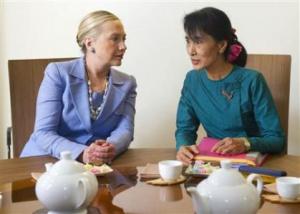
Reuters/Saul Loeb/Pool SOS HIllary CLinton and Aung San Suu Kyi
very friendly . Madam Secretary was told to keep her distance by the human rights activist and Nobel prize winner. The dog got a US chew toy according to Reuters corespondent Andrew Quinn. Clinton emphasized the importance of democracy on her last day of the visit and her hope that one day relations between the countries will normalize. More progress is needed from the Myanmar who has been run by a group of Generals for some time.
Clinton met President Thein Sein on Thursday and announced a package of modest steps to improve ties, including U.S. support for new International Monetary Fund and World Bank needs assessment missions and expanded U.N. aid programs for the country’s struggling economy.
She also said the United States would consider reinstating a full ambassador in Myanmar and could eventually ease crippling economic sanctions, but underscored that these future steps would depend on further measurable progress in Myanmar’s reform drive.“It has to be not theoretical or rhetorical. It has to be very real, on the ground, that can be evaluated. But we are open to that and we are going to pursue many different avenues to demonstrate our continuing support for this path of reform,” Clinton told a news conference on Thursday in the capital, Naypyitaw, before arriving in Yangon.
If you want a really wonky post on how bad it could get in the US and the world if the Eurozone doesn’t take care of it’s problems, you can read this analysis of UBS analysis at Zero Hedge.
Despite the very short term bounce in markets on yet another soon to be failed experiment in global liquidity pump priming, UBS’ Andrew Cates refuses to take his eyes of the ball which is namely preventing a European collapse by explaining precisely what the world would look like if a European collapse were allowed to occur. Which is why to people like Cates this week’s indeterminate intervention is the worst thing that could happen as it only provides a few days worth of symptomatic breathing room, even as the underlying causes get worse and worse. So, paradoxically, we have reached a point where the better things get (yesterday we showed just how “better” they get as soon as the market realized that the intervention half life has passed), the more the European banks will push to make things appear and be as bad as possible, as the last thing any bank in Europe can afford now is for the ECB to lose sight of the target which is that it has to print. Which explains today’s release of “How bad might it get“, posted a day after the Fed’s latest bail out: because instead of attempting to beguile the general public into a false sense of complacency, UBS found it key to take the threat warnings to the next level. Which in itself speaks volumes. What also speaks volumes is his conclusion: “Finally it is worth underscoring again that a Euro break-up scenario would generate much more macroeconomic pain for Europe and the world. It is a scenario that cannot be readily modelled. But it is now a tail risk that should be afforded a non-negligible probability. Steps toward fiscal union and a more proactive ECB, after all, will still not address the fundamental imbalances and competitiveness issues that bedevil the Euro zone. Nor will they tackle the inadequacy of structural growth drivers and the deep-seated demographic challenges that the region faces in the period ahead. Monetary initiatives designed to shore up confidence can give politicians more time to enact the necessary policies. But absent those policies and sooner or later intense instability will resume.”
I’ve been meaning to do a post explaining what the FED and the five other central banks did to prevent a credit market lock up for the past two days, but, see the first paragraph. I was reliant on my blackberry for internet access AND phone calls for two days so it didn’t happen. I’ll try to do it today if any one is interested. Basically, this could be another Lehman Brothers scenario because there are sings that interbank lending has slowed to a trickle. The extra push of world currencies is supposed to get banks around the world to lend again. If they don’t lend to each other, than the banks will scramble to cover their reserves and basically rescind and short term loans to corporations for things like inventory, working capital and payroll shortages. We’re technically not bailout out Europe and we’re trying to prevent another bailout of our usual suspect financial institutions with global exposure. This wouldn’t be as widespread as the mortgage meltdown since the exposure to that was country wide (no pun intended). The Fed can maneuver a lot here. What this could do is create some inflation which has pluses and minuses. They also are debasing the dollar which is good for exporters bad for importers and people that like to buy cheap foreign goods. Merkel and the Germans have gotten a little stiff on the plans again so the deal still isn’t made. They’re not keen on the idea of Eurobonds. Increased fiscal integration is slow tracked.
“I personally, and the whole government believes, that eurobonds are the wrong method — and even harmful — in this phase of European development,” Merkel told the General Anzeiger newspaper.
She also emphasised the independence of the European Central Bank and said it was up to the ECB to decide how to ensure currency stability.
I guess the nasty results of the German bond float last week didn’t really sink in afterall.
Okay, so this is incredibly long now and possibly way too depressing for a Friday. However, you can add the cheery bits down thread. What’s on your reading and blogging list today?
Demotion of Women to Non-Persons Fails. For Now.
Posted: November 9, 2011 Filed under: abortion rights, birth control, Civil Rights, fundamentalist Christians, Human Rights, Reproductive Rights, Surreality, Women's Rights 15 CommentsGood for Mississippi for voting that garbage down.
But it’s a bit flabbergasting that a question of basic rights is being voted on at all. What’s next? A vote on keeping slaves?
Because, you know, the right to your own life is fairly basic. It’s why you can kill someone in self-defense.
Except, apparently, if you make the mistake of living while female. Think about ectopic pregnancy for a minute. It occurs when the fertilized egg starts to develop outside the womb. It has a very high fatality rate without treatment, higher than most forms of untreated plague, for instance. According to our Christian Taliban, if someone saves your life in that case, they’ve committed murder. In their minds, it’s like removing the feeding tube from a dependent patient.
Women are feeding tubes to them. And we, in all seriousness, go around voting on whether women are more than that or not.
Cry, the not-so-beloved country.
Crossposted to Acid Test
Why Occupy Wall St. Should Bother
Posted: November 6, 2011 Filed under: #Occupy and We are the 99 percent!, Austerity, Baby Boomers, Bailout Blues, Banksters, commercial banking, Corporate Crime, Human Rights, income inequality, investment banking, poverty | Tags: 2011: days of revolt, Financial Crisis, U.S. Economy 4 CommentsHere’s a message that should go viral for all the doubters and naysayers and critics of the Occupy Wall St. Movement. Why should we bother as one poster at Sky Dancing asked this morning? Why should Occupy beam in on the Koch brothers or Lloyd Blankfein or any of the infamous 1% that have brought the United States and the world to its knees?
Watch and listen. And then ask: how can we or Occupy or any rational, reasonable human being not be bothered?

 peej
peej Carissa
 bostonboomer
 dakinikat
 ecocatwoman
 mablue2
 Mama Lopez
 peggysue22
 quixote
 skydancingguestblogger
 Mona (aka Wonk the Vote)



 Sky Dancing
Recent Comments