
“It’s the first time that our court has said that a closely held corporation has the rights of a person when it comes to religious freedom,” she said during a Q&A at the Aspen Ideas Festival. “I find it deeply disturbing that we are going in that direction.”
“It’s very troubling that a sales clerk at Hobby Lobby who needs contraception, which is pretty expensive, is not going to get that service through her employer’s health care plan because her employer doesn’t believe she should use birth control,” she continued.
Tuesday Reads
Posted: July 29, 2014 Filed under: #Occupy and We are the 99 percent!, 2014 elections, 2016 elections, Democratic Politics, Hillary Clinton, morning reads, Ralph Nader, Voter Ignorance, We are so F'd 29 CommentsGood Morning!
The state of America’s democratic experiment really worries me these days. It seems so railroaded by the interests of the very few. I’m not sure if you got a  chance to read the following article at Salon by Bill Curry. You should. It’s about how the Democratic Party got co-opted by Wall Street interests and helped continue us down the road to complete plutocracy. It starts with out following the decline in the party’s alignment with ordinary Americans and the history of Ralph Nader’s formation of the consumer protection movement. Ultimately, it is about Nader and his new book. But,the details of the re-alignment and Nader’s personal history are an interesting read when put into the context of our road to corporate tyranny.
In the late ’70s, deregulation fever swept the nation. Carter deregulated trucks and airlines; Reagan broke up Ma Bell, ending real oversight of phone companies. But those forays paled next to the assaults of the late ’90s. The Telecommunications Act of 1996 had solid Democratic backing as did the Financial Services Modernization Act of 1999. The communications bill authorized a massive giveaway of public airwaves to big business and ended the ban on cross ownership of media. The resultant concentration of ownership hastened the rise of hate radio and demise of local news and public affairs programming across America. As for the “modernization” of financial services, suffice to say its effect proved even more devastating. Clinton signed and still defends both bills with seeming enthusiasm.
The Telecommunications Act subverted anti-trust principles traceable to Wilson. The financial services bill gutted Glass-Steagall, FDR’s historic banking reform. You’d think such reversals would spark intra-party debate but Democrats made barely a peep. Nader was a vocal critic of both bills. Democrats, he said, were betraying their heritage and, not incidentally, undoing his life’s work. No one wanted to hear it. When Democrats noticed him again in 2000 the only question they thought to ask was, what’s got into Ralph? Such is politics in the land of the lotus eaters.
The furor over Nader arose partly because issues of economic and political power had, like Nader himself, grown invisible to Democrats. As Democrats continued on the path that led from Coehlo to Clinton to Obama, issues attendant to race, culture and gender came to define them. Had they nominated a pro-lifer in 2000 and Gloria Steinem run as an independent it’s easy to imagine many who berated Nader supporting her. Postmortems would have cited the party’s abandonment of principle as a reason for its defeat. But Democrats hooked on corporate cash and consultants with long lists of corporate clients were less attuned to Nader’s issues.
Democrats today defend the triage liberalism of social service spending but limit their populism to hollow phrase mongering (fighting for working families, Main Street not Wall Street). The rank and file seem oblivious to the party’s long Wall Street tryst. Obama’s economic appointees are the most conservative of any Democratic president since Grover Cleveland but few Democrats seem to notice, or if they notice, to care.
 This also happened along side a group of democratic senators–including Joe Biden–that helped seat the 5 generic, oddball Catholic men that threaten everything the country stands for by deciding almost SCOTUS decisions in oddball Catholic ways. (You have to wonder if they listen at all to the current Pope.) Additionally, things have gotten so right wing in the diplomacy sector that John Kerry and Barack Obama’s state department seem to be tilting in the same direction as the neocon-infested, apartheid loving Israeli government of Bibi the Butcher of Gaza.
This certainly isn’t the party of my FDR-loving Great Grandmother Nancy Anna Chisholm Williams whose father and uncle blazed the west with the Chisholm Trail and who lived and died a Depression surviving Okie. Big political interests keep driving the Democrats into very undemocratic places.
The Obama administration deserves much of the blame for the failure of the latest round of Israeli-Palestinian peace talks.
It had originally been hoped that the United States would present a binding framework along the lines of what moderate Israeli and Palestinian political leaders had agreed to in unofficial talks in Geneva in 2003: Israel would recognize a Palestinian state based roughly on the pre-1967 borders with mutual territorial swaps, which would leave the Palestinians with 22 percent of historic Palestine and allow Israel to keep the remaining 78 percent; the Palestinian state would be demilitarized and all irregular militias disarmed; illegal settlements in occupied Palestinian territory near the Israeli border—encompassing close to 80 percent of the settlers—would be incorporated into Israel while settlers in the more remote settlements would be required to return to Israel; there would be no right of return for Palestinian refugees to Israel, but there would be international assistance in helping them resettle in the new Palestinian state; and some Israeli troops would remain along border crossings between the Palestinian state and its Arab neighbors, eventually to be replaced by international forces.
The Palestinian government agreed to these terms. Israel rejected them. Rather than make public this framework, and thereby hope the Israeli public would pressure its right-wing government to compromise, the Obama administration instead insisted that “both sides” had shown a lack of will to compromise.
An interview with an anonymous U.S. official close to the peace talks in an Israeli publication confirmed numerous other reports that, despite the Obama administration’s claims to the contrary, the Palestinian side made major concessions while the Israeli side essentially refused to make any, generally refusing to talk about any substantive issues.
A host of Democratic and Republican former officials—including a former national security adviser, secretary of defense, chair of the House Foreign Affairs Committee, trade representative, and undersecretary of state for political affairs—went on record arguing that the Obama administration would have to challenge the Israeli government’s hard line towards the Palestinians in order for the peace process to be successful. Unfortunately, the White House apparently had no interest in doing so.
Instead, Washington has focused on Palestinian Authority President Mahmoud Abbas’s refusal to give in to U.S. and Israeli demands that he recognize Israel as a “Jewish state.” While the Palestinian government, the Palestine Liberation Organization, and the ruling Fatah party have all recognized the state of Israel for more than 20 years, the Obama administration has effectively moved the goalposts by declaring that recognizing the Israeli government, acknowledging its right to exist, and providing security guarantees is not enough, insisting that the Palestinians explicitly recognize the state of Israel’s ethno-religious identity as well. No previous administration has put forward such a requirement. President Carter never made such demands on Egypt, nor did President Clinton require this of Jordan as a condition for their peace treaties with Israel. Abbas has said that Israel can identify itself however it wants, but—given that 20 percent of the Israeli population is ethnically Palestinian Arab—it would be politically impossible to agree to something that would acknowledge second-class status for other Palestinians.
Never in history has any country been required to recognize the ethnic or religious identity of another state as a condition for peace. It appears, then, that the Obama administration’s demand may have been an effort to destroy any chance of a peace agreement and leave an opening to blame the Palestinians—despite their agreement to virtually every other issue—for the failure of the peace process.
The failure may also come from President Obama’s trusting Secretary of State John Kerry, a longtime supporter of the Israeli right, to play such a key role in the peace talks. In 2004, Kerry unconditionally endorsed an Israeli plan to unilaterally and illegally annex large areas of the West Bank, leaving the Palestinians with only a series of small non-contiguous cantons surrounded by Israel as their “state,” a proposal denounced worldwide as a violation of the UN Charter, a series of UN Security Council resolutions, and basic principles of international law. Indeed, Kerry has long insisted that it was “unrealistic” to demand an Israeli withdrawal from its occupied territories. (By contrast, Kerry has demanded that Russia withdraw completely from Crimea, citing the illegality of any country acquiring “part or all of another state’s territory through coercion or force.”)
A Democratic administration is basically supporting an apartheid state replete with ethnic cleansing. Under what world does a secular, U.S.  democracy support an apartheid-creating theocracy that won’t follow any agreements it made previously? Why are we the lone country cowering in the corner with a government gone genocidal instead of searching out the country’s numerous moderates and secular leaders and finding a path to coexistance? It truly worries me that former SOS Hillary Clinton who went on Fareed Zakaria’s show on Sunday may continue down this road of letting huge political donors outweigh solutions and fairness. Yet, her interview sounded like there’s some key differences between Kerry’s handling of this situation and the previous problems handled by Clinton. Is she distancing herself from her former boss and signalling that things will be different with her in charge? Will US domestic and foreign policy stop lurching to the right?
ZAKARIA: Bibi Netanyahu…
CLINTON: Right.
ZAKARIA: You say you had a complicated, and it sounded like a difficult relationship with him.
CLINTON: Well, I have to say, I’ve known Bibi a long time. And I have a very good relationship with him, in part because we can yell at each other and we do. And I was often the designated yeller. Something would happen, a new settlement announcement would come and I would call him up, “What are you doing, you’ve got to stop this.” And we understood each other, because I know how hard it is to be the leader of a relatively small country that is under constant pressure, and does face a lot of legitimate threats to its existence from those around it. And I also care deeply about how Israel is able not just to survive, but thrive, and just fundamentally disagreed with Bibi in the ’90s that I was in favor of a two-state solution. I was the first person associated with any administration to say that out loud. And he did not. But then when he came back in in 2009, he did. And I’ve sat with him, as you and I are sitting, and I really believed that if he thought he could get adequate security guarantees for a long enough period of time, he would be able to resolve everything with the exception of Jerusalem, which is the hardest issue. You can get borders and if you can figure out how to do security within those borders, some of which may require having IDF and international forces in the Jordan Valley, for example, then if you could move toward a state and leave Jerusalem to be worked on, because that’s the hardest issue for all sides.
ZAKARIA: But, you know, he gave an interview recently to, I think it was The Times of Israel where he said there are no circumstances under which we will ever relinquish security control of the area west of the Jordan, meaning, the West Bank. That sounds like it’s a – it’s going back on his acceptance of the two-state solution.
CLINTON: Well, Fareed, I see that as an – as an opening negotiating position, because I’ve had the private one-on-one conversations and the private conversations with him sitting there and – and Mahmoud Abbas sitting there and George Mitchell sitting there. And I know that Abbas, in my conversations, was willing to entertain a number of years where there could be some continuing security. Remember, the IDF – the Israel Defense Forces – have a working relationship with the Palestinian Authority security forces, which have been incredibly professional. We’ve helped to provide training, as has Jordan and others, and the positions that Netanyahu has taken. Now, once they take a position, and I know the years that Abbas has said are – are permitted and – and I know the years that Bibi has demanded, you’re in a negotiation. But if there’s no process going on, which is why we can’t even leave the vacuum of no process, despite how incredibly frustrating it is, then, of course Abbas is going to say never, not under any circumstances, and Bibi is going to say absolutely forever.
ZAKARIA: In 2009, you said that you wanted Israel settlement activity to stop. In fact, you were pretty blunt. You said no exceptions.
CLINTON: Um-hmm.
ZAKARIA: You write in the book that that was a tactical mistake because it made on – Bibi Netanyahu get even more hardline.
CLINTON: Right.
ZAKARIA: But Martin Indyk has just resigned as the you know, the kind of – the sherpa of the peace process. And he says that the immediate trigger, in his view, there were many, but was the fact that the Palestinians looked at the Israeli continued settlement activity…
CLINTON: Right.
ZAKARIA: – and said these guys are not serious, we’re never going to be able to get a state…
CLINTON: Right.
ZAKARIA: – look at what they’re doing.
CLINTON: This is my biggest complaint, with the Israeli government. I am a strong supporter of Israel, a strong supporter of their right to defense themselves. But the continuing settlements, which have been denounced by successive American administrations on both sides of the aisle, are clearly a terrible signal to send, if, at the same time, you claim you’re looking for a two-state solution. Now, when I was negotiating and I had been able to put together three face-to-face meetings between Netanyahu and Abbas, it was clear that if we were working off the ’67 borders, which was our stated position that President Obama had outlined, some of the settlements would be within any responsible drawing of borders for Israel. But a number of them would not. And those that would not would have to be either dismantled or live under Palestinian rule. There are deep wells of mistrust and misunderstanding on both sides. And what I’ve urged the Israelis to do is do more to help the Palestinians in the West Bank right now. Don’t monopolize the water. Don’t make it difficult to build. So even while we’re struggling over the end issues that would resolve the conflict, like borders, don’t make life so miserable, you know, because that’s not any way to begin to try to deal with the mistrust. You know, the longer I do this, Fareed, the more convinced I am that mistrust and misunderstanding are often the real fundamental obstacles to bringing people together. And that means that people from both sides of whatever divide it is, whether it’s Israeli, Palestinian, you know, Russian-speaking, Ukraine-speaking, whatever it might be, people have to start listening and working together to build habits of cooperation that might possibly lead to greater trust.
 There are a number of articles where you read recent interviews with Hillary where she sounds more and more like a candidate these days. I want to hear that Hillary will take us back to democracy for all. Not just for those who can purchase it. Here’s Hillary on the US Border situation.
In a smart move, Hillary Clinton firmed up her position on the crisis in an interview that aired over the weekend — in a manner that, intentionally or not, sharpened the contrast with the position of most Republicans.
Speaking to Fusion’s Jorge Ramos, Clinton came out against any changes to the 2008 trafficking law, which Republicans are seeking to expedite deportations of arriving minors as a condition for supporting any money to address the debacle.
“I don’t agree that we should change the law,” Clinton told Ramos. She added that she wanted a more strenuous effort to distinguish between “migrant” children and “refugees,” to ensure that those who genuinely qualify for humanitarian relief in the U.S. obtain it. “I’m advocating an appropriate procedure, well funded by the Congress, which they are resisting doing, so that we can make individual decisions,” Clinton said. “We should be setting up a system in Honduras, Guatemala, El Salvador, to screen kids over there, before they get in the hands of coyotes.”
In opposing changes to the 2008 law, Clinton has placed herself a bit to the left of even Obama, who initially signaled openness to such changes before backtracking after Congressional Dems objected. And Clinton is also clarifying her previous suggestion that the kids should be “sent back.”
“Like Pelosi and Reid, she’s realized that the tough line of President Obama – change the law, send ‘em back – is not the position of most Democratic voters and lawmakers,” immigration advocate Frank Sharry tells me. “She’s repositioned herself. Smart.”
 Is it likely Hillary will move us back to more traditional Democratic policies or is she likely to continue the rightward drift of elected Democratic Leaders like Obama and even Bill Clinton? A recent poll shows that Hillary is popular with white voters; more so than a lot of Democratic pols before her.
This entire idea of having a crazy right wing nut of GOP while Democrats continue to cater to neocons and plutocrats still worries me. We use to have two functioning parties that represented fairly diverse groups of voters. It wasn’t all sweetness and light, but there wasn’t such a concentration of policy that benefited so few coming out of them both. They also did the business of the people. Now we still have two parties. It’s just that one represents crazy religionists and whacked out billionaire libertarians and the other one that occasionally does something for the common american still is likely to slide further to the right to attract rich, powerful donors.
So, that’s what’s on my mind. What’s on your reading and blogging list today?
Tuesday Reads: Live and Let Live Edition
Posted: July 1, 2014 Filed under: Affordable Care Act (ACA), birth control, Discrimination against women, Feminists, fetus fetishists, fundamentalist Christians, GLBT Rights, Hillary Clinton, Marriage Equality, morning reads, religious extremists, Reproductive Health, Reproductive Rights 28 CommentsGood Morning!
 Why is it that many religious people just cannot live without imposing their views on others? That’s one of the things I’ve been thinking about since the reliably patriarchal side of SCOTUS took one more step to force their favorite flavor of religion on the rest of us. Today’s photo montage is via “The Invisibles”. It is a montage of gay couples during the times when theirs was a “love that dare not speak its name”. There are so many folks that choose to live outside of the conventions of the society into which they were born. I was raised to think that this country was born of the dreams of folks wanting to establish a place where they could not be persecuted for not following the majority’s norms. Our country has not had perfect beginnings. But up until recently, I always felt that we were at least creeping towards a “more perfect union”.
While the plight of the GLBT community is improving and appears to have some forward momentum, there are others that are being shoved back into conformity with lives and values not of their choosing. This includes women, immigrants and many minorities. Why do others feel they have to justify their own lives by persecuting others? We’re headed towards our nation’s birthday. What has happened to the idea of creating our “more perfect union” with “liberty and justice for all”?
So, first I feel like I have to add more to the discussion on the SCOTUS decision that allows privately and tightly held corporations that are not engaged  in the business of religion to hold religious beliefs identical to the owners that are supposedly separate from the corporation enough to be indemnified by any illegal activities it undertakes. Hillary Clinton made her views clear on the subject as did Justice Ginsberg writing for the dissent. I will rely on their words here. Hillary Clinton calls the decision “deeply disturbing”.
Justice Ginsberg wrote a masterful dissent.
On Monday, the Supreme Court sided with Hobby Lobby on the company’s challenge to the Affordable Care Act’s contraceptive mandate, ruling that the mandate, as applied to “closely held” businesses, violates the 1993 Religious Freedom Restoration Act. But the divided court’s 5-4 decision included a dramatic dissent from Justice Ruth Bader Ginsburg, who called the majority opinion “a decision of startling breadth.” Ginsburg read a portion of her decision from the bench on Monday.
Addressing the majority of her colleagues — including all but one of the six men sitting on the Supreme Court — Ginsburg wrote:
In the Court’s view, RFRA demands accommodation of a for-profit corporation’s religious beliefs no matter the impact that accommodation may have on third parties who do not share the corporation owners’ religious faith—in these cases, thousands of women employed by Hobby Lobby and Conestoga or dependents of persons those corporations employ. Persuaded that Congress enacted RFRA to serve a far less radical purpose, and mindful of the havoc the Court’s judgment can introduce, I dissent.
The justice goes on to criticize the opinion’s interpretation of the religious freedom law, writing that “until today, religious exemptions had never been extended to any entity operating in ‘the commercial, profit-making world.'”
The reason why is hardly obscure. Religious organizations exist to foster the interests of persons subscribing to the same religious faith. Not so of for-profit corporations. Workers who sustain the operations of those corporations commonly are not drawn from one religious community. Indeed, by law, no religion-based criterion can restrict the work force of for-profit corporations…The distinction between a community made up of believers in the same religion and one embracing persons of diverse beliefs, clear as it is, constantly escapes the Court’s attention. One can only wonder why the Court shuts this key difference from sight.
“In sum,” Ginsburg adds about the free exercise claims at the heart of this case,“‘[y]our right to swing your arms ends just where the other man’s nose begins.’”
Justice Alito got a little prickly in his majority opinion about Ginsburg’s strong criticism of their take on the case:
As this description of our reasoning shows, our holding is very specific. We do not hold, as the principal dissent alleges, that for-profit corporations and other commercial enterprises can “opt out of any law (saving only tax laws) they judge incompatible with their sincerely held religious beliefs.” Post, at 1 (opinion of GINSBURG, J.). Nor do we hold, as the dissent implies, that such corporations have free rein to take steps that impose “disadvantages . . . on others” or that require “the general public [to] pick up the tab.” Post, at 1–2. And we certainly do not hold or suggest that “RFRA demands accommodation of a for-profit corporation’s religious beliefs no matter the impact that accommodation may have on . . . thousands of women employed by Hobby Lobby.” Post, at 2.1 The effect of the HHS-created accommodation on the women employed by Hobby Lobby and the other companies involved in these cases would be precisely zero. Under that accommodation, these women would still be entitled to all FDA-approved contraceptives without cost sharing.
Ginsburg seems to reply to Alito by suggesting that what Alito sees as a narrow, limited decision is essentially an invitation for lots of future challenges on religious grounds: “Although the Court attempts to cabin its language to closely held corporations,” she writes, “its logic extends to corporations of any size, public or private. Little doubt that RFRA claims will proliferate.”
Further quotes from Ginsburg’s dissent can be read at MOJO.
Here are seven more key quotes from Ginsburg’s dissent in Burwell v. Hobby Lobby:
- “The exemption sought by Hobby Lobby and Conestoga would…deny legions of women who do not hold their employers’ beliefs access to contraceptive coverage”
- “Religious organizations exist to foster the interests of persons subscribing to the same religious faith. Not so of for-profit corporations. Workers who sustain the operations of those corporations commonly are not drawn from one religious community.”
- “Any decision to use contraceptives made by a woman covered under Hobby Lobby’s or Conestoga’s plan will not be propelled by the Government, it will be the woman’s autonomous choice, informed by the physician she consults.”
- “It bears note in this regard that the cost of an IUD is nearly equivalent to a month’s full-time pay for workers earning the minimum wage.”
- “Would the exemption…extend to employers with religiously grounded objections to blood transfusions (Jehovah’s Witnesses); antidepressants (Scientologists); medications derived from pigs, including anesthesia, intravenous fluids, and pills coated with gelatin (certain Muslims, Jews, and Hindus); and vaccinations[?]…Not much help there for the lower courts bound by today’s decision.”
- “Approving some religious claims while deeming others unworthy of accommodation could be ‘perceived as favoring one religion over another,’ the very ‘risk the [Constitution’s] Establishment Clause was designed to preclude.”
- “The court, I fear, has ventured into a minefield.”
You can read the full dissent here. (It starts on page 60.)
 The court attempted a narrow decision but crept into an area of corporate law that could create an interesting situation. Usually, corporations are considered distinct from their owners. Hobby Lobby is a corporation tightly held by a family so the majority view basically carved out this type of corporation and said “it’s different”. However, how can you indemnify owners from corporate malfeasance AND say that this specific corporation that doesn’t have a religious mission reflects this set of owner’s pet superstitions? Could the justices have unintentionally left a back door open to challenge the very basis of incorporation which is to make any corporation its own entity?
The decision’s acknowledgment of corporations’ religious liberty rights was reminiscent of Citizens United v. Federal Election Commission, a 2010 ruling that affirmed the free speech rights of corporations. Justice Alito explained why corporations should sometimes be regarded as persons. “A corporation is simply a form of organization used by human beings to achieve desired ends,” he wrote. “When rights, whether constitutional or statutory, are extended to corporations, the purpose is to protect the rights of these people.”
Justice Ginsburg said the commercial nature of for-profit corporations made a difference.
“The court forgets that religious organizations exist to serve a community of believers,” she wrote. “For-profit corporations do not fit that bill.”
I wanted to point out the anniversary of a sad day in New Orleans history. I’m not sure how many of you know about the UpStairs Lounge fire of 1973. The arson mass murder of GLBT stands as the largest of its kind in modern history.
On June 24, 1973, an arsonist set fire to a gay bar in New Orleans called the Upstairs Lounge, killing 32 gay men and women in what has gone down in history as thelargest gay mass murder in U.S. history.
Today is the 41st anniversary of that tragedy, which has been documented by Robert L. Camina in the new film “Upstairs Inferno”. According to the first official teaser trailer below, the horrific event led to even more reprehensible acts in its wake – several bodies from within the club were never claimed by family members, those survivors featured in the news went on to lose their jobs and livelihoods, and the New Orleans police department lagged its feet and attempted to cover up the deadly crime.
To this day, no one has ever been charged with setting fire to the UpStairs Lounge.
Many folks believe this is an event that should not be forgotten.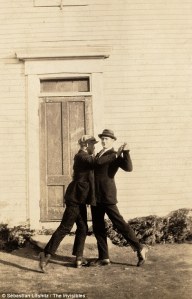
For a complex array of reasons, including homophobia, shame, and despair, the fire and its victims languished in obscurity for years, not taking its proper place in the broader sweep of LGBT history, but this is quickly changing.
“Upstairs”, my musical tragedy commemorating the fire and honoring its victims premiered last year in New Orleans to sold-out audiences, as part of the 40th anniversary memorials and Pride events. A portion of the musical is now playing at the West Village Musical Theatre Festival in New York.
A new book, “The UpStairs Lounge Arson: Thirty-Two Deaths in a Louisiana Gay Bar”, released just last month, is the most extensively-researched and carefully-told history of the subject.
And “Upstairs Inferno”, a documentary by acclaimed filmmaker Robert Camina is currently in post-production.
In addition, Delery, Camino, and I are advocating the inclusion of the UpStairs Lounge site on the National Register of Historic Places.
To commemorate the anniversary of the fire, I spoke with Camina about his documentary.
The lion’s share of published research about the fire comes from Johnny Townsend, author of “Let the Faggots Burn”, and Clay Delery. Did you interview them for the piece and what did you learn?
Well of course Townsend had a lot to contribute, because without his efforts many years ago to interview people, many of the stories would have been lost. So I think he brought a lot of insight to the tragedy that, since so many have passed on, we are not able to access.
Did you get to talk to anyone that Delery and Townsend did not get to talk to?
I don’t think they interviewed Francis Dufrene. We were able to interview him. He was a survivor of the fire. He slipped through the bars and jumped and landed on the pavement. He suffered third-degree burns. He gave us a distinctive perspective of what it was like in the middle of it when the fire started, so we definitely learned a little bit of what it was like the emotions just the mood and a frame of mind of what people going through in there.
As far as you can tell, what was the UpStairs lounge like as a bar?
It was a very comfortable place. Everyone we talked to said that the patrons were like a family. And the word that has come up that you’re very familiar with is “Sanctuary”.Yes, that’s why I opened my musical with a song of that title. And of course, when a place that is considered a sanctuary is invaded and ruined, it has a profound impact on a community. And I’m not sure I had a whole sense of the impact that it had until I was there last year for the 40th Anniversary to see how the community responded to the memorial events and the play.
Supreme Court Justice Antonin Scalia made an appearance at the Lanier Theological Library in Houston, Texas on Friday, where he claimed that the success of capitalism was deeply tied to the nation’s religious values.
“While I would not argue that capitalism as an economic system is inherently more Christian than socialism … it does seem to me that capitalism is more dependent on Christianity than socialism is,” Scalia, a devout Catholic, said during his speech,according to the Houston Chronicle. “For in order for capitalism to work — in order for it to produce a good and a stable society — the traditional Christian virtues are essential.”
Unfortunately, I can’t seem to read the part in the new testament where the jesus dude said ANY of that. Evidently, we’re supposed to all follow his brand of religion even if we find it to be complete bunk.
Why can’t we just live and let live?
What’s on your reading and blogging list today?
Friday Reads: Some Things Just Never Change
Posted: June 13, 2014 Filed under: Hillary Clinton, Iraq, morning reads, right wing hate grouups 78 Comments Good Morning!
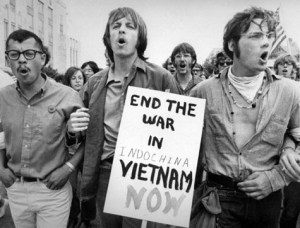
Do you remember the picture over there on the left? It’s our country getting out of Vietnam in 1975. That happened during my first year at university. My high school graduation was overshadowed by Watergate and the resignation of Nixon. My coming of age was basically full of these kinds of things that jade you. I won’t even go into the amazingly bad economy full of stagflation and unemployment. It’s amazing to me that my daughters now get to experience my Déjà vu with their fresh eyes. The photo down there on the right is the US leaving Iraq. The similarities are frightening. So look at these photos and then we will talk about Iraq which has been a singularly unpleasant topic for quite some time. It’s more unraveling of very bad U.S. Policy. Rachel Maddow covered it very thoroughly last night. Iraq is basically splitting into three distinct entities. It appears Baghdad will fall shortly.  Iraq is completely and fully experiencing a civil war.
Iraq was on the brink of falling apart Thursday as al-Qaeda renegades asserted their authority over Sunni areas in the north, Kurds seized control of the city of Kirkuk and the Shiite-led government appealed for volunteers to help defend its shrinking domain. The discredited Iraqi army scrambled to recover after the humiliating rout of the past three days, dispatching elite troops to confront the militants in the central town of Samarra and claiming that it had recaptured Tikrit, the home town of the late Iraqi strongman Saddam Hussein, whose regime was toppled by U.S. troops sweeping north from Kuwait in 2003. But there was no sign that the militant push was being reversed. With the al-Qaeda-inspired Islamic State of Iraq and Syria now sweeping south toward Baghdad, scattering U.S.-trained security forces in its wake, the achievements of America’s eight-year war in Iraq were rapidly being undone. Iraq now seems to be inexorably if unintentionally breaking apart, into Shiite, Sunni and Kurdish enclaves that amount to the de facto partition of the country. As the scale of the threat to the collapsing Iraqi state became clear, Obama administration officials met to discuss options for a response, including possible airstrikes. An Iraqi official in the office of Prime Minister Nouri al-Maliki said the United States had committed to carrying out airstrikes against the militants, but U.S. officials said no decision had been reached. President Obama indicated there would be some form of intervention, though he did not specify what. “It’s fair to say . . . there will be some short-term things that need to be done militarily,” he said.
 Iraqi Kurds have taken the oil-rich city of Kirkuk while radical Sunnis head for Baghdad. Shia radicals aligned with Iran and Syria have also moved into the embattled country.
In Mosul, Sunni militants of the Islamic State of Iraq and the Levant (ISIL) staged a parade of American Humvees seized from the collapsing Iraqi army in the two days since the fighters drove out of the desert and overran Iraq’s second biggest city. Two helicopters, also seized by the militants, flew overhead, witnesses said, apparently the first time the militant group has obtained aircraft in years of waging insurgency on both sides of the Iraqi-Syrian frontier. State television showed what it said was aerial footage of Iraqi aircraft firing missiles at insurgent targets in Mosul. The targets could be seen exploding in black clouds. Further south, the fighters extended their lightning advance to towns only about an hour’s drive from the capital Baghdad, where Shi’ite militia are mobilizing for a potential replay of the ethnic and sectarian bloodbath of 2006-2007. Trucks carrying Shi’ite volunteers in uniform rumbled towards the front lines to defend the capital. The stunning advance of ISIL, which aims to build a Caliphate ruled on medieval Sunni Islamic principles across Syria and Iraq, is the biggest threat to Iraq since U.S. troops withdrew in 2011. Hundreds of thousands of people have fled their homes in fear as the militants seized the main cities of the Tigris valley north of Baghdad in a matter of days. The security forces of Iraq’s autonomous Kurdish north, known as the peshmerga, or those who confront death, took over bases in Kirkuk vacated by the army, a spokesman said.
There were no jihadis in Iraq when Dubya et al lied us into war. There certainly are jihadis there now.
As the U.S. pullout began under the terms of a treaty signed in 2008 by then-President George W. Bush, Maliki, the leader of a Shiite political party, promised to run a more inclusive government—to bring more Sunnis into the ministries, to bring more Sunnis from the Sons of Iraq militia into the national army, to settle property disputes in Kirkuk, to negotiate a formula on sharing oil revenue with Sunni districts, and much more.
Maliki has since backpedaled on all of these commitments and has pursued policies designed to strengthen Shiites and marginalize Sunnis. That has led to the resurgence of sectarian violence in the past few years. The Sunnis, finding themselves excluded from the political process, have taken up arms as the route to power. In the process, they have formed alliances with Sunni jihadist groups—such as the Islamic State of Iraq and Syria, or ISIS, which has seized not just Mosul but much of northern Iraq—on the principle that the enemy of their enemy is their friend.Something like this has happened before. Between 2005 and 2006, jihadists who called themselves al-Qaida in Iraq, led by Abu Musab al-Zarqawi, took control of Anbar province, in the western part of the country, by playing on the population’s fear of the anti-Sunni ethnic-cleansing campaigns launched by Maliki’s army.* ISIS, an offshoot of Zarqawi’s organization, is following the same handbook, picking up support from one of northern Iraq’s leading Sunni militias, Jaysh Rijal al-Tariqah al-Naqshbandia, or JRTN. That is a risky move for a group like JRTN, which shares neither the millenarian goals nor the extremely violent tactics of ISIS (which, it’s worth noting, was expelled from al-Qaida because even current al-Qaida leader Ayman al-Zawahiri considered the group too violent). But JRTN’s leaders have accepted the risk for now to advance their own goal of overthrowing Maliki. (They boast that they have been fighting alongside ISIS, but disavow involvement in the killing of civilians.)The fall of Mosul is particularly poignant because that was the city where peace and prosperity seemed most likely in the early days of the American occupation. David Petraeus, then the three-star general who commanded the 101st Airborne Division, applied his theory of counterinsurgency to all of Nineveh province, of which Mosul was the capital. And, for a while anyway, it worked.
While most U.S. commanders in post-Hussein Iraq were ordering their soldiers to bust down doors and arrest or shoot all men who seemed to be insurgents, Petraeus and his team took steps to create a government. Using funds pilfered from Saddam Hussein’s coffers, they vetted candidates for a citywide election (selecting leaders from all factions and tribes), started up newspapers and TV stations, coordinated fuel shipments from Turkey, and reopened businesses, communication lines, and the university. This game plan was classic “nation-building,” a phrase anathema to most Army generals and the secretary of defense at the time, Donald Rumsfeld. The idea was not to make the people of Mosul love America, but rather to make them feel invested in the future of the new Iraq.
 So, it seems Dubya et all have not only brought on a civil war in Iraq, they planted the seeds for a civil war in the Republican Party. More than ever, it’s important to vote in the midterms this year. We cannot afford to have this battle fought on the floor of our Congress. The Tealiban are fed up with lip service. They want to make sure that women wear their versions of the head-to-toe burkhas, that gays are stoned, and that we have no federal government to stand in the way of a new NeoConfederacy.
The GOP’s leadership crisis extends beyond Congress. In recent cycles, Republican presidential primaries have been relatively orderly affairs where the party establishment rallies around a frontrunner—often the person who came in second the last time (Bob Dole, John McCain, Mitt Romney)—who holds off right-wing challengers on his way to the nomination. This year, however, that kind of elite control looks unlikely. Chris Christie, the first choice of many GOP leaders, is so wounded that even if he runs, he will not be the frontrunner. Some donors are rallying behind Jeb Bush. If he does not run, they may turn to Marco Rubio. But the road to the GOP nomination runs through Iowa and South Carolina, whose Republican activists resemble the anti-establishment, talk-radio-powered folks who knocked off Cantor. If those activists helped defeat Cantor merely for supporting citizenship for undocumented immigrant children, think how they’ll react to Bush or Rubio, who support a path to citizenship for their parents as well. In the Democratic Party, by contrast—which has enjoyed a reputation for organizational anarchy since the days of Will Rogers—party hierarchies are clear and largely unchallenged. A February Pew poll found that Democrats were more than 20 points more likely than Republicans to say their party’s leaders stand up for party principles. And the consequences are plain to see.
Even though a lot of us–including me–are not really Democrats or Republicans, it is important that the extremists in the Republican party go no further. We could spend the next two years with a right wing radicalism we’ve never seen before in this country.
American political parties always face a tension between their establishment and ideological wings. On the Republican side, going back more than a hundred years to the Teddy Roosevelt era, that was a struggle between moderate progressives and conservatives. Now it is different. There are no moderates or progressives in today’s GOP; the fight is between hard-line conservatives who believe in smaller government and radical nihilists who want to blow up the whole thing, who have as much disdain for Republican traditional conservatives as they do for liberals.
Meanwhile, the urban-rural, reactionary-progressive split seems more pronounced than ever. An extremely interesting Pew Poll was released  yesterday that shows exactly what it means to live in a divided America.
The overall share of Americans who express consistently conservative or consistently liberal opinions has doubled over the past two decades from 10% to 21%. And ideological thinking is now much more closely aligned with partisanship than in the past. As a result, ideological overlap between the two parties has diminished: Today, 92% of Republicans are to the right of the median Democrat, and 94% of Democrats are to the left of the median Republican. Today 92% of Republicans are to the right of the median Democrat, and 94% of Democrats are to the left of the median RepublicanPartisan animosity has increased substantially over the same period. In each party, the share with a highly negative view of the opposing party has more than doubled since 1994. Most of these intense partisans believe the opposing party’s policies “are so misguided that they threaten the nation’s well-being.”
I guess I do agree that today’s Republican party is a threat to this country. It’s definitely a threat to American women.
Here’s a Fresh Air interview with Hillary Clinton if you’re interested.
Hillary Clinton is on a national book tour for her new memoir, Hard Choices. The book outlines her four years as secretary of state during President Obama’s first term, when she met with leaders all over the world.
One of her priorities was to campaign for gay rights and women’s rights. She says she saw the “full gamut” on how women were treated, and in some cases it was “painful to observe.”
“It has become — and I think will continue to be — a very important issue for the United States to combat around the world and to stand up for the rights of all people,” she tells Fresh Air‘s Terry Gross.
The only thing that gives me hope is that the average Fox viewer and Republican are older than me. Let’s hope our daughters and sons, our granddaughters and grandsons see the insanity of repeating these same mistakes. The polls of our future citizens look a lot more hopeful than the polls based on the old guard.
What’s on your reading and blogging list today?
Lazy Saturday Reads
Posted: May 31, 2014 Filed under: Crime, FBI, Hillary Clinton, metadata, morning reads, NSA, National Security Agency, Rape Culture, Real Life Horror, U.S. Politics, Violence against women | Tags: Edward Snowden, George Packer, Glenn Greenwald, Jonathan Chait, Margaret Sullivan, Michael Kinsley 34 Comments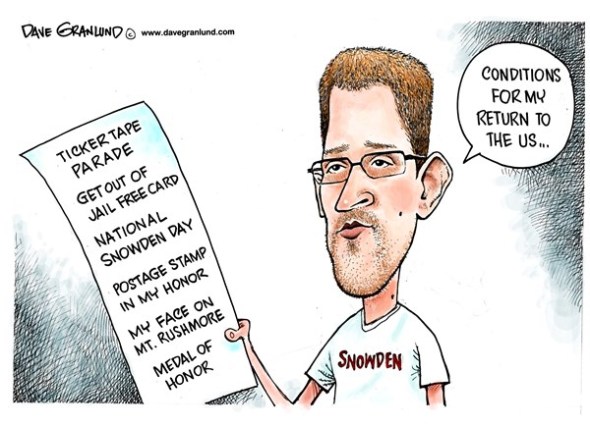
Good Morning!!
I stole the above Dave Granlund cartoon from JJ’s Friday night post, because it perfectly expresses my viewpoint on who and what Edward Snowden is. I’ll have the latest Snowden news for you in a minute, but first a personal update and some breaking Boston bombing news.
I’m in Indiana visiting my mom for a couple of weeks. The weather is gorgeous here, and I’m really enjoying it. It’s great to be out of the drizzly cold weather the Boston area has been having. I’m looking forward to doing quite a bit of yard work, helping my mom buy a new bed, celebrating her 89th birthday with her, and just generally enjoying her company.
As usual, I drove my car out here, and I made great time. The speed limits have been increased to 70 mph in Ohio and Indiana, and everyone in Massachusetts and New York routinely drives at least 10-15 miles over the 65 mph limit. So I probably averaged around 70-75 mph on the trip.
My mechanic told me that I need to start using premium gas in my car. I hated to do it, but to my surprise I got much better mileage with the expensive gas. I used 2-1/2 tanks of gas to go more than 900 miles. Usually it takes 3 full tanks and a little more to make the trip!
As I mentioned above, some Boston bombing news broke last night. From The Boston Globe: Man charged with obstructing bombing probe.
A cab driver from Quincy who was close to the two suspected Boston Marathon bombers was arrested Friday on charges of lying to investigators and destroying evidence, allegedly obstructing the ongoing investigation of the 2013 attack that shocked the city and the nation.
Khairullozhon Matanov, a 23-year-old Kyrgyzstan national, allegedly contacted Tamerlan Tsarnaev 42 minutes after the April 15, 2013, bombings, and he bought him and his younger brother, Dzhokhar Tsarnaev, dinner at a restaurant that night. Matanov visited Tamerlan, whom he knew from playing soccer and from places of worship, at the suspected bomber’s Cambridge home two days later.
Over several days after the bombings, he also called the brothers repeatedly.
Authorities alleged in a sweeping indictment unsealed Friday that Matanov realized the FBI would want to interview him about his relationship with the suspected bombers, but that he deleted files from his computer and tried to get rid of his cellphones. They also allege that he lied to investigators about his encounters with the brothers in the days after the bombings.
Matanov discussed his friendship with the Tsarnaev brothers with others in the days following the bombing, but he claims that they didn’t confess their involvement to him. Apparently, the FBI knew about all this a year ago; it’s not clear why they waited until now to charge Matanov. I’ll be keeping my eye on this story.
Now the latest on the Snowden Operation.
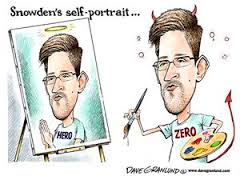
Edward Snowden has been dominating the news for the past few days because of the interview he gave to NBC’s Brian Williams and the recent release of Glenn Greenwald’s book on his collaboration with Snowden in releasing classified NSA files. I have to admit up front that I haven’t yet been able to force myself to watch the interview. Frankly, I doubt if Williams asked any of the questions that I think Snowden should be asked; but I promise I’ll watch the thing today to find out for sure. Meanwhile, I’ve gathered some reactions from people who have watched it.
Frankly, I admit up front that I think Edward Snowden is a defector as well as an arrogant, grandiose, narcissistic jerk. But I think you all knew that already. With that said, here are the latest Snowden (and Greenwald) stories from my very biased point of view.
Last week there were a couple of high-profile negative reviews of Glenn Greenwald’s book No Place to Hide, one by George Packer and the other by Michael Kinsley. As you know, Greenwald doesn’t take criticism well, and he and his fans were not happy with either review. Packer’s review was the most scathing and carefully argued, but Kinsley is taking most of the heat from the Greenwald fan base, probably because the review was quite snarky. For example:
Greenwald was the go-between for Edward Snowden and some of the
newspapers that reported on Snowden’s collection of classified documents
exposing huge eavesdropping by the National Security Agency, among
other scandals. His story is full of journalistic derring-do, mostly set in
exotic Hong Kong. It’s a great yarn, which might be more entertaining if
Greenwald himself didn’t come across as so unpleasant. Maybe he’s
charming and generous in real life. But in “No Place to Hide,” Greenwald
seems like a self-righteous sourpuss, convinced that every issue is
“straightforward,” and if you don’t agree with him, you’re part of
something he calls “the authorities,” who control everything for their own
nefarious but never explained purposes….Throughout “No Place to Hide,” Greenwald quotes any person or
publication taking his side in any argument. If an article or editorial in
The Washington Post or The New York Times (which he says “takes
direction from the U.S. government about what it should and shouldn’t
publish”) endorses his view on some issue, he is sure to cite it as evidence that he is right. If Margaret Sullivan, the public editor (ombudsman, or
reader representative) of The Times, agrees with him on some controversy,
he is in heaven. He cites at length the results of a poll showing that more
people are coming around to his notion that the government’s response to
terrorism after 9/11 is more dangerous than the threat it is designed to
meet.Greenwald doesn’t seem to realize that every piece of evidence he
musters demonstrating that people agree with him undermines his own
argument that “the authorities” brook no dissent. No one is stopping
people from criticizing the government or supporting Greenwald in any
way. Nobody is preventing the nation’s leading newspaper from publishing
a regular column in its own pages dissenting from company or government
orthodoxy. If a majority of citizens now agree with Greenwald that dissent
is being crushed in this country, and will say so openly to a stranger who
rings their doorbell or their phone and says she’s a pollster, how can
anyone say that dissent is being crushed? What kind of poor excuse for an
authoritarian society are we building in which a Glenn Greenwald, proud
enemy of conformity and government oppression, can freely promote this
book in all media and sell thousands of copies at airport bookstores
surrounded by Homeland Security officers?
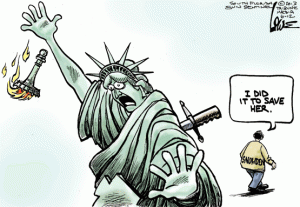
And so on . . . After Kinsley’s piece was published the Snowden cult, of which NYT public editor Margaret Sullivan is a charter member, reacted as usual with an over-the-top firestorm of rage. I’ll let Sullivan speak for the cult. She questioned the choice of Kinsley as reviewer and accused the long-time book-reviewer of arguing the only the government should decide whether classified government materials should be published. She apparently also felt that Kinsley showed insufficient deference to her idol Glenn Greenwald. I’d like to quote from Sullivan’s piece, but for some reason I can’t copy and paste from it. But here’s a reaction to the kerfluffle from Jonathan Chait: Times vs. Sullivan vs. Kinsley vs. Greenwald. Chait agrees with me that the Packer review is “more devastating.” Chait thoroughly skewers Margaret Sullivan, and she can’t attack him because he didn’t do it at the NYT.
It’s certainly true that Kinsley is more effective [than Packer] at poking a hole in Greenwald’s argument than in making the case for his own (obviously problematic) alternative. That would seem to be fair enough given that he’s writing a review of Greenwald’s book. Not to Sullivan, who sprung into action, using her public editor’s column to scold Kinsley. His review “expressed a belief that many journalists find appalling,” she wrote, aghast. Also, “there’s a lot about this piece that is unworthy of the Book Review’s high standards, the sneering tone about Mr. Greenwald, for example.” No sneering in the book review!
Paul writes back to Sullivan — in a rebuttal posted at the bottom of Sullivan’s item — to say, more or less, “let me explain to you what what a book review is”:
It seems there is a lot of confusion on the Internet, especially among those who do not work in the media but even — disturbingly — within the media, about the differences between an editorial and a book review, between what “The New York Times” says and what a reviewer for The New York Times Book Review says. …
For a reviewer to address how a writer comes across, particularly in a memoir or first-hand account, is entirely fair game for a book review, and by no means an ad hominem attack.
The notion that it’s wrong for the book review to print abhorrent reviews, let alone to poke fun at no less a hero than Glenn Greenwald, is an artifact of the culture of smugness that Kinsley is writing about here. If there’s one thing objective journalists are allowed — indeed, expected — to hold extremely strong opinions about, other than the importance of reducing the budget deficit, it’s the importance of journalists themselves. How dare a newspaper publish a review expressing skepticism about special rights for journalists?
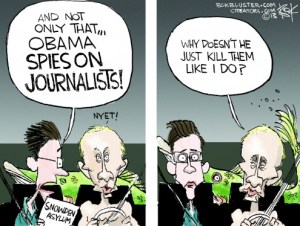
Just for balance, here is a fairly non-judgmental summary of the overall “controversy” at the Neiman Report.
Finally, Kinsley’s response to Margaret Sullivan
Since I haven’t yet watched the Snowden interview with Brian Williams, I’ll give you what I think is the best response I’ve seen so far from Kurt Eichenbaum at Newsweek: 16 Questions Edward Snowden Wasn’t Asked. This article is must-read–if only I could quote the whole thing! Here’s a small sample:
1. Most of the information that has been revealed from the documents you obtained dealt with the abilities, rather than the actions, of the NSA. Did you see or do you have any evidence that the agency was, in fact, spying on Americans who were not linked to terrorist organizations through what is known as the “three-hop” standard? (Under this rule, one of 22 NSA officials must give approval to an analyst who believes a “reasonable, articulable suspicion” exists that a number is directly linked to terrorists. Then the analyst is allowed to determine through searches of metadata which phone numbers were called by the first number. The NSA can then determine the numbers called by the second phone, and the numbers called by the third. The intent is to see if numbers called in the United States by phones directly connected to terrorists will reveal terrorist operatives inside the country.)
5. Did you see or do you have evidence of the NSA reading content of emails sent by Americans or listening to phone calls of Americans without meeting the standards required by the national security courts known as FISA courts?
10. Do you believe that surveillance in foreign nations is intrinsically wrong?
11. You say that you do not believe your actions damaged United States security and that the government has failed to reveal instances where it did. Two questions: What kind of analysis did you conduct to be sure that the information you were taking did not compromise security? And, secondly, given that journalists do not have security clearances, why did you think they were the best placed to Click here and determine what would compromise national security and what didn’t?
Please go read the rest. It sounds like Brian Williams pretty much avoided asking Snowden any hard questions at all.
A few more quick headlines:
NBC News (Irony alert!): Russia Web Journalism Award Named For Edward Snowden.
More horrendous gang rapes in India–from Reuters India: Home minister seeks report on grisly rape, hanging of teens in Uttar Pradesh.
Exclusive: The Daily Banter’s Investigation Helps Catch Sandy Hook Memorial Thief.
Hilarious must-read from Politico: NSA releases Snowden memo.
Oliver Willis: Republicans already handing the White House to Hillary Clinton.
Those are my offerings for today. What are you reading and blogging about? Please share your links on any topic in the comment thread.http
Monday Reads: the Hillary Factor
Posted: May 19, 2014 Filed under: 2014 elections, 2016 elections, Hillary Clinton, morning reads, right wing hate grouups 73 CommentsGood Morning!
The Republicans are seriously flipping out at the thought of President Hillary Clinton. I didn’t watch the Sunday talking head shows but I certainly followed the follow-up fallout. Reince Prebius is literally pissing his Little Lord Fauntleroy suits in anticipation of the 2016 race.
By repeating the claim over and over again that she won’t run, RNC chairman Reince Priebus admitted that the Republican goal is to smear Hillary Clinton into not running for president.
Priebus claimed that Clinton’s age and health are fair game. The RNC chairman said, “What was her record as Secretary of State? Benghazi, Boko Haram, you know, Syria, Russia, those are going to be the issues that I believe will cause her to rethink whether or not she wants to run for president.”
Later he said, “What I think is going to make her rethink whether she should actually run for president. By the way, I don’t think she will if she has another month like she just had, but the issues that I talked about are the issues that are going to make her unacceptable to the American people.”
Priebus denied the that issue is to convince her not to run, then he claimed that Clinton is trying to sweep Benghazi under the rug, and he repeated, “My view though is David, is that given the month she just had, actually I doubt very much that she will run for president in 2016.”
 The man who should be in front of a firing squad for lying us into war, violating our torture agreements, and ignoring all the intelligence leading up to 9/11 even crawled out from the Wyoming caves long enough to snarl Benghazi! Like this guy doesn’t need a full out investigation leading to his arrest and imprisonment. When do we get to hold Bush/Cheney inc responsible for all their screw ups?
Dick Cheney, the former vice president who was in office during the terrorist attacks on Sept. 11, 2001 and later pushed the country into war with Iraq based on faulty intelligence, said on Sunday that former Secretary of State Hillary Clinton would be “held accountable” for four Americans that died during a terrorist attack in Benghazi.
During a Sunday interview on Fox News, host Chris Wallace asked Cheney if Clinton “did anything wrong,” and if she should be “held responsible for the events surrounding that attack.”
“She was secretary of state at the time that it happened,” Cheney opined. “She was one of the first in Washington to know about it. I think she clearly bears responsibility for whatever the State Department did or didn’t do with respect to that crisis.”
“I do think it’s a major issue,” he added. “I don’t think we’ve heard the last of it yet, and I expect that she will be held accountable during the course of the campaign.”
Cheney’s wife, Lynne, who was also on the program also doubled down on her recent suggestion that Hillary Clinton had conspired with Vanity Fair to publish an article by Monica Lewinsky to get the issue out of the way before a 2016 presidential run.
“I was really paying the Clintons a large compliment,” she insisted. “I was saying how clever they are politically. And it seemed to me, if you had something that might come up during the campaign that would be damaging, it was very smart to get it out of the way early.”
“So, that’s my case, Chris, and I’m staying with it.”
The totally irrelevant Karl Rove continued his spiel on Fox. He’s been so consistently wrong on things recently that you’d think even the Fox vacuum tube would burst.
On “Fox News Sunday,” Rove said the Clintons are hypocritical for crying foul.
“I love President Clinton’s comments the other day,” Rove said. “Let’s remember, this is a guy who ran for office savaging Bob Dole.”
“I love being lectured by Bill Clinton,” Rove said sarcastically.
Bill Clinton didn’t necessarily lecture Rove, but he did defend his wife last week, saying she is “strong.” But the former president might have made the situation worse for his wife by saying she had a “terrible” concussion that took six months to get over. That is the first time anyone from her team has said it was a six-month recovery.
“Karl Rove is struggling to be relevant,” Sen. Claire McCaskill of Missouri shot back on NBC’s “Meet the Press,” calling the former Bush adviser’s super PAC, which spent more than $175 million trying to elect Republican Mitt Romney, an “abject failure.”
What is it with these men that they are so afraid of one woman? It just amazes me to see the kind of filth the kick up about her.
Bernie Sanders is questioning Hillary from the left.
Sanders says he doesn’t know whether Clinton will run or not but, like everyone, can see the direction of things this spring. He already has plenty of questions about whether the former senator and secretary of state is what he believes the times demand.
“If she does run, will she be as strong as the times require in taking on the billionaire class that has so much power? I’m not sure that she will be,” Sanders said during an interview in his Senate office. “Will she be as strong as needs be to address the crisis of climate change? I am not sure that she will be. Will she be as strong as needs be to take on the power of Wall Street? I’m not sure she will be.”
It has been widely assumed that if Clinton runs, someone who speaks for the party’s restive progressive wing could mount some kind of challenge — symbolic, gadfly or otherwise — to force a more robust discussion about economic issues and the power of Wall Street and corporate interests. Sen. Elizabeth Warren (D-Mass.) is a popular choice among many on the left to lead that effort, but she has so far demurred. Sanders is not so reticent.
He appears slightly uneasy presenting himself purely as the anti-Hillary. “I like Hillary and have known her for many years,” he said somewhat defensively after he was reminded that he recently told Jay Newton-Small of Time magazine that he would be a better president.
“What I do know about Hillary Clinton is that she has been a very strong advocate of women’s rights,” he continued. “I respect that. She and I have worked together on some issues regarding children. She’s been a strong advocate of children. I have a lot of respect for Hillary Clinton.”
But it’s clear his respect has limits when it comes to the core issues that long have animated his politics. “These are extraordinary times, which require a boldness and an aggressiveness that I’m not sure her past history suggests is there,” Sanders said. “I am not sure that she has been — ” He paused and caught himself. “Well, that’s all. I’m going to leave it at that.”
I do worry about the “inevitability” factor raising its head again. That caused a lot of democratic pols to search out other candidates. Will we see some of the same?
Massachusetts Gov. Deval Patrick said he is concerned about the “inevitability” factor with a potential Clinton nomination.
“I do worry about the inevitability thing,” Patrick said on CNN’s “State of the Union,” adding that it’s “off-putting to the … average voter.”
“I think that was an element of her campaign the last time,” he said, without having to specify how that turned out (Barack Obama won). “I just hope that the people around her pay attention to that this time around.”
All of this effort is pure speculation at the moment anyway since Clinton still is coy about her future. I also hope we can continue to focus on the 2014 elections and the need to ensure we don’t see the Republicans win the Senate Majority. There is still a good chance that the ever scarier Repubican loonies could do it. Right now many folks are saying there are 48 seats leaning towards each party and about 4 are a toss up. This is the outlook from Larry Sabato.
The calculated takeaway is this: As of now, Democrats are clear underdogs in the two states where they want to play offense. They also are probably no better than 50-50 in any of the seven red states where they are defending seats, and drowning in a couple. A big enough wave could cut into the blue states, too, although probably not as deeply as Republicans fantasize. Put it all together, and the current forecast calls for a wave that’s more than a ripple but less than a tsunami — a four to eight-seat addition for the Republicans, with the higher end of the range being a shade likelier than the lower.
So, I’m really worried about all of this. I don’t want to experience the absolute misogyny again and I certainly don’t want the right wing religious whackos in office. I think we really need to work on GOTV for the fall and try to get off the 2016 races already!
What’s on your reading and blogging list today?

 peej
peej Carissa
 bostonboomer
 dakinikat
 ecocatwoman
 mablue2
 Mama Lopez
 peggysue22
 quixote
 skydancingguestblogger
 Mona (aka Wonk the Vote)



 Sky Dancing
Recent Comments