
Hillary says No
Posted: March 16, 2011 Filed under: Democratic Politics, Diplomacy Nightmares, Domestic Policy, Egypt, Foreign Affairs, Hillary Clinton, Tunisia | Tags: CNN, interview with Hillary Clinton, politics, Wolf Blitzer 25 CommentsCNN’s Wolf Blitzer has released an interview with SOS Hillary Clinton. Blitzer asked if she was going to either serve a second term or run for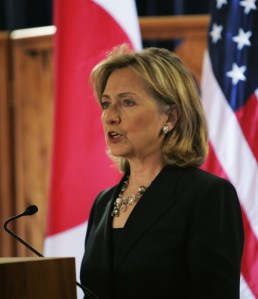 President in 2012. This is pretty clear evidence the Clinton is planning on returning to private life shortly. Blitzer interviewed Clinton during her visit to the U.S. Embassy in Cairo on March 16, 2011.
Q- If the president is reelected, do you want to serve a second term as secretary of state?
No
Q- Would you like to serve as secretary of defense?
No
Q- Would you like to be vice president of the United States?
No
Q- Would you like to be president of the United States?
No
Q- Why not?
Because I have the best job I could ever have. This is a moment in history where it is almost hard to catch your breath. There are both the tragedies and disasters that we have seen from Haiti to Japan and there are the extraordinary opportunities and challenges that we see right here in Egypt and in the rest of the region. So I want to be part of helping to represent the United States at this critical moment in time, to do everything I can in support of the president and our government and the people of our country to stand for our values and our ideals, to stand up for our security, which has to remain first and foremost in my mind and to advance America’s interests. And there isn’t anything that I can imagine doing after this that would be as demanding, as challenging or rewarding.
Q- President of the United States?
You know, I had a wonderful experience running and I am very proud of the support I had and very grateful for the opportunity, but I’m going to be, you know, moving on.
Q- I asked my viewers and followers on Twitter to send questions and a lot of them said, “Ask her if she’ll run in 2016 for the presidency.” A lot of folks would like to you to do that.
Well that’s very kind, but I am doing what I want to do right now and I have no intention or any idea even of running again. I’m going to do the best I can at this job for the next two years.
Clinton also spoke of democratic reforms in Egypt while visiting that nation and Tunisia. She was greeted with protests in Tunisia.
Clinton toured Cairo’s Tahrir Square, the epicenter of the pro-democracy uprising that led to last month’s resignation of Egyptian President Hosni Mubarak.
Clinton said visiting the square was a “great reminder of the power of the human spirit and desire for freedom and human rights and democracy.”
She was welcomed by Egyptian citizens and shook hands with passersby in the square before meeting with Egyptian Prime Minister Essam Sharaf.
Before leaving for Tunisia on Wednesday, Clinton was set to meet with Arab League Secretary General Amr Moussa. Moussa, 74, is a veteran Egyptian diplomat and has announced his candidacy for the country’s presidency.
Clinton also met with pro-democracy activists and members of Egypt’s civil society. She is the highest-ranking U.S. official to visit Egypt since the anti-government protests.
Clinton arrived in Cairo Tuesday after attending a Group of Eight foreign ministers’ meeting in Paris.
After wrapping up talks in Egypt, she travels to Tunisia – the starting point of the pro-democracy movement that has swept through much of the Middle East and North Africa this year.
Dozens of Tunisians took to the streets in Tunis on Wednesday to protest against Clinton’s visit. The demonstrators said they oppose foreign intervention in their country.
There appears to be no break through in her meetings with the G8 in terms of backing a no-fly zone for Libya. While she met with Egypt’s Prime Minister, some details of their meeting have not been released.
On Tuesday, Clinton issued a strong statement of praise for Egypt’s political revolution, declaring she was “deeply inspired” by the dramatic change and promising new assistance for America’s longtime Middle East ally.
Clinton pledged $90 million in emergency economic assistance during a meeting in Cairo with Foreign Minister Nabil Al-Araby. She is the highest ranking U.S. official to visit Egypt since the overthrow of Mubarak.
“The United States will work to ensure that the economic gains Egypt has forged in recent years continue, and that all parts of Egyptian society benefit from these gains,” a State Department statement noted.
She’s not yet discussed her plans after she retires from the position of US Secretary of State.
Don’t tell the truth if you want to keep your job in the Obama Administration
Posted: March 13, 2011 Filed under: Civil Liberties, Democratic Politics, Hillary Clinton, torture, U.S. Military, U.S. Politics, Wikileaks | Tags: Barack Obama, Bradley Manning, Defense Department, Hillary Clinton, P.J. Crowley, Pentagon, State Department 27 Comments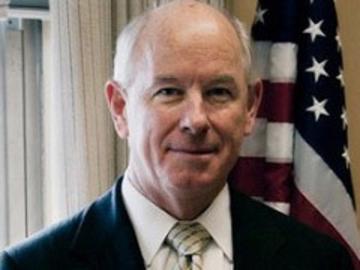
P.J. Crowley
PJ Crowley is gone as Hillary Clinton’s right hand man at the State Department simply because he spoke the truth to a small audience at MIT last week. From CNN (emphasis added):
P.J. Crowley abruptly resigned Sunday as State Department spokesman over controversial comments he made about the Bradley Manning case.
Sources close to the matter [said] the resignation, first reported by CNN, came under pressure from the White House, where officials were furious about his suggestion that the Obama administration is mistreating Manning, the Army private who is being held in solitary confinement in Quantico, Virginia, under suspicion that he leaked highly classified State Department cables to the website Wikileaks.
Speaking to a small group at MIT last week, Crowley was asked about allegations that Manning is being tortured and kicked up a firestorm by answering that what is being done to Manning by Defense Department officials “is ridiculous and counterproductive and stupid.”
Crowley did add that “nonetheless, Bradley Manning is in the right place” because of his alleged crimes, according to a blog post by BBC reporter Philippa Thomas, who was present at Crowley’s talk.
But that wasn’t good enough for our authoritarian President, who cannot abide criticism of any kind–at least from the liberal side of the aisle.
House Speaker John Boehner can question Obama’s American citizenship, and Senate Minority Leader Mitch McConnell can say his main goal is to prevent Obama’s reelection, but let a State Department official question whether torturing whistleblower Bradley Manning is appropriate or smart policy, and he’s gone in the blink of an eye.
The writing was on the wall after President Obama’s cold and unfeeling remarks about Manning at his press conference on Friday.
“I’ve actually asked the Pentagon whether or not the procedures that have been taken in terms of his confinement are appropriate and are meeting our basic standards,” Obama said, suggesting some of those procedures were to protect Manning’s safety. “They have assured me that they are.”
Because the best way to find out if a crime is being committed is to ask the people who are perpetrating the crime, right?
Obama is the Commander and Chief of the armed forces. He could order the Defense Department to stop torturing Manning today. But at this point we’ve all learned not to expect any human decency or leadership of any kind from this man. He has now explicitly put his stamp of approval on the psychological torture of an American citizen, who has done nothing more than reveal war crimes committed by the U.S. military.
P.J. Crowley, who apparently does possess some human emotions and empathy, dared to speak his mind at a private meeting and when the word got out, Obama canned him.
According to Politico, Hillary Clinton wanted Crowley gone anyway and this just “controversy” speeded things up.
Crowley had been on the outs with Secretary of State Hillary Clinton, and rarely accompanied her on her travels abroad. Michael Hammer, President Barack Obama’s NSC spokesman, had been sent to State earlier this year, with the plan for him to succeed Crowley, sources said.
Is that the White House pushing the blame off on Hillary again or is it really true? I honestly don’t know, but I have some strong suspicions.
In a statement Sunday, Crowley notably made no apology for his remarks, but acknowledged that they made his continued service untenable.
“The unauthorized disclosure of classified information is a serious crime under U.S. law. My recent comments regarding the conditions of the pre-trial detention of Private First Class Bradley Manning were intended to highlight the broader, even strategic impact of discreet actions undertaken by national security agencies every day and their impact on our global standing and leadership. The exercise of power in today’s challenging times and relentless media environment must be prudent and consistent with our laws and values,” Crowley said.
“Given the impact of my remarks, for which I take full responsibility, I have submitted my resignation as Assistant Secretary for Public Affairs and Spokesman for the Department of State,” Crowley said.
Clinton said in a statement that she accepted Crowley’s resignation “with regret.” His service, she wrote, “is motivated by a deep devotion to public policy and public diplomacy, and I wish him the very best.”
Best wishes to Crowley. I hope he lands a job where he is allowed to speak the truth and doesn’t have to defend torture.
Libya News Update
Posted: March 10, 2011 Filed under: Foreign Affairs, Hillary Clinton, Libya, Psychopaths in charge, Team Obama, torture, U.S. Military, U.S. Politics | Tags: Barack Obama, Hillary Clinton, Libya uprising, Moammar Gadhafi, NATO, Torture, United Nations 28 CommentsLots of Libya news is breaking today, so I thought I’d post an afternoon update.
First up, Secretary of State Hillary Clinton announced today that she plans to meet with Libyan rebels.

Secretary of State Hillary Rodham Clinton said Thursday that she would meet with Libyan rebel leaders in the United States and during travels next week to France, Tunisia and Egypt.
Mrs. Clinton did not identify the Libyan rebel leaders she intended to meet.
American officials have reached out to members of the rebel’s provisional council in eastern Libya, directly and through intermediaries, but Mrs. Clinton’s meetings will be the administration’s highest-level contacts with those who hope to replace Colonel Qaddafi’s government.
“We are standing with the Libyan people as they brave bombs and bullets to demand that Qaddafi must go — now, ” Mrs. Clinton said in remarks to a House panel.
Earlier, France became the first country to recognize the opposition government in Libya. Unfortunately, I’m afraid this, and Clinton’s efforts could turn out to be too little, too late. From the LA Times:
France became the first nation to recognize the opposition government in eastern Libya on Thursday, even as rebel fighters protecting a key oil complex on the Mediterranean coast were reported to be retreating under a fierce assault by government forces.
In the coastal oil city of Ras Lanuf, captured Friday by rebel fighters, reports from the front said troops loyal to Libyan leader Moammar Kadafi had forced rebels to begin a retreat from the city. Rebel positions there were pounded by airstrikes, artillery and rockets, according to news accounts.
If pro-Kadafi forces are able to seize the petrochemical complex, port and airport in Ras Lanuf, it would give the regime in Tripoli control over one of Libya’s largest oil facilities. Ras Lanuf is 225 miles by road southwest of Benghazi, the rebel stronghold.
The apparent rebel setback in eastern Libya came after Kadafi’s government claimed Wednesday it had regained control of the contested city of Zawiya, 30 miles west of the capital, Tripoli. Residents reached by phone said Zawiya was under siege.
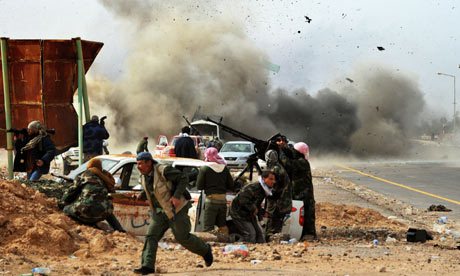
A tank shell explodes outside Ras Lanuf
Nicholas Kristof made “the case for a no-fly zone” today:
“This is a pretty easy problem, for crying out loud.”
For all the hand-wringing in Washington about a no-fly zone over Libya, that’s the verdict of Gen. Merrill McPeak, a former Air Force chief of staff. He flew more than 6,000 hours, half in fighter aircraft, and helped oversee no-fly zones in Iraq and the Adriatic, and he’s currently mystified by what he calls the “wailing and gnashing of teeth” about imposing such a zone on Libya.
“I can’t imagine an easier military problem,” he said. “If we can’t impose a no-fly zone over a not even third-rate military power like Libya, then we ought to take a hell of a lot of our military budget and spend it on something usable.”
He continued: “Just flying a few jets across the top of the friendlies would probably be enough to ground the Libyan Air Force, which is the objective.” …. “If we can’t do this, what can we do?” he asked, adding: “I think it would have a real impact. It might change their calculation of who might come out on top. Just the mere announcement of this might have an impact.”
I guess the problem is that we have an inexperienced, indecisive Commander-in-Chief who is waiting for his aides to tell him what to do. As our President dithers and NATO “squabbles” Gaddafi is succeeding in crushing the courageous, ragtag opposition fighters.
The Year of Wishful Thinking
Posted: March 2, 2011 Filed under: Barack Obama, Democratic Politics, Domestic Policy, Hillary Clinton, U.S. Economy, U.S. Politics | Tags: 2008 Democratic primaries, Bush years, economy, Great Depression, jobs, Republican crazies, Ruth Marcus, tax cuts 39 CommentsI’m not one to look back to the past. I definitely am not one to obsess on the past. It’s possible that my  Buddhist training keeps me rooted in the pragmatic present. It’s likely that it had something to do with my bout with inoperable and deadly cancer. It took me at least five years to think beyond about one month. I completely lost my ability to project ahead during that time. While I have regained my foresight and I have an appreciation for hindsight, I’m still not one to rehash what coulda, shoulda, woulda been. However, Ruth Marcus shoved my thoughts back to the year of wishful thinking.
It was about 3 years ago when I started to realize who the only credible Democratic candidate was for the post-Dubya years. I came to that after listening to about three primary debates and reading a lot of background material. I was tempted by the lot of them but I always found it odd that the first one I discounted as more vice presidential material than presidential material given his appalling performance in the first primary debate wound up with the top job. The world keeps spinning on. We now have so many crazies in the Republican party that it’s a wonder they all don’t walk through the statehouse with a set of visible knuckles dragging the floor. The economy isn’t creating enough jobs to sustain us and we have people advocating the same kinds of policy that caused the great depression now. One of the worst ones wants to repeat the 20’s era Fed’s mistakes and is in charge of the House oversight committee on the Fed. Then, we have irresponsible tax cuts while running two wars. And THAT’s just a few of the economic policies ruling topsy turvy land these days.
So, again, my chagrin and thoughts were peaked by this Ruth Marcus Op Ed piece. So, I had to look back to read now and look forward.
For a man who won office talking about change we can believe in, Barack Obama can be a strangely passive president. There are a startling number of occasions in which the president has been missing in action – unwilling, reluctant or late to weigh in on the issue of the moment. He is, too often, more reactive than inspirational, more cautious than forceful.
Each of these instances can be explained on its own terms, as matters of legislative strategy, geopolitical calculation or political prudence.
He didn’t want to get mired in legislative details during the health-care debate for fear of repeating the Clinton administration’s prescriptive, take-ours-or-leave-it approach. He doesn’t want to go first on proposing entitlement reform because history teaches that this is not the best route to a deal. He didn’t want to say anything too tough about Libya for fear of endangering Americans trapped there. He didn’t want to weigh in on the labor battle in Wisconsin because, well, it’s a swing state.
Yet the dots connect to form an unsettling portrait of a “Where’s Waldo?” presidency: You frequently have to squint to find the White House amid the larger landscape.
This tough assessment from someone who generally shares the president’s ideological perspective may be hard to square with the conservative portrait of Obama as the rapacious perpetrator of a big-government agenda.
Then, read on, the rationalizations are still there but we finally get back to the punchline: “Where’s Obama? No matter how hard you look, sometimes he’s impossible to find.” I’d just like to say that any one with an impressive career of voting present so many times, who was known to hide out in bathrooms during the tough votes, spent his entire senate career campaigning and not voting, and only introduced minor legislation into the Chicago legislature after it was carefully crafted by others already had shown his brand of leadership. How a standing record that was way out of its way in proving “he who hesitates is lost” got translated into national ‘hope and change’ by so many people will be something I will ask myself whenever books come out with themes similar to Marcus’ WAPO musings. Past performance is usually an indicator of future performance. Next time, check your data. That is all. Back to the present for me.

 peej
peej Carissa
 bostonboomer
 dakinikat
 ecocatwoman
 mablue2
 Mama Lopez
 peggysue22
 quixote
 skydancingguestblogger
 Mona (aka Wonk the Vote)



 Sky Dancing
Recent Comments